
The Effects of Chatbot Characteristics on Satisfaction and Continuance Intention: The Moderating Role of the Need for Human Interaction †


Abstract
1. Introduction
2. Theoretical Background and Hypothesis Development
2.1. Expectation–Confirmation Model
2.2. Hypothesis Development
2.2.1. Perceived Intelligence
2.2.2. Perceived Anthropomorphism
2.2.3. Expectation–Confirmation
2.2.4. Perceived Usefulness and Perceived Enjoyment
2.2.5. Satisfaction
2.2.6. The Moderating Role of the Need for Interaction with a Service Employee
3. Method
3.1. Pretest and Pilot Study
3.2. Sample and Data Collection
3.3. Procedure and Measures
3.4. Measures
3.5. Data Analysis Method
4. Research Findings
4.1. Demographic Characteristics of the Participants
4.2. Common Method Bias
4.3. Evaluation/Assessment of the Measurement Model
4.4. Evaluation of the Structural Model
5. Discussion and Conclusions
5.1. Theoretical Contributions
5.2. Managerial Implications
5.3. Limitations and Future Research
6. Conclusions
Author Contributions
Funding
Institutional Review Board Statement
Informed Consent Statement
Data Availability Statement
Conflicts of Interest
References
- Bhatnagr, P.; Rajesh, A. Artificial Intelligence Features and Expectation Confirmation Theory in Digital Banking Apps: Gen Y and Z Perspective. Manag. Decis. 2024, 63, 3642–3675. [Google Scholar] [CrossRef] [Scilit]
- Le, X.C.; Nguyen, T.H. The Effects of Chatbot Characteristics and Customer Experience on Satisfaction and Continuance Intention toward Banking Chatbots: Data from Vietnam. Data Brief 2024, 52, 110025. [Google Scholar] [CrossRef] [Scilit]
- Statista Digital Banks—Worldwide. Available online: https://www.statista.com/outlook/fmo/banking/digital-banks/worldwide (accessed on 6 March 2025).
- Juniper Research. Over Half of Global Population to Use Digital Banking in 2026. Available online: https://www.juniperresearch.com/press/over-half-global-population-digital-banking/ (accessed on 6 March 2025).
- Jang, M.; Jung, Y.; Kim, S. Investigating Managers’ Understanding of Chatbots in the Korean Financial Industry. Comput. Hum. Behav. 2021, 120, 106747. [Google Scholar] [CrossRef] [Scilit]
- Lee, J.C.; Tang, Y.; Jiang, S. Understanding Continuance Intention of Artificial Intelligence (AI)-Enabled Mobile Banking Applications: An Extension of AI Characteristics to an Expectation Confirmation Model. Humanit. Soc. Sci. Commun. 2023, 10, 333. [Google Scholar] [CrossRef] [Scilit]
- Serifat, O.A.; Igah, R.C.; Balogun, K.M.; Mensah, G.R.; Odai, E.N. AI-Driven Fraud Detection in Digital Banking: ML Approach for Secure and Transparent Financial Transactions. Am. J. Financ. Technol. Innov. 2025, 3, 177–187. [Google Scholar] [CrossRef] [Scilit]
- Ryman-Tubb, N.; Krause, P.; Garn, W. How Artificial Intelligence and Machine Learning Research Impacts Payment Card Fraud Detection: A Survey and Industry Benchmark. Eng. Appl. Artif. Intell. 2018, 76, 130–157. [Google Scholar] [CrossRef] [Scilit]
- Huang, M.-H.; Rust, R.T. Engaged to a Robot? The Role of AI in Service. J. Serv. Res. 2021, 24, 30–41. [Google Scholar] [CrossRef] [Scilit]
- Rodríguez-Espíndola, O.; Chowdhury, S.; Dey, P.K.; Albores, P.; Emrouznejad, A. Analysis of the Adoption of Emergent Technologies for Risk Management in the Era of Digital Manufacturing. Technol. Forecast. Soc. Change 2022, 178, 121562. [Google Scholar] [CrossRef] [Scilit]
- Ashrafuzzaman, M.; Parveen, R.; Sumiya, M.A.; Rahman, A. AI-Powered Personalization in Digital Banking: A Review of Customer Behavior Analytics and Engagement. Am. J. Interdiscip. Stud. 2025, 6, 40–71. [Google Scholar] [CrossRef] [Scilit]
- Ikhsan, R.B.; Fernando, Y.; Prabowo, H.; Gui, A.; Kuncoro, E.A. An Empirical Study on the Use of Artificial Intelligence in the Banking Sector of Indonesia by Extending the TAM Model and the Moderating Effect of Perceived Trust. Digit. Bus. 2025, 5, 100103. [Google Scholar] [CrossRef] [Scilit]
- Osuma, G.; Nzimande, N. Disaggregated Effects of Artificial Intelligence, Online and Mobile Banking on Customer Satisfaction in Banks: An Analysis Using Structural Equation Modelling. J. Infrastruct. Policy Dev. 2024, 8, 9941. [Google Scholar] [CrossRef] [Scilit]
- Schrank, J. The Impact of Artificial Intelligence on Behavioral Intentions to Use Mobile Banking in the Post-COVID-19 Era. Front. Artif. Intell. 2025, 8, 1649392. [Google Scholar] [CrossRef] [Scilit]
- Venkatesh, V.; Thong, J.Y.L.; Xu, X. Consumer Acceptance and Use of Information Technology: Extending the Unified Theory of Acceptance and Use of Technology. MIS Q. 2012, 36, 157–178. [Google Scholar] [CrossRef] [Scilit]
- Teepapal, T. AI-Driven Personalization: Unraveling Consumer Perceptions in Social Media Engagement. Comput. Hum. Behav. 2025, 165, 108549. [Google Scholar] [CrossRef] [Scilit]
- Reddy, J.K.; Syed, W.K.; Mohammed, A.; Jiwani, N.; Kiruthiga, T. AI-Based Behavioral Biometrics for Enhanced Authentication in Mobile Banking. In Proceedings of the 2025 3rd International Conference on Intelligent Cyber Physical Systems and Internet of Things (ICoICI), Coimbatore, India, 17–19 September 2025; IEEE: New York, NY, USA, 2025; pp. 595–599. [Google Scholar] [CrossRef] [Scilit]
- Kuraku, C.; Gollangi, H.K. Biometric Authentication in Digital Payments: Utilizing AI and Big Data for Real-Time Security and Efficiency. Educ. Adm. Theory Pract. 2020, 26, 954–964. [Google Scholar] [CrossRef] [Scilit]
- Azhari, S.C.; Permatasari, A.; Angelus, M. Implementation of Biometric Technology in Indonesian Mobile Banking: A TAM Perspective on Enhancing Transaction Security and Enjoyment. In Proceedings of the 2025 International Conference on Inventive Computation Technologies (ICICT), Kirtipur, Nepal, 23–25 April 2025; IEEE: New York, NY, USA, 2025; pp. 152–158. [Google Scholar] [CrossRef] [Scilit]
- Guo, Y.; Waked, H.N. Trust-Mediated Adoption of AI Robo-Advisors in Inland China: An Extended UTAUT Perspective. J. Financ. Serv. Mark. 2026, 31, 11. [Google Scholar] [CrossRef] [Scilit]
- Manser Payne, E.; Peltier, J.W.; Barger, V.A. Mobile Banking and AI-Enabled Mobile Banking: The Differential Effects of Technological and Non-Technological Factors on Digital Natives’ Perceptions and Behavior. J. Res. Interact. Mark. 2018, 12, 328–346. [Google Scholar] [CrossRef] [Scilit]
- Vieras, B.; Mark, D.; John, A.; Martin, T. The Impact of Real-Time Financial Fraud Detection on Financial Institutions’ Reputation and Customer Trust. 2025. Available online: https://www.researchgate.net/publication/388068563 (accessed on 31 March 2026).
- Kapale, R.; Deshpande, P.; Shukla, S.; Kediya, S.; Pethe, Y.; Metre, S. Explainable AI for Fraud Detection: Enhancing Transparency and Trust in Financial Decision-Making. In Proceedings of the 2024 2nd DMIHER International Conference on Artificial Intelligence in Healthcare, Education and Industry (IDICAIEI), Wardha, India, 29–30 November 2024; IEEE: New York, NY, USA, 2024; pp. 1–6. [Google Scholar] [CrossRef] [Scilit]
- Mollik, E.; Majeed, F. AI-Driven Cybersecurity in Mobile Financial Services: Enhancing Fraud Detection and Privacy in Emerging Markets. J. Cybersecur. Priv. 2025, 5, 77. [Google Scholar] [CrossRef] [Scilit]
- Gefen, D.; Karahanna, E.; Straub, D.W. Trust and TAM in Online Shopping: An Integrated Model. MIS Q. 2003, 27, 51–90. [Google Scholar] [CrossRef] [Scilit]
- Bojd, B.; Garimella, A.; Yin, H. Stigma Reduces AI Aversion: A Tradeoff Between Judgment and Misinformation Concerns; SSRN: Rochester, NY, USA, 2025. [Google Scholar] [CrossRef] [Scilit]
- Croes, E.A.; Antheunis, M.L.; Van Der Lee, C.; De Wit, J.M. Digital Confessions: The Willingness to Disclose Intimate Information to a Chatbot and Its Impact on Emotional Well-Being. Interact. Comput. 2024, 36, 279–292. [Google Scholar] [CrossRef] [Scilit]
- Lee, J.C.; Chen, X. Exploring Users’ Adoption Intentions in the Evolution of Artificial Intelligence Mobile Banking Applications: The Intelligent and Anthropomorphic Perspectives. Int. J. Bank Mark. 2022, 40, 631–658. [Google Scholar] [CrossRef] [Scilit]
- Sundjaja, A.M.; Utomo, P.; Colline, F. The Determinant Factors of Continuance Use of Customer Service Chatbot in Indonesia E-Commerce: Extended Expectation Confirmation Theory. J. Sci. Technol. Policy Manag. 2025, 16, 182–203. [Google Scholar] [CrossRef] [Scilit]
- Banerjee, S.; Sreejesh, S. Examining the Role of Customers’ Intrinsic Motivation on Continued Usage of Mobile Banking: A Relational Approach. Int. J. Bank Mark. 2022, 40, 87–109. [Google Scholar] [CrossRef] [Scilit]
- Lin, R.; Zheng, Y.X.; Lee, J.C. Artificial Intelligence-Based Pre-Implementation Interventions in Users’ Continuance Intention to Use Mobile Banking. Int. J. Mob. Commun. 2023, 21, 518–540. [Google Scholar] [CrossRef] [Scilit]
- Venkatesh, V.; Morris, M.G.; Davis, G.B.; Davis, F.D. User Acceptance of Information Technology: Toward a Unified View. MIS Q. 2003, 27, 425–478. [Google Scholar] [CrossRef] [Scilit]
- Belanche, D.; Casaló, L.V.; Flavián, C. Artificial Intelligence in FinTech: Understanding Robo-Advisors Adoption among Customers. Ind. Manag. Data Syst. 2019, 119, 1411–1430. [Google Scholar] [CrossRef] [Scilit]
- Lappeman, J.; Marlie, S.; Johnson, T.; Poggenpoel, S. Trust and Digital Privacy: Willingness to Disclose Personal Information to Banking Chatbot Services. J. Financ. Serv. Mark. 2022, 28, 337–352. [Google Scholar] [CrossRef] [Scilit]
- Luo, X.; Tong, S.; Fang, Z.; Qu, Z. Machines vs. Humans: The Impact of Artificial Intelligence Chatbot Disclosure on Customer Purchases. Mark. Sci. 2019, 38, 937–947. [Google Scholar] [CrossRef] [Scilit]
- Davis, F.D. Perceived Usefulness, Perceived Ease of Use, and User Acceptance of Information Technology. MIS Q. 1989, 13, 319–340. [Google Scholar] [CrossRef] [Scilit]
- Bhattacherjee, A. Understanding Information Systems Continuance: An Expectation-Confirmation Model. MIS Q. 2001, 25, 351–370. [Google Scholar] [CrossRef] [Scilit]
- Cho, J. The Impact of Post-Adoption Beliefs on the Continued Use of Health Apps. Int. J. Med. Inform. 2016, 87, 75–83. [Google Scholar] [CrossRef] [Scilit] [PubMed]
- Huang, A.; Ozturk, A.B.; Zhang, T.; de la Mora Velasco, E.; Haney, A. Unpacking AI for Hospitality and Tourism Services: Exploring the Role of Perceived Enjoyment on Future Use Intentions. Int. J. Hosp. Manag. 2024, 119, 103693. [Google Scholar] [CrossRef] [Scilit]
- Oghuma, A.P.; Libaque-Saenz, C.F.; Wong, S.F.; Chang, Y. An Expectation-Confirmation Model of Continuance Intention to Use Mobile Instant Messaging. Telemat. Inform. 2016, 33, 34–47. [Google Scholar] [CrossRef] [Scilit]
- Balakrishnan, J.; Abed, S.S.; Jones, P. The Role of Meta-UTAUT Factors, Perceived Anthropomorphism, Perceived Intelligence, and Social Self-Efficacy in Chatbot-Based Services. Technol. Forecast. Soc. Change 2022, 180, 121692. [Google Scholar] [CrossRef] [Scilit]
- Bhatnagr, P.; Rajesh, A.; Misra, R. Continuous Intention Usage of Artificial Intelligence Enabled Digital Banks: A Review of Expectation Confirmation Model. J. Enterp. Inf. Manag. 2024, 37, 1763–1787. [Google Scholar] [CrossRef] [Scilit]
- Moussawi, S.; Koufaris, M. Perceived Intelligence and Perceived Anthropomorphism of Personal Intelligent Agents: Scale Development and Validation. In Proceedings of the 52nd Hawaii International Conference on System Sciences, Maui, HI, USA, 8–11 January 2019. [Google Scholar] [CrossRef] [Scilit]
- Ashfaq, M.; Yun, J.; Yu, S.; Loureiro, S.M.C. I, Chatbot: Modeling the Determinants of Users’ Satisfaction and Continuance Intention of AI-Powered Service Agents. Telemat. Inform. 2020, 54, 101473. [Google Scholar] [CrossRef] [Scilit]
- Katana 1 in 2 Customers Prefer a Real Human over an AI Chatbot when Chatting Online. Available online: https://katanamrp.com/blog/customers-prefer-a-real-human-over-an-ai-chatbot/ (accessed on 6 March 2025).
- Dabholkar, P.A.; Bagozzi, R.P. An Attitudinal Model of Technology-Based Self-Service: Moderating Effects of Consumer Traits and Situational Factors. J. Acad. Mark. Sci. 2002, 30, 184–201. [Google Scholar] [CrossRef] [Scilit]
- Demoulin, N.T.M.; Djelassi, S. An Integrated Model of Self-Service Technology (SST) Usage in a Retail Context. Int. J. Retail Distrib. Manag. 2016, 44, 540–559. [Google Scholar] [CrossRef] [Scilit]
- Dabholkar, P.A. Consumer Evaluations of New Technology-Based Self-Service Options: An Investigation of Alternative Models of Service Quality. Int. J. Res. Mark. 1996, 13, 29–51. [Google Scholar] [CrossRef] [Scilit]
- Evanschitzky, H.; Iyer, G.R.; Pillai, K.G.; Kenning, P.; Schütte, R. Consumer Trial, Continuous Use, and Economic Benefits of a Retail Service Innovation: The Case of the Personal Shopping Assistant. J. Prod. Innov. Manag. 2015, 32, 459–475. [Google Scholar] [CrossRef] [Scilit]
- Pereira, T.; Limberger, P.F.; Ardigó, C.M. The Moderating Effect of the Need for Interaction with a Service Employee on Purchase Intention in Chatbots. Telemat. Inform. Rep. 2021, 1, 100003. [Google Scholar] [CrossRef] [Scilit]
- Meuter, M.L.; Ostrom, A.L.; Roundtree, R.I.; Bitner, M.J. Self-Service Technologies: Understanding Customer Satisfaction with Technology-Based Service Encounters. J. Mark. 2000, 64, 50–64. [Google Scholar] [CrossRef] [Scilit]
- Oliver, R.L. A Cognitive Model for the Antecedents and Consequences of Satisfaction. J. Mark. Res. 1980, 17, 460–469. [Google Scholar] [CrossRef] [Scilit]
- Castillo, D.; Farrugia Caruana, L. Unveiling Customer Expectations of Chatbot Interactions: A Systematic Literature Review and Research Agenda. Int. J. Hum.-Comput. Interact. 2025, 1–28. [Google Scholar] [CrossRef] [Scilit]
- Venkatesh, V.; Davis, F.D. A Theoretical Extension of the Technology Acceptance Model: Four Longitudinal Field Studies. Manag. Sci. 2000, 46, 186–204. [Google Scholar] [CrossRef] [Scilit]
- Kang, Y.S.; Hong, S.; Lee, H. Exploring Continued Online Service Usage Behavior: The Roles of Self-Image Congruity and Regret. Comput. Hum. Behav. 2009, 25, 111–122. [Google Scholar] [CrossRef] [Scilit]
- Thong, J.Y.L.; Hong, S.J.; Tam, K.Y. The Effects of Post-Adoption Beliefs on the Expectation-Confirmation Model for Information Technology Continuance. Int. J. Hum.-Comput. Stud. 2006, 64, 799–810. [Google Scholar] [CrossRef] [Scilit]
- van der Heijden, H. User Acceptance of Hedonic Information Systems. MIS Q. 2004, 28, 695–704. [Google Scholar] [CrossRef] [Scilit]
- Wang, M.C. Determinants and Consequences of Consumer Satisfaction with Self-Service Technology in a Retail Setting. Manag. Serv. Qual. 2012, 22, 128–144. [Google Scholar] [CrossRef] [Scilit]
- Davis, F.D.; Bagozzi, R.P.; Warshaw, P.R. Extrinsic and Intrinsic Motivation to Use Computers in the Workplace. J. Appl. Soc. Psychol. 1992, 22, 1111–1132. [Google Scholar] [CrossRef] [Scilit]
- Locke, E.A. The Nature and Causes of Job Satisfaction. In Handbook of Industrial and Organizational Psychology; Dunnette, M.D., Ed.; Holt, Rinehart & Winston: New York, NY, USA, 1976; pp. 1297–1349. [Google Scholar]
- Oliver, R.L. Whence Consumer Loyalty? J. Mark. 1999, 63, 33–44. [Google Scholar] [CrossRef] [Scilit]
- Cheng, X.; Bao, Y.; Zarifis, A.; Gong, W.; Mou, J. Exploring Consumers’ Response to Text-Based Chatbots in E-Commerce: The Moderating Role of Task Complexity and Chatbot Disclosure. Internet Res. 2022, 32, 496–517. [Google Scholar] [CrossRef] [Scilit]
- Ruan, Y.; Mezei, J. When Do AI Chatbots Lead to Higher Customer Satisfaction than Human Frontline Employees in Online Shopping Assistance? Considering Product Attribute Type. J. Retail. Consum. Serv. 2022, 68, 103059. [Google Scholar] [CrossRef] [Scilit]
- Choi, Y.S.; Lee, S.Z.; Choi, J. A Study on Factors Influencing Continuous Usage Intention of Chatbot Services in South Korean Financial Institutions. Int. J. Financ. Stud. 2025, 13, 56. [Google Scholar] [CrossRef] [Scilit]
- Gurung, D.; Parajuli, P. Impact of Chatbot in Operational Efficiency in Banking Sector in Nepal. LBEF Res. J. Sci. Technol. Manag. 2024, 6, 82–105. [Google Scholar]
- Habib, A.; Pramana, E.; Junaedi, H.; Ronando, E. Extending the Expectation Confirmation Model to Examine Continuous Use of Mobile Banking: Security, Trust, and Convenience. INTENSIF J. Ilm. Penelit. Penerapan Teknol. Sist. Inf. 2025, 9, 76–96. [Google Scholar] [CrossRef] [Scilit]
- Mehrolia, S.; Alagarsamy, S.; Moorthy, V.; Jeevananda, S. Will Users Continue Using Banking Chatbots? The Moderating Role of Perceived Risk. FIIB Bus. Rev. 2023, 1–19. [Google Scholar] [CrossRef] [Scilit]
- Misra, R.; Malik, G.; Singh, P. A Localized and Humanized Approach to Chatbot Banking Companions: Implications for Financial Managers. Manag. Decis. 2025, 63, 3756–3785. [Google Scholar] [CrossRef] [Scilit]
- Tam, C.; Santos, D.; Oliveira, T. Exploring the Influential Factors of Continuance Intention to Use Mobile Apps: Extending the Expectation Confirmation Model. Inf. Syst. Front. 2020, 22, 243–257. [Google Scholar] [CrossRef] [Scilit]
- Lin, R.R.; Lee, J.C. The Supports Provided by Artificial Intelligence to Continuous Usage Intention of Mobile Banking: Evidence from China. Aslib J. Inf. Manag. 2024, 76, 293–310. [Google Scholar] [CrossRef] [Scilit]
- Mpinganjira, M.; Dlodlo, N.; Idemudia, E.C. Perceived Experiential Value and Continued Use Intention of E-Retail Chatbots. Int. J. Retail Distrib. Manag. 2024, 52, 121–135. [Google Scholar] [CrossRef] [Scilit]
- Song, X.; Gu, H.; Li, Y.; Leung, X.Y.; Ling, X. The Influence of Robot Anthropomorphism and Perceived Intelligence on Hotel Guests’ Continuance Usage Intention. Inf. Technol. Tour. 2024, 26, 89–117. [Google Scholar] [CrossRef] [Scilit]
- Priya, B.; Sharma, V. Exploring Users’ Adoption Intentions of Intelligent Virtual Assistants in Financial Services: Anthropomorphic and Socio-Psychological Perspectives. Comput. Hum. Behav. 2023, 148, 107912. [Google Scholar] [CrossRef] [Scilit]
- Crolic, C.; Thomaz, F.; Hadi, R.; Stephen, A.T. Blame the Bot: Anthropomorphism and Anger in Customer–Chatbot Interactions. J. Mark. 2022, 86, 132–148. [Google Scholar] [CrossRef] [Scilit]
- Xi, Y.; Ji, A.; Yu, W. Enhancing or Impeding? Exploring the Dual Impact of Anthropomorphism in Large Language Models on User Aggression. Telemat. Inform. 2024, 95, 102194. [Google Scholar] [CrossRef] [Scilit]
- Mulcahy, R.F.; Riedel, A.; Keating, B.; Beatson, A.; Letheren, K. Avoiding Excessive AI Service Agent Anthropomorphism: Examining Its Role in Delivering Bad News. J. Serv. Theory Pract. 2023, 34, 98–126. [Google Scholar] [CrossRef] [Scilit]
- Belk, R.W. Understanding the Robot: Comments on Goudey and Bonnin (2016). Rech. Appl. Mark. (Engl. Ed.) 2016, 31, 83–90. [Google Scholar] [CrossRef] [Scilit]
- Sheehan, B.; Jin, H.S.; Gottlieb, U. Customer Service Chatbots: Anthropomorphism and Adoption. J. Bus. Res. 2020, 115, 14–24. [Google Scholar] [CrossRef] [Scilit]
- Cai, D.; Li, H.; Law, R. Anthropomorphism and OTA Chatbot Adoption: A Mixed Methods Study. J. Travel Tour. Mark. 2022, 39, 228–255. [Google Scholar] [CrossRef] [Scilit]
- Moussawi, S.; Koufaris, M.; Benbunan-Fich, R. How Perceptions of Intelligence and Anthropomorphism Affect Adoption of Personal Intelligent Agents. Electron. Mark. 2021, 31, 343–364. [Google Scholar] [CrossRef] [Scilit]
- Qiu, L.; Benbasat, I. Online Consumer Trust and Live Help Interfaces: The Effects of Text-to-Speech Voice and Three-Dimensional Avatars. Int. J. Hum.-Comput. Interact. 2005, 19, 75–94. [Google Scholar] [CrossRef] [Scilit]
- van Pinxteren, M.M.E.; Wetzels, R.W.H.; Rüger, J.; Pluymaekers, M.; Wetzels, M. Trust in Humanoid Robots: Implications for Services Marketing. J. Serv. Mark. 2019, 33, 507–518. [Google Scholar] [CrossRef] [Scilit]
- Wang, P.; Kwon, S.; Zhang, W. A Study on the Effect of Anthropomorphism, Intelligence, and Autonomy of IPAs on Continuous Usage Intention: From the Perspective of Bi-Dimensional Value. Asia Pac. J. Inf. Syst. 2022, 32, 125–150. [Google Scholar] [CrossRef] [Scilit]
- Kim, B.; de Visser, E.; Phillips, E. Two Uncanny Valleys: Re-Evaluating the Uncanny Valley across the Full Spectrum of Real-World Human-Like Robots. Comput. Hum. Behav. 2022, 135, 107340. [Google Scholar] [CrossRef] [Scilit]
- Mori, M.; MacDorman, K.F.; Kageki, N. The Uncanny Valley [From the Field]. IEEE Robot. Autom. Mag. 2012, 19, 98–100. [Google Scholar] [CrossRef] [Scilit]
- Waytz, A.; Cacioppo, J.T.; Epley, N. Who Sees Human? The Stability and Importance of Individual Differences in Anthropomorphism. Perspect. Psychol. Sci. 2010, 5, 219–232. [Google Scholar] [CrossRef] [Scilit]
- Epley, N.; Waytz, A.; Cacioppo, J.T. On Seeing Human: A Three-Factor Theory of Anthropomorphism. Psychol. Rev. 2007, 114, 864–886. [Google Scholar] [CrossRef] [Scilit]
- Yuan, S.; Liu, Y.; Yao, R.; Liu, J. An Investigation of Users’ Continuance Intention towards Mobile Banking in China. Inf. Dev. 2016, 32, 20–34. [Google Scholar] [CrossRef] [Scilit]
- Ayyoub, A.A.M.; Eidah, B.A.A.; Khlaif, Z.N.; El-Shamali, M.A.; Sulaiman, M.R. Understanding Online Assessment Continuance Intention and Individual Performance by Integrating Task–Technology Fit and Expectancy Confirmation Theory. Heliyon 2023, 9, e21325. [Google Scholar] [CrossRef] [Scilit]
- Cheng, Y.M. Which Quality Determinants Cause MOOCs Continuance Intention? A Hybrid Extending the Expectation-Confirmation Model with Learning Engagement and Information Systems Success. Libr. Hi Tech 2023, 41, 1748–1780. [Google Scholar] [CrossRef] [Scilit]
- Hidayat-Ur-Rehman, I.; Ahmad, A.; Khan, M.N.; Mokhtar, S.A. Investigating Mobile Banking Continuance Intention: A Mixed-Methods Approach. Mob. Inf. Syst. 2021, 2021, 9994990. [Google Scholar] [CrossRef] [Scilit]
- Jia, J.; Chen, L.; Zhang, L.; Xiao, M.; Wu, C. A Study on the Factors That Influence Consumers’ Continuance Intention to Use Artificial Intelligence Chatbots in a Pharmaceutical E-Commerce Context. Electron. Libr. 2025, 43, 303–321. [Google Scholar] [CrossRef] [Scilit]
- Kumar, R.R.; Israel, D.; Malik, G. Explaining Customer’s Continuance Intention to Use Mobile Banking Apps with an Integrative Perspective of Expectation–Confirmation Theory and Self-Determination Theory. Pac. Asia J. Assoc. Inf. Syst. 2018, 10, 5. [Google Scholar]
- Li, L.; Wang, Q.; Li, J. Examining Continuance Intention of Online Learning during COVID-19 Pandemic: Incorporating the Theory of Planned Behavior into the Expectation–Confirmation Model. Front. Psychol. 2022, 13, 1046407. [Google Scholar] [CrossRef] [Scilit]
- Nguyen, D.M.; Chiu, Y.T.H.; Le, H.D. Determinants of Continuance Intention towards Banks’ Chatbot Services in Vietnam: A Necessity for Sustainable Development. Sustainability 2021, 13, 7625. [Google Scholar] [CrossRef] [Scilit]
- Park, E. User Acceptance of Smart Wearable Devices: An Expectation–Confirmation Model Approach. Telemat. Inform. 2020, 47, 101318. [Google Scholar] [CrossRef] [Scilit]
- Huang, F.; Liu, S. If I Enjoy, I Continue: The Mediating Effects of Perceived Usefulness and Perceived Enjoyment in Continuance of Asynchronous Online English Learning. Educ. Sci. 2024, 14, 880. [Google Scholar] [CrossRef] [Scilit]
- Shiau, W.L.; Luo, M.M. Continuance Intention of Blog Users: The Impact of Perceived Enjoyment, Habit, User Involvement and Blogging Time. Behav. Inf. Technol. 2013, 32, 570–583. [Google Scholar] [CrossRef] [Scilit]
- Sinha, N.; Singh, N. Revisiting Expectation Confirmation Model to Measure the Effectiveness of Multichannel Bank Services for Elderly Consumers. Int. J. Emerg. Mark. 2023, 18, 4457–4480. [Google Scholar] [CrossRef] [Scilit]
- Bhattacherjee, A.; Barfar, A. Information Technology Continuance Research: Current State and Future Directions. Asia Pac. J. Inf. Syst. 2011, 21, 1–18. [Google Scholar]
- Tang, Y.; Jiang, S.; Lee, J.C. Continuous Usage Intention of Artificial Intelligence (AI)-Enabled Mobile Banking: A Preliminary Study. In Proceedings of the 2022 2nd International Conference on Economic Development and Business Culture (ICEDBC 2022), Dali, China, 31 December 2022; Atlantis Press: Paris, France, 2022; pp. 135–139. [Google Scholar] [CrossRef] [Scilit]
- Alnaser, F.M.; Rahi, S.; Alghizzawi, M.; Ngah, A.H. Does Artificial Intelligence (AI) Boost Digital Banking User Satisfaction? Integration of Expectation Confirmation Model and Antecedents of Artificial Intelligence Enabled Digital Banking. Heliyon 2023, 9, e18930. [Google Scholar] [CrossRef] [Scilit]
- Franque, F.B.; Oliveira, T.; Tam, C.; Santini, F.D.O. A Meta-Analysis of the Quantitative Studies in Continuance Intention to Use an Information System. Internet Res. 2021, 31, 123–158. [Google Scholar] [CrossRef] [Scilit]
- Alsharo, M.; Khwaileh, J.; Al-Essa, M. Examining Consumers’ Continuance Intention to Use P2P Mobile Payment Systems: An Extended TPB Approach. J. Theor. Appl. Electron. Commer. Res. 2026, 21, 61. [Google Scholar] [CrossRef] [Scilit]
- Susanto, A.; Chang, Y.; Ha, Y. Determinants of Continuance Intention to Use the Smartphone Banking Services: An Extension to the Expectation-Confirmation Model. Ind. Manag. Data Syst. 2016, 116, 508–525. [Google Scholar] [CrossRef] [Scilit]
- Rahi, S.; Othman Mansour, M.M.; Alharafsheh, M.; Alghizzawi, M. The Post-Adoption Behavior of Internet Banking Users through the Eyes of Self-Determination Theory and Expectation Confirmation Model. J. Enterp. Inf. Manag. 2021, 34, 1874–1892. [Google Scholar] [CrossRef] [Scilit]
- Choi, Y.; Wen, H.; Chen, M.; Yang, F. Sustainable Determinants Influencing Habit Formation among Mobile Short-Video Platform Users. Sustainability 2021, 13, 3216. [Google Scholar] [CrossRef] [Scilit]
- Albashrawi, M.; Motiwalla, L. Privacy and Personalization in Continued Usage Intention of Mobile Banking: An Integrative Perspective. Inf. Syst. Front. 2019, 21, 1031–1043. [Google Scholar] [CrossRef] [Scilit]
- Sharma, S.K.; Sharma, M. Examining the Role of Trust and Quality Dimensions in the Actual Usage of Mobile Banking Services: An Empirical Investigation. Int. J. Inf. Manag. 2019, 44, 65–75. [Google Scholar] [CrossRef] [Scilit]
- Pereira, T.; Limberger, P.F.; Minasi, S.M.; Buhalis, D. New Insights into Consumers’ Intention to Continue Using Chatbots in the Tourism Context. J. Qual. Assur. Hosp. Tour. 2024, 25, 754–780. [Google Scholar] [CrossRef] [Scilit]
- Ghaniabadi, M. Factors That Impact Users’ Attitudes Toward Chatbots and Their Intentions to Use Chatbot in Online Services. Doctoral Dissertation, Vilniaus Universitetas, Vilnius, Lithuania, 2023. [Google Scholar]
- Moussawi, S.; Koufaris, M.; Benbunan-Fich, R. The Role of User Perceptions of Intelligence, Anthropomorphism, and Self-Extension on Continuance of Use of Personal Intelligent Agents. Eur. J. Inf. Syst. 2023, 32, 601–622. [Google Scholar] [CrossRef] [Scilit]
- Hair, J.F.; Hult, G.T.M.; Ringle, C.M.; Sarstedt, M. A Primer on Partial Least Squares Structural Equation Modeling (PLS-SEM), 2nd ed.; Sage Publications: Thousand Oaks, CA, USA, 2017. [Google Scholar]
- Shiau, W.L.; Yuan, Y.; Pu, X.; Ray, S.; Chen, C.C. Understanding Fintech Continuance: Perspectives from Self-Efficacy and ECT-IS Theories. Ind. Manag. Data Syst. 2020, 120, 1659–1689. [Google Scholar] [CrossRef] [Scilit]
- Hayes, A.F. Introduction to Mediation, Moderation, and Conditional Process Analysis: A Regression-Based Approach, 3rd ed.; The Guilford Press: New York, NY, USA, 2022. [Google Scholar]
- Podsakoff, P.M.; MacKenzie, S.B.; Lee, J.Y.; Podsakoff, N.P. Common Method Biases in Behavioral Research: A Critical Review of the Literature and Recommended Remedies. J. Appl. Psychol. 2003, 88, 879–903. [Google Scholar] [CrossRef] [Scilit]
- Hair, J.F.; Black, W.C.; Babin, B.J.; Anderson, R.E. Multivariate Data Analysis; Pearson: New York, NY, USA, 2014. [Google Scholar]
- Henseler, J.; Hubona, G.; Ray, P.A. Using PLS Path Modeling in New Technology Research: Updated Guidelines. Ind. Manag. Data Syst. 2016, 116, 2–20. [Google Scholar] [CrossRef] [Scilit]
- Fornell, C.; Larcker, D.F. Evaluating Structural Equation Models with Unobservable Variables and Measurement Error. J. Mark. Res. 1981, 18, 39–50. [Google Scholar] [CrossRef] [Scilit]
- Vafaei-Zadeh, A.; Nikbin, D.; Loo, J.; Hanifah, H. Unlocking Generation Y’s Continuance Intentions in Personal Cloud Storage Services: An Extended Expectation Confirmation Model Analysis. Electron. Libr. 2024, 42, 827–847. [Google Scholar] [CrossRef] [Scilit]
- Mbama, C.I.; Ezepue, P.O. Digital Banking, Customer Experience and Bank Financial Performance: UK Customers’ Perceptions. Int. J. Bank Mark. 2018, 36, 230–255. [Google Scholar] [CrossRef] [Scilit]
- Chinmulgund, A.; Khatwani, R.; Tapas, P.; Shah, P.; Sekhar, R. Anthropomorphism of AI-Based Chatbots by Users during Communication. In Proceedings of the 2023 3rd International Conference on Intelligent Technologies (CONIT), Hubli, India, 23–25 June 2023; IEEE: New York, NY, USA, 2023; pp. 1–6. [Google Scholar] [CrossRef] [Scilit]
- Xu, Y.; Shieh, C.-H.; van Esch, P.; Ling, I.-L. AI Customer Service: Task Complexity, Problem-Solving Ability, and Usage Intention. Australas. Mark. J. 2020, 28, 189–199. [Google Scholar] [CrossRef] [Scilit]
- Xu, Y.; Zhang, J.; Deng, G. Enhancing Customer Satisfaction with Chatbots: The Influence of Communication Styles and Consumer Attachment Anxiety. Front. Psychol. 2022, 13, 902782. [Google Scholar] [CrossRef] [Scilit]
- Ng, M.; Coopamootoo, K.P.; Toreini, E.; Aitken, M.; Elliot, K.; van Moorsel, A. Simulating the Effects of Social Presence on Trust, Privacy Concerns and Usage Intentions in Automated Bots for Finance. In Proceedings of the 2020 IEEE European Symposium on Security and Privacy Workshops (EuroS&PW), Genoa, Italy, 7–11 September 2020; IEEE: New York, NY, USA, 2020; pp. 190–199. [Google Scholar] [CrossRef] [Scilit]
- McLean, G.; Osei-Frimpong, K. Chat Now… Examining the Variables Influencing the Use of Online Live Chat. Technol. Forecast. Soc. Change 2019, 146, 55–67. [Google Scholar] [CrossRef] [Scilit]
- Parasuraman, A. Technology Readiness Index (TRI): A Multiple-Item Scale to Measure Readiness to Embrace New Technologies. J. Serv. Res. 2000, 2, 307–320. [Google Scholar] [CrossRef] [Scilit]
- Silva, S.C.; De Cicco, R.; Vlačić, B.; Elmashhara, M.G. Using Chatbots in E-Retailing—How to Mitigate Perceived Risk and Enhance the Flow Experience. Int. J. Retail Distrib. Manag. 2023, 51, 285–305. [Google Scholar] [CrossRef] [Scilit]



| Observed Variables for Each Construct | Factor Load | Standard Error | t-Statistic Value | p-Value | Cronbach’s Alpha | Composite Reliability (CR) | Average Variance Extracted (AVE) | |
|---|---|---|---|---|---|---|---|---|
| Perceived Anthropomorphism | I feel that my interaction with the chatbot in the mobile banking application is similar to having a conversation with a real human being. | 0.867 | 0.012 | 7.018 | 0.000 | 0.907 | 0.911 | 0.782 |
| I perceive the chatbot in the mobile banking application as possessing human-like characteristics (e.g., happy, friendly, humorous, helpful). | 0.906 | 0.009 | 9.556 | 0.000 | ||||
| I feel that the chatbot in the mobile banking application behaves as if it has human-like characteristics (e.g., happy, friendly, humorous, helpful). | 0.912 | 0.007 | 9.523 | 0.000 | ||||
| I believe that my conversations with the chatbot in the mobile banking application are natural rather than artificial. | 0.850 | 0.015 | 8.431 | 0.000 | ||||
| Perceived Enjoyment | I believe that my interaction with the chatbot in the mobile banking application while using it is enjoyable. | 0.904 | 0.009 | 6.611 | 0.000 | 0.936 | 0.937 | 0.840 |
| I believe that my interaction with the chatbot in the mobile banking application while using it is interesting. | 0.899 | 0.010 | 8.204 | 0.000 | ||||
| I believe that my interaction with the chatbot in the mobile banking application while using it is entertaining. | 0.935 | 0.006 | 5.151 | 0.000 | ||||
| I believe that my interaction with the chatbot in the mobile banking application while using it is exciting. | 0.926 | 0.008 | 9.080 | 0.000 | ||||
| Perceived Usefulness | I find that performing my banking transactions using the chatbot in the mobile banking application helps me complete my transactions more quickly. | 0.902 | 0.010 | 9.063 | 0.000 | 0.948 | 0.949 | 0.793 |
| I find that performing my banking transactions using the chatbot in the mobile banking application enables me to meet my needs more quickly. | 0.903 | 0.010 | 9.917 | 0.000 | ||||
| I find that performing my banking transactions using the chatbot in the mobile banking application increases my productivity. | 0.896 | 0.010 | 9.300 | 0.000 | ||||
| I find that performing my banking transactions using the chatbot in the mobile banking application enhances my effectiveness. | 0.909 | 0.010 | 9.331 | 0.000 | ||||
| I find that performing my banking transactions using the chatbot in the mobile banking application increases my chances of accomplishing banking tasks that are important to me. | 0.839 | 0.021 | 9.305 | 0.000 | ||||
| I find that performing my banking transactions using the chatbot in the mobile banking application is generally useful. | 0.893 | 0.009 | 9.791 | 0.000 | ||||
| Satisfaction | I think that the chatbot in the mobile banking application being able to meet my personal needs makes me satisfied. | 0.931 | 0.006 | 6.744 | 0.000 | 0.954 | 0.955 | 0.879 |
| I am satisfied with the solution provided by the chatbot in the mobile banking application. | 0.950 | 0.005 | 5.426 | 0.000 | ||||
| I think that I am quite satisfied with my overall experience with the chatbot in the mobile banking application. | 0.942 | 0.006 | 7.404 | 0.000 | ||||
| I am satisfied with the implementation of the chatbot system in mobile banking applications. | 0.926 | 0.008 | 7.539 | 0.000 | ||||
| Continuance Intention/Intention | While performing my banking transactions, I think that I will continue to use the chatbot in mobile banking applications. | 0.930 | 0.009 | 8.746 | 0.000 | 0.967 | 0.968 | 0.883 |
| While performing my banking transactions, I plan to continue using the chatbot in mobile banking applications. | 0.940 | 0.005 | 8.950 | 0.000 | ||||
| While performing my banking transactions, I want to continue using the chatbot in mobile banking applications as much as possible. | 0.954 | 0.005 | 8.812 | 0.000 | ||||
| While performing my banking transactions, I think that I will continue using the chatbot in mobile banking applications rather than using any alternative tool (i.e., instead of using human personnel). | 0.927 | 0.006 | 8.504 | 0.000 | ||||
| While performing my banking transactions, I think that I will continue using the chatbot in mobile banking applications rather than stopping using it. | 0.945 | 0.005 | 9.166 | 0.000 | ||||
| Confirmation | I think that my experience of using the chatbot in mobile banking applications is better than I expected. | 0.964 | 0.004 | 5.334 | 0.000 | 0.959 | 0.960 | 0.825 |
| I think that the level of service provided by the chatbot in mobile banking applications is better than I expected. | 0.959 | 0.004 | 5.130 | 0.000 | ||||
| Overall, I think that most of my expectations regarding the use of the chatbot in mobile banking applications have been met. | 0.962 | 0.004 | 4.238 | 0.000 | ||||
| Perceived Intelligence | Perceived I think that the chatbot in the mobile banking application is able to understand my commands. | 0.886 | 0.010 | 5.668 | 0.000 | 0.954 | 0.955 | 0.793 |
| I think that the chatbot in the mobile banking application is able to communicate with me in a way that I can understand. | 0.868 | 0.018 | 4.100 | 0.000 | ||||
| I think that the chatbot in the mobile banking application is able to complete tasks quickly. | 0.901 | 0.008 | 5.582 | 0.000 | ||||
| I think that the chatbot in the mobile banking application is able to find the information necessary to complete its tasks. | 0.919 | 0.010 | 4.322 | 0.000 | ||||
| I think that the chatbot in the mobile banking application is able to process the information necessary to complete its tasks. | 0.849 | 0.012 | 6.157 | 0.000 | ||||
| I think that the chatbot in the mobile banking application is able to provide me with a useful response. | 0.918 | 0.007 | 3.366 | 0.000 |
| Perceived Anthropomorphism | Perceived Enjoyment | Perceived Usefulness | Satisfaction | Continuance Intention/Intention | Confirmation | Perceived Intelligence | |
|---|---|---|---|---|---|---|---|
| Perceived Anthropomorphism | 0.884 | ||||||
| Perceived Enjoyment | 0.611 | 0.916 | |||||
| Perceived Usefulness | 0.618 | 0.649 | 0.891 | ||||
| Satisfaction | 0.583 | 0.601 | 0.728 | 0.937 | |||
| Continuance Intention/Intention | 0.512 | 0.549 | 0.620 | 0.726 | 0.939 | ||
| Confirmation | 0.624 | 0.643 | 0.760 | 0.756 | 0.582 | 0.962 | |
| Perceived Intelligence | 0.470 | 0.503 | 0.635 | 0.743 | 0.684 | 0.621 | 0.891 |
| Hypotheses | Beta Coefficient | Standard Error | t-Statistic Value | p Value | F2 | R2 | VIF | Hypothesis Test Result | |
|---|---|---|---|---|---|---|---|---|---|
| Direct Effects | |||||||||
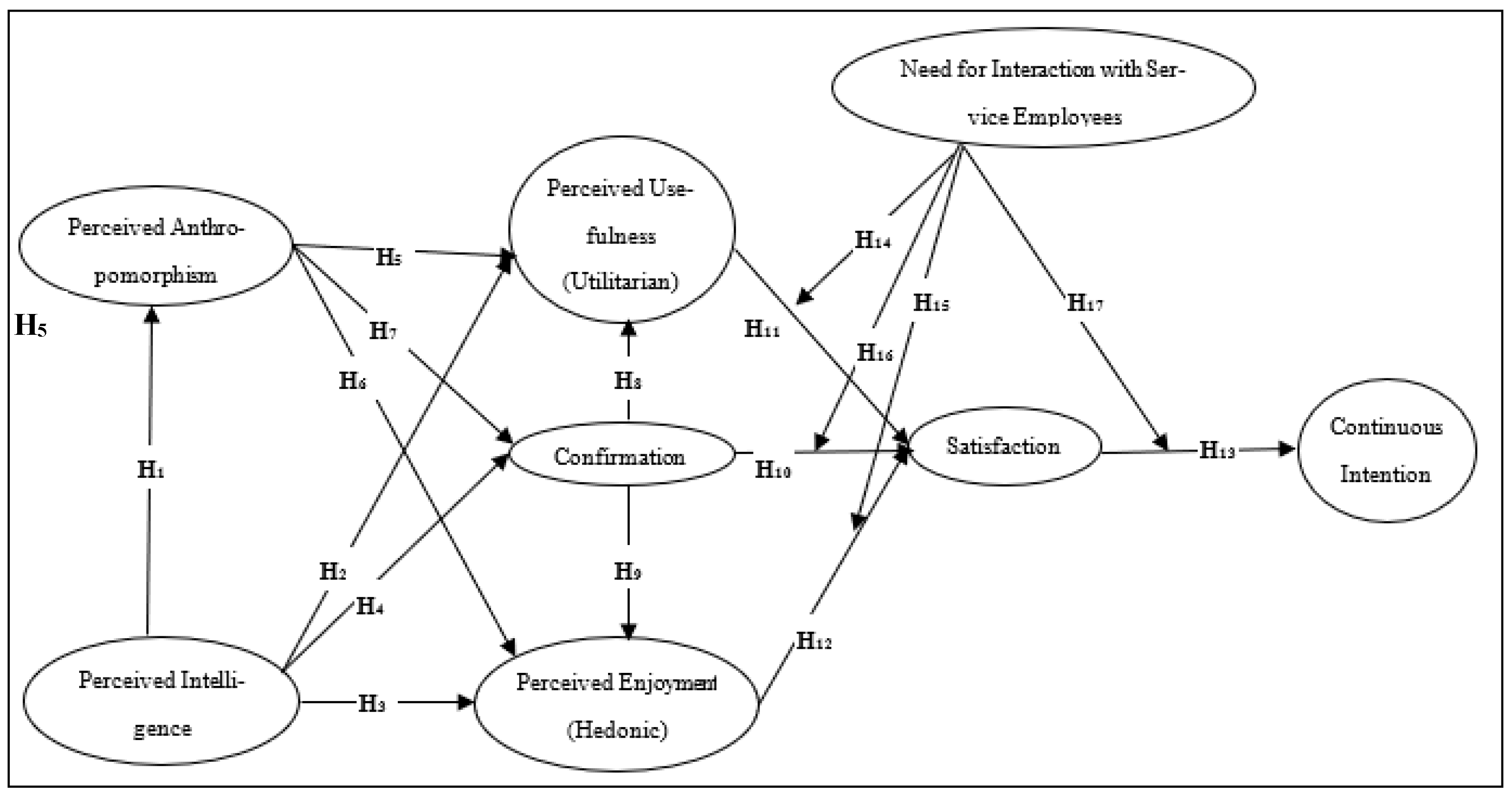
| H1 | Perceived Intelligence → Perceived Anthropomorphism | 0.470 | 0.037 | 12.580 | 0.000 | 0.284 | 0.219 | 1.000 | Supported |
| H2 | Perceived Intelligence → Perceived Usefulness | 0.239 | 0.035 | 6.728 | 0.000 | 0.097 | 0.643 | 1.659 | Supported |
| H5 | Perceived Anthropomorphism → Perceived Usefulness | 0.203 | 0.041 | 4.917 | 0.000 | 0.070 | 1.667 | Supported | |
| H8 | Expectation–Confirmation → Perceived Usefulness | 0.485 | 0.046 | 10.640 | 0.000 | 0.314 | 2.116 | Supported | |
| H3 | Perceived Intelligence → Expectation–Confirmation | 0.421 | 0.040 | 10.615 | 0.000 | 0.292 | 0.525 | 1.284 | Supported |
| H6 | Perceived Anthropomorphism → Expectation–Confirmation | 0.426 | 0.040 | 10.619 | 0.000 | 0.299 | 1.284 | Supported | |
| H7 | Perceived Anthropomorphism → Perceived Enjoyment | 0.327 | 0.052 | 6.338 | 0.000 | 0.127 | 0.491 | 1.667 | Supported |
| H4 | Perceived Intelligence → Perceived Enjoyment | 0.125 | 0.049 | 2.574 | 0.010 | 0.019 | 1.659 | Supported | |
| H9 | Expectation–Confirmation → Perceived Enjoyment | 0.361 | 0.059 | 6.165 | 0.000 | 0.122 | 2.116 | Supported | |
| H10 | Expectation–Confirmation → Satisfaction | 0.441 | 0.065 | 6.812 | 0.000 | 0.204 | 0.630 | 2.606 | Supported |
| H11 | Perceived Benefit → Satisfaction | 0.322 | 0.053 | 6.068 | 0.000 | 0.107 | 2.642 | Supported | |
| H12 | Perceived Enjoyment → Satisfaction | 0.108 | 0.049 | 2.208 | 0.027 | 0.017 | 1.902 | Supported | |
| H13 | Satisfaction → Intention | 0.726 | 0.020 | 7.179 | 0.000 | 1.113 | 0.551 | 1.000 | Supported |
| Satisfaction | Continuance Intention/Intention | |||||||||||
|---|---|---|---|---|---|---|---|---|---|---|---|---|
| Independent Variables | Coefficient | Standard Error | t-Statistic Value | p | 95% Confidence Interval of the Effect Size/Level | Coefficient | Standard Error | t-Statistic Value | p | 95% Confidence Interval of the Effect Size/Level | ||
| Lower Bound/Level | Upper Bound/Level | Lower Bound/Level | Upper Bound/Level | |||||||||
| Conditional Effect Analysis Results for the Perceived Usefulness Model | ||||||||||||
| Fixed/Constant Effect | −1.270 | 0.5486 | −2.3149 | 0.021 | −2.348 | −0.191 | 0.5635 | 0.4975 | 1.1328 | 0.2580 | −0.4145 | 1.5415 |
| Perceived Benefit (X) | 0.8080 | 0.1163 | 6.9500 | 0.000 | 0.579 | 1.036 | 0.2067 | 0.0568 | 3.6373 | 0.0003 | 0.0950 | 0.3184 |
| Need for Interaction with Service Employees (W) | 0.4345 | 0.1115 | 3.8971 | 0.0001 | 0.2153 | 0.6537 | 0.1510 | 0.0917 | 1.6470 | 0.1004 | 0.3312 | −0.0292 |
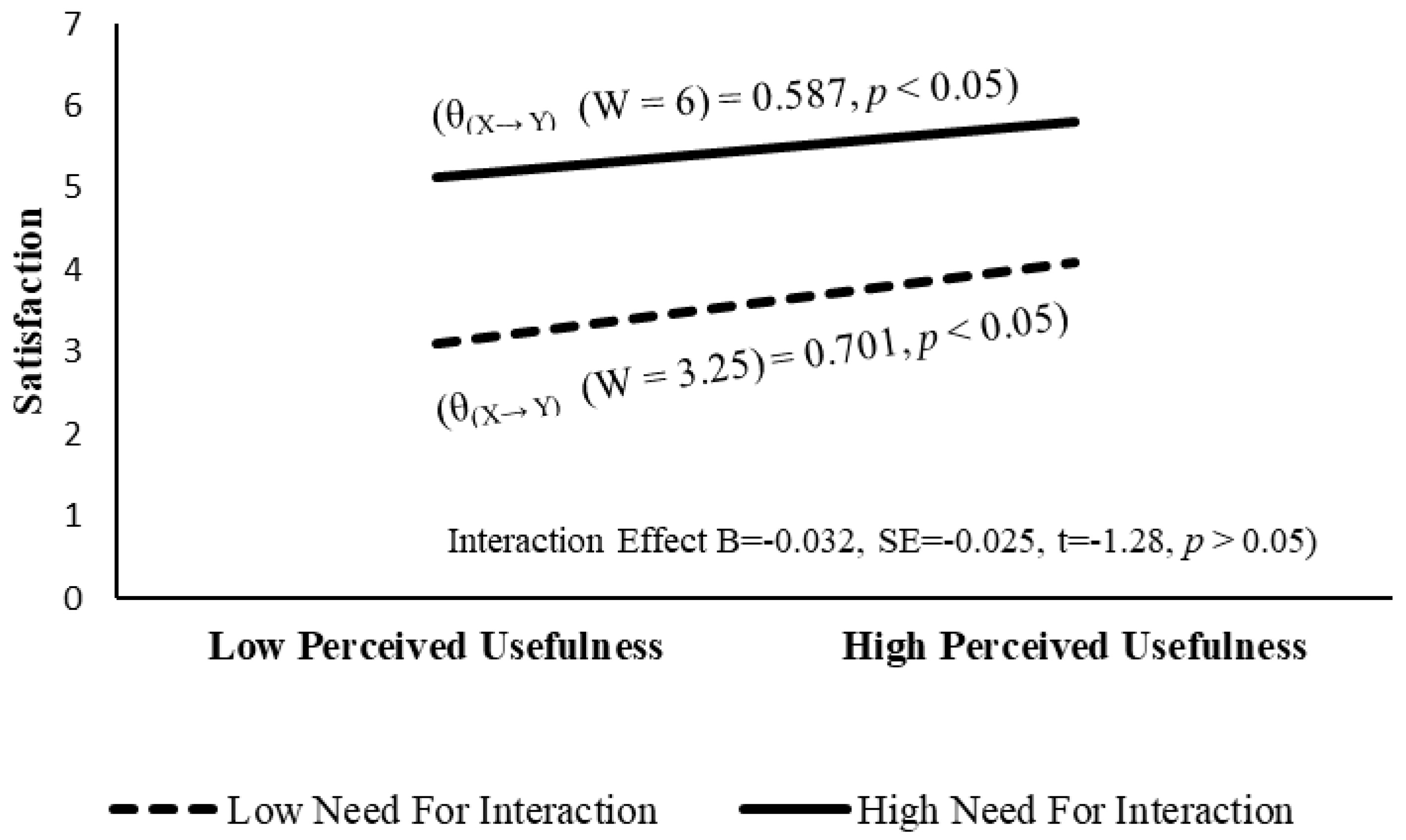
| Need for Interaction with Service Employees * Perceived Usefulness (X * W) | −0.0317 | −0.0248 | −1.2809 | 0.201 | −0.0805 | 0.0170 | ||||||
| Satisfaction (M) | 0.8088 | 0.1073 | 7.5381 | 0.0000 | 0.5979 | 1.0197 | ||||||
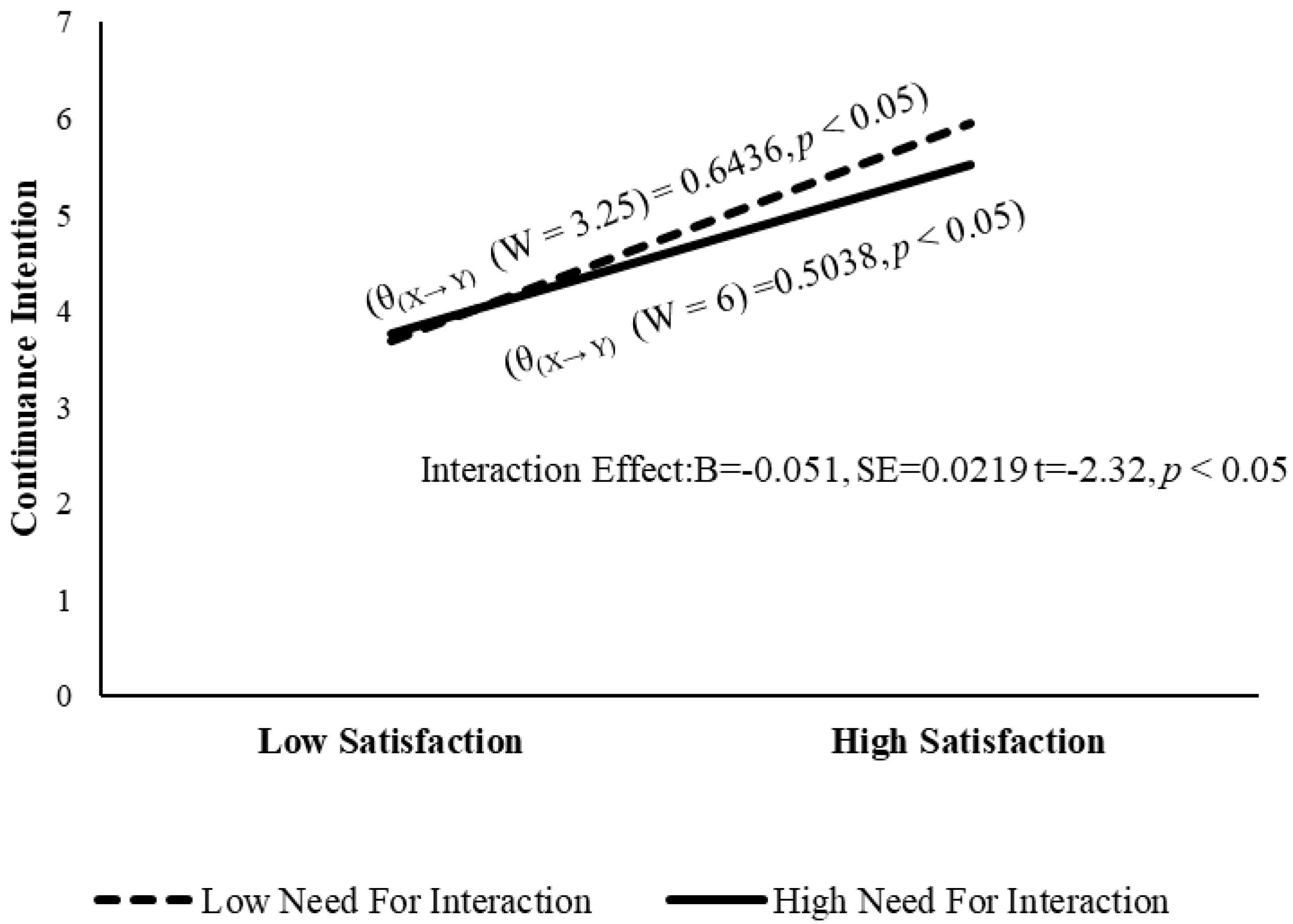
| Need for Interaction with Service Employees * Satisfaction (X * W) | −0.0508 | 0.0219 | −2.3222 | 0.0207 | −0.0939 | −0.0078 | ||||||
| R2 = 0.63; F (8, 393) = 83.401, p < 0.001 | R2 = 0.55; F (9, 392) = 53.68, p < 0.001 | |||||||||||
| Conditional Effect Analysis Results for the Expectation—Confirmation Model | ||||||||||||
| Fixed/Constant Effect | 0.1914 | 0.4124 | 0.4641 | 0.6428 | −0.6194 | 1.0022 | 1.1421 | 0.4746 | 2.4065 | 0.0166 | 0.2090 | 2.0752 |
| Expectation–Confirmation (X) | 0.9398 | 0.0972 | 9.6728 | 0.000 | 0.7488 | −1.1309 | 0.0811 | 0.0480 | 1.6911 | 0.0916 | −0.0132 | 0.1754 |
| Need for Interaction with Service Employees (W) | 0.4994 | 0.0777 | 6.4231 | 0.0000 | 0.3465 | 0.6523 | 0.1430 | 0.0930 | 1.5376 | 0.1249 | −0.0398 | 0.3258 |
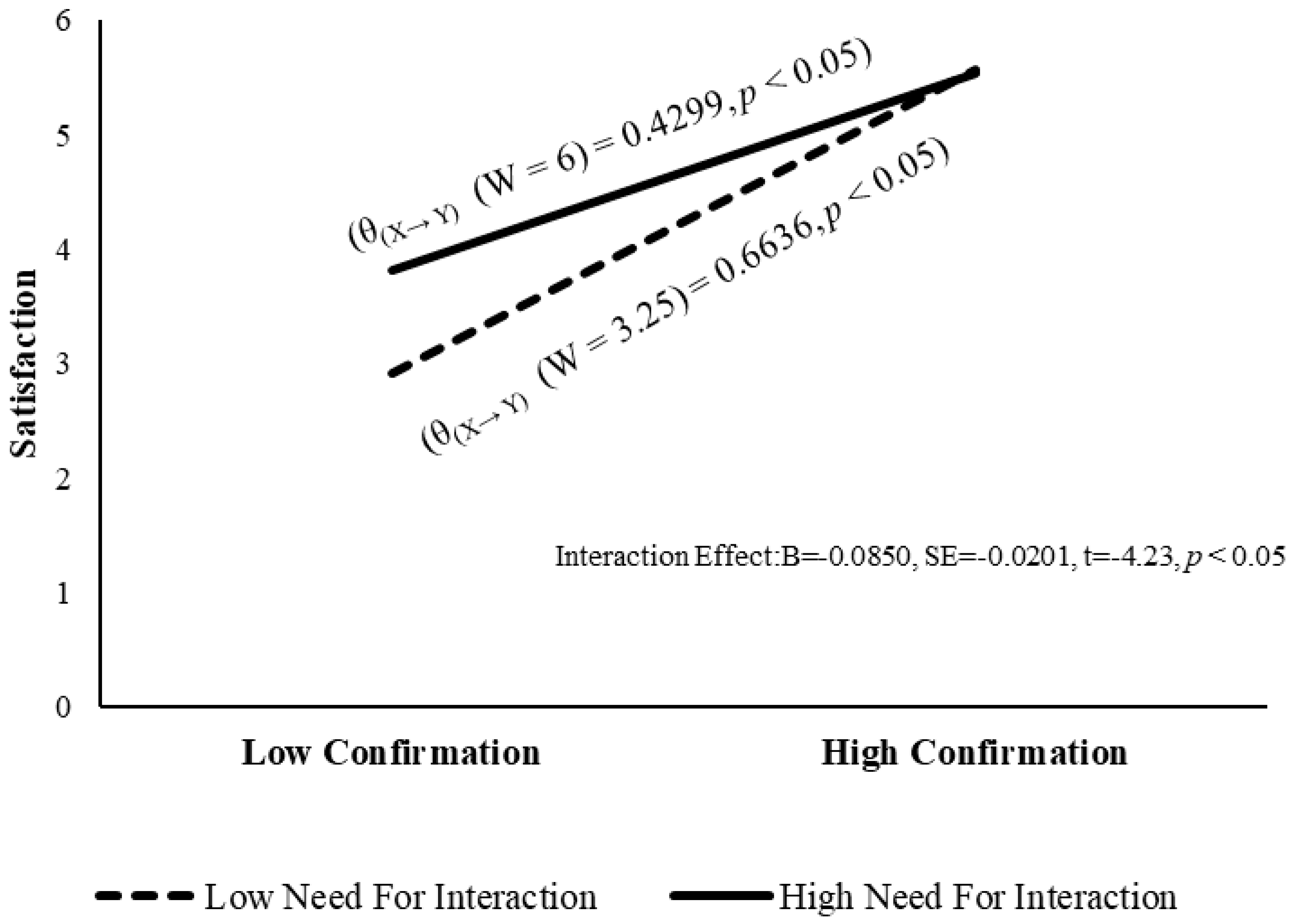
| Need for Interaction with Service Employees * Expectation–Confirmation (X * W) | −0.0850 | 0.0201 | −4.2327 | 0.000 | −0.1245 | −0.0455 | ||||||
| Satisfaction (M) | 0.8858 | 0.1072 | 8.2626 | 0.0000 | 0.6751 | 1.0966 | ||||||
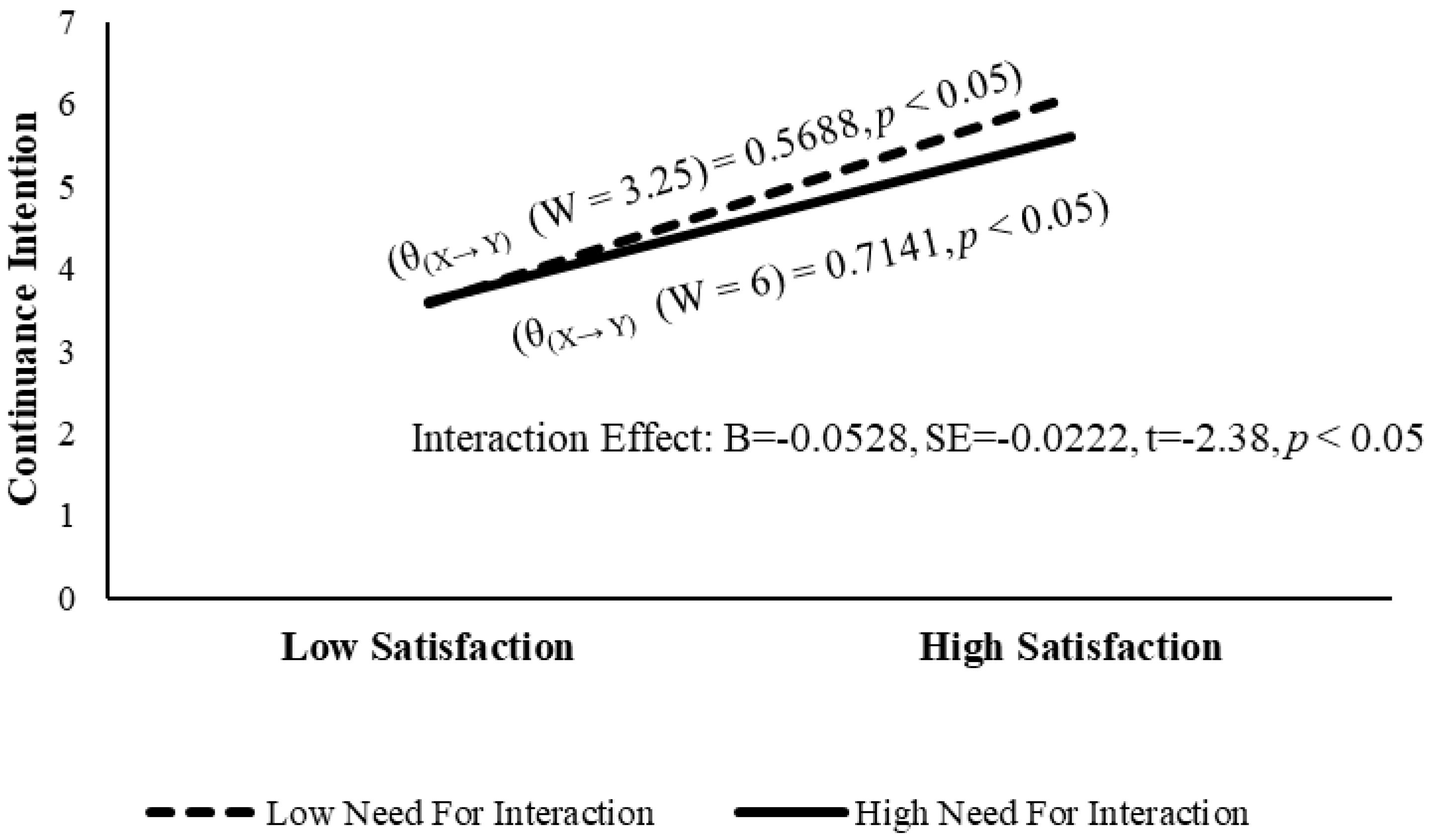
| Need for Interaction with Service Employees * Satisfaction (X * W) | −0.0528 | 0.0222 | −2.3820 | 0.0177 | −0.0965 | −0.0092 | ||||||
| R2 = 0.64; F (8, 393) = 86.354, p < 0.001 | R2 = 0.54; F (9, 392) = 51.19, p < 0.001 | |||||||||||
| Conditional Effect Analysis Results for the Perceived Enjoyment Model | ||||||||||||
| Fixed/Constant Effect | −0.3376 | 0.5143 | −0.6565 | 0.5119 | −1.3487 | 0.6735 | 0.7836 | 0.4769 | 1.6430 | 0.1012 | −0.1540 | 1.7212 |
| Perceived Enjoyment (X) | 0.8109 | 0.1162 | 6.9790 | 0.0000 | 0.5825 | 1.0394 | 0.1837 | 0.0462 | 3.9768 | 0.0001 | 0.0929 | −0.2744 |
| Need for Interaction with Service Employees (W) | 5821 | 0.0905 | 6.4334 | 0.0000 | 0.4042 | 0.7600 | 0.1455 | 0.0914 | 1.5923 | 0.1121 | −0.0342 | 0.3252 |
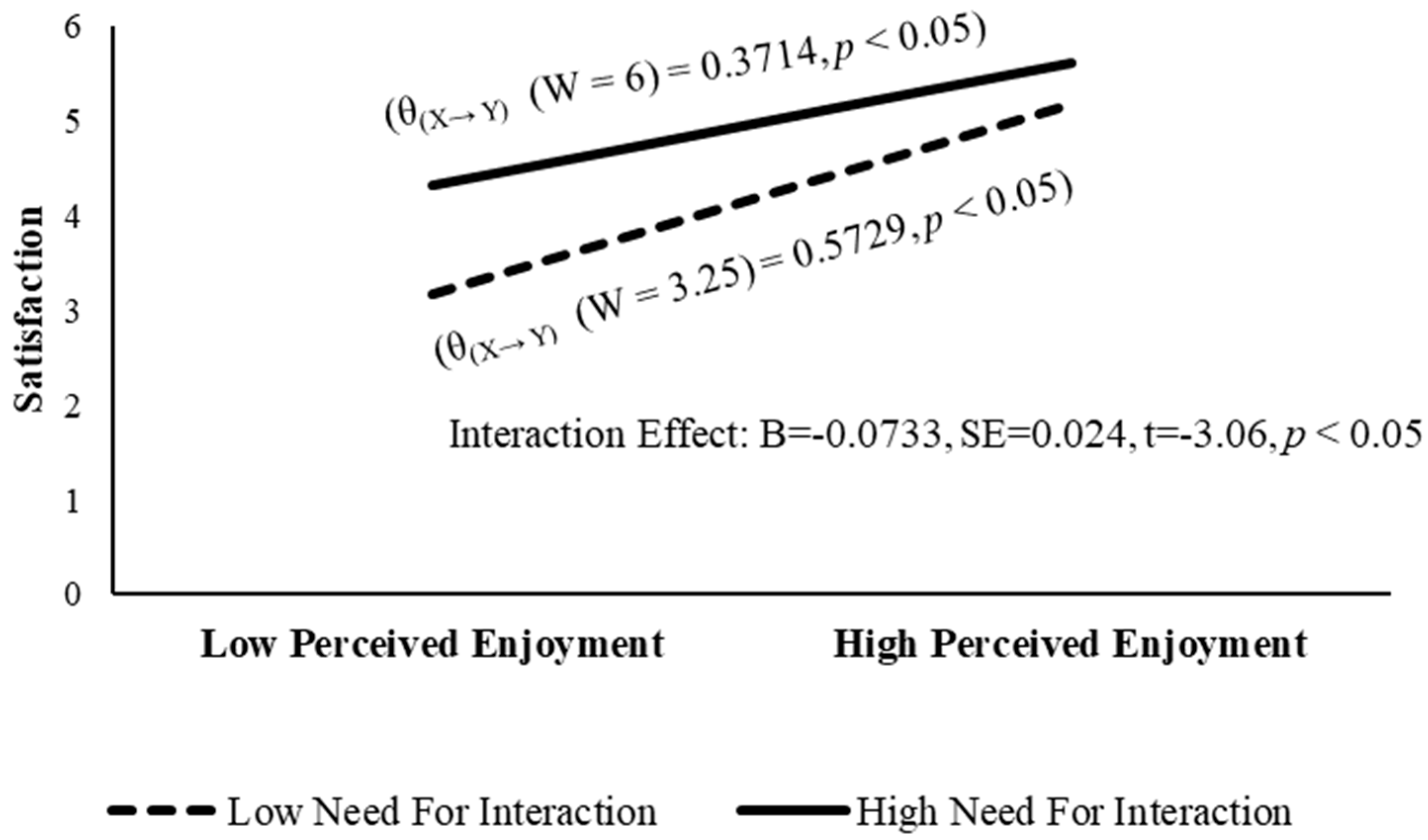
| Need for Interaction with Service Employees * Perceived Enjoyment (X * W) | −0.0733 | 0.0239 | −3.0602 | 0.0024 | −0.1203 | −0.0262 | ||||||
| Satisfaction (M) | 0.8521 | 0.1032 | 8.2601 | 0.0000 | 0.6493 | 1.0549 | ||||||
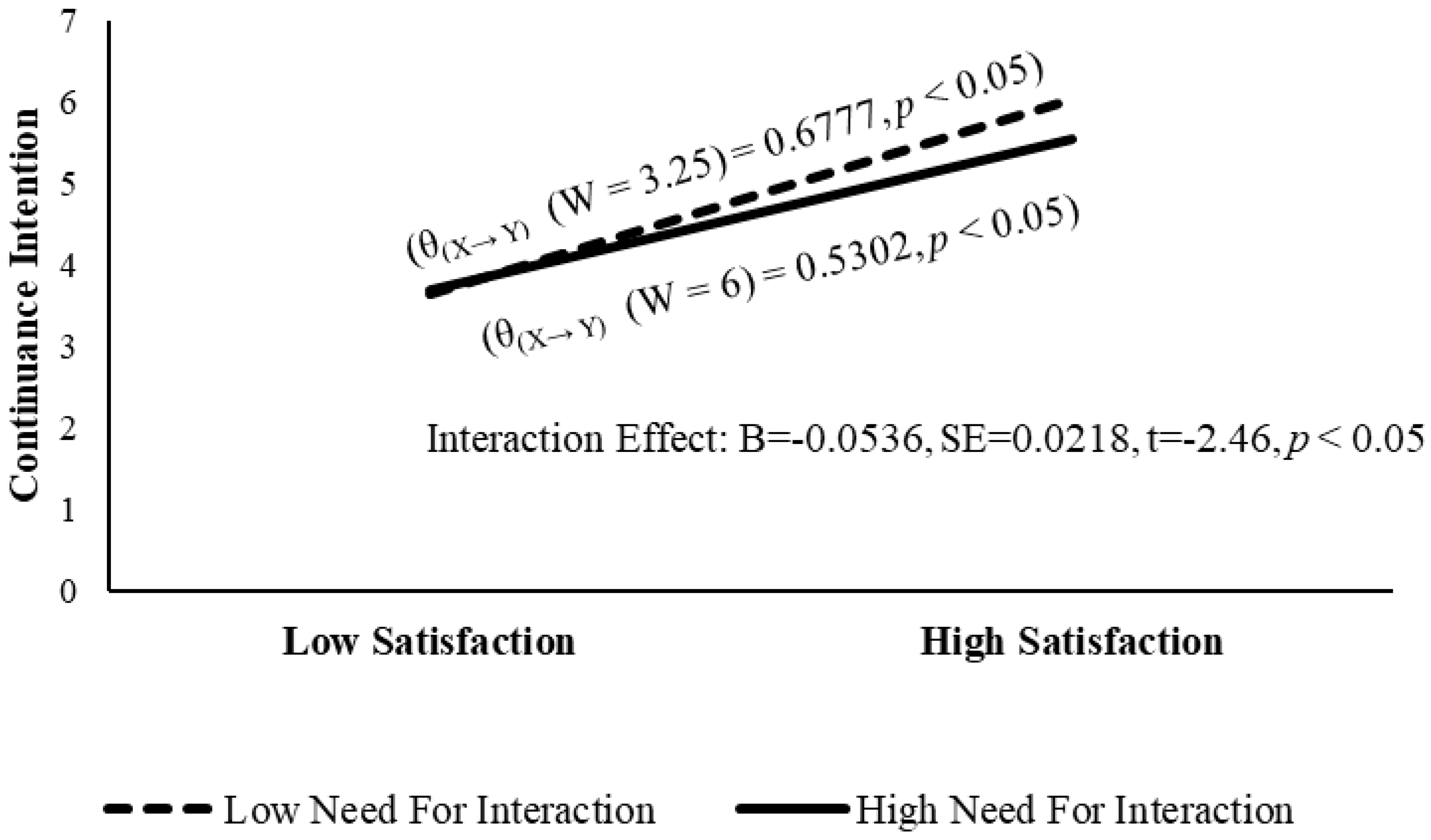
| Need for Interaction with Service Employees * Satisfaction (X * W) | −0.0536 | 0.0218 | −2.4581 | 0.0144 | −0.0966 | −0.0107 | ||||||
| R2 = 0.54; F (8, 393) = 57.205, p < 0.001 | R2 = 0.55; F (9, 392) = 54.30, p < 0.001 | |||||||||||
| Need for Interaction with Service Employees | Impact Level | Standard Error | t-Statistic Value | p Value | 95% Confidence Interval of the Effect Size/Level | |||
|---|---|---|---|---|---|---|---|---|
| Lower Bound/Level | Upper Bound/Level | |||||||
| Level | Value | |||||||
| Low | 3.2500 | 0.7006 | 0.0518 | 13.5261 | 0.0000 | 0.5988 | 0.8024 | |
| Medium | 4.7500 | 0.6388 | 0.0427 | 14.9444 | 0.0000 | 0.5547 | 0.7228 | |
| High | 6.0000 | 0.5872 | 0.0562 | 10.4415 | 0.0000 | 0.4767 | 0.6978 | |
| Need for Interaction with Service Employees | Impact Level | Standard Error | T-Statistic Value | p Value | 95% Confidence Interval of the Effect Size/Level | |||
|---|---|---|---|---|---|---|---|---|
| Lower Bound/Level | Upper Bound/Level | |||||||
| Level | Value | |||||||
| Low | 3.2500 | 0.6436 | 0.0585 | 11.0061 | 0.0000 | 0.5286 | 0.7586 | |
| Medium | 4.7500 | 0.5673 | 0.0557 | 10.1927 | 0.0000 | 0.4579 | 0.6768 | |
| High | 6.0000 | 0.5038 | 0.0669 | 7.5291 | 0.0000 | 0.3723 | 0.6354 | |
| Need for Interaction with Service Employees | Impact Level | Standard Error | T-Statistic Value | p Value | 95% Confidence Interval of the Effect Size/Level | |||
|---|---|---|---|---|---|---|---|---|
| Lower Bound/Level | Upper Bound/Level | |||||||
| Level | Value | |||||||
| Low | 3.2500 | 0.6636 | 0.0424 | 15.6361 | 0.0000 | 0.5802 | 0.7471 | |
| Medium | 4.7500 | 0.5362 | 0.0339 | 15.8253 | 0.0000 | 0.4696 | 0.6028 | |
| High | 6.0000 | 0.4299 | 0.0446 | 9.6400 | 0.0000 | 0.3422 | 0.5176 | |
| Need for Interaction with Service Employees | Impact Level | Standard Error | T-Statistic Value | p Value | 95% Confidence Interval of the Effect Size/Level | |||
|---|---|---|---|---|---|---|---|---|
| Lower Bound/Level | Upper Bound/Level | |||||||
| Level | Value | |||||||
| Low | 3.2500 | 0.7141 | 0.0582 | 12.2684 | 0.0000 | 0.5997 | 0.8285 | |
| Medium | 4.7500 | 0.6348 | 0.0562 | 11.3060 | 0.0000 | 0.5245 | 0.7452 | |
| High | 6.0000 | 0.5688 | 0.0682 | 8.3425 | 0.0000 | 0.4348 | 0.7028 | |
| Need for Interaction with Service Employees | Impact Level | Standard Error | T-Statistic Value | p Value | 95% Confidence Interval of the Effect Size/Level | |||
|---|---|---|---|---|---|---|---|---|
| Lower Bound/Level | Upper Bound/Level | |||||||
| Level | Value | |||||||
| Low | 3.2500 | 0.5729 | 0.0516 | 11.0960 | 0.0000 | 0.4714 | 0.6744 | |
| Medium | 4.7500 | 0.4630 | 0.0418 | 11.0782 | 0.0000 | 0.3808 | 0.5452 | |
| High | 6.0000 | 0.3714 | 0.0543 | 6.8379 | 0.0000 | 0.2646 | 0.4782 | |
| Need for Interaction with Service Employees | Impact Level | Standard Error | T-Statistic Value | p Value | 95% Confidence Interval of the Effect Size/Level | |||
|---|---|---|---|---|---|---|---|---|
| Lower Bound/Level | Upper Bound/Level | |||||||
| Level | Value | |||||||
| Low | 3.2500 | 0.6777 | 0.0522 | 12.9784 | 0.0000 | 0.5750 | 0.7804 | |
| Medium | 4.7500 | 0.5972 | 0.0497 | 12.0229 | 0.0000 | 0.4996 | 0.6949 | |
| High | 6.0000 | 0.5302 | 0.0624 | 8.5019 | 0.0000 | 0.4076 | 0.6528 | |
| Conditional Direct Effect: Perceived Usefulness → Continuance Intention | ||||||||||
|---|---|---|---|---|---|---|---|---|---|---|
| Need for Interaction with Service Employees | Impact Level | Standard Error | T-Statistic Value | p Value | 95% Confidence Interval of the Effect Size/Level | |||||
| Level | Value | Lower Bound/Level | Upper Bound/Level | |||||||
| Low | 3.25 | 0.6436 | 0.0585 | 11.0061 | 0.0000 | 0.5286 | 0.7586 | |||
| Medium | 4.75 | 0.5673 | 0.0557 | 10.1927 | 0.0000 | 0.4579 | 0.6768 | |||
| High | 6.00 | 0.5038 | 0.0669 | 7.5291 | 0.0000 | 0.3723 | 0.6354 | |||
| Conditional Indirect Effect: Perceived Usefulness → Satisfaction → Continuance Intention | ||||||||||
| Need for Interaction with Service Employees | Impact Level | Resampling Standard Error | 95% Confidence Interval of the Effect Size/Level | Pairwise Comparison Differences | Pairwise Differences (95% Confidence Interval) | |||||
| Level | Value | Lower Bound/Level | Upper Bound/Level | Differences Between Levels | Difference Level | SE | Lower Bound/Level | Upper Bound/Level | ||
| Low | 3.25 | 0.4536 | 0.0469 | 0.3674 | 0.5543 | Medium-Low | −0.0808 | 0.0298 | −0.1451 | −0.0290 |
| Medium | 4.75 | 0.3728 | 0.0415 | 0.2899 | 0.4553 | High-Low | −0.1425 | 0.0498 | −0.2480 | −0.0546 |
| High | 6.00 | 0.3111 | 0.0483 | 0.2092 | 0.4008 | High-Medium | −0.0617 | 0.0201 | −0.1027 | −0.0255 |
| Conditional Direct Effect: Expectation–Confirmation → Continuance Intention | ||||||||||
| Need for Interaction with Service Employees | Impact Level | Standard Error | T-Statistic Value | p Value | 95% Confidence Interval of the Effect Size/Level | |||||
| Level | Value | Lower Bound/Level | Upper Bound/Level | |||||||
| Low | 3.25 | 0.7141 | 0.0582 | 12.2684 | 0.0000 | 0.5997 | 0.8285 | |||
| Medium | 4.75 | 0.6348 | 0.0562 | 11.3060 | 0.0000 | 0.5245 | 0.7452 | |||
| High | 6.00 | 0.5688 | 0.0682 | 8.3425 | 0.0000 | 0.4348 | 0.7028 | |||
| Conditional Indirect Effect: Expectation–Confirmation → Satisfaction → Continuance Intention | ||||||||||
| Need for Interaction with Service Employees | Impact Level | Resampling Standard Error | 95% Confidence Interval of the Effect Size/Level | Pairwise Comparison Differences | Pairwise Differences (95% Confidence Interval) | |||||
| Level | Value | Lower Bound/Level | Upper Bound/Level | Differences Between Levels | Difference Level | SE | Lower Bound/Level | Upper Bound/Level | ||
| Low | 3.25 | 0.4739 | 0.0474 | 0.3855 | 0.5703 | Medium-Low | −0.1335 | 0.0278 | −0.1922 | −0.0809 |
| Medium | 4.75 | 0.3404 | 0.0387 | 0.2662 | 0.4171 | High-Low | −0.2294 | 0.0451 | −0.3225 | −0.1432 |
| High | 6.00 | 0.2445 | 0.0411 | 0.1611 | 0.3233 | High-Medium | −0.0958 | 0.0175 | −0.1318 | −0.0618 |
| Conditional Direct Effect: Perceived Enjoyment → Continuance Intention | ||||||||||
| Need for Interaction with Service Employees | Impact Level | Standard Error | T-Statistic Value | pValue | 95% Confidence Interval of the Effect Size/Level | |||||
| Level | Value | Lower Bound/Level | Upper Bound/Level | |||||||
| Low | 3.25 | 0.6777 | 0.0522 | 12.9784 | 0.0000 | 0.5750 | 0.7804 | |||
| Medium | 4.75 | 0.5972 | 0.0497 | 12.0229 | 0.0000 | 0.4996 | 0.6949 | |||
| High | 6.00 | 0.5302 | 0.0624 | 8.5019 | 0.0000 | 0.4076 | 0.6528 | |||
| Conditional Indirect Effect: Perceived Enjoyment → Satisfaction → Continuance Intention | ||||||||||
| Need for Interaction with Service Employees | Impact Level | Resampling Standard Error | 95% Confidence Interval of the Effect Size/Level | Pairwise Comparison Differences | Pairwise Differences (95% Confidence Interval) | |||||
| Level | Value | Lower Bound/Level | Upper Bound/Level | Differences Between Levels | Difference Level | SE | Lower Bound/Level | Upper Bound/Level | ||
| Low | 3.25 | 0.3882 | 0.0471 | 0.2999 | 0.4865 | Medium-Low | −0.1117 | 0.0308 | −0.1772 | −0.0557 |
| Medium | 4.75 | 0.2765 | 0.0361 | 0.2042 | 0.3478 | High-Low | −0.1913 | 0.0502 | −0.2968 | −0.0993 |
| High | 6.00 | 0.1969 | 0.0402 | 0.1138 | 0.2723 | High-Medium | −0.0796 | 0.0195 | −0.1204 | −0.0434 |
Disclaimer/Publisher’s Note: The statements, opinions and data contained in all publications are solely those of the individual author(s) and contributor(s) and not of MDPI and/or the editor(s). MDPI and/or the editor(s) disclaim responsibility for any injury to people or property resulting from any ideas, methods, instructions or products referred to in the content. |
© 2026 by the authors. Licensee MDPI, Basel, Switzerland. This article is an open access article distributed under the terms and conditions of the Creative Commons Attribution (CC BY) license.
Share and Cite
Avcılar, M.Y.; Yenilmez, G. The Effects of Chatbot Characteristics on Satisfaction and Continuance Intention: The Moderating Role of the Need for Human Interaction. J. Theor. Appl. Electron. Commer. Res. 2026, 21, 122. https://doi.org/10.3390/jtaer21040122
Avcılar MY, Yenilmez G. The Effects of Chatbot Characteristics on Satisfaction and Continuance Intention: The Moderating Role of the Need for Human Interaction. Journal of Theoretical and Applied Electronic Commerce Research. 2026; 21(4):122. https://doi.org/10.3390/jtaer21040122
Chicago/Turabian StyleAvcılar, Mutlu Yüksel, and Gülhan Yenilmez. 2026. "The Effects of Chatbot Characteristics on Satisfaction and Continuance Intention: The Moderating Role of the Need for Human Interaction" Journal of Theoretical and Applied Electronic Commerce Research 21, no. 4: 122. https://doi.org/10.3390/jtaer21040122
APA StyleAvcılar, M. Y., & Yenilmez, G. (2026). The Effects of Chatbot Characteristics on Satisfaction and Continuance Intention: The Moderating Role of the Need for Human Interaction. Journal of Theoretical and Applied Electronic Commerce Research, 21(4), 122. https://doi.org/10.3390/jtaer21040122