

“Buying Fewer but More Expensive”: The Impact of Air Quality on Average Order Value (AOV) in Online Food Delivery and an Analysis of Consumer Behavior

Abstract
1. Introduction
2. Literature Review
2.1. Air Quality Deterioration and the Expansion of Online Demand
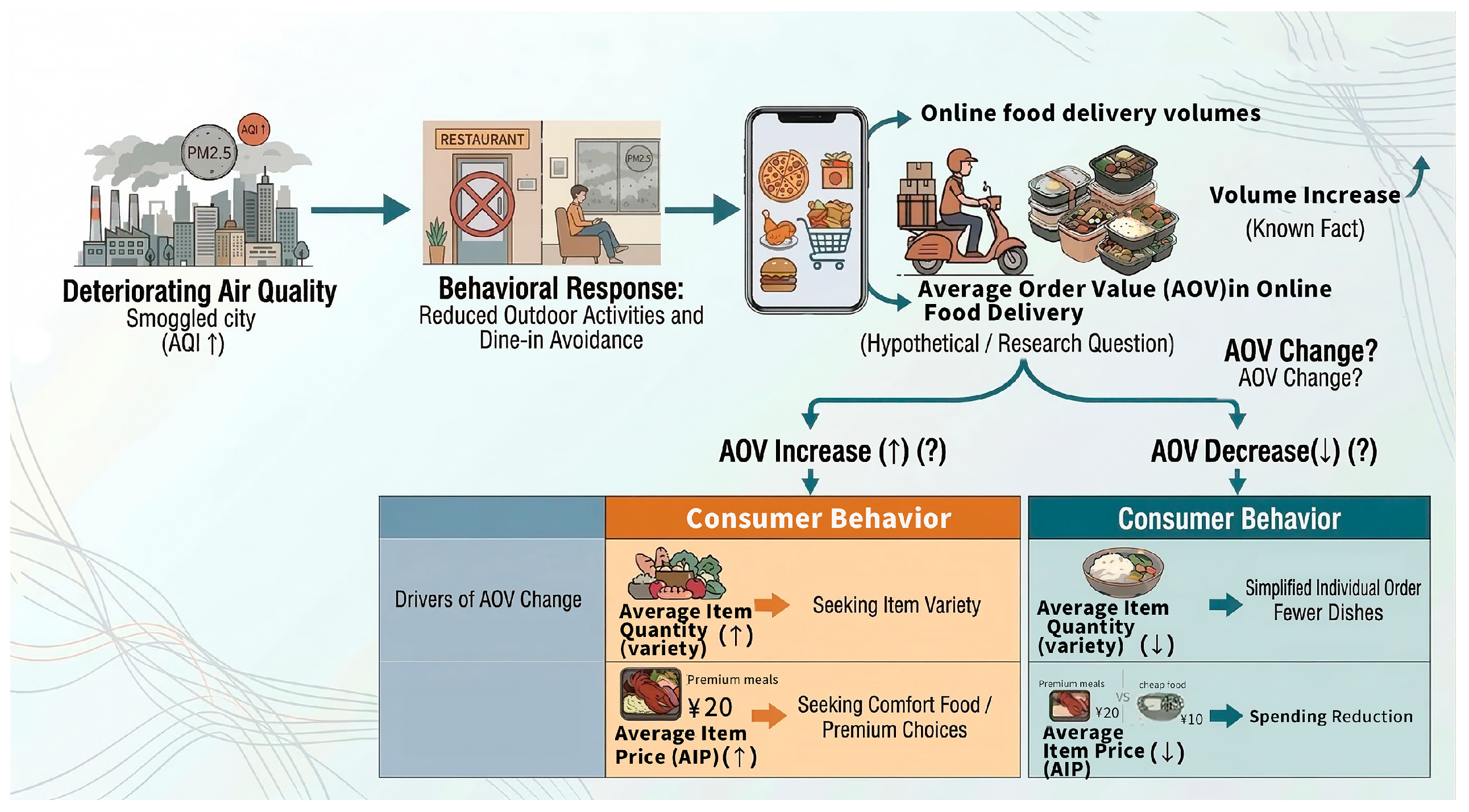
2.2. Theoretical Deduction from a Psychological Perspective: Conflict Between Defensive Frugality and Compensatory Consumption
2.3. Multidimensional Context of Factors Influencing Online Consumption Decisions
2.4. The Impact of Temporal Factors and Weather on the Catering and Retail Industry
2.5. Comparative Analysis of Online and Offline Consumption Decision Factors
2.6. “Price” as the Research Gap
3. Data and Methodology
3.1. Data Source and Sample Context
3.2. Variable Description
3.3. Preliminary Data Analysis: A “Homogeneous” Comparison Under Strictly Controlled Conditions
3.4. Analysis Methodology
- Step 1: Random Forest-based Model Construction
- Step 2: Significance Determination Based on Permutation Test
- Step 3: Influence Quantification Based on Partial Dependence Analysis
4. Results
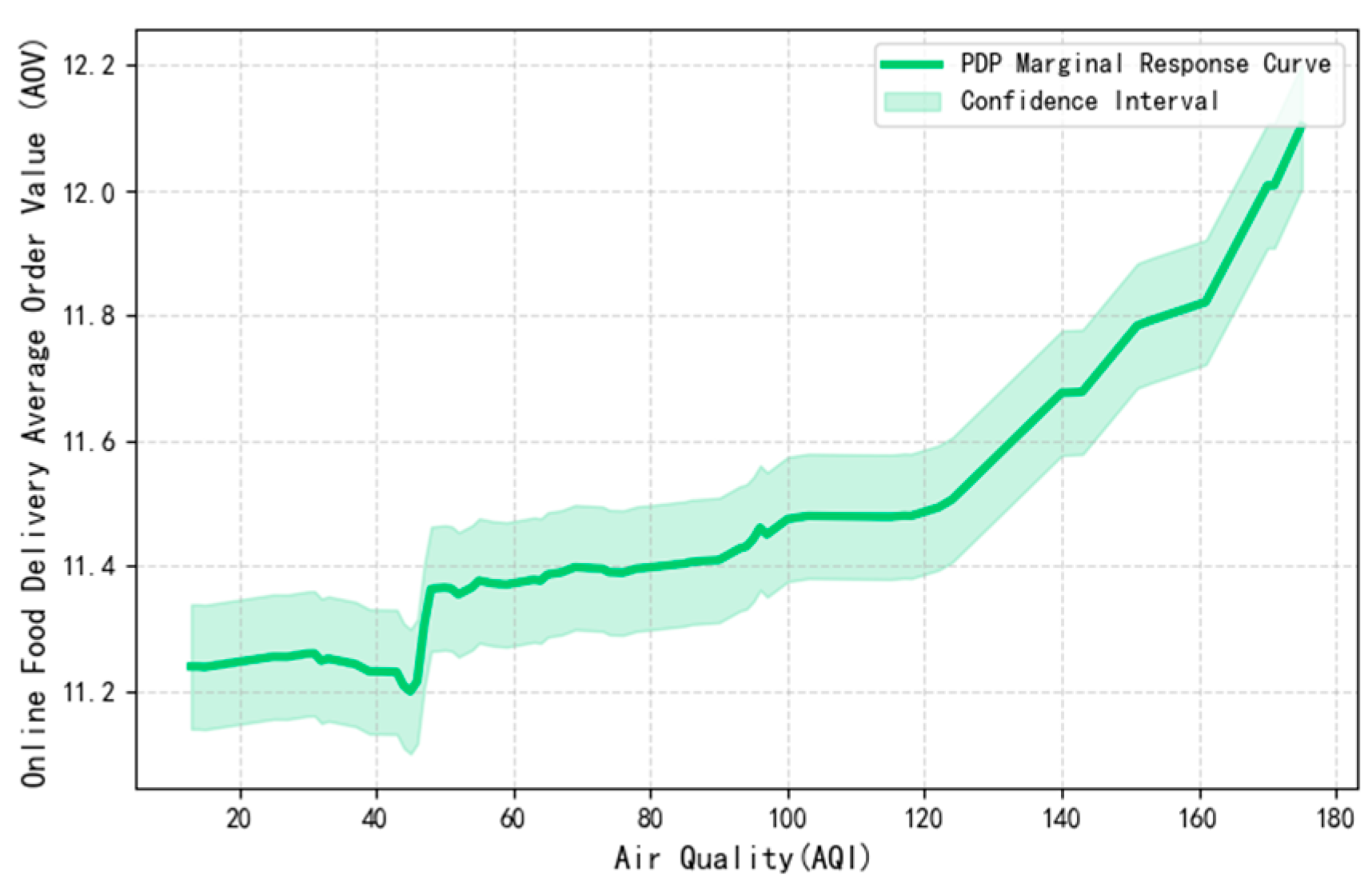
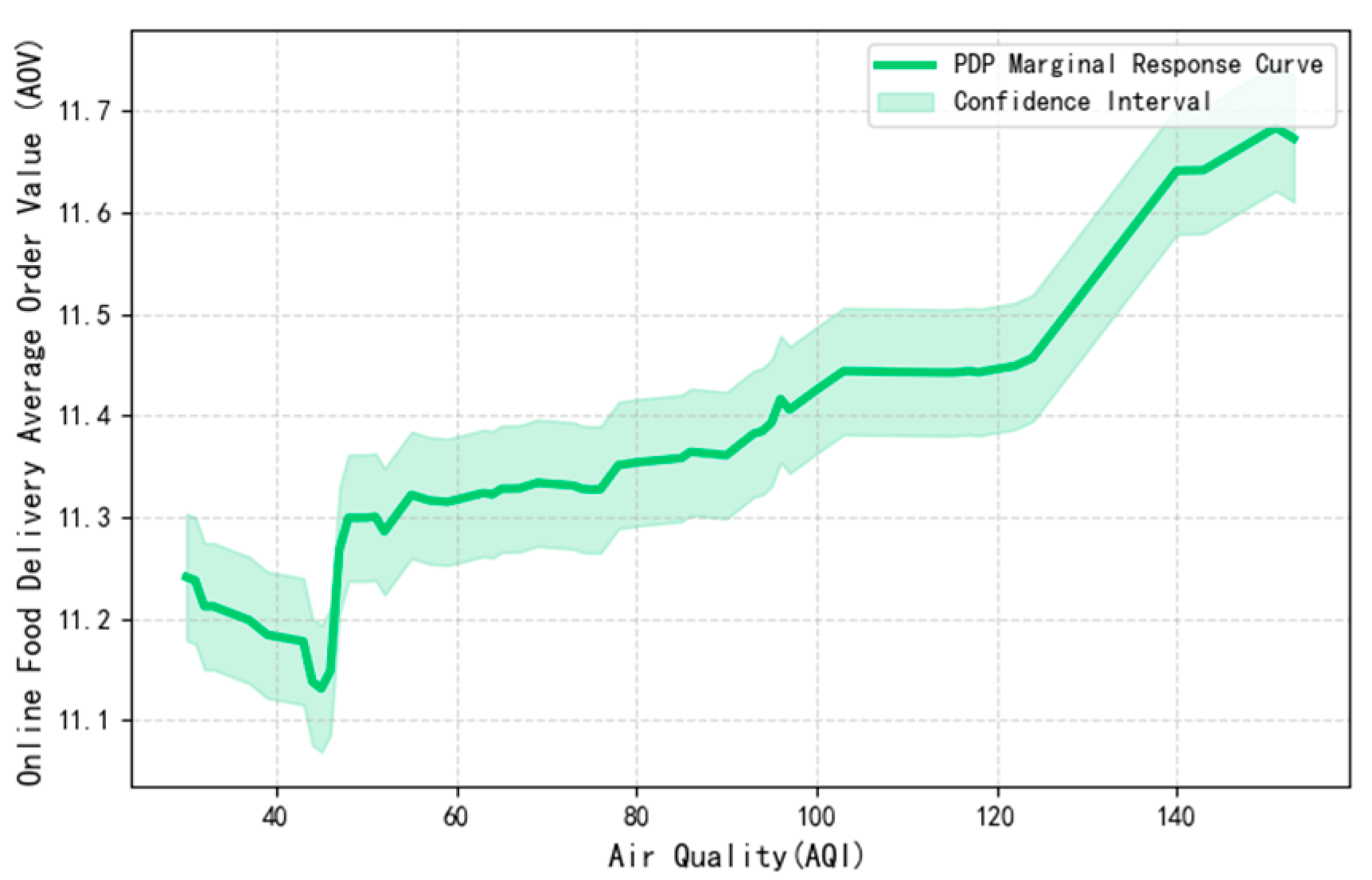
4.1. The Impact of Air Quality on Online Food Delivery Average Order Value (AOV)
4.2. Robustness Checks
4.2.1. Sample Adjustment: Excluding Extreme Observations
4.2.2. OLS Regression
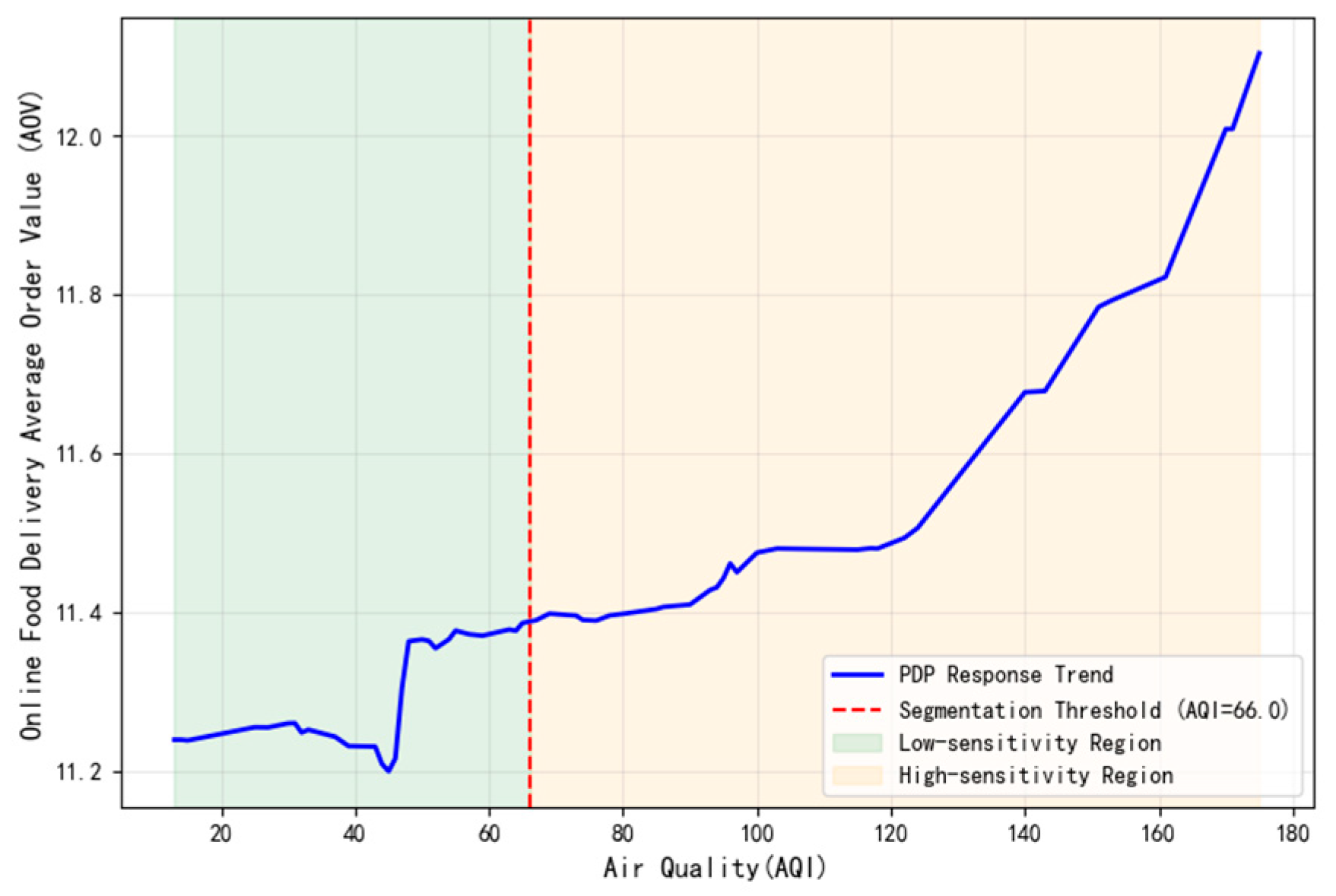
4.3. Heterogeneity Analysis Across Different Air Quality Intervals
- (1)
- Good Air Quality Interval (AQI: 13–65)
- (2)
- Poor Air Quality Interval (AQI: 67–175)
4.4. Mechanism Identification of the Impact of Air Quality on Food Delivery AOV
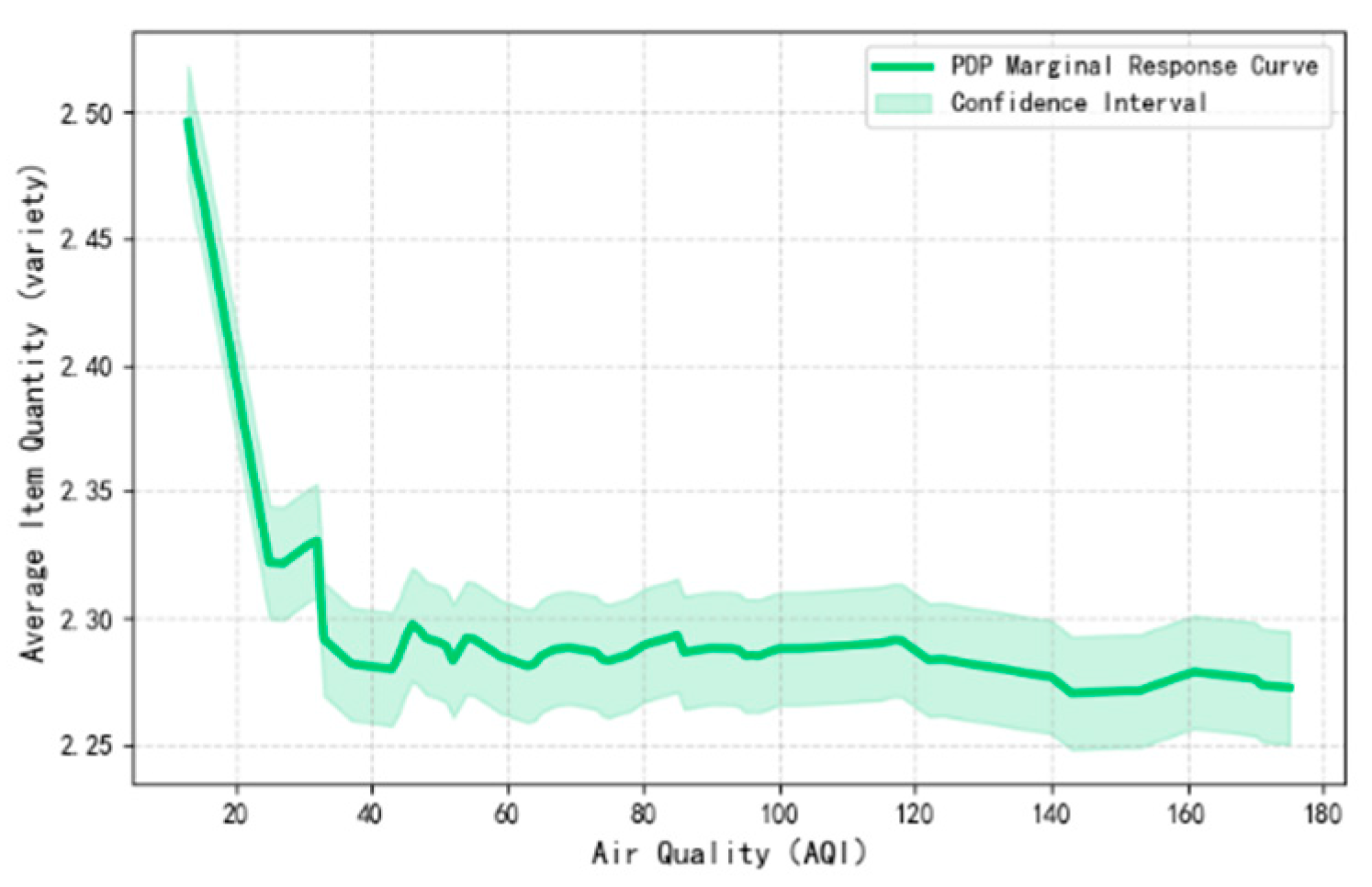
4.4.1. The Reduction in Average Item Quantity Under Air Quality Deterioration
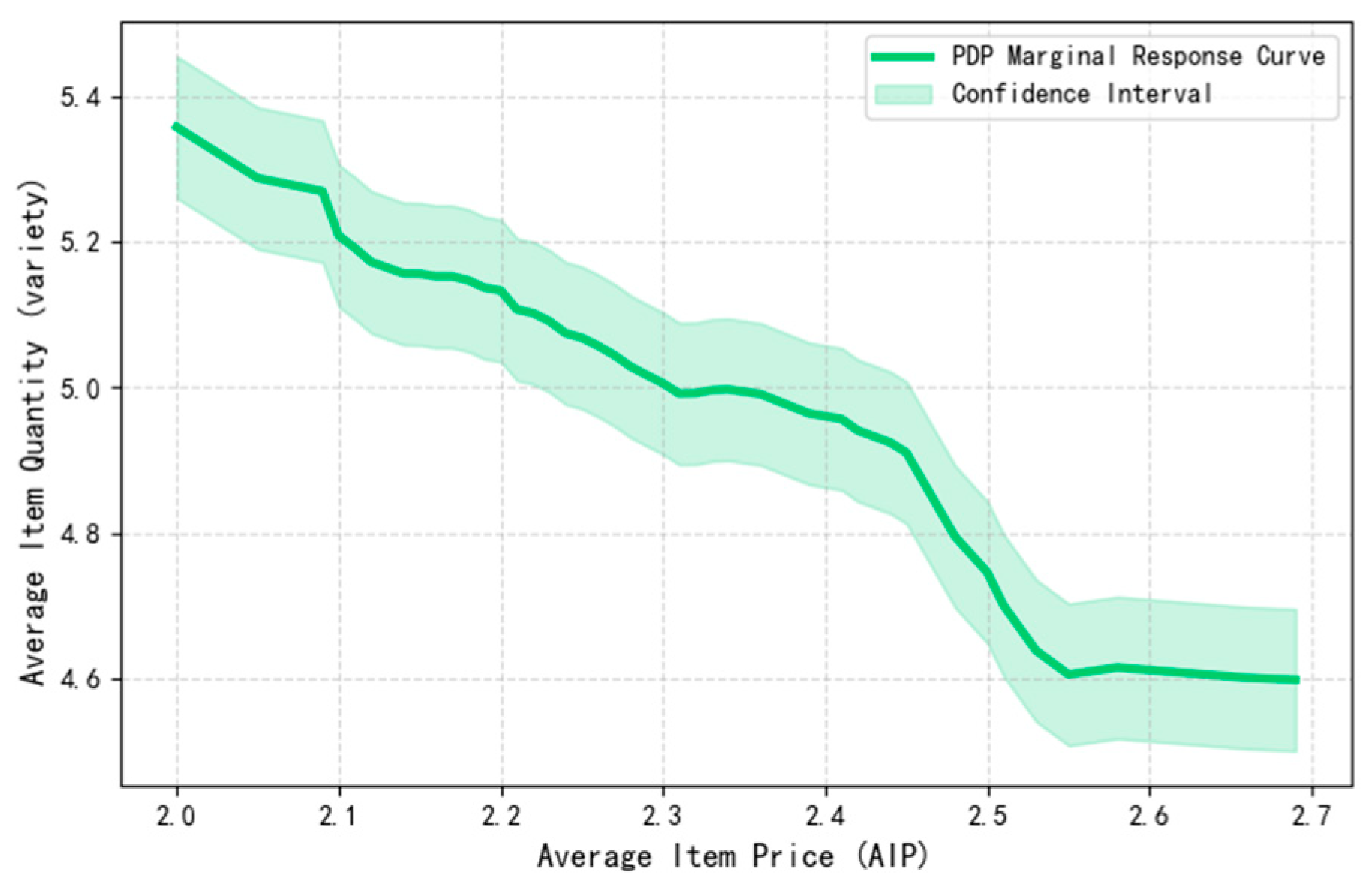
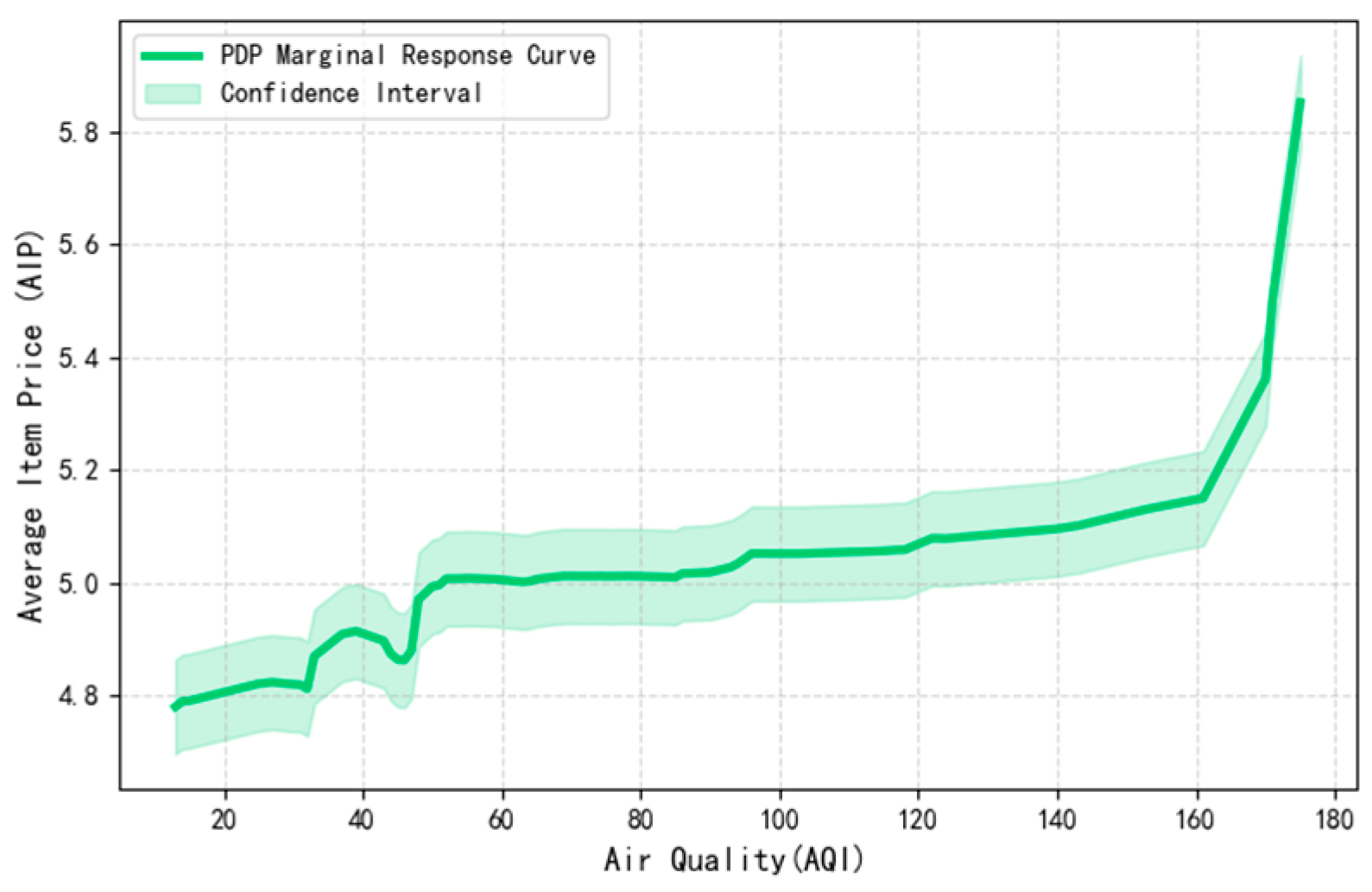
4.4.2. The Elevation of Average Item Price Under Air Quality Deterioration
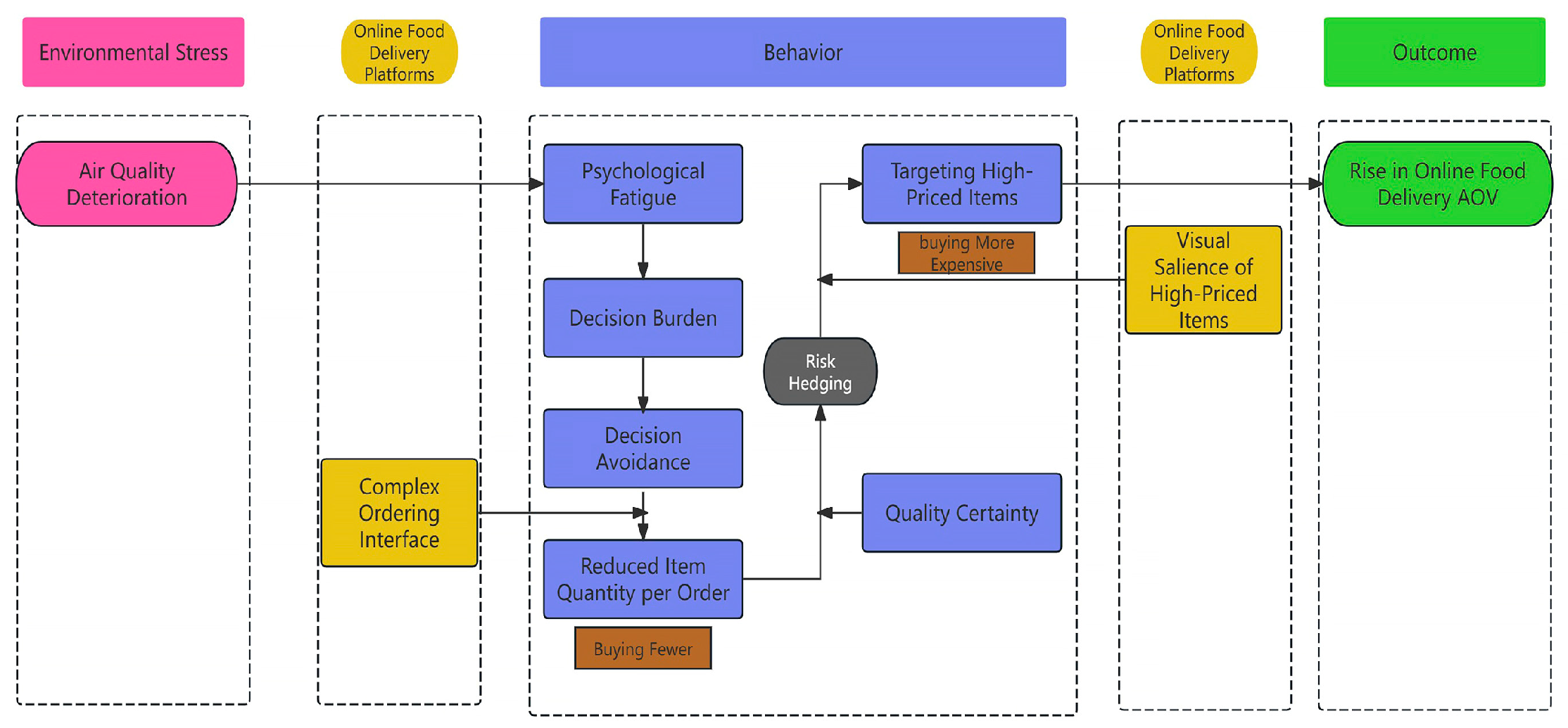
5. Analysis of Consumers’ “Buying Fewer but More Expensive” Behavior
6. Conclusions and Management Implications
6.1. Research Conclusions
- (1)
- Air quality deterioration significantly drives up online food delivery AOV, exhibiting non-linear acceleration characteristics.
- (2)
- The behavior of “buying fewer but more expensive” supports the rise in online food delivery AOV.
- (3)
- The underlying cause of “buying fewer but more expensive” is that “buying fewer” triggers “buying more expensive.”
6.2. Management Implications
- (1)
- Establish a dynamic operational system based on environmental monitoring to strategically optimize profit structures using environmental dividends.
- (2)
- Optimize dynamic product curation and ranking logic: transition from “quantity-driven” to “value-relevance.”
- (3)
- Implement “decision navigation” on store pages to alleviate cognitive friction and enhance ordering efficiency.
6.3. Research Limitations and Future Research Outlook
6.3.1. Research Limitations
- (1)
- Limitations in Universality and Representativeness.
- (2)
- Inferential Nature of Consumer Behavior.
- (3)
- Insufficient Dynamic Coverage of Environmental Variables.
6.3.2. Research Outlook
- (1)
- Cross-validation across multiple categories and regions.
- (2)
- Directly Obtaining Consumer-side Data.
- (3)
- Detection of Lag Effects in the Time Dimension.
Author Contributions
Funding
Institutional Review Board Statement
Informed Consent Statement
Data Availability Statement
Conflicts of Interest
References
- Chu, J.; Liu, H.; Salvo, A. Air pollution as a determinant of food delivery and related plastic waste. Nat. Hum. Behav. 2021, 5, 212–220. [Google Scholar] [CrossRef]
- Tian, X.; Min, S.; Shen, J.; Hong, Q.; Headey, D.; Zhao, F.; Wang, X. Air pollutions affect restaurant and foodservice industry in China. PNAS Nexus 2025, 4, pgaf124. [Google Scholar] [CrossRef]
- Hobfoll, S.E. Conservation of resources: A new attempt at conceptualizing stress. Am. Psychol. 1989, 44, 513–524. [Google Scholar] [CrossRef]
- Sharma, E.; Alter, A.L. Financial Deprivation Prompts Consumers to Seek Scarce Goods. J. Consum. Res. 2012, 39, 545–560. [Google Scholar] [CrossRef]
- Durante, K.M.; Laran, J. The Effect of Stress on Consumer Saving and Spending. J. Mark. Res. 2016, 53, 814–828. [Google Scholar] [CrossRef]
- Rucker, D.D.; Galinsky, A.D. Desire to Acquire: Powerlessness and Compensatory Consumption. J. Consum. Res. 2008, 35, 257–267. [Google Scholar] [CrossRef]
- Kim, S.; Rucker, D.D. Bracing for the Psychological Storm: Proactive versus Reactive Compensatory Consumption. J. Consum. Res. 2012, 39, 815–830. [Google Scholar] [CrossRef]
- Atalay, A.S.; Meloy, M.G. Retail therapy: A strategic effort to improve mood. Psychol. Mark. 2011, 28, 638–660. [Google Scholar] [CrossRef]
- Kim, S.; Trusov, M. The Impact of Air Pollution on Consumer Spending. J. Mark. 2025, 89, 78–96. [Google Scholar] [CrossRef]
- Davis, F.D. Perceived usefulness, perceived ease of use, and user acceptance of information technology. MIS Q. 1989, 13, 319–340. [Google Scholar] [CrossRef]
- Venkatesh, V.; Morris, M.G.; Davis, G.B.; Davis, F.D. User Acceptance of Information Technology: Toward a Unified View. MIS Q. 2003, 27, 425–478. [Google Scholar] [CrossRef]
- Eroglu, S.; Machleit, K.; Davis, L. Empirical Testing of a Model of Online Store Atmospherics and Shopper Responses. Psychol. Mark. 2003, 20, 139–150. [Google Scholar] [CrossRef]
- Wu, W.; Lee, C.; Fu, C.; Wang, H. How can online store layout design and atmosphere influence consumer shopping intention on a website? Int. J. Retail. Distrib. Manag. 2013, 42, 4–24. [Google Scholar] [CrossRef]
- Ha, Y.; Lennon, S.J. Effects of site design on consumer emotions: Role of product involvement. J. Res. Interact. Mark. 2010, 4, 80–96. [Google Scholar] [CrossRef]
- Mayer, R.C.; Davis, J.H.; Schoorman, F.D. An Integrative Model of Organizational Trust. Acad. Manag. Rev. 1995, 20, 709–734. [Google Scholar] [CrossRef]
- Jarvenpaa, S.L.; Tractinsky, N.; Vitale, M. Consumer trust in an Internet store. Inf. Technol. Manag. 2000, 1, 45–71. [Google Scholar] [CrossRef]
- Gefen, D.; Karahanna, E.; Straub, D.W. Trust and TAM in Online Shopping: An Integrated Model. MIS Q. 2003, 27, 51–90. [Google Scholar] [CrossRef]
- Pavlou, P.A. Consumer Acceptance of Electronic Commerce: Integrating Trust and Risk with the Technology Acceptance Model. Int. J. Electron. Commer. 2003, 7, 101–134. [Google Scholar] [CrossRef]
- Kim, D.J.; Ferrin, D.L.; Rao, H.R. A trust-based consumer decision-making model in electronic commerce: The role of trust, perceived risk, and their antecedents. Decis. Support Syst. 2008, 44, 544–564. [Google Scholar] [CrossRef]
- Hennig-Thurau, T.; Gwinner, K.P.; Walsh, G.; Gremler, D.D. Electronic word-of-mouth via consumer-opinion platforms: What motivates consumers to articulate themselves on the Internet? J. Interact. Mark. 2004, 18, 38–52. [Google Scholar] [CrossRef]
- Cheung, C.M.K.; Thadani, D.R. The impact of electronic word-of-mouth communication: A literature analysis and integrative model. Decis. Support Syst. 2012, 54, 461–470. [Google Scholar] [CrossRef]
- King, R.A.; Racherla, P.; Bush, V.D. What We Know and Don’t Know About Online Word-of-Mouth: A Review and Synthesis of the Literature. J. Interact. Mark. 2014, 28, 167–183. [Google Scholar] [CrossRef]
- Kumar, A.; Bezawada, R.; Rishika, R.; Janakiraman, R.; Kannan, P.K. From Social to Sale: The Effects of Firm-Generated Content in Social Media on Customer Behavior. J. Mark. 2016, 80, 7–25. [Google Scholar] [CrossRef]
- Ansari, A.; Essegaier, S.; Kohli, R. Internet Recommendation Systems. J. Mark. Res. 2000, 37, 363–375. [Google Scholar] [CrossRef]
- Babin, B.J.; Darden, W.R.; Griffin, M. Work and/or Fun: Measuring Hedonic and Utilitarian Shopping Value. J. Consum. Res. 1994, 20, 644–656. [Google Scholar] [CrossRef]
- Childers, T.L.; Carr, C.L.; Peck, J.; Carson, S. Hedonic and utilitarian motivations for online retail shopping behavior. J. Retail. 2001, 77, 511–535. [Google Scholar] [CrossRef]
- Lian, J.-W.; Yen, D.C. Online shopping drivers and barriers for older adults: Age and gender differences. Comput. Hum. Behav. 2014, 37, 133–143. [Google Scholar] [CrossRef]
- Hernández, B.; Jiménez, J.; José Martín, M. Age, gender and income: Do they really moderate online shopping behaviour? Online Inf. Rev. 2011, 35, 113–133. [Google Scholar] [CrossRef]
- Wang, T.; He, C.; Jin, F.; Hu, Y.J. Evaluating the Effectiveness of Marketing Campaigns for Malls Using a Novel Interpretable Machine Learning Model. Inf. Syst. Res. 2021, 33, 659–677. [Google Scholar] [CrossRef]
- Bujisic, M.; Bogicevic, V.; Parsa, H.G. The effect of weather factors on restaurant sales. J. Foodserv. Bus. Res. 2017, 20, 350–370. [Google Scholar] [CrossRef]
- Badorf, F.; Hoberg, K. The impact of daily weather on retail sales: An empirical study in brick-and-mortar stores. J. Retail. Consum. Serv. 2020, 52, 101921. [Google Scholar] [CrossRef]
- Chua, B.L.; Karim, S.; Lee, S.; Han, H. Customer Restaurant Choice: An Empirical Analysis of Restaurant Types and Eating-out Occasions. Int. J. Environ. Res. Public Health 2020, 17, 6276. [Google Scholar] [CrossRef] [PubMed]
- Cho, M.; Bonn, M.A.; Li, J.J. Differences in perceptions about food delivery apps between single-person and multi-person households. Int. J. Hosp. Manag. 2019, 77, 108–116. [Google Scholar] [CrossRef]
- 2345 Weather. Available online: https://tianqi.2345.com/wea_history/60279.htm (accessed on 16 January 2026).
- He, J.; Liu, H.; Salvo, A. Severe Air Pollution and Labor Productivity: Evidence from Industrial Towns in China. Am. Econ. J. Appl. Econ. 2019, 11, 173–201. [Google Scholar] [CrossRef]
- Lu, J.G.; Lee, J.J.; Gino, F.; Galinsky, A.D. Polluted Morality: Air Pollution Predicts Criminal Activity and Unethical Behavior. Psychol. Sci. 2018, 29, 340–355. [Google Scholar] [CrossRef] [PubMed]
- Archsmith, J.; Heyes, A.; Saberian, S. Air Quality and Error Quantity: Pollution and Performance in a High-Skilled, Quality-Focused Occupation. J. Assoc. Environ. Resour. Econ. 2018, 5, 827–863. [Google Scholar] [CrossRef]
- Sweller, J. Cognitive load during problem solving: Effects on learning. Cogn. Sci. 1988, 12, 257–285. [Google Scholar] [CrossRef]
- Simon, H.A. A behavioral model of rational choice. Q. J. Econ. 1955, 69, 99–118. [Google Scholar] [CrossRef]
- Vohs, K.D.; Baumeister, R.F.; Schmeichel, B.J.; Twenge, J.M.; Nelson, N.M.; Tice, D.M. Making choices impairs subsequent self-control: A limited-resource account of decision making, self-regulation, and active initiative. J. Personal. Soc. Psychol. 2008, 94, 883–898. [Google Scholar] [CrossRef]
- Vohs, K.D.; Faber, R.J. Spent Resources: Self-Regulatory Resource Availability Affects Impulse Buying. J. Consum. Res. 2007, 33, 537–547. [Google Scholar] [CrossRef]
- Sivanathan, N.; Pettit, N.C. Protecting the self through consumption: Status goods as affirmational commodities. J. Exp. Soc. Psychol. 2010, 46, 564–570. [Google Scholar] [CrossRef]
- Zeithaml, V.A. Consumer perceptions of price, quality, and value: A means-end model and synthesis of evidence. J. Mark. 1988, 52, 2–22. [Google Scholar] [CrossRef]
- Tice, D.M.; Bratslavsky, E.; Baumeister, R.F. Emotional distress regulation takes precedence over impulse control: If you feel bad, do it! J. Personal. Soc. Psychol. 2001, 80, 53–67. [Google Scholar] [CrossRef]
- Alba, J.W.; Williams, E.F. Pleasure principles: A review of research on hedonic consumption. J. Consum. Psychol. 2013, 23, 2–18. [Google Scholar] [CrossRef]
- Dhar, R.; Wertenbroch, K. Consumer choice between hedonic and utilitarian goods. J. Mark. Res. 2000, 37, 60–71. [Google Scholar] [CrossRef]
- Mandel, N.; Rucker, D.D.; Levav, J.; Galinsky, A.D. The Compensatory Consumer Behavior Model: How self-discrepancies drive consumer behavior. J. Consum. Psychol. 2017, 27, 133–146. [Google Scholar] [CrossRef]





| Variable Category | Variable Name (Abbreviation) | Definition | Data Source | Description/Notes |
|---|---|---|---|---|
| Dependent Variable | Average Order Value (AOV) | Daily average net amount paid per order | Transaction-level logs from the store’s backend | |
| Independent Variable | Air Quality Index (AQI) | Daily air quality value in the business location | 2345 Weather (A leading third-party meteorological platform) [34] | The platform synchronizes authoritative real-time monitoring data from national meteorological stations and provides historical logs accurate to the “district and county” level. This fine-grained data granularity ensures a high degree of spatio-temporal alignment between the relevant variables and the store’s specific geographical location. |
| Mechanism Variable | Average Item Quantity (Variety) | Daily average number of items included in a single order | Transaction-level logs from the store’s backend | For example, an order with “one set meal + one add-on” or “two set meals” counts as two items. From a decision psychology perspective, both represent equal weights of choice breadth. Thus, it is a valid proxy for “buying more.” |
| Mechanism Variable | Average Item Price (AIP) | The average transaction price per individual item within an order | Secondary calculation based on transaction logs | Filters out the influence of item count to determine whether consumers are “buying more expensive” items |
| Control Variable | Marketing Intensity | A composite index of promotional investments from both the merchant and the platform | Store backend operational dashboard | A weighted score calculated from discount depth, traffic acquisition investment, and real-time conversion rates |
| Control Variable | Average Temperature | Daily average temperature of the specific date | 2345 Weather | Controls for the physiological impact of temperature on food selection |
| Control Variable | Activity Subsidies | Financial subsidies directly funded by the delivery platform. | Transaction-level logs from the store’s backend. | Measures platform-side investment (e.g., universal red envelopes). This represents the financial gap between “merchant revenue” and “consumer out-of-pocket spending,” isolating the noise from platform promotional policies |
| Control Variable | Temporal Factors | A 0–1 dummy variable for calendar cycles. | Calendar information | 0 for workdays; 1 for statutory holidays and weekends |
| Control Variable | Weather | A 0–1 dummy variable for precipitation. | 2345 Weather | 0 for sunny/cloudy; 1 for rain. No other extreme weather like snow or hail was recorded in the sample |
| Air Quality Level | Sample Size (Days) | Temporal Factor | Weather Condition | Mean AOV | Mean Variety | Mean AIP |
|---|---|---|---|---|---|---|
| Excellent | 8 | Workday | Sunny | 10.2325 | 2.4 | 4.2773 |
| Lightly Polluted | 5 | Workday | Sunny | 11.484 | 2.308 | 4.9717 |
| Moderately Polluted | 4 | Workday | Sunny | 14.07 | 2.23 | 6.4015 |
| Coefficient | p-Value | |
|---|---|---|
| Air Quality Index (AQI) | 0.0081 | 0.0036 |
| Marketing Intensity | Controlled | — |
| Average Temperature | Controlled | — |
| Activity Subsidies | Controlled | — |
| Temporal Factors (Holidays/Weekends) | Controlled | — |
| Weather (Rainy/Sunny) | Controlled | — |
| R-squared | 0.6886 | — |
Disclaimer/Publisher’s Note: The statements, opinions and data contained in all publications are solely those of the individual author(s) and contributor(s) and not of MDPI and/or the editor(s). MDPI and/or the editor(s) disclaim responsibility for any injury to people or property resulting from any ideas, methods, instructions or products referred to in the content. |
© 2026 by the authors. Licensee MDPI, Basel, Switzerland. This article is an open access article distributed under the terms and conditions of the Creative Commons Attribution (CC BY) license.
Share and Cite
Wang, Y.; Li, J.; Yang, M. “Buying Fewer but More Expensive”: The Impact of Air Quality on Average Order Value (AOV) in Online Food Delivery and an Analysis of Consumer Behavior. J. Theor. Appl. Electron. Commer. Res. 2026, 21, 121. https://doi.org/10.3390/jtaer21040121
Wang Y, Li J, Yang M. “Buying Fewer but More Expensive”: The Impact of Air Quality on Average Order Value (AOV) in Online Food Delivery and an Analysis of Consumer Behavior. Journal of Theoretical and Applied Electronic Commerce Research. 2026; 21(4):121. https://doi.org/10.3390/jtaer21040121
Chicago/Turabian StyleWang, Ye, Jinye Li, and Minggang Yang. 2026. "“Buying Fewer but More Expensive”: The Impact of Air Quality on Average Order Value (AOV) in Online Food Delivery and an Analysis of Consumer Behavior" Journal of Theoretical and Applied Electronic Commerce Research 21, no. 4: 121. https://doi.org/10.3390/jtaer21040121
APA StyleWang, Y., Li, J., & Yang, M. (2026). “Buying Fewer but More Expensive”: The Impact of Air Quality on Average Order Value (AOV) in Online Food Delivery and an Analysis of Consumer Behavior. Journal of Theoretical and Applied Electronic Commerce Research, 21(4), 121. https://doi.org/10.3390/jtaer21040121