


Abstract
Returnee entrepreneurs connect rural communities with wider markets and contribute to local development. Digital platforms expand their market reach but intensify competition for audience attention amid similar rural content. Existing research explains how resources and local embeddedness shape returnee entrepreneurial performance, but offers less insight into how entrepreneurs present these advantages to external audiences. Drawing on cultural entrepreneurship theory, we distinguish village connection narrative from market operation narrative and examine the role of narrative activity. We analyse 1922 account-month observations from 476 returnee entrepreneurs on Douyin using dictionary-based measures and panel fixed-effects models. Village connection narrative was positively associated with performance. The association between market operation narrative and performance weakened as narrative emphasis increased, and a complete inverted U-shaped pattern was evident only at low narrative activity. Narrative activity did not significantly strengthen the VCN–performance relationship, whereas higher narrative activity was associated with a flatter MON–performance relationship. These findings extend understanding of how returnee entrepreneurs present their village relationships and market operations through narratives, and how narrative content and activity relate to entrepreneurial performance.
1. Introduction
In China, returnee entrepreneurship offers an important setting for examining how urban–rural connections shape rural economic development [1,2,3,4,5]. Returnee entrepreneurs combine experience acquired elsewhere with village relationships and local production. Digital platforms enable them to bring these locally grounded ventures into wider markets through short videos and livestream commerce [6,7,8,9,10,11]. However, competition among similar presentations of village life and local products makes it difficult for returnee entrepreneurs to convey what distinguishes their ventures [12,13]. Their central challenge extends beyond reaching distant consumers to communicating the value of their village connections and operating practices.
Research on returnee entrepreneurship explains how migration experience, local embeddedness, and resource mobilisation shape venture formation and development [3,4,14,15]. Digital entrepreneurship research shows how platforms reduce spatial barriers and expand access to external markets [6,16,17]. Together, these studies explain how returnee ventures develop and reach wider markets, but give less attention to how entrepreneurs use narratives to present the village relationships and operating practices underlying their ventures. Cultural entrepreneurship provides a theoretical perspective for examining how entrepreneurial narratives give meaning to these venture foundations. It views entrepreneurial narratives as cultural tools that connect venture resources and activities to broader systems of meaning [18,19,20]. Narratives can make entrepreneurial action and resource use more intelligible to external audiences [21,22,23]. Different narratives may emphasise different foundations of the same venture, making narrative content important to its relationship with performance. On digital platforms, entrepreneurial narratives unfold through successive short posts that compete for attention alongside visible audience responses and opportunities to purchase [10,11,24,25]. Narrative activity may also condition how different forms of narrative content relate to performance.
Building on this perspective, we distinguish village connection narrative (VCN) from market operation narrative (MON). VCN presents village relationships and contributions to local development, whereas MON presents operating practices and market value. We examine how these narratives relate to returnee entrepreneurial performance and whether narrative activity (NA) moderates their relationships with performance. Using an unbalanced monthly panel of 1922 account-month observations from 476 returnee entrepreneurs on Douyin, we estimate models with entrepreneur and time fixed effects. VCN was positively associated with performance. MON was also positively associated with performance at lower levels, but this association weakened as MON increased. A complete inverted U-shaped pattern was evident only at low NA. NA did not significantly strengthen the VCN–performance relationship, whereas higher NA was associated with a flatter MON–performance relationship.
This study makes three contributions. First, it shows that entrepreneurial narratives have distinct performance associations depending on the venture foundations they emphasise. Second, it connects village relationships and market operations to entrepreneurial narratives, adding a narrative perspective to explanations of returnee entrepreneurial performance. Third, it clarifies the role of narrative activity in digital entrepreneurship. Higher activity was associated with a flatter MON–performance relationship, while the expected strengthening of the VCN–performance relationship was not supported. These findings show why narrative content and activity need to be examined together without assuming that greater activity strengthens every narrative–performance relationship.
2. Literature Review and Hypothesis Development
2.1. Returnee Entrepreneurship
Returnee entrepreneurship refers to venture creation by individuals who return to their home regions after gaining experience elsewhere [2,3,4,26]. In China, it is closely associated with rural–urban mobility. Many returnee entrepreneurs leave their home villages for cities, where they acquire experience and knowledge that are less readily available locally. After returning, they apply these resources within the relationships and production conditions of their home villages. Returnee entrepreneurship therefore combines experience acquired elsewhere with renewed village embeddedness.
Existing research has examined both entrepreneurial return and venture development. Experience gained away from home can influence the decision to return and enter entrepreneurship [2,27], while individual circumstances and post-return conditions also shape these choices [14,28,29]. After return, external experience can support opportunity recognition and new operating practices, although its value depends on its fit with local relationships and production conditions [4,15,30]. Ties to home also shape the motives and meanings attached to entrepreneurial return [31]. Returnee entrepreneurship has further been associated with employment, rural incomes, and local industry development [32,33,34]. More recent studies examine digitalisation, showing that digital platforms connect returnee entrepreneurs with consumers beyond their home regions and reduce barriers to market participation [6,16,17].
Taken together, this literature explains entrepreneurial return, the use of externally acquired experience, renewed village embeddedness, and expanding market access. Less attention has been given to how returnee entrepreneurs present the significance of these entrepreneurial foundations after entering wider digital markets. Village relationships, prior experience, and operating practices can shape venture development but remain difficult for distant consumers to observe directly. This gap directs attention to entrepreneurial narratives as a means through which returnee entrepreneurs communicate the meaning and relevance of their venture activities to external audiences.
2.2. Entrepreneurial Narratives
Entrepreneurial narratives are cultural tools through which entrepreneurs organise and present their ventures, actions, and aspirations to external audiences [18,22,35]. Cultural entrepreneurship emphasises how narratives connect entrepreneurial activity to broader systems of meaning and make ventures intelligible to potential supporters [18]. Narratives can explain how resources are mobilised, how entrepreneurial actions acquire significance, and how current activities relate to future possibilities [19,20,36]. They thus help audiences understand the foundations and development of a venture.
Research has examined both the content and presentation of entrepreneurial narratives. Narratives may establish entrepreneurial identity and opportunity [18,20], explain resource use and entrepreneurial action [21,22], or situate ventures within local relationships and histories [23]. Their rhetorical, linguistic, emotional, and multimodal forms also shape how entrepreneurial claims are expressed and interpreted [19,37,38,39,40]. These studies connect entrepreneurial narratives to venture evaluation and external support [37,41,42,43]. However, less is known about how narratives presenting different foundations of the same venture relate to entrepreneurial performance.
Digital platforms introduce a further question concerning narrative activity. Online entrepreneurial communication can unfold through multiple brief messages rather than a single, complete account [24]. Short narrative fragments can also convey entrepreneurial meanings without forming complete narratives individually [25]. In platform commerce, entrepreneurs communicate alongside audience interaction and commercial exchange [10,11]. Narrative activity may therefore matter alongside the content being presented. Yet it remains unclear whether greater activity conditions the performance associations of different narratives in the same way. We address these questions by distinguishing VCN from MON and examining how NA relates to their respective performance associations.
2.3. Hypothesis Development
Returnee entrepreneurs draw on village relationships and experience acquired elsewhere to establish and operate their ventures. Entrepreneurial narratives can present these foundations through different explanatory functions. VCN communicates the venture’s relationships with the home village and its contribution to local development. MON presents how entrepreneurs organise resources, develop products, and undertake market operations. We examine whether these narratives have distinct relationships with performance.
VCN presents an enduring relationship between the returnee entrepreneur and the home village. It communicates the entrepreneur’s return, continued participation in village life, and contribution to local development. Village relationships can provide access to local knowledge and actors and support participation in local production systems [15,44]. These relationships may underpin venture activity, yet external audiences cannot readily observe their entrepreneurial significance.
VCN makes these foundations more intelligible by connecting village relationships to current entrepreneurial activities. Accounts of return establish the entrepreneur’s relationship with the village, while accounts of continued participation show how that relationship is expressed in practice. Narratives can help audiences interpret entrepreneurial claims by locating venture activity within a recognisable social setting [19]. Place narratives can similarly make the entrepreneurial relevance of local relationships visible to outsiders [23]. VCN also presents contributions to local producers and communities alongside the entrepreneur’s commercial activities. Entrepreneurial narratives can attract support when they communicate benefits for others and connect venture activity to meanings valued by audiences [45,46,47].
VCN therefore presents village relationships and local contribution as meaningful foundations of returnee ventures. Greater emphasis on VCN should provide external audiences with stronger grounds for supporting these ventures and be positively associated with entrepreneurial performance.
Hypothesis 1a.
Village connection narrative is positively related to returnee entrepreneurial performance.
MON presents how returnee entrepreneurs organise and apply resources in current venture operations. Entrepreneurs bring knowledge, skills, and market experience acquired away from home into their ventures [2,4]. After returning, they combine these resources with local production conditions [4,15]. The resulting operating processes are difficult for external audiences to observe directly, particularly in digital markets where product characteristics and expected performance cannot be readily inspected [48]. MON makes these processes more intelligible by presenting product development, production practices, quality control, and responses to market demands.
At low to moderate levels, MON should be positively associated with performance. Information about production and operating practices can help audiences assess how entrepreneurs use resources, address practical problems and create product value. Such cues strengthen the informational basis for product judgement and purchase decisions in digital commerce [49,50]. By connecting resources, actions and expected outcomes, MON provides a more intelligible account of how the venture operates and creates value [18,19,20,21]. Greater emphasis on MON should therefore be associated with more favourable performance at low to moderate levels.
The positive marginal association should diminish as MON becomes more prominent. Once a venture’s operating practices and product value are sufficiently clear, additional operating information may offer less new information. Continued emphasis on sales, expansion, and commercial returns may also make the venture’s market orientation increasingly salient. Audience responses to creator content can depend on how commercial cues are embedded alongside relational content [51]. This interplay is particularly relevant to returnee entrepreneurship, where venture activity can also signify village relationships and local development. As commercial-return cues accumulate, audiences may place greater weight on market-oriented motives when interpreting these broader meanings. Research suggests that prominent commercial return cues can weaken favourable responses to activities associated with broader social value [52,53]. Diminishing informational value should reduce MON’s positive marginal association with performance, while accumulating commercial cues may contribute to a negative association at higher levels. Together, these processes suggest an inverted U-shaped relationship.
Hypothesis 1b.
Market operation narrative has an inverted U-shaped relationship with returnee entrepreneurial performance.
Digital platforms allow entrepreneurial communication to unfold through successive brief posts rather than a single communication event [22,24]. Individual fragments can convey entrepreneurial meanings without forming complete narratives on their own [25]. This communication pattern makes narrative activity relevant alongside narrative content. NA captures how frequently entrepreneurs publish short videos and may condition the performance associations of VCN and MON.
NA may strengthen the positive relationship between VCN and performance. VCN presents village relationships and local contribution as continuing foundations of entrepreneurial activity. Greater NA situates VCN within a more active stream of venture communication. Such communication can convey relational orientation alongside other venture attributes [24]. This broader context may help audiences connect the village relationships and local contribution conveyed by VCN with current venture practices, making them more recognisable as continuing foundations of the venture. We therefore expect greater NA to strengthen the positive association between VCN and performance.
Hypothesis 2a.
Higher narrative activity strengthens the positive relationship between village connection narrative and returnee entrepreneurial performance.
NA may also flatten the nonlinear relationship between MON and performance. At low to moderate levels of MON, information about operating practices helps audiences assess the venture’s capability and product value. When narrative activity is limited, MON may provide an important source of such information. At higher NA, MON is encountered within a more active stream of venture communication. Because the benefits of communication do not increase indefinitely with activity [54], further emphasis on operating practices may add less to audiences’ understanding of the venture. The positive marginal association between MON and performance should therefore become weaker at higher levels of NA.
At higher levels of MON, greater NA may also attenuate the negative marginal association with performance. Strong MON makes commercial returns increasingly prominent while providing diminishing additional information about operations. As commercial-return cues become more salient, audiences may place greater weight on selling motives when interpreting the venture. Heightened recognition of persuasive intent can be associated with weaker purchase responses in digital commerce [55]. Greater NA, however, expands the communication context in which these cues are interpreted. Entrepreneurial communication can convey multiple venture attributes [24], making commercial-return cues less likely to dominate the interpretation of the venture’s wider development. The negative marginal association may consequently become less pronounced. A weaker positive marginal association at lower MON levels and a weaker negative association at higher levels together imply a flatter nonlinear relationship.
Hypothesis 2b.
Higher narrative activity flattens the nonlinear relationship between market operation narrative and returnee entrepreneurial performance.
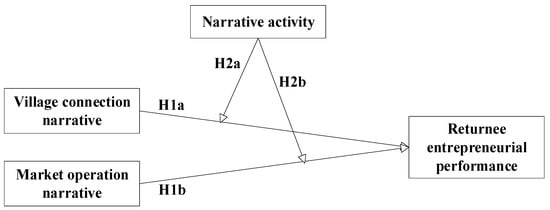
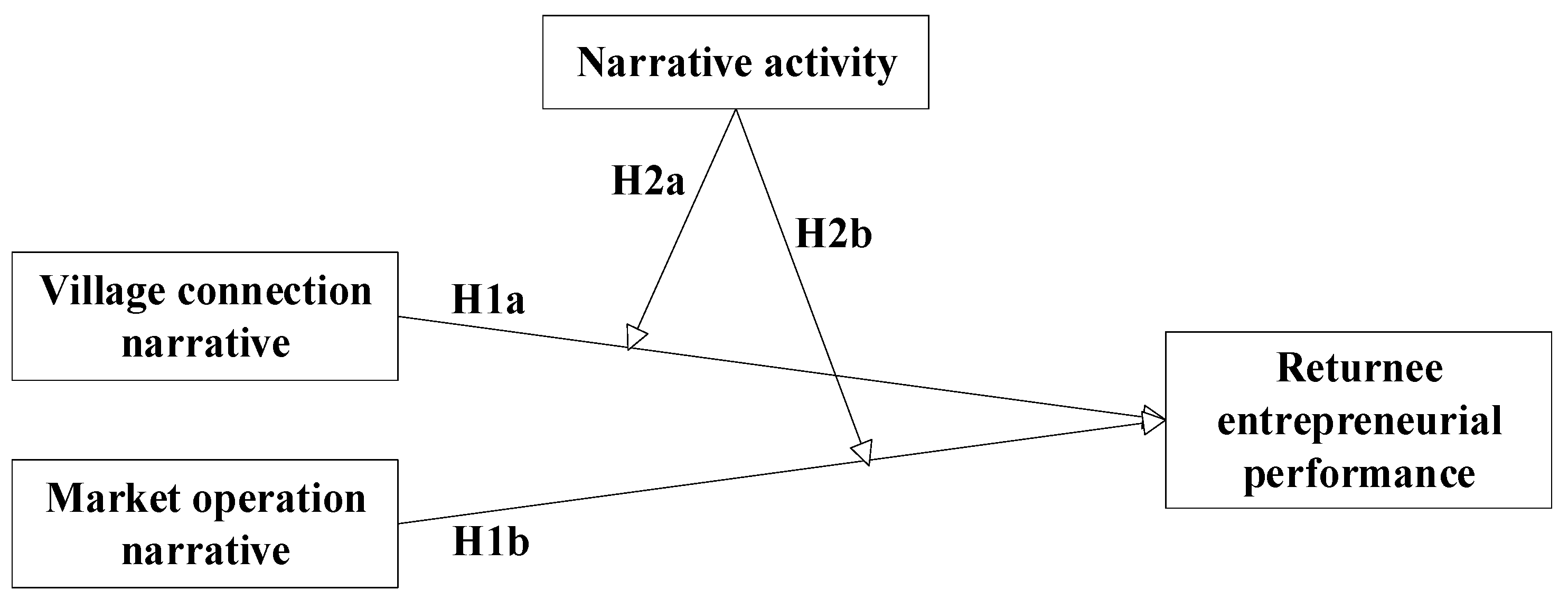
Figure 1 summarises the theoretical model and proposed relationships.
Figure 1.
Theoretical model.
3. Materials and Methods
3.1. Sample and Data Collection
This study used monthly data on returnee entrepreneurs operating on Douyin (Beijing Douyin Technology Co., Ltd., Beijing, China) from January to July 2025. Data were collected from two sources. Profile biographies and video content were obtained directly from Douyin through a web crawler, while sales and product information were obtained from XinDou (Shanghai Newrank Information Technology Co., Ltd., Shanghai, China), a third-party Douyin analytics platform. The two sources were matched at the account and month levels.
Returnee entrepreneurs were defined as individuals who had acquired experience away from home, returned to their home village or place of origin, and subsequently engaged in entrepreneurial activity. Candidate accounts were initially identified using four Chinese search terms in account names and profiles: “返乡创业” (return entrepreneurship), “新农人创业” (new-farmer entrepreneurship), “乡村守护人” (village guardian), and “回乡创业” (return-home entrepreneurship). Three of these search terms contained expressions that also appeared in the VCN dictionary:“返乡” (returning to one’s hometown), “新农人” (new-farmer), and “乡村” (village). The terms were used only for initial screening; final inclusion required manual verification of prior experience away from home, subsequent return to the home area, and current entrepreneurial activity. Duplicate, inactive, invalid, and unverifiable accounts were excluded. We identified 700 eligible returnee entrepreneur accounts for the January–July 2025 observation period. Sales revenue was available for 2366 account-month observations from 576 accounts. Applying the data-availability requirements for the remaining analysis variables yielded an unbalanced panel of 1922 account-month observations from 476 entrepreneurs. This reduction reflects the availability of XinDou sales data and other analysis variables and may introduce sample selection that affects the representativeness of the analytical sample. Among these entrepreneurs, 371 contributed at least two usable monthly observations, whereas 105 contributed only one observation. The fixed-effects estimator retained these singleton observations in the reported estimation sample, but they provided no within-entrepreneur variation and therefore did not contribute to identification of the focal coefficients. The effective sample contributing to within-entrepreneur identification comprised 1817 observations from 371 entrepreneurs. Within this effective sample, the within-entrepreneur standard deviations were 0.0425 for VCN and 0.0260 for MON. The full sample-construction process and panel structure are reported in Supplementary Table S4.
At each monthly observation, the crawler recorded the account biography and textual content associated with the first three videos displayed on its profile. Selection followed display position rather than publication date. Pinned videos were included if they occupied those positions, and displayed videos were not necessarily posted during the preceding 30 days. The combined texts measure narrative themes prominently presented on the profile at the observation point, rather than all content posted during the month. The same collection protocol was applied across monthly observations. Douyin profile information was publicly accessible at the time of collection.
3.2. Measures
3.2.1. Dependent Variable
Returnee entrepreneurial performance reflects the commercial performance of the venture on the platform. We measured performance using merchandise sales revenue during the preceding 30 days, obtained from XinDou. Sales revenue was recorded in Chinese yuan, and PERF was calculated as the natural logarithm of sales revenue plus one. The transformation retains observations with zero sales, while missing sales values were treated as missing rather than as zero.
3.2.2. Independent Variables
We measured village connection narrative and market operation narrative using customised Chinese dictionaries. Dictionary measures capture the relative frequency of theoretically defined content in entrepreneurial texts [13,45,56]. Because existing dictionaries do not reflect the meanings specific to returnee entrepreneurship, we developed separate dictionaries for the two constructs.
Dictionary development combined theory-guided seed selection, corpus-based semantic expansion, and manual screening. Seed terms were derived from the construct definitions and relevant research. The village connection dictionary covered return experience, village relationships, production practices, collaboration with farmers, local culture, and contributions to village development [12,57,58,59]. The market operation dictionary covered product development, production processes, quality improvement, marketing, customer service, and market operations [60]. A Word2Vec model was used to identify semantically related candidate terms, which were then reviewed in their textual contexts for conceptual relevance. The final dictionaries contained 116 VCN terms and 110 MON terms. The complete Chinese dictionaries are provided in Supplementary Table S1; a concise account of their development is given in Table S2.
Texts were segmented using Jieba, and Chinese stop words were removed. For each account-month text, VCN and MON scores were calculated as dictionary-term occurrences divided by the total number of retained tokens. Higher scores indicate greater relative emphasis on the corresponding narrative content. Two doctoral coders independently rated a month-stratified random sample of 105 account-month texts. VCN and MON were rated separately on an ordered five-point scale from 0 to 4 based on the extent and elaboration of substantively relevant content. VCN ratings considered return experience, continuing village relationships, participation in village production, and contribution to village development, whereas MON ratings considered production organisation, product development, quality control, marketing, and other market operations. Inter-coder agreement was good, with ICC(2,2) values of 0.858 for VCN and 0.811 for MON (Table S3). However, convergence between the mean human ratings and the corresponding dictionary scores was modest, with Spearman’s ρ = 0.245 (p = 0.012) for VCN and ρ = 0.333 (p < 0.001) for MON (Table S3). Table 1 presents illustrative terms from the two dictionaries.
Table 1.
Examples of village connection narrative and market operation narrative dictionary terms.
3.2.3. Moderating Variable
Narrative activity captures the frequency of account-level content updates through which entrepreneurial narratives are presented. We measured NA as the number of short videos posted during the preceding 30 days and transformed the count using ln(x + 1).
3.2.4. Control Variables
We grouped the controls into audience composition, commercial activity, and platform engagement and audience size. Audience composition was measured by the proportion of male followers. Commercial activity included livestream activity and product count. Platform engagement and audience size included likes, shares, and follower count. Non-negative count variables were transformed using ln(x + 1). Because the latter measures may evolve jointly with narratives and sales, the control groups were introduced sequentially to assess the stability of the focal estimates across specifications. Table 2 summarises the definitions and operationalisation of all variables used in the analyses.
Table 2.
Variable definitions and measures.
3.3. Model Specification
We estimated entrepreneur fixed-effects models using the monthly panel data. Entrepreneur fixed effects account for time-invariant differences across entrepreneurs, while time fixed effects capture shocks common to all accounts. Standard errors were clustered at the entrepreneur level. We introduced the control variables sequentially to assess the sensitivity of the focal estimates to alternative control sets. The baseline specifications included entrepreneur and time fixed effects. Subsequent specifications added the control groups described above, with platform engagement introduced last because these measures may evolve jointly with entrepreneurial narratives and performance.
H1a was tested by estimating the association between village connection narrative and returnee entrepreneurial performance. For H1b, we included both the linear and squared terms of market operation narrative. We evaluated the proposed inverted U-shaped relationship using the quadratic term, slopes at the lower and upper bounds, an inverse-U test, and the estimated turning point [61]. We also examined whether the turning point lay within the observed range and whether sufficient observations occurred on both sides. The moderation models included narrative activity and its interactions with the focal narrative terms. H2a was tested using the interaction between village connection narrative and narrative activity. For H2b, we included both MON × NA and MON2 × NA. Because moderation of a quadratic relationship cannot be inferred from either interaction coefficient alone, we evaluated the conditional curves at low, mean, and high levels of narrative activity. We examined their slopes, quadratic terms, turning points, and inverse-U tests to assess whether higher narrative activity flattened the relationship.
4. Results
4.1. Descriptive Statistics, Correlations, and Multicollinearity
Table 3 reports the descriptive statistics and pairwise correlations for the study variables. The mean values of VCN and MON were 0.082 and 0.054, respectively, while the mean of narrative activity was 2.760. VCN and MON were moderately and positively correlated (r = 0.345, p < 0.01), indicating that the two themes tended to co-occur. Among the control variables, likes and shares showed the strongest correlation (r = 0.809, p < 0.01). Follower count was also positively correlated with likes (r = 0.664, p < 0.01) and shares (r = 0.557, p < 0.01). The remaining correlations were generally moderate. These patterns suggest that platform engagement and audience size are related but not interchangeable dimensions of account activity. Variance inflation factors ranged from 1.04 to 3.85, suggesting no serious multicollinearity.
Table 3.
Descriptive statistics and correlations.
4.2. Main Effects
Table 4 reports seven fixed-effects specifications for the main effects. Models 1–3 examine H1a using progressively richer control sets. Model 1 includes entrepreneur and time fixed effects only. Model 2 adds audience composition and commercial activity, while Model 3 further includes platform engagement and audience size. Models 4–6 follow the same sequence for H1b by including the linear and squared terms of MON. Model 7 jointly includes VCN, MON, and MON squared as a sensitivity specification.
Table 4.
Main effects of entrepreneurial narratives on returnee entrepreneurial performance.
VCN was positively associated with PERF across Models 1–3. The coefficient declined from 3.775 (SE = 1.118, p < 0.01) in Model 1 to 3.106 (SE = 1.059, p < 0.01) in Model 2 and 2.915 (SE = 1.024, p < 0.01) in Model 3. In the joint specification, the VCN coefficient remained positive and significant (b = 2.379, SE = 1.022, p < 0.05). These results support H1a. For H1b, the linear MON coefficient was positive and the squared term was negative across Models 4–7, indicating a consistently concave relationship. In Model 6, the most extensively adjusted hypothesis-specific specification, the linear coefficient was 7.083 (SE = 3.068, p < 0.05) and the squared coefficient was −18.436 (SE = 9.685, p < 0.10).
Table 5 reports the endpoint slopes, inverse-U tests, and turning points. In Model 6, the slope at the lower bound was positive and significant (b = 7.083, p = 0.011), while the slope at the upper bound was negative but only marginally significant (b = −8.517, p = 0.060). The full-range inverse-U test produced p = 0.060. The estimated turning point was 0.192, with a 95% confidence interval of [0.115, 0.269], and lay within the observed MON range of 0 to 0.423. However, the P1–P99 inverse-U test was not significant (p = 0.548), and only 11 observations, or 0.57% of the sample, lay above the estimated turning point. The joint specification yielded stronger full-range evidence (p = 0.038), but the P1–P99 test remained nonsignificant (p = 0.194). These results indicate a diminishing marginal association: MON was positively associated with performance at lower levels, but its marginal association weakened as MON increased. The unconditional models did not establish a complete inverted U-shaped relationship over the central P1–P99 range.
Table 5.
U test for the market operation narrative and returnee entrepreneurial performance.
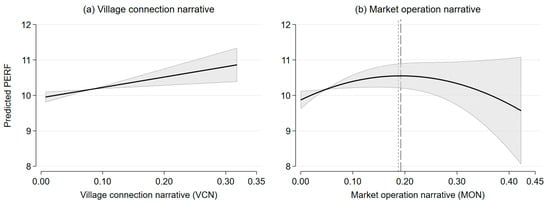
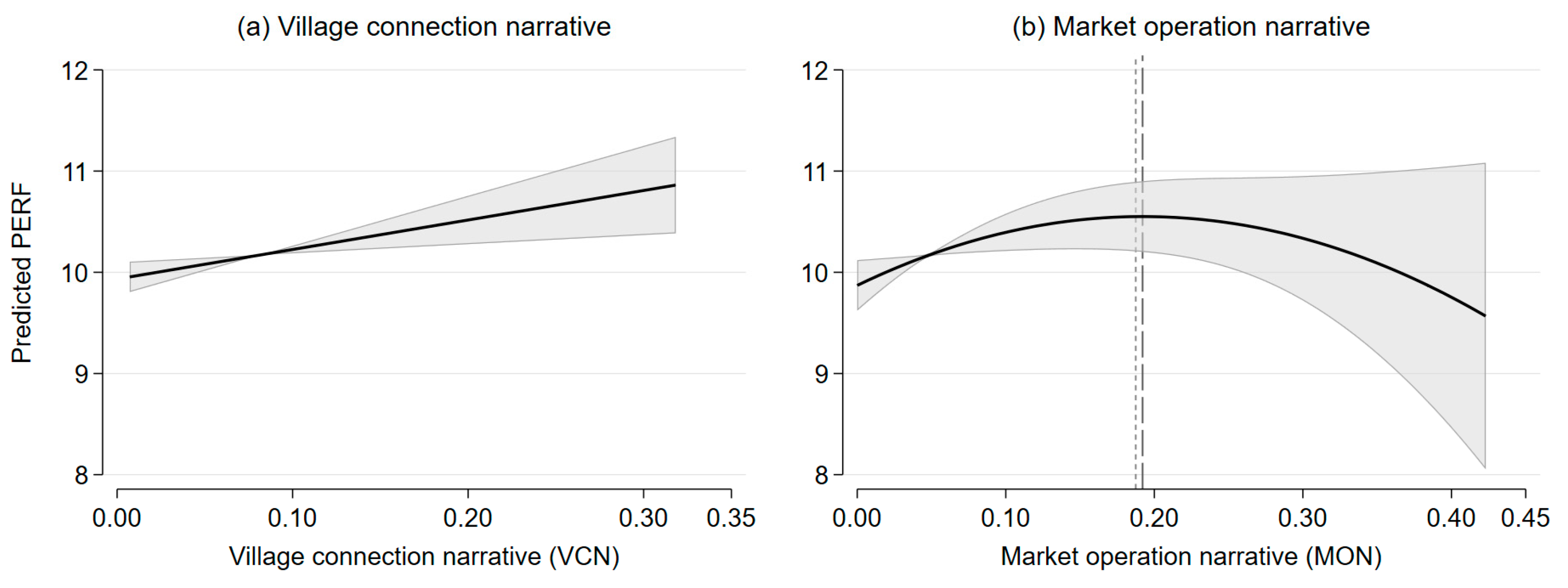
Table 6 reports the substantive magnitude of the two main relationships. Moving VCN from its 25th percentile (0.041) to its 75th percentile (0.102) was associated with a 19.5% increase in predicted performance (95% CI [5.7%, 35.2%], p = 0.005). Moving MON from its 25th percentile (0.025) to its 75th percentile (0.073) was associated with a 28.6% increase in predicted performance (95% CI [4.5%, 58.4%], p = 0.018). Both MON percentiles lie below the estimated turning point, so this comparison represents the increasing portion of the estimated relationship. Figure 2 illustrates the estimated relationships between the two narrative measures and performance.
Table 6.
Substantive effect sizes for the main relationships.
Figure 2.
Estimated relationships between entrepreneurial narratives and returnee entrepreneurial performance. Notes. Panel (a) shows the estimated relationship between village connection narrative and performance over the P1–P99 empirical range of VCN. Panel (b) shows the estimated relationship between market operation narrative and performance over the full observed MON range. Shaded areas indicate 95% confidence intervals. In Panel (b), the long-dashed vertical line marks the estimated turning point and the short-dashed vertical line marks the 99th percentile of MON.
4.3. Moderating Effects
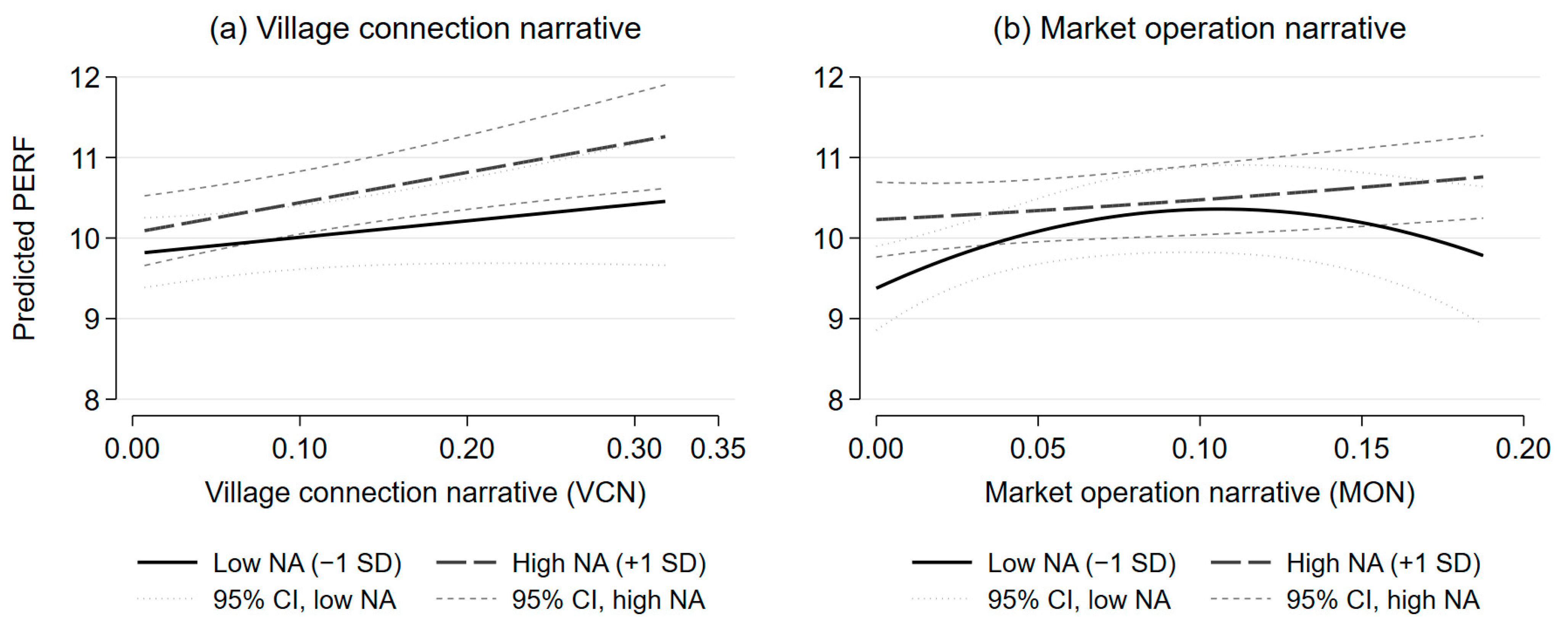
Table 7 reports the moderating effects of narrative activity. VCN, MON, and NA were mean-centred before constructing the interaction and quadratic terms. Models 8 and 10 include entrepreneur and time fixed effects only. Models 9 and 11 additionally include audience composition, commercial activity, and platform engagement and audience size. For H2a, the interaction between VCN and NA was positive but not statistically significant in either Model 8 (b = 1.204, SE = 0.859) or Model 9 (b = 0.800, SE = 0.736). The conditional VCN slope increased from 2.049 at low NA to 2.902 at mean NA and 3.755 at high NA. However, the interaction term itself remained nonsignificant. H2a was therefore not supported. For H2b, Model 11 showed a negative but nonsignificant MON × NA coefficient (b = −3.065, SE = 1.864) and a positive and significant MON squared × NA coefficient (b = 42.926, SE = 18.893, p = 0.024). Model 11 allows the MON curve to vary with NA, whereas Model 6 estimates a common MON curve, which accounts for the different curvature and turning-point estimates across the two models.
Table 7.
Moderating effects of narrative activity.
Table 8 reports conditional diagnostics derived from Model 11 at low, mean, and high levels of NA. At low NA, the conditional quadratic coefficient was −87.272, and the P1–P99 inverse-U test was significant (p = 0.027). At mean NA, the quadratic coefficient weakened to −41.512, and the P1–P99 inverse-U test became marginally significant (p = 0.068). At high NA, the conditional quadratic coefficient was 4.249 and was no longer negative. The complete inverted U-shaped pattern predicted in H1b was therefore supported within the central MON range at low NA, received only marginal support at mean NA, and was not evident at high NA. Formal contrasts provide direct evidence of this flattening pattern. Moving from low to high NA increased the quadratic coefficient by 91.521 (p = 0.024), reduced the slope at the lower end of the MON distribution by 16.496 (p = 0.036), and increased the slope at the upper end by 17.824 (p = 0.028). Higher NA therefore weakened the positive marginal association at lower levels of MON and attenuated the negative marginal association at higher levels. The turning point shifted from 0.106 at low NA to 0.124 at mean NA, although this shift was only marginally significant (Δ = 0.018, p = 0.090). No turning point was interpreted at high NA because the conditional relationship was no longer concave. Taken together, the significant MON2 × NA interaction and the formal contrasts in Table 8, Panel C, support H2b. Figure 3 illustrates the conditional relationships at low and high levels of NA.
Table 8.
Conditional moderation diagnostics. Panel (A). Simple slopes for H2a. Panel (B). Conditional nonlinear relationship for H2b. Panel (C). Formal tests of flattening.
Figure 3.
Moderating effects of narrative activity. Notes. Panel (a) shows the conditional relationship between village connection narrative and performance at low and high levels of narrative activity. Panel (b) shows the corresponding conditional relationship for market operation narrative. Low and high narrative activity represent one standard deviation below and above the mean. Boundary lines indicate 95% confidence intervals. Both panels are shown over the P1–P99 empirical range of the focal narrative variable.
4.4. Robustness Tests
We conducted four sets of robustness analyses to assess whether the main findings were sensitive to alternative outcome measurement, textual characteristics, unobserved time-varying conditions, and extreme values. First, we replaced the primary sales-revenue measure with monthly sales volume monitored by the same third-party platform. Sales volume was measured as the number of product units sold during the month and transformed as ln(sales volume + 1). This alternative measure changes the operationalisation of entrepreneurial performance while holding the data source constant. Second, we additionally controlled for narrative scale and narrative sentiment to examine whether the focal associations reflected differences in the amount of textual material or general textual valence rather than narrative content itself. Third, we estimated more restrictive fixed-effects specifications that absorbed province-by-time, product-category-by-time, and province-by-product-category-by-time effects. These models account for time-varying conditions shared by entrepreneurs in the same province or product category, while retaining entrepreneur fixed effects. Fourth, we examined sensitivity to extreme observations by winsorising the dependent variable and continuous covariates at the 1st and 99th percentiles. VCN, MON, and NA were left unchanged so that the empirical ranges used to identify the nonlinear and moderating relationships were not mechanically compressed.
Table 9 summarises the robustness analyses. Table 10 reports the corresponding nonlinear diagnostics for H1b. The positive association between VCN and PERF was stable across all specifications, with coefficients ranging from 2.077 to 3.488 and remaining statistically significant throughout. The VCN × NA interaction remained nonsignificant in every specification, providing no additional support for H2a. The positive MON squared × NA interaction was similarly stable, ranging from 35.603 to 43.293 and remaining statistically significant across all robustness tests. These results indicate that the positive VCN association and the flattening pattern proposed in H2b are not confined to the benchmark specification. The evidence for H1b was more sensitive to model specification. The MON quadratic coefficient remained negative across all robustness tests, indicating that its marginal association with performance weakened as MON increased. Full-range inverse-U tests provided significant or marginal evidence in the benchmark model, the specification controlling for narrative scale and sentiment, all three high-dimensional fixed-effects models, and the winsorised specification. The alternative performance measure, however, did not reproduce the full inverted-U pattern. More importantly, none of the robustness specifications established a statistically significant downturn over the P1–P99 range of MON. The robustness evidence therefore supports a weakening marginal MON–PERF association rather than a robust unconditional inverted U-shaped relationship. Additional dictionary sensitivity analyses are reported in Supplementary Table S5. The VCN association remained positive across the alternative dictionaries; the MON estimates retained negative curvature, but evidence of a complete inverted U-shaped relationship remained limited.
Table 9.
Robustness of the main and moderating effects.
Table 10.
Nonlinear diagnostics for H1b across robustness specifications.
We also examined persistence in the profile-facing textual measures. Among 1225 consecutive account-month pairs, 112 (9.14%) contained identical cleaned texts. Excluding these repeated snapshots left the MON squared × NA interaction positive (b = 43.358, SE = 20.073, p = 0.031). Excluding 332 observations with high textual overlap yielded a similar estimate (b = 41.542, SE = 19.748, p = 0.036). These checks suggest that highly persistent profile text does not account for the estimated flattening pattern, although the three-video snapshots do not represent complete monthly posting histories.
4.5. Temporal Ordering and Reverse-Direction Analyses
To address concerns about temporal ordering and overlapping measurement windows, we estimated one-period-ahead fixed-effects models in which narrative measures at t − 1 predicted PERF at t. As shown in Table 11, lagged VCN remained positively associated with subsequent performance both without lagged covariates (b = 3.062, SE = 1.135) and after lagged covariates were included (b = 3.007, SE = 1.141). These estimates are consistent with the VCN–performance association extending beyond contemporaneous measurement.
Table 11.
Temporal-ordering and reverse-direction analyses. Panel (A). Lagged narratives predicting subsequent performance. Panel (B). Prior performance predicting subsequent narratives.
The corresponding evidence for MON was weaker. Neither the lagged linear MON term nor its squared term was statistically significant, and the quadratic coefficient was positive rather than negative. The hypothesised nonlinear relationship was therefore not reproduced in the one-period-ahead models. The contemporaneous MON specification was likewise unsupported in the same consecutive-month subsample. The weaker lagged estimates should therefore not be attributed solely to the introduction of a temporal lag. This result provides no additional support for the complete inverted U-shaped prediction in H1b. We also estimated reverse-direction fixed-effects models in which prior performance predicted subsequent narrative content. PERF at t − 1 was not significantly associated with VCN at t (b = −0.001, p = 0.188) or MON at t (b ≈ 0, p = 0.765). We therefore found no evidence in these specifications that prior performance systematically predicted subsequent narrative emphasis. These tests improve the temporal interpretation of the observed associations, but they do not rule out reverse relationships operating over other time horizons or other forms of time-varying endogeneity.
5. Discussion
5.1. Theoretical Contributions
This study makes three contributions to research on cultural entrepreneurship, returnee entrepreneurship, and digital entrepreneurial narratives.
First, the study advances cultural entrepreneurship research by clarifying how different narrative functions relate to entrepreneurial performance. Existing research shows how narratives convey entrepreneurial identity, future possibilities, resource use, and the significance of place [18,20,21,22,23]. We extend this work by examining two functions within the same venture setting. VCN presents the venture’s village relationships and local contribution, whereas MON explains its operating practices and market value. Their distinct performance associations suggest that the entrepreneurial foundations made intelligible through narratives matter for how narrative content relates to performance. VCN was positively associated with performance, whereas the positive association of MON weakened as its emphasis increased. A complete inverted U-shaped pattern emerged only at low narrative activity.
Second, the study extends explanations of returnee entrepreneurial performance by incorporating the narrative presentation of entrepreneurial resources and relationships. Prior research explains how migration experience, resource endowments, local embeddedness, and digital opportunities support venture formation and market participation [2,4,6,15]. These perspectives establish the importance of the resources and relationships on which returnee ventures depend. Our findings add that narratives presenting village relationships and market operations have distinct associations with performance. This directs attention to how returnee entrepreneurs present the significance of their locally embedded relationships and externally acquired experience to consumers beyond their home villages. It connects cultural entrepreneurship with a central concern in returnee entrepreneurship research: how ventures combine resources acquired elsewhere with relationships rooted in the home village.
Third, the study advances research on digital entrepreneurial narratives by examining narrative activity alongside narrative content. Existing research shows that entrepreneurial meanings can be communicated through multiple brief messages and narrative fragments [24,25]. Our findings extend this perspective by showing that the performance implications of narrative activity differ across narrative functions. The expected strengthening of the VCN–performance relationship was not supported, whereas higher NA was associated with a flatter MON–performance relationship. These contrasting results indicate that greater narrative activity does not uniformly strengthen the performance associations of entrepreneurial narratives. Its role must be understood in relation to the narrative content being emphasised.
5.2. Practical Implications
The findings offer practical insights for returnee entrepreneurs, digital platforms, and entrepreneurship support organisations.
For returnee entrepreneurs, the findings highlight the value of grounding entrepreneurial narratives in actual village relationships and operating practices. Village connection narratives can draw on experiences of returning home, cooperation with local producers, and contributions to village development. Market operation narratives can explain product development, production processes, quality control, and responses to customer needs. Such accounts can provide audiences with concrete information about the venture’s operations and products. Entrepreneurs can also plan short-video content around ongoing venture activities rather than treating more frequent posting as a goal in itself. This approach gives attention to both narrative content and activity while allowing entrepreneurs to develop narratives suited to their ventures.
For digital platforms, the findings suggest opportunities to improve creator analytics. Creator tools could help entrepreneurs review village connection and market operation content alongside posting activity and available sales indicators. For example, monthly summaries could show how narrative emphasis and short-video activity vary alongside merchandise sales. Such feedback would help creators assess their own narrative practices without prescribing a particular narrative mix or posting frequency.
For entrepreneurship support organisations, narrative training could complement existing assistance with venture operations and market access. Training could help returnee entrepreneurs develop short-video content from their actual migration experiences, village relationships, and operating practices. Practical exercises could involve documenting cooperation with local farmers, explaining product quality, or showing how experience acquired elsewhere informs current operations. Such training would help entrepreneurs present the distinctive foundations of their ventures through concrete entrepreneurial activities.
5.3. Limitations and Future Research
This study has several limitations. First, the dictionary measures capture the focal narrative constructs imperfectly. Although inter-coder agreement was good, correspondence between human ratings and dictionary scores was modest, with Spearman’s ρ of 0.245 for VCN and 0.333 for MON. Measurement error may therefore attenuate the estimated associations. Dictionary-based analysis also omits visual and audio information contained in short videos. Future research could combine text, visual, and audio measures to capture entrepreneurial narratives more fully. Second, sample construction may limit representativeness. Keyword-based identification may omit returnee entrepreneurs who use different self-descriptions, while some sampling terms overlap with the VCN vocabulary. The availability of XinDou sales data and other analysis variables may introduce further selection. In addition, 105 entrepreneurs contributed only one usable observation and therefore did not contribute to within-entrepreneur identification. Future studies could use broader sampling strategies and more complete longitudinal coverage. Third, the timing of the measures constrains interpretation. VCN and MON were measured from profile biographies and the first three displayed videos, whereas NA and performance refer to the preceding 30 days. Displayed videos could be pinned or posted outside the same 30-day period. NA therefore captures overall posting activity rather than the frequency of VCN- or MON-specific content. The seven-month panel and overlapping measurement windows also limit assessment of longer-term dynamics and temporal ordering. Longer panels with non-overlapping windows and content-specific activity measures could address these limitations. Fourth, the observational design does not establish causal mechanisms. Entrepreneur and time fixed effects cannot eliminate time-varying omitted factors or fully rule out reverse relationships. The study also does not directly observe how audiences interpret village relationships, operating practices, or commercial cues. Moreover, evidence for a complete inverted U-shaped MON relationship was limited outside low-activity accounts. Finally, the focus on Douyin and short-term merchandise sales limits generalisability to other platforms and dimensions of entrepreneurial performance. Future research could use audience-based designs, longer observation periods, and comparative platform settings to examine these boundaries.
6. Conclusions
This study examined how VCN and MON relate to returnee entrepreneurial performance on Douyin and whether NA conditions these relationships. VCN was positively associated with performance, whereas MON showed a concave relationship with limited evidence for its declining segment. NA did not significantly strengthen the VCN–performance relationship but was associated with a flatter MON–performance relationship. These findings highlight the importance of distinguishing how returnee entrepreneurs present village relationships and market operations through narratives. They also show that narrative activity does not have the same implications across different forms of narrative content. By examining narrative content and activity together, the study extends understanding of how returnee entrepreneurs present their ventures and how these narratives relate to performance in digital markets.
Supplementary Materials
The following supporting information can be downloaded at: https://www.mdpi.com/article/10.3390/jtaer21100342/s1. Table S1, Complete Chinese dictionaries and corpus frequencies; Table S2, Dictionary development and measurement; Table S3, Independent human-coding assessment of dictionary measures; Table S4, Analytical sample and panel structure; Table S5, Dictionary sensitivity analyses.
Author Contributions
Conceptualization, C.Z. and Y.Z.; methodology, Y.Z. and R.Z.; software, Y.Z.; validation, C.Z.; formal analysis, Y.Z.; investigation, Y.Z.; resources, C.Z.; data curation, R.Z. and Y.Z.; writing—original draft preparation, R.Z. and Y.Z.; writing—review and editing, R.Z. and Y.Z.; visualization, C.Z.; supervision, C.Z.; project administration, C.Z. All authors have read and agreed to the published version of the manuscript.
Funding
This research was funded by the Graduate Innovation Fund of Shanghai University of Finance and Economics, grant number CXJJ-2025-416.
Institutional Review Board Statement
Not applicable. This study used publicly accessible online information and secondary data from a third-party monitoring service and involved no direct interaction or intervention with human participants.
Informed Consent Statement
Not applicable. No participants were recruited or directly involved in the study.
Data Availability Statement
The data presented in this study are available from the corresponding author upon reasonable request. The data are not publicly available because they were collected from digital platforms and are subject to platform and third-party data restrictions.
Acknowledgments
During the preparation of this manuscript, the authors used ChatGPT (GPT-5.5, OpenAI) to improve the language and clarity of the text. The authors reviewed and edited the output and take full responsibility for the content of the publication.
Conflicts of Interest
The authors declare no conflicts of interest.
Abbreviations
The following abbreviations are used in this manuscript:
| VCN | Village connection narrative |
| MON | Market operation narrative |
| NA | Narrative activity |
| PERF | Returnee entrepreneurial performance |
| FE | Fixed effects |
References
- Bao, A.; Pang, G.; Zeng, G. Entrepreneurial effect of rural return migrants: Evidence from China. Front. Psychol. 2022, 13, 1078199. [Google Scholar] [CrossRef] [Scilit]
- Démurger, S.; Xu, H. Return migrants: The rise of new entrepreneurs in rural China. World Dev. 2011, 39, 1847–1861. [Google Scholar] [CrossRef] [Scilit]
- Ma, Z. Urban labour-force experience as a determinant of rural occupation change: Evidence from recent urban-rural return migration in China. Environ. Plan. A 2001, 33, 237–255. [Google Scholar] [CrossRef] [Scilit]
- Ma, Z. Social-capital mobilization and income returns to entrepreneurship: The case of return migration in rural China. Environ. Plan. A 2002, 34, 1763–1784. [Google Scholar] [CrossRef] [Scilit]
- Wang, T.; Liu, J.; Zhu, H.; Jiang, Y. The impact of risk aversion and migrant work experience on farmers’ entrepreneurship: Evidence from China. Agriculture 2024, 14, 209. [Google Scholar] [CrossRef] [Scilit]
- Koo, W.W.-Y.; Eesley, C.E. Take me home, country roads: Return migration and platform-enabled entrepreneurship. Organ. Sci. 2025, 36, 1202–1220. [Google Scholar] [CrossRef] [Scilit]
- Nambisan, S. Digital entrepreneurship: Toward a digital technology perspective of entrepreneurship. Entrep. Theory Pract. 2017, 41, 1029–1055. [Google Scholar] [CrossRef] [Scilit]
- Autio, E.; Nambisan, S.; Thomas, L.D.W.; Wright, M. Digital affordances, spatial affordances, and the genesis of entrepreneurial ecosystems. Strateg. Entrep. J. 2018, 12, 72–95. [Google Scholar] [CrossRef] [Scilit]
- Nambisan, S.; Wright, M.; Feldman, M. The digital transformation of innovation and entrepreneurship: Progress, challenges and key themes. Res. Policy 2019, 48, 103773. [Google Scholar] [CrossRef] [Scilit]
- Leong, K.Y.; Ho, J.S.Y.; Tehseen, S.; Yafi, E.; Cham, T.-H. The intangible values of live streaming and their effect on audience engagement. J. Mark. Anal. 2024, 12, 990–1005. [Google Scholar] [CrossRef] [Scilit]
- He, Y.; Huang, N.; Wang, L.; Sun, Y. Real-time sales data, streamer improvisation, and sales performance: Evidence from live stream selling. MIS Q. 2025, 49, 1567–1594. [Google Scholar] [CrossRef] [Scilit]
- Zhao, L. Selling rural China: The construction and commodification of rurality in Chinese promotional livestreaming. Media Cult. Soc. 2024, 46, 481–499. [Google Scholar] [CrossRef] [Scilit]
- Zhao, C.; Liu, Z.; Zhang, C. Real or fictional? Digital entrepreneurial narratives and the acquisition of attentional resources in social entrepreneurship. J. Innov. Knowl. 2023, 8, 100387. [Google Scholar] [CrossRef] [Scilit]
- Ding, H.; Dong, W.; Qin, C. Does migrant working experience stimulate returnees’ entrepreneurship: Evidence from rural China. J. Econ. Behav. Organ. 2025, 229, 106865. [Google Scholar] [CrossRef] [Scilit]
- Wang, Y.; Jiang, Y.; Geng, B.; Wu, B.; Liao, L. Determinants of returnees’ entrepreneurship in rural marginal China. J. Rural Stud. 2022, 94, 429–438. [Google Scholar] [CrossRef] [Scilit]
- Chen, Y.; Huang, R.; Zeng, Y.; Huang, Q. Research on the impact of digital inclusive finance on the performance of rural returnee entrepreneurs in China. Sci. Rep. 2024, 14, 22077. [Google Scholar] [CrossRef] [Scilit]
- Yin, J.; Yi, G.; Ma, R.; Chen, L.; Yang, S. Does the digitalization of hometowns promote return migrants’ entrepreneurship? Empirical evidence from panel data for China. Appl. Geogr. 2026, 186, 103855. [Google Scholar] [CrossRef] [Scilit]
- Lounsbury, M.; Glynn, M.A. Cultural entrepreneurship: Stories, legitimacy, and the acquisition of resources. Strateg. Manag. J. 2001, 22, 545–564. [Google Scholar] [CrossRef] [Scilit]
- Martens, M.L.; Jennings, J.E.; Jennings, P.D. Do the stories they tell get them the money they need? The role of entrepreneurial narratives in resource acquisition. Acad. Manag. J. 2007, 50, 1107–1132. [Google Scholar] [CrossRef] [Scilit]
- Navis, C.; Glynn, M.A. Legitimate distinctiveness and the entrepreneurial identity: Influence on investor judgments of new venture plausibility. Acad. Manag. Rev. 2011, 36, 479–499. [Google Scholar] [CrossRef] [Scilit]
- Fisher, G.; Neubert, E.; Burnell, D. Resourcefulness narratives: Transforming actions into stories to mobilize support. J. Bus. Ventur. 2021, 36, 106122. [Google Scholar] [CrossRef] [Scilit]
- Garud, R.; Schildt, H.A.; Lant, T.K. Entrepreneurial storytelling, future expectations, and the paradox of legitimacy. Organ. Sci. 2014, 25, 1479–1492. [Google Scholar] [CrossRef] [Scilit]
- Kimmitt, J.; Kibler, E.; Schildt, H.; Oinas, P. Place in entrepreneurial storytelling: A study of cultural entrepreneurship in a deprived context. J. Manag. Stud. 2024, 61, 1036–1073. [Google Scholar] [CrossRef] [Scilit]
- Fischer, E.; Reuber, A.R. Online entrepreneurial communication: Mitigating uncertainty and increasing differentiation via Twitter. J. Bus. Ventur. 2014, 29, 565–583. [Google Scholar] [CrossRef] [Scilit]
- Phillips, D.; Moore, C.B.; Rutherford, M.W. Legitimating language and emotional tone in antenarratives: A cultural entrepreneurship perspective. J. Bus. Res. 2025, 186, 114988. [Google Scholar] [CrossRef] [Scilit]
- Silva, B.G.; Andriese, N.C.; Combs, J.G. Return migrant entrepreneurship: A systematic review and future research agenda. Entrep. Theory Pract. 2026, 50, 115–149. [Google Scholar] [CrossRef] [Scilit]
- Duan, J.; Yin, J.; Xu, Y.; Wu, D. Should I stay or should I go? Job demands’ push and entrepreneurial resources’ pull in Chinese migrant workers’ return-home entrepreneurial intention. Entrep. Reg. Dev. 2020, 32, 429–448. [Google Scholar] [CrossRef] [Scilit]
- Xi, C.; Zhang, Y.; Zhao, X.; Qu, X. Does migration work experience promote return home for entrepreneurship? The mediation of cognitive ability and the moderation of risk preference. J. Knowl. Econ. 2025, 16, 317–338. [Google Scholar] [CrossRef] [Scilit]
- Zhao, X.; Marjerison, R.K.; Peng, C. The impact and effectiveness of China’s entrepreneurship policy for back-home migrant workers. Humanit. Soc. Sci. Commun. 2024, 11, 623. [Google Scholar] [CrossRef] [Scilit]
- Haarman, A.; Langevang, T. Capitalizing on translocal affiliations: Configuring capital in returnee entrepreneurship. Glob. Netw. 2021, 21, 703–722. [Google Scholar] [CrossRef] [Scilit]
- Redhead, G.; Bika, Z. Is home where the heart is? Investigating the relationship between hometown and entrepreneurship. Entrep. Reg. Dev. 2025, 37, 433–459. [Google Scholar] [CrossRef] [Scilit]
- Shen, L.; Wang, F. Can migrant workers returning home for entrepreneurship increase agricultural labor productivity: Evidence from a quasi-natural experiment in China. Agriculture 2024, 14, 905. [Google Scholar] [CrossRef] [Scilit]
- Xu, X.; Jin, Z. Impact of return migration on employment structure: Evidence from rural China. J. Asian Econ. 2024, 91, 101697. [Google Scholar] [CrossRef] [Scilit]
- Yang, M.; Peng, H.; Yue, S. How returning home for entrepreneurship affects rural common prosperity. Int. Rev. Econ. Finance 2025, 98, 103871. [Google Scholar] [CrossRef] [Scilit]
- Gartner, W.B. Entrepreneurial narrative and a science of the imagination. J. Bus. Ventur. 2007, 22, 613–627. [Google Scholar] [CrossRef] [Scilit]
- Überbacher, F. Legitimation of new ventures: A review and research programme. J. Manag. Stud. 2014, 51, 667–698. [Google Scholar] [CrossRef] [Scilit]
- Allison, T.H.; McKenny, A.F.; Short, J.C. The effect of entrepreneurial rhetoric on microlending investment: An examination of the warm-glow effect. J. Bus. Ventur. 2013, 28, 690–707. [Google Scholar] [CrossRef] [Scilit]
- Clarke, J.S.; Cornelissen, J.P.; Healey, M.P. Actions speak louder than words: How figurative language and gesturing in entrepreneurial pitches influences investment judgments. Acad. Manag. J. 2019, 62, 335–360. [Google Scholar] [CrossRef] [Scilit]
- Naimi, A.; Arenas, D.; Kickul, J.; Awan, S. Too emotional to succeed: Entrepreneurial narratives in a prosocial setting. Int. J. Entrep. Behav. Res. 2023, 29, 687–706. [Google Scholar] [CrossRef] [Scilit]
- Oo, P.P.; Jiang, L.; Sahaym, A.; Parhankangas, A.; Chan, R. Actions in words: How entrepreneurs use diversified and changing speech acts to achieve funding success. J. Bus. Ventur. 2023, 38, 106289. [Google Scholar] [CrossRef] [Scilit]
- Moss, T.W.; Neubaum, D.O.; Meyskens, M. The effect of virtuous and entrepreneurial orientations on microfinance lending and repayment: A signaling theory perspective. Entrep. Theory Pract. 2015, 39, 27–52. [Google Scholar] [CrossRef] [Scilit]
- Parhankangas, A.; Renko, M. Linguistic style and crowdfunding success among social and commercial entrepreneurs. J. Bus. Ventur. 2017, 32, 215–236. [Google Scholar] [CrossRef] [Scilit]
- Taeuscher, K.; Zhao, E.Y.; Lounsbury, M. Categories and narratives as sources of distinctiveness: Cultural entrepreneurship within and across categories. Strateg. Manag. J. 2022, 43, 2101–2134. [Google Scholar] [CrossRef] [Scilit]
- Korsgaard, S.; Ferguson, R.; Gaddefors, J. The best of both worlds: How rural entrepreneurs use placial embeddedness and strategic networks to create opportunities. Entrep. Reg. Dev. 2015, 27, 574–598. [Google Scholar] [CrossRef] [Scilit]
- Allison, T.H.; Davis, B.C.; Short, J.C.; Webb, J.W. Crowdfunding in a prosocial microlending environment: Examining the role of intrinsic versus extrinsic cues. Entrep. Theory Pract. 2015, 39, 53–73. [Google Scholar] [CrossRef] [Scilit]
- Lortie, J.; Cox, K.C.; Roundy, P.T. Social impact models, legitimacy perceptions, and consumer responses to social ventures. J. Bus. Res. 2022, 144, 312–321. [Google Scholar] [CrossRef] [Scilit]
- Soublière, J.; Lockwood, C. Achieving cultural resonance: Four strategies toward rallying support for entrepreneurial endeavors. Strateg. Manag. J. 2022, 43, 1499–1527. [Google Scholar] [CrossRef] [Scilit]
- Dimoka, A.; Hong, Y.; Pavlou, P.A. On product uncertainty in online markets: Theory and evidence. MIS Q. 2012, 36, 395–426. [Google Scholar] [CrossRef] [Scilit]
- Pan, M.; Blut, M.; Ghiassaleh, A.; Lee, Z.W.Y. Influencer marketing effectiveness: A meta-analytic review. J. Acad. Mark. Sci. 2025, 53, 52–78. [Google Scholar] [CrossRef] [Scilit]
- Wang, H.-M.; Zhu, Y.-P.; Lee, K.-T. What signals are you sending? How signal consistency influences consumer purchase behavior in live streaming commerce. J. Theor. Appl. Electron. Commer. Res. 2025, 20, 109. [Google Scholar] [CrossRef] [Scilit]
- Chung, J.; Ding, Y.; Kalra, A. I really know you: How influencers can increase audience engagement by referencing their close social ties. J. Consum. Res. 2023, 50, 683–703. [Google Scholar] [CrossRef] [Scilit]
- Ellen, P.S.; Webb, D.J.; Mohr, L.A. Building corporate associations: Consumer attributions for corporate socially responsible programs. J. Acad. Mark. Sci. 2006, 34, 147–157. [Google Scholar] [CrossRef] [Scilit]
- Lee, S.; Bolton, L.E.; Winterich, K.P. To profit or not to profit? The role of greed perceptions in consumer support for social ventures. J. Consum. Res. 2017, 44, 853–876. [Google Scholar] [CrossRef] [Scilit]
- Leung, F.F.; Gu, F.F.; Li, Y.; Zhang, J.Z.; Palmatier, R.W. Influencer marketing effectiveness. J. Mark. 2022, 86, 93–115. [Google Scholar] [CrossRef] [Scilit]
- Song, S.; Xu, Y.; Ma, B.; Zong, X. Understanding how streamer’s self-presentation in e-commerce live streaming affects consumers: The role of persuasion knowledge. J. Theor. Appl. Electron. Commer. Res. 2024, 19, 1922–1942. [Google Scholar] [CrossRef] [Scilit]
- Seigner, B.D.C.; Milanov, H.; Lundmark, E.; Shepherd, D.A. Tweeting like Elon? Provocative language, new-venture status, and audience engagement on social media. J. Bus. Ventur. 2023, 38, 106282. [Google Scholar] [CrossRef] [Scilit]
- Wang, Y.; Wang, H. Constructing ideal Wanghong villages on social media: The rural aesthetics, e-commerce livestreaming, and digital representations of Chinese rurality. J. Rural Stud. 2025, 119, 103782. [Google Scholar] [CrossRef] [Scilit]
- Li, H. From disenchantment to reenchantment: Rural microcelebrities, short video, and the spectacle-ization of the rural lifescape on Chinese social media. Int. J. Commun. 2020, 14, 3769–3787. [Google Scholar]
- Li, Z. New rural narratives and their cultural logic. Zhongguo Shehui Kexue 2023, 7, 80–99. (In Chinese) [Google Scholar]
- Zott, C.; Amit, R. Business model design and the performance of entrepreneurial firms. Organ. Sci. 2007, 18, 181–199. [Google Scholar] [CrossRef] [Scilit]
- Haans, R.F.J.; Pieters, C.; He, Z.-L. Thinking about U: Theorizing and testing U- and inverted U-shaped relationships in strategy research. Strateg. Manag. J. 2016, 37, 1177–1195. [Google Scholar] [CrossRef] [Scilit]

Disclaimer/Publisher’s Note: The statements, opinions and data contained in all publications are solely those of the individual author(s) and contributor(s) and not of MDPI and/or the editor(s). MDPI and/or the editor(s) disclaim responsibility for any injury to people or property resulting from any ideas, methods, instructions or products referred to in the content. |
© 2026 by the authors. Licensee MDPI, Basel, Switzerland. This article is an open access article distributed under the terms and conditions of the Creative Commons Attribution (CC BY) license.