


Abstract
This study proposes and validates a comprehensive model of the determinants of online travel company success by establishing the relationships between a properly conceptualized higher-order e-service quality construct, perceived value, and satisfaction on customer loyalty and customers’ citizenship behavior. The model was tested using structural equation modeling and data collected on 257 US travelers. Results reveal that e-service quality positively influences customers’ loyalty and citizenship behavior both directly and indirectly (through perceived value and satisfaction). Perceived value also exerts a direct positive influence on satisfaction. The results provide theoretical and practical implications by helping to demystify the relationships between the tested variables, as well as by increasing our understanding of the determinants of success in online travel websites.
1. Introduction
Consumer adoption of the Internet as an information/commerce medium has resulted in increased use of online platforms to book hotels or trips [1]. This growth has prompted the emergence of a multitude of travel websites competing for consumers’ attention [2]. Examples include online travel agencies such as Booking.com, Ctrip.com, and Expedia.com, as well as the Trivago, Kayak, and HotelsCombined metasearch engines [3]. In addition to these, there is a growing range of hybrid players, with traditional intermediaries transitioning into semi-online companies to better appeal to travelers [4]. This makes it difficult for consumers to decide which website to use to make travel arrangements, as well as easier for travelers to switch between suppliers [5,6]. As a result, online travel websites have difficulty retaining users, as consumers have many potential alternatives, each with their own relative advantages, to explore [7].
Accordingly, recent studies have examined determinants of customer loyalty in the context of online travel, in an attempt to enhance our understanding of what drives consumers to use or reuse a specific website, and thus what contributes to online travel website success [6,8,9,10,11]. One major issue is e-service quality, or how different functionalities and aspects of a website influence users’ decision to reuse that site in the future [12,13]. Studies have also explored other determinants from the service and marketing literature, including perceived value (PV) and satisfaction, as determinants of intent to reuse. These suggest that customers who believe they have received value for money, and exhibit positive feelings toward the provider, are more likely to reuse a website in the future [8,11].
Despite enhancing our understanding of the factors that determine a platform’s success, these studies suffer from several limitations. First, many fail to conceptualize e-service quality (e-SQ) appropriately. Most subsidize e-SQ with its different dimensions (i.e., using each dimension of e-SQ as a separate construct) instead of using a single e-SQ construct [8,9,13]. In effect, this implies a lower level of abstraction (in this case, dimensions of e-service quality rather than e-SQ itself), resulting in a mis-conceptualization of e-SQ. Such an approach leads to interpretational confounding when it comes to interrelationships among variables, since upholding the effect of one or more dimensions of e-SQ does not necessarily validate the overall effect of e-SQ on the variables being studied [14]. Other studies combined the various dimensions of e-SQ into a single score and then used the aggregated scores as manifestations of the e-SQ construct [10,11,15,16,17]. While this does permit the use of a single e-SQ construct, aggregation can lead to measurement errors at the dimension level, distorting and affecting the validity of the interrelationships between e-SQ and the other variables [18]. As a result, further investigation is needed to properly conceptualize e-SQ both in general and in the online travel context to better understand its impact and how it affects loyalty through perceived value and satisfaction.
In addition, except for loyalty, most prior studies fail to consider several other customer marketing outcomes that could potentially contribute to online travel website success. For example, customers’ citizenship behavior (CCB) (customers’ voluntarily providing recommendations to peers and spontaneously helping them in the consumption and purchase of a company’s products and services) has become a key desirable marketing outcome in the e-commerce context [19,20]. Online shoppers typically lack real-time face-to-face interaction with salespeople, relying instead on feedback from other customers to aid in their purchase/repurchase decision [19]. This is particularly true for travel, which by nature is intangible and requires a higher level of information search to help inform purchase decisions [21,22]. Yet, few papers have examined CCB in the online travel context. To the authors’ knowledge, none to date have included e-SQ, perceived value, or satisfaction variables within a single model to investigate how these variables help determine CCB when considered simultaneously. Thus, there is a need to investigate how e-SQ on travel websites influences CCB and loyalty toward the site, and more specifically to establish how e-SQ affects online travel CCB through perceived value and satisfaction.
Based on the above research gaps and drawing on cognitive–affective–conative and social exchange theories, the present study proposes a comprehensive theoretical model of the relationships between the impact of a properly conceptualized, higher-order, e-SQ construct, perceived value, and satisfaction on customer loyalty and customer citizenship behavior in the context of online travel websites. This study aims to enhances our understanding of whether a properly conceptualized e-SQ has a direct and/or indirect relationship on customer loyalty and CCB, and, in the case of an indirect relationship between e-SQ’s and customer loyalty and CCB, respectively, whether these latter relationships are mediated by perceived value, satisfaction, or both. Finally, this study aims to confirm the role of customers’ citizenship behavior, in addition to loyalty, as a key success factor for online travel websites. As such, this study has both theoretical and practical implications, with the suggested relationships, particularly the use of a higher-order scheme for e-SQ, and the inclusion of CCB alongside perceived value and satisfaction, having not been previously explored simultaneously in the literature. This study also proposes and validates a more comprehensive conceptual model of online travel website success, contributing to the literature and our understanding of the determinants of success in online travel. Lastly, this study provides practical implications for online travel website managers to help retain existing customers and enhance competitiveness by clarifying the dimensions underlying e-SQ and highlighting which they should prioritize to enhance customer satisfaction, loyalty, and voluntary positive behaviors.
2. Literature Review and Hypotheses
E-service quality (e-SQ) is defined as “customer judgments relating to the quality of service delivered in a virtual environment” [8] (p. 2) with the main scales proposed to measure e-service quality adapted from the service quality literature [21,22,23,24]. For instance, Parasuraman et al. [25] conceptualized e-SQ as a higher-order construct that comprises four dimensions: efficiency, fulfillment, system availability, and privacy. Fulfillment represents the output aspect of e-service, while efficiency, system availability and privacy represent the process aspects of the quality of interactions between consumer and website [26,27]. Carlson and O’Cass [28] and Collier and Bienstock [29] revisited the scale in [26], proposing three rather than four dimensions, namely process quality; recovery quality and outcome quality; and environmental quality, delivery quality, and outcome quality. Outcome quality in both studies refers to the output aspect of the service, while the other dimensions are parallel to process aspects in [26]. As a result, Sigala [27] proposed a further reduced scale where e-SQ is measured as two simple and clear dimensions, namely process and output quality, with the former (i.e., process) encompassing most of the functional aspects of a website advanced in [26,29].
Most previous studies, however, have been conducted in the online retailing context, which is to say for tangible products, and thus might not be applicable to intangible tourism products/services (see [30,31,32]). Other studies have tried to refine existing scales to the specific context of travel and tourism [11]. In particular, ref. [32] constructed one of the most comprehensive and adopted scales for measuring e-travel service quality, consisting of five dimensions: (1) information quality (the potential of the site to provide useful and relevant information); (2) security (the ability of the site to protect customer information); (3) web functionality (or ease of use); (4) customer relationships or personalization (the ability of the site to provide personalized information for the customer); and lastly (5) responsiveness or fulfillment (the ability of the site to fulfill customers’ needs). This last dimension embeds the output aspect and the other four dimensions the process/functional aspect of e-SQ quality [11].
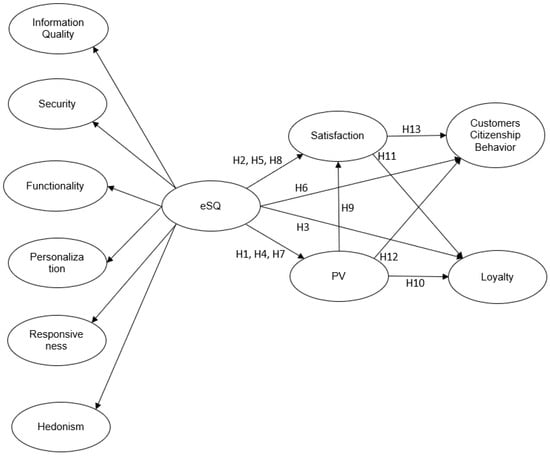
More recently, Nguyen et al. [33] expanded [32]’s scale to the context of hotel websites, adding two additional dimensions: “web design” as well as “response time.” However, these two items had already been noted by [32] in its “web functionality’ dimension,” thus bringing only minor additions to [32]’s already established scale. Additionally, ref. [9,31,34] suggested the addition of a hedonic dimension to the output and process/functional aspect dimensions proposed by [32]. Playfulness (i.e., hedonic quality) has already been demonstrated to play a role in technology acceptance in the online marketing and retailing literature [35] and within tourism, where purchasing is often associated with higher levels of pleasure and enjoyment than with tangible products [31]. Accordingly, six dimensions—the five dimensions of [32] plus a hedonic dimension—are used in this study to conceptualize e-SQ. This is hypothesized as a higher-order reflective construct where the arrows point from the e-SQ construct to its six lower aforementioned dimensions, in alignment with the mainstream literature in the online retailing context advocating a reflective scheme for e-SQ.
Although the previous literature has upheld the relationship between e-SQ and satisfaction, perceived value, and loyalty in the online travel context (see [6,8,9]), the nature of these relationships (whether e-SQ influences loyalty directly or indirectly through satisfaction and perceived value) remains blurred. One of the primary reasons for this is how e-SQ has been conceptualized in previous studies: with the majority, if not all, using either the dimensions of e-SQ [8,9] or a unidimensional aggregate e-SQ construct [10,11]. For example, by adopting a dimensional approach, ref. [12] found that the e-SQ of a travel website had a direct positive effect on loyalty among tourists booking their trip to Jordan, while ref. [13] found that e-SQ had both a direct and indirect effect (through satisfaction) on loyalty among hotel bookers in Vietnam. In contrast, refs. [8,9] established that e-SQ had only a positive indirect impact on loyalty through perceived value [9] and satisfaction [8] among Spanish users of online travel services and hotel online bookers in Saudi Arabia, respectively. Moreover, ref. [10] used an aggregated unidimensional measure of e-SQ and found that it had a positive direct and indirect (through satisfaction) effect on loyalty among Malaysian OTA users. Similarly, ref. [11], also using an aggregate measure, found that e-SQ had only an indirect effect on loyalty through both satisfaction and perceived value among OTA users in India.
Thus, the exact relationship and interplay between variables remain unclear. As a result, the following hypotheses were constructed to further elucidate the precise nature of the relationships between e-SQ (conceptualized as a higher order), perceived value, satisfaction, and loyalty and CCB, respectively, specifically in the online travel context. These hypotheses find support in both cognitive–affective–conative as well as social exchange theories. The former (cognitive–affective–conative) stipulates that customers’ perception of the objective (cognitive) quality of a product, compared to their initial expectations, leads to positive emotional/affective feeling towards that product and ultimately to behavioral intentions in terms of loyalty and repeat usage (see [36]), while the latter (social exchange) is based on reciprocity, which stipulates that customers will develop affective feelings and future positive behavioral intentions toward a product when they perceive the benefits they receive to outweigh their effort and/or sacrifices (see [9]).
H1.
e-SQ (conceptualized as a higher-order construct composed of six underlying dimensions: information quality, security, functionality, personalization, responsiveness, and hedonism) will have a direct and positive effect on customers’ perceived value of their OTA experience.
H2.
e-SQ (conceptualized as a higher-order construct) will have a direct and positive effect on customers’ satisfaction with the OTA experience.
H3.
e-SQ (conceptualized as a higher-order construct) will have a direct and positive effect on customers’ loyalty towards the OTA.
H4.
e-SQ (conceptualized as a higher-order construct) will have an indirect and positive effect on customers’ loyalty towards the OTA through perceived value.
H5.
e-SQ (conceptualized as a higher-order construct) will have an indirect and positive effect on customers’ loyalty towards the OTA through satisfaction.
In the online context, CCB refers to “the voluntary and discretionary behaviors expressed by e-shoppers in an internet service environment to facilitate the delivery, purchase, and consumption of e-services, while at the same time helping the firm service success” [37] (p. 131). While CCB has received growing attention in the service and e-commerce literature [38,39], few papers have examined the relationships between e-SQ and CCB alongside other relationship variables in the online context and in the online travel sector specifically. Prior results also demonstrate a lack of consensus as to whether e-SQ impacts CCB directly or indirectly through variables such as satisfaction or perceived value [21,22,37,40]. For instance, in online retailing, ref. [21] found that e-SQ dimensions had both positive direct and indirect effects on CCBs (through affective feelings) in terms of providing recommendation to others in online apparel sales in Taiwan, while ref. [40] found that e-SQ (measured as a unidimensional aggregate construct) only affects the CCB of website users directly in the context of apparel sales in Malaysia. In the travel and tourism context, ref. [37] found e-SQ to only have an indirect effect through satisfaction and commitment on CCB among U.S. OTAs users, with CCB measured in terms of recommendation and helping other users by facilitating their online travel purchase.
As such, further empirical investigation is needed to clarify the relationships between e-SQ, satisfaction, and perceived value on CCB in the online travel context. Social exchange theory, in particular, helps endorse the indirect relationship through satisfaction and perceived value [8,20], as customers will only engage in voluntary behavior to the advantage of the company when they perceive the benefits to outweigh their effort or sacrifice, leading to the following additional hypotheses specifically in the context of online travel.
H6.
e-SQ (conceptualized as a higher-order construct) will have a direct and positive effect on customers’ citizenship behavior on behalf of the OTA.
H7.
e-SQ (conceptualized as a higher-order construct) will have an indirect and positive effect on customers’ citizenship behavior on behalf of the OTA through perceived value.
H8.
e-SQ (conceptualized as a higher-order construct) will have an indirect and positive effect on customers’ citizenship behavior on behalf of the OTA through satisfaction.
Satisfaction in the online context is defined as “a positive and affective state resulting from the evaluation of all aspects of services provided through an e-commerce channel” [8] (p. 3), while perceived value refers to the “trade-off between what the customers receive in return for the monetary and non-monetary costs which they have to incur in an internet service environment” [11] (p. 5). In online travel, few studies have simultaneously incorporated both satisfaction and perceived value within the same model when examining website loyalty. For instance, [11], in one of the few studies that considered both satisfaction and perceived value concurrently in the context of hotel bookings in India, found that satisfaction has a positive influence on loyalty, with perceived value only having a positive influence on satisfaction but not loyalty. Conversely, the authors of [9], considering only perceived value in their study of Spanish online travel service users, found that perceived value had a positive influence on loyalty. Likewise, the authors of [8], considering satisfaction (but not perceived value), found that satisfaction positively influences loyalty among OTA customers in Saudi Arabia. Thus, there is a need to establish the interrelationship between satisfaction and perceived value and their effect on loyalty. Cognitive–affective theory suggests that positive cognitive assessment (i.e., perceived value) leads to positive feelings (i.e., satisfaction) [11], suggesting that only when satisfied with a product/service, and only when the benefits received outweigh the effort, will customers enter future exchange(s) with a service provider. These lead to the following hypotheses:
H9.
Perceived value of the OTA experience will have a direct and positive effect on customers’ satisfaction.
H10.
Perceived value of the OTA experience will have a direct and positive effect on loyalty towards the OTA.
H11.
Satisfaction with the OTA experience will have a direct and positive effect on loyalty towards the OTA.
As with loyalty, few studies have investigated the concurrent effects of satisfaction and perceived value on CCB. To the authors’ knowledge, online travel studies have only investigated the effect of satisfaction on CCB, where [37] found satisfaction to positively influence CBB in the context of U.S. online travel customers. In the general retailing context, the authors of [41] considered perceived value (and not satisfaction) in their study on the effect of relationship marketing activities on CCB among US e-commerce platform users, finding that perceived value has a positive influence on CCB. The authors of [42], considering both perceived value and satisfaction simultaneously in their study of the effect of relationship quality among buyers and sellers on CCB, found that perceived value positively influences satisfaction, but only satisfaction (not perceived value) influenced CCB. Thus, there is still a need for further empirical examination of how perceived value and satisfaction alongside e-SQ influence CCB in the online travel context. Based on this argument and social exchange theory, the following final two hypotheses are suggested:
H12.
Perceived value of the OTA experience will have a direct and positive effect on customer citizenship behavior on behalf of the OTA.
H13.
Satisfaction with the OTA experience will have a direct and positive effect on customer citizenship behavior on behalf of the OTA.
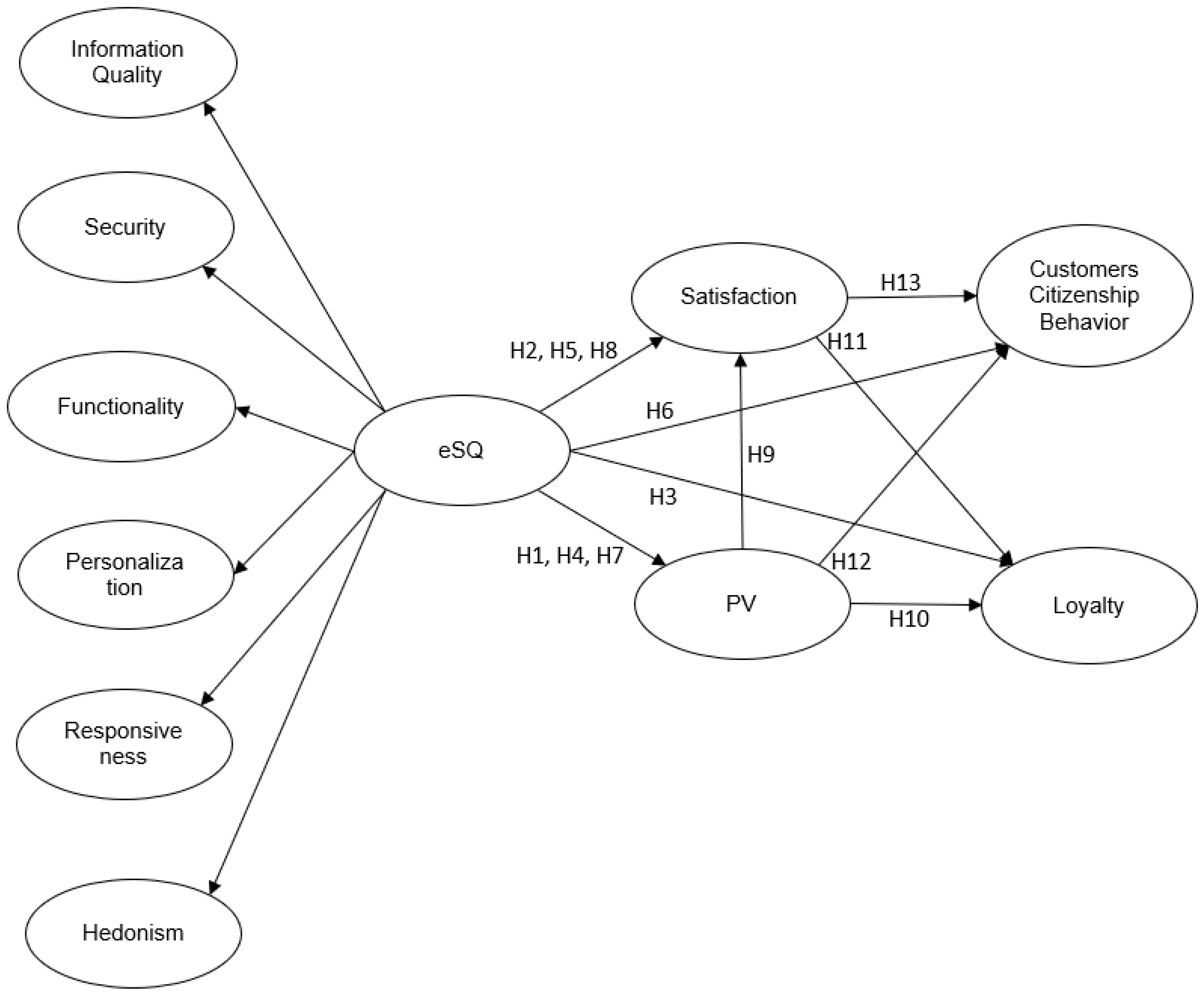
Figure 1 shows the proposed conceptual model, with e-SQ conceptualized as a higher-order construct composed of six underlying dimensions: information quality, security, functionality, personalization, responsiveness, and hedonism. The model also depicts the proposed hypotheses among the constructs based on the literature review and hypothesis section above.
Figure 1.
The proposed theoretical model.
3. Materials and Methods
An a priori power analysis was conducted using G*Power (version 3.1.9.7) to determine the required sample size for a linear multiple regression. Based on previous research and the proposed model, a medium effect size of (f2) = 0.15 was used, with an alpha level of 0.05 and the desired power at 0.95 with Npredictors = 3. The analysis indicated that a minimum sample size of 119 participants would be required to detect the specified effect size with 95% power.
Data was collected by the MIS Group, a leading market research agency in the UK, from their online panel representative of the US population. To complete the questionnaire, respondents must have used a travel website at least once in the prior 12 months for information searching or booking, with travel websites strictly referring to either an online travel agency (OTA) or metasearch engine. To avoid confusion and ensure respondents clearly understood the meaning of an online travel site, a short description of the two terms along with illustrative examples was included at the beginning of the survey. In total, 1260 respondents were approached, with 257 respondents passing the filter criteria and completing the questionnaire, resulting in a response rate of 20.4%, which is common for this type of online study [42]. Post hoc analysis using G*Power suggested a power of 0.99 based on this achieved sample size [43].
The questionnaire included questions about respondents’ perceptions of the quality of the travel website (e-SQ), level of satisfaction, perceived value (PV), and their loyalty and customer citizenship behavior. All question measures were taken from validated scales in prior research, specifically [9,10,21,22,31,44,45], and measured using a 5-point Likert scale, where 1 = “Strongly Disagree” and 5 = “Strongly Agree” (see Appendix A Table A1 for further information). e-SQ was conceived a higher-order construct composed of six dimensions: information quality, security, functionality, personalization, and responsiveness, adapted from [32] and hedonism, taken from [9]. In addition, one item was added for measuring the responsiveness dimension, namely “Booking order contains all necessary health and safety guidelines pertaining to COVID-19 that users need to be aware/informed of”, to account for the possible effect of the recent COVID-19 pandemic on travelers’ subsequent perceptions and decisions. Satisfaction was measured using five items adapted from [44,45]. Perceived value was measured using four items adapted from [9]. Finally, loyalty and customers’ citizenship behavior (CCB) were measured using three and four scales, respectively, adapted from [10,21,22]. The questionnaire also included questions on respondents’ socio-demographics (age, gender, income, education, occupation).
Prior to administering the study, the questionnaire was pilot tested with a panel of tourism professionals and academics to ensure the consistency, comprehension, and face validity of the various constructs/questions, with slight wording changes made at this stage. In addition, Common Variance Bias (CMV) was not a concern with the results from Harman’s one-factor test (see [46]), implying that no single factor accounted for more than 50% of covariation in our sample. The sample of 257 respondents was 52% (N = 133) women, with an average age of 42 (minimum age = 18, maximum age = 69, and S.D. = 14). Moreover, 26% had a secondary/high school education, 26% a vocational degree, 31% a bachelor’s degree, and 17% a master’s or doctoral degree. One-third of respondents were managers/professionals, 17% self-employed, 13% retired, 12% skilled/unskilled workers, and 5% students. Finally, 51% of respondents earned up to USD 60,000, 26% earned between USD 60,000 and USD 100,000, and 23% earned over USD 100,000. As such, the demographics show that the sample is well distributed and representative of the relevant population.
A partial least squares structural equation model (PLS-SEM) was used to examine the proposed model (see Figure 1). PLS-SEM analysis was used instead of covariance-based structural equation modeling (CB-SEM) as it helped (1) overcome non-convergence problems due to the higher-order nature of the e-SQ construct and (2) overcome non-identification problems caused by the small sample size relative to the number of constructs and indicators in the model [47], with PLS-SEM typically achieving better results where such violation of CB-SEM assumptions are present (see [48]). The PLS-SEM analysis centered around two steps: (1) validating the outer (measurement) models in terms of convergent and discriminant validity as well as the reliability of the various constructs, including the higher order e-SQ construct, and (2) examining the inner (structural) model through path regression assumed between constructs [49].
4. Results
4.1. Outer Model Results
PLS-SEM was run with XL-STAT software version 2022 on the full dataset of unstandardized data, using mode A (reflective scheme) for all model constructs (including the higher-order e-SQ construct); the centroid method was used to estimate the weights of the inner model [49].
The convergent validity of all constructs was confirmed, with loadings for each construct exceeding or close to 0.7 (see Table 1). This was particularly true for the higher-order e-SQ construct, where the six dimensions of (1) information quality, (2) security, (3) functionality, (4) personalization, (5) responsiveness, and (6) hedonism were shown to load significantly. Moreover, the average variance extracted (AVE) for each construct/dimension exceeded the required 0.5 threshold, indicating that a significant part (50% or more) of indicators’ variance was captured by the construct, supporting convergent validity and suggesting that all items measured well on their underlying constructs [48].
Table 1.
Results of the outer model.
The discriminant validity of all constructs/dimensions was also supported, with the root of AVE for each construct greater than the correlation coefficient of that construct with every other construct of the model [49] (see Table 2), implying that each construct has the strongest relationships with its own indicators and can thus be used as a standalone construct in the model. It is worth noting that the higher-order e-SQ construct was not included in Table 2 as it is replaced with its first-order dimensions (see [48]).
Table 2.
Results of discriminant validity (Sq correlations for any pair of latent variables < AVE).
Lastly, the reliability of all constructs was upheld, with Dillon–Goldstein’s rho for all constructs found to be above the lower limit of 0.7 [47], indicating that each construct’s indicators combine well in representing their respective construct (see Table 1).
4.2. Inner Model Results
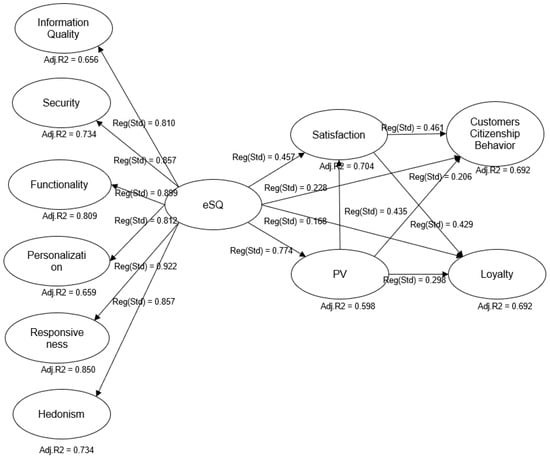
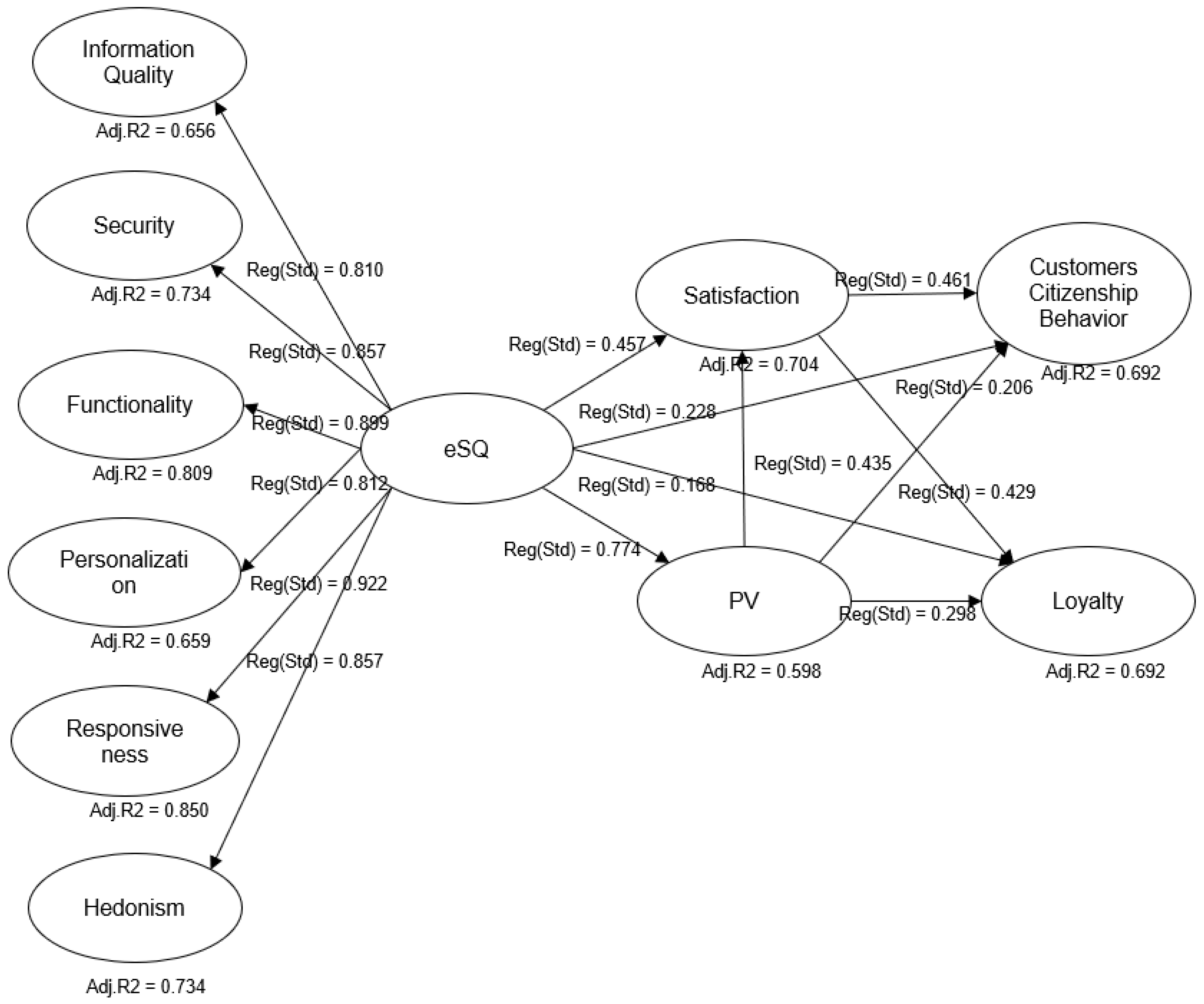
The adjusted R2 results demonstrate that a substantial part of the variance of endogenous constructs can be explained by the model (Figure 2). The adjusted R2 for satisfaction, PV, and loyalty and customers’ citizenship behavior were 70.4%, 59.8%, and 69.2%, respectively, exceeding the minimum 20% threshold proposed by [48]. Moreover, the Stone–Geisser Q2 values for all endogenous construct indicators (i.e., satisfaction, PV, loyalty and citizenship), computed using blindfolding procedures, were all greater than the minimum threshold of 0.10 suggested by [50]. This implies that the model is an effective predictor in explaining the endogenous latent variables and supporting the overall nomological validity of the model (see [48]).
Figure 2.
Results of structural model. All coefficients are significant at p < 0.05.
The path coefficients were examined using bootstrapping with 1000 iterations of resampling [49] (Figure 2). The results of the inner model reveal that e-SQ had a significant positive effect on PV (reg. coeff. std. = 0.774), satisfaction (reg. coeff. std. = 0.457), and loyalty and CCB (reg. coeff. std. = 0.168 and 0.228, respectively), providing support for Hypotheses 1–3 and Hypothesis 6. Additionally, both PV and satisfaction had a positive significant effect on both loyalty (reg. coeff. std. = 0.298 and 0.429, respectively) and CCB (reg. coeff. std. = 0.206 and 0.461, respectively), supporting Hypotheses 10–13. Finally, PV had a significant positive effect on satisfaction (reg. coeff. std. = 0.435), supporting Hypothesis 9.
Table 3 summarizes the direct, indirect, and total effects of e-SQ on loyalty and CCB with the indirect effect of e-SQ on both loyalty through PV and satisfaction (reg. coeff. std. = 0.231 and 0.340, respectively) and on CCB through PV and satisfaction (reg. coeff. std. = 0.159 and 0.365, respectively), which is significant, supporting Hypotheses 4–8. Moreover, the total indirect effect of e-SQ on loyalty and CCB is larger than its direct effect on the latter variables. The outcomes for all hypotheses are summarized in Table 4.
Table 3.
Standardized direct, indirect, and total effects.
Table 4.
Outcome of the hypotheses.
5. Discussion
Addressing gaps in the extant literature, the present study sets out to propose and test a comprehensive model of online travel website success by examining the relationships between a properly conceptualized higher-order e-SQ construct, PV, and satisfaction, respectively, on customers’ loyalty and customers’ citizenship behavior (CCB). The results demonstrate that when all variables are considered concurrently, e-SQ influences loyalty and CCB both directly and indirectly (through satisfaction and perceived value), with the latter jointly mediating its effect on loyalty and CCB. The findings also confirm the importance of CCB as a key success factor and desirable marketing outcome, alongside loyalty, for online travel websites. This suggests that e-SQ, satisfaction, and PV enhance not only loyalty and reuse intention but also customers’ voluntary positive behavior (i.e., providing recommendations and helping other users).
From a theoretical perspective, establishing that the higher-order e-SQ construct positively influenced both loyalty and customers’ citizenship behavior (CCB) both directly and indirectly (through PV and satisfaction) helps bridge gaps in the existing literature. Although extant studies show that e-SQ impacts loyalty either directly (see [10,12]) or indirectly (see [8,9]), as discussed in the literature review, many prior studies did not use proper higher conceptualization for e-SQ and/or do not incorporate both perceived value and satisfaction simultaneously within their analysis. Accordingly, this study’s results clearly demonstrate that when e-SQ is properly operationalized and used alongside perceived value and satisfaction in the same model, it simultaneously exerts both a direct and indirect effect on loyalty. Such findings help clarify our understanding as to how e-SQ impacts loyalty within the marketing literature in general and within the online travel literature specifically.
The results also help further establish the relationship between e-SQ and customer citizenship behavior (CCB), with few studies to date having examined this issue in the context of e-SQ, let alone considering perceived value alongside satisfaction and e-SQ simultaneously [22]. Most prior studies have found either a direct effect of e-SQ on CCB [38] or an indirect effect through satisfaction [37]. In contrast, the present study suggests that when e-SQ, satisfaction, and perceived value are considered concurrently, e-SQ has both a positive direct and indirect (through both perceived value and satisfaction) effect on CCB. Such findings further contribute to our understanding of CCB and how these variables (e-SQ, perceived value, and satisfaction) collectively influence CCB and subsequently firm success in the online travel context.
Moreover, this study’s results confirm that PV precedes satisfaction in the online context in general and online travel specifically, confirming previous results that have advocated for the relationship between perceived value and satisfaction [8,11]. Both variables demonstrate a direct effect on loyalty and CCB, in addition to the mediating role they play between e-SQ and loyalty, emphasizing the need to incorporate both constructs (i.e., perceived value and satisfaction) into models examining online travel business success. Existing papers have to date failed to do so, instead focusing solely on satisfaction (see [8,22]). Results in this case clearly demonstrate that perceived value, in addition to satisfaction, exerts a positive influence on CCB, which aligns with social exchange theory (see [20]) in that for customers to engage in voluntary behavior benefiting the company and other users, they first need to perceive benefits that outweigh their effort or sacrifices.
Lastly, the results reveal that hedonism or pleasure is a key aspect of e-SQ that helps enhance customers’ perception of service in an online context. This subsequently influences their level of perceived value and satisfaction, and ultimately their loyalty and CCB toward the firm. Thus, the results further confirm and validate recent studies advocating for the use of hedonism as an additional dimension of e-SQ in the online context and within online travel specifically (see [9,31]). The latter is often associated with higher levels of pleasure and enjoyment on behalf of the traveler/customer, especially during the search and purchase stage, as opposed to tangible counterparts [31].
6. Conclusions
This study developed and tested a comprehensive model of the antecedents and measures of online travel website success by examining the relationships between a higher-order e-SQ construct, PV, and satisfaction on customers’ loyalty and customers’ citizenship behavior (CCB). These relationships, particularly the use of a higher-order scheme for e-SQ, and the simultaneous inclusion of CCB, perceived value, and satisfaction in the model, have not been previously empirically explored in the literature, neither in general nor in the specific context of online travel. The results confirm that when all variables are considered concurrently, e-SQ influences loyalty and CCB both directly and indirectly (through satisfaction and perceived value), with the latter jointly mediating e-SQ‘s effect on loyalty and CCB. In addition, the indirect effect of e-SQ on both loyalty and CCB was found to be greater than the direct effect (see Figure 2). Lastly, this study also confirmed the importance of CCB as a key success factor and desirable marketing outcome for online travel websites, suggesting that e-SQ, satisfaction, and PV enhance not only loyalty and reuse intention but also customers’ voluntary positive behavior (i.e., providing recommendations and helping other users).
Collectively, these findings imply that online travel firms need to pay even greater attention to quality, as e-SQ plays a role in enhancing guests’ perceived value and satisfaction. From this, we can infer that customers with positive experiences tend to extract additional benefits from their interactions. As such, they derive not only a higher level of satisfaction but are willing to make further efforts to use that site. This allows online travel firms to charge higher prices and extract additional monetary benefits because of positive service quality and perceived value. It also further enhances their chances of retaining existing customers and engendering voluntary behavior due to the significant mediating effect that both perceived value and satisfaction have on loyalty and CCB and subsequently on firm success.
Overall, these results help advance our understanding of the determinants and measures of success in the online travel context in general, and in the context of online travel websites in particular, by helping clarify and refine our understanding of both the nature and conceptualization of the e-SQ construct and how it impacts loyalty within the marketing literature in general and online travel literature specifically. They help demystify the mechanisms through which e-SQ influences the key success factors and desirable marketing outcomes of online travel websites, providing practical implications for OTAs and metasearch engines to provide better customer service by clarifying the specific dimensions of e-SQ they should emphasize to enhance service quality. The results also clarify how providing better quality service can enhance customer satisfaction and value, ultimately retaining customers and enhancing the success and competitiveness of the business. Examining the dimension loadings of e-SQ (see Table 1), all six dimensions are shown to be important in shaping e-SQ, with website functionality, responsiveness, and hedonism having the highest weights, implying that managers should pay closest attention to these issues. Doing so would not only enhance guest loyalty and future repurchase intention but also help build CBB, which is critical in the online context where users often lack real-time face-to-face interaction with salespeople or company representatives, relying instead on peer feedback to assist them in their decisions
This paper is not without its limitations. First, data for this study were collected from a single country, the US, and so, there is a need to collect data from different countries and perform cross-country analyses to further corroborate and extrapolate the findings. Additionally, this study only examined the marketing relationship variables of PV and satisfaction. Future papers could incorporate additional variables advanced in the service quality literature, such as trust, commitment, or website reputation, to provide additional insights on how e-SQ affects e-travel service success. Lastly, the relatively small sample size prevented us from performing multigroup analysis to examine differences in results across demographic profiles (e.g., age, gender, education, etc.); future works could collect larger samples, testing the results across respondents’ demographic and travel characteristic variables (e.g., travel party, visit motivation, etc.) to revalidate the hypotheses.
Author Contributions
Conceptualization, P.O. and G.A.; methodology, P.O. and G.A.; software, G.A.; validation, P.O. and G.A.; formal analysis, P.O. and G.A.; data curation, G.A.; writing—original draft preparation, P.O. and G.A.; writing—review and editing, P.O. and G.A. All authors have read and agreed to the published version of the manuscript.
Funding
This research received no external funding.
Institutional Review Board Statement
The study was approved by the Ethics Committee of the University of South Australia (protocol code 204275, 10 October 2021) for studies involving humans.
Informed Consent Statement
Informed consent was obtained from all subjects involved in the study.
Data Availability Statement
Data used in this study is unavailable due to privacy restrictions.
Conflicts of Interest
The authors declare no conflicts of interest.
Appendix A
Table A1.
List of the constructs used in the model and their respective indicators.
References
- Abdullah, S.; Van Cauwenberge, P.; Bauwhede, H.V.; O’cOnnor, P. The indirect distribution dilemma: Assessing the financial impact of participation in Booking.com for hotels. Tour. Rev. 2022, 77, 1024–1042. [Google Scholar] [CrossRef] [Scilit]
- Christodoulidou, N.; Connolly, D.J.; Brewer, P. Travel Meta-Search: Opportunity or Threat? Tour. Anal. 2009, 14, 821–832. [Google Scholar] [CrossRef] [Scilit]
- O’Connor, P. Electronic distribution. In Encyclopedia of Tourism Management and Marketing; Buhalis, D., Ed.; Edward Elgar: Worcester, UK, 2022; pp. 1–4. [Google Scholar]
- De Brito, C. Thomas Cook Launches First Campaign Since Rebranding as OTA. Connecting Travel. 15 June 2022. Available online: https://www.connectingtravel.com/news/thomas-cook-launches-first-campaign-since-rebranding-as-ota (accessed on 3 March 2023).
- Suárez-Álvarez, L.; Río-Lanza, A.B.D.; Vázquez-Casielles, R.; Díaz-Martín, A.M. Switching Barriers in Online Travel Agencies: The Impact on Positive Word of Mouth. Tour. Anal. 2019, 24, 213–225. [Google Scholar] [CrossRef] [Scilit]
- Rizal, H.; Amin, H.; Suddin, L.; Sondoh, S.L.; Jung Ku, C. Relationship Quality and E-Loyalty Towards Online Travel Agency (OTA): Social Exchange Theory Perspective. J. Pengur. 2020, 58, 39–51. [Google Scholar] [CrossRef] [Scilit]
- Huang, G.; Zhong, S.; Wong, I.A.; Lin, Z. Evolutionary selection for travel agencies under COVID-19 adversity through the lens of life history theory. J. Travel Tour. Mark. 2021, 38, 917–934. [Google Scholar] [CrossRef] [Scilit]
- Alnaim, A.F.; Sobaih, A.E.E.; Elshaer, I.A. Measuring the Mediating Roles of E-Trust and E-Satisfaction in the Relationship Between E-Service Quality and E-Loyalty: A Structural Modeling Approach. Mathematics 2022, 10, 2328. [Google Scholar] [CrossRef] [Scilit]
- Bernardo, M.; Marimon, F.; Alonso-Almeida, M.d.M. Functional quality and hedonic quality: A study of the dimensions of e-service quality in online travel agencies. Inf. Manag. 2012, 49, 342–347. [Google Scholar] [CrossRef] [Scilit]
- Jasni, W.N.F.W.; Jamaluddin, M.R.; Hanafiah, M.H. Online travel agencies (OTAs) e-service quality, brand image, customer satisfaction and loyalty. J. Tour. Hosp. Culin. Arts 2020, 12, 96–111. [Google Scholar]
- Singh, P.; Chauhan, K. A Study on Relationship Between Antecedents and Consequences of Customer Satisfaction for Online Hotel Booking Apps. Indraprastha J. Manag. 2020, 8, 2–14. [Google Scholar]
- Rahahleh, A.; Al-Nsour, S.; Moflih, M.; Alabaddi, Z.; Al-Nassar, B.; Al-Nsour, N. The influence of electronic service quality on relationship quality: Evidence from tourism industry. Manag. Sci. Lett. 2020, 10, 2759–2768. [Google Scholar] [CrossRef] [Scilit]
- Vo, N.T.; Chovancová, M.; Tri, H.T. The Impact of E-Service Quality on the Customer Satisfaction and Consumer Engagement Behaviors Toward Luxury Hotels. J. Qual. Assur. Hosp. Tour. 2020, 21, 499–523. [Google Scholar] [CrossRef] [Scilit]
- Hallak, R.; Assaker, G.; El-Haddad, R. Re-examining the relationships among perceived quality, value, satisfaction, and destination loyalty: A higher-order structural model. J. Vacat. Mark. 2018, 24, 118–135. [Google Scholar] [CrossRef] [Scilit]
- Su, L.; Cheng, X.; Zarifis, A. Passengers as defenders: Unveiling the role of customer-company identification in the trust-customer citizenship behaviour relationship within ride-hailing context. J. Tour. Stud. Res. Tour. 2024, 107, 105086. [Google Scholar] [CrossRef] [Scilit]
- Masnadi, F.; Claudia, J.; Rosman, D. Digital Comfort: Decoding E-Service Excellence and E- WOM Influence on E-Satisfaction and Repeat Stays Through OTA Platforms in Jakarta. In Proceedings of the 2024 9th International Conference on Business and Industrial Research (ICBIR), Bangkok, Thailand, 23–24 May 2024; pp. 1351–1356. [Google Scholar] [CrossRef] [Scilit]
- Pires, P.; Prisco, M.; Delgado, C.; Santos, J. A Conceptual Approach to Understanding the Customer Experience in E-Commerce: An Empirical Study. J. Theor. Appl. Electron. Commer. Res. 2024, 19, 1943–1983. [Google Scholar] [CrossRef] [Scilit]
- Howat, G.; Assaker, G. The hierarchical effects of perceived quality on perceived value, satisfaction, and loyalty: Empirical results from public, outdoor aquatic centres in Australia. Sport Manag. Rev. 2013, 16, 268–284. [Google Scholar] [CrossRef] [Scilit]
- Ning, Y.; Hu, C. Influence Mechanism of Social Support of Online Travel Platform on Customer Citizenship Behavior. Front. Psychol. 2022, 13, 842138. [Google Scholar] [CrossRef] [Scilit]
- Woo, M. Assessing customer citizenship behaviors in the airline industry: Investigation of service quality and value. J. Air Transp. Manag. 2019, 76, 40–47. [Google Scholar] [CrossRef] [Scilit]
- Wu, S.-H.; Huang, S.C.-T.; Tsai, C.-Y.D.; Lin, P.-Y. Customer citizenship behavior on social networking sites: The role of relationship quality, identification, and service attributes. Internet Res. 2017, 27, 428–448. [Google Scholar] [CrossRef] [Scilit]
- Zhu, T.; Liu, B.; Song, M.; Wu, J. Effects of Service Recovery Expectation and Recovery Justice on Customer Citizenship Behavior in the E-Retailing Context. Front. Psychol. 2021, 12, 658153. [Google Scholar] [CrossRef] [Scilit]
- Brady, M.K.; Cronin, J.J. Some New Thoughts on Conceptualizing Perceived Service Quality: A Hierarchical Approach. J. Mark. 2001, 65, 34–49. [Google Scholar] [CrossRef] [Scilit]
- Grönroos, C. A Service Quality Model and Its Marketing Implications. Eur. J. Mark. 1984, 18, 36–44. [Google Scholar] [CrossRef] [Scilit]
- Parasuraman, A.; Zeithaml, V.A.; Berry, L. SERVQUAL: A multiple-item scale for measuring consumer perceptions of service quality. J. Retail. 1988, 64, 12–40. [Google Scholar]
- Parasuraman, A.; Zeithaml, V.A.; Malhotra, A. E-S-QUAL: A Multiple-Item Scale for Assessing Electronic Service Quality. J. Serv. Res. 2005, 7, 213–233. [Google Scholar] [CrossRef] [Scilit]
- Sigala, M. E-service quality and Web 2.0: Expanding quality models to include customer participation and inter-customer support. Serv. Ind. J. 2009, 29, 1341–1358. [Google Scholar] [CrossRef] [Scilit]
- Carlson, J.; O’Cass, A. Developing a framework for understanding e-service quality, its antecedents, consequences, and mediators. Manag. Serv. Qual. Int. J. 2011, 21, 264–286. [Google Scholar] [CrossRef] [Scilit]
- Collier, J.E.; Bienstock, C.C. Measuring Service Quality in E-Retailing. J. Serv. Res. 2006, 8, 260–275. [Google Scholar] [CrossRef] [Scilit]
- Bitner, M.J.; Zeithaml, V.A.; Gremler, D.D. Technology’s Impact on the Gaps Model of Service Quality. In Handbook of Service Science; Maglio, P.P., Kieliszewski, C.A., Spohrer, J.C., Eds.; Springer: New York City, NY, USA, 2010; pp. 197–218. [Google Scholar] [CrossRef] [Scilit]
- Hahn, S.-E.; Sparks, B.; Wilkins, H.; Jin, X. E-Service Quality Management of a Hotel Website: A Scale and Implications for Management. J. Hosp. Mark. Manag. 2017, 26, 694–716. [Google Scholar] [CrossRef] [Scilit]
- Ho, C.-I.; Lee, Y.-L. The development of an e-travel service quality scale. Tour. Manag. 2007, 28, 1434–1449. [Google Scholar] [CrossRef] [Scilit]
- Le, V.H.; Nguyen, H.T.T.; Nguyen, N.; Pervan, S. Development and validation of a scale measuring hotel website service quality (HWebSQ). Tour. Manag. Perspect. 2020, 35, 100697. [Google Scholar] [CrossRef] [Scilit]
- Long, K.; Tran, Y.; Huong, D. Driving Online Green Product Loyalty Through Website Personalization and Hedonic Quality Enjoyment: Evidence from Vietnamese E-Commerce Consumers. Int. J. Sustain. Dev. Plan. 2025, 20, 2575–2588. [Google Scholar] [CrossRef] [Scilit]
- Assaker, G.; O’Connor, P.; El-Haddad, R. Examining an integrated model of green image, perceived quality, satisfaction, trust, and loyalty in upscale hotels. J. Hosp. Mark. Manag. 2020, 29, 934–955. [Google Scholar] [CrossRef] [Scilit]
- O’Connor, P.; Assaker, G. Examining the antecedents and effects of hotel corporate reputation on customers’ loyalty and citizenship behavior: An integrated framework. J. Hosp. Mark. Manag. 2022, 31, 640–661. [Google Scholar] [CrossRef] [Scilit]
- Anaza, N.A.; Zhao, J. Encounter-based antecedents of e-customer citizenship behaviors. J. Serv. Mark. 2013, 27, 130–140. [Google Scholar] [CrossRef] [Scilit]
- Bakır, M.; Atalık, Ö.; Itani, N. Service quality and repurchase intentions in the airline industry: A multiple mediation analysis through customer citizenship behaviour. Curr. Issues Tour. 2024, 28, 4025–4046. [Google Scholar] [CrossRef] [Scilit]
- Shen, Q.; Du, Y.; Huang, J. Consumer Citizenship Behavior in Online/Offline Shopping Contexts: Differential Impact of Consumer Perceived Value and Perceived Corporate Social Responsibility. Sustainability 2024, 16, 2968. [Google Scholar] [CrossRef] [Scilit]
- Ponnusamy, G. Customers as Volunteers? E-Customer Citizenship Behavior and Its Antecedents. Inf. Manag. Bus. Rev. 2015, 7, 50–58. [Google Scholar] [CrossRef] [Scilit]
- Cheng, Z.; Chen, X.; Cui, X. How Do Relationship Marketing Activities Contribute to Customer Citizenship Behavior in the Context of Cross-Border E-Commerce? Int. J. Innov. Comput. Inf. Control 2022, 18, 1957–1967. [Google Scholar] [CrossRef]
- Suryani, T.; Listyarti, I. Building Customer Citizenship Behavior from Relationship Quality and Perceived Value Perspective in Online Transportation Service. J. Sos. Hum. (JSH) 2020, 1. [Google Scholar] [CrossRef] [Scilit]
- Ali, F.; Ciftci, O.; Nanu, L.; Cobanoglu, C.; Ryu, K. Response Rates In Hospitality Research: An Overview of Current Practice and Suggestions For Future Research. Cornell Hosp. Q. 2021, 62, 105–120. [Google Scholar] [CrossRef] [Scilit]
- Jeon, M.M.; Jeong, M. Customers’ perceived website service quality and its effects on e-loyalty. Int. J. Contemp. Hosp. Manag. 2017, 29, 438–457. [Google Scholar] [CrossRef] [Scilit]
- Sadeghi, A.; Ghujali, T.; Bastam, H. The Effect of Organizational Reputation on E-loyalty: The Roles of E-Trust and E-Satisfaction. ASEAN Mark. J. 2018, 10, 1. [Google Scholar]
- Podsakoff, P.M.; MacKenzie, S.B.; Lee, J.-Y.; Podsakoff, N.P. Common method biases in behavioral research: A critical review of the literature and recommended remedies. J. Appl. Psychol. 2003, 88, 879–903. [Google Scholar] [CrossRef] [Scilit]
- Do Valle, P.O.; Assaker, G. Using Partial Least Squares Structural Equation Modeling in Tourism Research: A Review of Past Research and Recommendations for Future Applications. J. Travel Res. 2016, 55, 695–708. [Google Scholar] [CrossRef] [Scilit]
- Hair, J.; Hult, G.T.M.; Ringle, C.M.; Sarstedt, M. A Primer on Partial Least Squares Structural Equation Modeling, 2nd ed.; SAGE Publications, Inc.: Thousand Oaks, CA, USA, 2016. [Google Scholar]
- Chin, W.W. How to Write Up and Report PLS Analyses. In Handbook of Partial Least Squares: Concepts, Methods and Applications; Esposito Vinzi, V., Chin, W.W., Henseler, J., Wang, H., Eds.; Springer: Berlin/Heidelberg, Germany, 2010; pp. 655–690. [Google Scholar] [CrossRef] [Scilit]
- Falk, R.F.; Miller, N.B. A Primer for Soft Modeling; University of Akron Press: Akron, OH, USA, 1992; p. xiv 103. [Google Scholar]

Disclaimer/Publisher’s Note: The statements, opinions and data contained in all publications are solely those of the individual author(s) and contributor(s) and not of MDPI and/or the editor(s). MDPI and/or the editor(s) disclaim responsibility for any injury to people or property resulting from any ideas, methods, instructions or products referred to in the content. |
© 2026 by the authors. Licensee MDPI, Basel, Switzerland. This article is an open access article distributed under the terms and conditions of the Creative Commons Attribution (CC BY) license.