Skip to Content
JTAERJournal of Theoretical and Applied Electronic Commerce Research
  • Article
  • Open Access

5 January 2026

From Manual Delivery to Autonomous Delivery Robots: A Socio-Technical Push–Pull–Mooring Framework


,
,
and
1
School of Northeast Asia Studies, Shandong University, Weihai 264209, China
2
Graduate School of Management of Technology, Pukyong National University, Busan 48547, Republic of Korea
*
Author to whom correspondence should be addressed.

Abstract

Urban delivery demand continues to rise, intensifying last-mile logistics challenges and accelerating the transition from manual delivery to autonomous delivery robots (ADRs). This study investigates the behavioral mechanisms underlying consumers’ migration toward ADRs. Grounded in the socio-technical systems perspective, we integrate the Push–Pull–Mooring (PPM) model with Social Cognitive Theory (SCT) to explain how technological and social stimuli shape switching and continuance intentions through cognitive and emotional pathways. Survey data from 786 Chinese consumers, analyzed using second-order structural equation modeling, support the proposed framework. The results indicate that dissatisfaction with manual delivery (push) and perceived benefits of ADRs (pull) significantly enhance both switching and continuance intentions. Outcome expectancy positively predicts switching intention but negatively predicts continuance intention. Technophobia reduces switching intention but does not significantly influence continuance. Moreover, social norms moderate key relationships, highlighting the role of external social influence in technology transition. This study extends PPM research into the smart logistics context, introduces socio-cognitive mechanisms into technology switching analysis, and conceptually distinguishes switching and continuance intentions as separate constructs. The findings offer practical guidance for ADR developers and policymakers by emphasizing strategies to reduce emotional resistance, enhance social endorsement, and promote the sustainable adoption of autonomous delivery technologies.

1. Introduction

As urban delivery demand continues to grow, the “last-mile” logistics bottleneck has become increasingly prominent. Since the COVID-19 pandemic, contactless delivery, safety, and timeliness have emerged as key public concerns [1]. Against this backdrop, autonomous delivery robots (ADRs), an emerging intelligent delivery technology, have begun to attract widespread attention and active exploration across various scenarios, including retail, e-commerce, and community delivery [2]. ADRs refer to fully automated electric vehicles equipped with GPS, cameras, and multiple sensors that can deliver packages, groceries, or meals directly to consumers’ doorsteps without human intervention [3]. Despite the pandemic’s catalytic effect and the promotion of innovative city initiatives, ADR technology remains in its early stages, and consumer psychological acceptance remains uncertain [4,5]. Most consumers have become accustomed to efficient and familiar manual delivery methods, such as door-to-door courier services or pickup from parcel stations [6]. In contrast, as a highly automated, emerging approach, ADRs still face significant user-acceptance barriers to widespread adoption [1].
To avoid acceptance barriers, service providers must deploy ADRs that align with users’ expectations, needs, and motivations to ensure effective integration into existing logistics systems [1,7]. Accordingly, substantial academic research has examined the primary determinants of consumers’ willingness to adopt ADRs. These studies have predominantly employed classical frameworks, such as the Technology Acceptance Model (TAM), Expectation–Confirmation Theory (ECT), Task–Technology Fit (TTF) model, and Innovation Diffusion Theory (IDT), to analyze consumers’ adoption attitudes and behavioral intentions systematically [1,3,6,8]. Research indicates that perceived usefulness, ease of use, interaction quality, and usage habits are significant predictors of ADR acceptance intention. Moreover, individual characteristics such as innovativeness, anthropomorphic design, social uniqueness, and lifestyle congruence also play crucial roles in user adoption [5,9,10,11]. These findings lay the theoretical groundwork for clarifying how ADR adoption decisions are made. However, they overlook consumers’ willingness to shift from traditional delivery modes to ADRs. As ADRs represent an emerging delivery method, consumers must consciously switch between manual and ADR-based adoption decisions. In addition, continuance intention has often been neglected as a critical variable for promoting sustained advancement of AI-enabled innovations [12]. Furthermore, existing studies predominantly emphasize the role of technical attributes [13] while lacking an integrated perspective on the dual driving forces of social and technological factors that underlie consumer behavior. Therefore, this study adopts a choice-based modeling approach to evaluate how consumers trade off different attributes, thereby deepening understanding of consumer decision-making processes and providing theoretical evidence to inform policy formulation and commercial deployment.
Grounded in a dual socio-technical perspective, this study conducts an empirical investigation. It develops a theoretical model to assess the factors influencing consumers’ switch from traditional delivery to ADRs and explore their psychological decision-making processes, thereby addressing the research gap. Specifically, the study is grounded in socio-technical systems (STS) theory. It combines the push–pull–mooring (PPM) paradigm with social cognitive theory (SCT) to develop a new second-order structural equation modeling (SEM) framework. STS theory emphasizes that the social and technical dimensions interact with user experience and behavioral responses, forming the dual foundation of system functioning [12]. The PPM model, derived from research on migration behavior, explains the motivational mechanisms underlying individuals’ transitions between behavioral states [14]. In this framework, push variables capture dissatisfaction related to the original service (e.g., manual delivery), pull factors reflect the attractiveness of the alternative (e.g., ADRs), and mooring factors capture individual-level psychological resistance, such as emotional attachment and cultural habits [14]. Accordingly, this study identifies the path mechanisms influencing consumer behavioral intentions from three dimensions: social attributes (push), technological attributes (pull), and psychological resistance (mooring).
Furthermore, to gain a more comprehensive understanding of consumer decision-making, this study also explores the key psychological mechanisms underlying technology adoption [15]. SCT emphasizes the significant influence of outcome expectancy on users’ adoption of new technologies. Accordingly, this study incorporates outcome expectancy as a mediating variable to reveal the cognitive pathway underlying the formation of behavioral intention. It includes social norms as a moderator to assess the extent to which the external social environment influences consumer decision-making. Building upon these foundations, the research further refines the scope of an investigation into three core questions:(1) How do social push drivers, technical pull influences, and mooring constraints, respectively, influence consumers’ switching and continuance intentions regarding ADRs? (2) Does outcome expectancy mediate the relationships among the factors mentioned above and behavioral intentions? (3) Do mooring factors and social norms exert moderating effects within these relationships? This study focuses on Chinese consumers as the research sample, based on two primary considerations: First, China, one of the world’s largest instant delivery markets, is experiencing mounting “last-mile” logistics pressure amid rapid urbanization. ADRs pilots have already been implemented in cities such as Beijing, Shenzhen, and Hangzhou, providing a realistic empirical context and consumer familiarity for this study. Second, although ADR deployment has advanced rapidly in China, systematic analyses of consumer adoption mechanisms in the Chinese context remain limited. Therefore, this study provides empirical insights with local relevance to inform the formulation of enterprise strategy and policy interventions.
The present research yields several meaningful theoretical advancements. First, drawing on the STS perspective, this study systematically identifies key drivers of consumers’ switching intentions toward ADRs. It constructs a novel second-order SEM that offers a comprehensive view of how social and technological attributes jointly influence behavioral intentions. Second, although the PPM paradigm has been widely adopted in studies of migration-related consumer behavior [14,16,17], empirical research on consumer transitions from manual delivery to ADRs is scarce. This research introduces the PPM model into the context of intelligent delivery, thereby advancing its theoretical application from traditional service migration to socio-technical integration scenarios. Third, by integrating the PPM model with SCT for the first time, this study expands their theoretical boundaries in emerging technology adoption and addresses the lack of an integrated “context–cognition–behavior” mechanism in consumer behavior research. Fourth, this study distinguishes between “switching intention” and “continuance intention” as two distinct behavioral pathways, thereby addressing the gap in existing research that often fails to differentiate between short-term trial behavior and long-term adoption. Ultimately, by examining the moderating roles of technophobia and social norms, the study enhances the theoretical understanding of how emotional and social variables influence the technology acceptance process in consumer contexts. On a practical level, the findings provide empirical evidence to support enterprise strategies for promoting ADRs, optimizing user guidance, and enhancing service acceptance, while also offering policy recommendations for creating a regulatory environment conducive to ADR adoption.

2. Literature Review and Research Hypotheses

2.1. Manual Delivery and Studies on Consumer Acceptance of ADRs

Traditional manual delivery refers to a logistics model in which couriers or riders complete “last-mile” delivery tasks, and it has long occupied a dominant position within urban distribution systems [18]. This model relies on human resources for sorting, dispatching, and signing deliveries, offering advantages such as high flexibility, broad coverage, and strong adaptability, particularly in emergency response and high-contact service scenarios. From the consumer perspective, manual delivery, characterized by “humanized delivery,” offers a significant emotional connection advantage over door-to-door services [18]. However, as urban traffic congestion, rising labor costs, and the rapid growth of delivery demand increase, manual delivery has gradually revealed structural shortcomings, including unstable delivery timeliness, high operational costs, and inefficiency during peak periods [1,7,19]. Moreover, Pani et al. [20] also noted that manual delivery faces additional challenges during public emergencies (such as the COVID-19 pandemic), including health risks from high-contact interactions and insufficient system resilience, exacerbating its vulnerability in crisis contexts. Peppel et al. [21] pointed out that manual delivery involves extensive traffic activities, not only increasing the risk of traffic accidents but also lacking real-time dynamic scheduling capabilities, making it difficult to flexibly adjust routes and service arrangements according to traffic conditions, weather changes, and customers’ immediate demands, thereby further limiting overall delivery efficiency. These issues have become critical drivers, prompting users and enterprises to seek alternative solutions.
ADRs have emerged as an unmanned smart logistics solution to address the structural bottlenecks in efficiency and cost associated with traditional delivery models and have gained widespread attention amid the broader context of innovative city development and green logistics transformation [2]. ADRs integrate artificial intelligence, autonomous driving, and Internet of Things (IoT) technologies, offering advantages such as low carbon emissions, uncrewed operation, and cost efficiency. They are regarded as a key tool for alleviating last-mile delivery pressure and meeting the demand for contactless delivery [3,7,22]. However, as ADR technology remains in its early stages, consumers exhibit significant variability in acceptance, commonly encountering multiple cognitive and attitudinal barriers [7]. Existing research has begun to explore consumers’ acceptance attitudes and usage intentions toward ADRs, identifying key influencers such as perceived utility and usability, anthropomorphism, innovativeness, and lifestyle congruence [5,7,11]. Some studies have further introduced variables such as outcome expectancy [8], perceived value [13], trust, and cooperativeness [5] to uncover the cognitive and emotional mechanisms underlying ADR adoption. Table 1 summarizes representative studies on consumers’ acceptance intentions toward ADRs, highlighting the breadth and depth of research across diverse academic perspectives.
Table 1. Academic studies on consumers’ acceptance intentions toward ADRs.
Despite the burgeoning literature summarized in Table 1, three critical theoretical lacunae remain and warrant further investigation. First, regarding the behavioral scope, existing studies predominantly examine ADR adoption in isolation, treating it as a static “accept/reject” decision. This approach overlooks the dynamic nature of technological substitution, in which consumers must actively weigh the decision to switch from a deeply entrenched incumbent service (manual delivery) to a novel alternative [1]. Furthermore, while initial adoption is well-studied, the drivers of continuance intention—critical for the long-term viability of AI logistics—remain underexplored [12]. Second, regarding the theoretical lens, current research largely adopts a technology-centric perspective (e.g., focusing on efficiency or usability) [13]. However, as ADRs operate in public spaces and involve service interactions, they function as complex socio-technical systems. Existing models often fail to systematically integrate technological drivers, social factors (e.g., trust, norms), and psychological barriers (e.g., inertia, technophobia) within a unified framework. Third, regarding the decision mechanism, there is a scarcity of research employing migration or trade-off frameworks (such as the PPM model) to explicate the specific psychological processes consumers undergo when transitioning between delivery modes. To bridge these gaps, this study develops a dual-path choice model to systematically examine the drivers and mechanisms underlying consumers’ transition from manual to autonomous delivery.

2.2. Theoretical Framework and Model

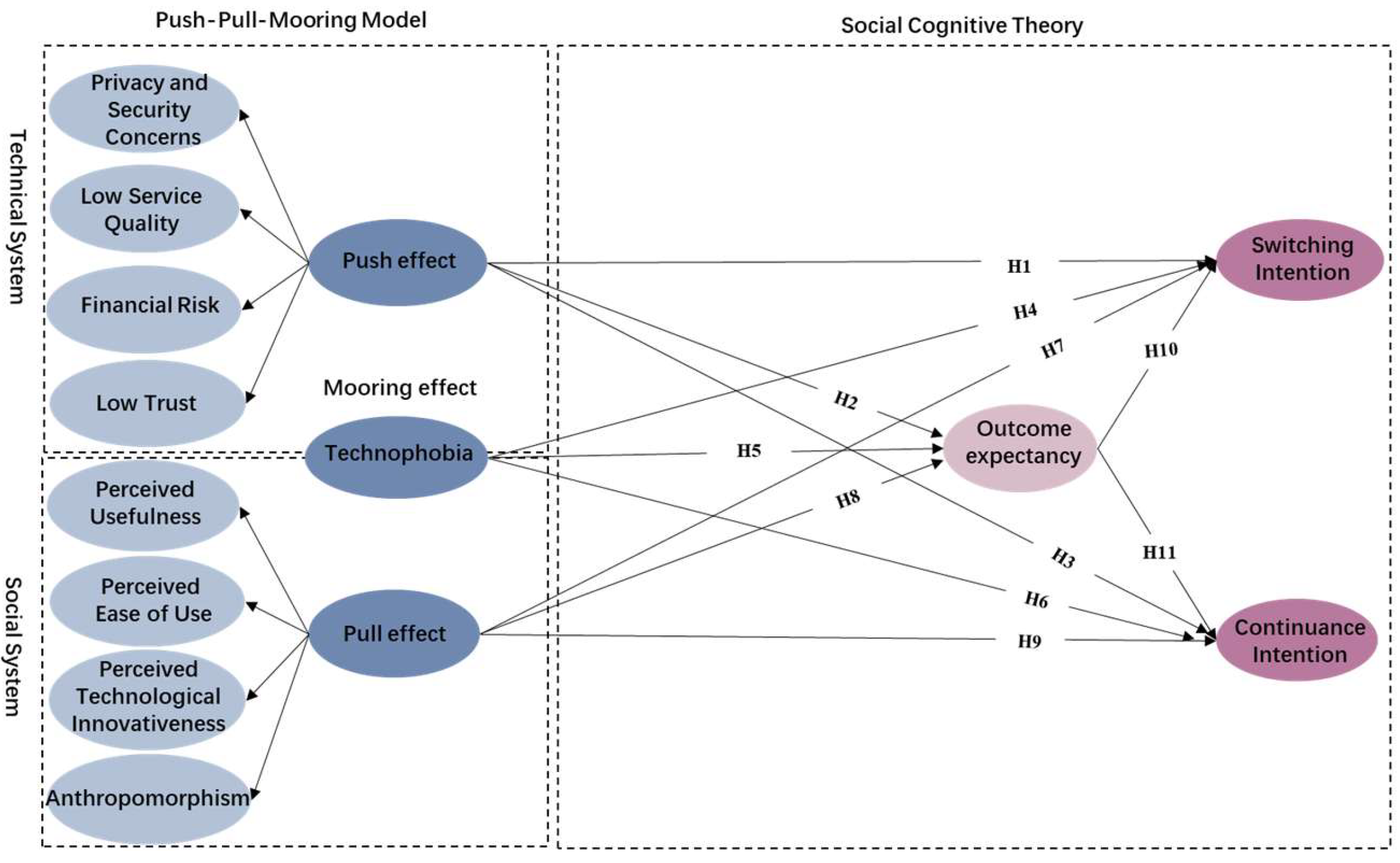
To systematically examine the behavioral transition from manual delivery to ADRs, this study integrates the PPM model [27], STS theory, and SCT [28,29]. While PPM provides the structural logic for migration behavior, it requires contextual drivers to explain why users switch. STS fills this gap by categorizing these drivers into technical and social dimensions. Furthermore, SCT is incorporated to elucidate the internal cognitive mechanism—specifically, outcome expectancy—that translates these external drivers into behavioral intentions. The integration of these frameworks constructs a comprehensive second-order SEM (see Figure 1).
Figure 1. Theoretical model.

2.2.1. Push–Pull–Mooring (PPM) Model

The PPM framework serves as the overarching behavioral structure for this study. Originally developed to explain migration, it posits that switching behavior is influenced by three forces: push factors (negative factors at the origin), pull factors (positive factors at the destination), and mooring factors (impediments to switching) [30,31,32]. While PPM has been robustly applied to service switching and digital migration [17,33], prior studies often lack a systematic rationale for selecting specific push/pull factors. In the context of ADRs, “push” factors reflect dissatisfaction with manual delivery (e.g., risks, inefficiencies), while “pull” factors capture the appeal of robotic delivery. This study employs the PPM paradigm to model the user’s transition pathway but relies on STS theory to identify the specific antecedents of these forces.

2.2.2. Socio-Technical Systems (STS) Theory

STS theory asserts that any operational system comprises interacting social (people, attitudes, values) and technical (tasks, technology, processes) subsystems [12,34]. Successful technology adoption requires the joint optimization of both dimensions [28]. ADRs exemplify a complex socio-technical system [3]. The technical dimension involves functional attributes such as automation accuracy, efficiency, and contactless delivery capabilities [11]. Conversely, the social dimension pertains to human-centric concerns, including trust, privacy, safety, and the nuances of human–robot interaction [35,36]. By adopting the STS lens, this study systematically categorizes the “push” and “pull” drivers into technical performance and social concerns, ensuring a holistic evaluation of the ADR ecosystem beyond mere functional utility.

2.2.3. Social Cognitive Theory (SCT)

To bridge the external drivers and behavioral outcomes, we incorporate SCT, explicitly focusing on Outcome Expectancy. SCT suggests that environmental factors influence behavior through cognitive evaluation [10,15]. Outcome expectancy refers to a user’s judgment of the likely consequences of a behavior—ranging from efficiency gains to emotional satisfaction [15]. In this framework, SCT explains the psychological processing: users do not switch to ADRs solely because of technical features, but because they cognitively process these STS attributes into specific outcome expectancies (e.g., expecting higher efficiency or lower privacy risk) [37]. Thus, SCT serves as the cognitive nexus, translating the social and technical attributes identified by STS into the switching motivations modeled by PPM.

2.3. Research Hypothesis

2.3.1. Push Effect

Consistent with existing studies, this study defines push factors as negative experiences or perceptions that drive users to abandon their original service systems [32], explicitly referring to the key drivers that prompt consumers to discontinue using traditional manual delivery [38]. Research in the service sector suggests that push factors primarily involve users’ negative perceptions of existing services, such as low service quality, privacy and security risks, financial risks, and low trust, all of which can trigger migration behaviors [16,32,39,40,41].
Specifically, service quality reflects the extent to which a service meets users’ expectations [42]. Traditional manual delivery often leads to user dissatisfaction due to delays, indifferent attitudes, and inconsistent service, thereby reducing satisfaction and continuance intention [43,44]. In the context of crowdsourced logistics, couriers frequently access users’ private information, and the lack of transparency regarding their identities intensifies concerns about privacy breaches and personal safety [39,45]. During the pandemic, face-to-face services entailed elevated health risks, exacerbating consumer concerns over the safety of conventional delivery [13]. Additionally, as the demographic dividend declines and labor costs rise, consumers increasingly perceive a mismatch between the price and service value of manual delivery, heightening their financial risk [7]. Previous studies have confirmed that price sensitivity is a key driver of users’ intention to switch services, and it also leads consumers to form positive expectations regarding ADR’s cost efficiency [13,16]. At the same time, trust deficits manifest as users’ doubts about the reliability, stability, and execution capability of delivery services, weakening emotional attachment, and increasing their willingness to evaluate alternative technologies [16]. Moreover, trust deficits regarding manual delivery may further enhance consumers’ positive expectations of new technologies and increase their intention to continue using them [46].
In summary, low service quality, privacy and security concerns, financial risks, and low trust constitute typical push factors within traditional manual delivery services, systematically driving consumers to migrate toward ADRs and influencing their switching intention, outcome expectancy, and continuance intention. Based on these insights, this research proposes:
H1: 
Push factors contribute positively to switching intention.
H2: 
Push factors contribute positively to outcome expectancy.
H3: 
Push factors contribute positively to continuance intention.

2.3.2. Mooring Effect

In migration behavior research, the mooring effect refers to intrinsic forces that do not directly stem from service failures or the attractiveness of alternatives, yet that impose psychological or behavioral constraints on switching decisions [38]. It typically manifests as hesitation, resistance, or emotional attachment at the cognitive, affective, or behavioral level when individuals consider switching services, such as habitual usage or technology-related anxiety [14,47]. Although prior literature has extensively investigated the anchoring effect of “inertia” within migration dynamics [14], studies examining “technophobia” functioning as a mooring factor remain limited—especially in contexts where intelligent and automated technologies are rapidly proliferating, leaving their potential inhibitory effect insufficiently validated.
Technophobia refers to the negative psychological responses, such as anxiety, resistance, and perceived incompetence, that individuals experience when encountering emerging technologies or intelligent systems, particularly in highly technologized delivery service contexts [47]. Therefore, this study conceptualizes technophobia as a key mooring factor in consumers’ migration from traditional manual delivery systems to ADRs. Existing studies indicate that technophobia reflects users’ anxiety, resistance, and perceived lack of competence regarding emerging intelligent systems, which may suppress their positive expectations and reduce their readiness to embrace these intelligent solutions [47,48]. In summary, this research argues that technophobia disrupts individuals’ evaluation of the efficiency and convenience benefits of ADRs, thereby significantly reducing their outcome expectancy and switching intention. Moreover, when such fear remains unaddressed, the likelihood of continued use may also decline substantially. Therefore, this research proposes:
H4: 
Technophobia significantly reduces switching intention.
H5: 
Technophobia significantly reduces outcome expectancy.
H6: 
Technophobia significantly reduces continuance intention.

2.3.3. Pull Effect

In migration studies, pull factors are the attractive features of an alternative system that motivate individuals to consider switching. These factors are typically reflected in the system’s advantages in efficiency, convenience, and innovation [32]. In service switching and technology adoption research, consumers’ willingness to adopt new systems is often driven by their positive perceptions of system performance and technological advancement [14].
In the TAM framework, perceived usefulness and ease of use function as core variables that determine users’ intention to adopt innovative technologies. Ye et al. found that these factors significantly enhance switching intentions among live-streaming e-commerce users [49]. Yuen et al. further validated the positive effects of ADRs on consumers’ outcome expectancy and adoption intention [13]. In addition, anthropomorphism is a key social attribute in robotic technology, encompassing human-like appearance and affective or interactional capabilities [11,50]. Empirical evidence suggests that anthropomorphic features significantly enhance users’ brand perception and interactive experience with intelligent products, thereby strengthening their intention to use. Another important pull factor is technological innovativeness, which refers to users’ subjective perceptions of a technology’s novelty and relative advantage [51]. Lowe and Alpert argue that desirable technological innovations must offer tangible improvements that significantly enhance the user experience [52]. Related research also shows that firms emphasizing technological innovativeness in their marketing are more likely to attract consumer attention and facilitate conversion [51]. For example, suppose ADRs are perceived as saving time, reducing errors, and improving the delivery experience. In that case, consumers are more likely to transition from conventional delivery methods to ADRs [13].
In summary, perceived ease of use, usefulness, anthropomorphism, and technological innovativeness collectively constitute the key pull factors in ADRs. The stronger these perceptions are, the greater the consumers’ switching intention, positive outcome expectancy, and continuance intention. Accordingly, this research proposes:
H7: 
Pull factors significantly enhance switching intention.
H8: 
Pull factors significantly enhance outcome expectancy.
H9: 
Pull factors significantly enhance continuance intention.

2.3.4. Outcome Expectancy

Within the framework of SCT, outcome expectancy is regarded as a core variable for predicting behavioral intention, reflecting individuals’ subjective judgments about the consequences of their actions [10,15]. Specifically, outcome expectancy refers to consumers’ cognitive assessment of a technology’s ability to improve efficiency, enhance convenience, and generate value returns. It is a critical psychological foundation for driving behavioral intention [15]. In last-mile delivery scenarios, the service advantages of ADRs closely align with consumers’ expectations for an efficient, convenient lifestyle, increasing the likelihood of adoption and integration into daily routines. When users believe that ADRs can deliver faster, lower-cost, and less error-prone services, their intention to replace manual delivery becomes more evident, and their continuance intention is correspondingly strengthened [8,13]. Prior studies have shown that the more positive consumers’ outcome expectancy toward autonomous delivery technologies, the stronger their willingness to adopt them [10]. Moreover, positive outcome expectancy facilitates initial switching behavior and enhances user loyalty and system stickiness by increasing satisfaction and aligning expectations.
Accordingly, this research proposes:
H10: 
Outcome expectancy significantly enhances switching intention.
H11: 
Outcome expectancy significantly enhances continuance intention.

3. Methodology

We employed both qualitative insights and quantitative validation analyses to test our theoretical model (Figure 1). To enhance the robustness and consistency of our findings, we adopted a multi-source and mixed-methods design to improve the credibility of the results [53]. In the qualitative phase, we conducted interviews with ten experts from China. The interviewees included academic researchers with extensive experience in smart logistics, consumer behavior, technology adoption, and autonomous delivery robots, as well as industry experts with practical experience in logistics operations, unmanned technology implementation, and platform service management. Participants were selected based on their expertise and influence in autonomous delivery technologies or consumer adoption research. Their professional insights facilitated a deeper understanding of the behavioral mechanisms, influencing factors, and real-world challenges involved in consumers’ transition from manual delivery to ADRs. Each of these semi-structured interviews lasted over 30 min and provided critical support for the construction of our theoretical model and the subsequent design of the questionnaire.

3.1. Measurements and Questionnaire Development

Given the presence of multiple higher-order latent constructs, we adopted a second-order SEM framework to evaluate the theoretical model and hypotheses. The push construct was specified as a second-order factor indicated by privacy and security concerns, low service quality, perceived financial risk, and low trust, while the pull construct was specified as a second-order factor indicated by perceived technological innovativeness (TIN), anthropomorphism, perceived usefulness, and ease of use. These higher-order factors, together with technophobia, outcome expectancy, switching intention, and continuance intention toward ADRs, formed a hierarchical model for systematic hypothesis testing. This approach is appropriate because it (i) more faithfully represents the cognitive structure of multidimensional constructs than first-order models [42]; (ii) aggregates subdimensional variance, thereby strengthening the explanatory power of relationships among latent variables and improving overall model robustness [54]; and (iii) mitigates bias in factor loadings associated with item proliferation, improving theoretical fit and explanatory capacity [42].
In this study’s second-order SEM, all latent constructs were measured using empirically validated scales, which were contextually adapted to ensure relevance and validity in the ADR setting. Acceptance intention comprised switching intention [55] (shift from manual delivery to ADRs) and continuance intention [46] (long-term usage tendency). Push factors captured negative perceptions of manual delivery across privacy/security concerns, low service quality, low trust, and financial risk, with items adapted from Wang et al. [45], Poon and Tung [39], Jung et al. [16], Uzir et al. [56], Yi et al. [57], and Luo et al. [58]. Pull factors reflected positive perceptions of ADRs, including perceived usefulness, ease of use, technological innovativeness, and anthropomorphism, drawing from Yuen et al. [3], Ruiz-Alba et al. [40], and Chi et al. [50]. Mooring was operationalized as technophobia, a concept articulated by Subero-Navarro and colleagues to capture individuals’ uncertainty and resistance toward automation [47]. Outcome expectancy, as a key cognitive variable, reflects perceived gains in efficiency, convenience, and affective returns, as described by Osakwe and colleagues [10]. Each construct employed ≥4 observed indicators to capture its conceptual domain; full items and sources appear in Appendix A.

3.2. Survey Administration

The questionnaire tool utilized in this study was structured into three segments. The first part introduced the study context, briefly outlining the concept of ADRs, the research goals, data usage policies, and a privacy assurance statement. The statement clarified that all data would be used solely for academic research, in strict compliance with relevant privacy protection regulations. No personally identifiable information was collected or disclosed. Respondents were encouraged to answer truthfully after being fully informed, to reduce evaluation anxiety and defensiveness, thereby minimizing social desirability bias in the survey responses. The second section of the questionnaire focused on the primary constructs. Items were evaluated on a 7-point Likert-type scale, ranging from “strong disagreement” (1) to “strong agreement” (7), to assess participants’ level of agreement with each statement. In addition, the wording of all items was designed to be neutral and objective, avoiding overtly value-laden expressions to enhance the authenticity and reliability of responses. This third segment gathered general demographic characteristics.
The target population consisted of Chinese residents aged 18 or older who were registered on the Sojump platform. Sojump is one of the largest online survey platforms in China, with over 6.2 million active respondents who possess high levels of digital literacy and frequent mobile usage, making it a suitable data source for studying ADR technology acceptance and switching mechanisms. Sojump administered the online survey as a professional survey service provider. All participants were required to read and agree to an informed consent statement before accessing the questionnaire. All survey items were presented in Simplified Chinese to ensure accurate comprehension of the measurement constructs. Prior to the formal survey, a pilot test involving 90 respondents was conducted, and several items were revised based on feedback to ensure measurement validity and linguistic clarity. During the formal data collection stage, a total of 1000 responses were collected, and respondents who completed the questionnaire received a monetary incentive. Based on the pilot responses, the estimated average completion time was approximately six minutes. To ensure data quality, several exclusion criteria were applied, including completion times below two minutes and failure to pass attention checks, resulting in the removal of 214 invalid responses and the retention of 786 valid cases. The adequacy of the final sample size (n = 786) was verified against the requirements for SEM. First, an a priori power analysis using G*Power 3.1 indicated that to detect a medium effect size (f2 = 0.15) with a statistical power of 0.95 at α = 0.05, a minimum of 129 subjects was required. Second, the sample size meets the recommendations of Kline [59] and Hair et al. [60], who suggest a minimum sample size of 200 for SEM analysis to minimize convergence failures and improper solutions. Thus, the dataset provides sufficient statistical power for robust model estimation. The research team paid Sojump 6 RMB per completed questionnaire, covering both participant compensation and platform service fees. All valid data were included in the subsequent empirical analyses. Although the sample showed some variation in gender, age, and income (see Table 2), it primarily consisted of young to middle-aged adults (21–40 years) with relatively high educational levels and extensive experience with mobile internet technologies. Therefore, the findings are more applicable to ADRs’ potential core user group, and caution is advised when generalizing to low-technology-exposure groups or older populations.
Table 2. Demographic Profile of Respondents.

3.3. Preliminary Analysis

In SEM, ensuring that data meet approximate normality is essential for applying maximum likelihood estimation (MLE). To verify this assumption, skewness and kurtosis were assessed. Kline noted that skewness values should not exceed ±3, and kurtosis values should remain within ±8 [59]. The results showed that all observed variables fell within these thresholds (see Table 3), indicating no severe skewness or extreme outliers. Accordingly, the data met the distributional assumptions for SEM and were deemed appropriate to facilitate further structural path analysis and testing of research assumptions.
Table 3. Confirmatory factor analysis results.
This study conducted two types of bias assessments: response bias and common method bias. To examine response bias, we compared the responses of early participants (those in the first 50%) and late participants (those in the last 50%) using an independent-samples t-test and found no significant differences in mean scores between the groups. Therefore, it can be reasonably inferred that non-response bias is unlikely to have a substantive impact on our research findings [61]. Second, this research employed two diagnostic approaches to ensure data validity and reliability, while controlling for potential common-method bias (CMB) arising from the same-source data collection. Firstly, Harman’s single-factor test showed that only 41.34% of the total variance was accounted for by the initial principal component, which is below the 50% threshold, indicating no dominant factor [55]. Secondly, the ULMC (unmeasured latent method construct) technique was employed by adding a method factor to the measurement model. A comparative analysis of fit indices from baseline versus method-adjusted models revealed no significant difference, suggesting that CMB had no significant effect on the outcomes. The above results confirm that CMB is absent in this research, indicating that the data are suitable for subsequent empirical analysis [62].

3.4. Demographic Characteristics

To further examine the representativeness and external validity of the sample, the demographic characteristics of the respondents were summarized and analyzed, as presented in Table 2. Among the 786 eligible participants, 52.4% identified as male and 47.6% as female, suggesting near gender parity with a slight predominance of male respondents. The majority were between 21 and 40 years, with the most significant proportion in the 21–30 age group (38.0%), followed by those aged 31–40 (18.6%). This age distribution reflects a youthful to middle-aged sample, consistent with the typical profile of online panel participants. Regarding education, 69.2% of the respondents reported having completed college-level or higher education, indicating a relatively advanced educational background and suggesting strong cognitive and decision-making capacity. Regarding income brackets, most participants fell within the mid-income range: 56.6% earned RMB 2500–6500, 18.4% earned between RMB 6501 and 8500, and 15.3% earned more than RMB 8500. The income distribution aligns closely with the 2024 report on household income and consumption expenditure released by the National Bureau of Statistics of China, further validating the sample’s real-world representativeness [63].

4. Empirical Results and Discussion

4.1. Confirmatory Factor Analysis

As presented in Table 3, all fit statistics fell within acceptable ranges, indicating that the model appropriately represented the latent constructs. Regarding internal consistency, all latent variables achieved Cronbach’s alpha and composite reliability values exceeding the 0.70 criterion. Moreover, the standardized factor loadings and average variance extracted (AVE) surpassed the 0.50 threshold, supporting adequate construct reliability and validity [60]. Second-order factors—push and pull—also demonstrated adequate model fit: Push: χ2/df = 3.100, SRMR = 0.033, RMSEA = 0.052, CFI = 0.997, IFI = 0.977, TLI = 0.973; Pull: χ2/df = 3.101, SRMR = 0.048, RMSEA = 0.071, CFI = 0.946, NFI = 0.933, TLI = 0.939. These findings offer further empirical support for the validity of the higher-order constructs.
The inter-construct correlations were further examined to evaluate the discriminant validity of the evaluative framework. Findings indicated the square roots of the AVE for all constructs were greater than their corresponding inter-construct correlations (see Table 4), thereby meeting Fornell and Larcker’s criterion [64]. This suggests that the constructs are distinct, with no substantial overlap, supporting the measurement model’s discriminant validity. Additionally, variance inflation factor (VIF) tests were conducted across all unobserved constructs to assess potential multicollinearity. The VIF values for all variables were well below the threshold of 3, indicating negligible multicollinearity [60]. Overall, the measurement model demonstrated acceptable levels of construct convergence, discriminant validity, and control of multicollinearity, establishing a robust foundation for subsequent structural model assessment.
Table 4. Discriminant validity test results.

4.2. Structural Model Analysis

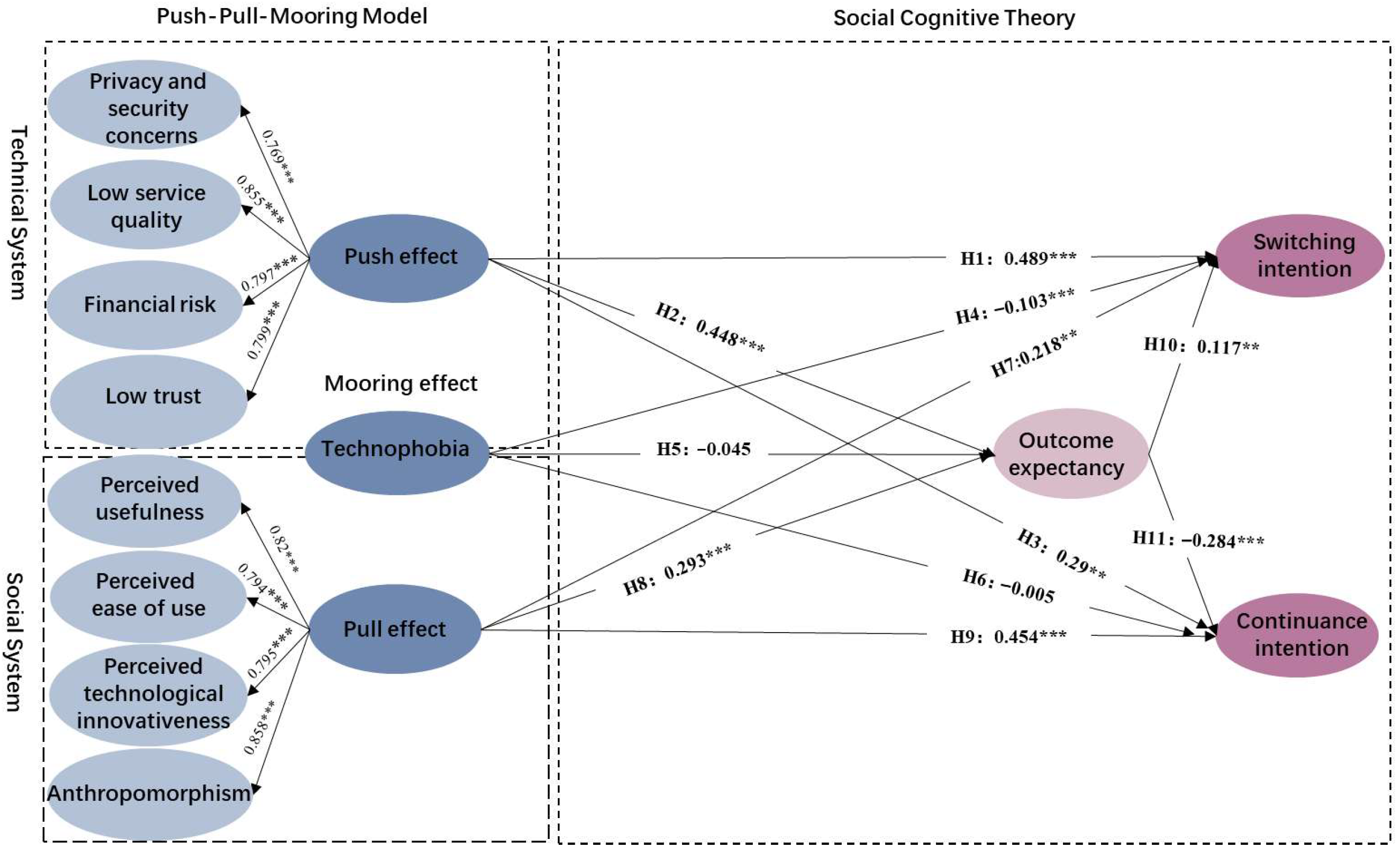
Following confirmation of the measurement model’s reliability and validity through CFA, this study further evaluated the structural model using second-order SEM to empirically test the hypothesized relationships among the core constructs [65]. Estimating the path coefficients allows for the examination of causal relationships among the latent variables and their statistical significance. The standardized path coefficients of the second-order SEM are presented in Figure 2 and Table 5. All path coefficients were below 1.0, indicating that the parameter estimates were within an acceptable range and free from estimation bias [42]. The model fit indices showed a good model fit (χ2/df = 2.769, SRMR = 0.0438, RMSEA = 0.047, CFI = 0.934, IFI = 0.934, TLI = 0.931), suggesting that the data were well-aligned with the proposed model.
Figure 2. Structural modeling result. * p < 0.05, ** p < 0.01, *** p < 0.001.
Table 5. Path relationship hypothesis test results.
As shown in Figure 2, the push, pull, and technophobia constructs had a significant direct effect on switching intention. Specifically, push factors (β = 0.489, p < 0.001) and pull factors (β = 0.218, p < 0.01) had a positive and significant influence on switching intention. In contrast, technophobia, as a mooring variable, had a significant adverse effect (β = −0.103, p < 0.001). These findings support hypotheses H1, H7, and H4. Further analysis reveals that push (β = 0.448, p < 0.001) and pull factors (β = 0.293, p < 0.001) significantly and positively influenced outcome expectancy, confirming hypotheses H2 and H8. However, the path from technophobia to outcome expectancy was not statistically significant (p > 0.05), thus disconfirming hypothesis H5. This result suggests that although some consumers experience technology-related anxiety, they still hold optimistic expectations regarding ADR’s efficiency gains and service improvements. In other words, technophobia primarily affects emotional and cognitive load rather than rational evaluations of technological outcomes. Finally, push (β = 0.290, p < 0.01) and pull factors (β = 0.454, p < 0.001) also had significant positive effects on continuance intention, further supporting hypotheses H3 and H9. In contrast, technophobia had no considerable impact on continuance intention, and hypothesis H6 was not supported. These findings highlight that while technophobia may hinder initial switching decisions, its influence becomes limited once users establish habitual usage.
In addition, outcome expectancy had a significantly positive effect on switching intention (β = 0.117, p < 0.01), verifying hypothesis H10. Nevertheless, the impact of outcome expectancy on continuance intention was significantly adverse (β = −0.284, p < 0.001), contrary to hypothesis H11. This result may suggest that although consumers initially hold positive expectations toward ADRs, a mismatch between expectations and actual experiences over time may lead to expectation disconfirmation, reducing their willingness to maintain long-term usage [66]. This finding highlights that positive expectations do not necessarily translate into sustained behavior, and the underlying mechanisms of expectation fulfillment warrant further investigation.

4.3. Mediation Effect Analysis

Following the recommendation of Nitzl et al. [67], 10,000 bootstrap samples were generated, and the significance of indirect effects was assessed within a 95% confidence interval. The mediation results are presented in Table 6. Firstly, outcome expectancy was found to serve as a significant intermediary in the dynamics between push-related factors and users’ switching intention (SWI) (bSWI = 0.065, p < 0.05), as well as in their continuance Intention (CTI) (bCTI = −0.119, p < 0.001). Secondly, outcome expectancy also mediated the effect of pull factors on switching intention (SWI) (bSWI = 0.042, p < 0.05) and continuance intention (CTI) (bCTI = −0.077, p < 0.01). These findings suggest that outcome expectancy serves as a cognitive channel through which socio-technical attributes influence consumer intentions, and it is a critical psychological mechanism linking contextual stimuli to behavioral responses.
Table 6. Results of mediating effect testing.

4.4. Moderation Effect Analysis

The moderating effects were tested using Hayes’ PROCESS macro (Model 1) with 5000 bootstrap resamples and a 95% confidence interval. This analysis examined the interactive influence of the mooring factor (technophobia) and social norms on the associations among push–pull variables and users’ behavioral intentions toward adoption (including both switching and continuance intentions). Table 7 provides a detailed summary of the moderation results.
Table 7. Analysis of moderation effects.
The results indicated that technophobia significantly moderated the effects of both push factors (β = −0.067, t = −3.221, p < 0.01) and pull factors (β = −0.050, t = −2.210, p < 0.05) on switching intention. Social norms demonstrated consistent moderating effects across all examined paths. Specifically, social norms significantly moderated the relationships between push factors (βSWI = 0.085, tSWI = 4.164, p < 0.001; βCTI = 0.061, tCTI = 2.597, p < 0.05), pull factors (βSWI = 0.105, tSWI = 4.972, p < 0.001; βCTI = 0.068, tCTI = 2.983, p < 0.01), and technophobia (βSWI = 0.128, tSWI = 6.634, p < 0.001; βCTI = 0.069, tCTI = 3.355, p < 0.01) on both switching and continuance intentions.
To characterize the direction and magnitude of moderation, we conducted simple-slope analyses for all significant interaction terms. The results show that: Negative moderation by technophobia. Along the paths from push and pull to switching intention, technophobia exerts a significant negative moderating effect; when technophobia is high, the positive impacts of push and pull on switching intention are attenuated. Positive moderation by social norms. Social norms positively moderate the effects of push and pull on both switching and continuance intentions; higher levels of social norms strengthen these relationships. Buffering by social norms against technophobia. Along the technophobia → intention paths, social norms exhibit a negative interaction with technophobia; higher social norms significantly buffer technophobia’s suppressing effects on both switching and continuance intentions.

4.5. Discussion of Results

The findings largely support the proposed conceptual model while revealing nuanced behavioral mechanisms governing the transition to ADRs. The discussion is structured around three key dimensions: direct drivers and barriers, the dual role of outcome expectancy, and boundary conditions.

4.5.1. Direct Effects and Stage-Specific Barriers

First, the results confirm that both push and pull factors are potent drivers of ADR adoption. Consistent with migration theory [32], dissatisfaction with manual delivery (push) and the functional appeal of ADRs (pull) significantly enhance users’ switching intention and outcome expectancy. Notably, pull factors exerted the strongest influence on continuance intention (β = 0.454), underscoring that long-term retention is primarily anchored in the technological superiority and value proposition of the new system. Regarding barriers, Technophobia exhibited a distinct stage-specific effect. It significantly inhibited switching intention (supporting H4) but had no significant impact on outcome expectancy or continuance intention (H5, H6 rejected). This suggests that technophobia operates as a pre-adoption “gatekeeper.” Automation anxiety impedes the initial decision to cross the threshold into usage; however, once users overcome this hurdle and engage with the service, their continued use is driven by actual performance experiences and habit formation rather than residual anxiety [6,22].

4.5.2. The “Expectation Paradox”: Mediation Mechanisms

Second, the mediation analysis reveals a complex “double-edged” role of Outcome Expectancy. While push and pull factors successfully elevate outcome expectancy to drive switching intention (H10), this heightened expectancy negatively predicts continuance intention (β= −0.284), contrary to H11. This counterintuitive finding aligns with the Expectation Disconfirmation paradigm [1,66]. Specifically, while high expectations are necessary to motivate the initial switch, they may set a high benchmark that reality fails to meet. Suppose the actual service experience falls short of the idealized expectations formed via advertising or social influence (an “expectation–performance gap”). In that case, users may experience disappointment, thereby weakening their resolve to continue using the service [68]. Thus, optimistic expectations facilitate entry but may jeopardize retention if not managed realistically.

4.5.3. Boundary Conditions: Technophobia and Social Norms

Finally, the moderation analysis highlights the interplay between individual psychology and social context. Technophobia negatively moderated the impact of both push and pull factors on switching intention, indicating that high anxiety acts as a psychological barrier that dampens the perceived attractiveness of ADRs [48]. Conversely, Social Norms exerted a pervasive positive moderating effect. They not only strengthened the pathways from drivers to behavioral intentions but also mitigated the inhibitory effect of technophobia. This suggests that a supportive social environment—characterized by conformity and social proof—can effectively buffer against individual technological anxiety, encouraging even hesitant users to adopt and sustain ADR usage [69,70].

5. Conclusions

5.1. Theoretical Contributions

This study advances theory in five ways. First, from the STS perspective, this research systematically identifies the key drivers influencing consumers’ switching intentions toward ADRs. It conceptualizes consumers’ dissatisfaction with traditional manual delivery services as push factors and their favorable perceptions of ADR’s technological advantages as pull factors, thereby proposing a migration logic grounded in the dual social and technological dimensions. Unlike previous studies that primarily focused on the technical dimension within technology acceptance models, this study integrates the categorization of migration drivers with the STS framework, thereby refining the structural components of the PPM model at the theoretical level and enhancing its explanatory power in capturing complex consumer decision-making processes [14].
More importantly, this study provides robust empirical evidence for applying the PPM framework to explain consumers’ switching intentions from traditional manual delivery to ADRs. The validated model indicates that social, technological, and psychological drivers influence consumers’ intention to adopt ADRs. This finding transcends the limitations of prior research, which typically concentrated on a single dimension, such as technological functionality or product attributes, by highlighting the more complex and systematic structure of the migration drivers. Moreover, although the PPM framework has been widely applied across various migration contexts, empirical studies examining consumers’ transition from traditional manual delivery to ADRs remain absent. This study extends the PPM model’s theoretical scope in socio-technical systems and deepens its applicability to emerging scenarios of technological substitution.
Third, this study is the first to integrate the PPM framework with SCT, thereby extending its applicability to the context of intelligent delivery systems. This integration addresses a critical gap in consumer behavior research by proposing a unified context–cognition–behavior pathway. Specifically, the study incorporates “outcome expectancy,” a core construct in SCT, as a mediating variable to illustrate how consumers’ idealized expectations of new technologies serve as a cognitive bridge in migration decision-making. This mechanism enhances theoretical understanding of dynamic adoption processes and provides a mental perspective that facilitates a more comprehensive understanding of individual psychological decision-making in the context of technological substitution [10,15].
Fourth, this research uncovers critical differences in the mechanisms underlying switching intention and continuance intention. Switching intention primarily reflects consumers’ short-term motivation to experiment with new technology. In contrast, continuance intention is a more structural intention to adopt ADRs as a long-term delivery solution. While positive outcome expectancy facilitates switching intention, overly optimistic expectations of ADRs that are unmet by experience may lead to an expectation–reality gap, thereby diminishing long-term usage motivation [66,68]. This finding lays the groundwork for future research that differentiates between trial-based behavior and structural substitution behavior.
Ultimately, this study extends the exploration of the moderating effects of technophobia and social norms, shedding light on how emotional and social factors influence the pathways of consumer decision-making. Specifically, technophobia, as a negative emotional factor, significantly suppresses the influence of both push and pull forces on users’ intention to switch. This finding extends the theoretical interpretation of mooring mechanisms in the current PPM structure and broadens the scope of emotional constructs within migration dynamics models [47,48]. Meanwhile, social norms exert a positive moderating influence, shaping how push, pull, and mooring variables affect switching and continued intention, confirming the pivotal role of normative influence in consumer adoption decisions [32].

5.2. Policy Implications

This research provides actionable guidance for ADR developers, service providers, and policymakers. Importantly, these insights are scalable and applicable to a broad spectrum of organizations, ranging from large-scale logistics platforms to Small and Medium-sized Enterprises (SMEs) (e.g., local retailers and community service providers) seeking to deploy autonomous solutions. By understanding the specific drivers of consumer switching and continuance, organizations of varying sizes can tailor their strategies as follows:
First, regarding risk management, findings on “Push factors” serve as critical early warning indicators. While push factors primarily reflect dissatisfaction with manual delivery, they also highlight consumers’ sensitivity to service failure. For large-scale platforms, this implies a need to pair automation scale with rigorous “systematic risk identification,” specifically addressing privacy, security and data transparency to build systemic trust [7,71]. For smaller operators, who may lack robust brand endorsement, transparency regarding pricing and service terms is vital to mitigate financial concerns and avoid triggering user resistance [10,12].
Second, regarding technological enhancement, “pull factors” serve as the primary driver of adoption. Developers should prioritize the “humanization” of ADR systems by integrating natural language processing and emotion recognition to foster trust [12,19]. Furthermore, SMEs and community-based organizations can leverage “high-frequency, low-cost trial deployments” in specific micro-environments (e.g., campuses, residential compounds). These localized pilots effectively lower cognitive barriers and stimulate motivation through tangible hands-on experience, facilitating a bottom-up diffusion of acceptance [11].
Third, regarding expectation management, this study uncovers a potential “expectation-reality gap.” While elevating outcome expectancy drives initial trials [1], overpromising can backfire, eroding continuance intention (β = −0.284). Therefore, firms of all sizes must avoid hyperbolic marketing. Instead of exaggerating futuristic benefits, marketing communications should focus on “service consistency” and “reliability.” Ensuring that the actual delivery experience matches the promotional narrative is crucial for converting trial users into long-term loyalists [66].
Fourth, regarding social influence, the positive moderation of social norms suggests that policymakers and community leaders can shape public acceptance by leveraging social proof. Since ADRs are novel, consumers look to “referent others” for cues. Organizations can foster a positive social atmosphere by showcasing testimonials from early adopters and model communities. For local SMEs, organizing community demonstration events can enhance users’ sense of social identification and imitative motivation, effectively bridging the gap between hesitation and adoption [11].
Finally, regarding user support, developers must implement systematic interventions to mitigate technophobia. This is particularly critical for demographic inclusivity. Strategies should include interactive voice guides and simulation tutorials to reduce operation-induced anxiety. Additionally, targeted “digital literacy programs”—such as offline training camps for older adults—can boost technological self-efficacy [22]. By incorporating anthropomorphic designs and responsive feedback mechanisms, companies can alleviate psychological barriers, ensuring that the technology is accessible and welcoming to non-expert users.

5.3. Limitations and Future Research

This study has several limitations that offer avenues for future inquiry.
First, the study’s generalizability is constrained by geographical and cultural factors. As the data were collected exclusively in China, consumers in other regions may exhibit different motivations, social norms, and technology acceptance thresholds. Future research should conduct cross-cultural replications to test the model’s robustness across diverse socio-technical contexts [7]. The cross-sectional design also limits observation of temporal dynamics; longitudinal tracking could validate switching pathways and long-run adoption.
Second, this study modeled outcome expectancy as the primary mediator; however, the complex nature of resistance and adoption suggests that additional mediators (e.g., perceived value, emotional attachment) and moderators (e.g., social anxiety, personal innovativeness) warrant further examination to enrich explanatory power [12,56].
Third, the scope of “traditional delivery” includes various non-face-to-face options (e.g., smart lockers, collection points) that were not separately analyzed. Future work should compare ADRs against these specific last-mile alternatives regarding acceptance and satisfaction [6,14,18].
Fourth, the sample composition presents a demographic limitation. Due to the web-based survey administration and the early-stage nature of ADR adoption, respondents were predominantly young, highly educated, and had high income levels. While this aligns with the typical profile of early technology adopters, it limits the generalizability of the findings to broader demographics, such as older adults or lower-income groups. Future studies should employ stratified sampling and multigroup analyses to examine how age, education, and income levels moderate the mechanism underlying ADR acceptance [22].
Finally, regarding sectoral generalizability, it is crucial to delineate the boundary conditions of these findings. This study focuses specifically on the “Last-Mile Delivery” context, where consumers actively choose between manual courier services and ADRs. Consequently, the verified “PPM” mechanisms are primarily applicable to high-contact service logistics, including on-demand delivery, smart campus/community logistics, and unmanned retail services. Caution should be exercised when extrapolating these results to industrial manufacturing sectors (e.g., factory automation) or to backend intralogistics, where end-user interaction is minimal, and the decision-making dynamics differ fundamentally. Future research is encouraged to test whether the “technophobia” and “switching” mechanisms observed here hold in other service robot contexts, such as hospitality or healthcare robotics.

Author Contributions

Conceptualization, X.T.; Data Curation, D.C. and S.Z.; Formal Analysis, X.T. and Y.L.; Investigation, D.C. and S.Z.; Methodology, X.T. and Y.L.; Project Administration, Y.L.; Resources, Y.L.; Software, X.T.; Supervision, Y.L.; Validation, X.T.; Visualization, Y.L.; Writing—Original Draft, X.T.; Writing—Review and Editing, Y.L. All authors have read and agreed to the published version of the manuscript.

Funding

This research received no external funding.

Institutional Review Board Statement

In accordance with the ethical guidelines established by the National Health Commission, Ministry of Education, Ministry of Science and Technology, and Administration of Traditional Chinese Medicine of China, our research is categorized under life science research due to the use of sociological methods for behavioral data collection. However, it does not involve any life science or medical issues, nor does it include the collection of biospecimens, health records, or sensitive personal information. Per Article 32 of the National Guidelines for Scientific Research Ethics Review, studies involving human data or anonymized information—where there is no harm to participants, no sensitive personal information or commercial interests, and no relevance to life science or medical topics—are eligible for exemption from ethical review. This provision is intended to alleviate unnecessary burdens on researchers and foster the development of life science and medical research. Specifically, Article 32, Item 2 allows for exemption from ethical review for research utilizing anonymized data. Our study fully complies with this criterion, as it involved a voluntary questionnaire, ensuring complete anonymization of participant responses. The data collected are non-sensitive, non-medical, and unrelated to life science research. After thorough consideration, the study was conducted in accordance with the Declaration of Helsinki. Ethical review and approval were waived for this study because it involved anonymous survey data, in accordance with institutional and national guidelines.

Data Availability Statement

The datasets generated during and/or analyzed during the current study are available from the corresponding author upon reasonable request.

Acknowledgments

The authors gratefully acknowledge all team members, whose collective efforts and perseverance made it possible to complete this study despite the challenges encountered.

Conflicts of Interest

The authors declare they have no conflicts of interest.

Appendix A

ConstructIDMeasurementSource
Perceived Usefulness
(UFN)
UFN1Robot delivery services are useful to me.[3]
UFN2Robot delivery helps limit excessive or irrelevant face-to-face interactions.
UFN3Robot delivery can help me maintain a normal lifestyle.
UFN4Robot delivery can improve my efficiency.
UFN5Robot delivery can increase the flexibility of my daily life.
Perceived Ease of Use
(EOU)
EOU1I find it easy to grasp how robot delivery services work.[3]
EOU2I find robot delivery services straightforward to understand.
EOU3I believe I can easily become skilled at using robot delivery services.
EOU4I can easily get robot delivery services to perform the tasks I want.
EOU5I believe interacting with robot delivery services does not require much mental effort.
Perceived Technological Innovativeness
(TIN)
TIN1Robot delivery technology is novel and innovative.[40]
TIN2The robot delivery system is technologically advanced.
TIN3The robot delivery platform technology enables me to receive high-quality delivery services.
TIN4I believe robot delivery services will lead the delivery industry in the future.
Anthropomorphism
(ANT)
ANT1The robot delivery system appears as natural as a human courier.[50]
ANT2The robot delivery system has a human-like appearance.
ANT3The robot delivery system embodies values and norms.
ANT4The robot delivery system understands the purpose of delivery.
ANT5The robot delivery system communicates in a human-like manner.
ANT6The robot delivery system provides appropriate responses to user inquiries.
ANT7The robot delivery system can recognize users’ emotions.
ANT8The robot delivery system can respond to users’ emotions.
Technophobia
(TPH)
TPH1I prefer human couriers over autonomous delivery robots for delivering my packages.[47]
TPH2I feel uncomfortable with the increasing presence of autonomous delivery robots in daily life.
TPH3Compared with robot couriers, I feel safer and more at ease with human couriers.
TPH4Autonomous delivery robots should not be responsible for delivering essential or high-value items.
TPH5I feel uneasy when interacting with autonomous delivery robots during the delivery process.
Privacy and Security Concerns
(PSC)
PSC1I am concerned that human couriers may collect excessive personal information.[39,45]
PSC2I’m worried that couriers could utilize my personal information inappropriately.
PSC3I worry that my data might be disclosed to third parties without my approval.
PSC4I fear that human couriers may commit crimes against me.
PSC5Using human delivery services may increase the risk of being harmed by criminals.
PSC6Using human delivery services may increase my safety risks.
Low Service Quality
(LSQ)
LSQ1The overall quality of the courier’s service was relatively low and inconsistent.[16]
LSQ2Human delivery made me feel unsafe.
LSQ3The courier’s service felt insincere, leaving me dissatisfied.
LSQ4The courier responded slowly to my requests and failed to act promptly.
Financial Risk
(FNR)
FNR1Human delivery is more expensive than delivery by robots.[57,58]
FNR2The actual cost of human delivery is likely to be higher than that of robot delivery.
FNR3I believe the service quality of human delivery is lower than that of robot delivery, given the comparable costs.
FNR4Compared with human delivery, robot delivery offers more attractive product/service costs.
FNR5Compared with human delivery, robot delivery is perceived as fairer and more reasonable in terms of cost.
Low Trust
(LTS)
LTS1I feel uneasy when using human delivery services.[56]
LTS2I believe that human delivery services are not sufficiently safe.
LTS3This delivery service often fails to meet its commitments, and its delivery time is unreliable.
LTS4I do not trust human delivery services.
Social Norms
(SNM)
SNM1My family members think that I should use delivery robots.[69,70]
SNM2The media often recommends that we use delivery robots.
SNM3My friends believe that I should use delivery robots.
SNM4Most residents in my community approve of using delivery robots.
SNM5The general public supports the use of delivery robots.
Outcome expectancy
(OEP)
OEP1I expect delivery robots to offer a wide range of unique features.[10]
OEP2I expect delivery robots to provide better value for money.
OEP3I expect delivery robots to offer greater convenience than human couriers.
OEP4I expect delivery robots to deliver higher service quality than human couriers.
Switching Intention
(SWI)
SWI1I am willing to try using delivery robots in the future.[55]
SWI2I would be willing to experience delivery robot services if given the opportunity.
SWI3Compared to human delivery, I am more willing to use delivery robots.
SWI4I would not consider returning to human delivery services if delivery robots prove efficient and reliable.
Continuance Intention
(CTI)
CTI1I always try to use delivery robots as much as possible.[46]
CTI2I will consider using delivery robot services in the long term.
CTI3Going forward, I prefer robotic delivery over traditional methods.
CTI4Overall, I intend to use delivery robots for receiving delivery services.

References

  1. Koh, L.Y.; Yuen, K.F. Individual-, task-, and technology-fit perspective of autonomous delivery robots confirmation and adoption in smart cities. Int. J. Hosp. Manag. 2025, 128, 104182. [Google Scholar] [CrossRef]
  2. Ghiani, G.; Guerriero, E.; Manni, E.; Pareo, D. Combining autonomous delivery robots and traditional vehicles with public transportation infrastructure in last-mile distribution. Comput. Ind. Eng. 2025, 203, 111001. [Google Scholar] [CrossRef]
  3. Yuen, K.F.; Koh, L.Y.; Anwar, M.H.D.B.; Wang, X. Acceptance of autonomous delivery robots in urban cities. Cities 2022, 131, 104056. [Google Scholar] [CrossRef]
  4. Edrisi, A.; Ganjipour, H. Factors affecting intention and attitude toward sidewalk autonomous delivery robots among online shoppers. Transp. Plan. Technol. 2022, 45, 588–609. [Google Scholar] [CrossRef]
  5. Wu, M.; Lin, A.S.Q.; Yuen, K.F. The effects of motivated consumer innovativeness on consumer acceptance of autonomous delivery robots. J. Retail. Consum. Serv. 2024, 81, 104030. [Google Scholar] [CrossRef]
  6. Cai, L.; Yuen, K.F.; Xie, D.; Fang, M.; Wang, X. Consumer’s usage of logistics technologies: Integration of habit into the unified theory of acceptance and use of technology. Technol. Soc. 2021, 67, 101789. [Google Scholar] [CrossRef]
  7. Hossain, M. Autonomous delivery robots: A literature review. IEEE Eng. Manag. Rev. 2023, 51, 77–89. [Google Scholar] [CrossRef]
  8. Koh, L.Y.; Yuen, K.F. Consumer adoption of autonomous delivery robots in cities: Implications on urban planning and design policies. Cities 2023, 133, 104125. [Google Scholar] [CrossRef]
  9. Hwang, J.; Kim, J.J.; Lee, K.W. Investigating consumer innovativeness in the context of drone food delivery services: Its impact on attitude and behavioral intentions. Technol. Forecast. Soc. Change 2021, 163, 120433. [Google Scholar] [CrossRef]
  10. Osakwe, C.N.; Hudik, M.; Říha, D.; Stros, M.; Ramayah, T. Critical factors characterizing consumers’ intentions to use drones for last-mile delivery: Does delivery risk matter? J. Retail. Consum. Serv. 2022, 65, 102865. [Google Scholar] [CrossRef]
  11. Xu, S.; Zhang, X.; Kim, R.; Su, M. Anthropomorphic last-mile robots and consumer intention: An empirical test under a theoretical framework. J. Retail. Consum. Serv. 2024, 81, 104028. [Google Scholar] [CrossRef]
  12. Kang, W.; Shao, B.; Du, S.; Chen, H.; Zhang, Y. How to improve voice assistant evaluations: Understanding the role of attachment with a socio-technical systems perspective. Technol. Forecast. Soc. Change 2024, 200, 123171. [Google Scholar] [CrossRef]
  13. Yuen, K.F.; Cai, L.; Lim, Y.G.; Wang, X. Consumer acceptance of autonomous delivery robots for last-mile delivery: Technological and health perspectives. Front. Psychol. 2022, 13, 953370. [Google Scholar] [CrossRef] [PubMed]
  14. Chen, L.; Wu, P.; Dou, Y.; Wu, Y. Investigating senders’ switching intention to smart lockers: An extension of push-pull-mooring model. J. Retail. Consum. Serv. 2023, 74, 103414. [Google Scholar] [CrossRef]
  15. Maleki, S.; Naeimi, A.; Bijani, M.; Moghadam, N.S. Comparing predictive power of planned behavior and social cognition theories on students’ pro-environmental behaviors: The case of University of Zanjan, Iran. J. Clean. Prod. 2025, 486, 144386. [Google Scholar] [CrossRef]
  16. Jung, J.; Han, H.; Oh, M. Travelers’ switching behavior in the airline industry from the perspective of the push-pull-mooring framework. Tour. Manag. 2017, 59, 139–153. [Google Scholar] [CrossRef]
  17. Chang, H.H.; Wong, K.H.; Li, S.Y. Applying push-pull-mooring to investigate channel switching behaviors: M-shopping self-efficacy and switching costs as moderators. Electron. Commer. Res. Appl. 2017, 24, 50–67. [Google Scholar] [CrossRef]
  18. Boysen, N.; Fedtke, S.; Schwerdfeger, S. Last-mile delivery concepts: A survey from an operational research perspective. Or Spectr. 2021, 43, 1–58. [Google Scholar] [CrossRef]
  19. Chi, O.H.; Jia, S.; Li, Y.; Gursoy, D. Developing a formative scale to measure consumers’ trust toward interaction with artificially intelligent (AI) social robots in service delivery. Comput. Hum. Behav. 2021, 118, 106700. [Google Scholar] [CrossRef]
  20. Pani, A.; Mishra, S.; Golias, M.; Figliozzi, M. Evaluating public acceptance of autonomous delivery robots during COVID-19 pandemic. Transp. Res. Part D Transp. Environ. 2020, 89, 102600. [Google Scholar] [CrossRef]
  21. Peppel, M.; Ringbeck, J.; Spinler, S. How will last-mile delivery be shaped in 2040? A Delphi-based scenario study. Technol. Forecast. Soc. Change 2022, 177, 121493. [Google Scholar] [CrossRef]
  22. Alverhed, E.; Hellgren, S.; Isaksson, H.; Olsson, L.; Palmqvist, H.; Flodén, J. Autonomous last-mile delivery robots: A literature review. Eur. Transp. Res. Rev. 2024, 16, 4. [Google Scholar] [CrossRef]
  23. Abrams, A.M.; Dautzenberg, P.S.; Jakobowsky, C.; Ladwig, S.; Rosenthal-von Der Pütten, A.M. A theoretical and empirical reflection on technology acceptance models for autonomous delivery robots. In Proceedings of the 2021 ACM/IEEE International Conference on Human-Robot Interaction, Boulder, CO, USA, 8–11 March 2021; pp. 272–280. [Google Scholar]
  24. Koh, L.Y.; Xia, Z.; Yuen, K.F. Consumer acceptance of the autonomous robot in last-mile delivery: A combined perspective of resource-matching, perceived risk and value theories. Transp. Res. Part A Policy Pract. 2024, 182, 104008. [Google Scholar] [CrossRef]
  25. Westerlund, M. Social Acceptance of Autonomous Food Delivery Robots: An Analysis of Public Commentaries. ROBONOMICS J. Autom. Econ. 2024, 5, 57. [Google Scholar]
  26. Ayyildiz, E.; Erdogan, M. Addressing the challenges of using autonomous robots for last-mile delivery. Comput. Ind. Eng. 2024, 190, 110096. [Google Scholar] [CrossRef]
  27. Tang, Z.; Chen, L. An empirical study of brand microblog users’ unfollowing motivations: The perspective of push-pull-mooring model. Int. J. Inf. Manag. 2020, 52, 102066. [Google Scholar] [CrossRef]
  28. Lu, Y.; Xiang, C.; Wang, B.; Wang, X. What affects information systems development team performance? An exploratory study from the perspective of combined socio-technical theory and coordination theory. Comput. Hum. Behav. 2011, 27, 811–822. [Google Scholar] [CrossRef]
  29. Qiu, L.; Li, X.; Choi, S.H. Exploring the influence of short video platforms on tourist attitudes and travel intention: A social–technical perspective. J. Destin. Mark. Manag. 2024, 31, 100826. [Google Scholar] [CrossRef]
  30. Lee, E.S. A theory of migration. Demography 1966, 3, 47–57. [Google Scholar] [CrossRef]
  31. Moon, B. Paradigms in migration research: Exploring’moorings’ as a schema. Prog. Hum. Geogr. 1995, 19, 504–524. [Google Scholar] [CrossRef]
  32. Bansal, H.S.; Taylor, S.F.; St James, Y. “Migrating” to new service providers: Toward a unifying framework of consumers’ switching behaviors. J. Acad. Mark. Sci. 2005, 33, 96–115. [Google Scholar] [CrossRef]
  33. Hsieh, J.K.; Hsieh, Y.C.; Chiu, H.C.; Feng, Y.C. Post-adoption switching behavior for online service substitutes: A perspective of the push–pull–mooring framework. Comput. Hum. Behav. 2012, 28, 1912–1920. [Google Scholar] [CrossRef]
  34. Trist, E.L.; Bamforth, K.W. Some social and psychological consequences of the longwall method of coal-getting: An examination of the psychological situation and defences of a work group in relation to the social structure and technological content of the work system. Hum. Relat. 1951, 4, 3–38. [Google Scholar] [CrossRef]
  35. Li, Y.; Li, X.; Cai, J. How attachment affects user stickiness on live streaming platforms: A socio-technical approach perspective. J. Retail. Consum. Serv. 2021, 60, 102478. [Google Scholar] [CrossRef]
  36. Kapoor, K.; Bigdeli, A.Z.; Dwivedi, Y.K.; Schroeder, A.; Beltagui, A.; Baines, T. A socio-technical view of platform ecosystems: Systematic review and research agenda. J. Bus. Res. 2021, 128, 94–108. [Google Scholar] [CrossRef]
  37. Hsu, M.H.; Chiu, C.M.; Ju, T.L. Determinants of continued use of the WWW: An integration of two theoretical models. Ind. Manag. Data Syst. 2004, 104, 766–775. [Google Scholar] [CrossRef]
  38. Wang, S.; Wang, J.; Yang, F. From willingness to action: Do push-pull-mooring factors matter for shifting to green transportation? Transp. Res. Part D Transp. Environ. 2020, 79, 102242. [Google Scholar] [CrossRef]
  39. Poon, W.C.; Tung, S.E.H. The rise of online food delivery culture during the COVID-19 pandemic: An analysis of intention and its associated risk. Eur. J. Manag. Bus. Econ. 2022. ahead-of-print. [Google Scholar] [CrossRef]
  40. Ruiz-Alba, J.L.; Abou-Foul, M.; Nazarian, A.; Foroudi, P. Digital platforms: Customer satisfaction, eWOM and the moderating role of perceived technological innovativeness. Inf. Technol. People 2022, 35, 2470–2499. [Google Scholar] [CrossRef]
  41. Liu, Y.; Shang, M.; Jia, C.; Lim, X.J.; Ye, Y. Understanding consumers’ continuous-use intention of crowdsourcing logistics services: Empirical evidence from China. Heliyon 2024, 10, e29819. [Google Scholar] [CrossRef]
  42. Zhao, J.; Liu, Q.; Lee, M.K.; Qi, G.; Liu, Y. Consumers’ usage of errand delivery services: The effects of service quality and consumer perception. J. Retail. Consum. Serv. 2024, 81, 104048. [Google Scholar] [CrossRef]
  43. SEO, W.T. Effect of Delivery Application Quality on Application Trust, Delivery Rider Trust, and Intention to Use: Focused on Trust Transfer in Online Platform Logistics. Korean J. Franch. Manag. 2021, 12, 41–54. [Google Scholar]
  44. Su, D.N.; Nguyen-Phuoc, D.Q.; Duong, T.H.; Dinh, M.T.T.; Luu, T.T.; Johnson, L. How does quality of mobile food delivery services influence customer loyalty? Gronroos’s service quality perspective. Int. J. Contemp. Hosp. Manag. 2022, 34, 4178–4205. [Google Scholar] [CrossRef]
  45. Wang, Y.J.; Wang, Y.; Huang, G.Q.; Lin, C. Public acceptance of crowdsourced delivery from a customer perspective. Eur. J. Oper. Res. 2024, 317, 793–805. [Google Scholar] [CrossRef]
  46. Amoroso, D.L.; Ackaradejruangsri, P. Going cashless in Japan: Using exchange benefit and cost approach to study continuance intention of mobile wallet. Technol. Soc. 2024, 78, 102529. [Google Scholar] [CrossRef]
  47. Subero-Navarro, Á.; Pelegrín-Borondo, J.; Reinares-Lara, E.; Olarte-Pascual, C. Proposal for modeling social robot acceptance by retail customers: CAN model+ technophobia. J. Retail. Consum. Serv. 2022, 64, 102813. [Google Scholar] [CrossRef]
  48. Zhao, L.; He, Q.; Kamal, M.M.; O’Regan, N. Technophobia and the manager’s intention to adopt generative AI: The impact of self-regulated learning and open organisational culture. J. Manag. Psychol. 2025, 40, 567–585. [Google Scholar] [CrossRef]
  49. Ye, D.; Liu, F.; Cho, D.; Jia, Z. Investigating switching intention of e-commerce live streaming users. Heliyon 2022, 8, e11145. [Google Scholar] [CrossRef]
  50. Chi, O.H.; Chi, C.G.; Gursoy, D. Seeing Personhood in Machines: Conceptualizing Anthropomorphism of Social Robots. J. Serv. Res. 2024, 28, 10946705241297196. [Google Scholar] [CrossRef]
  51. Shetu, S.N.; Islam, M.M.; Promi, S.I. An empirical investigation of the continued usage intention of digital wallets: The moderating role of perceived technological innovativeness. Future Bus. J. 2022, 8, 43. [Google Scholar] [CrossRef]
  52. Lowe, B.; Alpert, F. Forecasting consumer perception of innovativeness. Technovation 2015, 45, 1–14. [Google Scholar] [CrossRef]
  53. Pang, Q.; Liu, X.; Su, M. Leveraging Digital Intelligence Technologies for Green Shipping: Organization Information Processing and Contingency Perspective. Bus. Strategy Environ. 2025, 34, 9023–9039. [Google Scholar] [CrossRef]
  54. Koufteros, X.; Babbar, S.; Kaighobadi, M. A paradigm for examining second-order factor models employing structural equation modeling. Int. J. Prod. Econ. 2009, 120, 633–652. [Google Scholar] [CrossRef]
  55. Yuen, K.F.; Ng, W.H.; Wang, X. Switching intention in the online crowdsourced delivery environment: The influence of a platform’s technological characteristics and relational bonding strategies. Technol. Soc. 2023, 72, 102167. [Google Scholar] [CrossRef]
  56. Uzir, M.U.H.; Al Halbusi, H.; Thurasamy, R.; Thiam Hock, R.L.; Aljaberi, M.A.; Hasan, N.; Hamid, M. The effects of service quality, perceived value and trust in home delivery service personnel on customer satisfaction: Evidence from a developing country. J. Retail. Consum. Serv. 2021, 63, 102721. [Google Scholar] [CrossRef]
  57. Yi, J.; Yuan, G.; Yoo, C. The effect of the perceived risk on the adoption of the sharing economy in the tourism industry: The case of Airbnb. Inf. Process. Manag. 2020, 57, 102108. [Google Scholar] [CrossRef]
  58. Luo, H.; Liu, X.; Lv, X.; Hu, Y.; Ahmad, A.J. Investors’ willingness to use robo-advisors: Extrapolating influencing factors based on the fiduciary duty of investment advisors. Int. Rev. Econ. Financ. 2024, 94, 103411. [Google Scholar] [CrossRef]
  59. Kline, R.B. Principles and Practice of Structural Equation Modeling; Guilford Publications: New York, NY, USA, 2023. [Google Scholar]
  60. Hair, J.F.; Risher, J.J.; Sarstedt, M.; Ringle, C.M. When to use and how to report the results of PLS-SEM. Eur. Bus. Rev. 2019, 31, 2–24. [Google Scholar] [CrossRef]
  61. Rogelberg, S.G.; Stanton, J.M. Introduction: Understanding and dealing with organizational survey nonresponse. Organ. Res. Methods 2007, 10, 195–209. [Google Scholar] [CrossRef]
  62. Podsakoff, P.M.; MacKenzie, S.B.; Lee, J.Y.; Podsakoff, N.P. Common method biases in behavioral research: A critical review of the literature and recommended remedies. J. Appl. Psychol. 2003, 88, 879. [Google Scholar] [CrossRef]
  63. National Bureau of Statistics of China. 2024 Report on National Residents’ Income and Consumption Expenditure. 17 January 2025. Available online: http://www.stats.gov.cn/sj/zxfb/202501/t20250117_1958325.html (accessed on 20 May 2025).
  64. Fornell, C.; Larcker, D.F. Evaluating structural equation models with unobservable variables and measurement error. J. Mark. Res. 1981, 18, 39–50. [Google Scholar] [CrossRef]
  65. Liu, Y.; Zhao, S.; Zhao, S. Adoption of digital logistics platforms in the maritime logistics industry: Based on diffusion of innovations and extended technology acceptance. Humanit. Soc. Sci. Commun. 2025, 12, 791. [Google Scholar] [CrossRef]
  66. Saeed, N.; Akhtar, N.; Attri, R.; Yaqub, M.Z. How violation of consumers’ expectations causes perceived betrayal and related behaviors: Theoretical perspectives from expectancy violation theory. J. Retail. Consum. Serv. 2024, 81, 103961. [Google Scholar] [CrossRef]
  67. Nitzl, C.; Roldan, J.L.; Cepeda, G. Mediation analysis in partial least squares path modeling: Helping researchers discuss more sophisticated models. Ind. Manag. Data Syst. 2016, 116, 1849–1864. [Google Scholar] [CrossRef]
  68. Licata, J.W.; Chakraborty, G.; Krishnan, B.C. The consumer’s expectation formation process over time. J. Serv. Mark. 2008, 22, 176–187. [Google Scholar] [CrossRef]
  69. Hwang, Y. The moderating effects of gender on e-commerce systems adoption factors: An empirical investigation. Comput. Hum. Behav. 2010, 26, 1753–1760. [Google Scholar] [CrossRef]
  70. Barth, M.; Jugert, P.; Fritsche, I. Still underdetected–Social norms and collective efficacy predict the acceptance of electric vehicles in Germany. Transp. Res. Part F Traffic Psychol. Behav. 2016, 37, 64–77. [Google Scholar] [CrossRef]
  71. Zibarzani, M.; Abumalloh, R.A.; Nilashi, M. Adoption behavioural intention of robots in last mile food delivery: The importance of environmental friendliness and moderating impacts of privacy and security concerns. Res. Transp. Bus. Manag. 2024, 55, 101146. [Google Scholar] [CrossRef]
Disclaimer/Publisher’s Note: The statements, opinions and data contained in all publications are solely those of the individual author(s) and contributor(s) and not of MDPI and/or the editor(s). MDPI and/or the editor(s) disclaim responsibility for any injury to people or property resulting from any ideas, methods, instructions or products referred to in the content.

Article Metrics

Citations

Article Access Statistics

Multiple requests from the same IP address are counted as one view.