Skip to Content

International Journal of Plant Biology

International Journal of Plant Biology is an international, peer-reviewed, open access journal on all different subdisciplines of plant biology, published monthly online by MDPI (from Volume 13, Issue 1 - 2022).

Get Alerted

Add your email address to receive forthcoming issues of this journal.

All Articles (536)

Physalis peruviana exhibits highly variable and poorly reproducible morphogenic responses under in vitro conditions, limiting the development of reliable regeneration systems. This study evaluated how the interaction between thidiazuron (TDZ), naphthaleneacetic acid (NAA), and explant type influences shoot regeneration in the Colombiano ecotype of Physalis peruviana. A factorial design (2 × 3 × 2) revealed that morphogenic responses were primarily driven by interaction effects rather than by individual plant growth regulators. Hypocotyl explants cultured in 4.54 µM TDZ combined with 0.6 µM NAA showed the highest shoot production, shoot formation capacity, and elongation. In contrast, TDZ alone induced limited shoot production, did not support efficient and organized shoot development, and was associated with abnormal morphologies. The response to NAA was non-linear, with intermediate concentrations maximizing shoot regeneration response, indicating that morphogenic competence operates within a narrow hormonal range. Overall, regeneration in the Colombiano ecotype of P. peruviana evaluated here was governed by the interaction between hormonal balance and explant type, identifying favorable conditions for shoot regeneration under the conditions tested.

22 May 2026
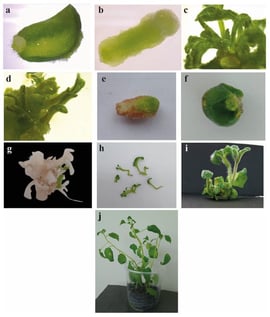
Sequential morphogenic responses leading to shoot regeneration in explants. (a) Callus induction and tissue swelling on the adaxial surface of the cotyledon after 7 days of culture. (b) Callus formation in hypocotyl explants after 7 days of culture. (c,d) Shoot regeneration response from cotyledon and hypocotyl explants after 3 weeks on growth regulator-supplemented medium. (e,f) Lack of organogenic response in explants cultured on medium containing TDZ alone. (g) Albino hypocotyl-derived structure formed under TDZ treatment. (h) Malformed leaf-like tissues induced by TDZ. (i) Hypocotyl-derived shoot cluster obtained on medium supplemented with 4.54 µM TDZ + 0.6 µM NAA, corresponding to the treatment with the highest shoot number and shoot elongation. (j) Rooted and acclimatized regenerants established in a commercial peat–perlite substrate (Plug Mix 8).

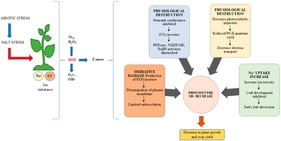
Soil salinity as a major abiotic stressor has significantly affected crop production worldwide. However, plants have developed complex signaling networks that enable them to adapt and cope with such environmental shifts. Recent research has demonstrated the involvement of hydrogen sulfide (H2S) in signaling cascades that link plant development with stress tolerance management. Similarly, glutathione (GSH), a non-enzyme antioxidant, and a vital tripeptide, has been found to protect plants from oxidative damage and regulate metabolic functions under abiotic stress. As a potential scavenger of ROS, GSH maintains cellular redox homeostasis through the ascorbate-GSH cycle and acts as a signaling molecule for the sulfur-status of plants. This review focusses on: (i) revisiting the concept and current status of soil salinity; (ii) highlighting its impact at cellular and whole-plant levels; (iii) elucidating the role of a H2S and GSH in plant salt stress tolerance; and (iv) exploring the potential interactive roles of H2S and GSH in mitigating salinity impacts. This review will provide valuable insights into the complex network involving H2S and GSH, suggesting pathways for developing climate-resilient crops.

7 May 2026

Schematic representation of salinity stress-caused major impacts in plants.

Exogenous Application of Sodium Nitroprusside on the Morphophysiology of Passiflora edulis Sims Under Water Deficit

  • Anna Paula Marques Cardoso,
  • Walter Esfrain Pereira and
  • Francisca Iris da Silva Souza
  • + 12 authors

The availability of water is a limiting factor for the growth and productivity of yellow passion fruit (Passiflora edulis Sims). The use of bioregulators has been investigated as a strategy to mitigate the effects of abiotic stress. Different concentrations of SNP were evaluated on growth, gas exchange, photosynthetic pigments, chlorophyll fluorescence, and enzymatic activity in Passiflora edulis seedlings under different water conditions. The experiment was conducted in a randomized block design, in a 2 × 4 factorial scheme, with two irrigation conditions (80 and 30% of field capacity), combined with three concentrations of SNP (50, 100 and 250 µM) and water (control), with five replications. Water deficit reduced morphological, physiological, and enzymatic parameters. The application of SNP increased root fresh mass (23.56 g at the 100 µM dose) and leaf dry mass (8.21 g at 250 µM SNP), with increases of 24.52% and 30.52% compared to the values obtained under the 50 µM dose, respectively. The highest number of leaves (14) and leaf area (1183.3 cm2) was observed at 250 µM SNP, corresponding to increases of 7.70% and 17.27%, respectively, compared to plants without SNP application. Water deficit reduced growth, gas exchange, chlorophyll fluorescence, and enzymatic activity. SNP promotes improvements in growth; however, it does not mitigate water deficit effects in Passiflora edulis seedlings.

2 May 2026

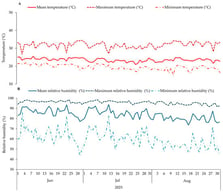
Daily mean values of maximum, minimum, and average air temperature (A), and maximum, minimum, and average relative air humidity (B), recorded during the experimental period.

Champereia manillana (Bl.) Merr. var. longistaminea is an evergreen small tree. It belongs to the genus Champereia Griff. (Opiliaceae), and its tender leaves or flower buds can be eaten. It also has important medicinal and nutritional values. Wild populations of C. manillana are small and has a phenomenon of deforestation. Market development is hindered by propagation constraints, including low seed germination rates and poor rooting of cuttings. Standardized cultivation protocols are currently lacking. This paper systematically reviews the current status of propagation and cultivation research on C. manillana and analyzed the primary challenges. Recent research indicated that seed germination obstacles had been preliminarily overcome, and 50% shading was identified as the optimal cultivation condition. However, challenges remain, including slow growth, lack of standardized water and fertilizer management, and unclear molecular mechanisms regulating development. Future research should focus on improving vegetative propagation efficiency, elucidating growth mechanisms via multi-omics, and establishing standardized cultivation protocols from breeding to harvest. These strategies are essential for the sustainable utilization of C. manillana resources.

1 May 2026

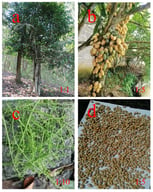
Morphology of Champereia manillana. (a) Whole plant; (b) Fruit; (c) Inflorescences; (d) Seeds. The red numbers indicate the scale ratios of each photograph.

News & Conferences

Volumes

Latest Issues

Open for Submission

Editor's Choice

Reprints of Collections

Plant Invasion
Reprint

Plant Invasion

Editors: Bruce Osborne, Panayiotis G. Dimitrakopoulos
XFacebookLinkedIn
Int. J. Plant Biol. - ISSN 2037-0164