


Article

Shoot Regeneration Response in the ‘Colombiano’ Ecotype of Physalis peruviana L. Is Influenced by the Interaction of TDZ, NAA, and Explant Type

by
Edinson Pooll Acuña-Ramirez
,
Raúl Vargas
*,
Eyner Huaman
and
Manuel Oliva-Cruz
*
Instituto de Investigación para el Desarrollo Sustentable de Ceja de Selva, Universidad Nacional Toribio Rodríguez de Mendoza de Amazonas, Chachapoyas 01001, Peru
*
Authors to whom correspondence should be addressed.
Int. J. Plant Biol. 2026, 17(6), 41; https://doi.org/10.3390/ijpb17060041 (registering DOI)
Submission received: 30 March 2026 / Revised: 3 May 2026 / Accepted: 13 May 2026 / Published: 22 May 2026
(This article belongs to the Section Plant Physiology)

Abstract

Physalis peruviana exhibits highly variable and poorly reproducible morphogenic responses under in vitro conditions, limiting the development of reliable regeneration systems. This study evaluated how the interaction between thidiazuron (TDZ), naphthaleneacetic acid (NAA), and explant type influences shoot regeneration in the Colombiano ecotype of Physalis peruviana. A factorial design (2 × 3 × 2) revealed that morphogenic responses were primarily driven by interaction effects rather than by individual plant growth regulators. Hypocotyl explants cultured in 4.54 µM TDZ combined with 0.6 µM NAA showed the highest shoot production, shoot formation capacity, and elongation. In contrast, TDZ alone induced limited shoot production, did not support efficient and organized shoot development, and was associated with abnormal morphologies. The response to NAA was non-linear, with intermediate concentrations maximizing shoot regeneration response, indicating that morphogenic competence operates within a narrow hormonal range. Overall, regeneration in the Colombiano ecotype of P. peruviana evaluated here was governed by the interaction between hormonal balance and explant type, identifying favorable conditions for shoot regeneration under the conditions tested.

1. Introduction

Efficient in vitro regeneration remains a major constraint for the biotechnological utilization of Physalis peruviana L. (Solanaceae), a species of increasing agronomic and nutraceutical relevance due to its high content of bioactive compounds such as vitamin C, carotenoids, phenolic acids, and withanolides [1,2,3]. Despite its potential, regeneration responses in this species are often inconsistent and poorly reproducible, limiting the establishment of reliable experimental and propagation systems [4]. This variability suggests that morphogenic competence is not an inherent property of the species, but a context-dependent response influenced by the interaction between hormonal conditions and explant-specific developmental factors [5,6].
Recalcitrance to regeneration reflects a limited capacity of plant tissues to undergo organogenic reprogramming in response to exogenous cues [7]. In Physalis species, this phenomenon has been associated with reduced responsiveness to plant growth regulators (PGRs), variability among explant types, and strong dependence on culture conditions [8,9,10]. Together, these constraints indicate that regeneration efficiency is governed by context-dependent developmental responses rather than by uniform hormonal treatments [11,12].
Among PGRs, thidiazuron (TDZ) is widely recognized for its high cytokinin-like activity and its ability to induce shoot organogenesis in recalcitrant species [13,14]. However, TDZ frequently disrupts normal morphogenesis when applied alone, leading to abnormal shoot development and limited elongation [14]. In contrast, auxins such as naphthaleneacetic acid (NAA) are essential for cell division and differentiation, and their interaction with cytokinins is critical for coordinating morphogenic transitions [15,16,17,18].
Although cytokinin–auxin combinations have been used to improve regeneration in P. peruviana, reported responses remain variable and often lack reproducibility across experimental systems [10,19,20,21]. This variability suggests that regeneration outcomes are not determined solely by the presence of specific regulators, but by the interaction between hormonal balance and the intrinsic developmental competence of the explant [10,19,20,21]. In this study, we focused on optimizing regeneration for the Colombiano ecotype of P. peruviana, testing different combinations of TDZ, NAA, and explant types under controlled conditions.
In particular, the extent to which TDZ–NAA interactions modulate morphogenic responses in an explant-dependent manner has not been systematically evaluated [10,19,20,21]. Juvenile tissues such as cotyledons and hypocotyls may differ substantially in their developmental plasticity and physiological responsiveness, which could critically influence their response to exogenous signals [22,23,24,25,26].
In this context, understanding how hormonal interactions and explant identity jointly regulate morphogenic responses is essential to improve regeneration consistency in the Colombiano ecotype of P. peruviana. We hypothesize that morphogenic competence in this species arises from the interaction between TDZ and NAA and is strongly dependent on explant type, resulting in differential regulation of shoot induction, proliferation, and elongation. Therefore, this study aimed to evaluate the combined effects of TDZ, NAA, and explant type on shoot regeneration responses and to identify favorable conditions for shoot regeneration in the Colombiano ecotype of Physalis peruviana.

2. Materials and Methods

2.1. Plant Material and In Vitro Germination

Seeds of Physalis peruviana L. (Colombiano ecotype) were obtained from a commercial supplier (Sierra Seeds, Lima, Peru). Prior to sterilization, seeds were imbibed in distilled water for 48 h to promote uniform germination.
Surface disinfection was carried out under aseptic conditions in a laminar airflow cabinet (BIOBASE Group, Jinan, China) by immersion in 2% (v/v) sodium hypochlorite solution supplemented with 0.01% (v/v) Tween 80 (Sigma-Aldrich, St. Louis, MO, USA) for 30 min under constant agitation. Seeds were rinsed four times with sterile distilled water and inoculated onto germination medium. No visible microbial contamination was detected during seed germination and initial establishment.

2.2. Culture Medium and Growth Conditions

Seed germination and subsequent culture were performed on Murashige and Skoog (MS) basal medium with vitamins [27] (PhytoTechnology Laboratories, Lenexa, KS, USA), supplemented with 30 g L−1 sucrose (Sigma-Aldrich, St. Louis, MO, USA) and solidified with 7 g L−1 agar (Agar, plant tissue culture grade, A7921, Sigma-Aldrich, St. Louis, MO, USA). The pH was adjusted to 5.8 prior to sterilization in an autoclave (Astell Scientific, Sidcup, UK) at 121 °C for 15 min at 204.8 kPa.
Thidiazuron (TDZ) and naphthaleneacetic acid (NAA) (PhytoTech Labs, Lenexa, KS, USA) were added to the medium before autoclaving and applied uniformly across all treatments, as reported in previous plant tissue culture studies [28,29,30]. Cultures were maintained in a growth room at 25 ± 1 °C under a 16 h photoperiod, with a photosynthetic photon flux density of 70 µmol m−2 s−1.

2.3. Explant Preparation

Seedlings ranging from 7 to 14 days after germination were used as explant sources. Explants were not obtained from seedlings of a single exact chronological age, but from a mixed population selected on the basis of developmental uniformity. Specifically, only seedlings with fully expanded cotyledons and otherwise uniform growth were selected, whereas seedlings that had not yet reached this stage were allowed to continue growing until they met the selection criteria. Under sterile conditions, cotyledons without petiole and hypocotyl segments (~5 mm in length, excluding apical and basal regions) were then excised.

2.4. Experimental Design and Culture Conditions

The experiment followed a completely randomized design with a 2 × 3 × 2 factorial arrangement consisting of TDZ (2.27 and 4.54 µM), NAA (0, 0.6, and 1.2 µM), and explant type (cotyledon and hypocotyl), resulting in 12 treatments.
Each treatment consisted of five replicates, with each replicate represented by one Petri dish (100 × 15 mm) (Normax, Marinha Grande, Portugal) containing five explants, for a total of 300 explants. The Petri dish was treated as the experimental unit, and mean values per unit were used for statistical inference.
Explants were cultured for 4 weeks on MS medium supplemented with the corresponding PGR combinations (induction phase). Regenerating explants were then transferred to regulator-free MS medium in Magenta™ GA-7 vessels (PhytoTech Labs, Lenexa, KS, USA) for an additional 4 weeks to promote shoot elongation and development.

2.5. Morphogenic Evaluation

Morphogenic responses were evaluated after 8 weeks of culture, comprising 4 weeks of induction followed by 4 weeks of elongation. The following variables were recorded: callus formation (%), calculated as the percentage of explants showing visible callus; shoot regeneration response (%), defined as the percentage of explants producing at least one shoot ≥ 2 mm in length; shoots per regenerating explant, determined as the mean number of shoots per responsive explant; shoot formation capacity (SFC), calculated as SFC = [(% explants forming shoots) × (mean number of shoots per explant)]/100 [31]; main shoot length (mm), measured as the length of the longest shoot per explant after the elongation phase; and shoot fresh mass (mg), determined immediately after excision using an analytical balance (Entris®, Sartorius Lab Instruments GmbH & Co. KG, Göttingen, Germany) after removal of surface moisture. For fresh mass, all shoots produced within each experimental unit were collected and weighed, and the mean value per unit was used for statistical analysis.

2.6. Rooting and Acclimatization

Well-developed shoots (≥2 cm in length) were carefully excised and transferred to polypropylene containers (122 mm upper diameter × 92 mm lower diameter × 125 mm height). Plants were established in a commercial substrate based on Sphagnum peat and 15% perlite (Plug Mix 8, Maruplast internacional, Lima, Peru), previously moistened to field capacity with distilled water. Immediately after transplantation, each container was covered with a transparent plastic lid to maintain high relative humidity (approximately 90–95%) during the initial acclimatization phase.
The acclimatization process was conducted under semi-controlled greenhouse conditions at 25 ± 2 °C, using a shade net system to reduce light intensity and avoid photoinhibition. Relative humidity was gradually reduced by partially opening the lids over a period of 10–14 days until complete removal. Irrigation was performed every 2–3 days using distilled water to maintain adequate substrate moisture. Rooting and acclimatization were recorded descriptively, and no quantitative analysis of rooting percentage or acclimatization survival was performed in this phase.

2.7. Statistical Analysis

Prior to analysis, the assumptions of normality and homogeneity of variances were evaluated using the Shapiro–Wilk and Levene tests, respectively. When deviations from these assumptions were detected, data were transformed accordingly to satisfy the requirements of parametric analysis. A three-way factorial analysis of variance (ANOVA) was performed to assess the effects of thidiazuron (TDZ), naphthaleneacetic acid (NAA), explant type, and their interactions on all evaluated variables, following a completely randomized design. The experimental unit corresponded to the Petri dish, and mean values per unit were used for statistical inference to avoid pseudoreplication. Callus formation (%) and SFC values were log-transformed [ln(x)] when required to meet ANOVA assumptions.
When significant effects were detected, mean comparisons were performed using Tukey’s honestly significant difference (HSD) test at a significance level of p < 0.05. In the presence of significant interaction effects, interpretation was based primarily on the interaction terms rather than on main effects.
All statistical analyses were conducted using R software (version 4.5.1; R Foundation for Statistical Computing, Vienna, Austria) [32], employing the packages agricolae (version 1.3.7) [33].

3. Results

3.1. Interaction Effects of TDZ, NAA, and Explant Type

Morphogenic responses in the Colombiano ecotype of Physalis peruviana were largely determined by interaction effects among TDZ, NAA, and explant type (Table 1). The three-way interaction (TDZ × NAA × explant type) was highly significant for callus formation, shoots per regenerating explant, shoot formation capacity (SFC), main shoot length, and shoot fresh mass (p < 0.001 in all cases), indicating that shoot production and development depended on the combined influence of hormonal regime and tissue type.
By contrast, shoot regeneration response was not significantly affected by the three-way interaction (p = 0.799). Two-way interactions also contributed significantly to most morphogenic variables. In particular, TDZ × NAA significantly affected all evaluated traits, including shoot regeneration response, whereas the interactions TDZ × explant type and NAA × explant type significantly influenced all variables related to shoot production and growth but not regeneration response.

3.2. Effect of TDZ, NAA, and Explant Type on Morphogenic Traits

Morphogenic responses varied markedly among treatment combinations, confirming that regeneration behavior was strongly dependent on both hormonal regime and explant type (Table 2).
The best overall performance was observed in hypocotyl explants cultured on 4.54 µM TDZ combined with 0.6 µM NAA. This treatment produced the highest number of shoots per regenerating explant (12.20 ± 1.79), the highest SFC (11.28 ± 1.26), and the greatest main shoot length (12.29 ± 0.84 mm), significantly exceeding the remaining treatments (p < 0.05).
In cotyledon explants, the most favorable response was observed under 4.54 µM TDZ plus 1.2 µM NAA, which produced the highest shoot fresh mass (724.60 ± 96.22 mg). However, this treatment did not maximize shoot number or SFC, indicating that biomass accumulation was not necessarily associated with the highest organogenic efficiency.
Callus formation ranged from 32% to 92% across treatments. The highest callogenic responses were recorded in hypocotyl explants cultured in the presence of NAA (0.6–1.2 µM), whereas the lowest callus formation was observed in cotyledon explants grown in the absence of auxin.
Overall, hypocotyl explants were more responsive in terms of shoot proliferation and elongation under the most favorable hormonal combinations, whereas cotyledon explants exhibited comparatively higher regeneration frequency under some treatment conditions.

3.3. Main Effects of Explant Type, TDZ, and NAA on Shoot Regeneration Response

Because no significant interaction was detected for shoot regeneration response (Table 1), the main effects of explant type, TDZ concentration, and NAA concentration were analyzed independently (Table 3).
Explant type significantly affected shoot regeneration response, with cotyledon explants showing a higher proportion of responsive explants (87.33 ± 13.63%) than hypocotyl explants (76.33 ± 13.26%). TDZ concentration also influenced this variable, with 4.54 µM TDZ promoting higher regeneration frequency (84.66 ± 16.92%) than 2.27 µM TDZ (79.00 ± 12.42%).
Among the evaluated factors, NAA concentration had the strongest effect on regeneration frequency. The highest value was observed at 0.6 µM NAA (93.00 ± 8.64%), followed by 1.2 µM NAA (84.00 ± 13.14%), whereas the absence of NAA resulted in a markedly lower regeneration frequency (68.50 ± 8.75%).

3.4. Temporal Progression of Morphogenic Responses

A sequential pattern of morphogenic development was observed in both cotyledon and hypocotyl explants during the 8-week culture period (Figure 1).
Initial responses were detected after 7 days of culture and consisted of tissue swelling and the formation of greenish-cream callus in both explant types (Figure 1a,b). By day 12, callus tissues in NAA-supplemented treatments developed visible organogenic structures under stereoscopic observation. Between the third and fourth weeks, shoot regeneration response became evident in responsive treatments (Figure 1c,d).
In contrast, explants cultured on TDZ alone showed measurable shoot production but lacked organized shoot regeneration response, with limited elongation and abnormal morphologies (Figure 1e,f). After transfer to regulator-free medium, regenerated shoots continued to elongate, with the combination of 4.54 µM TDZ and 0.6 µM NAA promoting the most vigorous shoot proliferation and elongation, particularly in hypocotyl explants (Figure 1i).
Abnormal morphogenic responses were also detected in specific treatments. Hypocotyl explants cultured with 4.54 µM TDZ developed albino structures lacking visible chlorophyll (Figure 1g), and some explants exhibited malformed leaf-like tissues and irregular growth (Figure 1h).

3.5. Rooting and Ex Vitro Acclimatization

Rooting and acclimatization were documented descriptively. Both processes occurred simultaneously. Regenerated shoots (≥2 cm in length) initiated root formation 11 days after transfer to ex vitro conditions, without the application of exogenous auxin. Relative humidity was gradually reduced over a period of 10–14 days by progressively opening the plastic lids. After four weeks, the lids were completely removed (Figure 1j). No quantitative analysis of rooting percentage or acclimatization survival was performed in this phase.

4. Discussion

The present study showed that morphogenic responses in the Colombiano ecotype of Physalis peruviana were determined by the interaction between TDZ, NAA, and explant type rather than by the isolated effects of individual plant growth regulators. The superior performance observed under specific TDZ–NAA combinations, particularly in hypocotyl explants, indicates that regeneration efficiency depends on the establishment of a suitable hormonal balance rather than on increasing regulator concentration per se [16,17,18,34,35,36]. In practical terms, this suggests that shoot regeneration in the Colombiano ecotype of P. peruviana is governed by the integration of exogenous hormonal cues with tissue-specific developmental responsiveness.
A key finding of this study is that regeneration performance differed according to the response variable considered. Although cotyledon explants showed higher shoot regeneration response overall, hypocotyl explants displayed greater shoot proliferation and elongation under the most favorable hormonal combinations. This distinction is biologically relevant because regeneration efficiency cannot be inferred solely from the proportion of responsive explants; it must also consider the capacity of those explants to sustain organized shoot development [19,20,21]. The superior performance of hypocotyl tissues under 4.54 µM TDZ plus 0.6 µM NAA therefore suggests greater morphogenic competence under optimized hormonal conditions. Such explant-dependent responses have been widely recognized in Physalis and other plant regeneration systems, where tissue origin, developmental state, and anatomical organization strongly influence morphogenic behavior [22,23,24,25,26].
This differential response between explant types is consistent with previous studies in Physalis and other Solanaceae species, where regeneration capacity has been strongly influenced by tissue origin and developmental state [22,23,24,25]. For example, Swartwood and Van Eck [26] reported that only hypocotyl explants of P. grisea were capable of shoot regeneration response under zeatin-supplemented conditions, while cotyledons remained unresponsive. Likewise, previous studies in P. peruviana have reported moderate and variable regeneration efficiencies depending on explant type and culture conditions [8,9,10,19], reinforcing the view that tissue identity becomes a major limiting factor when hormonal conditions are not fully optimized. From a developmental perspective, these differences may reflect variation in endogenous hormone balance, histological organization, and cellular plasticity, as suggested in general morphogenic and anatomical studies of in vitro systems [23,24,25].
The role of NAA in the present study was not merely additive but strongly concentration-dependent. The intermediate level of 0.6 µM NAA consistently maximized shoot regeneration response, SFC, and shoot growth, whereas increasing the concentration to 1.2 µM did not further improve morphogenic performance and in some cases reduced it. This non-linear pattern suggests that shoot regeneration in P. peruviana operates within a relatively narrow hormonal window. Excess auxin may favor callogenic activity or interfere with the coordination of shoot developmental pathways, thereby reducing organogenic efficiency. This interpretation agrees with current models proposing that successful de novo organogenesis depends on a precise balance between auxin and cytokinin uptake, signaling, and downstream developmental outputs [16,17,18,34,35,36]. Similar concentration-dependent responses to auxin–cytokinin interactions have also been documented in other regeneration systems, including Solanum sisymbriifolium, Solanum tuberosum, and several Physalis species [37,38,39,40,41].
The results also show that TDZ alone was insufficient to sustain efficient organogenic development. Although TDZ is widely recognized as a highly active cytokinin-like regulator capable of inducing adventitious shoot formation, its isolated application in the present study resulted in lower shoot productivity, reduced elongation, and abnormal morphologies. This behavior is consistent with previous evidence showing that TDZ can strongly stimulate morphogenesis while simultaneously impairing normal development when hormonal balance is not properly adjusted [13,14,42,43,44,45,46]. Such effects have been attributed to disruptions in endogenous hormonal homeostasis, including excessive cytokinin activity and altered auxin transport or signaling [14,17,35,36,46]. Under the conditions tested here, the addition of NAA likely restored a more favorable auxin–cytokinin balance, thereby supporting coordinated cell division, differentiation, and elongation.
Despite its strong inductive effect on shoot formation, TDZ alone was associated with morphological abnormalities, including leaf deformation, irregular growth, and the occurrence of albino tissues. This dual effect has been widely reported and is generally attributed to disruption of endogenous hormonal regulation and metabolic imbalance [14,46]. Albinism, in particular, has been linked to impaired chloroplast differentiation and altered expression of genes involved in plastid biogenesis [47]. Similar abnormalities have been described in Physalis minima [48] and in Dendrocalamus latiflorus [49], further supporting the view that severe morphogenic disturbances may arise under unbalanced in vitro hormonal conditions. However, previous studies also suggest that albinism may reflect not only hormonal imbalance but also defects in plastid development and broader physiological stress during in vitro culture [47,50].
From a practical standpoint, the ability of regenerated shoots to root directly under ex vitro conditions without exogenous auxin represents an important advantage of the system. This response suggests that shoots produced under the optimal regeneration treatment retained sufficient physiological competence to initiate rooting after transfer to substrate. Adventitious root formation is known to depend on endogenous auxin status and on the interaction between hormonal and environmental signals [51,52]. In addition, successful acclimatization is strongly influenced by water balance, stomatal regulation, and humidity management during the transition from in vitro to ex vitro conditions [53,54,55,56]. The observed establishment of the plants in the present study is likely the result of both intrinsic rhizogenic competence and favorable acclimatization conditions. Similar ex vitro rooting responses have been reported in Solanum betaceum [57], and substrate optimization may further enhance rooting success and plant survival [58].
Taken together, these findings indicate that successful regeneration in the Colombiano ecotype evaluated here depends on two interrelated factors: an adequate hormonal balance and the intrinsic competence of the explant. Under this framework, regeneration should not be interpreted as the simple result of adding cytokinin and auxin, but as the outcome of a context-dependent interaction in which tissue identity shapes the response to exogenous signals. This helps explain why apparently similar regeneration protocols often produce variable outcomes across studies and experimental systems [7,11,19,59,60].
Some limitations of the present study should be acknowledged. Only two TDZ concentrations and three NAA concentrations were evaluated, and the analysis was restricted to cotyledon and hypocotyl explants from a single plant source. An additional methodological limitation is that the chemical stability of TDZ and NAA after autoclaving was not analytically verified, although the same preparation procedure was used consistently across all treatments. The rooting and acclimatization phase was also documented descriptively, and no quantitative assessment of rooting frequency or survival after acclimatization was performed. Furthermore, the physiological and molecular mechanisms underlying the observed responses were not directly examined, which limits mechanistic interpretation. Future studies should therefore incorporate endogenous hormone profiling, histological analysis, and gene expression approaches to better resolve the regulatory basis of morphogenic competence in P. peruviana [7,24,25,61,62]. The evaluation of additional auxins or cytokinins, as well as other explant types and developmental stages, may also help refine the regeneration system and broaden its applicability.
Even so, the present results provide an experimental basis for regeneration in the Colombiano ecotype evaluated here and may support future regeneration-dependent biotechnological applications, including micropropagation and other regeneration-dependent biotechnological applications [7,63,64]. However, while the results show promise, further independent validation experiments involving different ecotypes and experimental conditions are needed to confirm the robustness and general applicability of the regeneration system.

5. Conclusions

The present study demonstrates that in vitro morphogenesis in the Colombiano ecotype Physalis peruviana is primarily determined by the interaction between thidiazuron (TDZ), naphthaleneacetic acid (NAA), and explant type, rather than by the isolated effect of individual growth regulators. Among the evaluated treatments, the combination of 4.54 µM TDZ and 0.6 µM NAA consistently produced the best morphogenic performance, particularly in hypocotyl explants, which showed superior shoot proliferation, shoot formation capacity, and shoot elongation. These findings indicate that efficient regeneration depends on a finely balanced auxin–cytokinin regime coupled with explant-specific morphogenic competence.
By contrast, TDZ applied alone induced some shoot production, but it was insufficient to sustain efficient and organized organogenesis, as evidenced by limited shoot elongation and abnormal morphologies. Ex vitro rooting was also observed without the application of exogenous auxin during acclimatization. This observation suggests the potential to simplify the regeneration workflow by avoiding an additional in vitro rooting phase; however, this aspect was documented descriptively and requires quantitative evaluation in future studies.
Overall, this study identifies favorable conditions for shoot regeneration in the Colombiano ecotype of P. peruviana under the experimental conditions evaluated. The observed shoot regeneration and ex vitro establishment may support future micropropagation efforts, although the rooting and acclimatization phase still requires quantitative evaluation. However, while the results are promising, further independent validation across experiments and biological contexts, together with histological analysis, is still required to confirm the robustness of the response and the organogenic nature of the regeneration process. More specifically, these findings help clarify how hormonal balance and explant identity jointly determine morphogenetic outcomes in the Colombiano ecotype.

Author Contributions

Conceptualization: R.V. and M.O.-C.; methodology: E.P.A.-R. and R.V.; investigation: E.P.A.-R. and E.H.; formal analysis: R.V. and E.P.A.-R.; data curation: E.P.A.-R. and R.V.; writing—original draft: E.P.A.-R.; writing—review and editing: R.V., E.H. and M.O.-C.; visualization: E.P.A.-R.; supervision: M.O.-C.; project administration: R.V.; funding acquisition: M.O.-C. All authors have read and agreed to the published version of the manuscript.

Funding

The article processing charge (APC) was covered by the Vice-Rectorate for Research of the Universidad Nacional Toribio Rodríguez de Mendoza de Amazonas (UNTRM), Peru.

Data Availability Statement

The data supporting the findings of this study are available from the corresponding author upon reasonable request.

Acknowledgments

The authors gratefully acknowledge the Plant Tissue Culture Unit of the Laboratory of Plant Physiology and Biotechnology (FISIOBVLAB), Universidad Nacional Toribio Rodríguez de Mendoza de Amazonas (UNTRM), for providing the infrastructure, laboratory facilities, and technical support essential for the successful execution of the in vitro culture experiments.

Conflicts of Interest

The authors declare no conflicts of interest.

References

  1. Olivares-Tenorio, M.-L.; Dekker, M.; Verkerk, R.; van Boekel, M.A.J.S. Health-Promoting Compounds in Cape Gooseberry (Physalis peruviana L.): Review from a Supply Chain Perspective. Trends Food Sci. Technol. 2016, 57, 83–92. [Google Scholar] [CrossRef]
  2. Akhtar, N.; Chaudhari, S.K.; Arshad, S.; Fatima, H.; Amjad, M.S. Biological Activities and Nutritional Value of Physalis peruviana L. In Natural Bio-Active Compounds: Volume 1: Production and Applications; Springer: Singapore, 2019; pp. 587–598. [Google Scholar]
  3. Campos, D.; Chirinos, R.; Ranilla, L.G.; Pedreschi, R. Bioactive Potential of Andean Fruits, Seeds, and Tubers. In Advances in Food and Nutrition Research; Elsevier: Amsterdam, The Netherlands, 2018; pp. 287–343. [Google Scholar]
  4. Yadav, S.; Barnwal, N.; Rai, G.K.; Bajpai, M.; Rai, P. In Vitro Propagation of Goldenberry (Physalis peruviana L.): A Review. Veg. Sci. 2019, 46, 78–82. [Google Scholar]
  5. Ramar, K.; Ayyadurai, V.; Arulprakash, T. In Vitro Shoot Multiplication and Plant Regeneration of Physalis peruviana L. an Important Medicinal Plant. Int. J. Curr. Microbiol. Appl. Sci. 2014, 3, 456–464. [Google Scholar]
  6. Lashin, I.I.; Elhaw, M.H. Evaluation of Secondary Metabolites in Callus and Tissues of Physalis peruviana. Int. J. Mod. Bot. 2016, 6, 10–17. [Google Scholar]
  7. Bidabadi, S.S.; Jain, S.M. Cellular, Molecular, and Physiological Aspects of In Vitro Plant Regeneration. Plants 2020, 9, 702. [Google Scholar] [CrossRef] [PubMed]
  8. Mascarenhas, L.M.S.; De Santana, J.R.F.; Brito, A.L. Micropropagation of Physalis peruviana L. Pesqui. Agropecu. Trop. 2019, 49, e55603. [Google Scholar] [CrossRef]
  9. da Silva, L.S.; Villa, F.; da Silva, D.F.; da Silva, E.C.; Ritter, G.; Eberling, T. Micropropagation of Physalis Species with Economic Potential. Rev. Ceres 2021, 68, 521–529. [Google Scholar] [CrossRef]
  10. Vargas, R.; Vigo, C.N.; Juarez-Contreras, L.; Oliva-Cruz, M. Development and Optimization of In Vitro Shoot Regeneration in Physalis peruviana Using Cotyledon Explants. J. Genet. Eng. Biotechnol. 2025, 23, 100463. [Google Scholar] [CrossRef]
  11. Patel, P.; Sarswat, S.K.; Modi, A. Chapter 12—Strategies to Overcome Explant Recalcitrance under In Vitro Conditions. In Advances in Plant Tissue Culture; Chandra Rai, A., Kumar, A., Modi, A., Singh, M.B.T.-A., Eds.; Academic Press: Cambridge, MA, USA, 2022; pp. 283–294. ISBN 978-0-323-90795-8. [Google Scholar]
  12. Girgžde, E.; Samsone, I.; Gailis, A. Peroxidase, Polyphenol Oxidase Activity and Total Phenolic Concentration in Birch (Betula pendula) In Vitro Shoots during Rejuvenation. Environ. Exp. Biol. 2019, 17, 15–19. [Google Scholar] [CrossRef]
  13. Ahmad, Z.; Shahzad, A. Thidiazuron Influenced Morphogenesis in Some Medicinal Plants. In Thidiazuron: From Urea Derivative to Plant Growth Regulator; Springer: Singapore, 2018; pp. 231–246. [Google Scholar]
  14. Dewir, Y.H.; Nurmansyah; Naidoo, Y.; Teixeira da Silva, J.A. Thidiazuron-Induced Abnormalities in Plant Tissue Cultures. Plant Cell Rep. 2018, 37, 1451–1470. [Google Scholar] [CrossRef]
  15. George, E.F.; Hall, M.A.; De Klerk, G.-J. (Eds.) Plant Growth Regulators II: Cytokinins, Their Analogues and Antagonists. In Plant Propagation by Tissue Culture: Volume 1. The Background; Springer: Dordrecht, The Netherlands, 2008; pp. 205–226. ISBN 978-1-4020-5005-3. [Google Scholar]
  16. Ćosić, T.; Raspor, M. The Role of Auxin and Cytokinin Signaling Components in de Novo Shoot Organogenesis. In Auxins, Cytokinins and Gibberellins Signaling in Plants; Aftab, T., Ed.; Springer: Cham, Switzerland, 2022; pp. 47–75. ISBN 978-3-031-05427-3. [Google Scholar]
  17. Hnatuszko-Konka, K.; Gerszberg, A.; Weremczuk-Jeżyna, I.; Grzegorczyk-Karolak, I. Cytokinin Signaling and de Novo Shoot Organogenesis. Genes 2021, 12, 265. [Google Scholar] [CrossRef]
  18. Flasiński, M.; Hąc-Wydro, K. Natural vs Synthetic Auxin: Studies on the Interactions between Plant Hormones and Biological Membrane Lipids. Environ. Res. 2014, 133, 123–134. [Google Scholar] [CrossRef] [PubMed]
  19. Vargas, R.; Vigo, C.N.; Guelac, M.; Huaman, E.; Oliva-Cruz, M. Efficient and Cost-Effective Shoot Regeneration in Aguaymanto (Physalis peruviana L.) Using Meta-Topolin and 6-Benzylaminopurine Combinations. J. Genet. Eng. Biotechnol. 2025, 23, 100599. [Google Scholar] [CrossRef]
  20. de Jesús Romo-Paz, F.; Orozco-Flores, J.D.; Delgado-Aceves, L.; Zamora-Natera, J.F.; Salcedo-Pérez, E.; Vargas-Ponce, O.; Portillo, L. Micropropagation of Physalis angulata L. and P. chenopodifolia Lam. (Solanaceae) via Indirect Organogenesis. In Vitro Cell. Dev. Biol.—Plant 2023, 59, 497–506. [Google Scholar] [CrossRef]
  21. Sandhya, H.; Rao, S. Effect of Growth Regulators on Regeneration through Leaf and Stem Derived Callus in Physalis minima Linn. Curr. Trends Biotechnol. Pharm. 2016, 10, 280–285. [Google Scholar]
  22. Yücesan, B.B.; Mohammed, A.; Arslan, M.; Gürel, E. Clonal Propagation and Synthetic Seed Production from Nodal Segments of Cape Gooseberry (Physalis peruviana L.), a Tropical Fruit Plant. Turk. J. Agric. For. 2015, 39, 797–806. [Google Scholar] [CrossRef]
  23. George, E.F.; Hall, M.A.; De Klerk, G.-J. (Eds.) The Anatomy and Morphology of Tissue Cultured Plants. In Plant Propagation by Tissue Culture: Volume 1. The Background; Springer: Dordrecht, The Netherlands, 2008; pp. 465–477. ISBN 978-1-4020-5005-3. [Google Scholar]
  24. Kruglova, N.; Zinatullina, A.; Yegorova, N. Histological Approach to the Study of Morphogenesis in Callus Cultures In Vitro: A Review. Int. J. Plant Biol. 2023, 14, 533–545. [Google Scholar] [CrossRef]
  25. Jiménez, V.M.; Bangerth, F. Endogenous Hormone Levels in Explants and in Embryogenic and Non-Embryogenic Cultures of Carrot. Physiol. Plant. 2001, 111, 389–395. [Google Scholar] [CrossRef] [PubMed]
  26. Swartwood, K.; Van Eck, J. Development of Plant Regeneration and Agrobacterium Tumefaciens-Mediated Transformation Methodology for Physalis Grisea. Plant Cell Tissue Organ Cult. 2019, 137, 465–472. [Google Scholar] [CrossRef]
  27. Murashige, T.; Skoog, F. A Revised Medium for Rapid Growth and Bio Agsays with Tohaoco Tissue Cultures. Physiol. Plant. 1962, 15, 473–497. [Google Scholar] [CrossRef]
  28. Ghosh, A.; Igamberdiev, A.U.; Debnath, S.C. Thidiazuron-Induced Somatic Embryogenesis and Changes of Antioxidant Properties in Tissue Cultures of Half-High Blueberry Plants. Sci. Rep. 2018, 8, 16978. [Google Scholar] [CrossRef]
  29. Li, Y.; Xiao, J.; Jeong, B.R. Regeneration of Cotoneaster wilsonii Nakai through Indirect Organogenesis. Horticulturae 2022, 8, 795. [Google Scholar] [CrossRef]
  30. Pardi, R.; Basile, G.N.; De Mastro, G.; Gargano, M.L.; Tagarelli, A.; Ruta, C. Efficient Micropropagation by Ex Vitro Rooting of Myrtus communis L. Horticulturae 2025, 11, 207. [Google Scholar] [CrossRef]
  31. Lambardi, M.; Sharma, K.K.; Thorpe, T.A. Optimization of In Vitro Bud Induction and Plantlet Formation from Mature Embryos of Aleppo Pine (Pinus halepensis Mill.). In Vitro Cell. Dev. Biol.—Plant 1993, 29, 189–199. [Google Scholar] [CrossRef]
  32. R Core Team. R: A Language and Environment for Statistical Computing; R Foundation for Statistical Computing: Vienna, Austria, 2024; Available online: https://www.R-project.org/ (accessed on 15 January 2026).
  33. de Mendiburu, F. Agricolae: Statistical Procedures for Agricultural Research; FAO: Rome, Italy, 2023. [Google Scholar]
  34. Werner, T.; Motyka, V.; Laucou, V.; Smets, R.; Van Onckelen, H.; Schmülling, T. Cytokinin-Deficient Transgenic Arabidopsis Plants Show Multiple Developmental Alterations Indicating Opposite Functions of Cytokinins in the Regulation of Shoot and Root Meristem Activity. Plant Cell 2003, 15, 2532–2550. [Google Scholar] [CrossRef]
  35. Šmeringai, J.; Schrumpfová, P.P.; Pernisová, M. Cytokinins—Regulators of de Novo Shoot Organogenesis. Front. Plant Sci. 2023, 14, 1239133. [Google Scholar] [CrossRef] [PubMed]
  36. Raspor, M.; Motyka, V.; Kaleri, A.R.; Ninković, S.; Tubić, L.; Cingel, A.; Ćosić, T. Integrating the Roles for Cytokinin and Auxin in De Novo Shoot Organogenesis: From Hormone Uptake to Signaling Outputs. Int. J. Mol. Sci. 2021, 22, 8554. [Google Scholar] [CrossRef]
  37. Deb, G.; Sultana, S.; Bhuiyan, M.S.U.; Sarker, K.K.; Papry, A.S. In Vitro Plant Regeneration of Wild Eggplant (Solanum sisymbriifolium) to Produce Large Number of Rootstocks for Tomato Grafting. J. Adv. Biotechnol. Exp. Ther. 2019, 2, 65–72. [Google Scholar] [CrossRef]
  38. Kumlay, A.M.; Ercisli, S. Callus Induction, Shoot Proliferation and Root Regeneration of Potato (Solanum tuberosum L.) Stem Node and Leaf Explants under Long-Day Conditions. Biotechnol. Biotechnol. Equip. 2015, 29, 1075–1084. [Google Scholar] [CrossRef]
  39. Shaheen, A.; Shahzad, A. High Frequency Shoot Regeneration in Nodal and Shoot Tip Explants of Pygmy Ground Cherry (Physalis minima L.) via. Two Different Modes of Organogenesis. Int. J. Bot. Stud. 2022, 7, 96–103. [Google Scholar]
  40. García-osuna, H.T.; Bocardo, L.E.; Robledo-Torres, V.; Benavides, A. Germinación y Micropropagación de Tomate de Cáscara (Physalis ixocarpa) Tetraploide (Germination and Micropropagation of Tetraploid Husk Tomato (Physalis ixocarpa)). Rev. Mex. Cienc. Agric. 2015, 12, 2301–2311. [Google Scholar]
  41. Zapata, E.V.; Mendoza, J.M.; Rivera, M.M.S.; Muñoz, J.S.; Barrera, N.P.T.; Tinajero, M.M. Propagación In Vitro, Aclimatación e Identificación de Una Especie Silvestre Del Género Physalis Con Utilidad Alimentaria, En Puebla, México. Agrociencia 2020, 54, 859–872. [Google Scholar] [CrossRef]
  42. Ahmad, N.; Srivastava, R.; Anis, M. Improvement in Carnation Shoot Multiplication Using Thidiazuron In Vitro. Propag. Ornam. Plants 2006, 6, 109–113. [Google Scholar]
  43. Erişen, S.; Atalay, E.; Yorgancilar, M. The Effect of Thidiazuron on the In Vitro Shoot Development of Endemic Astragalus cariensis in Turkey. Turk. J. Bot. 2011, 35, 521–526. [Google Scholar] [CrossRef]
  44. Hussain, S.A.; Ahmad, N.; Anis, M.; Hakeem, K.R. Development of an Efficient Micropropagation System for Tecoma stans (L.) Juss. Ex Kunth Using Thidiazuron and Effects on Phytochemical Constitution. In Vitro Cell. Dev. Biol.—Plant 2019, 55, 442–453. [Google Scholar] [CrossRef]
  45. Deepa, A.V.; Anju, M.; Dennis Thomas, T. The Applications of TDZ in Medicinal Plant Tissue Culture. In Thidiazuron: From Urea Derivative to Plant Growth Regulator; Springer: Singapore, 2018; pp. 297–316. [Google Scholar]
  46. Huetteman, C.A.; Preece, J.E. Thidiazuron: A Potent Cytokinin for Woody Plant Tissue Culture. Plant Cell Tissue Organ Cult. 1993, 33, 105–119. [Google Scholar] [CrossRef]
  47. Canonge, J.; Roby, C.; Hamon, C.; Potin, P.; Pfannschmidt, T.; Philippot, M. Occurrence of Albinism during Wheat Androgenesis Is Correlated with Repression of the Key Genes Required for Proper Chloroplast Biogenesis. Planta 2021, 254, 123. [Google Scholar] [CrossRef]
  48. Akram, M.; Mahmood, R.; Arshad, F.; Gohar, U.F. Liquid Culture System for In Vitro Propagation of Physalis minima L. a Threatened Medicinal Plant. J. Innov. Sci. 2023, 9, 72–82. [Google Scholar] [CrossRef]
  49. Lin, C.-S.; Liang, C.J.; Hsaio, H.W.; Lin, M.J.; Chang, W.C. In Vitro Flowering of Green and Albino Dendrocalamus latiflorus. New For. 2007, 34, 177–186. [Google Scholar] [CrossRef]
  50. Kumari, M.; Clarke, H.J.; Small, I.; Siddique, K.H.M. Albinism in Plants: A Major Bottleneck in Wide Hybridization, Androgenesis and Doubled Haploid Culture. Crit. Rev. Plant Sci. 2009, 28, 393–409. [Google Scholar] [CrossRef]
  51. Yoshida, S.; Saiga, S.; Weijers, D. Auxin Regulation of Embryonic Root Formation. Plant Cell Physiol. 2013, 54, 325–332. [Google Scholar] [CrossRef] [PubMed]
  52. Lakehal, A.; Bellini, C. Control of Adventitious Root Formation: Insights into Synergistic and Antagonistic Hormonal Interactions. Physiol. Plant. 2019, 165, 90–100. [Google Scholar] [CrossRef]
  53. Malamy, J.E. Intrinsic and Environmental Response Pathways That Regulate Root System Architecture. Plant Cell Environ. 2005, 28, 67–77. [Google Scholar] [CrossRef]
  54. Hepworth, C.; Turner, C.; Landim, M.G.; Cameron, D.; Gray, J.E. Balancing Water Uptake and Loss through the Coordinated Regulation of Stomatal and Root Development. PLoS ONE 2016, 11, e0156930. [Google Scholar] [CrossRef]
  55. Hazarika, B.N. Morpho-Physiological Disorders in In Vitro Culture of Plants. Sci. Hortic. 2006, 108, 105–120. [Google Scholar] [CrossRef]
  56. Pospíšilová, J.; Synková, H.; Haisel, D.; Semorádová, Š. Acclimation of Plantlets to Ex Vitro Conditions: Effects of Air Humidity, Irradiance, CO2 Concentration and Abscisic Acid (a Review). Acta Hortic. 2007, 748, 29–38. [Google Scholar] [CrossRef]
  57. Correia, M.; Lopes, T.; Puga, A.P.; Pinto, G.; Canhoto, J.; Correia, S. Morpho-Physiological Evaluation of Solanum betaceum Cav. In Vitro Cloned Plants: A Comparison of Different Micropropagation Methods. Plants 2023, 12, 1884. [Google Scholar] [CrossRef] [PubMed]
  58. Salgado Pirata, M.; Correia, S.; Canhoto, J. Ex Vitro Simultaneous Acclimatization and Rooting of In Vitro Propagated Tamarillo Plants (Solanum betaceum Cav.): Effect of the Substrate and Mineral Nutrition. Agronomy 2022, 12, 1082. [Google Scholar] [CrossRef]
  59. Gupta, S.; Van Eck, J. Modification of Plant Regeneration Medium Decreases the Time for Recovery of Solanum lycopersicum Cultivar M82 Stable Transgenic Lines. Plant Cell Tissue Organ Cult. 2016, 127, 417–423. [Google Scholar] [CrossRef]
  60. Halmagyi, A.; Coste, A.; Deliu, C.; Băcilă, I. High Frequency Direct Organogenesis in Five Romanian Tomato (Lycopersicon esculentum Mill.) Cultivars. Horticulturae 2023, 9, 411. [Google Scholar] [CrossRef]
  61. Anuruddi, H.I.G.K.; Nakandalage, N.; Fonseka, D.L.C.K. New Insights for the Production of Medicinal Plant Materials: Ex Vitro and In Vitro Propagation. In Biosynthesis of Bioactive Compounds in Medicinal and Aromatic Plants: Manipulation by Conventional and Biotechnological Approaches; Kumar, N., Singh, R.S., Eds.; Springer: Cham, Switzerland, 2023; pp. 181–212. ISBN 978-3-031-35221-8. [Google Scholar]
  62. Kulus, D.; Tymoszuk, A. Advancements in In Vitro Technology: A Comprehensive Exploration of Micropropagated Plants. Horticulturae 2024, 10, 88. [Google Scholar] [CrossRef]
  63. Long, Y.; Yang, Y.; Pan, G.; Shen, Y. New Insights into Tissue Culture Plant-Regeneration Mechanisms. Front. Plant Sci. 2022, 13, 926752. [Google Scholar] [CrossRef]
  64. Hwang, H.-H.; Yu, M.; Lai, E.-M. Agrobacterium-Mediated Plant Transformation: Biology and Applications. Arab. Book 2017, 15, e0186. [Google Scholar] [CrossRef]
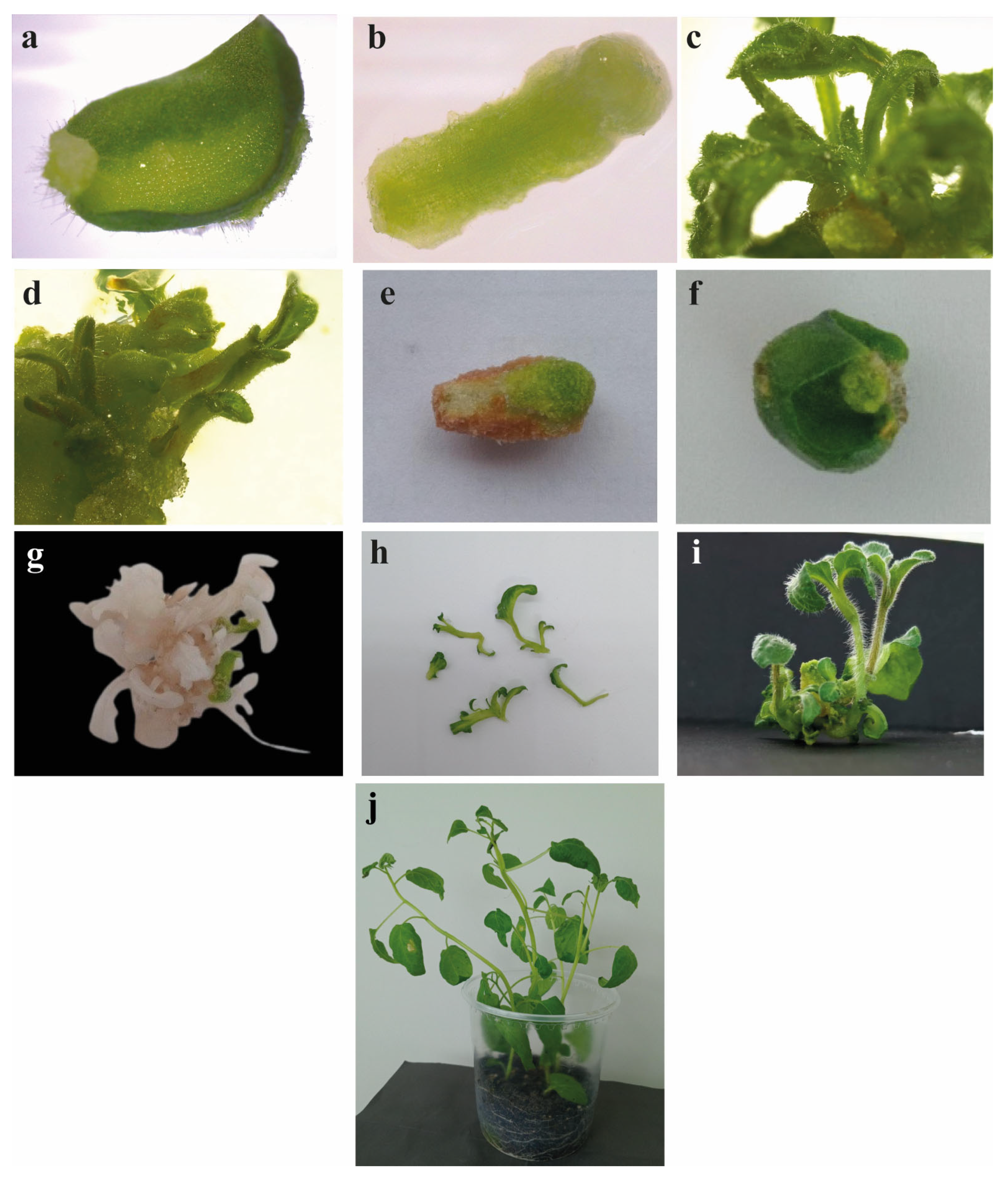
Figure 1. Sequential morphogenic responses leading to shoot regeneration in explants. (a) Callus induction and tissue swelling on the adaxial surface of the cotyledon after 7 days of culture. (b) Callus formation in hypocotyl explants after 7 days of culture. (c,d) Shoot regeneration response from cotyledon and hypocotyl explants after 3 weeks on growth regulator-supplemented medium. (e,f) Lack of organogenic response in explants cultured on medium containing TDZ alone. (g) Albino hypocotyl-derived structure formed under TDZ treatment. (h) Malformed leaf-like tissues induced by TDZ. (i) Hypocotyl-derived shoot cluster obtained on medium supplemented with 4.54 µM TDZ + 0.6 µM NAA, corresponding to the treatment with the highest shoot number and shoot elongation. (j) Rooted and acclimatized regenerants established in a commercial peat–perlite substrate (Plug Mix 8).
Ijpb 17 00041 g001
Table 1. Significance of two-way and three-way interaction effects of TDZ, NAA, and explant type on morphogenic traits of the Colombiano ecotype of Physalis peruviana.
Interaction EffectsCallus (%)Shoot Regeneration Response (%)Shoots per Regenerating ExplantShoot Formation Capacity (SFC)Main Shoot Length (mm)Fresh Mass (mg)
TDZ × NAA0.008 **<0.001 ***<0.001 ***<0.001 ***<0.001 ***0.001 **
TDZ × E<0.001 ***0.374 ns<0.001 ***<0.001 ***<0.001 ***<0.001 ***
NAA × E<0.001 ***0.142 ns<0.001 ***<0.001 ***<0.001 ***<0.001 ***
TDZ × NAA × E<0.001 ***0.799 ns<0.001 ***<0.001 ***<0.001 ***<0.001 ***
Values correspond to p-values obtained from factorial ANOVA. Significance levels were defined as follows: ** p < 0.01; *** p < 0.001; ns, not significant. TDZ: thidiazuron; NAA: naphthaleneacetic acid; E: explant type; SFC: shoot formation capacity.
Table 2. Effects of TDZ, NAA, and explant type on morphogenic traits of the Colombiano ecotype of Physalis peruviana as determined by Tukey’s HSD test.
Explant TypeTDZ (µM)NAA (µM)Callus (%)Shoot Regeneration Response (%)Shoots per Regenerating ExplantShoot Formation Capacity (SFC)Length of the Main Shoot (mm)Shoot Fresh Mass (mg)
Cotyledon2.27032.00 ± 4.47 d76.00 ± 5.48 cd2.60 ± 0.55 de2.00 ± 0.16 g4.49 ± 0.29 e324.80 ± 61.84 de
0.660.00 ± 7.07 c96.00 ± 8.94 ab6.40 ± 1.51 bc6.16 ± 0.36 cd5.97 ± 0.54 c587.80 ± 57.67 bc
1.268.00 ± 10.95 bc84.00 ± 8.94 bc5.00 ± 1.00 cd4.16 ± 0.38 f6.31 ± 0.42 c583.00 ± 53.17 bc
4.54060.00 ± 7.07 c68.00 ± 4.47 d2.00 ± 0.70 e1.36 ± 0.11 g2.10 ± 0.14 f201.20 ± 24.41 f
0.668.00 ± 10.95 bc100.00 ± 0.00 a4.80 ± 1.48 cd4.80 ± 0.45 ef5.31 ± 0.48 cde521.60 ± 43.30 bc
1.280.00 ± 0.00 ab100.00 ± 0.00 a8.00 ± 1.58 b8.00 ± 0.71 b8.46 ± 0.78 b724.60 ± 96.22 a
Hypocotyl2.27068.00 ± 8.37 bc66.00 ± 8.94 d2.22 ± 0.44 e1.44 ± 0.16 g3.08 ± 0.33 f245.20 ± 47.34 ef
0.692.00 ± 10.95 a84.00 ± 5.47 bc6.60 ± 1.14 bc5.52 ± 0.54 de8.50 ± 0.47 b495.20 ± 52.88 c
1.276.00 ± 8.94 abc68.00 ± 4.47 d3.40 ± 0.54 de2.32 ± 0.15 g5.80 ± 0.47 cd286.40 ± 28.19 def
4.54068.00 ± 8.37 bc64.00 ± 11.40 d3.80 ± 0.83 de2.46 ± 0.23 g4.78 ± 0.45 de327.60 ± 53.05 de
0.692.00 ± 10.95 a92.00 ± 8.37 ab12.20 ± 1.79 a11.28 ± 1.26 a12.29 ± 0.84 a619.40 ± 74.22 ab
1.292.00 ± 8.37 a84.00 ± 8.95 bc8.60 ± 0.55 b7.26 ± 0.81 bc6.24 ± 0.68 c374.60 ± 17.43 d
Values are expressed as mean ± standard deviation. Different letters within each column indicate significant differences among treatments according to Tukey’s honestly significant difference (HSD) test at p < 0.05. TDZ: thidiazuron; NAA: naphthaleneacetic acid; SFC: shoot formation capacity.
Table 3. Main effects of explant type, thidiazuron (TDZ), and naphthaleneacetic acid (NAA) on morphogenic responses of the Colombiano ecotype of Physalis peruviana under in vitro conditions.
FactorsShoot Regeneration Response (%)
Explant (E)
Cotyledon87.33 ± 13.63 a
Hypocotyl76.33 ± 13.26 b
TDZ (µM)
2.2779.00 ± 12.42 a
4.5484.66 ± 16.92 b
NAA (µM)
0.0068.50 ± 8.75 c
0.6093.00 ± 8.64 a
1.2084.00 ± 13.14 b
ANOVA (main effects)
Explant<0.001 ***
TDZ<0.001 ***
NAA<0.001 ***
Values are expressed as mean ± standard deviation (SD) (n = 5 replicates per treatment, with five explants per replicate). Data were analyzed using factorial analysis of variance (ANOVA). Mean comparisons were performed using Tukey’s honestly significant difference (HSD) test at p < 0.05. Different lowercase letters within each column indicate statistically significant differences among levels of each factor. p-values corresponding to main effects are presented in the ANOVA section of the table. Significance levels are indicated as follows: *** p < 0.001. E: explant type; TDZ: thidiazuron; NAA: naphthaleneacetic acid.
Disclaimer/Publisher’s Note: The statements, opinions and data contained in all publications are solely those of the individual author(s) and contributor(s) and not of MDPI and/or the editor(s). MDPI and/or the editor(s) disclaim responsibility for any injury to people or property resulting from any ideas, methods, instructions or products referred to in the content.


