Article

Enhancing the Growth and the Yield of Greenhouse Zucchini (Cucurbita pepo L.) Cultivars Using Desalinated Seawater in Semi-Arid Regions


1
Department of Horticulture, Horticultural Complex-Agadir Campus (CHA), Hassan II Institute of Agronomy and Veterinary Medicine (IAV Hassan II), Agadir 80000, Morocco
2
Laboratory of Plant Biotechnology, Faculty of Sciences, Ibn Zohr University, Agadir 80000, Morocco
3
Plant Production, Protection, and Biotechnology Department, Hassan II Institute of Agronomy and Veterinary Medicine (IAV Hassan II), Rabat 10101, Morocco
4
Laboratory of Microbial Biotechnology and Plant Protection, Faculty of Sciences, Ibn Zohr University, Agadir 80000, Morocco
5
Department of Plant Protection, Hassan II Institute of Agronomy and Veterinary Medicine, Agadir 80000, Morocco
6
Department of Landscape and Environment, Horticultural Complex-Agadir Campus (CHA), Hassan II Institute of Agronomy and Veterinary Medicine (IAV Hassan II), Agadir 80000, Morocco
7
Mechanic Process Energy and Environment Laboratory, National School of Applied Sciences (ENSA), Ibn Zohr University, Agadir 80000, Morocco
*
Author to whom correspondence should be addressed.
Int. J. Plant Biol. 2026, 17(4), 30; https://doi.org/10.3390/ijpb17040030
Submission received: 26 November 2025 / Revised: 27 March 2026 / Accepted: 28 March 2026 / Published: 13 April 2026
(This article belongs to the Section Plant Response to Stresses)

Abstract

Climate change exacerbates water scarcity in semi-arid and arid regions, particularly across the Mediterranean Basin, posing severe challenges to food security and freshwater availability. Non-conventional water resources, such as desalinated seawater, are increasingly considered for supplementing irrigation; however, their exclusive use can induce osmotic stress, nutrient imbalances, and soil alkalinity, thereby limiting crop performance. This study evaluated the agronomic, and physiological impacts of blending freshwater (FW) and desalinated seawater (DSW) for two zucchini (Cucurbita pepo L.) cultivars, Radia and Kayssar, under greenhouse conditions. Five irrigation regimes were tested: T1 (FW100%), T2 (FW75%-DSW25%), T3 (FW50%-DSW50%), T4 (FW25%-DSW75%), and T5 (DSW100%). Moderate blending, particularly T2 and T3, optimized vegetative growth, biomass accumulation, and reproductive performance, maximum yields were obtained under T3, reaching 6.65 kg/plant for Radia and 5.49 kg/plant for Kayssar, while fruit quality, including caliber and soluble solids content (°Brix), was also highest under this regime. These findings support the suggestion that implementing such combined/blended irrigation regimes can enhance vegetative growth, yield, and fruit quality in the face of increasing water scarcity and energy constraints.

1. Introduction

Zucchini (Cucurbita pepo L.), a self-pollinated warm-season crop of the Cucurbitaceae family, is among the most widely cultivated Cucurbitae species worldwide [1]. Native to tropical and subtropical regions, it exhibits remarkable phenotypic diversity in fruit shape and color, ranging from elongated to globular forms and from dark green to yellow-orange hues. Its adaptability, high yield potential, and nutritional richness have made it a crop of paramount global importance [2,3]. Increasing consumer demand for year-round fresh produce has driven its expansion under protected environments such as greenhouses and shade net houses [4,5], where fruit quality, determined by attributes like firmness, soluble solids content, acidity, and color, depends on the interaction between genetic, environmental, and agronomic factors, notably cultivar selection, irrigation management, nutrient supply, and climatic control [6,7].
The sustainability of intensive greenhouse production is increasingly constrained by global water scarcity, which severely limits conventional freshwater (FW) availability, especially in semi-arid and Mediterranean coastal regions [8]. To enhance agricultural resilience, alternative irrigation sources are being explored, including treated wastewater, desalinated seawater (DSW), rainwater harvesting, and atmospheric water collection [9,10,11]. Among these, DSW represents a reliable, drought-resilient resource capable of supporting long-term food and water security [12,13,14,15,16]. However, its agricultural use is constrained by high energy requirements, dependence on fossil fuels, and resulting greenhouse gas emissions and production costs [17,18,19]. Moreover, its ionic composition, rich in sodium, chloride, and boron but poor in calcium, magnesium, and sulfur, can alter soil properties, disrupt nutrient balance, and impair plant growth and fruit quality [20,21,22,23,24].
To mitigate these constraints, blending DSW with conventional FWhas emerged as a promising adaptive irrigation strategy. Partial substitution of FW with DSW, typically in the range of 25–75%, can optimize resource use while maintaining economic viability and minimizing soil salinization risks [10,25,26,27,28,29]. Nevertheless, the agronomic and environmental implications of such blended irrigation systems remain insufficiently understood, particularly for cucurbitaceous crops cultivated under greenhouse conditions. Most prior research has focused on solanaceous crops such as tomato, pepper, and eggplant, or leafy and leguminous species, leaving notable knowledge gaps regarding zucchini [30,31].
Therefore, the present study investigates the integration of desalinated seawater, a nonconventional water resource, as an adaptive irrigation strategy in greenhouse zucchini (Cucurbita pepo L.) cultivation under semi-arid conditions. Specifically, it aims to evaluate the effects of different DSW–FW blends on plant growth, yield, and fruit quality of both varieties Radia and Kayssar.

2. Results

2.1. Substrate and Drainage Water Properties Under Different Irrigation Regimes

The pH of the drainage water showed temporal variation throughout the experimental period and was influenced by the irrigation treatments (Figure 1). At the beginning of the experiment, pH values were relatively similar across treatments, remaining within a slightly alkaline range of approximately 8.0–8.2. Additionally, during 15–25 days after plantation (DAP), pH values remained relatively low and fluctuated slightly among treatments, generally ranging between approximately 7.9 and 8.6. A slight decline was observed around 25DAP, particularly in the treatment irrigated with 50%DSW + 50%FW (T3) 100% DSW (T5). From approximately 35 DAP onward, the pH of the drainage water increased progressively in all treatments. This upward trend continued until the end of the experiment, reaching maximum values between about 8.9 and 9.3 at 65–70 DAP. Treatments with proportions of DSW generally showed slightly higher pH values during the later stages of the experiment. The lowest pH levels were recorded toward the end of the monitoring period in the T3 (50%FW + 50%DSW) treatment. In contrast, the 100% DSW treatment did not exhibit the highest pH values, indicating that increasing the proportion of DSW alone did not necessarily result in greater alkalinization of the drainage water, whereas its blending with FW appeared to minimize this effect.
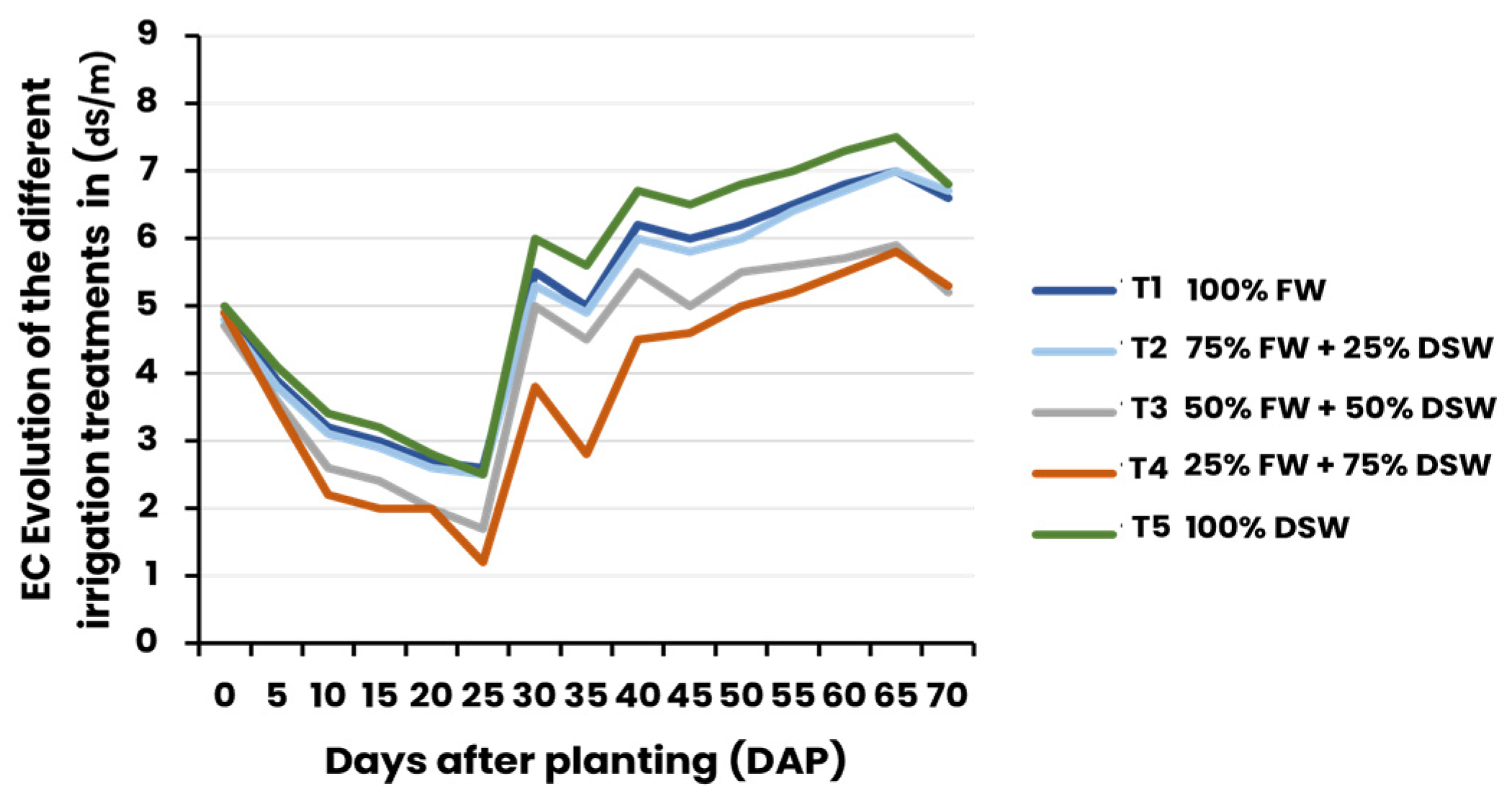
The electrical conductivity (EC) of the saturated paste extract showed clear temporal variation among irrigation treatments throughout the experiment (Figure 2). During the initial weeks after transplanting, EC values decreased slightly across all treatments, reaching their lowest levels around the fourth week. This early decline was followed by a marked increase in EC as the cultivation period progressed.
From approximately day 30 onward, EC increased progressively across all treatments, although the magnitude of the increase differed by irrigation regime. Treatments containing higher proportions of DSW exhibited the greatest accumulation of salts in the substrate. The T5 treatment (100% DSW) consistently recorded the highest EC values, reaching approximately 7.5 mS cm−1 toward the end of the experiment.
The blended irrigation treatments (T2, T3, and T4) showed intermediate EC values, with a progressive increase over time, reflecting gradual salt accumulation in the growing substrate. Overall, the results indicate that increasing the proportion of DSW in the irrigation mixture generally resulted in higher substrate salinity, as evidenced by the elevated EC values measured in the drainage extract.
In contrast, the T1 treatment (100% FW) exhibited a different pattern, with EC values increasing during the later stages of the experiment and reaching levels relatively close to those observed in the 100% DSW treatment. This pattern may reflect salt concentration in the substrate due to evapotranspiration and limited leaching over time, leading to the progressive accumulation of dissolved ions in the root zone.
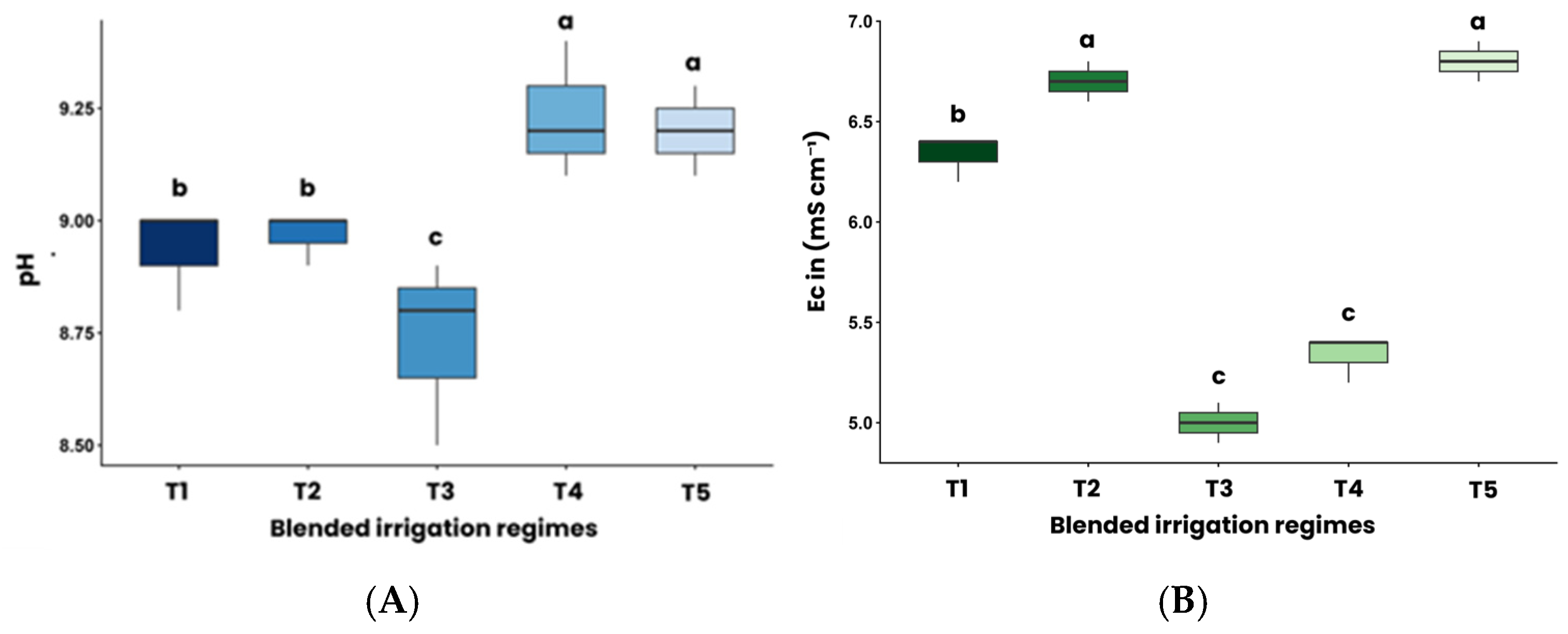
Statistical analysis showed that the final pH and electrical conductivity (EC) of the drainage water were significantly (p < 0.01) influenced by the proportion of DSW applied in the irrigation treatments (Figure 3A,B). Both parameters varied markedly among treatments, reflecting the impact of irrigation water composition on the drainage water quality.
pH generally increased with higher proportions of DSW in the irrigation water. The highest pH values were observed under T4 and T5, reaching median values close to 9.2. In contrast, T1 and T2 exhibited moderately alkaline conditions, while T3 showed the lowest pH values. A different pattern was observed for EC. The highest EC values were recorded under T5 and T2, reaching approximately 6.8 and 6.7 mS cm−1, respectively. T1 displayed intermediate EC levels, whereas the lowest EC values were observed under T3 and T4.

2.2. Vegetative Growth and Biomass Accumulation

The vegetative growth and biomass production of the two cultivars, Radia and Kayssar, were significantly influenced by the irrigation treatments combining freshwater (FW) and desalinated seawater (DSW) T1 (FW100%), T2 (FW75%-DSW25%), T3 (FW50%-DSW50%), T4 (FW25%-DSW75%), and T5 (DSW 100%). Analysis of variance revealed highly significant treatment effects (***, p < 0.001) for all measured vegetative and biomass parameters in both cultivars. (Table 1).
For the cultivar Radia, the number of leaves (NL) varied significantly among treatments, ranging from 28.70 ± 1.30 under T1 to 37.10 ± 3.74 under T3. The highest NL values were recorded under T3, followed by T5 (35.10 ± 3.29) and T4 (31.85 ± 4.65), while T1 and T2 produced the lowest values. Plant height (PH) in Radia followed a similar trend, with the maximum value observed under T3 (109.89 ± 10.78 cm), which was significantly higher than T1 (91.16 ± 9.69 cm) and T2 (92.29 ± 7.85 cm). Intermediate values were recorded for T4 (106.08 ± 4.65 cm) and T5 (100.03 ± 4.05 cm).
For the cultivar Kayssar, NL also showed significant differences across irrigation regimes. The highest value was obtained under T4 (35.93 ± 3.81), followed by T3 (34.28 ± 1.04) and T5 (31.81 ± 1.49), whereas the lowest NL was recorded under T1 (26.52 ± 2.14). Plant height increased progressively with the inclusion of desalinated water, reaching the highest values under T5 (99.28 ± 10.33 cm) and T3 (96.98 ± 5.81 cm), while the lowest PH was observed under T1 (79.14 ± 6.79 cm).
Biomass-related parameters were also significantly influenced by the irrigation treatments in both cultivars (p < 0.001). In Radia, fresh leaf weight (FL) showed a marked increase with mixed irrigation, reaching the highest value under T3 (503.51 ± 23.87 g), followed by T5 (461.72 ± 46.49 g) and T2 (458.84 ± 40.96 g). The lowest FL was observed under T1 (238.24 ± 21.98 g). Dry leaf weight (DL) in Radia ranged from 27.88 ± 1.27 g under T1 to 58.57 ± 4.52 g under T3, indicating a significant improvement in biomass accumulation when freshwater was partially substituted with desalinated water. Similarly, stem fresh weight (FS) increased significantly under mixed irrigation treatments, with the highest value recorded at T3 (635.11 ± 39.23 g), followed by T4 (587.99 ± 32.82 g) and T5 (566.03 ± 44.20 g). Dry stem weight (DS) also peaked under T3 (60.30 ± 5.02 g), whereas the lowest values were observed under T1 and T5 (46.93 ± 4.26 g and 46.39 ± 3.86 g, respectively).
In Kayssar, fresh leaf weight (FL) was significantly enhanced under T3 (489.31 ± 28.47 g), which was markedly higher than T1 (124.59 ± 14.65 g) and the other treatments. Dry leaf weight (DL) showed a similar pattern, reaching its maximum under T3 (48.89 ± 2.29 g), while the lowest value occurred under T1 (23.85 ± 2.07 g). For stem fresh weight (FS), the highest value was recorded under T3 (543.33 ± 26.21 g), whereas T1 produced the lowest yield (429.95 ± 24.84 g). Dry stem weight (DS) also peaked under T3 (64.51 ± 5.14 g), while T1 and T5 resulted in significantly lower values (47.61 ± 4.21 g and 48.93 ± 4.48 g, respectively).

2.3. Fruit Production and Crop Yield

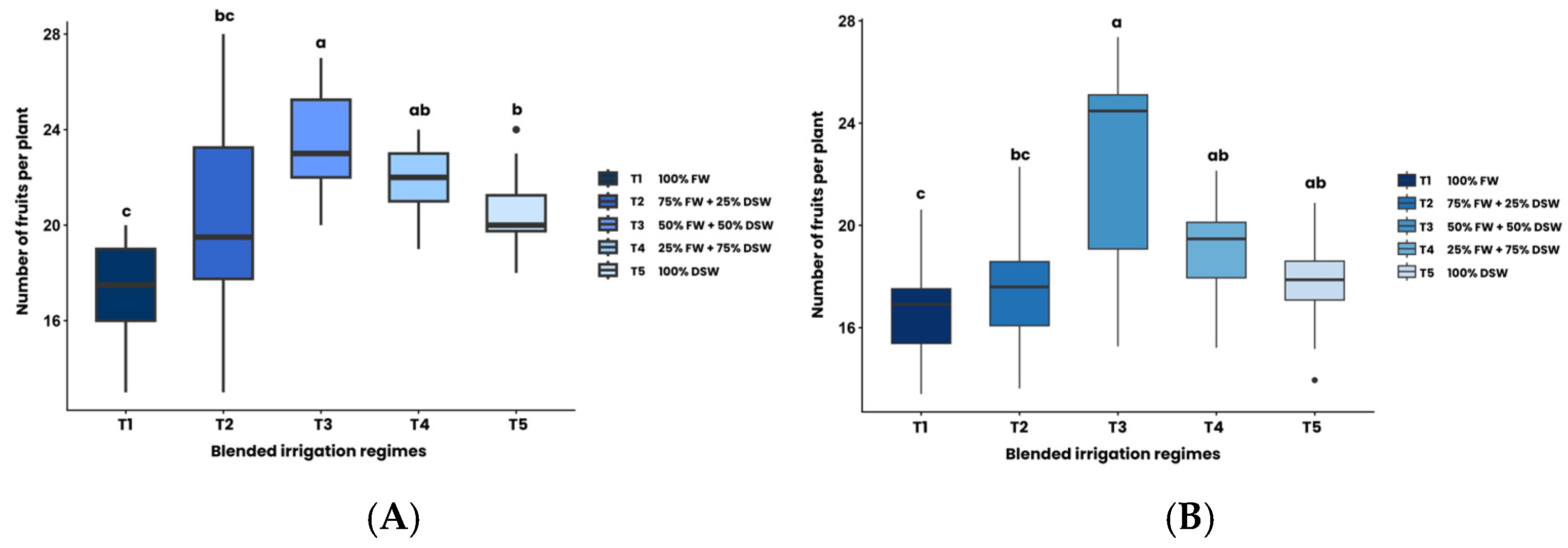
A highly significant effect of irrigation treatments on the number of fruits per plant was observed for both cultivars (***, p < 0.001), indicating that the proportion of freshwater (FW) and desalinated seawater (DSW) strongly influenced reproductive performance. Figure 4 below shows the variation in the number of fruits per plant for Radia cultivar and Kayssar cultivar as influenced by the different irrigation treatments.
In the cultivar Radia, plants irrigated with the T3 treatment produced the highest fruit number per plant and were superior to most other treatments (p < 0.01; Figure 5). The median fruit number under T3 was clearly higher, indicating that a balanced mixture of freshwater and desalinated seawater promoted reproductive development. Intermediate fruit numbers were observed under T4 and T5, which did not differ significantly from T3 but tended to show slightly lower median values. Similarly, T2 resulted in moderate fruit production and was statistically comparable to T4 and T5. In contrast, the lowest fruit number per plant was recorded under T1, which differed significantly from the T3 treatment.
A similar trend was observed for the cultivar Kayssar, where fruit number per plant differed significantly across the irrigation treatments. The T3 treatment resulted in the highest fruit number per plant and was greater than most other treatments, confirming the positive effect of balanced blended irrigation. The T4 and T5 treatment produced intermediate fruit numbers and did not significantly differ from T3, suggesting that relatively high proportions of desalinated seawater can still sustain fruit production. The T2 treatment also resulted in moderate fruit numbers comparable to T4 and T5, whereas the lowest values were recorded under T1, indicating that the exclusive use of freshwater resulted in reduced fruit set compared with blended irrigation regimes (Figure 5).
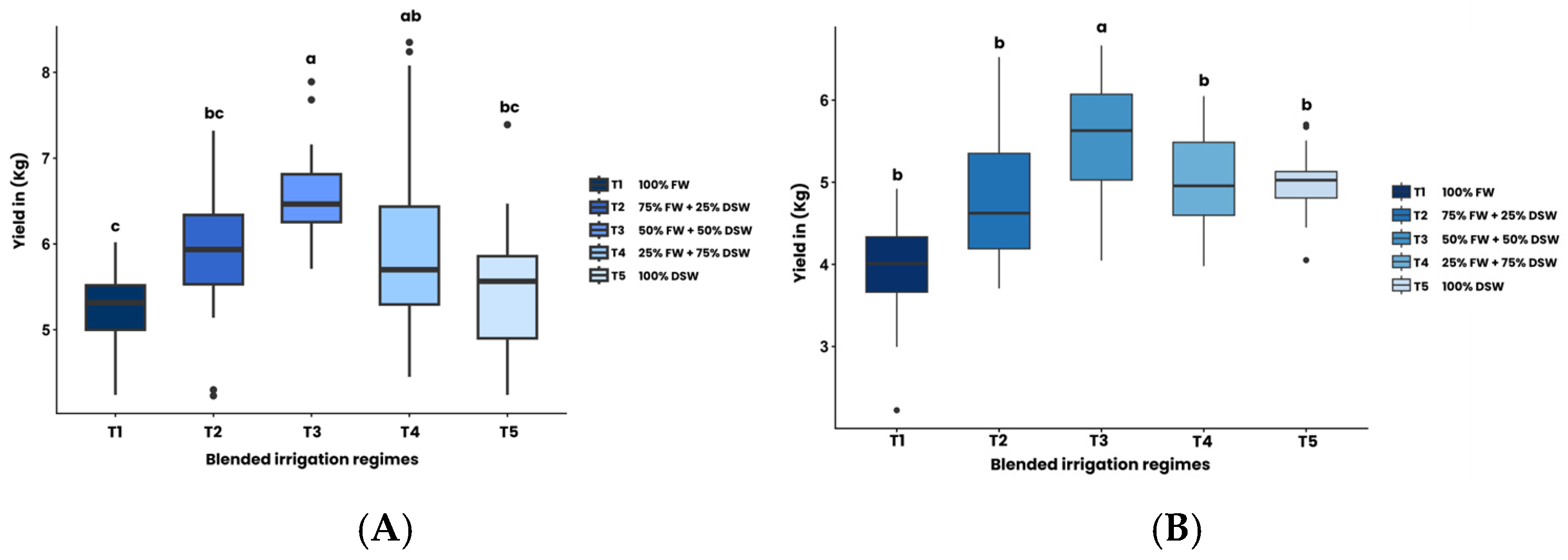
In the cultivar Radia, plants irrigated with the T3 treatment produced the highest yield per plant and were superior to most other irrigation regimes (≈6.5 Kg), indicating that a balanced mixture of freshwater and desalinated seawater enhanced crop productivity. Intermediate yield values were observed under T2 (≈6.0 Kg), which did not differ significantly from T3 but tended to exhibit slightly lower yields. Similarly, T4 and T5 resulted in moderate yield levels and was statistically comparable to T2 (≈5.6; 5.5 Kg, respectively). In contrast, the lowest yield was recorded under T1 with a yield of (≈5.3 Kg).
In the cultivar Kayssar, irrigation treatments also influenced yield per plant. Plants irrigated with the T3 treatment produced the highest yield (≈5.5 Kg), showing a significantly greater yield value compared with the other irrigation regimes. This result suggests that the balanced combination of freshwater and desalinated seawater favored crop performance. In contrast, T1, T2, T4, and T5 exhibited lower yield values (≈4.1; 4.6; 4.8; and 4.9 Kg, respectively), and no significant differences were observed.

2.4. Fruit Quality

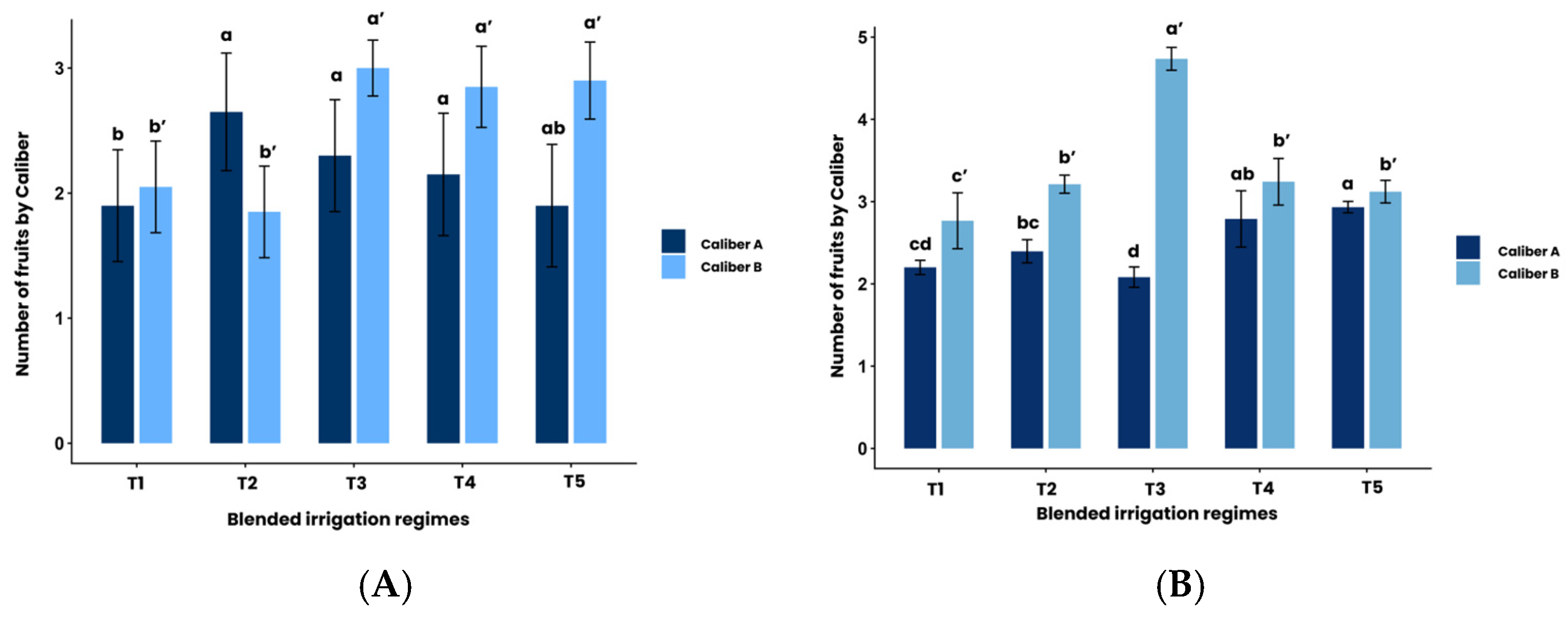
The composition of irrigation water significantly affected the distribution of fruit calibers in both zucchini cultivars (p < 0.01; Figure 6). In Radia, T3 produced the highest number of exportable fruits, with 2.1 A′ and 3.0 B′ fruits per plant. Intermediate treatments resulted in fewer high-caliber fruits: T4 (1.8 A′, 2.8 B′), T5 (1.7 A′, 2.8 B′), and T2 (1.5 A′, 1.8 B′), while T1 (FW100-DSW0%) produced the lowest number of top-quality fruits (1.2 A′, 2.2 B′). Kayssar showed a similar pattern, with T3 producing 2.0 A′ and 4.6 B′ fruits per plant, followed by T4 (1.6 A′, 3.2 B′), T2 (1.4 A′, 3.2 B′), T5 (1.5 A′, 3.1 B′), and T1 (1.1 A′, 2.8 B′).
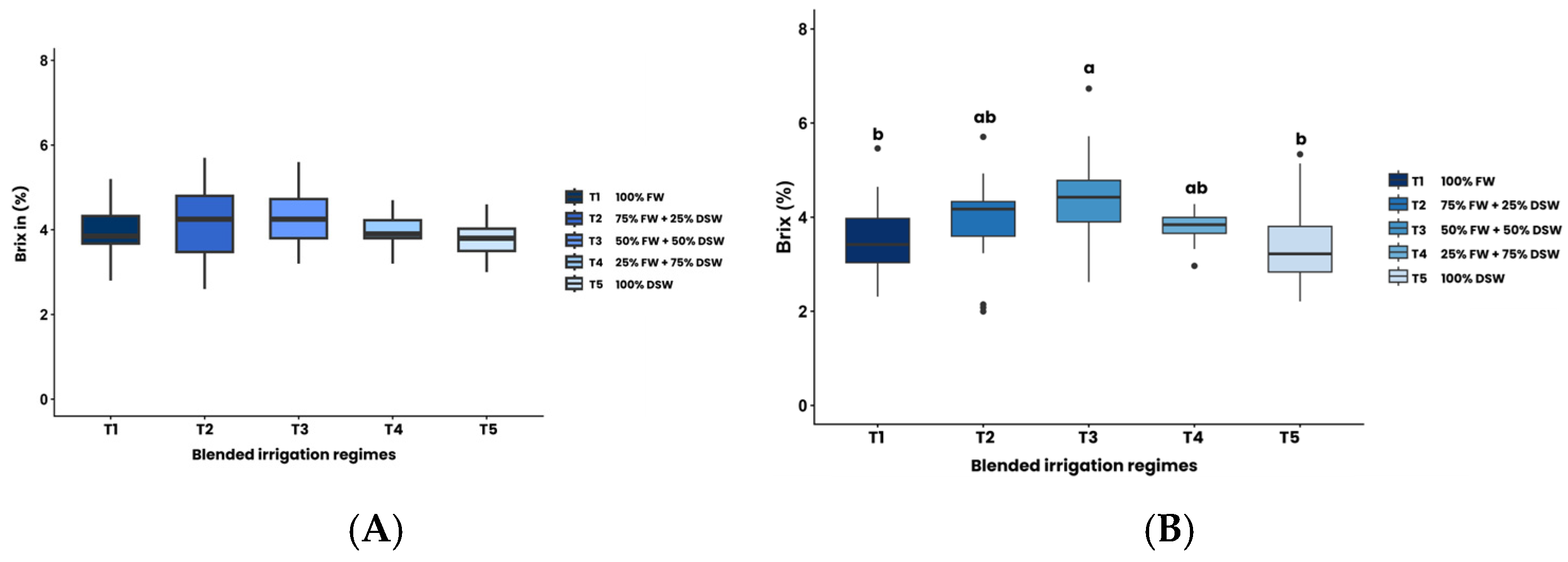
The soluble solids content (°Brix) of zucchini fruits in the Radia cultivar was not significantly affected by irrigation treatment, whereas in the Kayssar cultivar, irrigation had a significant effect (p < 0.01) (Figure 7).
Across treatments, the 50:50 blend of well water and desalinated seawater T3 produced the highest sugar content, with Kayssar reaching 4.0°Bx, reflecting an optimal ionic and osmotic environment for carbohydrate accumulation. Intermediate °Brix values were observed under the other blended treatments recorded slightly lower values (3.5–3.8 °Bx). Notable, the lowest sugar levels occurred under non mixed treatments T1 and T5, representing a significant decrease in °Bx relative to the optimal treatment.

3. Discussion

Greenhouse zucchini production in arid and semi-arid regions faces increasing constraints due to limited freshwater availability and the variable chemical composition of alternative water sources. Desalinated seawater (DSW) has emerged as a strategic supplement, yet its exclusive use may alter substrate chemistry, nutrient dynamics, and plant physiological performance. Understanding how moderate blending of DSW with mineral-rich groundwater influences soil–plant interactions is critical for optimizing productivity and fruit quality under water-limited conditions. The results of the present experiment, demonstrated that an intermediate irrigation blend (50:50 FW-DSW) provides a balance between osmotic stress mitigation, nutrient availability, and physiological regulation, resulting in enhanced vegetative growth, biomass accumulation, reproductive performance, and fruit quality in two zucchini cultivars with distinct genotypic responses.
The obtained results indicated that irrigation water composition significantly influenced substrate chemical properties, particularly pH and salinity, which are fundamental determinants of nutrient availability and root function. Treatments involving moderate blending of desalinated seawater (DSW) and well water maintained substrate pH and salinity within a favorable range, whereas extreme irrigation regimes probably led to higher alkalinity and/or excessive sodium accumulation. These findings highlight the pivotal role of substrate chemistry in shaping root–soil interactions and microbial activity [32]. Alkaline conditions, as observed under high-DSW treatments, can reduce the solubility of essential micronutrients such as iron, manganese, zinc, and copper, limit their uptake, and impair physiological processes, including chlorophyll biosynthesis, enzymatic activity, and photosynthesis [33,34]. Similarly, elevated salinity or sodium accumulation disrupts osmotic balance, constrains water uptake, and interferes with ion homeostasis, leading to reduced turgor, limited cell expansion, and impaired metabolic activity [35]. The observed benefits of moderate blending likely stem from its ability to stabilize pH and ionic composition, preserve nutrient solubility, and support microbial populations critical for nutrient cycling [36].
Vegetative growth closely reflected substrate conditions and irrigation water quality. Moderate blending of DSW with well water T3 (FW50-DSW50%) promoted leaf emergence, stem elongation, and, therefore, canopy expansion in both cultivars, indicating that balanced osmotic and ionic conditions optimize root hydraulic conductivity, water uptake, and nutrient assimilation [37]. Mechanistically, improved turgor maintenance, cell expansion, and mesophyll differentiation under moderate blending likely activated growth-regulating phytohormones such as gibberellins and auxins, driving apical meristem activity [38]. In contrast, extreme treatments, exclusively DSW, imposed osmotic stress and disrupted nutrient homeostasis, resulting in reduced leaf number, stunted stems, and compromised canopy architecture [39]. Genotypic differences were evident, with Radia exhibiting slightly higher tolerance to ionic stress than Kayssar, highlighting the importance of cultivar-specific irrigation strategies and the differential capacity of genotypes to manage osmotic adjustment, ion exclusion, and nutrient uptake. These results corroborate previous studies demonstrating that moderate salinity or blended water sustains vegetative growth while mitigating the deleterious effects of nutrient imbalances and ionic toxicity [40,41,42].
Biomass production mirrored the patterns observed in vegetative growth. Intermediate blending of DSW and fresh water maximized leaf and stem fresh and dry weights, reflecting enhanced carbon assimilation, nutrient uptake, and turgor-driven cell expansion. Efficient utilization of essential macro- and micronutrients, including nitrogen, potassium, magnesium, and calcium, supported chlorophyll biosynthesis, photosynthetic capacity, and structural tissue formation [43]. Greater leaf biomass indicates sustained mesophyll differentiation and photosynthetic efficiency [44], whereas increased stem biomass suggests reinforced vascular development, lignification, and mechanical support, mediated by coordinated hormonal regulation [45]. In contrast, extreme irrigation regimes likely induced osmotic stress, ion toxicity, and nutrient precipitation, impairing assimilate transport, carbon fixation, and structural growth [46,47]. Physiologically, moderate blending alleviates osmotic and oxidative stress, supports antioxidant activity, maintains photosystem efficiency, and facilitates effective source–sink partitioning. Genotypic differences in biomass accumulation suggest variability in osmotic adjustment, ion exclusion, and nutrient use efficiency, emphasizing the need for cultivar-specific irrigation management. These results are consistent with previous greenhouse studies, where intermediate water blending optimized vegetative biomass, whereas extremes constrained overall plant vigor [42,48,49].
Reproductive outcomes followed trends observed in vegetative vigor and biomass accumulation. Moderate blending maximized fruit set and overall yield, demonstrating that optimal vegetative growth directly supports reproductive success. Enhanced source–sink relationships, carbohydrate allocation, and hormonal regulation under moderate blending improved pollen viability, fertilization, and early fruit development [50]. Balanced osmotic potential and nutrient availability, particularly potassium, calcium, and boron, were essential for these reproductive processes [51]. By contrast, extreme irrigation regimes imposed osmotic and ionic stresses that constrained both vegetative growth and reproductive efficiency. These findings are consistent with prior studies showing that intermediate water blending stabilizes physiology, optimizes canopy–fruit interactions, and enhances yield in saline-affected greenhouse crops [25,29,40].
Finally, fruit quality, encompassing size and sugar content (°Brix), was strongly influenced by irrigation strategy, reflecting the integrated effects of substrate conditions, vegetative vigor, and nutrient assimilation. Moderate blending consistently produced the highest proportion of market-preferred B′ caliber fruits and superior °Brix values, demonstrating that optimal osmotic and ionic conditions enhance structural development, carbohydrate accumulation, and sugar translocation. In contrast, high-salinity groundwater limited cell expansion and favored smaller, less marketable fruits, while exclusive DSW restricted micronutrient availability, particularly calcium, magnesium, and boron, impairing cell wall integrity, sugar metabolism, and sucrose transport [52,53,54,55,56,57]. The superior quality under moderate blending reflects the physiological synergy between balanced substrate chemistry, vegetative growth, and nutrient uptake, supporting sweetness, uniformity, and marketability [58].
The present findings reinforce the concept that irrigation water quality acts as a central driver of soil–plant physiological interactions in greenhouse systems exposed to water scarcity. Rather than the exclusive use of a single water source, a balanced blending strategy appears to create a more stable chemical and osmotic environment that supports coordinated vegetative and reproductive development. The consistent superiority of the intermediate treatment across growth, biomass, yield, and fruit quality parameters suggests that plant performance under saline or desalinated irrigation is governed by a delicate equilibrium between nutrient availability and osmotic regulation. These results contribute to a growing body of evidence indicating that optimizing ionic composition, rather than merely increasing water supply, constitutes a key lever for sustaining productivity in arid-region horticulture.

4. Materials and Methods

The study was conducted at the experimental farm of the Horticultural Complex of Agadir (CHA), Hassan II Institute of Agronomy and Veterinary Medicine (IAV Hassan II), located in the Souss-Massa region, southwest Morocco (30°36′ N, 9°36′ W; 32 m a.s.l.). The site lies approximately 11.5 km from the Atlantic Ocean and is characterized by a semi-arid to arid climate influenced by coastal humidity, representative of the region’s major horticultural production zones. Experiments were carried out in a north–south oriented multi-span greenhouse equipped with a double-layer inflatable wall, automated extractors, an evaporative cooling system, and retractable thermal screens. Temporal dynamics of greenhouse microclimate parameters during zucchini (Cucurbita pepo L.) cultivation recorded by automated data loggers throughout successive cropping cycles. Critical physiological thresholds: The temperature limits at 2 °C and 8 °C, corresponding to the lower and upper boundaries for sustained vegetative activity, and relative humidity limits at 40% and 80%, delineating the optimal range for transpiration efficiency while indicating potential risks of water stress or pathogen proliferation.

4.1. Plant Material and Growth Conditions

Two commercial F1 hybrid cultivars of zucchini (Cucurbita pepo L.) were used. “Radia”, a light-fruited, early maturing cultivar well adapted to semi-arid conditions, and “Kayssar”, a dark-fruited, vigorous cultivar with high yield potential. Seeds were germinated in peat moss substrate under controlled nursery conditions for 15 days, with regulated temperature, irrigation, and photo period to ensure uniform germination. At the 3–4 leaf stage, uniform seedlings were transplanted into 7000 cm3 black polyethylene pots filled with sterilized and sieved loamy soil. The growth medium’s physicochemical properties are described in Table 2 and Nutrient inputs of nitrogen at different phenological growth stages in Table 3:
Prior to transplanting, for the overall number of pots required for the present experiment, all of which had a capacity of 7.3 kg, about 6.85% compost (C/N = 12.6; organic matter, 40.5 and pH = 8.3) and 93.15% of the soil were mixed thoroughly to prepare the growth medium and subsequently used to fill the pots.

4.2. Irrigation System and Water Source

A pressurized drip irrigation system was installed for precise and uniform water delivery. Self-compensating emitters with a discharge rate of 2 L h−1 were connected to each pot, with two emitters per plant to ensure homogeneous wetting and accurate application under contrasting salinity regimes. Irrigation scheduling was based on crop evapotranspiration (ETc), adjusted weekly according to local meteorological data and greenhouse microclimatic conditions. The desalinated seawater (DSW) used in the experiment was sourced from the Chtouka Aït Baha desalination plant, located approximately 40 km south of Agadir. The facility operates using reverse osmosis technology and is powered partly by solar energy. It has a production capacity of 275,000 m3 day−1, expandable to 400,000 m3 day−1, supplying both drinking water and irrigation water to the Souss-Massa agricultural perimeter (≈15,000 ha). The desalinated water used in this study had an average EC of 0.68 dS m−1 and Na+ concentration of 3.91 meq L−1, while the freshwater (FW) from local wells exhibited EC 0.81 dS m−1 and Na+ concentration of 1.88 meq L−1 (Table 4).

4.3. Experimental Design and Irrigation Treatments

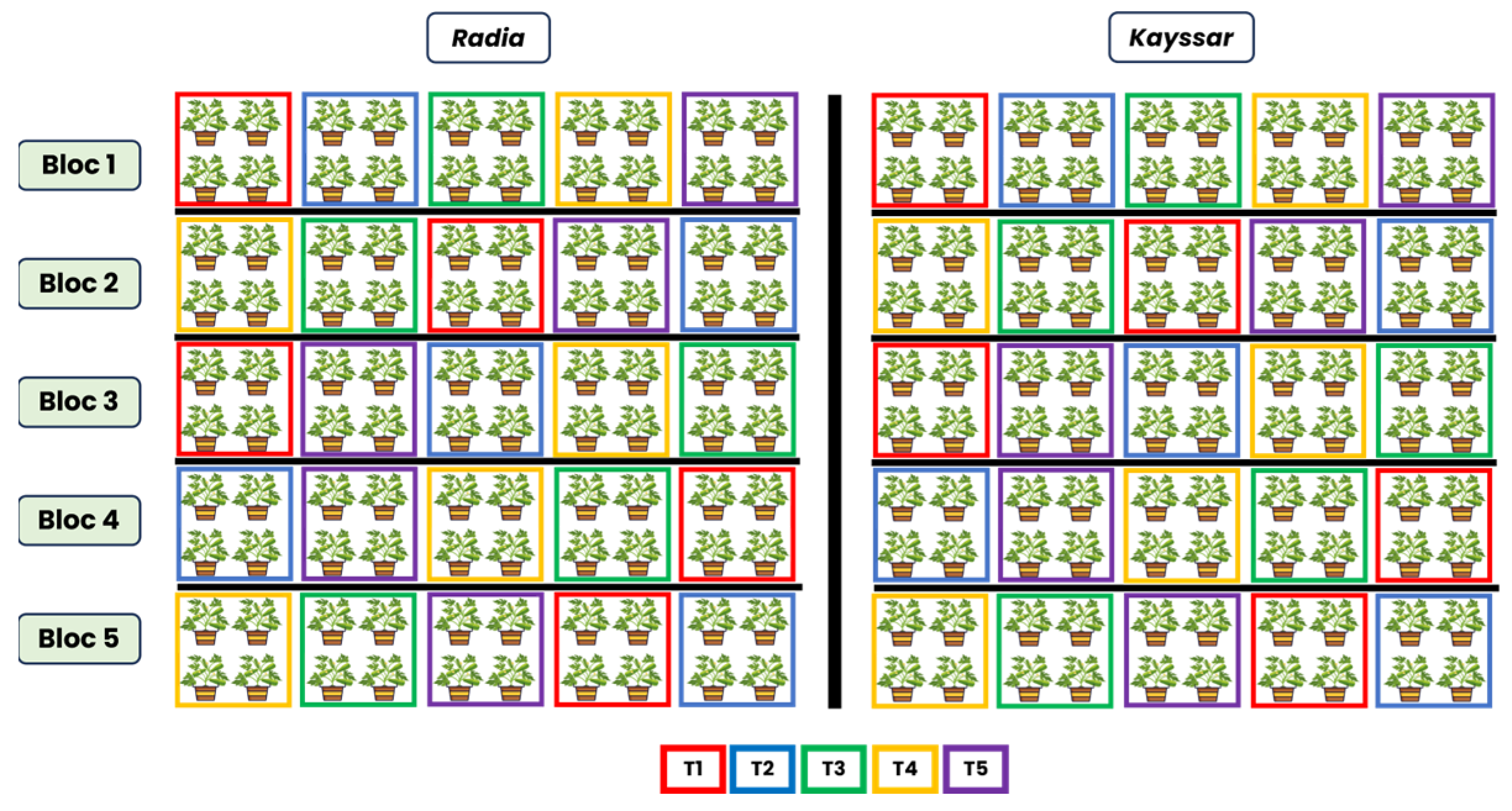
The experiment was established according to a randomized complete block design (RCBD) with five irrigation treatments and five replications to account for potential spatial variability within the greenhouse. Each treatment was randomly assigned within each block to ensure statistical independence and minimize environmental bias. The irrigation treatments were formulated to create a gradient in water salinity as described in Table 5 below:
Each experimental unit consisted of four plants per cultivar grown in individual pots (Figure 8), arranged at a spacing of 20 × 20 cm to ensure adequate aeration and minimize interplant competition. The total experimental area covered 48 m2. To prevent lateral water movement and treatment interference, buffer zones of 0.8 m were maintained between blocks and 0.4 m between adjacent treatment plots. Each treatment received equal total water volumes across the crop cycle, with only the salinity level varying according to the FW–DSW ratio.

4.4. Data Collection and Measurements

Vegetative growth was monitored weekly for six consecutive weeks after transplanting to evaluate canopy development and vegetative vigor under the different irrigation regimes. Plant height (cm) was measured from the soil surface to the apex of the youngest fully expanded leaf using a graduated ruler, while the number of leaves per plant was manually counted. Fruit harvesting commenced 45 days after transplanting (DAT) and was conducted at 2–3-day intervals until 90 DAP. During each harvest, the number of fruits per plant, average fruit weight (g), and fruit length (cm) were recorded. Fruit weight was determined using a digital balance, and fruit length was measured with a precision digital caliper.
The soluble solids content (SSC, °Brix) of freshly harvested fruits was measured using a handheld digital refractometer (ATAGO Co., Ltd., Tokyo, Japan). Measurements were performed on juice extracted from the central portion of the fruit to ensure consistency and representativeness. Fruits were graded according to the United Nations Economic Commission for Europe (UNECE, 2017 [59]) standards for zucchini, based on size, shape uniformity, external color, and absence of visible defects (Table 6). This classification allowed for a precise evaluation of marketable yield and fruit quality consistency among treatments.
At the end of the growth cycle, biomass accumulation was determined using four representative plants per experimental unit. Plants were carefully uprooted, rinsed with distilled water to remove adhering soil particles, and separated into leaves and stems. The fresh weight of each organ was recorded using a digital analytical balance (±0.01 g). Samples were then oven-dried at 60 °C for 48 h to obtain dry biomass, ensuring complete removal of tissue moisture. The total and organ-specific biomass were subsequently calculated to determine overall growth performance and shoot biomass partitioning.

4.5. Statistical Analysis

All experimental data were statistically analyzed using IBM SPSS Statistics software (version 25.0; IBM Corp., Armonk, NY, USA). Prior to analysis, data were tested for normality using the Shapiro–Wilk test. When the data satisfied the assumptions of normal distribution, homogeneity of variances was verified using Levene’s test. For datasets meeting both assumptions, a one-way analysis of variance (ANOVA) was performed to evaluate the effects of irrigation treatments on the measured parameters. Treatment means were compared using Tukey’s Honest Significant Difference (HSD) post hoc test at a significance level of p < 0.05. When data did not conform to normality or homogeneity assumptions, non-parametric methods were applied. In such cases, the Kruskal–Wallis test was used to detect significant treatment effects, followed by pairwise comparisons using Dunn’s test (p < 0.05). All results were expressed as mean ± standard deviation (SD).

5. Conclusions

Blending desalinated seawater (DSW) with fresh water represents a practical and climate-resilient irrigation strategy for zucchini (Cucurbita pepo L.) cultivation in semi-arid regions. A 50:50 ratio of freshwater to DSW was the most effective, enhancing vegetative growth, biomass accumulation, fruit yield, and key quality traits. While genotypic variation was evident, with “Radia” generally outperforming “Kayssar”, both cultivars benefited from intermediate blending, highlighting the broad applicability of this irrigation approach. Mechanistically, the 50:50 blend provided a balanced ionic composition that alleviated osmotic stress, supported root function, and maintained optimal nutrient availability, thereby preserving physiological performance. Complementary substrate analyses indicate that moderate blending mitigated risks associated with salinization and alkalinity, maintaining favorable pH and electrical conductivity compared with extreme irrigation treatments. These effects collectively supported healthy vegetative development, efficient nutrient uptake, and enhanced reproductive success. These findings underscore the potential of balanced FW–DSW irrigation as a scalable, environmentally sustainable solution, aligning high-value horticultural production with climate mitigation and resource-efficiency objectives in water-limited regions.

Author Contributions

Conceptualization, K.K.; methodology, K.K., J.Z. and B.Z.; software, A.B. and S.E.M.; validation, K.K., O.L. and Y.I.; formal analysis, A.B.; investigation, H.T.; resources, M.E. and I.L.; data curation, K.K.; writing—original draft preparation, A.E.; writing—review and editing, K.K., A.B. and S.E.M.; visualization, K.B.; supervision, K.K.; project administration, Y.I.; funding acquisition, O.L. and Y.I. All authors have read and agreed to the published version of the manuscript.

Funding

This research was funded by BONEX-PRIMA 1. Project acronym: BONEX Project full title: Boosting Nexus Framework Implementation in the Mediterranean, BONEX Code: 1631.

Data Availability Statement

Data are contained within this article. Further inquiries can be directed to the corresponding authors.

Acknowledgments

During the preparation of this manuscript/study, the authors may have used AI-assisted tools for the purposes of grammar corrections and language refinement to improve the clarity and the quality of the text, but not for any text generation, data, or graphics, or for study design, data collection, analysis, or interpretation of data. All presented results are part of experimental study. The authors have reviewed and edited the output and take full responsibility for the content of this publication.

Conflicts of Interest

The authors declare no conflicts of interest.

Abbreviations

The following abbreviations are used in this manuscript:
DSWDesalinated Seawater
FWFresh Water
DATDay After Transplanting
NLNumber of Leaves per plant
PHPlant Height (cm)
FLFresh Leaf Biomass (g)
DLDry Leaf Biomass (g)
FSFresh Stem Biomass (g)
DSDry Stem Biomass (g)

References

  1. Chomicki, G.; Schaefer, H.; Renner, S.S. Origin and domestication of Cucurbitaceae crops: Insights from phylogenies, genomics and archaeology. New Phytol. 2020, 226, 1240–1255. [Google Scholar] [CrossRef]
  2. Martínez-Valdivieso, D.; Font, R.; Fernández-Bedmar, Z.; Merinas-Amo, T.; Gómez, P.; Alonso-Moraga, Á.; Del Río-Celestino, M. Role of zucchini and its distinctive components in the modulation of degenerative processes: Genotoxicity, anti-genotoxicity, cytotoxicity and apoptotic effects. Nutrients 2017, 9, 755. [Google Scholar] [CrossRef]
  3. Santosh, D.T.; Maitra, S.; Tiwari, K.N. Optimizing nutrients through drip fertigation and plastic mulch on the growth and yield in banana (Musa acuminata L.). Res. Crop. 2023, UME 24, 330–336. [Google Scholar] [CrossRef]
  4. Ayiecho, P.O.; Nyabundi, J.O. Origin of Agriculture, Crop Domestication and Centers of Diversity. In Conventional and Contemporary Practices of Plant Breeding; Springer: Berlin/Heidelberg, Germany, 2025; pp. 5–23. [Google Scholar]
  5. Formisano, L.; Pannico, A.; El-Nakhel, C.; Starace, G.; Poledica, M.; De Pascale, S.; Rouphael, Y. Improved porosity of insect proof screens enhances quality aspects of zucchini squash without compromising the yield. Plants 2020, 9, 1264. [Google Scholar] [CrossRef]
  6. Daley, O.; Isaac, W.-A.; John, A.; Kahramanoğlu, İ. Preharvest factors, maturity indices and postharvest physiology of fruits and vegetables. In Postharvest Physiology and Handling of Horticultural Crops; CRC Press: Boca Raton, FL, USA, 2023; pp. 3–35. [Google Scholar]
  7. López-Peñuelas, V.M.; Figueroa-Pérez, M.G.; López-Valenzuela, J.Á.; Reynoso-Camacho, R.; Sandoval-Sicairos, E.S.; Cuevas-Rodríguez, E. Exogenous application of chemical elicitors affects crop yield and nutraceutical potential of yellow summer squash (Cucurbita pepo L. var. cylindrica) fruits. N. Z. J. Crop. Hortic. Sci. 2025, 53, 2145–2164. [Google Scholar] [CrossRef]
  8. Biswas, A.; Sarkar, S.; Das, S.; Dutta, S.; Choudhury, M.R.; Giri, A.; Bera, B.; Bag, K.; Mukherjee, B.; Banerjee, K.; et al. Water scarcity: A global hindrance to sustainable development and agricultural production—A critical review of the impacts and adaptation strategies. Camb. Prism. Water 2025, 3, e4. [Google Scholar] [CrossRef]
  9. Imbernón-Mulero, A.; Gallego-Elvira, B.; Martínez-Alvarez, V.; Acosta, J.A.; Antolinos, V.; Robles, J.M.; Navarro, J.M.; Maestre-Valero, J.F. Irrigation of young grapefruits with desalinated seawater: Agronomic and economic outcomes. Agric. Water Manag. 2024, 299, 108877. [Google Scholar] [CrossRef]
  10. Martínez-Alvarez, V.; Gallego-Elvira, B.; Maestre-Valero, J.; Martin-Gorriz, B.; Soto-Garcia, M. Assessing concerns about fertigation costs with desalinated seawater in south-eastern Spain. Agric. Water Manag. 2020, 239, 106257. [Google Scholar] [CrossRef]
  11. Vera, A.; Moreno, J.L.; García, C.; Nicolás, E.; Bastida, F. Agro-physiological and soil microbial responses to desalinated seawater irrigation in two crops. Ecotoxicol. Environ. Saf. 2023, 250, 114507. [Google Scholar] [CrossRef]
  12. Aende, A.; Gardy, J.; Hassanpour, A. Seawater desalination: A review of forward osmosis technique, its challenges, and future prospects. Processes 2020, 8, 901. [Google Scholar] [CrossRef]
  13. Bortolini, L.; Maucieri, C.; Borin, M. A tool for the evaluation of irrigation water quality in the arid and semi-arid regions. Agronomy 2018, 8, 23. [Google Scholar] [CrossRef]
  14. Burn, S.; Hoang, M.; Zarzo, D.; Olewniak, F.; Campos, E.; Bolto, B.; Barron, O. Desalination techniques—A review of the opportunities for desalination in agriculture. Desalination 2015, 364, 2–16. [Google Scholar] [CrossRef]
  15. Khawaji, A.D.; Kutubkhanah, I.K.; Wie, J.-M. Advances in seawater desalination technologies. Desalination 2008, 221, 47–69. [Google Scholar] [CrossRef]
  16. Martínez-Alvarez, V.; Martin-Gorriz, B.; Soto-García, M. Seawater desalination for crop irrigation—A review of current experiences and revealed key issues. Desalination 2016, 381, 58–70. [Google Scholar] [CrossRef]
  17. Ayaz, M.; Namazi, M.; Din, M.A.U.; Ershath, M.M.; Mansour, A.; Aggoune, E.-H.M. Sustainable seawater desalination: Current status, environmental implications and future expectations. Desalination 2022, 540, 116022. [Google Scholar] [CrossRef]
  18. Martínez-Alvarez, V.; González-Ortega, M.J.; Martín-Gorriz, B.; Soto-García, M.; Maestre Valero, J.F. The use of desalinated seawater for crop irrigation in the Segura River Basin (south-eastern Spain). Desalination 2017, 422, 153–164. [Google Scholar] [CrossRef]
  19. Schiffler, M. Perspectives and challenges for desalination in the 21st century. Desalination 2004, 165, 1–9. [Google Scholar] [CrossRef]
  20. Acosta, J.; Imbernón-Mulero, A.; Martínez-Álvarez, V.; Gallego-Elvira, B.; Maestre-Valero, J. Midterm effects of irrigation with desalinated seawater on soil properties and constituents in a Mediterranean citrus orchard. Agric. Ecosyst. Environ. 2025, 381, 109421. [Google Scholar] [CrossRef]
  21. Hilal, N.; Kim, G.; Somerfield, C. Boron removal from saline water: A comprehensive review. Desalination 2011, 273, 23–35. [Google Scholar] [CrossRef]
  22. Kim, H.; Kim, S.; Jeon, J.; Jeong, H. Effects of irrigation with desalinated water on lettuce grown under greenhouse in South Korea. Appl. Sci. 2020, 10, 2207. [Google Scholar] [CrossRef]
  23. Mendoza-Grimón, V.; Fernández-Vera, J.R.; Hernández-Moreno, J.M.; Palacios-Díaz, M.d.P. Sustainable irrigation using non-conventional resources: What has happened after 30 years regarding boron phytotoxicity? Water 2019, 11, 1952. [Google Scholar] [CrossRef]
  24. Silber, A.; Israeli, Y.; Elingold, I.; Levi, M.; Levkovitch, I.; Russo, D.; Assouline, S. Irrigation with desalinated water: A step toward increasing water saving and crop yields. Water Resour. Res. 2015, 51, 450–464. [Google Scholar] [CrossRef]
  25. Ben-Gal, A.; Yermiyahu, U.; Cohen, S. Fertilization and blending alternatives for irrigation with desalinated water. J. Environ. Qual. 2009, 38, 529–536. [Google Scholar] [CrossRef] [PubMed]
  26. Hipólito-Valencia, B.J.; Mosqueda-Jiménez, F.W.; Barajas-Fernández, J.; Ponce-Ortega, J.M. Incorporating a seawater desalination scheme in the optimal water use in agricultural activities. Agric. Water Manag. 2021, 244, 106552. [Google Scholar] [CrossRef]
  27. Maestre-Valero, J.F.; Imbernón-Mulero, A.; Martínez-Alvarez, V.; Ben Abdallah, S.; Gallego-Elvira, B. Regional analysis of technological alternatives for boron reduction in desalinated seawater for irrigation in south-eastern Spain. Irrig. Sci. 2025, 43, 403–418. [Google Scholar] [CrossRef]
  28. Martínez-Alvarez, V.; González-Ortega, M.J.; Martin-Gorriz, B.; Soto-García, M.; Maestre-Valero, J.F. Seawater desalination for crop irrigation—Current status and perspectives. In Emerging Technologies for Sustainable Desalination Handbook; Elsevier: Amsterdam, The Netherlands, 2018; pp. 461–492. [Google Scholar]
  29. Navarro, J.M.; Imbernón-Mulero, A.; Robles, J.M.; Hernández-Ballester, F.M.; Antolinos, V.; Gallego-Elvira, B.; Maestre-Valero, J.F. Physiological Responses of a Grapefruit Orchard to Irrigation with Desalinated Seawater. Plants 2024, 13, 781. [Google Scholar] [CrossRef]
  30. Awaad, H.A.; Mansour, E.; Akrami, M.; Fath, H.E.; Javadi, A.A.; Negm, A. Availability and feasibility of water desalination as a non-conventional resource for agricultural irrigation in the mena region: A review. Sustainability 2020, 12, 7592. [Google Scholar] [CrossRef]
  31. Gruda, N.S.; Dong, J.; Li, X. From salinity to nutrient-rich vegetables: Strategies for quality enhancement in protected cultivation. Crit. Rev. Plant Sci. 2024, 43, 327–347. [Google Scholar] [CrossRef]
  32. Hernández, D.L.; Hobbie, S.E. The effects of substrate composition, quantity, and diversity on microbial activity. Plant Soil 2010, 335, 397–411. [Google Scholar] [CrossRef]
  33. Aung, T.T.; Shi, F.; Zhai, Y.; Xue, J.; Wang, S.; Ren, X.; Zhang, X. Acidic and alkaline conditions affect the growth of tree peony plants via altering photosynthetic characteristics, limiting nutrient assimilation, and impairing ROS balance. Int. J. Mol. Sci. 2022, 23, 5094. [Google Scholar] [CrossRef]
  34. Riaz, M.U.; Ayub, M.A.; Khalid, H.; ul Haq, M.A.; Rasul, A.; ur Rehman, M.Z.; Ali, S. Fate of micronutrients in alkaline soils. In Resources Use Efficiency in Agriculture; Springer: Berlin/Heidelberg, Germany, 2020; pp. 577–613. [Google Scholar]
  35. Bernal, A.; Zafra, M.A.; Simón, M.J.; Mahía, J. Sodium homeostasis, a balance necessary for life. Nutrients 2023, 15, 395. [Google Scholar] [CrossRef]
  36. Srivastava, P.; Sachan, K.; Baskar, P.; Saikanth, D.R.K.; Lytand, W.; Kumar, R.K.M.H.; Singh, B.V. Soil microbes expertly balancing nutrient demands and environmental preservation and ensuring the delicate stability of our ecosystems-a review. Int. J. Plant Soil Sci. 2023, 35, 989–1000. [Google Scholar] [CrossRef]
  37. Griffiths, M.; York, L.M. Targeting root ion uptake kinetics to increase plant productivity and nutrient use efficiency. Plant Physiol. 2020, 182, 1854–1868. [Google Scholar] [CrossRef]
  38. Nadeem, S.M.; Ahmad, M.; Zahir, Z.A.; Kharal, M.A. Role of phytohormones in stress tolerance of plants. In Plant, Soil and Microbes: Volume 2: Mechanisms and Molecular Interactions; Springer: Cham, Switzerland, 2016; pp. 385–421. [Google Scholar]
  39. Khondoker, M.; Mandal, S.; Gurav, R.; Hwang, S. Freshwater shortage, salinity increase, and global food production: A need for sustainable irrigation water desalination—A scoping review. Earth 2023, 4, 223–240. [Google Scholar] [CrossRef]
  40. Andriolo, J.L.; da Luz, G.L.; Witter, M.H.; Godoi, R.d.S.; Barros, G.T.; Bortolotto, O.C. Growth and yield of lettuce plants under salinity. Hortic. Bras. 2005, 23, 931–934. [Google Scholar] [CrossRef]
  41. Daghari, I.; El Zarroug, M.R.; Muanda, C.; Naima, S. Best irrigation scheduling way with saline water and desalinated water: Field experiments. La Houille Blanche 2020, 106, 72–74. [Google Scholar] [CrossRef]
  42. Iriany, A.; Hasanah, F.; Widyanto, N.D.; Farahdina, F.A.R. Supplemented desalinated seawater using sulfuric acid activated zeolit as hydroponic medium for mustard (Brassica juncea L.). In IOP Conference Series: Earth and Environmental Science; IOP Publishing: Bristol, UK, 2023. [Google Scholar]
  43. Marschner, H. Marschner’s Mineral Nutrition of Higher Plants, 3rd ed.; Academic Press: Cambridge, MA, USA, 2011; pp. 135–150. [Google Scholar]
  44. Ye, M.; Zhang, Z.; Huang, G.; Xiong, Z.; Peng, S.; Li, Y. High leaf mass per area Oryza genotypes invest more leaf mass to cell wall and show a low mesophyll conductance. AoB Plants 2020, 12, plaa028. [Google Scholar] [CrossRef]
  45. Peng, L.; Liu, H.; Wu, Y.; Bing, J.; Zhang, G. New advances in the regulation of stem growth in vascular plants. Plant Growth Regul. 2024, 103, 65–80. [Google Scholar] [CrossRef]
  46. Hussain, S.; Shaukat, M.; Ashraf, M.; Zhu, C.; Jin, Q.; Zhang, J. Salinity stress in arid and semi-arid climates: Effects and management in field crops. In Climate Change and Agriculture; Hussain, S., Ed.; IntechOpen: Rijeka, Croatia, 2019; pp. 201–655. [Google Scholar]
  47. Paranychianakis, N.; Chartzoulakis, K. Irrigation of Mediterranean crops with saline water: From physiology to management practices. Agric. Ecosyst. Environ. 2005, 106, 171–187. [Google Scholar] [CrossRef]
  48. Navarro, J.M.; Antolinos, V.; Botía, P.; Robles, J.M. Deficit irrigation applied to lemon trees grafted on two rootstocks and irrigated with desalinated seawater. Plants 2023, 12, 2300. [Google Scholar] [CrossRef]
  49. Suárez, N.; Medina, E. Salinity effect on plant growth and leaf demography of the mangrove, Avicennia germinans L. Trees 2005, 19, 722–728. [Google Scholar] [CrossRef]
  50. Falchi, R.; Bonghi, C.; Drincovich, M.F.; Famiani, F.; Lara, M.V.; Walker, R.P.; Vizzotto, G. Sugar metabolism in stone fruit: Source-sink relationships and environmental and agronomical effects. Front. Plant Sci. 2020, 11, 573982. [Google Scholar] [CrossRef]
  51. Azeem, M.; Shoujun, Y.; Qasim, M.; Abbasi, M.W.; Ahmed, N.; Hanif, T.; Adnan, M.Y.; Ahmad, R.; Dong, R. Foliar enrichment of potassium and boron overcomes salinity barriers to improve growth and yield potential of cotton (Gossypium hirsutum L.). J. Plant Nutr. 2021, 44, 438–454. [Google Scholar] [CrossRef]
  52. Ehret, D.L.; Ho, L. The effects of salinity on dry matter partitioning and fruit growth in tomatoes grown in nutrient film culture. J. Hortic. Sci. Biotechnol. 1986, 61, 361–367. [Google Scholar] [CrossRef]
  53. Kaya, C.; Tuna, A.L.; Ashraf, M.; Altunlu, H. Improved salt tolerance of melon (Cucumis melo L.) by the addition of proline and potassium nitrate. Environ. Exp. Bot. 2007, 60, 397–403. [Google Scholar] [CrossRef]
  54. Meiri, A.; Plaut, Z.; Pincas, L. Salt tolerance of glasshouse-grown muskmelon. Soil Sci. 1981, 131, 189–193. [Google Scholar] [CrossRef]
  55. Mendlinger, S.; Pasternak, D. Effect of time of salinization on flowering, yield and fruit quality factors in melon, Cucumis melo L. J. Hortic. Sci. 1992, 67, 529–534. [Google Scholar] [CrossRef]
  56. Pesce, G.R.; Salicola, S.A.; Formenti, C.; Pandino, G.; Mauromicale, G.; Lombardo, S. Sustainability of organic zucchini in Mediterranean environment: An on-farm experimentation. J. Sci. Food Agric. 2025, 105, 6406–6416. [Google Scholar] [CrossRef]
  57. Zuccarini, P. Biological and technological strategies against soil and water salinization I—Rhizosphere. J. Plant Nutr. 2010, 33, 1287–1300. [Google Scholar] [CrossRef]
  58. Ali, A.; Niu, G.; Masabni, J.; Ferrante, A.; Cocetta, G. Integrated nutrient management of fruits, vegetables, and crops through the use of biostimulants, soilless cultivation, and traditional and modern approaches—A mini review. Agriculture 2024, 14, 1330. [Google Scholar] [CrossRef]
  59. UNECE Standard FFV-46; UNECE Standard Concerning the Marketing and Commercial Quality Control of Tomatoes. United Nations Economic Commission for Europe (UNECE): Geneva, Switzerland, 2017.
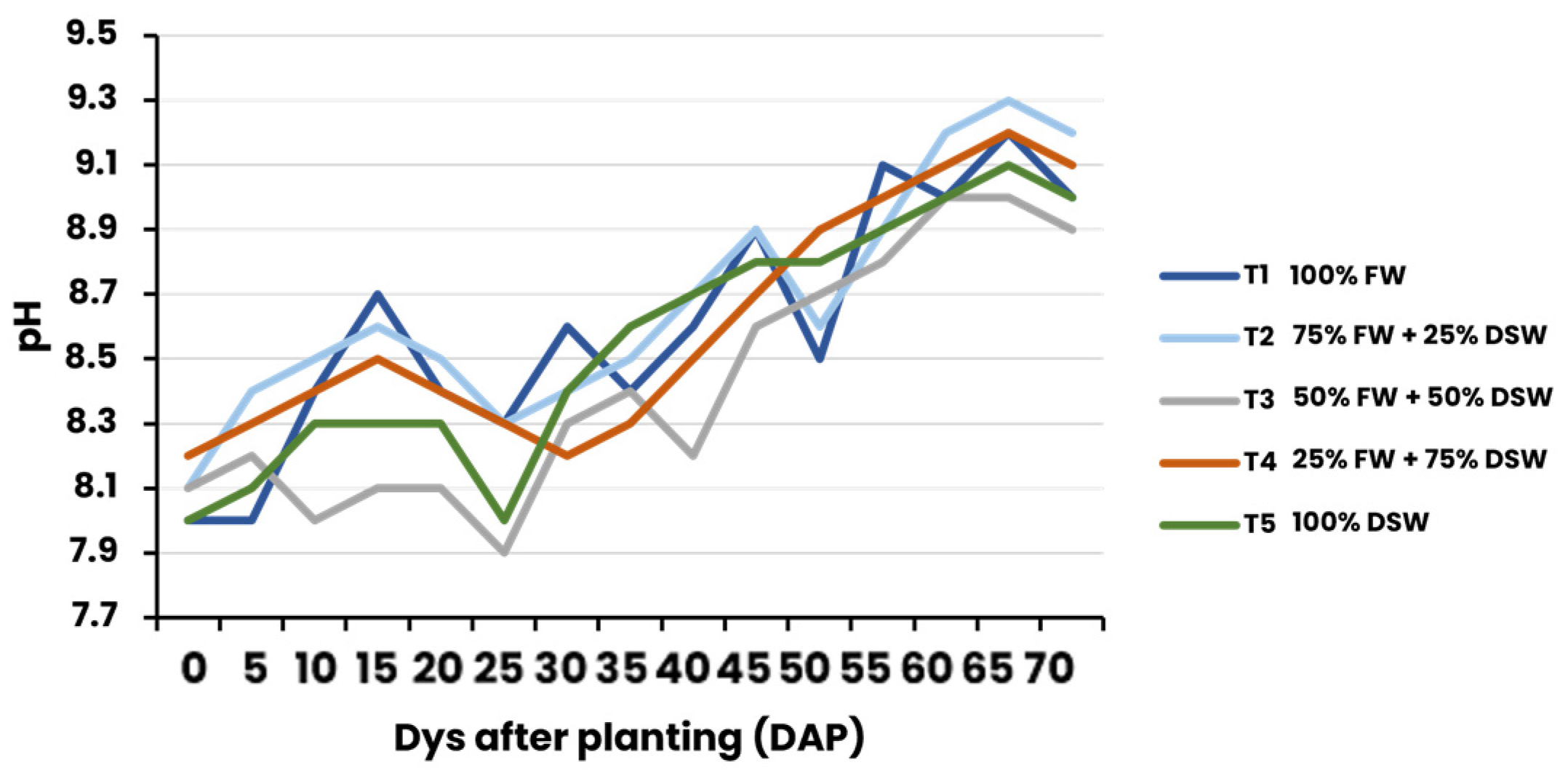
Figure 1. Evolution of pH of drainage water according to the different irrigation treatments.
Ijpb 17 00030 g001
Figure 2. Evolution of electrical conductivity of the saturated paste extract (EC, dS/m) in the different irrigation treatments.
Ijpb 17 00030 g002
Figure 3. Effect of different irrigation blends of well water (FW) and desalinated seawater (DSW) on substrate physicochemical properties: (A) pH of drainage water and (B) electrical conductivity (EC, dS·m−1). T1 (FW100%), T2 (FW75%-DSW25%), T3 (FW50%-DSW50%), T4 (FW25%-DSW75%), and T5 (DSW100%).
Ijpb 17 00030 g003
Figure 4. Distribution of the number of fruits per plant for (A) Radia cultivar and (B) Kayssar cultivar under different blended irrigation regimes (T1–T5). Treatments correspond to increasing proportions of desalinated seawater in the irrigation water. Boxplots represent the median, interquartile range, and variability of the data. Different lowercase letters indicate significant differences among treatments according to Tukey’s HSD test for parametric data and Dunn for non-parametric data (p ≤ 0.05).
Ijpb 17 00030 g004
Figure 5. Effect of blended irrigation regimes of desalinated seawater (DSW) and well water (FW) on Number of fruits per plant (A) zucchini Radia (Cucurbita pepo L.) cultivar and (B) Kayssar (Cucurbita pepo L.) cultivar. Boxplots represent the median, interquartile range, and variability of the data. Different lowercase letters indicate significant differences among treatments according to Tukey’s HSD test for parametric data and Dunn for non-parametric data (p ≤ 0.05). T1 (FW100%), T2 (FW75%-DSW25%), T3 (FW50%-DSW50%), T4 (FW25%-DSW75%), and T5 (DSW 100%). The dot indicates an extreme point (>1.5 times the interquartile range beyond the quartiles), while (**) denote a very extreme point (>3 times the Interquartile range).
Ijpb 17 00030 g005
Figure 6. Effect of different blended irrigation regimes combining desalinated seawater and well water on zucchini (Cucurbita pepo L.) fruit quality for cultivars Radia and Kayssar. (A) Corresponds to number of fruits with A’ caliber (>7 à 14 cm) and fruits with B’ caliber (>21 à 30 cm) in Radia plants. (B) Corresponds to number of fruits with A’ caliber (>7 à 14 cm) and fruits with B’ caliber (>21 à 30 cm) in Kayssar plants. Values represent the mean ± standard deviation (n = 20). Distinct letters above bars indicate statistically significant differences among treatments according to Tukey’s HSD test (p < 0.05). T1 (FW100%), T2 (FW75%-DSW25%), T3 (FW50%-DSW50%), T4 (FW25%-DSW75%), and T5 (DSW 100%).
Ijpb 17 00030 g006
Figure 7. Effect of irrigation water composition on the soluble sugar content (°Brix) of zucchini (Cucurbita pepo L.) cultivars (A) in “Radia” and (B) in “Kayssar”. Data represents the mean ± standard deviation (n = 20). Different letters above bars indicate statistically significant differences among treatments (Tukey’s HSD test, p < 0.05). The dot indicates an extreme point (>1.5 times the interquartile range beyond the quartiles), while (**) denote a very extreme point (>3 times the Interquartile range).
Ijpb 17 00030 g007
Figure 8. Schematic representation of the experimental design based on a randomized complete block design (RCBD), illustrating the five irrigation treatments defined by T1 (FW100%), T2 (FW75%-DSW25%), T3 (FW50%-DSW50%), T4 (FW25%-DSW75%), and T5 (DSW 100%), applied to two zucchini cultivars (Radia and Kayssar).
Ijpb 17 00030 g008
Table 1. Vegetative growth and biomass parameters of two zucchini cultivars (Radia and Kayssar) under five irrigation treatments (T1–T5). NL = number of leaves per plant; PH = plant height (cm); FL = fresh leaf biomass (g); DL = dry leaf biomass (g); FS = fresh stem biomass (g); DS = dry stem biomass (g). T1 (FW100%), T2 (FW75%-DSW25%), T3 (FW50%-DSW50%), T4 (FW25%-DSW75%), and T5 (DSW 100%). Data are represented as means ± standard deviation. Different lowercase letters indicate statistically significant differences among treatments in Radia according to one-way ANOVA and Tukey’s HSD test (p < 0.05) for normal data and according to Kruskal–Wallis followed by Dunn test for non-parametric data. Different uppercase letters indicate statistically significant differences among treatments in Kayssar according to one-way ANOVA and Tukey’s HSD test (p < 0.05) for normal data and according to Kruskal–Wallis followed by Dunn test for non-parametric data.
RadiaKayssar
T1T2T3T4T5T1T2T3T4T5
Vegetative attributesNL28.70 ± 1.30 (c)30.30 ± 3.44 (c)37.10 ± 3.74 (a)31.85 ± 4.65 (bc)35.10 ± 3.29 (ab)26.52 ± 2.14 (CD)30.36 ± 2.03 (C)34.28 ± 1.04 (AB)35.93 ± 3.81 (A)31.81 ± 1.49 (BC)
PH91.16 ± 9.69 (c)92.29 ± 7.85 (c)109.89 ± 10.78 (a)106.08 ± 4.65 (ab)100.03 ± 4.05 (bc)79.14 ± 6.79 (C)88.78 ± 5.15 (B)96.98 ± 5.81 (A)96.72 ± 7.97 (A)99.28 ± 10.33 (A)
BiomassFL238.24 ± 21.98 (c)458.84 ± 40.96 (ab)503.51 ± 23.87 (a)404.67 ± 44.73 (b)461.72 ± 46.49 (ab)124.59 ± 14.65 (C)303.33 ± 25.91 (B)489.31 ± 28.47 (A)319.53 ± 28.78 (B)316.77 ± 23.94 (B)
DL27.88 ± 1.27 (d)40.80 ± 5.01 (bc)58.57 ± 4.52 (a)38.26 ± 2.69 (c)45.46 ± 2.68 (ab)23.85 ± 2.07 (C)32.04 ± 1.86 (BC)48.89 ± 2.29 (A)40.35 ± 3.20 (B)42.00 ± 3.88 (A)
FS466.32 ± 34.80 (d)534.61 ± 29.46 (c)635.11 ± 39.23 (a)587.99 ± 32.82 (b)566.03 ± 44.20 (bc)429.95 ± 24.84 (B)511.59 ± 27.01 (B)543.33 ± 26.21 (A)514.44 ± 52.94 (B)512.58 ± 21.25 (B)
DS46.93 ± 4.26 (c)53.32 ± 3.12 (b)60.30 ± 5.02 (a)55.71 ± 4.65 (b)46.39 ± 3.86 (c)47.61 ± 4.21 (C)55.84 ± 2.74 (B)64.51 ± 5.14 (A)58.51 ± 4.82 (B)48.93 ± 4.48 (C)
Table 2. Physicochemical characteristics of growth medium (soil + vermicompost) prior to the initiation of experimental treatments. Values represent baseline chemical properties expressed on a dry-weight basis (per 100 g growth medium). EC: electrical conductivity; K2O: potassium; P2O5: phosphorus; MgO: magnesium; Ca2+: calcium; Na+: sodium; Cl: chloride; N–NH4+: ammonium nitrogen; N–NO3: nitrate nitrogen. These parameters provide an initial characterization of the growth medium fertility status and its suitability for supporting zucchini (Cucurbita pepo L.) cultivation under controlled greenhouse conditions.
Properties Value
Organic matter(%)3.07
EC(mS cm−1)0.32
pH 8.4
K2Omeq/100 g0.17
Na+meq/100 g0.16
MgOmeq/100 g0.18
Ca2+meq/100 g0.74
P2O5meq/100 g0.02
Clmeq/100 g0.24
N–NH4+meq/100 g0.03
N–NO3meq/100 g0.36
Table 3. Nutrient inputs of nitrogen (N), phosphorus (P2O5), and potassium (K2O) expressed per plant (g.plant−1) and applied to zucchini (Cucurbita pepo L.) at different phenological growth stages.
Phenological StageN (g. plant−1)P2O5 (g. plant−1)K2O (g. plant−1)
Vegetative growth2.253.004.50
Flowering stage2.253.004.50
Fruit development3.003.75
Maturity and harvest3.003.75
Note: Symbol “–” indicates that no application of the corresponding nutrient was provided during that stage.
Table 4. Physico-chemical properties of desalinated water (DSW) and fresh water (FW).
pHEC (dS m−1)
at 25 °C
Ca2+
(meq L−1)
Na+
(meq L−1)
Mg2+
(meq L−1)
K+
(meq L−1)
NH4+
(meq L−1)
DSW7.550.681.443.91<0.310.080.02
FW7.710.813.531.883.930.060.00
Table 5. Irrigation treatments applied, showing the proportions of freshwater (FW) and desalinated seawater (DSW) used to establish different salinity levels for zucchini (Cucurbita pepo L.) cultivation.
Treatment(FW)(DSW)Description
EC0.81 dS m−10.68 dS m−1
T1100%0%Control (freshwater only)
T275%25%Low salinity mixture
T350%50%Moderate salinity mixture
T425%75%High salinity mixture
T50%100%Desalinated seawater only
Table 6. Caliber-based classification of zucchini (Cucurbita pepo L.) fruits according to UNECE (2017) quality standards, showing the size categories and corresponding fruit weight ranges used for market grading.
Caliber CodeSize CategoryFruit Size Range (cm)
A′Small grading7–14
B′Medium grading21–30
Note: Caliber codes (A′, B′,) correspond to distinct commercial grading categories based on individual fruit size.
Disclaimer/Publisher’s Note: The statements, opinions and data contained in all publications are solely those of the individual author(s) and contributor(s) and not of MDPI and/or the editor(s). MDPI and/or the editor(s) disclaim responsibility for any injury to people or property resulting from any ideas, methods, instructions or products referred to in the content.