

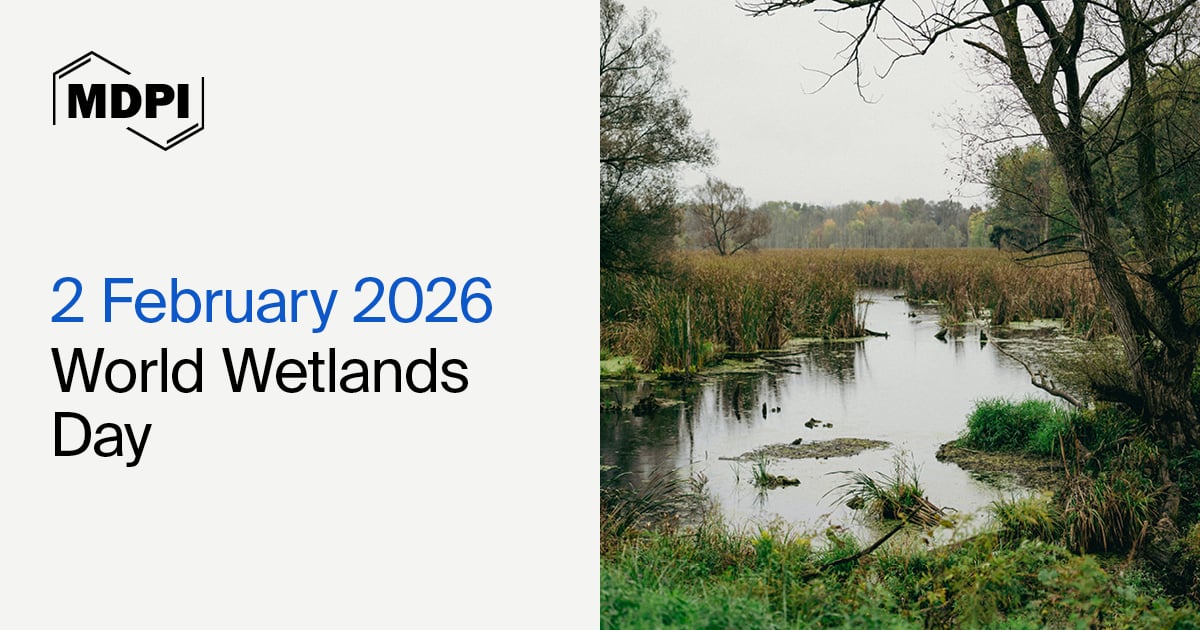
World Wetlands Day—“Wetlands and Traditional Knowledge: Celebrating Cultural Heritage”, 2 February 2026
World Wetlands Day, observed annually on 2 February, highlights the vital role wetlands play in supporting biodiversity, regulating water systems, and sustaining human well-being. As some of the world’s most productive ecosystems, wetlands provide essential services such as flood control, water purification, carbon storage, and habitat for diverse species, yet they remain under increasing threat.
The 2026 theme, “Wetlands and Traditional Knowledge: Celebrating Cultural Heritage,” spotlights the deep-rooted connections between wetland ecosystems and the cultural practices, wisdom, and stewardship of communities around the world. By drawing on traditional knowledge alongside scientific insight, this theme emphasizes how cultural heritage contributes to sustaining and restoring these dynamic landscapes.
MDPI supports this global observance by showcasing research that advances wetland science, conservation, and sustainable management, helping to safeguard these critical ecosystems for future generations.

|
|
|
|
|
|
|
|


“Effects of Pollutants in Urban Wastewater on Rhizoplane Microbial Communities in Constructed Wetlands: Resistance and Resilience of Macrophyte-Associated Microbiomes”
by Paolo Piccolo, Annamaria Gentile, Angela Cicatelli, Francesco Guarino and Stefano Castiglione
Environments 2025, 12(11), 414; https://doi.org/10.3390/environments12110414
“Generation of Nitrous Oxide by Aerobic Denitrifiers Isolated from an Urban Wetland in Bogotá, Colombia”
by Maribeb Castro-González and Verónica Molina
Limnol. Rev. 2025, 25(3), 32; https://doi.org/10.3390/limnolrev25030032
“Stable Water Isotopes Across Marsh, River, and Lake Environments in the Zoige Alpine Wetland on the Tibetan Plateau”
by Yangying Zhan, Chunyi Li, Yu Ning, Guichun Rong, You Zhou, Kexin Liu, Junxuan Li and Haoyang Wang
Water 2025, 17(6), 820; https://doi.org/10.3390/w17060820
“Removal of Heavy Metals and Bulk Organics towards Application in Modified Constructed Wetlands Using Activated Carbon and Zeolites”
by Luca M. Ofiera, Purnendu Bose and Christian Kazner
Water 2024, 16(3), 511; https://doi.org/10.3390/w16030511
“Advancing Knowledge of Wetland Vegetation for Plant Diversity Conservation: The Case of Small Lakes, Ponds, and Pools in Maremma (Southern Tuscany, Central Italy)”
by Lorenzo Lastrucci, Federico Selvi, Enrico Bajona, Andrea Sforzi, Eugenia Siccardi and Daniele Viciani
Land 2025, 14(2), 218; https://doi.org/10.3390/land14020218
“Assessing Climate Change Impacts on Streamflow and Baseflow in the Karnali River Basin, Nepal: A CMIP6 Multi-Model Ensemble Approach Using SWAT and Web-Based Hydrograph Analysis Tool”
by Manoj Lamichhane, Sajal Phuyal, Rajnish Mahato, Anuska Shrestha, Usam Pudasaini, Sudeshma Dikshen Lama, Abin Raj Chapagain, Sushant Mehan and Dhurba Neupane
Sustainability 2024, 16(8), 3262; https://doi.org/10.3390/su16083262

|
“Microplastics Pollution in Aquatic Ecosystems: Challenges and Perspectives, 2nd Edition” |
“Sustainable Water and Nutrients Resources Management: Natural and Constructed Wetlands” |
 |
 |

|
|
|

