Skip to Content
  • Congratulations to Prof. Roger Penrose, Advisory Board member of Universe, for receiving the Nobel Prize in Physics 2020.

Universe

Universe is a peer-reviewed, open access journal focused on theoretical, experimental, and observational progress in fundamental and applied physics, from circumterrestrial space to cosmological scenarios, and is published monthly online by MDPI.

Get Alerted

Add your email address to receive forthcoming issues of this journal.

All Articles (3,632)

  • Article
  • Open Access

Direct Detection of White Dwarfs from DESI Legacy Imaging Surveys Images

  • Zhichao Li,
  • Jiangchuan Zhang and
  • Jingkun Zhao
  • + 4 authors

White dwarfs (WDs) represent the final evolutionary stage of low- to intermediate-mass stars. They are among the most abundant compact objects in the Milky Way. Large-scale WD surveys are therefore essential for probing stellar evolution and galactic structure. In recent years, large-scale digital sky surveys, such as the Sloan Digital Sky Survey and the Dark Energy Spectroscopic Instrument (DESI) Legacy Imaging Surveys, have amassed vast archives of photometric images. These datasets provide a rich resource for WD searches. We employ the WD Network to detect and localize WDs directly within 640 × 640 pixels photometric images. The framework enables fully automated identification of WD candidates from photometric images. On the test set, this model achieves a precision of 96.6%, a recall of 94.5%, and an F1 score of 95.5%. Images in the actual search are more diverse, and their distribution may differ from the test set, and these metrics may not directly reflect the model’s performance in the actual search. Using 125,872 photometric images from DESI Legacy Surveys Data Release 9, we detected 18,242 WD candidates. Cross-matching these candidates with DESI Data Release 1 spectra yielded 719 candidate spectra. We then performed manual visual inspections and confirmed 75 new WDs and 7 new CVs, which highlights substantial contamination among the remaining candidates with available spectra. We publicly released this WD candidates catalog online. These results expand the current census of known WDs and provide both a valuable data resource and a practical technical reference for future large-scale astronomical image processing.

Universe

30 September 2026

Data augmentation via random cropping. Left: The original 
  
    2300
    ×
    2300
  
 pixels survey image. Top right: A randomly cropped 
  
    640
    ×
    640
  
 pixels subimage extracted from the original frame. Bottom right: The 
  
    30
    ×
    30
  
 pixels annotation map generated using LabelImg, where a central cross marks the position of the WD. By constraining the maximum offset of the crop center to 305 pixels, the target remains fully visible after augmentation. This approach simulates the random spatial distribution of targets in real survey data, while mitigating overfitting and eliminating non-physical positional prior bias.
  • Article
  • Open Access

A complete classification is conducted of the exact solutions of Maxwell vacuum equations for invariant electromagnetic fields in null homogeneous Petrov spaces with non-solvable groups of motions G3, acting simply transitively on null hypersurfaces of null homogeneous Petrov spaces. The classification of exact solutions to Maxwell vacuum equations is based on using the representation of components of the contravariant metric tensor and components of the invariant electromagnetic field in terms of the vector fields of a canonical frame. The classification results are presented in a form convenient for further use.

Universe

30 September 2026

  • Article
  • Open Access

We present a plane-of-sky observational analysis of a solar eruptive event that occurred on 2 September 2023. The flare peaked at approximately 07:00 UT, closely aligning with the impulsive acceleration phase of the erupting flux rope, which accelerated from an initial speed of 42 km s−1 to 501 km s−1. The associated coronal mass ejection (CME) propagated through interplanetary space at a near-constant speed of 519 km s−1, suggesting that its kinetic energy was primarily acquired within the lower solar atmosphere. Comparison of the projected propagation directions of the erupting flux rope and the CME reveals an apparent angular offset of approximately 10°, which is interpreted through Potential Field Source Surface (PFSS) modeling as the result of asymmetric magnetic pressure gradients. Notably, the overlying coronal loops exhibited a piecewise acceleration, with the velocity increasing from approximately 7 km s−1 to 320 km s−1. Furthermore, the passage of the eruption-induced disturbance triggered large-amplitude, damped vertical oscillations in an adjacent prominence. Applying magnetohydrodynamic (MHD) prominence seismology based on Hyder’s model, we derive a local radial magnetic field strength of 1.77–7.02 G. These results provide a detailed view of the evolution from magnetic energy release to large-scale coronal disturbances and the subsequent prominence oscillation.

Universe

28 September 2026

  • Article
  • Open Access

Several minimal-length constructions deform the spacetime metric conformally at leading order, . We ask which observables can register such a deformation. The two structural results rest on standard properties of conformal rescalings; what is worked out here is their consequence for this class of metrics, carried to closed form on a black-hole background. For an arbitrary conformal factor the unparametrized null geodesics are unchanged, so the critical impact parameter, the shadow angular radius seen from infinity, the deflection angles and the Shapiro delay keep their undeformed values at all orders, and the photon sphere keeps its coordinate location although its areal radius changes. A minimally coupled massless test scalar on g˜ obeys, exactly, a wave equation on g with the single potential , into which the Weyl invariant does not enter; a conformally coupled massless scalar does not see the deformation at all. For a Reissner–Nordström background and the power-law family η=ε0(M/r)p, with p as a model input rather than a prediction, we obtain the leading large-l scalar quasinormal shift , suppressed as l−2, and closed forms for the ISCO radius, the disk radiative efficiency and the orbital frequency. Within this family the channels fall silent at the distinct exponents p=3, 2 and 5/2. All results are checked by computer algebra.

Universe

27 September 2026

Highly Accessed Articles

News & Conferences

Latest Issues

Open for Submission

Journal Sections

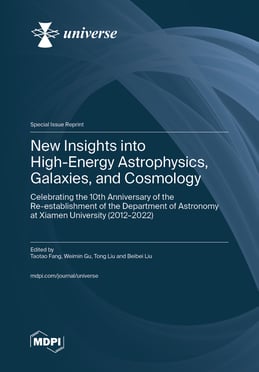
New Insights into High-Energy Astrophysics, Galaxies, and Cosmology
Reprint

New Insights into High-Energy Astrophysics, Galaxies, and Cosmology

Celebrating the 10th Anniversary of the Re-establishment of the Department of Astronomy at Xiamen University (2012–2022)
Editors: Taotao Fang, Weimin Gu, Tong Liu, Beibei Liu
XFacebookLinkedIn
Universe - ISSN 2218-1997