


- 3.1Impact Factor
- 4.1CiteScore
- 21 daysTime to First Decision
Smart and Sustainable Tourism Systems: Innovation, Management, and Future Challenges
This special issue belongs to the section “Systems Practice in Social Science“.
Special Issue Information
Dear Colleagues,
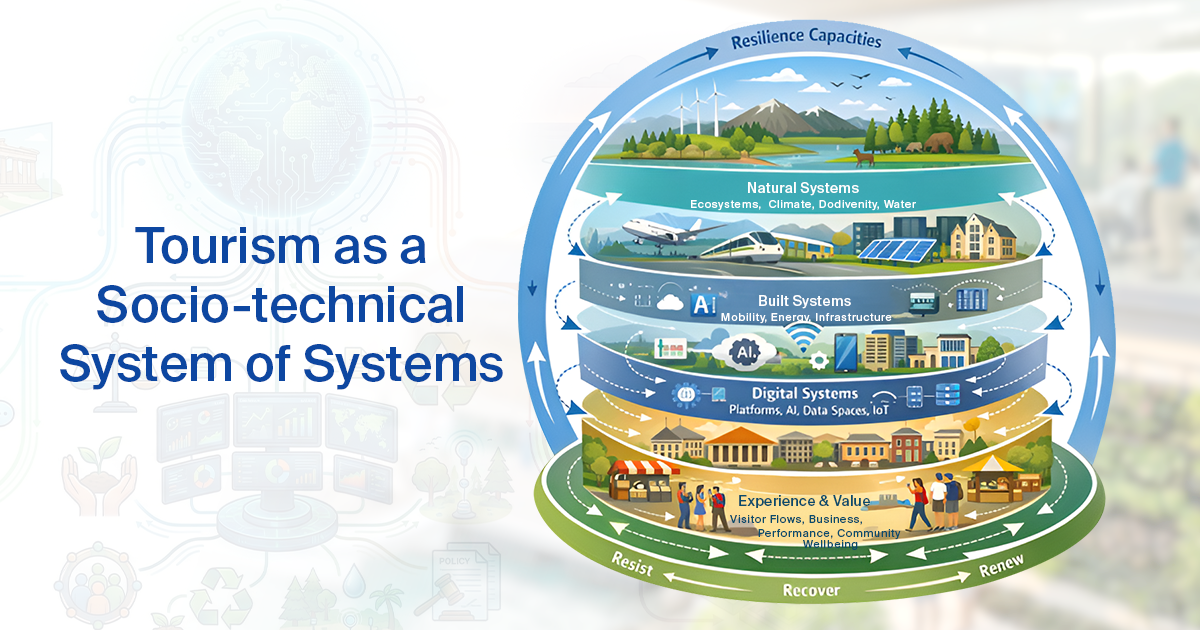
Tourism is at a systemic inflection point. Climate volatility, biodiversity loss, infrastructure constraints, and social legitimacy pressures are converging with rapid digitalization and platformization, reconfiguring tourism into a tightly coupled socio-technical system of systems spanning destinations, hospitality firms, mobility networks, data infrastructures, and governance regimes (MDPI MDPI Systems Aims & Scope, 2025; Dahmann, 2014). These dynamics produce non-linear risk propagation and institutional lock-ins, suggesting that effective interventions must move beyond “shallow” parameter changes and target deeper leverage points (e.g., rules, information flows, self-organization, intent)
While “smart tourism” has advanced through ICT-enabled innovation, foundational research emphasizes that smartness is not merely technological; it emerges from the co-evolution of ICT with leadership, human/social capital, and ecosystem governance. Meanwhile, platform-mediated coordination introduces public-value tensions around privacy, accountability, and control that reshape tourism market structures and destination governance). In parallel, regenerative tourism scholarship argues for a paradigm shift—from impact mitigation toward systems change through boundary spanning, learning, and social–ecological renewal (resilience research further supports multi-capacity pathways: resistance–recovery–adaptation–renewal) and the need for robust assessment frameworks that track system performance over time
This Special Issue invites interdisciplinary contributions that apply systems theory, systems engineering, and complexity-informed methods (e.g., system dynamics, agent-based modelling, network analysis, digital twins) to conceptualize, model, and govern smart, sustainable, and regenerative tourism systems. We particularly welcome work on AI as a systemic catalyst—shaping decision intelligence, efficiency, and service architectures—while interrogating governance, trust, and ethics (we also welcome contributions on emerging tourism data governance models and data spaces ).
In this Special Issue, original research articles and reviews are welcome. Research areas may include the following:
- Predicting consumer behavior from the perspectives of new technology-based hospitality and tourism systems;
- Exploring innovative solutions to achieve sustainable hospitality and tourism systems;
- Risk identification regarding digital transformation in the hospitality and tourism sector;
- Applications of emerging technologies in hospitality and tourism development;
- Development and optimization of innovative tourism and hospitality systems;
- Commercialization of cutting-edge technology-based restaurant systems;
- Technology acceptance behavior in the hospitality and tourism context.
We look forward to receiving your contributions.
Reference:
Tourism as socio-technical system-of-systems: architectures, interdependencies, interoperability, cascading failures (Dahmann, 2014).
Prof. Dr. Michail Toanoglou
Dr. Leonard Jackson
Dr. Thomas Krabokoukis
Guest Editors
Manuscript Submission Information
Manuscripts should be submitted online at www.mdpi.com by registering and logging in to this website. Once you are registered, click here to go to the submission form. Manuscripts can be submitted until the deadline. All submissions that pass pre-check are peer-reviewed. Accepted papers will be published continuously in the journal (as soon as accepted) and will be listed together on the special issue website. Research articles, review articles as well as short communications are invited. For planned papers, a title and short abstract (about 250 words) can be sent to the Editorial Office for assessment.
Submitted manuscripts should not have been published previously, nor be under consideration for publication elsewhere (except conference proceedings papers). All manuscripts are thoroughly refereed through a single-blind peer-review process. A guide for authors and other relevant information for submission of manuscripts is available on the Instructions for Authors page. Systems is an international peer-reviewed open access monthly journal published by MDPI.
Please visit the Instructions for Authors page before submitting a manuscript. The Article Processing Charge (APC) for publication in this open access journal is 2400 CHF (Swiss Francs). Submitted papers should be well formatted and use good English. Authors may use MDPI's English editing service prior to publication or during author revisions.
Keywords
- smart tourism
- sustainable tourism
- regenerative tourism
- tourism resilience
- AI governance
- digital transformation
- artificial intelligence (AI)
- internet of things (IoT)
- big data analytics
- blockchain
- smart destinations
- tourism management
- hospitality innovation
- green transition
- smart governance
- consumer behavior
- cybersecurity and data privacy
- climate resilience
- destination marketing
- tourism ecosystems
Benefits of Publishing in a Special Issue
- Ease of navigation: Grouping papers by topic helps scholars navigate broad scope journals more efficiently.
- Greater discoverability: Special Issues support the reach and impact of scientific research. Articles in Special Issues are more discoverable and cited more frequently.
- Expansion of research network: Special Issues facilitate connections among authors, fostering scientific collaborations.
- External promotion: Articles in Special Issues are often promoted through the journal's social media, increasing their visibility.
- Reprint: MDPI Books provides the opportunity to republish successful Special Issues in book format, both online and in print.
Published Papers


Systems - ISSN 2079-8954