



You are currently on the new version of our website. Access the old version .

Sustainability

Sustainability is an international, peer-reviewed, open-access journal on environmental, cultural, economic, and social sustainability of human beings, published semimonthly online by MDPI.
The Canadian Urban Transit Research & Innovation Consortium (CUTRIC), International Council for Research and Innovation in Building and Construction (CIB) and Urban Land Institute (ULI) are affiliated with Sustainability and their members receive discounts on the article processing charges.
Quartile Ranking JCR - Q2 (Environmental Studies | Environmental Sciences)

All Articles (100,528)

This study investigates the different mechanisms through which environmental disclosure and green accounting practices influence investment attractiveness in an emerging market context. Drawing on legitimacy theory and the resource-based view, we examine whether these environmental accountability mechanisms create value directly or through enhanced sustainability performance. Using survey data from 290 non-financial firms listed on the Saudi Stock Exchange, we employ partial least squares structural equation modeling to test a mediated-moderation model within the Saudi Vision 2030 framework. The results reveal differentiated value-creation pathways: environmental disclosure affects investment attractiveness indirectly through sustainable economic outcomes (full mediation; indirect effect β = 0.121, p < 0.001), while green accounting demonstrates both direct (β = 0.237, p < 0.001) and indirect effects (β = 0.091, p < 0.01), indicating partial mediation. Both practices are positively associated with sustainable economic outcomes (β_ED = 0.290, β_GA = 0.219, p < 0.001), which in turn are positively related to investment attractiveness (β = 0.416, p < 0.001). Unexpectedly, Vision 2030 alignment shows no significant moderating effect (β = 0.042, p = 0.498), suggesting that the sustainability–investment relationship is not significantly conditioned by perceived alignment with the national strategic framework in this sample. The model explains 25.7% of the variance in investment attractiveness and 20.0% of that in sustainable economic outcomes, indicating moderate explanatory power. These findings contribute to the environmental accounting literature by suggesting that internal management-oriented practices may be more closely associated with investment attractiveness than disclosure transparency alone. Overall, the results indicate that green accounting systems are associated with investment attractiveness, while environmental disclosure appears to require observable sustainability performance to be reflected in investment perceptions, offering measured implications for corporate strategy and regulatory policy in sustainability transitions.

18 January 2026
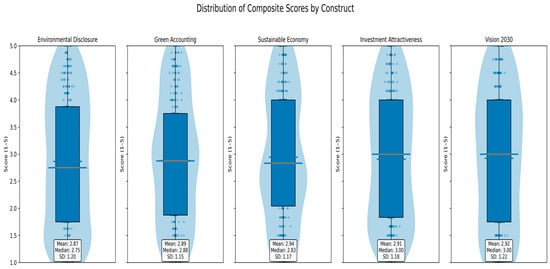
Distribution of Composite Scores Across Study Constructs.

Simultaneous optimization of vehicle routing and cargo loading is essential for reducing operational costs and improving the environmental performance of logistics systems. To overcome the limitations of traditional sequential approaches to the one-to-many pickup and delivery vehicle routing problem with three-dimensional loading constraints (3L-PDVRP), this paper proposes a deeply coupled hybrid genetic algorithm (HGA). The algorithm adopts a grouping-based genetic encoding strategy to accommodate variable fleet sizes and incorporates a tree-search-based loading module. A dynamic three-dimensional loading feasibility verification mechanism is embedded directly into the evolutionary search so that routing decisions are continuously guided by fragility, stacking stability, support constraints, and other loading constraints. In addition, an adaptive hybrid insertion strategy is employed to balance global exploration and local exploitation during route construction and repair. Extensive computational experiments on extended benchmark instances derived from standard datasets show that the proposed method consistently outperforms a large neighborhood search (LNS)-based baseline from the literature, reducing the average total travel distance by 10.60% and increasing the average vehicle loading rate by 2.76%. These results indicate that the proposed HGA provides an effective approach to the synergistic optimization of routing and loading in one-to-many distribution settings, offering practical value for lowering transportation costs and supporting more sustainable logistics operations. This methodology provides decision support for logistics enterprises, reducing travel distances while ensuring three-dimensional loading feasibility, thereby enabling greener and safer transportation operations.

18 January 2026

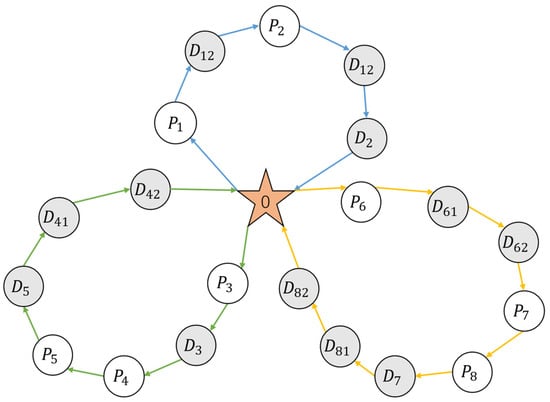
Vehicle Distribution Network Structure Diagram. The star icon represents the central depot. Circles labeled with 
  
    P
  
 indicate pickup nodes, while circles labeled with 
  
    D
  
 indicate delivery nodes. Directed arrows represent the travel routes of different vehicles, with different colors corresponding to distinct vehicle routes.

The Jiangsu Yangtze River city cluster is a key growth pole of the Yangtze River Economic Belt, yet substantial disparities in development levels persist across cities, and the role of rail transit investment in fostering regional economic coordination remains insufficiently understood. This study aims to reveal the dynamic mechanisms through which railway transportation investment influences regional economic growth via population migration and service industry agglomeration, and to quantify the economic multiplier effects under different investment scenarios. Considering the close economic linkages among cities, spatial autocorrelation analysis is applied to assess intercity economic dependence, which provides the basis for developing a system dynamics model that links the rail transit system with the regional economy. Using data from eight core cities over the period 2014–2023, the model is employed to simulate long-term economic responses under different investment scenarios. The results indicate that increasing the rail transit investment ratio from 0.0077 to 0.02 is associated with an estimated 13.2% increase in regional GDP by 2030, with a corresponding economic multiplier of approximately 1.8, while simulation errors remain within 4.1–16.2% compared with historical data. The findings suggest that rail transit investment promotes regional growth through improved accessibility, factor agglomeration, and industrial upgrading, and that coordinated planning at the urban agglomeration scale is more effective than isolated city-level strategies. By integrating spatial dependence analysis with system dynamics modeling, this study offers a dynamic perspective on the regional economic impacts of rail transit investment.

18 January 2026

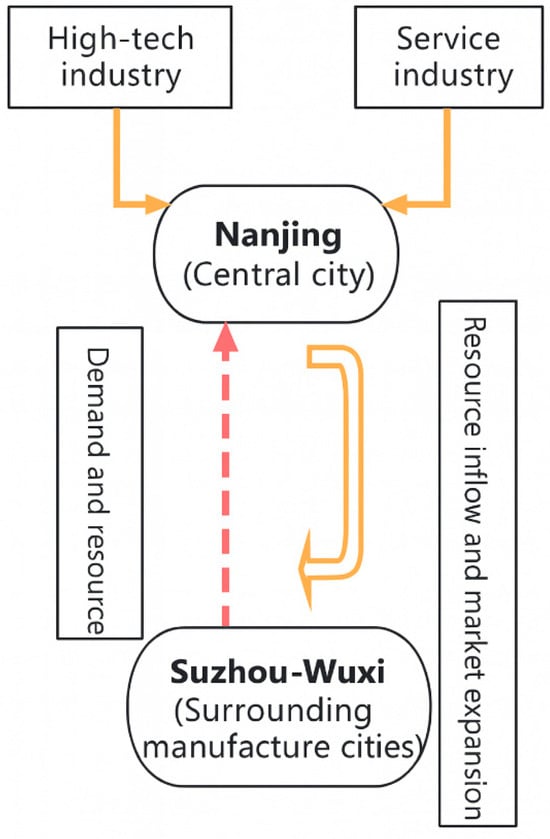
The Urban-Rural Relationship and Industrial Characteristics Along the Yangtze River Belt.

News & Conferences

Issues

Open for Submission

Editor's Choice

Reprints of Collections

Application of Remote Sensing and GIS for Promoting Sustainable Geoenvironment
Reprint

Application of Remote Sensing and GIS for Promoting Sustainable Geoenvironment

Editors: Hariklia D. Skilodimou, George D. Bathrellos, Konstantinos G. Nikolakopoulos
Climate Change Impacts and Adaptation
Reprint

Climate Change Impacts and Adaptation

Interdisciplinary Perspectives—Volume II
Editors: Cheng Li, Fei Zhang, Mou Leong Tan, Kwok Pan Chun

Get Alerted

Add your email address to receive forthcoming issues of this journal.

XFacebookLinkedIn
Sustainability - ISSN 2071-1050