

Journal Menu
► ▼ Journal Menu-
- Sustainability Home
- Aims & Scope
- Editorial Board
- Reviewer Board
- Topical Advisory Panel
- Early Career Editorial Board
- Instructions for Authors
- Special Issues
- Topics
- Sections & Collections
- Article Processing Charge
- Indexing & Archiving
- Editor’s Choice Articles
- Most Cited & Viewed
- Journal Statistics
- Journal History
- Journal Awards
- Society Collaborations
- Conferences
- Editorial Office
Journal Browser
► ▼ Journal BrowserNeed Help?
Announcements
15 April 2021
MDPI Celebrates Company Milestone With 25th Anniversary Page
"We exist to help scientists achieve their own objectives"

In June of this year, MDPI will celebrate the 25th anniversary of its foundation. To mark this significant milestone, we have created a 25th Anniversary page on our website that evokes the development of our company over the past quarter-century.
MDPI has been a pioneer of Open Access publishing ever since the concept was first created.
In a wide-ranging interview, our CEO Delia Mihaila reflects on the company’s 25th anniversary and its contribution to the world of scientific publishing.
Delia considers how MDPI has evolved since starting life in 1996 as a visionary ‘project’ run out of an apartment in Basel, Switzerland, by Dr. Shu-Kun Lin. A chemist who was passionate about the long-term preservation of rare chemical sample, Dr. Lin was determined to help scholars publish their findings as quickly as possible and make their research results available to as wide a readership as possible worldwide. That determination remains unchanged 25 years later.
Today, MDPI is an international organization with over 4,000 employees based on three continents and in ten countries, and ranks among the world's top four academic publishers.
MDPI's mission is to accelerate access to new scientific research, delivering insight faster for researchers worldwide. Read more here about the company's remarkable success story and what the Open Access publishing model can offer the global scientific community.
8 April 2021
Recruiting Editoral Board Members for Future Transportation
Future Transportation (ISSN 2673-7590) is an international, peer-reviewed, open access journal, which publishes emerging technologies and potential applications in all areas of transportation and other disciplines such as civil engineering, economics, environment and geography, and computer science.
Future Transportation is recruiting new Editorial Board members with expertise in research and findings concerning transportation studies and related topics.
Editorial Board members should be active researchers in transportation or a related field and be passionate about participating in scientific communication and publishing activities. The applicants should have experience in the peer-review process of open-access scientific journals. Scholars who have the experience to lead national research projects, organize academic congresses, or achieved significant achievements will have priority in the evaluation.
The responsibilities of Editorial Board members will include, but are not limited to the following:
- Making decisions regarding whether a manuscript can be accepted or not, based on the reports we collect;
- Serving as the Editor for a Special Issue on a topic related to their research interests when it is convenient or introducing candidates;
- Promoting Future Transportation and increasing its visibility at related academic conferences;
- Advising on the journal’s development.
The internal MDPI Editors will serve as Assistant Editors to provide support when required.
As an Editorial Board member, you will have the unique opportunity for networking and communication with scholars in the Future Transportation community, to build a long-term relationship and mark you as influential within your discipline. You will be able to receive the Editor Certificate for this authorized identity. In addition, you will be able to publish one free paper per year after peer review.
The term of this position is two years. The benefits will be evaluated annually based on your yearly editorial work performance and contribution to the journal Editorial Office.
If you are interested with this position, please send your application with self-introduction and academic resume to the journal Editorial Office (futuretransp@mdpi.com).
The journal Editorial Office looks forward to working with you.
Future Transportation Editorial Office
16 March 2021
Recruiting Editors for Sustainable Chemistry
Sustainable Chemistry (ISSN 2673-4079) is an international, peer-reviewed, open-access journal published quarterly by MDPI, which provides an advanced forum for studies that present significant advances in the development of alternative green and sustainable technologies in chemical engineering.
Sustainable Chemistry is recruiting new Editorial Board members with expertise in green and sustainable chemistry.
Editorial Board members should be active researchers in sustainable chemistry or a related field and be passionate about participating in scientific communication and publishing activities. The applicants should have experience in the peer-review process of open-access scientific journals. Scholars who have experience to lead national research projects, organize academic congresses, or achieved significant achievements will have priority in the evaluation.
The responsibilities of Editorial Board members will include but are not limited to making decisions regarding whether a manuscript can be accepted or not, based on the reports we collect; serving as the Editor for a Special Issue on a topic related to their research interests when it is convenient or introducing candidates; promoting Sustainable Chemistry and increasing its visibility at related academic conferences; and advising on the journal’s development. The internal MDPI Editors will serve as Assistant Editors to provide support when required.
As an Editorial Board member, you will have the unique opportunity for networking and communication with scholars in the Sustainable Chemistry community, to build a long-term relationship and mark you as influential within your discipline. You will be able to receive the Editor Certificate for this authorized identity. In addition, you will be able to publish one free paper per year after peer review.
The term of this position is two years. The benefits will be evaluated annually based on yearly editorial work performance and contribution by the journal Editorial Office.
If you are interested with this position, please send your application with self-introduction and academic resume to the journal Editorial Office (suschem@mdpi.com).
The journal Editorial Office looks forward to working with you.
Sustainable Chemistry Editorial Office
10 March 2021
Journal Selector: Helping to Find the Right MDPI Journal for Your Article

At MDPI, we strive to make your online publication process seamless and efficient. To achieve this, our team is continuously developing tools and features to make the user experience useful and convenient.
As the number of academic papers continues to grow, so does the need to analyze and work with them on a large scale. This prompted us to design a new feature aimed at helping researchers find journals that are relevant to their publication by matching their abstract topic. In this regard, we designed a similarity model that automatically identifies the most suitable academic journals for your paper.
We are pleased to introduce Journal Selector, a new feature that measures similarity in academic contexts. By simply entering the title and/or abstract into our Journal Selector, the author will see a list of the most related scientific journals published by MDPI. This method helps authors select the correct journals for their papers, highlighting the time of publication and citability.
The methodology is known as representation learning, where words are represented as vectors in hyperspace. Representation helps us differentiate between different concepts within articles, and in turn, helps us identify similarities between them.
We used an advanced machine learning model to better capture the semantic meanings of words. This helps the algorithm make better predictions by leveraging scientific text representation. In turn, this ensures high precision, helping authors decide which journal they should submit their paper to.
The goal is to support authors to publish their work in the most suitable journal for their research, as fast as possible, accelerating their career progress.
Contact: Andrea Perlato, Head of Data Analytics, MDPI (email)
8 March 2021
Women in Sustainability
Under the travel restrictions imposed by the ongoing pandemic, academic exchanges have become increasingly strained. Yet, our endeavors for advancing scholarly publishing and communication never stop. To celebrate this year’s International Women’s Day, we are dedicated to furthering cutting-edge research on human inclusion and equality, and acknowledging the achievements of women in advancing Sustainability.
Sustainability runs Special Issues to create collections of papers to promote the diversity of scholarly communication among our readers, editors and authors. Special Issues are led by Guest Editors who are experts in the subject and oversee the editorial process for papers. Papers published in a Special Issue are collected together on a dedicated page of the journal website. For any inquiries, please contact the Editorial Office and we hope that this will spark new ideas for further collaborations and discussions.
On this International Women’s Day, we present the latest research below on, and by, women in Sustainability:
Gender Issues in Transport and Mobility
edited by Pierluigi Coppola and Ines. Kawgan-Kagan
Submission deadline 28 May 2021
Keywords: gender-specific needs; women in transport; gender analysis methods; transport equity assessment; social inclusion and fairness in transport
Social Sustainability in Business from a Gender Perspective
edited by Mónica Segovia Pérez and Eva Cifre
submission deadline 31 May 2021
Keywords: social sustainability; gender; gender equality; decent work; working conditions; health and well-being; corporate sustainability; women’s pro-environmental attitudes and values; research; COVID-19
Women for Sustainable Energy
edited by Valeria Palomba, Luisa F. Cabeza, Anna Laura Pisello and Cristina Prieto
submission deadline 31 July 2021
Keywords: energy; energy efficiency; sustainable future; smart city; renewable energy sources; LCA; energy policy
Inclusive Water, Sanitation, Hygiene and Health (WASH2): Towards a Sustainable and Healthy Society
edited by Sayed Mohammad Nazim Uddin and Chad Staddon
submission deadline 31 August 2021
Keywords: Global Water, Sanitation, Hygiene and Health (WASH2); Social exclusion; Marginalization; Global South and North; Inequalities and insecurity; Global health or international health or one health research; Risks, hazards and vulnerabilities; Homelessness; Poverty and power; Service delivery; WASH2 and women; Indigenous/First Nations/Aboriginal people; WASH2 system approach; Community-based research; Epidemiology; Health policy; Environmental health; Urban political ecology; Humanitarian WASH2
Sustainability and Resilience to Climate Change Hazards and Gender Equality
edited by Anastasia Zabaniotou, Paola Rizzi, Khaled A. Al-Sahili, Vasiliki Skoulou and Maria Cristina Marolda
submission deadline 30 Mar 2021
Keywords: Gender Equality; Climate Change; Resilience, Hazards; Vulnerability; Policies; Education; Research
Moving toward Sustainability: Rethinking Gender Structures in Education and Occupation Systems
edited by Sandra L. Hanson and Enrique S. Pumar
submission deadline 1 Apr 2021
Keywords: sustainability; gender; education; occupations; structures; inequality
Gender in Sustainable Innovation
edited by Ana Beatriz Hernández Lara and Amado Alarcón Alarcón
submission deadline 31 May 2021
Keywords: Gender and strategic management; Gender and corporate governance; Gender in sustainable innovation; Gender in sustainable entrepreneurship; Gender as a dimension of quality and impact of research; Role of gender in sustainable development goals
Social Sustainability in Business from a Gender Perspective
edited by Mónica Segovia Pérez and Eva Cifre
submission deadline 31 May 2021
Keywords: social sustainability; gender; gender equality; decent work; working conditions; health and well-being; corporate sustainability; women’s pro-environmental attitudes and values; research; COVID-19
To access the full list of Special Issues, please click here.
Sustainability Editorial Office
sustainability@mdpi.com


18 February 2021
Sustainability | 2020 Review
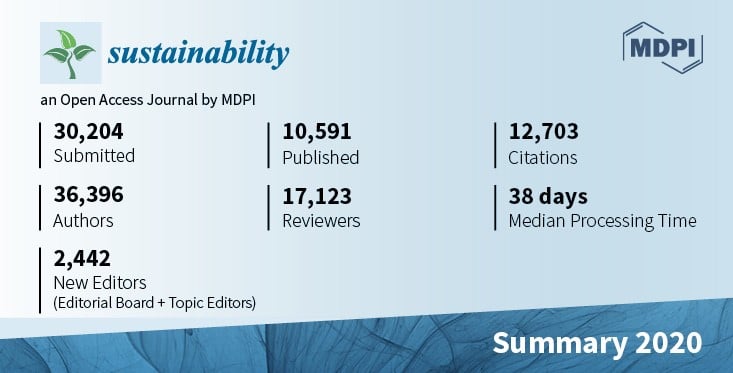
The year 2020 was a year of growth for Sustainability. The journal received 30,204 submissions and published 10,591 articles from 36,396 international authors. The total number of reviewers invited and involved in the peer-review process of the journal reached 17,123, with an additional 2,442 academic editors (including 592 Editorial Board Members and 1850 Topic Editors) joining our journal’s Board during this year. Sustainability articles were cited 12,703 times in 2020 and the impact factor (IF) is 2.576. Thanks to the commitment and dedication of the Editorial staff, the median time between submission and publication further decreased to 38 days.
The journal established the following 8 topical Sections: Hazards and Sustainability; Sustainability, Biodiversity and Conservation; Climate Change; Sustainable Materials; Health and Sustainability; Sustainable Food; Resources and Sustainable Utilization; and Sustainable Management. Additionally, in 2020 Sustainability became a journal affiliated with the International Council for Research and Innovation in Building and Construction (CIB).
High Altmetrics Papers
Adapting to Climate Change: The Interplay between International and Domestic Institutions in the Context of Climate Finance
Adaptation, Official Development Assistance, and Institution Building: The Case of the Caribbean Community Climate Change Centre
Jonathan Rosenberg
Sustainable Urban and Rural Development
Smart City Governance in Developing Countries: A Systematic Literature Review
Si Ying Tan et al.
Sustainable Urban and Rural Development
Urban Digital Twins for Smart Cities and Citizens: The Case Study of Herrenberg, Germany
Fabian Dembski et al.
Sustainable Education and Approaches
Analysis on the Higher Education Sustainability in China Based on the Comparison between Universities in China and America
Yong-Ming He et al.
Environmental Sustainability and Applications
Environmental Impacts of a Pet Dog: An LCA Case Study
Kim Maya Yavor et al.
Collections/Special Issues
Sustainability runs Special Issues to create collections of articles on specific topics with the aim of building a community of authors and readers to discuss the latest research and develop new ideas and research directions. Special Issues are led by Guest Editors who are experts in the subject, who oversee the editorial process for papers. Papers published in a Special Issue will be collected together on a dedicated page of the journal website. High-quality Collections/Special Issues will be printed as books. The book can be made available on Amazon, eBookMall, Apple books, etc.
Hot Special Issues
Sustainable Urban Planning Techniques
Sustainable Energy Economics and Policy
Sustainable Natural Resource Management
Smart Cities, City Dashboards, Planning and Evaluation of Urban Performances
Business, Management, Entrepreneurship and Innovation for Sustainable Development
Open Calls
Climate Change and Circular Bioeconomy: Old Challenges and New Opportunities for Environmental Biotechnology
edited by Silvio Matassa and Willy Verstraete
submission deadline 30 July 2021
Sustainable Innovations and Governance in the Agri-Food Industry
edited by Concetta Nazzaro, Marco Lerro and Marcello Stanco
submission deadline 24 September 2021
Feature Paper on Sustainability Wastewater Management
edited by Dariusz Młyński and Piotr Bugajski
submission deadline 30 November 2021
Read full list of call for papers at https://www.mdpi.com/journal/sustainability/special_issues.
On behalf of the editorial team, we would like to express our gratitude to the Editor-in-Chief of Sustainability, all Section Editors-in-Chief and Editorial Board Members, as well as to the Guest Editors of Special Issues, Topic Board Members, and Reviewer Board Members, all of whom have ensured the continued success of the journal through their hard work and diligence!
In 2021, Sustainability will continue to contribute to academic exchange and sharing of knowledge.
15 December 2020
MDPI adopts C4DISC principles to improve diversity and inclusion in scholarly communications
MDPI is proud to adopt the principles of the Coalition for Diversity & Inclusion in Scholarly Communications (C4DISC) to support building equity, inclusion, diversity, and accessibility in scholarly communications.
The C4DISC represents organizations and individuals working in scholarly communications and is focused on addressing issues of diversity and inclusion within the publishing industry.

MDPI’s Managing Editors encourage the Editors-in-Chief and Associate Editors to appoint diverse expert Editorial Boards. This is also reflective in our multi-national and inclusive workplace. We are proud to create equal opportunities without regard to gender, ethnicity, geographic location, sexual orientation, age, disability, political beliefs, religion, or socio-economic status. There is no place for discrimination in our workplace and editors of MDPI journals are to uphold these principles in high regard.
Representatives from C4DISC meet monthly, and have started to implement initiatives to shed light and improve on the lack of diversity in scholarly communications. Some of the initiatives include developing a joint statement of principles; conducting market research; providing training resources, best practices, toolkits, and documentation for our collective memberships; and establishing outreach programs, curricula, events, and publications.
The Coalition is committed to:
- eliminating barriers to participation, extending equitable opportunities across all stakeholders, and ensuring that our practices and policies promote equitable treatment and do not allow, condone, or result in discrimination;
- creating and maintaining an environment that respects diverse traditions, heritages, and experiences;
- promoting diversity in all staff, volunteers, and audiences, including full participation in programs, policy formulation, and decision-making;
- raising awareness about career opportunities in our industries to groups who are currently underrepresented in the workforce;
- supporting our members in achieving diversity and inclusion within their organizations.
14 December 2020
Article Layout and Templates Revised for Future Volumes
At MDPI we have slightly revised the layout for articles to be published in the 2021 Volume, starting at the end of December 2020. As of today, the article templates available for download on ‘Instructions for Authors’ pages have been updated.
The most noticeable change can be found on the first page of the article, where a left-hand column has been created to include the following front matter elements: (i) the recommended citation style for the article, (ii) the publishing history, (iii) as well as the Creative Commons Attribution license used (iv) a standard note regarding affiliations. At the same time, the extra spacing on the left means the authors’ affiliations are now more clearly set apart than before. Other front matter key elements such as journal logo, article type, article title, authors, abstract and keywords remain unchanged.
The blank column on the left runs through all pages in an article; as a result, the main text is slightly more condensed, which improve reader friendliness for smaller screens. Small figures/tables are aligned on the left with standard indenture, while large figures/tables are centered and covering the full width of the page. The revised layout was applied in the article pictured below, to serve as an example:
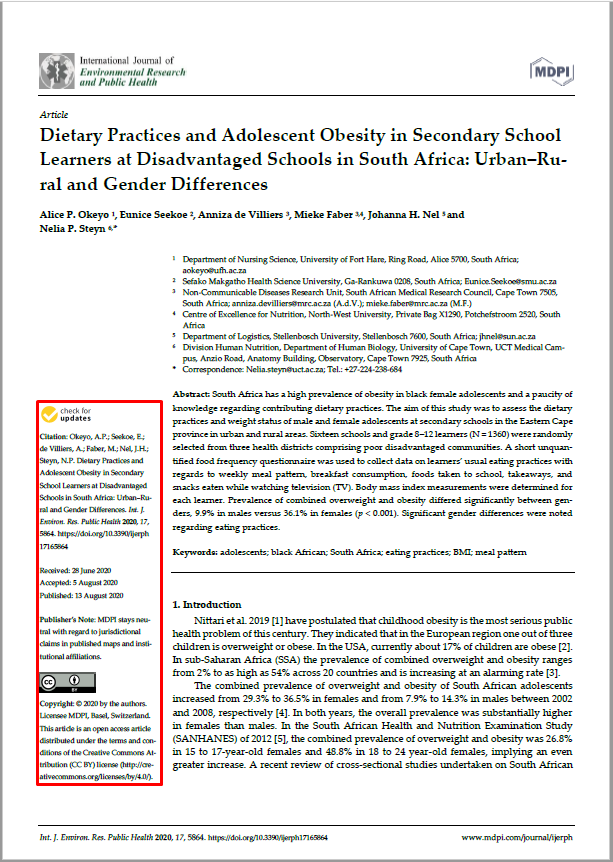
1) Information is displayed in the left information bar.
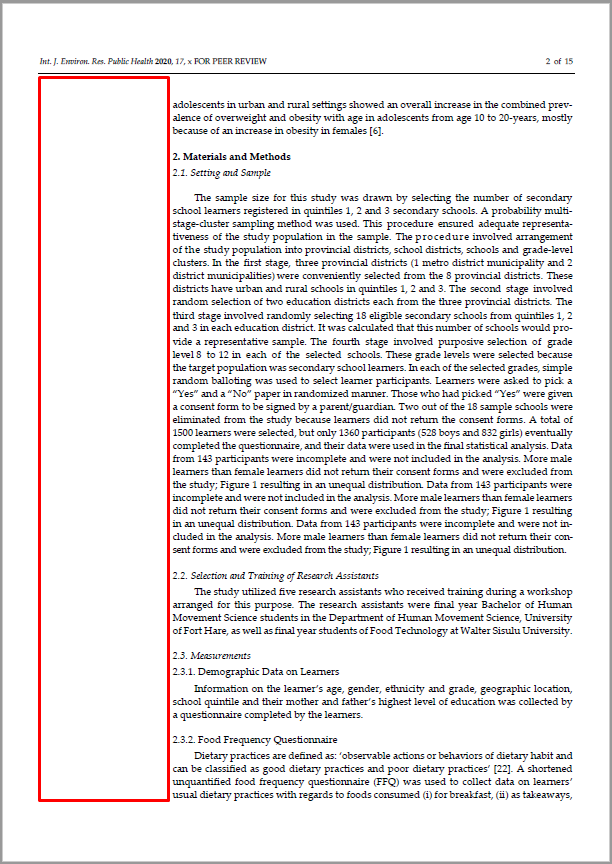
2) In the main text, there is a blank column on the left.
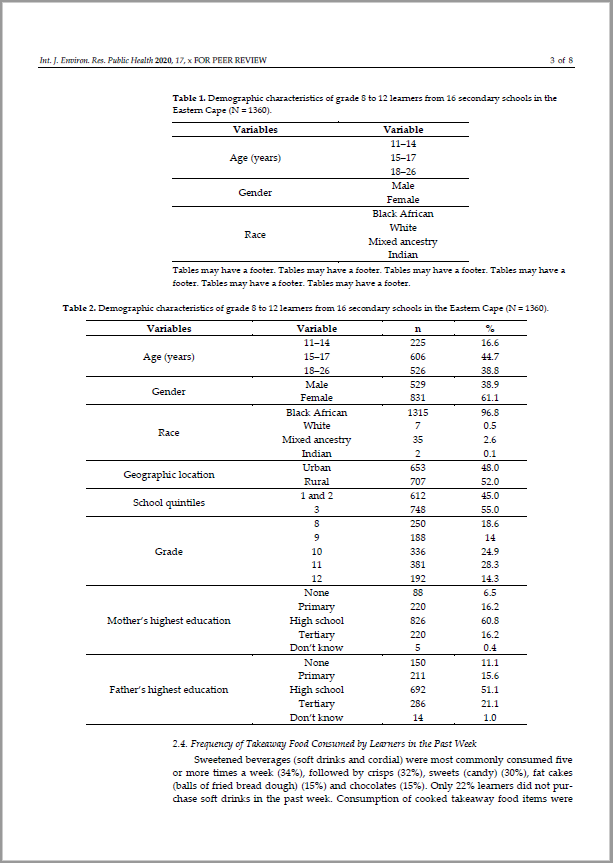
3) Small tables/figures are aligned on the left, large tables/figures are centered.
11 December 2020
2020 "Highly Cited Researchers" on MDPI Journal's Editorial Boards
We are pleased to acknowledge that many academic editors who have made an impact on MDPI journals as editorial board members, editors-in-chief, or section editors, are recognized as 2020 Highly Cited Researchers by Clarivate.
Highly Cited Researchers highlights the top 1% of researchers, by citations, in one or more of the 22 fields used in Clarivate Analytics Essential Science Indicators. We offer our congratulations to 279 academic editors of MDPI journals who were recognized as the most influential scholars in their fields in 2020.
Adams, Dave Agarwal, Ravi P. Ahn, Choon Ki Ahn, Myung-Ju Albrecht, Randy A. Andersson, Dan I. Anker, Stefan D. Apergis, Nicholas Ariga, Katsuhiko Artaxo, Paulo Balsamo, Gianpaolo Barba, Francisco J. Benediktsson, Jon Atli Benelli, Giovanni Bhatnagar, Amit Bialystok, Ellen Blaabjerg, Frede Blay, Jean-Yves Bogers, Marcel Bolton, Declan J. Boyer, Cyrille Brocca, Luca Bruix, Jordi Buhalis, Dimitrios Burdick, Jason A. Byrd, John C. Cabeza, Luisa F. Cabrerizo-Lorite, Francisco Javier Cai, Jianchao Calhoun, Vince D. Cantu, Robert C. Cerqueira, Miguel Chang, Jo-Shu Chau, Kwok-wing Chemat, Farid Chen, Jianmin Chen, Jun Chen, Min Chen, Shaowei Chen, Wei Chen, Wei-Hsin Chen, Xiaofeng Chen, Yangkang Chen, Zhi-Gang Chiclana, Francisco Corella, Dolores Cortes, Javier Cortes, Jorge Cummings, Kenneth Michael Dai, Shifeng Decker, Eric A. DePinho, Ronald A. Dimopoulos, Meletios-Athanasios Dincer, Ibrahim Du, Yihong Dupont, Didier Edwards, David Ellahi, Rahmat Ellis, Erle C. ElMasry, Gamal Esteller, Manel Estruch, Ramón Fang, Chuanglin Fasano, Alessio Fernandez-Lafuente, Roberto Ferreira, Isabel Fortino, Giancarlo Galluzzi, Lorenzo Galvano, Fabio Gandomi, Amir H. Gandomi, Amir H. Gao, Bin Gao, Feng Gao, Wei Garbe, Claus García, Hermenegildo Geschwind, Daniel H. Giampieri, Francesca Giralt, Sergio A. Glanz, Karen Goldewijk, Kees Klein Gössling, Stefan Govindan, Kannan Granato, Daniel Grosso, Giuseppe Grosso, Giuseppe Guerrero, Josep M. Haase, Dagmar Hagger, Martin S. Hamblin, Michael R. Han, Heesup Jankovic, Joseph Janotti, Anderson |
Jiang, Hai-Long Kalaji, Hazem M. Kalantar-Zadeh, Kourosh Kaner, Richard B. Karimi, Hamid Reza Kataoka, Kazunori Keesstra, Saskia Kepp, Oliver Kerminen, Veli-Matti Keyzers, Robert A. Khademhosseini, Ali Khan, Nafees A. Kim, Ki-Hyun Klemeš, Jiří Jaromír Klenk, Hans-Peter Konopleva, Marina Y. Krammer, Florian Krebs, Frederik C. Kroemer, Guido Kudo, Masatoshi Kurths, Juergen Kurzrock, Razelle Kuznetsov, Nikolay V. Kyrpides, Nikos C. La Vecchia, Carlo Lai, Yuekun Lam, James Lancellotti, Patrizio Lee, Sangmoon Leung, Victor C. M. Li, Jinghong Li, Yurui Lindahl, José M. Merigó Lip, Gregory Y. H. Loh, Xian Jun Long, Hualou Lund, Henrik Luo, Jingshan Luque, Rafael Lyons, Timothy W. Ma, Jun Ma, Wen-Xiu Ma, Yanming Maeda, Keisuke Makarova, Kira Mantovani, Alberto Martín-Belloso, Olga Martinoia, Enrico Marzband, Mousa Masclaux-Daubresse, Celine Masson, Patrick Mateos, María Victoria Mathiesen, Brian Vad Matyjaszewski, Krzysztof McArthur, Grant A. McCauley, Darren Medlock, Jolyon M. Melero, Ignacio Mezzetti, Bruno Miroshnichenko, Andrey E. Moran, Daniel Mueller, Lukas A. Mueller-Roeber, Bernd Naushad, Mu Nemeroff, Charles B. Nieto, Juan J. O'Donnell, Colm Ogino, Shuji Olabi, Abdul-Ghani O'Regan, Donal Orsini, Nicola Oswald, Isabelle P. Ozcan, Aydogan Pahl-Wostl, Claudia Pang, Huan Payne, James E. Peng, Shushi Perc, Matjaz Perez-Alvarez, Jose Angel Piquero, Alex R. Ploss, Alexander Postolache, Mihai Pradhan, Biswajeet Prinsep, Michele R. Qian, Dong Qu, Xiaogang Reiter, Russel J. Riahi, Keywan Richter, Andreas Rignot, Eric Robert, Caroline Ros, Emilio Rosell, Rafael |
Rosen, Marc A. |
The full list of 2020 Highly Cited Researchers can be accessed on https://recognition.webofsciencegroup.com/awards/highly-cited/2020/
--- Highly Cited Researchers (HCR) is a Clarivate product.
8 November 2020
The UN Sustainable Development Goals: an Interdisciplinary Academic Introduction

EdX MOOC “The UN Sustainable Development Goals: An Interdisciplinary Academic Introduction” (University of Leuven)
Climate change, pandemics, poverty, hunger, energy, conflicts,… These are big challenges the humanity is facing today, and they are all interrelated. To overcome such systemic issues, we need to step up actions at all levels.
In 2015, the United Nations have adopted the 17 Sustainable Development Goals (SDGs) in the 2030 Agenda for Sustainable Development, a framework of goals to build a better, more viable and sustainable world for all by 2030. This framework is a powerful tool to translate sustainability commitments into concrete actions at all levels, from the local to the global. But five years into the SDGs, how well do you know about them? How did they came up to be? How are they structured? What challenges do they face?
The EdX MOOC “The UN Sustainable Development Goals: an Interdisciplinary Academic Introduction”, developed by the University of Leuven (Belgium), unravels the complex web of the 17 SDGs and explains their emergence, structure, and interrelatedness. In a systematic manner, the course explores the background and the reality of each of the SDGs, and reflects on the challenges they are confronted with.
The course is taught by an interdisciplinary team of academic experts from the University of Leuven, as well as by practitioners in the field. Throughout the 6 modules, you will explore the concept of sustainable development and each of the 17 SDGs through videos complemented by reading materials. The discussion platforms and activities will offer you the opportunity to exchange with your peers on some of the most salient sustainability issues globally as well as to share your own experiences in contributing to the SDGs in your daily life.
The course consists of 6 modules and takes approximately 25 hours to complete, which you can do at your own pace up until 25 October 2021. As it is 100% online, it is entirely COVID-safe and you can take it from wherever you want.
As an introductory course, this MOOC is targeted at anyone with any educational or professional background who is interested in understanding how the ambitious 2030 Agenda and its SDGs aim to solve global issues.
Interested? Join over 5000 participants around the world and enroll now: https://www.edx.org/course/the-un-sustainable-development-goals-an-interdisci
What learners have said about the course…
“This was a great introductory course to the SDGs and now I feel a lot more confident in the holistic aspect of sustainability!”
“I liked the interactive material. Breaking it up with videos and little finger exercises was really excellent and a great way to reflect critically on the goals without spending too much time and effort on each task (manageable for us with busy schedules!). The content addressed both criticisms, trade-offs and synergies, giving a very realistic outlook on the SDGs and inspires us to think about how we can reform, adapt and continue making progress.”
“The course is very well-designed in term of contents and how lecturers analyze each goal and give examples.”
“The MOOC was really good to broaden my horizon. It was clearly divided according to the goals, so I could easily follow the lectures. I could understand the importance of SDGs for all actors in public and private sectors.”
