Skip Content
You are currently on the new version of our website. Access the old version .

Robotics

Robotics is an international, peer-reviewed, open access journal on robotic systems in theory, design, and applications, published monthly online by MDPI.
The International Federation for the Promotion of Mechanism and Machine Science (IFToMM) and Robotic Global Surgical Society (TROGSS) are affiliated with Robotics and its members receive a discount on the article processing charges.
Quartile Ranking JCR - Q2 (Robotics)

All Articles (1,287)

Localization and mapping remain critical challenges for Unmanned Ground Vehicles (UGVs) operating in unstructured natural environments, such as forests and agricultural fields. While Visual SLAM (VSLAM) and Visual–Inertial SLAM (VI-SLAM) have matured significantly in structured and urban scenarios, their extension to outdoor natural domains introduces severe challenges, including dynamic vegetation, illumination variations, a lack of distinctive features, and degraded GNSS availability. Recent advances in Deep Learning have brought promising developments to VSLAM- and VI-SLAM-based pipelines, ranging from learned feature extraction and matching to self-supervised monocular depth prediction and differentiable end-to-end SLAM frameworks. Furthermore, emerging methods for adaptive sensor fusion, leveraging attention mechanisms and reinforcement learning, open new opportunities to improve robustness by dynamically weighting the contributions of camera and IMU measurements. This review provides a comprehensive overview of Visual and Visual–Inertial SLAM for UGVs in unstructured environments, highlighting the challenges posed by natural contexts and the limitations of current pipelines. Classic VI-SLAM frameworks and recent Deep-Learning-based approaches were systematically reviewed. Special attention is given to field robotics applications in agriculture and forestry, where low-cost sensors and robustness against environmental variability are essential. Finally, open research directions are discussed, including self-supervised representation learning, adaptive sensor confidence models, and scalable low-cost alternatives. By identifying key gaps and opportunities, this work aims to guide future research toward resilient, adaptive, and economically viable VSLAM and VI-SLAM pipelines, tailored for UGV navigation in unstructured natural environments.

2 February 2026
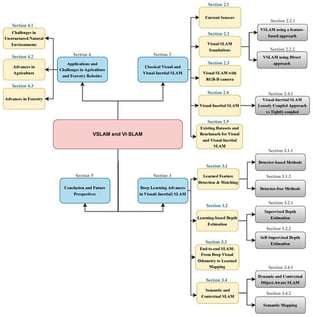
Diagram representing the structure of the article.

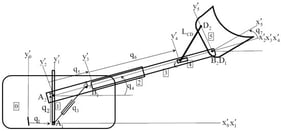
An extended operational space kinematics and dynamics formulation is presented for the control of redundant non-serial compound robotic manipulators. A broad spectrum of high-load-capacity non-serial manipulators used in earth moving, material handling, and construction applications is addressed. Departing from conventional approaches that rely on Jacobian pseudoinverses and local null-space projections, a globally valid, differential-geometry-based, multi-valued inverse kinematic mapping is defined at the configuration level, with the explicit self-motion parameterization of manipulator redundancy. The formulation yields coupled second-order ordinary differential equations of manipulator dynamics on the product space of task variables and self-motion coordinates. This enables the direct integration of system dynamics with control strategies, such as model predictive control or feedback design, while maintaining task constraint compliance. The methods presented are validated through the simulation and control of a non-serial compound material loader manipulator with multiple degrees of redundancy, demonstrating advantages in generality, numerical accuracy, and trajectory smoothness.

2 February 2026

Compound material loader.

This paper presents the development and experimental evaluation of the Athena parallel robot, a novel system designed for robot-assisted pancreatic surgery. The development of the experimental model based on the kinematic scheme, including the command and control system (hardware and software), the calibration procedure, and the performance measurements of the experimental model based on finite element analyses of the 3D model, are also detailed in this paper. Based on these finite element analyses, a region of the robot that introduces clearance during the operation of the experimental model is found. The paper also presents the methodology used for mapping the robot’s workspace with an optical system, which enabled improvements to ensure coverage of the entire pancreas area. The results obtained before and after the mechanical improvements are presented, demonstrating a reduction in clearance by up to 4.1 times following part replacement, as well as a workspace extension that enables the active instrument to reach the entire pancreatic region.

1 February 2026

Kinematic scheme of the Athena parallel robot (reprinted from ref. [32]).

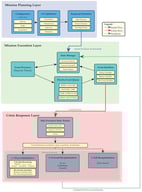
This paper presents an optimization framework for Multi-Robot Task Allocation (MRTA) for a heterogeneous robot fleet operating in dynamic, failure-prone environments. In contrast to traditional MRTA approaches that handle only the initial allocation, our system extends functionality by integrating real-time crisis response and intelligent task recovery from failure points. The framework combines island model genetic algorithm-based initial optimization with an event-driven architecture for handling robot failures during mission execution. Our key contribution is the integration of crisis-aware capabilities with the island model paradigm, enabling task resumption from failure points and dynamic reoptimization, while preserving the diversity benefits of multi-population evolution. When a robot fails, the system intelligently substitutes replacement robots and resumes interrupted tasks from their exact failure point, rather than restarting from the beginning. This significantly improves mission efficiency and resilience. We introduce a temporal scheduling mechanism that tracks actual task execution states and calculates remaining work upon failure, enabling true task continuation. Experimental validation across 57 diverse scenarios with 2340 independent runs demonstrates that the island model achieves higher fitness scores, maintains greater population diversity, exhibits more consistent performance, and recovers faster from crisis events compared to the standard single-population genetic algorithm.

29 January 2026

System Architecture for Multi-Robot Task Allocation with Crisis Response. The framework consists of three main layers: (1) Mission Planning Layer performs initial task allocation using Island Model GA and generates temporal schedules; (2) Mission Execution Layer monitors robot states and task progress through an event-driven architecture; (3) Crisis Response Layer implements three-tier recovery strategies (direct substitution, forward reoptimization, full replanning) when robot failures occur.

News & Conferences

Issues

Open for Submission

Editor's Choice

Reprints of Collections

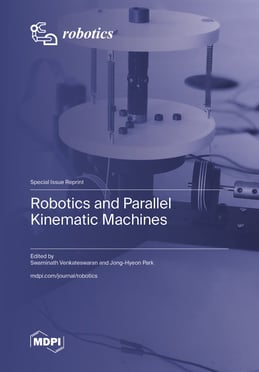
Robotics and Parallel Kinematic Machines
Reprint

Robotics and Parallel Kinematic Machines

Editors: Swaminath Venkateswaran, Jong-Hyeon Park
Kinematics and Robot Design VI, KaRD2023
Reprint

Kinematics and Robot Design VI, KaRD2023

Editors: Raffaele Di Gregorio

Get Alerted

Add your email address to receive forthcoming issues of this journal.

XFacebookLinkedIn
Robotics - ISSN 2218-6581