Skip Content
You are currently on the new version of our website. Access the old version .

Magnetochemistry

Magnetochemistry is an international, peer-reviewed, open access journal on all areas of magnetism and magnetic materials published monthly online by MDPI.

Quartile Ranking JCR - Q2 (Chemistry, Inorganic and Nuclear)

All Articles (1,125)

This Special Issue of Magnetochemistry is dedicated to Professor Dai-Zheng Liao on the occasion of his 85th birthday [...]

10 February 2026

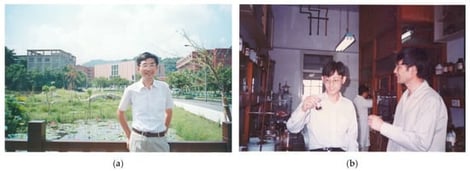
(a) Professor Liao visiting Academia Sinica in Taipei, 2000. (b) Professor Liao (right) supervising Dr. Hui-Zhong Kou (left) during an experiment at Nankai University, 1997.

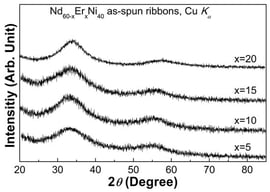
In the present work, we selected an amorphous Nd60Ni40 alloy as a basic alloy and added Er with a higher effective magnetic moment and de Gennes factor to replace Nd for the purpose of improving the magnetocaloric performance of the Nd60Ni40 amorphous alloy. The formability, magnetization, and magnetocaloric behaviors of the Nd60-xErxNi40 (x = 5, 10, 15, 20) amorphous alloys were studied. It was found that Er substitution generally improved the glass formability, but simultaneously decreased the Curie temperature, coercivity, and magnetic entropy change peak of the basic alloy. The mechanism for these unexpected results was investigated, and it was supposed that the decreased Curie temperature and the deteriorated magnetocaloric properties may have resulted from the antiferromagnetic coupling between the Nd and Er atoms.

8 February 2026

XRD patterns of the Nd60-xErxNi40 as-spun ribbons.

Sugarcane vinasse is a high-strength effluent with a high organic load and intense coloration from melanoidins and phenolic compounds, making conventional biological treatment difficult. This study presents a magnetically recoverable Fe3O4@latex-ZnO nanocomposite, synthesized using natural Hevea brasiliensis latex as a green polymeric interlayer. Transmission Electron Microscopy (TEM) shows a core–shell structure that enhances ZnO anchoring and reduces aggregation. X-ray Diffraction (XRD) confirms the coexistence of spinel Fe3O4 and wurtzite ZnO without secondary phases, while Fourier Transformed Infrared Spectroscopy (FTIR) verifies the latex layer through characteristic organic bands, indicating a stable organic–inorganic interface. Under 4 h of UV irradiation, the nanocomposite significantly reduced vinasse COD from 23,450 to 12,450–13,150 mg L−1 (≈44–47%) and BOD from 11,600 to 4800–5000 mg L−1 (≈57–59%), demonstrating substantial oxidation of the organic fraction. The magnetic core enables quick separation post-treatment, enhancing the practicality of the process. Overall, this innovative approach positions the ZnO nanocomposite as a promising option for vinasse pre-treatment and integrated agro-industrial effluent treatment.

6 February 2026

Illustrative image of the Photocatalytic reactor used in the experiments. Schematic representation of the UV photoreactor employed in vinasse degradation, showing the lamps, the sample arrangement in Erlenmeyer flasks, and the irradiation geometry.

The ligand-driven self-assembly of metal clusters offers a powerful strategy for constructing discrete molecular architectures with tunable magnetic and structural properties. By judiciously selecting appropriate multidentate ligands, researchers can direct the formation of polynuclear metal assemblies with diverse nuclearities, geometries, and topologies. Coordination-driven processes commonly stabilize such assemblies where multidentate ligands operate as templates and linkers. These will also determine how the metal centers are arranged in space and how they connect to each other. These clusters can take on shapes that range from basic bridging dimers to more complicated icosahedral and cubane-type motifs. They often have excellent symmetry and strong frameworks. Magnetically, these clusters are a great place to study exchange interactions, spin frustration, and the behavior of single-molecule magnets (SMMs). The magnetic characteristics depend on things like the type of metal ions, the bridging ligands, the overall shape, and the local coordination environment. Interestingly, a large number of ligand-assembled clusters exhibit high spin ground states and slow magnetization relaxation, which makes them attractive options for quantum information storage and molecular spintronic devices. This review connects coordination chemistry, supramolecular design, and molecular magnetism of pyridine–amine–carboxylate frameworks, offering insights into fundamental magnetic phenomena and guiding the development of next-generation functional materials. Continued exploration of ligand frameworks and metal combinations holds the potential to yield novel clusters with enhanced or unprecedented magnetic characteristics.

4 February 2026

Schematic representation of polyhedral view of 1-D coordination polymers (a) 1, (b) 7 and (c) 16. Color code: violet, Mn; orange, Cu; cyan, Zn; blue, N; red, O; and gray, C atoms. Reproduced with permission from ref. [47]. Copyright 2001, John Wiley and Sons.

News & Conferences

Issues

Open for Submission

Editor's Choice

Get Alerted

Add your email address to receive forthcoming issues of this journal.

XFacebookLinkedIn
Magnetochemistry - ISSN 2312-7481