This Special Issue of Magnetochemistry is dedicated to Professor Dai-Zheng Liao on the occasion of his 85th birthday. Professor Liao was born in 1939 in Fujian, China. He graduated from the Chemistry Department of Fudan University in 1962. In the same year, he began his academic career at the Chemistry Department (now the College of Chemistry) at Nankai University, where he continued to work until his retirement in 2011. As both a mentor and a scientist, he guided eighteen master’s and twenty-five doctoral students and published over 700 scientific papers in peer-reviewed journals throughout his distinguished career.
Professor Liao has long been dedicated to teaching
Advanced Inorganic Chemistry and
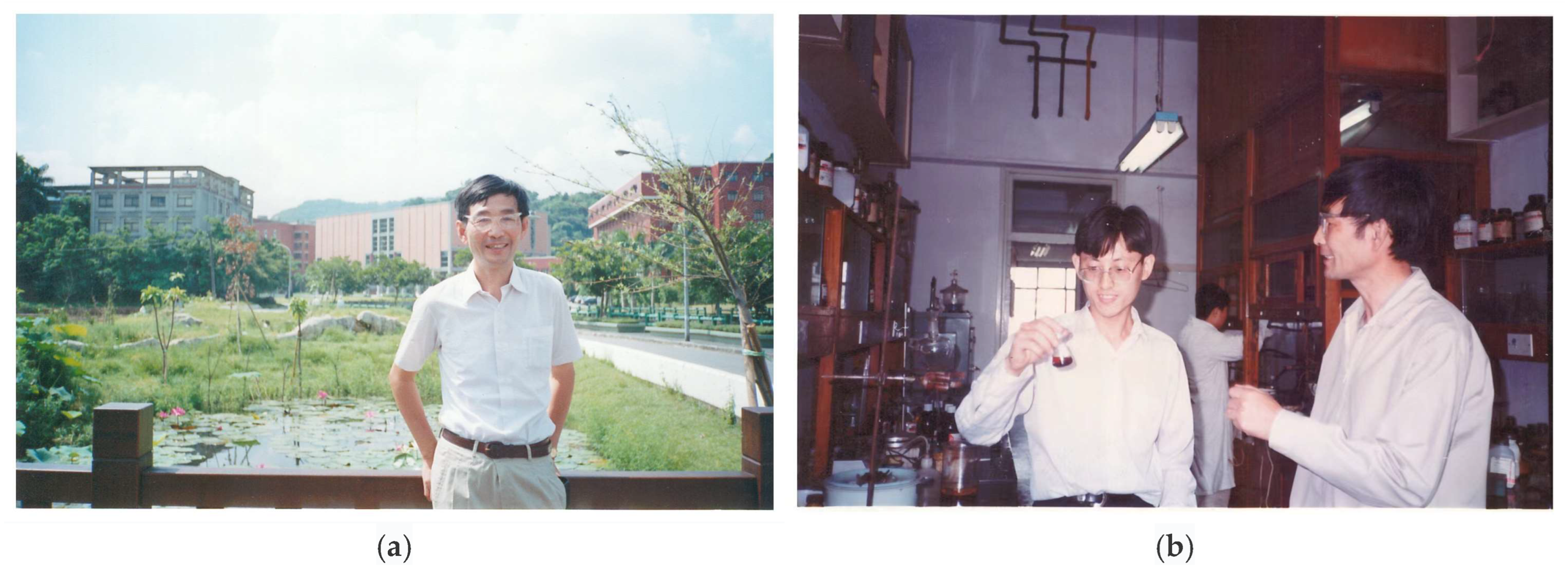
Quantum Chemistry. During his teaching career, Professor Liao focused on delivering high-quality education, relying on creative solutions to engage his students. At a time when multimedia tools were not widely available, he put great effort into designing effective teaching materials. One notable example was his creation of a large, one-square-meter poster filled with key formulas, which became a distinctive feature of his lectures. In an era when academic resources were limited in China and the literature was in print, Professor Liao strove to make the latest research accessible to his students. He diligently sought out the few available resources, often relying on physical copies of papers to stay connected with cutting-edge developments. His efforts helped bring global advancements to his students, encouraging them to stay informed and motivated in pursuing their own research. The photographs in
Figure 1 capture moments from Professor Liao’s research career, including his visit to Academia Sinica in Taipei and his mentorship of Dr. Hui-Zhong Kou at Nankai University. In his free time, Professor Liao loved playing table tennis, which helped him stay active and maintain the same energy and enthusiasm he brought to his work and mentorship.
Professor Liao was a pioneer in the development of molecular magnetism research in China. Between 1985 and 1986, he served as a visiting professor at Kyushu University in Japan, where he was first introduced to the emerging field of molecular magnetism, which was then a rapidly growing area of coordination chemistry. Upon returning to China, Professor Liao was one of the first to lead a research team in the field of molecular magnetism. He made significant contributions to spin-crossover complexes, irregular spin-state structures, magnetic ordering, radical complexes, and single-molecule magnets. In recognition of his work, he was awarded the Second Prize of the National Natural Science Award of China in 2003 for the project on “Foundational Studies in Molecular Magnetism”. His pioneering work played a key role in the growth of molecular magnetism in China, inspiring scholars from Nanjing University, Peking University, and Sun Yat-sen University to initiate research in the field, resulting in many significant academic contributions.
To honor Professor Liao’s profound contributions to the field of molecular magnetism, Magnetochemistry is pleased to present this Special Issue, entitled “Molecular Magnetism: A Tribute to Professor Dai-Zheng Liao on the Occasion of His 85th Birthday”, featuring fifteen contributions from leading researchers in the field of molecular magnetism in China.
In chronological order, the first contribution in this Special Issue—by Y.-X. Wang, Y.-F. Wang, and B. Yin from Northwest University [
1]—is a theoretical study, based on ab initio electronic structure calculation, on a group of 16 pentacoordinate Dy(III) single-ion magnets. They emphasize the contribution from the equatorial coordinating atoms might be even more important than that from the axial coordinating atoms for good Dy(III) SMMs and reveal that widening the axial ∠O–Dy–O might be a probable way of improving the SMM performance of penta-coordinated Dy-SIMs.
Y. Qian, Y. Gao, L. Xu, R. K. Kremer, J. Zhang, and X.-M. Ren from Nanjing Tech University, the Max-Planck-Institute für Festkörperforschung, and Nanjing University [
2] report the variable-temperature crystal structures of two isomorphous salts: [1-benzyl-4-aminopyridinium][M(mnt)
2] (M = Ni or Cu; mnt
2− = maleonitriledithiolate). A magnetostructural phase transition occurred at
TC ~ 190 K in the
S = ½ Ni complex at ambient pressure, converting paramagnetic tetramers into nonmagnetic spin-paired dimers. No such transition was observed in the nonmagnetic Cu complex in the same temperature range. The magnetic and phase transition properties of the Ni complex under varying pressures show that
TC increases linearly with pressure (0.003–0.88 GPa) at a rate of 90 K GPa
−1.
Y. Zhou, Z. Yao, N. Li, F. Liu, J. Zhao, and X. Bu from Tianjin University of Technology and Nankai University [
3] present mixed-valence metal formates [CH
3NH
2CH
3]
n[Cr
III1−xFe
IIIxFe
II(HCO
2)
6]
n that exhibit the
N-,
P-, and
Q-type Néel’s ferrimagnetism. The positive and negative exchange bias in
N- and
P-type ferrimagnets originates from the antiferromagnetic exchange interaction between the uncompensated spin of the host ferrimagnetic lattice and the pinned compensated spin of the antiferromagnetic clusters as a guest, which is rooted in the valence disorder of the iron ions.
H.-H. Cui, D.-Z. Wang, S. Li, L. Wang, X. Yu, X. Liu, J. Wang, M. Wang, and Y. Tang from Nantong University [
4] report two mononuclear octahedral Co(II) complexes: [Co(L)X
2] (L = 1-(prop-2-en-1-yl)-1H-imidazole, X = NCS
− and NCSe
−). Magnetic data revealed large easy-plane magnetic anisotropy in both complexes, and they display field-induced slow magnetic relaxation. For both complexes, the Raman mechanism was found to be the dominant process in the whole temperature range. The magnetic relaxation of [Co(L)(NCSe)
2] is faster, likely due to the presence of the hydrogen-bonding system.
B. Zhang, Y. Zhang, D. Wang, Z. Wang, G. Chang, Z. Gao, Y. Guo, F. Liu, Z. Zhao, X. Zhang, B. Qu, P. Xu, J. Wang, F. Dong, T. Liang, Y. Sun, D. Yang, Q. Li, X. Luo, and R. Feng from the Institute of Chemistry (CAS), Peking University, the National Center for Nanoscience and Technology, and the Institute of High-Energy Physics (CAS) [
5] present an organic–inorganic hybrid (BEDT-TTF)
3[Cu
2(μ-C
2O
4)
3]·CH
3CH
2OH·1.2H
2O prepared via electrocrystallization. The three donor organic molecules have a total formal charge of +2, consistent with TTF core bond lengths and Raman spectra. It is a semiconductor with room-temperature conductivity:
σrt = 0.04 S/cm and
Eα = 40 meV. The antiferromagnetic copper-oxalate framework exhibits spin frustration, making it a quantum spin liquid candidate.
Y. Zhou, J. Xie, C. Jin, Y. Ma, and L. Li from Nankai University [
6] report a heterolanthanide complex [Dy
0.56La
1.44(hfac)
7(NITPhMeImbisH)] derived from a nitronyl nitroxide biradical NITPhMeImbis with Dy(hfac)
3 and La(hfac)
3 (hfac
− = hexafluoroacetylacetonate). In the complex, the protonated NITPhMeImbisH
+ ligand chelates one Ln(III) via two neighboring NO units and binds La(III) through another NO group, forming a dinuclear structure. Magnetic measurements show dominant ferromagnetic couplings in the complex. Spin dynamics studies reveal frequency-dependent
χ″ peaks under a dc field (field-induced relaxation), a combination of Orbach and QTM processes, with
Ueff = 15.14 K,
τ0 = 3.04 × 10
−7 s, and
τQTM = 3.61 × 10
−4 s.
Z. Pan, Y.-S. Ding, L. Li, and Z. Zheng from Southern University of Science and Technology [
7] present trinuclear rare-earth chloride-bridged clusters [(Li(THF)(Et
2O))(Cp*RE)
3(
μ-Cl)
4(
μ3-Cl)
2(
μ4-Cl)] (RE = Y, Gd, Tb, Dy, etc.; Cp* = pentamethylcyclopentadienide) synthesized by reacting LiCp* with RECl
3 (1:1 molar ratio) in THF:Et
2O (1:9). These clusters are highly soluble in common organic solvents. Magnetic studies show Gd
3 has coexistent ferromagnetic and antiferromagnetic superexchange interactions; Dy
3 exhibits intramolecular dipolar interactions and slow magnetic relaxation below 23 K with an energy barrier of 125(6) cm
−1 under a zero DC field.
A contribution by X.-F. Chen, T. Wang, D. Liao, N. Wu, Y. Peng, S.-Y. Zhang, and Z.-B. Hu from the Jiangxi University of Science and Technology and Gannan Normal University [
8] report two organic–inorganic materials: (TMAA)
2[CoCl
4] and (TMAA)
2[MnCl
4] (TMAA
+ = N,N,N-trimethyl-1-adamantylammonium). Both exhibit first-order structural phase transition at high temperatures; near the transition point, their dielectric properties and
χMT values show significant abnormal changes, indicating dielectric and spin bistability. Moreover, an external magnetic field induces obvious changes in their dielectric constants, providing strong evidence for magnetic–dielectric coupling effects.
C.-M. Liu from the Institute of Chemistry (CAS) [
9] reports two new Dy
2 complexes: [Dy
2(L
Schiff-1)
2(DMF)
2(dpp)
2]·0.5DMF and [Dy
2(L
Schiff-2)
2(DMF)
2(dpp)
2]·2DMF, based on two compartmental Schiff-base ligands. Magnetic studies show ferromagnetic interactions between Dy
3+ ions in both complexes, which act as zero-field SMMs with
Ueff/
k values of 49.7 K for [Dy
2(L
Schiff-1)
2(DMF)
2(dpp)
2]·0.5DMF and 151.8 K for [Dy
2(L
Schiff-2)
2(DMF)
2(dpp)
2]·2DMF. This work indicates that heterocycle groups (pyrazine vs. pyridine) on the ligands affect the SMM properties of the reported complexes.
L. Miao, D.-M. Zhu, C.-M. Liu, Y.-Q. Zhang, and H.-Z. Kou from Tsinghua University, Nanjing Normal University, and the Institute of Chemistry (CAS) [
10] report three lanthanide complexes, [Dy(HL
1-o)(NO
3)
2(CH
3OH)
2]NO
3·CH
3OH, and tetranuclear complexes, [Ln
4(L
1-c)
2(L
2)
2(μ
3-OH)
2(NO
3)
2(CH
3OH)
4](NO
3)
2·2CH
3CN·5CH
3OH·2H
2O (Ln = Dy or Gd). Magnetic measurements reveal the mononuclear Dy(III) complex is an SMM, the tetranuclear Dy(III) complex shows slow magnetic relaxation, and the tetranuclear Gd(III) complex is a magnetic cooling material with a −Δ
Sm of 9.81 J kg
−1 K
−1 at 2 K and 5 T. Theoretical calculations on the mononuclear Dy(III) complex indicate good magnetic anisotropy with a calculated energy barrier of 194.6 cm
−1.
Y.-W. Geng, T. Guo, X.-Q. Wang, and T. Han from Xi’an Jiaotong University [
11] used the sulfur-containing ligand of 2-pyridinethiol 1-oxide (HL) and successfully synthesized a series of hourglass-like Ln
9 clusters: [Ln
9(L)
17(
μ3-OH)
9(
μ4-OH)]·
nH
2O (Ln = Gd,
n = 3; Ln = Tb,
n = 3; Ln = Dy,
n = 1). Magnetic data analysis reveals that Gd
9 shows a significant MCE, with the entropy change (−Δ
Sm) reaching a maximum of 34.41 J kg
−1 K
−1 at 2 K under Δ
H = 7 T, and Dy
9 exhibits SMM characteristics. Gd
9 possesses the highest molar mass among the reported Gd
9 clusters with MCE and a competitive −Δ
Sm value.
L. Zhou, H. Lv, Y. Liang, D. Liu, Z. Yao, S. Luo, and Z. Chen from Guangxi Normal University and the Guizhou University of Engineering Science [
12] report a dinuclear dysprosium complex, [Dy
2(HOBQ)
4Cl
6], prepared by reacting DyCl
3 with benzo[
h]quinolin-10-ol (HOBQ). Magnetic measurements revealed that the complex is a field-induced single-molecule magnet with an energy barrier of 71(2) K and an obvious magnetic hysteresis loop. The magneto-structural correlation is corroborated by ab initio CASSCF calculations, demonstrating that a compressed octahedral geometry with two axial phenoxy groups can achieve Dy(III) single-molecule magnets.
X. Wang, S. Qin, X. Li, W. Zuo, Q. Wang, L. Li, Y. Ma, J. Tang, and B. Zhao from Nankai University and the Changchun Institute of Applied Chemistry [
13] present a centrosymmetric dinuclear dysprosium complex, [Dy
2(H
2dapp)
2(
μ-OH)
2(H
2O)
2]·4TCNQ·2CH
3OH, which was synthesized using a pentadentate Schiff-base ligand and the TCNQ
·− radical anion. The complex exhibits ferromagnetic Dy–Dy magnetic interactions and shows weak magnetic relaxation under zero field, with an effective energy barrier of approximately 2.82 K and a pre-exponential factor
τ0 of 6.88 × 10
−6 s. This behavior is proposed to arise from the short intermolecular Dy···Dy distance of 7.97 Å, which facilitates enhanced intermolecular dipolar interactions and quantum tunneling of magnetization.
A contribution by X. Gou, X. Sun, P. Cheng, and W. Shi from Nankai University and the Suzhou Institute of Nano-Tech and Nano-Bionics (SINANO) [
14] present a new review on the recent advances in photo-responsive molecular nanomagnets, which show great potential in optical switches, smart sensors, and data storage devices. The design strategies and the photo-responsive mechanism based on spin transition, photocyclization, and photogenerated radicals are discussed in detail.
S.-S. Bao and L.-M. Zheng of Nanjing University [
15] report two kinds of dysprosium(III) single-molecule magnets (Ln-SMMs), which show stimulus response changes in photoluminescence and magnetic properties. They also investigated the effect of pressure on magnetic properties and observed narrowing of the butterfly-shaped hysteresis loop and acceleration of magnetic relaxation. These changes are mainly caused by intramolecular π–π interaction and external stimuli (such as grinding and pressure), which provide potential value for information storage and molecular device applications.
As a true mentor, Professor Liao guided his students not only in research but also in shaping their characters and professional development. He took a personal interest in their growth, engaging with them both academically and personally. Even after retirement, he continued to inspire young scientists, fostering a passion for education and maintaining close connections with his students. His dedication as an educator has made a lasting impact on the field of chemistry in China.
This Special Issue reflects Professor Liao’s lasting influence, bringing together contributions from scholars who have been directly or indirectly influenced by his guidance and research. We sincerely thank all the contributors, whose work is a testament to the ongoing impact of Professor Liao’s mentorship and legacy.