Article

Effect of Er Substitution on Magnetic and Magnetocaloric Properties of Nd60Ni40 Metallic Glass

State Key Laboratory of Materials for Advanced Nuclear Energy, Shanghai University, Shanghai 200072, China
*
Author to whom correspondence should be addressed.
Magnetochemistry 2026, 12(2), 24; https://doi.org/10.3390/magnetochemistry12020024
Submission received: 30 December 2025 / Revised: 26 January 2026 / Accepted: 3 February 2026 / Published: 8 February 2026
(This article belongs to the Section Magnetic Materials)

Abstract

In the present work, we selected an amorphous Nd60Ni40 alloy as a basic alloy and added Er with a higher effective magnetic moment and de Gennes factor to replace Nd for the purpose of improving the magnetocaloric performance of the Nd60Ni40 amorphous alloy. The formability, magnetization, and magnetocaloric behaviors of the Nd60-xErxNi40 (x = 5, 10, 15, 20) amorphous alloys were studied. It was found that Er substitution generally improved the glass formability, but simultaneously decreased the Curie temperature, coercivity, and magnetic entropy change peak of the basic alloy. The mechanism for these unexpected results was investigated, and it was supposed that the decreased Curie temperature and the deteriorated magnetocaloric properties may have resulted from the antiferromagnetic coupling between the Nd and Er atoms.

1. Introduction

Amorphous alloys (AAs), also known as metallic glasses (MG), are a special type of material system that is usually fabricated by rapidly cooling melted alloys to prevent the atoms from arranging into a periodic and ordered structure during solidification [1,2,3]. The unique atomic configuration of these amorphous materials, that is, long-range atomic disorder and short-range order, not only brings about mechanical advantages such as high strength and hardness, but also demonstrates excellent magnetic properties, including significant magnetocaloric effects (MCEs), outstanding magnetoelastic properties, and so on [4,5,6,7].
An MCE refers to an exothermic/endothermic phenomenon due to a change in the magnetic entropy in a magnet upon magnetization/demagnetization. The excellent MCEs in the amorphous alloys make them potential candidate materials for advanced applications in novel magnetic refrigeration solutions that are more efficient and environmentally friendly than the conventional vapor expansion/compression refrigeration technology [8,9,10,11,12,13,14,15,16]. As the key refrigerant materials, amorphous alloys show several advantages over intermetallic compounds: they present features of a second-order magnetic transition, accompanied by a broadened magnetic entropy change (−ΔSm) peak, which is much more appropriate for working in an Ericsson cycle. In contrast, intermetallic compounds that exhibit strong magnetocaloric effects (such as Gd5(Si,Ge)4, La(Fe,Si)13, MnFe(P,As), and so on) usually experience a first-order magnetic phase transition and show a sharp but narrow −ΔSm, which results in a high maximum −ΔSm (−ΔSmpeak) but low refrigeration capacity (RC = −ΔSmpeak × ΔTFWHM, where ΔTFWHM is the temperature interval at half of −ΔSmpeak); their peak −ΔSm temperatures, usually equal to their Curie temperatures (Tc), are tunable, because metallic glasses can be synthesized over a relatively wide range of compositions, and thus, the Tc of these amorphous alloys, depending on their composition, is tailorable. By comparison, the MCEs of intermetallic compounds undergoing a first-order magnetic phase transition are very sensitive to impurities; in other words, the Curie temperatures of these intermetallic compounds are difficult to adjust through micro-alloying or element substitution without dramatically deteriorating their magnetocaloric properties. Thus, the mechanical properties and corrosion resistance of amorphous alloys are better than those of intermetallic compounds [17,18,19].
Among these MGs, rare-earth (RE) transition metal (TM)-based MGs show great potential as high-performance magnetocaloric materials due to their high magnetic moments brought about by both the RE’s 4f electrons and the TM’s 3d electrons. For example, the −ΔSmpeak of Gd-Co-based metallic glasses reaches 10.1 J/(kg × K) under 5 T [20], which is primarily attributed to the substantial magnetic moments of Gd due to its half-filled 4f electronic configuration. The Er60Ni30Co10 amorphous alloy exhibits a −ΔSmpeak of ~12.1 J/(kg × K) under 5 T [21], and the Er67.5Co32.5 binary metallic glass even shows a high −ΔSmpeak of up to 17.47 J/(kg × K) under 5 T [22], both of which are closely related to the high effective magnetic moment of Er (9.58 μB). According to the multicomponent rule of metallic glasses, micro-alloying or element substitution may be advantageous for enhancing the glass-forming ability (GFA) of the mother alloys, which makes it easier for them to be fabricated into amorphous refrigerants, and, in addition, may further enhance the MCEs if the proper RE elements are added.
According to our preliminary results, Nd-Ni binary AAs show good GFA and good magnetocaloric performance at low temperatures [23]. In the present work, we considered introducing other earth elements with larger magnetic moments to replace the Nd element for the purpose of improving the GFA and MCE of the Nd-Ni binary MGs. A Nd60Ni40 binary MG, with good GFA and magnetocaloric properties, was selected as the basic alloy. Er, with a much higher effective magnetic moment than Nd (3.62 μB) and a higher de Gennes factor (G = 2.55 for Er and 1.84 for Nd) [24], was selected as the substitution element. The influences of Er-doping on the GFA, Curie temperature, −ΔSmpeak, and RC of the Nd60Ni40 MG, and their mechanisms, were investigated.

2. Experimental Methods

Using a high-vacuum furnace under high-purity Ar protection, pure Nd, Er, and Ni metals (purity > 99.9 at%)—mixed simultaneously, pursuant to their respective parts in the composition of Nd60-xErxNi40 (x = 5, 10, 15, 20)—were arc-melted five times to prepare master alloy ingots. The broken pieces of the master alloy ingots were remelted and subsequently sprayed from a hole at the bottom of the quartz tube onto a high-speed rotating copper roller to prepare thin ribbons. Nd60-xErxNi40 ribbons with an average thickness of 40 ± 0.5 μm were chosen for the follow-up investigation. XRD analysis using Cu Kα radiation was performed on the Nd60-xErxNi40 ribbons to ascertain their amorphous structure. A scanning rate of 20 K/min was applied to obtain measurements of their differential scanning calorimetry (DSC) traces on a NETZSCH 404C calorimeter from Germany. The magnetization (M)-temperature (T) curves, the magnetization curves under isothermal conditions (M-H curve), and the hysteresis loops of the MG ribbons were determined by a vibrating sample magnetometer (VSM) module equipped on a Quantum Design 6000 Physical Property Measurement System (PPMS) from Quantum Design, a company based in the United States.

3. Results and Discussion

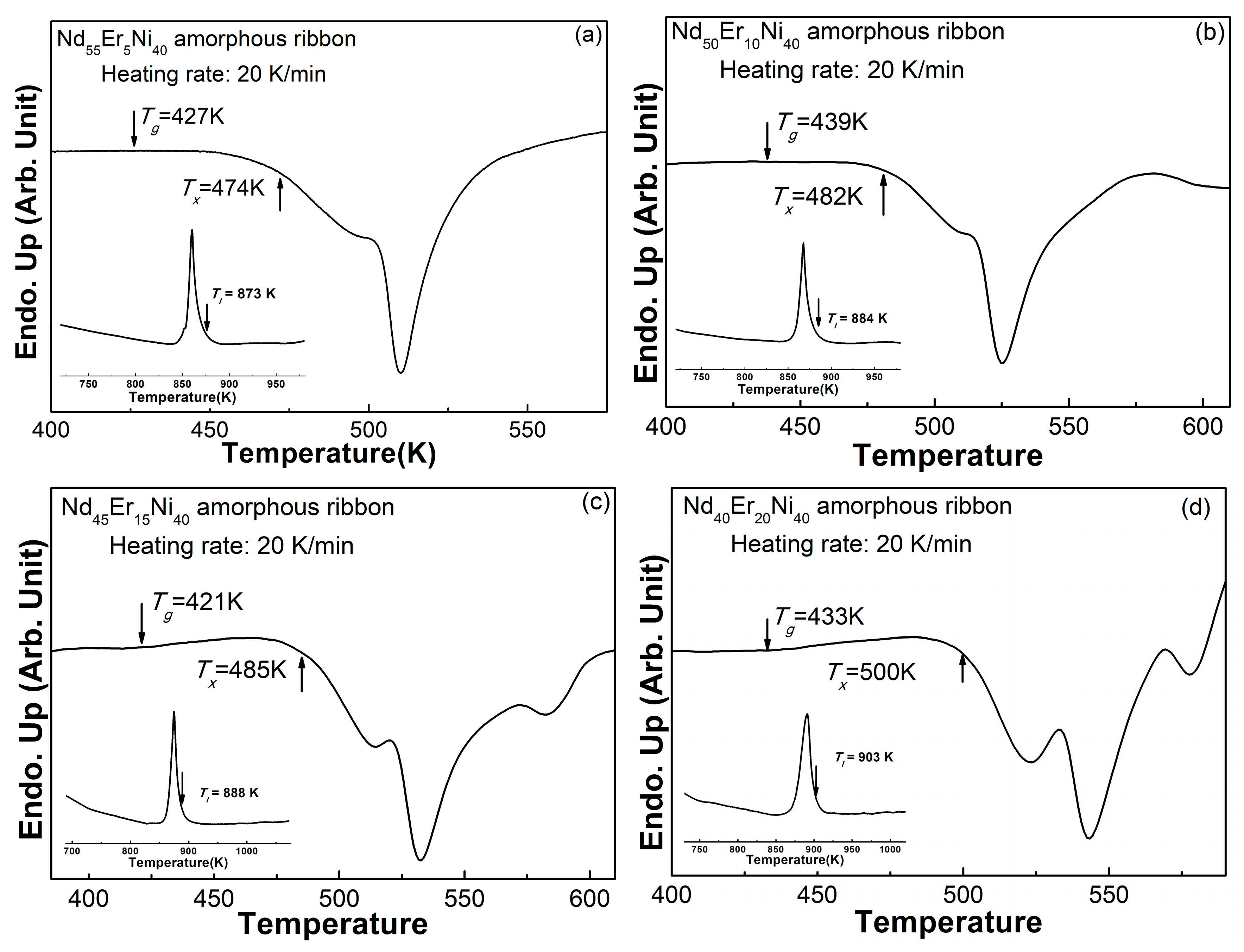
It was found that none of the Nd60-xErxNi40 (x = 5, 10, 15, 20) ribbons exhibited obvious sharp crystalline diffraction peaks according to their XRD patterns, as is displayed in Figure 1. Instead, all the samples exhibited smooth diffraction peaks between 30° and 40°, indicating the typical amorphous features of Nd60-xErxNi40 as-spun ribbons. The amorphous characteristics of the Nd60-xErxNi40 ribbons were also illustrated by an endothermic glass transition event and sharp exothermic crystallization reaction, as is clearly observed in their respective DSC plots, as shown in Figure 2: (a) x = 5, (b) x = 10, (c) x = 15, and (d) x = 20. The onset temperatures for the glass transition (Tg) and crystallization (Tx) of the MG ribbons, as determined by a tangent method, are summarized in Table 1. The liquidus temperatures (Tl) for the Nd60-xErxNi40 MG ribbons obtained from the melting curves, as displayed in the inset of Figure 2a–d, are also enumerated in Table 1. Consequently, Trg, defined by D. Turnbull [25], and parameter γ, defined by C. T. Liu and Z. P. Lu [26,27], can be calculated according to
T r g = T g T l
γ = T x T g + T l
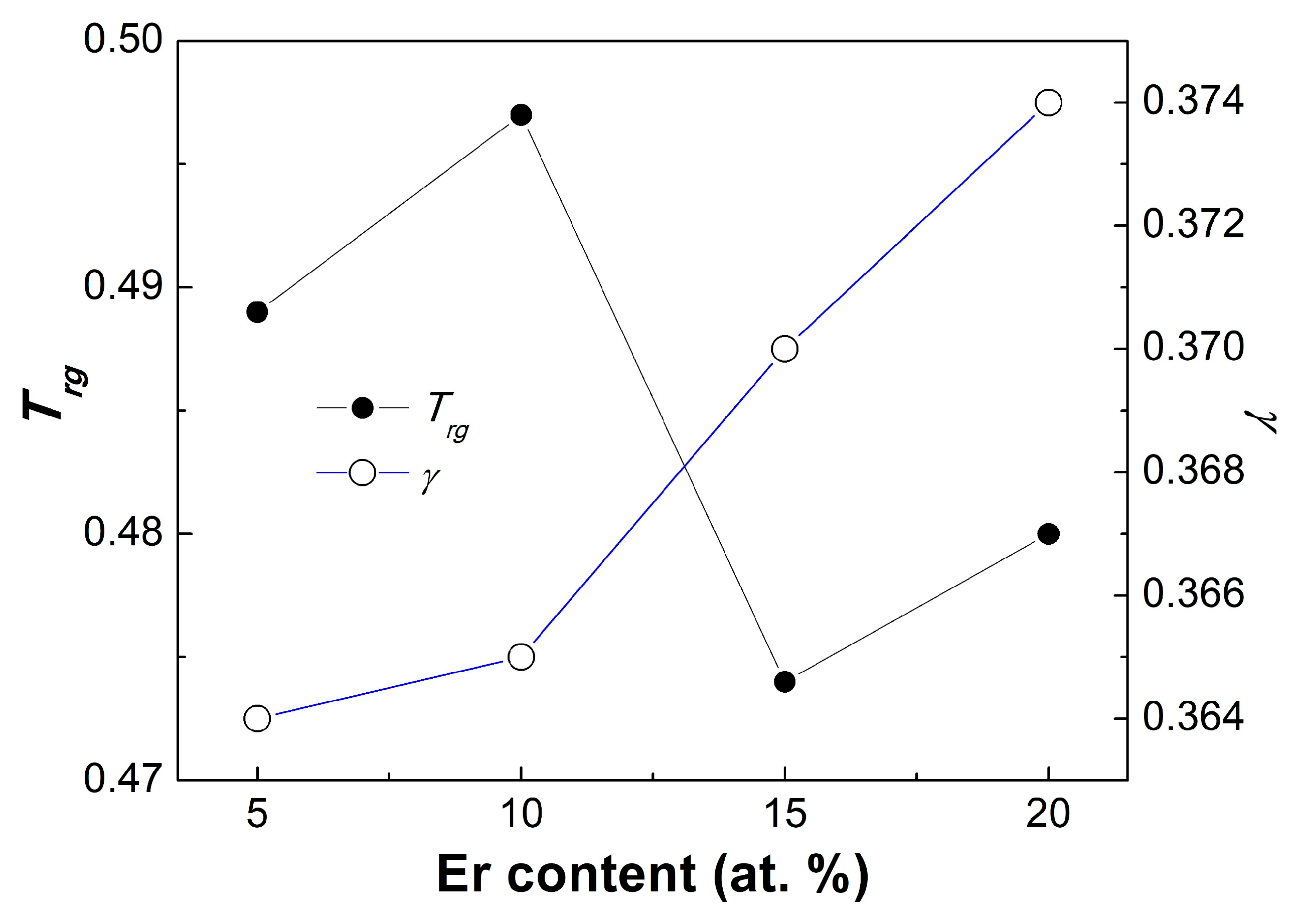
Figure 3 illustrates the variation in Trg and γ in the Nd60-xErxNi40 MG ribbons according to their composition. According to the Trg values of the samples, the GFA was enhanced by Er substitution from 5% to 10% and then decreased with any further addition of Er. However, the γ parameter increased monotonously with the addition of Er, indicating the increasing substitution of GFA by Er.
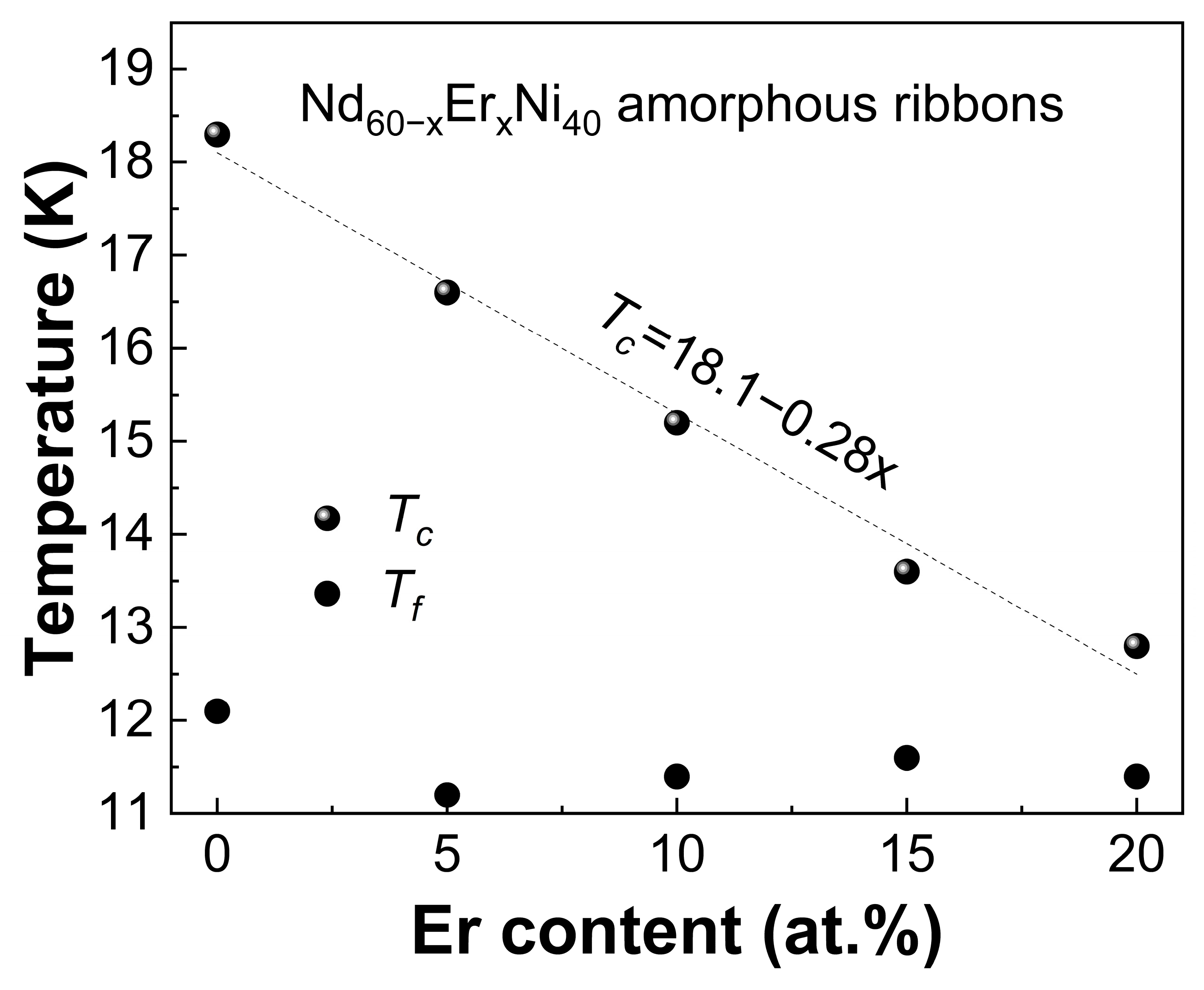
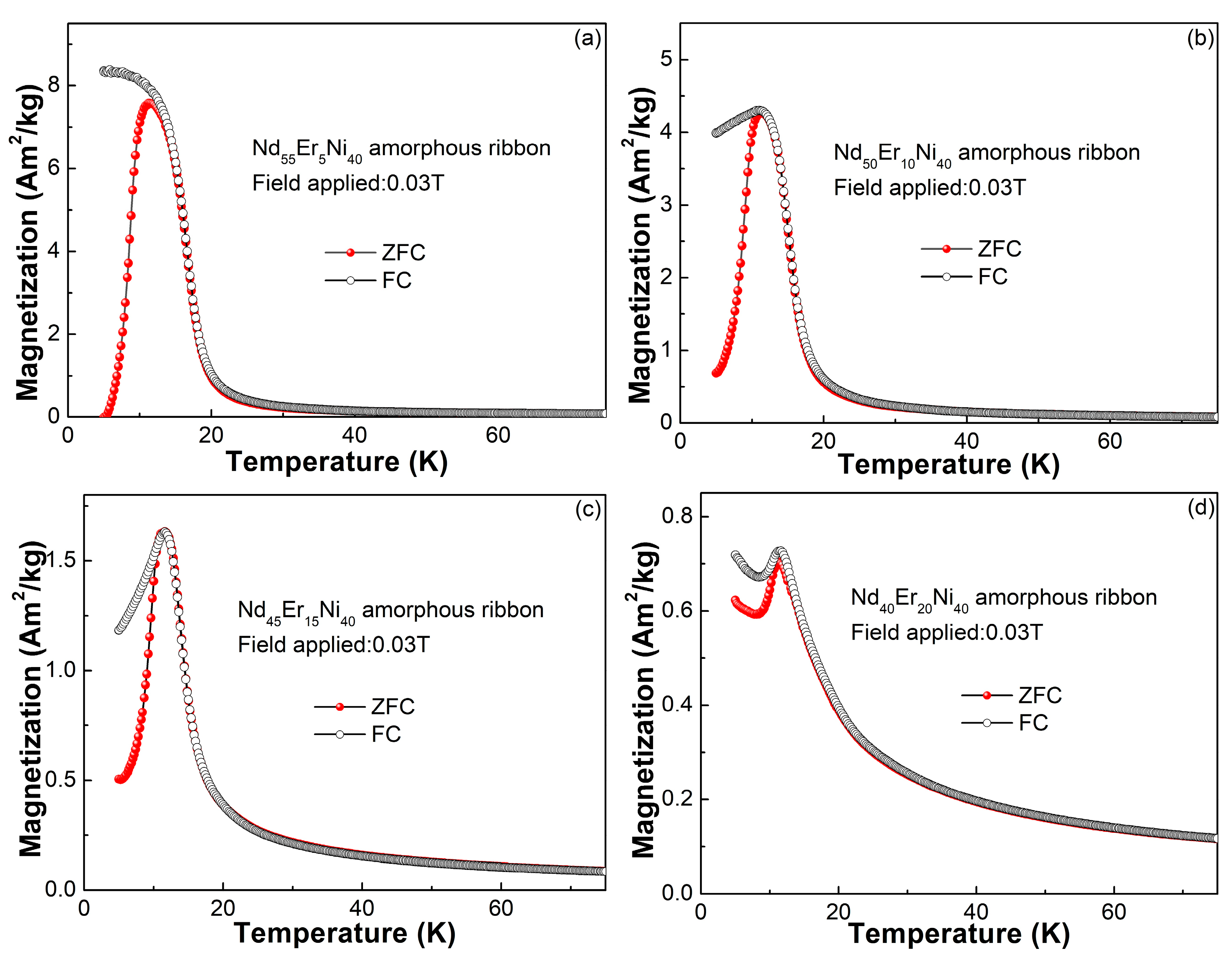
The M-T curves of the Nd60-xErxNi40 MG ribbons were obtained from 5 K to 100 K under an applied magnetic field of 0.03 T, after cooling from ambient temperature to 5 K without a magnetic field (zero field cooling, ZFC), and under a magnetic field of 0.03 T (field cooling, FC). As shown in Figure 4, all the MG ribbons show typical λ-shape characteristics in their field-cooled and zero-field-cooled M-T curves, indicating the significant spin-glass-like (SGL) behaviors of these MG ribbons. The Curie temperature and the spin-glass-like freezing temperature (Tf) of the Nd60-xErxNi40 (x = 5, 10, 15, 20) MG ribbons, acquired from their ZFC M-T curves, are listed in Table 2. The compositional dependence of Tc as well as Tf, as illustrated in Figure 5, indicates that the Tc of the ribbons decreased linearly with the ascending Er content, while the Tf of the Nd60-xErxNi40 ribbons decreased from x = 5 to x = 10 and then increased with any further addition of Er. The relationship between Tc and Er content was anomalous, because for Nd60-xErxNi40 MG ribbons with a constant Ni content, Tc maintains a positive proportion relative to the de Gennes factor (G) [28] of the ribbons, which can be calculated in a double RE ions system as follows:
G = c 1 G 1 + c 2 G 2
Where cn and Gn are the molar fraction and de Gennes factor of the respective RE ion. As is known, G equals 2.55 for Er and 1.84 for Nd, and thus the increasing substitution of Er for Nd should result in an increasing G in the MGs and give rise to an enhancement of Tc according to Er content, which is obviously the opposite of the experimental results. Considering that the coupling between light RE elements, such as Nd and Ni, is ferromagnetic, while the coupling between heavy RE elements, such as Er and Ni, is antiferromagnetic, the coupling between Nd and Er is most likely antiferromagnetic, according to the Ruderman–Kittel–Kasuya–Yosida (RKKY) indirect exchange model. In the RKKY model, the magnetic moments of localized 4f electrons in RE ions are coupled indirectly through the polarization of conduction electrons (primarily 5d and 6s states) [29,30,31]. The sign and strength of this exchange depend on the interatomic distances, the Fermi surface topology, and the de Gennes factor G. The de Gennes factor G may be calculated as follows:
  G = g J 1 2 J J + 1
where gJ is the Landé g-factor, and J is the total angular momentum quantum number. For light rare-earth elements like Nd (gJ ≈ 0.727, (gJ − 1) < 0), the coupling with transition metals (e.g., Ni 3d states) is typically ferromagnetic, leading to a parallel alignment of moments. In contrast, heavy rare-earth elements like Er (gJ ≈ 1.2, (gJ − 1) > 0) exhibit antiferromagnetic coupling with TM moments, resulting in antiparallel alignment. When light and heavy rare-earth elements are mixed, the inter-RE exchange often introduces a competitive antiferromagnetic component arising from the opposing signs of (gJ − 1) and the resulting frustration in the RKKY-mediated interactions [32,33,34]. This competition disrupts the overall ferromagnetic ordering, effectively reducing the net exchange field and leading to a lower Tc. Furthermore, the antiferromagnetic Nd-Er coupling weakens the total magnetic moment per RE atom, manifesting as reduced magnetization in the M-H curves and diminished magnetic susceptibility. Consequently, the magnetocaloric effect deteriorates, with −ΔSmpeak and RC decreasing due to a lower degree of magnetic entropy change associated with the frustrated spin ordering and enhanced spin-glass-like behavior.
To ascertain the above assumptions, the overall system energy of the amorphous Nd55Er5Ni40 alloy was calculated based on a first-principles simulation and compared under two initial configurations: the Nd’s magnetic moments being parallel to Er’s, and the Nd’s magnetic moments being anti-parallel to the Er’s. The Nd55Er5Ni40 amorphous structure was first constructed using the stochastic quenching (SQ) method [35,36,37]. This method commences with an initial structure of 100 atoms distributed in a random way in a cubic cell under a periodic boundary, and is rooted in the single random valley approximation of vibrational transitions (VT) theory. First-principles calculations were performed using the Vienna Ab initio Simulation Package (VASP) [38]. This approach relies on density functional theory (DFT), and the implementation of the projected augmented wave (PAW) pseudopotential [39]. As expected, the simulation results show that the overall energy of the system where the Nd’s magnetic moment is antiparallel to the Er’s magnetic moment is ~1 meV lower than that of the one where the Nd’s magnetic moment is parallel to the Er’s magnetic moment, indicating that the atomic magnetic moments between Nd and Er have a stronger propensity to form antiferromagnetic structures. By linearly fitting the Tc plots of the Nd60-xErxNi40 (x = 0, 5, 10, 15, 20) MG ribbons, the Curie temperature of the samples follows a Tc = 18.1 − 0.28x relationship. The negative slope (-0.28) of the Tc-x relationship may arise from the antiferromagnetic configuration of the atomic magnetic moments between Nd and Er. Supposing that the introduction of Er atoms brings about a negative G value, the total G values of the Nd60-xErxNi40 MGs will decrease with the addition of Er, which may lead to a decrease in Curie temperature in the MG samples with increasing Er content, and thus, a negative slope of the Tc-x relationship.
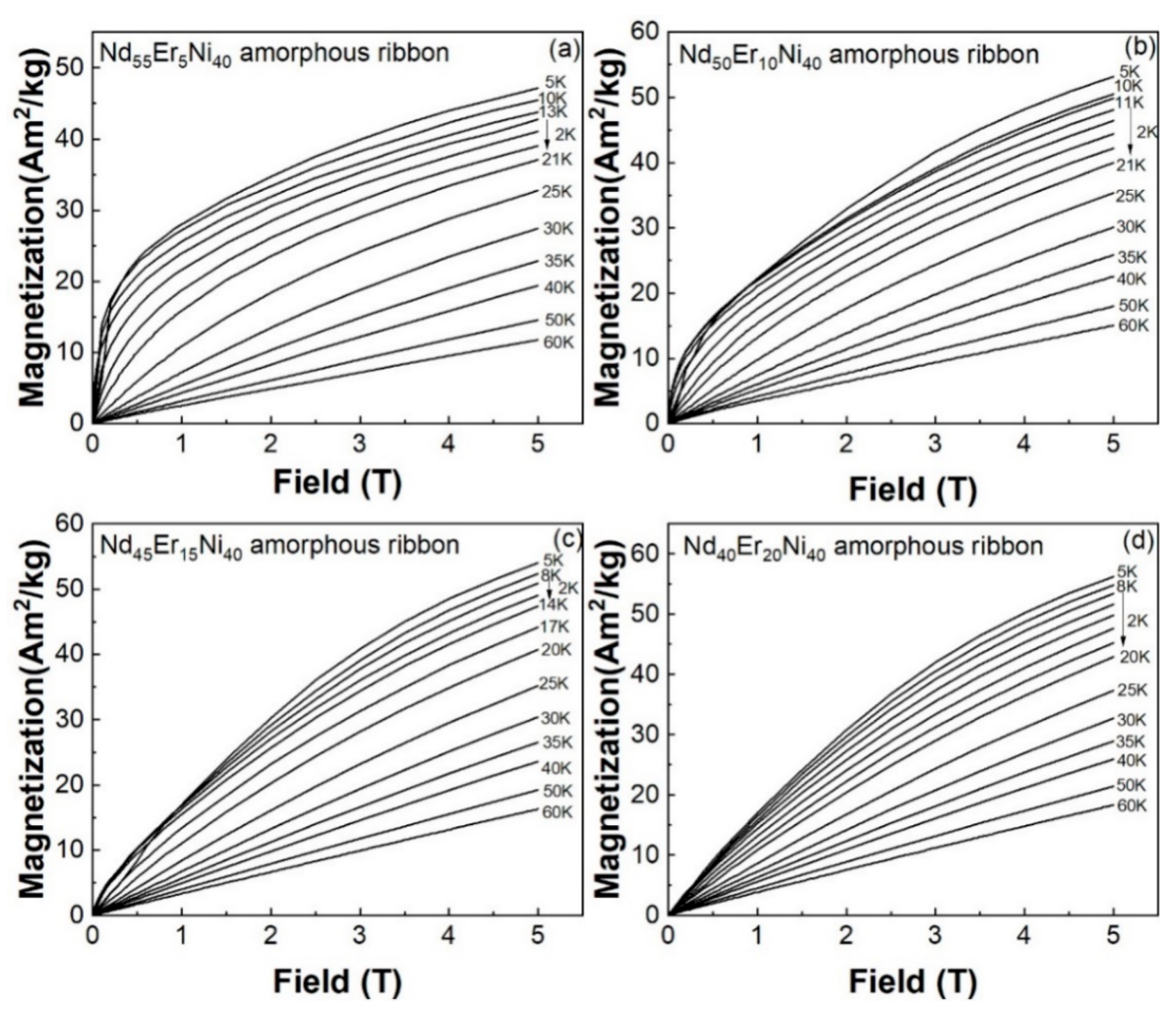
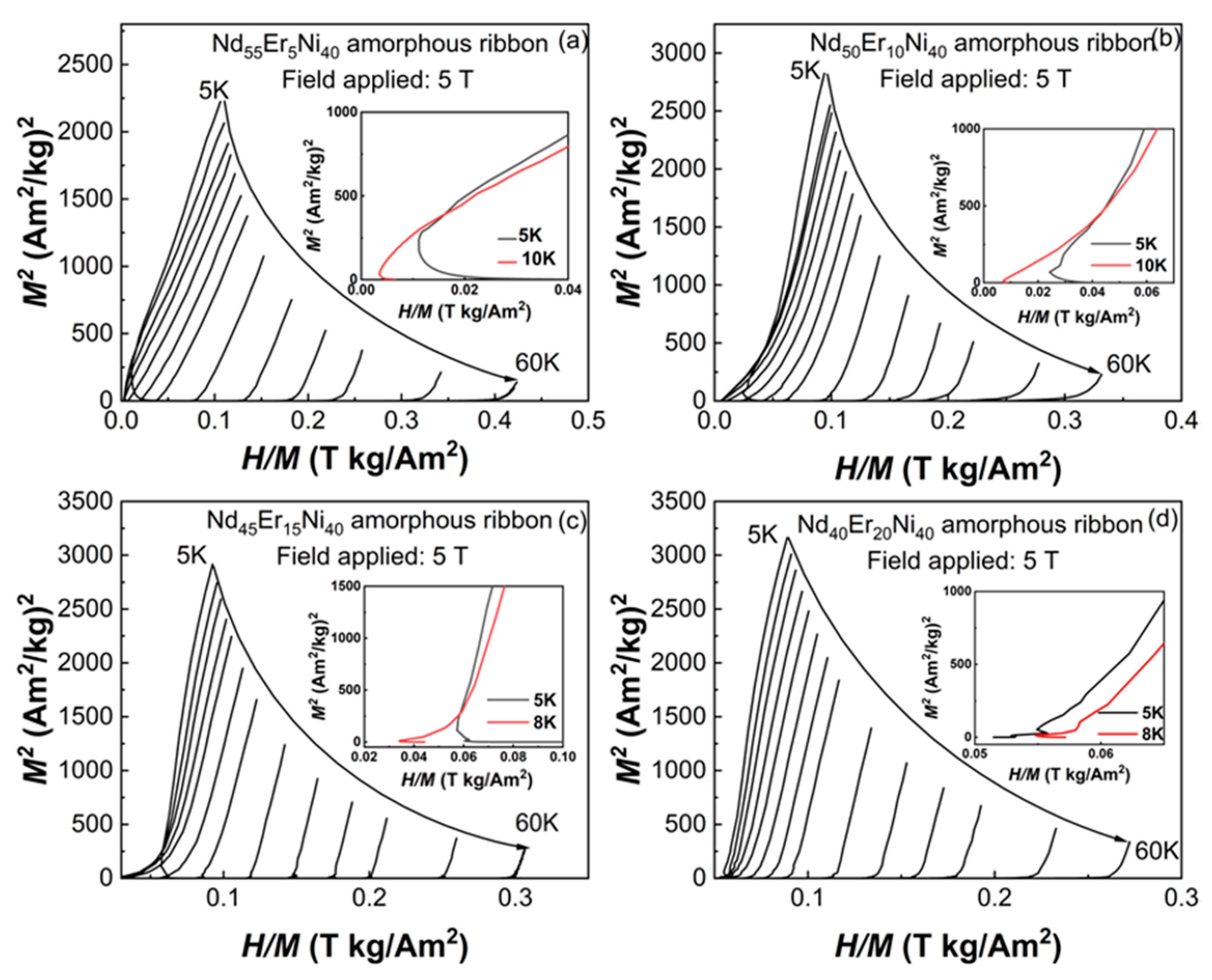
The magnetization behaviors of the Nd60-xErxNi40 MG ribbons are further affected by the SGL phenomena and the competition between ferromagnetic and antiferromagnetic interactions. The isothermal M-H curves of the Nd60-xErxNi40 ribbons at various temperatures are shown in Figure 6. The M-H curves of the Nd60-xErxNi40 ribbons clearly exhibit characteristics that are typical of SGL behaviors at temperatures lower than their Tf, and the magnetic susceptibility of the MG samples gradually decreases with increasing Er content. To illustrate the SGL behaviors in a more detailed way, the Arrott plots of the amorphous Nd60-xErxNi40 ribbons were constructed, as shown in Figure 7a for x = 5, (b) for x = 10, (c) for x = 15, and (d) for x = 20. All the samples show C-shaped Arrott plots with negative slopes below Tf, as shown in the insets of Figure 7a–d, which are the typical SGL characteristics in amorphous samples. On the other hand, the introduction of antiferromagnetic Er atoms may bring about a delay in the magnetic response, resulting in a gradual decrease in magnetic susceptibility with increasing Er content in the Er-doped Nd60Ni40 MGs.
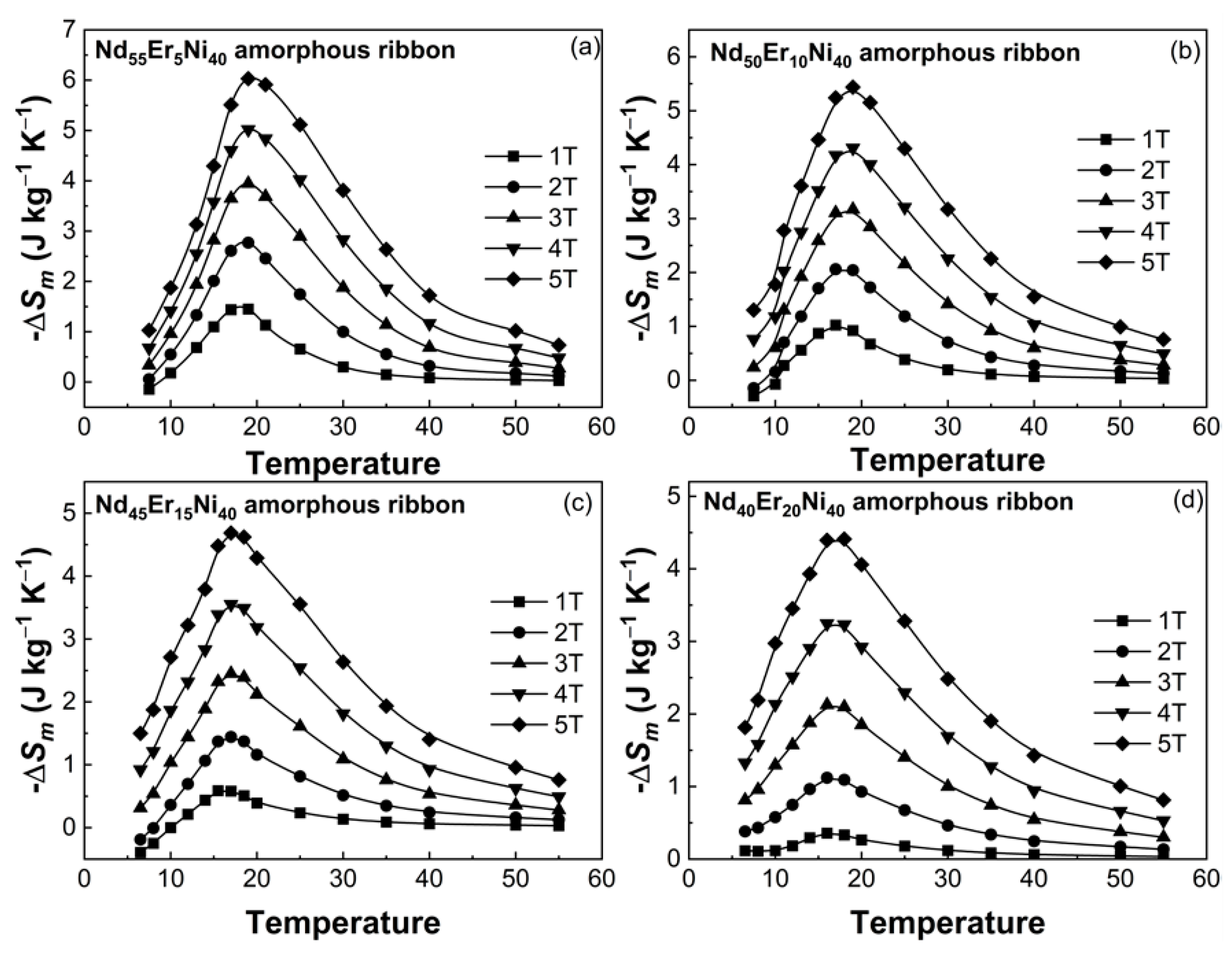
The effect of SGL behaviors and the competition between ferromagnetic and antiferromagnetic interactions on the magnetization behaviors of the MG samples may also influence their magnetocaloric performance. Figure 8 shows the magnetic entropy change ((−ΔSm)-T) curves of the Nd60-xErxNi40 MG ribbons under applied fields of 1 T, 2 T, 3 T, 4 T, and 5 T. The −ΔSmpeak of the Nd60-xErxNi40 MG under various magnetic fields and its RC under 5 T are summarized in Table 2. −ΔSmpeak under 5 T decreases gradually from 7.86 J/(kg × K) when x = 0, to 6.08 J/(kg × K) when x = 5, 5.45 J/(kg × K) when x = 10, 4.72 J/(kg × K) when x = 15, and 4.45 J/(kg × K) when x = 20. The RC of the Nd60-xErxNi40 MG ribbons under 5 T also decreases from 172 J/kg (x = 0), to 122 J/kg (x = 5), 114 J/kg (x = 10), 109 J/kg (x = 15), and finally 108 J/kg (x = 20). This suggests that the introduction of Er atoms gives rise to antiferromagnetic coupling in the alloy, subsequently reduces the total magnetic ordering degree, and finally, deteriorates the magnetocaloric properties of the Nd60-xErxNi40 MGs. As a result, the enhancement of the MCE of RE-TM-based amorphous alloys not only depends on using RE elements with high magnetic moments, but also on the magnetic coupling between RE elements.

4. Conclusions

In the present work, we replaced Nd atoms with Er atoms with a higher effective magnetic moment and de Gennes factor, with the hope of improving the GFA and magnetocaloric properties of a Nd60Ni40 amorphous alloy. Amorphous Nd60-xErxNi40 ribbons were successfully fabricated, and their amorphous structure was ascertained by XRD detection. Based on the thermal properties of the Nd60-xErxNi40 MG ribbons, as measured by DSC, the GFA of these alloys was studied. It was found that the γ parameter increased monotonously with the addition of Er, while Trg v was enhanced by Er substitution from 5% to 10% and then decreased with any further addition of Er, indicating that the Er substitution generally increases the GFA of Nd60Ni40 MG. The Nd60-xErxNi40 MG ribbons show typical SGL behaviors in their M-T curves, and their Tc, as well as Tf, decrease gradually with the addition of Er, although the de Gennes factor of Er is higher than that of Nd. It is supposed that the antiferromagnetic structure of the atomic magnetic moment between Nd and Er brings about a negative G value in Er, resulting in a decrease in total G values in the Nd60-xErxNi40 MGs with the addition of Er, and finally leads to a decrease in Curie temperature with increasing Er content. On the other hand, Er substitution with a higher effective magnetic moment not only failed to improve the magnetocaloric performance of Nd60Ni40 MG, but actually reduced the −ΔSmpeak and RC of the alloys. It was argued that the introduction of Er atoms gives rise to antiferromagnetic coupling in the alloy, subsequently reducing the total magnetic ordering degree, and finally deteriorating the magnetocaloric properties of the Nd60-xErxNi40 MGs. Therefore, the enhancement of the MCE of the RE-TM-based amorphous alloy depends not only on the high magnetic moments of the substituted RE elements but also on the magnetic coupling between the RE elements.

Author Contributions

L.X. and D.D. defined the topic and the main content of the review. N.C. and S.-T.Y. jointly completed the experiment. N.C. wrote the initial draft, which was reviewed and completed by L.X. All authors have read and agreed to the published version of the manuscript.

Funding

The work was supported by the National Natural Science Foundation of China, grant numbers 51871139 and 52071196.

Institutional Review Board Statement

Not applicable.

Informed Consent Statement

Not applicable.

Data Availability Statement

The original contributions presented in this study are included in the article. Further inquiries can be directed to the corresponding authors.

Conflicts of Interest

The authors declare no conflicts of interest.

References

  1. Klement, W.; Willens, R.; Duwez, P. Non-Crystalline Structure in Solidified Gold-Silicon Alloys. Nature 1960, 187, 869–870. [Google Scholar] [CrossRef]
  2. Wang, W.H.; Dong, C.; Shek, C.H. Bulk Metallic Glasses. Mater. Sci. Eng. R Rep. 2004, 44, 45–89. [Google Scholar] [CrossRef]
  3. Louzguine-Luzgin, D.V.; Louzguina-Luzgina, L.V.; Churyumov, A.Y. Mechanical Properties and Deformation Behavior of Bulk Metallic Glasses. Metals 2013, 3, 1–22. [Google Scholar] [CrossRef]
  4. Ming, W.; Guo, X.; Xu, Y.; Zhang, G.; Jiang, Z.; Li, Y.; Li, X. Progress in Non-Traditional Machining of Amorphous Alloys. Ceram. Int. 2023, 49, 1585–1604. [Google Scholar] [CrossRef]
  5. Zhai, T.G.; Yuan, J.M.; Li, Z.B.; Ding, D.; Xia, L. Magnetocaloric Response of an Eutectic Er69Ni31 Amorphous Alloy. Magnetochemistry 2025, 11, 106. [Google Scholar] [CrossRef]
  6. Li, Z.B.; Yuan, J.M.; Wang, Q.; Ding, D.; Xia, L. Achieving Higher Curie Temperature and Magnetic Entropy Change by Minor Co Substitution for Fe in a Fe88Pr10Al2 Amorphous Alloy. Intermetallics 2026, 189, 109125. [Google Scholar] [CrossRef]
  7. Yuan, J.M.; Li, Z.B.; Zhai, T.G.; Wang, Q.; Ding, D.; Xia, L. Effect of Pr and Nd Replacement for Zr on the Magnetic and Magnetocaloric Properties of the Fe88Zr10B2 Amorphous Alloy. Mod. Phys. Lett. B 2025, 40, 2650012. [Google Scholar] [CrossRef]
  8. Franco, V.; Blázquez, J.S.; Ipus, J.J.; Law, J.Y.; Moreno-Ramírez, L.M.; Conde, A. Magnetocaloric Effect: From Materials Research to Refrigeration Devices. Prog. Mater. Sci. 2018, 93, 112–232. [Google Scholar] [CrossRef]
  9. Gschneidner, K.A., Jr.; Pecharsky, V.K. Magnetocaloric Materials. Annu. Rev. Mater. Res. 2000, 30, 387–429. [Google Scholar] [CrossRef]
  10. Yu, B.F.; Gao, Q.; Zhang, B.; Meng, X.Z.; Chen, Z. Review on Research of Room Temperature Magnetic Refrigeration. Int. J. Refrig. 2003, 26, 622–636. [Google Scholar] [CrossRef]
  11. Brown, G.V. Magnetic Heat Pumping Near Room Temperature. J. Appl. Phys. 1976, 47, 3673–3680. [Google Scholar] [CrossRef]
  12. Hu, F.X.; Shen, B.G.; Sun, J.R.; Cheng, Z.H.; Rao, G.H.; Zhang, X.X. Influence of Negative Lattice Expansion and Metamagnetic Transition on Magnetic Entropy Change in the Compound LaFe11.4Si1.6. Appl. Phys. Lett. 2001, 8, 3675–3677. [Google Scholar] [CrossRef]
  13. Shen, B.G.; Sun, J.R.; Hu, F.X.; Zhang, H.W.; Cheng, Z.H. Recent Progress in Exploring Magnetocaloric Materials. Adv. Mater. 2009, 21, 4545–4564. [Google Scholar] [CrossRef]
  14. Wada, H.; Morikawa, T.; Taniguchi, K.; Shibata, T.; Yamada, Y.; Akishige, Y. Giant Magnetocaloric Effect of MnAs1-xSbx in the Vicinity of First-Order Magnetic Transition. Phys. B-Condens. Matter 2003, 328, 114–116. [Google Scholar] [CrossRef]
  15. Wang, X.; Wang, Q.; Tang, B.Z.; Yu, P.; Xia, L.; Ding, D. Large Magnetic Entropy Change and Adiabatic Temperature Rise of a Ternary Gd34Ni33Al33 Metallic Glass. J. Rare Earths 2021, 39, 998–1002. [Google Scholar] [CrossRef]
  16. Huo, J.T.; Huo, L.S.; Li, J.W.; Men, H.; Wang, X.M.; Inoue, A.; Chang, C.; Wang, J.Q.; Li, R.W. High-Entropy Bulk Metallic Glasses as Promising Magnetic Refrigerants. J. Appl. Phys. 2015, 117, 073902. [Google Scholar] [CrossRef]
  17. Inoue, A. Stabilization of Metallic Supercooled Liquid and Bulk Amorphous Alloys. Acta Mater. 2000, 48, 279–306. [Google Scholar] [CrossRef]
  18. Wang, Q.; Ding, D.; Xia, L. Origin of Random Magnetic Anisotropy in a Fully Amorphous Tb55Co45 Alloy. J. Alloys Compd. 2025, 1039, 183378. [Google Scholar] [CrossRef]
  19. Luo, Q.; Wang, W.H. Magnetocaloric Effect in Rare Earth-Based Bulk Metallic Glasses. J. Alloys Compd. 2010, 495, 209–216. [Google Scholar] [CrossRef]
  20. Yu, P.; Zhang, N.Z.; Xia, L. Achieving an Enhanced Magneto-Caloric Effect by Melt Spinning a Gd55Co25Al20 Bulk Metallic Glass into Amorphous Ribbons. J. Alloys Compd. 2016, 655, 353–356. [Google Scholar] [CrossRef]
  21. Gao, W.L.; Wang, X.J.; Wang, L.J.; Zhang, Y.K.; Cui, J.Z. Cryogenic Magnetic Properties of Er60Ni30Co10 Amorphous Ribbon. J. Non-Cryst. Solids 2018, 484, 36–39. [Google Scholar] [CrossRef]
  22. Wang, P.; Wang, Q.; Yuan, J.; Zhai, T.; Li, Z.; Ding, D.; Xia, L. Excellent Magnetocaloric Effect Near the Hydrogen Liquefaction Temperature of a Binary Er67.5Co32.5 Metallic Glass. J. Non-Cryst. Solids 2024, 646, 123224. [Google Scholar] [CrossRef]
  23. Zhang, H.T.; Wang, Q.; Xia, L. Investigation on the Glass Forming Ability, Magnetic Properties of Nd-Ni Binary Metallic Glasses and the Mechanism Involved. J. Alloys Compd. 2025, 1027, 180569. [Google Scholar] [CrossRef]
  24. Coey, J.M.D. Magnetism and Magnetic Materials, 1st ed.; Cambridge University Press: Cambridge, UK, 2010. [Google Scholar] [CrossRef]
  25. Turnbull, D. Under What Conditions Can a Glass Be Formed? Contemp. Phys. 1969, 10, 473–488. [Google Scholar] [CrossRef]
  26. Lu, Z.P.; Liu, C.T. Glass Formation Criterion for Various Glass-Forming Systems. Phys. Rev. Lett. 2003, 91, 115505. [Google Scholar] [CrossRef]
  27. Lu, Z.P.; Liu, C.T. A New Glass-Forming Ability Criterion for Bulk Metallic Glasses. Acta Mater. 2002, 50, 3501–3512. [Google Scholar] [CrossRef]
  28. Jensen, J.; Mackintosh, A.R. Rare Earth Magnetism: Structures and Excitations, 1st ed.; Oxford University Press: Oxford, UK, 1991. [Google Scholar] [CrossRef]
  29. Ruderman, M.A.; Kittel, C. Indirect Exchange Coupling of Nuclear Magnetic Moments by Conduction Electrons. Phys. Rev. 1954, 96, 99–102. [Google Scholar] [CrossRef]
  30. Kasuya, T. A Theory of Metallic Ferro- and Antiferromagnetism on Zener’s Model. Prog. Theor. Phys. 1956, 16, 45–57. [Google Scholar] [CrossRef]
  31. Yosida, K. Magnetic Properties of Cu-Mn Alloys. Phys. Rev. 1957, 106, 893–898. [Google Scholar] [CrossRef]
  32. Hindmarch, A.T.; Hickey, B.J. Direct Experimental Evidence for the Ruderman-Kittel-Kasuya-Yosida Interaction in Rare-Earth Metals. Phys. Rev. Lett. 2003, 91, 116601. [Google Scholar] [CrossRef] [PubMed]
  33. Blanco-Rey, M.; Castrillo, R.; Ali, K.; Gargiani, P.; Ilyn, M.; Gastaldo, M.; Paradinas, M.; Valbuena, M.A.; Mugarza, A.; Ortega, J.E.; et al. The Role of Rare-Earth Atoms in the Anisotropy and Antiferromagnetic Exchange Coupling at a Hybrid Metal–Organic Interface. Small 2024, 20, 2402328. [Google Scholar] [CrossRef]
  34. Swift, W.M.; Wallace, W.E. Reversal of Coupling in Intermetallic Compounds Containing Two Rare Earth Elements. J. Solid State Chem. 1971, 3, 180–183. [Google Scholar] [CrossRef]
  35. Holmström, E.; Bock, N.; Peery, T.; Chisolm, E.; Lizárraga, R.; De Lorenzi-Venneri, G.; Wallace, D. Structure Discovery for Metallic Glasses Using Stochastic Quenching. Phys. Rev. B 2010, 82, 024203. [Google Scholar] [CrossRef]
  36. De Lorenzi-Venneri, G.; Wallace, D.C. Single-Random-Valley Approximation in Vibration-Transit Theory of Liquid Dynamics. Phys. Rev. E 2007, 76, 041203. [Google Scholar] [CrossRef]
  37. Lizárraga, R. Structural and Magnetic Properties of the Gd-Based Bulk Metallic Glasses GdFe2, GdCo2, and GdNi2 from First Principles. Phys. Rev. B 2016, 94, 174201. [Google Scholar] [CrossRef]
  38. Kresse, G.; Furthmüller, J. Efficient Iterative Schemes for Ab Initio Total-Energy Calculations Using a Plane-Wave Basis Set. Phys. Rev. B 1996, 54, 11169–11186. [Google Scholar] [CrossRef] [PubMed]
  39. Blöchl, P.E. Projector Augmented-Wave Method. Phys. Rev. B 1994, 50, 17953. [Google Scholar] [CrossRef]
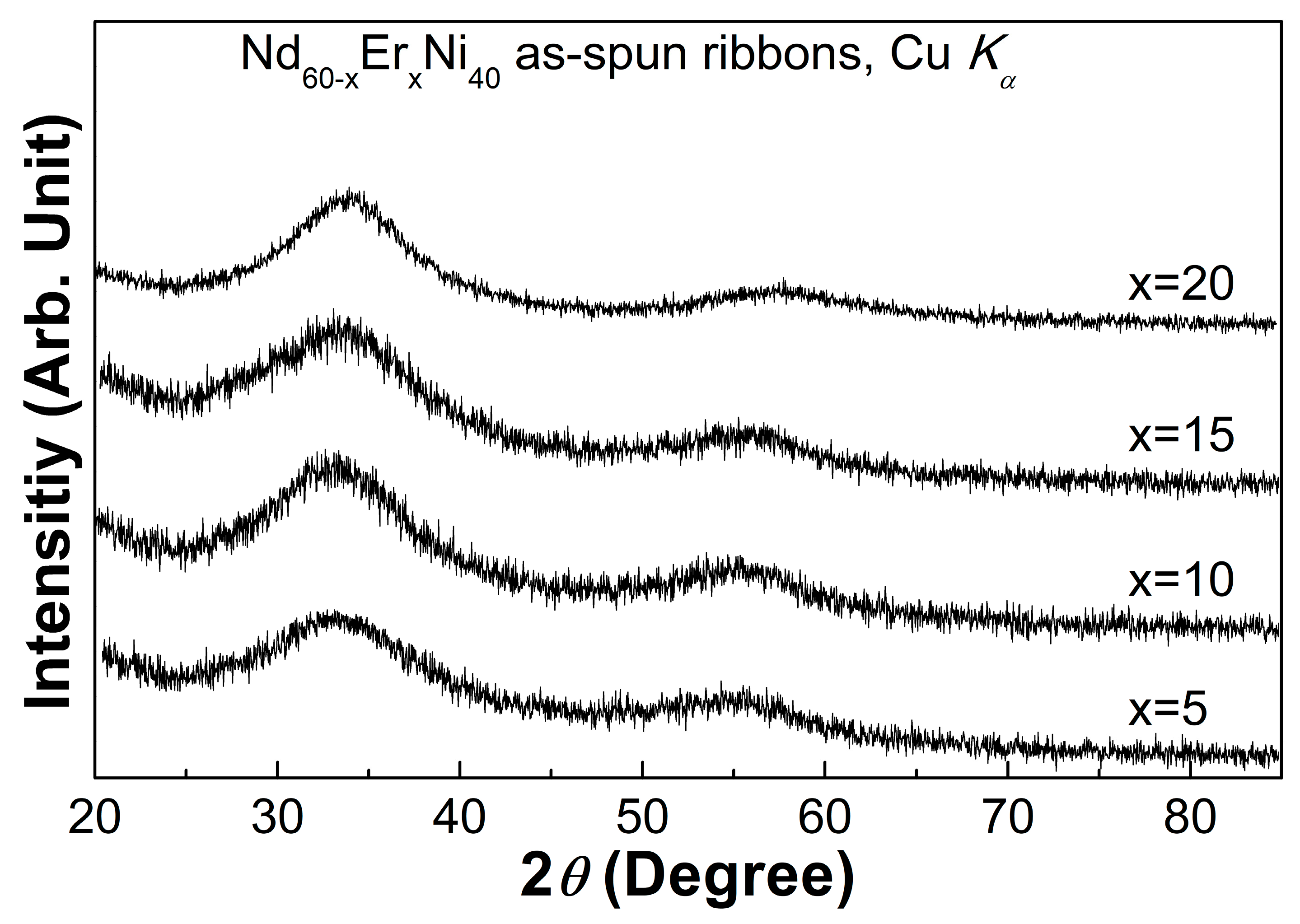
Figure 1. XRD patterns of the Nd60-xErxNi40 as-spun ribbons.
Magnetochemistry 12 00024 g001
Figure 2. DSC traces of the Nd60-xErxNi40 amorphous ribbons, (a) x = 5, (b) x = 10, (c) x = 15, and (d) x = 20; the insets are their respective melting behaviors.
Magnetochemistry 12 00024 g002
Figure 3. Compositional dependence of Trg and γ in the Nd60-xErxNi40 MG ribbons.
Magnetochemistry 12 00024 g003
Figure 4. ZFC and FC M-T curves of the Nd60-xErxNi40 MG ribbons measured under 0.03 T, (a) x = 5, (b) x = 10, (c) x = 15, and (d) x = 20.
Magnetochemistry 12 00024 g004
Figure 5. Compositional dependence of Tc and Tf of the Nd60-xErxNi40 MG ribbons.
Magnetochemistry 12 00024 g005
Figure 6. The isothermal M-H curves of the Nd60-xErxNi40 ribbons at various temperatures: (a) x = 5, (b) x = 10, (c) x = 15, and (d) x = 20.
Magnetochemistry 12 00024 g006
Figure 7. The Arrott plots for the Nd60-xErxNi40 MGs: (a) x = 5, (b) x = 10, (c) x = 15, and (d) x = 20. The insets show the Arrott curves for temperatures below Tf.
Magnetochemistry 12 00024 g007
Figure 8. (−ΔSm)-T curves of the Nd60-xErxNi40 MGs under 1 T, 2 T, 3 T, 4 T, and 5 T: (a) x = 5, (b) x = 10, (c) x = 15, and (d) x = 20.
Magnetochemistry 12 00024 g008
Table 1. Tg, Tx, Tl, Trg, and γ of the Nd60-xErxNi40 MG ribbons.
CompositionTg (K)Tx (K)Tl (K)Trg (K)γ
Nd55Er5Ni404274748730.4890.364
Nd50Er10Ni404394828840.4970.365
Nd45Er15Ni404214858880.4740.370
Nd40Er20Ni404335009030.4800.374
Table 2. Tc, Tf, −ΔSmpeak and RC of the Nd60-xErxNi40 MG ribbons.
CompositionTc (K)Tf (K)−ΔSmpeak (J/(kg × K))RC (5T)
(J/kg)
1T2T3T4T5T
Nd60Ni4018.312.12.103.895.46.717.86172
Nd55Er5Ni4016.611.21.452.773.945.026.08122
Nd50Er10Ni4015.211.41.022.063.174.315.45114
Nd45Er15Ni4013.611.60.591.442.453.554.72109
Nd40Er20Ni4012.811.40.361.122.132.924.45108
Disclaimer/Publisher’s Note: The statements, opinions and data contained in all publications are solely those of the individual author(s) and contributor(s) and not of MDPI and/or the editor(s). MDPI and/or the editor(s) disclaim responsibility for any injury to people or property resulting from any ideas, methods, instructions or products referred to in the content.