Article

Magnetically Recoverable Fe3O4@Latex Decorated with ZnO Nanocomposite for Efficient Photocatalytic Treatment of Sugarcane Vinasse


by
Lays da Silva Sá Gomes
1,
Daniel Ângelo Macena
1,
Maryane Pipino Beraldo Almeida
1,
Naiara Maria Pavani
1,
Iara Souza Lima
2,
Aroldo Geraldo Magdalena
3,
Oswaldo Baffa
4 and
Angela Kinoshita
1,*
1
Pro-Rectory of Research and Graduate Studies, University of Western São Paulo—UNOESTE, Presidente Prudente 19065-175, Brazil
2
Department of Chemistry, University of São Paulo—USP, Ribeirão Preto 14040-900, Brazil
3
Department of Chemistry, São Paulo State University—UNESP, Bauru 17033-360, Brazil
4
Department of Physics, University of São Paulo—USP, Ribeirão Preto 14040-900, Brazil
*
Author to whom correspondence should be addressed.
Magnetochemistry 2026, 12(2), 23; https://doi.org/10.3390/magnetochemistry12020023
Submission received: 12 December 2025 / Revised: 29 January 2026 / Accepted: 2 February 2026 / Published: 6 February 2026

Abstract

Sugarcane vinasse is a high-strength effluent with a high organic load and intense coloration from melanoidins and phenolic compounds, making conventional biological treatment difficult. This study presents a magnetically recoverable Fe3O4@latex-ZnO nanocomposite, synthesized using natural Hevea brasiliensis latex as a green polymeric interlayer. Transmission Electron Microscopy (TEM) shows a core–shell structure that enhances ZnO anchoring and reduces aggregation. X-ray Diffraction (XRD) confirms the coexistence of spinel Fe3O4 and wurtzite ZnO without secondary phases, while Fourier Transformed Infrared Spectroscopy (FTIR) verifies the latex layer through characteristic organic bands, indicating a stable organic–inorganic interface. Under 4 h of UV irradiation, the nanocomposite significantly reduced vinasse COD from 23,450 to 12,450–13,150 mg L−1 (≈44–47%) and BOD from 11,600 to 4800–5000 mg L−1 (≈57–59%), demonstrating substantial oxidation of the organic fraction. The magnetic core enables quick separation post-treatment, enhancing the practicality of the process. Overall, this innovative approach positions the ZnO nanocomposite as a promising option for vinasse pre-treatment and integrated agro-industrial effluent treatment.

1. Introduction

Sugarcane ethanol production plays a crucial role in the global shift to renewable energy sources, particularly in Brazil, where it serves as a fundamental component of the national bioenergy matrix. While it offers a favorable energy balance and produces lower greenhouse gas (GHG) emissions than fossil fuels, ethanol production generates significant volumes of vinasse (stillage). This liquid residue is characterized by an extremely high organic load, an acidic pH, elevated salinity, and a deep dark color. Typically, the production process yields 10–20 L of vinasse per liter of ethanol, posing considerable environmental and logistical challenges for sustainable management [1,2].
The complex composition of vinasse significantly hinders the efficiency of conventional treatment methods. Melanoidins, high-molecular-weight polymeric compounds from Maillard reactions, contribute to their intense color and resistance to biological degradation [3,4]. These compounds disrupt UV disinfection and anaerobic digestion processes and persist in wastewater due to their structural heterogeneity and complex organic bonds [4,5,6]. Additionally, phenolic compounds increase color intensity and toxicity, further complicating treatment [7].
Advanced Oxidation Processes (AOPs) have emerged as promising strategies for vinasse treatment. By generating powerful oxidizing species such as hydroxyl radicals (•OH) and superoxide radicals (•O2), AOPs can non-selectively oxidize recalcitrant organic molecules into smaller intermediates or mineralization products [7,8,9]. This method enhances biodegradation, reduces toxicity, and improves the treatability of refractory wastewaters [7]. Key mechanisms of AOPs include UV/H2O2 photolysis, Fenton reactions, photocatalysis, and other radical-driven oxidation pathways [7,8].
Zinc oxide (ZnO) is a prominent heterogeneous photocatalyst used in advanced oxidation processes (AOPs) because of its wide band gap (~3.3 eV), high UV photosensitivity, chemical stability, low cost, and ability to generate reactive oxygen species (ROS) under photoexcitation [9,10,11,12]. However, its application in real wastewater is limited by rapid electron–hole recombination, nanoparticle agglomeration, and difficulties in recovering the catalyst as a fine powder [12,13]. These issues have led to the development of composite and hybrid photocatalysts to enhance charge separation and operational practicality.
A common strategy to address these challenges is to incorporate magnetic components, particularly magnetite (Fe3O4), into photocatalytic systems. Magnetic photocatalysts enable quick, efficient separation using an external magnetic field, reducing catalyst loss and facilitating reuse [14]. Additionally, Fe3O4-ZnO heterojunctions enhance photocatalytic performance by promoting interfacial charge transfer, decreasing electron–hole recombination, and increasing charge-carrier lifetime [15,16]. The interface quality between semiconductor and magnetic phases is vital for photocatalytic efficiency, especially in complex wastewater matrices where mass-transfer limitations and optical attenuation are significant issues [15].
Alongside inorganic engineering methods, there is increasing interest in using polymeric and bio-based matrices to stabilize nanocomposites and enhance their performance in aggressive chemical environments. Polymers can prevent nanoparticle agglomeration, influence nucleation and growth, provide anchoring sites for photoactive phases, and protect magnetic cores from corrosion and metal leaching in aqueous settings [17,18].
Natural rubber latex, derived from Hevea brasiliensis, is an exceptional, renewable, and bio-based polymer. It exhibits low toxicity and is environmentally friendly compared to synthetic stabilizers from fossil feedstocks [19]. Research indicates that latex-coated iron oxide nanoparticles offer improved dispersion, surface stability, and reduced aggregation, with minimal ecotoxicological risks, making them suitable for environmental remediation technologies [20,21]. Thus, using natural latex aligns with green chemistry principles, the circular economy, and the utilization of renewable resources, especially in agro-industrial regions with readily available biomass and latex [22].

Novelty and Scope of This Study

Although UV-driven heterogeneous photocatalysis has been extensively studied, its application to sugarcane vinasse is limited by high turbidity, complex composition, and significant light attenuation, unlike in model dye studies [10]. Furthermore, most magnetic photocatalysts focus on fully inorganic architectures, often overlooking the benefits of sustainable biopolymeric matrices for interfacial stability and robustness [17]. In this study, we introduce a core–shell Fe3O4@latex nanocomposite coated with ZnO, in which natural Hevea brasiliensis latex serves as a biopolymeric interlayer between the magnetic core and the ZnO photoactive phase. This architecture aims to improve ZnO dispersion, protect the Fe3O4 core, and enhance operational stability while maintaining magnetic recoverability. We assess the photocatalytic performance of the latex-coated system using real sugarcane vinasse, measuring COD and BOD as indicators of organic matter oxidation, and compare it with a latex-free Fe3O4–ZnO counterpart synthesized under similar conditions. This integration positions latex-coated magnetic nanocomposites as a viable and robust solution for advanced pre-treatment of agro-industrial effluents.

2. Materials and Methods

2.1. Reagents and Materials

The following materials were used: Ferric chloride hexahydrate (FeCl3·6H2O, CAS No. 10025-77-1), ferrous chloride tetrahydrate (FeCl2·4H2O, CAS No. 13478-10-9), sodium hydroxide (NaOH, CAS No. 1310-73-2), and zinc sulfate heptahydrate (ZnSO4·7H2O, CAS No. 7446-20-0), all received in their current condition. Natural latex from Hevea brasiliensis was preserved in ammonia (NH3, CAS No. 7664-41-7) with a rubber content of 24 wt.%. All chemical reagents were supplied by Sigma-Aldrich (Saint Louis, MO, USA). and were analytical-grade or high-purity. Vinasse was collected from a sugar-energy plant in Presidente Prudente, São Paulo, Brazil.

2.2. Synthesis of Magnetite Nanoparticles (Fe3O4)

Magnetite nanoparticles (Fe3O4) were synthesized by chemical co-precipitation from ferric chloride hexahydrate (FeCl3·6H2O) and ferrous chloride tetrahydrate (FeCl2·4H2O) as iron precursors. Two aqueous solutions (200 mL each) were prepared, one with FeCl3·6H2O (0.20 mol·L−1) and the other with FeCl2·4H2O (0.10 mol·L−1), maintaining a Fe3+/Fe2+ molar ratio of 2:1. The solutions were mixed under a nitrogen (N2) atmosphere, and 20 mL of ammonium hydroxide (NH4OH, analytical grade) was added as the precipitating agent. The reaction was conducted under continuous magnetic stirring with a flow of N2(g) for 1 h, yielding a black Fe3O4 precipitate. Subsequently, the material was subjected to magnetic separation and washed with distilled water until the supernatant pH reached neutrality. The nanoparticles were then oven-dried at 60 °C for 4 h and calcined in a muffle furnace at 200 °C for 2 h to stabilize the structure [21].

2.3. Coating of Nanoparticles with Natural Latex

To prepare the Fe3O4@latex nanocomposite, 1.0 g of the synthesized Fe3O4 nanoparticles was dispersed in 200 mL of an aqueous NaOH solution (0.40 mol·L−1) under magnetic stirring. A controlled coagulation of natural latex preserved in NH3 (20 mL) was then performed by dripping it into the solution, allowing the polymer to adsorb and coagulate onto the nanoparticles, following Arsalani et al., 2018 [22] with adaptations. The resulting material was washed, filtered, and dried at 60 °C to produce the Fe3O4@latex composite.

2.4. Functionalization with ZnO

Fe3O4 and Fe3O4@latex served as substrates for ZnO deposition [23]. A total of 1.0 g of the samples were dispersed in 200 mL of an aqueous NaOH solution (0.40 mol·L−1) and stirred magnetically. The dropwise addition of 200 mL of aqueous ZnSO4·7H2O (0.005 mol·L−1) was conducted until zinc hydroxide precipitated on the nanomaterials [9]. The samples were filtered, dried at 60 °C, and calcinated at 150 °C for 1 h, yielding Fe3O4–ZnO and Fe3O4@latex decorated with ZnO nanocomposites.

2.5. Physicochemical Characterizations

The materials were characterized physicochemically using complementary techniques. Transmission electron microscopy (TEM—JEOL EM-1400 Flash, MA, USA) was used to evaluate particle morphology, distribution, and core–shell structure formation.
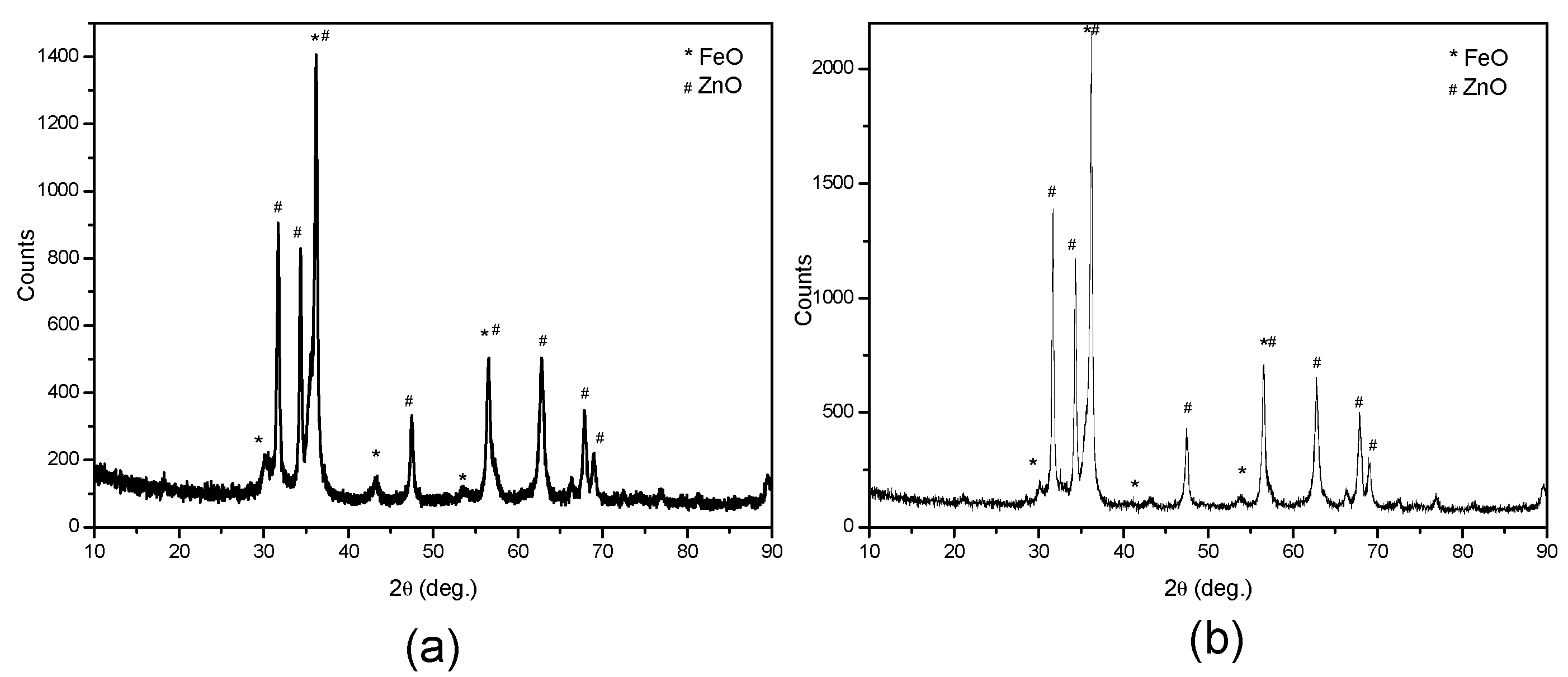
X-ray diffraction (XRD) was used to identify crystalline phases, confirming the spinel structure of magnetite (Fe3O4) and the wurtzite phase of ZnO and confirming their stability after coating with latex. Analysis was performed with the Bruker-AXS D2 Phaser (Billerica, MA, USA) at 30 kV and 10 mA, using CuKα1 radiation (λ = 1.54060 Å). All samples were analyzed with a step of 0.05 degrees and a time per step of 0.5 s.
Infrared spectroscopy (FTIR) was used to identify functional groups in natural latex and to explore chemical interactions between the polymer and the inorganic phases Fe3O4 and ZnO. FTIR spectra were recorded using a Shimadzu IR Prestige-21 spectrophotometer (Kyoto, Japan) with an Attenuated Total Reflectance (ATR) device, covering a range of 4000–650 cm−1 at a resolution of 2 cm−1.

2.6. Photocatalytic Tests

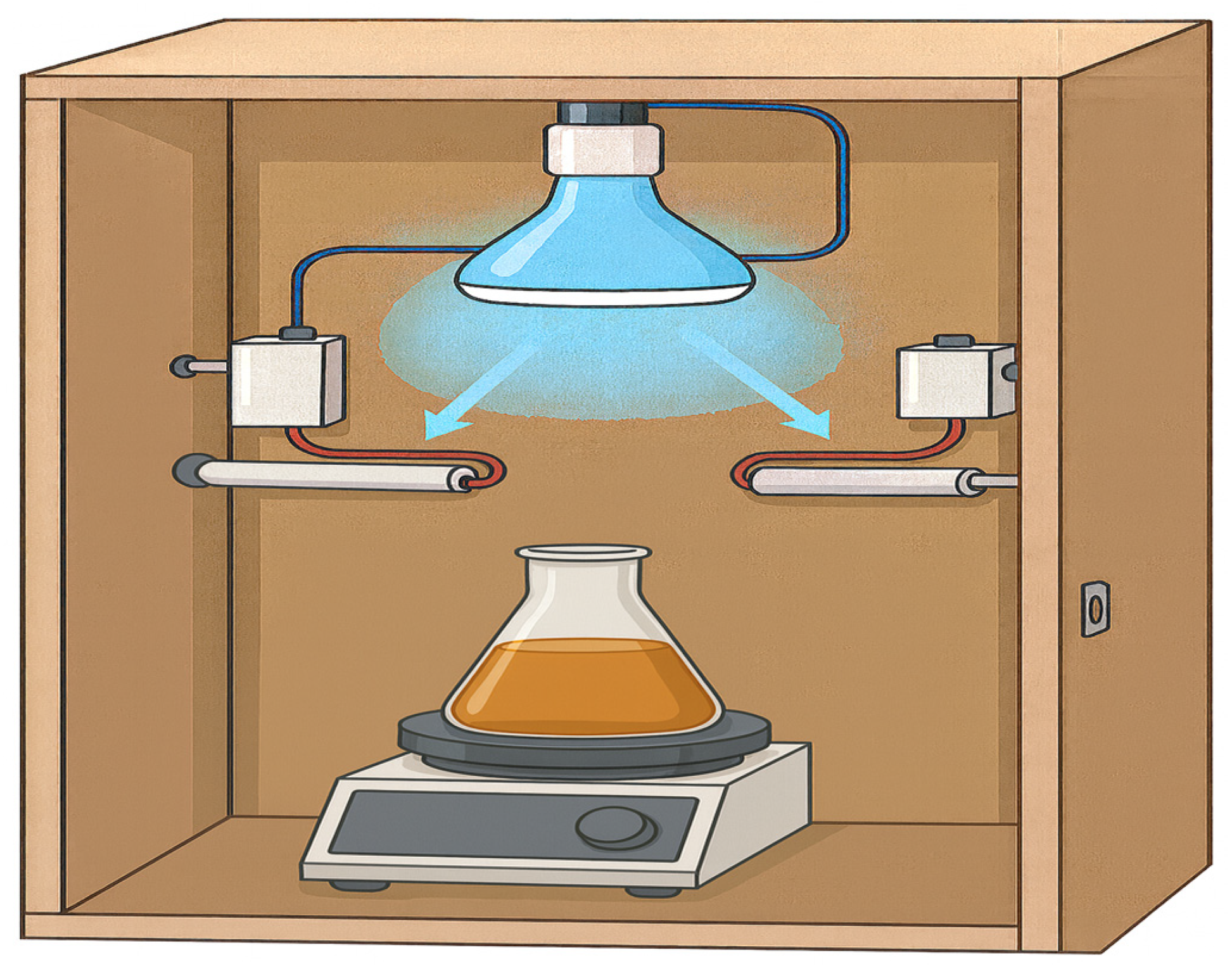
Photocatalytic tests were conducted in a reactor equipped with UV lamps (36 W (UV-C—Osram Puritec GmbH, Munich, Germany) and 300 W (UV—Osram Ultravitalux GmbH, Munich, Germany), using a fixed mass of catalyst, to evaluate the catalyst’s effectiveness in degrading vinasse (Figure 1). The vinasse was diluted 1:40, and the experiment ran for 4 h with 0.4 g of catalyst and 200 mL of solution. COD and BOD analyses were performed on samples collected before and after treatment, following standardized methodologies [24,25].

3. Results

3.1. Morphology and Core–Shell Architecture (TEM)

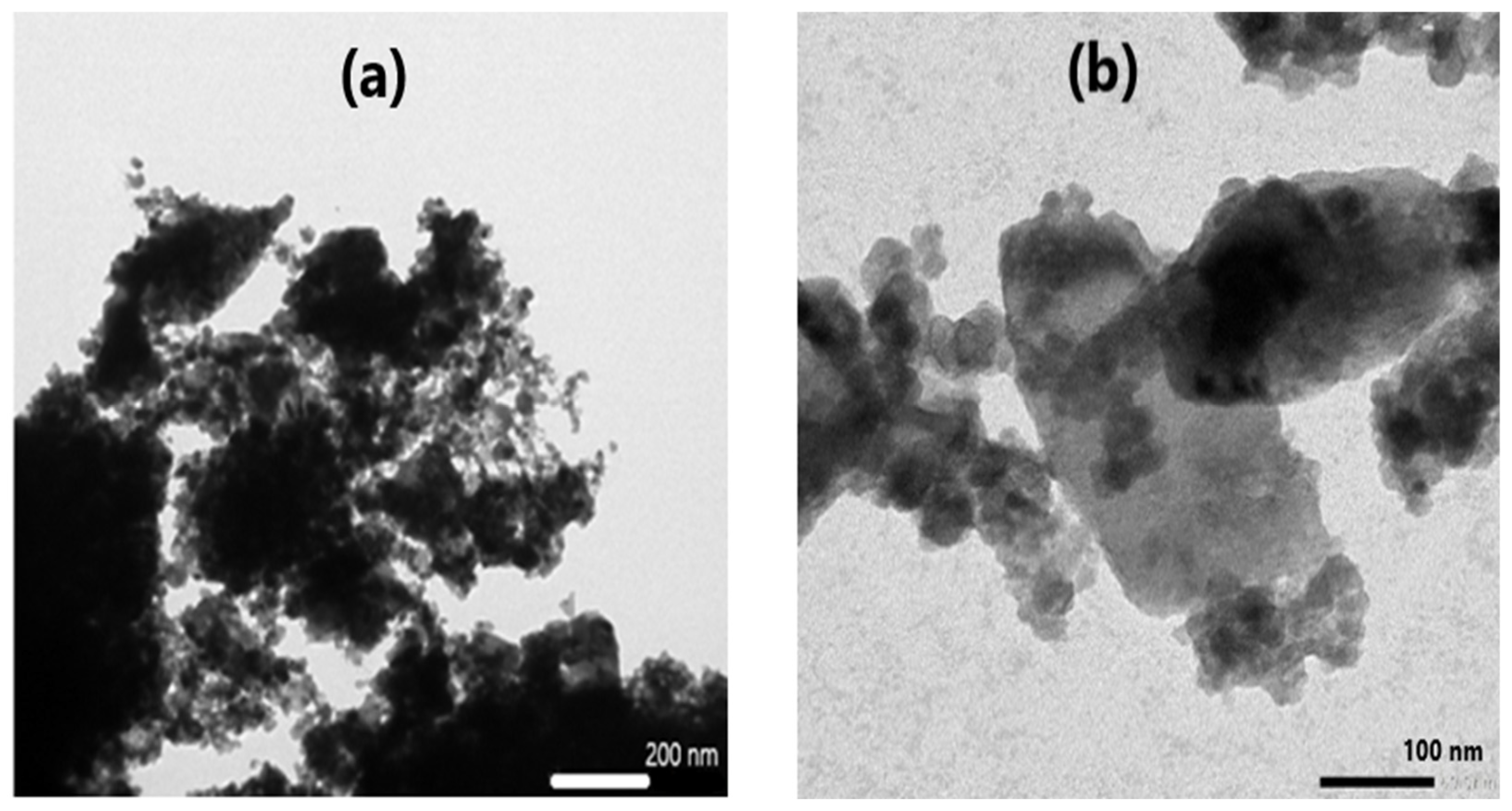
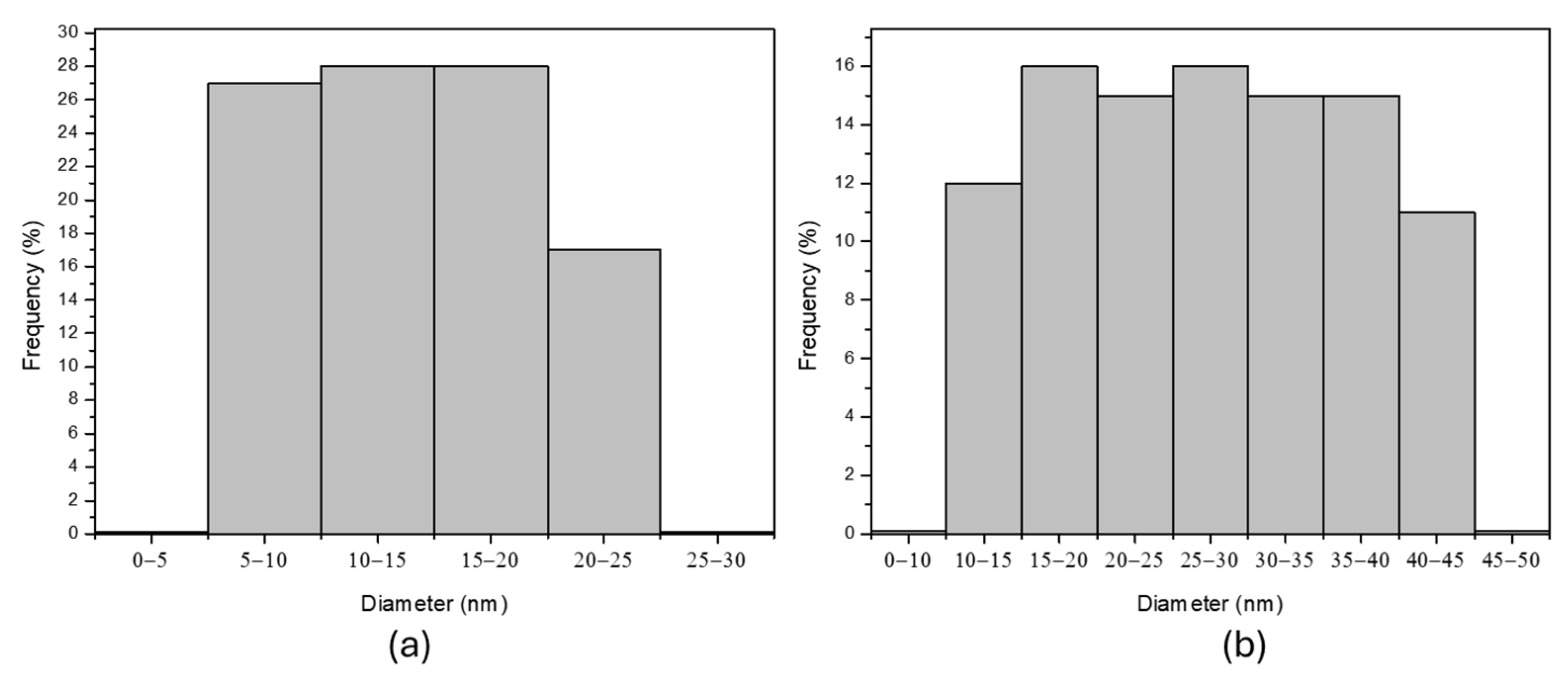
TEM micrographs (Figure 2) revealed marked differences between samples synthesized with and without latex. The Fe3O4–ZnO nanocomposite showed irregular ZnO clusters on the magnetic surface, resulting in significant agglomeration and heterogeneous particle size. In contrast, the Fe3O4@latex decorated with the ZnO nanocomposite exhibited a well-defined core–shell structure, with the dark gray magnetic core fully encapsulated in a continuous light gray polymer layer and ZnO nanoparticles anchored to this latex matrix, resulting in reduced aggregation and a more homogeneous distribution. Morphometric analysis using ImageJ version 1.54p software [26] showed that uncoated Fe3O4-ZnO nanoparticles had an average size of 6–23 nm, whereas latex-coated nanoparticles measured 12–45 nm. This size increase is attributed to the polymer layer surrounding the inorganic core, which increases the hydrodynamic diameter and apparent thickness, thereby confirming the effectiveness of the coating process [11].
To quantitatively support the particle size ranges observed in the TEM micrographs, we created particle size distribution histograms for both nanocomposites. The histograms (Figure 3) were based on measurements of the apparent particle diameter of individual nanoparticles from representative TEM images, obtained using ImageJ, and were generated in Microsoft Excel. Histograms were made for samples synthesized with and without latex to avoid mixing particle populations and to highlight the effects of the polymeric coating on particle size and dispersion. The histograms provide a representative assessment and reinforce the morphological trends noted in the TEM images.

3.2. Crystalline Structure (XRD)

The XRD diffractograms (Figure 4) revealed characteristic reflections of Fe3O4 in the spinel structure (peaks at 2θ ≈ 30°, 35°, 43°, 53°, 57°, corresponding to the crystal planes (200), (311), (400), (422), (511)) and ZnO in the hexagonal wurtzite phase (peaks at 2θ ≈ 31°, 34°, 36°, 47°, 56°, 63°, 66°, 67°, 69°, corresponding to the crystal planes (100), (002), (101), (102), (110), (103), (112), (201), (202). The absence of secondary phases indicates that precipitation and mild calcination preserved the crystalline integrity of both oxides. However, the Fe3O4@latex sample decorated with ZnO showed less intense overall peaks and sharper ZnO reflections, suggesting more orderly crystallite growth due to controlled nucleation on the latex surface. Lower relative peak intensities are likely due to the polymeric coating, which introduces an amorphous fraction capable of increasing diffuse scattering and reducing crystalline contrast [18].

3.3. FTIR Spectroscopy

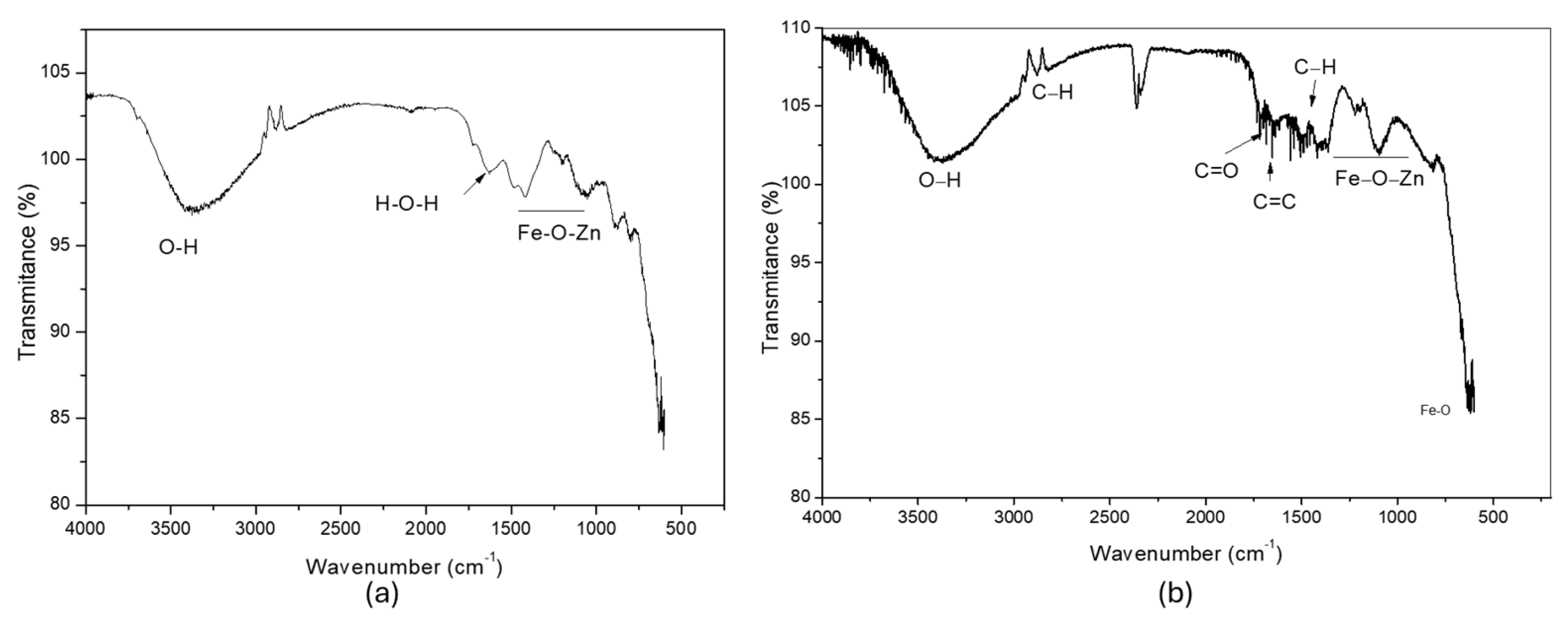
The FTIR spectra of the nanocomposites (Figure 5) confirm the presence of both magnetic and semiconductor phases. Absorption bands at ~580 cm−1, attributed to Fe–O stretching vibrations in the magnetite spinel structure, and at ~450 cm−1, assigned to Zn–O stretching modes, appear in both samples. These metal–oxygen vibrations indicate that the synthesis and coating processes preserved the structural integrity of Fe3O4 and ZnO.
In contrast, the FTIR spectrum of Fe3O4@latex decorated with ZnO exhibits additional vibrational features not found in the uncoated Fe3O4–ZnO sample, indicating successful incorporation of natural rubber latex. The band at ~1660 cm−1 corresponds to C=C stretching vibrations of the polyisoprene backbone, while the absorption at ~1100 cm−1 is linked to C–O–C stretching vibrations in natural latex. Furthermore, the broad band in the 3200–3400 cm−1 region is attributed to O–H and N–H stretching vibrations from hydroxyl groups, residual proteins, and amine-containing species inherent to natural rubber latex. The band observed at ~890 cm−1 is attributed to out-of-plane C–H bending vibrations of isoprene units, reinforcing the presence of the latex matrix and confirming its effective deposition onto the magnetic core before ZnO growth. The presence of these polymer-related bands in the latex-coated sample, alongside persistent Fe–O and Zn–O vibrations, indicates the formation of an organic–inorganic hybrid system rather than a simple physical mixture.
The FTIR results confirm the successful formation of the Fe3O4@latex-ZnO nanocomposite, in which natural rubber latex serves as a functional biopolymeric matrix that promotes interfacial interactions among the inorganic compounds. These interactions improve particle dispersion and structural stability, consistent with the morphological features observed in the TEM analysis and the enhanced performance of the latex-coated system. These spectroscopic findings align with the core–shell morphology observed in the TEM results.

3.4. Photocatalytic Activity (COD and BOD Reduction)

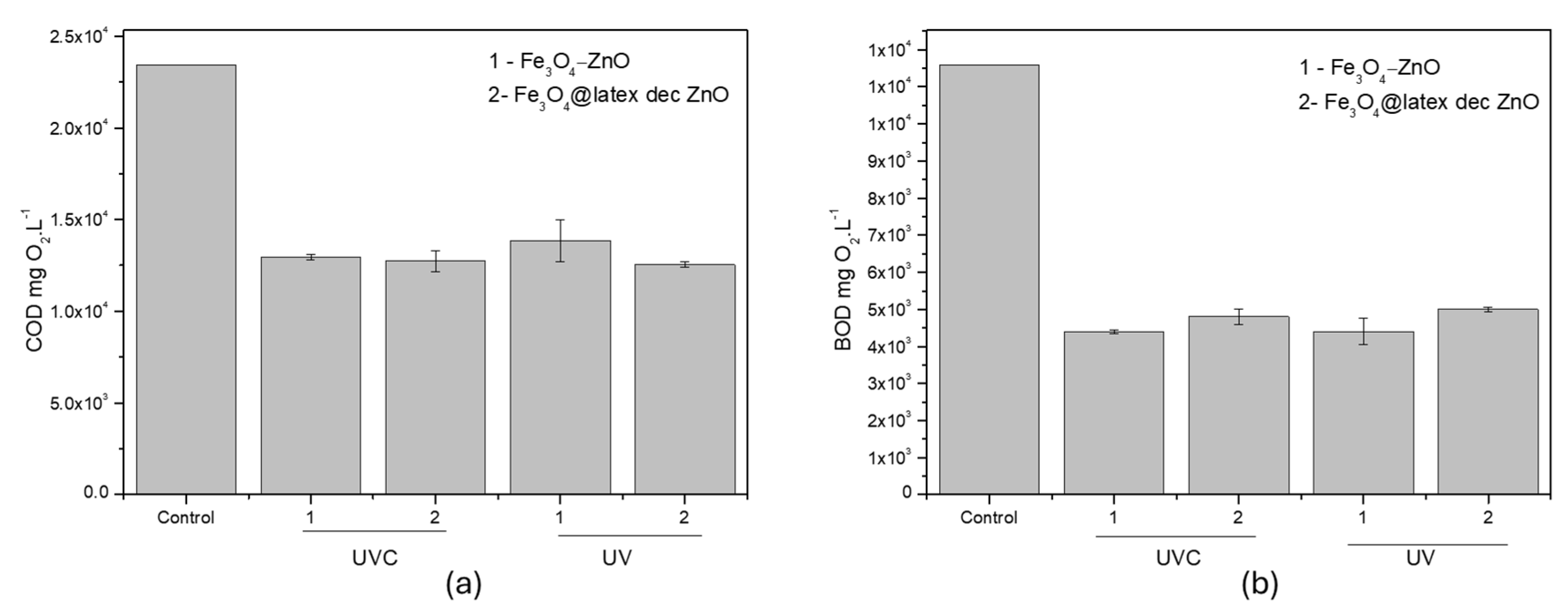
Both nanocomposites exhibited significant activity under two UV light sources. The Fe3O4@latex decorated with ZnO achieved COD and BOD reductions of approximately 47% and 58%, respectively (Figure 6). In comparison, the Fe3O4–ZnO nanocomposite without latex showed comparable degradation trends but with greater variability, indicating lower structural stability and some iron leaching. These results also incorporate the possible effects of photolysis and adsorption.
Photocatalytic efficiency was evaluated using chemical oxygen demand (COD) and biochemical oxygen demand (BOD), which are standard metrics for assessing the organic load of complex industrial effluents. COD and BOD are particularly suitable for real vinasse, given its high turbidity, intense coloration, and heterogeneous composition, which hinder reliable spectrophotometric monitoring of pollutant concentration and prevent the establishment of meaningful kinetic profiles. Therefore, these integrated parameters provide a more robust assessment of oxidation efficiency and biodegradability in complex effluent matrices.

4. Discussion

4.1. Influence of Latex on Morphology and ZnO Dispersion

TEM analyses showed that the addition of natural rubber latex significantly altered the nanoscale architecture and interfacial organization of Fe3O4@latex decorated with the ZnO nanocomposite. Polymeric matrices are known to influence nucleation and crystal growth kinetics, prevent nanoparticle agglomeration through steric stabilization, and provide functional groups that interact with metal precursors [21,23].
In the present system, latex serves as a continuous organic interlayer surrounding the Fe3O4 magnetic core, providing nucleation sites for ZnO. Functional groups in the latex, such as C=C bonds, C–O–C linkages, and residual nitrogen-containing moieties, enhance electrostatic and coordination interactions with Zn2+ during alkaline precipitation, yielding more homogeneous ZnO deposition. This leads to better dispersion and reduced aggregation in the latex-coated nanocomposite compared to the Fe3O4–ZnO system, in which ZnO forms directly on the inorganic magnetic surface.
In contrast, Fe3O4-ZnO systems synthesized without organic stabilization typically form dense agglomerates due to the high surface energy of oxide–oxide interfaces and magnetic dipole–dipole interactions among Fe3O4 particles [16,27]. These agglomerates reduce the effective surface area and create recombination-prone domains, thereby limiting photocatalytic efficiency. Therefore, the morphological characteristics observed in this study support previous findings that underscore the importance of polymeric interlayers in enhancing dispersion and colloidal stability in magnetic semiconductor nanocomposites.

4.2. Protection of the Magnetic Core and Prevention of Leaching

The stability of the Fe3O4 magnetic core is a key concern in photocatalytic applications using real effluents, such as vinasse, which has an acidic pH and high concentrations of organic acids and phenolic compounds that can complex metal ions. Studies have shown that uncoated magnetite nanoparticles may undergo surface oxidation, partial phase transformation, and leaching of Fe2+/Fe3+ under UV irradiation and in oxidative aqueous environments [28].
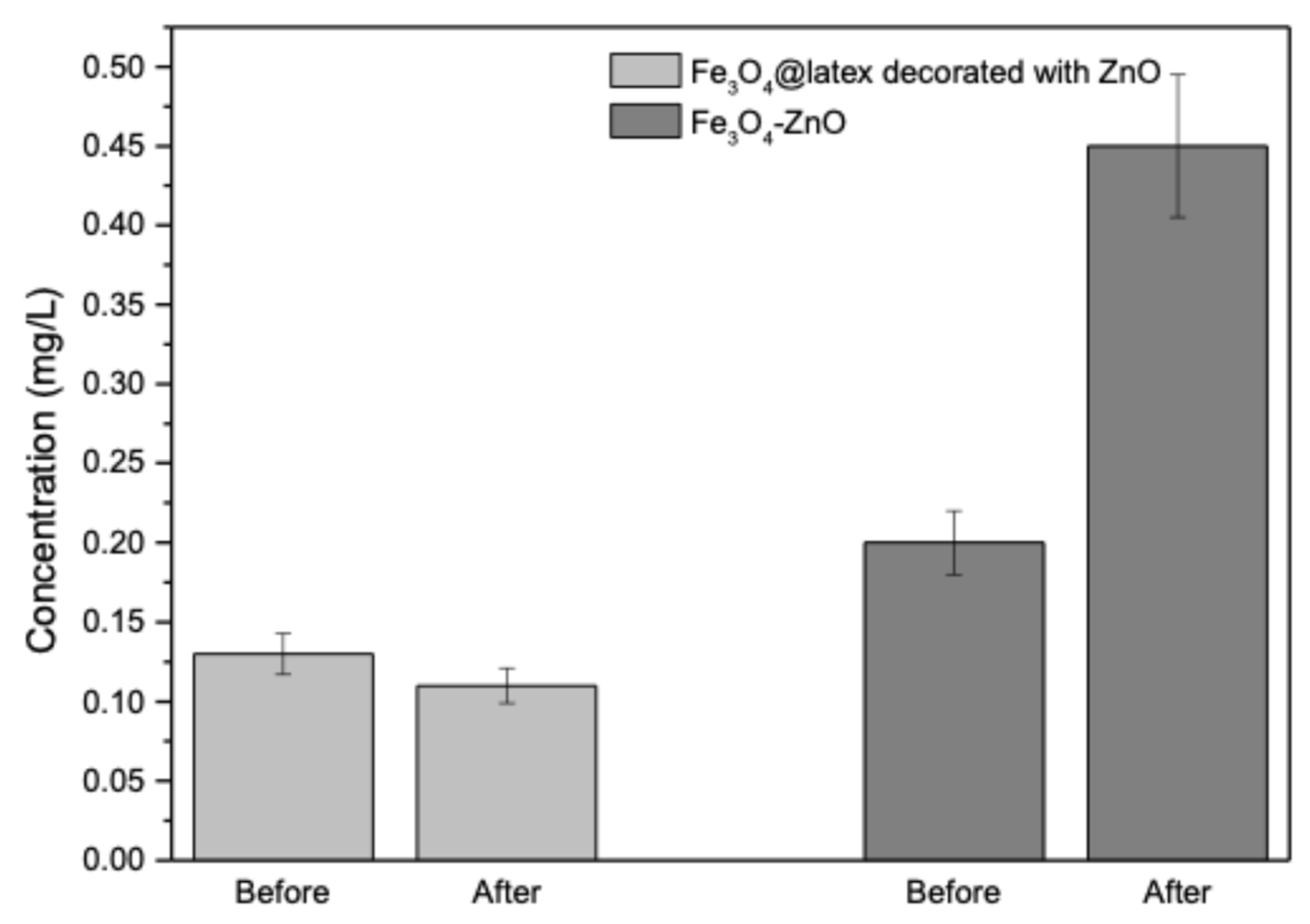
In this study, the latex interlayer in Fe3O4@latex decorated with ZnO served as a physical and chemical barrier, preventing direct contact between the magnetic core and the reaction medium. In this study, the latex interlayer in Fe3O4@latex decorated with ZnO acted as a physical and chemical barrier, limiting the direct contact between the magnetic core and the reaction medium. Clear evidence of this stabilizing effect is provided by the determination of total iron concentration in solution before and after the photocatalytic process (Figure 7). The total iron content was quantified using the 1,10-orthophenanthroline method, a well-established and widely adopted procedure for iron determination in water and wastewater, as described in Standard Methods for the Examination of Water and Wastewater [29]. In this assay, 0.4 g of each nanocomposite was dispersed in 200 mL of deionized water and subjected to UV irradiation under constant agitation for 4 h. A calibration curve was constructed prior to analysis, and iron concentrations (after removal of nanoparticles using a magnet and centrifugation) were measured both before and after the photocatalytic exposure. The results reveal a pronounced increase in dissolved iron for the Fe3O4–ZnO system without latex after UV exposure, whereas the Fe3O4@latex decorated with the ZnO nanocomposite exhibited nearly unchanged iron concentrations, indicating negligible leaching and superior chemical stability of the magnetic core. The experimental error was estimated by propagating the measurement errors originating from the equipment used. The value of 0.3 mg/L is usually considered the maximum limit for iron concentration in drinking water [30]; the values obtained with the nanomaterial Fe3O4@latex decorated with ZnO are below, validating it as a safe system in this respect for practical use. Additional indirect evidence of enhanced stability was observed in control experiments performed in deionized water. Under identical conditions, the latex-free system exhibited higher residual absorbance at 620 nm, suggesting a greater release of iron-related species into solution. Specifically, when 0.2 g of Fe3O4–ZnO was dispersed in 100 mL of ultrapure water and stirred for 4 h at 600 rpm, the measured absorbance reached 0.0016, whereas the corresponding value for Fe3O4@latex decorated with ZnO was significantly lower (0.0005). finding aligns with literature indicating that polymeric coatings effectively reduce corrosion and dissolution of magnetic cores in aqueous environments [21,31].
The control of iron release is especially important from an environmental standpoint, since the presence of dissolved iron in treated effluents is indirectly regulated through water quality standards defined according to the designated use of the receiving water bodies under Brazilian environmental legislation (CONAMA Resolution No. 357/2005) [32]. Although this regulation does not explicitly address nanoparticle leaching, it establishes quality criteria for dissolved metals in surface waters, thereby underscoring the need to minimize iron release during treatment processes. Within this framework, the substantially lower iron leaching observed for the latex-coated system constitutes a relevant advantage with respect to environmental compatibility and operational safety. Latex also played a fundamental role in preserving the physicochemical integrity of magnetic core under photochemical and chemically aggressive conditions. Fe3O4 is known to undergo surface oxidation, structural transformation, and partial dissolution of Fe2+/Fe3+ ions when exposed to UV irradiation, acidic media, or environments rich in reactive oxygen species [9,33]. These degradation pathways are particularly relevant in vinasse treatment, as the effluent contains melanoidins, organic acids, and phenolic compounds capable of leaching iron and thermodynamically favoring its transfer to the aqueous phase. The significant increase in total iron concentration observed for the Fe3O4–ZnO system after photocatalysis (Figure 7) is therefore attributed to the absence of a protective layer, leaving the magnetic core vulnerable to oxidative and chelation-driven dissolution. This behavior is particularly relevant to vinasse treatment, which contains melanoidins, organic acids, and phenolic compounds that can chelate iron and facilitate leaching. In this study, the Fe3O4–ZnO nanoparticle without latex showed indirect evidence of iron release. When 0.2 g of the nanocomposite Fe3O4–ZnO was mixed with 100 mL of ultrapure water and agitated for 4 h at 600 rpm, its absorbance at 620 nm was 0.0016, compared to 0.0005 for Fe3O4@latex decorated with ZnO, indicating better protection against the release of the substance. This aligns with findings that uncoated magnetite nanoparticles are highly susceptible to oxidation and dissolution in aqueous environments, due to their high surface reactivity and susceptibility to corrosion, whereas surface modification or coating improves chemical stability by protecting the Fe3O4 core from direct oxidation and ion release [34].
Conversely, Fe3O4@latex decorated with the ZnO nanocomposite demonstrated remarkable stability during photocatalysis, indicating that the organic coating acted as both a physical barrier and chemical shield. The hydrophobic latex matrix reduced solvent penetration into the magnetic surface, while the polymer minimized direct exposure to UV photons and reactive species, thereby limiting Fe leaching and preserving magnetic responsiveness and structural integrity under harsh reaction conditions. The combined effect of these mechanisms effectively suppressed iron leaching, preserved magnetic responsiveness, and maintained structural integrity even under harsh reaction conditions. Similar stabilizing effects have been widely reported for polymer-coated magnetite nanoparticles, in which surface modification significantly reduces oxidative degradation and ion release, thereby improving durability and environmental safety [31].

4.3. Enhancement of the Fe3O4–ZnO Heterojunction by Latex

The photocatalytic efficiency of ZnO-based materials is largely determined by the separation and longevity of photogenerated electron–hole pairs. Forming heterojunctions between ZnO and magnetic oxides, such as Fe3O4, has been extensively studied to reduce charge recombination and enhance photocatalytic performance [12,17].
In the Fe3O4@latex decorated with ZnO system, improved dispersion of ZnO nanoparticles on the latex matrix enhances interfacial contact with Fe3O4, thereby facilitating electron migration from the ZnO conduction band to the magnetic phase. This interfacial charge-transfer pathway extends charge-carrier lifetimes and promotes the formation of reactive oxygen species (ROS), which are responsible for oxidative degradation. Studies on Fe3O4/ZnO nanocomposites have shown enhanced photocatalytic activity due to charge separation at the heterointerface, along with the benefit of magnetic recoverability [16,18].
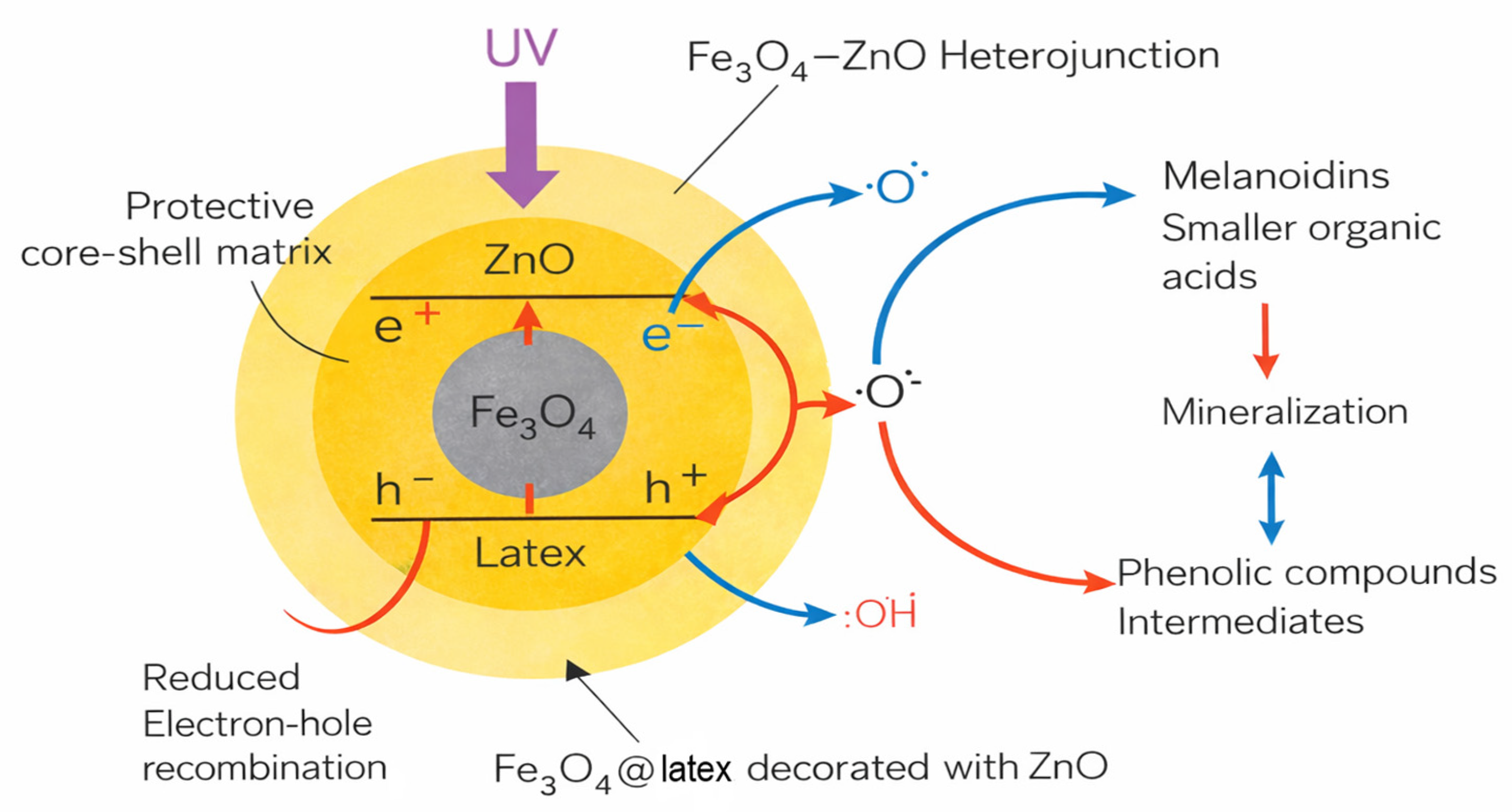
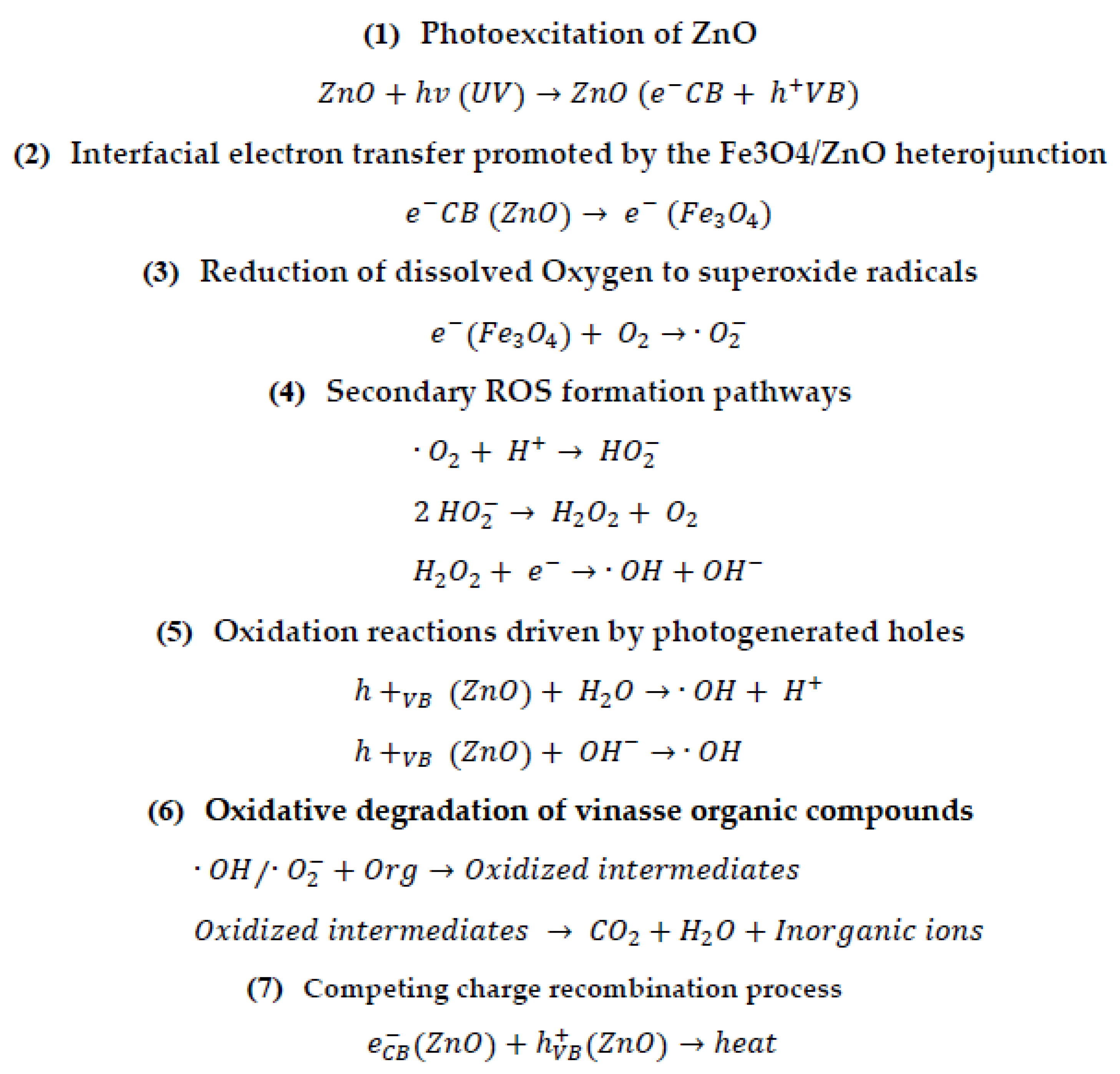
Although this study did not directly detect reactive oxygen species (ROS) by scavenger experiments or electron paramagnetic resonance (EPR) spectroscopy, the proposed photocatalytic mechanism (Figure 8) is consistent with well-established charge transfer pathways reported for ZnO-based magnetic heterojunction photocatalysts and with the degradation performance observed experimentally. The presence of the natural latex interlayer contributes indirectly to the stabilization of the Fe3O4–ZnO heterointerface, mitigating nanoparticle aggregation and suppressing the formation of recombination centers, thereby enhancing the separation and lifetime of photogenerated charge carriers.
The natural latex coating (Hevea brasiliensis) acts as a diffusion barrier and a colloidal stabilizer, minimizing iron release and enabling the magnetic reuse of the catalyst with minimal performance loss. Recent studies indicate that polymeric coatings in magnetic-semiconductor nanocomposites enhance chemical stability and operational durability, even in complex matrices containing phenolic and humic compounds [23].
Under UV irradiation, ZnO absorbs photons with energies equal to or greater than its band gap (~3.3 eV), promoting electrons from the valence band to the conduction band and generating photogenerated holes. These charge carriers participate in surface redox reactions: electrons reduce dissolved oxygen to form superoxide radicals (•O2), while holes oxidize water or hydroxyl ions to generate hydroxyl radicals (•OH). These ROS act as the primary oxidizing agents, driving the non-selective degradation of aromatic and conjugated organic compounds, including melanoidins and phenolic derivatives in vinasse [16,17,35,36].
In Fe3O4-ZnO systems, the magnetic phase serves as an electron mediator, enhancing interfacial electron transfer and reducing electron–hole recombination. The latex matrix improves dispersion and interfacial stability, thereby accounting for the observed photocatalytic performance. Although direct ROS identification was not performed, the proposed mechanism (Scheme 1) aligns with prior studies on Fe3O4-ZnO magnetic photocatalysts [15,16,17].

4.4. Photocatalytic Performance and Degradation of Recalcitrant Compounds in Vinasse

Photocatalytic experiments showed significant reductions in chemical oxygen demand (COD) (≈44–47%) and biochemical oxygen demand (BOD) (≈57–59%) after 4 h of UV irradiation, demonstrating the effectiveness of Fe3O4@latex decorated with ZnO in oxidizing organic matter in vinasse. These results are particularly relevant given the matrix’s complexity, which includes melanoidins, condensed aromatic structures, and nitrogen-containing chromophores that resist biological degradation [2,3]. The COD and BOD reductions indicate that the nanocomposite promotes oxidative degradation of the recalcitrant vinasse components. These molecules are known for their strong resonance-stabilized chromophores, which confer intense coloration and high biodegradation resistance [10]. Previous studies report variable removal efficiencies depending on factors such as dilution, pH, light intensity, and catalyst loading, with ZnO-only systems often achieving high BOD reductions while leaving significant residual COD, suggesting the persistence of refractory compounds [9]. These findings support the use of heterogeneous photocatalysis as a pretreatment step to reduce organic load, toxicity, and recalcitrance before further biological or combined treatment.
When exposed to UV light, ZnO generates hydroxyl and superoxide radicals and singlet oxygen via band-gap excitation, facilitating the cleavage of conjugated bonds and the oxidation of aromatic rings. The enhanced heterojunction in Fe3O4@latex decorated with ZnO promotes continuous interfacial charge transfer, sustaining radical formation throughout the reaction. Although both nanocomposites effectively remove pollutants, Fe3O4@latex decorated with ZnO shows greater reproducibility, better structural integrity, and more stable performance. These improvements are attributed to the protective and dispersive functions of the latex shell, which protect the catalyst’s integrity and maintain its active phases during the treatment of chemically complex effluents such as vinasse. Operationally, the latex-coated system also offers better handling, reduces nanoparticle loss, and enables rapid magnetic separation, making it more suitable for practical applications [19].
The results indicated high organic degradation efficiency across all nanocomposites, with significant reductions in COD and BOD under all evaluated conditions. The decrease in BOD suggests a reduction in biodegradable organic fractions and partial oxidation of recalcitrant molecules into lower–molecular-weight compounds that are more amenable to biological processes. This aligns with previous findings involving ZnO in agro-industrial effluents [9]. Additionally, the COD reduction highlights the effective role of ROS generated under UV-C irradiation.
The Fe3O4–ZnO heterostructure significantly enhanced photocatalytic performance by promoting efficient separation of photogenerated charge carriers. This reduction in recombination prolongs the lifetime of electron–hole pairs, thereby increasing the formation of hydroxyl and superoxide radicals. This mechanism is well documented in magnetic photocatalytic systems [17].
The results indicate that the biopolymeric layer in the latex coating significantly enhances performance and operational stability. Although the COD and BOD reductions were comparable to those of the uncoated composite, the latex-coated system offered practical advantages, including uniform dispersion, improved magnetic separation, safer handling, and reduced loss of fine nanoparticles to the aqueous medium. This suggests that the latex serves as a stabilizing support without substantially impeding UV penetration or ROS access to active catalytic sites.
The analysis of UV-C power settings shows that although higher light intensity can enhance photocatalytic kinetics, chromophoric compounds and the high turbidity of vinasse may limit light penetration, thereby reducing performance gains. This aligns with prior findings on advanced oxidation processes (AOPs) for highly colored effluents [3]. Therefore, future optimization should address hydrodynamic parameters, optical transparency, reactor geometry, and potential integration with biological post-treatment methods to improve mineralization and economic viability.
Dark control experiments were performed to decouple adsorption effects from photocatalytic degradation and to assess the contribution of adsorption to organic matter removal. For the Fe3O4–ZnO nanocomposite without latex, COD (27,550 mg O2·L−1) and expected BOD (344.4 mg O2·L−1) values remained unchanged over 4 h, indicating negligible adsorption and absence of organic species release in the absence of photoactivation. In contrast, Fe3O4@latex decorated with the ZnO nanocomposite exhibited an increase of 22% in COD and BOD under dark conditions. This behavior is attributed to a physicochemical phenomenon characteristic of natural polymers, as natural rubber latex contains non-rubber constituents (e.g., proteins, lipids, carbohydrates, and soluble serum-phase fractions) that may undergo swelling and partial leaching when dispersed in an aqueous medium under agitation, contributing additional oxidizable organic matter to the liquid phase [36,37]. More generally, polymeric materials in contact with water are known to release leachable organic fractions, which are detected by global parameters such as COD and BOD irrespective of the origin of the organic matter [38]. Importantly, this effect was observed exclusively in the absence of UV irradiation and does not indicate polymer degradation nor compromise the protective role of the latex interlayer toward the magnetic core, nor does it interfere with photocatalytic performance under irradiation, where organic matter removal is governed by oxidative photocatalytic processes.
The availability of natural rubber latex enhances this technology’s applicability, supports a circular economy, adds value to renewable resources, and promotes eco-efficient wastewater treatment in the agro-industry.
The results show that natural latex is not merely a passive structural component but an active element in engineering Fe3O4@latex decorated with ZnO. It improves ZnO dispersion, stabilizes the magnetic core, and enhances interfacial organization, thereby boosting photocatalytic efficiency and operational stability. Moreover, its renewable origin and low toxicity make natural latex a promising biopolymeric matrix for developing sustainable magnetic photocatalysts for treating complex agro-industrial effluents.
Significant reductions in COD and BOD were achieved; however, the residual organic load indicates that treated vinasse may not yet meet direct discharge requirements. According to Brazilian environmental regulation CONAMA Resolution No. 430/2011 [39], a BOD removal efficiency of at least 60% is required for effluent discharge. In the present study, BOD removal approached this threshold, underscoring the proposed photocatalytic system as an effective pre-treatment step, with the possibility of applying successive treatment cycles to achieve higher COD and BOD reductions. The partial oxidation of recalcitrant organic compounds is expected to enhance biodegradability and improve subsequent biological treatment, rather than serve as a standalone disposal solution. While international guidelines, such as those proposed by the World Health Organization for water reuse and environmental protection, recommend reducing organic load and toxicity before discharge or reuse, they do not establish fixed COD or BOD limits for industrial effluents.
To contextualize the photocatalytic performance reported in this study, it is useful to compare the findings with previous reports on ZnO-based magnetic nanocomposites in both real and model matrices. Studies using magnetic Fe3O4/ZnO heterostructures have demonstrated high degradation efficiencies, often under less complex experimental conditions. A relevant benchmark is the study of Kee et al. (2022) [33], who investigated ZnO photocatalysis for treating sugarcane vinasse after anaerobic digestion, achieving up to 83.4% COD removal and significant decolorization under UV irradiation. However, these results were based on a pre-treated effluent with much lower initial COD (≈250 mg L−1), reduced turbidity, and less chromophoric interference compared to untreated vinasse. Additionally, their experiments were conducted under optimized alkaline pH and extended irradiation times (up to 10 h), both of which enhance ZnO photocatalytic activity. Thus, while the study by Kee et al. clearly demonstrates ZnO’s effectiveness under optimal conditions, direct numerical comparison with the present work should be approached cautiously.
Tamashiro et al. (2022) [9] studied ZnO nanoparticles under solar irradiation for treating sugarcane vinasse, achieving approximately 72% BOD removal but only a 17% reduction in COD. This pattern reflects the tendency of ZnO-based systems to target more biodegradable organic fractions while leaving many refractory compounds largely unchanged.
Mirzaei et al. (2018) [40] reported a 47% COD reduction using a Fe3O4–ZnO@g-C3N4 magnetic heterostructure to treat pharmaceutical effluent within 60 min under UV/visible irradiation. Although this COD removal is comparable to our findings, it was achieved in a matrix with lower turbidity, reduced chromophoric interference, and less recalcitrant chemical composition than sugarcane vinasse. This highlights the complexity of the vinasse matrix, even after dilution, and the effectiveness of the Fe3O4@latex-ZnO system for agro-industrial effluents.
Nikazar et al. (2014) [41] studied a Fe3O4/ZnO core–shell photocatalyst using phenol as a model pollutant, reporting near-complete degradation under UV irradiation. While these results highlight the photocatalytic efficiency of Fe3O4/ZnO heterostructures and the role of magnetic–semiconductor interfaces in reducing charge recombination, model compounds such as phenol lack the molecular complexity, high molecular weight fractions, and intense coloration found in real vinasse. Thus, degradation efficiencies from model pollutants cannot be directly applied to agro-industrial effluents dominated by melanoidins, condensed aromatics, and nitrogen-containing chromophores.
Recent studies by Khodamorady et al. (2023) [42] have examined advanced Fe3O4@ZnO-based magnetic composites, including ZnO–ZnS systems, for the removal of organic dyes under UV or visible light. These studies highlight growing interest in magnetic ZnO-based photocatalysts and their high activity toward chromophoric model pollutants. However, dye solutions generally have lower organic complexity, reduced light scattering, and more favorable mass-transfer conditions than vinasse, which exhibits strong optical attenuation and a heterogeneous mixture of refractory compounds. Notably, Fe3O4@latex-ZnO shows competitive reductions in COD and BOD in real diluted sugarcane vinasse (1:40) under these harsh conditions.
Table 1 compares the photocatalytic performance of the present system with that of ZnO-based photocatalysts reported in the literature, including studies on raw and anaerobically digested vinasse and model matrices [9,33,40,41,42]. Although higher removal efficiencies are observed, they are often achieved under less complex conditions, such as lower initial COD, pretreated effluents, or optimized pH and catalyst loading.

5. Conclusions

This study presents a magnetically recoverable photocatalytic nanocomposite, Fe3O4@latex decorated with ZnO, developed using natural Hevea brasiliensis latex as a sustainable polymeric interlayer. This innovative approach integrates a magnetic core, a biopolymeric stabilizing layer, and a photoactive ZnO phase into a single platform for treating the challenging agro-industrial effluent, sugarcane vinasse.
Structural and spectroscopic analyses confirmed a core–shell architecture, with the latex matrix promoting uniform ZnO anchoring and reducing particle agglomeration. TEM analyses revealed improved dispersion compared to the Fe3O4–ZnO system, while XRD confirmed the stable coexistence of spinel Fe3O4 and wurtzite ZnO phases. FTIR spectra indicated the presence of latex and the organic–inorganic interfacial interactions.
Photocatalytic assays using real vinasse showed notable reductions in COD (≈44–47%) and BOD (≈57–59%) after 4 h of UV irradiation, indicating effective oxidation of the organic fraction. Although the treated effluent did not meet discharge standards, these results underscore the potential of heterogeneous photocatalysis as a pre-treatment strategy to reduce organic load, recalcitrance, and potential toxicity before downstream biological polishing.
From a mechanistic standpoint, the observed performance stems from ZnO photoexcitation, ROS generation, and enhanced charge separation at the Fe3O4/ZnO heterojunction. The latex interlayer stabilizes the interface, improves ZnO dispersion, and protects the magnetic core from degradation and leaching. Additionally, the Fe3O4 core enables rapid magnetic separation after treatment, improving process efficiency and minimizing nanoparticle losses.
The results indicate that natural latex is vital to the Fe3O4@latex decorated with the ZnO nanocomposite, offering morphological control, chemical stability, and operational advantages, in line with principles of green chemistry and renewable resource utilization. Future research should aim to enhance multi-cycle reuse, directly identify reactive species, and integrate complementary treatment processes to advance this sustainable platform for agro-industrial wastewater remediation. Additionally, photocatalytic experiments can be performed under solar irradiation, enhancing the sustainability and practical applicability of the proposed system. Repeated treatment cycles may also be implemented, allowing further reductions in COD and BOD to be achieved through successive photocatalytic steps.

Author Contributions

Conceptualization, L.d.S.S.G., A.G.M., O.B. and A.K.; methodology, L.d.S.S.G., D.Â.M., M.P.B.A., I.S.L., N.M.P., A.G.M., O.B. and A.K., forma analysis, L.d.S.S.G., A.G.M., O.B. and A.K.; investigation, L.d.S.S.G., D.Â.M., M.P.B.A., I.S.L., N.M.P. and A.K.; resources, A.K.; data curation, A.K.; writing—original draft preparation, L.d.S.S.G., D.Â.M. and A.K.; writing—review and editing, L.d.S.S.G., A.G.M., O.B. and A.K., supervision, A.K.; project administration, A.K.; funding acquisition, A.K. All authors have read and agreed to the published version of the manuscript.

Funding

This research was carried out with the support of the National Council for Scientific and Technological Development (CNPq) (grants 174400/2023-3, 174402/2023-6, and 306096/2023-4), and the Coordination of Superior Level Staff Improvement (CAPES) (grant 001), São Paulo Research Foundation (FAPESP) (grant 2013/07699-0) and National Institute of Science and Technology (INCT) (grant 408417/2024-2).

Data Availability Statement

The original contributions presented in this study are included in the article. Further inquiries can be directed to the corresponding authors.

Conflicts of Interest

The authors declare no conflicts of interest.

References

  1. Reis, C.E.R.; Hu, B. Vinasse from Sugarcane Ethanol Production: Better Treatment or Better Utilization? Front. Energy Res. 2017, 5, 7. [Google Scholar] [CrossRef]
  2. Nouhou Moussa, A.W.; Sawadogo, B.; Konate, Y.; Sidibe, S.d.S.; Heran, M. Critical State of the Art of Sugarcane Industry Wastewater Treatment Technologies and Perspectives for Sustainability. Membranes 2023, 13, 709. [Google Scholar] [CrossRef] [PubMed]
  3. Li, Y.; Zhang, Q.; Xiao, S.; Yang, Q.; Wang, L.; Hao, J. Review of Melanoidins as By-Product from Thermal Hydrolysis of Sludge: Properties, Hazards, and Removal. Processes 2024, 12, 135. [Google Scholar] [CrossRef]
  4. España-Gamboa, E.; Vicent, T.; Font, X.; Dominguez-Maldonado, J.; Canto-Canché, B.; Alzate-Gaviria, L. Pretreatment of Vinasse from the Sugar Refinery Industry under Non-Sterile Conditions by Trametes Versicolor in a Fluidized Bed Bioreactor and Its Effect When Coupled to an UASB Reactor. J. Biol. Eng. 2017, 11, 6. [Google Scholar] [CrossRef]
  5. Sarma, A.; Priyadarshi, N.; Chakraborty, R.; Kulkarni, P. A Review on the Role of Microbes in Degradation of Melanoidin from Distillery Wastewater. Int. J. Environ. Agric. Biotechnol. 2025, 10, 609267. [Google Scholar] [CrossRef]
  6. Santal, A.R.; Singh, N.P.; Saharan, B.S. Biodegradation and Detoxification of Melanoidin from Distillery Effluent Using an Aerobic Bacterial Strain SAG 5 of Alcaligenes Faecalis. J. Hazard. Mater. 2011, 193, 319–324. [Google Scholar] [CrossRef]
  7. Pandis, P.K.; Kalogirou, C.; Kanellou, E.; Vaitsis, C.; Savvidou, M.G.; Sourkouni, G.; Zorpas, A.A.; Argirusis, C. Key Points of Advanced Oxidation Processes (AOPs) for Wastewater, Organic Pollutants and Pharmaceutical Waste Treatment: A Mini Review. ChemEngineering 2022, 6, 8. [Google Scholar] [CrossRef]
  8. Cardoso, I.M.F.; Cardoso, R.M.F.; Esteves da Silva, J.C.G. Advanced Oxidation Processes Coupled with Nanomaterials for Water Treatment. Nanomaterials 2021, 11, 2045. [Google Scholar] [CrossRef]
  9. Tamashiro, J.R.; Lima, I.S.; de Paiva, F.F.G.; Silva, L.H.P.; de Oliveira, D.V.M.; Baffa, O.; Kinoshita, A. Treatment of Sugarcane Vinasse Using Heterogeneous Photocatalysis with Zinc Oxide Nanoparticles. Sustainability 2022, 14, 16052. [Google Scholar] [CrossRef]
  10. Ong, C.B.; Ng, L.Y.; Mohammad, A.W. A Review of ZnO Nanoparticles as Solar Photocatalysts: Synthesis, Mechanisms and Applications. Renew. Sustain. Energy Rev. 2018, 81, 536–551. [Google Scholar] [CrossRef]
  11. Zhou, X.Q.; Hayat, Z.; Zhang, D.D.; Li, M.Y.; Hu, S.; Wu, Q.; Cao, Y.F.; Yuan, Y. Zinc Oxide Nanoparticles: Synthesis, Characterization, Modification, and Applications in Food and Agriculture. Processes 2023, 11, 1193. [Google Scholar] [CrossRef]
  12. Chong, M.N.; Jin, B.; Chow, C.W.K.; Saint, C. Recent Developments in Photocatalytic Water Treatment Technology: A Review. Water Res. 2010, 44, 2997–3027. [Google Scholar] [CrossRef] [PubMed]
  13. Abou Zeid, S.; Leprince-Wang, Y. Advancements in ZnO-Based Photocatalysts for Water Treatment: A Comprehensive Review. Crystals 2024, 14, 611. [Google Scholar] [CrossRef]
  14. Reddy, L.H.; Arias, J.L.; Nicolas, J.; Couvreur, P. Magnetic Nanoparticles: Design and Characterization, Toxicity and Biocompatibility, Pharmaceutical and Biomedical Applications. Chem. Rev. 2012, 112, 5818–5878. [Google Scholar] [CrossRef]
  15. Qi, L.; Wang, S.; Liu, Y.; Zhao, P.; Tian, J.; Zhu, B.; Zhang, S.; Xie, W.; Yu, H. Facile Preparation of Magnetically Separable Fe3O4/ZnO Nanocomposite with Enhanced Photocatalytic Activity for Degradation of Rhodamine B. Nanomaterials 2024, 14, 926. [Google Scholar] [CrossRef]
  16. Varadi, A.; Leostean, C.; Stefan, M.; Popa, A.; Toloman, D.; Pruneanu, S.; Tripon, S.; Macavei, S. Fe3O4-ZnO:V Nanocomposites with Modulable Properties as Magnetic Recoverable Photocatalysts. Inorganics 2024, 12, 119. [Google Scholar] [CrossRef]
  17. Melegy, A.A.; Abdel-Monem, Y.K.; Ali, F.A.; Maysour, N.E.; Atta, A.M. Superparamagnetic Fe3O4/ZnO/ZnFe2O4 Nanocomposites for Efficient Photocatalytic Degradation of Methylene Blue from Water under UV Light. Sci. Rep. 2025, 15, 40393. [Google Scholar] [CrossRef]
  18. Verma, A.; Sharma, G.; Wang, T.; Kumar, A.; Dhiman, P.; García-Peñas, A. Graphitic Carbon Nitride (g-C3N4)-Based Magnetic Photocatalysts for Removal of Antibiotics. Carbon Lett. 2025, 35, 45–73. [Google Scholar] [CrossRef]
  19. Vicente, T.T.; Arsalani, S.; Quiel, M.S.; Fernandes, G.S.P.; da Silva, K.R.; Fukada, S.Y.; Gualdi, A.J.; Guidelli, É.J.; Baffa, O.; Carneiro, A.A.O.; et al. Improving the Theranostic Potential of Magnetic Nanoparticles by Coating with Natural Rubber Latex for Ultrasound, Photoacoustic Imaging, and Magnetic Hyperthermia: An In Vitro Study. Pharmaceutics 2024, 16, 1474. [Google Scholar] [CrossRef]
  20. Spiegel, S. Recent Advances in Applied Polymer Science. J. Appl. Polym. Sci. 2018, 135, 46279. [Google Scholar] [CrossRef]
  21. Magdalena, A.G.; Silva, I.M.B.; Marques, R.F.C.; Pipi, A.R.F.; Lisboa-Filho, P.N.; Jafelicci, M. EDTA-Functionalized Fe3O4 Nanoparticles. J. Phys. Chem. Solids 2018, 113, 5–10. [Google Scholar] [CrossRef]
  22. Arsalani, S.; Guidelli, E.J.; Araujo, J.F.D.F.; Bruno, A.C.; Baffa, O. Green Synthesis and Surface Modification of Iron Oxide Nanoparticles with Enhanced Magnetization Using Natural Rubber Latex. ACS Sustain. Chem. Eng. 2018, 6, 13756–13765. [Google Scholar] [CrossRef]
  23. Romero-Fierro, D.; Bustamante-Torres, M.; Bravo-Plascencia, F.; Magaña, H.; Bucio, E. Polymer-Magnetic Semiconductor Nanocomposites for Industrial Electronic Applications. Polymers 2022, 14, 752. [Google Scholar] [CrossRef] [PubMed]
  24. APHA. 5210 Biochemical Oxygen Demand (BOD); Baid, R., Eaton, A., Rice, E., Eds.; American Public Health Association: Washington, DC, USA, 2018; Volume 23, ISBN 9780875530130. [Google Scholar]
  25. APHA; AWWA; WEF. 5220-D Chemical Oxygen Demand (COD). In Standard Methods for the Examination of Water and Wastewater; Baid, R.B., Eaton, A.D., Rice, E.W., Eds.; American Public Health Association: Washington, DC, USA, 2018; pp. 5–14. ISBN 9780875530130. [Google Scholar]
  26. Schneider, C.A.; Rasband, W.S.; Eliceiri, K.W. NIH Image to ImageJ: 25 Years of Image Analysis. Nat. Methods 2012, 9, 671–675. [Google Scholar] [CrossRef] [PubMed]
  27. Wu, W.; Wu, Z.; Yu, T.; Jiang, C.; Kim, W.S. Recent Progress on Magnetic Iron Oxide Nanoparticles: Synthesis, Surface Functional Strategies and Biomedical Applications. Sci. Technol. Adv. Mater. 2015, 16, 023501. [Google Scholar] [CrossRef] [PubMed]
  28. Mylkie, K.; Nowak, P.; Rybczynski, P.; Ziegler-Borowska, M. Polymer-Coated Magnetite Nanoparticles for Protein Immobilization. Materials 2021, 14, 248. [Google Scholar] [CrossRef]
  29. APHA; AWWA; WEF. Method 3500-Fe B. Phenanthroline Method. In Standard Methods for the Examination of Water and Waste Water; American Public Health Association: Washington, DC, USA, 2017. [Google Scholar]
  30. WHO. Guidelines for Drinking-Water Quality: Incorporating First Addendum, 4th ed.; World Health Organization: Geneva, Switzerland, 2017. [Google Scholar]
  31. Batra, V.; Kaur, I.; Pathania, D.; Sonu; Chaudhary, V. Efficient Dye Degradation Strategies Using Green Synthesized ZnO-Based Nanoplatforms: A Review. Appl. Surf. Sci. Adv. 2022, 11, 100314. [Google Scholar] [CrossRef]
  32. CONAMA Resolution No. 357/2005; Classification of Water Bodies and Environmental Guidelines for Their Framing, as Well as Conditions and Standards for Effluent Discharges. National Environment Council (CONAMA): Brasília, Brazil, 2005.
  33. Kee, W.C.; Wong, Y.S.; Ong, S.A.; Lutpi, N.A.; Sam, S.T.; Chai, A.; Eng, K.M. Photocatalytic Degradation of Sugarcane Vinasse Using ZnO Photocatalyst: Operating Parameters, Kinetic Studies, Phytotoxicity Assessments, and Reusability. Int. J. Environ. Res. 2022, 16, 3. [Google Scholar] [CrossRef]
  34. Sun, M.; Bai, X.; Fu, X.; Yu, X.; Ye, Z.; Zhang, M.; Qiu, Y.L. Modification of Fe3O4 Magnetic Nanoparticles for Antibiotic Detection. Sci. Rep. 2025, 15, 4751. [Google Scholar] [CrossRef]
  35. Hwangbo, M.; Claycomb, E.C.; Liu, Y.; Alivio, T.E.G.; Banerjee, S.; Chu, K.H. Effectiveness of Zinc Oxide-Assisted Photocatalysis for Concerned Constituents in Reclaimed Wastewater: 1,4-Dioxane, Trihalomethanes, Antibiotics, Antibiotic Resistant Bacteria (ARB), and Antibiotic Resistance Genes (ARGs). Sci. Total Environ. 2019, 649, 1189–1197. [Google Scholar] [CrossRef]
  36. Navalón, S.; Dhakshinamoorthy, A.; Álvaro, M.; Ferrer, B.; García, H. Metal-Organic Frameworks as Photocatalysts for Solar-Driven Overall Water Splitting. Chem. Rev. 2023, 123, 445–490. [Google Scholar] [CrossRef]
  37. Bokobza, L. Some Applications of Vibrational Spectroscopy for the Analysis of Polymers and Polymer Composites. Polymers 2019, 11, 1159. [Google Scholar] [CrossRef]
  38. Nawamawat, K.; Sakdapipanich, J.T.; Ho, C.C.; Ma, Y.; Song, J.; Vancso, J.G. Surface Nanostructure of Hevea brasiliensis Natural Rubber Latex Particles. Colloids Surf. A Physicochem. Eng. Asp. 2011, 390, 157–166. [Google Scholar] [CrossRef]
  39. CONAMA Resolution No. 430/2011; Conditions, Parameters, Standards and Guidelines for the Management of Effluent Discharges into Receiving Water Bodies (Complementing and Amending Resolution No. 357/2005). National Environment Council (CONAMA): Brasília, Brazil, 2011.
  40. Mirzaei, A.; Chen, Z.; Haghighat, F.; Yerushalmi, L. Hierarchical Magnetic Petal-like Fe3O4-ZnO@g-C3N4 for Removal of Sulfamethoxazole, Suppression of Photocorrosion, by-Products Identification and Toxicity Assessment. Chemosphere 2018, 205, 463–474. [Google Scholar] [CrossRef]
  41. Nikazar, M.; Alizadeh, M.; Lalavi, R.; Rostami, M.H. The Optimum Conditions for Synthesis of Fe3O4/ZnO Core/Shell Magnetic Nanoparticles for Photodegradation of Phenol. J. Environ. Health Sci. Eng. 2014, 12, 21. [Google Scholar] [CrossRef]
  42. Khodamorady, M.; Bahrami, K. Fe3O4@BNPs@ZnO–ZnS as a Novel, Reusable and Efficient Photocatalyst for Dye Removal from Synthetic and Textile Wastewaters. Heliyon 2023, 9, e16397. [Google Scholar] [CrossRef]
Figure 1. Illustrative image of the Photocatalytic reactor used in the experiments. Schematic representation of the UV photoreactor employed in vinasse degradation, showing the lamps, the sample arrangement in Erlenmeyer flasks, and the irradiation geometry.
Magnetochemistry 12 00023 g001
Figure 2. TEM micrographs of the nanocomposites. (a) Fe3O4–ZnO without latex coating, showing heterogeneous ZnO deposition and particle agglomeration. (b) Fe3O4@latex decorated with ZnO, suggesting a well-defined core–shell structure with a continuous polymeric layer and homogeneously distributed ZnO nanoparticles anchored onto the latex matrix.
Magnetochemistry 12 00023 g002
Figure 3. Particle size distribution histograms obtained from TEM images. (a) Fe3O4–ZnO nanoparticles, exhibiting particle diameters predominantly in the range of 5–20 nm, and (b) Fe3O4@latex decorated with ZnO nanoparticles, with particle diameters mainly distributed between 10 and 45 nm, based on measurements of individual particles for each sample.
Magnetochemistry 12 00023 g003
Figure 4. XRD patterns of the synthesized nanocomposites. (a) Fe3O4-ZnO without latex coating and (b) Fe3O4@latex decorated with ZnO. Diffraction profiles showing the characteristic reflections of Fe3O4 (spinel structure) and ZnO (wurtzite). Both materials preserve phase purity, while the latex-coated nanocomposite exhibits sharper ZnO peaks, suggesting improved crystallite organization promoted by the polymeric matrix.
Magnetochemistry 12 00023 g004
Figure 5. FTIR spectra of Fe3O4–ZnO and Fe3O4@latex decorated with ZnO nanocomposites. (a) FTIR spectra of Fe3O4-ZnO and (b) FTIR spectra of Fe3O4@latex decorated with ZnO. The latex-coated sample exhibits characteristic organic bands (C=C, C–O–C, amine groups, and isoprene), confirming successful incorporation of natural rubber. Vibrational bands of Fe–O and Zn–O are observed in both samples, indicating the presence of inorganic components.
Magnetochemistry 12 00023 g005
Figure 6. Reduction in COD and BOD. COD (a) and BOD (b) of vinasse before (Control) and after treatment with and nanocomposites, under UVC (36 W) and UV (300 W) irradiation.
Magnetochemistry 12 00023 g006
Figure 7. Total iron concentration in solution before and after photocatalysis for Fe3O4@latex–ZnO and Fe3O4–ZnO nanocomposites, determined by the 1,10-orthophenanthroline method. The latex-coated system exhibits negligible iron leaching, whereas the uncoated Fe3O4–ZnO shows a significant increase in dissolved iron after the photocatalytic process, indicating reduced chemical stability of the magnetic core.
Magnetochemistry 12 00023 g007
Figure 8. Proposed photocatalytic mechanism of the Fe3O4@latex decorated with ZnO nanocomposite under UV irradiation. Illustration of the photocatalytic process under UV irradiation showing ZnO photoexcitation with generation of electron–hole pairs (e/h+), interfacial electron transfer from ZnO to Fe3O4, leading to suppressed charge recombination, generation of reactive oxygen species (ROS), including superoxide radicals (•O2) via reduction of dissolved O2 by photogenerated electrons and hydroxyl radicals (•OH) via oxidation of H2O/HO by photogenerated holes and oxidative degradation of recalcitrant organic compounds.
Magnetochemistry 12 00023 g008
Scheme 1. Proposed photocatalytic mechanism of Fe3O4@latex decorated with ZnO under UV irradiation. The mechanism highlights ZnO photoexcitation, interfacial electron transfer to Fe3O4, generation of reactive oxygen species (ROS) (•OH and •O2), and oxidative degradation of vinasse organic compounds.
Magnetochemistry 12 00023 sch001
Table 1. Comparison of ZnO-based photocatalysts reported in the literature and in the present study for vinasse and related matrices.
StudyPhotocatalyst (ZnO-Based)Treated MatrixLight SourceTimeKey ConditionsReported PerformanceComparative Assessment
This workFe3O4@latex decorated with ZnOSugarcane vinasse diluted (1:40)UV4 hMagnetic nanocomposite; biopolymeric latex interlayerCOD reduction (≈44–47%); BOD reduction (≈57–59%)Robust performance in highly recalcitrant, optically dense matrix; strong operational advantages; potential for repeated treatment cycles to achieve higher COD and BOD reductions
Tamashiro et al. (2022)
[9]
ZnO nanoparticlesSugarcane vinasseSolar light4 h40 mg L−1 ZnOCOD reduction (17.1%); BOD reduction (71.7%)Higher BOD removal but lower COD reduction
Kee et al. (2022)
[33]
ZnO powderAnaerobically digested vinasseUV (optimized)up to 10 hLow initial COD (~250 mg L−1), alkaline pHCOD reduction (83.4%); strong decolorizationHigh efficiency under mild, pre-treated conditions
Mirzaei et al. (2018)
[40]
Fe3O4–ZnO@g-C3N4Pharmaceutical effluentUV/Vis60 minMagnetic heterostructureCOD reduction (~47%); TOC reduction (~30%)Comparable COD removal but in less complex matrix
Nikazar et al. (2014)
[41]
Fe3O4/ZnO core–shellPhenol (model pollutant)UVModel systemNear-complete phenol degradationConfirms effectiveness of Fe3O4/ZnO heterostructures
Khodamorady et al. (2023)
[42]
Fe3O4@ZnO–ZnS compositeOrganic dye (model)UV/VisMagnetic recyclable systemHigh dye removalDemonstrates trend toward magnetic ZnO-based systems
Disclaimer/Publisher’s Note: The statements, opinions and data contained in all publications are solely those of the individual author(s) and contributor(s) and not of MDPI and/or the editor(s). MDPI and/or the editor(s) disclaim responsibility for any injury to people or property resulting from any ideas, methods, instructions or products referred to in the content.