Skip to Content

Journal of Interdisciplinary Research Applied to Medicine

Journal of Interdisciplinary Research Applied to Medicine (JDReAM) is an international, peer-reviewed, open access journal on health-related researches coming from different scientific sectors—such as biology, biotechnology, biomedicine as well as physics and statistics, informatics, technologies, computer engineering, nano-biomaterials, as well as neuroscience, psychology, pedagogy and human sciences—published quarterly online by MDPI (since Volume 6, Issue 1 - 2026). The Interdisciplinary Laboratory of Applied Research in Medicine (DReAM) is affiliated with JDReAM, which serves as its official journal. The members receive discounts on the article processing charges.
  • Open Access— free for readers, with article processing charges (APC) paid by authors or their institutions.
  • Rapid Publication: manuscripts are peer-reviewed and a first decision is provided to authors approximately 24.9 days after submission; acceptance to publication is undertaken in 5.6 days (median values for papers published in this journal in the first half of 2026).
  • Recognition of Reviewers: Reviewers whose reports are timely and of high quality receive an APC discount voucher for a future publication in an MDPI journal. Become a reviewer.

Get Alerted

Add your email address to receive forthcoming issues of this journal.

All Articles (62)

  • Case Report
  • Open Access

Distinguishing infectious collections from underlying malignancies may represent a significant diagnostic challenge, particularly when tumors present with necrotic, cystic, perforated, or abscess-like components. Here, we introduce the descriptive concept of “cancer–abscess” as a practical imaging-oriented framework for recognizing underlying malignancies presenting as presumed infectious collections. The first case involves an appendiceal-region malignancy initially interpreted as a postoperative pericecal collection after appendectomy; the second concerns a locally advanced rectal carcinoma complicated by abscess formation and fistulization into the gluteal region. Ultrasound, computed tomography, and magnetic resonance imaging findings are reviewed to highlight recurrent diagnostic red flags, including persistent mass-like architecture, enhancing solid components, irregular soft-tissue proliferation, necrotic-colliquative areas associated with pathological enhancement, suspicious nodal or implant-like disease, and atypical extension patterns. Recognition of these features may support earlier suspicion of malignancy, guide further diagnostic work-up, and reduce delays in oncologic treatment. The “cancer–abscess” concept should be considered whenever presumed infectious collections show atypical or persistent imaging characteristics.

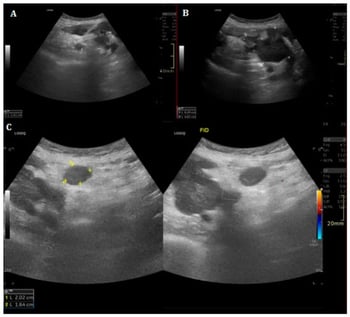
Ultrasound evaluation in Case 1. Urgent post-appendectomy ultrasound performed for abdominal pain and fever demonstrates a heterogeneous right pericecal collection with mixed anechoic and hyperechoic components (A,B). Adjacent mesenteric fat edema and hypoechoic nodular structures suspicious for lymphadenopathy are also visible (C). These atypical findings prompted second-level imaging for further characterization.
  • Perspective
  • Open Access

The new therapeutic options now available for patients with hepatocellular carcinoma (HCC) have made their assessment more complex, especially due to the different stages of liver cirrhosis typically associated with this tumor. The management of the disease therefore requires an interdisciplinary approach aimed at identifying the most appropriate treatment based on the risk–benefit profile and residual liver function, as well as in relation to the patient’s age and potential for a full or partial recovery, risk of complications, and cancer recurrence. Another factor to be carefully considered in patients with hepatocellular carcinoma is the frequent comorbidities and the associated socio-health variables (substance abuse, addictions, unfavorable economic or family circumstances), which can impact patient management or the possibilities for long-term monitoring, thus influencing the choice of the most appropriate therapeutic pathway. The healthcare services offered in the Province of Salerno (Campania Region, Southern Italy) to ensure all possible diagnostic and therapeutic options for these patients can be difficult to access due to the territorial extension of the Local Health Authority, characterized by clinics and hospitals located in distant locations, as well as the potential fragmentation of expertise between the University Hospital and ambulatorial facilities or small hospitals. An interdisciplinary consensus conference on the management of patients with HCC has been set with the aim of involving clinicians and surgeons working in healthcare facilities located in Salerno and its Province for the optimal care and effective management of these patients, taking into account all the clinical characteristics of the disease and individual health needs or expectations, from the perspective of personalized medicine.

Updated Barcelona Clinic Liver Cancer (BCLC) staging and treatment strategy, showing the specific suggested optimal therapeutic path, according to the characteristics of the patients, which are assigned to 5 main stages: Very Early, Early, Intermediate, Advanced, and Terminal [19].

Evaluation of Occupational Stress in Endodontics Using Smartwatch Technology

  • Elbahary Shlomo,
  • Kargar Saghar and
  • Tsesis Igor
  • + 5 authors

Occupational stress in dentistry, particularly during endodontic procedures, impacts practitioners’ health and performance. This study introduces a novel approach using real-time Heart Rate (HR) data from Apple Watch technology to assess physiological responses potentially indicative of occupational stress among endodontists. Materials and Methods: Twelve endodontists participated in this study, treating 119 patients. In a controlled clinical environment, HR was continuously monitored with the Apple Watch, and data were recorded via the Cardiogram app, capturing HR variations across treatment stages. Results: Significant HR fluctuations were observed during procedurally demanding stages such as local anesthesia and rubber dam placement. The endodontist’s HR, as a physiological proxy for stress, was significantly influenced by the treatment difficulty level, stage, and the patient’s age. Conclusions: Using Apple Watch technology, our study revealed significant HR variations during different endodontic treatment stages, suggesting fluctuating physiological responses that may reflect occupational stress. Elevated HR was noted during patient examination and rubber dam placement, particularly in complex cases. These preliminary findings suggest that HR monitoring via wearable technology may serve as a useful, albeit indirect, indicator of occupational stress during endodontic procedures. Future studies with larger samples and additional validated stress biomarkers are needed to confirm these observations.

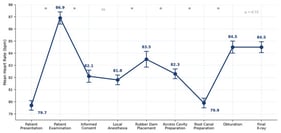
Mean Practitioner Heart Rate Across Endodontic Treatment Stages with Consecutive Pairwise Comparisons. Mean practitioner heart rate (bpm) recorded at each of the nine standardized endodontic treatment stages: (1) Patient Presentation, (2) Patient Examination, (3) Informed Consent, (4) Local Anesthesia, (5) Rubber Dam Placement, (6) Access Cavity Preparation, (7) Root Canal Preparation, (8) Obturation, (9) Final X-ray. Data represent means ± 95% confidence intervals (error bars and shaded band; n = 119 treatments, 12 endodontists). Significance brackets above the line indicate consecutive pairwise comparisons (Wilcoxon signed-rank test): * p < 0.001; ns = not significant. A statistically significant overall negative linear trend across stages was identified (mixed-effects model, p = 0.02).

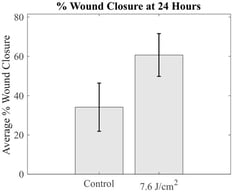
The development of precise quantitative metrics is essential for characterizing the response of biological systems to external perturbations, enabling a transition from qualitative observation to predictive modeling. In this context, mathematical frameworks can provide insight into the dynamic behavior of cell populations under external stimuli. In this study, a logistic-type growth model was employed to describe wound healing dynamics. A scratch assay protocol was applied to lung cancer cells, and a perturbation-based analytical framework was developed to quantify the influence of external factors. Novel metrics were introduced, including the percentage difference in wound closure at specific time points, the shift in inflection time, and the Average Difference in Wound Closure (ADWC). A pilot experimental study was conducted to evaluate the effect of Low-Level Laser Therapy (LLLT) on cell migration. The proposed model successfully captured the nonlinear dynamics of wound closure and enabled quantitative comparison between control and treated groups. The analysis demonstrated that LLLT enhances cellular activity, leading to a shift in the inflection time by approximately 7.6 h and an increase of 25.4% in wound closure at 24 h compared to the control group. The ADWC metric further confirmed a systematic difference in the overall healing dynamics between conditions. The presented perturbation-based framework provides a rigorous and interpretable tool for quantifying the effects of external stimuli on biological systems. These findings suggest a light-dependent modulation of tumor cell migration in an in vitro model, indicating that light exposure may influence cellular behavior under certain conditions. This observation may be relevant for clinical applications involving light, such as photodynamic therapy, particularly in cases of incomplete drug delivery.

The mean ± standard deviation values of the percentage of wound closure for the control and laser-treated groups are presented based on the numerical data in Table 1.

Highly Accessed Articles

News & Conferences

Latest Issues

Open for Submission

Journal Sections

XFacebookLinkedIn
J. Interdiscip. Res. Appl. Med. - ISSN 2532-7518