Skip to Content

Industries

Industries is an international, peer-reviewed, open access journal published quarterly online by MDPI with a focus on interdisciplinary research bridging industrial engineering, digital technologies, and strategic management.

Get Alerted

Add your email address to receive forthcoming issues of this journal.

All Articles (7)

This study investigated the integration of 3D-printed tensegrity launch tubes and compliant mechanism components into small-scale industrial line launcher systems. A multi-variable experimental design (n = 108 replicate shots) evaluated a seven-segment PLA tensegrity tube, the potential for a monolithic compliant launcher, and a pneumatic benchmark across various projectile types, tube configurations, and muzzle rifling geometries. The system exhibited a severe 57.4% launch failure rate, with failures concentrated in extended tube configurations and Rigid or Compliant muzzle attachments. To isolate the dominant operational drivers across the dataset, a composite velocity score was analyzed. Non-parametric variance testing identified tube configuration as the primary factor influencing velocity (Kruskal–Wallis H = 26.73, p < 0.001), followed by muzzle geometry (H = 10.20, p = 0.017). Post-test disassembly identified three distinct failure modes, primarily driven by bore clearance rather than the vibrational compliance of the tensegrity architecture. A Failure Mode and Effects Analysis (FMEA) quantified these risks, identifying tensegrity tube bore constriction as the primary threat to system reliability (Criticality = 336). Process capability analysis against Stage 1 prototyping gate criteria confirmed the system is not yet process-capable. Furthermore, a Total Cost of Ownership (TCO) analysis yielded an estimated US $8.07–11.22 per successful launch, challenging the economic scalability of low-cost additive manufacturing materials. This study establishes quantitative benchmarking and a reliability-centered Design for Additive Manufacturing (DfAM) framework required before scaling toward maritime, emergency, or aerospace applications.

Industries

3 August 2026
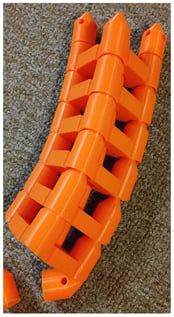
Tensegrity launch track being assembled.

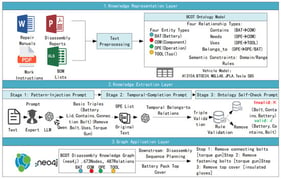
Effective disassembly process planning is fundamental to the sustainability of power battery recycling. However, existing knowledge graph (KG) methods rely on flat ontologies, failing to capture multi-level semantic structures and depending heavily on manual annotation, which cannot meet the scalability demands of Industry 5.0. We propose TSO-Prompt, a triple-stage ontology prompt-driven method. First, a Battery–Component–Operation–Tool (BCOT) ontology model defines four entity types and four relationship types with strict domain and range constraints. Second, a three-stage prompt strategy is designed: Stage 1 (Pattern Injection) embeds BCOT definitions for simultaneous entity recognition, ontology classification, and relation extraction; Stage 2 (Temporal Completion) captures cross-step operational dependencies; Stage 3 (Ontology Self-Check) filters hallucination-induced errors via rule-based verification. The fully zero-shot pipeline requires no manual annotation. Experiments on 172 disassembly steps from five battery models show TSO-Prompt achieves 100% core semantic retention, 90.1% operation recognition accuracy, a 6.4% entity F1 improvement over supervised baselines, and 60% query path length reduction over flat graphs, validating its potential for automated KG construction aligned with Industry 5.0 objectives.

Industries

23 July 2026

Overall framework of the TSO-Prompt method.

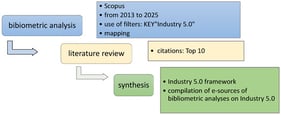
This paper presents a literature review and bibliometric synthesis of research on Industry 5.0 based exclusively on publications indexed in the Scopus database that include “Industry 5.0” among the authors’ keywords. Restricting the literature corpus to authors’ keywords was considered an appropriate approach for reconstructing the Industry 5.0 framework because keywords function as “academic hashtags,” reflecting how researchers intentionally position and describe their work within a specific research domain. The analysis covers the period 2013–2025. Unlike previous bibliometric studies that relied on full-text, title, or abstract searches, the approach adopted in this study treats authors’ keywords as an explicit declaration of a publication’s alignment with Industry 5.0 research. This perspective enables the reconstruction of the evolution, thematic structure, and cognitive boundaries of the field from the researchers’ own viewpoint. It also facilitates an examination of how Industry 5.0 has emerged and evolved as a distinct area of scientific inquiry between 2013 and 2025. The novelty of the study lies not in the application of bibliometric methods per se, but in the adoption of authors’ keywords as a criterion for delimiting the literature corpus. This methodological perspective allows for the development of an Industry 5.0 research landscape. In addition, the study provides a comprehensive overview of existing bibliometric analyses of Industry 5.0 and compiles relevant electronic sources to facilitate rapid access to the field’s principal research streams.

Industries

14 July 2026

Research methodology in the indicated work (paper) topic.
  • Feature Paper
  • Article
  • Open Access

Consumer Internet of Things (IoT) devices are increasingly central to Industry 4.0 commercialisation, but repeat demand depends on more than technical connectivity. This study examines how product design, ease of use, product quality and social status influence repurchase intention for consumer IoT devices in New Zealand, and whether trust and customer satisfaction mediate these relationships. A quantitative cross-sectional survey of 93 New Zealand IoT consumers was analysed using reliability testing, exploratory factor assessment, Pearson correlation, multiple regression and Hayes PROCESS Model 4 mediation. Trust and customer satisfaction jointly explained 63.3% of the adjusted variance in repurchase intention. Product design and product quality were significant direct predictors of both trust and customer satisfaction. Ease of use and social status were not significant direct predictors in the simultaneous regression models, but all four product attributes showed significant indirect effects on repurchase intention through trust and customer satisfaction. The findings suggest that consumer IoT repurchase in New Zealand is best understood as a post-adoption confidence process: functional, usability and symbolic product attributes become commercially meaningful when they are converted into trusted and satisfying product experiences. The study contributes an integrated model of IoT repurchase intention and offers practical guidance for IoT manufacturers, retailers, installers and policy actors seeking to strengthen consumer retention, privacy assurance and sustainable connected-product adoption.

Industries

14 July 2026

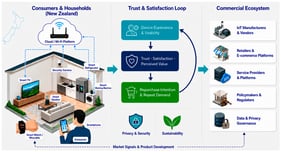
Consumer IoT ecosystem in New Zealand and its commercial relevance. Source: Authors’ own work.

Highly Accessed Articles

News & Conferences

Latest Issues

Open for Submission

Journal Sections

XFacebookLinkedIn
Industries - ISSN 3042-9021