
An LLM-Driven Triple-Stage Prompt for Automatic Disassembly Knowledge Graph Construction of End-of-Life Power Batteries Towards Industry 5.0




Abstract
1. Introduction
- (1)
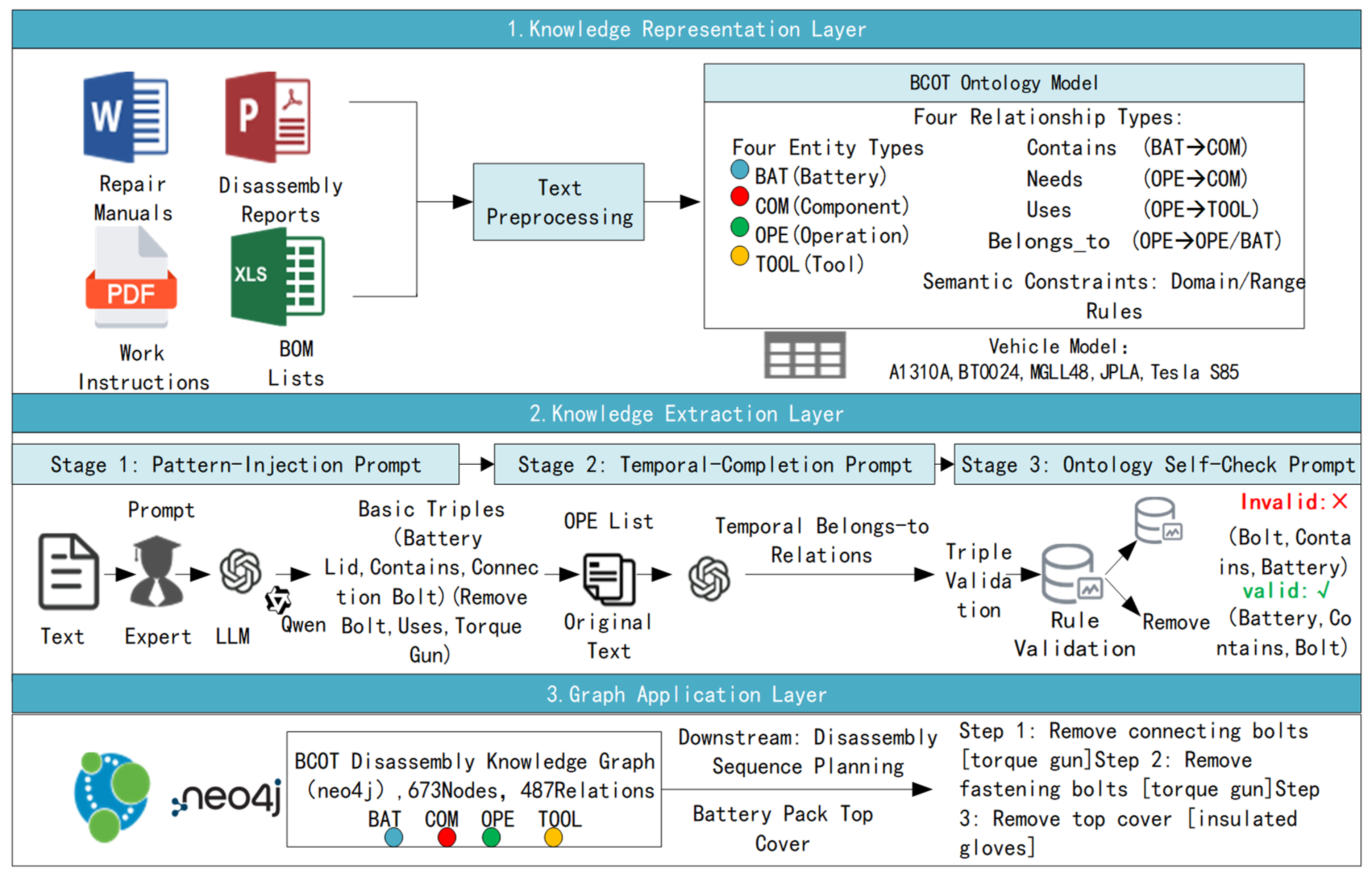
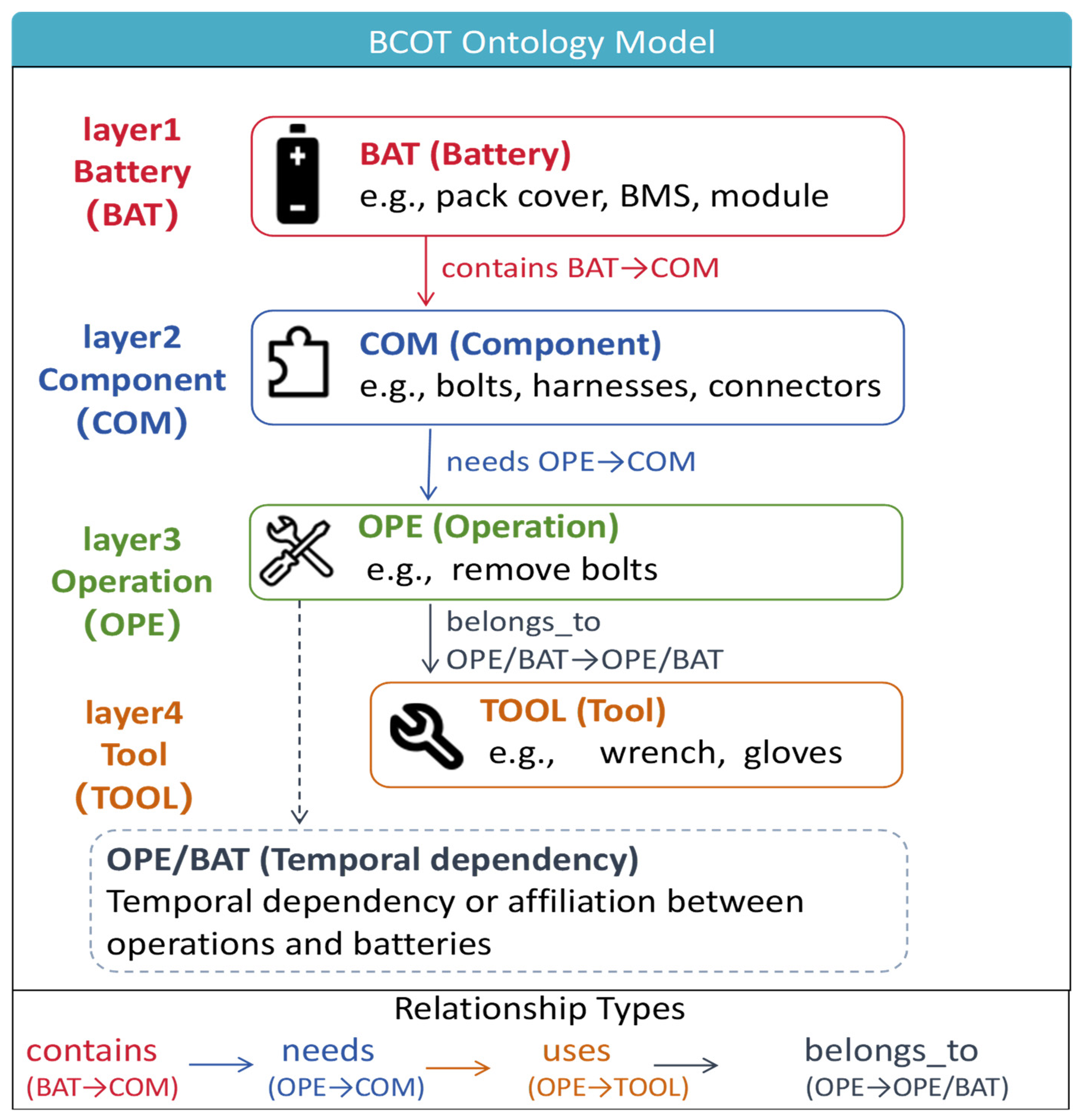
- We propose a BCOT ontology model for formalized knowledge representation of power battery disassembly. In this model, four entity types (BAT, COM, OPE, TOOL) and four relationship types (contains, needs, uses, belongs_to) with strict domain and range constraints. It may provide a theoretical foundation for semantically consistent disassembly knowledge extraction.
- (2)
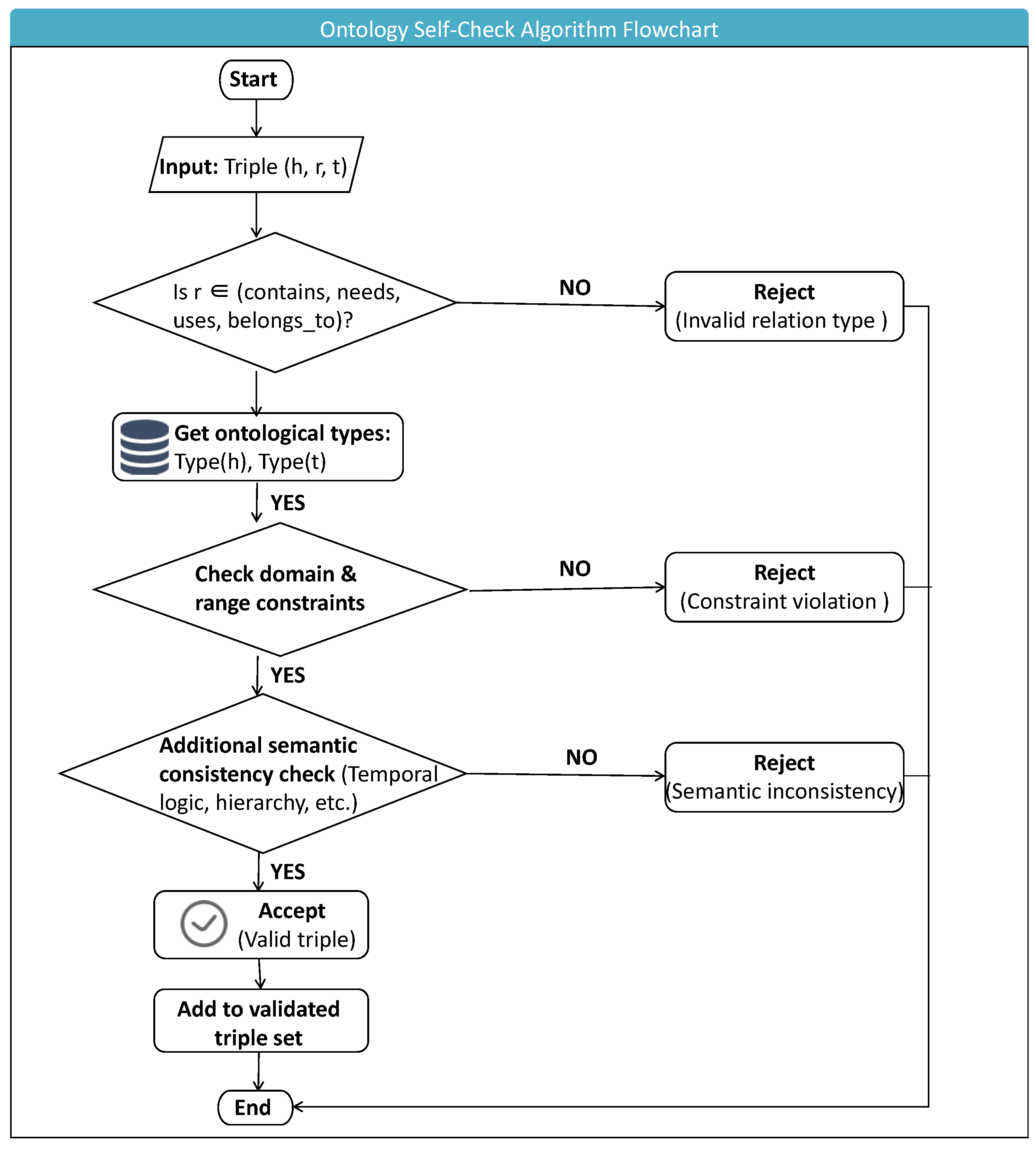
- We design a TSO-Prompt three-stage framework that integrates pattern injection, temporal completion, and ontology self-checking. This novel zero-shot prompt strategy requires no manually annotated training data, enabling rapid adaptation to new battery models.
- (3)
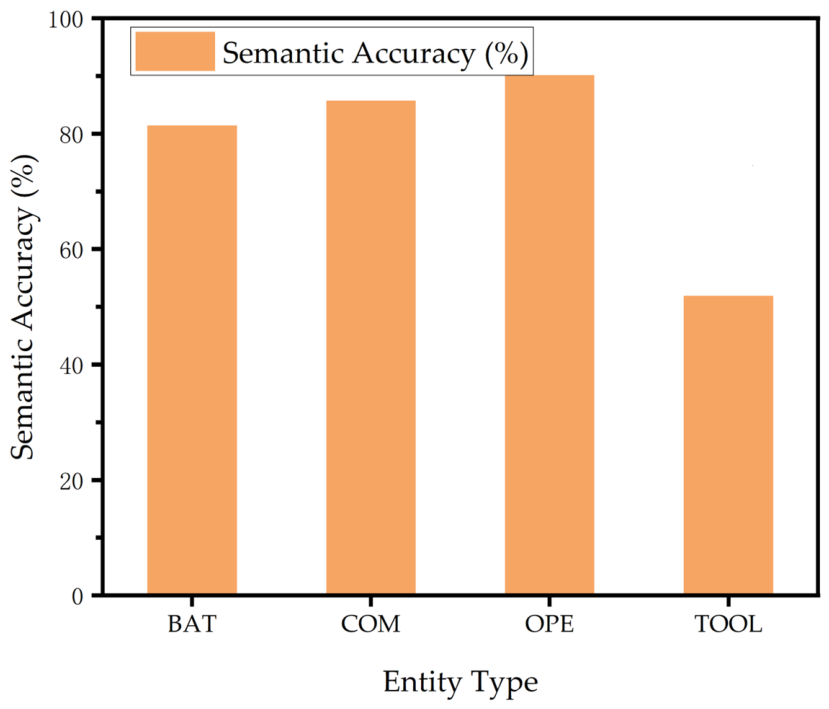
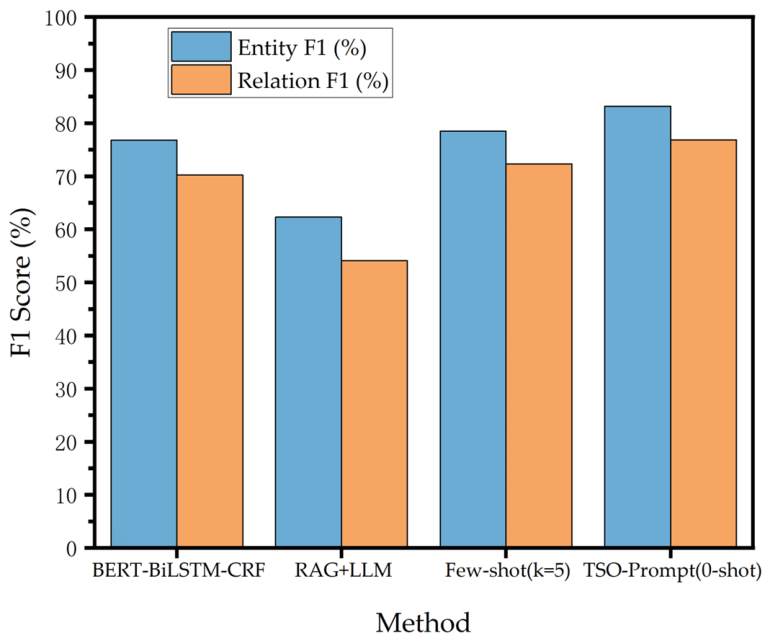
- We construct an experimental dataset of 172 disassembly steps from five mainstream battery models. Using this dataset, the proposed method achieves 100% core semantic retention, 90.1% operation recognition accuracy, and a 6.4% entity F1 improvement over supervised baselines, with the constructed KG supporting downstream DSP at a 60% query efficiency improvement.
2. Related Works
2.1. Power Battery Disassembly
2.2. Collaborative KG and LLMs in Manufacturing
2.3. Knowledge Graph Construction Techniques
3. Methodology
3.1. Overall Framework
3.2. BCOT Ontology Model
3.2.1. Formal Definition
3.2.2. Semantic Constraints
3.2.3. Theoretical Analysis
3.3. Stage 1: Pattern-Injection Prompts
3.3.1. Problem Formulation for Entity-Relation Extraction
3.3.2. Prompt Design Principles
- (1)
- Expert Role Setting. We assign the LLM the role of a “power battery disassembly process expert” to activate domain-specific knowledge acquired during pre-training. This role priming has been shown to improve extraction accuracy by biasing the model toward domain-relevant terminology and patterns.
- (2)
- Explicit Model Injection. The complete BCOT ontology definition—including all four entity types with representative examples, all four relationship types with directional constraints, and explicit violation examples—is embedded directly into the prompt as background knowledge. This serves as the “extraction guideline” that the LLM must strictly follow, effectively transforming the open-ended extraction task into a constrained generation task with well-defined output specifications.
- (3)
- Strict Format Constraints. The output is required to be a structured JSON array, where each triple explicitly specifies the head entity name, head entity type, relationship type, tail entity name, and tail entity type. This structured format eliminates parsing ambiguity and enables direct downstream processing without post hoc normalization.
3.3.3. Core Prompt Template
3.3.4. Extraction Process
3.4. Stage 2: Temporal-Completion Prompts
3.4.1. Problem Formulation for Temporal Dependency Completion
3.4.2. Prompt Design
3.4.3. Completion Algorithm
3.5. Stage 3: Ontology Self-Check Prompts
3.5.1. Problem Formulation for Ontology Validation
- (1)
- Relationship Direction Reversal. The LLM may confuse the directionality of relationships, generating triples such as (connecting bolt, contains, battery pack cover), which reverses the physical containment relationship.
- (2)
- Entity Type Misclassification. The LLM may incorrectly classify entities, for example, labeling “wrench” as a Component (COM) rather than a Tool (TOOL), or labeling “remove bolt” as a Component rather than an Operation.
- (3)
- Ontological Constraint Violation. The LLM may generate cross-ontology relationships, such as (operation A, uses, operation B) or (component X, needs, tool Y), violating the domain/range constraints of the BCOT model.
- (4)
- Relationship Type Misuse. The LLM may confuse semantically similar relationship types, such as using “needs” where “uses” is appropriate, or “belongs_to” where “contains” should be used.
3.5.2. Validation Rules
3.5.3. Validation Algorithm
3.5.4. Error Handling and Graph Instantiation
3.6. Chapter Summary
4. Experiments and Analysis
4.1. Experimental Setup
4.1.1. Dataset
4.1.2. Ground-Truth Construction
4.1.3. LLM Configuration
4.1.4. Evaluation Metrics
4.1.5. Baseline Models
- (1)
- BERT-BiLSTM-CRF [31]: A traditional supervised sequence labeling model. It was fine-tuned on the same annotated data using the BIO tagging scheme to recognize four entity types, with relation extraction based on predefined rules. The annotation cost was approximately 40 person-hours.
- (2)
- Traditional RAG + LLM [14]: A retrieval-augmented generation system built using the LangChain framework. Disassembly texts were chunked and indexed, and the LLM generated triples based on retrieved relevant text fragments.
- (3)
- Few-shot Prompt [10]: The LLM was provided with k annotated examples (k = 1, 3, 5) in the prompt to test its few-shot learning capability, serving as a comparison with the zero-shot setting.
4.2. Triple Extraction Performance
4.2.1. Manual Semantic Evaluation
4.2.2. Entity Type Recognition Performance
4.2.3. Baseline Comparison
4.2.4. Few-Shot Comparison
4.3. Ablation Experiments
- (1)
- Model injection is critical. Upon removing the BCOT model definition (-MI), the validity rate plummeted from 87.9% to 0%, with ontology errors increasing dramatically to 108. This compellingly demonstrates that explicit model injection is the key factor ensuring extraction quality—the LLM requires a clear domain knowledge framework to guide its extraction behavior. Without the injected ontology, the LLM generates entity types and relationship types that do not conform to the BCOT schema, rendering the extracted triples unusable.
- (2)
- Hierarchical ontology is indispensable. Replacing BCOT with a flat ontology (Flat) similarly failed to produce any valid triples. This confirms that hierarchical semantic constraints are fundamental to the structural validity of extraction results. Flat ontologies cannot express the layered dependencies between battery components, operations, and tools, leading to cross-layer relationship errors.
- (3)
- Temporal completion is effective. The complete method successfully supplemented temporal relations, whereas -S2 produced none. The operation chains generated by Stage 2 are essential for downstream disassembly sequence planning tasks. Without temporal relations, the knowledge graph captures what operations exist but not the order in which they must be performed—a critical piece of information for practical disassembly guidance.
- (4)
- Ontology validation ensures quality. When Stage 3 was removed (-S3 setting), approximately 8% of the total triples contained errors that violated BCOT constraints. These errors included relationship direction reversals (45% of errors), entity type misclassifications (30%), and constraint violations (25%). The complete method successfully filtered these errors through the ontology self-check mechanism, maintaining a 0% error rate in the final graph.
4.4. Graph Construction and Case Validation
4.4.1. Ontology Classification Accuracy
4.4.2. Knowledge Graph Visualization
4.4.3. Case Study: Disassembly Sequence Query
| MATCH (b: BAT {name: ‘battery pack top cover’})-[: contains]->(c: COM)<-[: needs]-(o: OPE) OPTIONAL MATCH (o)-[: uses]->(t: TOOL) OPTIONAL MATCH (o)-[: belongs_to]->(next: OPE) RETURN o.name AS Operation, COLLECT(DISTINCT t.name) AS Tools, next.name AS Next_Operation ORDER BY o.name |
4.5. Discussion
4.5.1. Advantages of the Proposed Method
4.5.2. Limitations
4.5.3. Future Directions
5. Conclusions
Author Contributions
Funding
Institutional Review Board Statement
Informed Consent Statement
Data Availability Statement
Conflicts of Interest
Abbreviations
| LLM | Large Language Model |
| BCOT | Battery–Component–Operation–Tool |
| TSO-Prompt | Triple-Stage Ontology Prompt |
| KG | Knowledge Graph |
| DSP | Disassembly Sequence Planning |
| BAT | Battery |
| COM | Component |
| OPE | Operation |
| TOOL | Tool |
| RAG | Retrieval-Augmented Generation |
| NER | Named Entity Recognition |
| BERT | Bidirectional Encoder Representations from Transformers |
| BiLSTM | Bidirectional Long Short-Term Memory |
| CRF | Conditional Random Field |
| LFP | Lithium Iron Phosphate |
| NCM | Nickel Cobalt Manganese |
| LMO | Lithium Manganese Oxide |
| GT | Ground Truth |
References
- Chen, M.; Wang, Z.; Zhang, Y. Reflections on intelligent robotic disassembly for retired power batteries. Auto Parts 2023, 5, 54–58. (In Chinese) [Google Scholar]
- Cong, L.; Liu, W.; Kong, S.; Li, H.; Deng, Y.; Ma, H. End-of-use management of spent lithium-ion batteries from sustainability perspective: A review. J. Manuf. Sci. Eng. 2021, 143, 100801. [Google Scholar] [CrossRef]
- Yu, J.; Zhang, H.; Jiang, Z.; Yan, W.; Wang, Y. Disassembly task planning for end-of-life automotive traction batteries based on ontology and partial destructive rules. J. Manuf. Syst. 2022, 62, 347–366. [Google Scholar] [CrossRef]
- Wu, H.; Jiang, Z.; Zhu, S.; Zhang, H. A knowledge graph based disassembly sequence planning for end-of-life power battery. Int. J. Precis. Eng. Manuf.-Green Technol. 2024, 11, 849–861. [Google Scholar]
- Wang, H.; Yan, W.; Zhang, X.; Zhu, S.; Jiang, Z.; Zhu, Z. GraphRAG-based disassembly sequence planning for end-of-life power batteries. China Mech. Eng. 2025; in press. [CrossRef]
- Liu, Q.; Li, Y.; Duan, H.; Liu, Y.; Qin, Z. A survey of knowledge graph construction techniques. J. Comput. Res. Dev. 2016, 53, 582–600. [Google Scholar]
- Guo, H.; Li, R.; Zhang, H.; Wang, Y.; Dong, Y. Multi-domain fusion knowledge graph for high-speed train maintainability design. China Mech. Eng. 2022, 33, 3015–3023. [Google Scholar]
- Huang, Z.; Guo, X.; Liu, Y.; Zhao, W.; Zhang, K. A smart conflict resolution model using multi-layer knowledge graph for conceptual design. Adv. Eng. Inform. 2023, 55, 101887. [Google Scholar] [CrossRef]
- Pan, S.; Luo, L.; Wang, Y.; Chen, C.; Wang, J.; Wu, X. Unifying large language models and knowledge graphs: A roadmap. IEEE Trans. Knowl. Data Eng. 2024, 36, 3580–3599. [Google Scholar] [CrossRef]
- Brown, T.B.; Mann, B.; Ryder, N.; Subbiah, M.; Kaplan, J.; Dhariwal, P.; Neelakantan, A.; Shyam, P.; Sastry, G.; Askell, A.; et al. Language models are few-shot learners. In Proceedings of the Advances in Neural Information Processing Systems 33 (NeurIPS), Vancouver, BC, Canada, 6–12 December 2020; pp. 1877–1901. [Google Scholar]
- Xiao, J.; Anwer, N.; Li, W.; Ertas, A.; Tatari, O. Dynamic Bayesian network-based disassembly sequencing optimization for electric vehicle battery. CIRP J. Manuf. Sci. Technol. 2022, 38, 824–835. [Google Scholar] [CrossRef]
- Wei, J.; Wang, X.; Schuurmans, D.; Bosma, M.; Ichter, B.; Xia, F.; Chi, E.H.; Le, Q.V.; Zhou, D. Chain-of-thought prompting elicits reasoning in large language models. In Proceedings of the Advances in Neural Information Processing Systems 35 (NeurIPS), New Orleans, LA, USA, 28 November–9 December 2022; pp. 24824–24837. [Google Scholar]
- Zhang, K.; Zhang, Y.; Wu, Y.; Zhang, X.; Zhai, S. LLM-based automatic construction method of equipment fault knowledge graph. Comput. Mod. 2024, 11, 46–53. [Google Scholar]
- Lewis, P.; Perez, E.; Piktus, A.; Petroni, F.; Karpukhin, V.; Goyal, N.; Küttler, H.; Lewis, M.; Yih, W.-t.; Rocktäschel, T.; et al. Retrieval-augmented generation for knowledge-intensive NLP tasks. In Proceedings of the Advances in Neural Information Processing Systems 33 (NeurIPS), Vancouver, BC, Canada, 6–12 December 2020; pp. 9459–9474. [Google Scholar]
- Jiang, Z.; Xie, B.; Zhu, S.; Zhang, H. Dynamic data flow-driven knowledge graph construction method for remanufacturing disassembly process. Comput. Integr. Manuf. Syst. 2024, 30, 879–892. (In Chinese) [Google Scholar]
- Xiao, X.; Li, C.; Huang, J.; Yu, T. Fault diagnosis of rolling bearing based on knowledge graph with data accumulation strategy. IEEE Sens. J. 2022, 22, 18831–18840. [Google Scholar] [CrossRef]
- Noy, N.F.; McGuinness, D.L. Ontology Development 101: A Guide to Creating Your First Ontology; Stanford Knowledge Systems Laboratory Technical Report; Stanford University: Stanford, CA, USA, 2001. [Google Scholar]
- Tang, X.; Feng, Z.; Xiao, Y.; Wang, M.; Ye, T.; Zhou, Y.; Zhang, D. Construction and application of an ontology-based domain-specific knowledge graph for petroleum exploration and development. Geosci. Front. 2023, 14, 101426. [Google Scholar] [CrossRef]
- Jiang, X.-J.; Zhou, W.; Hou, J. Construction of fault diagnosis system for control rod drive mechanism based on knowledge graph and Bayesian inference. Nucl. Sci. Tech. 2023, 34, 21. [Google Scholar] [CrossRef]
- Wang, J.; Yan, C.F.; Zhang, Y.M.; Li, Y.J.; Wang, H.B. Construction and application of knowledge graph for fault diagnosis of turbine generator set based on ontology. J. Phys. Conf. Ser. 2022, 2184, 012015. [Google Scholar] [CrossRef]
- Devlin, J.; Chang, M.W.; Lee, K.; Toutanova, K. BERT: Pre-training of deep bidirectional transformers for language understanding. In Proceedings of the 2019 Conference of the North American Chapter of the Association for Computational Linguistics (NAACL), Minneapolis, MN, USA, 2–7 June 2019; pp. 4171–4186. [Google Scholar]
- Vaswani, A.; Shazeer, N.; Parmar, N.; Uszkoreit, J.; Jones, L.; Gomez, A.N.; Kaiser, Ł.; Polosukhin, I. Attention is all you need. In Proceedings of the Advances in Neural Information Processing Systems 30 (NeurIPS), Long Beach, CA, USA, 4–9 December 2017; pp. 5998–6008. [Google Scholar]
- Deng, J.; Wang, T.; Wang, Z.; Zhou, J.; Cheng, L. Research on event logic knowledge graph construction method of robot transmission system fault diagnosis. IEEE Access 2022, 10, 17656. [Google Scholar] [CrossRef]
- Liu, Y.; Wei, S.; Huang, H.; Lai, Q.; Li, M.; Guan, L. Naming entity recognition of citrus pests and diseases based on the BERT-BiLSTM-CRF model. Expert Syst. Appl. 2023, 234, 121103. [Google Scholar] [CrossRef]
- Chen, C.; Wang, T.; Zheng, Y.; Liu, Y.; Xie, H.; Deng, J.; Cheng, L. Reinforcement learning-based distant supervision relation extraction for fault diagnosis knowledge graph construction under industry 4.0. Adv. Eng. Inform. 2023, 55, 101900. [Google Scholar] [CrossRef]
- Sun, H.; Grishman, R. Lexicalized dependency paths based supervised learning for relation extraction. Comput. Syst. Sci. Eng. 2022, 43, 861–870. [Google Scholar] [CrossRef]
- Li, S.; Wang, J.; Rong, J. Design-oriented product fault knowledge graph with frequency weight based on maintenance text. Adv. Eng. Inform. 2023, 58, 102229. [Google Scholar] [CrossRef]
- Xu, Z.; Sheng, V.S.; Gong, Y. A survey on knowledge graph embedding: Approaches, applications and benchmarks. Inf. Fusion 2023, 92, 13–36. [Google Scholar]
- Ji, S.; Pan, S.; Cambria, E.; Marttinen, P.; Yu, P.S. A survey on knowledge graphs: Representation, acquisition, and applications. IEEE Trans. Neural Netw. Learn. Syst. 2022, 33, 494–514. [Google Scholar] [CrossRef] [PubMed]
- Hogan, A.; Blomqvist, E.; Cochez, M.; d’Amato, C.; de Melo, G.; Gutierrez, C.; Kirrane, S.; Gayo, J.E.L.; Navigli, R.; Neumaier, S.; et al. Knowledge graphs. ACM Comput. Surv. 2022, 54, 71. [Google Scholar]
- Jiang, S.; Zhao, S.; Hou, K.; Liu, Y.; Zhang, L. A BERT-BiLSTM-CRF model for Chinese electronic medical records named entity recognition. In Proceedings of the 12th International Conference on Information Technology in Medicine and Education (ITME), Xiamen, China, 18–20 November 2022; pp. 166–170. [Google Scholar]



| Relationship | Domain | Range | Semantic Description |
|---|---|---|---|
| Contains | Battery consists of components | ||
| Needs | Operation acts to components | ||
| Uses | Operation needs tools | ||
| Belongs_to | Temporal dependencies or affiliations |
| [Role] You are a power battery disassembly process expert, proficient in the disassembly procedures of various battery pack models. [Background Knowledge] We are constructing an ontology-based disassembly knowledge graph. The BCOT model is defined as follows: Entity Types:
Relationship Types and Constraints:
[Task] Analyze the following text and extract all knowledge according to the above model. Output only a JSON list in the following format: [{“head”: “entity name”, “head_type”: “BAT/COM/OPE/TOOL”, “relation”: “contains/needs/uses/belongs_to”, “tail”: “entity name”, “tail_type”: “BAT/COM/OPE/TOOL”}] [Text] {input_text} Ensure: (1) All relationships strictly follow domain and range constraints. (2) Operation entities are complete action descriptions from the text. (3) No explanatory text beyond the JSON output. |
| [Role] You are a power battery disassembly process expert. [Task] In the previous stage, we extracted basic triples from the disassembly text. Now you need to identify temporal dependency relationships between operations. [Extracted Operation Entities] {ope_list} [Original Text] {original_text} [Instructions] Analyze the sequence of operations in the text and supplement “belongs_to” relations. Here, “belongs_to” denotes temporal dependency: operation A must be completed before operation B can begin. Output format: [{“head”: “preceding operation”, “head_type”: “OPE”, “relation”: “belongs_to”, “tail”:“subsequent operation”, “tail_type”: “OPE”}] If only one operation exists or temporal order cannot be determined, output an empty list []. |
| Rule ID | Relationship | Constraint | Handling |
|---|---|---|---|
| R1 | Contains | head=BAT ∧ tail=COM | Exclude |
| R2 | Needs | head=OPE ∧ tail=COM | Exclude |
| R3 | Uses | head=OPE ∧ tail=TOOL | Exclude |
| R4 | Belongs_to | head=OPE ∧ tail ∈ {OPE, BAT} | Exclude |
| R5 | any | relation ∈ {contains, needs, uses, belongs_to} | Mark for review |
| R6 | any | head_type, tail_type ∈ {BAT, COM, OPE, TOOL} | Mark for review |
| Vehicle Model | Steps | Entities | Triples |
|---|---|---|---|
| Off-road A1310A | 50 | 196 | 142 |
| Mercedes-Benz BT0024 | 25 | 98 | 71 |
| Foton MGL48C01Y | 35 | 137 | 99 |
| JPLA-10B759-AH | 45 | 176 | 127 |
| Tesla Model S 85 kWh | 17 | 66 | 48 |
| Total | 172 | 673 | 487 |
| Grade | Percentage | Description |
|---|---|---|
| All Correct | 36.70% | Semantically identical to GT |
| Partially Correct | 63.30% | Core semantics correct |
| All Incorrect | 0% | No completely incorrect samples |
| Core Retained | 100% | Core knowledge correctly extracted |
| Error Type | Percentage | Correctable by Stage 3 |
|---|---|---|
| Relationship direction reversal | 45% | Yes (R1–R4) |
| Entity type misclassification | 30% | Yes (R6) |
| Entity boundary errors | 15% | No |
| Missing entities | 10% | No |
| Method | Precision | Recall |
|---|---|---|
| BERT-BiLSTM-CRF | 74.20% | 79.50% |
| Traditional RAG + LLM | 60.10% | 64.80% |
| Few-shot (k = 5) | 76.80% | 80.20% |
| TSO-Prompt (0-shot) | 82.50% | 83.90% |
| Shots | Success Rate | Average Number of Trios |
|---|---|---|
| 0-shot | 100% | 4.9 |
| 1-shot | 100% | 3.6 |
| 3-shot | 100% | 4 |
| 5-shot | 100% | 4.1 |
| Ablation Setting | Validity Rate | Temporal Relations | Ontology Errors |
|---|---|---|---|
| Full (Complete Method) | 87.90% | √ | None |
| -S2 (without temporal) | 80.60% | × | None |
| -S3 (without integrity check) | — | √ | None |
| -MI (without mode injection) | 0% | × | Significant |
| Flat (Flat Body) | 0% | × | — |
| No. | Operation | Required Tools | Next Operation |
|---|---|---|---|
| 1 | Remove connecting bolts between battery pack cover and tray | [Torque Wrench] | Remove fastening bolts |
| 2 | Remove fastening bolts of battery pack cover | [Torque Wrench] | Remove battery pack cover |
| 3 | Remove battery pack cover | [Insulated Gloves] | — |
Disclaimer/Publisher’s Note: The statements, opinions and data contained in all publications are solely those of the individual author(s) and contributor(s) and not of MDPI and/or the editor(s). MDPI and/or the editor(s) disclaim responsibility for any injury to people or property resulting from any ideas, methods, instructions or products referred to in the content. |
© 2026 by the authors. Licensee MDPI, Basel, Switzerland. This article is an open access article distributed under the terms and conditions of the Creative Commons Attribution (CC BY) license.
Share and Cite
Song, L.; Du, Z.; Yan, W.; Liu, Y. An LLM-Driven Triple-Stage Prompt for Automatic Disassembly Knowledge Graph Construction of End-of-Life Power Batteries Towards Industry 5.0. Industries 2026, 1, 6. https://doi.org/10.3390/industries1010006
Song L, Du Z, Yan W, Liu Y. An LLM-Driven Triple-Stage Prompt for Automatic Disassembly Knowledge Graph Construction of End-of-Life Power Batteries Towards Industry 5.0. Industries. 2026; 1(1):6. https://doi.org/10.3390/industries1010006
Chicago/Turabian StyleSong, Lifang, Zhenjie Du, Wei Yan, and Ying Liu. 2026. "An LLM-Driven Triple-Stage Prompt for Automatic Disassembly Knowledge Graph Construction of End-of-Life Power Batteries Towards Industry 5.0" Industries 1, no. 1: 6. https://doi.org/10.3390/industries1010006
APA StyleSong, L., Du, Z., Yan, W., & Liu, Y. (2026). An LLM-Driven Triple-Stage Prompt for Automatic Disassembly Knowledge Graph Construction of End-of-Life Power Batteries Towards Industry 5.0. Industries, 1(1), 6. https://doi.org/10.3390/industries1010006