Skip to Content

International Journal of Molecular Sciences

International Journal of Molecular Sciences is an international, peer-reviewed, open access journal providing an advanced forum for biochemistry, molecular and cell biology, molecular biophysics, molecular medicine, and all aspects of molecular research in chemistry, and published semimonthly online by MDPI.
The Epigenetics Society, European Chitin Society (EUCHIS), Spanish Society for Cell Biology (SEBC) and others are affiliated with IJMS and their members receive a discount on the article processing charges.
Indexed in PubMed | Quartile Ranking JCR - Q1 (Biochemistry and Molecular Biology)

Get Alerted

Add your email address to receive forthcoming issues of this journal.

All Articles (113,259)

The biological basis of suicidal behavior extends beyond psychiatric diagnosis, and alterations in stress-response regulation, monoaminergic signaling, and GABAergic function may contribute to suicide risk. We enrolled 69 adults presenting to the emergency department after a suicide attempt episode and 72 controls. Expression of eight candidate genes (SLC6A3, SLC6A4, NR3C1, NR3C2, DRD2, MAOA, GABRA2, and GABBR2) was measured by qRT-PCR in paired peripheral blood and buccal swab samples, with GAPDH as the reference gene. Multiple testing was addressed with the Benjamini—Hochberg false discovery rate. NR3C2, which encodes the mineralocorticoid receptor, was the only gene downregulated in both sample types after FDR correction (blood: q = 0.0007; swab: q = 0.0004). Blood additionally showed changes in SLC6A4 (↓), DRD2 (↑), and GABBR2 (↑). In buccal swabs, every gene that reached significance—SLC6A3, NR3C1, GABRA2, and GABBR2—was downregulated. No gene achieved AUC ≥ 0.90 in ROC analysis. Gene-by-biochemistry correlations did not survive FDR correction, suggesting transcriptional changes independent of acute metabolic status. Overall, peripheral expression was matrix-dependent, and NR3C2 downregulation stood out as the one signal that replicated across both. Blood and buccal swabs captured complementary biological information, together pointing to impaired HPA-axis buffering. Because group-level confounders could not be adjusted for, these findings should be read as hypothesis-generating and warrant confounder-controlled, longitudinal validation.

11 August 2026
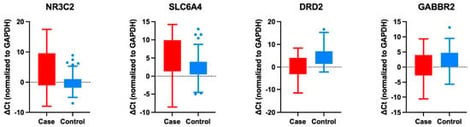
Peripheral blood ΔCt expression of FDR-significant genes in suicide attempt cases versus controls. Boxes indicate the 25th–75th percentile range with the median line; whiskers represent Tukey’s 1.5 × IQR criterion; individual points beyond whiskers are shown. Red: cases; blue: controls. q values (Benjamini–Hochberg FDR correction across eight genes): NR3C2, q = 0.0007; SLC6A4, q = 0.0007; DRD2, q = 0.0001; GABBR2, q = 0.0317. Sample sizes: NR3C2—cases n = 57, controls n = 63; SLC6A4—cases n = 62, controls n = 67; DRD2—cases n = 64, controls n = 63; GABBR2—cases n = 65, controls n = 65. ΔCt values are normalized to GAPDH; higher ΔCt corresponds to lower expression.

Switchable β-barrel-type fluorescent proteins are essential genetically encoded probes for super-resolution imaging. The space required for chromophore cis–trans isomerisation can also provide an opportunity to introduce bulkier chemistry at the 3-position of the phenolic ring. Here, we report, to our knowledge, the first successful genetic encoding of 3-cyano-L-tyrosine (3CNY) into a protein. Using genetic code expansion, the cyano-containing tyrosine derivative is incorporated directly into the chromophore of mKate, a pH-dependent switchable red fluorescent protein. While mKate adopts a fluorescent phenolate cis-state chromophore at physiological pH, substituting the native tyrosine with 3CNY yields a functional protein exhibiting hypsochromically shifted spectral properties. Time-dependent density functional theory (TD-DFT) calculations indicate that 3CNY incorporation results in a trans state at pH 8 but, unlike mKate, is fluorescent. The electron-withdrawing cyano group potentially perturbs conjugation across the chromophore, thus lowering the barrier to cis–trans isomerisation. The trans form may also be stabilised by hydrogen bonds from the cyano group to the rest of the protein. Overall, the introduction of a genetically encoded 3-CNY tyrosine analogue into a fluorescent protein chromophore expands our mechanistic understanding and enables the incorporation of a new chemical tag directly into the chromophore.

11 August 2026

Chromophore structure of mKate. (a) The β-barrel and chromophore structures of mKate at pH 7 (grey, PDB 3BXB) and at pH 4.2 (cyan, PDB 3bx9) [11]. Inset are the two alternative chromophore states with the P and I rings labelled for the cis (grey carbons) and trans (cyan carbons) states. (b) Putative models of the 3CNY-derived mKate chromophores. The U and D notation refers to which rotamer state the cyano group occupies; the U state carbons are coloured green, and the D state carbons are coloured cyan. Note that only either the U or D form is sampled at any one time but both are shown within the same chromophore structure for simplicity.

Evidence for Altered Epigenetic Regulatory Machinery in Migraine: A Peripheral Blood Study

  • Michal Fila,
  • Kinga Kołacz-Milewska and
  • Janusz Blasiak
  • + 5 authors

Calcitonin gene-related peptide (CGRP), encoded by the CALCA gene, plays a central role in migraine pathophysiology; however, it remains unclear whether migraine is associated with persistent systemic molecular alterations affecting the CGRP pathway during the interictal phase. Transient receptor potential cation channel subfamily A member 1 (TRPA1) stimulates the release of CGRP from nerve endings. We investigated gene-specific and global epigenetic regulatory mechanisms associated with CALCA and TRPA1 expression in the peripheral blood of 56 patients with episodic migraine in the interictal phase and 36 headache-free controls. Expression of CALCA, TRPA1, and genes encoding epigenetic regulators, histone deacetylases 1 and 6 (HDAC1 and HDAC6), was assessed by quantitative real-time PCR. DNA methylation of CALCA and TRPA1 was evaluated using methylation-specific PCR. Expression of other epigenetic regulators miRNA-375, miRNA-382, and miRNA-34a was determined using TaqMan MicroRNA assays. No significant differences were observed between migraine patients and controls in CALCA or TRPA1 expression, nor in DNA methylation of these genes. Similarly, no differences were found in the expression of miRNA-375 and miRNA-382. In contrast, miRNA-34a expression was significantly reduced in migraine patients. Moreover, the expression of HDAC1 and HDAC6 was significantly decreased in migraine. Despite the established role of CGRP in migraine, no evidence of persistent systemic dysregulation of CALCA or TRPA1 was detected in peripheral blood during the interictal phase. However, altered expression of miRNA-34a, HDAC1, and HDAC6 suggests the presence of broader epigenetic and post-transcriptional regulatory disturbances. These findings support a model in which migraine is associated with dysregulation of regulatory mechanisms rather than stable alterations of individual target genes.

11 August 2026

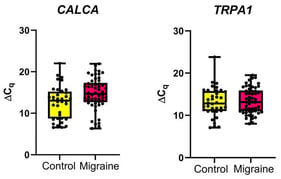
Expression of the calcitonin-related polypeptide alpha (CALCA) and transient receptor potential ankyrin 1 (TRPA1) genes in migraine patients (n = 54) and controls (n = 32). Gene expression was assessed by quantitative real-time PCR and expressed as ΔCq values (Cq_target − Cq_reference), with lower values indicating higher expression levels. Data are presented as box-and-whisker plots with individual data points. The central line represents the median, boxes indicate the interquartile range (IQR), and whiskers denote the minimum to maximum values.

Vernal keratoconjunctivitis (VKC) is a chronic pediatric ocular allergy that can progress from seasonal to persistent inflammation with vision-threatening complications. Although Th2-associated mechanisms have been implicated, the immune correlates of disease severity are not well defined. Tear samples from VKC patients (moderate intermittent and moderate persistent) and healthy controls were collected using Schirmer’s strips. Cytokine profiling was performed using the OLINK® Target 48 Cytokine Panel. Differential expression, correlation with clinical features, and pathway enrichment analyses were performed. Compared to control, IL-15, CXCL11, CXCL9, MMP12, and CCL13 were significantly elevated in VKC, with higher levels in the persistent phenotype. These cytokines correlated with symptom duration, limbal involvement, and papillary hypertrophy. Pathway analysis revealed enrichment of IL-17, JAK–STAT, and chemokine signaling pathways. VKC severity is associated with distinct tear cytokine signatures, with the persistent phenotype showing enhanced chronic inflammatory signaling. These findings identify candidate tear-based markers of disease severity that require validation in larger, independent, and longitudinal cohorts.

11 August 2026

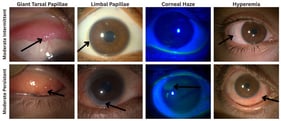
Representative clinical images demonstrating key ocular features in Moderate Intermittent and Moderate Persistent VKC. Moderate Intermittent VKC: Giant papillae are visible on the upper tarsal conjunctiva, accompanied by mild limbal papillae, localized corneal haze under fluorescein staining, and mild conjunctival hyperemia. Moderate Persistent VKC: More pronounced tarsal papillary hypertrophy is observed, along with prominent limbal thickening, extensive corneal epithelial damage and fluorescein uptake, and diffuse conjunctival hyperemia. Arrow are showing the clinical features written on top of of the respective figure.

News & Conferences

Volumes

Latest Issues

Open for Submission

Editor's Choice

XFacebookLinkedIn
Int. J. Mol. Sci. - ISSN 1422-0067