

You are currently viewing a new version of our website. To view the old version click .

Biology

Biology is an international, peer-reviewed, open access journal of biological sciences published semimonthly online by MDPI.
The Spanish Society for Nitrogen Fixation (SEFIN) and Federation of European Laboratory Animal Science Associations (FELASA) are affiliated with Biology and their members receive discounts on the article processing charges.
Indexed in PubMed | Quartile Ranking JCR - Q1 (Biology)

All Articles (8,709)

Improving phosphorus (P) utilization in broilers is crucial for reducing feed costs and environmental pollution. Bone mineralization trait is strongly associated with P utilization in poultry and is thus often used as an alternative trait for evaluating P utilization. Dentin matrix protein 1 (DMP1), an essential matrix protein for bone mineralization and P deposition, has been shown to be actively involved in P utilization in broilers, but the underlying mechanisms remain unclear. The current study aimed to investigate the possible mechanisms whereby DMP1 regulates P utilization of poultry by using gene silencing and overexpression technologies, combined with an in vitro model of primary broiler osteoblasts. The results showed that DMP1 overexpression augmented the P utilization of broiler osteoblasts, characterized by significant increases (p < 0.001) in P utilization rate, mineralization formation, alkaline phosphatase activity, and bone gla protein content. Meanwhile, DMP1 overexpression effectively (p < 0.05) activated the focal adhesion kinase (FAK) signaling, along with obvious (p < 0.01) decreases in fibroblast growth factor 23 (FGF23) expression and production. In contrast, DMP1 silencing reversed (p < 0.05) the above effects. Consistently, FAK activation promoted (p < 0.05) P utilization accompanied by remarkable (p < 0.05) decreases in FGF23 expression and production. Furthermore, gain- and loss-of-function assays demonstrated that a high level of FGF23 contributed to impaired P utilization, while a low level was beneficial. Interestingly, blocking FAK signaling not only recovered (p < 0.05) the FGF23 expression and production in DMP1 overexpressed cells but also obviously (p < 0.05) weakened their P utilization. These findings indicate that DMP1 inhibits FGF23 expression by activating FAK, thereby contributing to P utilization in broiler osteoblasts. They reveal a novel DMP1-FAK-FGF23 regulatory axis in broiler osteoblasts and provide a potential target for improving P efficiency in poultry.
8 January 2026

The effect of si-DMP1 or pcDNA3.1-DMP1 transfection on the mRNA expression levels of DMP1 (A,D), FAK (B,E), and FGF23 (C,F) in broiler osteoblasts. All values are expressed as means ± SE, n = 5–6. * p &lt; 0.05, ** p &lt; 0.01, *** p &lt; 0.001. DMP1, dentin matrix protein 1; FAK, focal adhesion kinase; FGF23, fibroblast growth factor 23.

Deep-sea hydrothermal vent fauna is often regarded as highly endemic, although exceptions have been reported. We examined genetic connectivity across broad spatial scales within the alvinocaridid genus Rimicaris, which has undergone substantial adaptive radiation worldwide. We analyzed six Rimicaris species using three genetic markers, cytochrome c oxidase subunit I (COI), 16S ribosomal rRNA gene (16S), and histone h3 (H3), and complete mitogenomes, employing newly generated sequences combined with publicly available sequence data. A genetic tree and haplotype networks were constructed, and divergence analyses were performed. Three clades of paired Rimicaris species were identified, each made up of taxa from different oceanic regions but showing relatively low COI divergence (0.35–1.90%). In Clade I, Rimicaris chacei and Rimicaris hybisae are morphologically similar and exhibit bidirectional gene flow, implying a dispersal route between the Mid-Atlantic Ridge (MAR) and the Mid-Cayman Spreading Center (MCSC). In Clade II, Rimicaris exoculata and Rimicaris kairei are morphologically, genetically, and ecologically distinct, reflecting restricted connectivity between the MAR and the Carlsberg Ridge (CR)–Central Indian Ridge (CIR). In Clade III, Rimicaris variabilis and Rimicaris cf. variabilis differ in nutritional strategies, showing a unidirectional dispersal route from the CIR to the southwestern Pacific (SWP), but morphological data to distinguish them are currently lacking. Some Rimicaris lineages maintain connectivity across distinct oceanic regions while others still form unique regional populations. This finding highlights the need for conservation strategies that incorporate both global-scale connectivity and regional endemism, rather than treating individual vent ecosystems as a single homogeneous management unit.

7 January 2026

Geographic sampling regions of sequenced specimens of the six Rimicaris species used in this study.

Quick Quantitative (QQ) immunoassays have been increasingly applied for the measurement of enrofloxacin (ENR) and ciprofloxacin (CIP) residues in aquaculture due to their speed and convenience. However, their quantitative reliability remains limited because measurement uncertainty (MU) is rarely considered during field testing. To enhance the metrological reliability of QQ-based residue analysis, we developed AquaUncertainty Pal, a mobile application that embeds real-time MU computation into the QQ workflow. The software automatically evaluates uncertainty sources during sampling and pipetting, visualizes the uncertainty budget, and guides users through optimized operations. The framework was validated against ISO/IEC 17025–accredited LC–MS/MS and assessed through a user study involving 20 frontline technicians. With the integrated software, pipetting precision (RSD) at 100 μL improved from 4.1% to 1.79%, the inter-operator variability (CV) decreased by 52%, and conformity assessment accuracy for samples near the maximum residue limit (MRL) increased from 25% to 70%. This suggests that real-time MU visualization effectively guided technicians toward consistent pipetting and interpretation behavior. These results demonstrate that integrating MU into the QQ workflow is both feasible and effective, substantially improving reliability and providing a replicable digital framework for uncertainty-informed residue monitoring in aquaculture.

7 January 2026

Integrated QQ workflow and embedded measurement uncertainty framework.

This study investigates the growth performance, gut content composition, and biochemical profiles of the fairy shrimp Streptocephalus sirindhornae cultured with natural diets under low and high stocking densities (20 and 40 ind. L−1). Fairy shrimp were reared for 15 days in 1 m3 floating cages placed in earthen ponds. On day 15, individuals in the low-density treatment exhibited significantly greater body weight (0.074 ± 0.013 g) and total length (20.97 ± 0.90 mm) than those in the high-density group. A total of 54 food taxa were identified in the gut contents, with phytoplankton comprising the dominant fraction (91%). In contrast, 105 food taxa were recorded in the culture ponds, including 54 phytoplankton and 51 zooplankton taxa; chlorophytes (27 taxa, 50%) and rotifers (33 species, 63.46%) were the most diverse groups. Fairy shrimp feeding on natural pond foods exhibited high levels of essential amino acids, with monounsaturated fatty acids dominating and linoleic acid (C18:2n6c) representing the principal polyunsaturated fatty acid. Overall, the results indicate that low-density rearing enhances fairy shrimp growth, while the high diversity of natural food organisms contributes to the favorable nutritional composition of S. sirindhornae.
7 January 2026

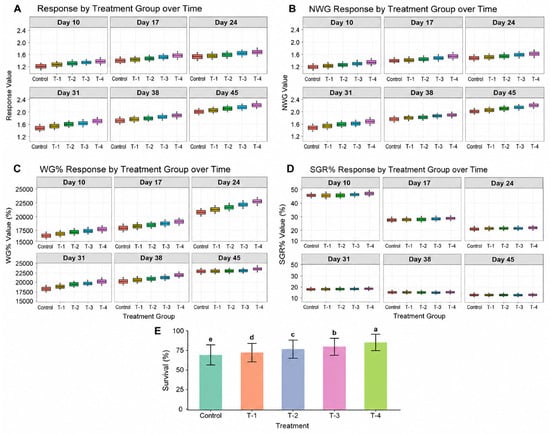
Comparison of (a) body weight per individual and (b) total body length of fairy shrimp S. sirindhornae under two different stocking densities. Different letters above the standard deviation bars indicate significant differences (p &lt; 0.05).

News & Conferences

Issues

Open for Submission

Editor's Choice

Reprints of Collections

Editorial Board Members' Collection Series
Reprint

Editorial Board Members' Collection Series

“Biodiversity and Ecosystem Function under Global Change”
Editors: Shucun Sun, Panayiotis G. Dimitrakopoulos
Biology, Ecology and Management of Aquatic Macrophytes and Algae
Reprint

Biology, Ecology and Management of Aquatic Macrophytes and Algae

Editors: Jinlin Liu, Shuang Zhao, Wei Liu

Get Alerted

Add your email address to receive forthcoming issues of this journal.

XFacebookLinkedIn
Biology - ISSN 2079-7737