


Abstract
The adverse health effects of exposure to air pollutants, notably to particulate matter (PM), are well-known, as well as the association with measured or estimated concentration levels. The role of perception can be relevant in exploring effects and pollution control actions. The purpose of this study was to explore studies that analyse people’s perception, together with the measurement of air pollution, in order to elucidate the relationship between them. We conducted a systematic review in accordance with the Preferred Reporting Items for Systematic Reviews and Meta-Analyses (PRISMA) guidelines. In March 2020, PubMed, EMBASE, and Scopus databases were explored in an attempt to search for studies published from 2000 to 2020. The review included 38 studies, most of which were conducted in China (n = 13) and the United States (n = 11) and published over the last four years (n = 26). Three studies were multicenter investigations, while five articles were based on a national-level survey. The air quality (AQ) was assessed by monitoring stations (n = 24) or dispersion models (n = 7). Many studies were population questionnaire-based, air monitoring and time-series studies, and web-based investigations. A direct association between exposure and perception emerged in 20 studies. This systematic review has shown that most of the studies establish a relationship between risk perception measurement. A broad spectrum of concepts and notions related to perception also emerged, which is undoubtedly an indicator of the wealth of available knowledge and is promising for future research.
1. Introduction
This systematic review is dedicated to clarifying the role of the perception of risk of air pollution, due to its relevance in the environmental and health field. The goal is to explore studies that analyse people’s perception, together with the measurement of air pollution, in order to elucidate the relationship between them. The focus is on particulate matter (PM) as its negative health effects have been demonstrated and quantified. Social, cultural, and contextual factors can influence people’s perception and the impacts on behavior, agency, self-efficacy, and the relationship with measured pollution should be clarified. This knowledge could be crucial to complementing studies on the health impacts of air pollution and improving decisions aimed at reducing human exposure. Moreover, recognizing the importance that perception holds in studies on Covid-19 [1] and its complex relationship with air pollution, this topic should be addressed and specifically investigated [2].
1.1. Risk Perception
Risk perception studies have been ancillary to different fields of knowledge, trying to disclose the reasons behind the behaviors of people and predict their future actions [3]. Risk perception can be defined as a person’s judgement about a risk, influenced by facts, knowledge (lay and scientific), personal preferences and attitudes (dread, trust, and interpretation of uncertainty), individual assessments (general and specific), and his/her social role (defined as “agency” by sociological disciplines; that is, the possibility/ability to act to change one’s condition). Beliefs, knowledge, values, and attitudes not only influence decisions, but also behaviors, psychophysical conditions, and exposure attitudes of people to environmental pressures [3]. Risk perception is not entirely rational since people assess risks using a mixture of cognitive skills (weighing the evidence and using reasoning and logic to reach conclusions) and emotional appraisals (intuition or imagination) [4,5,6].
In the domain of the environment and health, the study of risk perception has acquired increasing relevance as part of the knowledge required to understand social contexts and specific personal dimensions of exposure to pollutants; risk perception is fundamental in environment and health risk communication because it determines which hazards people care about and how they deal with them [7,8,9,10]. It reinforces the importance of epidemiology in evaluating the health of communities living in areas where the main perceptible sources of pollution are known, even if the evidence produced always maintains some uncertainty [11].
Complexity and uncertainty are specific features of this research activity and the inclusion of people’s perspective in the process could help to enhance the global understanding and the use of research results [9,12,13,14,15,16,17].
Nothing in risk is neutral and its perception is linked to multiple facts and motivations. Social science research in risk perception has explored and discovered how risk is understood, manufactured, or created socially, politically, and culturally [7,8,9,18,19,20,21,22,23]. Additionally, the economic evaluation of savings through which it is possible to achieve remediating high-risk areas includes risk perception calculated through the Willingness to Pay (WTP) index as an indirect indicator of health expenses [24].
1.2. Particulate Matter Pollution and Health
Ambient air pollution is the major environmental risk factor for the global disease burden, which has increased over the past 25 years, especially as a result of rising levels of pollution and increasing numbers of deaths from non-communicable diseases in low-income and middle-income countries [25].
Particulate matter (PM) comprises a class of pollutants consisting of a heterogeneous mixture of solid and liquid particles suspended in the air and it represents a considerable threat to health [26]. Primary PM can be released from both natural and anthropogenic sources, with road traffic considered the major source due to the erosion of pavements and abrasion of brakes and tires [27]. Secondary particles are products of the atmospheric transformation of nitrogen oxides and sulfur oxides, mainly emitted by traffic and the combustion of sulfur-containing fuels, respectively [28].
In 2013, the WHO International Agency for Research on Cancer (IARC) announced that there is sufficient evidence in humans for the carcinogenicity of outdoor air pollution and for PM in outdoor air pollution [29,30]. This understanding represented a turning point in research that focused on the health effects of inhalable PM, i.e., particles with diameters smaller than 10 (PM10) or 2.5 micrometers (PM2.5), and it was discovered that the size of particles is directly linked to their potential for causing health problems [31]. Human exposure to PM, both short and long term, has been quantitatively associated with numerous health effects, such as increased hospital admissions, emergency room visits, respiratory and cardiovascular morbidity, and mortality from cardiovascular and respiratory diseases and lung cancer [27]. Integrated exposure–response functions for each cause of death can be developed to estimate the relative risk of mortality attributable to PM. In particular, long-term exposure to PM2.5 was estimated to have caused 4.2 million deaths in 2015, corresponding to 7.6% of the total global mortality and making PM2.5 the fifth-ranking mortality risk factor [25].
For PM10 and PM2.5, concentration-response risk functions have been developed and proposed for health impact assessments. Many studies have included recommendations for actions and explorations of policy implications and the economic impact of PM reductions. Green energy policy in Europe includes air pollutant emission reduction in the motivation for reduction. Moreover, the international agreements addressing climate change consider PM in their reduction plans [32].
1.3. Policies
In several Asian cities, outdoor PM air pollution is increasing. In India, outdoor air pollution was responsible for more than 670,000 deaths in 2016. To deal with these health effects, several countries have launched large-scale policies, such as China [33,34] and India; in other countries like Thailand, there is a growing demand for policies to address the issue of polluted air [35]. Although in many countries there are no specific laws or protection rules, WHO guidelines are taken into consideration [28].
In China, to address the severe air pollution, the 2013 Action Plan on Prevention and Control of Air Pollution established a reduction of the PM2.5 concentration in Beijing, Nanjing, and Guangzhou cities by 25%, 20%, and 15%, respectively, between 2012 and 2017. After this, several plans and specific measures were implemented [36].
In the EU and US, air protection policies are similar and the reduction of air pollution is a central element. In the US, air quality (AQ) is a federal matter and the relevant policies apply to the whole country. In the EU, AQ policy is based on standards issued by the European Commission and national implementations, where Member States determine the best way to achieve them within each country. In addition, in the US, air pollution management is implemented through a combination of the AQ standard and the emission standard strategies, whereas in the EU, emission standards, emission taxation, and cost-benefit analysis are used [37].
In 2013, the European Commission adopted a Clean Air Policy Package for Europe in order to set new objectives for EU air policy and reduce the negative health impacts of air pollution, such as respiratory diseases and premature death, by almost 50% by 2030 [38].
2. Materials and Methods
The present systematic review was developed according to the Preferred Reporting Items for Systematic Reviews and Meta-Analyses (PRISMA) statement [39].
2.1. Search Strategy
This systematic review was performed by searching three different electronic databases, EMBASE, Scopus, and PubMed. Upon completing the search, a combination of Medical Subject Headings (MeSH) and non-MeSH keywords was used. Specifically, the keywords air pollution, particulate matter, PM10, PM2.5, risk perception, perception, and health were adopted in the following search query: (air AND pollution OR (particulate AND matter) OR PM10 OR PM2.5) AND (risk AND perception OR perception) AND health.
Only studies written in English were included and reviews, letters to the editor, and abstracts were excluded. The first search of the three databases was conducted without any time limitations. Few articles were published before 2000, so the search was limited to those published from January 2000 to March 2020.
2.2. Criteria for Eligibility
The following inclusion criteria were adopted:
- Perception concerns, exclusively PM exposure; if exposure refers to several pollutants or environmental matrices, PM should be specifically mentioned;
- PM levels are always measured, both directly and indirectly, and exposure refers to the specific population;
- PM measurement is only conducted outdoors;
- PM can also be included in an air quality index, AQI, while perception must always be measured, both directly and indirectly;
- Perception can be evaluated via quantitative or qualitative methods.
2.3. Study Selection
After removing duplicates, three researchers, who are the authors of the paper (L.C., G.D., and O.C.), independently evaluated titles and abstracts according to the eligibility criteria. The articles simultaneously selected by the three reviewers were employed in the next phase, i.e., the full text was read. The researchers thoroughly read the articles selected in the first phase in equal proportion. The reviewers individually decided to accept or reject the articles read. In cases of doubt among the three reviewers, the other two authors (F.G. and F.B.) examined the papers in order to achieve a final decision about their eligibility.
2.4. Data Extraction
All of the relevant data were extracted, including the author(s) name(s), publication date, title, study area, study design, age group(s) of participants, sample study, environmental exposure assessment methods, and main results. More specifically, the following information was taken into consideration: the methodology; the number and characteristics of the subjects involved in the research; how PM was measured; whether specific devices were tested; how risk perception was assessed; and which tools were used. These relevant data were included in table form to obtain a synthetic framework of all articles read in full by reviewers. This table format enabled the authors to complete a cursory overview of the materials selected in the first phase.
2.5. Perception Conceptual Dimensions
To be able to analyse the perception, the main methodological issue is the extent of the concept. “Perception” and “risk perception” were included in the search to be able to capture a wider variety of research in terms of methods, populations, and issues included. The perception linked to AQ measurement is intended to gather information about understanding and knowledge of the issue, psychological reactions, the capacity or availability to act as a consequence of this knowledge, and the response to public policies. Suggestions and recommendations for actions are generally presented as practical results of these studies.
To systematically examine the articles selected, the explored dimensions of perception (understanding/sensorial perception; reactions/psychological consequences; reactions/physical consequences; behaviors) were categorized by 20 features (awareness; belief; knowledge; concern; risk perception; worry; fear; outrage; familiarity; trust; annoyance; anxiety; life quality change; self-reported health symptoms; avoidance of the problem; search for information; exposure reduction; proactivity; request for action; and acceptance). This means that in each article, one or more of those features are explicitly searched as a tool for the analysis or are assumed in the concept.
3. Results
3.1. Search Results and Study Characteristics
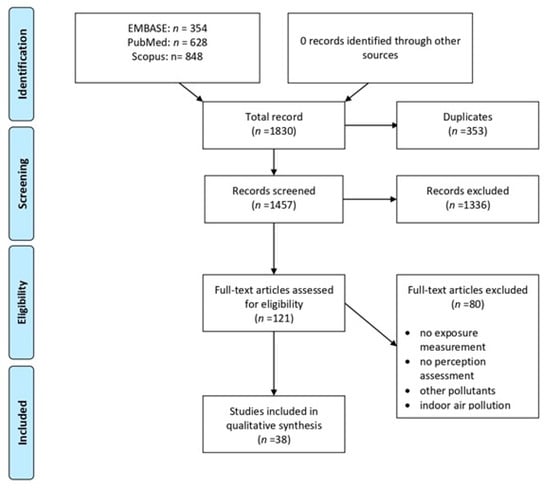
The PRISMA flow diagram in Figure 1 depicts the article selection process we followed for including studies in this review. We started by searching the three databases mentioned in the Methods section and identifying 1830 articles. From these first records, we removed 353 duplicates, leaving 1457 for further review. We reduced the number of included studies to 121 after screening the titles and abstracts and applying the following exclusion criteria:
Figure 1.
PRISMA flow diagram.
- Studies where the main exposures referred to tobacco smoke, indoor settings, specific pollutants originating from industries, or other anthropogenic sources such as caves and mines;
- Studies evaluating health outcomes related to air pollution, but not to perception or risk perception;
- Generic studies, editorials, or abstracts in proceedings of conferences.
The remaining 121 articles underwent a full-text evaluation, bringing the total number down to 38 published articles that met our inclusion criteria. By the end of the identification process, we had removed about two-thirds of the reports from the amount we initially identified for this current study because it was impossible to know from the titles and abstracts alone whether or not they included the following criteria:
- PM exposure measurement;
- Perception assessment;
- Presence of indoor air pollution;
- Presence of other pollutants.
Table 1 summarizes the main characteristics of the studies included in this review in reverse order of publication date.
Table 1.
Characteristics of included studies.
3.2. Geographical and Timeline Distribution
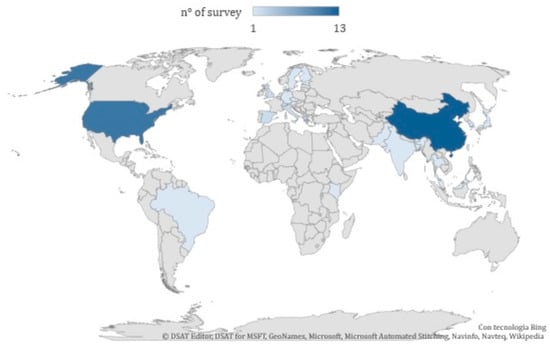
The articles included in this systematic review concern studies carried out in China (n = 13), the USA (n = 11), Greece (n = 3), South Korea (n = 2), the UK (n = 3), Italy (n = 2), Spain (n = 2), Switzerland (n = 2), Austria (n = 1), Bangladesh (n = 1), Belgium (n = 1), Brazil (n = 1), the Czech Republic (n = 1), Denmark (n = 1), Estonia (n = 1), Finland (n = 1), Germany (n = 1), India (n = 1), Japan (n = 1), Kenya (n = 1), Malaysia (n = 1), Pakistan (n = 1), Sweden (n = 1), Taiwan (n = 1) Thailand (n = 1), and the Netherlands (n = 1). Figure 2 shows the geographical distribution of surveyed countries.
Figure 2.
Geographical distribution of the studies included in the systematic review.
Three articles are multicenter studies, two are surveys performed in seven countries [35,54], and the remaining are surveys performed in six countries [74]. Six studies were based on a national-level [41,47,49,52,60,67], three on multi-province [40,45,57], and seven on multiple-city surveys [50,51,59,63,64,71,73].
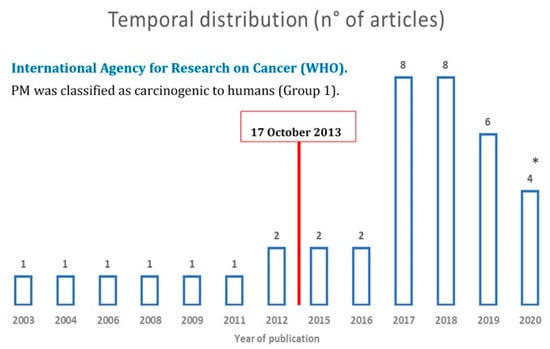
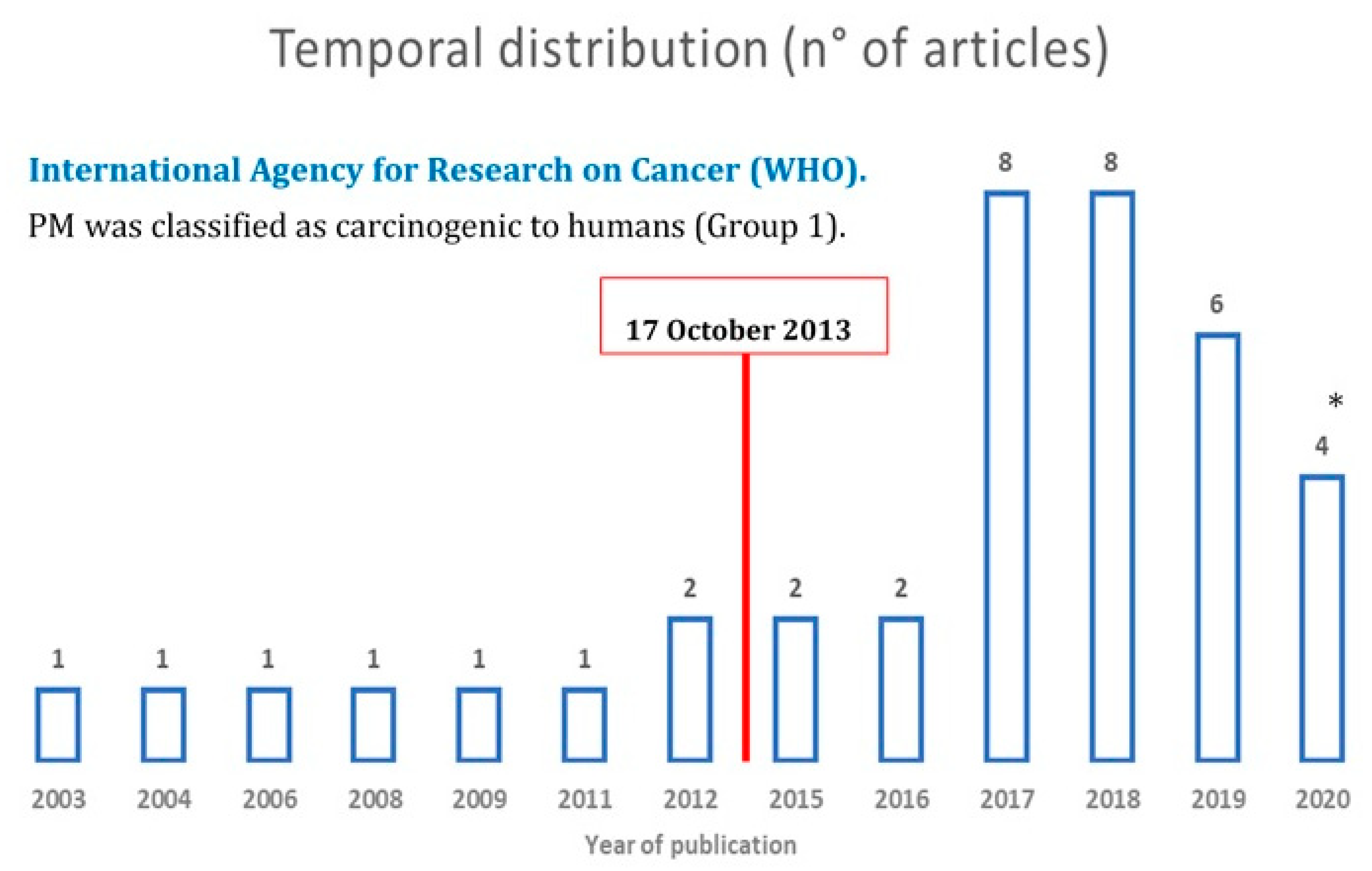
Looking at the timeline distribution of the articles, Figure 3 shows that research has increased over the last four years, during which time over 85% of the studies were published. As indicated in the caption for Figure 3, the year 2020 includes only the first three months of the year. The red vertical line in Figure 3 indicates the date IARC announced that PM is classified as a carcinogenic to humans (Group 1) [30].
Figure 3.
Timeline distribution of the articles included in the systematic review. * Only January, February, and March were included for the year 2020.
3.3. Exposure Assessment of Particulate Matter (PM)
Not all studies considered the same type of PM and not all used the same methods for assessing exposure. Specifically, 18 studies only considered PM2.5 as an indicator of exposure to PM; 7 studies only considered PM10; 1 study considered PM10, suspended particulate matter (SPT), and total suspended particles (TSP); 2 studies considered particle number counters (PNCs); and 10 studies considered PM2.5 and PM10. Nine of the 10 studies that considered both PM2.5 and PM10 evaluated the association between pollution and survey responses using AQI, which is a six-category classification of ambient AQ for six major pollutants: carbon monoxide, ground-level ozone, nitrogen dioxide, PM2.5 and PM10, and sulfur dioxide. Regarding PM exposure assessment, the majority of studies (n = 24) used AQ data from official monitoring stations, while seven studies used AQ models such as the Moderate Resolution Imaging Spectroradiometer (MODIS) Aerosol Optical Depth (AOD). Only seven studies directly measured PM air concentrations (See Table 1, Column “Exposure assessment”). Two studies considered low PM level chronic exposure [52,53].
3.4. Study Design and Population
The 38 studies selected presented multiple designs, populations involved, and procedures. Many studies were questionnaire-based and air monitoring population studies, time series, and web-based studies.
3.4.1. Population Studies
Sample sizes in general population studies ranged from 40 adult participants in community-based interviews, focus group discussions, and a community forum in Kenya [62], to 28,303 respondents, to a standardized state-based telephone survey [70], involving a total of 123,855 participants.
Six of the studies selected were not ad hoc studies, but part of major survey studies [27,40,41,48,53,66] and most of them concerned the adult population. Among the exceptions is the study of Bergstra and colleagues [51]. In this research, a cross-sectional questionnaire study was conducted for both children (2 ± 18 years) and adults (19 years and above) living in the direct vicinity of an area with heavy industry. Parents were asked to answer questions about the health of their children, with a particular focus on respiratory symptoms. Among the exceptions, a Chinese survey performed on 1000 parents 18 years old or older with children between 1 and 12 years old can also be mentioned [65].
Some research has focused on specific groups: Gany and colleagues (2016) [56] recruited taxi drivers for an air-monitoring study in 2012–2013. Another study in 2003 employed ethnographic field methods and semi-structured interviews to ask community members to identify salient risks from industrial pollution and examine whether and how perceptions differed across occupational groups (industrial workers, commercial and service sector workers, and farmers) in a Futian community [72]. A study in Malaysia included university students [46] and in a Leipzig University study, a collective of cyclists wore a unique combination of sensors that measured the particle number counts (PNC), noise, humidity, temperature, and geolocation [43].
Five studies investigated neighborhood vulnerability. In Hong Kong, a mixed-methods approach was applied to estimate neighborhood-based environmental vulnerability based on objective environmental measures and subjective environmental understanding from a local population [44]. In Wisconsin, the associations between low-level chronic exposure PM2.5 and cardiopulmonary health and the potential mediating or modifying effects of adverse neighborhood perceptions were examined [53]. In Nairobi, the authors made a case for participatory approaches in AQ studies, especially including those living in poor neighborhoods who may be particularly at risk from this trend [62]. In Chicago, the Community Adult Health Study studied the impact of individual, social, and built environmental factors on health and disparities in health [66]. In Seoul, Korea, 16,041 subjects aged > 20 years rated the outdoor AQ in the neighborhood [27].
3.4.2. Web-Based Studies
Studies using big data from the Internet were typical of Asian countries and we selected five of them: Google trends for seven Asian megacities [35]; an Internet search engine, Baidu [47,49]; and posts analysed on Weibo (a popular microblogging system) in China [64,67].
3.4.3. Procedures of the Studies
As for the procedures of the studies included in the systematic review, field studies [50,58,69,72], telephone survey studies [42,48,68,70,71,73], on-line surveys [44,54,57,61], and mixed procedure studies [53] were found. In the context of field studies, face-to-face interviews were the fundamental, but sometimes not unique, method employed to collect the data of interest to be related to the objective levels of pollution [34,42,50,55,58,59,60,66]. Considering mixed procedures and methods, we can mention Maleki’s study (2018) [53]; in this work, the protocol included in-person, audio-computer-assisted interviews; self-administered questionnaires; a physical examination; and biosample collection.
3.5. Risk Perception
To be able to systematically analyse the articles selected, the explored dimensions of perception were categorized by 20 features. The results of this analysis, presented in Table 2, showed that for “understanding” (44), most of the articles focused on awareness (32); for “reactions/psychological” (48), more represented risk perception (23); for “reactions/physical” (44), the declared symptoms were most represented (26); and for “behaviours” (38), exposure reduction (13) and search for information (12) were the most represented.
Table 2.
Recurrence of dimensions and features related to risk perception in the selected articles.
The details are shown in Table 2, in lines of the table including each of the features.
The studies examining understanding (44) included risk perception in 20 cases, symptoms in 23 cases, search for information in 12 cases, and exposure reduction in 13 cases.
Among the studies investigating psychological reactions (48), awareness was included in 19, symptoms in 17, search for information in 10, and exposure reduction in 12 cases.
The studies investigating physical reactions (44) also explored awareness in 24 cases, risk perception in 18 cases, search for information in 9 cases, and exposure reduction in 12 cases.
The studies analysing behaviors (38) also explored awareness in 19 cases, risk perception was considered in 16 cases, and symptoms were considered in 14 cases.
The results in terms of the association of perception, intended in the broad sense, included the 20 features examined, with measured pollution as the main outcome of this review. To examine the results in brief, see Table 3.
Table 3.
Association between perception and measured air pollution. The number of articles for each kind of association is shown, with the references. Further details for each article are in Table 1.
In only two cases, the link with air pollution was not evaluated at all: in one case [63], 14 features of perception, focusing on behaviors and socioeconomic analysis, were described and in the second case [50], the PM level measured in Hong Kong was used to build the scenarios for the questionnaire, only focusing on public awareness [50].
In five articles, measured pollution was not correlated with perception [43,48,56,71,73]. In the study by Ueberham et al. [43], cyclists were not aware of a risk posed by air pollution. In the study of Reames and Bravo [48], no association between pollution perception and air pollution exposure was observed and the findings supported the neighborhood stigma theory [66]. Physical conditions are worse in minority communities, but a disadvantaged social composition seems to independently contribute to negative perceptions of these communities. Perceptions of neighborhoods affect residents, also transcending the effects of objective conditions [72].
Gany et al. [56] carried out air monitoring in New York City taxi cabs and at roadside taxi stands, combined with a survey of taxi drivers’ knowledge related to air pollution and the associated health risks. Semenza et al. [71] measured AQ and meteorological conditions in Portland, OR and Houston, TX and 1962 subjects were interviewed by telephone about their perception and response. In Brody et al. [73], the perception of local AQ was different in Dallas and Houston and was not driven by actual readings from air monitoring stations.
An indirect influence of air pollution on perception was reported by Li et al. [40], in favor of the relation between awareness and risk perception and symptoms, and by Orru et al. [52], for which the effect of perceived exposure on symptoms and the effect of perceived exposure on disease were mediated by health risk perception.
In nine papers, AQ had a scarce influence on perception. In Huang et al. [55], the main linkage was with behavioral changes as a pre-post survey of the Youth Olympics showed that awareness and concern grew over time. In Huang et al. [59], perception was boosted by previous negative experiences with pollution. Experience was also crucial in Chen et al. [60] and Guo et al. [65], where the influence of socio-economic factors was a relevant element for explaining differences in perception. In King et al. [66], the stigma theory was utilized for explaining the linkages among awareness, risk perception, and socio-economic factors. Socioeconomic factors were also relevant in Kim et al. [27], where the declared symptoms were not explicitly correlated with perception or pollution and in Johnson et al. [68] and Rotko et al. [74], where symptoms were included and relevant. The study by Pantavou et al. (2017 and 2018) [50,58] established a direct link between symptoms and perception.
The consideration of symptoms is crucial because their linkage with perception has been widely reported in the literature. Let us consider this aspect in the following 20 articles, where a direct association between perception and measured pollution was identified, adding several further specific features.
Symptoms were a significant additional element in Misra et al. [35], where the circulation of information on the web was examined; in particular, the search for “cough” and “asthma”, together with “air pollution”, related to pollution measurement; Zakaria et al. [46] used a self-administered questionnaire in Selangor, Malaysia and Nikolopoulou et al. [69] employed a questionnaire-guide in San Diego, California to interview university students; Bergstra et al. [51] examined adults and children in an industrial area in the Netherlands; Malecki et al. [53] considered the linkage with low-level exposure in Wisconsin, USA, selecting a number of questions within a wider survey; Dons et al. [54] developed a cross-sectional questionnaire study in seven European cities; and Pantavou et al. [58] undertook a field study in Athens, associating citizen perception, behaviors, and symptoms with air pollution and dust.
In Mirabelli et al. [41], symptoms and information were investigated as a distinctive explanation because the article examined the diffusion of air pollution alerts. There were several interesting observations—in particular, that the received information declared by interviewees is a central element in perception, but it frequently does not correspond to real circulating information (i.e., 44% of citizens living in an area without AQ alerts reported being aware of the alerts). Apart from this cue, the analysis strictly correlated referred symptoms with a high perception and pollution awareness.
In Ban et al. [34], in Nanjing, China and in Wen et al. [70], in six states in the USA, together with air pollution perception, symptoms and behaviors were considered to elucidate the consequences of individual behavioral change in terms of coping with smog pollution in the first article [34] and the consequences of alerts in the second [70], Several research papers have dealt with the issue of risk communication and alerts and their effects on the population’s risk perception [41,48,69,71,73]. In Mirabelli et al. [41], knowledge of pollution and symptoms of related illnesses were more significant in areas where information about AQI was measured and disseminated. Additionally, in Reames et al. [48], pollution perception and health concerns were associated with air quality alert knowledge. The study of Wen et al. [70] showed that media alerts on air quality are a very important factor related to changes in outdoor activity. In Brody et al. [73], the authors sought to improve understanding of the major factors shaping public perceptions of air quality, concluding that perceptions appear to be influenced by the setting (urban vs. rural); state identification; and socioeconomic characteristics, such as age, race, political identification, and access to information. In the study of Semenza et al. [71], people changed behaviors when the air quality was worse, but this does not correspond with what is measured by control units.
In Dong et al. [47], AQ and perception were associated with information in the explanation because the analysis was conducted by Baidu web information dissemination and people searched for information as a reaction to the growing level of pollution.
In Tilt et al. [72], AQ and perception were associated with socioeconomic factors in the elucidation of the relationship. The study was conducted in an industrial district in China, where the people expressed concern about air and water pollution; the analysis showed the differences among industrial workers, farmers, and workers in the commercial sectors, offering an interpretation of the different points of view of the local population.
A direct association between perception and pollution has been established in a qualitative research study in a suburb in Nairobi, Kenya [62] and in a study using telephone questions and face-to-face interviews aimed at monitoring the evolution of perceived annoyance over time, related to PM in the environment [42]. Furthermore, Pu et al. [45] looked at the perceived risk and satisfaction of AQ in 31 Chinese provinces; Lu et al. [49], Wang et al. [67], and Tao et al. [64] used big data; Lu et al. (2018) [49] employed Baidu to analyse the patterns of public concern about haze and the relationship between public concern and AQ data provided by monitoring stations; Wang et al. [67] and Tao et al. [64] used Weibo to examine the content and quantity of messages referred to AQ and to construct an “Air Discussion Index”, respectively, to characterize the relationship between PM2.5 and social media posts; Cantuaria et al. [57] developed a cross-sectional study to assess the environmental conditions, annoyance, and health of rural residents in Denmark; and Cisneros et al. [61] studied California residents to understand their sources of AQ information, perceptions of AQ, and behaviors related to AQ.
4. Discussion
The main finding of the present systematic review is that 31 articles out of 38 established a relationship between perception and measured pollution, even if indirect or moderate, showing a variety of methodologies and population samples (Table 1). Regarding population samples, it must be underlined that the majority of the articles included in the systematic review did not consider the young population, when it is an integral part of the population, so this could be surveyed in the future. Given children’s vulnerability to the effects of air pollution [75], it is vital to understand how children perceive their environment. If perception surveys are performed in schools and followed by environmental and health education interventions, we could also achieve the goal of raising awareness among younger generations [13,76].
The distribution over time shows a substantial growth of publications on this topic in the last 4 years, with 26 publications between 2017 and 2020 (Figure 2); among them, the studies from China have acquired growing importance, with nine publications, while five studies were from the USA (Figure 1). This is due to an increased concern for air pollution and the implementation of control policies to be monitored and reinforced with ancillary studies. Two studies developed in China, at the national level [49], and in four Chinese megacities [64] used data collected by the USA embassy, mentioning the growing attention towards air pollution by the Chinese population that apparently the USA was boosting, offering air quality data.
As a whole, the results confirm the knowledge acquired on the relationship between air pollution and perception; in particular, that encompassed by the seminal article of Karen Bickerstaff [77], which analyzes the developments in two main disciplinary directions. First, consolidation of the socio-cultural perspective, with the contribution of anthropology, geography, and sociology, and second, a convergence between the cultural and psychological approaches. Most of the theories that maintain their validity and inform the research had already been presented [78]. Bickerstaff concluded, in particular, that the perception of risk is multi-dimensional and influenced by complex social, political, and cultural processes and that to understand how people frame the risk, it is crucial to address behavioral changes and communication. This analysis is largely valid today, with some additional elements reflected in the articles examined in this systematic review.
The diffusion of studies examining human bodies at a very sophisticated and intimate level, such as the human biomonitoring of blood, breast milk, and other specimens, or genetic tests, has led people to perceive pollution of the body and in the body in a more direct way, with relevant ethical implications [79]. The exploration of the perception of pollution in the body is a growing field of research that has developed from the experience gained and from the continuous attention to the issues of risk communication [13,80,81,82].
The choice of 20 features to summarize the different components of perception was useful for observing the frequency in the recurrences of awareness, risk perception, self-reported symptoms, and search for information, which are representative of the main conceptual areas of interest of those studies. It is also interesting to highlight that some of them were scarcely considered, such as outrage and fear, widely examined in psychological and sociological studies, but included in only one study each [34,63]; anxiety was considered in two studies [53,63] and request for actions from public authorities was considered in three cases [57,62,63].
An increasing number of studies are interpreting risk perception as a health modifier and it can be considered among the psychosocial determinants of health [83,84,85]. The term “social determinants” often evokes factors such as health-related features of neighborhoods, pointing to socioeconomic factors such as income, wealth, and education as the fundamental causes of a wide range of health outcomes [86].
Most of the studies examined in this systematic review included health considerations as self-reported symptoms, subject to personal judgement, and the linkage between perception and health symptoms was documented. This is relevant to supporting the hypothesis that risk perception plays a role as a health determinant or health effect modifier. It is interesting to note that the measured PM pollution and the short- and long-term health effects were not relevant in the studies analysed in the present review. However, we wish to emphasize that in 2013, IARC released news about the identification of PM as a carcinogenic for humans [30]. This assessment defined a step forward for scientific knowledge and the weight of air pollution within the burden of diseases became clearer, as well as its role in the distal determinants of health [87]. In the same period, there was a turning point in China in terms of the implementation of policies to protect the health of citizens from air pollution and there was a significant improvement in studies on health and air pollution [33,34].
4.1. Big Data Utilization and Applications
The use of search engine data and social media is changing the ways in which researchers investigate public opinion. Consequently, traditional survey research may play a less dominant role [88]. A recent review of the public’s use of big data from web searches shows that the use of Google Trends has increased dramatically in the last decade. In the process, the focus of research has shifted to forecasting changes. In contrast, in the past, the focus was merely on describing and diagnosing research trends, such as surveillance and monitoring [89]. One of the most recent applications of big data for the social sciences focused on an investigation of the phenomenon of vaccine hesitancy. Some studies have concluded that monitoring new media could be useful for detecting early signals of decreasing vaccine hesitancy and planning and targeting effective information campaigns [90,91].
This systematic review identified only five articles that studied perceived pollution using big data in the past five years. Three of them investigated perceived pollution using big data from web searches; namely, one of them used Google Trends [35] and the other two, the Baidu Index [47,49]. Although we found a correlation between the AQ level and perceived pollution in these three articles, we noticed that each study used different search terms, namely, “air pollution”, “cough”, and “asthma” [35]; “Shanghai air quality” [47]; and “haze” [49]. The other two articles collected messages from Sina Weibo, which is the most popular microblogging service in China. Both studies show that social media may be a useful proxy for measuring pollution, mainly when traditional measurement stations are unavailable, censored, or misreported [40,67].
Although these studies show promising results, several limitations should be considered, suggesting that we cannot completely abandon the research method of a questionnaire survey. In this regard, one of the main limitations is that big data can only provide an active collective public response compared to questionnaire surveys, which directly indicate public concern based on individual responses. Concerning Chinese studies, we should consider the effect of government censorship on using social media for informatics in China.
4.2. Communication and Recommendations
The disintermediation of communication, which has been growing exponentially in recent years, represents a relevant change in the circulation of information, with a potential relevant impact on risk perception and consequently, on health [92,93]. It is reflected in the studies examined here, with growing attention being placed on big data utilization and the continuous attention given to the utilization of results, the role of citizens, and the importance to inform and involve people to foster prevention and reduce environmental pollution.
In fact, it is clearly conceptualized by the scientific community and decision makers that the only way of managing complex problems in the environment and health domain is sharing responsibility and action to improve the quality and durability of decisions and actions. In particular, it is of utmost importance to gather information about risk perception to plan risk governance actions, including health literacy programs and communication and engagement activities, to be able to dialogue with different social actors and contribute to prevention and protection [3,21].
4.3. Strength, Limitations, and Future Lines of Research
To the best of our knowledge, this is the first systematic review investigating the relationship between ambient particulate matter levels and perceived pollution. In drafting this paper, we followed the PRISMA guidelines, which is one of the most appropriate tools for conducting systematic reviews. We searched three different databases to identify the highest possible number of studies and selected an extended timeframe, which allowed us to gather a significant proportion of the papers on this topic. All of the steps in the process, starting from the selection of abstracts to data extraction, were performed by three authors and not by the usual two, who have frequently consulted with each other when clarifying doubts. As for the scope of this systematic review, we are aware of the study’s limitations, mainly regarding the capability to gather all published articles on this issue. Specifically, two such limitations were the exclusion of some scientific databases and the selection of keywords. Moreover, we are aware that our decision not to consider scientific papers from gray literature may represent a limit of completeness, although, on the other hand, we believe the higher qualitative reliability of the review is reasonable and not negligible [39,94].
However, these types of limitations are inherent in all systematic reviews with similar objectives of producing new knowledge in an appropriate time period with only a few summarized articles. Regardless of the stated limitations, we believe that our work will be of interest to readers and may provide useful information for developing future lines of research focused on the investigation of social media and web search engines as predictors of air pollution peak episodes.
5. Conclusions
The results of this systematic review reinforce the hypothesis that AQ has an important influence on risk perception, through both indirect and direct links. There is a tendency to consider a wide spectrum of concepts and factors connected with perception, for example, behavioural changes, boosted by previous negative experiences with pollution. Experience is a key element of cognition and awareness, which can be influenced by socio-economic factors to explain differences in perception. In most articles, a direct association of perception with measured pollution was identified, with several specific features.
Unlike other types of environmental determinants, the impacts of air pollution, particularly PM, on the health of people and communities have been extensively studied, to the point of identifying a dose-response relationship. It is therefore possible to define the level of exposure of different populations and to take harm limitation measures. These measures will depend both on the actions taken by policy makers and on the willingness of people to contribute by changing personal and collective habits. From the point of view of epidemiological research, it is very interesting to understand whether and how much people are aware of the pollution that surrounds them and how it can affect their state of health. This is relevant for interpreting the existing data and for perspectives in terms of risk reduction, i.e., primary prevention.
Most of the studies examined in this systematic review include recommendations for actions and explorations of policy implications of air quality improvements. The public acceptance of mitigation policies constitutes a crucial factor for their success, necessitating ancillary actions such as health literacy programs, awareness raising campaigns, and public participation activities. The perception of people regarding exposure to air pollution and personal health is critical for evaluating the responses of communities and the acceptability of related policies. To conclude, this review may call for new studies that consider the younger segment of the population and that use big data as a source of knowledge, without renouncing the more classic methodologies of investigations. In addition, the analysis of the perception of risk as a determinant of health should be addressed. Moreover, this topic should be examined in the context of the current Covid-19 emergency and the research on the role of air pollution in the spread of the epidemic.
Author Contributions
Conceptualization, L.C. and F.B.; methodology, G.D. and F.G.; software, G.D.; formal analysis, L.C., O.C., and G.D.; investigation, L.C., O.C., and G.D.; data curation, L.C., O.C., and G.D.; writing—original draft preparation, L.C., O.C., and G.D.; writing—review and editing, F.B. and F.G.; visualization, G.D.; supervision, O.C. All authors have read and agreed to the published version of the manuscript.
Funding
This research received no external funding.
Acknowledgments
The authors thank Maria Cristina Imiotti and Rosanna Panini for their technical support.
Conflicts of Interest
The authors declare no conflict of interest.
Abbreviations
| AQ | air quality |
| AQI | Air Quality Index |
| PM | particulate matter |
| EU | European Community |
| WTP | Willingness to Pay |
References
- Cori, L.; Bianchi, F.; Cadum, E.; Anthonj, C. Risk Perception and COVID-19. Int. J. Environ. Res. Public Health 2020, 17, 3114. [Google Scholar] [CrossRef] [Scilit]
- Cori, L.; Bianchi, F. Covid-19 and air pollution: Communicating the results of geographic correlation studies. Epidemiol. Prev. 2020, 44, 120–123. [Google Scholar] [CrossRef] [Scilit] [PubMed]
- Rosa, E.A.; Renn, O.; McCright, A.M. The Risk Society Revisited: Social Theory and Risk Governance; Temple University Press: Philadelphia, PA, USA, 2014. [Google Scholar]
- Ropeik, D. Understanding Factors of Risk Perception. Available online: https://niemanreports.org/articles/understanding-factors-of-risk-perception/ (accessed on 10 August 2020).
- Slovic, P.; Peters, E.; Finucane, M.L.; Macgregor, D.G. Affect, risk, and decision making. Health Psychol. 2005, 24, S35–S40. [Google Scholar] [CrossRef] [Scilit] [PubMed]
- Yun, K.; Lurie, N.; Hyde, P.S. Moving mental health into the disaster-preparedness spotlight. N. Engl. J. Med. 2010, 363, 1193–1195. [Google Scholar] [CrossRef] [Scilit]
- Flynn, J.; Slovic, P.; Mertz, C.K. Gender, Race, and Perception of Environmental Health Risks. Risk Anal. 1994, 14, 1101–1108. [Google Scholar] [CrossRef] [Scilit] [PubMed]
- Pidgeon, N. Risk assessment, risk values and the social science programme: Why we do need risk perception research. Reliab. Eng. Syst. Saf. 1998, 59, 5–15. [Google Scholar] [CrossRef] [Scilit]
- Renn, O. Perception of risks. Toxicol. Lett. 2004, 149, 405–413. [Google Scholar] [CrossRef] [Scilit]
- Nelson, J.W.; Scammell, M.K.; Altman, R.G.; Webster, T.F.; Ozonoff, D.M. A new spin on research translation: The Boston Consensus Conference on Human Biomonitoring. Environ. Health Perspect. 2009, 117, 495–499. [Google Scholar] [CrossRef] [Scilit]
- Nieuwenhuijsen, M.J. Exposure Assessment in Environmental Epidemiology; Oxford University Press: Oxford, UK, 2015; ISBN 978-0-19-937881-4. [Google Scholar]
- Funtowicz, S.O.; Ravetz, J.R. Risk management as a postnormal science. Risk Anal 1992, 12, 95–97. [Google Scholar] [CrossRef] [Scilit]
- Coi, A.; Minichilli, F.; Bustaffa, E.; Carone, S.; Santoro, M.; Bianchi, F.; Cori, L. Risk perception and access to environmental information in four areas in Italy affected by natural or anthropogenic pollution. Environ. Int. 2016, 95, 8–15. [Google Scholar] [CrossRef] [Scilit]
- Carducci, A.; Fiore, M.; Azara, A.; Bonaccorsi, G.; Bortoletto, M.; Caggiano, G.; Calamusa, A.; De Donno, A.; De Giglio, O.; Dettori, M.; et al. Environment and health: Risk perception and its determinants among Italian university students. Sci. Total Environ. 2019, 691, 1162–1172. [Google Scholar] [CrossRef] [Scilit] [PubMed]
- Signorino, G. Proximity and risk perception. Comparing risk perception ‘profiles’ in two petrochemical areas of Sicily (Augusta and Milazzo). J. Risk Res. 2012, 15, 1223–1243. [Google Scholar] [CrossRef] [Scilit]
- Mudu, P.; Terracini, B.; Martuzzi, M. Human Health in Areas with Industrial Contamination; WHO Regional Office for Europe: Copenhagen, Denmark, 2014; ISBN 978-9-289-05005-0.
- Carducci, A.; Donzelli, G.; Cioni, L.; Palomba, G.; Verani, M.; Mascagni, G.; Anastasi, G.; Pardini, L.; Ceretti, E.; Grassi, T.; et al. Air pollution: A study of citizen’s attitudes and behaviors using different information sources. Epidemiol. Biostat. Public Health 2017, 14. [Google Scholar] [CrossRef] [Scilit]
- Zinn, J.O. Recent Developments in Sociology of Risk and Uncertainty. Hist. Soc. Res./Hist. Soz. 2006, 31, 275–286. [Google Scholar]
- Douglas, M.; Wildavsky, A. Risk and Culture; University of California Press: Berkeley, CA, USA, 1983; ISBN 978-0-520-05063-1. [Google Scholar]
- Kasperson, R.E.; Renn, O.; Slovic, P.; Brown, H.S.; Emel, J.; Goble, R.; Kasperson, J.X.; Ratick, S. The Social Amplification of Risk: A Conceptual Framework. Risk Anal. 1988, 8, 177–187. [Google Scholar] [CrossRef] [Scilit]
- Aven, T.; Renn, O. Risk, Governance and Society. In Risk Management and Governance: Concepts, Guidelines and Applications; Springer: Berlin/Heidelberg, Germany, 2010; ISBN 978-3-642-13925-3. [Google Scholar]
- Renn, O.; Rohrmann, B. Risk, Governance and Society. In Cross-Cultural Risk Perception: A Survey of Empirical Studies; Springer US: New York, NY, USA, 2000; ISBN 978-0-7923-7747-4. [Google Scholar]
- Michaels, D.; Monforton, C. Manufacturing uncertainty: Contested science and the protection of the public’s health and environment. Am. J. Public Health 2005, 95, S39–S48. [Google Scholar] [CrossRef] [Scilit]
- Guerriero, C. Cost-Benefit Analysis of Environmental Health Interventions; Elsevier: Amsterdam, The Netherlands, 2020; ISBN 978-0-12-812885-5. [Google Scholar]
- Cohen, A.J.; Brauer, M.; Burnett, R.; Anderson, H.R.; Frostad, J.; Estep, K.; Balakrishnan, K.; Brunekreef, B.; Dandona, L.; Dandona, R.; et al. Estimates and 25-year trends of the global burden of disease attributable to ambient air pollution: An analysis of data from the Global Burden of Diseases Study 2015. Lancet 2017, 389, 1907–1918. [Google Scholar] [CrossRef] [Scilit]
- Health Effects of Particulate Matter. Policy Implications for Countries in Eastern Europe, Caucasus and Central Asia (2013). Available online: https://www.euro.who.int/en/health-topics/environment-and-health/air-quality/publications/2013/health-effects-of-particulate-matter.-policy-implications-for-countries-in-eastern-europe,-caucasus-and-central-asia-2013 (accessed on 14 July 2020).
- Kim, M.; Yi, O.; Kim, H. The role of differences in individual and community attributes in perceived air quality. Sci. Total Environ. 2012, 425, 20–26. [Google Scholar] [CrossRef] [Scilit]
- Evolution of WHO Air Quality Guidelines: Past, Present and Future (2017). Available online: https://www.euro.who.int/en/health-topics/environment-and-health/air-quality/publications/2017/evolution-of-who-air-quality-guidelines-past,-present-and-future-2017 (accessed on 14 July 2020).
- IARC. Outdoor Air Pollution; WHO Press: New York, NY, USA, 2015; Volume 109, ISBN 978-92-832-0175-5.
- IARC Outdoor Air Pollution a Leading Environmental Cause of Cancer Deaths. Available online: https://www.iarc.fr/pressrelease/iarc-outdoor-air-pollution-a-leading-environmental-cause-of-cancer-deaths/ (accessed on 14 July 2020).
- US EPA. Health and Environmental Effects of Particulate Matter (PM). Available online: https://www.epa.gov/pm-pollution/health-and-environmental-effects-particulate-matter-pm (accessed on 14 July 2020).
- McMichael, A.J.; Woodruff, R.E.; Hales, S. Climate change and human health: Present and future risks. Lancet 2006, 367, 859–869. [Google Scholar] [CrossRef] [Scilit]
- Feng, L.; Liao, W. Legislation, plans, and policies for prevention and control of air pollution in China: Achievements, challenges, and improvements. J. Clean. Prod. 2016, 112, 1549–1558. [Google Scholar] [CrossRef] [Scilit]
- Ban, J.; Zhou, L.; Zhang, Y.; Brooke Anderson, G.; Li, T. The health policy implications of individual adaptive behavior responses to smog pollution in urban China. Environ. Int. 2017, 106, 144–152. [Google Scholar] [CrossRef] [Scilit] [PubMed]
- Misra, P.; Takeuchi, W. Assessing population sensitivity to urban air pollution using google trends and remote sensing datasets. In Proceedings of the ISPRS—International Archives of the Photogrammetry, Remote Sensing and Spatial Information Sciences, Baltimore, MD, USA, 6–11 October 2019; Volume XLII-3-W11, pp. 93–100. [Google Scholar]
- Wang, L.; Watanabe, T. Effects of environmental policy on public risk perceptions of haze in Tianjin City: A difference-in-differences analysis. Renew. Sustain. Energy Rev. 2019, 109, 199–212. [Google Scholar] [CrossRef] [Scilit]
- Kuklinska, K.; Wolska, L.; Namiesnik, J. Air quality policy in the U.S. and the EU—A review. Atmos. Pollut. Res. 2015, 6, 129–137. [Google Scholar] [CrossRef] [Scilit]
- EU Approves New Rules for Member States to Drastically Cut Air Pollution. Available online: https://ec.europa.eu/commission/presscorner/detail/en/IP_16_4358 (accessed on 14 July 2020).
- Moher, D.; Liberati, A.; Tetzlaff, J.; Altman, D.G. PRISMA Group Preferred reporting items for systematic reviews and meta-analyses: The PRISMA statement. PLoS Med. 2009, 6, e1000097. [Google Scholar] [CrossRef] [Scilit] [PubMed]
- Li, F.; Zhou, T. Effects of objective and subjective environmental pollution on well-being in urban China: A structural equation model approach. Soc. Sci. Med. 2020, 249, 112859. [Google Scholar] [CrossRef] [Scilit] [PubMed]
- Mirabelli, M.C.; Ebelt, S.; Damon, S.A. Air Quality Index and air quality awareness among adults in the United States. Environ. Res. 2020, 183, 109185. [Google Scholar] [CrossRef] [Scilit]
- Machado, M.; Reisen, V.A.; Santos, J.M.; Reis Junior, N.C.; Frère, S.; Bondon, P.; Ispány, M.; Aranda Cotta, H.H. Use of multivariate time series techniques to estimate the impact of particulate matter on the perceived annoyance. Atmos. Environ. 2020, 222, 117080. [Google Scholar] [CrossRef] [Scilit]
- Ueberham, M.; Schlink, U.; Dijst, M.; Weiland, U. Cyclists’ Multiple Environmental Urban Exposures—Comparing Subjective and Objective Measurements. Sustainability 2019, 11, 1412. [Google Scholar] [CrossRef] [Scilit]
- Ho, H.C.; Wong, M.S.; Man, H.Y.; Shi, Y.; Abbas, S. Neighborhood-based subjective environmental vulnerability index for community health assessment: Development, validation and evaluation. Sci. Total Environ. 2019, 654, 1082–1090. [Google Scholar] [CrossRef] [Scilit]
- Pu, S.; Shao, Z.; Fang, M.; Yang, L.; Liu, R.; Bi, J.; Ma, Z. Spatial distribution of the public’s risk perception for air pollution: A nationwide study in China. Sci. Total Environ. 2019, 655, 454–462. [Google Scholar] [CrossRef] [Scilit]
- Zakaria, M.F.; Ezani, E.; Hassan, N.; Ramli, N.A.; Wahab, M.I.A. Traffic-related Air Pollution (TRAP), Air Quality Perception and Respiratory Health Symptoms of Active Commuters in a University Outdoor Environment. Iop Conf. Ser. Earth Environ. Sci. 2019, 228, 012017. [Google Scholar] [CrossRef] [Scilit]
- Dong, D.; Xu, X.; Xu, W.; Xie, J. The Relationship between the Actual Level of Air Pollution and Residents’ Concern about Air Pollution: Evidence from Shanghai, China. Int. J. Environ. Res. Public Health 2019, 16, 4784. [Google Scholar] [CrossRef] [Scilit] [PubMed]
- Reames, T.G.; Bravo, M.A. People, place and pollution: Investigating relationships between air quality perceptions, health concerns, exposure, and individual- and area-level characteristics. Environ. Int. 2019, 122, 244–255. [Google Scholar] [CrossRef] [Scilit] [PubMed]
- Lu, Y.; Wang, Y.; Zuo, J.; Jiang, H.; Huang, D.; Rameezdeen, R. Characteristics of public concern on haze in China and its relationship with air quality in urban areas. Sci. Total Environ. 2018, 637–638, 1597–1606. [Google Scholar] [CrossRef] [Scilit] [PubMed]
- Pantavou, K.; Psiloglou, B.; Lykoudis, S.; Mavrakis, A.; Nikolopoulos, G.K. Perceived air quality and particulate matter pollution based on field survey data during a winter period. Int. J. Biometeorol. 2018, 62, 2139–2150. [Google Scholar] [CrossRef] [Scilit] [PubMed]
- Bergstra, A.D.; Brunekreef, B.; Burdorf, A. The mediating role of risk perception in the association between industry-related air pollution and health. PLoS ONE 2018, 13, e0196783. [Google Scholar] [CrossRef] [Scilit] [PubMed]
- Orru, K.; Nordin, S.; Harzia, H.; Orru, H. The role of perceived air pollution and health risk perception in health symptoms and disease: A population-based study combined with modelled levels of PM10. Int. Arch. Occup. Env. Health 2018, 91, 581–589. [Google Scholar] [CrossRef] [Scilit]
- Malecki, K.M.C.; Schultz, A.A.; Bergmans, R.S. Neighborhood Perceptions and Cumulative Impacts of Low Level Chronic Exposure to Fine Particular Matter (PM2.5) on Cardiopulmonary Health. Int. J. Environ. Res. Public Health 2018, 15, 84. [Google Scholar] [CrossRef] [Scilit]
- Dons, E.; Laeremans, M.; Anaya-Boig, E.; Avila-Palencia, I.; Brand, C.; de Nazelle, A.; Gaupp-Berghausen, M.; Götschi, T.; Nieuwenhuijsen, M.; Orjuela, J.P.; et al. Concern over health effects of air pollution is associated to NO2 in seven European cities. Air Qual. Atmos. Health 2018, 11, 591–599. [Google Scholar] [CrossRef] [Scilit]
- Huang, L.; Li, J.; He, R.; Rao, C.; van der Kuijp, T.J.; Bi, J. Quantitative Analysis of Health Risk Perception, Exposure Levels, and Willingness to Pay/Accept of PM2.5 during the 2014 Nanjing Youth Olympic Games. Environ. Sci. Technol. 2018, 52, 13824–13833. [Google Scholar] [CrossRef] [Scilit]
- Gany, F.; Bari, S.; Prasad, L.; Leng, J.; Lee, T.; Thurston, G.D.; Gordon, T.; Acharya, S.; Zelikoff, J.T. Perception and reality of particulate matter exposure in New York City taxi drivers. J. Expo. Sci. Environ. Epidemiol. 2017, 27, 221–226. [Google Scholar] [CrossRef] [Scilit] [PubMed]
- Cantuaria, M.L.; Brandt, J.; Løfstrøm, P.; Blanes-Vidal, V. Public perception of rural environmental quality: Moving towards a multi-pollutant approach. Atmos. Environ. 2017, 170, 234–244. [Google Scholar] [CrossRef] [Scilit]
- Pantavou, K.; Lykoudis, S.; Psiloglou, B. Air quality perception of pedestrians in an urban outdoor Mediterranean environment: A field survey approach. Sci. Total Environ. 2017, 574, 663–670. [Google Scholar] [CrossRef] [Scilit] [PubMed]
- Huang, L.; Rao, C.; van der Kuijp, T.J.; Bi, J.; Liu, Y. A comparison of individual exposure, perception, and acceptable levels of PM2.5 with air pollution policy objectives in China. Environ. Res. 2017, 157, 78–86. [Google Scholar] [CrossRef] [Scilit] [PubMed]
- Chen, Y.; Zhang, Z.; Shi, P.; Song, X.; Wang, P.; Wei, X.; Tao, F. Public perception and responses to environmental pollution and health risks: Evaluation and implication from a national survey in China. J. Risk Res. 2017, 20, 347–365. [Google Scholar] [CrossRef] [Scilit]
- Cisneros, R.; Brown, P.; Cameron, L.; Gaab, E.; Gonzalez, M.; Ramondt, S.; Veloz, D.; Song, A.; Schweizer, D. Understanding Public Views about Air Quality and Air Pollution Sources in the San Joaquin Valley, California. J. Environ. Public Health 2017, 2017, 4535142. [Google Scholar] [CrossRef] [Scilit]
- Ngo, N.S.; Kokoyo, S.; Klopp, J. Why participation matters for air quality studies: Risk perceptions, understandings of air pollution and mobilization in a poor neighborhood in Nairobi, Kenya. Public Health 2017, 142, 177–185. [Google Scholar] [CrossRef] [Scilit]
- Oltra, C.; Sala, R. Perception of risk from air pollution and reported behaviors: A cross-sectional survey study in four cities. J. Risk Res. 2018, 21, 869–884. [Google Scholar] [CrossRef] [Scilit]
- Tao, Z.; Kokas, A.; Zhang, R.; Cohan, D.S.; Wallach, D. Inferring Atmospheric Particulate Matter Concentrations from Chinese Social Media Data. PLoS ONE 2016, 11, e0161389. [Google Scholar] [CrossRef] [Scilit]
- Guo, Y.; Liu, F.; Lu, Y.; Mao, Z.; Lu, H.; Wu, Y.; Chu, Y.; Yu, L.; Liu, Y.; Ren, M.; et al. Factors Affecting Parent’s Perception on Air Quality—From the Individual to the Community Level. Int. J. Environ. Res. Public Health 2016, 13, 493. [Google Scholar] [CrossRef] [Scilit]
- King, K.E. Chicago residents’ perceptions of air quality: Objective pollution, the built environment, and neighborhood stigma theory. Popul. Environ. 2015, 37, 1–21. [Google Scholar] [CrossRef] [Scilit] [PubMed]
- Wang, S.; Paul, M.J.; Dredze, M. Social media as a sensor of air quality and public response in China. J. Med. Internet Res. 2015, 17, e22. [Google Scholar] [CrossRef] [Scilit] [PubMed]
- Johnson, B.B. Experience with urban air pollution in Paterson, New Jersey and implications for air pollution communication. Risk Anal. 2012, 32, 39–53. [Google Scholar] [CrossRef] [Scilit] [PubMed]
- Nikolopoulou, M.; Kleissl, J.; Linden, P.F.; Lykoudis, S. Pedestrians’ perception of environmental stimuli through field surveys: Focus on particulate pollution. Sci. Total Environ. 2011, 409, 2493–2502. [Google Scholar] [CrossRef] [Scilit]
- Wen, X.-J.; Balluz, L.; Mokdad, A. Association between media alerts of air quality index and change of outdoor activity among adult asthma in six states, BRFSS, 2005. J. Community Health 2009, 34, 40–46. [Google Scholar] [CrossRef] [Scilit]
- Semenza, J.C.; Wilson, D.J.; Parra, J.; Bontempo, B.D.; Hart, M.; Sailor, D.J.; George, L.A. Public perception and behavior change in relationship to hot weather and air pollution. Environ. Res. 2008, 107, 401–411. [Google Scholar] [CrossRef] [Scilit]
- Tilt, B. Perceptions of Risk from Industrial Pollution in China: A Comparison of Occupational Groups. Hum. Organ. 2006, 65, 115–127. [Google Scholar] [CrossRef] [Scilit]
- Brody, S.D.; Peck, B.M.; Highfield, W.E. Examining localized patterns of air quality perception in Texas: A spatial and statistical analysis. Risk Anal. 2004, 24, 1561–1574. [Google Scholar] [CrossRef] [Scilit]
- Rotko, T.; Oglesby, L.; Künzli, N.; Carrer, P.; Nieuwenhuijsen, M.J.; Jantunen, M. Determinants of perceived air pollution annoyance and association between annoyance scores and air pollution (PM2.5, NO2) concentrations in the European EXPOLIS study. Atmos. Environ. 2002, 36, 4593–4602. [Google Scholar] [CrossRef] [Scilit]
- Buka, I.; Koranteng, S.; Osornio-Vargas, A.R. The effects of air pollution on the health of children. Paediatr Child Health 2006, 11, 513–516. [Google Scholar]
- Carducci, A.; Casini, B.; Donzelli, G.; Verani, M.; Bruni, B.; Ceretti, E.; Zani, C.; Carraro, E.; Bonetta, S.; Bagordo, F.; et al. Improving awareness of health hazards associated with air pollution in primary school children: Design and test of didactic tools. Appl. Environ. Educ. Commun. 2016, 15, 247–260. [Google Scholar] [CrossRef] [Scilit]
- Bickerstaff, K. Risk perception research: Socio-cultural perspectives on the public experience of air pollution. Environ. Int. 2004, 30, 827–840. [Google Scholar] [CrossRef] [Scilit] [PubMed]
- Slovic, P. Perception of risk. Science 1987, 236, 280–285. [Google Scholar] [CrossRef] [Scilit] [PubMed]
- Sepai, O.; Collier, C.; Van Tongelen, B.; Casteleyn, L. Human biomonitoring data interpretation and ethics; obstacles or surmountable challenges? Environ. Health 2008, 7, S13. [Google Scholar] [CrossRef] [Scilit] [PubMed]
- De Felip, E.; Bianchi, F.; Bove, C.; Cori, L.; D’Argenzio, A.; D’Orsi, G.; Fusco, M.; Miniero, R.; Ortolani, R.; Palombino, R.; et al. Priority persistent contaminants in people dwelling in critical areas of Campania Region, Italy (SEBIOREC biomonitoring study). Sci. Total Environ. 2014, 487, 420–435. [Google Scholar] [CrossRef] [Scilit] [PubMed]
- Bianchi, F.; Minoia, C.; Minichilli, F.; Cori, L.; Bustaffa, E.; Leoni, E.; Migliore, S.; Ronchi, A.; Turci, R. Biomonitoring studies: Bioaccumulation of polychlorinated biphenyls and heavy metals. In Human Health in Areas with Industrial Contamination; WHO Regional Office for Europe: Copenhagen, Denmark, 2014; pp. 143–166. ISBN 978-92-890-5005-0. [Google Scholar]
- Cori, L. Risk communication and the role of knowledge broker, experiences in Italy. Toxicol. Environ. Chem. 2016, 98, 1100–1109. [Google Scholar] [CrossRef] [Scilit]
- Wallquist, L.; Visschers, V.H.M.; Siegrist, M. Impact of Knowledge and Misconceptions on Benefit and Risk Perception of CCS. Environ. Sci. Technol. 2010, 44, 6557–6562. [Google Scholar] [CrossRef] [Scilit]
- Shin, M.; Werner, A.K.; Strosnider, H.; Hines, L.B.; Balluz, L.; Yip, F.Y. Public Perceptions of Environmental Public Health Risks in the United States. Int. J. Environ. Res. Public Health 2019, 16, 1045. [Google Scholar] [CrossRef] [Scilit]
- Cardwell, F.S.; Elliott, S.J. Understanding an Environmental Health Risk: Investigating Asthma Risk Perception in Ontario Youth Sport. Int. J. Environ. Res. Public Health 2019, 16, 2033. [Google Scholar] [CrossRef] [Scilit]
- Braveman, P.; Gottlieb, L. The Social Determinants of Health: It’s Time to Consider the Causes of the Causes. Public Health Rep. 2014, 129, 19–31. [Google Scholar] [CrossRef] [Scilit]
- Lämmle, L.; Woll, A.; Mensink, G.B.M.; Bös, K. Distal and Proximal Factors of Health Behaviors and Their Associations with Health in Children and Adolescents. Int. J. Environ. Res. Public Health 2013, 10, 2944–2978. [Google Scholar] [CrossRef] [Scilit] [PubMed]
- Murphy, J.; Link, M.W.; Childs, J.H.; Tesfaye, C.L.; Dean, E.; Stern, M.; Pasek, J.; Cohen, J.; Callegaro, M.; Harwood, P. Social Media in Public Opinion ResearchExecutive Summary of the Aapor Task Force on Emerging Technologies in Public Opinion Research. Public Opin. Q. 2014, 78, 788–794. [Google Scholar] [CrossRef] [Scilit]
- Jun, S.-P.; Yoo, H.S.; Choi, S. Ten years of research change using Google Trends: From the perspective of big data utilizations and applications. Technol. Forecast. Soc. Chang. 2018, 130, 69–87. [Google Scholar] [CrossRef] [Scilit]
- Aquino, F.; Donzelli, G.; De Franco, E.; Privitera, G.; Lopalco, P.L.; Carducci, A. The web and public confidence in MMR vaccination in Italy. Vaccine 2017, 35, 4494–4498. [Google Scholar] [CrossRef] [Scilit]
- Donzelli, G.; Palomba, G.; Federigi, I.; Aquino, F.; Cioni, L.; Verani, M.; Carducci, A.; Lopalco, P. Misinformation on vaccination: A quantitative analysis of YouTube videos. Hum. Vaccines Immunother. 2018, 14, 1654–1659. [Google Scholar] [CrossRef] [Scilit]
- McLaughlin, C.P.; Kaluzny, A.D.; Kibbe, D.C.; Tredway, R. Changing roles for primary-care physicians: Addressing challenges and opportunities. Healthc Q. 2005, 8, 70–78. [Google Scholar] [CrossRef] [Scilit]
- Fontaine, G.; Lavallée, A.; Maheu-Cadotte, M.-A.; Bouix-Picasso, J.; Bourbonnais, A. Health science commu nication strategies used by researchers with the public in the digital and social media ecosystem: A systematic scoping review protocol. BMJ Open 2018, 8, e019833. [Google Scholar] [CrossRef] [Scilit]
- Krnic Martinic, M.; Pieper, D.; Glatt, A.; Puljak, L. Definition of a systematic review used in overviews of systematic reviews, meta-epidemiological studies and textbooks. BMC Med. Res. Methodol. 2019, 19, 203. [Google Scholar] [CrossRef] [Scilit]

© 2020 by the authors. Licensee MDPI, Basel, Switzerland. This article is an open access article distributed under the terms and conditions of the Creative Commons Attribution (CC BY) license (http://creativecommons.org/licenses/by/4.0/).