


Abstract
Unprovenanced skeletal remains housed in anatomy laboratories, medical schools, and museums present a persistent ethical challenge when the human skeletal remains potentially represent historically marginalized or legally protected populations. Reliance on a single line of evidence, like epitaphonomic indicators or population affinity estimates, may result in incomplete or misleading assessments. Herein, we present a structured, non-destructive protocol integrating epitaphonomic signatures and an estimation of population affinity (including assessing biocultural indicators of affinity) to support ethical decision-making regarding unprovenanced crania in institutional collections. Our proposed protocol was applied to 16 unprovenanced crania curated in a university anatomy collection. Epitaphonomic signatures associated with anatomical preparation were assessed using categorical scores; craniometric data were analyzed using FORDISC 3.1 following the standard approach therein and using a custom reference dataset imported into the program. Additional exploratory analyses were conducted using a Factor Analysis of Mixed Data (FAMD) to visualize concordance and discordance between epitaphonomic and craniometric variables. Results indicate most individuals exhibit epitaphonomic signatures consistent with anatomical preparation; however, when those data are integrated with craniometric analysis, we identified individuals warranting removal from teaching collections based on elevated ethical concerns. Case examples demonstrate how our protocol supports transparent ethical triage distinguishing between likely anatomically prepared human remains, human remains requiring repatriation, and indeterminate cases requiring further evaluation. This protocol provides a practical, nondestructive framework for the responsible stewardship of unprovenanced skeletal collections.
1. Introduction
Forensic anthropologists are often tasked with determining the medicolegal significance and potential provenance of human skeletal remains. The estimation of a suite of demographic parameters comprising the biological profile (i.e., age, sex, stature, and population affinity) combined with the assessment of epitaphonomic indicators may provide critical contextual clues when examining skeletal remains recovered during medicolegal death investigations, assessing skeletal remains in medical schools or university collections, or housed in various museum settings. The evaluation of unprovenanced skeletal remains presents a persistent challenge, as they often lack accession records, contextual information, or institutional knowledge regarding their acquisition and origin.
Despite federal regulations operationalizing the repatriation of Native American remains, many anatomy and pathology departments across the United States curate human remains of unknown, uncertain, or dubious provenance. These collections were often acquired prior to the establishment of ethical standards governing human remains research and curation (Carney, 2007; Cornwall et al., 2024; Skeleton Exports, 1985). As a result, unprovenanced skeletal elements may represent historically marginalized or legally protected groups, but still remain embedded within teaching or research collections. In these cases, forensic anthropological analysis can play a critical role in differentiating skeletal remains appropriate for educational use from those warranting repatriation or removal from teaching contexts (Hefner et al., 2016; Pokines et al., 2024).
Assessing unprovenanced skeletal remains is complicated by the inherent limitations of relying on a single line of evidence. Epitaphonomic indicators associated with anatomical preparation (e.g., chemical bleaching, drilled mounting holes, metallic hardware, handling patina) are commonly used to identify commercially sourced anatomically prepared remains (Pokines, 2013; Pokines et al., 2024; Schultz, 2012; Sorg & Haglund, 2002; Stubblefield, 2011; Swift & Pokines, 2024). However, these indicators do not necessarily indicate an individual is ethically appropriate for use, as remains of forensic or archaeological origin may exhibit overlapping or ambiguous epitaphonomic signatures. Similarly, population affinity estimates, while informative, are not intended to function as a definitive identification tool in isolation, particularly when reference datasets do not fully capture global human variation (Dunn et al., 2020; Hefner & Spradley, 2018; Ousley & Jantz, 2012).
Rather than treating population affinity estimation as an exercise in identification, we argue population affinity data can be framed as one component of a structured ethical decision-support process. In the context of unprovenanced skeletal collections, population affinity estimates function as precautionary indicators to identify remains warranting exclusion from teaching collections or, at a bare minimum to signal further ethical review. In these cases, the aim is not to assign identity with certainty, but to identify the risk of inappropriate use of human skeletal remains belonging to historically vulnerable or protected populations.
The goal of this study is to outline and demonstrate a structured, non-destructive protocol for assessing unprovenanced crania housed within institutional collections. We describe the approach employed by the Michigan State University Forensic Anthropology Laboratory (MSUFAL) when evaluating unprovenanced crania from the Michigan State University Division of Human Anatomy (MSUDHA). Building on prior work by Pokines (2015) and Hefner et al. (2016), this protocol integrates an assessment of epitaphonomic signatures along with population affinity estimates to support decision-making regarding the use, curation, and/or repatriation of human skeletal remains.
We propose a stepwise approach incorporating the: (1) evaluation of epitaphonomic signatures associated with anatomical preparation and use; (2) estimation of population affinity using craniometric data; and, (3) integrated interpretation of these lines of evidence to guide ethical outcomes. The application of this protocol is demonstrated using a sample of 16 unprovenanced crania illustrating distinct decision pathways, including anatomically prepared human remains, individuals likely representing Native American affinity, and individuals for whom provenance is ambiguous.
By formalizing a multifaceted framework, we hope to provide practitioners with a practical model for responsibly managing unprovenanced skeletal collections. As institutions increasingly digitize and make collections publicly accessible, the need for transparent and ethically grounded assessment protocols is timely and essential. Previous efforts have been made internationally, including interdisciplinary provenience research integrating archival documentation, radiological imaging, and craniometric analysis (Heeb & Kabwete-Mulinda, 2022; Winkelmann, 2020). While those frameworks have benefited from historical records and documentation, the protocol presented here addresses circumstances in which no documentation exists.
1.1. Background
Forensic anthropologists are frequently tasked with determining whether skeletal remains are forensically significant or appropriate for inclusion in curated collections. These determinations are often complicated by unreliable or absent contextual information, particularly for remains acquired prior to the establishment of modern ethical standards governing the collection and use of human skeletal remains. This challenge is especially true for unprovenanced skeletal elements housed within university anatomy laboratories, medical schools, and museums. In the United States, unprovenanced skeletal remains within institutional collections have direct ethical and legal implications (Billeck, 2002; Bray, 2001; Buikstra & Gordon, 1981; Cornwall et al., 2024; Dongoske, 1996; Green & Mitchell, 1990; Killion & Molloy, 2000; Larsen & Walker, 2005; Lovis et al., 2004; Ousley et al., 2005; Rose et al., 1996; Walker, 2004). Despite legislation requiring the repatriation of Native American ancestral remains, many institutions curate skeletal elements of uncertain origin that may have been unethically sourced, lack accession documentation, or have been retained for decades without institutional knowledge of provenance. In these cases, forensic anthropological analysis can provide a mechanism for assessing whether those elements are appropriate for continued educational use or require consultation and repatriation.
1.2. Anatomical Skeletal Trade and Its Implications
Commercially sourced anatomically prepared remains are commonly encountered in forensic and institutional contexts. Historically in the United States, much of this material has been linked to the ‘bone trade’ originating from the Indian subcontinent, with India accounting for a substantial proportion of anatomically prepared remains sold globally until trade bans were enacted in the mid-1980s (Agarwal, 2024; Hefner et al., 2016; Hortsch et al., 2026; Langley & Butaric, 2019; Pokines, 2013; Pokines et al., 2024; Schultz, 2012; Stubblefield, 2011; Swift & Pokines, 2024). To a lesser extent, anatomically prepared remains have been sourced from China and Eastern Europe, often using different preparation methods and exhibiting distinct epitaphonomic characteristics (Agarwal, 2024; Habicht et al., 2018; Hefner et al., 2016; Pokines et al., 2017).
The global skeletal trade complicates ethical assessments due to extensive phenotypic variability present among the numerous source populations. The Indian subcontinent, in particular, represents a region with a long history of population movement and gene flow, resulting in substantial craniofacial variation (Mastana, 2014; Mountain & Risch, 2004; Raghavan et al., 2013; Rajkumar & Kashyap, 2004; Verma et al., 2026). This diversity means anatomized individuals sourced from this region do not represent a homogeneous population (Hefner et al., 2016). This variability poses challenges for population affinity estimation, particularly when commonly used reference datasets underrepresent or exclude populations from the Indian subcontinent.
1.3. Epitaphonomic Signatures of Anatomized Individuals
Taphonomy is the study of processes that affect remains from death to recovery. As a sub-discipline of forensic anthropology, forensic taphonomy can provide critical context for interpreting skeletal remains (Dirkmaat & Cabo, 2016; Pokines, 2013, 2015; Pokines et al., 2024). In forensic anthropology, taphonomic indicators are routinely used to assess time-since-death and postmortem alterations, as well as a measure of forensic significance. Recently, the term “epitaphonomy” has been proposed to represent skeletal changes that occur after human remains were discovered and recovered. Epitaphonomic factors can include skeletal changes due to curation, destructive sampling, museum protocols, etc. that affect preservation (Trombley & Agarwal, 2025). Commercially prepared anatomized individuals present a unique taphonomic profile different from forensic or archaeological remains, which would fall within the framework of epitaphonomy and demonstrate a lack of taphonomic changes, such as soil staining. Therefore, we will refer to these as epitaphonomic signatures hereafter.
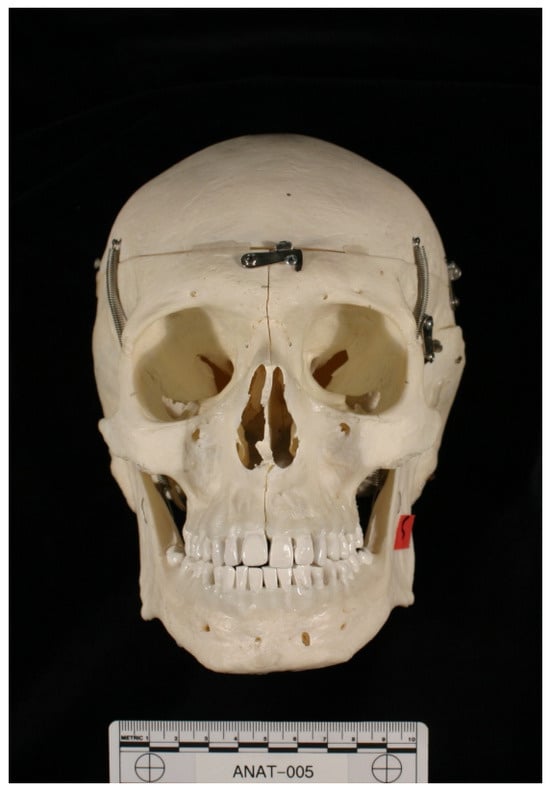
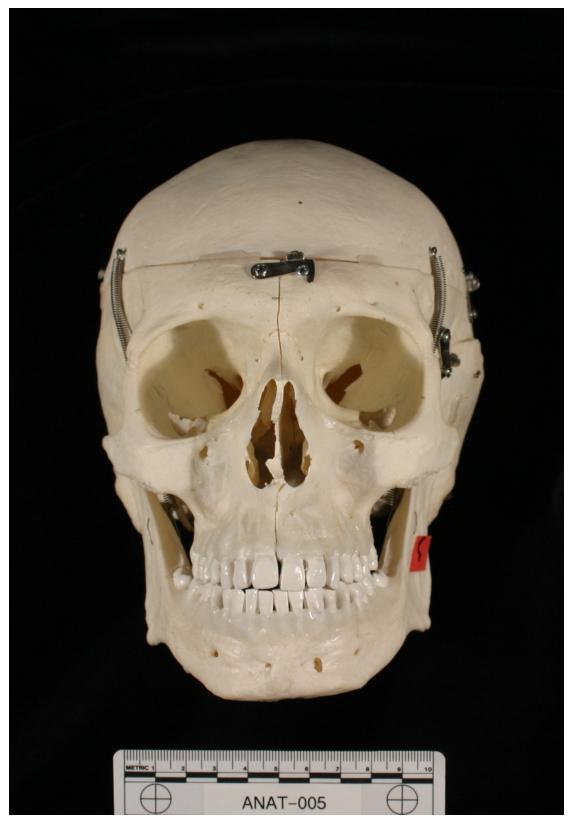
Characteristic epitaphonomic signatures associated with anatomically prepared remains include chemical bleaching, drilled mounting holes, metallic hardware, handling patina (wear), mismatched dentition, painted/pencil markings, and various sectioning techniques (Pokines, 2015; Schultz, 2012; Stubblefield, 2011). These features (Figure 1) reflect preparation, display, and prolonged use in teaching contexts rather than natural postmortem processes. While their presence is consistent with anatomical preparation, their absence does not necessarily mean that the remains were unethically obtained, as many anatomical preparations are currently for sale on widely accessible websites. On the other hand, forensically or archaeologically significant remains may also exhibit epitaphonomic modification similar to anatomical preparation resulting from repeated handling, cleaning, curation, or display. Consequently, reliance on epitaphonomic evidence alone may result in false assurances regarding the ethical status of unprovenanced skeletal remains. For example, remains of forensic or archaeological remains that have been repeatedly handled, cleaned, or curated may present epitaphonomic signatures superficially consistent with commercially prepared anatomical remains (Pokines, 2015; Stubblefield, 2011).
Figure 1.
Anatomized individual, ANAT-005.
1.4. Craniometric Analysis and Population Affinity
Craniometric analysis is a common tool in biological anthropology to investigate patterns of human variation, as cranial measurements can reflect broad geographic patterning at a global scale (Relethford, 1994, 2010; Roseman & Weaver, 2004). In forensic contexts, craniometric data are frequently employed to estimate population affinity using classification methods such as linear discriminant function analysis as implemented in software programs like Fordisc (FD3.1) (Jantz & Ousley, 2005; Ousley & Jantz, 2012).
However, the interpretive power of craniometric biodistance analyses is constrained by the composition of available reference datasets. Commonly used datasets, including those derived from Howells’ craniometric series (Howells, 1963, 1973, 1989, 1995, 1996) and the Forensic Data Bank (FDB) (Moore-Jansen & Jantz, 1986), do not adequately capture the diversity of populations historically involved in the anatomical skeletal trade. To address one aspect of this shortcoming, Hefner et al. (2016) recorded craniometric data from individuals originating from the Indian subcontinent to establish the substantial heterogeneity found within anatomical crania. The study (Hefner et al., 2016) emphasizes that craniometric data should not be used to treat anatomized individuals as a single undifferentiated group, but rather argue for regional reference samples that represent variation within anatomically sourced collections. While these data do not resolve all issues related to population representation, they offer an improved framework for assessing population affinity for unprovenanced anatomical remains.
1.5. Integrating Epitaphonomic and Craniometric Evidence
Epitaphonomic signatures and population affinity provide valuable information to forensic anthropologists, but each have limitations when applied independently. Epitaphonomic signatures may be ambiguous; craniometric classifications will always be constrained by reference sample composition and the acknowledged overlap between and among human groups due to human variation. When used together, these approaches may provide complementing lines of evidence to inform ethical decision-making regarding the use of human skeletal remains in the classroom.
Rather than functioning as definitive identification tools, epitaphonomy and craniometric data are best used in conjunction. When both lines of evidence are consistent with anatomical sourcing, continued use in an educational setting may be appropriate, while discordant or ambiguous results warrant heightened ethical scrutiny and further investigation. These lines of evidence are often used in forensic casework to determine forensic significance of unknown crania. However, affinity results and observations are simply noted and described as evidence, often with inappropriate reference populations or comprehensive frameworks.
We outline a stepwise protocol integrating aspects of epitaphonomy with estimates of population affinity to provide responsible stewardship and a quantitative assessment of unprovenanced crania. The protocol is designed to function during triage of collection reviews and casework involving forensic significance rather than as a system for definitive identification. At each stage, the goal is to assess whether available evidence supports continued inclusion of remains in teaching collections or if their removal and potential repatriation is warranted. This protocol is not presented as a validated classificatory instrument or diagnostic test. Rather, it is intended as a transparent and conservative decision-support framework organizing multiple lines of evidence for case-based ethical review. Our protocol emphasizes precaution, prioritizing the avoidance of human remains belonging to historically marginalized or legally protected populations in university teaching collections.
2. Materials and Methods
All analyses are presented in the order in which they informed decision-making, reflecting both the development of the protocol and its application to 16 unprovenanced crania curated in the MSUDHA.These individuals had no accession records or documented provenance and were historically used for teaching purposes. The MSUFAL was consulted to evaluate the status of these remains and determine whether continued educational use was appropriate. All analyses were conducted using non-destructive methods to minimize further ethical or legal concerns related to individual handling.
2.1. Epitaphonomic Signature Assessment
To establish the first component of the protocol, we systematically evaluated epitaphonomic signatures associated with anatomical preparation, use, and curation for each MSUDHA individual. Epitaphonomic indicators commonly linked to commercially sourced anatomically prepared remains are listed in Table 1. These features reflect preparation for and prolonged use in educational contexts rather than natural taphonomic processes. Each individual was assessed following the three skeletal modification categories (Pokines, 2015) distinguishing between original preparation, display and use preparation, and curation-related alterations (Table 1). Each category was scored either as absent (0) or present (1). A category was scored as present when at least one modification within that category was observed. Ambiguous signatures were scored conservatively as present. Each cranium was assessed by a single observer; because no cranium was scored by multiple observers, formal interrater reliability could not be calculated and should be addressed in future applications.
Table 1.
Categories of skeletal modification following Pokines (2015).
Secondary epitaphonomic signatures (Pokines, 2015) related to re-purposing (e.g., thermal alteration, wax application) were not included since they are less informative for identifying commercially sourced anatomical remains. These secondary signatures are typically related to informal display, such as souvenir skulls, rather than those used in teaching. Therefore, these would be more applicable in contexts of determining forensic significance in medicolegal investigations. The presence of multiple anatomical preparation, display, use, and curation signatures may be sufficient to distinguish a cranium as likely anatomical and appropriate for continued educational use.
2.2. Craniometric Data Collection and Population Affinity Assessment
The second component of the protocol applies craniometric analysis to estimate population affinity. For each MSUDHA individual, craniometric data were collected and compared against two reference datasets as described below. The first dataset was the FDB, representing modern populations typically used in forensic casework, and the second was a combined dataset comprised of the Howells dataset, archaeological reference populations often used for assessing forensic significance, and the Gupte–Turner dataset, Indian reference groups.
2.2.1. Craniometric Data Collection
Craniometric data were collected using a Microscribe Digitizer® (Revware Inc., 2023) in conjunction with 3Skull software (Ousley, 2014). The standard set of cranial landmarks was recorded for each individual, and all interlandmark distances (ILDs) were calculated in 3Skull and exported for analysis. In total, 24 ILDs were included in the final analyses (Table 2), to maximize comparability with reference datasets available in FD3.1 (Jantz & Ousley, 2005) and the Gupte–Turner (Gupte, 1909) dataset. Missing craniometric values were addressed during initial data analysis using the imputation procedure described below.
Table 2.
Interlandmark distances with corresponding abbreviations.
2.2.2. Reference Datasets
Two primary reference datasets were used for population affinity estimation. The first was the FDB implemented in FD3.1 (Jantz & Ousley, 2005; Manthey & Jantz, 2020). The FDB includes individuals from forensic anthropological casework, identified human skeletal collections, and donated human remains. The FDB represents populations commonly encountered in forensic contexts within the United States. Table 3 provides the sample distribution as outlined in FD3.1, by sex. The FDB was developed in part using craniometric data from European skeletal collections with known provenience, including remains within a repatriation context (Jantz & Ousley, 2005). This history is relevant to understanding the composition and limitations of the reference dataset, particularly for populations underrepresented in forensic casework contexts.
Table 3.
Description of reference samples, by sex, in Fordisc 3.1 Forensic Data Bank.
The second dataset is a custom database constructed for this study, incorporating selected craniometric data from Howells’ global cranial series (Howells, 1973, 1995, 1989) and a refined subset of the Gupte–Turner dataset compiled by B.A. Gupte in a craniological survey of skeletal material housed in the Indian Museum, Calcutta (Gupte, 1909). The Gupte–Turner dataset is provided in Hefner et al. (2016). Howells’ samples were selected to represent broad continental regions, while the Gupte–Turner dataset provides regional data from the Indian subcontinent. Following the recommendations of Hefner et al. (2016), Gupte–Turner samples were not pooled to preserve regional variation. Table 4 summarizes the datasets, by sex. For more descriptive summary data see (Howells, 1973, 1995, 1989) and Hefner et al. (2016).
Table 4.
Modified reference sample summary data with sample sizes, by sex for the Howells and Gupte–Turner samples.
2.2.3. Population Affinity Assessment
We applied a classification algorithm within FD3.1 using both the standard reference datasets contained in FD3.1 and a custom database that includes data from the Indian subcontinent. Each population affinity estimate was individually evaluated using posterior probabilities in conjunction with typicality probabilities and other measures of model fit to assess the relationship between the unknown individual and the reference groups.
Craniometric data from each MSUDHA individual were analyzed in FD3.1. For each analysis, posterior probabilities and the typicality F statistic (typicality probability) were recorded. Posterior probabilities were used to rank potential group membership, while typicality measures assessed how well each individual fit within the observed variation of the reference group. As noted above, population affinity estimates were interpreted as distance indicators rather than as any form of definitive classification. Posterior probabilities were interpreted comparatively and were evaluated in conjunction with typicality measures to assess the degree to which individuals were represented by the available reference samples. Any individual with the highest posterior probability as Native American or any other protected population and having an acceptable typicality probability (typ f > 0.05) was considered of ethical concern. When posterior probability favored one group over others but typicality probability was below the threshold, the result was interpreted as poor representation within the reference dataset and as a condition of uncertainty rather than evidentiary support for group attribution. The typicality threshold of ≥0.05 reflects standard practice in forensic craniometric analysis using FD3.1 and is not a novel decision point introduced by this study. Individuals falling below this threshold are interpreted as poorly represented by the available reference sample rather than as evidence of group membership (Jantz & Ousley, 2005). Individuals with highest posterior probabilities as populations historically associated with the anatomical skeletal trade were interpreted cautiously and only in conjunction with epitaphonomic evidence.
As noted above, population affinity estimates function as precautionary indicators of potential affiliation with populations for which special legal or ethical considerations apply, rather than as definitive identity assignments. Classifications suggesting affiliation with Native American or other protected populations elevate ethical concern and may warrant removal of the individual from teaching collections along with the initiation of consultation and/or repatriation procedures. Classifications consistent with populations historically associated with the anatomical skeletal trade (e.g., European, Indian, Chinese) may support continued educational use when corroborated by epitaphonomic evidence.
2.3. Factor Analysis of Mixed Data
The final step integrates epitaphonomic and craniometric evidence to guide more nuanced and ethically situated decision outcomes. For the MSUDHA sample, concordance between anatomical epitaphonomic signatures and population affinity estimates with known anatomical source populations aided in the estimation of a cranium as likely anatomical. In contrast, any discordance between epitaphonomic indicators and craniometric results increased ethical uncertainty and necessitated further scrutiny. Individuals yielding ambiguous or conflicting results may require escalation beyond this protocol, including consultation with institutional stakeholders, repatriation specialists, or additional non-destructive analytical methods.
To examine the relationship between epitaphonomic signatures and craniometric variables, we incorporated a Factor Analysis of Mixed Data (FAMD). In this context, FAMD is used as an exploratory ordination technique to visualize patterns of concordance and discordance among individuals, rather than as a predictive or inferential modeling approach. Given the small sample size (n = 16), the analysis is not intended to support statistical generalization or hypothesis testing.
FAMD allows the simultaneous analysis of categorical (epitaphonomic signatures) and continuous (craniometric measurements) variables, scaling each to contribute equally to the resulting dimensions (Husson & Josse, 2012). The epitaphonomic variables were coded as dichotomous indicators corresponding to the three Pokines (2015) categories. Missing craniometric values were imputed using the ‘imputeFAMD’ function in the ‘missMDA’ package in R (Husson et al., 2020). Eigenvalues and variable contributions were examined descriptively to assess the relative influence of epitaphonomic and craniometric variables on the resulting dimensions.
The resulting ordination is used strictly as a visualization tool to support interpretation of integrated evidence within individual cases and to identify patterns warranting further scrutiny.
The protocol is intentionally conservative, serving as a streamlined method for initial ethical assessments. By structuring assessment as a sequence of decision points rather than a single determination, this approach provides a transparent framework for responsible stewardship of unprovenanced crania. In the following sections, we present the results of this protocol applied to the unprovenanced MSUDHA crania. Results are described according to each step in the protocol, followed by three worked case examples illustrating distinct decision pathways.
3. Results
3.1. Epitaphonomic Signature
The majority of the MSUDHA individuals exhibited epitaphonomic signatures consistent with commercially prepared anatomical material. Some of the signatures most frequently observed included drilled holes at the cranial landmark vertex, metallic hardware within the cranial vault and mandible, metallic springs connecting the mandible to the cranium, chemical bleaching, patina associated with prolonged handling, and glaze-like surface coatings (see Figure 1). Of the 16 individuals, 15 exhibited at least one epitaphonomic signature associated with anatomical preparation or use. Most individuals demonstrated multiple indicators spanning Pokines’s (2015) categories (Table 5). One individual (ANAT-003) exhibited no epitaphonomic signatures associated with anatomical preparation.
Table 5.
Epitaphonomic anatomical preparation signatures.
3.2. Craniometric Population Affinity Assessment
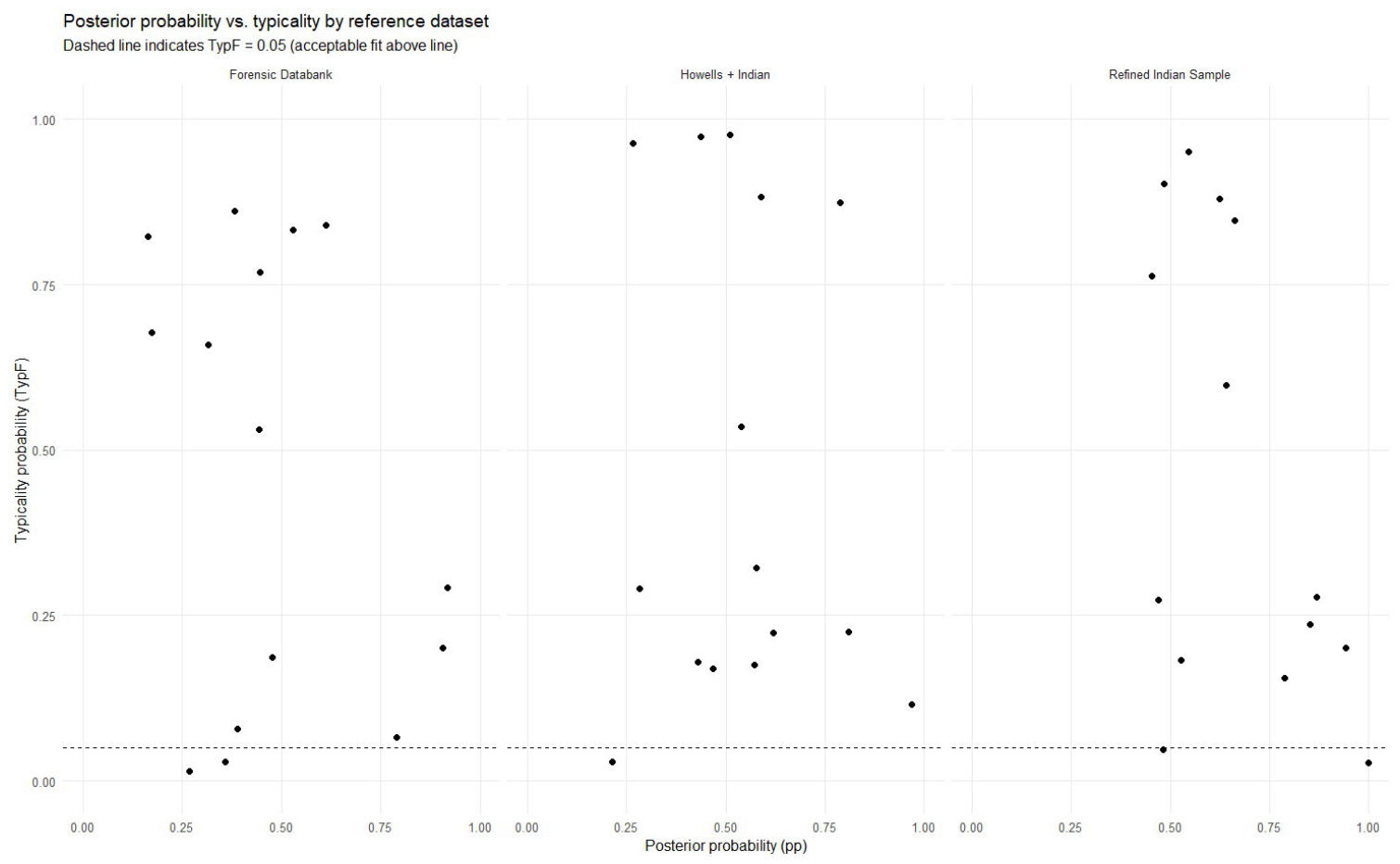
Craniometric analyses were conducted for all 16 individuals using FD3.1. Each individual was evaluated first against the FDB reference dataset followed by a custom dataset including selected Howells’ samples and the Gupte–Turner dataset. A final step evaluated a more refined analysis using only the Gupte–Turner data. Across all analyses using the FDB reference dataset, the majority of individuals were most similar to groups historically represented in anatomical skeletal trade contexts, such as European- and African-derived reference groups, with posterior probabilities and typicality values generally indicating acceptable fit (Table 6; Figure 2). Two individuals were closest to American Indian-associated reference samples, with posterior probabilities and typicality measures warranting heightened concern under the study’s interpretive framework. One individual, ANAT-007, lacked sufficient data for classification at any stage of the craniometric analyses (see Table 6).
Table 6.
Results of the classification analysis across reference datasets.
Figure 2.
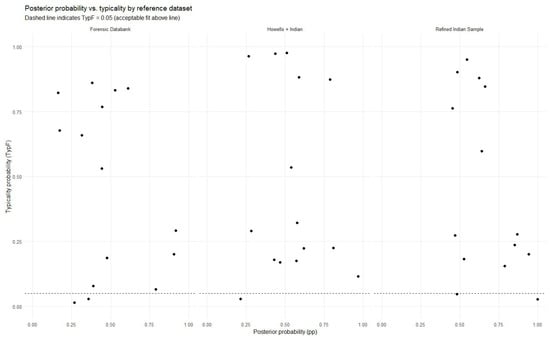
Posterior probability (pp) versus typicality probability (TypF) for MSUDHA individuals across reference datasets. Each point represents the highest posterior probability and the corresponding typicality for each individual under the Forensic Databank, Howells + Indian, and refined Indian reference samples. The dashed line marks TypF = 0.05, indicating acceptable fit to the reference distribution. Shifts in both pp and typicality across datasets highlight the dependence of craniometric affinity estimates on reference sample composition.
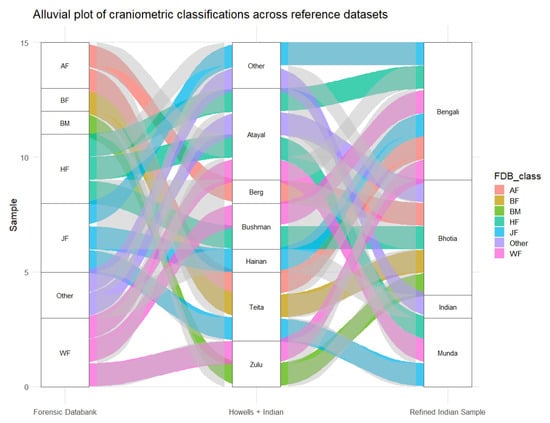
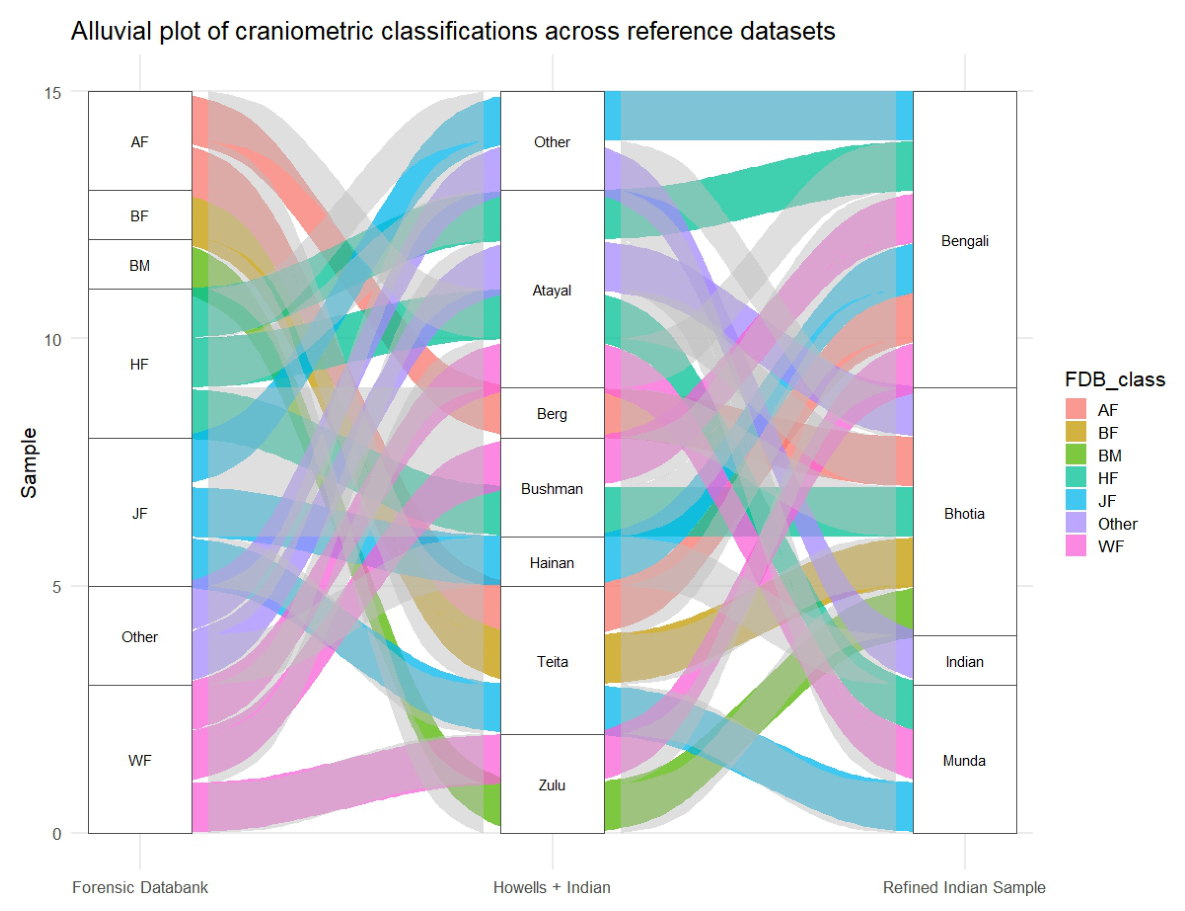
Using the expanded and refined reference datasets, population affinity estimations for these same individuals shifted; some were most similar to Indian subcontinent reference groups, others were broadly consistent with populations historically represented in anatomical collections (see Table 6; see Figure 2). Population affinity estimates varied depending on the reference dataset employed. The posterior probabilities often remained high, but the typicality values varied, underscoring the sensitivity of craniometric distance analyses to reference sample composition (see Figure 2). This instability highlights the importance of interpreting population affinity estimates comparatively and in conjunction with typicality measures, rather than as definitive assignments. In Figure 3, the gray areas indicate diffuse and crossing flows, demonstrating consistent funneling from heterogeneous starting classifications to intermediate categories and/or endpoint consolidation. Initial population affinity estimates in the FDB analysis were distributed across five of the six reference populations, suggesting geographic heterogeneity across the individuals represented. The intermediate run using the combined Howells and Gupte–Turner dataset resulted in estimates distributed across seven of the 11 reference groups. While, the refined Indian reference dataset contained 46 possible regional population groups, all individual affinity estimates resulted in only three endpoint groups (Bengali, Bhotia, and Munda). This pattern reflects instability in population affinity estimates across reference datasets or poor repeatability without adequate reference data.
Figure 3.
Alluvial plot of craniometric classifications across reference datasets. Flows depict changes in the highest posterior probability classification for each MSUDHA individual across the Forensic Databank, Howells + Indian, and Indian reference samples. The width of each flow corresponds to the number of individuals following a given classification path.
Population affinity estimates suggesting affiliation with Native American reference groups were treated as significant indicators for ethical review, particularly when combined with the absence of anatomical epitaphonomic signatures. In those cases, individuals were identified as requiring removal from teaching collections and referral for further institutional review.
3.3. Integrated Assessment Using Factor Analysis of Mixed Data
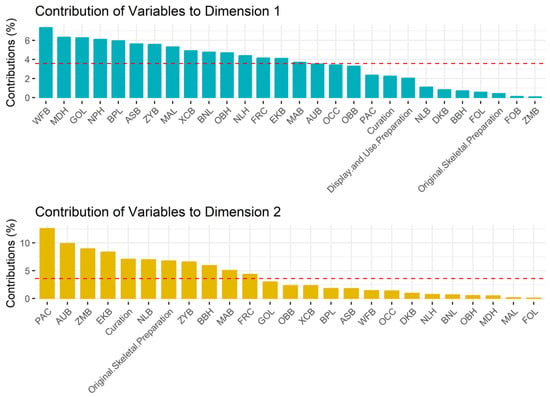
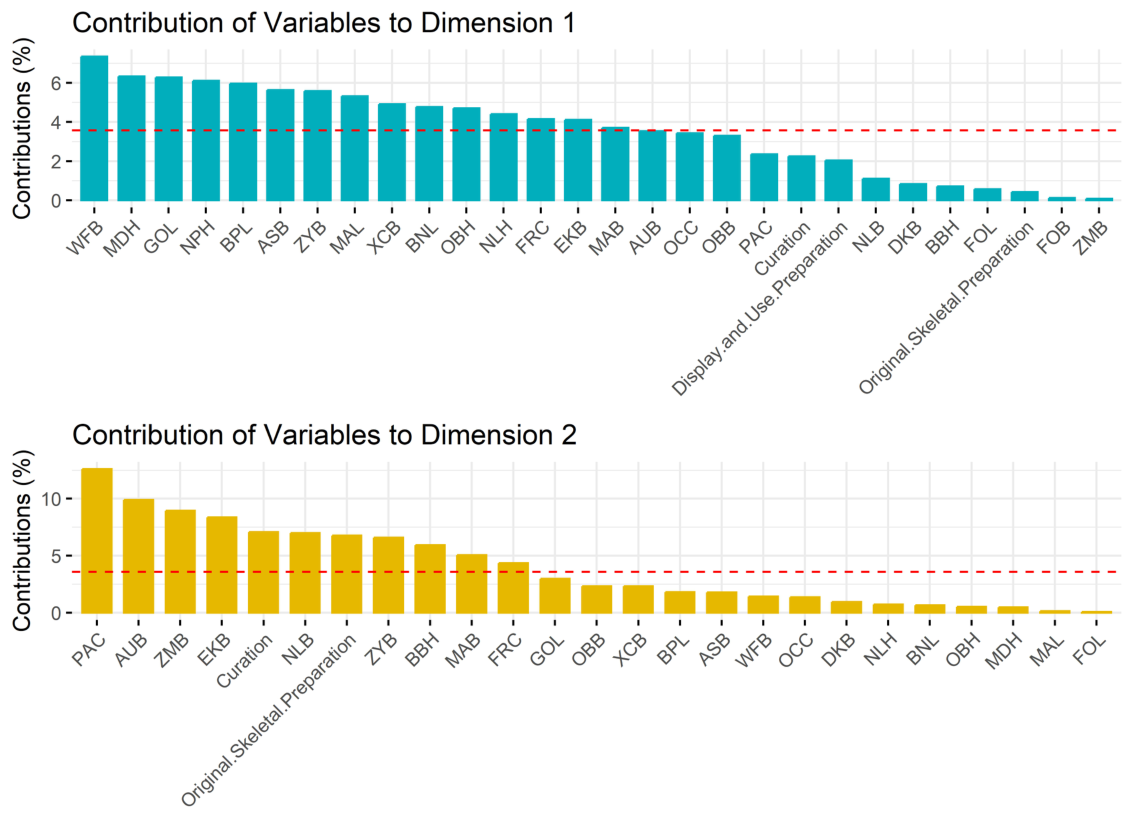
The exploratory FAMD ordination integrating epitaphonomic and craniometric variables illustrates patterns of variation across individuals, with the first two dimensions accounting for approximately half of the total variation (50.1%). Eigenvalues and variable contributions indicate both epitaphonomic and craniometric variables influence the model (Figure 4). Given the limited sample size, these patterns are interpreted descriptively and are not intended to represent stable multivariate structure beyond the present sample.
Figure 4.
Variable contributions from FAMD. Bars show the relative contribution of each variable to Dimension 1 (top) and Dimension 2 (bottom). The dotted red lines represent the average expected contribution of a variable to that dimension if all variables contributed equally. Values above the dotted red lines indicate variables that contribute more strongly to the corresponding axis.
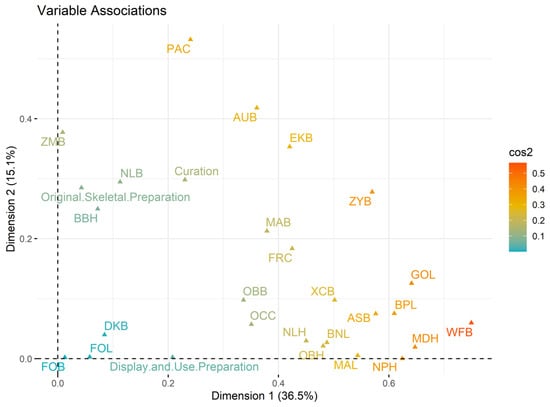
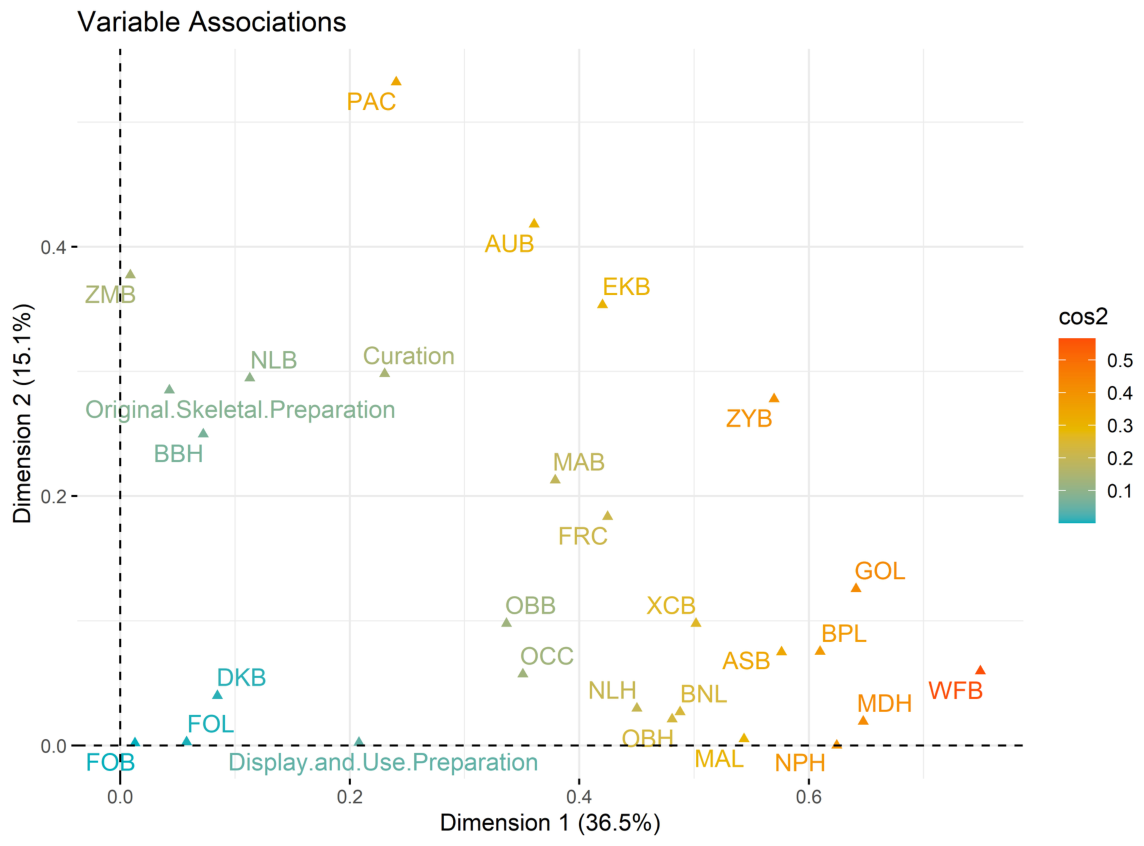
Variables contributing most strongly to the first dimension included minimum facial breadth (WFB), mastoid height (MDH), cranial length (GOL), upper facial height (NPH), and basion–prosthion Length (BPL), largely overall cranial size and vault-related metrics. The second dimension was most influenced by parietal chord (PAC), biauricular breadth (AUB), and bimaxillary breadth (ZMB), ectoconchion–ectoconchion (EKB) and curation-related variation, largely reflecting facial breadth and lateral morphology, as well as epitaphonomy (Figure 4). A reference line (red dashed line, Figure 4) indicating expected uniform contribution contextualizes variable influence across dimensions. The correlation structure of all variables and their contributions to the first two dimensions is illustrated in Figure 5. Variables are colored by cosine2 values to indicate the quality of representation along each of the plotted dimensions.
Figure 5.
Variable associations across principal dimensions of anatomical epitaphonomic signatures in the FAMD. Projection of epitaphonomic and craniometric variables onto the first two dimensions of the multivariate space (Dim1 = 36.5%, Dim2 = 15.1%). Original skeletal preparation, display and use preparation, and curation are projected with proximity measures reflecting shared variance and directional association. Color intensity corresponds to the squared cosine (cos2), indicating the relative contribution of each variable to the dimension. Dashed lines demarcate multivariate space.
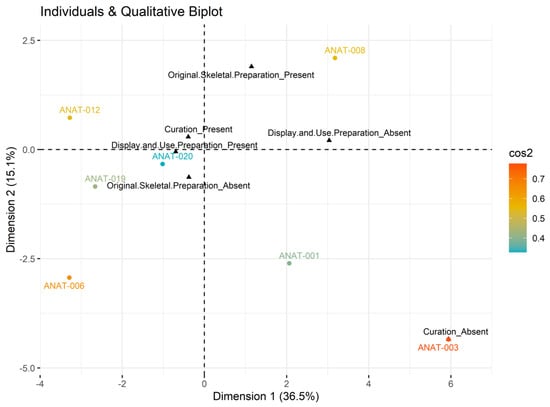
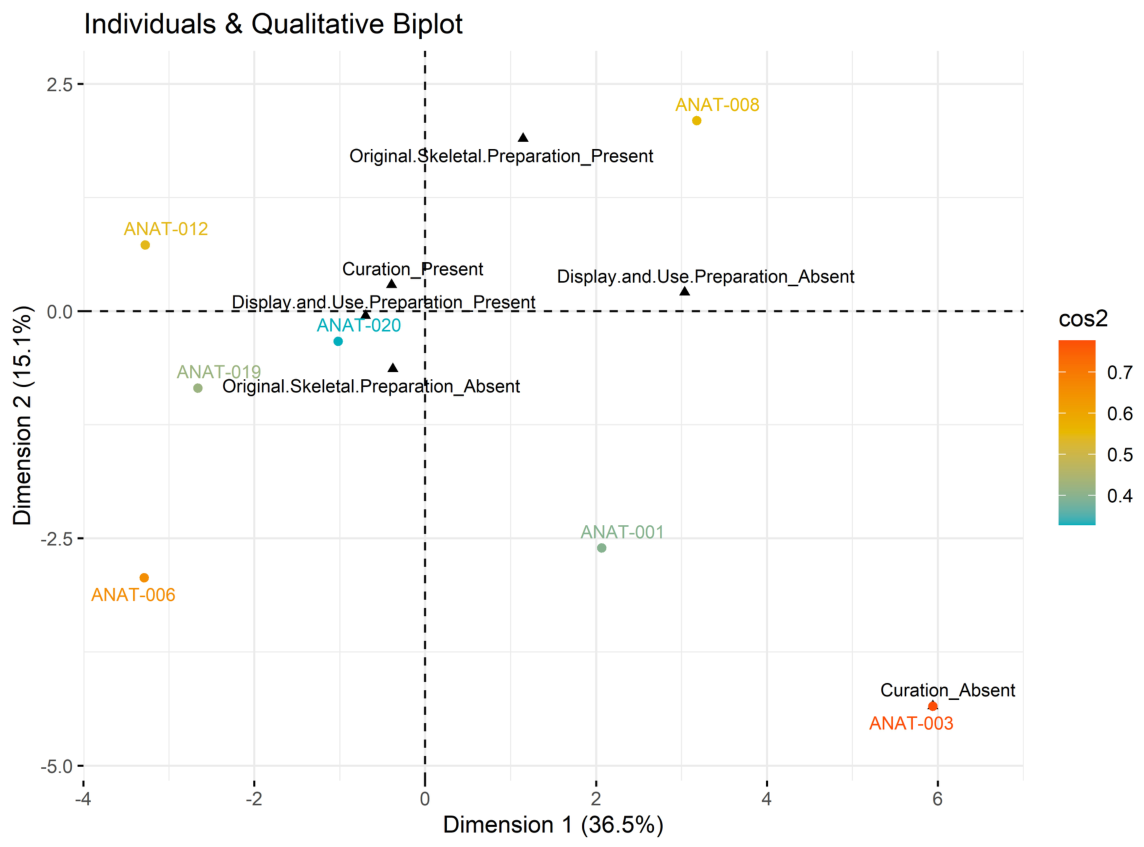
Visualization of individual scores demonstrates clustering consistent with epitaphonomic assessment results (Figure 6). Individuals exhibiting multiple anatomical epitaphonomic signatures cluster together, reflecting relative homogeneity among anatomically prepared remains, in terms of anatomical preparation. In contrast, individuals lacking anatomical signatures occupied distinct positions in the ordination space, corresponding with craniometric population affinity estimates indicating ethical concern.
Figure 6.
Biplot of the distribution of individuals (identified points) and qualitative epitaphonomic variables (labels) projected onto the first two dimensions (Dim1 = 36.5%, Dim2 = 15.1%). Individual positions reflect combined epitaphonomic signatures; qualitative variables indicate the direction and relative influence of original skeletal preparation, display and use preparation, and curation. Color intensity (cos2) reflects the quality of representation of individuals on the displayed dimensions. Dashed lines demarcate multivariate space.
4. Case Studies
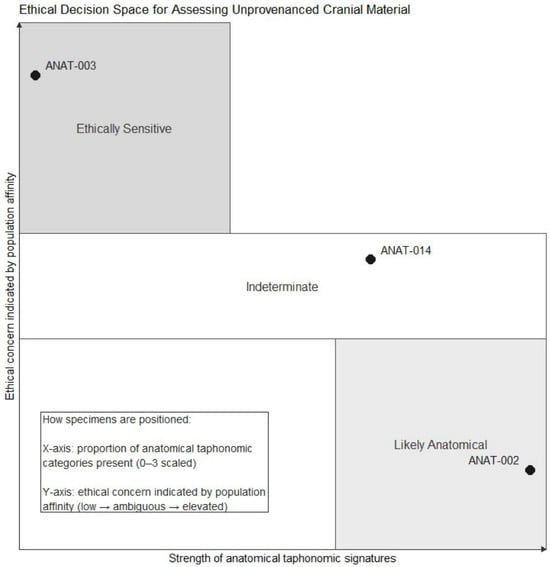
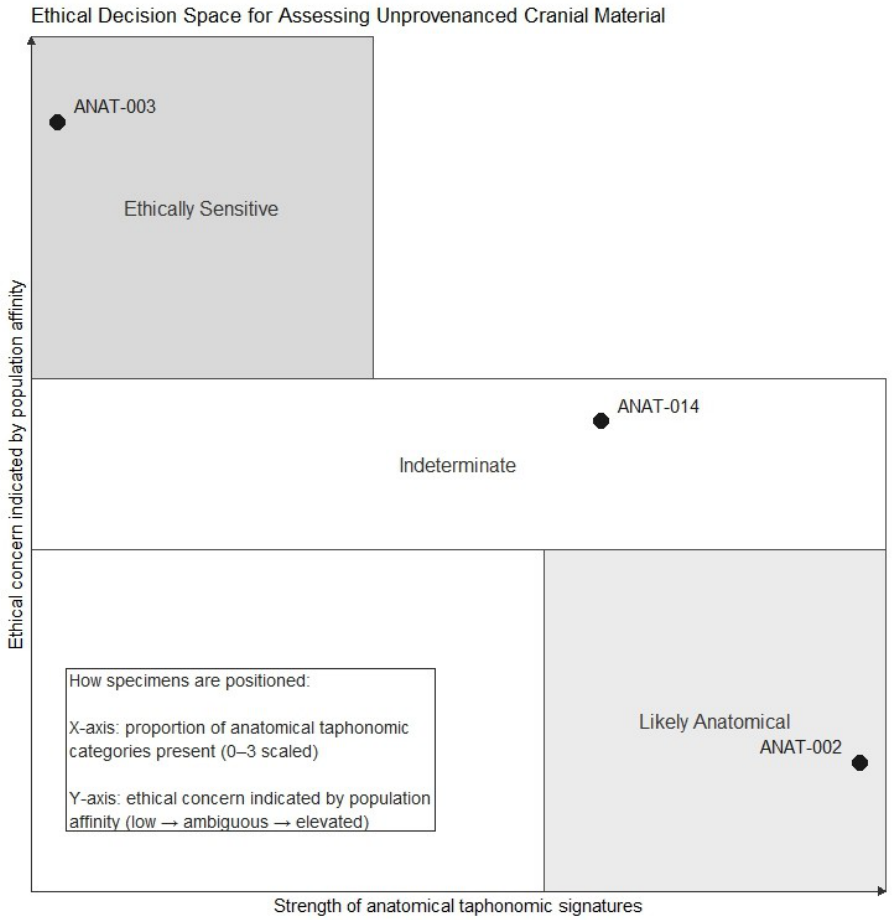
To illustrate the application of the stepwise protocol, three case examples are discussed. Each represents a distinct decision pathway (Figure 7) and demonstrates how epitaphonomic signature and population affinity estimates were integrated to guide ethical decision making. For each individual, we describe: (1) the protocol steps, (2) the evidence informing that decision, and (3) the final action or resolution.
Figure 7.
Decision space for assessing unprovenanced cranial material. Individuals are plotted according to the strength of anatomical epitaphonomic signature (x-axis) and the level of ethical concern indicated by population affinity (y-axis). Shaded regions represent interpretive categories that guide decision-making regarding analysis, reporting, and stewardship. Labeled points (case examples) illustrate how individual cases occupy different positions within this decision space.
4.1. Case Example 1: Individual ANAT-002
Individual ANAT-002 (see Figure 7) exhibits multiple epitaphonomic signatures consistent with commercially prepared anatomical material (see Table 5). Observed indicators include chemical bleaching, drilled mounting features, metallic hardware, and a darkened and shiny patina consistent with prolonged handling. These features span the categories of original skeletal preparation, display and use preparation, and curation-related modification (Pokines, 2013). Given the presence of multiple, concordant anatomical preparation signatures, ANAT-002 is determined as ‘likely anatomical’.
Craniometric population affinity estimation was conducted (see Table 6). These results suggested that ANAT-002 is closest to African samples in the FDB and Howells datasets, populations that have been associated with anatomical skeletal trade in the 18th and early 19th centuries (Stubblefield, 2011). The typicality measures indicate acceptable fit within these reference groups. However, this is not true for the Gupte–Turner dataset (Bhotia: pp = 0.481, TypF = 0.047). Based on concordant epitaphonomic and craniometric evidence, ANAT-002 was determined to be an anatomically prepared crania of African or African American affinity. Although no further escalation was warranted, the decision was made to remove ANAT-002 from active teaching use in recognition of the disproportionate representation of individuals of African descent in historical anatomical collections and the ethical considerations associated with their continued instructional use. This removal was not prompted by the protocol itself, but reflects an institutional choice to act conservatively given the well-documented misuse of individuals of African descent in historical collections. The protocol does not prescribe this action, but it accommodates it. No further escalation was warranted.
4.2. Case Example 2: Individual ANAT-003
Individual ANAT-003 (see Figure 7) exhibits no epitaphonomic signatures consistent with anatomical preparation, such as chemical bleaching, drilled mounting holes, metallic hardware, or handling-related patina (see Table 5). Instead, the individual exhibits mineral staining on the ectocranial surface, adherent soil and root material on the endocranial surface, and surface characteristics consistent with burial-like conditions such as soil staining.
Estimates of population affinity using the FDB dataset classified the individual as an American Indian male, with posterior probability and typicality measures supporting the classification (AmerInd Male: pp = 0.530, TypF = 0.832; see Table 6). Analysis using the custom database supported an affiliation outside the historically associated anatomical skeletal trade. Although the individual was most similar to the Bhotia sample with a high posterior probability (pp = 1.000), the typicality was insignificant (TypF = 0.027), suggesting uncertainty rather than evidentiary support for the classification. The heavy dental attrition observed is also consistent with expectations for pre- and proto-historic Native American human remains. Given the concordance between non-anatomical epitaphonomic signatures and the craniometric population affinity estimation indicating Native American affiliation, ethical concern was elevated. ANAT-003 was determined to be inappropriate for inclusion in teaching collections. The individual was removed from educational use, and consultation with institutional stakeholders, including the institution’s NAGPRA office, was completed prior to the inclusion of these data in the present study. This individual was repatriated to the requesting Tribal Nations in December 2021 (National Park Service, 2021, p. 61790). All analyses and reporting are consistent with institutional guidance and applicable legal and ethical frameworks.
4.3. Case Example 3: Individual ANAT-014
Individual ANAT-014 (see Figure 7) exhibits a limited number of epitaphonomic signatures associated with anatomically prepared remains (see Table 5). Some indicators of handling and curation are present; however, features typically associated with original skeletal preparation and display and use preparation, such as extensive bleaching or mounting hardware, are absent or ambiguous. As a result, epitaphonomic evidence alone was insufficient to confidently identify the nature of this individual.
Analysis of the craniometric data produced inconsistent results across reference datasets (AmerInd Female: pp = 0.173, TypF = 0.678; Teita Male: pp = 0.284, TypF = 0.291; Bengali: pp = 0.527, TypF = 0.182; see Table 6). While some classifications are consistent with populations historically associated with the anatomical trade, others suggested alternative affiliations. The typicality measures are all within acceptable range across reference groups. These results increase uncertainty regarding the ethical status of the individual. Integrated assessment using FAMD placed ANAT-014 outside the primary cluster of clearly anatomical individuals, again reflecting discordance between epitaphonomic and craniometric indicators. Due to these conflicting lines of evidence, ANAT-014 was classified as indeterminate under the protocol (see Figure 7). The classification of ANAT-014 as indeterminate does not implicate NAGPRA obligations; however, all data included in this study were reviewed and approved for dissemination in accordance with institutional oversight protocols. Continued educational use was not recommended pending further evaluation. Additional non-destructive analyses and consultation with institutional and ethical oversight bodies was advised to determine an appropriate course of action.
5. Discussion
The evaluation of unprovenanced skeletal remains represents one of the most persistent ethical challenges facing forensic anthropologists and curators of institutional collections. Legacy anatomical collections, particularly those assembled prior to the establishment of contemporary standards, sometimes lack proper documentation regarding origin, acquisition, or consent. As a result, institutions risk the continued use of human remains belonging to historically marginalized or legally protected populations. This study demonstrates how ethical uncertainty in these contexts can be reduced through a structured, multi-faceted assessment integrating epitaphonomic signatures and population affinity estimates in a relatively conservative approach.
The protocol presented here does not aim to resolve identity in a forensic sense, and is not presented as a validated diagnostic instrument. Rather, it provides a structured mechanism for ethical triage of human skeletal remains by organizing multiple lines of evidence within a transparent and precautionary framework. Our protocol is meant to detect remains that can be reasonably retained for educational purposes, pinpoint remains that warrant removal and repatriation consideration, and suggest when human remains warrant further evaluation. By formalizing this process, we can promote transparency, consistency, and accountability in institutional decision-making. All cases presented here were reviewed in accordance with institutional protocols, and where relevant, consultation processes were completed prior to dissemination of results.
One of the key findings reinforced by this study is the fallacy of treating anatomical skeletal collections as homogeneous entities. Like Stubblefield (2011) mentions, anatomized individuals can share common epitaphonomic signatures related to preparation and use, but underlying biological variation within these collections can be substantial. The results presented here align with prior work demonstrating heterogeneity among anatomized individuals, particularly those sourced from the Indian subcontinent.
The integration of population affinity estimates revealed individuals exhibiting similar anatomical preparation signatures can differ markedly in biological affinity. This observation has direct ethical implications. Assumptions of homogeneity obscure the presence of human remains belonging to protected populations and contributes to their inadvertent misuse. Our protocol addresses this risk by requiring more than anatomical appearance alone to determine appropriateness for classroom use.
We used population affinity estimation deliberately framed as an ethical indicator rather than a definitive classificatory outcome. This distinction is critical. When applied to unprovenanced skeletal material, population affinity estimates function as a precautionary signal to guide responsible action under uncertainty. In this context, the consequences of false negatives (i.e., incorrectly retaining remains that should be excluded) are ethically more significant than false positives (i.e., removing ethically sourced material).
The use of posterior probabilities and typicality measures reinforces a conservative framework. Rather than privileging statistical output, we instead emphasize concordance across analyses. When population affinity estimates suggest possible affiliation with Native American or other protected groups, ethical concern is elevated regardless of whether classification certainty meets forensic thresholds. This approach aligns ethical practice with minimizing harm in the face of incomplete information.
The primary strength of the proposed protocol lies in its integration of complementing (and at times conflicting) lines of evidence. Epitaphonomic signatures provide insight into preparation, use, and curation history; craniometric data offer information concerning biological variation and potential population affiliation. When considered independently, each method is vulnerable. When integrated, they provide a robust framework for ethical decision-making.
The use of Factor Analysis of Mixed Data (FAMD) provides a visual framework for integrating epitaphonomic and craniometric variables. In this study, FAMD functions as an exploratory tool to aid interpretation of concordance and discordance among lines of evidence rather than as a formal statistical model (Husson et al., 2020; Stull et al., 2023). Visualizing integrated results allows practitioners to identify individuals deviating from expected anatomical patterns and to prioritize those for additional review or analysis. This approach moves beyond checklist-style assessments and encourages holistic interpretation of skeletal evidence in a more robust and quantitative manner.
- Broader Applications and Implications
Although this study focuses on unprovenanced crania housed within one university anatomy collection, the protocol has broader applicability. Similar ethical challenges arise in museum collections, teaching laboratories, and forensic anthropology facilities managing legacy cases or unidentified remains. In each of these contexts, non-destructive, transparent, and precautionary assessments are essential. International provenance research, including large-scale efforts integrating archival and skeletal data for colonial-era collections, demonstrates the value of multi-method frameworks for responsible stewardship (Heeb & Kabwete-Mulinda, 2022; Winkelmann, 2020). The protocol presented here complements those efforts by addressing contexts where historical documentation is unavailable and ethical triage must rely on physical evidence alone.
The increasing digitization and public accessibility of skeletal collections further heighten the need for these protocols (Belcastro et al., 2025; Plemons & Spiros, 2025). Digital availability amplifies the consequences of misclassification by extending the use and visibility of unethically curated remains. The protocol presented here provides institutions with a defensible approach for evaluating remains prior to digitization, exhibition, or continued pedagogical use.
- Limitations and Opportunities for Refinement
Several limitations should be acknowledged. Population affinity estimation remains constrained by the composition of available reference datasets, particularly for populations historically involved in the anatomical skeletal trade. While the inclusion of regional data from the Indian subcontinent improves the interpretive context, those data are archaeological and may not capture the full range of variability in anatomical collections. Importantly, any refinement should remain aligned with the core principles of precaution, transparency, and ethical responsibility that underpin forensic anthropological analyses.
An additional limitation relates to sample size. The present study is based on a relatively small number of individuals (n = 16), reflecting a single institutional collection. As such, the multivariate analyses presented, including the FAMD, are intended for exploratory and illustrative purposes rather than for statistical inference or model development. The goal of these analyses is to support case-based ethical interpretation rather than establishing generalizable population-level relationships. Future work incorporating larger and more diverse samples will allow more robust evaluation of multivariate structure and the stability of observed patterns.
We acknowledge that this protocol has not been formally validated as a decision framework across multiple institutional collections. However, the purpose of this protocol is not to generate definitive classifications, but rather it is meant to structure ethical review in cases where uncertainty is inherent and the consequences of inappropriate retention may be substantial. Future work should evaluate the consistency of outcomes across larger samples, multiple observers, and a broader range of collections, and assess how frequently different lines of evidence converge or conflict under a standardized application of the protocol. Additionally, the TypF threshold applied in population affinity estimation reflects established methods in FORDISC practice rather than a validated cutoff specific to this protocol. Future work should evaluate how threshold selection affects individual placements within the decision space across larger and more diverse samples.
Future refinement of this protocol should extend beyond cranial material and craniometric approaches. Many institutional collections contain isolated long bones, partial skeletons, or even dentition where crania are absent, limiting the applicability of the proposed protocol. Incorporating postcranial metric analyses, such as long bone measurements as implemented in FORDISC (Jantz & Ousley, 2005; Spradley, 2014), as well as postcranial nonmetric morphological traits (Spiros, 2019), could complement epitaphonomic assessment and further reduce uncertainty in those contexts. Additional non-destructive cranial approaches could also strengthen the protocol, including macromorphoscopic trait analysis (Hefner, 2018; Hefner & Ousley, 2014) and dental morphological analysis (Edgar, 2013; Scott et al., 2018). Geometric morphometrics can be employed to distinguish population-level shape variation in anatomical collections and for the development of more robust reference datasets for protocol validation (Spradley & Jantz, 2016; Stull et al., 2023). Non-destructive imaging approaches, including computed tomography and three-dimensional surface scanning, are additional options for capturing skeletal morphology without compromising the integrity of the remains (Belcastro et al., 2025; Verma et al., 2026). Expanding the protocol in these directions would enhance its applicability across broader collection contexts and strengthen institutional capacity for responsible stewardship of fragmentary or incomplete skeletal remains.
6. Conclusions
In this study, we present a systematic, non-destructive protocol integrating epitaphonomic signatures and population affinity estimation to support responsible decision-making regarding the use of human remains in institutional collections. Rather than functioning as a tool for definitive identification, this framework is designed to reduce ethical risk by identifying remains that may warrant exclusion from teaching or, more importantly, repatriation consideration.
The application of this protocol to unprovenanced crania from a university anatomy collection demonstrates the value of converging multiple lines of evidence. Epitaphonomic signatures alone are insufficient to determine ethical appropriateness, and craniometric population affinity estimates are most informative when interpreted conservatively and in a proper context. When integrated, these methods provide a transparent and defensible basis for ethical triage, allowing practitioners to distinguish between anatomized individuals, human remains requiring immediate ethical action, and cases for which uncertainty necessitates additional analysis.
As institutions increasingly confront the legacy of unprovenanced skeletal collections and expand digital access to human remains, the need for precautionary and ethically grounded assessment is imperative. The protocol presented here offers a practical model for forensic anthropologists, curators, and institutions seeking to responsibly steward human remains while acknowledging historical inequities potentially embedded within their collections. By emphasizing integration, transparency, and caution, this approach contributes to broader efforts to align anthropological practice with contemporary standards of respect and accountability.
Author Contributions
Conceptualization, J.T.H. and N.G.; methodology, All authors; formal analysis, A.M.P., R.R.D., M.C.S., K.R.K. and J.T.H.; investigation, All authors; resources, N.G.; data curation, J.T.H.; writing—original draft preparation, J.T.H., A.M.P., R.R.D., M.C.S. and K.R.K.; writing—review and editing, A.M.P., R.R.D., M.C.S., K.R.K., N.G. and J.T.H.; visualization, M.C.S. and J.T.H.; supervision, J.T.H.; project administration, N.G. All authors have read and agreed to the published version of the manuscript.
Funding
This research received no external funding.
Institutional Review Board Statement
This study was reviewed by the Michigan State University Human Research Protection Program and determined not to involve human subjects under the Revised Common Rule (MSU Study ID: STUDY202600604; determination date: 6 April 2026). All materials included in the study originate solely from deceased individuals; therefore, no living human subjects were involved, and Michigan State University Institutional Review Board approval was not required.
Data Availability Statement
The data and code supporting the conclusions of this study are openly available in a GitHub repository at: https://github.com/hefnerj1/Ethical_Assessment_of_Anatomical_Crania (accessed on 1 June 2026). The repository contains the raw and/or processed data, R scripts, and documentation required to reproduce all results reported in this manuscript.
Acknowledgments
First we would like to thank the institutions and curators who provided access to collections and facilitated the use of comparative materials essential to all research, including our own. We are especially indebted to the donors whose decision to contribute their bodies to science made this work possible. Their gift represents an extraordinary commitment to education and research, and we recognize their contributions with respect and gratitude. We also thank M. Ancern and W. McQuade for thoughtful and constructive editorial comments that improved the clarity and quality of this manuscript.
Conflicts of Interest
The authors declare no conflict of interest.
References
- Agarwal, S. C. (2024). The bioethics of skeletal anatomy collections from India. Nature Communications, 15, 1692. [Google Scholar] [CrossRef] [Scilit]
- Belcastro, M. G., Sorrentino, R., Mameli, D., Pietrobelli, A., Nicolosi, T., Mariotti, V., Figus, C., Lodolo, E., Forni, L., Ratti, S., Rosas, A., Ríos Frutos, L. F., Colombo, A., Maglio, M., Martini, L., Marchiori, G., Giavaresi, G., & Fini, M. (2025). The digitization of human skeletal collections: New challenges and perspectives. Heritage, 8, 488. [Google Scholar] [CrossRef] [Scilit]
- Billeck, W. T. (2002). Cultural affiliation and repatriation in the Great Plains of the United States. Journal of American Archaeology, 21, 89–105. [Google Scholar]
- Bray, T. L. (2001). The future of the past: Archaeologists, native Americans, and repatriation. Garland Publishing. [Google Scholar]
- Buikstra, J. E., & Gordon, C. C. (1981). The study and restudy of human skeletal series: The importance of long-term curation. In A. Cantwell, J. B. Griffin, & N. A. Rothschild (Eds.), The research potential of anthropological museum collections (pp. 449–465). New York Academy of Sciences. [Google Scholar]
- Carney, S. (2007). Inside India’s underground trade in human remains. Wired Magazine, 15(12), 12–15. [Google Scholar]
- Cornwall, J., Champney, T. H., de la Cova, C., Hall, D., Hildebrandt, S., Mussell, J. C., Winkelmann, A., & DeLeon, V. B. (2024). American association for anatomy recommendations for the management of legacy anatomical collections. The Anatomical Record, 307(8), 2787–2815. [Google Scholar] [CrossRef] [Scilit]
- Dirkmaat, D. C., & Cabo, L. L. (2016). Forensic archaeology and forensic taphonomy: Basic considerations on how to properly process and interpret the outdoor forensic scene. Academic Forensic Pathology, 6(3), 439–454. [Google Scholar] [CrossRef] [Scilit]
- Dongoske, K. E. (1996). The native American graves protection and repatriation act: A new beginning, not the end, for osteological analysis—A Hopi perspective. American Indian Quarterly, 20, 287–297. [Google Scholar] [CrossRef] [Scilit] [PubMed]
- Dunn, R. R., Spiros, M. C., Kamnikar, K. R., Plemons, A. M., & Hefner, J. T. (2020). Ancestry estimation in forensic anthropology: A review. WIREs Forensic Science, 2, e1369. [Google Scholar] [CrossRef] [Scilit]
- Edgar, H. J. H. (2013). Estimation of ancestry using dental morphological characteristics. Journal of Forensic Sciences, 58(S1), S3–S8. [Google Scholar] [CrossRef] [Scilit]
- Green, R., & Mitchell, N. M. (1990). American Indian sacred objects, skeletal remains, repatriation and reburial: A resource guide. Smithsonian Institution, National Museum of American History. [Google Scholar]
- Gupte, B. A. (1909). Craniological data from the Indian museum, Calcutta. Government Printing. [Google Scholar]
- Habicht, J. L., Kiessling, C., & Winkelmann, A. (2018). Bodies for anatomy education in medical schools: An overview of the sources of cadavers worldwide. Academic Medicine, 93(9), 1293–1300. [Google Scholar] [CrossRef] [Scilit]
- Heeb, B. S., & Kabwete-Mulinda, C. (Eds.). (2022). Human remains from the former German colony of east Africa: Recontextualization and approaches for restitution. Böhlau Verlag. [Google Scholar]
- Hefner, J. T. (2018). The macromorphoscopic databank. American Journal of Physical Anthropology, 166, 994–1004. [Google Scholar] [CrossRef] [Scilit]
- Hefner, J. T., & Ousley, S. D. (2014). Statistical classification methods for estimating ancestry using morphoscopic traits. Journal of Forensic Sciences, 59(4), 883–890. [Google Scholar] [CrossRef] [Scilit] [PubMed]
- Hefner, J. T., Spatola, B. F., Passalacqua, N. V., & Gocha, T. P. (2016). Beyond taphonomy: Exploring craniometric variation among anatomical material. Journal of Forensic Sciences, 61(6), 1440–1448. [Google Scholar] [CrossRef] [Scilit]
- Hefner, J. T., & Spradley, M. K. (2018). Ancestry: Forensic applications. In The international encyclopedia of biological anthropology. John Wiley & Sons. [Google Scholar]
- Hortsch, M., Girão-Carmona, V. C. C., Leite, A. C. R. M., Nikas, I. P., Gatumu, M. K., Koney, N. K., & Van Nuland, S. E. (2026). A global overview of anatomical science education and its present and future role in biomedical curricula. Anatomical Sciences Education, 19(1), 5–45. [Google Scholar] [CrossRef] [Scilit] [PubMed]
- Howells, W. W. (1963). Cranial variation in man: A study by multivariate analysis of patterns of difference among recent human populations. Peabody Museum. [Google Scholar]
- Howells, W. W. (1973). Cranial variation in man. Harvard University. [Google Scholar]
- Howells, W. W. (1989). Skull shapes and the map. Harvard University. [Google Scholar]
- Howells, W. W. (1995). Who’s who in skulls. Harvard University. [Google Scholar]
- Howells, W. W. (1996). Howells’ craniometric data on the Internet. American Journal of Physical Anthropology, 101, 441–442. [Google Scholar] [CrossRef] [Scilit] [PubMed]
- Husson, F., & Josse, J. (2012). missMDA: Handling missing values with/in multivariate data analysis (principal component methods). CRAN. [Google Scholar]
- Husson, F., Josse, J., Lê, S., & Mazet, J. (2020). FactoMineR: Multivariate exploratory data analysis and data mining. R package. CRAN.
- Jantz, R. L., & Ousley, S. D. (2005). FORDISC 3.0: Computerized forensic discriminant functions. University of Tennessee. [Google Scholar]
- Killion, T. W., & Molloy, P. (2000). Repatriation’s silver lining. The SAA Bulletin: Working Together: Native Americans and Archaeologists, 17(2), 111–117. [Google Scholar]
- Langley, N. R., & Butaric, L. N. (2019). Anatomical sciences education among biological anthropology graduates: A solution to the dearth of anatomy educators? Medical Science Educator, 30(1), 129–137. [Google Scholar] [CrossRef] [Scilit]
- Larsen, C. S., & Walker, P. L. (2005). Ethics in bioarchaeology. In T. Turner (Ed.), From repatriation to genetic identity (pp. 111–119). SUNY Press. [Google Scholar]
- Lovis, W. A., Kintigh, K. W., Steponaitis, V. P., & Goldstein, L. G. (2004). Archaeological perspectives on NAGPRA. In Legal perspectives on cultural resources (pp. 165–184). AltaMira Press. [Google Scholar]
- Manthey, L., & Jantz, R. L. (2020). Fordisc: Anthropological software for estimation of ancestry, sex, time period, and stature. In Statistics and probability in forensic anthropology (pp. 275–287). Elsevier. [Google Scholar]
- Mastana, S. S. (2014). Unity in diversity: An overview of the genomic anthropology of India. Annals of Human Biology, 41, 287–299. [Google Scholar] [CrossRef] [Scilit]
- Moore-Jansen, P. H., & Jantz, R. L. (1986). Data collection procedures for forensic skeletal material. University of Tennessee. [Google Scholar]
- Mountain, J. L., & Risch, N. (2004). Assessing genetic contributions to phenotypic differences among racial and ethnic groups. Nature Genetics, 36, S48–S53. [Google Scholar] [CrossRef] [Scilit]
- National Park Service. (2021). Notice of inventory completion: Michigan State University, East Lansing, MI. Federal Register, 86(213), 61789–61791. [Google Scholar]
- Ousley, S. D. (2014). 3Skull: Three-dimensional skeletal analysis software [Computer software]. Available online: https://statsmachine.net/software/ (accessed on 1 June 2026).
- Ousley, S. D., Billeck, W. T., & Hollinger, R. E. (2005). Federal repatriation legislation and the role of physical anthropology in repatriation. American Journal of Physical Anthropology, 128, 2–32. [Google Scholar] [CrossRef] [Scilit]
- Ousley, S. D., & Jantz, R. L. (2012). Fordisc 3 and statistical methods for estimating sex and ancestry. In D. Dirkmaat (Ed.), A companion to forensic anthropology. Blackwell. [Google Scholar]
- Plemons, A. M., & Spiros, M. C. (2025). Toward ethical digital practices: Guidelines for consent, accountability, and transparency in anthropology. American Journal of Biological Anthropology, 186, e70044. [Google Scholar] [CrossRef] [Scilit]
- Pokines, J. T. (2013). Introduction: Collection of macroscopic osseous taphonomic data. In J. T. Pokines, & S. A. Symes (Eds.), Manual of forensic taphonomy (pp. 1–17). CRC Press. [Google Scholar]
- Pokines, J. T. (2015). Taphonomic characteristics of former anatomical teaching specimens received at a medical examiner’s office. Journal of Forensic Identification, 65(2), 173–185. [Google Scholar]
- Pokines, J. T., Appel, N., Pollock, C., Eck, C. J., Maki, A. G., Joseph, A. S., Cadwell, L., & Young, C. D. (2017). Anatomical taphonomy at the source: Alterations to a sample of 84 teaching skulls at a medical school. Journal of Forensic Identification, 67(4), 600–632. [Google Scholar]
- Pokines, J. T., Knight, E., Scialdone Méndez, C., & Moore, T. L. (2024). Excavation, archaeological context, and historical background of the nineteenth-century Winchester anatomized site. Forensic Anthropology, 8(4), 213–230. [Google Scholar] [CrossRef] [Scilit]
- Raghavan, M., Skoglund, P., Graf, K. E., Metspalu, M., Albrechtsen, A., Moltke, I., Rasmussen, S., Stafford, T. W., Jr., Orlando, L., Metspalu, E., Karmin, M., Tambets, K., Rootsi, S., Mägi, R., Campos, P. F., Balanovska, E., Balanovsky, O., Khusnutdinova, E., Litvinov, S., … Willerslev, E. (2013). Upper palaeolithic siberian genome reveals dual ancestry of native Americans. Science, 342(6152), 123. [Google Scholar] [CrossRef] [Scilit]
- Rajkumar, R., & Kashyap, V. (2004). Genetic structure of four socio-culturally diversified caste populations of southwest India. BMC Genetics, 5, 23. [Google Scholar] [CrossRef] [Scilit] [PubMed]
- Relethford, J. H. (1994). Craniometric variation among modern human populations. American Journal of Physical Anthropology, 95, 53–62. [Google Scholar] [CrossRef] [Scilit] [PubMed]
- Relethford, J. H. (2010). Population-specific deviations of global human craniometric variation from a neutral model. American Journal of Physical Anthropology, 142(1), 105–111. [Google Scholar] [CrossRef] [Scilit]
- Revware Inc. (2023). MicroScribe digitizer. Available online: https://www.revware.net (accessed on 1 June 2026).
- Rose, J. C., Green, T. J., & Green, V. D. (1996). NAGPRA is forever: Osteology and the repatriation of skeletons. Annual Review of Anthropology, 25, 81–103. [Google Scholar] [CrossRef] [Scilit]
- Roseman, C. C., & Weaver, T. D. (2004). Multivariate apportionment of global human craniometric diversity. American Journal of Physical Anthropology, 125(3), 257–263. [Google Scholar] [CrossRef] [Scilit]
- Schultz, J. J. (2012). The role of taphonomy in the analysis of human skeletal remains. In J. T. Pokines, & S. A. Symes (Eds.), Manual of forensic taphonomy (pp. 33–51). CRC Press. [Google Scholar]
- Scott, G. R., Pilloud, M. A., Navega, D., d’Oliveira Coelho, J., Cunha, E., & Irish, J. D. (2018). rASUDAS: A new web-based application for estimating ancestry from tooth morphology. Forensic Anthropology, 1(1), 18–31. [Google Scholar] [CrossRef] [Scilit]
- Skeleton Exports. (1985, August 17). Skeleton exports banned. The Glasgow Herald. 4.
- Sorg, M. H., & Haglund, W. D. (Eds.). (2002). Advancing forensic taphonomy. In Advances in forensic taphonomy (pp. 3–29). CRC Press. [Google Scholar]
- Spiros, M. C. (2019). Standardization of postcranial nonmetric traits and their utility in ancestry analysis. Forensic Anthropology, 2(1), 29–44. [Google Scholar] [CrossRef] [Scilit]
- Spradley, M. K. (2014). Metric ancestry estimation from the postcranial skeleton. In G. E. Berg, & S. C. Ta’ala (Eds.), Biological affinity in forensic identification of human skeletal remains: Beyond black and white (pp. 83–94). CRC Press. [Google Scholar]
- Spradley, M. K., & Jantz, R. L. (2016). Ancestry estimation in forensic anthropology: Geometric morphometric versus standard and nonstandard interlandmark distances. Journal of Forensic Sciences, 61(4), 892–897. [Google Scholar] [CrossRef] [Scilit] [PubMed]
- Stubblefield, P. R. (2011). The anatomical diaspora. Journal of Forensic Sciences, 56(5), 1324–1327. [Google Scholar] [CrossRef] [Scilit]
- Stull, K. E., New, B. T., Corron, L., Auchter, L. E., Spradley, K., Wolfe, C. A., Chu, E. Y., & Hefner, J. T. (2023). Exploring mutual and exclusive biological information in cranial metric and morphological variables. Forensic Anthropology, 7(2–3), 141. [Google Scholar] [CrossRef] [Scilit]
- Swift, K., & Pokines, J. T. (2024). Taphonomic changes of skeletal remains from the Winchester anatomized site. Forensic Anthropology, 8(4), 264–274. [Google Scholar] [CrossRef] [Scilit]
- Trombley, T. M., & Agarwal, S. C. (2025). Theoretical origins and biocultural approaches to taphonomy in bioarchaeology. Journal of Archaeological Method and Theory, 32, 51. [Google Scholar] [CrossRef] [Scilit]
- Verma, P., Tiwari, P., Hefner, J. T., Das, A., Datta, A., Patel, V., Dave, S., & Agarwal, S. (2026). Sex estimation using craniometric data obtained through computed tomography with a sample from Gujarat, India. Forensic Anthropology. Early view. [Google Scholar] [CrossRef] [Scilit]
- Walker, P. L. (2004). Caring for the dead: Finding a common ground in disputes over museum collections of human remains. Documenta Archaeobiologiae, 2, 13–27. [Google Scholar]
- Winkelmann, A. (2020). Repatriations of human remains from Germany—1911 to 2019. Museum & Society, 18(1), 40–51. [Google Scholar] [CrossRef] [Scilit]

Disclaimer/Publisher’s Note: The statements, opinions and data contained in all publications are solely those of the individual author(s) and contributor(s) and not of MDPI and/or the editor(s). MDPI and/or the editor(s) disclaim responsibility for any injury to people or property resulting from any ideas, methods, instructions or products referred to in the content. |
© 2026 by the authors. Licensee MDPI, Basel, Switzerland. This article is an open access article distributed under the terms and conditions of the Creative Commons Attribution (CC BY) license.