
Dietary Reconstruction of Migrant Populations in the Core Region of Early China


Abstract
1. Introduction
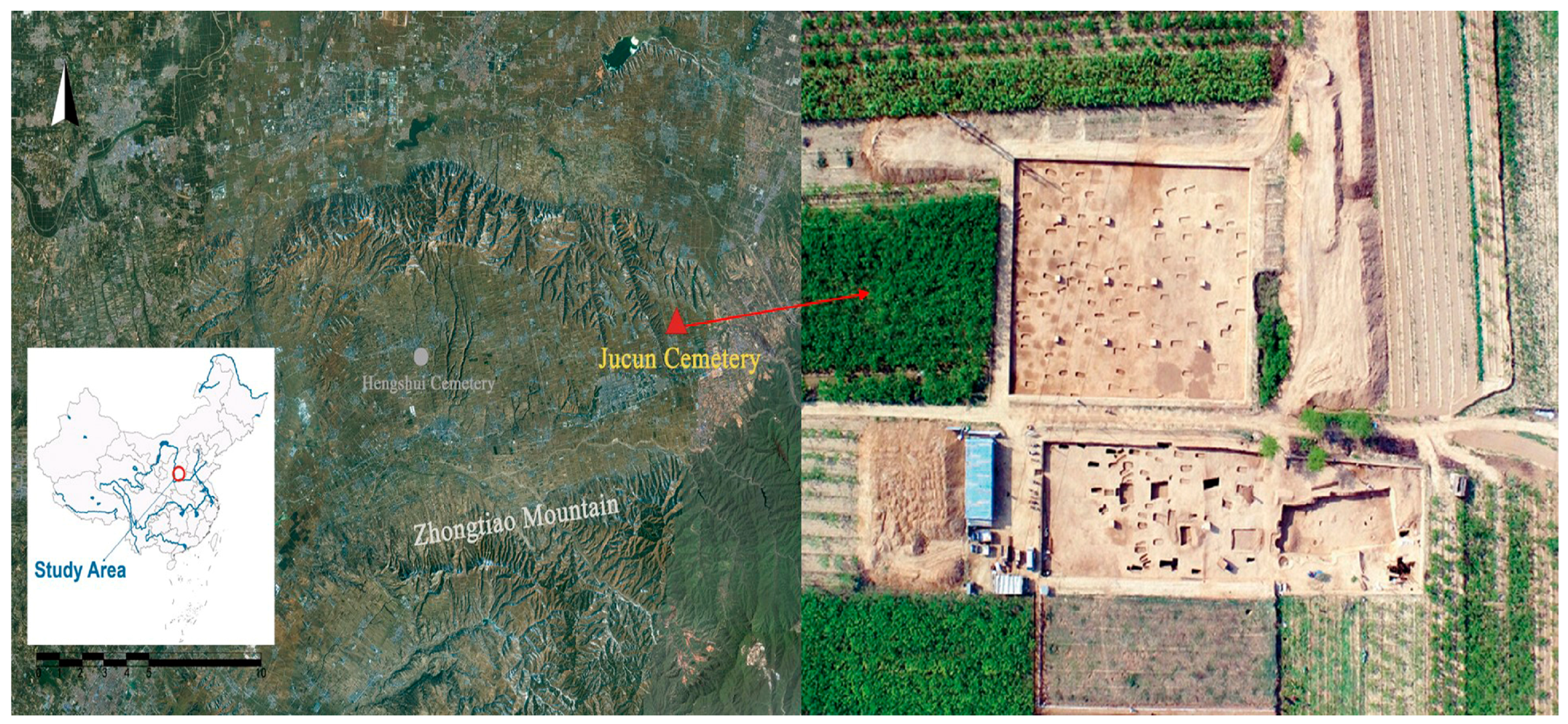
2. Site Background
3. Materials and Methods
4. Results
4.1. Collagen Quality Assessment
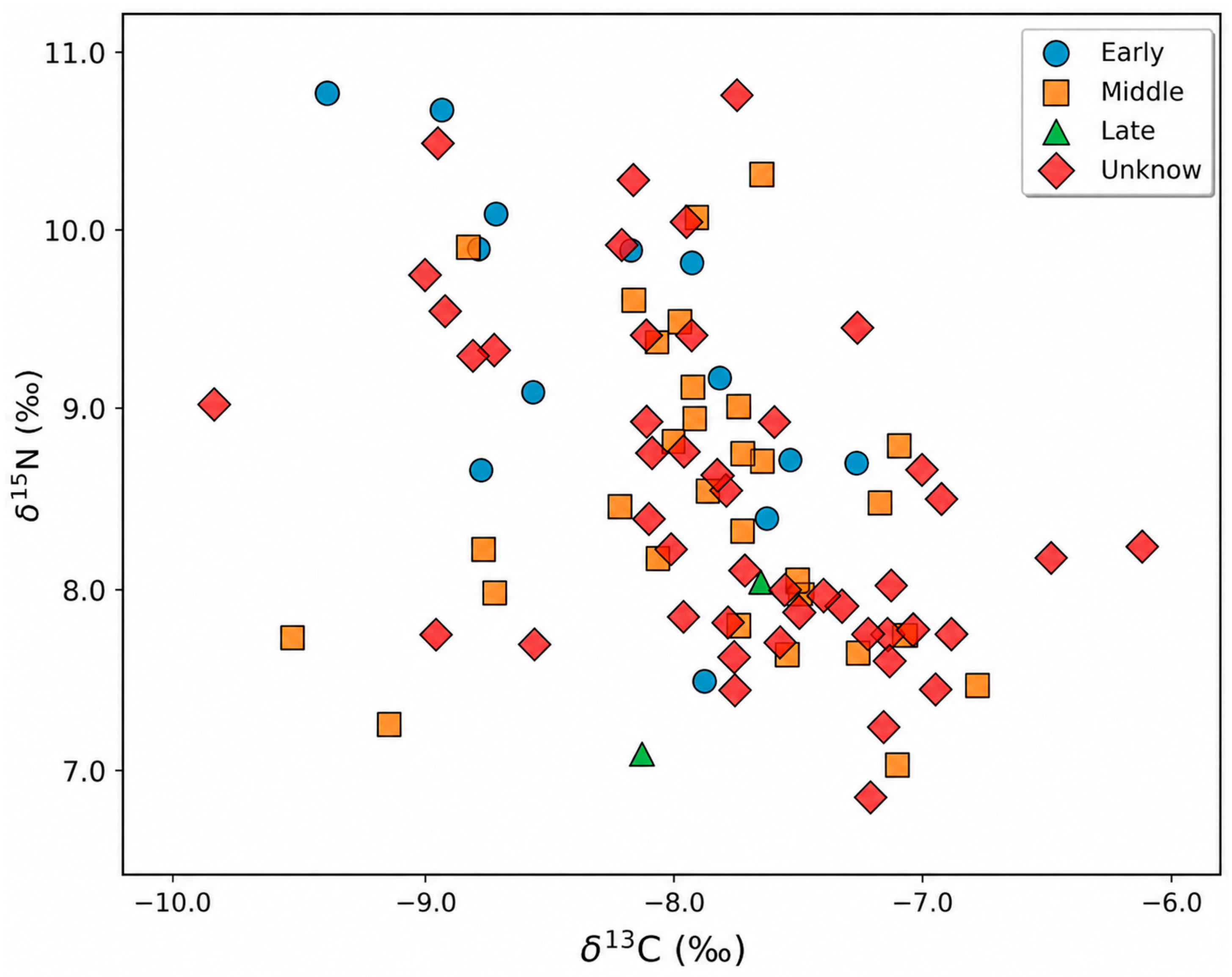
4.2. Overall Isotopic Results
5. Discussions
5.1. Overall Dietary Structure and Subsistence Patterns of the Jucun Population
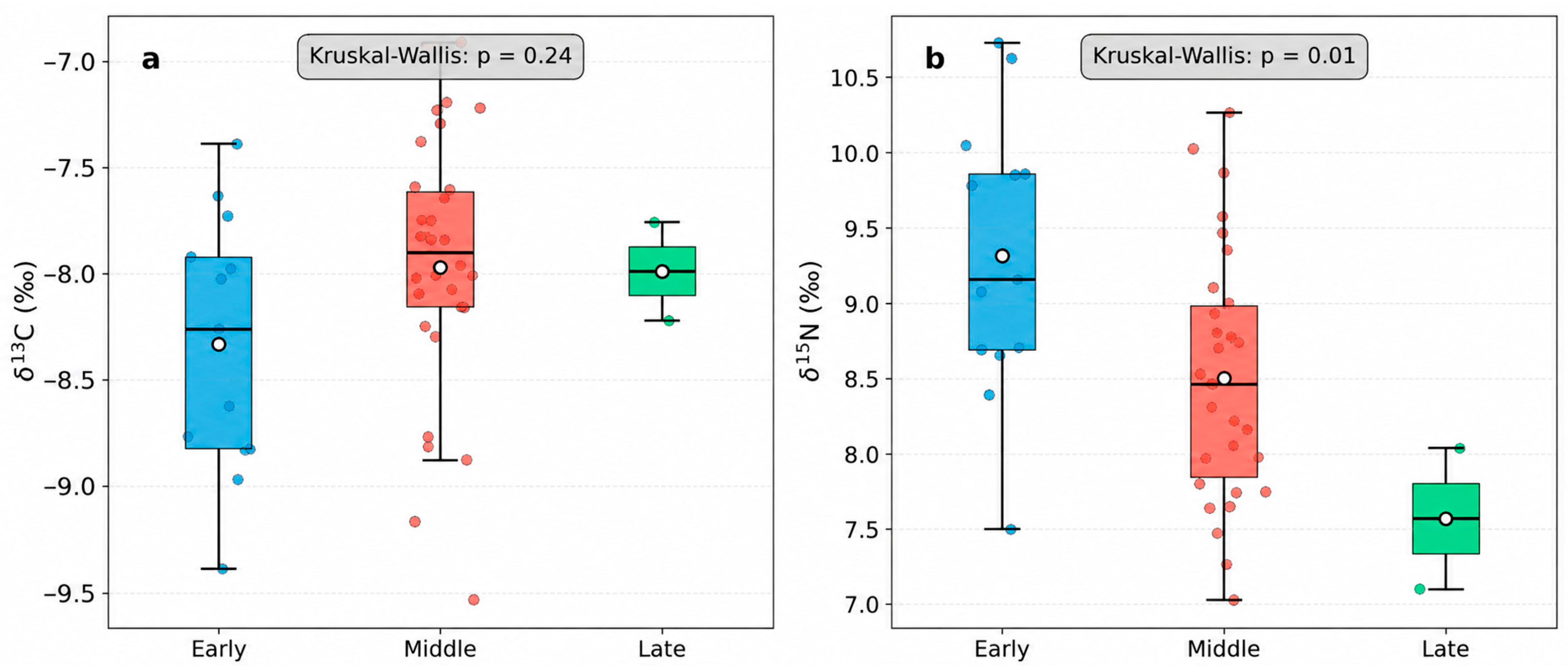
5.2. Dietary Changes of the Jucun Population During the Western Zhou
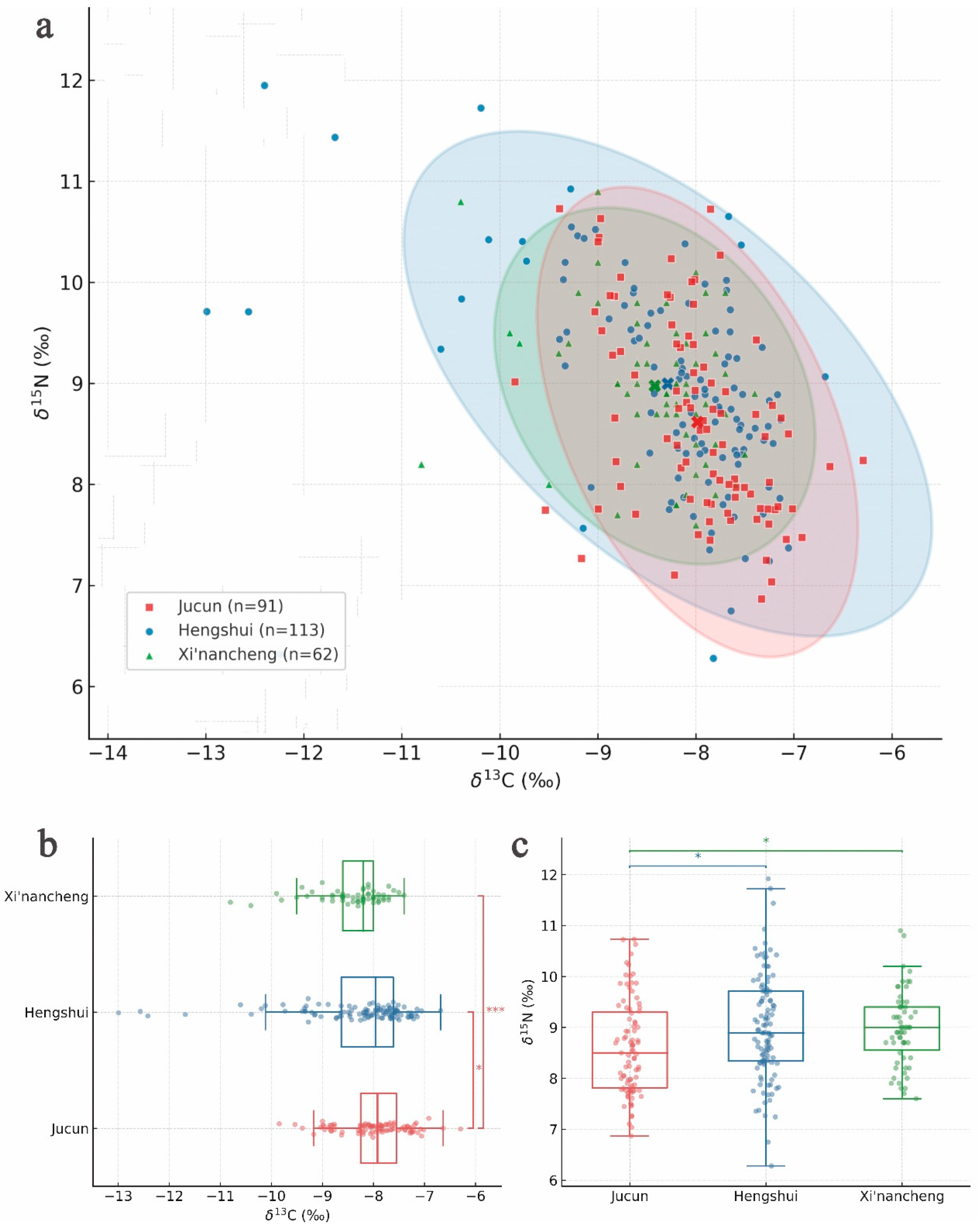
5.3. Dietary Formation of Migrant Di Populations in the Core Region of the Central Plains
6. Conclusions
- (1)
- The Jucun population exhibits a subsistence pattern overwhelmingly dominated by C4 millet-based crops, with generally low levels of animal protein intake. Their economic system was already centered on sedentary millet agriculture, rather than the traditionally assumed pastoral mode of subsistence.
- (2)
- After migrating into southern Shanxi, the Jucun population completed the transition to the local millet-based agricultural system within a relatively short period. Over time, they became one of the groups most strongly reliant on millet-based plant foods in the region.
- (3)
- The increasing dietary homogenization of the Di population at Jucun corresponds temporally with their growing identification with Zhou culture, reflecting a synchronous integration into Central Plains society at both economic and cultural levels.
Funding
Data Availability Statement
Conflicts of Interest
References
- Ambrose, S. H. (1990). Preparation and characterization of bone and tooth collagen for isotopic analysis. Journal of Archaeological Science, 17, 431–451. [Google Scholar] [CrossRef]
- Ambrose, S. H. (1993). Isotopic analysis of paleodiet: Methodological and interpretive considerations. In M. K. Sandford (Ed.), Investigations of ancient human tissue: Chemical analysis in anthropology (pp. 59–130). Gordon and Breach Science Publishers. [Google Scholar]
- Ban, L. (2023). Research on animal remains unearthed from the Hengshui graveyard of Western Zhou dynasty at Jiang county in Shanxi province [Master’s thesis, Jilin University]. [Google Scholar]
- Bocherens, H., & Drucker, D. (2003). Trophic level isotopic enrichment of carbon and nitrogen in bone collagen: Case studies from recent and ancient terrestrial ecosystems. International Journal of Osteoarchaeology, 13, 46–53. [Google Scholar] [CrossRef]
- Bocherens, H., Fizet, M., Mariotti, A., Lange-Badre, B., Vandermeersch, B., Borel, J. P., & Bellon, G. (1991). Isotopic biogeochemistry (13C,15N) of fossil vertebrate collagen: Application to the study of a past food web including Neandertal man. Journal of Human Evolution, 20, 481–492. [Google Scholar] [CrossRef]
- Cai, D., & Sun, Y. (2012). On the origin of the ancient DNA of demestic animals in China. Research of China’s Frontier Archaeology 邊疆考古研究, 11, 445–455. [Google Scholar]
- Cai, D., Zhang, N., & Zhao, X. (2021). Study on the origin and spread of Chinese goat. Cultural Relics in Southern China 南方文物, 1, 191–200. [Google Scholar]
- Cai, L., & Qiu, S. (1984). Determination of Carbon-13 and study of ancient recipes. Archaeology 考古, 10, 949–955. [Google Scholar]
- Cao, Y. (2022). A study on Rong Di in Shanxi during the Late Shang and Western Zhou dynasties [Master’s thesis, Shanxi Normal University]. [Google Scholar]
- Chen, X., Yuan, J., Hu, Y., He, N., & Wang, C. (2012). A preliminary exploration to the domestic animal raising strategy: The evidences from carbon and nitrogen isotope analyses. Archaeology 考古, 9, 75–82. [Google Scholar]
- Chisholm, B. S., Nelson, D. E., & Schwarcz, H. P. (1982). Stable-carbon isotope ratios as a measure of marine versus terrestrial protein in ancient diets. Science, 216, 1131–1132. [Google Scholar] [CrossRef] [PubMed]
- Christine, A. H. (2017). The social archaeology of food: Thinking about eating from prehistory to the present (p. 3). Cambridge University Press. [Google Scholar]
- Deng, H., & Xie, Y. (2026). Zooarchaeological analysis of animal offerings from the Western Zhou Dahekou cemetery, Yicheng, Shanxi. Cultural Relics in Southern China, 2026(2), 157–166. [Google Scholar]
- Deniro, M. J. (1985). Postmortem preservation and alteration of in vivo bone collagen isotope ratios in relation to paiaeodietary reconstruction. Nature, 317, 806–809. [Google Scholar] [CrossRef]
- Deniro, M. J., & Epstein, S. (1981). Influence of diet on the distribution of nitrogen isotopes in animals. Geochim Cosmochim Acta, 45, 341–351. [Google Scholar] [CrossRef]
- Guan, L., Hu, Y., Tang, Z., Yang, Y., Dong, Y., Cui, Y., & Wang, C. (2007). C, N stable isotope analysis of Tonghua Wanfabozi pig. Chinese Science Bulletin 科學通報, 52(14), 1678–1680. [Google Scholar] [CrossRef]
- Han, T., & Gao, S. (2025). A study of the Western Zhou population from the Jucun cemetery in Jiangxian county, Shanxi province. Wenwu Chunqiu, 6, 10–20. [Google Scholar]
- Hobson, K. A., & Welch, H. E. (1992). Determination of trophic relationships within a high arctic marine food web using δ13C and δ15N analysis. Marine Ecology. Progress Series (Halstenbek), 84, 9–18. [Google Scholar] [CrossRef]
- Hou, L., Sun, Y., Sun, X., Yang, S., Wang, H., Xie, Y., Zhu, H., & Zhang, Q. (2022). Social hierarchy of the Peng state in the Western Zhou dynasty: Stable isotope analysis of animals and humans from the Hengshui cemetery, Shanxi, China. Journal of Archaeological Science: Reports, 44, 103522. [Google Scholar] [CrossRef]
- Hsu, C. (1965). Western Chou civilization. Yale University Press. [Google Scholar]
- Huang, X., Zhang, J., Ren, L., Zhang, S., & Chen, F. (2021). Intensification and driving forces of pastoralism in northern China 5.7 Ka ago. Geophysical Research Letters, 48, e2020GL092288. [Google Scholar] [CrossRef]
- Katzenberg, M. A. (2007). Stable isotope analysis: A tool for studying past diet, demography, and life history. In Biological anthropology of the human skeleton: Second edition (pp. 411–441). Wiley-Liss. [Google Scholar]
- Kern, M. (2009). Bronze inscriptions, the Shijing and the Shangshu: The evolution of the ancestral sacrifice during the Western Zhou. In Handbook of oriental studies. Section 4, China (Vol. 21-1, pp. 143–200). Brill Academic Publishers. [Google Scholar]
- Lee-Thorp, J. A. (2008). On isotopes and old bones. Archaeometry, 50, 925–950. [Google Scholar] [CrossRef]
- Li, X., Zhang, S., Lu, M., Qiu, M., Wen, S., & Ma, M. (2020). Dietary shift and social hierarchy from the Proto-Shang to Zhou dynasty in the central plains of China. Environmental Research Letters, 15, 35002. [Google Scholar] [CrossRef]
- Lin, X., Chen, L., Xue, X., & Zhao, C. (2010). Stable isotopic analysis of human bones from the Qianliang temple graveyard, Ruicheng county, Shanxi province. Quaternary Sciences, 30, 415–421. [Google Scholar]
- Lu, P., Yuan, J., & Li, Z. (2014). Further discussion on the origin of domestic cattle in China—Discussion on the paper “Morphological and genetic evidence of early Holocene cattle management in northeast China”. Cultural Relics in Southern China 南方文物, 3, 48–59. [Google Scholar]
- Pei, D., Hu, Y., Yang, Y., Zhang, Q., Zhang, G., Tian, J., & Wang, C. (2008). Paleodietary analysis of humans from the Neiyangyuan site of Xiangning, Shanxi province. Acta Anthropologica Sinica, 27(4), 379–384. [Google Scholar] [CrossRef]
- Qu, J. (2021). Double-track governance in traditional Chinese society: Dialectics between the enfeoffment system of fiefdom and the bureaucratic prefectural system. Chinese Journal of Sociology, 7, 347–389. [Google Scholar] [CrossRef]
- Richards, M. P., & Hedges, R. E. M. (1999). Stable isotope evidence for similarities in the types of marine foods used by late Mesolithic humans at sites along the Atlantic coast of Europe. Journal of Archaeological Science, 26, 717–722. [Google Scholar] [CrossRef]
- Schoeninger, M. J., & Deniro, M. J. (1984). Nitrogen and carbon isotopic composition of bone collagen from marine and terrestrial animals. Geochim Cosmochim Acta, 48, 625–639. [Google Scholar] [CrossRef]
- Shu. (2016). Dietary Analysis I. In Shanxi Provincial Institute of Archaeology, Yuncheng Municipal Workstation of Cultural Heritage & Ruicheng County Administration of Tourism and Cultural Heritage (Eds.), The prehistoric cemetery of Qingliangsi (pp. 519–537). Cultural Relics Press. [Google Scholar]
- Su, Y. (2025). A research of the JUCUN cemetery in Jiangxian, Shanxi [Master’s thesis, Shanxi University]. [Google Scholar]
- Sun, Y. (2019). Carbon and nitrogen stable isotope of the human and animal bones from the Hengshui cemetery [Master’s thesis, Shanxi University]. [Google Scholar]
- Sun, Y. (2023). Stable carbon and nitrogen isotope study of human bones from Dahekou Western Zhou cemetery in Yicheng, Shanxi [Ph.D. thesis, Jilin University]. [Google Scholar]
- Vander Zanden, M. J., Cabana, G., & Rasmussen, J. B. (1997). Comparing trophic position of freshwater fish calculated using stable nitrogen isotope ratios (δ15N) and literature dietary data. Canadian Journal of Fisheries and Aquatic Sciences, 54, 1142–1158. [Google Scholar] [CrossRef]
- Wang, J. (2016). Jucun Western Zhou cemetrry at Jiang village. In Yearbook of archaeology in China 2015. China Social Science Press. [Google Scholar]
- Wang, Y. (2013). A Preliminary study on the relationship between social class and diet structure: A case study of Niedian and Fushan Qiaobei sites [Master’s thesis, University of Chinese Academy of Sciences]. [Google Scholar]
- Xie, Y. (2019). Six hundred years of the rise and fall of the Jin state. Sanjin Publishing House. [Google Scholar]
- Yan, L., Chen, K., Ma, Q., Sun, Z., Chu, H., & Ma, Y. (2026). A study on the subsistence strategy of the Qingjian Xinzhuang site in northern Shaanxi region during the late Shang period: A perspective from lipid residues in pottery. Archaeological and Anthropological Sciences, 18, 43. [Google Scholar] [CrossRef]
- Yang, Q., & Li, X. (2015). Investigation of the controlled factors influencing carbon isotope composition of foxtail and common millet on the Chinese loess plateau. Science China Earth Sciences, 58, 2296–2308. [Google Scholar] [CrossRef]
- Yang, Q., Li, X., Zhou, X., Zhao, K., & Sun, N. (2016). Quantitative reconstruction of summer precipitation using a mid-Holocene δ 13C common millet record from Guanzhong Basin, northern China. Climate of the Past, 12, 2229–2240. [Google Scholar] [CrossRef]
- Yang, Y. (2023). Archaeological research on the cathayization of the Rongdi ethnic group in the Western Zhou dynasty in the southern Shanxi province. Jilin University. [Google Scholar]
- Yuan, J. (1999). Man’s meat-acquiring patterns in neolithic China. Acta Archaeologica Sinica 考古學報, 1, 1–22. [Google Scholar]
- Yuan, J. (2010). Zooarchaeological study on the domestic animals in ancient China. Quaternary Sciences 第四紀研究, 30, 298–306. [Google Scholar]
- Zhang, T. (2016). Shang dynasty archaeological cultures on northern Shaanxi plateau. Journal of National Museum of China, 9, 18–30. [Google Scholar]
- Zhang, X., Qiu, S., Bo, G., Wang, J., & Zhong, J. (2007). Analysis of carbon and nitrogen in some human bones from Erlitou and Taosi sites. In Center For Scientific Archaeology IOAC (Ed.), Science of archaeology II (pp. 41–48). Science Press. [Google Scholar]
- Zhao, H. (2018). A research on the human skeletons from Jucun graveyardin Jiang county of Shanxi province. Jilin University. [Google Scholar]
- Zhao, Z. (2014). The process of origin of agriculture in China: Archaeological evidence from flotation results. Quaternary Sciences (Disiji Yanjiu 第四紀研究), 1, 73–84. [Google Scholar]
- Zhao, Z., & He, N. (2006). Floatation results from the remains excavated on the Taosi city-site in 2002 and their analysis. Archaeology (Kaogu 考古), 5, 77–86. [Google Scholar] [CrossRef]
- Zhu, H. (2004). Physical anthropology. Higher Education Press. [Google Scholar]



| No. | Lab. ID | Burial Context | Period | Sex | Age (Years) | Skeletal Element | C (%) | N (%) | C/N | δ13C (‰) | δ15N (‰) |
|---|---|---|---|---|---|---|---|---|---|---|---|
| 1 | SJJ94 | M1001 | E | M | 40–45 | Fibula | 32.5 | 11.5 | 3.3 | −7.6 | 8.7 |
| 2 | SJJ97 | M1002 | U | F | 25± | Humerus | 39.1 | 14 | 3.3 | −7.3 | 7.2 |
| 3 | SJJ96 | M1003 | M | F | 20± | Ulna | 34 | 12.1 | 3.3 | −7.2 | 7.7 |
| 4 | SJJ98 | M1004 | M | M | 40± | Fibula | 37.5 | 13.3 | 3.3 | −8.2 | 9.4 |
| 5 | SJJ86 | M1010 | M | F | 17–19 | Fibula | 38.4 | 13.7 | 3.3 | −8 | 10 |
| 6 | SJJ90 | M1011 | M | F | 25± | Radius | 18.3 | 6.7 | 3.2 | −9.2 | 7.3 |
| 7 | SJJ72 | M1017:2 | L | nan | 8–9 | Ulna | 20.5 | 7.1 | 3.4 | −8.2 | 7.1 |
| 8 | SJJ85 | M1022:2 | M | F | 20–25 | Fibula | 39.6 | 14.0 | 3.3 | −7.6 | 7.6 |
| 9 | SJJ71 | M1024 | U | F | 30–35 | Fibula | 35.5 | 12.7 | 3.3 | −6.6 | 8.2 |
| 10 | SJJ101 | M1042 | M | M | 40–45 | Ulna | 16.4 | 6.4 | 3.1 | −8 | 8.5 |
| 11 | SJJ62 | M1044 | M | F | 30± | Ulna | 21.4 | 7.6 | 3.3 | −8.1 | 8.8 |
| 12 | SJJ87 | M1047 | M | nan | 25± | Fibula | 41.1 | 14.7 | 3.3 | −7.6 | 8.1 |
| 13 | SJJ63 | M1053 | M | F | 45± | Ulna | 41.5 | 14.8 | 3.3 | −7.3 | 8.5 |
| 14 | SJJ59 | M1054 | U | M | 30± | Fibula | 25.2 | 9.3 | 3.2 | −7.7 | 7.7 |
| 15 | SJJ91 | M1057 | U | M | 25–30 | Fibula | 18.8 | 6.8 | 3.2 | −8.2 | 8.7 |
| 16 | SJJ92 | M1069 | U | F | 25–30 | Fibula | 36.7 | 13.1 | 3.3 | −7.8 | 8.1 |
| 17 | SJJ93 | M1070 | M | F | 45–50 | Fibula | 31 | 11.6 | 3.1 | −8 | 9.1 |
| 18 | SJJ95 | M1071 | U | M | 40–45 | Fibula | 24.7 | 9.6 | 3 | −7.1 | 8.7 |
| 19 | SJJ99 | M1074 | L | F | 17–19 | Ulna | 37.3 | 13.2 | 3.3 | −7.8 | 8 |
| 20 | SJJ100 | M1077 | U | F | 15–16 | Fibula | 29.8 | 11.1 | 3.1 | −7.4 | 7.9 |
| 21 | SJJ57 | M1078 | U | nan | 12–15 | Fibula | 38.5 | 13.7 | 3.3 | −7.1 | 7.5 |
| 22 | SJJ74 | M1079 | U | nan | Adult | Fibula | 35.2 | 12.8 | 3.2 | −7.3 | 7.8 |
| 23 | SJJ50 | M1080 | M | nan | 8–9 | Fibula | 29.9 | 10.5 | 3.3 | −7.6 | 8 |
| 24 | SJJ102 | M1082 | U | M | 35± | Fibula | 25.1 | 8.8 | 3.3 | −6.3 | 8.2 |
| 25 | SJJ66 | M1084 | M | F | 20± | Ulna | 29.4 | 11.2 | 3.1 | −8.3 | 8.5 |
| 26 | SJJ76 | M1085 | M | nan | 15± | Fibula | 41.2 | 14.5 | 3.3 | −8.8 | 8 |
| 27 | SJJ68 | M1192 | M | F | 35± | Radius | 25.8 | 9.4 | 3.2 | −7.8 | 9 |
| 28 | SJJ61 | M1264 | E | F | 50± | Femur | 35.6 | 12.7 | 3.3 | −7.4 | 8.7 |
| 29 | SJJ73 | M1288 | M | F | 35–40 | Tibia | 37.3 | 13.1 | 3.3 | −7.8 | 8.3 |
| 30 | SJJ64 | M1291 | E | F | 30± | Humerus | 29 | 10.4 | 3.2 | −8 | 7.5 |
| 31 | SJJ89 | M1300 | M | F | 20± | Fibula | 35.2 | 12.6 | 3.3 | −6.9 | 7.5 |
| 32 | SJJ60 | M1301 | M | F | 35± | Fibula | 39.8 | 14.6 | 3.2 | −7.4 | 7.7 |
| 33 | SJJ65 | M1322 | E | M | Adult | Fibula | 43.8 | 15.6 | 3.3 | −8.8 | 9.9 |
| 34 | SJJ67 | M1334 | M | F | 25–30 | Fibula | 27.6 | 9.7 | 3.3 | −7.2 | 7 |
| 35 | SJJ49 | M1358 | M | nan | 40± | Ulna | 42.1 | 15 | 3.3 | −8.1 | 9.5 |
| 36 | SJJ55 | M1370 | U | M | 30± | Fibula | 17.2 | 6.2 | 3.2 | −7.2 | 7.8 |
| 37 | SJJ51 | M1383 | U | M | 45–50 | Ulna | 18.8 | 6.6 | 3.3 | −7.6 | 7.9 |
| 38 | SJJ54 | M1388 | U | F | 15–20 | Fibula | 35.4 | 13.9 | 3 | −8.6 | 7.7 |
| 39 | SJJ56 | M1398 | E | M | 40–45 | Fibula | 29.4 | 10.4 | 3.3 | −8 | 9.8 |
| 40 | SJJ75 | M1399 | U | F | 20–25 | Fibula | 41.7 | 14.9 | 3.3 | −7.9 | 7.4 |
| 41 | SJJ77 | M1420 | U | M | 40± | Fibula | 32 | 11.4 | 3.3 | −7.7 | 8.9 |
| 42 | SJJ53 | M1421 | M | M | 30± | Tibia | 21.7 | 7.6 | 3.3 | −8.2 | 9.6 |
| 43 | SJJ78 | M1432 | U | F | 35–40 | Fibula | 34.7 | 12.3 | 3.3 | −7.9 | 8.5 |
| 44 | SJJ88 | M1434 | U | M | 20–25 | Fibula | 25.2 | 9.1 | 3.2 | −7.3 | 7.8 |
| 45 | SJJ58 | M1438 | M | nan | Adult | Femur | 25.4 | 9.3 | 3.2 | −8.9 | 9.9 |
| 46 | SJJ79 | M1441 | U | M | 45± | Fibula | 34.3 | 12.3 | 3.2 | −7.9 | 8.6 |
| 47 | SJJ16 | M2001 | U | F | Adult | Fibula | 35.3 | 12.6 | 3.3 | −8.8 | 9.3 |
| 48 | SJJ24 | M2002:1 | U | nan | nan | Humerus | 32.1 | 11.2 | 3.3 | −9 | 9.7 |
| 49 | SJJ15 | M2018 | U | M | 20–25 | Fibula | 42 | 15.2 | 3.2 | −8.2 | 8.4 |
| 50 | SJJ43 | M2019 | U | F | 14–16 | Fibula | 38.9 | 13.8 | 3.3 | −7.9 | 7.6 |
| 51 | SJJ40 | M2022 | U | nan | 35–40 | Femur | 19.9 | 8.1 | 2.9 | −8 | 10 |
| 52 | SJJ25 | M2025 | M | F | 30–35 | Ulna | 27.9 | 10.6 | 3.1 | −8.8 | 8.2 |
| 53 | SJJ21 | M2028 | E | F | 35± | Radius | 40.4 | 14.5 | 3.3 | −8.6 | 9.1 |
| 54 | SJJ13 | M2031:2 | U | F | 20± | Fibula | 33.6 | 11.9 | 3.3 | −9 | 9.5 |
| 55 | SJJ26 | M2032 | E | M | 25± | Ulna | 40.1 | 14.1 | 3.3 | −7.7 | 8.4 |
| 56 | SJJ18 | M2040 | U | M | 35–40 | Ulna | 17.1 | 5.9 | 3.4 | −8.3 | 10.2 |
| 57 | SJJ17 | M2041 | M | F | 40–45 | Ulna | 34 | 12.1 | 3.3 | −8.2 | 8.2 |
| 58 | SJJ11 | M2046 | U | F | 20± | Ulna | 16.5 | 5.7 | 3.4 | −9 | 7.8 |
| 59 | SJJ47 | M2048 | U | nan | 45± | Ulna | 39.9 | 14 | 3.3 | −8.2 | 9.4 |
| 60 | SJJ22 | M2053 | U | F | 35± | Ulna | 20.3 | 6.9 | 3.4 | −9.8 | 9 |
| 61 | SJJ23 | M2054 | U | nan | 7–9 | Femur | 36.7 | 13.6 | 3.2 | −7.1 | 8.5 |
| 62 | SJJ44 | M2068 | E | F | 35–40 | Fibula | 33.9 | 12 | 3.3 | −7.9 | 9.2 |
| 63 | SJJ36 | M2072 | M | F | 40± | Fibula | 41 | 14.6 | 3.3 | −7.8 | 7.8 |
| 64 | SJJ30 | M2073 | E | M | 25–30 | Humerus | 40.9 | 14.4 | 3.3 | −8.3 | 9.9 |
| 65 | SJJ8 | M2077 | M | F | 35± | Fibula | 30.4 | 10.8 | 3.3 | −7.7 | 8.7 |
| 66 | SJJ1 | M2082 | M | nan | 10–15 | Fibula | 18.9 | 6.3 | 3.5 | −9.5 | 7.7 |
| 67 | SJJ7 | M2087 | U | nan | 25± | Fibula | 39.1 | 13.8 | 3.3 | −7 | 7.8 |
| 68 | SJJ42 | M2088 | M | M | 35–40 | Femur | 41 | 14.7 | 3.3 | −7.2 | 8.8 |
| 69 | SJJ5 | M2100 | U | nan | 10± | Fibula | 34.2 | 11.9 | 3.3 | −7.9 | 7.8 |
| 70 | SJJ9 | M2113 | U | M | Adult | Femur | 37.5 | 13.2 | 3.3 | −7.9 | 10.7 |
| 71 | SJJ27 | M2114 | U | F | 30± | Fibula | 30.6 | 10.9 | 3.3 | −8.2 | 8.9 |
| 72 | SJJ37 | M2115 | U | M | 35± | Fibula | 37.1 | 13.3 | 3.3 | −8.3 | 9.9 |
| 73 | SJJ46 | M2116 | U | M | 40–45 | Fibula | 27.3 | 9.5 | 3.4 | −7.3 | 8 |
| 74 | SJJ31 | M2134 | E | M | 45–50 | Femur | 22.4 | 8.2 | 3.2 | −8.8 | 10 |
| 75 | SJJ32 | M2140 | U | M | 30± | Ulna | 37.9 | 13.4 | 3.3 | −8.1 | 8.8 |
| 76 | SJJ6 | M2144 | U | M | 25± | Fibula | 36 | 12.3 | 3.4 | −8.8 | 9.3 |
| 77 | SJJ35 | M2150 | U | nan | 20± | Fibula | 33.5 | 11.9 | 3.3 | −7.5 | 8 |
| 78 | SJJ29 | M2181 | U | M | 20–25 | Fibula | 42.5 | 15.4 | 3.2 | −7.3 | 7.6 |
| 79 | SJJ69 | M2203 | U | F | 15–20 | Fibula | 30.2 | 10.6 | 3.3 | −8.1 | 8.2 |
| 80 | SJJ20 | M2222 | U | M | 35–40 | Fibula | 24.2 | 8.5 | 3.3 | −7.4 | 9.4 |
| 81 | SJJ70 | M2226 | U | M | 35–40 | Ulna | 28.2 | 10 | 3.3 | −8 | 9.4 |
| 82 | SJJ82 | M2231 | E | F | 40± | Radius | 42.1 | 15.2 | 3.2 | −8.8 | 8.7 |
| 83 | SJJ19 | M2238 | U | nan | 6± | Fibula | 17.1 | 6 | 3.4 | −7.7 | 8 |
| 84 | SJJ28 | M2243 | M | nan | 13–16 | Fibula | 39.6 | 14.4 | 3.2 | −7.8 | 8.7 |
| 85 | SJJ10 | M2247 | U | nan | 8± | Ulna | 37.3 | 13.4 | 3.3 | −8.1 | 7.9 |
| 86 | SJJ45 | M2249 | M | F | 20± | Fibula | 39.6 | 14.1 | 3.3 | −8 | 8.9 |
| 87 | SJJ33 | M2250 | M | M | 35± | Tibia | 23 | 8.1 | 3.3 | −7.8 | 10.3 |
| 88 | SJJ4 | M2256 | E | M | 25–30 | Femur | 22.5 | 7.8 | 3.3 | −9.4 | 10.7 |
| 89 | SJJ2 | M2260 | E | F | 50± | Ulna | 35.5 | 12.7 | 3.3 | −9 | 10.6 |
| 90 | SJJ38 | M2273 | U | nan | 13–16 | Fibula | 18.6 | 6.9 | 3.1 | −7.3 | 6.9 |
| 91 | SJJ34 | M2293 | U | M | 40–45 | Fibula | 18.7 | 6.4 | 3.4 | −9 | 10.4 |
| Group Type | Group | n | δ13C (‰) | p Value | δ15N (‰) | p Value | Methods |
|---|---|---|---|---|---|---|---|
| Period | Early | 13 | −8.3 ± 0.6 | 0.24 | 9.3 ± 0.9 | 0.01 * | Kruskal–Wallis test |
| Middle | 30 | −8.0 ± 0.6 | 8.5 ± 0.8 | ||||
| Late | 2 | −8.0 ± 0.3 | 7.6 ± 0.7 |
| Site a | Age/Dynasty | n | δ13C (‰) | δ15N (‰) | Ref. |
|---|---|---|---|---|---|
| Qingliangsi-1 | Neolithic | 87 | −8.2 ± 1.8 | 9.3 ± 1.3 | (Shu, 2016) |
| Qingliangsi-2 | Neolithic | 27 | −8.1 ± 0.9 | 8.5 ± 1.1 | (Lin et al., 2010) |
| Taosi-1 | Neolithic | 3 | −11.3 ± 1.6 | nan | (L. Cai & Qiu, 1984) |
| Neiyangyuan | Xia | 2 | −7.4 ± 0.1 | 8.5 ± 0.1 | (Pei et al., 2008) |
| Taosi-2 | Xia | 12\7 b | −6.3 ± 1.1 | 8.9 ± 1.3 | (X. Zhang et al., 2007) |
| Qiaobei | Late Shang—Early Zhou | 3 | −7.7 ± 0.1 | 8.1 ± 0.7 | (Y. Wang, 2013) |
| Hengshui | Western Zhou | 113 | −8.3 ± 1.1 | 9.0 ± 1.0 | (Sun, 2019) |
| Xi’nancheng | Western Zhou | 62 | −8.4 ± 0.7 | 9.0 ± 0.7 | (Li et al., 2020) |
| Jucun | Western Zhou | 91 | −8.0 ± 0.6 | 8.6 ± 0.9 | this paper |
Disclaimer/Publisher’s Note: The statements, opinions and data contained in all publications are solely those of the individual author(s) and contributor(s) and not of MDPI and/or the editor(s). MDPI and/or the editor(s) disclaim responsibility for any injury to people or property resulting from any ideas, methods, instructions or products referred to in the content. |
© 2026 by the author. Licensee MDPI, Basel, Switzerland. This article is an open access article distributed under the terms and conditions of the Creative Commons Attribution (CC BY) license.
Share and Cite
Sun, Y. Dietary Reconstruction of Migrant Populations in the Core Region of Early China. Humans 2026, 6, 21. https://doi.org/10.3390/humans6030021
Sun Y. Dietary Reconstruction of Migrant Populations in the Core Region of Early China. Humans. 2026; 6(3):21. https://doi.org/10.3390/humans6030021
Chicago/Turabian StyleSun, Yuze. 2026. "Dietary Reconstruction of Migrant Populations in the Core Region of Early China" Humans 6, no. 3: 21. https://doi.org/10.3390/humans6030021
APA StyleSun, Y. (2026). Dietary Reconstruction of Migrant Populations in the Core Region of Early China. Humans, 6(3), 21. https://doi.org/10.3390/humans6030021