


Abstract
Background/Objectives: Malnutrition and nutritional vulnerability are common in patients with cancer and are associated with adverse clinical outcomes, particularly among hospitalised patients. However, data specifically describing nutritional risk in patients admitted to medical oncology departments remain limited. This study aimed to estimate the prevalence of nutritional risk at hospital admission and to evaluate factors associated with nutritional risk and its clinical consequences. Methods: The REGIO registry is a national multicentre prospective cohort including adult patients with solid tumours admitted to medical oncology departments in 17 Spanish hospitals between February 2024 and January 2025. Nutritional risk was assessed within the first working day of hospitalisation using the Malnutrition Screening Tool (MST), with a score ≥ 2 indicating nutritional risk. Multivariable logistic regression models were used to identify factors associated with nutritional risk and its association with prolonged hospital stay and mortality. Results: A total of 1229 patients were included (median age 67.8 years; 59% male; 64% metastatic disease). Nutritional risk was identified in 53% of patients. In multivariable analysis, poorer functional status, tumour progression, recent exposure to cytotoxic chemotherapy, and tumour types with higher nutritional impact were independently associated with nutritional risk. Patients at nutritional risk had longer hospital stays (median 10 vs. 7 days; p < 0.001), a higher likelihood of prolonged hospitalisation (adjusted OR 1.38), and increased mortality at 30 days (adjusted OR 1.63) and 60 days after discharge (adjusted OR 1.53). Conclusions: In this large multicentre cohort, nutritional risk was highly prevalent and independently associated with worse clinical outcomes, supporting the clinical relevance of systematic nutritional screening at hospital admission in patients with cancer.
1. Introduction
Malnutrition is a clinical condition characterised by an imbalance in tissue metabolism and nutritional reserves, and is associated with functional impairment and poorer clinical outcomes [1,2,3]. In the context of illness, disease-related malnutrition (DRM) is defined by the presence of systemic inflammation together with insufficient nutrient intake or impaired nutrient utilisation, as seen in patients with cancer [4].
DRM is particularly prevalent among patients with cancer and has been associated with poorer prognosis and reduced survival. Cancer increases the risk of malnutrition through several mechanisms, including reduced dietary intake due to anorexia and treatment-related gastrointestinal toxicity, increased energy and protein requirements associated with chronic systemic inflammation, and reduced anabolic stimuli such as physical activity [4].
The negative impact of disease-related malnutrition (DRM) among patients with cancer has been widely documented, affecting survival, quality of life, and healthcare costs [4]. Indeed, it is estimated that 10–20% of deaths among patients with cancer are attributable to malnutrition rather than to the tumour itself [5]. In hospitalised patients with cancer, DRM has also been associated with a higher risk of complications, poorer tolerance to anticancer treatments, reduced survival, and longer hospital stays, with consequent functional, clinical, and economic consequences [4,6]. Despite this impact, nutritional screening at hospital admission, recommended by major clinical guidelines [7,8,9,10], remains underutilised in hospitalised oncology patients, thereby limiting early identification of nutritional risk and timely access to appropriate nutritional interventions [4,11,12].
The prevalence of disease-related malnutrition (DRM) in patients with cancer has been widely studied, although reported estimates vary widely. Although prevalence is generally high, reported estimates range from 20% to 80% [6,7,13,14], with recent meta-analyses reporting pooled prevalences around 40% in patients with cancer [15]. This wide variability may be influenced by several factors, including the country in which the study was conducted, the healthcare setting (outpatient versus hospitalised patients), the timing of the nutritional assessment, the type of malignancy, tumour stage and oncological status (controlled versus progressive disease), and the nutritional assessment tool used. Specifically, in hospitalised patients with cancer, the reported prevalence of DRM ranges from 19% to 89% in previous studies [6,11,16,17,18,19].
In Spain, two major multicentre cohorts have reported the prevalence of disease-related malnutrition (DRM) in hospitalised patients with cancer: a subanalysis of the PREDyCES cohort [16] and a subgroup analysis of the SeDREno study [17], reporting prevalences of 33.4% and 29.7%, respectively. However, these studies have two main limitations. First, they were not specifically designed to evaluate patients with cancer, which resulted in a smaller oncology-specific sample size compared with other international cohorts [14]. Second, they included patients hospitalised across different hospital departments and for heterogeneous reasons, which may limit their applicability to the clinical context of medical oncology units. As a result, data specifically addressing nutritional risk in patients admitted to medical oncology departments remain scarce.
Therefore, the primary objective of this study was to estimate the prevalence of nutritional risk at hospital admission among patients with cancer admitted to medical oncology departments in Spain. As secondary objectives, we analysed the factors associated with nutritional risk and its impact on length of hospital stay, mortality, and hospital readmission.
2. Materials and Methods
2.1. Study Design and Participants
The REGIO registry is a national multicentre, prospective, observational, and longitudinal study promoted by the Spanish Society of Internal Medicine (SEMI), involving 17 centres and 38 investigators. Adult patients with solid tumours requiring hospital admission for any reason to the medical oncology departments of the participating centres were included (Supplementary Table S1). Patients admitted exclusively for diagnostic procedures, planned administration of antineoplastic treatment (i.e., scheduled inpatient admissions for treatment delivery, such as multi-day intravenous therapies), or comfort care in the context of imminent end of life were excluded. In addition, patients receiving systemic treatment in outpatient settings (e.g., day hospital or infusion units with same-day discharge) were not included, as they do not require hospital admission. Patients undergoing cancer-related surgical procedures were also not included, as in the Spanish healthcare system, they are routinely managed and hospitalised under surgical specialties rather than in medical oncology departments. Patients who declined to provide written informed consent were also excluded.
The recruitment period spanned from 1 February 2024 to 31 January 2025. Patients were selected using systematic sampling based on the time of hospital admission, including the first patient whose electronic admission record was registered after 17:00 on the previous day. To minimise interference with routine clinical activity and to reduce potential seasonal selection bias, a maximum of seven patients per month per investigator were included over twelve consecutive months.
Demographic variables, medical history, functional status, oncological history, and hospital size were recorded. Comorbidity was assessed using the non-cancer Charlson Comorbidity Index, derived from the original index [20], with oncological variables excluded due to their redundancy. Variables related to hospital admission (reason for admission, length of stay, and discharge destination) were also collected, and patients were followed clinically for up to 60 days after discharge.
2.2. Assessment of Nutritional Risk
Nutritional risk was assessed using the Malnutrition Screening Tool (MST) during the first working day of hospitalisation, with a score of ≥2 considered indicative of nutritional risk, which corresponds to the validated and widely accepted cut-off for this tool. The MST is a simple screening tool based on recent unintentional weight loss and decreased appetite, with higher scores reflecting greater nutritional risk (Supplementary Table S1). It is a screening tool validated in hospitalised oncology patients [4,21], with a reported sensitivity of 48–79%, specificity of 83–94%, and an area under the curve (AUC) ranging from 0.70 to 0.83 [21,22,23,24]. Given the multicentre design of the registry and its broad clinical scope, a simple and standardised screening tool was considered the most feasible approach for systematic assessment at hospital admission. Accordingly, the aim of this study was to identify nutritional risk rather than to establish a formal diagnosis of malnutrition. MST also offers several practical advantages, including its simplicity, rapid administration, and low interobserver variability [7,25]. Weight and height were recorded at admission, and body mass index (BMI) was calculated. Low BMI was defined, according to GLIM (Global Leadership Initiative on Malnutrition) criteria [2], as BMI < 20 kg/m2 in patients aged < 70 years or <22 kg/m2 in those aged ≥ 70 years.
2.3. Statistical Analysis
Quantitative variables were described as mean ± standard deviation (SD) or median (interquartile range [IQR]), according to their distribution, which was assessed using the Shapiro–Wilk test. Categorical variables were expressed as absolute frequencies and percentages. Comparisons between groups were performed using Student’s t-test or Welch’s t-test for normally distributed quantitative variables, and the Mann–Whitney U test otherwise. Categorical variables were compared using the χ2 test or Fisher’s exact test, as appropriate.
To identify factors associated with nutritional risk at hospital admission and to evaluate its clinical consequences (prolonged hospital stay, in-hospital mortality, and mortality 30 and 60 days after discharge), multivariable logistic regression models were used. Variable selection was based on clinical and epidemiological criteria and on their association in the univariable analysis, prioritising model parsimony. Potential collinearity between variables was also assessed.
Missing data were evaluated for all variables included in the analyses. The proportion of missing values was low for most variables (<5%). Multivariable analyses were therefore performed using complete-case datasets including patients with available data for all variables included in each model. Given the low proportion of missing data, imputation procedures were not considered necessary.
In the multivariable models, only tumour types with a frequency ≥ 1.5% in the cohort were included in order to avoid unstable estimates in underrepresented categories. Tumours were grouped a priori into three predefined clinical categories according to their nutritional impact, as described in previous studies [11,14,16,18]. In particular, tumours affecting the upper gastrointestinal tract, head and neck, and pancreas were classified as high impact due to their well-established association with reduced oral intake, malabsorption, and cancer cachexia, whereas breast cancer and melanoma were considered low impact, with intermediate categories including the remaining tumour types.
Length of hospital stay was analysed both as a continuous variable and as a dichotomous variable. Prolonged hospitalisation was defined as a length of stay above the 75th percentile of the cohort, a commonly used approach in hospital outcome studies to identify patients with extended hospitalisation. Survival was estimated using Kaplan–Meier curves, which were compared using the log-rank test. Sensitivity analyses were performed by categorising relevant continuous variables, such as age and the non-cancer Charlson Comorbidity Index, in order to assess the robustness of the results. Results were expressed as odds ratios (ORs) with 95% confidence intervals (95% CIs). A p-value < 0.05 was considered statistically significant.
All analyses were performed using Jamovi software (version 2.6.44).
3. Results
3.1. Patient Characteristics
A total of 1229 patients were included; the median age was 67.8 years (IQR 15.75), and 59.0% were male. At admission, 64.3% of patients had metastatic disease and 38.8% had a baseline ECOG performance status ≥ 2 (Table 1). The proportion of missing data was low for most variables and is detailed in Supplementary Table S3.
Table 1.
Demographic and clinical characteristics of patients in the REGIO cohort and stratification by nutritional risk (NR) defined by MST ≥ 2.
The most frequent malignancies were lung cancer (29.0%), colorectal cancer (11.8%), breast cancer (9.4%), and pancreatic cancer (7.7%). At admission, 65.4% of patients had uncontrolled oncological disease, defined as either recent diagnosis or disease progression. Regarding prior oncological treatments, 59.2% of patients had received cytotoxic chemotherapy within the eight weeks preceding admission, 20.3% immunotherapy, 13.3% targeted molecular therapies, and 3.4% hormonal therapy.
The median length of hospital stay was 8 days (IQR 10). In-hospital mortality was 9.2%, reaching 27.6% at 60 days after discharge, and the overall 60-day readmission rate was 33.4% (Table 1).
3.2. Prevalence of Nutritional Risk and Associated Risk Factors
Overall, 53.0% of patients (n = 641) were identified as being at nutritional risk according to MST. In addition, 19.4% of patients had a low BMI according to GLIM criteria. Patients at nutritional risk had a lower mean body weight (66.7 ± 14.9 kg vs. 72.0 ± 14.5 kg; p < 0.001) and a significantly lower mean BMI (24.1 ± 4.9 vs. 26.2 ± 4.8; p < 0.001) compared with those without nutritional risk. Despite this, 72.7% of patients classified as being at nutritional risk had a BMI within the normal range, highlighting the limitations of BMI as a standalone marker of nutritional status.
The prevalence of nutritional risk was higher in men than in women (57.2% vs. 47.1%; p < 0.001), and also increased with worse functional status, with a prevalence of 31.9% in patients with ECOG 0–1 compared with 67.0% in those with ECOG 3–4 (p < 0.001). Regarding tumour type, the highest prevalences of nutritional risk were observed in oesophageal (73.0%), gastric (68.6%), pancreatic (71.0%) and head and neck cancers (57.7%), whereas the lowest prevalences were found in breast cancer (33.9%) and melanoma (33.1%) (Table 2). Nutritional risk was also more frequent in patients with uncontrolled oncological disease, both at initial diagnosis (60.8%) and in those with disease progression (57.5%), compared with patients with stable disease (43.5%), partial response (48.5%), or complete response (30.7%). No significant differences were observed according to metastatic status (54.3% vs. 51.0%; p = 0.27) (Table 3).
Table 2.
Prevalence of nutritional risk according to tumour type. Tumour types are presented in descending order according to prevalence; estimates from small sample sizes should be interpreted with caution.
Table 3.
Oncological characteristics of patients and stratification by nutritional risk (NR) defined by MST ≥ 2.
In the univariate analysis (Table 4), the male sex was associated with a higher likelihood of being at nutritional risk (OR 1.50; 95% CI: 1.19–1.89). Poorer functional status was also associated with a higher likelihood of nutritional risk (ECOG 2 vs. 0–1: OR 2.47; 95% CI: 1.89–3.27; ECOG 3–4 vs. 0–1: OR 2.84; 95% CI: 1.94–4.16). Significant associations were also observed with tumour progression, tumours with high nutritional risk and recent treatment with cytotoxic chemotherapy. No statistically significant associations were identified for age, non-tumour Charlson Comorbidity Index, metastatic disease or hospital type.
Table 4.
Univariable and multivariable analysis of factors associated with nutritional risk.
Multivariable analysis was performed in 1035 patients (Table 4). In the adjusted model, functional status remained independently associated with nutritional risk, with a higher likelihood observed in patients with ECOG 2 compared with ECOG 0–1 (OR 2.78; 95% CI: 1.91–4.62). Clinical status at admission, defined as tumour progression versus stable disease, was independently associated with a higher likelihood of being at nutritional risk (OR 1.88; 95% CI: 1.43–2.47). Recent treatment with cytotoxic chemotherapy also remained independently associated with nutritional risk (OR 1.41; 95% CI: 1.07–1.84). Regarding tumour type, an independent association with nutritional risk was observed, with a higher likelihood in tumours with intermediate nutritional impact (OR 1.82; 95% CI: 1.16–2.84), particularly in those with high nutritional impact (OR 3.32; 95% CI: 1.97–5.60), compared with tumours with low impact. Neither age (entered as a continuous variable) nor the non-tumour Charlson Comorbidity Index showed an independent association in the main model. The association observed for male sex in the univariate analysis did not remain significant after multivariable adjustment. In the sensitivity analyses, when age was categorised, only patients aged 80 years or older showed a higher likelihood of nutritional risk compared with the reference group (<70 years) (OR 1.53; 95% CI: 1.00–2.32; p = 0.04), whereas the group aged 70–79 years did not show statistically significant differences. Categorisation of the Charlson Comorbidity Index did not substantially modify the observed associations, confirming the robustness of the main model.
3.3. Clinical Consequences of Nutritional Risk
Patients at nutritional risk had a significantly longer hospital stay than those without nutritional risk, with a median length of stay of 10 days (IQR 11) versus 7 days (IQR 8) (p < 0.001). Nutritional risk was associated with a higher likelihood of prolonged hospital stay (defined as a stay longer than the 75th percentile, corresponding to 15 days) in the univariate analysis (OR 1.60; 95% CI: 1.23–2.09; p < 0.001). This association remained significant after adjustment in the multivariable model (OR 1.38; 95% CI: 1.01–1.88; p = 0.041) (Supplementary Table S4).
In-hospital mortality was higher in patients with nutritional risk compared with those without risk (11.7% vs. 6.2%; p < 0.001), with an unadjusted odds ratio of 2.02 (95% CI: 1.33–3.07). In the multivariable models, nutritional risk at admission was associated with higher 30-day mortality (adjusted OR 1.63; 95% CI: 1.12–2.37) and 60-day mortality after discharge (adjusted OR 1.53; 95% CI: 1.10–2.13). For in-hospital mortality, the magnitude of the association was similar, although it did not reach statistical significance after adjustment (OR 1.48; 95% CI: 0.88–2.50) (Supplementary Table S5).
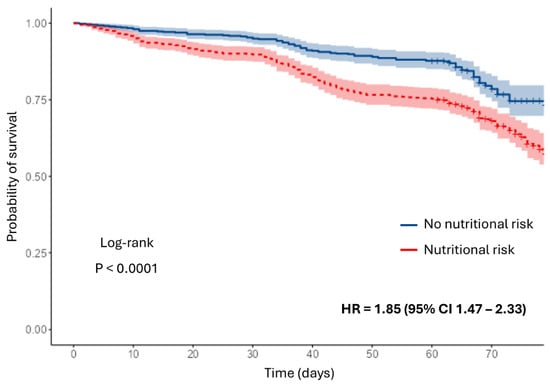
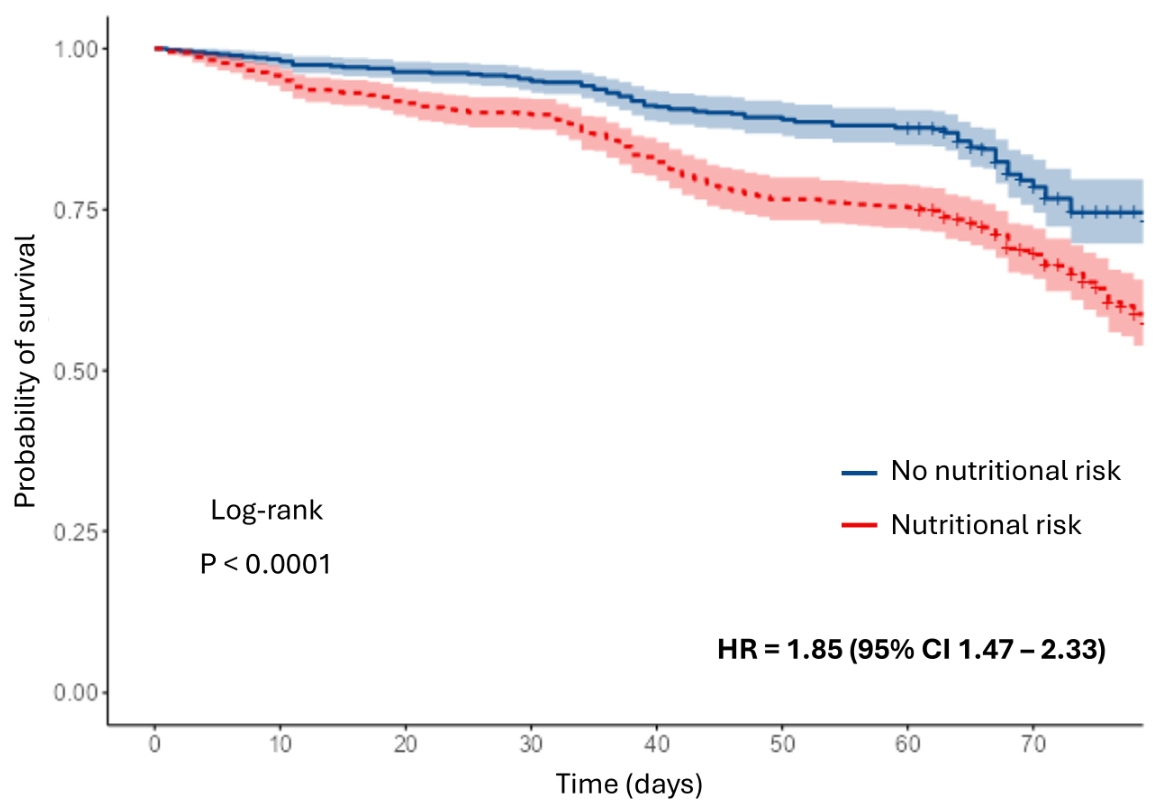
Kaplan–Meier survival analysis showed lower survival among patients with nutritional risk at admission compared with those without risk, with an early separation of the curves. This finding was consistent with the higher in-hospital mortality observed in patients at nutritional risk. The difference between groups was statistically significant according to the log-rank test (Figure 1).
Figure 1.
Overall survival according to the presence or absence of nutritional risk at hospital admission.
No statistically significant differences were observed in the 60-day hospital readmission rate between patients with and without nutritional risk, either in the univariate analysis or after multivariable adjustment.
4. Discussion
This study represents the largest multicentre cohort conducted in Spain specifically focusing on nutritional assessment in hospitalised patients with cancer. In this population, 53% of patients were identified as being at nutritional risk according to the MST, highlighting the substantial burden of nutritional vulnerability among patients admitted to medical oncology services. In Spain, two major multicentre studies have previously evaluated the prevalence of hospital malnutrition: the PREDyCES study [26] (2012, screening using NRS-2002 in 31 centres) and the SeDREno study [17] (2021, 17 hospitals, assessment using MUST and GLIM criteria). However, neither of these studies was specifically designed to evaluate patients with cancer, who could also be hospitalised in any hospital department. A subanalysis of the PREDyCES study [16] including hospitalised oncology patients (N = 401) reported a prevalence of nutritional risk at admission of 33.9%, although only 15% of these patients were admitted to medical oncology departments. In the SeDREno study [17], 39% of patients with cancer (N = 466) presented nutritional risk, with confirmed malnutrition according to GLIM criteria in 39.1% of cases. In both studies, the prevalence of nutritional risk was substantially lower than that observed in our cohort. When focusing specifically on patients admitted to medical oncology departments, higher estimates have been reported. A recent single-centre study by López-Gómez JJ et al. [27] described a prevalence of nutritional risk of 67.8% using MUST and 91.3% using MNA, although the study included a relatively small sample size. International studies have also reported heterogeneous prevalences, including 39% malnutrition in France [18], 30.5% in Korea [28], 40.7% in the Netherlands [29] and 45.3% in Brazil [11]. Nevertheless, comparisons across studies should be interpreted with caution, as the prevalence of nutritional risk is influenced by several factors, including patient characteristics, tumour types, oncological treatments, reasons for admission, and the nutritional screening tools used.
In our study, nutritional risk was independently associated with functional status, tumour type, control of oncological disease, and recent exposure to cytotoxic chemotherapy. Rather than representing causal relationships, these factors likely reflect the coexistence of multiple markers of disease severity and patient vulnerability. Regarding tumour type, the highest prevalence of nutritional risk was observed in pancreatic cancer and tumours of the upper gastrointestinal tract, whereas breast cancer showed the lowest risk. These findings are consistent with previous reports describing a particularly high nutritional burden in malignancies affecting the digestive tract [11,14,16,18]. An unexpected observation was the high proportion of patients with prostate cancer classified as being at nutritional risk (58%), despite this malignancy generally being considered to carry a low nutritional risk profile. This finding likely reflects the specific clinical context of hospitalisation in medical oncology, which often includes patients with advanced disease, complications requiring admission, or exposure to intensive systemic treatments. One particularly relevant finding is that nutritional risk was not associated with tumour stage but rather with the level of disease control. Independent of metastatic status, patients at initial diagnosis or with progressive disease showed the highest prevalence of nutritional risk, whereas those with stable disease or objective oncological response presented substantially lower rates. Although this observation is clinically and pathophysiologically plausible, it contrasts with several previous studies reporting a direct association between malnutrition and tumour stage [30]. Age was not independently associated with nutritional risk when analysed as a continuous variable. However, when categorised, patients aged over 80 years showed a higher probability of nutritional risk, suggesting that the relationship between age and malnutrition may not be linear but instead concentrated at very advanced ages. This pattern is compatible with a threshold effect potentially linked to frailty or reduced physiological reserve, and similar findings were reported by Almeida et al. [31] in a cohort of more than 3000 older patients with cancer.
Our study confirms an independent association between exposure to cytotoxic chemotherapy and nutritional risk, consistent with previous reports [14,18]. This relationship is likely bidirectional, reflecting a vicious cycle in which malnutrition worsens treatment tolerance while treatment-related toxicity and complications further compromise nutritional status [7,21,30]. A more exploratory observation in our cohort relates to the potential relationship between immunotherapy and nutritional status, an area that remains poorly characterised in the current literature [14]. In our study, the prevalence of nutritional risk among patients receiving immunotherapy alone was slightly lower than that observed in patients treated exclusively with chemotherapy, but clearly higher than that observed in those receiving targeted molecular therapies or hormonal treatment. These findings should be interpreted with caution, as this analysis was not a predefined objective of the study, and the results should therefore be considered hypothesis-generating.
In this cohort of hospitalised patients with cancer, nutritional risk was consistently associated with worse clinical outcomes. Patients identified as being at nutritional risk experienced longer hospital stays and higher mortality, with a median hospitalisation three days longer and a significantly higher probability of prolonged admission (>15 days). These findings are in line with previous studies and recent meta-analysis [3,16,27,31,32] and highlight the clinical and economic implications of malnutrition in hospitalised oncology patients, particularly in terms of healthcare resource utilisation and associated costs [16]. While the association between nutritional status and survival has been widely described in ambulatory oncology populations [30,33,34,35], evidence in hospitalised patients remains comparatively scarce. In our study, patients at nutritional risk showed substantially higher mortality, both during hospitalisation and at 30 and 60 days after discharge, with mortality rates approximately twice those observed in patients without nutritional risk. Importantly, this association remained independent of other prognostic factors, as confirmed in the multivariable models. Although the association with in-hospital mortality did not reach statistical significance after adjustment, the consistent magnitude of the effect observed across the different time horizons (OR 1.4–1.6) supports the interpretation of nutritional risk at admission as a relevant prognostic marker in this population. The lack of statistical significance for in-hospital mortality likely reflects the lower number of events during hospitalisation and the resulting limited statistical power. Overall, our results are consistent with those reported in previous studies of hospitalised oncology patients, although most of these studies included smaller cohorts [36] and/or were conducted in single-centre settings [27,36,37,38].
In the general hospitalised population, the association between nutritional status and the risk of hospital readmission is well documented [39,40]. In contrast, evidence in patients with cancer remains more limited and heterogeneous [41,42]. In our cohort, no significant differences were observed in the 60-day readmission rate between patients with and without nutritional risk at admission. A possible explanation for this finding is the higher early mortality observed among patients with cancer, which may have reduced the likelihood of readmission being observed, with death acting as a competing risk.
This study has several strengths, including its prospective design, large sample size, and multicentre structure, with a representative distribution of the most common tumour types. Importantly, the study was specifically designed to characterise patients admitted to medical oncology departments, which distinguishes it from previous cohorts. However, several limitations should be acknowledged. First, nutritional status was assessed using MST, a screening tool for nutritional risk, and a comprehensive diagnostic evaluation of malnutrition based on GLIM criteria was not performed, despite these criteria currently being considered the diagnostic reference standard [2,17]. Therefore, our findings should be interpreted as referring to nutritional risk rather than confirmed malnutrition. However, the objective of the study was to evaluate nutritional screening at hospital admission in a large multicentre real-world cohort, and MST was selected because of its feasibility, simplicity, and prior validation in oncology settings. MST-based nutritional risk showed consistent associations with clinically relevant outcomes, supporting its usefulness as a pragmatic screening tool in hospitalised patients with cancer. In addition, sarcopenia was not evaluated, which may have limited a more complete characterisation of nutritional status. Furthermore, information on nutritional interventions during hospitalisation (e.g., oral nutritional supplements, enteral or parenteral nutrition) was not systematically collected. Nutritional management was performed according to routine clinical practice at each centre and was not standardised or protocol-driven within the study. Therefore, we were unable to evaluate the potential impact of nutritional support on clinical outcomes, although previous studies have suggested that nutritional interventions may improve outcomes, including mortality, in hospitalised patients with cancer [43]. Second, the generalisability of our findings to other clinical contexts may be limited, such as surgical oncology admissions or hospitalisations related to initial diagnostic work-up. Furthermore, in our healthcare system, patients with cancer receiving radiotherapy as their only treatment are rarely admitted to medical oncology departments, and therefore, this group may be underrepresented in our cohort. The REGIO registry was designed to assess multiple clinical dimensions of hospitalised oncology patients, which justified the use of a simple, rapid, and efficient nutritional screening tool. Moreover, most studies evaluating hospital malnutrition in oncology populations rely on screening tools rather than full diagnostic assessments, making our findings comparable with the existing literature. The choice of MST as the screening instrument may also have influenced our results, as different screening tools have shown partially non-overlapping diagnostic performance [21,22,32]. Nevertheless, MST is recommended by several major scientific societies for nutritional screening in oncology patients [7,8,10]. Finally, our findings suggest that MST provides adequate prognostic discrimination, as patients identified as being at nutritional risk showed worse clinical outcomes, supporting its practical usefulness in the hospital setting.
5. Conclusions
In this multicentre cohort of patients hospitalised in medical oncology departments, we observed a high prevalence of nutritional risk identified using MST, exceeding that previously reported in other national cohorts. Nutritional risk was independently associated with functional status (ECOG), tumour type, disease control, and recent exposure to cytotoxic chemotherapy. Importantly, patients identified as being at nutritional risk experienced worse clinical outcomes, including longer hospitalisation and higher mortality during follow-up, supporting the clinical relevance of systematic nutritional screening in hospitalised patients with cancer.
Supplementary Materials
The following supporting information can be downloaded at https://www.mdpi.com/article/10.3390/nu18081296/s1, Table S1: Participating hospitals and hospital size, ordered by number of included patients; Table S2: Malnutrition Screening Tool; Table S3: Proportion of missing data across study variables; Table S4: Multivariable analysis of factors associated with prolonged hospital stay (≥15 days); Table S5: Multivariable analysis of factors associated with in-hospital mortality and mortality at 30 and 60 days after hospital discharge.
Author Contributions
Conceptualization, F.J.T.M., J.M.-H., A.G.-V., P.V.G. and L.M.O.; methodology, F.J.T.M.; formal analysis, F.J.T.M.; investigation, F.J.T.M., L.L.R., L.M.O., P.V.G., J.M.-H., E.P.F.F., A.E.M., L.L.D., L.M.S.U., J.G.O., C.H.-M., J.R.H., M.L.-T., M.J.D.H., N.B.R., L.F.-C., C.M.-R., J.S. and A.G.-V.; data curation, F.J.T.M.; writing—original draft preparation, F.J.T.M. and L.L.R.; writing—review and editing, all authors; visualisation, F.J.T.M.; supervision, F.J.T.M.; project administration, F.J.T.M., J.M.-H., A.G.-V., P.V.G. and L.M.O. All authors have read and agreed to the published version of the manuscript.
Funding
The REGIO registry was funded by the Spanish Society of Internal Medicine (SEMI). No specific grant number is associated with this funding. The funder had no role in the design, analysis, interpretation, or writing of the manuscript.
Institutional Review Board Statement
This study was conducted in accordance with the Declaration of Helsinki and approved by the Clinical Research Ethics Committee of Hospital Universitario 12 de Octubre (Madrid, Spain) (protocol code 23/373; date of approval: 7 August 2023).
Informed Consent Statement
Informed consent was obtained from all subjects involved in the study.
Data Availability Statement
The original contributions presented in this study are included in the article/Supplementary Materials. Further inquiries can be directed to the corresponding author.
Acknowledgments
The authors would like to thank Eduardo Montero, Co-management and Consultative Medicine Working Group of the Spanish Society of Internal Medicine (SEMI), for facilitating the development of the REGIO registry.
Conflicts of Interest
The authors declare that there are no conflicts of interest related to the conduct of this study.
Abbreviations
The following abbreviations are used in this manuscript:
| AUC | Area under the curve |
| BMI | Body mass index |
| CI | Confidence interval |
| CUP | Cancer of unknown primary |
| DRM | Disease-related malnutrition |
| ECOG | Eastern Cooperative Oncology Group |
| GLIM | Global Leadership Initiative on Malnutrition |
| IQR | Interquartile range |
| MNA | Mini Nutritional Assessment |
| MST | Malnutrition Screening Tool |
| MUST | Malnutrition Universal Screening Tool |
| NR | Nutritional risk |
| NRS-2002 | Nutritional Risk Screening 2002 |
| NSCLC | Non-small cell lung cancer |
| OR | Odds ratio |
| SD | Standard deviation |
| SEMI | Spanish Society of Internal Medicine |
| SCLC | Small cell lung cancer |
References
- Cederholm, T.; Bosaeus, I. Malnutrition in Adults. N. Engl. J. Med. 2024, 391, 155–165. [Google Scholar] [CrossRef] [Scilit] [PubMed]
- Cederholm, T.; Jensen, G.L.; Correia, M.I.T.D.; Gonzalez, M.C.; Fukushima, R.; Higashiguchi, T.; Baptista, G.; Barazzoni, R.; Blaauw, R.; Coats, A.J.; et al. GLIM criteria for the diagnosis of malnutrition—A consensus report from the global clinical nutrition community. Clin. Nutr. 2019, 38, 1–9. [Google Scholar] [CrossRef] [Scilit] [PubMed]
- Zhang, J.; Xu, W.; Zhang, H.; Fan, Y. Association between risk of malnutrition defined by patient-generated subjective global assessment and adverse outcomes in patients with cancer: A systematic review and meta-analysis. Public Health Nutr. 2024, 27, e105. [Google Scholar] [CrossRef] [Scilit]
- Arends, J.; Baracos, V.; Bertz, H.; Bozzetti, F.; Calder, P.C.; Deutz, N.E.P.; Erickson, N.; Laviano, A.; Lisanti, M.P.; Lobo, D.N.; et al. ESPEN expert group recommendations for action against cancer-related malnutrition. Clin. Nutr. 2017, 36, 1187–1196. [Google Scholar] [CrossRef] [Scilit]
- Wie, G.A.; Cho, Y.A.; Kim, S.Y.; Kim, S.M.; Bae, J.M.; Joung, H. Prevalence and risk factors of malnutrition among cancer patients according to tumor location and stage in the National Cancer Center in Korea. Nutrition 2010, 26, 263–268. [Google Scholar] [CrossRef] [Scilit]
- Muresan, B.T.; Núñez-Abad, M.; Artero, A.; Rios, J.R.; Cunquero-Tomás, A.J.; Iranzo, V.; Garrido, J.; Jiménez-Portilla, A.; Herrero, C.C.; Juan, C.J.S. Relation of Malnutrition and Nosocomical Infections in Cancer Patients in Hospital: An Observational Study. J. Nutr. Metab. 2022, 2022, 5232480. [Google Scholar] [CrossRef] [Scilit]
- Trujillo, E.B.; Kadakia, K.C.; Thomson, C.; Zhang, F.F.; Livinski, A.; Pollard, K.; Mattox, T.; Tucker, A.; Williams, V.; Walsh, D.; et al. Malnutrition risk screening in adult oncology outpatients: An ASPEN systematic review and clinical recommendations. J. Parenter. Enter. Nutr. 2024, 48, 874–894. [Google Scholar] [CrossRef] [Scilit]
- Arends, J.; Strasser, F.; Gonella, S.; Solheim, T.; Madeddu, C.; Ravasco, P.; Buonaccorso, L.; de van der Schueren, M.; Baldwin, C.; Chasen, M.; et al. Cancer cachexia in adult patients: ESMO Clinical Practice Guidelines☆. ESMO Open 2021, 6, 100092. [Google Scholar] [CrossRef] [Scilit]
- Muscaritoli, M.; Arends, J.; Bachmann, P.; Baracos, V.; Barthelemy, N.; Bertz, H.; Bozzetti, F.; Hütterer, E.; Isenring, E.; Kaasa, S.; et al. ESPEN practical guideline: Clinical Nutrition in cancer. Clin. Nutr. 2021, 40, 2898–2913. [Google Scholar] [CrossRef] [Scilit]
- De Las Peñas, R.; Majem, M.; Perez-Altozano, J.; Virizuela, J.A.; Cancer, E.; Diz, P.; Donnay, O.; Hurtado, A.; Jimenez-Fonseca, P.; Ocon, M.J. SEOM clinical guidelines on nutrition in cancer patients (2018). Clin. Transl. Oncol. 2019, 21, 87–93. [Google Scholar] [CrossRef] [Scilit] [PubMed]
- De Pinho, N.B.; Martucci, R.B.; Rodrigues, V.D.; D’Almeida, C.; Thuler, L.; Saunders, C.; Jager-Wittenaar, H.; Peres, W. Malnutrition associated with nutrition impact symptoms and localization of the disease: Results of a multicentric research on oncological nutrition. Clin. Nutr. 2019, 38, 1274–1279. [Google Scholar] [CrossRef] [Scilit]
- Neelemaat, F.; Meijers, J.; Kruizenga, H.; Van Ballegooijen, H.; Van Bokhorst-de Van Der Schueren, M. Comparison of five malnutrition screening tools in one hospital inpatient sample. J. Clin. Nurs. 2011, 20, 2144–2152. [Google Scholar] [CrossRef] [Scilit] [PubMed]
- Trabulo, C.; Lopes, J.; Da Silva Dias, D.; Gramaça, J.; Fernandes, I.; Gameiro, R.; Pina, I.; Mäkitie, A.; Ottery, F.; Ravasco, P. Assessment of nutritional status of oncology patients at hospital admission: A Portuguese real-world study. Front. Nutr. 2022, 9, 972525. [Google Scholar] [CrossRef] [Scilit] [PubMed]
- Bossi, P.; Delrio, P.; Mascheroni, A.; Zanetti, M. The Spectrum of Malnutrition/Cachexia/Sarcopenia in Oncology According to Different Cancer Types and Settings: A Narrative Review. Nutrients 2021, 13, 1980. [Google Scholar] [CrossRef] [Scilit] [PubMed]
- Zhang, J.; Quan, Y.; Wang, X.; Wei, X.; Shen, X.; Li, X.; Liang, T. Global epidemiological characteristics of malnutrition in cancer patients: A comprehensive meta-analysis and systematic review. BMC Cancer 2025, 25, 1191. [Google Scholar] [CrossRef] [Scilit]
- Planas, M.; Álvarez-Hernández, J.; León-Sanz, M.; Celaya-Pérez, S.; Araujo, K.; De Lorenzo, A.G.; on behalf of the PREDyCES® Researchers. Prevalence of hospital malnutrition in cancer patients: A sub-analysis of the PREDyCES® study. Support. Care Cancer 2016, 24, 429–435. [Google Scholar] [CrossRef] [Scilit]
- Zugasti Murillo, A.; Petrina-Jáuregui, M.E.; Ripa-Ciáurriz, C.; Sánchez, R.S.; Villazón-González, F.; Faes, Á.G.-D.; Fernández-López, C.; Calles-Romero, L.; Martín-Palmero, M.Á.; Riestra-Fernández, M.; et al. SeDREno study—Prevalence of hospital malnutrition according to GLIM criteria, ten years after the PREDyCES study. Nutr. Hosp. 2021, 38, 1016–1025. [Google Scholar] [CrossRef] [Scilit]
- Hébuterne, X.; Lemarié, E.; Michallet, M.; De Montreuil, C.B.; Schneider, S.M.; Goldwasser, F. Prevalence of Malnutrition and Current Use of Nutrition Support in Patients with Cancer. J. Parenter. Enter. Nutr. 2014, 38, 196–204. [Google Scholar] [CrossRef] [Scilit]
- Song, C.; Shi, H. Diagnosis of malnutrition in cancer patients. Cancer Biol. Med. 2024, 20, 963–966. [Google Scholar] [CrossRef] [Scilit]
- Charlson, M.E.; Pompei, P.; Ales, K.L.; MacKenzie, C.R. A new method of classifying prognostic comorbidity in longitudinal studies: Development and validation. J. Chronic Dis. 1987, 40, 373–383. [Google Scholar] [CrossRef] [Scilit]
- Reber, E.; Schönenberger, K.A.; Vasiloglou, M.F.; Stanga, Z. Nutritional Risk Screening in Cancer Patients: The First Step Toward Better Clinical Outcome. Front. Nutr. 2021, 8, 603936. [Google Scholar] [CrossRef] [Scilit]
- Shaw, C.; Fleuret, C.; Pickard, J.M.; Mohammed, K.; Black, G.; Wedlake, L. Comparison of a novel, simple nutrition screening tool for adult oncology inpatients and the Malnutrition Screening Tool (MST) against the Patient-Generated Subjective Global Assessment (PG-SGA). Support. Care Cancer 2014, 23, 47–54. [Google Scholar] [CrossRef] [Scilit]
- Susetyowati, S.; Sarasati, R.M.; Rizqi, F.; Sanubari, N.D.G.; Nuraini, A. Determining the Valid Tools to Screen Malnutrition in Cancer Patients: A Comparison to Patient Generated-Subjective Global Assessment (PG-SGA). J. Gizi Indones. Indones. J. Nutr. 2022, 11, 49–56. [Google Scholar] [CrossRef] [Scilit]
- Lima, J.; Brizola Dias, A.J.; Burgel, C.F.; Bernardes, S.; Gonzalez, M.C.; Silva, F.M. Complementarity of nutritional screening tools to GLIM criteria on malnutrition diagnosis in hospitalised patients: A secondary analysis of a longitudinal study. Clin. Nutr. 2022, 41, 2325–2332. [Google Scholar] [CrossRef] [Scilit] [PubMed]
- Isenring, E.; Cross, G.; Daniels, L.; Kellett, E.; Koczwara, B. Validity of the malnutrition screening tool as an effective predictor of nutritional risk in oncology outpatients receiving chemotherapy. Support. Care Cancer 2006, 14, 1152–1156. [Google Scholar] [CrossRef] [Scilit] [PubMed]
- Álvarez-Hernández, J.; Planas Vila, M.; León-Sanz, M.; García de Lorenzo, A.; Celaya-Pérez, S.; García-Lorda, P.; Araujo, K.; Sarto Guerri, B.; on behalf of the PREDyCES® Researchers. Prevalencia y Costes de la Malnutrición en Pacientes Hospitalizados; Estudio PREDyCES. Nutr. Hosp. 2012, 27, 1049–1059. [Google Scholar] [CrossRef] [Scilit] [PubMed]
- López-Gómez, J.J.; Cerezo-Martín, J.M.; Gómez-Hoyos, E.; Jiménez-Sahagún, R.; Torres-Torres, B.; Ortolá-Buigues, A.; Delgado-García, E.; Mellen, I.P.; de Luis Román, D.A. Diagnosis of malnutrition and its relationship with prognosis in hospitalized patients with oncological pathology. Endocrinol. Diabetes Nutr. 2023, 70, 304–312. [Google Scholar] [CrossRef] [Scilit]
- Na, B.G.; Han, S.S.; Cho, Y.A.; Wie, G.A.; Kim, J.Y.; Lee, J.M.; Lee, S.D.; Kim, S.H.; Park, S.J. Nutritional Status of Patients with Cancer: A Prospective Cohort Study of 1588 Hospitalized Patients. Nutr. Cancer 2018, 70, 1228–1236. [Google Scholar] [CrossRef] [Scilit]
- Meijers, J.M.M.; Schols, J.M.G.A.; vanBokhorst-de Van Der Schueren, M.A.E.; Dassen, T.; Janssen, M.A.P.; Halfens, R.J.G. Malnutrition prevalence in The Netherlands: Results of the Annual Dutch National Prevalence Measurement of Care Problems. Br. J. Nutr. 2008, 101, 417–423. [Google Scholar] [CrossRef] [Scilit]
- Segura, A.; Pardo, J.; Jara, C.; Zugazabeitia, L.; Carulla, J.; Peñas, R.d.L.; García-Cabrera, E.; Azuara, M.L.; Casadó, J.; Gómez-Candela, C. An epidemiological evaluation of the prevalence of malnutrition in Spanish patients with locally advanced or metastatic cancer. Clin. Nutr. 2005, 24, 801–814. [Google Scholar] [CrossRef] [Scilit]
- D’Almeida, C.A.; Peres, W.A.F.; De Pinho, N.B.; Martucci, R.B.; Rodrigues, V.D.; Ramalho, A. Prevalence of Malnutrition in Older Hospitalized Cancer Patients: A Multicenter and Multiregional Study. J. Nutr. Health Aging 2020, 24, 166–171. [Google Scholar] [CrossRef] [Scilit]
- Amaral, T.F.; Antunes, A.; Cabral, S.; Alves, P.; Kent-Smith, L. An evaluation of three nutritional screening tools in a Portuguese oncology centre. J. Hum. Nutr. Diet. 2008, 21, 575–583. [Google Scholar] [CrossRef] [Scilit]
- Hoobler, R.; Herrera, M.; Woodruff, K.; Sanchez, A.; Coletta, A.M.; Chaix, A.; Elizondo, J.; Playdon, M.C. Malnutrition Risk Is Associated with All-Cause Mortality and Chemotherapy Complications Among Adults Diagnosed with Diverse Cancer Types: A Retrospective Cohort Study. J. Acad. Nutr. Diet. 2025, 125, 1242–1255.e10. [Google Scholar] [CrossRef] [Scilit]
- Muscaritoli, M.; Modena, A.; Valerio, M.; Marchetti, P.; Magarotto, R.; Quadrini, S.; Narducci, F.; Tonini, G.; Grassani, T.; Cavanna, L.; et al. The Impact of NUTRItional Status at First Medical Oncology Visit on Clinical Outcomes: The NUTRIONCO Study. Cancers 2023, 15, 3206. [Google Scholar] [CrossRef] [Scilit] [PubMed]
- Zhang, X.; Tang, M.; Zhang, Q.; Zhang, K.-P.; Guo, Z.-Q.; Xu, H.-X.; Yuan, K.-T.; Yu, M.; Braga, M.; Cederholm, T.; et al. The GLIM criteria as an effective tool for nutrition assessment and survival prediction in older adult cancer patients. Clin. Nutr. 2021, 40, 1224–1232. [Google Scholar] [CrossRef] [Scilit] [PubMed]
- Contreras-Bolívar, V.; Sánchez-Torralvo, F.J.; Ruiz-Vico, M.; González-Almendros, I.; Barrios, M.; Padín, S.; Alba, E.; Olveira, G. GLIM Criteria Using Hand Grip Strength Adequately Predict Six-Month Mortality in Cancer Inpatients. Nutrients 2019, 11, 2043. [Google Scholar] [CrossRef] [Scilit]
- Sánchez-Torralvo, F.J.; Ruiz-García, I.; Contreras-Bolívar, V.; González-Almendros, I.; Ruiz-Vico, M.; Abuín-Fernández, J.; Barrios, M.; Alba, E.; Olveira, G. CT-Determined Sarcopenia in GLIM-Defined Malnutrition and Prediction of 6-Month Mortality in Cancer Inpatients. Nutrients 2021, 13, 2647. [Google Scholar] [CrossRef] [Scilit]
- Zhang, X.; Zhao, W.; Du, Y.; Zhang, J.; Zhang, Y.; Li, W.; Hu, W.; Zong, L.; Liu, Y.; Qin, H.; et al. A simple assessment model based on phase angle for malnutrition and prognosis in hospitalized cancer patients. Clin. Nutr. 2022, 41, 1320–1327. [Google Scholar] [CrossRef] [Scilit]
- Sharma, Y.; Miller, M.; Kaambwa, B.; Shahi, R.; Hakendorf, P.; Horwood, C.; Thompson, C. Malnutrition and its association with readmission and death within 7 days and 8–180 days postdischarge in older patients: A prospective observational study. BMJ Open 2017, 7, e018443. [Google Scholar] [CrossRef] [Scilit]
- Meulemans, A.; Matthys, C.; Vangoitsenhoven, R.; Sabino, J.; Van Der Schueren, B.; Maertens, P.; Pans, C.; Stijnen, P.; Bruyneel, L. A multicenter propensity score matched analysis in 73,843 patients of an association of nutritional risk with mortality, length of stay and readmission rates. Am. J. Clin. Nutr. 2021, 114, 1123–1130. [Google Scholar] [CrossRef] [Scilit] [PubMed]
- Calleja Fernández, A.; de la Maza, B.P.; Casariego, A.V.; Taibo, R.V.; Gómez, J.J.L.; Rodríguez, I.C.; Pomar, M.D.B. Food intake and nutritional status influence outcomes in hospitalized hematology-oncology patients. Nutr. Hosp. 2015, 31, 2598–2605. [Google Scholar] [CrossRef] [Scilit] [PubMed]
- MacFarling Meure, C.; Steer, B.; Porter, J. Interrelationships between Dietary Outcomes, Readmission Rates and Length of Stay in Hospitalised Oncology Patients: A Scoping Review. Nutrients 2023, 15, 400. [Google Scholar] [CrossRef] [Scilit] [PubMed]
- Bargetzi, L.; Brack, C.; Herrmann, J.; Bargetzi, A.; Hersberger, L.; Bargetzi, M.; Kaegi-Braun, N.; Tribolet, P.; Gomes, F.; Hoess, C.; et al. Nutritional support during the hospital stay reduces mortality in patients with different types of cancers: Secondary analysis of a prospective randomized trial. Ann. Oncol. 2021, 32, 1025–1033. [Google Scholar] [CrossRef] [Scilit] [PubMed]

Disclaimer/Publisher’s Note: The statements, opinions and data contained in all publications are solely those of the individual author(s) and contributor(s) and not of MDPI and/or the editor(s). MDPI and/or the editor(s) disclaim responsibility for any injury to people or property resulting from any ideas, methods, instructions or products referred to in the content. |
© 2026 by the authors. Licensee MDPI, Basel, Switzerland. This article is an open access article distributed under the terms and conditions of the Creative Commons Attribution (CC BY) license.