


Abstract
Oleanolic acid (OA) is a pentacyclic triterpenoid recoverable from several plant-processing residues, but its usefulness as a bioproduct feedstock depends on more than botanical occurrence. Olive leaves, olive pomace, grape pomace, and peel-rich fruit residues differ markedly in OA content, co-triterpenoid profile, moisture, handling requirements, and realistic product route. This review compares these feedstocks quantitatively where comparable data are available and examines extraction and purification as connected processing steps. Dimethyl carbonate has shown high OA selectivity in grape pomace. Microwave-assisted extraction studies report the amount of OA recovered per unit of dry biomass together with laboratory-scale energy data for residual olive skin, while supercritical CO2 is suitable for lipophilic matrices but may still require extensive downstream separation. DES and ionic-liquid systems remain less developed because solvent recovery, residual solvent control, and product compatibility have not been demonstrated for complete OA processes. Techno-economic and life-cycle studies on the same residue classes show that drying, transport, solvent recycling, energy integration, and co-product recovery can determine process performance; a complete OA-specific TEA or LCA was not identified. Product development also depends on whether the output is purified OA, a standardized triterpenoid-rich fraction, or a formulated matrix. Human evidence is most developed for OA-enriched olive oil, whereas most other health-related applications remain preclinical. No complete source–process–product dataset was identified that links feedstock composition, OA recovery, final specification, exposure, safety, and economic and environmental performance.
1. Introduction
Plant secondary metabolites recovered from agro-industrial residues can provide high-value product streams within circular biorefineries. Pentacyclic triterpenoids are relevant in this context because they combine defined chemical structures, broad botanical occurrences, and biological activities that support health-oriented applications. Their practical value, however, depends on whether they can be recovered from available biomass by selective, scalable, and product-compatible processes [1,2,3].
Oleanolic acid (OA), an oleanane-type pentacyclic triterpenoid, occurs as a free aglycone and as a structural unit of triterpenoid saponins [1]. Although OA has been studied mainly in pharmacology, phytochemistry, and medicinal chemistry [1,2,3,4,5], it is also recoverable from plant materials and processing residues, including olive leaves and pomace, grape pomace, fruit peels, and cuticular wax-rich fractions [2,6,7,8]. These matrices create an opportunity to examine OA as a bio-based chemical within residue-valorization and bioproduct-development pathways.
Many OA-containing matrices are already generated by food and agricultural industries and contain additional valuable constituents, including phenolics, lipids, waxes, and related triterpenes [2,6,7,8]. OA recovery is most useful when integrated with co-product recovery within the same process. This approach follows cascading biomass use, in which high-value fractions are recovered before residual solids are directed to lower-value material or energy applications [5,9].
The processing problem differs between residues. Wet pomaces impose stabilization, drying, and transport burdens. Cuticle-rich materials can give concentrated triterpenoid fractions but often contain waxes and structurally related compounds that complicate purification. Matrices rich in both OA and ursolic acid may be better suited to standardized mixed-triterpenoid products than to isolation of OA. The feedstock and the intended product specification jointly determine process selection [2,3,4].
Extraction yield alone does not describe process performance. Two methods can give similar crude-extract yields while producing very different OA enrichment and purification burdens. A meaningful process comparison also includes solvent consumption and recovery, energy input, waste generation, and scale-up [10]. SFE, microwave- and ultrasound-assisted extraction, pressurized liquid extraction, DMC, DES, and ionic-liquid systems have all been investigated, but the amount and quality of OA-specific process data differ considerably among them [7,8,10,11,12,13,14,15,16,17].
The required degree of purification depends on the intended product. Purified OA with a stated assay and related-substance profile is preferable for analytical, mechanistic, and pharmaceutical studies, whereas standardized OA-rich fractions may be more appropriate when the complete phytochemical fraction forms part of the intended product.
OA is highly lipophilic and poorly water-soluble, which limits dissolution, absorption, and the translation of in vitro activity into oral or topical products [2,3,4]. Lipid-based systems, liposomes, polymeric carriers, cyclodextrin complexes, and solid dispersions have been used to improve dispersion, stability, and exposure [3,4]. Within the source-to-product pathway considered here, formulation is the step that converts purified OA or standardized OA-rich fractions into product-specific dosage forms.
The biological evidence is similarly uneven. Human pharmacokinetic and intervention data are available for OA-enriched olive oil [18,19], whereas most liver-related, vascular, anticancer, redox, inflammatory, and topical studies remain mechanistic or preclinical [3,4,20,21,22,23,24,25,26,27,28,29,30,31]. Interpretation depends on the identity of the tested OA material as well as on the biological endpoint.
Existing reviews primarily address OA pharmacology, antioxidant activity, structural modification, or drug delivery [1,2,4,32,33]. A smaller body of literature connects feedstock selection, residue stabilization, extraction and purification, formulation, and product-specific evidence. This review synthesizes these stages as a single source-to-product pathway for OA-containing bioresources and bioresidues.
Accordingly, this review aims to: (i) identify realistic OA-containing feedstocks; (ii) compare extraction and purification routes in relation to selectivity, scalability, and product requirements; (iii) assess opportunities for integration into cascading biorefineries; (iv) evaluate formulation strategies for purified OA and OA-rich fractions; and (v) align health-oriented applications with the available evidence, safety requirements, and sustainability constraints.
The literature considered in this narrative review was identified through searches of PubMed, Scopus, Web of Science Core Collection, and Google Scholar. The reference lists of relevant reviews and primary studies were also screened manually to identify additional publications. Searches combined the term “oleanolic acid” with “bioresource”, “bioresidue”, “agro-industrial residue”, “olive leaves”, “olive pomace”, “grape pomace”, “apple pomace”, “cranberry pomace”, “fruit-processing residue”, “green extraction”, “microwave-assisted extraction”, “supercritical CO2”, “deep eutectic solvent”, “ionic liquid”, “biorefinery”, “purification”, “formulation”, “bioavailability”, “nutraceutical”, “cosmeceutical”, “techno-economic analysis”, and “life-cycle assessment”. Publications available up to 30 August 2026 were considered.
For interpretation, the evidence was separated into four categories: (i) OA-specific experimental studies in which OA was directly quantified, recovered, purified, or formulated; (ii) studies of OA-containing residue-derived fractions or matrices in which OA was one component of a defined multicomponent material; (iii) process, techno-economic, or life-cycle evidence from analogous biorefinery systems in which OA was not quantified as a separate product; and (iv) conceptual process integration proposed in this review. Evidence from analogous systems and conceptual extrapolation is used to identify relevant process variables and integration options, rather than as direct validation of an OA production route.
Figure 1 summarizes the source-to-product pathway examined in this review.
Figure 1.
Source-to-product pathway for oleanolic acid (OA), linking bioresource selection and pretreatment with extraction, purification, cascading valorization, formulation, and health-oriented bioproduct development.
2. OA-Containing Plant Bioresources: Feedstock Relevance and Variability
2.1. Criteria for Selecting OA-Containing Feedstocks
Oleanolic acid (OA) occurs in numerous plant species, but its presence alone does not make a plant material suitable for bioproduct development. A useful feedstock contains a quantifiable amount of OA or a defined triterpenoid fraction and is available in sufficient and reproducible quantities for processing. In this review, total triterpenoid content refers to the combined content of the quantified triterpenoids reported for a given material, most commonly OA, ursolic acid, and maslinic acid. Values obtained by non-specific colorimetric assays are not directly comparable with compound-specific chromatographic data and are treated separately when reported. Feedstock evaluation also needs to account for collection, stabilization, extraction, and downstream processing requirements [1,2,3,34].
OA-containing materials can be divided into three operational groups: agro-industrial and agricultural residues generated within existing processing chains; peel-, skin-, leaf-, or cuticle-rich fractions in which triterpenoids are concentrated near plant surfaces; and cultivated medicinal or culinary biomass intended for standardized botanical products. These groups differ in supply continuity, cost, regulatory status, co-product composition, and the level of purification required for the intended product. The amount of OA recoverable per unit of feedstock and the value of the resulting product streams are more informative for feedstock selection than OA concentration alone [34,35,36,37,38,39].
2.2. Cuticular Localization and Implications for Feedstock Selection
OA and its structural isomer ursolic acid are frequently associated with plant cuticles and epicuticular waxes [40,41,42]. Consequently, leaves, fruit skins, peels, and skin-rich pomace fractions may contain higher triterpenoid levels than internal tissues. This localization affects both feedstock selection and process design because drying, milling, particle size, solvent polarity, and extraction temperature influence access to wax-associated compounds.
Cuticle-rich residues may be processed either as sources of purified OA or as sources of standardized mixed triterpenoid fractions. The appropriate product format depends on the relative abundance of OA, ursolic acid, waxes, sterols, and other co-extractives, as well as on the purity required for the intended application. For topical or cosmetic products, a standardized triterpenoid-rich fraction may be more practical than complete isolation of OA, provided that composition, safety, and stability are adequately controlled [40,41,42].
2.3. Medicinal and Culinary Biomass as Non-Residual OA Sources
Medicinal and culinary plants can contain OA together with ursolic acid, phenolic diterpenes, flavonoids, and other bioactive constituents. Rosemary is a representative example, containing OA and ursolic acid alongside carnosic acid, carnosol, and rosmarinic acid [43]. Such materials are most relevant to standardized botanical extracts, functional ingredients, and topical or cosmetic products in which OA serves as one marker within a broader phytochemical profile.
Unlike agro-industrial residues, cultivated herbal biomass may have a higher acquisition cost and established competing uses. Its suitability depends on biomass price, cultivation requirements, regulatory status, extract standardization, and the value of the complete phytochemical fraction. These materials are not necessarily suitable as bulk feedstocks for purified OA.
2.4. Feedstock Variability and Biomass-Level Standardization
OA and individual triterpenoid levels vary with species, cultivar, plant organ, tissue development and, for fruits, maturation stage, as well as with harvest season, geographical origin, agricultural practice, processing conditions, drying, and storage [34,41,42]. The proportion of peel, skin, leaf, or cuticular material is particularly important because triterpenoids are not distributed uniformly within plant tissues. Variation in residue composition may therefore influence both the amount of OA recoverable per unit of feedstock and the composition of co-extracted fractions.
Extraction data are comparable only when the biomass has first been characterized. At minimum, studies should report botanical identity, plant organ or residue type, geographical and processing origin, moisture content or dry-weight basis, stabilization and storage conditions, particle-size range, and OA and co-triterpenoid content before extraction [34,35,41,42,44,45,46]. Formulation can improve the delivery of a defined extract, but it cannot compensate for an inadequately characterized or compositionally inconsistent feedstock.
The suitability of an OA-containing material depends on regional availability, compositional reproducibility, processing infrastructure, co-product potential, and the intended product format. Table 1 summarizes the principal feedstock categories and the criteria that distinguish residue-derived, cuticle-rich, cultivated botanical, and purified-compound supply routes.
Table 1.
Operational categories of OA-containing feedstocks and their implications for bioproduct development. Compiled from refs. [1,2,3,6,7,8,34,40,41,42,43,47,48].
3. Agro-Industrial Bioresidues as Feedstocks for OA Recovery
3.1. Criteria for Evaluating OA-Containing Bioresidues
Agro-industrial residues are relevant OA feedstocks when they are generated at sufficient scale, collected within existing processing chains, and amenable to stabilization and selective fractionation. OA is frequently associated with leaves, peels, skins, pomace, and cuticular or lipid-rich fractions, many of which are incompletely utilized [7,8,34,35]. Their suitability depends on biomass availability, composition, moisture content, storage stability, extractability, co-product potential, and downstream compatibility; OA concentration alone is insufficient.
The industrial relevance of OA-containing residues is better assessed from the scale of the residue streams than from crop production alone. Olive-oil processing generates large quantities of solid and liquid by-products; total waste biomass associated with olive-oil extraction has been estimated to be at least 40 Mt annually, including more than 20 Mt of dry biomass [49]. Grape pomace generation has been estimated at approximately 9 Mt per year worldwide [50], while global apple-pomace production is reported at about 4 Mt annually [51]. These quantities indicate substantial feedstock availability, but they do not directly represent recoverable OA. Moisture content, fraction composition, triterpenoid distribution, collection logistics, and competing uses determine how much of each residue can realistically enter an OA-oriented process.
Olive leaves, olive pomace, grape pomace, and peel-rich apple residues represent distinct processing matrices. Olive leaves are structurally distinct from wet pomaces and contain both phenolics and triterpenes; olive pomace is a high-moisture, lipid- and fiber-containing residue; grape pomace combines phenolic-rich and lipophilic skin and seed fractions; and apple pomace varies according to processing route and peel content [34,35,36]. These differences determine the required preprocessing, extraction sequence, purification depth, and realistic product format.
3.2. Olive Leaves: Composition, Preprocessing, and Product Routes
Olive leaves are generated during pruning, harvesting, and industrial cleaning before olive oil production. Depending on the region and collection system, they may be directed to animal feed, composting, energy recovery, or disposal [37]. Their phytochemical composition includes oleuropein-related secoiridoids, flavonoids, phenolic compounds, OA, and other pentacyclic triterpenes [6,7,34,37].
The amount of leaf biomass is large enough to make logistics relevant to process design. Espeso et al. estimated that approximately 1.25 million tonnes of olive-leaf waste are generated annually in Spain, corresponding to about half of the reported global amount [37]. The stream is seasonal and includes material originating from pruning, harvesting, and mill cleaning. Fresh olive leaves also require stabilization. Ramírez et al. reported an initial moisture content of 49.6 ± 1.9% in leaves used for drying experiments [52]. Thus, the apparent availability of the residue cannot be equated directly with the quantity of standardized dry feedstock available for extraction.
Most olive-leaf valorization studies have focused on polar phenolics, whereas OA represents a complementary lipophilic product stream. Because phenolics and triterpenic acids differ in polarity and solubility, sequential fractionation may be preferable to a single non-selective extraction. Polar compounds and OA-rich fractions can be recovered as separate streams using solvent systems or extraction technologies matched to each compound class [7,37].
Practical feedstock control includes separation of leaves from twigs and foreign material, stabilization or drying under defined conditions, milling to a specified particle-size range, and controlled storage. A practical olive-leaf pathway may therefore combine a standardized phenolic fraction, an OA- and maslinic-acid-containing triterpenoid fraction, and subsequent utilization of the lignocellulosic residue [6,7,34,37,38,39].
3.3. Olive Pomace and Pomace-Derived Lipid Fractions
Olive pomace is generated during mechanical olive-oil extraction and contains residual oil, water, skins, pulp, stone fragments, lignocellulosic solids, phenolics, waxes, sterols, OA, and maslinic acid [23,34]. Its composition depends on olive cultivar, extraction technology, water content, and subsequent storage or processing.
Olive pomace is generated at a substantially larger mass than the triterpenoid fraction that can ultimately be recovered from it. Depending on the extraction system, approximately 0.80–0.87 kg of pomace may be generated per kilogram of olives in two-phase processing, compared with 0.36–0.43 kg/kg in traditional pressing. On this basis, global olive-pomace generation for the 2021/22 campaign was estimated at approximately 12.4 million tonnes [53]. The physical state of the residue is a major constraint. In an industrial two-phase pomace study, moisture ranged from 60.36 to 71.92% before further processing [54].
These values have direct consequences for OA recovery. Transporting untreated pomace over long distances means transporting predominantly water, while drying introduces a substantial energy demand before extraction. Integration with an existing olive mill or pomace-oil facility is therefore more realistic than a stand-alone process based on long-distance transport of fresh pomace. Exhausted olive pomace remains a possible secondary feedstock: Gómez-Cruz et al. measured 1.96 mg OA/g solid before microwave-assisted water fractionation and 3.60 mg/g in the remaining solid after this step [55]. The higher concentration after fractionation reflects removal of other biomass components and enrichment of the residual solid rather than additional OA formation.
OA and maslinic acid may be recovered as purified compounds, triterpenoid-enriched fractions, or components of pomace-derived lipid products. Pomace olive oil enriched in triterpenic acids has been investigated in preclinical metabolic and vascular models, illustrating that complete purification of OA is not required for every product route [23]. However, the composition, stability, safety, and regulatory status of the enriched oil or fraction must be defined.
Fresh olive pomace is moisture-rich and susceptible to fermentation and chemical deterioration. Stabilization, dewatering or drying, storage, and any defatting step should therefore be incorporated into process design. A sequential pathway may include recovery of residual oil and lipophilic triterpenes, separation of polar phenolics, and utilization of the remaining solids as fiber-rich materials, adsorbents, compost, biochar, biogas substrates, or energy feedstocks [23,34,38,39,56].
3.4. Grape Pomace: Sequential Recovery of Polar and Lipophilic Fractions
Grape pomace consists mainly of skins, seeds, and stems remaining after juice or wine production. It contains anthocyanins, tannins, flavanols, seed oil, dietary fiber, and a lipophilic skin and cuticular fraction that may contain OA and related triterpenoids [8,57].
Grape pomace represents approximately 20–30% of the mass of grapes entering winemaking, and recent estimates place worldwide generation at about 9 million tonnes per year [50]. Fresh pomace is also a wet material; reported moisture values commonly fall between 50 and 72% [58]. Disposal without adequate treatment can create a high organic load and contribute to soil and water contamination. At the same time, grape pomace already has competing valorization routes through phenolic recovery, seed oil, dietary fiber, animal feed, composting, and energy production [50,57,58,59]. In grape pomace, OA is more plausibly recovered as one value stream within a multiproduct process; the process economics do not rest on OA alone.
The chemical heterogeneity of grape pomace supports sequential rather than single-step extraction. Polar solvents can be used to recover anthocyanins, flavanols, and tannins, whereas supercritical CO2 or other low- to medium-polarity systems can target oils, waxes, sterols, and triterpenoids [8]. The priority product and the effect of the first extraction step on later fractions determine the extraction order.
Supercritical CO2 has been applied specifically to OA recovery from grape pomace [8]. Its process performance depends on pressure, temperature, moisture, particle size, extraction time, co-solvent use, equipment demand, and the resulting OA enrichment. OA is therefore best considered as a component of the lipophilic product stream within an integrated grape-pomace process rather than as the sole value driver [8,57].
3.5. Apple Pomace and Peel-Rich Residues: Mixed Triterpenoid Feedstocks
Apple pomace is generated during juice, cider, puree, and other fruit-processing operations. It may contain peel, pulp, seeds, stems, and residual soluble solids, with proportions determined by cultivar and processing technology.
Apple pomace accounts for approximately 25–30% of the initial mass of apples processed for cider or juice [60]. Global generation has been estimated at about 4 million tonnes per year [51]. Fresh pomace contains approximately 70–85% moisture and is rich in fermentable material, which limits storage without stabilization [51]. Existing outlets include animal feed, pectin production, food ingredients, composting, and energy or fermentation routes [36,51,60,61]. The availability of large amounts of pomace does not necessarily translate into a large OA stream, because triterpenic acids are concentrated primarily in the peel and ursolic acid is usually more abundant than OA.
Triterpenic acids are concentrated mainly in the peel and cuticular wax layer rather than being distributed uniformly throughout the fruit [35,36,41,42].
Ursolic acid commonly predominates over OA in apple peel and pomace [35,41,42]. Consequently, peel-rich apple residues are generally more suitable for standardized mixed OA/ursolic-acid fractions than for OA-only products. Potential product routes include triterpenoid-rich nutraceutical, topical, or cosmetic ingredients, provided that composition and batch variability are controlled.
Supercritical CO2 extraction has been investigated for the recovery of triterpenic acids and phytosterols from apple pomace, including assessment of process parameters, extraction kinetics, and scale-up [35]. Feedstock mapping should distinguish peel-rich residues from pulp-dominant pomace because peel proportion directly affects the recoverable triterpenoid fraction. Stabilization, peel enrichment, and compositional analysis should therefore precede extraction optimization.
3.6. Cranberry Pomace as an Additional Mixed-Triterpenoid Side Stream
Cranberry processing provides another example of a fruit-derived side stream in which OA is retained in the peel-rich solid fraction. Xue et al. quantified pentacyclic triterpenoids in cranberry raw materials and products and found 12.22 mg OA/g dry weight in pomace, together with 47.52 mg/g ursolic acid and smaller amounts of corosolic and maslinic acids. Total quantified triterpenoids and their hydroxycinnamoyl esters reached 64.09 mg/g dry weight [47]. The composition differs markedly from olive-derived materials because ursolic acid is the dominant free triterpenoid. Cranberry pomace is therefore more realistically considered a mixed-triterpenoid feedstock than a source intended for selective OA production.
Total triterpenoid content and OA content are not interchangeable. A residue may contain a substantial triterpenoid pool while only a fraction of that pool corresponds to OA. For product development, the relevant parameter is therefore the concentration and recoverability of each major triterpenoid rather than the total value alone.
Other fruit-processing residues may provide smaller or less well-characterized mixed-triterpenoid streams. For example, ethanol extraction of Chaenomeles speciosa fruit residue yielded a combined OA and ursolic acid fraction of 1.607% under the optimized conditions reported by Cai et al. [48].
3.7. Residue Logistics, Stabilization, and Preprocessing
The major OA-containing residues differ substantially in their stabilization requirements. Olive pomace is wet and fermentation-prone; grape and apple pomace contain water and fermentable constituents; and olive leaves require separation, drying, and controlled storage [35,36,37,57,61].
Drying can improve storage stability and extraction reproducibility, but temperature and duration may affect sensitive co-components and increase energy demand. Milling can increase the accessible surface area, whereas excessively fine particles may hinder filtration, solvent flow, or supercritical-fluid processing [34,35,36,37,61].
Comparability depends on reporting biomass origin, collection and processing time, moisture content, stabilization method, drying conditions, particle-size range, storage conditions, microbial control, and compositional release criteria [35,37,38,39].
3.8. Comparative Criteria for OA-Containing Residues
Table 2 shows that a single ranking of OA-containing residues would be misleading. The available datasets differ in cultivar, residue definition, preprocessing, and analytical basis. Nevertheless, several practical distinctions are clear when OA concentration is considered together with biomass scale and matrix composition.
Table 2.
Quantitative comparison of representative OA-containing agro-industrial residues and implications for product development. Values refer to the material basis stated in the cited studies.
In the dataset reported by Zhang et al., olive leaves contained 7.58–10.48 mg OA/g dry weight, while UA remained below 0.26 mg/g, corresponding to OA/UA ratios of approximately 37–66 [62]. Within this dataset, the low co-occurrence of UA reduces the OA/UA separation challenge compared with UA-rich fruit residues.
Olive leaves nevertheless have upstream constraints: the biomass is seasonal, requires separation from twigs and foreign matter, and contains about 50% moisture before drying [37,52].
Olive pomace presents a different trade-off. Its annual mass is much larger, but fresh two-phase pomace contains roughly 60–72% water and has a more heterogeneous lipid–fiber matrix [53,54]. Transport and stabilization can therefore offset part of the advantage associated with feedstock abundance. The most plausible route is integration with an existing olive-processing or pomace-oil operation, where triterpenic acids can be recovered alongside residual oil and phenolic fractions.
Grape pomace contains considerably less OA in the directly comparable dry-matrix data available here: 0.27–0.40 mg/g in the six red-grape pomaces examined by Errichiello et al. [13]. A dedicated process aimed solely at OA would therefore be difficult to justify from concentration alone. Its industrial relevance comes from centralized winery generation and the simultaneous presence of phenolics, seed oil, waxes, and fiber. OA is better treated as one component of the lipophilic fraction than as the principal product of the process.
Apple and cranberry pomaces occupy another category. Both contain measurable OA, but UA predominates. Whole cider-apple pomace contained a mean of 1.525 mg OA/g and 4.219 mg UA/g dry weight [60], while cranberry pomace contained 12.22 and 47.52 mg/g, respectively [47]. Extensive separation of OA from UA would add purification steps without an obvious benefit for every application. These residues are therefore better aligned with standardized mixed-triterpenoid ingredients unless a specific product requires isolated OA.
Route selection therefore depends on the intended output. In the literature datasets summarized here, olive leaves combine comparatively high OA content with low UA co-occurrence and may support routes directed toward purified OA. Wet olive pomace is more naturally evaluated as part of an integrated mill-based process, whereas grape pomace can provide OA as one component of a broader lipophilic product stream. Apple and cranberry pomaces contain substantial UA alongside OA and may be more suitable for standardized mixed-triterpenoid fractions. These are route-specific interpretations of heterogeneous literature data rather than a standardized ranking of feedstock quality.
3.9. Residue-Specific Product Routes
The quantitative comparison above indicates that process selection cannot be separated from the intended product. The residue-specific routes summarized below therefore reflect both composition and handling constraints. They should not be interpreted as a universal hierarchy of feedstocks.
4. Green Extraction, Fractionation, and Purification of Oleanolic Acid
4.1. Process-Selection Criteria for OA Recovery
Extraction and purification determine whether an OA-containing residue can be converted into a reproducible product stream. OA is a lipophilic, weakly polar triterpenic acid that commonly co-occurs with waxes, lipids, pigments, phenolics, sterols, and structurally related compounds such as maslinic and ursolic acids [1,2,34,63]. Total extract yield is therefore not an adequate measure of process performance.
Here, crude-extract yield refers to the total mass of extract obtained per unit of feedstock; OA content or concentration refers to the amount or proportion of OA in a specified material; OA recovery refers to the fraction of OA initially present in the feedstock that is recovered after a defined processing sequence; purity refers to the proportion of OA in the isolated final material; enrichment denotes an increase in the OA proportion relative to the starting material or crude extract; and selectivity describes preferential extraction of OA relative to co-extracted constituents, as defined in the cited study.
Crude-extract yield is a poor basis for comparing OA extraction methods because waxes, lipids, pigments, carbohydrates, and structurally related triterpenes can account for a large part of the recovered material. More informative measures are the amount of OA recovered per unit of dry feedstock, OA enrichment or selectivity in the extract, solvent consumption and recovery, energy input, and the purification needed to reach the intended product specification. These parameters are reported inconsistently across the available studies. Table 3 therefore distinguishes measured OA-specific data from qualitative process characteristics; missing values are reported as such rather than inferred from total-extract or total-phenolic data [10,13,64].
4.2. Conventional Solvent Extraction
Conventional solid–liquid extraction remains widely used for recovering triterpenic acids from leaves, peels, pomace, and herbal biomass. Methanol, ethanol, ethyl acetate, acetone, n-butanol, chloroform, and other low- or medium-polarity solvents have been applied because OA has low water solubility [2,13,63].
These methods are useful for analytical studies, laboratory isolation, and comparison with newer extraction technologies. Their suitability for product development, however, depends on solvent toxicity, residual-solvent limits, solvent-to-solid ratio, extraction time, temperature, selectivity, and solvent recovery. Non-selective extraction of waxes, lipids, pigments, and related triterpenes can increase the mass of crude extract while also increasing purification requirements.
Ethanol and ethyl acetate may be more product-compatible than chlorinated solvents, but solvent identity alone does not justify the label “green”. Process assessment includes solvent consumption and recovery, energy demand, extract enrichment, and downstream purification [10,13,63].
4.3. Supercritical CO2 Extraction
Supercritical CO2 extraction (SFE) is suitable for the recovery of non-polar and moderately polar constituents from lipid- and wax-rich plant matrices. It has been applied to OA-containing grape pomace, apple pomace, and olive leaves [8,14,15,35]. Studies on apple pomace have also addressed extraction kinetics and scale-up, whereas combined SFE and centrifugal partition chromatography have been used for the recovery and purification of OA and maslinic acid from olive leaves [14,35].
The carboxylic acid and hydroxyl groups of OA may limit its solubility in pure supercritical CO2. Small amounts of ethanol or another modifier may therefore be required to improve recovery. Pressure, temperature, biomass moisture, particle size, extraction time, CO2 flow, co-solvent concentration, and separator conditions can influence both OA yield and extract composition [8,14,15,35].
Recent work combining SFE with downstream centrifugal partition chromatography provides a useful measure of what can be achieved when extraction and purification are evaluated together. Antoniadi et al. processed 21 g of dried olive leaves containing 211.68 mg OA and ultimately isolated 89.5 mg OA, corresponding to an overall OA recovery of approximately 42.3%. The isolated OA exceeded 95% purity [14]. The 42.3% value describes the complete SFE–CPC sequence, not the extraction efficiency of SFE alone.
This distinction matters when SFE is compared with simpler extraction methods. Supercritical CO2 reduces the amount of conventional organic solvent used during the extraction stage, but compression, pressure control, separator operation, and any co-solvent recovery remain part of the process. In the cited SFE–CPC study, ethanol was introduced stepwise at 0–10% w/w during extraction, and CPC was still required to obtain the purified compounds [14]. No OA-specific techno-economic analysis was reported. SFE is therefore technically relevant when selective lipophilic extraction or solvent-sensitive products are required, but the available OA literature does not yet establish that it is the least energy- or cost-intensive route [8,14,15,35,38,39].
4.4. Dimethyl Carbonate and Alternative Hydrophobic Solvents
Dimethyl carbonate (DMC) has been investigated for selective OA extraction from grape pomace [13]. Its principal relevance is not simply the replacement of a conventional solvent, but the possibility of enriching OA while limiting the extraction of carbohydrates, highly polar phenolics, and other matrix constituents. Improved selectivity can reduce the number and intensity of subsequent purification steps.
The grape-pomace study provides unusually useful selectivity data because DMC was compared directly with conventional and alternative solvents under the same extraction conditions. At a biomass-to-solvent ratio of 1:10 and room-temperature extraction overnight, DMC gave a molar OA selectivity of 61%, compared with 40% for ethyl acetate [13]. DMC also co-extracted fewer hydrophilic metabolites than acetone, 2-methyltetrahydrofuran, or n-butanol. The solvent was recovered and reused in three consecutive extraction cycles without a significant loss of OA extraction performance [13].
DMC is particularly useful when the target is OA enrichment; total extract yield is secondary in this case. The limitations are equally clear. The study concerned a single class of grape-pomace matrices, used an overnight extraction, and did not establish pilot-scale solvent balances or production cost. DMC can therefore be considered a selective candidate for grape-pomace fractionation, but its industrial advantage over ethanol, ethyl acetate, or SFE remains to be demonstrated at process scale [10,13].
4.5. Microwave-Assisted, Ultrasound-Assisted, and Pressurized Liquid Extraction
Microwave-assisted extraction (MAE) has recently been examined directly in an OA-containing agro-industrial residue. Gómez-Cruz et al. applied ethanol–water MAE to the residual olive skin fraction generated during olive-pomace processing and evaluated solvent composition, temperature, extraction time, solids loading, milling, and process energy demand [17]. Across residual skin samples from different industrial sources, the amount of OA recovered per unit of dry biomass reached up to 2.19 g/100 g, while the corresponding value for maslinic acid reached 5.1 g/100 g. The study is relevant beyond extraction yield because energy consumption and downstream use of the extracted solids were considered within the same process.
Under the optimized conditions reported for unmilled residual olive skin, MAE with 100% ethanol at 99 °C for 4 min and a solid loading of 10% w/v yielded 1.05 ± 0.02 g OA/100 g dry biomass. The measured energy consumption was 0.097 ± 0.001 kWh for the laboratory extraction run [17]. When the same conditions were applied to residual olive-skin samples from different industrial sources, the amount of OA recovered ranged from 1.05 to 2.19 g/100 g dry biomass. Variation between industrial samples exceeded the differences produced by some extraction settings.
The energy result is useful because extraction performance and electricity consumption were measured in the same experiment, but the absolute kWh value is equipment- and scale-specific and cannot be extrapolated directly to an industrial installation. The short four-minute extraction and use of ethanol are practical advantages. Conversely, heating to approximately 100 °C, solvent recovery, microwave penetration at larger scale, and the recovery of a mixed OA/maslinic-acid fraction remain relevant engineering constraints [17].
Ultrasound-assisted extraction (UAE) can enhance solvent penetration and mass transfer through cavitation, whereas pressurized liquid extraction (PLE) uses elevated temperature and pressure to accelerate extraction [11,12]. OA-specific evidence for UAE and PLE is less complete than that available for DMC, MAE, or the recent SFE–CPC process. Much of the olive-leaf literature on ultrasound or pressurized extraction reports total phenolics, antioxidant capacity, or total extract yield rather than OA mass balance. Such data cannot be used to rank these technologies for OA recovery [11,12].
UAE remains useful as a mass-transfer intensification step, particularly for cuticle-rich materials, but stronger sonication can also increase the extraction of waxes and other matrix constituents. PLE offers rapid extraction at elevated temperature and pressure, although the same conditions can increase co-extraction of lipids and pigments. Neither method currently has sufficient OA-specific solvent-recovery, purification, and scale-up data to support a general claim of superiority. In Table 3, their process status is therefore separated from the much larger literature concerning phenolic extraction.
4.6. DES/NADES and Ionic Liquids: Extraction Performance and Downstream Constraints
Direct evidence for OA extraction with DES is still limited. Tanaka et al. compared several betaine-based systems for wine pomace and found that betaine/xylitol at a 3:2 molar ratio gave the highest OA extraction among the DES formulations tested [16]. Water and 1,3-butanediol were used as controls. The study demonstrated that OA can be transferred from wine pomace into a betaine-based eutectic medium under relatively mild conditions, but it did not establish a complete solvent-recovery loop, OA recovery after separation from the DES, or a specification for residual DES components in a final product. The experiment establishes extraction feasibility but not a complete product-recovery process.
Aqueous surface-active ionic liquids have been investigated more quantitatively in olive leaves. Cláudio et al. reported an OA extraction yield of up to 2.5 wt% relative to the dried leaf mass using a 500 mM aqueous solution of [C14mim]Cl at 80 °C; microwave irradiation reduced the extraction time to 30 min [7]. The aqueous ionic-liquid systems could compete with or exceed several conventional organic solvents in the experimental comparison. However, the extract contained the ionic liquid, and regeneration of the IL was not demonstrated as part of the OA recovery procedure. At process scale, separation of OA from the extraction medium, IL make-up losses, regeneration efficiency, and residual IL in the product become additional unit operations rather than secondary analytical details.
The wider DES literature does not support treating low volatility or the natural origin of individual components as proof of low environmental impact. Toxicity and biodegradability vary with composition and concentration, and some DESs cannot be classified as readily biodegradable [65]. A recent assessment of DES sustainability also noted that carbon-footprint and life-cycle data remain scarce and that the environmental result depends on the production of the constituent chemicals, solvent lifetime, recovery, and the complete process in which the DES is used [66]. For OA extraction, these data are currently unavailable.
Similar reservations apply to ionic liquids. Their negligible vapour pressure avoids one source of atmospheric solvent emission, but synthesis of the cation and anion, precursor production, toxicity, biodegradability, and losses during use contribute to the overall environmental burden [67]. Recovery technologies based on membranes, extraction, adsorption, distillation, and aqueous biphasic systems are available, but each introduces additional material and energy requirements [68]. For process assessment, a closed-loop recovery experiment provides more information than the label “green solvent”.
Product category introduces a further constraint. A DES or IL that performs well during extraction is not automatically acceptable as a component of a food, nutraceutical, cosmetic, or pharmaceutical product. Its composition, residual level, toxicological profile, stability, and removal or retention in the final formulation have to be assessed for the intended use [69]. At present, the OA-specific DES and IL studies are best interpreted as process-development studies. Evidence of extraction efficiency exists, whereas product-scale solvent recovery, life-cycle performance, and regulatory suitability remain largely unresolved.
4.7. Purification and Product-Specific Fractionation
Purification is a major determinant of the feasibility of OA recovery because OA commonly co-occurs with maslinic acid, ursolic acid, sterols, fatty acids, waxes, and pigments. Separation from structurally related triterpenic acids may be more demanding than the initial extraction [14,63].
Flash chromatography has been used to isolate OA and maslinic acid from olive-leaf extracts using solubility-guided solvent selection, washing, HPTLC monitoring, and spectroscopic confirmation [63]. A combined process involving SFE and pH-zone-refining centrifugal partition chromatography has also produced OA and maslinic acid at reported purity values exceeding 95% [14]. These examples link extraction selectivity directly to purification performance.
The expression “high-purity OA” is not sufficiently precise for process comparison unless a numerical assay is reported. In this review, purified OA is used only to describe a product in which OA has been isolated as the principal chemical entity. The actual assay, analytical method, and relevant impurities should be stated whenever the source provides them.
Published purification studies illustrate why a fixed threshold cannot be assigned to all OA products. The recent SFE–pH-zone CPC process for olive leaves yielded OA at >95% purity, with an overall OA recovery of approximately 42.3% [14]. In another pH-zone-refining countercurrent chromatographic process, Wang et al. isolated 38.56 mg OA from 100 mg of an Aralia chinensis crude extract at 99.01% purity [70]. These values describe the products obtained in those specific processes; they do not establish 95% or 99% as universal regulatory thresholds.
The distinction between enrichment and purification is equally important. Surface molecularly imprinted solid-phase extraction increased the OA content of a grape-pomace extract from 13.4% to 93.2% [71]. This is a large enrichment, but the resulting material remains compositionally different from a 99% isolated OA substance. A more recent molecularly imprinted SPE study increased OA in Ligustrum lucidum extract from 58% to 76% [72]. Such methods can reduce the load on subsequent purification, but enrichment percentage should not be reported as equivalent to final chemical purity.
Product specification determines the relevant endpoint. For an analytical reference or a mechanistic study, OA assay and structurally related impurities need to be explicitly reported. For a standardized botanical or residue-derived fraction, the appropriate specification may instead define OA together with ursolic acid, maslinic acid, and other matrix markers. In that case, maximizing OA purity is not necessarily the objective.
4.8. Analytical Standardization and Process-Reporting Requirements
The critical analytical problem is not detection of OA itself, but its resolution from structurally related triterpenes, particularly ursolic acid. OA and UA are positional isomers and can show very similar chromatographic and mass-spectrometric behaviour. Conventional reversed-phase C18 methods do not always provide baseline separation, so detector sensitivity cannot compensate for inadequate chromatographic resolution [73].
For routine quantification of OA-rich biomass or concentrated fractions, HPLC with DAD, UV, or ELSD can be adequate when OA and UA are baseline-resolved, and the method is validated for the specific matrix. Olmo-García et al. compared DAD with ESI-ion-trap MS and APCI-TOF-MS for olive tissues. MS provided lower detection limits, whereas DAD offered a wider dynamic range; quantitative results from the three platforms did not differ significantly under the validated conditions [74]. Thus, mass spectrometry is not automatically required for every high-concentration process sample.
Column selectivity becomes more important when OA and UA coexist at comparable concentrations. Polymeric PAH-type stationary phases have provided better OA/UA resolution than several conventional monomeric C18 phases [73]. Cyclodextrin modification offers another route: Wang et al. obtained an OA/UA resolution of Rs = 8.143 by reversed-phase HPLC using hydroxypropyl-β-cyclodextrin as a mobile-phase additive [75]. Such methods are particularly useful when quantitative separation of the two isomers is more important than broad untargeted profiling.
LC–MS becomes more useful when triterpenoids occur at low concentration, when several related compounds have to be quantified simultaneously, or when additional confirmation is required. Giménez et al. separated maslinic, oleanolic, and ursolic acids together with erythrodiol and uvaol using LC–triple-quadrupole MS; limits of detection for the triterpenic acids were below 1 nM [76]. The chromatographic separation remains essential because OA and UA are isomers and similar mass spectra alone do not guarantee reliable distinction.
ELSD is useful for triterpenoids because OA and UA have weak UV chromophores and can be quantified without derivatization. A validated HPLC–ELSD method has been reported for simultaneous determination of OA, UA, carnosic acid, carnosol, and rosmarinic acid in rosemary [77]. HPTLC is more suitable for rapid fraction screening and process monitoring than as the sole identity test for a purified OA product. In the olive-leaf flash-chromatography study, HPTLC was used to identify OA-containing fractions, whereas final identity and purity were confirmed using NMR and ATR-FTIR [63].
NMR provides an orthogonal option when sufficient material is available. Palu et al. used 13C-NMR for identification and validated 1H-qNMR for quantitative determination of OA and UA in enriched Ilex aquifolium fractions [78]. NMR is less attractive than LC–MS for trace analysis but is useful for structural confirmation and assay of sufficiently concentrated or purified fractions.
Analytical method selection depends on the decision being made. Routine feedstock screening does not require the same sensitivity as human pharmacokinetic analysis, and a standardized OA/UA-rich fraction does not require the same identity testing as isolated OA. The minimum requirement is demonstrated resolution of relevant co-triterpenes, validated quantification in the actual matrix, and an assay linked to the intended product specification.
Comparable reporting uses a defined material basis. A minimum dataset includes biomass identity, moisture content or dry-weight correction, crude-extract yield, OA content per unit of dry biomass, OA content in the extract or fraction, co-triterpenoid composition, analytical validation parameters, and batch variability. Reporting OA only per gram of crude extract does not allow direct comparison of feedstock productivity.
AGREEprep and related tools can support assessment of analytical sample-preparation procedures [64], but they should not be presented as complete metrics for process-scale extraction. Process reporting should additionally include solvent identity and origin, solvent-to-solid ratio, temperature, pressure where applicable, extraction time, energy-relevant parameters, solvent recovery, number of extraction and purification steps, OA enrichment or purity, waste generation, and the intended product route. Where sufficient data are available, environmental and economic comparison should use process-level metrics, life-cycle assessment, or techno-economic analysis.
4.9. Selection of Extraction and Purification Routes
The extraction route should be selected jointly with the feedstock characteristics, desired product, and required purification level. SFE and hydrophobic solvent systems are most directly applicable to lipid- and wax-rich fractions, whereas sequential solvent extraction may be required when phenolics and triterpenoids are intended as separate product streams. In apple peel-rich residues, the target will commonly be a mixed OA/ursolic-acid fraction rather than purified OA. Production of purified OA with a defined numerical assay usually requires an additional separation step, such as chromatography, centrifugal partition chromatography, or crystallization.
The comparison in Table 3 does not identify one universally preferable extraction method. For grape pomace, DMC has been reported with a directly quantified molar OA selectivity of 61%, although its scale-up has not been demonstrated [13]. MAE has the advantage of unusually detailed OA and laboratory energy data for residual olive skin, but the resulting product remains a mixed triterpenic-acid extract. SFE is better established as an industrial extraction technology and can reduce the use of conventional organic solvents during extraction, yet purified OA still requires downstream separation, and OA-specific economic data are lacking. DES and ionic-liquid systems remain less mature because solvent recovery and final-product compatibility have not been demonstrated for an OA process.
Process selection therefore depends on the required product. A standardized triterpenoid fraction can tolerate co-extraction that would be unacceptable in a route designed for purified OA. Figure 2 summarizes this decision sequence; Table 3 provides the corresponding evidence base.
Figure 2.
Framework for selecting extraction and purification routes for oleanolic acid (OA). Feedstock composition, product requirements, process constraints, and purification needs are considered jointly to define the final product format.
The main extraction and purification strategies relevant to OA recovery are summarized in Table 3.
Table 3.
Extraction, fractionation, and purification strategies reported or proposed for OA-containing biomass.
5. Integrated Biorefinery and Cascading Valorization of OA-Containing Residues
5.1. Role of OA in Multiproduct Biorefineries
OA-containing residues are chemically heterogeneous and may provide several product streams, including triterpenic acids, phenolics, oils, waxes, pectin, fibers, and lignocellulosic solids. OA recovery is evaluated as one operation within a multiproduct process, together with the fate of the remaining biomass fractions [9,38,39].
Within a cascading biorefinery, the position of the OA-related step depends on its compatibility with the recovery of other constituents. Lipophilic extraction may precede polar extraction when the priority is an OA-rich, wax-rich, or oil-associated fraction. In other processes, phenolics or water-soluble components may be removed first, provided that the applied conditions do not impair subsequent triterpenoid recovery.
The economic value of a residue stream cannot be inferred from the concentration of a single compound. This is illustrated by a techno-economic model for grape pomace in which three processing schemes were compared at a plant capacity of 32,659 t wet pomace per year [79]. Production of grape-seed oil alone gave a negative net present value of USD 11.8 million, whereas adding polyphenol recovery increased the NPV to USD 55.4 million. The full process, producing seed oil, polyphenols, and biochar, reached an NPV of USD 111.7 million, an internal rate of return of 34.3%, and a payback period of 2.5 years [79]. Polyphenols accounted for 57.6% of the revenue in the three-product scenario.
The comparison is relevant to OA-containing residues because it shows that a low-mass, high-value fraction can influence the economics of the complete process without carrying the entire value of the biomass. The same reasoning applies to OA. Its contribution depends on recovery, purity, and selling price, but also on whether phenolics, oils, structural carbohydrates, and the remaining solids are converted into saleable products rather than waste [23,34,36,38,39,57,59,61].
5.2. Cascade Design for Olive-Derived Residues
Olive-derived residues can support separate polar and lipophilic product streams. A representative cascade may begin with stabilization and size reduction, followed by recovery of residual oil, waxes, sterols, OA, and maslinic acid using a hydrophobic solvent system or supercritical CO2. A subsequent hydroethanolic step may recover oleuropein-related compounds, flavonoids, and other phenolics [6,7,23,37].
The extraction order remains an experimental question because lipid removal may alter the accessibility of phenolics, whereas hydroethanolic extraction may change biomass structure and the composition of the subsequent lipophilic fraction. OA and maslinic acid may be produced as purified compounds, as a standardized triterpenoid fraction, or as components of a triterpenic-acid-enriched oil.
After extraction, the remaining solids may be evaluated for fiber recovery, adsorption materials, composting, biochar, anaerobic digestion, or energy use [23,37,38,39].
5.3. Cascade Design for Grape Pomace
A grape-pomace cascade must account for the different polarity and localization of phenolics, seed oil, waxes, sterols, triterpenoids, and structural carbohydrates. One possible sequence is the recovery of a lipophilic fraction using supercritical CO2 or dimethyl carbonate, followed by hydroethanolic extraction of phenolics. An alternative sequence may prioritize anthocyanins and other phenolics before extracting the remaining wax- and triterpenoid-containing fraction [8,13,57,59].
The preferred order depends on the target products and on whether the first extraction step changes the stability or accessibility of subsequent fractions. OA recovery should be quantified together with seed-oil yield, phenolic retention, solvent consumption, and the composition of the residual solids.
Following extraction, the remaining biomass may be used for fiber-rich products, fermentation, anaerobic digestion, composting, or biochar production [57,59]. OA contributes to the complete grape-pomace product portfolio; OA alone does not represent process value.
5.4. Cascade Design for Apple Pomace and Peel-Rich Residues
The design of an apple-pomace cascade depends strongly on the proportion of peel in the residue. Peel-rich material is more suitable for the recovery of cuticular triterpenoids and waxes, whereas pulp-rich fractions are more directly relevant to pectin, fiber, and fermentable-carbohydrate recovery [35,36,41,61].
A possible sequence includes separation or enrichment of the peel fraction, recovery of OA-, ursolic-acid-, phytosterol-, and wax-containing components, extraction of polyphenols, and subsequent pectin or fiber processing. The optimal order must be established experimentally because extraction conditions used for polyphenols or pectin may affect the recovery and quality of the lipophilic fraction.
Because ursolic acid commonly predominates, the most realistic triterpenoid product is often a standardized mixed OA/ursolic-acid fraction rather than purified OA. The remaining solids may be directed to fiber products, fermentation, feed where appropriate, anaerobic digestion, or energy recovery [35,36,61].
5.5. Design Variables for Sequential Fractionation
Sequential fractionation depends mainly on compound polarity, biomass condition, sensitivity of the target fractions, and product priority [8,11,13,34,35,38,39,57,59,61]. OA and related triterpenes generally require non-polar or medium-polarity systems, whereas many phenolics, soluble carbohydrates, and pectin require more polar or aqueous conditions.
The first processing step may change the physical structure, moisture content, extractability, or stability of the remaining biomass. High-temperature, strongly acidic, or prolonged extraction conditions may also influence subsequent product streams. Extraction order is best compared using a mass balance for all target fractions rather than by optimizing OA separately.
5.6. Selection of the OA-Related Product Format
The OA-related output may be defined as purified OA with a stated numerical assay, an OA-rich triterpenoid fraction, or a standardized multi-component extract. Purified OA provides a chemically defined input for analytical standards, mechanistic studies, pharmaceutical research, and formulations that require a known OA dose [2,3,4,24,33,80,81,82,83,84,85,86,87,88]. The required assay cannot be specified independently of the intended use and analytical specification; whenever purity is discussed, the numerical value and method of determination should be reported.
Standardized OA-rich fractions may require less extensive purification and may retain maslinic acid, ursolic acid, sterols, waxes, or selected phenolics. Their suitability depends on the intended product, marker-compound specifications, impurity profile, residual solvents, stability, and batch consistency [23,34,44,45,46,59,61].
The product specification sets the purification endpoint. Purification beyond the level needed for safety, reproducibility, and performance may increase cost and environmental burden without providing a corresponding product benefit.
5.7. Quantitative Evidence from Multiproduct Residue Biorefineries
Complete mass balances that include OA as a separately recovered product are not yet available for the residue streams discussed in this review. Quantitative studies of the same biomasses nevertheless show how product distribution changes the technical and economic interpretation of a cascade.
Jin et al. modelled a grape-pomace biorefinery using one metric tonne of wet pomace as the process basis. The three-product configuration yielded 49.7 kg grape-seed oil, 40.6 kg polyphenols, and 161.7 kg biochar per tonne of wet grape pomace [79]. Bio-oil and syngas generated during pyrolysis were combusted internally, providing an energy credit to the process. Only 0.2% of the original grape-pomace mass remained as solid waste in the full biorefinery configuration, compared with 48.8% in the seed-oil-only process [79]. OA was not recovered as a separate stream in this model. For an OA-oriented process, the lipophilic fraction would therefore need to be characterized for OA before refining or pyrolysis if triterpenoid recovery were to be integrated into the cascade.
A recent study of exhausted olive pomace provides a second quantitative example. Georgiadou et al. reported, per kilogram of dry EOP, 245 g of crude phenolic-rich extract and 60 g of succinic acid [89]. The process also generated 136.8 g of lignin and 439.9 g of post-hydrolysis solids, which were proposed for combustion within the olive-pomace mill. On a normalized basis of 1000 kg dry EOP, these values correspond to 245 kg phenolic-rich extract, 60 kg succinic acid, 136.8 kg lignin, and 439.9 kg post-hydrolysis solids. The reported global-warming potential was 0.79 kg CO2-eq per kilogram of dry EOP [89].
This mass distribution is useful for the present review even though OA was not quantified as a separate product. It shows where an OA-recovery step would need to fit into a realistic cascade: before conditions that alter or consume the lipophilic fraction, and without compromising the recovery of the larger lignocellulosic streams. A credible OA biorefinery assessment therefore requires an OA mass balance across every processing step rather than an extraction yield measured from the starting biomass alone. Figure 3 summarizes this quantitative multiproduct benchmark and indicates the proposed integration point for an OA-rich stream.
Figure 3.
Quantitative multiproduct biorefinery benchmark and proposed integration point for OA recovery. Product yields are based on the grape-pomace biorefinery model of Jin et al. [79]. OA was not recovered separately in that study; the OA-rich stream is shown as a proposed integration point.
5.8. Techno-Economic and Environmental Assessment
Techno-economic assessment of OA recovery is not yet sufficiently developed to assign a production cost to residue-derived OA across the feedstocks considered here. The TEA and LCA examples discussed below are therefore treated as analogous evidence for the corresponding biomass classes rather than as OA-specific process validation. Evidence from related residue biorefineries nevertheless identifies the variables that are likely to control feasibility. These include plant capacity, transport and stabilization of wet biomass, solvent recovery, energy-intensive separation steps, product yield, and the market value of co-products.
Transport is not a negligible input when wet residues are collected from dispersed processing sites. In the grape-pomace model of Jin et al., a collection radius of 200 miles was assumed and feedstock cost was set at USD 32 per tonne, based primarily on transportation [79]. The pomace entered the process at 50.7% moisture and was dried to 7.8% before seed and skin separation. The model therefore incorporated both logistics and drying before extraction rather than treating grape pomace as a zero-cost dry feedstock. These assumptions are site-specific, but they illustrate why laboratory extraction yield alone cannot predict process economics.
Co-product value can be more important than the nominal value of the primary extraction target. In the same grape-pomace analysis, annual operating costs were USD 6.9 million for seed-oil production, USD 16.6 million for the oil-plus-polyphenol process, and USD 16.3 million for the complete oil–polyphenol–biochar biorefinery [79]. The addition of biochar production increased the number of unit operations but sharply reduced solid-waste disposal. Polyphenol price and plant capacity were among the parameters with the strongest influence on NPV. The result does not establish profitability for OA recovery, but it shows that an OA stream would need to be evaluated together with the revenue and processing costs of the other fractions.
Similar dependence on high-value co-products has been reported for olive residues. Orive et al. evaluated a plant processing 1500 t of extracted olive pomace per year, with phenolic recovery followed by anaerobic digestion [90]. The average polyphenol extraction was 22.10 kg GAE per tonne of EOP, while the dephenolized fraction was used for methane production. The model gave an NPV of approximately EUR 2.0 million and an IRR of 58%. Sensitivity analysis identified the amount and selling price of the hydroxytyrosol-rich extract as the principal economic variables [90].
This result again cautions against assigning the economic performance of a residue biorefinery to biomass cost alone. A relatively small high-value fraction can determine profitability. For OA, a comparable assessment would require measured OA recovery after purification, the saleable specification of the resulting OA or OA-rich fraction, and the additional solvent, energy, and separation costs needed to reach that specification.
Environmental performance is equally dependent on the complete process configuration. Pérez-Almada et al. modelled a 100,000 t/y exhausted-olive-pomace biorefinery producing antioxidant extract, lignin, and bioethanol [91]. Across the base and renewable-energy scenarios, heating and cooling duties accounted for approximately 80–90% of the carbon-footprint contribution. A carbon-capture scenario reduced the cradle-to-gate carbon footprint to −1.05 kg CO2-eq per multifunctional product unit, but its cost increased to USD 27.74 per functional unit compared with USD 10.99 for the base scenario [91]. Other impact categories also increased in some scenarios, demonstrating that a lower carbon footprint does not necessarily correspond to a lower overall environmental burden.
Apple pomace provides a comparable example of the effect of process integration. Rebolledo-Leiva et al. reported a carbon footprint of 1.13 kg CO2-eq per kilogram of bioethanol when anaerobic digestion of vinasse was integrated to generate biogas and reduce external energy demand [92]. Alternative vinasse management by lagooning or composting increased the carbon footprint to values close to 4 kg CO2-eq/kg bioethanol. The same analysis estimated a minimum bioethanol selling price of USD 5.7/kg and identified the vinasse-treatment section as a major cost contributor [92]. Transport of apple pomace was excluded because the model assumed that the biorefinery was located next to the processing plant. This assumption illustrates how plant location can materially alter both TEA and LCA results.
Environmental claims for OA-containing processes require a defined source–process–product system with explicit system boundaries. At minimum, the assessment needs to include biomass stabilization and transport, solvent production and recovery, heat and electricity demand, purification, water use, treatment of liquid and solid residues, and allocation among co-products. Comparisons based only on the extraction solvent or OA yield are insufficient for establishing environmental preference.
5.9. Comparison of Residue-Specific Cascade Configurations
Quantitative studies confirm that cascade configuration affects both product value and process burden. Grape pomace provides the clearest economic example: recovery of oil alone was not profitable in the model of Jin et al., whereas sequential recovery of polyphenols and conversion of the remaining solids to biochar changed the economic outcome substantially [79]. For olive residues, published TEA and LCA studies similarly show that high-value extracts, energy recovery, and the use of lignocellulosic fractions can determine the result [89,90,91]. Direct OA-inclusive TEA or LCA remains unavailable. Table 4 presents residue-specific processing options; it does not demonstrate that any one OA route is already economically or environmentally validated.
Table 4.
Representative sequential fractionation configurations for OA-containing agro-industrial residues and the quantitative biorefinery evidence available for the corresponding biomass classes.
6. Formulation and Product Development of OA and OA-Rich Fractions
6.1. Product-Specific Formulation Requirements
Formulation requirements depend on the chemical form of the OA-containing input and the intended product. Purified OA, standardized OA-rich extracts, and mixed triterpenoid fractions differ in composition, solubility, stability, dose definition, and compatibility with excipients. They should not be treated as interchangeable formulation materials.
OA has poor aqueous solubility and limited oral absorption, which restrict direct use in aqueous and oral products [2,4,80,81,82]. Formulation may improve dissolution, dispersion, stability, exposure, or topical delivery, but the required performance attributes differ among oral supplements, topical products, functional lipid matrices, and advanced pharmaceutical systems.
Carrier selection starts from a defined target product profile specifying the OA input, route of administration, intended dose, stability requirements, manufacturing scale, regulatory category, and relevant performance tests. For residue-derived fractions, this profile also covers co-triterpenes, waxes, sterols, phenolics, pigments, residual lipids, and possible solvent residues [2,3,4,24,80,81,82,83,84,85,86,87,88,93,94].
6.2. Physicochemical and Compositional Constraints
The rigid pentacyclic structure and high lipophilicity of OA contribute to low aqueous solubility, slow dissolution, and variable absorption [80,81,83]. These properties complicate aqueous processing and may produce substantial differences between nominal dose, dissolved dose, and biologically available dose.
The formulation of OA-rich fractions presents additional challenges. Such fractions may contain maslinic acid, ursolic acid, sterols, fatty acids, waxes, pigments, phenolics, and residual process components [6,13,23,34,35,41,42,57]. These constituents can alter solubility, interfacial behavior, oxidation stability, color, odor, viscosity, particle formation, and release.
Carrier selection is interpretable only when the OA-containing input has first been characterized. Relevant information includes OA and co-triterpenoid content, moisture, residual solvents, lipid and wax content, oxidation markers, particle size, thermal behavior, and batch variability. Evaluation then concerns the complete formulation; OA content alone is insufficient.
6.3. Lipid-Based, Emulsifying, and Phospholipid Systems
Lipid-based systems are compatible with the lipophilic character of OA and can improve its dispersion or solubilization. Reported approaches include liposomes, PEGylated liposomes, microemulsions, nanoemulsions, and self-microemulsifying drug delivery systems (SMEDDS) [80,81,82,83,84,93].
A SMEDDS formulation produced a 5.07-fold increase in oral bioavailability relative to the comparator tablet used in the study [81]. Microemulsion-based delivery also altered the in vitro antioxidant response measured in RAW 264.7 cells [93]. Both effects were formulation-specific and cannot be extrapolated to residue-derived OA-rich extracts without additional compatibility, digestion, and pharmacokinetic studies.
Lipid formulations require control of OA loading, droplet or vesicle size, physical stability, oxidation, surfactant concentration, digestion behavior, release, and storage conditions. Phospholipid oxidation, leakage, aggregation, sterilization, sensory properties, and manufacturing scale may limit particular product routes. The suitability of food-grade oils, phospholipids, and plant-derived surfactants should be demonstrated for the final composition rather than inferred from the origin of the excipient [80,81,82,83,84,93].
6.4. Solid-State and Cyclodextrin-Based Systems
Solid dispersions, spray-freeze-dried systems, and cyclodextrin complexes have been investigated to improve OA dissolution and aqueous compatibility. OA dispersed in poloxamers and γ-cyclodextrin showed improved solubility and permeability [85], while spray-freeze drying with polyvinylpyrrolidone and sodium caprate improved dissolution and oral bioavailability [83].
Cyclodextrin complexation has also been used to deliver OA in cell-based experiments, where it increased apparent cell availability and avoided the need for DMSO as the delivery vehicle [24]. This finding is relevant to experimental interpretation because the solvent or carrier can affect the measured response.
Critical development variables include OA loading, inclusion or dispersion efficiency, crystallinity, dissolution, moisture sensitivity, excipient ratio, storage stability, and scale-up. Claims of improved bioavailability require product-specific exposure or performance data; dissolution alone is insufficient.
6.5. Polymeric, Protein, and Lipid Nanocarriers
Polymeric, protein, and lipid nanocarriers have been investigated mainly for advanced pharmaceutical delivery of purified OA. PEGylated PLA and PLGA nanoparticles increased cellular delivery and cytotoxic activity in cancer-cell models [86], while lactoferrin nanoparticles improved dissolution and oral exposure in preclinical studies [87].
Nanostructured lipid carriers containing OA and gentiopicrin have also been evaluated for sustained release and pharmacokinetic improvement [88].
These systems may support controlled release, targeting, or co-delivery, but their development requires control of particle size distribution, loading, encapsulation efficiency, release, aggregation, residual solvents, excipient toxicity, sterilization, and long-term stability. Manufacturing can involve organic solvents, surfactants, high-energy processing, and multiple purification steps [80,84,86,87,88].
Evidence obtained using purified OA cannot be transferred directly to OA-rich residue extracts. Co-extracted lipids, waxes, pigments, and structurally related triterpenes may affect nanoparticle formation and release. For residue-derived products, advanced nanocarriers remain pharmaceutical research platforms and are not default nutraceutical or cosmetic solutions.
6.6. Food-Grade and Bio-Based Carrier Systems
Food-grade proteins and polysaccharides may provide formulation routes for OA-containing ingredients outside advanced pharmaceutical delivery. Soy-protein/chitosan microspheres containing OA have been evaluated for maintaining the quality of minimally processed produce [94]. This application demonstrates that OA formulation can also support food-related or surface-protection functions.
Potential carrier materials include chitosan, pectin, alginate, starch, cellulose derivatives, plant proteins, phospholipids, and protein–polysaccharide complexes. Their applicability to residue-derived OA fractions depends on loading, matrix compatibility, release, mechanical or coating properties, microbiological stability, sensory effects, and the regulatory status of both the carrier and the OA-containing input.
The use of a renewable carrier does not by itself establish a lower environmental impact. Processes combining residue-derived OA fractions with bio-based excipients should be compared with conventional formulations in terms of material use, energy demand, processing steps, stability, and product performance [36,38,39,61,94].
6.7. Formulation Requirements for Purified OA and OA-Rich Fractions
Purified OA permits precise dose definition and facilitates interpretation of excipient compatibility, dissolution, pharmacokinetics, and biological activity. It is therefore the preferred input for mechanistic studies, advanced pharmaceutical formulations, and systems requiring a chemically defined active substance [4,24,33,80,81,82,83,84,85,86,87,88,93].
OA-rich extracts and mixed triterpenoid fractions require broader compositional specifications. In addition to OA, relevant attributes may include maslinic and ursolic acids, phenolics, lipids, waxes, pigments, residual solvents, oxidation markers, water content, microbial quality, and batch variability [7,14,23,34,63]. These properties may affect carrier formation, physical stability, release, sensory characteristics, and biological performance.
Development begins with characterization of the OA-containing input, followed by carrier screening, compatibility testing, stability studies, and definition of product-specific release criteria. The final specification covers both the OA dose and constituents that materially affect safety, stability, or performance [44,45,46]. Formulation selection depends on the OA-containing input, route of administration, target product specification, evidence level, and manufacturing requirements.
Table 5 compares the principal formulation systems, the OA inputs for which evidence is available, and the data required before application to residue-derived fractions.
Table 5.
Formulation systems investigated for OA and their applicability to purified OA and OA-rich fractions.
Most published OA delivery studies used purified OA rather than OA recovered directly from agro-industrial residues. Their applicability to OA-rich residue fractions therefore requires separate compatibility, stability, exposure, and safety studies.
7. Health-Oriented Applications of OA and OA-Containing Bioproducts
7.1. Product-Specific Interpretation of Biological Evidence
Biological evidence is useful for product development only when the tested OA-containing material is clearly defined. Purified OA, OA-enriched olive oil, botanical extracts, residue-derived triterpenoid fractions, and OA-loaded carriers differ in composition, dose definition, dissolution, and exposure. Results obtained with one material cannot therefore be assigned to another without additional testing.
The evidence reviewed here is interpreted according to product format and study type. Human intervention and pharmacokinetic data are available for OA-enriched olive oil [18,19]. Most other applications are supported by cell-based or animal studies using purified OA, experimental formulations, or defined triterpenoid-rich matrices [20,23,24,25,26,27,28,29,30,31]. These studies identify possible biological functions, but they do not establish equivalent efficacy for residue-derived OA fractions.
For this reason, the following sections focus on the information relevant to product development: the OA material tested, route and dose, level of evidence, and the additional data required before a product-specific claim can be considered.
7.2. Human Evidence: OA-Enriched Olive Oil
Among the product formats covered in this review, OA-enriched olive oil has the most developed human evidence. In the PREDIABOLE randomized controlled trial, participants with prediabetes received an olive-oil formulation providing approximately 30 mg OA per day. Progression to type 2 diabetes was lower in the intervention group than in the control-oil group [18]. The result applies only to the chemically defined olive-oil preparation used in the trial; it does not establish efficacy for olive-leaf extracts, pomace fractions, or isolated OA administered in another formulation.
A separate randomized study measured systemic OA exposure after administration of functional olive oil and identified transport associated with serum albumin and triglyceride-rich lipoproteins [19]. The tested product includes the lipid matrix, which may influence OA dissolution, absorption, and systemic transport.
These studies provide human exposure and intervention evidence for a defined OA-enriched food matrix. They do not establish a general health claim for OA-containing extracts or residue-derived fractions. Further product development requires dose reproducibility, characterization of the complete lipid and triterpenoid profile, stability during storage, repeated-intake safety, and confirmation of the intended effect for the final commercial formulation.
7.3. Preclinical Application Areas and Product-Development Limits
Redox and inflammatory effects of OA have been examined mainly in mechanistic and preclinical studies. Reported responses include Nrf2-, MAPK-, and NF-κB-associated pathways and changes in cytokine production [6,20,25,26]. These data support investigation of OA-dependent cellular responses, but they do not establish an antioxidant or anti-inflammatory effect for a finished oral or topical product. In complex OA-rich fractions, phenolics and other co-extractives may contribute to the measured response.
Liver-related and vascular studies are also predominantly preclinical. Purified OA has been investigated in models of chemically induced liver injury and metabolic stress [3,26,27], while triterpenic-acid-enriched pomace olive oil and purified OA have been evaluated in animal models of vascular dysfunction and atherosclerosis [23,28]. Translation to a product depends on product-specific exposure data, dose–response information, repeated-dose safety, and controlled human endpoints.
Anticancer studies use purified OA, semisynthetic derivatives, or advanced delivery systems [4,21,22,29,30]. These experiments belong primarily to pharmaceutical and medicinal-chemistry research. Cytotoxicity or pathway modulation in cell and animal models does not provide evidence for an anticancer claim for an OA-rich food, supplement, cosmetic, or residue-derived extract.
Topical studies are similarly at an early stage. Purified OA and cyclodextrin complexes have been examined in cell-migration and related models [24,31], but direct evidence for standardized residue-derived topical fractions is limited. Product development would require dermal penetration and retention data, irritation and sensitization testing, microbiological control, stability, and a defined concentration range in the final formulation.
7.4. Evidence Hierarchy and Product Claims
Biological activity and product evidence are not equivalent. A useful evidence sequence begins with chemical definition of the tested material, followed by mechanistic or cell-based data, animal studies where appropriate, human exposure, and controlled human intervention for the final product format. Progression between these stages cannot be assumed from OA content alone.
Process evidence forms a separate axis. Feedstock identity, extraction and purification, residual solvents, batch variability, co-product recovery, and environmental performance describe how the product is made; they do not demonstrate biological efficacy. Conversely, human evidence for one formulation does not validate a different production route or OA-containing matrix.
Commercial availability and regulatory authorization are separate from experimental evidence. None of the residue-derived OA fractions discussed in this section is treated here as clinically validated solely because OA has shown activity in another test system. Claims have to follow the composition, dose, route, and evidence generated for the final product. Table 6 summarizes the product-specific evidence hierarchy and the corresponding limitations of the currently available evidence.
Table 6.
Product-specific evidence hierarchy for OA-containing materials and the limits of the currently available evidence.
8. Safety, Quality Control, and Regulatory Positioning
8.1. Product-Specific Composition and Purity Targets
A single purity threshold cannot be applied to all OA-containing products. The relevant endpoint depends on whether OA is intended as an isolated chemical substance, a marker within a standardized botanical fraction, a component of a food matrix, or an active incorporated into a delivery system. For this reason, numerical purity is useful only when the product itself is intended to be purified OA [14,44,45,46,63,70,71,72,73,74,75,76,77,78].
For isolated OA used in analytical, mechanistic, or pharmaceutical research, the OA assay should be reported numerically together with structurally related triterpenes and other relevant impurities. Published preparative studies provide examples rather than universal specifications: the SFE–CPC process of Antoniadi et al. yielded OA at >95% purity [14], whereas pH-zone-refining countercurrent chromatography produced OA at 99.01% purity in another plant matrix [70]. Neither value should be interpreted as a regulatory threshold applicable to every OA product.
Standardized OA-rich fractions require a different specification. Here, increasing OA purity is not necessarily the objective. The product is better defined by a stated OA range together with major co-triterpenes, particularly maslinic and ursolic acids, and a reproducible chromatographic fingerprint. Matrix components that affect stability or formulation, including waxes, lipids, phenolics, pigments, and residual processing components, also form part of the specification.
Food matrices require dose definition rather than chemical isolation of OA. In the PREDIABOLE trial, the tested olive oil provided approximately 30 mg OA per day [18]. For such a product, the relevant analytical target is the OA dose per serving together with the composition and stability of the complete lipid matrix. A 95–99% OA purity specification would have little meaning for the finished oil.
Delivery systems introduce another level of specification. Liposomes, nanoparticles, solid dispersions, and emulsifying systems require a defined OA input, but the final product is characterized by OA loading, encapsulation or incorporation efficiency, particle or droplet properties, release, residual solvents, stability, and route-specific performance [24,80,81,82,83,84,85,86,87,88,93]. The assay of the starting OA and the OA content of the final formulation should therefore be reported separately.
These distinctions are used throughout this review in place of the generic term “high purity”. Where a numerical purity value is available, it is stated explicitly. Where the intended product is a multi-component fraction or formulation, composition and product performance are treated as more informative attributes than OA purity alone. Table 7 summarizes the interpretation of OA purity according to product format.
Table 7.
Interpretation of OA purity according to product format.
8.2. Feedstock and Batch-Control Strategy
Batch specifications need to follow the intended product. A biomass used for isolation of OA can be screened primarily for recoverable OA, interfering triterpenes, moisture, and contaminants. A residue intended for a standardized multi-component fraction requires broader control because variation in UA, MA, waxes, lipids, phenolics, or oxidation products may alter both processing and final-product performance [34,44,45,46,59,62].
The analytical basis also has to remain constant between batches. OA values expressed per fresh biomass, dry biomass, crude extract, or enriched fraction cannot be compared without conversion to a common basis. For residue-derived products, the specification should therefore state the material basis, extraction yield, OA recovery, and composition of the fraction entering formulation.
Analytical control is defined by the product specification. A fixed list of techniques is inadequate. For a purified OA material, the method needs to resolve OA from UA and other relevant related substances and provide a numerical OA assay. For standardized multi-component fractions, quantification of OA alone is insufficient; the major co-triterpenes and a reproducible chromatographic fingerprint are needed to control batch composition. HPLC-DAD or HPLC-ELSD may be sufficient for routine high-concentration samples when baseline separation is demonstrated, whereas LC–MS is more appropriate for low-level or complex samples and for confirmatory analysis [73,74,75,76,77,78]. NMR can provide an orthogonal identity check for isolated or sufficiently enriched fractions [78].
Method validation should address specificity, linearity, accuracy, precision, range, detection and quantification limits where relevant, robustness, and sample stability. Analytical Quality by Design may support method development when an analytical target profile, critical method attributes, and critical method parameters are explicitly defined [45].
8.3. Process-Related Impurities and Residual Solvents
The environmental profile of an extraction medium and its acceptability in a finished product are separate questions. Ethanol, ethyl acetate, DMC, DES, ionic liquids, and solvent systems used during chromatography differ in volatility, toxicological characterization, ease of removal, and analytical control [7,10,13,16,65,66,67,68,69].
For OA process comparison, solvent use is most informative when reported as part of a material balance. This includes the amount introduced, the fraction recovered or recycled, losses during purification, and the residual level in the resulting OA product or fraction. Reporting only the identity of a nominally “green” solvent does not provide this information.
The issue becomes more complex when the extraction medium is proposed to remain in the formulation. In that case, it becomes part of the administered product and requires composition- and dose-specific safety assessment. Current OA studies using DES or ionic-liquid systems provide extraction evidence but do not yet establish a general route from extraction medium to an approved finished product.
8.4. Formulation-Specific Exposure and Safety
Formulation changes the exposure produced by a given OA dose. Lipid systems, solid dispersions, cyclodextrins, and nanocarriers can alter dissolution, absorption, cellular uptake, or skin penetration [24,80,81,82,83,84,85,86,87,93]. Safety data obtained with unformulated OA therefore cannot automatically be transferred to a formulation that markedly increases exposure.
The relevant tests depend on route. Oral products require characterization of dose uniformity, digestion or dissolution, stability, excipient exposure, and gastrointestinal compatibility. Topical products require penetration and retention data together with irritation, sensitization, and microbiological stability. Nanocarriers add particle-size distribution, aggregation, release, residual process components, and storage stability [24,80,81,82,83,84,85,86,87,88,93,94].
This distinction is particularly important for residue-derived fractions. Co-extracted waxes, lipids, phenolics, pigments, and related triterpenes may change carrier formation and release. Safety and performance are evaluated on the complete formulation; OA alone is not a proxy for either.
8.5. Product Category, Commercial Status, and Claim Boundaries
Commercial and clinical use is distinct from evidence generated for residue-derived products. OA tablets and capsules have been reported as over-the-counter medicines in China for acute and chronic hepatitis [95]. This clinical history concerns defined medicinal OA preparations and does not validate olive-leaf extracts, pomace-derived fractions, food oils, or OA-loaded carriers as equivalent products. The source reviewed here also does not provide a transferable purity specification for residue-derived OA materials.
In contrast, the OA-enriched olive oil studied in PREDIABOLE represents a defined experimental functional-food matrix with randomized human intervention data [18], not evidence for all OA-containing foods. Residue-derived OA-rich fractions discussed elsewhere in this review remain primarily at the extraction, standardization, formulation, or preclinical-development stage.
The development pathway depends on the identity of the OA-containing material, route of administration, dose, intended use, target population, and proposed claims. A purified OA nanoparticle intended for treatment is fundamentally different from an OA-enriched food matrix, a botanical supplement ingredient, or a topical cosmetic formulation.
Regulatory classification depends on the final material, dose, route, intended use, and jurisdiction. A medicinal OA tablet, an OA-enriched food oil, a standardized botanical extract, and a topical residue-derived fraction therefore require different evidence packages. The present review does not assign regulatory status across jurisdictions; it distinguishes only the product formats and evidence levels represented in the cited literature.
Claims are limited to the tested product. Cell-based antioxidant activity does not establish a disease-related claim, and animal pharmacology does not establish human efficacy. Likewise, human evidence obtained with OA-enriched olive oil cannot be transferred to an olive-leaf extract or a nanoparticulate OA formulation [2,3,4,18,19,25,26,80,81,82].
8.6. Linking Process Variables with Product Quality
Process variables are relevant only when they alter a measurable property of the intended product. For OA-containing residues, the main examples are feedstock moisture and triterpenoid profile, drying conditions, extraction solvent and temperature, purification conditions, and solvent removal. Their relevance differs among purified OA, a mixed triterpenoid fraction, and a lipid-based formulation.
Corresponding product attributes may include OA assay, OA/UA/MA profile, residual solvents, oxidation, moisture, particle or droplet size, release, microbiological quality, and stability. A formal Quality-by-Design framework is justified only when relationships between material attributes, process parameters, and product quality are established experimentally. Listing potential variables alone does not constitute a QbD study [44,45,46].
8.7. Minimum Reporting Requirements
For source-to-product comparison, six information blocks are particularly important:
1. Feedstock: botanical identity, residue type, dry- or fresh-weight basis, moisture, stabilization, and storage.
2. Extraction: solvent composition, solvent-to-solid ratio, time, temperature or pressure, crude-extract yield, and solvent recovery where measured.
3. OA mass balance: OA per unit of dry feedstock, OA in the resulting extract or fraction, recovery across purification, and relevant co-triterpenes.
4. Final material: numerical OA assay or defined multi-component specification, impurity profile, residual solvents, and batch variability.
5. Formulation and evidence: OA dose, carrier or matrix, release or dissolution, exposure, safety, and exact material used in biological testing.
6. Process performance: energy- and water-relevant inputs, waste, co-product recovery, and TEA/LCA data where available.
These data allow comparison of source–process–product combinations without assuming that extraction yield, OA purity, biological activity, or environmental performance can substitute for one another.
Table 8 summarizes product-specific quality attributes, safety considerations, and evidence requirements for the principal OA-containing product formats discussed in this review.
Table 8.
Product-specific compositional targets, analytical controls, and evidence requirements for OA-containing materials.
9. Knowledge Gaps and Research Priorities
9.1. Integration of Source, Process, Product, and Evidence Data
Most OA studies stop at one stage of the source-to-product pathway. Occurrence studies characterize the plant material, extraction papers optimize recovery, formulation studies usually begin with commercially purified OA, and pharmacological experiments often use materials with no connection to a documented production route. The resulting datasets cannot be combined reliably into a complete product assessment.
A high OA concentration in biomass does not establish an efficient process. Likewise, biological activity measured with purified OA says little about the performance of a residue-derived fraction unless composition, formulation, dose, and exposure are known. The missing unit of evidence is a defined source–process–product dataset in which these stages are measured for the same material.
No study identified in this review provides a complete OA-specific mass balance together with techno-economic and life-cycle assessment for a defined agro-industrial residue. Existing TEA and LCA studies concern the same biomass classes, but their main products are generally phenolics, oils, lignin, organic acids, biochar, or biofuels rather than OA [79,89,90,91,92]. Their results identify relevant process burdens, but their profitability cannot be transferred directly to an OA recovery route.
9.2. Feedstock Quantification, Availability, and Stabilization
Comparison of OA-containing feedstocks is limited by inconsistent units, moisture correction, extraction procedures, and definitions of the reported material. OA may be expressed per unit of fresh biomass, dry biomass, crude extract, standardized fraction, or total triterpenes, and some studies provide only qualitative identification. Such data do not permit direct comparison of feedstock productivity [8,34,35,36,41,42].
A comparable dataset needs two mass-based values: OA per unit of dry biomass and OA per unit of the resulting extract or fraction. Reporting the major co-triterpenes, particularly MA and UA, alongside crude-extract yield and OA recovery would help separate differences in biomass composition from those introduced during extraction.
Supply data are another source of uncertainty. Residue origin, collection period, annual or seasonal availability, moisture, stabilization, storage, particle size, microbial quality, and the interval between residue generation and processing determine whether a laboratory feedstock can be reproduced at process scale. Regional biomass mapping is useful when it links biomass quantity to transport requirements, preprocessing demand, and existing processing infrastructure [13,37,38,39,56,57,59].
9.3. Integrated Evaluation of Extraction and Purification
Extraction studies commonly optimize the amount of OA recovered per unit of feedstock without providing sufficient information on selectivity, solvent recovery, energy demand, or the purification required to reach the intended product specification [7,8,10,13]. A high crude-extract yield may be accompanied by low OA enrichment and extensive co-extraction of waxes, lipids, pigments, sterols, and related triterpenes.
The informative unit of comparison is the full sequence from dry feedstock to specified product. Relevant outputs include OA recovery, enrichment or final assay, solvent-to-solid ratio, extraction conditions, solvent recycling, number of separation steps, throughput, waste generation, and co-product recovery.
For purified OA, chromatography, centrifugal partition chromatography, crystallization, precipitation, adsorption, and combined workflows can be compared through purity, recovery, solvent demand, throughput, reproducibility, and cost [14,63]. For standardized OA-rich fractions, the endpoint is the required composition, not the maximum attainable purity.
9.4. Formulation and Exposure of Residue-Derived OA Fractions
Most published formulation studies use purified OA rather than OA-rich fractions recovered directly from agro-industrial residues [24,80,81,82,86,87]. Residue-derived fractions may contain maslinic acid, ursolic acid, sterols, waxes, lipids, pigments, and phenolics that affect carrier formation, physical stability, release, digestion, skin penetration, and biological response.
The first unanswered question is whether the co-extracted components alter carrier performance. Direct comparison of purified OA with a chemically standardized residue-derived fraction in the same formulation system would show whether additional purification is necessary for a given dosage form.
Improved solubility or dispersion is only an intermediate result. For oral systems, the next evidence concerns dissolution or digestion, systemic exposure, metabolites, and interindividual variability. For topical systems, it concerns skin penetration, local retention, irritation, and sensitization. Advanced nanocarriers add biodistribution, clearance, accumulation, and formulation-specific safety [19,24,80,81,87].
9.5. Product-Specific Evidence and Environmental Assessment
The biological evidence for OA differs substantially among product types and applications. Human bioavailability and intervention data are available for the OA-enriched olive-oil preparations evaluated in refs. [18,19], whereas most liver-related, vascular, anticancer, and topical applications remain mechanistic or preclinical [4,21,22,23,24,26,27,29,31]. These evidence levels apply to the tested product, dose, and route; they cannot be transferred to a different OA-containing matrix.
Health performance and production performance are separate but connected dimensions. Biological activity does not demonstrate that a process is environmentally preferable, while residue origin or solvent replacement does not establish an effective or safe product.
The missing evidence is a study that links a chemically defined final product with exposure data and a complete process balance covering solvent and water use, energy demand, recovery, waste, co-product allocation, TEA, and environmental assessment [10,38,39,56,64]. Comparisons are meaningful when the routes deliver equivalent product functions; isolated extraction methods are not enough.
9.6. OA Source-to-Product Readiness Framework
The proposed OA source-to-product readiness framework comprises ten sequential levels covering feedstock identification, processing, product characterization, formulation, evidence generation, safety, scale-up, and final product readiness. It is intended as a qualitative tool for identifying missing evidence rather than as a validated numerical scoring system.
Level 1: Resource identification. OA is identified in a defined plant tissue, residue, or processing fraction, and its botanical and material origin is documented.
Level 2: Feedstock characterization. OA and relevant co-triterpenes are quantified on a defined moisture or dry-weight basis, and variability among batches is assessed.
Level 3: Supply and stabilization feasibility. Biomass availability, seasonality, collection, transport, moisture control, stabilization, storage, and preprocessing requirements are defined.
Level 4: Extraction feasibility. OA recovery and enrichment are demonstrated using reported solvent, time, temperature, pressure, selectivity, and mass-balance data.
Level 5: Purification and product definition. A purified OA product or standardized OA-rich fraction is obtained with defined recovery, composition, impurities, residual solvents, and batch reproducibility.
Level 6: Formulation feasibility. The defined OA input is incorporated into a stable dosage form or product matrix suitable for the intended route and manufacturing process.
Level 7: Exposure and performance validation. Dissolution, release, digestion, systemic exposure, dermal penetration, or another route-specific performance measure is linked to biological or functional outcomes at a defined dose.
Level 8: Safety and regulatory assessment. Product-specific impurities, toxicology, microbiological quality, stability, exposure, intended use, and claim requirements are evaluated.
Level 9: Pilot-scale, economic, and environmental assessment. Process scale-up, throughput, solvent and energy use, co-product recovery, techno-economic feasibility, and environmental performance are assessed.
Level 10: Product readiness. The product has a defined source, manufacturing process, specification, formulation, stability profile, safety assessment, evidence base, intended use, and applicable regulatory pathway.
The framework can be used to identify which data are available for a specific OA-containing feedstock and which steps remain unsupported. Assignment to a level should be made for a defined source–process–product combination; evidence obtained for purified commercial OA should not automatically increase the readiness of a residue-derived OA-rich fraction.
Most published studies address individual early or intermediate stages rather than the complete sequence. OA-enriched olive oil provides human exposure and intervention data [18,19], but its readiness assessment applies only to the specific product and process evaluated. Figure 4 presents the ten levels and the information required for progression between them.
Figure 4.
Ten-level source-to-product readiness framework for OA-containing bioresources. Each level defines the minimum information required to progress from resource identification and feedstock characterization to processing, formulation, exposure, safety, pilot-scale assessment, and product readiness.
The principal research gaps and the minimum evidence required to address them are summarized in Table 9.
Table 9.
Principal research gaps and minimum evidence requirements for OA-containing bioproduct development. Synthesized from refs. [7,8,9,10,18,19,20,23,24,25,26,27,28,29,30,31,32,35,37,38,39,40,41,51,52,53,54,55,56,57].
10. Conclusions
OA-containing residues differ in OA content, co-triterpenoid profile, moisture, and processing requirements. In the datasets examined here, olive leaves contained relatively high OA levels with low UA co-occurrence, supporting their consideration for routes aimed at purified OA [37,52,62]. Wet olive pomace is more appropriately considered within integrated olive-mill or pomace-oil processing, where triterpenoid recovery can be combined with oil, phenolic, and lignocellulosic streams [23,34,53,54,55,56,89,90,91]. Grape pomace contains lower OA in the directly comparable dry-matrix dataset [13], but its large processing stream and broader product portfolio support recovery of OA as one component of a lipophilic fraction [8,50,57,58,59,79]. Apple and cranberry pomaces contain substantial UA alongside OA and therefore support consideration of standardized mixed-triterpenoid products [35,41,42,47,51,60,61]. These comparisons are based on heterogeneous literature data and should not be interpreted as a standardized ranking of intrinsic feedstock quality.
Extraction technologies also differ in what has actually been demonstrated. For grape pomace, DMC has been reported with a directly quantified molar OA selectivity of 61% [13]. MAE studies on residual olive skin report OA mass recovered per unit of dry biomass together with laboratory-scale energy consumption [17], while SFE can be coupled to downstream purification but does not remove the need for separation when purified OA is required [8,14,15,35]. DES and ionic-liquid systems have demonstrated OA extraction, but solvent recovery, product residues, regulatory suitability, and complete process-level environmental data remain unresolved [7,16,65,66,67,68,69]. No OA-specific route identified here combines a closed mass balance with TEA and LCA [79,89,90,91,92].
Product specification is as important as extraction. Purified OA requires a numerical assay and control of structurally related triterpenes, while residue-derived OA-rich fractions are better defined by multi-component composition and batch consistency [14,44,45,46,63,70,71,72,73,74,75,76,77,78]. Human evidence is strongest for OA-enriched olive oil [18,19], whereas most other health-related applications remain preclinical [3,4,20,21,22,23,24,25,26,27,28,29,30,31]. No study identified in this review follows one defined biomass stream through stabilization, OA recovery, purification or standardization, formulation, exposure, safety, and process-scale economic and environmental assessment [79,89,90,91,92].
Author Contributions
Conceptualization, A.G. and B.B.-C.; Methodology, A.G.; Writing—original draft preparation, A.G.; Writing—review and editing, A.G.; Visualization, A.G. and B.B.-C.; Supervision, A.G. All authors have read and agreed to the published version of the manuscript.
Funding
This research received no external funding.
Data Availability Statement
No new data were created or analyzed in this study. Data sharing is not applicable to this article.
Acknowledgments
The authors would like to thank Mariusz Malinowski, (mariusz.malinowski@student.wsb.edu.pl), a student of English Philology at WSB University, for his assistance with English-language editing during the preparation of this manuscript.
Conflicts of Interest
The authors declare no conflicts of interest.
Abbreviations
The following abbreviations are used in this manuscript:
| AQbD | Analytical Quality by Design |
| CPC | Centrifugal partition chromatography |
| DAD | Diode-array detector |
| DES | Deep eutectic solvent |
| DMC | Dimethyl carbonate |
| EOP | Exhausted olive pomace |
| ELSD | Evaporative light-scattering detector |
| GAE | Gallic acid equivalents |
| HPLC | High-performance liquid chromatography |
| HPTLC | High-performance thin-layer chromatography |
| IL | Ionic liquid |
| IRR | Internal rate of return |
| LCA | Life-cycle assessment |
| LC–MS | Liquid chromatography–mass spectrometry |
| MA | Maslinic acid |
| MAE | Microwave-assisted extraction |
| NADES | Natural deep eutectic solvent |
| NLC | Nanostructured lipid carrier |
| NMR | Nuclear magnetic resonance |
| NPV | Net present value |
| OA | Oleanolic acid |
| PEG | Polyethylene glycol |
| PLA | Poly(lactic acid) |
| PLGA | Poly(lactic-co-glycolic acid) |
| PLE | Pressurized liquid extraction |
| QbD | Quality by Design |
| SFE | Supercritical fluid extraction |
| SMEDDS | Self-microemulsifying drug delivery system |
| TEA | Techno-economic analysis |
| UA | Ursolic acid |
| UAE | Ultrasound-assisted extraction |
References
- Pollier, J.; Goossens, A. Oleanolic Acid. Phytochemistry 2012, 77, 10–15. [Google Scholar] [CrossRef] [Scilit]
- Castellano, J.M.; Ramos-Romero, S.; Perona, J.S. Oleanolic Acid: Extraction, Characterization and Biological Activity. Nutrients 2022, 14, 623. [Google Scholar] [CrossRef] [Scilit]
- Günther, A.; Bednarczyk-Cwynar, B. Oleanolic Acid: A Promising Antioxidant—Sources, Mechanisms of Action, Therapeutic Potential, and Enhancement of Bioactivity. Antioxidants 2025, 14, 598. [Google Scholar] [CrossRef] [Scilit]
- Shaharyar, M.A.; Banerjee, T.; Sengupta, M.; Bhowmik, R.; Sarkar, A.; Mandal, P.; Alzarea, S.I.; Ghosh, N.; Akhtar, J.; Kazmi, I.; et al. Monotherapy or Combination Therapy of Oleanolic Acid? From Therapeutic Significance and Drug Delivery to Clinical Studies: A Comprehensive Review. Planta Med. 2025, 91, 306–319. [Google Scholar] [CrossRef] [Scilit]
- Muscat, A.; De Olde, E.M.; De Boer, I.J.M.; Ripoll-Bosch, R. The Battle for Biomass: A Systematic Review of Food-Feed-Fuel Competition. Glob. Food Secur. 2020, 25, 100330. [Google Scholar] [CrossRef] [Scilit]
- Sánchez-Quesada, C.; López-Biedma, A.; Warleta, F.; Campos, M.; Beltrán, G.; Gaforio, J.J. Bioactive Properties of the Main Triterpenes Found in Olives, Virgin Olive Oil, and Leaves of Olea europaea. J. Agric. Food Chem. 2013, 61, 12173–12182. [Google Scholar] [CrossRef] [Scilit]
- Cláudio, A.F.M.; Cognigni, A.; De Faria, E.L.P.; Silvestre, A.J.D.; Zirbs, R.; Freire, M.G.; Bica, K. Valorization of Olive Tree Leaves: Extraction of Oleanolic Acid Using Aqueous Solutions of Surface-Active Ionic Liquids. Sep. Purif. Technol. 2018, 204, 30–37. [Google Scholar] [CrossRef] [Scilit]
- Chronopoulou, L.; Agatone, A.C.; Palocci, C. Supercritical CO2 Extraction of Oleanolic Acid from Grape Pomace. Int. J. Food Sci. Technol. 2013, 48, 1854–1860. [Google Scholar] [CrossRef] [Scilit]
- Stegmann, P.; Londo, M.; Junginger, M. The Circular Bioeconomy: Its Elements and Role in European Bioeconomy Clusters. Resour. Conserv. Recycl. X 2020, 6, 100029. [Google Scholar] [CrossRef] [Scilit]
- Chemat, F.; Vian, M.A.; Cravotto, G. Green Extraction of Natural Products: Concept and Principles. Int. J. Mol. Sci. 2012, 13, 8615–8627. [Google Scholar] [CrossRef] [Scilit]
- Rosa, A.D.; Junges, A.; Fernandes, I.A.; Cansian, R.L.; Corazza, M.L.; Franceschi, E.; Backes, G.T.; Valduga, E. High Pressure Extraction of Olive Leaves (Olea europaea): Bioactive Compounds, Bioactivity and Kinetic Modelling. J. Food Sci. Technol. 2019, 56, 3864–3876. [Google Scholar] [CrossRef] [Scilit]
- Şahin, S.; Şamlı, R. Optimization of Olive Leaf Extract Obtained by Ultrasound-Assisted Extraction with Response Surface Methodology. Ultrason. Sonochem. 2013, 20, 595–602. [Google Scholar] [CrossRef] [Scilit]
- Errichiello, F.; Cucciniello, R.; Tomasini, M.; Falivene, L.; Gambuti, A.; Cassiano, C.; Forino, M. Efficient and Selective Extraction of Oleanolic Acid from Grape Pomace with Dimethyl Carbonate. Green Chem. 2024, 26, 10177–10188. [Google Scholar] [CrossRef] [Scilit]
- Antoniadi, L.; Angelis, A.; Nikou, T.; Michailidis, D.; Skaltsounis, L.A. Rapid and Effective Recovery of Oleanolic and Maslinic Acids from Olive Leaves Using SFE and pH-Zone Centrifugal Partition Chromatography. Molecules 2025, 30, 2709. [Google Scholar] [CrossRef] [Scilit]
- Kyriakoudi, A.; Mourtzinos, I.; Tyśkiewicz, K.; Milovanovic, S. An Eco-Friendly Supercritical CO2 Recovery of Value-Added Extracts from Olea europaea Leaves. Foods 2024, 13, 1836. [Google Scholar] [CrossRef] [Scilit]
- Tanaka, E.; Yokota, Y.; Urakawa, M.; Usuki, T. Extraction of Oleanolic Acid from Wine Pomace Using Betaine-Based Deep Eutectic Solvents. Eur. Food Res. Technol. 2024, 250, 2053–2058. [Google Scholar] [CrossRef] [Scilit]
- Gómez-Cruz, I.; Contreras, M.D.M.; Romero, I.; Castro, E. Lower Energy-Demanding Extraction of Bioactive Triterpene Acids by Microwave as the First Step towards Biorefining Residual Olive Skin. Antioxidants 2024, 13, 1212. [Google Scholar] [CrossRef] [Scilit]
- Santos-Lozano, J.M.; Rada, M.; Lapetra, J.; Guinda, Á.; Jiménez-Rodríguez, M.C.; Cayuela, J.A.; Ángel-Lugo, A.; Vilches-Arenas, Á.; Gómez-Martín, A.M.; Ortega-Calvo, M.; et al. Prevention of Type 2 Diabetes in Prediabetic Patients by Using Functional Olive Oil Enriched in Oleanolic Acid: The PREDIABOLE Study, a Randomized Controlled Trial. Diabetes Obes. Metab. 2019, 21, 2526–2534. [Google Scholar] [CrossRef] [Scilit]
- García-González, A.; Espinosa-Cabello, J.M.; Cerrillo, I.; Montero-Romero, E.; Rivas-Melo, J.J.; Romero-Báez, A.; Jiménez-Andreu, M.D.; Ruíz-Trillo, C.A.; Rodríguez-Rodríguez, A.; Martínez-Ortega, A.J.; et al. Bioavailability and Systemic Transport of Oleanolic Acid in Humans, Formulated as a Functional Olive Oil. Food Funct. 2023, 14, 9681–9694. [Google Scholar] [CrossRef] [Scilit]
- Wang, X.; Ye, X.; Liu, R.; Chen, H.-L.; Bai, H.; Liang, X.; Zhang, X.-D.; Wang, Z.; Li, W.; Hai, C.-X. Antioxidant Activities of Oleanolic Acid in Vitro: Possible Role of Nrf2 and MAP Kinases. Chem. Biol. Interact. 2010, 184, 328–337. [Google Scholar] [CrossRef] [Scilit]
- Li, X.; Song, Y.; Zhang, P.; Zhu, H.; Chen, L.; Xiao, Y.; Xing, Y. Oleanolic Acid Inhibits Cell Survival and Proliferation of Prostate Cancer Cells in Vitro and in Vivo through the PI3K/Akt Pathway. Tumor Biol. 2016, 37, 7599–7613. [Google Scholar] [CrossRef] [Scilit]
- Potočnjak, I.; Šimić, L.; Vukelić, I.; Batičić, L.; Domitrović, R. Oleanolic Acid Induces HCT116 Colon Cancer Cell Death through the P38/FOXO3a/Sirt6 Pathway. Chem. Biol. Interact. 2022, 363, 110010. [Google Scholar] [CrossRef] [Scilit]
- Claro-Cala, C.M.; Quintela, J.C.; Pérez-Montero, M.; Miñano, J.; Alvarez De Sotomayor, M.; Herrera, M.D.; Rodríguez-Rodríguez, R. Pomace Olive Oil Concentrated in Triterpenic Acids Restores Vascular Function, Glucose Tolerance and Obesity Progression in Mice. Nutrients 2020, 12, 323. [Google Scholar] [CrossRef] [Scilit]
- Stelling-Férez, J.; López-Miranda, S.; Gabaldón, J.A.; Nicolás, F.J. Oleanolic Acid Complexation with Cyclodextrins Improves Its Cell Bio-Availability and Biological Activities for Cell Migration. Int. J. Mol. Sci. 2023, 24, 14860. [Google Scholar] [CrossRef] [Scilit]
- Fernández-Aparicio, Á.; Perona, J.S.; Castellano, J.M.; Correa-Rodríguez, M.; Schmidt-RioValle, J.; González-Jiménez, E. Oleanolic Acid-Enriched Olive Oil Alleviates the Interleukin-6 Overproduction Induced by Postprandial Triglyceride-Rich Lipoproteins in THP-1 Macrophages. Nutrients 2021, 13, 3471. [Google Scholar] [CrossRef] [Scilit]
- Alqrad, M.A.I.; El-Agamy, D.S.; Ibrahim, S.R.M.; Sirwi, A.; Abdallah, H.M.; Abdel-Sattar, E.; El-Halawany, A.M.; Elsaed, W.M.; Mohamed, G.A. SIRT1/Nrf2/NF-κB Signaling Mediates Anti-Inflammatory and Anti-Apoptotic Activities of Oleanolic Acid in a Mouse Model of Acute Hepatorenal Damage. Medicina 2023, 59, 1351. [Google Scholar] [CrossRef] [Scilit]
- Wang, Y.; Liu, K. Therapeutic Potential of Oleanolic Acid in Liver Diseases. Naunyn. Schmiedebergs Arch. Pharmacol. 2024, 397, 4537–4554. [Google Scholar] [CrossRef] [Scilit]
- Luo, H.; Liu, J.; Ouyang, Q.; Xuan, C.; Wang, L.; Li, T.; Liu, J. The Effects of Oleanolic Acid on Atherosclerosis in Different Animal Models. Acta Biochim. Biophys. Sin. 2017, 49, 349–354. [Google Scholar] [CrossRef] [Scilit]
- Shanmugam, M.K.; Dai, X.; Kumar, A.P.; Tan, B.K.H.; Sethi, G.; Bishayee, A. Oleanolic Acid and Its Synthetic Derivatives for the Prevention and Therapy of Cancer: Preclinical and Clinical Evidence. Cancer Lett. 2014, 346, 206–216. [Google Scholar] [CrossRef] [Scilit]
- Bednarczyk-Cwynar, B.; Ruszkowski, P.; Kulawik, M.; Sip, S.; Zalewski, P.; Wiśniewska, D.; Günther, A. Short-Chain Oleanolic Acid Esters and Furoyl Hybrids: Pharmacological Prediction, ADMETox Profiling, In Vitro Cytotoxicity Evaluation, Antioxidant Testing and EGFR Docking. Pharmaceutics 2026, 18, 832. [Google Scholar] [CrossRef] [Scilit]
- Stelling-Férez, J.; Gabaldón, J.A.; Nicolás, F.J. Oleanolic Acid Stimulation of Cell Migration Involves a Biphasic Signaling Mechanism. Sci. Rep. 2022, 12, 15065. [Google Scholar] [CrossRef] [Scilit]
- Günther, A.; Kulawik, M.; Sip, S.; Zalewski, P.; Jarmołowska-Jurczyszyn, D.; Stawicki, P.; Bednarczyk-Cwynar, B. Targeting Oxidative Stress in Carcinogenesis: Oleanolic Acid and Its Molecular Pathways. Antioxidants 2026, 15, 67. [Google Scholar] [CrossRef] [Scilit]
- Wang, W.; Li, Y.; Li, Y.; Sun, D.; Li, H.; Chen, L. Recent Progress in Oleanolic Acid: Structural Modification and Biological Activity. Curr. Top. Med. Chem. 2022, 22, 3–23. [Google Scholar] [CrossRef] [Scilit]
- Xie, P.; Cecchi, L.; Bellumori, M.; Balli, D.; Giovannelli, L.; Huang, L.; Mulinacci, N. Phenolic Compounds and Triterpenes in Different Olive Tissues and Olive Oil By-Products, and Cytotoxicity on Human Colorectal Cancer Cells: The Case of Frantoio, Moraiolo and Leccino Cultivars (Olea europaea L.). Foods 2021, 10, 2823. [Google Scholar] [CrossRef] [Scilit]
- Woźniak, Ł.; Szakiel, A.; Pączkowski, C.; Marszałek, K.; Skąpska, S.; Kowalska, H.; Jędrzejczak, R. Extraction of Triterpenic Acids and Phytosterols from Apple Pomace with Supercritical Carbon Dioxide: Impact of Process Parameters, Modelling of Kinetics, and Scaling-Up Study. Molecules 2018, 23, 2790. [Google Scholar] [CrossRef] [Scilit]
- Aguiar Pascoalino, L.; Barros, L.; Barreira, J.C.M.; Oliveira, M.B.P.P.; Reis, F.S. Closing the Loop: Exploring Apple Pomace as a Source of Bioactive Compounds in the Framework of Circular Economy. Sustain. Food Technol. 2025, 3, 81–95. [Google Scholar] [CrossRef] [Scilit]
- Espeso, J.; Isaza, A.; Lee, J.Y.; Sörensen, P.M.; Jurado, P.; Avena-Bustillos, R.D.J.; Olaizola, M.; Arboleya, J.C. Olive Leaf Waste Management. Front. Sustain. Food Syst. 2021, 5, 660582. [Google Scholar] [CrossRef] [Scilit]
- Teigiserova, D.A.; Hamelin, L.; Thomsen, M. Review of High-Value Food Waste and Food Residues Biorefineries with Focus on Unavoidable Wastes from Processing. Resour. Conserv. Recycl. 2019, 149, 413–426. [Google Scholar] [CrossRef] [Scilit]
- Muscat, A.; De Olde, E.M.; Ripoll-Bosch, R.; Van Zanten, H.H.E.; Metze, T.A.P.; Termeer, C.J.A.M.; Van Ittersum, M.K.; De Boer, I.J.M. Principles, Drivers and Opportunities of a Circular Bioeconomy. Nat. Food 2021, 2, 561–566, Correction in Nat. Food 2021, 2, 742. [Google Scholar] [CrossRef] [Scilit]
- Gómez-Pulido, L.D.M.; González-Cano, R.C.; Domínguez, E.; Heredia, A. Structure Determination of Oleanolic and Ursolic Acids: A Combined Density Functional Theory/Vibrational Spectroscopy Methodology. R. Soc. Open Sci. 2021, 8, 210162. [Google Scholar] [CrossRef] [Scilit]
- Woźniak, Ł.; Szakiel, A.; Głowacka, A.; Rozpara, E.; Marszałek, K.; Skąpska, S. Triterpenoids of Three Apple Cultivars—Biosynthesis, Antioxidative and Anti-Inflammatory Properties, and Fate during Processing. Molecules 2023, 28, 2584. [Google Scholar] [CrossRef] [Scilit]
- Butkevičiūtė, A.; Janulis, V.; Kviklys, D. Triterpene Content in Flesh and Peel of Apples Grown on Different Rootstocks. Plants 2022, 11, 1247. [Google Scholar] [CrossRef] [Scilit]
- Borrás-Linares, I.; Stojanović, Z.; Quirantes-Piné, R.; Arráez-Román, D.; Švarc-Gajić, J.; Fernández-Gutiérrez, A.; Segura-Carretero, A. Rosmarinus Officinalis Leaves as a Natural Source of Bioactive Compounds. Int. J. Mol. Sci. 2014, 15, 20585–20606. [Google Scholar] [CrossRef] [Scilit]
- Monagas, M.; Brendler, T.; Brinckmann, J.; Dentali, S.; Gafner, S.; Giancaspro, G.; Johnson, H.; Kababick, J.; Ma, C.; Oketch-Rabah, H.; et al. Understanding Plant to Extract Ratios in Botanical Extracts. Front. Pharmacol. 2022, 13, 981978. [Google Scholar] [CrossRef] [Scilit]
- Park, G.; Kim, M.K.; Go, S.H.; Choi, M.; Jang, Y.P. Analytical Quality by Design (AQbD) Approach to the Development of Analytical Procedures for Medicinal Plants. Plants 2022, 11, 2960. [Google Scholar] [CrossRef] [Scilit]
- Noviana, E.; Indrayanto, G.; Rohman, A. Advances in Fingerprint Analysis for Standardization and Quality Control of Herbal Medicines. Front. Pharmacol. 2022, 13, 853023. [Google Scholar] [CrossRef] [Scilit]
- Xue, L.; Carreiro, B.; Mia, M.S.; Paetau-Robinson, I.; Khoo, C.; Neto, C. Pentacyclic Triterpenoid Content in Cranberry Raw Materials and Products. Foods 2024, 13, 3136. [Google Scholar] [CrossRef] [Scilit]
- Cai, J.; Liu, S.-Y.; Wei, Z.-X.; Zhang, D.; Pan, X.-Z.; Bian, J.-J.; Bai, Z.-C. Study on the Conditions of Extracting Oleanolic Acid and Ursolic Acid from Residue of Chaenomeles Speciosa (Sweet) Nakai. Sci. Technol. Food Ind. 2015, 36, 282–285. [Google Scholar] [CrossRef]
- Enaime, G.; Dababat, S.; Wichern, M.; Lübken, M. Olive Mill Wastes: From Wastes to Resources. Environ. Sci. Pollut. Res. 2024, 31, 20853–20880. [Google Scholar] [CrossRef] [Scilit]
- Karastergiou, A.; Gancel, A.-L.; Jourdes, M.; Teissedre, P.-L. Valorization of Grape Pomace: A Review of Phenolic Composition, Bioactivity, and Therapeutic Potential. Antioxidants 2024, 13, 1131. [Google Scholar] [CrossRef] [Scilit]
- Costa, J.M.; Ampese, L.C.; Ziero, H.D.D.; Sganzerla, W.G.; Forster-Carneiro, T. Apple Pomace Biorefinery: Integrated Approaches for the Production of Bioenergy, Biochemicals, and Value-Added Products—An Updated Review. J. Environ. Chem. Eng. 2022, 10, 108358. [Google Scholar] [CrossRef] [Scilit]
- Ramírez, E.M.; Brenes, M.; Romero, C.; Medina, E. Olive Leaf Processing for Infusion Purposes. Foods 2023, 12, 591. [Google Scholar] [CrossRef] [Scilit]
- Soares, T.F.; Alves, R.C.; Oliveira, M.B.P.P. From Olive Oil Production to By-Products: Emergent Technologies to Extract Bioactive Compounds. Food Rev. Int. 2024, 40, 3342–3369. [Google Scholar] [CrossRef] [Scilit]
- Christofi, A.; Fella, P.; Agapiou, A.; Barampouti, E.M.; Mai, S.; Moustakas, K.; Loizidou, M. The Impact of Drying and Storage on the Characteristics of Two-Phase Olive Pomace. Sustainability 2024, 16, 1116. [Google Scholar] [CrossRef] [Scilit]
- Gómez-Cruz, I.; Contreras, M.D.M.; Romero, I.; Castro, E. Optimization of Microwave-Assisted Water Extraction to Obtain High Value-Added Compounds from Exhausted Olive Pomace in a Biorefinery Context. Foods 2022, 11, 2002. [Google Scholar] [CrossRef] [Scilit]
- Agnihotri, S.; Heggset, E.B.; De Lima, J.A.; Horváth, I.S.; Tanase-Opedal, M. Cascade Processing of Agricultural, Forest, and Marine Waste Biomass for Sustainable Production of Food, Feed, Biopolymers, and Bioenergy. Energies 2025, 18, 4093. [Google Scholar] [CrossRef] [Scilit]
- Taifouris, M.; El-Halwagi, M.; Martin, M. Evaluation of the Economic, Environmental, and Social Impact of the Valorization of Grape Pomace from the Wine Industry. ACS Sustain. Chem. Eng. 2023, 11, 13718–13728. [Google Scholar] [CrossRef] [Scilit]
- Rodrigues, R.P.; Gando-Ferreira, L.M.; Quina, M.J. Increasing Value of Winery Residues through Integrated Biorefinery Processes: A Review. Molecules 2022, 27, 4709. [Google Scholar] [CrossRef] [Scilit]
- Abreu, T.; Sousa, P.; Gonçalves, J.; Hontman, N.; Teixeira, J.; Câmara, J.S.; Perestrelo, R. Grape Pomace as a Renewable Natural Biosource of Value-Added Compounds with Potential Food Industrial Applications. Beverages 2024, 10, 45. [Google Scholar] [CrossRef] [Scilit]
- Pando Bedriñana, R.; Rodríguez Madrera, R.; Loureiro Rodríguez, M.D.; López-Benítez, K.; Picinelli Lobo, A. Green Extraction of Bioactive Compounds from Apple Pomace from the Cider Industry. Antioxidants 2024, 13, 1230. [Google Scholar] [CrossRef] [Scilit]
- Putra, N.R.; Rizkiyah, D.N.; Abdul Aziz, A.H.; Che Yunus, M.A.; Veza, I.; Harny, I.; Tirta, A. Waste to Wealth of Apple Pomace Valorization by Past and Current Extraction Processes: A Review. Sustainability 2023, 15, 830. [Google Scholar] [CrossRef] [Scilit]
- Zhang, C.; Zhang, J.; Xin, X.; Zhu, S.; Niu, E.; Wu, Q.; Li, T.; Liu, D. Changes in Phytochemical Profiles and Biological Activity of Olive Leaves Treated by Two Drying Methods. Front. Nutr. 2022, 9, 854680. [Google Scholar] [CrossRef] [Scilit]
- Agatonovic-Kustrin, S.; Gegechkori, V.; Mohammed, E.U.R.; Ku, H.; Morton, D.W. Isolation of Bioactive Pentacyclic Triterpenoid Acids from Olive Tree Leaves with Flash Chromatography. Appl. Sci. 2022, 12, 996. [Google Scholar] [CrossRef] [Scilit]
- Wojnowski, W.; Tobiszewski, M.; Pena-Pereira, F.; Psillakis, E. AGREEprep—Analytical Greenness Metric for Sample Preparation. TrAC Trends Anal. Chem. 2022, 149, 116553. [Google Scholar] [CrossRef] [Scilit]
- Hayyan, A.; Zainal-Abidin, M.H.; Putra, S.S.S.; Alanazi, Y.M.; Saleh, J.; Nor, M.R.M.; Hashim, M.A.; Gupta, B.S. Evaluation of Biodegradability, Toxicity and Ecotoxicity of Organic Acid-Based Deep Eutectic Solvents. Sci. Total Environ. 2024, 948, 174758. [Google Scholar] [CrossRef] [Scilit]
- Hayyan, M. The Environmental Origin and Fate of Deep Eutectic Solvents: A Two-Edged Sword in Sustainability Claims. J. Mol. Liq. 2025, 439, 128928. [Google Scholar] [CrossRef] [Scilit]
- De Jesus, S.S.; Maciel Filho, R. Are Ionic Liquids Eco-Friendly? Renew. Sustain. Energy Rev. 2022, 157, 112039. [Google Scholar] [CrossRef] [Scilit]
- Khoo, Y.S.; Tjong, T.C.; Chew, J.W.; Hu, X. Techniques for Recovery and Recycling of Ionic Liquids: A Review. Sci. Total Environ. 2024, 922, 171238. [Google Scholar] [CrossRef] [Scilit]
- Negi, T.; Kumar, A.; Sharma, S.K.; Rawat, N.; Saini, D.; Sirohi, R.; Prakash, O.; Dubey, A.; Dutta, A.; Shahi, N.C. Deep Eutectic Solvents: Preparation, Properties, and Food Applications. Heliyon 2024, 10, e28784. [Google Scholar] [CrossRef] [Scilit]
- Wang, C.; Wang, X.; Zhao, S.; Sun, W.; Tong, S. Preparative Separation of Structural Isomeric Pentacyclic Triterpene Oleanolic Acid and Ursolic Acid from Natural Products by pH-Zone-Refining Countercurrent Chromatography. RSC Adv. 2019, 9, 38860–38866. [Google Scholar] [CrossRef] [Scilit]
- Lu, C.; Tang, Z.; Liu, C.; Ma, X. Surface Molecularly Imprinted Polymers Prepared by Two-step Precipitation Polymerization for the Selective Extraction of Oleanolic Acid from Grape Pomace Extract. J. Sep. Sci. 2018, 41, 3496–3502. [Google Scholar] [CrossRef] [Scilit]
- Xu, J.; Wang, W.; Chen, Y.; Xu, X.; Duan, A.; Zhu, Y.; Zhu, Q. Molecularly Imprinted Polymer for Solid-Phase Extraction of Oleanolic Acid from Ligustrum lucidum Fruit. J. Chromatogr. Sci. 2025, 63, bmaf010. [Google Scholar] [CrossRef] [Scilit]
- Azenha, I.S.; Simões, M.M.Q.; Mendes, A.; Silva, C.M. Adsorbents, Mobile Phases, and Strategies for the Chromatographic Separation of Betulinic, Oleanolic, and Ursolic Acids. Biomass Convers. Biorefinery 2024, 14, 13747–13778. [Google Scholar] [CrossRef] [Scilit]
- Olmo-García, L.; Bajoub, A.; Fernández-Gutiérrez, A.; Carrasco-Pancorbo, A. Evaluating the Potential of LC Coupled to Three Alternative Detection Systems (ESI-IT, APCI-TOF and DAD) for the Targeted Determination of Triterpenic Acids and Dialcohols in Olive Tissues. Talanta 2016, 150, 355–366. [Google Scholar] [CrossRef] [Scilit]
- Wang, C.; Wang, X.; Zhao, S.; Zuo, G.; Xu, M.; Tong, S. Liquid Chromatographic and Liquid-Liquid Chromatographic Separation of Structural Isomeric Oleanolic Acid and Ursolic Acid Using Hydroxypropyl-β-Cyclodextrin as Additive. J. Chromatogr. A 2020, 1625, 461332. [Google Scholar] [CrossRef] [Scilit]
- Giménez, E.; Juan, M.E.; Calvo-Melià, S.; Barbosa, J.; Sanz-Nebot, V.; Planas, J.M. Pentacyclic Triterpene in Olea europaea L: A Simultaneous Determination by High-Performance Liquid Chromatography Coupled to Mass Spectrometry. J. Chromatogr. A 2015, 1410, 68–75. [Google Scholar] [CrossRef] [Scilit]
- Li, P.; Liu, A.; Li, Y.; Yuan, B.; Xiao, W.; Liu, Z.; Zhang, S.; Lin, H. Development and Validation of an Analytical Method Based on HPLC-ELSD for the Simultaneous Determination of Rosmarinic Acid, Carnosol, Carnosic Acid, Oleanolic Acid and Ursolic Acid in Rosemary. Molecules 2019, 24, 323. [Google Scholar] [CrossRef] [Scilit]
- Palu, D.; Bighelli, A.; Casanova, J.; Paoli, M. Identification and Quantitation of Ursolic and Oleanolic Acids in Ilex Aquifolium L. Leaf Extracts Using 13C and 1H-NMR Spectroscopy. Molecules 2019, 24, 4413. [Google Scholar] [CrossRef] [Scilit]
- Jin, Q.; O’Keefe, S.F.; Stewart, A.C.; Neilson, A.P.; Kim, Y.-T.; Huang, H. Techno-Economic Analysis of a Grape Pomace Biorefinery: Production of Seed Oil, Polyphenols, and Biochar. Food Bioprod. Process. 2021, 127, 139–151. [Google Scholar] [CrossRef] [Scilit]
- Das, I.; Rajagopal, N.; Reddy, Y.; Kampa Sundara, B. Oleanolic Acid in Nanomedicine: Emerging Formulation Strategies and Applications. J. Pharm. Innov. 2025, 20, 266. [Google Scholar] [CrossRef] [Scilit]
- Yang, R.; Huang, X.; Dou, J.; Zhai, G.; Su, L. Self-Microemulsifying Drug Delivery System for Improved Oral Bioavailability of Oleanolic Acid: Design and Evaluation. Int. J. Nanomed. 2013, 8, 2917–2926. [Google Scholar] [CrossRef] [Scilit]
- Gao, D.; Tang, S.; Tong, Q. Oleanolic Acid Liposomes with Polyethylene Glycol Modification: Promising Antitumor Drug Delivery. Int. J. Nanomed. 2012, 7, 3517–3526. [Google Scholar] [CrossRef] [Scilit]
- Tong, H.H.Y.; Du, Z.; Wang, G.N.; Chan, H.M.; Chang, Q.; Lai, L.C.M.; Chow, A.H.L.; Zheng, Y. Spray Freeze Drying with Polyvinylpyrrolidone and Sodium Caprate for Improved Dissolution and Oral Bioavailability of Oleanolic Acid, a BCS Class IV Compound. Int. J. Pharm. 2011, 404, 148–158. [Google Scholar] [CrossRef] [Scilit]
- Chen, M.; Zhong, Z.; Tan, W.; Wang, S.; Wang, Y. Recent Advances in Nanoparticle Formulation of Oleanolic Acid. Chin. Med. 2011, 6, 20. [Google Scholar] [CrossRef] [Scilit]
- De Stefani, C.; Lodovichi, J.; Albonetti, L.; Salvatici, M.C.; Quintela, J.C.; Bilia, A.R.; Bergonzi, M.C. Solubility and Permeability Enhancement of Oleanolic Acid by Solid Dispersion in Poloxamers and γ-CD. Molecules 2022, 27, 3042. [Google Scholar] [CrossRef] [Scilit]
- Man, D.K.W.; Casettari, L.; Cespi, M.; Bonacucina, G.; Palmieri, G.F.; Sze, S.C.W.; Leung, G.P.H.; Lam, J.K.W.; Kwok, P.C.L. Oleanolic Acid Loaded PEGylated PLA and PLGA Nanoparticles with Enhanced Cytotoxic Activity against Cancer Cells. Mol. Pharm. 2015, 12, 2112–2125. [Google Scholar] [CrossRef] [Scilit]
- Xia, X.; Liu, H.; Lv, H.; Zhang, J.; Zhou, J.; Zhao, Z. Preparation, Characterization, and in Vitro/Vivo Studies of Oleanolic Acid-Loaded Lactoferrin Nanoparticles. Drug Des. Devel. Ther. 2017, 11, 1417–1427. [Google Scholar] [CrossRef] [Scilit]
- Zhang, K.; Lv, S.; Li, X.; Feng, Y.; Li, X.; Liu, L.; Li, S.; Li, Y. Preparation, Characterization, and in Vivo Pharmacokinetics of Nanostructured Lipid Carriers Loaded with Oleanolic Acid and Gentiopicrin. Int. J. Nanomed. 2013, 8, 3227–3239. [Google Scholar] [CrossRef] [Scilit]
- Georgiadou, E.; Skoutida, S.; Filippi, K.; Ioannidou, S.; Banias, G.F.; Koutinas, A. Biorefinery Development and Environmental Impact Assessment Using Two-phase Exhausted Olive Pomace for the Production of Succinic Acid and Phenolic-rich Extract. J. Chem. Technol. Biotechnol. 2025, 100, 2309–2324. [Google Scholar] [CrossRef] [Scilit]
- Orive, M.; Cebrián, M.; Amayra, J.; Zufía, J.; Bald, C. Techno-Economic Assessment of a Biorefinery Plant for Extracted Olive Pomace Valorization. Process Saf. Environ. Prot. 2021, 147, 924–931. [Google Scholar] [CrossRef] [Scilit]
- Pérez-Almada, D.; Galán-Martín, Á.; Contreras, M.D.M.; Romero-García, J.M.; Castro, E. Uncovering the Techno-Economic and Environmental Implications of a Multiproduct Biorefinery from Exhausted Olive Pomace. ACS Sustain. Chem. Eng. 2025, 13, 2732–2745. [Google Scholar] [CrossRef] [Scilit]
- Rebolledo-Leiva, R.; Estévez, S.; Hernández, D.; Feijoo, G.; Moreira, M.T.; González-García, S. Apple Pomace Integrated Biorefinery for Biofuels Production: A Techno-Economic and Environmental Sustainability Analysis. Resources 2024, 13, 156. [Google Scholar] [CrossRef] [Scilit]
- Stefani, C.D.; Vasarri, M.; Salvatici, M.C.; Grifoni, L.; Quintela, J.C.; Bilia, A.R.; Degl’Innocenti, D.; Bergonzi, M.C. Microemulsions Enhance the In Vitro Antioxidant Activity of Oleanolic Acid in RAW 264.7 Cells. Pharmaceutics 2022, 14, 2232. [Google Scholar] [CrossRef] [Scilit]
- Gao, S.; Yang, M.; Luo, Z.; Ban, Z.; Pan, Y.; Tu, M.; Ma, Q.; Lin, X.; Xu, Y.; Li, L. Soy Protein/Chitosan-Based Microsphere as Stable Biocompatible Vehicles of Oleanolic Acid: An Emerging Alternative Enabling the Quality Maintenance of Minimally Processed Produce. Food Hydrocoll. 2022, 124, 107325. [Google Scholar] [CrossRef] [Scilit]
- Pan, D.; Qu, Y.; Shi, C.; Xu, C.; Zhang, J.; Du, H.; Chen, X. Oleanolic Acid and Its Analogues: Promising Therapeutics for Kidney Disease. Chin. Med. 2024, 19, 74. [Google Scholar] [CrossRef] [Scilit]
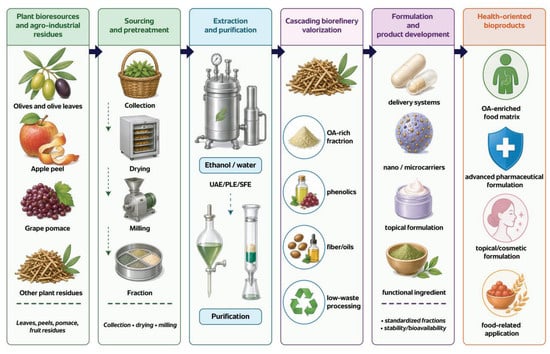
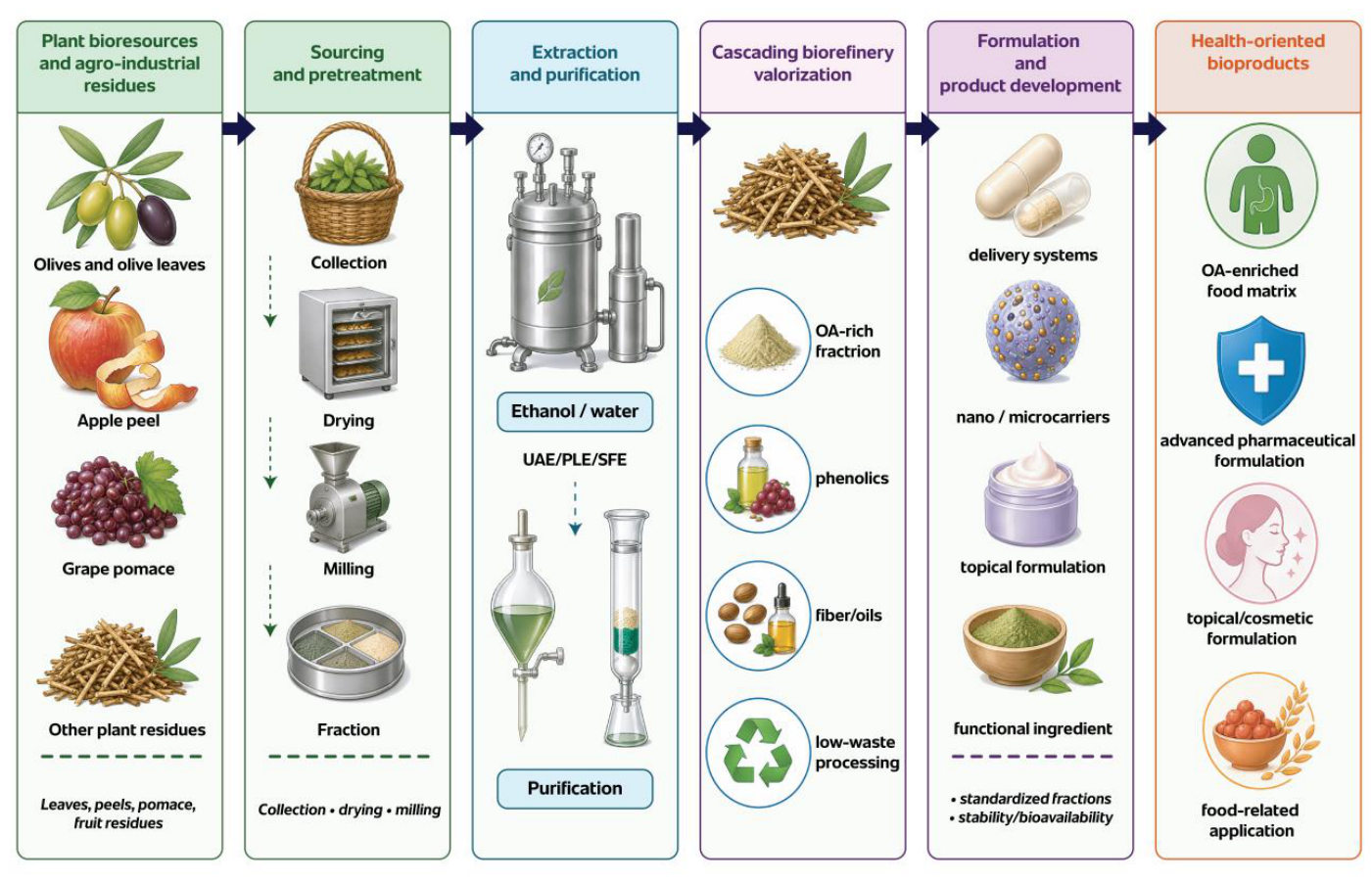
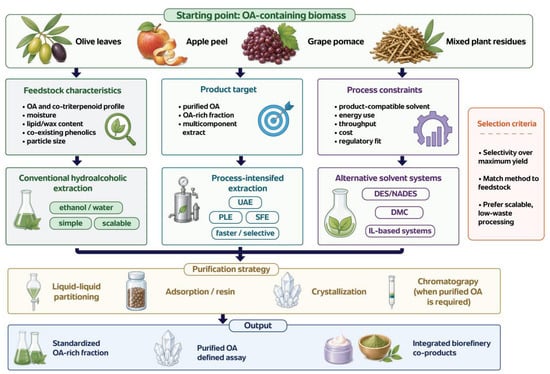
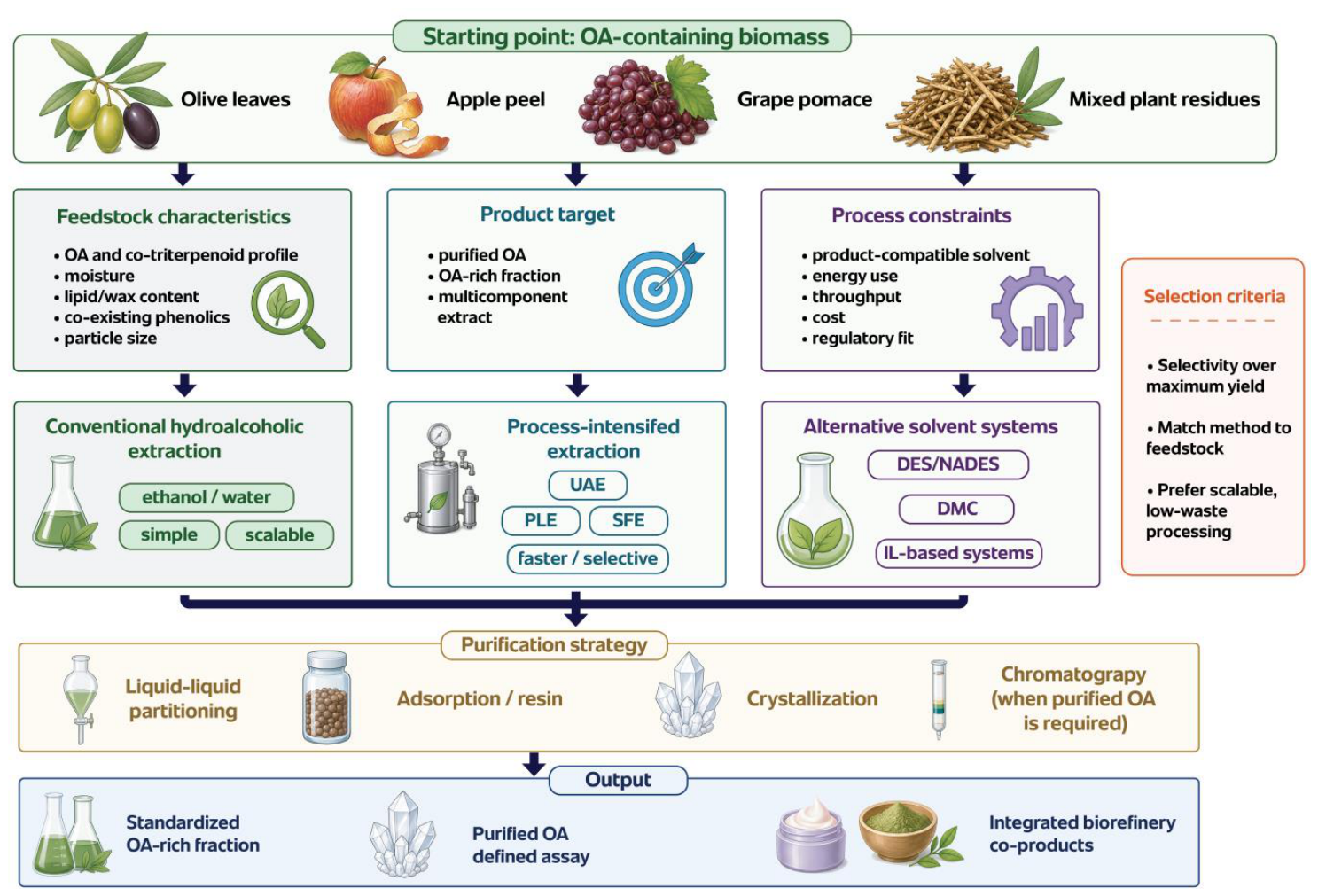
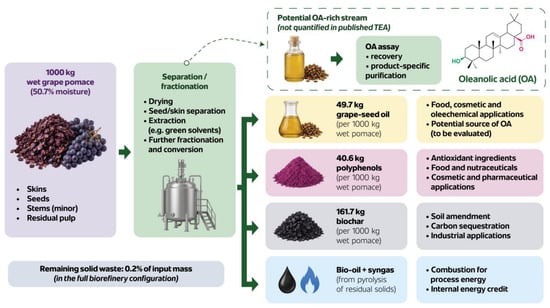
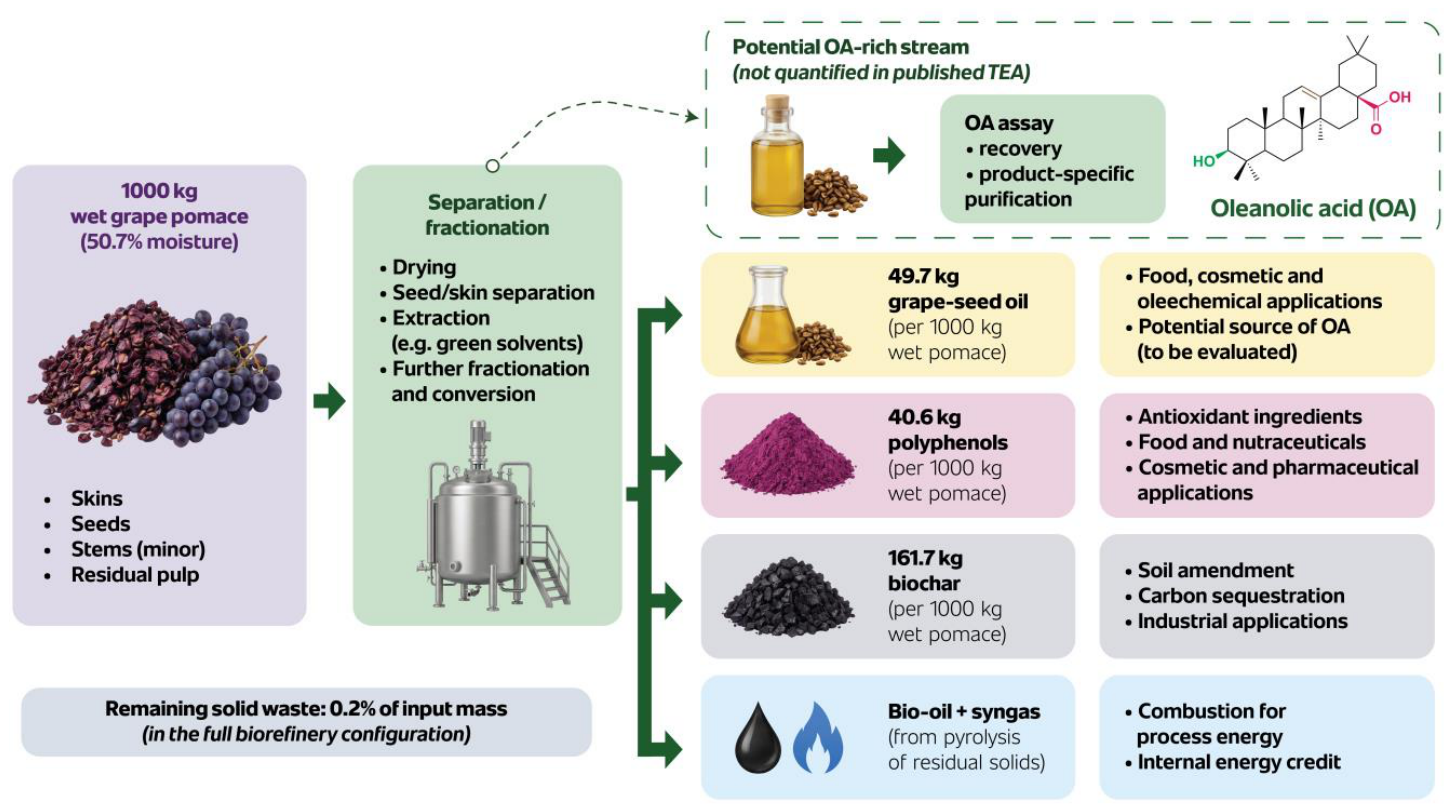
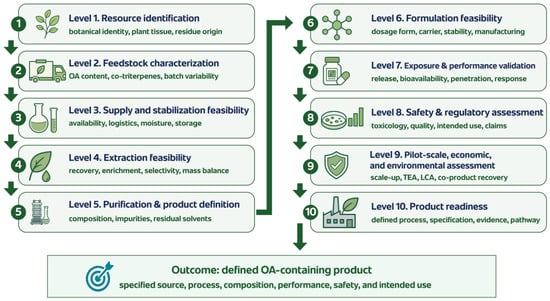
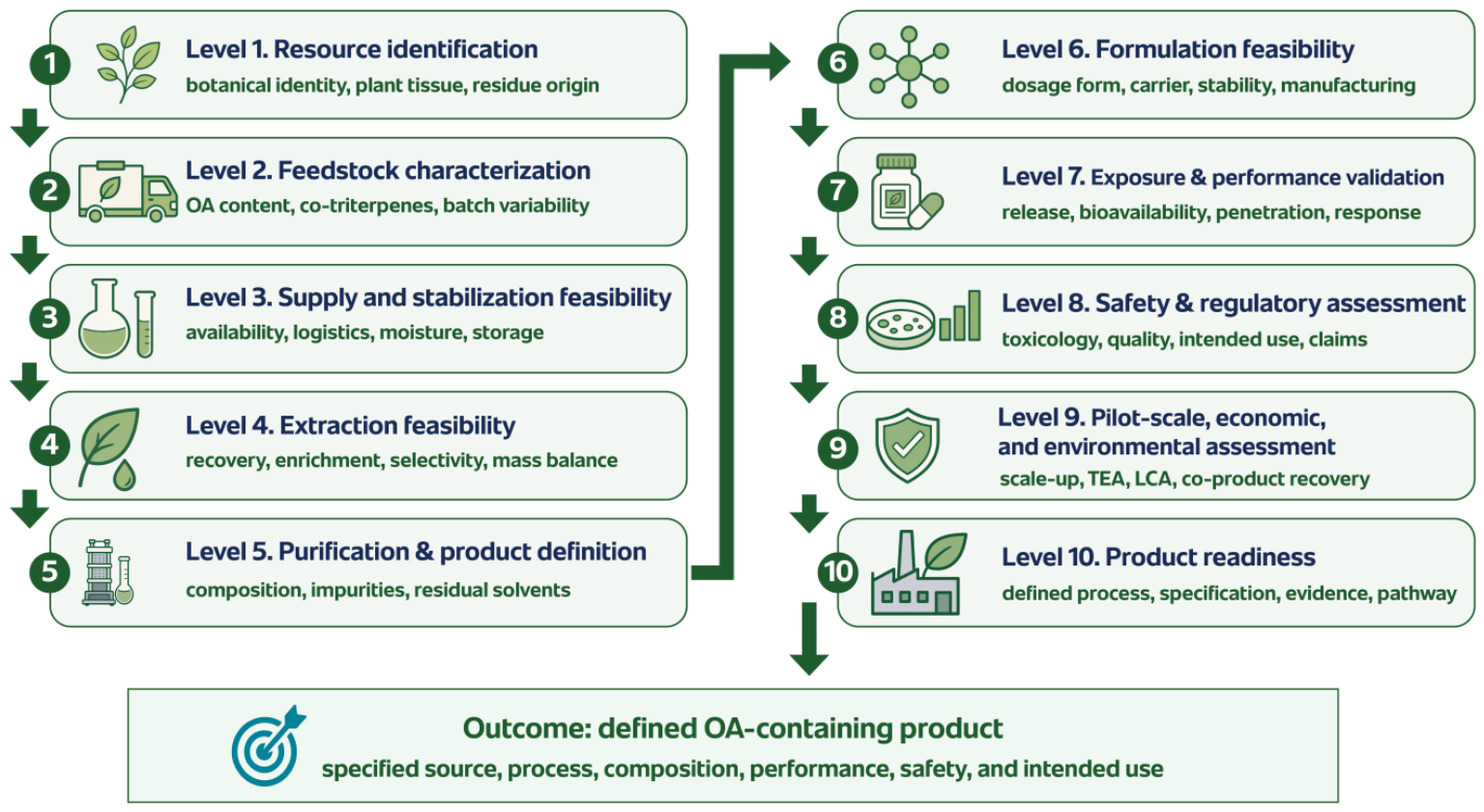

Disclaimer/Publisher’s Note: The statements, opinions and data contained in all publications are solely those of the individual author(s) and contributor(s) and not of MDPI and/or the editor(s). MDPI and/or the editor(s) disclaim responsibility for any injury to people or property resulting from any ideas, methods, instructions or products referred to in the content. |
© 2026 by the authors. Licensee MDPI, Basel, Switzerland. This article is an open access article distributed under the terms and conditions of the Creative Commons Attribution (CC BY) license.