


Abstract
In commercial aerospace flight-style launch scenarios, multiple parallel missions impose tight constraints, multiple objectives, and highly dynamic conditions on TT&C (Telemetry, Tracking, and Command) resource scheduling. This paper studies coordinated scheduling of TT&C equipment and sites. First, a multi-objective model is formulated that considers equipment–type matching, time-window constraints, mobile-equipment transfer paths, and coverage requirements. The model enforces coverage thresholds for all mission arc segments, while minimizing (i) the total travel distance of mobile equipment and (ii) the number of mobile units deployed. Second, to obtain high-quality feasible solutions quickly, an improved greedy scheduling algorithm is proposed. The algorithm processes tasks in chronological order and makes locally optimal decisions. It prioritizes fixed equipment and then selects mobile equipment by minimizing transfer distance under time-feasibility constraints. Finally, experiments on simulated scenarios demonstrate the effectiveness of the proposed method. The algorithm produces feasible schedules that satisfy coverage requirements in an extremely short time. It also provides a good initial solution for subsequent refinement, which makes it suitable for dynamic scheduling that requires real-time responsiveness.
1. Introduction
With the rapid growth of the global commercial space sector, large-scale, regular, and low-cost access to space is becoming essential. It enables emerging applications such as space resource utilization, in-space manufacturing, and space tourism. In this context, “scheduled launches” are regarded as a key direction for future space transportation systems. The goal is to provide Earth-to-space services in a flight-like manner, with high frequency, high reliability, and predictable launch timelines [1].
Commercial space companies are major drivers of this trend. They are developing launch systems that are more flexible, responsive, and cost-effective. From an industrial perspective, Xu et al. found that explosive launch demand (e.g., LEO constellation deployment) requires China’s space transportation system to overcome bottlenecks such as customized production and long launch-test cycles, and to shift toward high-frequency, low-cost services [2]. Liu et al. further argued that future launch systems should promote integrated information systems and digital–intelligent transformation, so as to achieve low cost, high efficiency, rapid response, and high reliability [3].
However, scheduled launches rely not only on reusable rockets and rapid launch operations, but also on ground-based TT&C systems. High-frequency missions, diverse trajectories, and parallel launches make TT&C scheduling much more difficult than traditional single-mission planning. In this paper, TT&C is treated as an integrated capability because, in flight-style launch scenarios, telemetry, tracking, and command are often provided by the same ground equipment and must be scheduled together. Separating them would increase modeling complexity and obscure the core coupling among resources.
Given limited TT&C equipment and fixed geographic deployment, the system must provide continuous coverage for multiple missions and multiple arc segments. At the same time, it should improve utilization efficiency and reduce operational costs. These requirements form a key bottleneck for scaling scheduled launches.
Although TT&C scheduling has been widely studied (see Section 2), most existing work focuses on single-mission settings or static allocation. Limited attention has been paid to the coupled problem of task assignment and mobile-equipment routing under high-frequency parallel launches. In addition, the operational features of flight-style launches—stringent real-time requirements, heterogeneous equipment types, and spatiotemporal coupling—have not been systematically addressed.
To address these gaps, TT&C equipment-site scheduling for multiple rockets launched in parallel is studied. A multi-objective model is formulated that minimizes total travel distance and the number of mobile units used, while meeting coverage constraints. A fast greedy algorithm is also designed to support dynamic scheduling with real-time requirements. The main contributions are as follows:
- Problem formulation. A multi-objective model for TT&C scheduling in flight-style launch scenarios is proposed. The model captures equipment-type matching, time windows, transfer paths, and coverage constraints.
- Algorithm design. Considering NP-hardness and real-time requirements, a constructive greedy algorithm is developed. It allocates tasks sequentially along the timeline using a “fixed first, mobile second, shortest distance” rule.
- Bridging Scheduling Theory and Space Engineering. While TT&C scheduling originates from space engineering, this study situates the problem within the broader field of integrated scheduling with transportation delays. The proposed model and algorithm offer a new application context for classical scheduling frameworks, extending their applicability to high-frequency commercial launch scenarios.
To the best of our knowledge, this is the first study that systematically addresses coupled resource allocation and mobile-equipment routing for high-frequency commercial rocket launches. The remainder of the paper is organized as follows. Section 2 reviews related work. Section 3 describes the problem. Section 4 presents the optimization model. Section 5 introduces the greedy algorithm and system implementation. Section 6 reports simulation results. Section 7 concludes and discusses future work.
2. Literature Review
This section reviews representative studies on TT&C resource scheduling from three perspectives: exact mathematical programming, heuristic/metaheuristic algorithms, and machine learning-based approaches. It is emphasized how existing work addresses (or does not address) coupled resource assignment and mobile-equipment routing under dynamic multi-mission scenarios.
2.1. Exact Mathematical Programming Methods
Early studies often formulated the TT&C scheduling problem as a mixed-integer programming model. Gooley et al. [4] from the U.S. Air Force Institute of Technology abstracted the space TT&C resource scheduling problem into a mixed-integer programming framework, thereby transforming high-frequency, highly dynamic resource allocation into a solvable mathematical formulation. Rigo et al. [5], addressing the scheduling problem for nanosatellite missions under extremely constrained resources, proposed an efficient branch-and-bound algorithm. They decomposed the original mixed-integer linear programming model by mission and constructed a novel formulation based on time profiles. Liang et al. [6] extended the optimization objective to dynamic resource reservation, reflecting a shift from simple efficiency optimization to strategic resource management; however, the trade-off relationships among their multiple objectives are complex, making the problem difficult to solve. Xu et al. [7] adopted integer linear programming modeling and utilized Lagrangian relaxation to enhance solution efficiency, significantly improving computational performance for large-scale scheduling problems. Lee et al. [8] formulated a mixed-integer linear programming model for scheduling missions and communications of multiple satellites with multiple ground stations under time-window constraints. Their model captures time-space network constraints and aims to maximize data throughput, representing another exact mathematical programming approach in the TT&C scheduling domain.
Exact methods can provide optimal solutions for small problems. However, their computational cost grows rapidly with instance size. As a result, they are often unsuitable for real-time scheduling in high-frequency launch scenarios.
2.2. Heuristic and Meta-Heuristic Algorithms
To overcome the computational limitations of exact methods, many researchers have turned to heuristic and meta-heuristic algorithms. In the application of genetic algorithms, Chen et al. [9] proposed an improved algorithm based on population perturbation and elimination strategies to maximize mission revenue and completion rate, providing an effective solution for high-conflict, multi-constraint scheduling problems under resource-limited conditions. Zhang et al. [10] focused on the multi-mission parallel planning problem at space launch sites and developed a genetic algorithm with a two-layer encoding scheme; using a process-preserving crossover strategy, their algorithm can generate an optimized plan for the parallel testing of five rockets within one minute. Yin et al. [11] concentrated on the multi-satellite TT&C scheduling problem under strong resource coupling and proposed an improved genetic algorithm that significantly enhances scheduling efficiency while ensuring mission revenue. Ma et al. [12] addressed TT&C for large constellations with a hybrid simulated-annealing multi-layer coded genetic algorithm that effectively balances global search and local exploitation. Ye et al. [13] used NSGA-II to optimize airline crew scheduling with competing objectives of cost and fatigue. Unlike such evolutionary methods, our greedy algorithm prioritizes real-time response over Pareto exploration.
Beyond genetic algorithms, other meta-heuristics have also been explored. Fan et al. [14] proposed an improved particle swarm algorithm incorporating heuristic rules, which increased the mission execution rate. Niu et al. [15] targeted the satellite observation resource scheduling problem in a multi-station cooperative mode and designed a large-scale neighborhood search algorithm based on a hybrid deletion operator, effectively improving the completion rate of large-scale satellite observation missions. Some studies have also designed dedicated heuristic rules for specific challenges. Xin et al. [16] developed a conflict-avoidance heuristic algorithm that identifies critical conflicting resources through probability distributions, offering a non-greedy strategy selection approach. Zhang et al. [17] adopted a “divide and conquer” strategy and a shuffled frog leaping algorithm for small satellite observation planning. Chen et al. [18] designed a dynamic scheduling method to handle disturbances such as mission insertions.
More recently, Zhang et al. [19] applied U-NSGA-III to design UAM corridor networks under three conflicting objectives. Their work confirms the viability of multi-objective evolutionary optimization in aviation, but the associated computational cost makes it less suitable for millisecond-level TT&C scheduling. Cong et al. [20] presented a stochastic NSGA-II model for multi-airport cooperative scheduling under uncertain travel and departure times, further illustrating the use of evolutionary optimization in aviation scheduling. Tang et al. [21] proposed a priority-based heuristic with partial backtracking for spacecraft TT&C task scheduling under time-window and task-splitting constraints, further demonstrating the effectiveness of heuristic methods in TT&C resource allocation.
These heuristic methods improve computational efficiency and can handle larger problem sizes, but most focus on either fixed equipment scheduling or simplified movement models. The integrated optimization of both task assignment and mobile equipment path planning—especially with spatiotemporal coupling—remains insufficiently explored.
2.3. Machine Learning-Based Approaches
With the advancement of computational power and machine learning techniques, reinforcement learning and deep learning have been increasingly applied to TT&C scheduling. Xue et al. [22] proposed a heterogeneous TT&C resource joint scheduling method based on the Deep Q-Network (DQN) reinforcement learning algorithm, aimed at solving the dynamic scheduling problem of multiple satellites, multiple ground stations, and multiple missions under the coexistence of state-owned and commercial TT&C resources. Building on this, Cheng et al. [23] introduced a deep reinforcement learning framework to address the integrated TT&C and data transmission resource scheduling challenges in large-scale constellation systems. Wu et al. [24] targeted the scenario dynamics and conflict complexity in multi-satellite TT&C resource scheduling, constructed a scheduling model based on the Markov Decision Process, and proposed a deep reinforcement learning method using the Asynchronous Advantage Actor–Critic (A3C) algorithm, achieving good results across multiple indicators such as mission completion and resource utilization. Dai et al. [25] introduced automated machine learning techniques into the space TT&C field, proposing a spectrum recognition method based on neural architecture search and a spectrum allocation strategy based on Bayesian optimization, enabling the automated generation of neural network architectures.
Machine learning-based methods show promise for handling uncertainty and adapting to dynamic environments, but they typically require extensive training data and careful parameter tuning, and their applicability to real-time, safety-critical launch scenarios is still under investigation.
2.4. Research Gaps and Motivation
The above review reveals that while substantial progress has been made in space TT&C scheduling, most existing studies treat the problem as either a static resource allocation or a pure task-sequencing problem, often overlooking the following aspects:
- Coupling of resource assignment and mobile equipment routing: Few works simultaneously optimize which equipment to assign to which task and how mobile equipment should move between sites under time-window constraints.
- High-frequency parallel missions: Traditional models are typically designed for single missions or low-density launch schedules; they do not adequately address the real-time requirements and resource competition arising from multiple launches occurring in quick succession.
- Comprehensive multi-objective trade-offs: Although multiple objectives are considered in some studies, the integration of coverage satisfaction, equipment utilization, and movement cost minimization in a unified framework remains scarce.
To address these gaps, this paper proposes a multi-objective optimization model that explicitly captures equipment type matching, time windows, movement paths, and coverage requirements. A fast greedy algorithm is designed to generate high-quality feasible solutions in real time, specifically tailored for flight-style launch scenarios. The proposed approach bridges the gap between classical scheduling theory and the practical needs of commercial space operations.
3. Problem Description and Analysis
3.1. Problem Description
Under the vision of commercial space scheduled launches, the TT&C system, as the core ground infrastructure ensuring launch safety and mission success, faces a fundamental transformation from serving single, low-frequency missions to supporting high-frequency, multi-mission parallel launches. The core problem addressed by this research can be summarized as follows: Given the hard constraints of limited quantity and fixed geographical distribution of TT&C resources (including both fixed and mobile stations), how to dynamically allocate these resources and plan the movement paths of mobile equipment for a series of parallel rocket missions, each with distinct launch times, flight trajectories, and TT&C requirements, thereby optimizing the overall system effectiveness while satisfying the coverage requirements for each mission’s critical arc segments.
3.2. System Characteristic Analysis
The entire TT&C resource scheduling process faces multiple complex constraints and system optimization challenges, primarily reflected in the following aspects:
- Heterogeneity of Mission Requirements. Rocket launch missions are not homogeneous units. Different missions have distinct flight trajectories and timing schedules. Each mission is decomposed into multiple TT&C arc segments, which have different equipment type requirements (e.g., telemetry, radar, optical), observation time windows, and coverage thresholds (critical arc segments typically require over 90% coverage, while general arc segments require over 70% coverage).
- TT&C Equipment Capability Constraints. TT&C resources are categorized into fixed stations and mobile stations, which differ significantly in coverage capability and deployment flexibility. Fixed stations have permanent locations and no movement costs, but their coverage is limited by their geographical positions. Mobile stations can be relocated between different preset sites via road networks, but movement requires time. Each piece of equipment belongs to a single equipment type (e.g., telemetry, radar, optical), and its coverage performance is determined by its maximum operational range and minimum observation elevation angle; coverage is ineffective beyond these limits.
- Coverage Capability and Spatial Constraints of TT&C Sites. TT&C sites are the physical locations where equipment is deployed, and different sites have varying capabilities to cover different rocket arc segments. The geographical distribution of sites determines their visibility for specific trajectories. The movement of mobile equipment between sites must consider the road network and distances, which constitutes a spatial path feasibility constraint.
- Coupling of Mission Execution and Resource Movement. The allocation of TT&C tasks and the path planning of mobile equipment are deeply coupled and mutually influential. The sequence and duration of equipment movement determine whether it can arrive at designated sites on time to perform subsequent tasks. Conversely, the time windows of tasks constrain the available periods for equipment movement. This spatiotemporal coupling requires that the scheduling scheme simultaneously satisfy the temporal continuity constraints of all equipment and the time window constraints of all missions; failure to do so renders the scheme infeasible.
The aforementioned constraints collectively constitute a highly constrained, multi-objective, and dynamic resource scheduling and path planning coupling problem. This necessitates that the scheduling system achieve a comprehensive balance between ensuring mission coverage and optimizing operational costs under limited resources.
4. Decision Optimization Model for TT&C Resource Scheduling
4.1. Model Assumptions
Based on the characteristics of the rocket TT&C resource scheduling problem and the modeling requirements, the following reasonable assumptions are established to simplify model complexity and focus on the core optimization objectives:
- Assumption of Deterministic Mission Data. The trajectory data, launch sequence, and TT&C arc segment divisions for rocket launch missions are known prior to the start of the scheduling period. Each arc segment has a defined time window, the required set of equipment types, and a minimum coverage threshold. Temporary changes that may occur during actual mission execution (such as launch delays or trajectory adjustments) are not considered; the model focuses on generating a static scheduling scheme for a given set of missions.
- Assumption of Trajectory Discretization and Demand Aggregation. The continuous flight trajectory of each rocket can be discretized into several arc segments characterized by constant TT&C requirements. Within each arc segment, the geometric relationship between the rocket and ground sites changes continuously over time, but the required equipment types remain stable. This assumption allows coverage capability to be statistically estimated through discrete-time sampling, transforming the continuous spatiotemporal visibility problem into calculable coverage parameters.
- Assumption of Arc Segment Types and Coverage Thresholds. Based on mission importance, each TT&C arc segment is classified as either a critical arc segment or a general arc segment, corresponding to minimum coverage thresholds of 0.9 and 0.7, respectively. This classification is known before the scheduling period begins and serves as an input constraint for the model.
- Assumption of Idealized Equipment State Transitions. During task execution and state transitions of TT&C equipment, preparation times such as antenna pointing adjustment, signal acquisition and locking, and equipment warm-up are either ignored or uniformly consolidated into a fixed constant preparation time. Mobile equipment is assumed to move at a constant speed between sites, with travel time strictly equal to the Euclidean distance divided by speed, disregarding factors like road conditions, traffic situations, or equipment failures.
- Assumption of Resource Exclusivity. Any single TT&C equipment unit can only perform one observation task at a time. Once a task begins, it cannot be interrupted or preempted. Equipment can only be transferred to the next task site after completing its current task. The movement process of mobile equipment also occupies its available time window; observation tasks cannot be performed during movement.
These assumptions ensure the mathematical tractability of the model while remaining as close as possible to engineering practice, laying a reasonable theoretical foundation for subsequent algorithm design and system implementation.
4.2. Definition of Elements
To accurately characterize the mathematical structure of the TT&C resource scheduling problem, the core elements involved in the model are formally defined as follows:
Scheduling Entities and Mission Requirements. The set of rocket launch missions is denoted as . For any mission , its flight trajectory is discretized into a series of consecutive TT&C arc segments, forming the set . Each arc segment possesses the following attributes: an indivisible observation time window indicating the start and end times during which the arc segment can be observed by TT&C equipment; a set of required equipment types , where is the set of all TT&C equipment types (e.g., telemetry, radar, optical), and a minimum coverage threshold is used to measure the required observation quality that the arc segment must achieve.
TT&C Resources. TT&C resources are classified into two categories: mobile TT&C equipment (TT&C vehicles) and fixed TT&C equipment (fixed stations). There are V TT&C vehicles. For any mobile station , its inherent attributes include its equipment type , its average movement speed , and its initial deployment site (typically a base or depot). There are F fixed stations. For any fixed station , its inherent attributes include its equipment type and its fixed deployment site , where is the set of all available TT&C sites. All TT&C resources are collectively referred to as equipment, denoted as .
TT&C Sites. TT&C sites are the geographical locations where equipment can be deployed to carry out observation tasks, forming the set . Each site is uniquely determined by its longitude, latitude, and elevation in the geodetic coordinate system. The travel distance between sites is denoted as , which is assumed to be a known Euclidean distance or road network distance. This distance, together with the mobile station’s movement speed , determines the travel time required for the equipment to transfer between two sites.
Equipment Performance and Coverage Capability. Each equipment type has two key performance parameters: the maximum operational range and the minimum observation elevation angle . For a given arc segment of rocket mission , if equipment of type is deployed at site , its coverage capability for arc segment is quantified by the coverage parameter . This parameter is pre-calculated based on spatial geometric relationships and represents the proportion of time within the arc segment’s time window during which the equipment at that site can satisfy the conditions of having an elevation angle no less than and a slant range not exceeding .
Scheduling Decision Variables. The scheduling scheme is described by the following system of decision variables: The binary variable indicates whether TT&C vehicle is assigned to site to perform the observation task for arc segment . Similarly, indicates whether fixed station is assigned to perform the observation for that arc segment. To characterize the movement paths of mobile equipment, the binary variable is introduced, denoting whether TT&C vehicle transfers from site to site . The auxiliary continuous variables and record the arrival time and departure time of TT&C vehicle at site , respectively. Furthermore, the binary variables and indicate whether TT&C vehicle and fixed station are actually utilized in the scheduling scheme, respectively.
To facilitate subsequent modeling, the key elements involved in the model are formally defined, and the main symbol descriptions are shown in Table 1.
Table 1.
Symbol Definition.
4.3. Mathematical Model Formulation
This model aims to optimize the scheduling scheme for TT&C resources and is formulated as a multi-objective optimization problem. The primary objectives are to ensure that coverage requirements for all arc segments are satisfied (enforced through constraints) and to minimize the total movement distance of mobile equipment, which directly affects operational cost. In addition, the model also implicitly seeks to reduce the number of equipment units used, particularly mobile ones, as a secondary consideration for resource efficiency. To capture these objectives, the following optimization criteria are defined:
- Minimizing the Total Travel Distance: This objective aims to reduce the cumulative travel distance of all mobile equipment, thereby lowering fuel consumption, equipment wear, and overall operational cost:
- 2.
- Minimizing the Number of Mobile Equipment Utilized: This objective focuses on reducing the number of mobile equipment units (TT&C vehicles) used, thereby lowering movement costs and scheduling complexity:
The above two optimization objectives involve an inherent trade-off. On one hand, reducing the number of mobile equipment units used tends to prioritize fixed stations and fully utilize already-deployed mobile units, which may increase the travel distance of individual mobile units. On the other hand, minimizing the total travel distance prefers selecting the closest mobile equipment, potentially activating more units to shorten individual trips. The two objectives are not perfectly aligned, and a balance must be struck between resource economy and movement efficiency.
To handle both objectives simultaneously, this paper adopts a hierarchical optimization strategy. Minimizing the total travel distance is treated as the primary objective, which is directly optimized by the “shortest-distance-first” selection rule embedded in the greedy algorithm. Minimizing the number of mobile equipment units used is treated as a secondary objective, which is indirectly achieved through the “fixed-equipment-first” allocation rule and the equipment status tracking mechanism. This strategy is justified by the practical requirements of flight-style launch scenarios: travel distance directly affects fuel consumption, equipment wear, and mission responsiveness, and thus constitutes the main component of operational cost, whereas the number of equipment units used has a relatively secondary impact on system schedulability. Therefore, instead of using a weighted-sum or Pareto-based multi-objective approach, this paper unifies the two objectives within a single decision framework through priority rules in the greedy strategy, ensuring solution quality while maintaining real-time performance.
The decision-making for the entire system must satisfy multiple types of constraints.
Equations (3)–(12) are the constraints. Equations (3) and (4) state that if the coverage of equipment at site for arc segment is zero, then the task cannot be assigned. Equations (5) and (6) stipulate that the equipment type assigned to a task must belong to the set of types required for that arc segment. In the following constraints, denotes a sufficiently large positive constant, used to construct logical constraints that are activated only when the corresponding decision variable equals 1. Equations (7) and (8) require that the time during which equipment performs a task must strictly fall within the observation time window of arc segment . Equation (9) specifies that the same equipment can only perform at most one task at any given time. For mobile equipment, if it is to perform two consecutive tasks, sufficient time must be reserved for transfer and preparation; Equations (10) and (11) indicate that if a piece of equipment is assigned any task, its utilization indicator variable must be true. Equation (12) mandates that for each equipment type required for every arc segment , the cumulative coverage provided by all utilized equipment must meet or exceed the threshold for that arc segment.
The aforementioned constraints collectively define the feasible solution space for the TT&C resource scheduling problem. Some of the complex constraints are presented only in a basic framework within the mathematical model. During the actual algorithm solution, these are satisfied through heuristic rules, thereby improving solution efficiency while ensuring feasibility.
5. Algorithm Design and System Construction
Addressing the strongly constrained, multi-objective characteristics of the rocket TT&C resource scheduling problem in scheduled launch scenarios, as well as the urgent requirement for real-time response posed by large-scale concurrent missions, this chapter designs a fast constructive algorithm based on a greedy strategy. This algorithm takes the mission timeline as its main thread, adheres to the local optimization criteria of “fixed stations first, then mobile units; among the same type, select the closest,” and efficiently generates a scheduling scheme that meets coverage requirements while ensuring temporal feasibility.
5.1. Design Philosophy of the Greedy Algorithm
The rocket TT&C resource scheduling problem addressed in this paper is a classic NP-Hard problem. Its complexity stems from the fact that it is a hybrid of several classic combinatorial optimization challenges. Specifically, it requires simultaneous decision-making on three coupled sub-problems: which equipment to assign to which task (resource allocation), in what sequence a piece of equipment should perform its tasks (task sequencing), and how mobile equipment should travel between sites to minimize costs (path planning). The problem can be viewed as a comprehensive extension of the Generalized Assignment Problem (GAP), the Vehicle Routing Problem with Time Windows (VRPTW), and the Job-Shop Scheduling Problem (JSP). Following the classification framework of integrated production and outbound distribution scheduling (IPODS) proposed by Chen et al. [26], a similar bilevel coordination idea appears in Peng et al. [27] for multi-airport departure management, where takeoff sequencing and surface taxiing are optimized jointly. Unlike their use of NSGA-II and simulated annealing, the greedy strategy proposed in this paper prioritizes deterministic rule-based decisions to meet real-time constraints. A similar two-stage greedy idea appears in Jeong et al. [28] for heterogeneous multi-UAV task allocation, where an initial greedy allocation is followed by a “rebalancing” step that reassigns tasks to reduce makespan under temporal constraints, which is conceptually analogous to our “fixed-first, mobile-second, shortest-distance” priority rule. This problem falls into the category of “models with batch delivery to multiple customers by the routing method,” which inherently combines resource allocation, task sequencing, and vehicle routing decisions.
As the number of tasks, equipment types, and available sites increases, the number of potential scheduling schemes grows exponentially, leading to a “combinatorial explosion.” For instance, merely matching N tasks to M equipment units presents a vast number of combinations, even before considering the complex routing choices for each mobile unit among multiple sites and strict time-window constraints. Consequently, finding a globally optimal solution that satisfies all constraints and optimizes multiple objectives (e.g., movement distance, number of equipment) through exhaustive search is computationally intractable and cannot be accomplished in polynomial time. This is a hallmark of NP-Hard problems and justifies why, in engineering practice, heuristic algorithms like the greedy strategy proposed herein are employed to rapidly generate high-quality feasible solutions. Such numerical methods, as discussed in Han et al. [29] for on-line supply chain scheduling, are well-suited for NP-hard problems where real-time responsiveness is critical. The core philosophy of the greedy algorithm proposed in this paper can be summarized as follows:
- Sequential Processing Along the Timeline: All TT&C arc segments are sorted in ascending order of their start times, and resources are allocated sequentially for each type of equipment required for each arc segment. This processing method ensures that tasks with earlier times have priority in acquiring resources, preventing later tasks from preempting resources and causing earlier tasks to miss their windows.
- Fixed Equipment Priority: Fixed stations are located at known sites, require no movement, and incur no additional costs, so they are allocated first. If a fixed station exists that matches the required type, is idle during the required time, and has positive coverage for the task, it is used directly.
- Shortest Distance Priority for Mobile Equipment: When fixed equipment is unavailable, the algorithm selects, from all mobile equipment of the required type, the “equipment-site” combination that can arrive at the target site on time and involves the shortest movement distance. This criterion aims to minimize the total movement distance while also considering equipment load balancing.
The above philosophy pursues the minimization of resource consumption while ensuring the feasibility of the scheme, aligning with the dual requirements of rapidity and economy in practical scheduling.
It is worth noting that the proposed greedy strategy differs fundamentally from generic swarm intelligence methods (e.g., the predatory search strategy discussed in [30]) in both objective and mechanism. Swarm-based methods focus on continuous optimization and global exploration, whereas the present work addresses a discrete, strongly constrained scheduling problem where feasibility and real-time response dominate over optimality. The contribution is not a new metaheuristic, but rather a domain-aware constructive heuristic that reduces a complex NP-hard problem to a tractable sequence of local decisions without sacrificing solution quality.
The proposed greedy strategy differs from conventional greedy scheduling methods in two key aspects. First, it explicitly handles multi-type equipment requirements by processing each required equipment type separately for every arc segment, rather than treating tasks as monolithic units. This allows the algorithm to incrementally accumulate coverage from multiple equipment units until the threshold is met. Second, it incorporates a spatiotemporally aware feasibility check (detailed in Section 5.3) that accounts for both site transfer times and preparation times, enabling realistic mobile equipment routing. While standard greedy algorithms typically consider only immediate task allocation, resource assignment and movement decisions are integrated in a unified framework by the proposed approach, which is essential for the coupled nature of flight-style launch TT&C scheduling.
5.2. Greedy Algorithm Procedure
The algorithm processes arc segments in chronological order. For each required equipment type of a segment, it first tries to allocate a fixed station that is idle and has positive coverage. If none is available, it selects the mobile equipment that can arrive at a suitable site on time with the shortest travel distance. This greedy selection ensures feasibility while keeping computational cost low. The detailed steps are given in Algorithm 1.
| Algorithm 1: Greedy Algorithm (GA) |
| ; equipment set (fixed equipment , mobile equipment ); site distance matrix coverage threshold Output: Scheduling scheme Initialization: 1. For each fixed equipment : status idle, occupied time slots 2. For each mobile equipment :current position , available time , accumulated distance 3. For all segments 4. Total movement distance Main loop: For each arc segment 1. Obtain , , 2. For each , if 3. Fixed equipment allocation: Traverse idle equipment of type at site has coverage for and is idle within , then: , add the time slot to , record the assignment 6. 7., skip to next type 8. Mobile equipment allocation: If then: of type and candidate sites : ) 12. If 13. Update , , 14. If , then: 15. Update : 16. 17. Record trajectory (start point , end point , distance , arrival time , arc segment ) 18. 19. , record assignment 20. If and there are other available mobile equipment, repeat this mobile equipment allocation process 21. If finally , record coverage gap |
5.3. CheckFeasibility Function: Temporal Feasibility Check
During the allocation process of mobile equipment, it is necessary to determine whether a piece of equipment departs from its current location, arrives at the target site, and completes the necessary preparations before the task start time. To this end, the CheckFeasibility function is defined. Its inputs are the equipment , the target site , and the task start time ; its output is a Boolean value indicating whether the assignment is feasible.
Assume that the current position of equipment is , its available time (i.e., the end time of its previous task) is , and its movement speed is . The distance from to the target site is ; then the required movement time is .
The preparation time τ is determined based on task continuity:
If the equipment performs consecutive tasks at the same site (i.e., ), then the preparation time τ is set to 60 s;
Otherwise (different sites ), the preparation time τ is set to 300 s;
The earliest time the equipment can start moving towards the target is:
The arrival time at the target site is:
The time when preparations are completed is:
If , the equipment can be in position before the task starts, and CheckFeasibility returns True; otherwise, it returns False.
This check mechanism implicitly embodies the temporal exclusivity of the equipment: since the equipment’s available time is exactly the end time of its previous task, if the start time of the new task is earlier than this time, will be forcibly postponed to , thereby automatically avoiding time conflicts.
5.4. System Module Construction
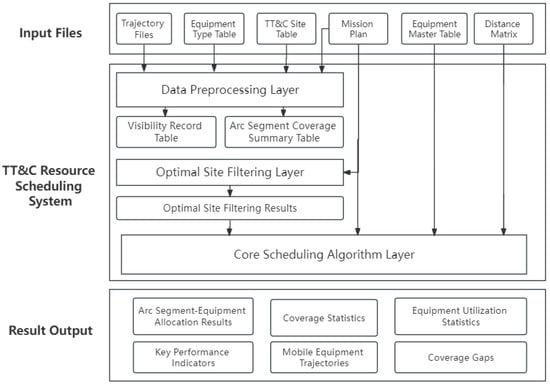
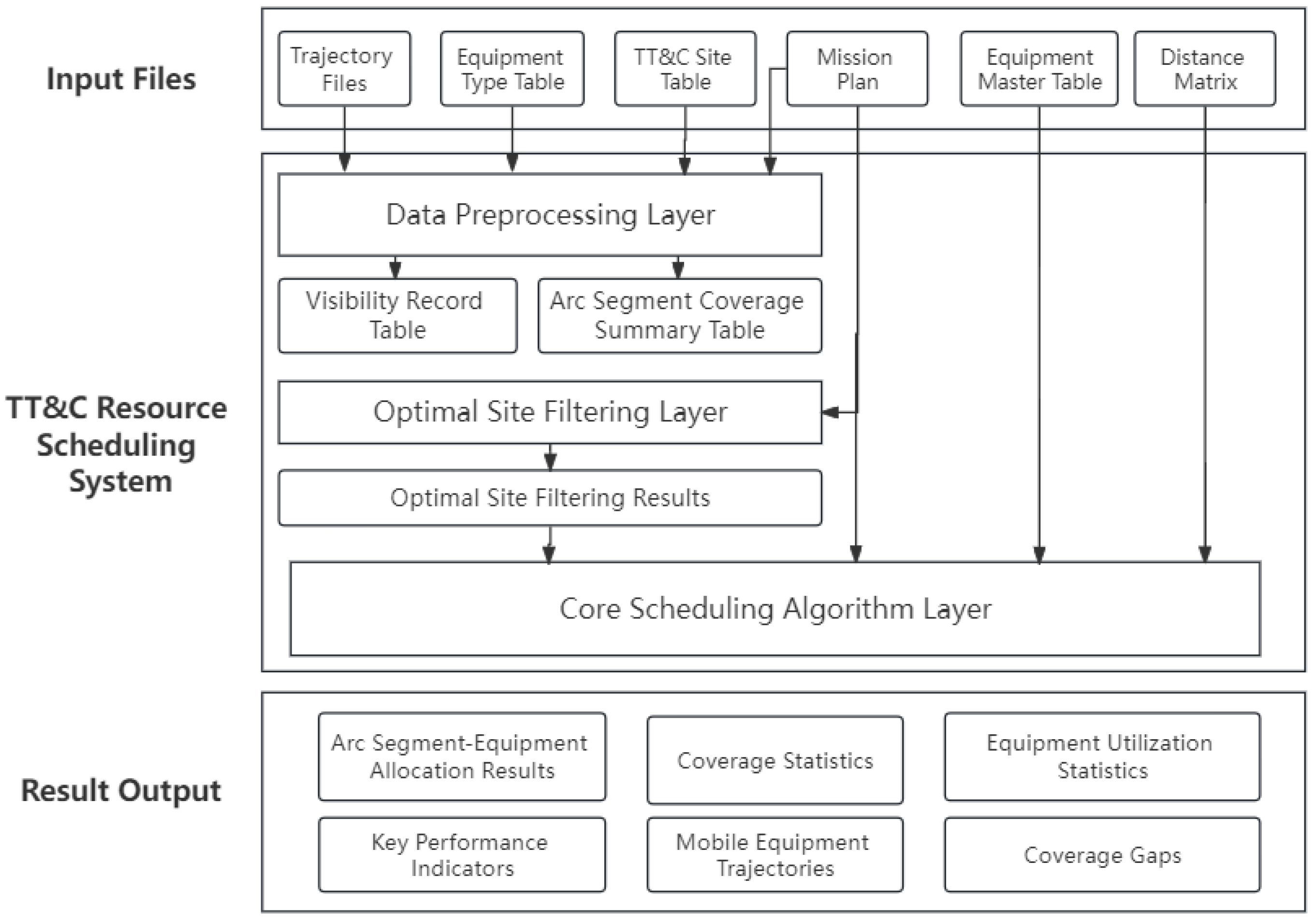
To implement the aforementioned algorithm and support engineering applications, this paper designs and implements a modular rocket TT&C resource scheduling system. The overall architecture is shown in Figure 1. The system follows the principles of separating data from decision-making and module decoupling, and is divided into four layers.
Figure 1.
Measurement and Control Resource Scheduling System Architecture.
Data Preprocessing Layer: Responsible for processing trajectory data, TT&C site coordinates, and equipment performance parameters. It generates an “equipment-site-arc segment” coverage matrix through spatial geometric calculations. This layer also computes the site distance matrix, providing a foundation for subsequent path planning. Preprocessing results are stored in file formats for use by upper layers.
Optimal Site Filtering Layer: Based on the arc segment types (critical/general) specified in the mission plan and their corresponding coverage thresholds (0.9/0.7), this layer filters the coverage matrix to generate a list of candidate sites for each arc segment’s required equipment type (i.e., the set of sites that meet the minimum quality requirements). This layer effectively narrows the search space for subsequent algorithms, improving scheduling efficiency.
Core Algorithm Layer: Implements the greedy scheduling algorithm described in this chapter. This layer receives the mission plan, equipment information, candidate site lists, and the distance matrix as input, maintains dynamic equipment status in memory, constructs the scheduling scheme in chronological order, and outputs detailed allocation results, equipment trajectories, and performance indicators.
Result Output Layer: Parses the scheduling scheme generated by the algorithm into standardized, multi-perspective, and easy-to-read reports. These include the arc segment-equipment allocation table, equipment utilization statistics, mobile equipment trajectories, coverage statistics, coverage gaps, and summaries of key performance indicators. Output files are in Excel format, facilitating manual review and subsequent analysis.
The modules interact through standardized data interfaces, which not only ensures the overall scalability of the system but also facilitates the replacement or upgrading of the core algorithm for different scenarios. In practical applications, the preprocessing and filtering layers can run offline, while the core algorithm layer can respond to mission changes in real-time, meeting the dynamic scheduling requirements of scheduled launches.
5.5. Complexity, Feasibility, and Optimality Analysis
To thoroughly evaluate the proposed greedy algorithm, this section analyzes its computational complexity, solution feasibility, and optimality characteristics.
Time Complexity. The greedy algorithm processes each arc segment and, for each required equipment type, iterates over candidate equipment units. Let be the total number of arc segments, be the maximum number of equipment types per segment, be the number of fixed stations, and be the number of mobile stations. For mobile stations, the algorithm evaluates candidate equipment–site pairs, where the number of candidate sites is bounded by , the total number of TT&C sites. The feasibility check for each candidate involves computing travel distance and verifying temporal constraints, both of which are operations. Therefore, the overall time complexity is In practice, the candidate site list is pre-filtered (as described in Section 5.4), which significantly reduces the effective value of , making the algorithm highly efficient.
Feasibility Analysis. The algorithm guarantees the generation of a feasible scheduling solution by explicitly enforcing all constraints during the allocation process. Temporal feasibility is ensured through the time feasibility check (Section 5.3), which verifies that mobile equipment can arrive at the target site and complete preparations before the task start time. Resource exclusivity is maintained by updating equipment status (i.e., available time and current location) immediately after each allocation, preventing overlapping assignments. If no suitable equipment is available for a given arc segment–equipment type pair, the algorithm records a coverage gap and continues.
Optimality Analysis. The proposed algorithm follows a greedy strategy that makes locally optimal decisions at each step—prioritizing fixed equipment and, among mobile equipment, selecting the one with the shortest travel distance. While this approach efficiently constructs a feasible solution, it does not guarantee global optimality. Greedy algorithms are known to be effective for problems where local optimal choices lead to globally optimal outcomes, but the TT&C resource scheduling problem exhibits strong coupling between resource allocation and path planning, making such properties unlikely to hold in all cases. Nevertheless, the greedy design is justified by the practical requirements of flight-style launch scenarios, which demand rapid generation of high-quality feasible solutions.
6. Simulation Experiments and Result Analysis
To verify the effectiveness of the greedy algorithm proposed in this paper, this chapter constructs a simulation experiment for TT&C resource scheduling under scheduled launch conditions based on the theoretical framework established in Section 4 and Section 5. The experimental scenario relies on the geographical characteristics of a typical commercial space launch site, with simulation sites and trajectory data generated parametrically, to systematically evaluate the system’s performance.
6.1. Experimental Scenario and Parameter Settings
Currently, global commercial space launch activities are becoming increasingly frequent, with major spacefaring nations and regions constructing or planning dedicated commercial launch sites. The Cape Canaveral Space Launch Complex in the United States is one of the world’s busiest commercial launch sites, having long undertaken various commercial launch missions for companies such as SpaceX and ULA. Its well-established infrastructure and abundant TT&C resources provide a typical scenario for research on scheduling methods. The Guiana Space Centre in Kourou, leveraging its geographical advantage near the equator, has become a primary base for European commercial launches. In recent years, China has also accelerated the development of its commercial space launch capabilities. The Hainan Commercial Space Launch Site is under construction and will soon be operational, set to become a core hub for high-frequency commercial rocket launches in China. These launch sites share common characteristics in terms of TT&C resource layout, mission types, and equipment configurations, providing a realistic foundation for validating the universality of the method proposed in this paper.
The coordinates (28.39° N, 80.61° W) are selected as the mission launch point. Thirty TT&C sites are simulated around the launch site in different directions (east, northeast, north) and at various distances. The longitude, latitude, and distance matrix of these sites are calculated using spherical geometry. Elevations are randomly generated within a range of 0 to 2000 m to simulate realistic terrain undulations. The sites are numbered 1 to 30.
The 30 TT&C sites are arranged radially from the launch point toward the north, northeast, and east directions. Specifically, sites 1–10 are placed along the northward direction (longitude fixed at −80.61°, latitude increasing from 30.19° to 46.38°), sites 11–20 extend northeastward (longitude decreasing from −79.14° to −64.02°, latitude increasing from 29.66° to 40.12°), and sites 21–30 are distributed eastward (longitude decreasing from −78.56° to −60.35°, latitude slowly decreasing from 28.38° to 26.89°). This configuration covers the typical flight corridors of the launch missions.
A total of 30 TT&C equipment units are configured, covering four types: radar, optical, telemetry, and safety control. Their performance parameters, listed in Table 2, are based on typical specifications of operational TT&C equipment. The mission time windows in Table 3 were randomly generated over a 7-day period to simulate a high-density launch scenario. The arc segment requirements in Table 4 were defined according to mission criticality: critical segments (e.g., ascent phase) require radar and telemetry coverage, while general segments allow more flexibility. All trajectory data were generated using STK with a 1 s sampling interval, providing accurate position sequences for coverage calculations. The equipment is divided into fixed stations and mobile stations. There are 15 fixed stations, initially deployed at specific sites, and 15 mobile stations, initially located at their deployment base. The movement speed of mobile equipment is set to 20 m/s. The preparation time for consecutive tasks at the same site is 60 s, while that for tasks at different sites is 300 s.
Table 2.
Equipment Type and Technical Specifications.
Table 3.
Mission schedule and trajectory parameters.
Table 4.
Mission Plan and Segment Requirements.
Rocket launch trajectories were simulated using STK (Systems Tool Kit) Version 12.2 software (Analytical Graphics, Inc., Exton, PA, USA) with a sampling interval of 1 s, providing the precise position sequence of each rocket in the Earth-Centered, Earth-Fixed (ECEF) coordinate system. A scenario involving five rocket launch missions executed over a 7-day period was simulated. The mission time windows, launch points, and burnout points for each mission are summarized in Table 3.
Each mission includes 7 TT&C arc segments, which are classified into critical segments (coverage threshold 0.9) and general segments (coverage threshold 0.7). The equipment types required for each arc segment are determined by mission requirements, and the specific mission plan is shown in Table 4. The start and end times of the arc segments are accurate to the second, and the trajectory flight sequence has been taken into account.
6.2. Baseline Algorithms and Evaluation Metrics
The detailed experimental setup, including the configuration of TT&C sites, equipment, missions, and trajectory parameters, is described in Section 6.1. This section presents the baseline algorithms used for comparison and the evaluation metrics adopted to assess performance. To comprehensively evaluate the performance of the greedy scheduling algorithm (GA) proposed in this paper, two representative classical intelligent optimization algorithms were selected for comparison:
- Genetic Algorithm (GA): A standard genetic algorithm framework is used, employing a weighted sum method to simultaneously optimize coverage and movement distance. The parameter settings are as follows: population size 50, number of generations 100, crossover probability 0.8, mutation probability 0.1. Tournament selection is used for the selection operation, single-point crossover for the crossover operation, and uniform mutation for the mutation operation.
- Particle Swarm Optimization (PSO): A standard particle swarm optimization framework is used, also with a weighted sum as the fitness function. The parameter settings are as follows: swarm size 30, maximum iterations 100, inertia weight 0.7, cognitive coefficient 1.5, and social coefficient 1.5.
The following metrics are primarily used for evaluation:
- Mission Completion Rate: The ratio of arc segment–equipment type combinations that meet the coverage threshold to the total number of required combinations. The total number of required combinations is the sum of equipment types required for all arc segments.
- Equipment Utilization Rate: The ratio of the number of equipment units actually used to the total number of equipment units (30).
- Total Travel Distance: The cumulative distance traveled by all mobile equipment during the mission period (in meters).
- Algorithm Runtime: The total time consumed from inputting mission data to outputting a complete scheduling scheme (in seconds), used to evaluate real-time performance.
- Coverage Gaps: The number of arc segment–equipment type combinations that fail to meet the coverage threshold, along with their corresponding gap values.
- Fixed/Mobile Equipment Usage Ratio: Reflects the scheduling scheme’s reliance on fixed resources. A higher ratio indicates that the algorithm prioritizes fixed equipment to reduce movement costs.
6.3. Experimental Results
Based on the experimental settings described in Section 6.1 and the evaluation metrics defined in Section 6.2, the proposed greedy scheduling algorithm was applied to optimize resource scheduling for five rocket launch missions, comprising a total of 35 TT&C arc segments. This section analyzes the experimental results from multiple dimensions, including equipment utilization, movement distance, coverage satisfaction, and time feasibility.
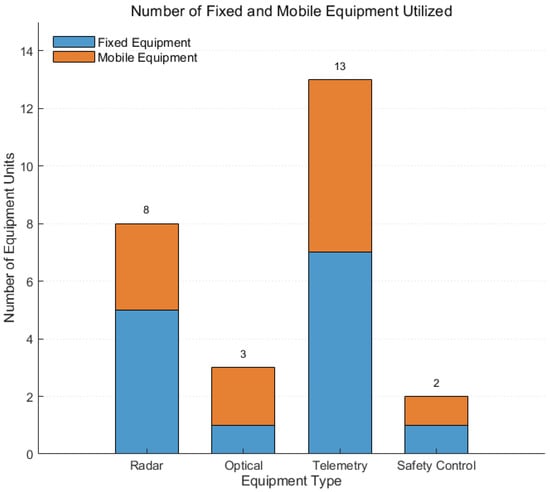
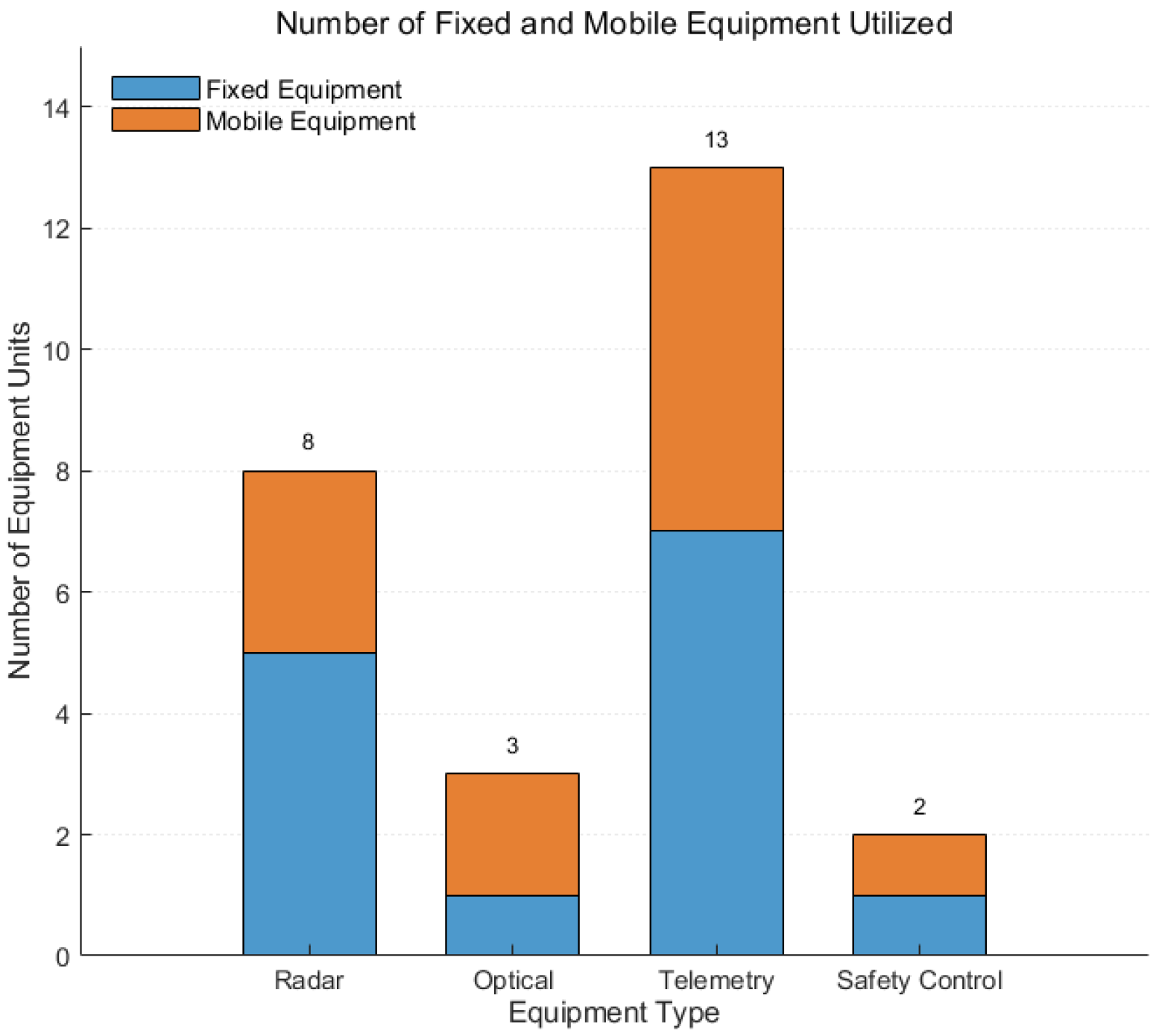
Equipment Utilization Structure. Across the five rocket launch missions, a total of 25 equipment units were utilized, resulting in an equipment utilization rate of 83.33%. The utilization ratio of fixed to mobile equipment was 1.27:1, indicating that the algorithm prioritizes the use of fixed equipment to reduce movement costs. The fact that 5 equipment units were not utilized reflects the system’s inherent redundancy tolerance in resource scheduling. Figure 2 illustrates the number of fixed and mobile equipment units utilized by the proposed algorithm.
Figure 2.
Number of Fixed and Mobile Equipment Utilized.
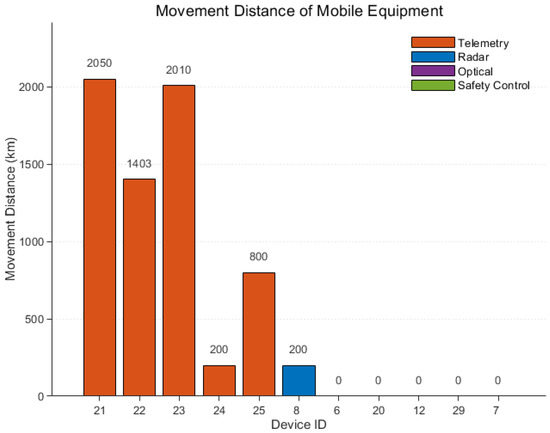
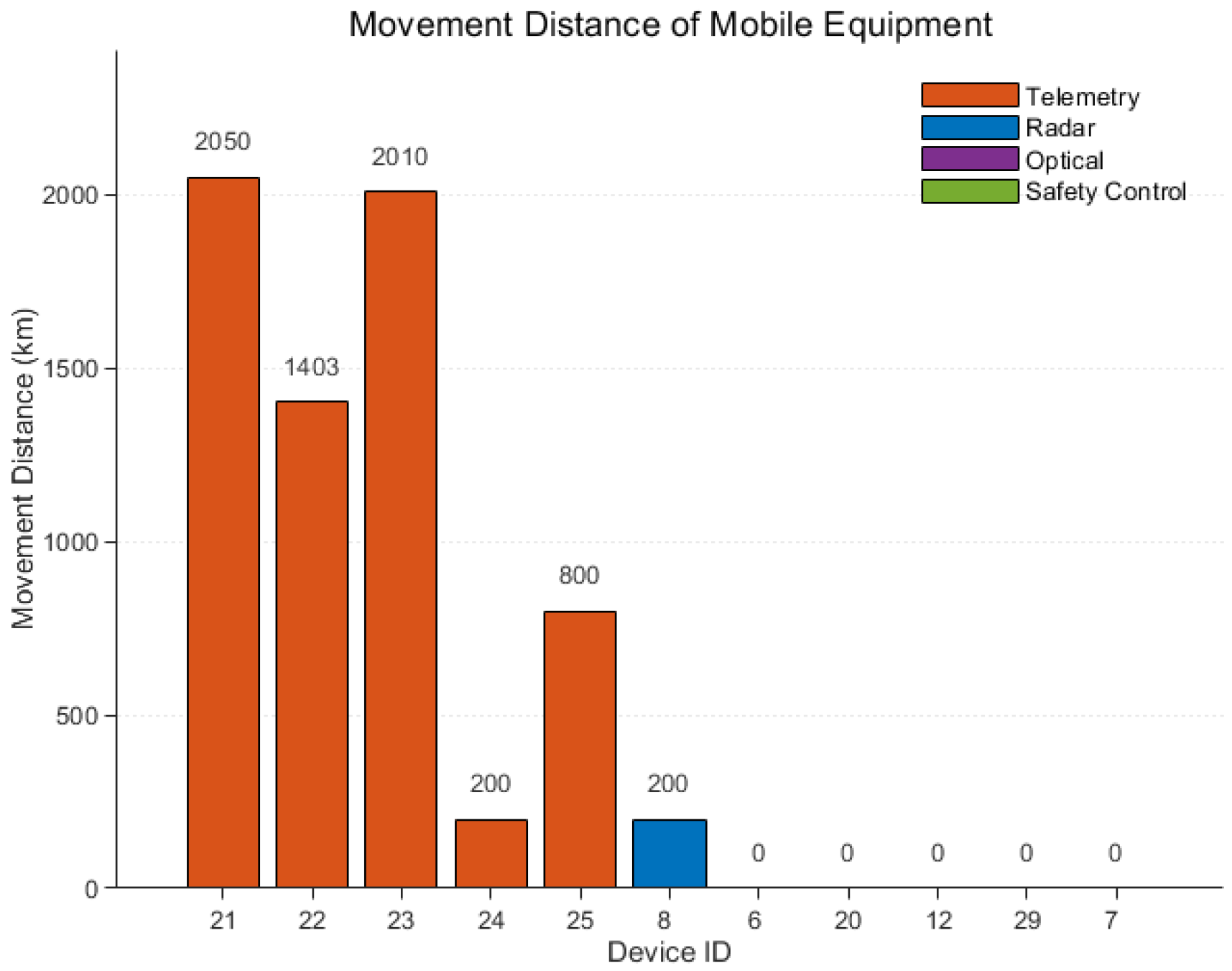
Mobile Equipment Movement Characteristics. The total movement distance of the mobile equipment was 6,662,660 m (approximately 6662.66 km), with an average movement distance of 605,696.36 m per mobile equipment unit. The movement distance for each equipment unit is shown in Figure 3. Notably, some mobile equipment units (such as Equipment 6, 20, 12, and 29) did not move at all, completing multiple tasks at their initial sites. For instance, Equipment 20 executed 6 arc segments without any relocation. This reflects an efficient utilization strategy involving “consecutive tasks at the same site,” where the preparation time for same-site consecutive tasks is only 60 s, significantly reducing operational overhead.
Figure 3.
Movement Distances of Mobile Equipment.
Coverage Satisfaction. The experimental results demonstrate that the proposed greedy algorithm generated a feasible scheduling scheme meeting all coverage requirements within an extremely short time. The number of coverage gaps was zero, achieving a 100% arc segment satisfaction rate. This verifies the effectiveness and robustness of the algorithm under strongly constrained conditions.
Computational Efficiency. Under the test environment with a main frequency of 2.8 GHz, the proposed algorithm achieved a solution time of only 0.09 s, demonstrating strong real-time response capability and fully meeting the requirements for high-frequency and rapid response in scheduling systems under flight-style launch scenarios.
6.4. Comparative Algorithm Analysis
To comprehensively evaluate the performance of the proposed greedy algorithm, two representative classical intelligent optimization algorithms—a standard genetic algorithm (GA) and a standard particle swarm optimization (PSO) algorithm—were implemented as benchmarks. Both benchmark algorithms use a weighted sum fitness function to simultaneously optimize coverage and movement distance. The parameter settings for each benchmark algorithm are described in Section 6.2.
Table 5.
Algorithm Performance Comparison (Part 1).
Table 6.
Algorithm Performance Comparison (Part 2).
Mission Completion Rate: The proposed GA achieves a 100% mission completion rate. All 44 arc segment–equipment type requirements across 35 arc segments are satisfied, with zero coverage gaps. In contrast, the PSO algorithm achieves a completion rate of 74.29% with 9 coverage gaps, while the GA achieves only 65.71% with 13 coverage gaps. This demonstrates the significant advantage of the proposed algorithm in meeting mission constraints.
Resource Utilization Efficiency: The proposed GA achieves an equipment utilization rate of 83.33% (25 out of 30 units), higher than GA (66.67%) and PSO (26.67%). A higher utilization rate indicates more efficient use of system resources and better alignment between mission requirements and resource supply.
Travel Distance Analysis: The total travel distance of the proposed GA is 6662.66 km, which is between that of PSO (494.67 km) and GA (21,086.17 km). Notably, PSO’s minimal travel distance comes at the expense of mission completion, as it only deploys 1 mobile equipment unit, leaving many arc segments uncovered. GA, despite deploying more equipment, incurs excessive travel distance, reflecting inefficient path planning. The proposed algorithm achieves a moderate travel distance while ensuring full coverage, demonstrating the effectiveness of the “fixed equipment first” strategy.
Computational Efficiency: The runtime of the proposed GA is only 0.09 s, significantly faster than PSO (8.97 s) and GA (26.75 s), meeting the high real-time requirements of flight-style launch scenarios. This advantage enables dynamic scheduling and rapid rescheduling.
Advantages of the Proposed Greedy Algorithm. Compared with the two benchmark algorithms, the proposed greedy algorithm demonstrates clear advantages:
Superior Mission Completion. The proposed algorithm achieves a 100% mission completion rate with zero coverage gaps, significantly outperforming PSO (74.29%) and GA (65.71%). This demonstrates its ability to satisfy all mission constraints under complex spatiotemporal conditions.
High Computational Efficiency. With a runtime of only 0.09 s, the proposed algorithm is two orders of magnitude faster than GA (26.75 s) and two orders of magnitude faster than PSO (8.97 s), making it well-suited for real-time and dynamic scheduling scenarios.
Balanced Resource Utilization. The algorithm achieves an equipment utilization rate of 83.33%—higher than both benchmarks—with a moderate fixed-to-mobile usage ratio of 1.27. This reflects the effectiveness of the “fixed equipment first, shortest distance first” greedy strategy in controlling movement costs while fully utilizing available resources.
Path Efficiency. The total travel distance of 6662.66 km is significantly lower than that of GA (21,086.17 km) and, while higher than PSO, is achieved without compromising coverage quality. The strategy of prioritizing fixed equipment and selecting the nearest mobile unit effectively reduces unnecessary relocations.
In summary, the experimental results validate that the proposed greedy algorithm strikes an effective balance between coverage satisfaction, resource utilization, and computational efficiency, making it a practical solution for flight-style launch TT&C resource scheduling.
6.5. Discussion of Algorithm Limitations
Although the proposed algorithm achieves good results in the experimental scenario, it has the following limitations:
- Static Scheduling Assumption: The algorithm assumes all mission information is known before scheduling, and it cannot handle real-time disturbances such as mission insertions or equipment failures. In practical flight-style launch scenarios, events such as launch delays and trajectory adjustments occur, necessitating the introduction of dynamic rescheduling mechanisms.
- Risk of Local Optimality: The greedy strategy seeks local optimality at each step (e.g., always selecting the nearest equipment), which may lead to suboptimal global resource allocation. For instance, during periods of high task density, early tasks might occupy strategically positioned mobile units, leaving later tasks with tight deadlines unable to secure suitable resources.
- Model Simplification and Engineering Gaps: The model assumes a constant equipment movement speed (20 m/s), distinguishes preparation time only based on same-site or different-site status (60/300 s), and does not account for actual road networks, equipment failure probabilities, or weather effects. In engineering practice, parameters must be adjusted to reflect real-world conditions.
- Scalability Verification: This experiment is limited to 5 rockets and 35 arc segments. Further validation is required to assess the algorithm’s efficiency and solution quality when scaled to tens or even hundreds of rockets launching in parallel.
7. Conclusions
This paper addressed the rocket TT&C resource scheduling problem in scheduled launch scenarios by establishing a multi-objective optimization model and designing a fast scheduling algorithm based on a greedy strategy. Experiments demonstrate that the proposed algorithm can generate feasible schemes meeting all coverage requirements within an extremely short time, achieving an equipment utilization rate of 83.33% and effectively balancing resource allocation with movement costs. The algorithm’s solution time of only 0.07 s satisfies real-time scheduling demands. Future work will introduce a dynamic task insertion mechanism and explore hybrid scheduling combining multi-objective intelligent optimization algorithms with greedy strategies to enhance global optimization capability and system robustness.
Unlike conventional algorithm-application studies, our contribution lies in the priority-rule framework that enables deterministic, sub-second scheduling for high-dynamic launch scenarios. In summary, the model and algorithmic framework proposed in this paper can effectively support TT&C resource scheduling decisions in scheduled launch scenarios, providing a solid initial solution foundation for subsequent introduction of intelligent search mechanisms for global optimization.
Author Contributions
Conceptualization, L.H. and H.L.; methodology, T.L.; validation, L.H., H.L. and T.L.; formal analysis, T.L.; investigation, L.H.; resources, H.L.; data curation, L.H.; writing—original draft preparation, L.H.; writing—review and editing, H.L.; visualization, T.L.; supervision, H.L. All authors have read and agreed to the published version of the manuscript.
Funding
This research received no external funding. The APC was funded by the authors.
Data Availability Statement
The original contributions presented in this study are included in the article. Further inquiries can be directed to the corresponding author.
Conflicts of Interest
The authors declare no conflict of interest.
References
- Bao, W.M.; Wang, X.W. Prospect of flight-style launch aerospace transportation system. Astronaut. Syst. Eng. Technol. 2021, 5, 1–6. [Google Scholar]
- Xu, L.J.; Zhu, H.Y.; Zhang, Z.G.; Liu, Y.R. Prospects for the Industrialization Development of Aerospace Transportation Systems. J. Space Technol. Eng. 2025, 2, 50–59. [Google Scholar]
- Liu, Y.; Xin, T.D. Thoughts on the development of space launch system for space flights. Astronaut. Syst. Eng. Technol. 2025, 9, 31–38. [Google Scholar]
- Gooley, T.D. The Satellite Range Scheduling Process. Master’s Thesis, Air Force Institute of Technology, Wright-Patterson AFB, Dayton, OH, USA, 1993. [Google Scholar]
- Rigo, C.A.; Seman, L.O.; Camponogara, E.; Morsch Filho, E.; Bezerra, E.A.; Munari, P. A branch-and-price algorithm for nanosatellite task scheduling to improve mission quality-of-service. Eur. J. Oper. Res. 2022, 303, 168–183. [Google Scholar] [CrossRef] [Scilit]
- Liang, J.; Chen, X.; Liu, J.; Yuan, D.; Luo, Q. An optimization algorithm of space TT&C resource allocation for dynamic resource reservation. Telecommun. Eng. 2022, 62, 1741–1750. [Google Scholar]
- Xu, D. Research on Resource Scheduling Algorithm for Space-Ground Station Network Based on Mathematical Programming. Master’s Thesis, University of Electronic Science and Technology of China, Chengdu, China, 2024. [Google Scholar]
- Lee, M.; Yu, S.; Kwon, K.; Lee, M.; Lee, J.; Kim, H. Mixed-Integer Linear Programming Model for Scheduling Missions and Communications of Multiple Satellites. Aerospace 2024, 11, 83. [Google Scholar] [CrossRef] [Scilit]
- Chen, M.; Wen, J.; Song, Y.J.; Xing, L.N.; Chen, Y.W. A population perturbation and elimination strategy based genetic algorithm for multi-satellite TT&C scheduling problem. Swarm Evol. Comput. 2021, 65, 100912. [Google Scholar]
- Zhang, J.; Hu, M.; Zhong, W.; Sun, L.; Hu, P.; Ye, X.; Yan, Z. Multi-Mission Parallel Planning Method for Space Launch Sites Based on Genetic Algorithm. J. Electron. Meas. Instrum. 2025, 39, 117–124. [Google Scholar]
- Yin, X.; Han, X.D.; Li, Z.Y.; Xu, R. Improved genetic method for satellite TT&C scheduling under strong resourcecoupling. Chin. Space Sci. Technol. 2025, 45, 59–68. [Google Scholar]
- Ma, L.; Qin, Y.; Qin, J.; Xu, M. TT & C Task Planning for Large Constellations Using Hybrid Simulated Annealing Genetic Algorithm. J. Astronaut. 2023, 44, 1757–1766. [Google Scholar]
- Ye, B.; Qin, F.; Zhang, J. Research on Airline Crew Scheduling Model for Fatigue Management. Aerospace 2025, 12, 1116. [Google Scholar] [CrossRef] [Scilit]
- Fan, H.J.; Zhang, W.Y.; Tian, M.M.; Ma, G.; Cheng, B. A resource scheduling method for satellite mission ground station based on particle swarm optimization algorithm. J. Univ. Chin. Acad. Sci. 2022, 39, 801–808. [Google Scholar] [CrossRef]
- Niu, G.; Jiao, Y.; Pan, X. Research on Satellite Observation Resource Scheduling Algorithm in Multi-Station Cooperative Mode. In Proceedings of the 6th Conference on System Engineering: System Engineering and High Quality Development, Hangzhou, China, 11–14 October 2024. [Google Scholar]
- Xin, L.Q.; Zhang, C.; Zhao, L.Z.; Liu, J. Conflict avoidance scheduling algorithm for complex associated TT & C requirements. Syst. Eng. Electron. 2022, 44, 1581–1588. [Google Scholar]
- Zhang, X.X.; Wang, J.F.; Yang, C. Research on heuristic autonomous programming algorithm for satellite earth observation mission. J. Sichuan Univ. Nat. Sci. Ed. 2020, 57, 663. [Google Scholar]
- Chen, H.; Zhao, F.; Bai, J. Research on Optimization Algorithm for Dynamic Task Scheduling of Earth Observation Satellites. Radio Eng. 2021, 51, 947–954. [Google Scholar]
- Zhang, Z.; Zheng, Y.; Li, C.; Jiang, B.; Li, Y. Designing an Urban Air Mobility Corridor Network: A Multi-Objective Optimization Approach Using U-NSGA-III. Aerospace 2025, 12, 229. [Google Scholar] [CrossRef] [Scilit]
- Cong, W.; Zhao, Z.; Wei, M.; Liu, H. A Stochastic Optimization Model for Multi-Airport Flight Cooperative Scheduling Considering CvaR of Both Travel and Departure Time. Aerospace 2025, 12, 631. [Google Scholar] [CrossRef] [Scilit]
- Tang, J.; Hou, Y.; Wu, S.; Si, Z.; Xu, J.; Qi, C. An Approach for Spacecraft Operational Task Scheduling Considering Constrained Space–Ground TT&C Resources and Task Splitting. Aerospace 2025, 12, 1077. [Google Scholar]
- Xue, N.; Ding, D.; Jia, Y.; Wang, Z.; Liu, Y. DQN-based Joint Scheduling Method of Heterogeneous TT&C Resources. J. Syst. Simul. 2023, 35, 423–434. [Google Scholar]
- Cheng, S.; Li, H.; Bai, W.; Zhou, D.; Zhu, Y. Resource Scheduling Method for Integration of TT&C and Observation Based on Multi-Agent Deep Reinforcement Learning. Space-Integr.-Ground Inf. Netw. 2023, 4, 12–22. [Google Scholar]
- Wu, Y. Research on Multi-Satellite TT&C Resource Scheduling Method Based on Deep Reinforcement Learning. Master’s Thesis, Chongqing University, Chongqing, China, 2020. [Google Scholar]
- Dai, G. Research on Resource Allocation Strategy for Space TT&C Network Based on Automated Machine Learning. Master’s Thesis, Beijing University of Posts and Telecommunications, Beijing, China, 2023. [Google Scholar]
- Chen, Z.L. Integrated Production and Outbound Distribution Scheduling: Review and Extensions. Oper. Res. J. Oper. Res. Soc. Am. 2010, 58, 130–148. [Google Scholar] [CrossRef] [Scilit]
- Peng, Y.; Wan, Z.; Jiang, B.; Ran, L. Bi-Level Scheduling for Beijing-Tianjin-Airport Cluster Departures. Aerospace 2026, 13, 190. [Google Scholar] [CrossRef] [Scilit]
- Jeong, B.M.; Oh, Y.S.; Jang, D.S.; Hwang, N.E.; Kim, J.W.; Choi, H.L. Makespan-Minimizing Heterogeneous Task Allocation under Temporal Constraints. Aerospace 2023, 10, 1032. [Google Scholar] [CrossRef] [Scilit]
- Han, B.; Zhang, W.; Lu, X.; Lin, Y. On-line supply chain scheduling for single-machine and parallel-machine configurations with a single customer: Minimizing the makespan and delivery cost. Eur. J. Oper. Res. 2015, 244, 704–714. [Google Scholar] [CrossRef] [Scilit]
- Wang, J.W.; Wang, H.F.; Ip, W.H.; Furuta, K.; Kanno, T.; Zhang, W.J. Predatory Search Strategy Based on Swarm Intelligence for Continuous Optimization Problems. Math. Probl. Eng. Theory Methods Appl. 2013, 2013, 749256. [Google Scholar] [CrossRef] [Scilit]

Disclaimer/Publisher’s Note: The statements, opinions and data contained in all publications are solely those of the individual author(s) and contributor(s) and not of MDPI and/or the editor(s). MDPI and/or the editor(s) disclaim responsibility for any injury to people or property resulting from any ideas, methods, instructions or products referred to in the content. |
© 2026 by the authors. Licensee MDPI, Basel, Switzerland. This article is an open access article distributed under the terms and conditions of the Creative Commons Attribution (CC BY) license.