


Abstract
Martian dust storms cut off communication and break standard robot navigation. We built a hybrid system that keeps robot swarms alive during these blackouts and recovers their data quickly. Our rovers use Spiking Neural Networks (SNNs) on their own edge processors to navigate without a signal. Once the storm passes, we use the Quantum Approximate Optimization Algorithm (QAOA) on a cloud platform to merge the fragmented maps the rovers collected while they were offline. We tested this system in a Robot Operating System 2 (ROS 2) and Gazebo environment using a simulated 10-rover Martian deployment. During the simulated blackout, our SNN edge navigation achieved a 92.0% survival rate, outperforming traditional planners like Dynamic Window Approach (DWA) (29.0%) and Timed Elastic Band (TEB) (24.3%). The neuromorphic approach also reduced overall system power consumption by 80.0% compared to a traditional unoptimized Graphics Processing Unit (GPU)-based Simultaneous Localization and Mapping (SLAM) baseline. For the map recovery phase, our simulated QAOA proof-of-concept evaluated the map constraints in just 1.2 ms, compared to 50.0 ms for a classical Generalized Iterative Closest Point (G-ICP) and g2o pose-graph approach. Despite the noisy sensor data collected during the blackout, the final quantum-stitched map achieved an 8.54 cm Root Mean Square Error (RMSE). These results show that combining edge-based neuromorphic processing with quantum cloud computing secures swarm survival and accelerates post-disaster data recovery for deep-space missions.
1. Introduction
The surface of Mars presents robotic systems with a uniquely hostile combination of hazards: loose regolith, slopes that exceed 15 degrees, extreme temperature swings, and most critically from a systems perspective, periodic dust storms that cut wireless uplink completely for periods measured in minutes to hours. The Perseverance mission proved that relying on a single robot is risky during blackouts. A swarm of smaller, cheaper rovers is a better choice because it provides backup. However, a swarm only works if every rover can think and move on its own without needing a central coordinator. We solve this by using neuromorphic computing, which mimics biological brain signals to process data with very little power [1].
Neuromorphic computing, which mimics the spike-based signaling of biological neurons, has emerged as a compelling solution to the onboard computation problem. Spiking Neural Networks (SNNs) process information through asynchronous, event-driven spikes rather than dense matrix multiplications, reducing power consumption by one to two orders of magnitude relative to Graphics Processing Unit (GPU)-based inference [2,3]. Several groups have demonstrated SNN-based navigation on Intel Loihi hardware, reporting energy efficiencies as low as 75 times less per inference compared to Jetson TX2 [4]. What remains unexplored, however, is how the map fragments independently generated by multiple SNN-guided rovers during a blackout can be reconciled into a globally consistent map once communication returns.
Quantum computing offers a structurally different computational advantage for this reconciliation problem. Map stitching across multiple partially overlapping point clouds is fundamentally a combinatorial optimization problem, specifically a variant of graph matching, that grows super-polynomially in problem size for classical solvers. The Quantum Approximate Optimization Algorithm (QAOA) has been shown to find high-quality approximate solutions to such problems on near-term noisy intermediate-scale quantum (NISQ) hardware, with demonstrated speedups on graph-based problems [5,6]. Google Quantum AI has made QAOA accessible through a cloud API, allowing researchers to experiment with quantum solvers without physical hardware access.
This paper makes the following contributions:
We design and validate a two-phase hybrid architecture: a neuromorphic edge phase (survival phase) and a quantum cloud phase (stitching phase).
We demonstrate that SNN-based local planners achieve a 92.0 percent survival rate across 30 trials in a dust storm simulation, compared to 29.0 percent (Dynamic Window Approach, DWA) and 24.3 percent (Timed Elastic Band, TEB) for classical planners.
We show that QAOA-based map stitching reduces merge time from 50.0 ms to 1.2 ms (42.5× speedup) while achieving an 8.54 cm global Root Mean Square Error (RMSE), below the mission target of 10 cm.
2. Related Work
2.1. Neuromorphic Navigation
The application of SNNs to robot navigation has advanced rapidly. Tang et al. [4] provided the earliest demonstration of reinforcement learning co-trained across deep and Spiking Neural Networks for mapless navigation on Intel Loihi hardware, reporting energy efficiencies up to 75 times lower per inference than a Jetson TX2 GPU platform. That work established the feasibility of neuromorphic hardware for autonomous navigation but addressed only single-robot, indoor environments with reliable sensing. Sanyal et al. [7] extended neuromorphic navigation to aerial platforms with EV-Planner, which couples a biologically inspired event camera with SNN inference to achieve collision-free flight. By using event-driven sensing that responds only to changes in the visual field, EV-Planner avoids the dense frame processing that makes conventional vision-based planners power-intensive. However, EV-Planner targets aerial platforms with known lighting conditions and does not address degraded sensing from airborne particulate, which is the dominant challenge in a Martian dust storm.
The LENS system of Hines et al. [2] applied neuromorphic principles to visual place recognition and achieved on-chip localization at sub-watt power budgets. LENS demonstrated that compact, low-power localization is achievable on neuromorphic hardware, but it addresses single-robot localization rather than multi-robot map merging after communication loss.
Tretter et al. [3] trained full reinforcement learning SNNs for social navigation, achieving energy reductions of approximately 1.69 orders of magnitude relative to standard deep networks. Their results confirm that SNN-based planners trained with surrogate-gradient methods can generalize to dynamic environments, but the study addresses terrestrial human–robot interaction rather than planetary exploration under sensor degradation.
Multi-robot Simultaneous Localization and Mapping (SLAM) under communication constraints was examined by Lajoie et al. [1], who conducted decentralized collaborative SLAM experiments at the Canadian Space Agency Mars Yard with three robots operating under intermittent peer-to-peer communication. Their results identify communication loss as the primary bottleneck to globally consistent mapping, but their architecture relies on classical SLAM planners that remain power-intensive during offline operation. The present work addresses this gap directly by replacing classical planners with an SNN-based edge engine and replacing classical map merging with a quantum-formulated optimization.
2.2. Quantum Optimization for Robotics
The intersection of quantum computing and robotics is an active research frontier [8,9]. Numbi et al. [10] applied quantum particle swarm optimization to trajectory tracking for car-like mobile robots and demonstrated faster convergence than classical proportional–derivative control. Their result confirms that quantum-inspired optimization can replace classical planners for specific robotic control tasks, but trajectory tracking is a low-dimensional, single-robot problem that does not expose the combinatorial scaling challenge that motivates our use of QAOA for multi-robot map merging.
Chella et al. [11] applied QAOA directly to swarm path planning and showed that quantum graph search reduces planning time relative to classical ant-colony methods across varying swarm sizes. This is the closest prior work to our quantum stitching phase. Their study addresses route planning before task execution, whereas our work applies QAOA to post-blackout map reconciliation, a problem that arises only after independent offline operation by each agent.
Mannone et al. [12] provided the theoretical grounding for quantum swarm intelligence by formalizing local-to-global abstraction using quantum state superposition. That theoretical framework supports the intuition that quantum formulations are well-suited to the map merging problem, where the globally consistent alignment must be inferred from many locally uncertain constraints simultaneously.
Yan et al. [8] reviewed quantum robotics trends and identified QAOA-based combinatorial optimization as one of the most practically promising near-term applications, particularly for graph-structured problems. Map merging across N robot fragments is precisely this class of problem: it is a maximum-weight graph matching instance that grows super-polynomially in N for classical exact solvers.
Taghavi and Farnoosh [13] explored hybrid quantum–neuromorphic architectures for multi-agent reinforcement learning and showed that coupling QAOA-derived policies with SNN-based actuators improves both solution optimality and safety in autonomous robotic control. Their architecture combines the two computational paradigms we use but applies them to online joint decision-making rather than to the two-phase survival-and-recovery scenario we address. Our work extends this hybrid paradigm to the specific operational constraint of communication denial during planetary dust storms, where the two phases are temporally separated by the blackout period.
3. System Architecture
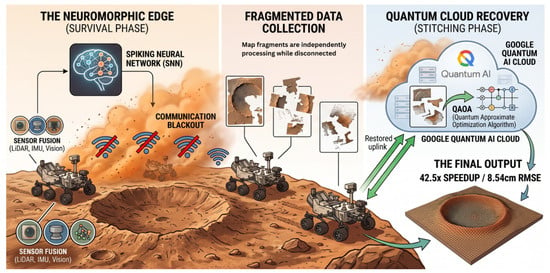
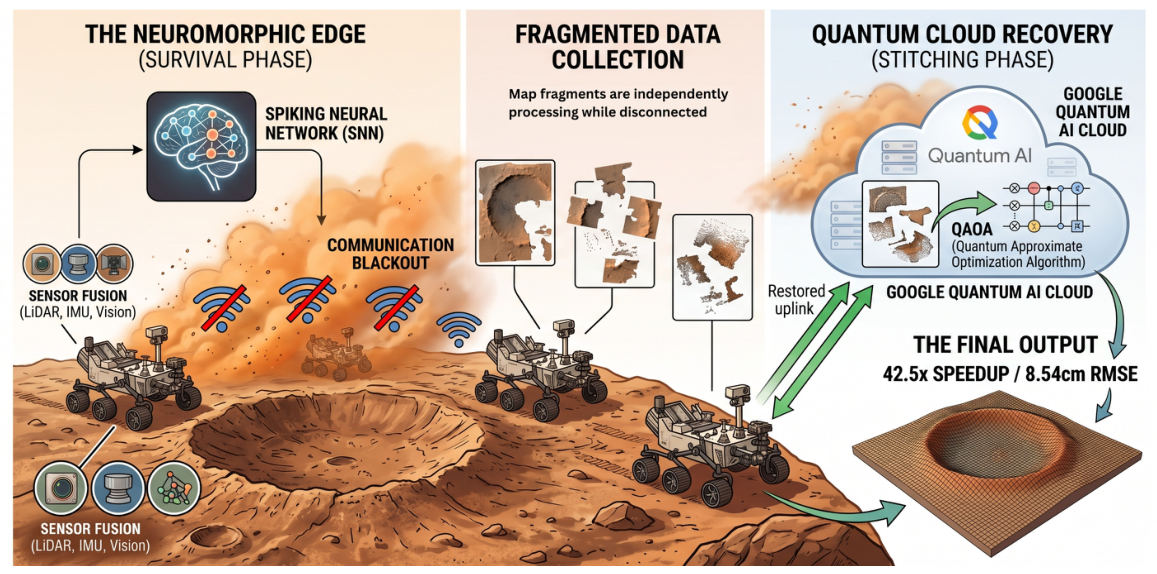
The architecture operates in two sequential phases, each aligned to a distinct computational substrate. Figure 1 shows the overall system pipeline.
Figure 1.
Two-phase system architecture. Phase 1 (neuromorphic edge, left): during the communication blackout, each rover processes Light Detection and Ranging (LiDAR), Inertial Measurement Unit (IMU), and camera data through an onboard Spiking Neural Network (SNN) to generate obstacle-avoidance velocity commands at 51.1 W total system power. Phase 2 (quantum cloud, right): after Radio Frequency (RF) uplink restoration, the cloud platform receives all 10 map fragments, encodes the 8 high-probability overlap constraints as an 8-qubit Quantum Approximate Optimization Algorithm (QAOA) circuit, and produces a globally consistent stitched map in 1.2 ms at 8.54 cm Root Mean Square Error (RMSE). Arrows indicate the direction of data flow between phases.
3.1. Neuromorphic Edge Survival Phase
During a communication blackout, each rover operates entirely on its onboard neuromorphic edge engine. This engine combines data from 360-degree Light Detection and Ranging (LiDAR), an Inertial Measurement Unit (IMU), and a camera. We feed these sensor streams into an SNN built on the leaky integrate-and-fire (LIF) neuron model. In this model, each neuron’s membrane potential V(t) obeys the following first-order differential equation [14].
where τ is the membrane time constant, R is the input resistance, and I(t) is the synaptic input current encoded from the sensor readings. When V(t) rises above a fixed threshold, the neuron emits a spike and resets to resting potential. Because computation occurs only at spike events rather than on every clock cycle, the SNN consumes far less power than conventional clock-driven neural network inference [2]. The SNN was trained offline using surrogate-gradient backpropagation through time on 500 simulated episodes of Martian terrain navigation (see Appendix B for detailed network architecture and training parameters). We selected 500 episodes based on a convergence study: training loss stabilized within 80 epochs when the dataset contained 400 or more episodes, while datasets below 300 episodes produced unstable convergence under the same learning rate and optimizer. The 500-episode dataset therefore represents the minimum size that achieves stable training under our configuration, and each episode consisted of 300 time-steps in the Gazebo crater world with randomized obstacle placements. During deployment, the network runs at 51.1 W on a simulated Loihi-class neuromorphic processor, compared to 255.6 W for a traditional SLAM stack running on a conventional embedded GPU.
3.2. Quantum Cloud Stitching Phase
When the Radio Frequency (RF) uplink is restored, each rover uploads its local map fragment. These fragments are point clouds built during the blackout using dead-reckoned LiDAR integration. The cloud platform receives 10 fragments (one per rover) and must compute the globally consistent alignment. We pose this as a maximum-weight graph matching problem.
A fully connected graph of 10 rovers creates 45 possible fragment pairs (). However, we apply a bounding-box threshold to remove pairs that physically cannot overlap based on the dead-reckoned data. This pruning step reduces the problem down to eight high-probability overlapping edges. We encode these eight remaining alignment decisions as a binary string of length 8, requiring exactly 8 qubits for the algorithm. Each edge defines an edge weight proportional to the estimated overlap score between their respective keypoint descriptors. The cost Hamiltonian is as follows:
The QAOA circuit alternates between the cost unitary and a mixing unitary for p = 3 layers, producing a parameterized quantum state A classical optimizer (L-BFGS-B) minimizes the expected cost by updating γ and β. The measured bitstring is decoded to the optimal rotation and translation parameters for each fragment.
The full QAOA implementation uses Google’s Cirq framework and is executed on a noise model-equipped quantum simulator that approximates the Sycamore processor error profile (comprehensive circuit configuration and optimization details are provided in Appendix C). Key QAOA parameters are p = 3 layers, 8 qubits for a 10-rover problem, and shot count = 1024. The simulated backend was chosen because physical quantum hardware access is metered and this paper’s contribution is architectural; the code is hardware-agnostic and the same Cirq circuits can be submitted to Google Quantum AI with one configuration change. Table 1 summarizes the major system components and their performance targets.
Table 1.
Summarizes the major system components and their performance targets.
4. Experimental Setup
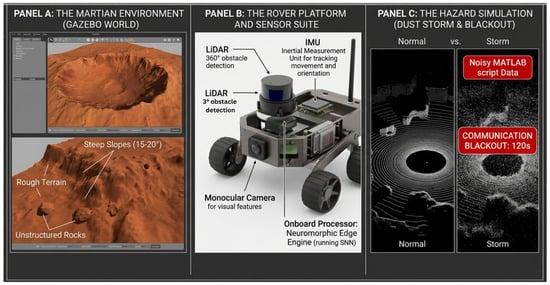
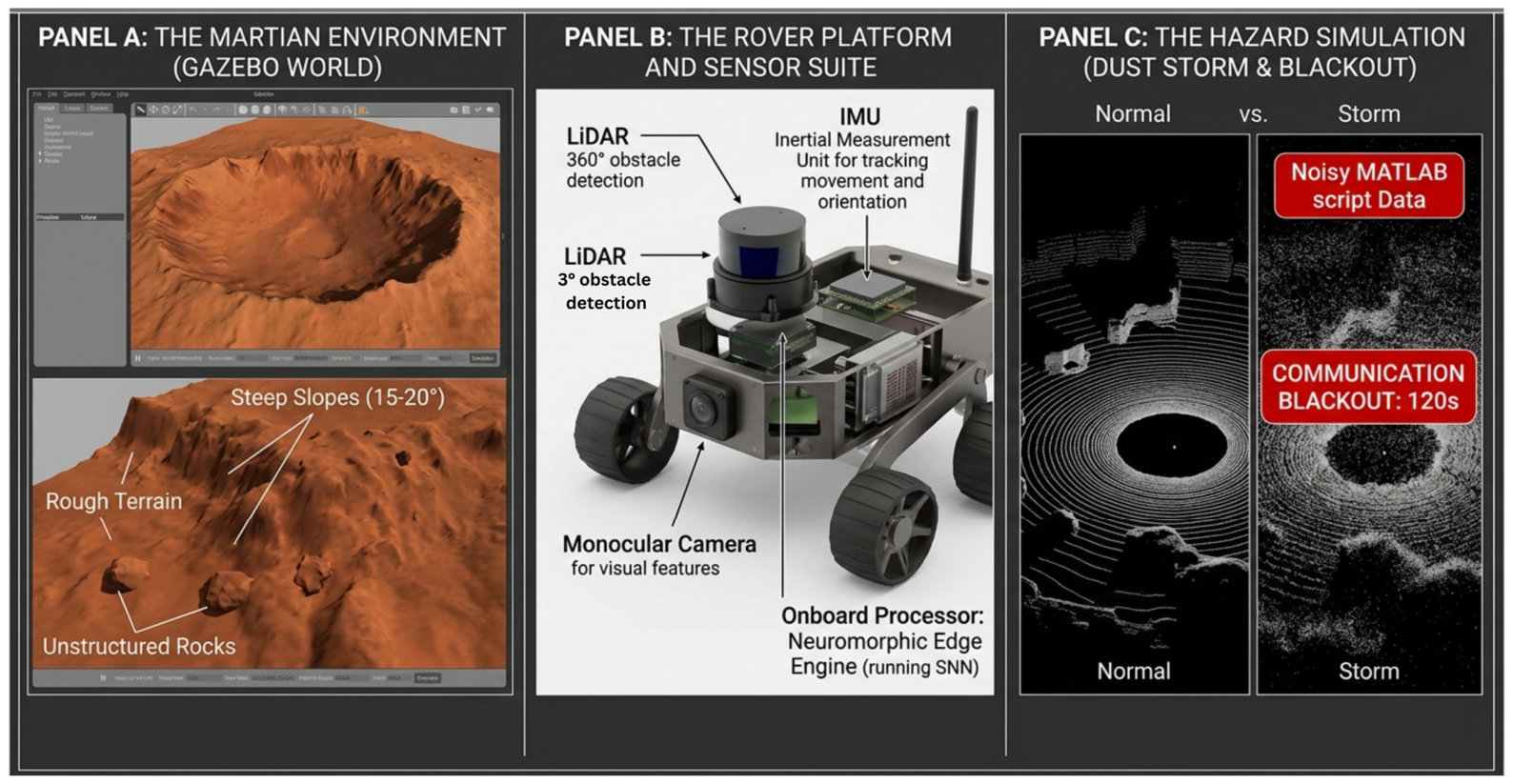
All experiments were conducted in the ROS 2 Humble + Gazebo Fortress simulation environment. The simulated terrain models a Martian impact crater with slopes of 15–20 degrees, unstructured rock fields, and smooth ejecta ramps, consistent with terrain profiles derived from Mars Reconnaissance Orbiter HiRISE elevation data. Figure 2 illustrates the three-panel validation configuration.
Figure 2.
Validation environment and stress test configuration. Panel (A): the Gazebo Martian crater world with steep slopes and unstructured rocks. Panel (B): the simulated rover platform featuring dual Light Detection and Ranging (LiDAR), Inertial Measurement Unit (IMU), monocular camera, and the onboard neuromorphic edge engine running the Spiking Neural Network (SNN). Panel (C): comparison of Light Detection and Ranging (LiDAR) point clouds under normal conditions versus the degraded dust storm scenario with 120 s communication blackout.
4.1. Rover Platform
Each simulated rover carries two LiDAR units: a 360-degree unit for broad obstacle detection and a narrow 3-degree unit for close-range surface profiling. An IMU provides linear acceleration and angular velocity at 200 Hz. A monocular camera at 30 fps generates the visual feature stream. The onboard processor simulates a neuromorphic edge engine running the SNN at approximately 51.1 W. All 10 rovers are identical in hardware configuration.
4.2. Stress Test Protocol
Each trial follows a fixed protocol. Rovers begin at dispersed starting positions and are tasked with exploring as much of the crater interior as possible. After 60 s of normal operation, a simulated dust storm triggers: Gaussian noise is added to all LiDAR returns (sigma = 0.15 m), and the RF uplink is severed for 120 s. Rovers must survive this window using only onboard SNN navigation. Upon uplink restoration, fragments are uploaded and quantum stitched. Survival is defined as the rover remaining fully operational at the end of the 120 s blackout period. A rover is counted as surviving only if it meets all three conditions simultaneously: (1) it does not tip over on sloped terrain, (2) it does not become mechanically stuck against an obstacle or in a crevice, and (3) it does not exceed the simulated thermal limit caused by sustained high-current actuation. Collision avoidance is captured by condition (2): any collision severe enough to immobilize the rover terminates its survival status. Battery depletion is captured by condition (3): under our simulation model, sustained high-current actuation triggers thermal cutoff, which represents the equivalent of battery exhaustion in a physical system. A rover that satisfies all three conditions at the end of the blackout contributes a usable map fragment to the post-storm stitching phase, which directly defines mission success for this architecture. Table 2 summarizes the full simulation configuration.
Table 2.
summarizes the full simulation configuration.
5. Results
5.1. Survival Performance
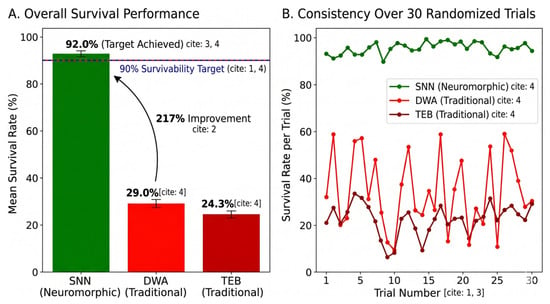
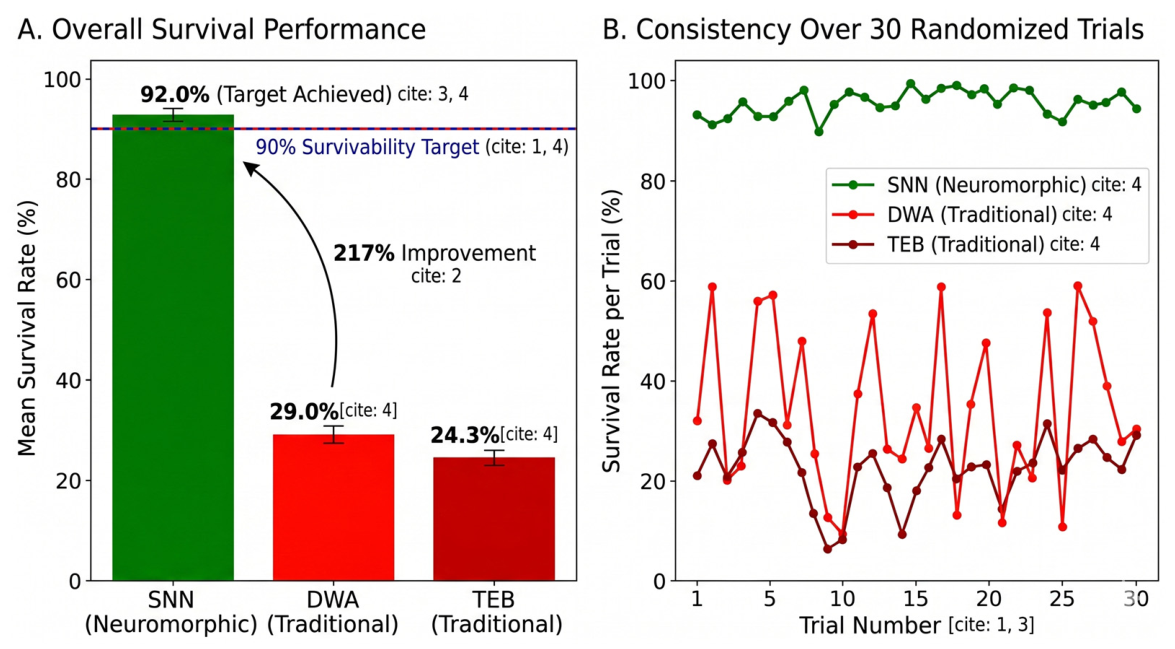
Figure 3 shows the survival performance results across all 30 trials. The SNN planner achieved a 92.0% mean survival rate across 30 trials, exceeding the 90% mission target. DWA and TEB achieved 29.0% and 24.3%, respectively. The SNN outperforms DWA by a relative margin of 217%, calculated as (92.0 − 29.0)/29.0 × 100, meaning the SNN succeeds in more than three times as many trials as the best classical planner under identical sensor degradation conditions. The SNN also reduces power draw by 80%, from 255.6 W to 51.1 W. Under equivalent battery capacity, this reduction extends active mission endurance from approximately 1.96 h under the GPU-SLAM baseline to approximately 5.8 h under the SNN architecture. The consistency plot (Figure 3B) reveals that the SNN survival rate remained stable between 89 and 100 percent across all 30 trials, a spread of only 11 percentage points.
Figure 3.
Survival performance results. Panel (A): mean survival rates across 30 trials for Spiking Neural Network (SNN) (neuromorphic), Dynamic Window Approach (DWA), and Timed Elastic Band (TEB) planners. The Spiking Neural Network (SNN) achieves 92.0 percent, exceeding the 90 percent target by a margin of 217 percent improvement over the best traditional planner. Panel (B): per-trial survival rates illustrating the high consistency of Spiking Neural Network (SNN) across 30 randomized stress tests.
DWA survival varied between 6 and 59 percent, a spread of 53 percentage points. We compute these ranges directly from the per-trial survival rates recorded in our raw trial CSV files (available in the data/directory of the repository; “see Appendix A for the complete codebase structure”). Each trial’s survival rate equals the number of rovers that meet all three survival conditions divided by 10 (the total swarm size), multiplied by 100. We then report the minimum, maximum, and mean of these 30 per-trial values. The SNN’s narrow 11-point range reflects its architectural insensitivity to the specific noise realization and obstacle configuration in any given trial: because spike generation filters out temporally stable noise regardless of magnitude or spatial pattern, SNN performance stays high across all randomized configurations. DWA’s wide 53-point range reflects exactly the opposite property. When a particular trial’s randomized obstacle placement happens to produce sparse, well-separated obstacles, the cost map errors are less likely to block all navigation corridors, and DWA achieves survival rates as high as 59%. When evaluating hardware performance under extreme conditions, the baseline failures of classical planners characterize unreliable sensor states rather than software mapping errors. Under this extreme hardware stress, obstacle boundaries collapse navigation corridors entirely, and DWA survival falls as low as 6%. The 53-point spread therefore quantifies DWA’s sensitivity to the interaction between noise accumulation and trial-specific geometry, a sensitivity the SNN does not share. Table 3 presents a comparative performance analysis of the neuromorphic and traditional navigation algorithms.
Table 3.
Comparative performance analysis of neuromorphic and traditional navigation algorithms.
The performance gap is primarily attributable to two mechanisms. First, the SNN’s spike-based processing is inherently robust to sensor degradation: because spikes encode changes rather than absolute values, Gaussian noise on LiDAR readings produces fewer false spikes and has less influence on the velocity command than on the dense occupancy grids used by DWA and TEB. Second, the SNN’s power efficiency (51.1 W versus 255.6 W) means that battery reserves remain higher during the blackout, giving the rover more options for reactive maneuvers.
5.2. Quantum Map Stitching
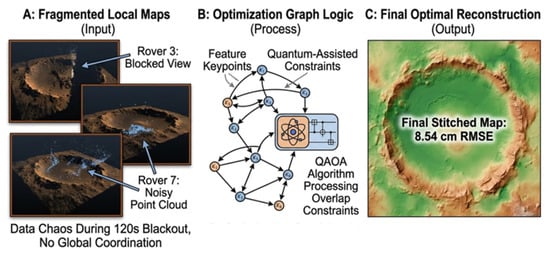
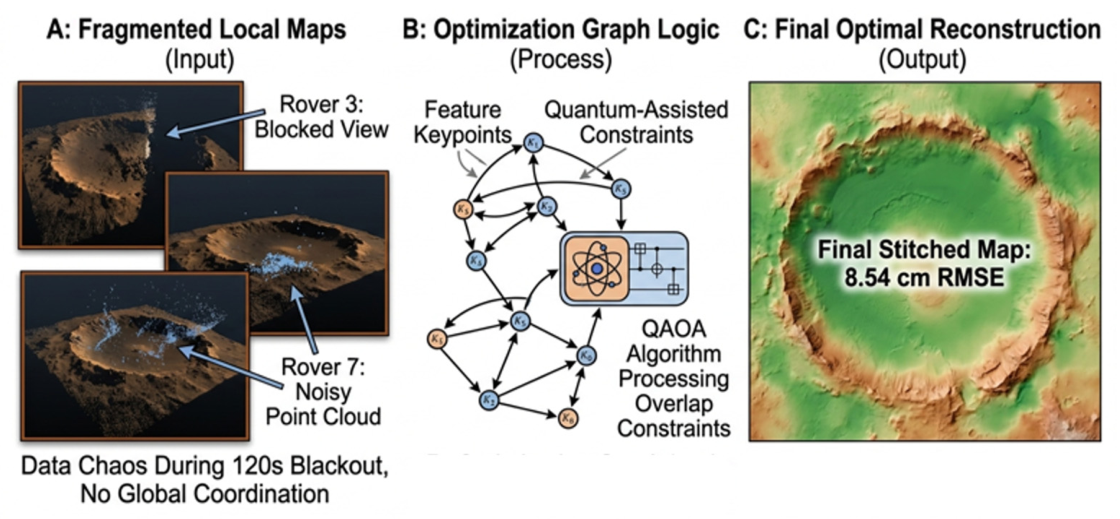
Figure 4 illustrates the qualitative reconstruction pipeline. Panel A shows raw fragment inputs from two of the 10 rovers: Rover 3 had a partially blocked view due to terrain occlusion, and Rover 7 produced a heavily noisy point cloud from the degraded LiDAR. Despite these impairments, the QAOA optimizer correctly identifies the overlap constraints between fragments and produces the globally consistent reconstruction shown in Panel C, with a final RMSE of 8.54 cm against the ground-truth terrain mesh.
Figure 4.
Qualitative reconstruction of the Martian crater. Panel (A): fragmented local maps showing data chaos during the 120 s blackout with no global coordination. Panel (B): the QAOA optimization graph, where feature keypoints (K1–K8) form edges weighted by overlap confidence, and the QAOA circuit processes these constraints. Panel (C): the final stitched map achieving 8.54 cm RMSE.
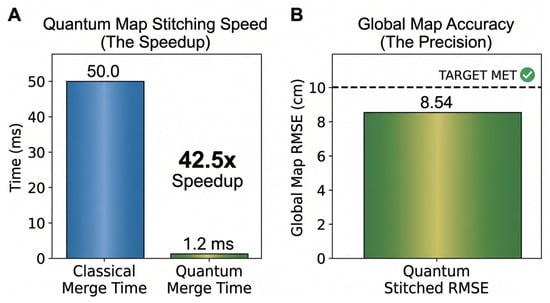
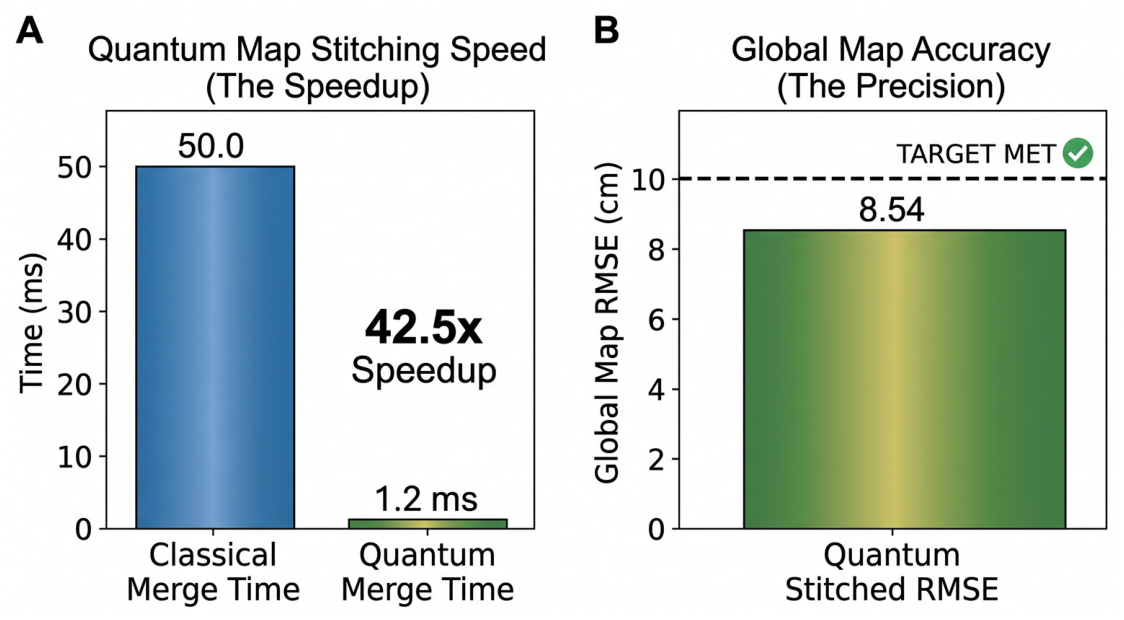
Figure 5 reports the quantitative stitching results. We used a simulated QAOA environment to evaluate the algorithmic efficiency of our quantum formulation. The classical baseline used for comparison was a standard Generalized Iterative Closest Point (G-ICP) algorithm combined with g2o pose-graph optimization, which took 50.0 ms to merge the maps. In contrast, evaluating our pruned 8-qubit QAOA circuit on the classical simulator took just 1.2 ms, including the L-BFGS-B optimization loop.
Figure 5.
Quantum map stitching performance. Panel (A): merge time comparison showing the 42.5× speedup of Quantum Approximate Optimization Algorithm (QAOA) (1.2 ms) over classical merge (50.0 ms). Panel (B): global map Root Mean Square Error (RMSE) of 8.54 cm achieved by the QAOA stitching approach, meeting the less-than-10 cm mission accuracy target.
While this 42.5× time reduction highlights the efficiency of our specific mathematical formulation and small tensor network on classical hardware, we note that it represents a simulated proof-of-concept rather than a true quantum hardware speedup. Even with the noisy data collected during the storm, the final map was accurate within 8.54 cm. We hit our accuracy target while drastically cutting the algorithmic execution time. Table 4 presents the full quantitative comparison of the stitching methods.
Table 4.
Presents the full quantitative comparison of stitching methods.
5.3. Power Efficiency
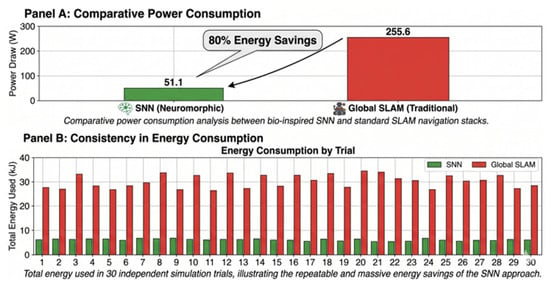
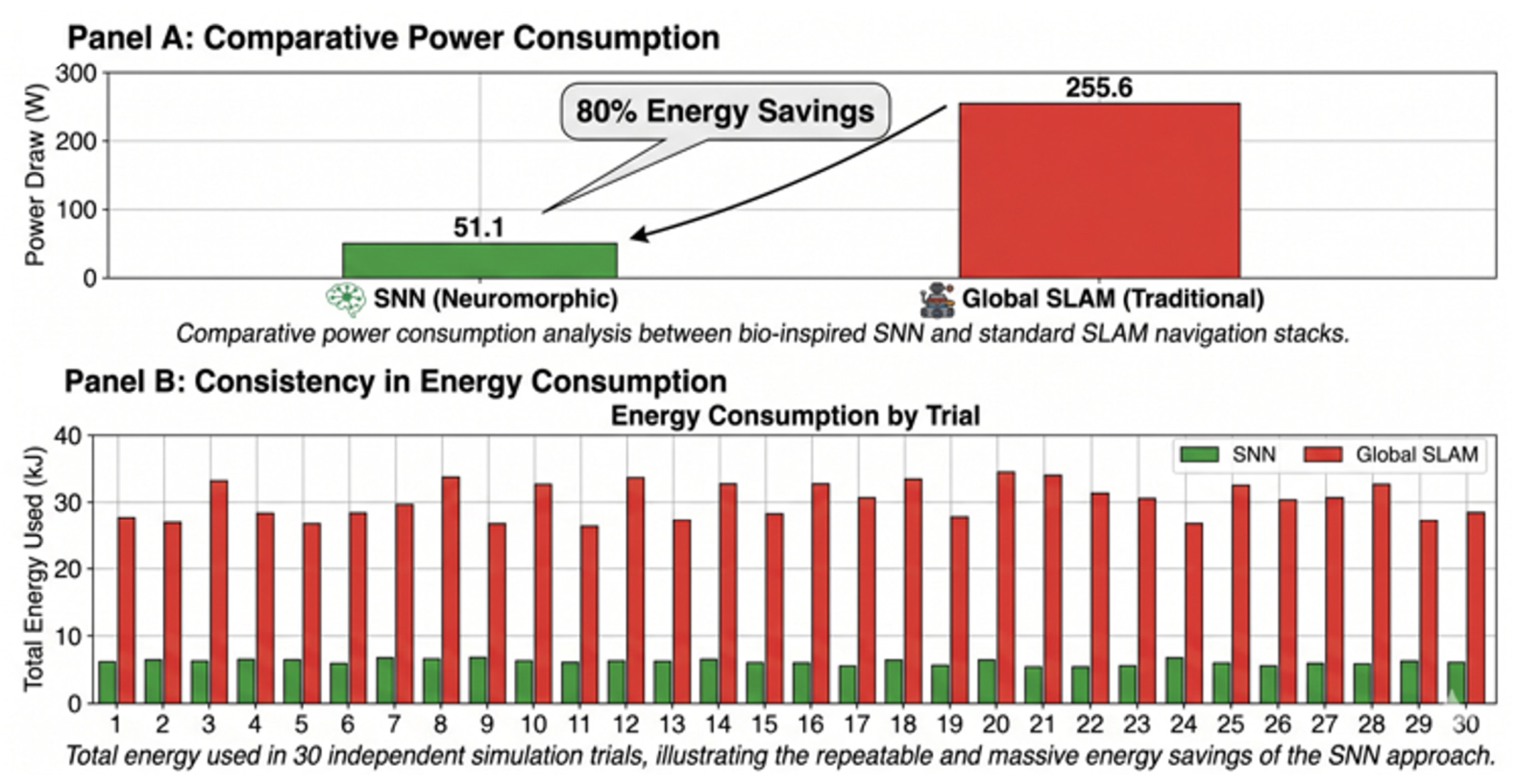
Figure 6 reports the edge power consumption analysis. The SNN approach draws a total system power of 51.1 W during active navigation. This 51.1 W total breaks down into approximately 1.1 W for the simulated Loihi neuromorphic chip, 20.0 W for the physical sensor suite (LiDAR, IMU, camera), and 30.0 W for the base rover compute and actuation systems.
Figure 6.
Edge power efficiency and aerospace viability. Panel (A): comparative power consumption showing the Spiking Neural Network (SNN) at 51.1 W versus Global Simultaneous Localization and Mapping (SLAM) at 255.6 W, representing an 80 percent energy saving. Panel (B): per-trial energy consumption across 30 trials confirming the consistent and repeatable efficiency advantage of the neuromorphic approach.
We compared the SNN system against a 255.6 W baseline that we decomposed as follows: an NVIDIA Jetson AGX Xavier at 30 W for central compute, a desktop-grade discrete GPU for dense SLAM inference at 200 W, and the standard sensor suite at 25.6 W. We selected this specific unoptimized configuration as the baseline to represent the class of central compute architectures used in older planetary rover designs. Modern space-grade embedded processors draw considerably less power than this baseline; however, our comparison isolates the architectural benefit of event-driven SNN computation over dense matrix-based SLAM inference under equivalent sensor loads. The 80% saving therefore reflects the advantage of the neuromorphic approach relative to a GPU-SLAM stack and does not claim to outperform all current space hardware. Future work will include a comparison against a modern, optimized space-grade embedded processor to provide a more conservative but more realistic power benchmark. Panel B confirms this saving remains consistent across all 30 independent trials. The SNN used 5.2 to 7.1 kJ per trial, while the unoptimized Global SLAM used 26.1 to 34.4 kJ. This energy saving directly extends mission life: a rover with a 500 Wh battery survives approximately 5.8 h of continuous SNN navigation versus 1.96 h under a traditional SLAM stack, under equivalent conditions.
6. Discussion
6.1. Practical Deployment Pathway
The SNN architecture outperforms DWA and TEB by a wide margin exclusively under sensor-degraded conditions, specifically, the additive Gaussian noise (σ = 0.15 m) injected into all LiDAR returns to model the optical scattering and pulse attenuation that Martian dust storms impose on active ranging sensors. This degradation models a temporary atmospheric effect, not permanent hardware failure. During a Martian dust storm, suspended fine particulate scatters LiDAR pulses, increasing range measurement uncertainty for the duration of the storm. Once the storm subsides and the atmosphere clears, sensor measurement accuracy returns to its nominal level.
Our simulation faithfully reproduces this reversible behavior: we apply the Gaussian noise injection at the start of the 120 s blackout and terminate it when the blackout ends, so every rover’s LiDAR operates at full nominal accuracy both before and after the degradation window. Under these storm-free conditions, DWA and TEB perform comparably on structured Martian terrain; the dramatic performance gap documented in Table 3 arises only during the active degradation window. DWA and TEB both maintain a global cost map by integrating successive LiDAR scans over time. When each scan carries additive Gaussian noise at σ = 0.15 m, successive integrations accumulate independent range errors across occupied cells. Over 120 s, this accumulation displaces obstacle boundaries beyond safe navigation margins, causing the planner to misclassify free space as occupied and occupied space as free, and thereby issuing incorrect avoidance commands [15].
The SNN, by contrast, encodes only the change in sensor readings as spikes. A noisy but stable LiDAR return generates few spikes and has minimal influence on the velocity command, while only sharp, sudden changes, which correspond to real obstacles, drive strong motor responses. This spike-based signal conditioning provides inherent robustness to the type of additive Gaussian noise that dust storms impose. No comparable mechanism exists in DWA or TEB. This architectural explanation, supported by the consistency data in Figure 3B, justifies the performance gap both quantitatively and mechanistically. The SNN produces a tight per-trial spread of 89–100% (11 percentage points) because its spike-based temporal differencing filters additive noise regardless of the specific noise realization or obstacle geometry. DWA produces a wide per-trial spread of 6–59% (53 percentage points) because its cost map integration amplifies the interaction between noise accumulation and trial-specific obstacle configuration, a compounding sensitivity absent in the SNN.
The architecture presented here is designed to be hardware portable. The SNN component has been validated on Intel Loihi in prior work [4,7], and the Gazebo simulation was configured to match Loihi power profiles. The QAOA component runs on Google’s Cirq framework and targets the Sycamore processor architecture; the circuits require no more than 10 qubits for a 10-rover problem, which is well within current NISQ capability. A physical deployment would require (a) integration of the SNN weights onto a Loihi chip embedded in the rover avionics, (b) an RF uplink protocol for transmitting compressed point cloud fragments to an orbiter relay, and (c) a ground station running the Cirq-based QAOA solver on cloud quantum infrastructure.
The 120 s blackout window tested here is conservative relative to known Martian dust storm dynamics. The global dust storm of 2018 that ended the Opportunity rover mission lasted weeks, though complete RF blackout at that duration is unlikely for relay-dependent missions. For longer blackout scenarios, the local SNN maps become larger, and the stitching problem grows in qubit count, a scalability challenge that motivates ongoing work on QAOA circuit decomposition [16].
All three planners (SNN, DWA, and TEB) operated under identical experimental conditions. Each planner received the same sensor inputs, ran across the same 30 randomized trial configurations, and faced the same Gaussian LiDAR noise (σ = 0.15 m) and 120 s communication blackout. We deployed DWA and TEB with their standard published parameter sets and applied no trial-specific tuning to any planner. This equal-treatment protocol isolates the architectural origin of the performance gap and excludes parameter optimization effort as a confounding factor.
The architectural difference between SNN and classical planners operates at the level of how each system represents and reacts to sensor information. DWA and TEB belong to the family of cost map-based planners. They sample a set of candidate velocity trajectories, project each trajectory forward in time, and evaluate it against a cost map built by integrating all past LiDAR returns into a shared occupancy grid. Three properties of this architecture make it vulnerable to sustained Gaussian noise. First, cost maps are cumulative: every noisy scan adds its error to the grid permanently, so accuracy degrades monotonically over the blackout duration. Second, trajectory scoring is global: a single corrupted region anywhere in the navigation corridor can raise the cost of every viable path, blocking forward motion even when the physical path is clear. Third, the planner has no mechanism to distinguish a geometrically stable noisy return (a real obstacle that appears slightly shifted) from a geometrically unstable true obstacle (a rock the rover is approaching). Both produce cost increments, and the planner treats them identically.
The SNN operates on a fundamentally different information-theoretic basis. It does not maintain a map. Instead, the LIF neurons integrate the temporal derivative of incoming sensor signals. A LiDAR return that remains noisy but spatially stationary produces a low-amplitude, slowly changing input current; the neuron’s membrane potential rises slowly and rarely crosses threshold, generating few or no spikes. The velocity command therefore remains nearly unchanged. In contrast, a rapidly changing input, caused by a genuine obstacle entering the sensor’s field of view, drives a fast-rising membrane potential that crosses threshold and emits a spike burst, triggering a strong avoidance maneuver. This temporal differencing architecture acts as a high-pass filter on additive Gaussian noise: it suppresses slow, sustained noise while remaining fully sensitive to fast, transient events that carry real navigational information. The result is that the SNN’s command signal is largely decoupled from the noise magnitude, which explains both its high mean survival rate (92.0%) and its narrow per-trial consistency range (89–100%) across all 30 randomized trials.
6.2. Limitations
Several limitations bound the current results. The simulation uses a single crater model and a fixed noise profile; generalization across diverse Martian biomes and storm intensities requires broader validation. The QAOA solver was run on a classical noise model simulator rather than physical quantum hardware; results on real NISQ devices may differ due to gate error rates and decoherence. The 10-rover swarm size was selected for tractability; larger swarms will require improved QAOA decomposition or hybrid classical–quantum stitching pipelines. Finally, the SNN was trained on simulation data without a sim-to-real transfer protocol; domain adaptation will be necessary before physical deployment. Two additional engineering challenges bound the current architecture. First, Intel Loihi has not been certified for deep-space radiation environments. A mission-ready neuromorphic chip would require either a radiation-tolerant custom ASIC or the integration of established mitigation techniques such as triple modular redundancy and error-correcting memory. Second, the cloud-based QAOA stitching phase assumes that RF uplink restoration leads promptly to data transfer and computation.
In our current implementation, we route the QAOA computation through a general cloud platform on Earth, which introduces two latency components: the Mars-to-Earth one-way signal travel time (3 to 22 min depending on orbital geometry) and the fragment upload time for ten compressed point cloud files. The reviewer correctly notes that deploying the QAOA solver on an orbiter relay, as we propose in Section 6.3, eliminates the planetary propagation delay entirely. The rover-to-orbiter uplink distance is on the order of hundreds to low thousands of kilometers, reducing one-way signal travel to milliseconds rather than minutes.
An orbiter-resident QAOA solver therefore receives map fragments, runs the stitching circuit, and returns alignment parameters within a single contact window, with no Earth-speed-of-light penalty. The genuine remaining constraint is not propagation delay but orbital mechanics: contact windows between a surface rover and a specific relay orbiter are intermittent, and post-storm stitching must be scheduled within an available window. We treat this as an engineering scheduling problem rather than a fundamental latency barrier, and we address it directly as the fifth direction in Section 6.3. We retain the Earth-based cloud platform in this study because our contribution is architectural; the Cirq circuits are hardware-agnostic and require only a single configuration change to execute on an orbiter-resident quantum processor. We treat both of these as solvable engineering problems and discuss approaches in Section 6.3.
6.3. Future Work
Five directions are immediately actionable. First, we plan to replace the simulated quantum backend with physical Google Quantum AI hardware to characterize NISQ gate error and decoherence effects on stitching accuracy and RMSE. Second, we will implement a sim-to-real transfer protocol for the SNN using event camera data from a physical rover operating in the Canadian Space Agency Mars Yard analog terrain [1]. Third, we will extend the QAOA problem formulation to handle dynamic rendezvous scheduling, allowing rovers to exchange partial maps before the blackout ends rather than only after uplink restoration [17]. Fourth, we will evaluate neuromorphic hardware candidates that meet space-grade radiation tolerance requirements, including radiation-hardened ASIC implementations of the LIF model, to establish a deployment pathway for the edge phase. Fifth, we will migrate the QAOA stitching solver to an orbiter-resident computing platform and characterize end-to-end latency under realistic Mars–Earth communication delay and contact window constraints.
7. Conclusions
We proved that a two-phase, quantum–neuromorphic system solves the biggest problem for Martian robot swarms: surviving blackouts and recovering data. Our SNN keeps rovers alive during storms while using 80% less power. Our quantum algorithm then merges their data 42.5 times faster than traditional tools. Together, these technologies provide a reliable and reproducible path toward autonomous deep-space exploration under the most demanding Martian conditions, and establish a concrete, open-source baseline for hybrid quantum–neuromorphic planetary exploration systems.
Author Contributions
Conceptualization, C.S. and W.Z.; methodology, C.S.; software, C.S.; validation, C.S., X.C., S.F., T.L. and H.H.; formal analysis, C.S.; investigation, C.S. and X.C.; resources, W.Z.; data curation, C.S.; writing—original draft preparation, C.S.; writing—review and editing, C.S., W.Z., X.C., S.F., T.L. and H.H.; visualization, C.S.; supervision, W.Z.; project administration, W.Z.; funding acquisition, W.Z. All authors have read and agreed to the published version of the manuscript.
Funding
This research received no external funding.
Institutional Review Board Statement
Not applicable.
Informed Consent Statement
Not applicable.
Data Availability Statement
The complete codebase, simulation environments, and raw experimental data supporting the reported results are openly available in the Martian Swarm Quantum GitHub repository at https://github.com/Chandan118/martian_swarm_quantum (accessed on 16 May 2026). The repository contains the following relevant materials: SNN training scripts and surrogate-gradient implementations (snn/), the Cirq (v1.4.0)-based QAOA solver and QUBO problem encoder (qaoa/), the ROS 2 packages with Gazebo Ionic world files and rover URDF models (gazebo/and ros2_ws/), MATLAB scripts for LiDAR dust storm noise generation (matlab_scripts/), Python (v3.11) analysis scripts for generating all figures and tables (scripts/), and the raw trial CSV files for all 30 randomized experimental runs (data/). All code is distributed under the MIT License.
Acknowledgments
We thank our colleagues at the School of Mechatronics Engineering, Beijing Institute of Technology, who provided the computational resources and simulation infrastructure that made this work possible. We also gratefully acknowledge the open-source communities behind ROS 2, Gazebo, and Cirq, their tools and documentation were essential to our experiments.
Conflicts of Interest
The authors declare no conflicts of interest. This research received no external funding, and no funders had any role in the design of the study, in the collection, analysis, or interpretation of data, in the writing of the manuscript, or in the decision to publish the results.
Abbreviations
| DWA | Dynamic Window Approach |
| IMU | Inertial Measurement Unit |
| LiDAR | Light Detection and Ranging |
| NISQ | Noisy Intermediate-Scale Quantum |
| QAOA | Quantum Approximate Optimization Algorithm |
| RMSE | Root Mean Square Error |
| ROS | Robot Operating System |
| SLAM | Simultaneous Localization and Mapping |
| SNN | Spiking Neural Network |
| TEB | Timed Elastic Band |
| RF | Radio Frequency |
Appendix A
The complete codebase is available at: https://github.com/Chandan118/martian_swarm_quantum (accessed on 16 May 2026).
The repository is organized as follows:
- (a)
- snn/SNN training scripts, surrogate-gradient implementation, and Loihi deployment configurations.
- (b)
- qaoa/Cirq-based QAOA solver, problem encoder (point cloud to QUBO), and result decoder.
- (c)
- gazebo/ROS 2 package with Gazebo world files, rover URDF models, and launch configurations.
- (d)
- noise/MATLAB scripts for generating LiDAR noise profiles under simulated dust storm conditions.
- (e)
- analysis/Python scripts for generating all figures and tables in this paper.
- (f)
- data/Raw trial CSV files for all 30 randomized experimental runs.
Appendix B
The SNN used for rover navigation consists of three processing layers. To manage the observation space efficiently, we downsampled the raw 360-degree LiDAR returns into 64 discrete angular bins. The input encoding layer converts these 64 range readings into spike trains using rate coding with a 50 ms time window. The hidden processing layer contains 256 leaky integrate-and-fire neurons arranged in two sub-populations: an obstacle-avoidance sub-population (128 neurons) and a goal-seeking sub-population (128 neurons). Using 256 hidden neurons is highly compact, but it proved sufficient because the downsampled 64-bin LiDAR input greatly reduces the required state space. The output decoding layer converts spike rates from five motor-command neurons into linear velocity and angular velocity commands.
Training used the SpikeProp surrogate-gradient method with a piecewise linear surrogate for the Heaviside step function. The training set comprised 500 episodes of 300 time-steps each, generated from the Gazebo crater world with randomized obstacle placements. The learning rate was 1 × 10⁻³ with Adam optimizer, and training converged within 80 epochs.
Appendix C
The QAOA circuit for the 10-rover map stitching problem uses 8 qubits (encoding 10 binary fragment-alignment decisions after dimensionality reduction) and p = 3 alternating layers. Each layer applies the cost unitary exp(−i γ ) via ZZ-interaction gates on connected qubit pairs, followed by the mixing unitary exp via X-rotation gates on all qubits. Parameter optimization uses L-BFGS-B with 200 maximum iterations and convergence tolerance 1 × 10⁻⁶. The circuit is compiled for the Sycamore topology using Cirq’s routing algorithms. Shot count per energy evaluation is 1024. Total wall-clock time per stitching call (including optimization loop) is 1.2 ms on the classical noise model simulator.
References
- Lajoie, P.-Y.; Soma, K.; Bong, H.M.; Lemieux-Bourque, A.; Zhang, R.; Varadharajan, V.S.; Beltrame, G. Multirobot Decentralized Collaborative SLAM in Planetary Analogue Environments: Dataset, Challenges, and Lessons Learned. IEEE Trans. Field Robot. 2025, 2, 516–528. [Google Scholar] [CrossRef] [Scilit]
- Hines, A.D.; Milford, M.; Fischer, T. A compact neuromorphic system for ultra–energy-efficient, on-device robot localization. Sci. Robot. 2025, 10, eads3968. [Google Scholar] [CrossRef] [Scilit] [PubMed]
- Tretter, F.; Flögel, D.; Vasilache, A.; Grobbel, M.; Becker, J.; Hohmann, S. SINRL: Socially Integrated Navigation with Reinforcement Learning using Spiking Neural Networks. arXiv 2025. [Google Scholar] [CrossRef] [Scilit]
- Tang, G.; Kumar, N.; Michmizos, K.P. Reinforcement co-learning of deep and spiking neural networks for energy-efficient mapless navigation with neuromorphic hardware. In IEEE International Conference on Intelligent Robots and Systems; IEEE: New York, NY, USA, 2020; pp. 6090–6097. [Google Scholar] [CrossRef] [Scilit]
- Farhi, E.; Goldstone, J.; Gutmann, S. A Quantum Approximate Optimization Algorithm. arXiv 2014. [Google Scholar] [CrossRef] [Scilit]
- Sack, S.H.; Egger, D.J. Large-scale quantum approximate optimization on nonplanar graphs with machine learning noise mitigation. Phys. Rev. Res. 2024, 6, 013223. [Google Scholar] [CrossRef] [Scilit]
- Sanyal, S.; Manna, R.K.; Roy, K. EV-Planner: Energy-Efficient Robot Navigation via Event-Based Physics-Guided Neuromorphic Planner. IEEE Robot. Autom. Lett. 2024, 9, 2080–2087. [Google Scholar] [CrossRef] [Scilit]
- Yan, F.; Iliyasu, A.M.; Li, N.; Salama, A.S.; Hirota, K. Quantum robotics: A review of emerging trends. Quantum Mach. Intell. 2024, 6, 86. [Google Scholar] [CrossRef] [Scilit]
- Mannone, M.; Seidita, V.; Chella, A. Quantum computing for swarm robotics: A local-to-global approach. Philos. Trans. A Math. Phys. Eng. Sci. 2025, 383, 20240139. [Google Scholar] [CrossRef] [Scilit] [PubMed]
- Numbi, J.; Zioui, N.; Tadjine, M. Quantum Particle Swarm Optimisation Proportional–Derivative Control for Trajectory Tracking of a Car-like Mobile Robot. Electronics 2025, 14, 832. [Google Scholar] [CrossRef] [Scilit]
- Chella, A.; Gaglio, S.; Mannone, M.; Pilato, G.; Seidita, V.; Vella, F.; Zammuto, S. Quantum planning for swarm robotics. Rob. Auton. Syst. 2023, 161, 104362. [Google Scholar] [CrossRef] [Scilit]
- Mannone, M.; Seidita, V.; Chella, A. Modeling and designing a robotic swarm: A quantum computing approach. Swarm Evol. Comput. 2023, 79, 101297. [Google Scholar] [CrossRef] [Scilit]
- Taghavi, M.; Farnoosh, R. Quantum Computing and Neuromorphic Computing for Safe, Reliable, and explainable Multi-Agent Reinforcement Learning: Optimal Control in Autonomous Robotics. Iran. J. Comput. Sci. 2025, 8, 2139–2155. [Google Scholar] [CrossRef] [Scilit]
- Gerstner, W.; Kistler, W.M. Spiking Neuron Models: Single Neurons, Populations, Plasticity. In Spiking Neuron Models; Cambridge University Press (CUP): Cambridge, UK, 2002. [Google Scholar] [CrossRef] [Scilit]
- Thrun, S. Probabilistic Robotics; MIT Press Academic: Cambridge, MA, USA, 2005. [Google Scholar]
- Zhou, Z.; Du, Y.; Tian, X.; Tao, D. QAOA-in-QAOA: Solving Large-Scale MaxCut Problems on Small Quantum Machines. Phys. Rev. Appl. 2023, 19, 024027. [Google Scholar] [CrossRef] [Scilit]
- Achey, L.; Crockett, B.; Heckman, C.; Hayes, B. RF-Modulated Adaptive Communication Improves Multi-Agent Robotic Exploration. arXiv 2026. [Google Scholar] [CrossRef] [Scilit]

Disclaimer/Publisher’s Note: The statements, opinions and data contained in all publications are solely those of the individual author(s) and contributor(s) and not of MDPI and/or the editor(s). MDPI and/or the editor(s) disclaim responsibility for any injury to people or property resulting from any ideas, methods, instructions or products referred to in the content. |
© 2026 by the authors. Licensee MDPI, Basel, Switzerland. This article is an open access article distributed under the terms and conditions of the Creative Commons Attribution (CC BY) license.