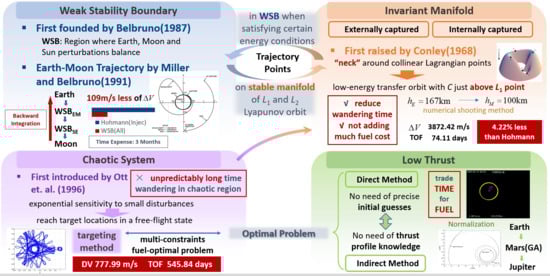
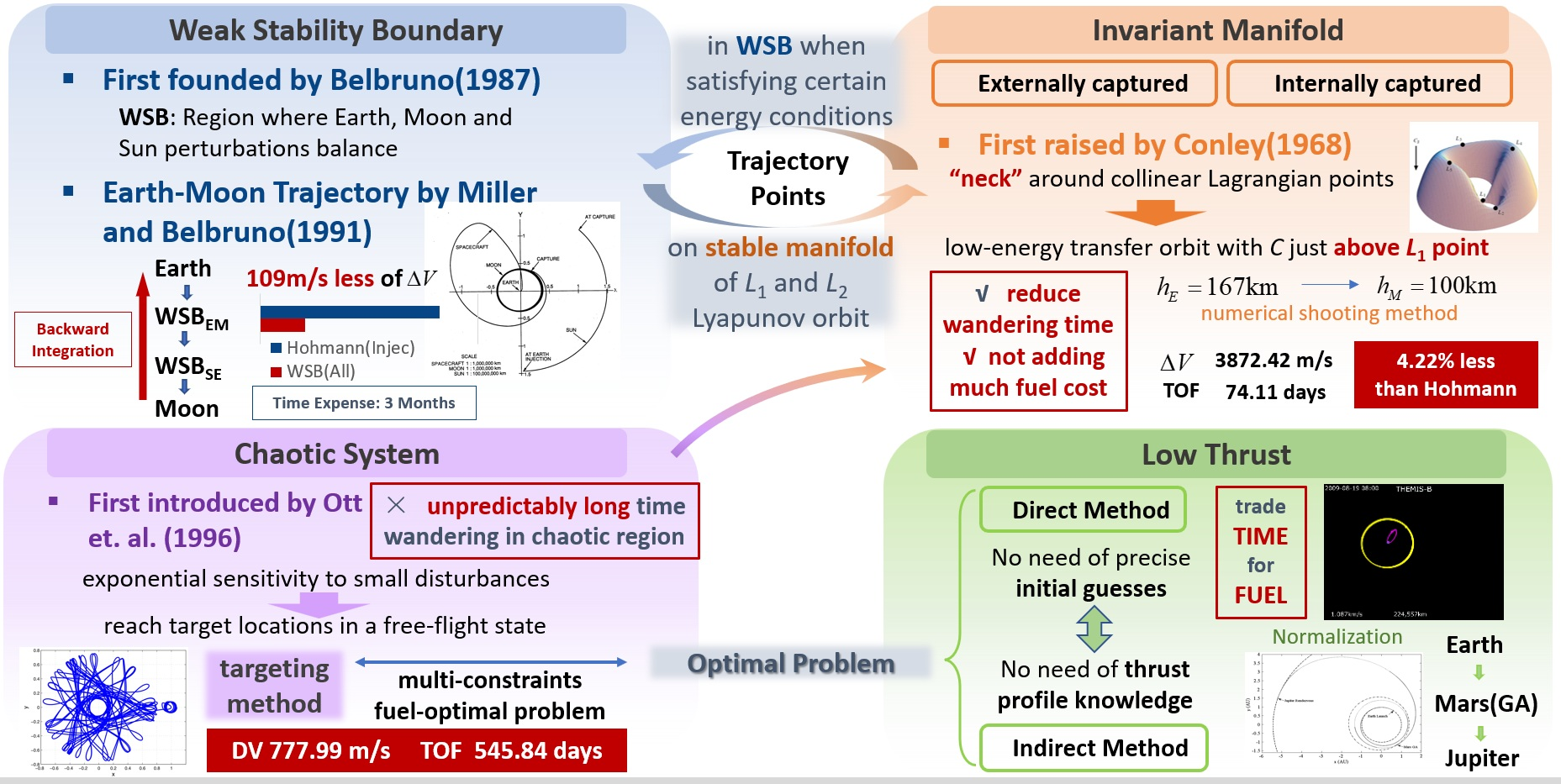
1. Introduction
Deep-space exploration missions are increasingly constrained by competing requirements on payload mass, mission flexibility, and operational lifetime. In this study, the term “deep space” primarily refers to the cislunar region beyond low Earth orbit and, in a broader sense, may also encompass interplanetary trajectories within the solar system. Within this context, Earth–Moon transfer trajectory design plays a foundational role, as transfer strategy directly determines propulsion demand, mission architecture, and downstream operational capabilities [
1]. While conventional Earth–Moon transfers have historically emphasized short time of flight (TOF) and operational simplicity, the growing emphasis on sustained exploration, multi-objective missions, and flexible launch opportunities has brought fuel-efficient, low-energy transfer strategies to the forefront of contemporary mission design. In conventional mission scenarios, the overall propulsion cost is largely dominated by impulsive maneuvers associated with Earth departure and lunar capture, which is most notable during trans-lunar injection and lunar orbit insertion, thereby exerting a decisive influence on payload allocation and mission robustness. For this reason, the present review focuses specifically on transfer trajectory design problems in which propellant savings are achieved primarily by reshaping the transfer through longer TOF, rather than on propulsion expenditures arising in later operational phases after capture.
Classical Earth–Moon transfer strategies have traditionally been developed under two-body or patched-conic assumptions, in which the gravitational influence of multiple celestial bodies is simplified or segmented to facilitate analytical tractability and operational control [
2,
3,
4,
5,
6,
7,
8,
9]. These approaches, together with pseudo-state formulations employed in Earth–Moon transfer analysis and mission design, have formed the backbone of early Earth–Moon transfer practice [
10,
11,
12,
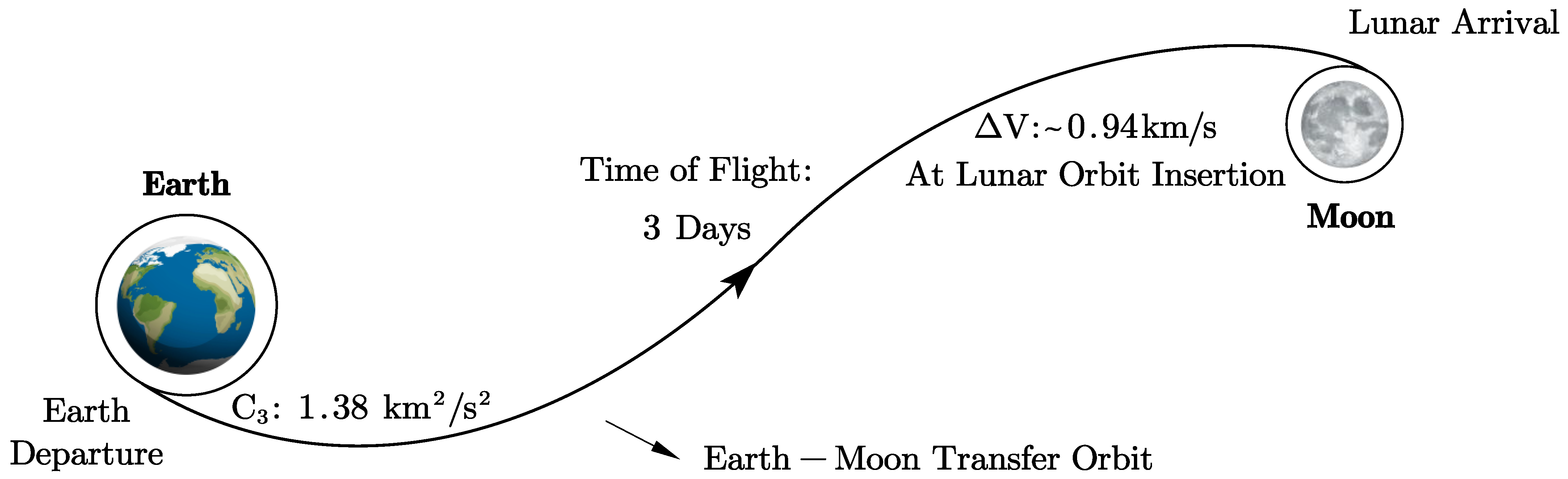
13]. Owing to their short TOF and relatively predictable dynamical behavior, these methods were widely adopted in early lunar exploration programs, most notably during the Apollo missions, and remain representative baselines for comparison with later low-energy designs [
14,
15]. The mission illustration of Apollo 11 is shown on
Figure 1. Nevertheless, these simplified dynamical assumptions inherently lead to substantial velocity mismatches between transfer arcs, necessitating large impulsive maneuvers and resulting in high fuel consumption, particularly during lunar orbit insertion.
The limitations of traditional transfer strategies have motivated sustained efforts to develop trajectory design methods that utilize the multi-body gravitational dynamics of the Earth–Moon–Sun system. Rather than minimizing transfer time, low-energy transfer approaches prioritize fuel efficiency by leveraging multibody dynamical interactions, often at the expense of longer flight durations [
16]. Early investigations revealed that low-energy transit orbits exist in regions of phase space that are inaccessible under patched-conic formulations, thereby expanding the reachable set of Earth–Moon transfer trajectories [
17]. A major milestone in this direction was the introduction of the weak stability boundary (WSB), which demonstrated that ballistic lunar capture could be achieved through carefully guided trajectories requiring little or no impulsive velocity change at arrival [
18,
19,
20,
21,
22,
23,
24].
Closely related to WSB-based transfers, chaotic dynamics in multibody systems enable sensitive dependence on initial conditions, allowing small perturbations to redirect spacecraft trajectories across wide regions of phase space [
25,
26,
27,
28,
29,
30,
31]. Although chaos was initially regarded as a destabilizing phenomenon to be avoided in mission design, subsequent studies revealed that controlled exploitation of chaotic regions could facilitate low-energy targeting and transfer opportunities, including successful application in mission recovery scenarios such as Hiten [
22]. Further advances established a deep connection between chaotic transport, weak stability boundaries, and invariant manifolds associated with periodic orbits around libration points, providing a unifying geometric interpretation of low-energy Earth–Moon transfers [
20,
23,
32,
33,
34,
35,
36,
37]. Compared with uncontrolled chaotic transfers that involve prolonged chaotic wandering, invariant-manifold-based transfers offer improved predictability and reduced transfer times while retaining favorable fuel characteristics, making them particularly attractive for operational mission design.
In parallel with dynamically driven approaches, low-energy Earth–Moon transfers have also been investigated from an optimization perspective with continuous low-thrust propulsion. In this approach, trajectory design is formulated as a constrained optimal control problem, typically seeking to minimize fuel consumption subject to constraints on thrust magnitude, direction, and mission duration [
38,
39,
40,
41,
42,
43]. Unlike ballistic or quasi-ballistic transfers governed primarily by intrinsic dynamical structures, low-thrust trajectories rely on numerical optimization techniques, encompassing direct, indirect, and hybrid formulations that integrate transcription-based and shooting-based strategies, can be naturally integrated with multibody dynamical models to further enhance fuel efficiency. These optimization-driven strategies are not mutually exclusive with dynamical approaches; in practice, modern mission designs frequently combine invariant manifolds, chaotic targeting, and low-thrust propulsion within a unified framework [
44,
45].
Despite extensive research, existing studies and reviews often focus on individual trajectory design techniques or present low-energy transfer methods in a predominantly historical or method-centric manner. Systematic comparisons that connect underlying dynamical mechanisms, modeling assumptions, computational complexity, robustness to initial condition uncertainty, and mission applicability remain relatively limited. In particular, the practical trade-offs among fuel efficiency, transfer time, sensitivity to perturbations, and operational risk are not always examined within a unified evaluative framework, complicating method selection for real-world mission design. Motivated by these gaps, this review provides a structured and comparative synthesis of low-energy Earth–Moon transfer strategies. Rather than offering a purely chronological survey, the paper organizes transfer methods according to their governing dynamical principles and optimization formulations, highlighting their respective advantages, limitations, and areas of applicability. By examining weak stability boundary methods, chaos-assisted transfers, invariant-manifold-based trajectories, and low-thrust optimization within a common evaluative perspective, this work aims to support informed trajectory design choices for lunar and deep-space missions. Specifically, this review addresses three questions:
(1) What mechanisms enable propellant reduction through longer transfer time in deep-space trajectory design?
(2) How do the major trajectory design approaches differ in their fuel–time trade characteristics and dynamical foundations;?
(3) Under what mission scenarios are time-for-fuel transfer strategies practically attractive?
In addition to the classical studies that established the theoretical foundations of low-energy trajectory design, recent research over the past decade has significantly expanded this field. Modern studies have incorporated higher-fidelity dynamical models, improved numerical optimization techniques, and emerging computational approaches such as machine-learning-assisted trajectory design. These developments have broadened the practical applicability of time-for-fuel transfer design, especially in cislunar logistics, lunar transfer optimization, and selected deep-space mission scenarios [
46,
47,
48,
49]. In modern trajectory design, dynamical analysis and numerical optimization are typically used in a complementary manner: dynamical structures reveal feasible transport pathways, while optimization techniques refine trajectories within these structures.
The remainder of this review is organized as follows:
Section 2 introduces weak stability boundary theory and its application to low-energy Earth–Moon transfers.
Section 3 examines chaos-based targeting methods and their integration with optimization techniques.
Section 4 reviews invariant manifold theory and transfer design via libration-point dynamics.
Section 5 discusses low-thrust transfer strategies, including direct and indirect optimization approaches.
Section 6 summarizes representative mission applications and associated design trade-offs. Finally,
Section 7 concludes with perspectives on current challenges and future research directions.
2. Weak Stability Boundary, Ballistic Capture: Mechanisms, Construction, and Trade-Offs
Conventional Earth–Moon transfers based on Hohmann or patched-conic formulations are derived under two-body Keplerian assumptions, in which gravitational influence from a single primary dominates the spacecraft dynamics. While such simplifications enable short transfer times and operational predictability, they inevitably lead to large velocity mismatches during Earth departure and lunar orbit insertion, particularly due to the hyperbolic excess velocity relative to the Moon. Consequently, substantial impulsive maneuvers are required to dissipate energy at capture, resulting in high overall fuel consumption.
Comparatively, WSB transfers represent a trajectory design approach that leverages multi-body gravitational interactions among the Earth, Moon, and Sun. Rather than relying on large impulsive corrections, WSB-based trajectory navigate regions of phase space where the combined gravitational forces permit low-energy transitions and gradual energy exchange. Within such regions, small perturbations can induce significant changes in spacecraft motion, enabling ballistic or quasi-ballistic lunar capture with minimal or no insertion maneuver when appropriate targeting and control are employed. This capture mechanism, known as ballistic capture, occurs when a spacecraft naturally enters a temporary bound motion around the Moon under multi-body gravitational dynamics. The surrounding phase-space region enabling such capture is commonly referred to as the weak stability boundary (WSB) [
18,
19,
20,
21,
22,
23,
24].
In addition to their fuel efficiency, transfers dominated by WSB technique offer enhanced flexibility in launch and arrival conditions. Because capture does not rely on precise alignment between the Earth–Moon geometry at departure and arrival, the admissible launch window is typically broader than that of direct transfers [
50]. These characteristics have motivated sustained interest in WSB transfers for missions prioritizing propellant savings and mission robustness, beginning with their conceptual formulation by Belbruno [
18] and their first practical application in the recovery of the Japanese Hiten spacecraft.
2.1. Definitions and Dynamical Interpretation of WSB and Ballistic Capture
Despite their demonstratable practical value, concepts of WSB and ballistic capture were not initially supported by a unified or rigorous mathematical definition. Early descriptions focused on their phenomenological properties, characterizing WSB regions as zones where gravitational perturbations from the Earth, Moon, and Sun tend to balance, allowing low-velocity spacecraft motion and ballistic capture [
18]. In general terms, WSB can be interpreted as a dynamically sensitive transition set in phase space near the secondary body, separating trajectories that remain temporarily captured from those that escape under small variations in energy or initial state. In the Earth–Moon transfer context, WSB is therefore not regarded as a sharply defined geometric surface in physical space, but rather as a phase-space boundary associated with weak capture and escape behavior.
Within this concept, ballistic capture refers to a capture process in which a spacecraft naturally enters a temporary bound motion around the Moon through multi-body gravitational dynamics, with little or no large impulsive lunar-orbit-insertion maneuver required at the initial capture stage. In this sense, ballistic capture describes the dynamical arrival mechanism, whereas WSB characterizes the surrounding phase-space region that enables such capture. Subsequent work generalized the early phenomenological interpretation, suggesting that WSB regions should be viewed as complex three-dimensional domains surrounding the secondary body rather than as sharply defined surfaces [
19,
51].
Several complementary definitions were later proposed to formalize the concept of WSB within different dynamical frameworks. In phase-space terms, WSB regions have been described as transitional zones separating trajectories that escape from the Moon from those that remain temporarily captured, without requiring active velocity reduction [
48]. Recognizing limitations in earlier formulations, García and Gómez [
23] argued that WSB transfers are more appropriately described within the restricted four-body problem, where solar perturbations play a critical role. Their analysis provided analytical extensions of WSB regions by examining stability and instability properties in the vicinity of lunar capture.
A major theoretical development was achieved by establishing a geometric connection between WSBs and invariant manifolds associated with periodic orbits around libration points. Invariant manifolds are stable and unstable phase-space structures associated with periodic orbits around the collinear libration points, particularly the Lyapunov or halo families near
L1 and
L2. These manifolds organize transport pathways in the Earth–Moon system and provide the geometric pathway underlying many low-energy transfer trajectories. Belbruno et al. [
20] demonstrated that, under suitable energy conditions and zero radial velocity constraints, points on the stable manifolds of Lyapunov orbits about the
L1 and
L2 points correspond to WSB locations in the planar circular restricted three-body problem. This result provided a rigorous dynamical interpretation of WSB regions and clarified their relationship with invariant manifold theory. Subsequent studies further showed that WSB regions are often bounded by stable manifolds satisfying specific Jacobi constant conditions, offering both numerical and analytical tools for identifying candidate transfer trajectories [
23].
These developments reveal that WSBs should not be viewed as isolated dynamical curiosities but rather as manifestations of deeper geometric structures in multibody dynamics. This interpretation naturally bridges WSB-based transfers with invariant-manifold-based design strategies, which are discussed in
Section 4, and highlights the role of phase-space geometry in enabling low-energy Earth–Moon transfers.
2.2. Trajectory Construction Using WSB Theory
Following the identification of weak stability boundaries, extensive efforts have been devoted to developing practical trajectory construction techniques that exploit WSB dynamics for fuel-efficient Earth–Moon transfers. Early work in this area was primarily motivated by the successful rescue of the Japanese Hiten spacecraft, which demonstrated the feasibility of low-energy transfers guided by weak stability theory and provided a strong impetus for further methodological development [
18,
22].
Initial trajectory construction strategies typically relied on bidirectional numerical integration, in which candidate transfer trajectories were propagated backward from lunar orbit conditions and forward from Earth departure conditions to identify intersections within WSB regions. More recently, semi-analytical screening methods based on auxiliary dynamical systems have been proposed to efficiently identify feasible low-energy Earth–Moon transfer trajectories, thereby reducing the computational cost of large-scale trajectory searches [
52]. By systematically varying energy levels and small velocity perturbations, feasible ballistic capture trajectories could be generated that satisfied both departure and arrival constraints [
21,
22]. The following studies demonstrated that trajectories passing through the Earth–Sun weak stability region, located approximately
from the Earth, could naturally return toward the Moon and enable ballistic capture with minimal insertion maneuvers [
53]. Although such transfers incur significantly longer time of flight, which are often on the order of several months, the associated fuel savings were shown to be substantial when compared with classical Hohmann and bi-elliptic transfers [
21].
Building on these foundations, Belbruno–Miller trajectories were later formalized as a representative class of WSB-based transfers, providing a reference framework for characterizing energy savings and launch window flexibility [
22,
54]. Subsequent analyses demonstrated that the allowable injection period and transfer duration are strongly coupled to the capture
, revealing an intrinsic trade-off between fuel efficiency and temporal flexibility. These findings highlighted that WSB transfers are not single-solution constructs, but rather families of trajectories parameterized by energy level, injection timing, and capture conditions.
As research progressed, more studies focus on elucidating the dynamical mechanisms underlying WSB transfers. Detailed investigations revealed that solar perturbations play a decisive role in shaping low-energy trajectories, particularly by raising the periapsis of Earth-centered orbits and facilitating gradual energy exchange prior to lunar capture [
55]. In addition to qualitative interpretations, recent studies have provided a geometric description of Sun-assisted lunar transfers within the planar bicircular four-body problem, where the trajectory can be decomposed into Earth–Moon three-body arcs connected by a Sun-dominated phase outside the Moon’s sphere of influence [
56]. Subsequent studies further refined the dynamical interpretation of WSB transitions and quantified the transient nature of ballistic capture under solar and terrestrial perturbations [
57,
58]. These results provided a coherent dynamical explanation for the existence and robustness of low-energy capture trajectories.
More recent efforts have shifted from individual trajectory design toward the systematic exploration of WSB-based transfer families. Comparative studies involving large ensembles of direct and low-energy transfers demonstrated consistent reductions in launch energy and lunar insertion
for WSB trajectories, despite of the cost of extended transfer durations [
23,
59,
60]. High-fidelity numerical investigations under restricted four-body dynamics employed direct transcription and multiple-shooting techniques to map the trade space between time of flight and fuel consumption, thereby enabling quantitative assessment of mission-level design trade-offs [
61]. Extending these approaches to lunar landing scenarios further revealed a strong dependence of feasible trajectories on flight-path angle and Jacobi constant, underscoring the sensitivity of WSB transfers to initial energy conditions [
62,
63].
To address this sensitivity, probabilistic and optimization-based methods have been introduced to enhance robustness and design flexibility. Monte Carlo sampling of initial conditions has been used to characterize the statistical emergence of low-energy transfers and to quantify the dominant influence of solar perturbations [
64]. Multi-objective optimization frameworks have further enabled systematic identification of Pareto-optimal trajectories balancing fuel consumption and transfer time, allowing inverse mapping from performance metrics to initial orbital conditions [
64]. Collectively, these developments indicate that WSB-based transfer design has evolved from isolated case studies toward a more structured, albeit still computationally intensive, design methodology.
In recent years, the design of low-energy Earth–Moon trajectories has increasingly incorporated higher-fidelity dynamical models and improved numerical search strategies. Recent studies have explored auxiliary dynamical systems, bicircular four-body formulations, and Sun-assisted transfer geometries to better capture the complex gravitational interactions governing cislunar trajectories [
46,
56].
3. Chaos-Assisted Transfers, Targeting Control: From Map Dynamics to Practical Design
Chaotic dynamics are characterized by extreme sensitivity to initial conditions and long-term unpredictability, features that are traditionally regarded as undesirable in trajectory design. However, within the context of low-energy deep-space transfers where extended flight duration may be used as a trade-off for reduced fuel consumption, these same properties can be deliberately exploited to enable efficient transport through complex multibody gravitational environments. By applying carefully designed control or targeting strategies, chaotic transport can provide a practical middle ground between the passive, long-duration transfers associated with WSBs and more structured manifold-based approaches.
The concept of chaos control was formally introduced by Ott et al. [
25], who demonstrated that a sequence of small, well-timed perturbations can steer trajectories within chaotic systems toward desired dynamical states. Although initially developed to stabilize motion and mitigate uncertainty, the exponential sensitivity and ergodic transport properties inherent to chaotic dynamics were later recognized as valuable tools for enabling low-energy transfers in celestial mechanics [
65,
66,
67]. In particular, chaos-assisted transfer strategies aim to guide spacecraft through naturally existing transport channels in phase space, reducing the need for large impulsive maneuvers while avoiding the prohibitively long wandering times associated with uncontrolled chaotic motion.
A key theoretical foundation of chaos-assisted transfer design lies in lobe dynamics and the role of stable and unstable manifolds as mediators of transport between dynamically distinct regions [
68,
69,
70]. Intersections of these manifolds on appropriately defined Poincaré surfaces identify pathways through which trajectories can be redirected toward target regions, such as the lunar vicinity, with modest energy expenditure. Without the use of control, such chaotic transport may require several years to achieve lunar approach; however, the introduction of targeted perturbations enables dramatic reductions in transfer time while preserving the low-energy character of the trajectory.
The manifolds and lobe structures discussed above explain why low-energy transport is possible in chaotic regions, but they do not determine how to reach the target in finite mission time. In the absence of control, a trajectory may remain trapped in long chaotic wandering, which weakens the engineering value of chaos-assisted transfer despite its low energy cost. Targeting strategies were introduced to resolve this difficulty: by applying small, discrete corrections at carefully selected locations, they steer the spacecraft through the chaotic transport region toward a prescribed terminal neighborhood while limiting unnecessary recurrence. In other words, targeting converts chaotic transport from a qualitative dynamical opportunity into a usable transfer design tool [
71].
It is important to note that chaos-assisted transfers should not be interpreted as a single isolated optimal trajectory in the space–time domain. Instead, they correspond to a family of dynamically connected trajectories forming a transport channel in phase space. Within this structure, small deviations in initial conditions or timing do not necessarily lead to a complete loss of efficiency, but rather shift the trajectory within an admissible dynamical region. From an engineering perspective, this implies that robustness of the chaos-assisted trajectory is achieved by constraining trajectory evolution within the desired transport structure through targeting, optimization, or hybrid dynamical methods. In this context, trajectory correction maneuvers are typically required, but their cost generally remains small relative to the overall propellant savings enabled by low-energy transport mechanisms.
3.1. Targeting in Chaotic Transfer
Targeting methods constitute the core practical tool for implementing chaos-assisted Earth–Moon transfers. In chaos-assisted Earth–Moon transfer design, targeting refers to the use of small, discrete impulses to regulate how a trajectory enters, evolves within, and exits a chaotic transport region, so that it reaches a prescribed terminal state within finite time. The main design challenges involve determining the timing, magnitude, and placement of these perturbations so as to minimize both fuel consumption and transfer duration.
Early developments extended targeting techniques from low-dimensional dynamical maps to higher-dimensional systems relevant to astrodynamics. Kostelich et al. [
66] demonstrated that hierarchical trees of admissible paths could be constructed to reach target neighborhoods through sequences of small perturbations. These approaches revealed that chaotic targeting could generate families of low-energy Earth–Moon transfers spanning a wide range of flight times and energy levels.
Subsequent studies highlighted the inherent trade-off between fuel efficiency and transfer duration within chaotic regions. Even small differences in
may lead to order-of-magnitude variations in TOF, motivating efforts to suppress unnecessary recurrence and prolonged wandering. Techniques such as recurrence elimination and the construction of
were introduced to connect orbit segments across chaotic layers bounded by Cantori, resulting in substantial reductions in transfer time [
72]. Further refinements reformulated ballistic capture in terms of invariant tori associated with lunar motion, enabling more flexible trajectory construction without explicit computation of local stable and unstable directions [
71].
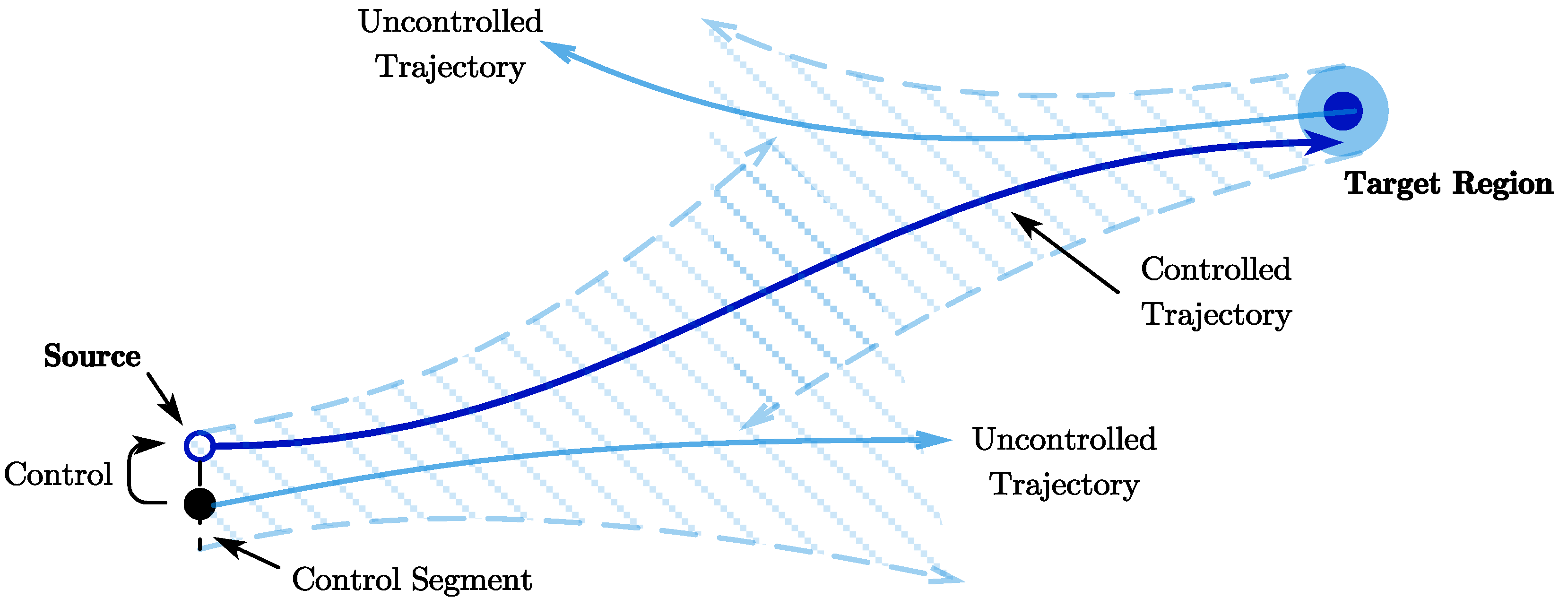
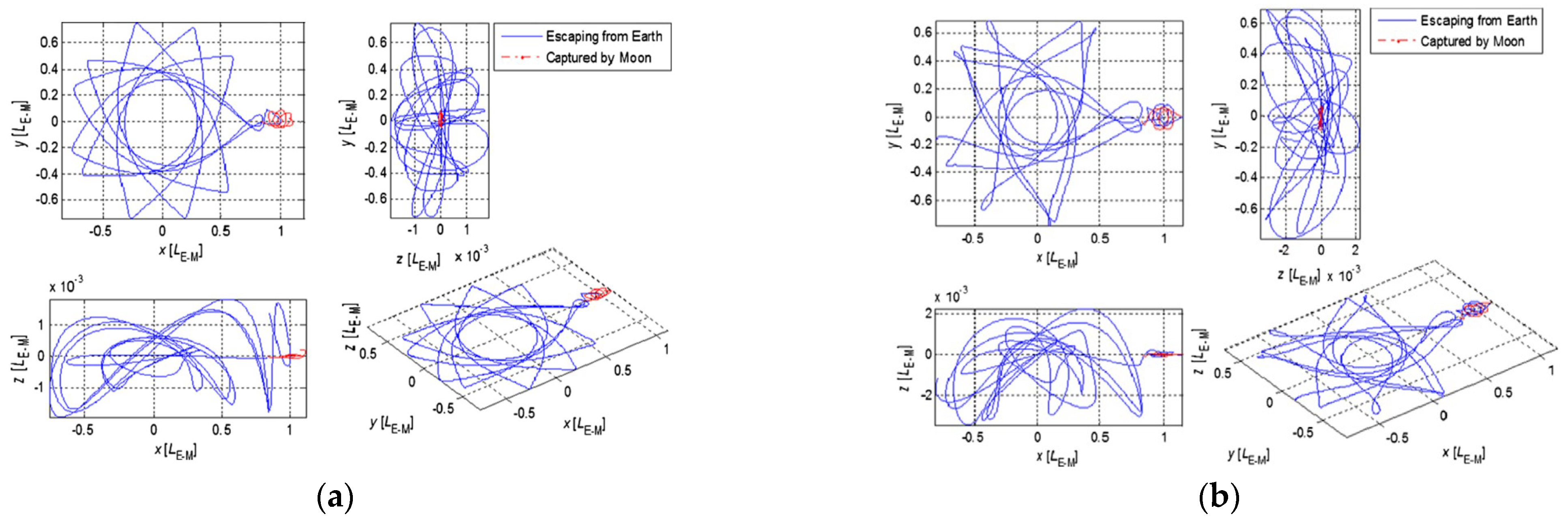
Building on these ideas, targeting strategies combined with optimization techniques were proposed to approach globally or near-globally optimal solutions in chaotic phase space. Pass-targeting methods employing forward–backward integration were shown to reduce transfer time by approximately half relative to earlier chaotic transfers, while maintaining comparable or lower fuel costs [
73]. The forward–backward method is shown in
Figure 2. Alternative formulations addressing hyperbolic chaotic scattering improved robustness against noise and state uncertainty, achieving further reductions in computational complexity at the expense of modest increases in
[
65].
Comparative analyses across these methods consistently place chaos-assisted transfers in a regime characterized by significantly reduced energy requirements relative to direct transfers, with time of flight spanning from several months to over a year depending on the degree of control applied [
67,
71,
72,
73,
74,
75,
76]. In uncontrolled conditions, trajectories wandering inside chaotic regions may experience extremely long residence times before naturally approaching the lunar vicinity. For example, uncontrolled chaotic trajectories reported in the literature can remain within the Earth–Moon dynamical region for decades before reaching lunar proximity [
73]. Controlled chaotic transfers, in contrast, employ discrete perturbations to guide the trajectory through the chaotic region toward a desired capture state. Representative cases reported in the literature demonstrate that such targeting strategies can achieve lunar capture with transfer durations ranging from several months to about one year, depending on the initial orbit, control strategy, and allowable
[
73,
75]. The main characteristics of these representative trajectories are summarized in
Table 1.
Ross [
76] further reviewed chaotic transfer design methods and highlighted the trade-off between TOF and required
when compared with classical impulsive transfers. The typical
–TOF ranges for different Earth–Moon transfer strategies are summarized in
Table 2 for clarity.
Overall, chaos-assisted targeting methods occupy a transitional region in the time–fuel design space of low-energy transfers. Compared with WSB-based trajectories, they sacrifice some of the extreme fuel optimality in exchange for substantially shorter and more controllable transfer durations. At the same time, their reliance on sensitive phase-space structures and discrete control actions distinguishes them from the more geometrically structured invariant-manifold-based approaches discussed in
Section 4.
3.2. Optimization and Phase-Space Structures in Chaotic Transfer
As the limitations of experience-driven targeting methods became increasingly evident, particularly in terms of impulse selection and sensitivity to initial guesses, a natural progression in chaos-assisted transfer design has been the formulation of chaotic control as a constrained optimization problem. Enabled by advances in numerical computation and heuristic optimization techniques, this line of research aims to systematically determine control locations, magnitudes, and sequencing while explicitly balancing fuel consumption, transfer duration, and control complexity.
Starting from this idea, optimization was introduced not to change the low-energy nature of chaotic transfer but to control how much time must be paid in exchange for lower control expenditure. Wang et al. [
77] discretized the chaotic transport process on a Poincaré map and solved the targeting problem as a bounded multi-step fuel-minimization problem using elitist teaching–learning-based optimization (ETLBO), with each crossing of the section treated as a potential control step. Their results make the low-fuel/long-time compromise very explicit: when the admissible control bound was reduced from 0.01 to 0.0001, the required total velocity boost decreased only from 835.41 m/s to 748.63 m/s, whereas the transfer time increased from 213.49 days to 1348.40 days and the number of control steps rose from 20 to 130. Even the shortest case still required about seven months, while the tightest-control case exceeded 3.5 years. This means that, in chaos-based Earth–Moon transfer, fuel saving obtained by restricting control is not proportional to the time penalty: once the control authority becomes too small, the spacecraft spends most of the mission repeatedly wandering inside the chaotic region, and the time cost rises much faster than the fuel benefit. Wang et al. also noted that all five optimized solutions still retained more than 31% advantage in total velocity boost relative to a Hohmann transfer, but their real contribution is not merely lower delta v; rather, it is to show quantitatively that optimization can replace ad hoc targeting and produce a controllable sequence of low-energy transfers under prescribed thrust bounds.
Subsequent studies therefore concentrated on improving the time efficiency of chaos-assisted low-energy transfers without sacrificing their low-fuel advantage, primarily by reducing unnecessary residence in the chaotic region and thereby obtaining a more favorable balance between transfer duration and control expenditure. Zheng et al. [
78] no longer relied on searching for near-recurrent points in the traditional sense, but divided the chaotic region into layers on the Poincaré section and combined this layered description with forward–backward targeting, so that the transfer would pass through the chaotic sea more directly. The resulting trajectories required only 2–4 impulses and achieved flight times of about 184–303 days with total velocity increments around 740.9–897.1 m/s, showing that the main way to shorten time was not to abandon chaotic transport, but to reduce unnecessary residence in the deeper chaotic layers. Zheng et al. [
79] then pushed this idea further by applying adaptive particle swarm optimization to determine the perturbation at each close lunar encounter. Their numerical results show a clear trend: allowing larger perturbation windows reduced the number of corrections from 5 to 2 and shortened flight time from 254 to 109 days, although the total velocity increment increased from 779 to 1010 m/s. Here again, the key issue is the same time-for-fuel exchange: a modest increase in control expenditure can buy a large reduction in wandering time. Finally, Zheng et al. [
80] combined chaos control with invariant-manifold transport. In their method, the Earth-side segment was still designed through chaotic control to avoid long chaotic drift, but the final approach to the Moon was transferred onto a Lyapunov-orbit manifold tube, so the path near capture was no longer left to chaotic wandering. The three representative solutions in that paper required 762.8–807.0 m/s and 38–101 days, whereas the authors reported that the pure chaos-control comparison case required 749.6 m/s and about 2.05 years. This is the most important result of the research group as a whole: the later work does not overturn the low-energy logic of chaos control, but shows that once manifold guidance is introduced near the lunar end, the same low-energy philosophy can be retained while sharply reducing the time cost that otherwise dominates purely chaotic designs.
Apart from its combination with optimization approach, recent studies from other research groups show that low-energy trajectory design has increasingly interpreted the chaos motion through the phase-space structures that organize transport in multibody systems. In this line of work, chaos is closely linked with libration-point periodic orbits, quasi-periodic orbits, resonant trajectories, and their associated stable and unstable manifolds. Haapala and Howell [
81] constructed transfer connections among periodic libration-point orbits in the Earth–Moon spatial circular restricted three-body problem (CRTPB) and showed that heteroclinic, homoclinic, and impulsively connected trajectories can be systematically organized into families rather than found only as isolated cases. McCarthy and Howell [
82] extended this viewpoint to four-body cislunar dynamics by combining quasi-periodic orbits and their invariant manifolds with continuation and Poincaré-based analysis to identify ballistic transfer opportunities under solar perturbations. Kumar et al. [
83] further highlighted the role of resonant transport by revealing heteroclinic connections among cislunar mean-motion resonances and between resonant orbits and the lunar
L1 region, showing that part of the semimajor-axis evolution can be achieved ballistically without additional control. Collectively, these studies indicate that recent work has increasingly used chaos together with resonant and manifold structures to identify the geometric backbone of low-energy transport, thereby turning long-time multibody evolution into a usable design resource rather than treating it merely as sensitivity or unpredictability.
A further development has been the combination of chaotic transport with lobe dynamics to improve the practical controllability of low-energy transfer design. In this approach, the goal is not simply to exploit chaotic wandering. Rather, the finite-time transport geometry of lobes is leveraged to reduce unnecessary residence in the chaotic region and to construct transfers that remain low-energy while improving time efficiency and tolerance to perturbations. Hiraiwa et al. [
84] showed that lobe dynamics can be used to design robust trajectories in low-dimensional Hamiltonian systems relevant to the Earth–Moon problem, obtaining transfer solutions with markedly lower TOF than earlier chaos-assisted targeting results while preserving moderate control cost. Their subsequent cislunar studies [
85] introduced sequences of lobes as building blocks for low-energy transfer design and combined them with graph-based search and trajectory correction to generate feasible Earth–Moon transfers. The later extension to higher-fidelity models [
86] further demonstrated that lobe-based construction can be coupled with multiple-shooting refinement, allowing low-energy chaotic transfers first obtained in CRTBP to be continued into more realistic models. Compared with earlier chaos-targeting strategies that relied heavily on recurrence search or manually selected perturbations, this line of work places greater emphasis on the local transport geometry inside the chaotic region, and therefore provides a more direct way to improve the time efficiency and robustness of low-energy transfer without abandoning its basic time-for-fuel advantage.
To clarify how different control formulations affect the balance between total velocity increment and transfer duration, the representative results reported in the above studies are summarized in
Table 3. Rather than serving as a strict one-to-one performance comparison, the table is intended to highlight the common trend in optimization-assisted chaos-based transfer design: reducing control authority or preserving a more purely low-energy character often leads to a disproportionate increase in flight time, whereas moderate additional control can substantially improve time efficiency while retaining most of the fuel-saving benefit.
Despite their appealing fuel-saving potential, the main limitation of chaos-assisted transfers is the exponential sensitivity to initial conditions, which makes the resulting trajectories highly vulnerable to navigation errors and finite maneuver execution accuracy. In practical mission design, this implies that a transfer identified in an idealized dynamical model may require substantial retargeting or correction when transitioned to higher-fidelity ephemeris models. Therefore, the main value of chaos-assisted methods may lie less in fully autonomous end-to-end transfer realization and more in providing access to low-energy transport channels, preliminary design opportunities, and recovery options that can later be regularized by optimization or manifold-based corrections. Recent work has further explored the role of chaotic transport mechanisms in trajectory design, particularly in connecting dynamical regions with minimal control effort. Advances in numerical continuation methods and global optimization techniques have improved the practical applicability of chaos-assisted trajectory design for complex multi-body systems.
4. Invariant Manifolds, Libration-Point Gateways: Structured Low-Energy Transport
As noted in
Section 2.1, the dynamical meaning of weak stability boundaries can be partly interpreted through invariant manifold structures associated with libration-point orbits. Moreover, chaos-assisted transfer strategies, as discussed in the previous section, demonstrate that low-energy Earth–Moon transport can be achieved by exploiting sensitive phase-space transport mechanisms. However, the practical implementation of chaos-assisted transfer is often hindered by prolonged residence times in chaotic regions and their strong dependence on initial conditions. In contrast, transfer design based on invariant manifold theory offers a more structured approach to low-energy transport, significantly reducing uncontrolled wandering while maintaining comparable fuel efficiency.
Based on invariant manifold theory, these transfer trajectories are derived from the circular CRTBP, which provides a simplified dynamical model for analyzing spacecraft motion in the Earth–Moon system. Early studies of the CRTBP revealed the existence of five equilibrium points, later termed Lagrangian points, around which families of periodic orbits arise. Conley [
17] demonstrated that, near the collinear Lagrangian points, phase space contains narrow transition channels connecting regions associated with the two primary bodies. These channels appear when the Jacobi constant of a trajectory slightly exceeds the critical value at the equilibrium point, allowing motion between the Earth and Moon through what is commonly referred to as a “neck” region in configuration space. This leads to a key principle of low-energy transfer that by selecting trajectories with Jacobi constants marginally above the critical value of the Earth–Moon
L1 or
L2 points, spacecraft can traverse between the Earth and Moon with minimal energy expenditure. Unlike chaos-assisted approaches that rely on statistical transport and repeated corrections, manifold-based transfers explicitly follow deterministic phase-space structures associated with periodic orbits, enabling more predictable and repeatable trajectory construction.
The chaotic method introduced in the former section can significantly reduce propellant consumption compared to traditional Earth–Moon transfer approaches such as Hohmann transfer. However, its practical application is limited by the potentially long residence time in chaotic regions, since the time required for the trajectory to escape and approach the Moon is often hard to predict. In comparison, construction of transfer trajectory on the basis of manifold theory could greatly reduce the wandering time while not adding much fuel cost compared to chaotic method. The basic transfer orbit design leveraging manifold theory is based on CRTBP, so as its origination. After the discovery of five Lagrangian points during the investigation of CRTBP by Euler and Lagrange, Conley [
17] discovered that there is always a “neck” around the collinear Lagrangian points around which the Jacobi constant of the periodic orbits was slightly above those critical points. Therefore, the low energy transfer orbits connecting two mass points, which could certainly be the Earth and the Moon, could be directed through the “neck” thanks to the Lagrangian point in between. On this basis, he gave a cure comprehension of designing transfer orbit of minimal fuel costs as deriving orbits that have the Jacobi constant just above that of the critical point between the Earth and the Moon, i.e., the
L1 point.
4.1. Theory and Computation in Invariant Manifold Transfers
Invariant manifolds constitute fundamental geometric objects associated with periodic orbits around equilibrium points in dynamical systems. For each periodic orbit, stable and unstable invariant manifolds are defined as sets of trajectories that asymptotically approach or depart from the periodic orbit in forward or backward time, respectively. In the absence of control, motion along these manifolds governs the global transport of trajectories through phase space.
Within the Earth–Moon CRTBP, invariant manifolds associated with periodic orbits around the collinear Lagrangian points
L1 and
L2 provide direct pathways for low-energy transfer. Trajectories guided by stable manifolds approach the vicinity of the Moon, while those following unstable manifolds depart toward Earth-centered or heliocentric regions. These dynamical structures have also been exploited in mission concepts, where spacecraft can drift along unstable manifolds of halo orbits to achieve large reorientation maneuvers with minimal propellant expenditure, as demonstrated for a starshade spacecraft operating near the Sun–Earth
L2 point [
87]. Depending on the chosen manifold family and system configuration, two distinct capture mechanisms can be identified. Transfers associated with
L1 manifolds remain primarily within the Earth–Moon system and lead to internal lunar capture, whereas transfers involving
L2 manifolds typically enter the Earth–Moon system from outside and are therefore influenced by solar perturbations, resulting in external lunar capture.
Systematic comparisons between invariant-manifold-based transfers and classical direct transfers have been conducted to quantify differences in energy expenditure and time of flight. Liang et al. [
88] analyzed both low-energy and direct Earth–Moon transfers within a three-body framework and constructed a global map of cislunar transfer behaviors across a range of Jacobi constants. Their results demonstrate a clear trade-off that TOF increases with Jacobi energy, while the required fuel cost decreases. These results provided quantitative evidence that transfers guided by invariant manifold occupy an intermediate region between chaotic and direct trajectories in the time–fuel trade space between chaotic and direct trajectories. Subsequent studies extended the trajectory design by invariant manifold beyond idealized planar models. Silva et al. [
44] developed low-energy Earth–Moon transfers featuring ballistic lunar capture by coupling the Sun–Earth and Earth–Moon CRTBP models. By accounting for the relative inclination between the lunar orbital plane and the ecliptic, their approach enabled shorter transfer durations while preserving fuel efficiency. An additional reduction in transfer time was achieved by replacing long manifold arcs with quasi-periodic orbits in the Sun–Earth system, incurring only a modest increase in velocity expenditure. Moreover, transfer trajectories design based on invariant manifolds have also been shown to outperform earlier ballistic capture designs in terms of operational efficiency. Compared with approaches that target low selenocentric orbits directly [
61], manifold-guided trajectories can maintain extended lunar capture orbits with reduced total
requirements. For example, transfers originating from low Earth parking orbits have demonstrated energy savings exceeding 200 m/s relative to Hohmann transfers, while maintaining sustained motion in the lunar vicinity for several months.
Collectively, these results indicate that invariant manifolds provide a deterministic and computationally tractable framework for low-energy transfer design. By explicitly leveraging the geometric structure of phase space, manifold-based methods mitigate the excessive time variability associated with chaos-assisted transfers while retaining their substantial fuel savings. This structured transport mechanism forms the basis for systematic transfer design to libration-point orbits and related mission applications, which are discussed in the following subsection.
4.2. Transfer via Lagrangian-Point Orbits
The concept of utilizing invariant manifolds for low-energy Earth–Moon transfers has evolved significantly with advances in both theoretical and computational techniques. Following Conley’s initial work on CRTBP [
17], subsequent research has focused on refining transfer trajectories through the stable and unstable manifolds of periodic orbits around the Lagrangian points. Based on Conley’s analysis of the dynamics of low-energy transfer orbits through the Lagrangian points, the Jacobi constant can be manipulated to pass through the “neck” between two mass points, such as the Earth and Moon. This concept, based on periodic orbits around Lagrangian points, provided an insight for designing low-energy trajectories that connect the Earth to the Moon. These trajectories offer a promising solution for low-energy transfers by minimizing fuel consumption, despite the cost of extended transfer durations.
Sweetser [
89] was among the first to establish a lower bound for the fuel cost of Earth-to-Moon transfers, calculating the minimum
for a trajectory from a 167 km low Earth orbit to a 100 km lunar orbit. His findings set the benchmark for fuel-efficient transfer orbits, showing that the minimum
required for this transfer was 3.721 km/s. Subsequently, Pernicka et al. [
90] demonstrated a significant reduction in
, achieving savings of 192 m/s compared to Hohmann transfer, by using a two-legged approach: first from Earth to
L1, and then from
L1 to the Moon. The trajectory was constructed using numerical integration both backward and forward in time, incorporating perturbations from the third body, the Sun. Although the
cost was still substantial (3.824 km/s), this approach illustrated the potential for low-energy trajectories that leveraged Lagrangian dynamics.
Topputo et al. [
16] proposed a direct transfer method using the
L1 nonlinear orbit, which further reduced the
to 3.894 km/s, compared to the classical Hohmann transfer. By introducing a new approach that extended the Lambert two-body arc to a three-body system, they showed that the link between the
L1 nonlinear orbit and lunar orbit could achieve a
reduction of approximately 100 m/s, while shortening the transfer time to 255.5 days. This demonstrated that transfers based on
L1 offer substantial fuel savings over traditional methods while still maintaining a feasible transfer time. Further refinement was provided by Mengali et al. [
45], who developed an analytical approximation of
for a two-impulse Earth–Moon trajectory, considering the Jacobi constant and the radii of stable orbits around the Earth and Moon. By minimizing the velocity variation through numerical optimization, the study found a
of 3.861 km/s with a TOF of 85 days, which was more than 100 m/s lower than the Hohmann transfer and saved 39% of the time compared to WSB transfers [
21]. This highlighted the effectiveness of combining optimization techniques with invariant manifolds for time-efficient, low-energy transfer design. In a similar vein, Pontani and Teofilatto [
91] employed manifold theory in two scenarios: (i) connecting the stable manifold of the
L1 Lyapunov orbit with the low Earth orbit (LEO), and (ii) connecting the unstable manifold of
L1 to the low lunar orbit (LLO). Their approach required three impulses along the trajectory, demonstrating that such trajectories could be optimized by applying isometric morphing techniques to minimize fuel consumption, resulting in a
of 3.596 km/s with a TOF of 121.9 days for the first scenario and 3.578 km/s with a TOF of 124 days for the second scenario. Xu et al. [
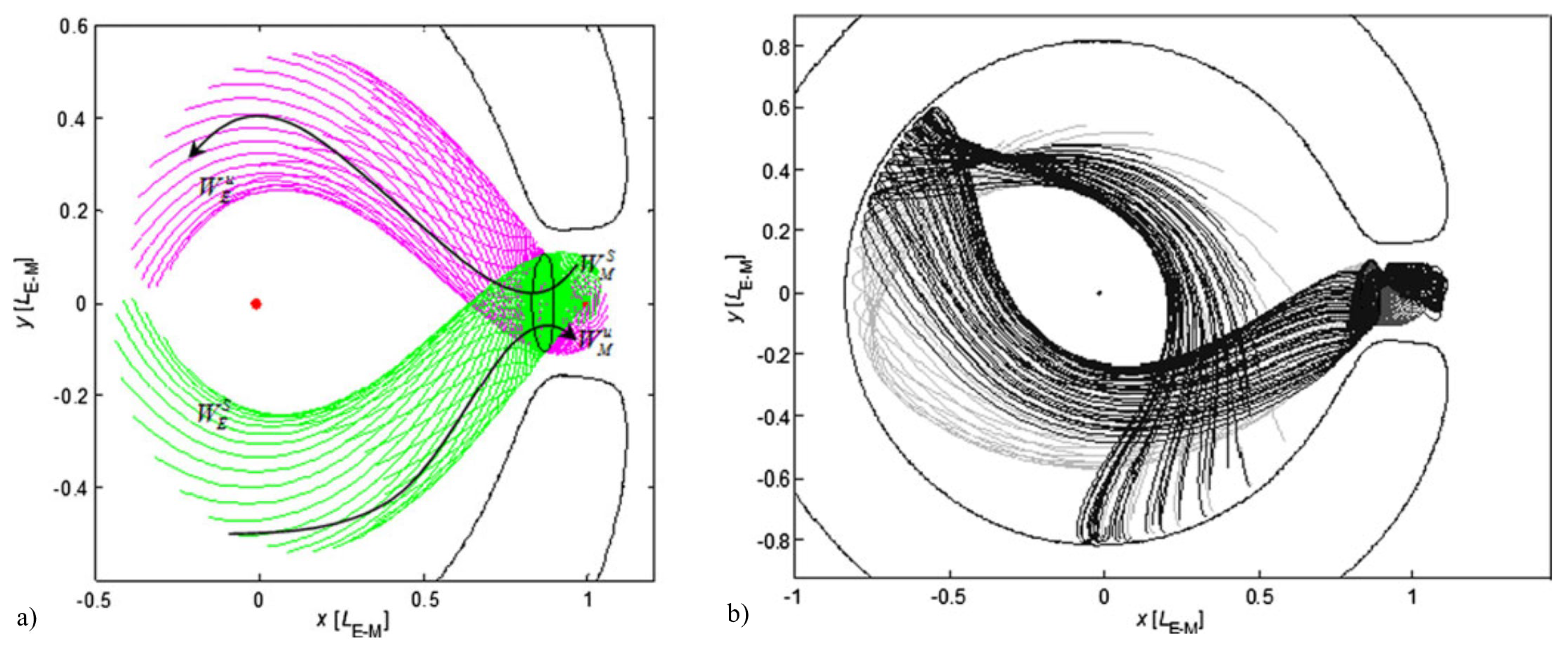
92] developed an analytical spatial bicircular model that accounts for the combined gravity of the Sun, Earth, and Moon, and used it to construct minimum-energy Earth–Moon transfers via two main pathways: trajectories transiting the collinear Lagrange points and those routed through halo orbits. They showed that, for
L1 and
L2 transit transfers, solar perturbations can render the transition time effectively unbounded within certain ranges of the solar phase angle
, while other
intervals admit finite-time transfers, and they mapped the favorable
regions accordingly (
Figure 3). For halo-orbit transfers, they introduced an additional design parameter (the selected point along the halo orbit) together with
to enlarge the feasible transfer set, and further reported that
L2-based designs can yield lower translunar fuel consumption; representative manifold-connection geometries and transfer types are summarized in
Figure 4.
As research advanced, new techniques were developed to optimize the use of invariant manifolds for low-energy transfer trajectories. Zheng et al. [
80] introduced the concept of hybrid transfer orbits combining invariant manifold theory with the four-body dynamics of the Earth–Moon–Sun system. Their analysis found that transfer trajectories passing through the Lagrangian points and halo orbits could achieve minimal fuel consumption, with the transfer to the
L2 point being particularly fuel-efficient. The inclusion of solar perturbations and adjustments to the phasing angle between the Earth, Moon, and Sun provided additional flexibility for low-energy transfer design.
In conclusion, invariant manifolds have proven to be a powerful tool in low-energy transfer design, providing deterministic and highly repeatable trajectories compared to chaotic methods. Although the trajectories are often associated with longer transfer times, their fuel efficiency and robustness make them an essential component of Earth–Moon transfer strategies, especially when combined with other low-energy methods such as hybrid models or optimization techniques. The development of these methods continues to show promise for future lunar and deep-space missions, where fuel efficiency remains a critical concern. However, the manifold geometry is defined with respect to a specific dynamical model, and its practical utility can degrade when additional perturbations or operational constraints are introduced. In mission designs, the main challenge is often not the existence of a transport channel itself, but preserving its robustness after model transition, trajectory patching, and correction design. This gap between elegant phase-space structures and certified flight trajectories remains one of the key issues in transferring manifold theory into routine mission design practice. In recent days, modern mission studies increasingly exploit invariant manifold structures for propellant-efficient spacecraft repositioning. These approaches have been applied not only to trajectory design but also to spacecraft retargeting and observation scheduling in libration-point missions.
To clarify the relationships among the main dynamical concepts involved in low-energy Earth–Moon transfers reviewed in
Section 2,
Section 3 and
Section 4,
Table 4 summarizes their associated dynamical regions and the corresponding energy threshold, emphasizing the relative dynamical regimes in which WSB transitions, ballistic capture, invariant-manifold transport, and chaos-assisted motion arise.
5. Low-Thrust Trajectories, Optimization Frameworks: Direct and Indirect Methods
Electric propulsion, particularly in the form of low-thrust systems, has gained significant attention in recent years for its ability to deliver higher payload fractions compared to traditional chemical propulsion systems. This is particularly relevant for deep-space missions where the trade-off between time and fuel consumption becomes a primary concern. While the Earth–Moon transfer using electric propulsion has been widely studied, more recent approaches have moved towards optimizing low-thrust trajectories, often leveraging numerical optimization techniques to balance the fuel and time costs effectively. These low-thrust methods, whether using constant-thrust electric propulsion or nuclear electric propulsion (NEP), are critical for missions with stringent payload requirements and long durations.
Low-thrust spacecraft provide continuous, small forces over extended periods. Unlike chemical propulsion, which operates through impulsive maneuvers, low-thrust propulsion systems require a more systematic approach to trajectory design. The optimization problem for low-thrust trajectory design is typically framed as follows: given the boundary conditions and mission constraints, the goal is to design a trajectory or series of trajectories that achieve specific mission objectives while minimizing fuel consumption or transfer time. This problem has led to the development of several optimization techniques, including direct and indirect methods, each offering distinct advantages and challenges.
The essence of low-thrust trajectory optimization lies in minimizing the objective function, typically fuel consumption or TOF, through a variety of methods. Optimization is often necessary due to the continuous nature of low-thrust propulsion, where the optimal trajectory cannot be easily derived using traditional methods. As a result, researchers have increasingly turned to optimization algorithms to solve the complex problem of low-thrust trajectory design [
10]. In particular, dedicated numerical algorithms have been developed to address the continuous and constrained nature of low-thrust control. For example, the Boulder Optimization of Low-Thrust Trajectories (BOLTT) tool adopts a two-point direct-shooting formulation with discretized bounded thrust control, which is conceptually analogous to the Sims–Flanagan transcription widely used in interplanetary trajectory design [
93].
5.1. Direct Optimal Method
The widespread application of direct optimization methods in solving low-thrust trajectory design problems has been made possible by the rapid development of numerical computing technologies and advanced computational algorithms [
10]. The core idea of direct methods lies in transforming the continuous control problem into a discrete optimization problem, where the optimization process typically involves numerical integration techniques [
94]. As the performance index is set to minimize fuel consumption, the trajectory design problem is then formulated as a nonlinear programming (NLP) problem. Compared to indirect methods, direct methods do not require precise initial guesses and have the advantage of easily interpretable decision variables, which are closely related to the physical parameters of the system.
Before the 1990s, the relationship between collocation integration methods and direct transcription was not clearly defined. However, this gap was addressed by Enright and Conway [
94] through the re-interpretation of the direct collocation method, using an implicit integration formula. They employed the Runge–Kutta integration method in a parallel shooting technique, which led to an alternate scheme that shared the same discrete adjoint equations as the state integration. This development significantly enhanced the optimization process, providing a systematic approach for solving low-thrust trajectory problems in the context of the CRTBP. Specifically, the design of planar trajectories from a circular LEO to a circular LLO with minimal fuel consumption was derived using a three-step approach [
95]. The proposed method involved first deriving the optimal low-thrust trajectories that would maximize energy savings for transfers departing from Earth and captured by the Moon. These solutions were then used as boundary conditions for the second step, which involved calculating suboptimal trajectories with minimal fuel consumption that required no coast arcs. Finally, the complete optimal trajectory from LEO to LLO was derived using a combination of direct and indirect optimization methods, refining the control variables to achieve the minimal energy cost. In subsequent work, Kluever and Pierson [
96] extended this method to account for NEP satellites, applying a similar approach to minimize fuel consumption while accommodating more complex orbital dynamics and longer mission durations.
In contrast to earlier approaches which required multiple impulses and relied heavily on periodic orbits, the work by Herman and Conway [
97] introduced the collocation method combined with nonlinear programming to directly solve for optimal Earth–Moon transfer orbits. Using a seventh-degree Gauss-Lobatto system, they discretized the optimal control problem and solved for a trajectory with a fixed transfer time but low energy consumption. The results showed that the use of low-thrust propulsion, with a thrust acceleration on the order of 10
−4, enabled the spacecraft to complete the transfer in 32 days, further demonstrating the efficiency of these direct optimization methods for low-thrust transfers. In addition, solar sail propulsion systems have introduced a new and cost-effective method for achieving propellant-free transfers. Unlike chemical or electric propulsion systems, solar sails rely on the interaction between solar photons and a membrane to generate thrust, enabling continuous propulsion over extended durations. The momentum generated by solar radiation pressure (SRP) leads to continuous low-thrust acceleration, which is inherently modeled using the same principles as low-thrust trajectory design. As a result, the optimization of solar sail trajectories has become an important area of research [
98].
The absence of propellant in solar sail systems shifts the focus from fuel optimization to minimizing travel time. This feature makes solar sails particularly appealing for long-term exploration missions with stringent mass constraints. Heiligers et al. [
99] demonstrated the feasibility of using solar sails to design a low-energy trajectory for exploring asteroid 2016 HO
3. Using a direct pseudo-spectral optimal control solver, they compared solar sail and solar electric propulsion (SEP). The solar sail trajectory took between 2.16 and 3.51 years to reach the asteroid, significantly faster than the 4.38–4.62 years required by SEP spacecraft. Furthermore, the SEP system consumed a much higher amount of fuel (5.9 kg), whereas the solar sail system operated with no propellant. Song and Gong [
100] explored the use of solar sails for a Mars transfer, applying convexification techniques to transform the original non-convex problem into a second-order cone programming formulation. Using this method, they derived a propellant-free transfer trajectory to Mars, with a TOF of 577.6 days. The efficiency and accuracy of this method were further validated by applying the same conditions using indirect methods. The study also extended this technique to multiple asteroid rendezvous missions, demonstrating the feasibility of propellant-free transfers to Mars, Venus, and asteroid99942 Apophis [
101].
Further research by Song and Gong introduced a hybrid pseudo-spectral method, which integrated the benefits of both direct and indirect methods for multi-target rendezvous missions. This method significantly reduced the computational burden compared to traditional approaches by addressing the hypersensitivity of initial guesses in indirect methods. Their findings highlighted the potential of solar sails for missions that require long-duration, propellant-free transfers, with TOFs ranging from 1214.4 days for a visit to Britta, to 584.9 days for Nicholson, and 643.9 days for Vesta [
102]. The results demonstrate that trajectories can be further optimized to achieve feasible TOF across multiple targets without propellant consumption.
5.2. Indirect Optimal Method
Indirect methods formulate low-thrust trajectory design as an optimal control problem and enforce first-order necessary conditions derived from Pontryagin’s maximum principle (PMP). In classical implementations, the continuous-time problem is converted into a two-point boundary value problem (TPBVP), where the initial values of the costate variables are tuned such that terminal constraints on both states and costates are satisfied. Recent work has extended this framework to end-to-end optimization of Earth–Moon transfers, showing that optimizing the connection between geocentric and selenocentric trajectory segments can significantly reduce both Δ
V and TOF compared with conventional junction strategies based on libration points [
47].
A central appeal of indirect methods is their compact parameterization: the trajectory and control history are represented through a relatively small set of variables (typically the initial costates and a small number of multipliers), without requiring an explicit thrust-shape guess in the decision space. This often yields high-accuracy solutions once convergence is achieved. In practice, however, indirect formulations face well-known operational limitations: (i) the convergence basin can be narrow and highly sensitive to small perturbations in initial costates and problem parameters; (ii) modest changes in mission constraints may require substantial reformulation of the necessary conditions; and (iii) deriving and enforcing transversality conditions can be algebraically intensive, which complicates both implementation and diagnostic interpretation. To address the sensitivity of costate initialization while retaining the accuracy of PMP-based formulations, Dixon and Bartholomew-Biggs [
38] proposed an adjoint-control transformation (ACT) method that maps the TPBVP into a NLP problem posed in terms of initial control variables. By converting the difficult step of costate guessing into a control-parameter optimization, ACT can enable convergence to locally optimal solutions in cases where direct TPBVP shooting fails [
38].
Subsequent work further developed ACT as a practical bridge between indirect optimality conditions and numerically robust search procedures. Martell and Lawton [
41] used ACT to solve an auxiliary optimization problem to generate effective initial guesses for adjoint variables, implemented by matching control values at selected node points along the trajectory. The same transformation framework was applied to minimum-fuel problems under explicit TOF constraints, including interplanetary round-trip Earth–Mars mission design [
103]. Qi and Xu [
104] further improved ACT-based implementations by expressing highly sensitive costate components through control-related variables with clearer physical interpretation, and demonstrated fuel-optimal transfers from LEO (500 km) and MEO (3639 km) to an Earth–Moon
L1 halo orbit [
101]. Collectively, these studies illustrate a recurring pattern: ACT does not remove the need for an indirect formulation, but it can substantially improve numerical practicality by relocating sensitivity from costate guessing to a more stable optimization layer [
38,
41,
103,
104]. In addition, recent studies have investigated low-thrust transfers between different families of periodic orbits in the Earth–Moon system, including transfers between planar and spatial quasi-satellite orbits, demonstrating the feasibility of propellant-efficient reconfiguration between dynamical orbit families [
48].
Beyond ACT, several algorithmic strategies have been proposed to enlarge the convergence regions of indirect solvers and reduce dependence on carefully selected initial guesses. Gil-Fernandez and Gomez-Tierno [
39] introduced a two-step reformulation procedure that expands convergence when solving the TPBVP and avoids the need for explicit initial guesses. Jiang et al. [
40] proposed constraining the initial costate vector onto a unit hypersphere via normalization, thereby reducing scaling pathologies in shooting iterations. Using the improved algorithmic setting, they constructed low-energy trajectories from Earth to Venus and to Jupiter with Mars gravity assist, demonstrating enhanced robustness across multi-leg mission structures. These contributions highlight that, for indirect methods, numerical reliability is often governed less by the PMP conditions themselves than by how costate initialization and scaling are managed in the solver loop.
Researchers have also improved indirect approaches through combined techniques, including hybrid initialization pipelines and coordinate-system choices that simplify optimality enforcement. Taheri et al. [
43] generated initial costates using trajectories produced by combining two shape-based methods, the pseudo-equinoctial elements and a three-dimensional finite Fourier series representation. Then they reported improved convergence rates relative to random costate initialization, ACT-based initialization, and a standard genetic algorithm, in Earth–Mars and Earth–Dionysus transfers. Ranieri and Ocampo [
105] proposed a stepwise procedure for Earth–Mars transfers using a two-dimensional model and multiple shooting, and improved numerical performance by formulating the problem in a single Earth-referenced coordinate system to avoid additional optimality complications introduced by coordinate transformations. Their approach enabled more accurate initial inputs, supported by a backward Mars capture spiral guess, and reported payload improvements for fixed fuel budgets; they also discussed capture spirals as a practical boundary for indirect methods in increasingly constrained mission designs. These studies reinforce a critical methodological point for this review: indirect methods can remain competitive for complex low-thrust missions when the implementation explicitly targets the dominant failure mode—costate sensitivity—through structured initialization and problem parameterization.
Indirect methods are also widely used in propellantless or hybrid-propulsion mission design, where the optimization objective and the control authority differ from conventional SEP-only cases. For example, Mengali and Quarta [
106] investigated transfers under a hybrid low-thrust configuration combining SEP with SRP. By modeling the dynamics under a reduced effective solar gravity and deriving steering laws through an indirect formulation, they constructed interplanetary rendezvous trajectories (e.g., toward Mars and Venus) and quantified trade-offs in TOF and propellant expenditure between hybrid and pure-SEP configurations. This line of work illustrates how indirect methods can incorporate additional continuous-control components beyond thrust magnitude or direction alone, while still maintaining the compact representation and high-accuracy characteristics that motivate PMP-based designs. With the rapid development of machine learning techniques, data-driven approaches have recently been introduced to approximate fuel-optimal trajectories and accelerate the solution of complex optimal control problems [
46,
49].
Despite its advantage of fuel efficiency and design flexibility, disadvantages induced by the trade-off characteristics should never be neglected. Specifically, fuel-optimal solutions often imply extended transfer durations, causing increased exposure to perturbations and greater numerical sensitivity in the optimization process. Moreover, direct methods are generally more robust in handling complex constraints, but at the price of higher-dimensional nonlinear programs and nontrivial discretization effects. Indirect methods can achieve high-accuracy solutions, yet their convergence remains strongly dependent on costate initialization and continuation strategy. As a result, the practical challenge is not merely to compute an optimal trajectory, but to identify solutions that remain numerically tractable and operationally robust. In recent years, low-thrust trajectory design has benefited from the integration of advanced numerical optimization and emerging computational techniques. For example, recent studies have applied successive convex optimization and beam-search strategies to improve the robustness of trajectory optimization and reduce sensitivity to initial guesses in complex multi-body environments. Other work has explored end-to-end trajectory optimization frameworks that directly incorporate propulsion constraints and mission requirements, enabling more efficient design of Earth–Moon transfers under realistic spacecraft power limitations. In addition, machine-learning-assisted approaches have been proposed to approximate optimal control solutions and significantly accelerate trajectory generation compared with traditional indirect or shooting-based optimization methods [
47,
48,
49].
In summary, to provide a clearer comparison of the various transfer strategies discussed in
Section 2,
Section 3,
Section 4 and
Section 5,
Table 5 summarizes their typical
costs, time of flight, applicable mission scenarios and corresponding computational complexity. The numerical ranges listed in the table represent typical values reported in representative studies and may vary depending on mission configuration and trajectory optimization constraints.
6. From Theory to Flight: Mission Demonstrations and Engineering Lessons
Low-energy transfers become especially compelling when delivered payload mass and propellant margin dominate mission utility, as well as when a longer TOF is operationally acceptable or can be absorbed by the overall mission schedule [
90]. In practice, the value of these trajectories is twofold: (i) mission recovery, where a modest
shortfall would otherwise terminate the mission; and (ii) capability expansion, where reduced propellant expenditure can be exchanged for additional payload, extended operations, or more flexible sequencing of gravity assists and capture strategies.
6.1. Mission Rescue Enabled by Low-Energy Design
A well-known case study is Hiten (MUSES-A). The mission was conceived to acquire and validate technologies relevant to later lunar and planetary exploration [
107]. After launch, an underperformance left the spacecraft with an apogee substantially below the original plan and a remaining maneuver budget of roughly 250 m/s, making the nominal lunar trajectory unattainable. Belbruno and Miller subsequently designed a WSB-based ballistic-capture transfer that exploited the coupled perturbations of the Sun–Earth–Moon system [
108]. The revised trajectory guided Hiten through a weak-stability region and achieved ballistic capture at a periapsis altitude of about 100 km, requiring only 30–169 m/s for the capture maneuver, which is compatible with the residual propellant [
22]. The transfer duration increased to approximately five months, but the rescue demonstrated that large mission-level capability can be recovered by accepting longer TOF in exchange for a substantially reduced insertion requirement.
A similar “time-for-fuel” recovery logic underpinned the rescue strategy for Nozomi (Hope), Japan’s first Mars probe. A malfunction caused by an oxidizer latching valve not fully opening during the Earth swing-by induced estimated 100 m/s
deficit, placing the remaining propellant budget at risk if corrected conventionally [
108]. The mitigation method relied on trajectory redesign using additional Earth gravity assists and a modified insertion sequence, conserving on the order of around 300 m/s at the cost of arriving at Mars roughly four years later [
109]. While the operational timeline expanded, the recovery illustrates the role of multi-body trajectory design and gravity-assist sequencing as a practical substitute for propellant-intensive corrections when TOF is negotiable.
The AsiaSat-3 case (later HGS-1) further highlights how low-energy transfers can recover value from severe insertion failures. Following a partial burn failure at GTO apogee, the spacecraft was stranded in a highly eccentric, highly inclined orbit (inclination of around 51.6° and eccentricity of around 0.73), with a required corrective
of approximately 2420 m/s, which exceeds the available capacity of 2020 m/s. A rescue trajectory using two lunar flybys successfully delivered the satellite to a usable low-inclination geosynchronous orbit within the remaining propellant budget, with a transfer duration of about 33 days [
110]. This outcome underscores a recurring theme: once the spacecraft is placed in a configuration where multi-body perturbations and lunar encounters can be leveraged, the mission can “buy back” otherwise prohibitive
at the expense of time expenditure. Hybrid trajectory architectures integrating impulsive maneuvers, low-thrust spirals, and gravity-assist flybys have also been demonstrated in practical design studies. For example, solutions developed for the Global Trajectory Optimization Competition (GTOC8) employed a hybrid strategy combining an initial impulsive maneuver of approximately 3 km/s, subsequent low-thrust spirals, and multiple lunar flybys to deploy a multi-spacecraft radio-interferometry constellation [
111].
6.2. Beyond Rescue: Expanding Mission Envelopes with Low-Energy Transfers
Low-energy techniques have also enabled new operational modes rather than merely recovering failed ones. ISEE-3/ICE was originally jointly developed by NASA and ESA to study the interaction between Earth’s magnetic field and solar wind. This mission adopted low-energy trajectory concepts including chaotic regions and lunar gravity assists to reach a halo orbit around the Earth–Moon
L1 point, and later transitioned to deep-space operations, becoming the first spacecraft to encounter a comet [
112]. Here, the trajectory design was not a contingency response but a mission-enabling choice: the ability to move between dynamical environments using modest maneuvers materially expanded the reachable mission set [
112]. Beyond single-spacecraft mission design, similar principles have also begun to influence the design of satellite formation configurations. Ding et al. investigated formation configuration establishment and screening strategies based on dynamical systems representations, including torus topological equivalence and Poincaré-based contraction mappings [
113,
114]. These approaches enable more efficient identification of bounded relative orbit configurations while reducing the maneuver cost or computational burden associated with trajectory search. Although such applications differ from cislunar capture, they share the same engineering motivation: when small, repeated maneuvers dominate lifecycle cost, even modest reductions in each maneuver demand compound into substantial gains over mission duration. Applications as such indicate strong evidence of the expansion of low-energy trajectory design techniques into satellite formation control out of mission design of a single satellite.
For interplanetary mission design, low-energy transfers have been considered as systematic design options rather than exceptional cases. For example, in the context of missions such as Mars Express, combining WSB-like excursions with single, double or triple lunar swing-bys can yield propellant savings on the order of about 150 kg, at the cost of longer transfer durations [
108]. Belló et al. further discussed ESA mission opportunities, while the absolute energy savings may be moderate, the use of libration-point orbit (LPO) techniques increases mission design flexibility by relaxing constraints on orbital-plane orientation and sequencing. Related ESA cases include Bepi Colombo, Venus Express, and SMART-1, where the operational benefit is frequently expressed as broader feasible design space rather than
reduction alone [
10,
115].
6.3. Extensions of Low Energy Transfer Design Enabled by Propulsion
The applications of low energy transfer trajectories have extended beyond purely WSB designs or transfers enabled mainly by gravitational dynamics. Increasing attention has been directed toward low propulsion approaches, which retain the fuel economy character, while providing greater controllability. In this context, solar electric propulsion (SEP) is especially important because it replaces large impulsive corrections with sustained low-thrust acceleration, allowing transfer energy to be accumulated gradually over long arcs. Early cislunar studies already showed that low-thrust trajectory design in the Earth–Moon system can be embedded directly into multi-body dynamics rather than treated merely as a perturbed two-body problem. Ozimek and Howell [
116] developed low-thrust transfers to libration point orbits by combining propulsion with variable specific impulse, together with an initial design informed by manifolds and subsequent optimization. This approach establishes a practical route from dynamical structures to implementable transfer solutions. Mingotti et al. [
117] further demonstrated that invariant manifold segments and powered arcs can be combined efficiently in lunar transfer construction, so that natural transport geometry reduces the burden on the controlled segment rather than being replaced by it. More recently, Kayama et al. [
118] showed that successive convex approximation can be applied effectively to sensitive cislunar low-thrust transfers, including halo-to-NRHO problems, indicating that modern optimization is increasingly capable of converting dynamically sensitive trajectory structures in multi-body systems into robust and computationally tractable optimal control solutions.
The practical significance of this trend is already visible in flight missions. SMART-1 [
98] established SEP as a viable means of reaching the Moon through gradual outward spiraling, while BepiColombo [
119] extends the same design logic to interplanetary cruise by combining solar electric propulsion with multiple gravity assists and WSB capture considerations near Mercury. More broadly, these missions illustrate that low energy transfers in current applications is no longer limited to passively exploiting natural dynamics; it increasingly involves actively shaping those dynamics through continuous thrust, with guidance and optimization embedded from the outset.
Solar sailing may be viewed as an even more extreme extension of the low-thrust trajectory design, because it replaces onboard propellant expenditure altogether with continuous acceleration from solar radiation pressure (SRP). Its advantage of fuel saving lies not only in propellant free thrust, but also in the coupling of long duration trajectory shaping with lightweight deployable structures and large-area packaging technologies [
98,
120,
121]. Earlier development programs by ESA and DLR had already demonstrated the feasibility of fully deployable lightweight sail structures in ground tests, thereby establishing the technological basis for later space missions [
121]. Johnson et al. [
122] further emphasized that, by the early 2010s, the field had moved from isolated conceptual studies toward a recognizable sequence of technology demonstration, with solar sails increasingly framed as enabling platforms for non-Keplerian hovering and propellant free deep-space transport [
120]. In this sense, the application bottleneck of solar sailing has progressively shifted from propulsion principle itself to deployment reliability and structural control.
A major in-space milestone was IKAROS (JAXA), which Tsuda et al. described as the world’s first successful interplanetary solar power sail technology demonstration mission [
123,
124]. IKAROS successfully deployed a sail with span of 20 m. It verified acceleration driven by SRP and demonstrated guidance and navigation for solar sailing, and it completed the Earth to Venus leg of its interplanetary trajectory before passing Venus at the end of the nominal mission phase. These results established solar sailing as a physically realizable means of deep-space trajectory shaping rather than a purely theoretical concept.
Beyond flight validation of a single destination, subsequent studies began to treat solar sails as agile platforms for multi-objective transfer design in multi-body environments. Heiligers and McInnes [
125] investigated solar-sail transfers between artificial equilibrium points in the Sun–Earth three-body system, showing that a sail performing similar to Sunjammer could connect regions such as sub-
L1, Parker spiral, and
L2 regions through smooth transfers with TOF on the order of 85–232 days. In a related line of work, Heiligers et al. [
126] studied transfers between north and south pole sitter orbits using both pure SEP and hybrid propulsion that combines SEP with SRP. They showed that such hybrid propulsion configurations can reduce propellant consumption in SEP and can enable transfer scenarios that remain difficult for current pure solar sail technology. The Sunjammer concept further illustrates how solar sails can be embedded into an end-to-end trajectory design process, rather than being treated as isolated propulsion demonstrations. Heiligers et al. [
127] designed a preliminary mission architecture from Earth GTO to the sub-
L1 region, including accessible artificial equilibrium points, fly-out optimization, and extended mission scenarios. Their results showed that sails of Sunjammer type could support transfers to Parker-spiral vantage points and
L2-region configurations, with individual extended-mission legs requiring roughly 3–8 months. For more demanding deep-space trajectory missions, JAXA’s proposed OKEANOS mission extends the solar sail missions from inner solar system demonstration to an outer solar system exploration trajectory with long TOF. Okada et al. [
128] described OKEANOS as a solar power sail mission to a Jupiter Trojan asteroid, using sail of large area to power advanced ion engines and thereby forming a hybrid propulsion system suited to cruise with TOF of decades.
In recent years, increasing attention has been directed toward hybrid trajectory design strategies that combine approaches based on dynamical systems with continuous propulsion and modern numerical optimization. In such frameworks, invariant manifolds, WSB pathways, or other natural transport structures are first used to identify low-energy routes in the multi-body environment, while low-thrust control, solar sailing, or related propulsion mechanisms provide the flexibility needed to connect or sustain these trajectories under realistic mission constraints [
116,
117,
118,
125,
126,
127]. Numerical optimal control methods are then employed to refine the trajectory, enforce mission constraints, and improve robustness under realistic perturbations. This hybrid method has become increasingly important because it leverages the physical insight of dynamical systems theory while benefiting from the flexibility and robustness of modern optimization techniques.
7. Conclusions
Low-energy Earth–Moon transfers provide a mature alternative to classical direct designs (e.g., Hohmann-type and patched-conic transfers) when mission design is strongly constrained by propellant budget, delivered mass, or capture burden and when a longer TOF can be accommodated. The literature reviewed in this paper shows that the essence of “time-for-fuel” trajectory design is not simply accepting a slower transfer but reshaping the transfer path so that propulsion demand is reduced through the exploitation of multi-body dynamics or sustained low-thrust control. In this sense, the fuel-saving potential of low-energy transfer arises mainly from weak stability boundary effects, ballistic capture behavior, chaotic transport across multibody phase space, invariant manifold connections associated with libration-point dynamics, and optimization-based low-thrust trajectory shaping. Even with modern computational capabilities, trajectory design remains fundamentally constrained by the underlying dynamical structure of the multi-body system. Consequently, identifying natural low-energy transport mechanisms remains essential for reducing propellant demand before numerical optimization is applied.
It should be emphasized that the trajectory design strategies discussed in this review do not replace modern numerical optimization techniques. Instead, they provide dynamical frameworks that define energetically efficient transport pathways in multi-body gravitational systems. In practice, dynamical analysis is typically used first to identify feasible regions of phase space, while numerical optimization is subsequently applied to refine trajectories within these dynamical structures and satisfy mission constraints. This complementary relationship between dynamical insight and optimization has been widely adopted in modern trajectory design.
The reviewed approaches can be organized along two complementary design logics. Methods of the first category primarily leverage dynamical structures of multi-body systems. WSB and ballistic-capture transfers are particularly effective in reducing capture burden and enabling low-energy arrival, although this benefit is usually accompanied by substantially longer transfer durations. Chaos-assisted methods can generate a broader range of low-energy transfer opportunities, but this flexibility often comes with stronger sensitivity to initial conditions, phasing, and model consistency, which increases verification and correction demands. Invariant-manifold-based approaches provide more structured and predictable transport pathways, often reducing nonproductive wandering relative to uncontrolled chaotic transport while preserving favorable propellant characteristics. In practice, these approaches are frequently hybridized: chaotic segments can be patched to manifold segments, and WSB interpretations can be used to rationalize capture behavior in terms of invariant structures, thereby moving the design along the fuel–time trade surface rather than committing to a single mechanism. In contrast, methods within the second category—low-thrust optimization—treat trajectory design as an optimal control problem driven by propulsion and operational constraints. Here, the defining feature is not a particular dynamical structure, but a computational pipeline that satisfies boundary conditions and mission constraints while optimizing propellant or time. Direct methods generally offer stronger robustness to complex constraints, whereas indirect methods can deliver highly accurate solutions once convergence is achieved, although they remain more sensitive to initialization. Practically, these two design logics are rarely independent: dynamical structures often provide the initial transport architecture, while optimal control techniques refine trajectories within this framework to satisfy mission constraints and improve performance.
From an engineering perspective, the practical value of these strategies is most evident in the mission scenarios reviewed in
Section 6, where transfer-stage propellant expenditure has a strong influence on payload margin, mission flexibility, or capture feasibility and where longer TOF remains operationally acceptable. This is especially true for cislunar and deep-space exploration missions, which often tolerate larger time scales in exchange for improved propellant economy, increased design flexibility, or expanded reachable mission opportunities. Under such conditions, extending transfer time is not merely a concession, but can become an effective means of enlarging the feasible design space and improving overall mission robustness at the transfer stage. In addition, future deep-space missions may increasingly rely on autonomous onboard guidance and adaptive trajectory correction to enhance operational robustness under communication delays.
Recent studies over the past decade have further expanded the practical design space of low-energy Earth–Moon transfers by integrating classical dynamical-system insights with modern computational frameworks. High-fidelity dynamical analyses based on extended multi-body models have improved the physical interpretation of Sun-assisted and weak stability boundary transfers, clarifying how solar perturbations shape transfer geometry and long-term capture conditions. In addition, recent work has explored advanced numerical and data-driven approaches to accelerate trajectory generation and improve robustness. Convexification strategies, power-limited optimal control formulations, and integrated trajectory–reentry design frameworks have been proposed to address multi-phase mission constraints. More recently, machine-learning-assisted optimal control methods have been introduced to approximate fuel-optimal solutions and significantly reduce computational cost compared with traditional shooting-based methods. Together, these developments indicate that modern trajectory design is gradually shifting from purely dynamical construction toward integrated computational frameworks that combine dynamical structures, optimization algorithms, and emerging learning-based techniques.
Based on the survey, several recommendations for further studies can be identified. First, a central open question concerns how propellant consumption is redistributed across different phases of the transfer and capture process under distinct dynamical mechanisms. While low-energy trajectories reduce overall propulsion demand, they often shift the burden between transfer, correction, and insertion, and a systematic characterization of these trade-offs across different design approaches remains limited. Second, for chaos-assisted methods, it remains necessary to systematically evaluate how deviations from the nominal trajectory affect fuel optimality and to develop robustness-oriented design strategies that balance correction cost with propellant savings. Although existing studies suggest that correction maneuvers typically remain a small fraction of the total ΔV, appropriate propellant margins are still required to ensure mission reliability. Finally, for multi-constraint, multi-phase missions, more reliable optimization pipelines are required, combining the feasibility and constraint-handling capability of direct methods with the accuracy of indirect methods. Techniques such as convexification or decomposition can be introduced to improve numerical robustness, convergence reliability, and solution consistency under complex mission constraints.
Finally, while the two categories are often presented as distinct, a promising engineering direction could be their deliberate integration. Such integration reflects an emerging trend in trajectory design, where dynamical systems theory identifies efficient transport pathways and optimization techniques that refine trajectories within these pathways to meet mission requirements. Conversely, optimization-based correction design can increase the operational reliability of transfers dominated by dynamical theories, thereby supporting time-for-fuel trajectory design for future lunar and deep-space missions.





 ,
,