


With the advancement of wearable tactile technology, complex multi-site and multimodal sensing has become an inevitable trend [1]. Among various platforms, fibers stand out as a promising candidate due to their unique morphology, which naturally suits both wearable integration and high-resolution tactile sensing. However, existing electronic fiber-based sensors still face critical limitations: achieving complex sensing typically requires a large number of electrode interfaces, leading to intricate wiring; the slender diameter of fibers makes stable electrode attachment difficult, resulting in poor reliability; moreover, conventional electronic sensors are susceptible to electromagnetic interference, high temperatures, and other environmental factors.
Optical fibers, which use light as the transmission medium, offer inherent advantages such as high frequency, high speed, immunity to electromagnetic interference, and mature manufacturing technologies [2]. They are typical examples of realizing multiple functions through only one or two end interfaces. Beyond telecommunications, optical fibers can serve as sensors by monitoring changes in light properties—intensity, wavelength spectrum, polarization, and propagation direction—that reflect external perturbations along the fiber [3]. Distributed fiber-optic sensor (DFOS) systems represent a technology capable of obtaining positional information from multiple points using a single optical fiber. It offers distinct advantages for complex wearable sensing applications: fewer interfaces, high precision, fast response, and easy scalability.
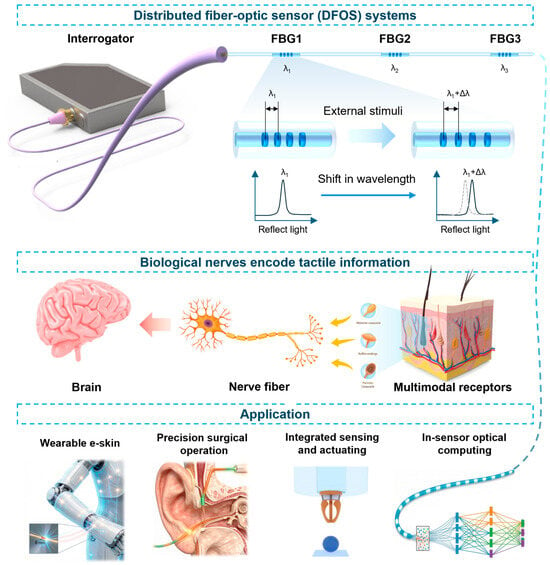
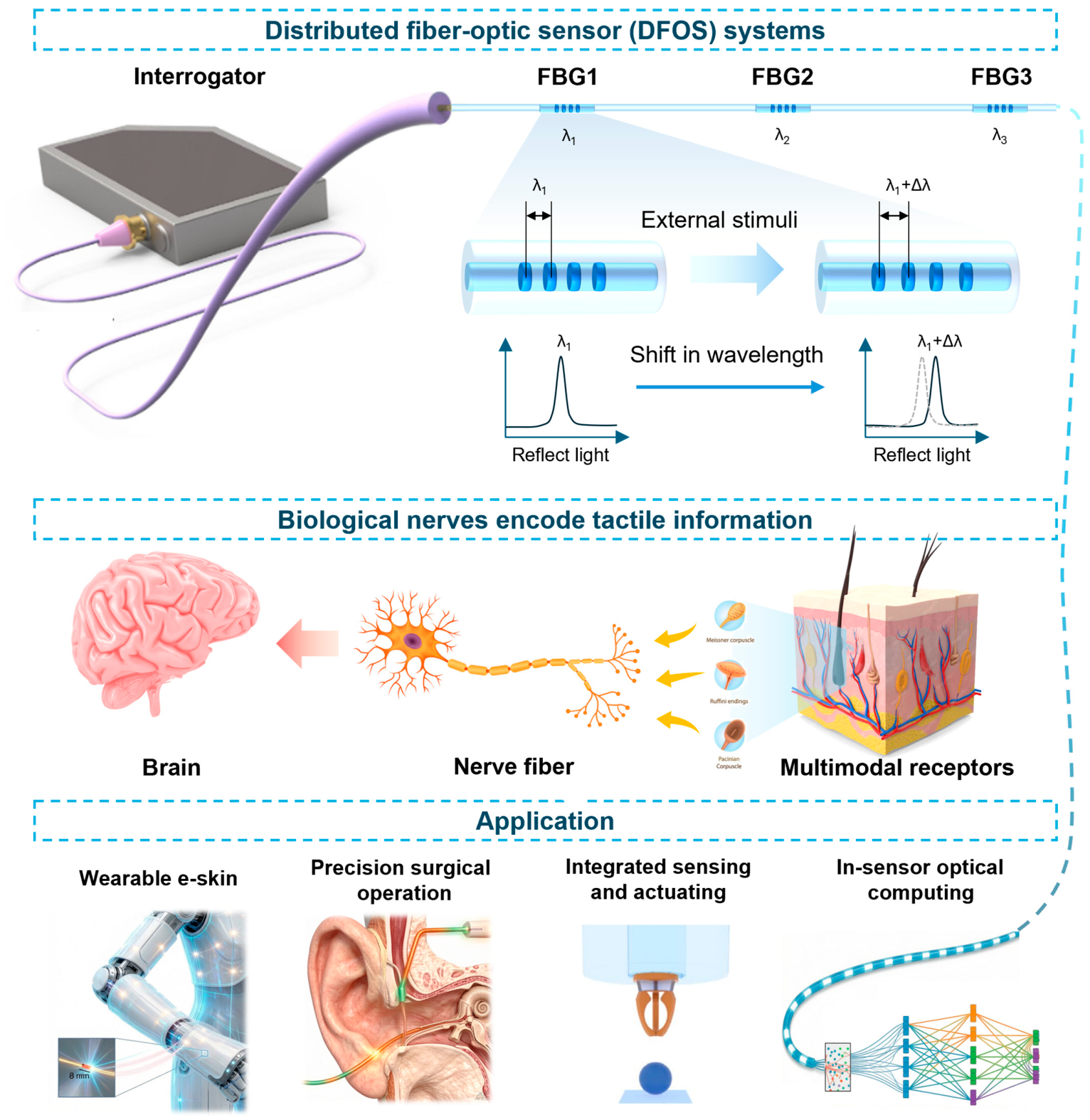
Among DFOS techniques, fiber Bragg grating (FBG) sensors have emerged as a particularly promising solution for wearable tactile sensing [4]. As shown in Figure 1, an FBG is formed by writing a periodic modulation of the refractive index along a short segment of a single-mode fiber core, creating a narrowband reflection filter. When broadband light propagates through the fiber, each grating reflects only a specific center wavelength while transmitting others. External strain, pressure, or temperature variations alter the grating period and effective refractive index, causing a measurable shift in the reflected wavelength. Moreover, the interrogator receives and analyzes the wavelength shifts in the returned spectrum to simultaneously extract position, force magnitude, frequency, and even modality (touch, sliding, and pressure). By inscribing multiple FBGs with different center wavelengths along a single optical fiber, distributed multipoint sensing is achieved. Remarkably, this single-fiber, multipoint architecture bears a striking resemblance to how biological nerves encode tactile information. From a bioinspired neural perspective, this architecture mirrors the hierarchical organization of the human somatosensory system. A major nerve trunk (e.g., the ulnar or median nerve) connects numerous mechanoreceptors distributed across the hand through branched axons, allowing the central nervous system to decode rich information about location, pressure, vibration, and texture via a limited number of nerve bundles.
Figure 1.
An FBG-based DFOS system inscribes multiple gratings with distinct center wavelengths (λ1, λ2, and λ3) along a single optical fiber. Each grating responds to different stimulus modalities, and sensing requires only one fiber end to be connected to the interrogator. By analyzing the wavelength shifts (Δλ) in the returned spectrum, the system simultaneously decouples multimodal information such as location, pressure, vibration, and texture, thereby greatly simplifying wiring. This design conceptually parallels the biological central nervous system, which decodes rich information about location, pressure, vibration, and other tactile modalities through a limited number of nerve bundles. Such FBG sensing systems hold substantial application potential in wearable electronic skins (for large-area distributed tactile sensing), precision medicine (for fine-scale perception in confined spaces), integrated sensing and actuation (for closed-loop control), and in-sensor optical computing (for ultra-fast, light-speed signal processing).
Therefore, many studies reconstruct human-like tactile perception from a bionic perspective [5]. Inspired by the large and single-hotspot receptive fields of Ruffini SA2 corpuscles, Massari et al. proposed a soft e-skin for sensorizing large areas of robot bodies [6]. In their work, a single optical fiber containing 16 FBGs with distinct characteristic wavelengths was embedded in an S-shaped layout within the e-skin. Combined with a deep neural network, the system could accurately perceive both the force intensity and the location of external tactile stimuli on the e-skin, achieving errors of 35 mN for force estimation and 3.2 mm for contact point localization. Prof. Oddo’s team further mimicked the structure of type II mechanoreceptors in human skin by embedding a fiber with 21 FBGs into an artificial skin. They employed a two-layer spiking neuronal network (SNN) to simulate the operation of type II primary afferents (PAs) and cuneate neurons (CNs), ultimately achieving performance comparable to neurophysiological findings in human skin [4]. Most recently, the same team integrated the FBG-embedded e-skin with a mixed-signal neuromorphic processor that implements the SNN in hardware, enabling highly parallel and low-power computation while maintaining high-precision tactile localization [7].
Beyond large-area distributed sensing on e-skins, FBG-based optical fiber sensing is also well suited for fine, multimodal perception over small areas. Mao et al. applied FBGs to a robotic fingertip platform, drawing inspiration from the structure of the human fingertip. By adopting a rigid–soft coupled architecture, they integrated multiple distributed FBGs into a fingertip-sized device to realize five sensing modalities: pressure, sliding, temperature, water pressure, and material recognition. The system exhibits excellent electromagnetic interference immunity, corrosion resistance, and underwater operability, enabling robust adaptability across diverse environments [8]. Furthermore, Gao et al. integrated four optical fibers, each containing three FBGs, into surgical pneumatic forceps, successfully achieving high-resolution six-axis force sensing. This system was ultimately used in cochlear implantation surgery, where the operating space is extremely confined [9]. Li et al. developed a 100 μm microneedle system integrated with fiber Bragg grating (FBG) force sensors for real-time estimation of tool–tissue interaction. It achieved fine-grained perception of interaction forces (0.99 mN resolution) that can effectively distinguish between surgical phases [10]. These results demonstrate great potential for optical fiber sensing in precision perception and medical applications.
Despite these successes, current FBG-based wearable systems still face several challenges. First, the number of gratings per fiber is limited by the source bandwidth (typically ≤50 gratings per fiber), making it difficult to achieve high-density array sensing. Current solutions primarily rely on deep learning algorithms to realize super-resolution perception [4]. Second, the deployment of many FBG fibers depends on manual placement, posing difficulties for stable conformal integration on high-curvature surfaces or complex geometries. To address this, Tao et al. proposed a programmable direct-patterning assembly method for fiber Bragg gratings. By employing cross-fiber routing and patterning techniques, they achieved a high-density sensor network on a single continuous fiber. This approach was successfully applied in laryngeal vibration detection and epidermal gesture recognition systems, capable of monitoring both high-frequency micro-vibrations and large-amplitude kinematic strain [11]. Third, current interrogators mainly rely on bulky benchtop instruments, making miniaturization another significant challenge. To tackle this, Yao et al. developed a photonic integrated circuit (PIC) chip based on a sine–cosine encoding principle, enabling high-speed, high-resolution real-time measurement of optical frequency variations. This optical frequency detector (5.5 mm × 2.7 mm) achieves a measurement speed of up to 2500 THz/s with a resolution of 2 MHz, surpassing the sensitivity and speed of existing FBG interrogators in both strain and vibration measurements [12].
Looking ahead, FBG-based optical fibers continue to offer promising research directions. For instance, FBG sensors can be integrated with actuation technologies to realize fiber-based sensing and feedback in a single platform, enabling finer perception and manipulation in confined spaces such as inside the body. Recent work has demonstrated the integration of a soft thermoresponsive hydrogel muscle directly onto an optical fiber, with dimensions as small as 38 × 38 × 61 μm, achieving precise manipulation of single cells and sub-10 μm irregular objects [13]. On the other hand, to fully exploit the speed advantage of light, combining fiber-optic sensing with optical computing to achieve in-sensor computing represents another highly promising direction. One recent study demonstrated in-sensor computing on an all-optical fiber, achieving light-speed signal processing without any electronic processors. This system enabled quantitative measurement of torsion angle, stretch, and vibration with a delay of less than 3 ns [14]. These emerging capabilities suggest that FBG-based fiber optics will play an increasingly important role in next-generation intelligent sensing systems, particularly where high speed, compactness, and multifunctionality are required.
We are pleased to present these research trends to the readers of AI Sensors and encourage further exploration in this exciting field.
Funding
This work was supported by NUS College of Design and Engineering (CDE)-Robotics Seed Grant Programme, “AI-Sensor Enhanced Medical Operation Training System” (grant no. A-800328300-00); NUS Colleage of Design and Engineering (CDE)-Robotics Seed Grant Programme, “A Multimodal Sensing/Haptic System For Lower-Limb Exoskeleton Feedback Control” (grant no. A-8003281-0000).
Institutional Review Board Statement
Not applicable.
Informed Consent Statement
Not applicable.
Data Availability Statement
This paper does not generate new data.
Acknowledgments
During the preparation of this manuscript/study, the authors used OpenAI/ChatGPT5.6 TOOL for the purposes of Image processing and language polishing. The authors have reviewed and edited the output and take full responsibility for the content of this publication.
Conflicts of Interest
The authors declare no conflicts of interest.
References
- Guo, X.; Sun, Z.; Zhu, Y.; Lee, C. Zero-Biased Bionic Fingertip E-Skin with Multimodal Tactile Perception and Artificial Intelligence for Augmented Touch Awareness. Adv. Mater. 2024, 36, 2406778. [Google Scholar] [CrossRef] [Scilit] [PubMed]
- Qu, J.; Mao, B.; Li, Z.; Xu, Y.; Zhou, K.; Cao, X.; Fan, Q.; Xu, M.; Liang, B.; Liu, H.; et al. Recent Progress in Advanced Tactile Sensing Technologies for Soft Grippers. Adv. Funct. Mater. 2023, 33, 230624. [Google Scholar] [CrossRef] [Scilit]
- Bai, H.; Li, S.; Barreiros, J.; Tu, Y.; Pollock, C.R.; Shepherd, R.F. Stretchable Distributed Fiber-Optic Sensors. Science 2020, 370, 848–852. [Google Scholar] [CrossRef] [Scilit] [PubMed]
- Pereira Resende Da Costa, A.C.; Filosa, M.; Barbosa Soares, A.; Oddo, C.M. Type II Mechanoreceptors and Cuneate Spiking Neuronal Network Enable Touch Localization on a Large-Area e-Skin. Nat. Mach. Intell. 2025, 7, 1278–1291. [Google Scholar] [CrossRef] [Scilit]
- Li, T.; Zhou, H.; Zhao, C.; Li, J.; Fan, H.; Zhu, Y.; Tu, H.; Zhou, Z.; Zhang, X.; Xu, Y.; et al. Multimodal Fiber Somatosensory: Optical Fiber ‘Nerves’ Empower Continuum Surgical Robots with Multimodal Feedback. Adv. Healthc. Mater. 2026, 15, e04556. [Google Scholar] [CrossRef] [Scilit] [PubMed]
- Massari, L.; Fransvea, G.; D’Abbraccio, J.; Filosa, M.; Terruso, G.; Aliperta, A.; D’Alesio, G.; Zaltieri, M.; Schena, E.; Palermo, E.; et al. Functional Mimicry of Ruffini Receptors with Fibre Bragg Gratings and Deep Neural Networks Enables a Bio-Inspired Large-Area Tactile-Sensitive Skin. Nat. Mach. Intell. 2022, 4, 425–435. [Google Scholar] [CrossRef] [Scilit]
- Ortone, A.; Filosa, M.; Indiveri, G.; Desoli, G.; Mazzoni, A.; Oddo, C.M. Bioinspired Spiking Architecture Enables Energy Constrained Touch Encoding. Nat. Commun. 2026, 17, 2108. [Google Scholar] [CrossRef] [Scilit] [PubMed]
- Mao, B.; Xiang, Y.; Zhang, Y.; Huang, Y.; Chen, P.; Cui, G.; Qu, J. A Function-Structure-Integrated Optical Fingertip with Rigid-Soft Coupling Enabling Self-Decoupled Multimodal Underwater Sensing. Adv. Funct. Mater. 2026, 36, e22722. [Google Scholar] [CrossRef] [Scilit]
- Gao, H.; Liu, H.; Jia, H.; Lin, Z.; Zou, Y.; Xu, Z.; Huang, S.; Tan, H.; Wu, H.; Chen, W.; et al. Multi-Axis Robotic Forceps with Decoupled Pneumatic Actuation and Force Sensing for Cochlear Implantation. Nat. Commun. 2025, 16, 1648. [Google Scholar] [CrossRef] [Scilit] [PubMed]
- Li, H.; Gao, P.; Tan, H.; Li, H.; Zhu, H.; Jiang, M.; Ni, Y.; He, Y.; Huang, J.; Zhu, Y.; et al. Interaction-Aware Dexterous Robot for Minimally Invasive Transcanal Inner Ear Interventions. Nat. Commun. 2026, 17, 5658. [Google Scholar] [CrossRef] [Scilit] [PubMed]
- Tao, Y.; Xu, W.; Yu, P.; Shen, A.; Zhao, Y.; Zhang, X.; Li, M.; Zhao, J. Programmable Direct-Patterning Assembly Enables High-Density and Surface-Conformal Integration of Fiber Bragg Grating Sensor Arrays. Nat. Commun. 2026, 17, 5998. [Google Scholar] [CrossRef] [Scilit] [PubMed]
- Yao, X.S.; Yang, Y.; Ma, X.; Lin, Z.; Zhu, Y.; Ke, W.; Tan, H.; Wang, X.; Cai, X. On-Chip Real-Time Detection of Optical Frequency Variations with Ultrahigh Resolution Using the Sine-Cosine Encoder Approach. Nat. Commun. 2025, 16, 309. [Google Scholar] [CrossRef] [Scilit] [PubMed]
- Pan, D.; Liang, K.; Xin, C.; Zhong, L.; Jiang, S.; Zhang, C.; Yang, L.; Wang, Z.; Lao, Z.; Ni, J.; et al. Optical Fibre Gripper for High-Performance 3D Micromanipulation. Nature 2026, 655, 93–101. [Google Scholar] [CrossRef] [Scilit] [PubMed]
- Tao, Y.; Wan, Y.; Long, Z.; Zhang, W.; Du, J.; He, Z. Nanosecond-Latency All-Optical Fiber Sensing with in-Sensor Computing. Light Sci. Appl. 2026, 15, 251. [Google Scholar] [CrossRef] [Scilit] [PubMed]
Disclaimer/Publisher’s Note: The statements, opinions and data contained in all publications are solely those of the individual author(s) and contributor(s) and not of MDPI and/or the editor(s). MDPI and/or the editor(s) disclaim responsibility for any injury to people or property resulting from any ideas, methods, instructions or products referred to in the content. |
© 2026 by the authors. Licensee MDPI, Basel, Switzerland. This article is an open access article distributed under the terms and conditions of the Creative Commons Attribution (CC BY) license.