


Abstract
Metal oxide semiconductor (MOS) gas sensors are widely used for low-cost chemical detection, but their practical performance is still limited by high operating temperature, insufficient selectivity, signal drift, and device-to-device variation. Recent advances in microelectromechanical systems (MEMS), dynamic sensing protocols, and artificial intelligence (AI) provide new opportunities to improve MOS gas sensing from both hardware and data-processing perspectives. MEMS micro-hotplates enable miniaturized devices, low-power heating, rapid thermal control, temperature-modulated operation, and compatibility with integrated readout and interface circuits, while AI methods extract multivariate, nonlinear, and temporal information from cross-sensitive sensor responses. This review summarizes the fundamentals of MOS sensing materials, MEMS micro-hotplate platforms, material–device integration strategies, and AI-assisted data-processing methods ranging from classical statistical analysis to deep learning. Representative strategies are discussed, including single-sensor feature extraction, sensor-array recognition, temperature-modulated sensing, drift compensation, and AI-guided material design. Application studies in food quality assessment, agriculture, medical diagnostics, environmental monitoring, and public safety are further reviewed to show how sensing tasks evolve from odor-fingerprint discrimination to nonlinear feature interpretation, dynamic response analysis, domain adaptation, and deployable intelligent monitoring. Particular attention is given to the role of high-consistency integration of MOS sensing layers on MEMS platforms, since reproducible material loading, morphology, electrode coverage, and thermal coupling are essential for reliable datasets and transferable AI models. Finally, key challenges are discussed, including dataset heterogeneity, long-term drift, edge deployment, and material–device reproducibility. This review highlights that future AI-assisted MOS/MEMS gas sensors require coordinated design of sensing materials, device platforms, fabrication processes, operating protocols, and data-driven models.
1. Introduction
Reliable trace-gas detection is required in many fields, including environmental monitoring, food safety, medical diagnostics, industrial safety, and public security [1,2]. Metal oxide semiconductor gas sensors, commonly referred to as MOS or MOX gas sensors in the gas-sensing literature, have been widely studied and applied because of their simple structure, low cost, good stability, and high sensitivity [3]. Nevertheless, traditional MOS sensors still suffer from several practical limitations such as high operating temperature, high power consumption, limited selectivity, and long-term signal drift, which restrict their usability under complex environmental conditions or in portable and Internet-of-Things (IoT) devices [4].
Microelectromechanical systems (MEMS) technology provides a device-level route to reduce power consumption, accelerate thermal response, and enable miniaturized gas-sensing platforms [5]. By integrating a micro-heater, electrodes, and sensing layer on a thermally isolated micro-hotplate, MEMS devices achieve precise temperature control, millisecond-scale thermal response, and power consumption on the order of tens of milliwatts [6]. Wafer-level fabrication improves structural uniformity across devices. The MEMS platform is also compatible with monolithic integration of on-chip signal-processing circuits [7]. In addition, MEMS gas sensors can also operate in pulsed-heating modes to further reduce power consumption. This operation also provides a physical basis for obtaining reproducible, information-rich datasets through temperature-modulated sensing [8].
Artificial intelligence (AI), particularly machine-learning methods, has become increasingly important for interpreting complex gas-sensing data. Instead of relying on steady-state resistances or empirical calibration curves, data-driven approaches can extract high-dimensional and nonlinear features from time-dependent signal responses, thereby enabling accurate identification of gas species and concentration estimation [9]. By learning complex correlations between gas concentration, temperature, and humidity, machine-learning algorithms can improve gas discrimination and concentration prediction under variable environmental conditions [10,11]. These methods can partially compensate for signal drift and environmental interference, although their reliability depends strongly on the reproducibility of the sensing devices and the quality of the training dataset [12].
The convergence of MOS materials, MEMS micro-hotplate technology, and AI algorithms is shifting gas sensors from simple signal transducers toward miniaturized, low-power, and data-driven sensing microsystems. Several recent reviews have addressed closely related aspects of this trend. Xiao et al. summarized AI-enabled MOS gas sensors for complex-environment applications, with emphasis on algorithm-assisted selectivity improvement and intelligent application scenarios [13]. Chung and Shim reviewed MEMS gas sensors from wafer-level fabrication to system-level AI integration, highlighting scalable manufacturing, dynamic operation modes, and AI-assisted sensor arrays [14]. Building on these timely contributions, the present review focuses on the coupling among MOS sensing-material design, MEMS micro-hotplate platforms, material–device integration, temperature-modulated operation, and AI-assisted data analysis. Particular attention is given to high-consistency MOS integration on MEMS platforms, because reproducible material loading, morphology, electrode coverage, and thermal coupling are essential for reliable datasets and transferable AI models. This review summarizes recent advances in AI-assisted MOS gas sensing and highlights how MEMS micro-hotplate platforms can support low-power operation, controllable temperature modulation, device integration, and more reproducible data acquisition through improved device-to-device uniformity. The article first outlines the fundamentals of MOS and MEMS gas sensing, then compares various AI methodologies from traditional chemometric methods and classical machine-learning algorithms to deep learning, and finally highlights their applications in food safety, agriculture, healthcare, environmental monitoring, and public safety. By connecting these three levels, we aim to clarify how the synergy between materials, microsystems, and algorithms is enabling the next generation of adaptive, low-power, and intelligent gas-sensing technologies.
2. Fundamentals of MOS Gas Sensors and MEMS Micro-Hotplate Platforms
2.1. Metal Oxide Semiconductor Gas Sensing Materials
2.1.1. Gas Sensing Mechanisms of MOS Materials
Gas sensors are devices that convert information on the concentration or composition of target gases into measurable electrical signals [15]. Gas sensors can operate through different transduction mechanisms, including chemiresistive, electrochemical, optical, thermal-conductivity, field-effect, and mechanical or mass-sensitive modes. Beyond MOS-based chemiresistive sensors, several MEMS-compatible gas or chemical sensing platforms have been reported or reviewed, such as functionalized microcantilevers [16,17], thermal-conductivity-based MEMS resonators combined with machine learning [18], AI-assisted MEMS microcantilever biosensors [19], and graphene-based MEMS gas sensors [20]. These platforms highlight the broader role of lithographically defined and miniaturized MEMS devices in chemical detection. Nevertheless, MOS sensing materials remain among the most widely investigated gas-sensing platforms because of their simple device configuration, high sensitivity, rich material tunability, compatibility with MEMS micro-hotplate operation, and suitability for sensor arrays, dynamic operation, and AI-assisted signal analysis. For MOS sensing materials, the gas-sensing behavior essentially originates from the charge-carrier modulation induced by surface adsorption and chemical reactions with gas molecules [21]. According to the widely accepted adsorbed oxygen model, when MOS materials are exposed to ambient air, oxygen molecules are adsorbed on the surface of MOS materials and capture electrons from the semiconductor to form ionized oxygen species, such as O2−, O−, and O2− [22]. The dominant oxygen species depend on the material characteristics and operating temperature. In n-type semiconducting oxides, the formation of these oxygen species involves electron capture, leading to the development of a surface depletion layer and an increase in baseline resistance, whereas in p-type semiconducting oxides, it results in hole accumulation and a decrease in resistance [23]. Upon introduction of target gases, redox reactions between the gas molecules and adsorbed oxygen species—or directly with lattice oxygen—cause further changes in the local charge carrier concentration until a new steady state is reached. These carrier modulation processes manifest as measurable resistance variations in the device. As shown in Figure 1, this is a typical sensing mechanism of an n-type semiconductor toward reducing gases [24]. The overall sensing response is governed by multiple factors, including the carrier concentration, defect chemistry, surface band bending, grain-boundary or interfacial potential barriers, morphology, as well as the operating temperature and ambient humidity.
Figure 1.
Gas sensing mechanism of metal oxide [24]. Reproduced from [24] under the terms of the Creative Commons Attribution 4.0 International (CC BY 4.0) license.
2.1.2. Enhancement Mechanisms of MOS Gas-Sensing Materials
The gas-sensing performance of metal oxide semiconductors is governed by several interrelated physical and chemical factors, including band alignment, interfacial potential barriers, surface reaction activity, depletion layer modulation, and gas diffusion behavior. In the design of MOS materials, these factors are typically adjusted through widely used strategies such as heterostructure construction [25], surface modification or doping [26], grain size control [27], and morphology engineering [28].
The response of MOS sensors largely depends on the modulation of band bending and potential barriers at interfaces, which determine charge transfer and carrier transport during gas adsorption. A heterojunction generally refers to an interface formed between two semiconducting phases with different band structures or bandgaps. When two semiconductors or phases come into contact, the alignment of their Fermi levels generates an internal electric field that regulates the width of the space–charge region. Such interfacial coupling enhances electron exchange and amplifies the resistance change upon gas exposure [29]. In material design, constructing appropriate heterojunctions (n–n, n–p, or p–p) within selected material systems can effectively improve sensitivity and selectivity through controlled interfacial charge dynamics.
The surface chemical activity directly affects the formation and consumption of adsorbed oxygen species, which govern the electron transfer process. Doping or surface modification with noble or transition metals introduces catalytically active sites. These sites can lower the reaction activation energy and alter the surface work function [30]. Such modifications not only provide catalytic sites for chemical sensitization (e.g., catalytic dissociation, oxygen spillover, and redox mediation) but also induce electronic sensitization by tuning the band structure and interfacial potential barriers [31]. Consequently, the incorporation of noble or transition metal elements effectively accelerates surface reactions, enhances sensitivity, and improves response and recovery characteristics by strengthening the surface activity.
The grain size of MOS materials has a pronounced influence on gas-sensing characteristics [32]. When the grain size approaches or becomes smaller than twice the Debye length, the entire grain can become fully depleted during the redox reaction with target gases, resulting in the maximum modulation of carrier concentration [33]. Therefore, proper control of grain size enables optimized coupling between the electronic conduction pathway and the surface adsorption behavior. Thermal treatment and controlled synthesis conditions are commonly employed to tune this structural factor.
The morphology of metal oxide nanostructures plays a crucial role in determining how efficiently gas molecules reach and react with the active surfaces. Structures with higher specific surface area, such as nanowires, nanosheets, or porous frameworks, provide more adsorption and reaction sites, thereby increasing charge transfer during gas interaction [34]. Meanwhile, open or hierarchical pores create continuous diffusion channels that allow gas molecules to penetrate deeply into the sensing layer, effectively reducing the response delay caused by limited gas accessibility in dense materials. When the pore size is comparable to or smaller than the mean free path of gas molecules, Knudsen diffusion becomes important, and gas transport is dominated by molecule–wall collisions [35]. Therefore, rational morphology design not only enlarges the active surface area but also optimizes the diffusion mechanism, achieving faster response and recovery as well as higher overall sensitivity. Morphology engineering therefore remains one of the most effective approaches for optimizing the gas-sensing performance of MOS materials.
Figure 2 illustrates the four enhancement mechanisms of MOS-based gas sensors [33,36,37,38,39,40,41]. Understanding these mechanisms is also important for data-driven analysis, because material structure, surface chemistry, and operating conditions determine the features extracted from sensing signals.
Figure 2.
Schematic illustration of four major enhancement mechanisms for MOS gas-sensing performance, including grain size effect, morphology control, heterostructure construction, and doping/surface modification mechanisms [33,36,37,38,39,40,41]. The neck-control schematic was adapted from [33] under the terms of the Creative Commons Attribution 3.0 (CC BY 3.0) license; changes were made. The α-Fe2O3/SnO2, CuO/ZnO, CuO/WO3, Au@Co-ZnO, Ag/In2O3, and Pt/mCeO2 morphology graphics were adapted from [36], [37], [38], [39], [40], and [41], respectively, under the terms of the Creative Commons Attribution 4.0 International (CC BY 4.0) license; changes were made.
2.2. MEMS Micro-Hotplate Platforms for MOS Gas Sensors
The response of MOS gas sensors depends strongly on operating temperature because surface adsorption, redox reactions, and reversible adsorption/desorption processes are thermally activated [42,43]. In conventional ceramic-tube or macroscale heated MOS sensors, the sensing material is typically coated on a bulky substrate and heated by an external coil or thick-film heater. Such configurations often require high power consumption, show slow thermal response, and provide limited temperature controllability, which restricts their use in portable, integrated, or dynamically operated sensing systems. MEMS micro-hotplate technology addresses these device-level limitations by localizing Joule heating within a micromachined membrane, thereby reducing thermal mass and suppressing heat loss to the silicon substrate [44].
A MEMS micro-hotplate generally integrates a dielectric membrane, a microheater, electrodes, and a sensing region within a miniaturized platform. The membrane provides mechanical support and thermal isolation, while the microheater generates a localized temperature field for activating gas–solid reactions. Compared with conventional heated substrates, MEMS micro-hotplates can achieve lower power consumption, faster thermal response, more precise temperature control, and better structural reproducibility. Reported devices can reach operating temperatures of 200–400 °C with power consumption in the 10–80 mW range and millisecond-scale thermal response [44]. Compatibility with planar semiconductor processes also enables device miniaturization, wafer-level structural consistency, and potential monolithic integration with signal-processing circuits [44].
As shown in Figure 3a, membrane structure is central to the thermal behavior of MEMS micro-hotplates. Closed-membrane designs are commonly fabricated by backside anisotropic wet etching using KOH, EDP, or TMAH, leaving a SiNx/SiO2 dielectric membrane suspended over an etched cavity [45,46]. This structure offers relatively high mechanical robustness and can withstand annealing temperatures up to 700 °C, but lateral heat conduction through the membrane causes additional heat loss [45,47,48,49]. In contrast, suspended-membrane designs reduce thermal conduction to the substrate by supporting the heated region with slender or patterned mechanical structures. Representative configurations include multibeam and reticular suspended SiO2 micro-hotplates [50], straight and corrugated cantilever-beam structures [51], and thin-LTCC cantilever micro-hotplates [52], as shown in Figure 3b–d. Liu et al. demonstrated that the geometry of the suspended film and heater strongly affects temperature uniformity and power consumption, with their optimized design achieving a minimum temperature difference of 50 °C at a maximum platform temperature of 450 °C [50]. Tian et al. further showed that cantilever geometry and beam optimization can substantially reduce thermal loss, achieving a simulated power consumption of 0.27 mW at 200 °C [51]. Vasiliev et al. demonstrated an alternative ceramic-MEMS implementation using a 20–30 μm LTCC membrane and a laser-shaped cantilever microhotplate, which operated at approximately 150 mW at 450 °C [52].
The conductive heat loss through support beams is proportional to the number, cross-sectional area, and thermal conductivity of the beams and inversely proportional to their length: [42,53]. This relation favors low-thermal-conductivity materials, long and narrow beams, and a reduced number of supports. However, stronger thermal isolation is usually accompanied by lower mechanical robustness, and beam fracture after sensing-layer deposition has been reported [54]. Therefore, membrane design requires a trade-off between thermal efficiency, mechanical stability, and process compatibility.
Figure 3.
Representative MEMS micro-hotplate structures and sensing-material integration strategies for MOS gas sensors: (a) Schematic comparison of closed-membrane type (left) and suspended-membrane type (right) micro-hotplates. (b–d) Representative suspended micro-hotplate geometries based on different mechanical and thermal support configurations: a multibeam suspended SiO2 micro-hotplate [50], a cantilever-based suspended-beam micro-hotplate [51], and a thin-LTCC cantilever micro-hotplate [52]. (e) Schematic illustrations and top-view layout designs of micro-hotplates with different heater/electrode geometries [50]. (f) Wafer-level localized growth of MOS sensing materials on micro-hotplate arrays using patterned photoresist-defined regions and mask-assisted precursor confinement [55]. (g) Photolithographic patterning of a photoresist/MOS nanoparticle composite precursor followed by calcination to form micro-patterned MOS sensing layers on a wafer-level gas-sensing chip. Panels (b) and (e) were adapted from [50], panel (c) from [51], panel (d) from [52], and panel (f) from [55], under the terms of the Creative Commons Attribution 4.0 International (CC BY 4.0) license; changes were made.
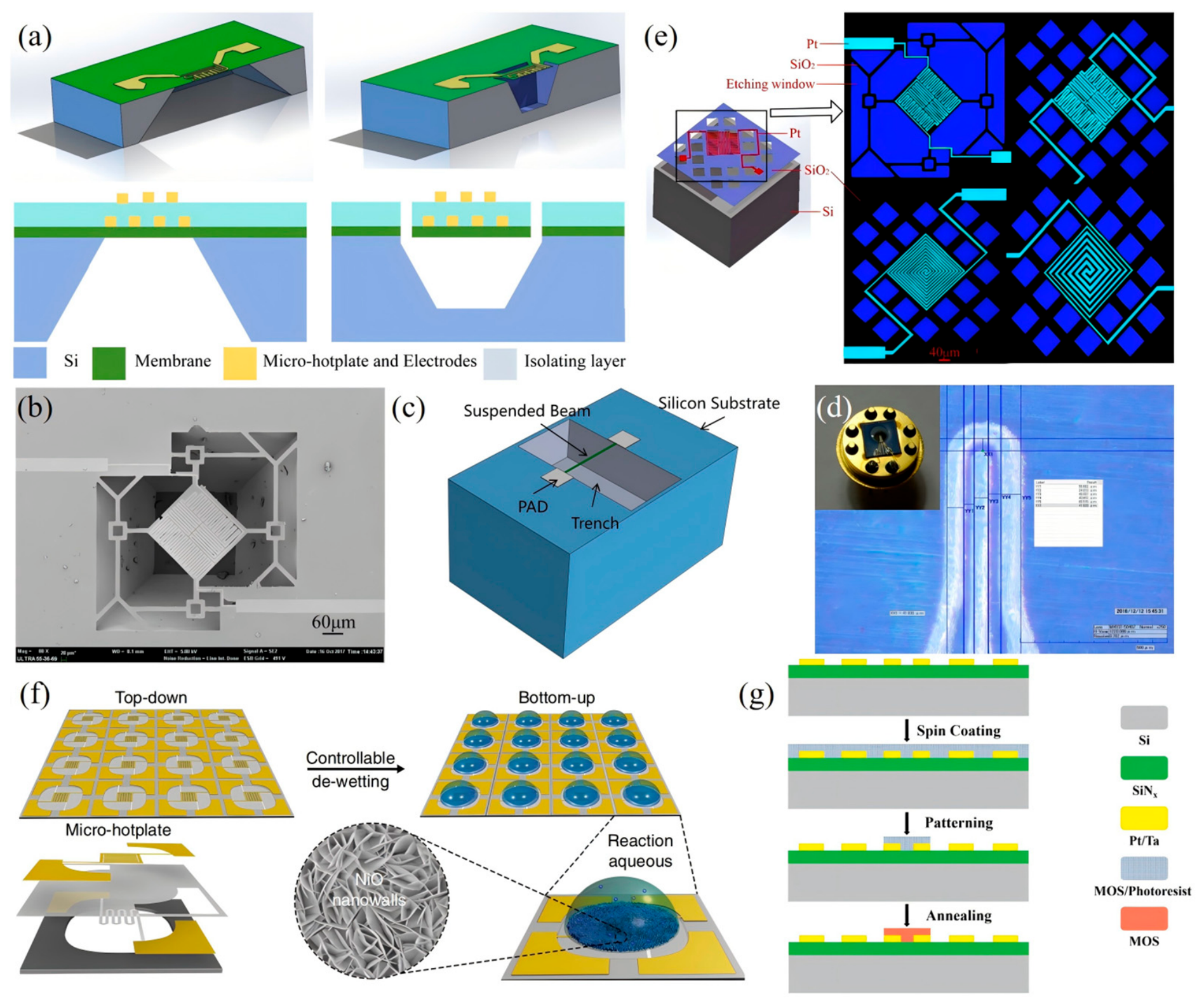
Heater geometry is another key factor controlling temperature distribution. As shown in Figure 3e, simple straight or conventional meander heaters may generate large edge temperature gradients [50]. To obtain a more uniform temperature plateau, optimized heater geometries such as variable-width meanders, double-spiral heaters, or inner heaters with outer compensation rings have been proposed [53,56,57,58,59]. For example, a double-spiral Pt heater combined with four-point probes enables more accurate measurement of the plateau temperature by reducing errors from lead and contact resistance [57]. Such thermal design is important not only for stable MOS sensing reactions but also for reproducible temperature-dependent responses in dynamic operation.
From a practical design and validation perspective, MEMS micro-hotplates should be benchmarked through structural design, electrothermal/thermomechanical simulation, microfabrication, and thermal characterization. Key variables and metrics include membrane type, support-beam geometry, heater/membrane materials, active-area size, heater/electrode layout, power consumption at the target temperature, heating/cooling response time, temperature uniformity or plateau size, thermal-cycling stability, device-to-device variation, and compatibility with wafer-level sensing-layer integration [44]. These benchmarks are particularly relevant to AI-assisted MOS gas sensing because thermal dynamics and temperature uniformity directly affect the reproducibility of steady-state and temperature-modulated response features.
Overall, MEMS micro-hotplate platforms provide the device-level foundation for low-power and integrated MOS gas sensors by enabling membrane thermal isolation, optimized temperature distribution, rapid heating, and wafer-level structural consistency. However, the final sensing performance still depends on how MOS materials are deposited, patterned, and coupled to the heated sensing region. Therefore, MOS material integration on MEMS platforms remains a separate and critical issue, as discussed in the next section.
2.3. Integration Strategies for MOS Sensing Materials on MEMS Platforms
The integration of MOS sensing materials is a critical step in MEMS-based gas sensors because the sensing layer directly determines the effective reaction area, gas accessibility, electrode contact, thermal coupling, and device-to-device response reproducibility. For AI-assisted gas sensing, this issue becomes even more important: algorithms require not only high response signals but also stable and comparable datasets collected from different sensing units or different fabrication batches. Even if the MEMS micro-hotplate itself provides a uniform structural platform, variations in sensing-layer thickness, coverage area, morphology, and contact condition can still lead to large fluctuations in baseline resistance, response amplitude, response/recovery kinetics, and long-term drift. Therefore, material integration should not be regarded as a simple post-deposition step; it is a key factor linking material performance, MEMS device yield, and data reliability.
Thin-film methods such as sputtering [60], chemical vapor deposition (CVD) [61], and atomic layer deposition (ALD) [62] offer precise thickness control and good compatibility with planar microfabrication, making them suitable for reproducible deposition on MEMS substrates. However, dense thin films often have limited specific surface area and restricted gas accessibility, which may weaken the advantages of nanostructured MOS materials. In contrast, thick-film approaches such as drop coating, screen printing, inkjet printing, and spray pyrolysis can better preserve porous or nanostructured morphologies and are therefore widely used to obtain higher sensing responses [42,43,63]. In practical gas-sensor fabrication, high-performance MOS powders are often dispersed into pastes or inks and then transferred onto the electrode area by dispensing, coating, or printing. Although this route is simple and flexible, gas-sensing slurries commonly suffer from sedimentation, viscosity variation, agglomeration, and poor rheological stability, which can cause nonuniform material loading and poor batch-to-batch reproducibility.
These problems become more serious when slurry-based deposition is applied to MEMS micro-hotplates. Because the active area of a MEMS sensor is small and often located on a suspended or thermally isolated membrane, small variations in droplet volume, wetting behavior, solvent evaporation, or particle distribution can lead to obvious differences in pattern size, film thickness, edge coverage, and electrode exposure. Excessive loading may also disturb thermal coupling or increase thermal mass, reducing the low-power advantage of the micro-hotplate. For suspended-membrane structures, the mechanical fragility of beams and membranes further limits the tolerance to post-deposition stress; beam breakage after sensing-layer deposition has been reported [54]. Therefore, although MEMS technology provides low power consumption, fast thermal response, and structural uniformity at the platform level, conventional slurry deposition can become a major source of response variation and yield loss after material integration.
Wafer-level integration is therefore essential for translating MOS material performance into reproducible MEMS-based sensor performance. It enables sensing materials to be positioned at defined locations, patterned with controlled geometry, and reproduced across multiple devices on the same substrate [55,64]. Conventional post-deposition methods often lack precise location control and batch-to-batch reproducibility [55,65]. To address this issue, lithography-assisted and wafer-level integration strategies have been developed to define the location, geometry, and loading of MOS sensing materials on MEMS platforms [44,55,65]. One reported strategy uses photoresist-template-guided dewetting. As shown in Figure 3f, patterned dry-film photoresist defines localized droplets, and a thermoplastic elastomer mask enables selective in situ growth of Ni(OH)2. This method achieved a relative standard deviation below 5% across eight sensors [55]. Another strategy directly mixes SnO2 nanoparticles or nanosheets with positive photoresist, patterns the composite precursor by standard photolithography, and removes organic residues by calcination at 500 °C for 5 h [66]. The principle of this process is schematically illustrated in Figure 3g. This approach achieved a response deviation below 4.5% across a 4-inch wafer while retaining the nanostructured morphology of the sensing material.
These examples indicate that the integration of MOS materials on MEMS platforms is moving from manual or droplet-based deposition toward lithographically defined and wafer-level reproducible processes. Such strategies are important not only for improving device yield and sensing-layer uniformity but also for generating more consistent response datasets for subsequent algorithmic analysis. In this sense, high-consistency material integration provides a bridge between MEMS device fabrication and AI-assisted gas sensing: it reduces uncontrolled device variation before data processing, allowing algorithms to learn gas-related features rather than fabrication-induced differences.
2.4. Need for AI-Assisted MOS Gas Sensing and the Enabling Role of MEMS Platforms
Conventional MOS gas sensors still face limitations in complex or dynamic environments, especially in selectivity, quantitative prediction, drift correction, and environmental adaptability [4,42]. Under conventional fixed-temperature operation, MOS sensors are often represented by steady-state resistance or response values, which provide limited information and mainly reflect overall conductivity changes rather than the full dynamics of surface reactions [9]. Moreover, strong nonlinearities among temperature, concentration, and ambient humidity hinder accurate modeling using conventional mathematical calibration methods [10,11]. These characteristics make it difficult to achieve gas discrimination, quantitative prediction, and adaptive correction based solely on physical models. Intelligent algorithms, in contrast, can extract high-dimensional, nonlinear, and temporal features from raw sensing signals—such as transient responses, temperature-dependent conductance profiles, and fluctuation patterns—to reveal hidden correlations associated with specific gases or reaction pathways [67]. However, applying such algorithms directly to traditional MOS sensors remains challenging because the data are typically sparse, noisy, and poorly reproducible, owing to device inconsistencies and uncontrolled thermal conditions [4,42,43].
MEMS-based sensing platforms can alleviate these problems by providing controlled thermal excitation, rapid temperature modulation, and more reproducible device structures [44]. The micro-hotplate architecture enables millisecond-scale temperature modulation, allowing the sensor to record dynamic conductance changes under precisely controlled heating sequences [68,69]. This approach generates rich multivariate signal sets within very short experimental cycles, expanding the data dimension accessible for machine learning and pattern recognition [8,68,69]. In this sense, MEMS-enabled temperature modulation converts thermally dependent surface reactions into dynamic electrical features that can be extracted by algorithms.
Equally important, wafer-level and lithographically defined integration of MOS sensing materials on MEMS platforms can improve device-to-device response consistency by controlling the location, geometry, thickness, morphology, and electrode contact of the sensing layer [55,64,66]. Such integration reduces uncontrolled variations in material loading, baseline resistance, thermal coupling, and response kinetics, thereby improving the statistical comparability of datasets collected from different devices or fabrication batches. For AI-assisted gas sensing, this consistency is particularly valuable because it reduces fabrication-induced distribution shifts and allows algorithms to focus more on gas-related response features. Although calibration, environmental compensation, and transfer learning may still be required, high-consistency material integration can make cross-device model transfer more reliable and reduce the recalibration burden.
In summary, the combination of optimized MOS sensing materials, MEMS micro-hotplate platforms, and wafer-level material integration provides a more reliable physical basis for AI-assisted gas sensing. Fast and controllable thermal modulation enriches dynamic signal features, while reproducible sensing-layer patterning improves data consistency across devices. Together, these hardware-level advantages support gas identification, concentration prediction, drift correction, and calibration transfer by providing algorithms with more informative and more comparable sensing datasets.
3. AI-Assisted Data Processing Methods for Gas Sensing
Building on the material and device fundamentals discussed above, this section introduces representative AI-assisted data-processing methods for gas sensing, progressing from classical statistical methods to traditional machine learning and neural-network-based deep learning.
3.1. Classical Statistical and Linear Methods
Gas sensor array data are often high-dimensional and redundant. Classical linear methods reduce dimensionality, extract features, and enable basic classification or clustering. This section reviews five representative classical methods: Principal Component Analysis (PCA), Linear Discriminant Analysis (LDA), Partial Least Squares Regression (PLS), Fuzzy C-means clustering, and Euclidean Distance to Centroids (EDC).
Principal Component Analysis
PCA is a widely used unsupervised linear technique for dimensionality reduction and feature extraction [70]. Its core idea is to transform the original high-dimensional data into a new coordinate system composed of orthogonal variables called principal components, as shown in Figure 4a. These principal components are linear combinations of the original variables and are mutually orthogonal, meaning that they are uncorrelated and describe non-redundant variance information. The principal components are ranked according to the amount of variance they explain, with the first principal component capturing the largest variance in the dataset and the subsequent components capturing the remaining variance under the orthogonality constraint. By projecting the data onto a lower-dimensional subspace spanned by the first few principal components, PCA provides a compact representation that preserves the dominant variance structure of gas-sensing responses.
Figure 4.
Overview of representative AI algorithms used for gas-sensing data analysis, including feature projection, linear discrimination, supervised machine learning, deep learning, and non-iterative neural-network models. (a) Schematic of the PCA algorithm for downscaling 2D data [71]. (b) Representative LDA projections of trained and predicted gas-sensing samples onto pairs of discriminant functions [72]. (c) Schematic illustration of the optimal separating hyperplane and classification margin in a linearly separable binary SVM [73]. (d) The influence of the number of decision trees on RF performance [74]. (e) The influence of the number of hidden layer neurons on ELM performance [74]. (f) Schematic architecture of an MLP/BPNN. (g) Genetic-algorithm-based workflow for BPNN parameter optimization. (h) Schematic illustration of hierarchical convolution and pooling operations in a CNN. (i) Schematic illustration of LSTM units across sequential time steps [75]. (j) Schematic encoder–decoder Transformer architecture. (k) GTW-GRNN model for estimating ground-level NO2 [76]. Panels (a), (b), (c), (d–e), (i), and (k) were adapted from [71], [72], [73], [74], [75], and [76], respectively, under the terms of the Creative Commons Attribution 4.0 International (CC BY 4.0) license; changes were made.
In gas sensor array applications, PCA has been widely used for dimensionality reduction and visualization. Zeng et al. [71] applied PCA to gas sensor array data, reducing the feature dimensionality and improving the area under the receiver operating characteristic curve (AUC) scores of support vector machine (SVM) and k-nearest neighbors (KNN) classifiers by 25.2% and 15.7%, respectively. Here, AUC is a classification-performance metric that evaluates the separability between classes, with a higher value indicating better discrimination. Chu et al. [77] used PCA to reduce 12 extracted features from a four-sensor array to five principal components with 95% cumulative explained variance, which then served as inputs to a back-propagation neural network and yielded a reported classification accuracy of 100% under the tested dataset and experimental protocol.
PCA offers several advantages: it is simple to implement, computationally efficient, and provides intuitive visualization of high-dimensional data in two or three dimensions. However, because PCA is a linear projection method, it may fail to capture nonlinear relationships in complex gas-sensing datasets.
Linear Discriminant Analysis
LDA is a supervised linear method used for both dimensionality reduction and classification [78]. Unlike PCA, which maximizes overall variance, LDA seeks projection directions that maximize the separation between different classes while minimizing the spread within each class. These projection directions are called discriminant axes. For a classification problem with C classes, LDA can generate at most C − 1 discriminant dimensions, where C is the number of classes. The projected coordinates of samples on these axes are referred to as linear discriminant scores. As illustrated in Figure 4b [72], the two plots show pairwise projections of the first three discriminant functions. The percentages given on the axes indicate the proportion of discriminative information captured by each function. Filled symbols represent the trained samples for different target gases and the background, whereas open symbols represent predicted samples. The separation of these clusters in the LDA space illustrates how LDA enhances inter-class discrimination. After projection into the LDA space, classification can be performed by interpreting the location or trajectory of test samples relative to the trained class distributions. More generally, classification in the LDA space can also be performed using distance-based rules, such as assigning a test sample to the nearest class centroid according to Euclidean distance.
Itoh et al. [79] developed a discriminant method in the LDA space using an array of eight semiconductive gas sensors, where the linear discriminant scores of test data were analyzed according to their trajectory angles. This approach successfully discriminated target gases even under contaminated air conditions. Liu et al. [80] constructed a carbon-based thin-film transistor sensor array. After preprocessing the sensing data with LDA and performing logistic-regression classification, a reported recognition accuracy of 100% was achieved for the three target gases under the tested dataset and experimental protocol. LDA is particularly effective when the data within each class are approximately normally distributed and share a common covariance structure. However, when these assumptions are violated, LDA may perform poorly.
Partial Least Squares Regression
PLS is a supervised linear regression technique that generalizes PCA by finding latent variables that maximize the covariance between the input features (predictors) and the output variables (responses) [81]. PLS is especially useful when the number of predictors exceeds the number of samples or when severe multicollinearity exists among the predictors.
In gas sensor array applications, PLS has been widely employed for quantitative gas concentration prediction. Lakhmi et al. [82] constructed a multi-sensor platform based on commercial sensors with different transduction principles and applied PLS to predict concentrations of H2, CO, CH4, and CO2 mixtures, achieving good prediction performance for all target analytes. Rai and Saeed [83] utilized PLS for dimensionality reduction in a gas sensor array designed for detecting butane, acetone, methane, and ethanol, enabling effective discrimination of different harmful gases.
PLS offers several benefits: it is robust to multicollinearity, reduces overfitting compared to ordinary least squares, and provides insight into which predictors are most influential. However, like PCA, PLS assumes a linear relationship between predictors and responses, which may not hold in complex gas mixtures.
Fuzzy C-means
Fuzzy C-means (FCM) is an unsupervised clustering algorithm that allows each data point to belong to multiple clusters with varying degrees of membership [84]. In contrast to hard clustering methods like K-means, FCM assigns membership values between 0 and 1, reflecting the uncertainty of cluster assignment.
In gas sensor array applications, FCM has been utilized for exploratory data analysis and preliminary classification. Verma et al. [85] developed a semi-supervised outlier detection method based on FCM for electronic nose (e-nose) systems, effectively distinguishing between real data samples and outliers on two experimental datasets. Rehman and Bermak [86] applied FCM clustering to datasets obtained from commercial and homemade sensor arrays, demonstrating its ability to separate gas clusters such as propane, chlorine, CO, CO2, SO2, and NO2.
FCM has the advantage of handling ambiguous boundaries and providing a probabilistic interpretation of clustering results. It is also relatively simple to implement and does not assume a specific distribution of the data. However, it requires the number of clusters to be specified in advance, and the solution can be sensitive to the initial choice of cluster centers and the fuzziness parameter.
Euclidean Distance to Centroids
EDC operates by first computing the centroid, or mean vector, of each class from the training data [87]. For a new test sample, the Euclidean distances to all class centroids are calculated, and the sample is assigned to the class whose centroid is closest. Owing to its simple decision rule, low computational cost, and minimal training requirement, EDC is commonly used as a basic reference classifier in pattern-recognition studies. Dixon and Brereton [87] compared EDC with LDA, QDA, LVQ, and SVM using datasets with different degrees of class overlap, dimensionality, and distribution structures. Their results showed that EDC can provide acceptable classification for simple and well-structured class distributions, but its performance deteriorates when class distributions overlap, become elongated, or when variables with different variances dominate the Euclidean distance. This limitation arises because EDC uses only class centroids and does not account for the variance–covariance structure of the data or correlations between features. Therefore, in gas sensor array analysis, EDC is mainly suitable as a simple baseline method, whereas more complex classifiers are often required when cross-sensitive sensor responses form overlapping or nonlinear patterns.
3.2. Traditional Machine Learning (ML) Methods
Traditional machine learning methods are interpretable, computationally light, and effective for small to medium datasets. This section reviews four representative traditional machine learning algorithms: KNNs, SVMs, decision trees (DTs), and random forests (RFs).
K-Nearest Neighbors
KNN is an instance-based supervised learning method in which a query sample is classified according to the labels of its nearest training samples under a chosen distance or similarity measure [88]. It does not build an explicit parametric model during training; instead, the algorithm stores the training dataset and makes predictions at run time by comparing a new query point with the stored instances.
In gas sensor array applications, KNN has been widely adopted as a simple baseline classifier due to its intuitive distance-based decision rule and ease of implementation. Zeng et al. [71] used KNN together with SVM to classify gas sensor array data after preprocessing and PCA-based dimensionality reduction. Under their experimental protocol, PCA improved the AUC score of KNN by 15.7%, indicating that appropriate feature extraction can substantially enhance the performance of distance-based classifiers. Although KNN is computationally simple and interpretable, its performance strongly depends on feature quality, distance metrics, and the separability of sensor response patterns, which limits its robustness for highly overlapping or drift-affected gas-sensing data.
Support Vector Machine
SVM is a powerful supervised learning model originally developed for binary classification but later extended to multi-class problems and regression using support vector regression (SVR) [89]. The fundamental idea of SVM is to find an optimal hyperplane that separates data points of different classes with the largest possible margin, as illustrated in Figure 4c for a linearly separable binary-classification case [73]. The hyperplane serves as the decision boundary between the two classes, while the two parallel boundaries define the classification margin. The “support vectors” are the training samples that lie closest to these margin boundaries and determine the position and orientation of the optimal hyperplane.
Trincavelli et al. [90] used an SVM-based posterior-probability ensemble strategy to identify bacteria in blood culture samples from electronic-nose responses, showing that ensembling decisions from consecutive samples could improve classification reliability. Pardo and Sberveglieri [91] applied SVM to electronic-nose classification data and systematically evaluated the effects of the number of principal components, kernel type, kernel parameters, and regularization parameter on classification performance, highlighting the importance of parameter optimization for avoiding underfitting and overfitting in e-nose pattern recognition. For quantitative analysis, Laref et al. [92] applied SVM regression with a Gaussian kernel to estimate pine essential-oil vapour concentrations from electronic-nose sensor-array responses. Using leave-one-out cross-validation, the SVM regression model achieved a lower prediction error than PLS regression (RMSE = 0.0346 vs. 0.0859) and maintained lower RMSE across different training-sample sizes, indicating better accuracy and generalization for gas/vapour concentration estimation.
In addition to the conventional SVM formulation, a related family of maximum margin classifiers, known as the Hyperdisked model maximum margin optimum classifier (HDMMMOC), has been explored in specific applications. Instead of relying on a hyperplane in a kernel-induced feature space, HDMMMOC typically constructs decision boundaries in the original feature space based on hyperdisk geometries, making it particularly suitable for scenarios where class distributions exhibit tight intra-class clustering and well-defined inter-class margins. In gas sensor array applications where the underlying data structure is approximately separable without complex transformations, HDMMMOC can serve as an efficient alternative to conventional SVM.
Decision Tree
A DT is a non-parametric supervised learning method that builds a tree-like model of decisions based on the input features [93]. A DT consists of nodes, branches, and leaves. Internal nodes represent tests on specific features, branches correspond to the outcomes of those tests, and leaf nodes hold the predicted class label (for classification) or a continuous value (for regression).
The tree is constructed recursively by splitting the training data into subsets based on the values of selected features. The goal at each split is to create child nodes that are as pure as possible, meaning that the samples in each node belong predominantly to a single class. Common criteria for evaluating split quality include Gini impurity, entropy (information gain), and mean squared error (for regression). Here, Gini impurity measures the degree of class mixing within a node; it becomes zero when all samples in the node belong to the same class and increases as the class distribution becomes more mixed.
DTs are easy to understand and visualize, and they can handle both numerical and categorical data without requiring extensive preprocessing. However, single DTs are prone to overfitting, especially when grown deep. Ensemble methods, such as RF, address these limitations by combining multiple trees.
Random Forest
RF is an ensemble learning method that constructs a multitude of DTs at training time and aggregates their predictions to improve accuracy and reduce overfitting [94]. The algorithm operates by generating multiple bootstrap samples from the original training dataset. For every bootstrap sample, a DT is grown without pruning, following a recursive partitioning process. At each node of a tree, rather than considering all available features, only a random subset of features is evaluated for splitting. The optimal split is then selected from this subset based on a criterion such as information gain or Gini impurity, which maximizes the homogeneity of the resulting child nodes.
The key hyperparameters in RFs include the number of trees in the forest and the size of the random feature subset considered at each split. Generally, increasing the number of trees leads to better performance but also increases computational cost and memory requirements, as shown in Figure 4d [74].
Men et al. [74] applied RFs, together with SVMs and ELMs, to classify and grade paraffin odor samples using an electronic nose. The RF model achieved a classification accuracy of 98.33–100% for paraffin samples with different odor levels, demonstrating its effectiveness for electronic-nose-based quality evaluation. Ma et al. [95] compared several machine learning methods for natural gas mixture identification using mixed-potential electrochemical sensor arrays. They found that RFs achieved over 98% identification accuracy, showed robustness against overfitting with increasing model complexity, and required less than 0.1 s training time and less than 0.1 ms inference time on single-board computer hardware.
RFs handle high-dimensional data effectively and maintain predictive accuracy even when a large proportion of features are irrelevant or noisy. Moreover, the ensemble nature of RFs makes them robust to overfitting, as the aggregation of multiple trees smoothes out individual errors.
3.3. Artificial Neural Network (ANN)
Artificial neural networks (ANNs) offer a fundamentally different paradigm rooted in connectionism [96]. Instead of relying on explicit mathematical rule extraction or hypothesis testing like classical machine learning, an ANN learns purely by weight optimization: knowledge is distributed across the adjustable connections (weights) that interconnect large numbers of simple processing units (neurons). Deep learning—a sub-field of machine learning that uses deep neural networks—extends this idea by using multiple hidden layers to enable end-to-end learning. Raw data (e.g., pixel matrices or time series) can be fed directly into the network. Hidden layers automatically learn hierarchical features: shallow layers capture low-level patterns (edges, local transients), intermediate layers assemble them into higher-level structures (textures, shapes), and deeper layers form task-relevant abstractions. ANN models can learn nonlinear relationships between multivariate sensor-array features and target gas identities or concentrations after appropriate signal preprocessing or feature extraction, making them suitable for complex gas-sensing patterns [97,98,99].
In an ANN, the basic processing unit, or neuron, computes a weighted sum of its inputs, adds a bias term, and passes the result through a nonlinear activation function. Both weights and biases are learnable parameters that are iteratively adjusted during training to minimize a task-specific loss function.
This section reviews the principal neural-network architectures that have been applied to gas sensor array data. The coverage includes shallow ANN models as well as deep learning architectures, defined here as networks that learn hierarchical feature representations through the composition of multiple nonlinear transformations, including deep multilayer perceptrons, convolutional neural networks, recurrent neural networks, and transformers.
Multilayer Perceptron (MLP) and Back-Propagation Neural Network (BPNN)
The multilayer perceptron (MLP) constitutes a foundational architecture of feed-forward artificial neural networks and has been extensively employed in gas-sensing applications since the early 1990s [96,97]. Structurally, an MLP comprises an input layer, one or more hidden layers, and an output layer, with neurons in adjacent layers typically connected through learnable weights [100]. A schematic representation of the multilayer MLP/BPNN architecture is shown in Figure 4f. When configured with multiple hidden layers, the MLP forms a deep multilayer perceptron (deep MLP), which is one of the basic architectures used in deep learning, whereas an MLP with a single hidden layer is generally regarded as a shallow neural network. Because neurons in adjacent layers are fully interconnected, MLPs are commonly described as fully connected neural networks. During training, input signals are propagated forward through the network, and a loss function is minimized using the back-propagation algorithm, which computes gradients of the loss with respect to the network parameters and updates them iteratively.
MLPs have been used both for identifying different gases and for quantifying individual component concentrations in gas mixtures [97,99]. However, the fully connected structure of MLPs can make them prone to overfitting when the number of input variables is large relative to the number of training samples, a common situation in spectroscopic or multi-sensor data [99,100]. Furthermore, MLPs treat the input as a fixed feature vector and do not explicitly model temporal dependencies, which limits their effectiveness for directly processing time-series sensor data. Despite these drawbacks, MLPs provide the conceptual basis for several more advanced neural-network architectures discussed below.
A back-propagation neural network (BPNN) is commonly implemented as an MLP trained using the back-propagation algorithm, typically together with gradient-based optimization methods [98]. During training, back propagation computes the error gradients and adjusts the network weights and biases to minimize a loss function, such as the mean squared error between predicted and target outputs [77,98]. BPNNs have been widely adopted in gas sensing for both classification and quantitative analysis because of their ability to model complex nonlinear relationships. When applied to time-series sensing data, BPNNs typically rely on extracted features rather than directly learning from raw sequences and therefore often require appropriate feature engineering [77]. Its relatively simple architecture also allows optimization techniques such as genetic algorithms to be incorporated for parameter initialization or optimization [77]. Figure 4g schematically summarizes a genetic-algorithm-based workflow for network-parameter optimization.
Convolutional Neural Network (CNN)
Convolutional neural networks (CNNs) have emerged as a dominant architecture in deep learning, originally developed for image recognition but increasingly applied to time-series analysis, including gas sensor data [101]. In contrast to the fully connected structure of MLPs, which suffer from parameter explosion and information loss when processing high-dimensional or spatiotemporal data, CNNs introduce two key innovations: local connectivity and weight sharing [102]. The defining characteristic of a CNN is its use of convolutional layers that apply learnable filters to local regions of the input, thereby capturing spatial or temporal patterns through weight sharing and local connectivity [102,103]. The general convolution and pooling process is schematically illustrated in Figure 4h, where convolutional operations extract local features and pooling progressively reduces the feature dimensions.
Although Figure 4h illustrates the general CNN architecture using a two-dimensional representation, CNNs can be configured in one-dimensional (1D) form to process time-series signals from gas sensor arrays directly. In this configuration, the input is typically structured as a matrix where rows correspond to sensors and columns correspond to time steps [103]. The convolutional layers extract local temporal features, pooling layers reduce dimensionality, and fully connected layers perform classification or regression. The CNN’s ability to learn discriminative features automatically from raw or minimally pre-processed time-series data is particularly advantageous in electronic nose applications where manual feature engineering is time-consuming and may discard relevant information [102].
However, CNNs require large training datasets to achieve good generalization and may struggle with variable-length sequences unless appropriate padding or segmentation strategies are employed [102,104]. Padding makes response sequences have a fixed input length by adding extra values at the boundaries, whereas segmentation divides long dynamic response curves into fixed-length windows before model training or prediction. Moreover, CNNs’ ability to model long-range temporal dependencies is limited by the fixed receptive field size—a limitation that recurrent architectures are specifically designed to address.
Recurrent Neural Network (RNN), LSTM, and GRU
In contrast to feed-forward architectures such as MLPs and CNNs, which process each input independently without maintaining a state across time steps, the recurrent neural network (RNN) is specifically designed to model sequential data by maintaining a hidden state that captures information from previous time steps [105]. Using simple recurrent units, the hidden state at each time step is generated by combining the current input and the previous hidden state through a single transformation (e.g., the tanh function). In terms of connectivity, an RNN typically employs fully connected layers between the input and hidden units, as well as between hidden units across time steps. This recurrent connection enables the network to exhibit temporal dynamics, making RNNs theoretically well-suited for processing sensor time series where current responses depend on past exposures [95,100,103]. Simple RNNs suffer from the vanishing and exploding gradient problems in long-series data, which limits their ability to learn long-range dependencies.
To overcome these limitations, more sophisticated, gated architectures have been developed. The long short-term memory (LSTM) network introduces a memory cell and three gating mechanisms—input, forget, and output gates [106]. The forget gate determines which past information to discard, the input gate controls which new information to incorporate into the state, and the output gate decides the current output. This design enables the network to selectively remember and forget. LSTM regulates the flow of information and allows gradients to propagate effectively over many time steps. A bidirectional LSTM (Bi-LSTM) combines forward and backward LSTMs to capture both past and future information. Figure 4i illustrates the operation of LSTM units across sequential time steps [95]. The gated recurrent unit (GRU) simplifies the LSTM architecture by combining the input and forget gates into a single update gate and merging the cell state with the hidden state, resulting in fewer parameters and often faster training while retaining comparable performance [106,107].
In gas sensing applications, RNNs have been used for tasks that inherently involve temporal dependencies, such as concentration prediction during dynamic exposure and sensor drift modelling [95,103]. The primary advantage of RNN-based models is their inherent suitability for sequence data, enabling them to model complex temporal dynamics such as adsorption/desorption kinetics and sensor recovery. Nevertheless, the higher computational cost of RNNs compared to feed-forward networks and the need for careful hyper-parameter tuning to avoid overfitting cannot be ignored.
Transformer
Besides the deep learning architectures discussed above—deep MLPs, CNNs and RNNs—the Transformer introduces a fundamentally different paradigm built around self-attention mechanisms without recurrent connections [108]. Originally developed for natural language processing, the Transformer has since been adapted to time-series forecasting, sensor data fusion, and other sequence-modeling tasks where capturing long-range dependencies is critical [108]. The original encoder–decoder Transformer architecture is schematically illustrated in Figure 4j.
The architecture of the Transformer model is shown in Figure 4j. Its core innovation lies in the self-attention mechanism, which computes a weighted combination of information from all input positions simultaneously, allowing each element to directly interact with every other element in the sequence. This global connectivity stands in contrast to the local connectivity of CNNs (which is limited by fixed receptive fields) and the sequential dependency of RNNs (which propagates information step by step). By eliminating recurrence, the Transformer enables full parallelization during iterative training, significantly accelerating computation compared with RNNs. As illustrated in Figure 4j, the original encoder–decoder Transformer architecture consists of stacked encoder and decoder blocks. The encoder takes the input embeddings together with positional encoding, while the decoder processes shifted-right outputs and attends to the encoder representations. Each block contains a multi-head attention sub-layer followed by a position-wise feed-forward network (FFN), with residual connections and layer normalization applied around each sub-layer. The FFN itself is structurally similar to a two-layer MLP applied independently to each position, inheriting the fully connected nature of an MLP but within a non-recurrent, globally attentive architecture [108,109].
The Transformer’s ability to model long-range dependencies in parallel makes it particularly suited for applications where sensor responses are influenced by events far back in time or where multiple sensors exhibit complex, non-local interactions. Its disadvantages include higher memory consumption due to the quadratic complexity of self-attention with respect to sequence length, and the need for large datasets to achieve good generalization.
Other neural network architectures
While the architectures discussed above—deep MLPs, CNNs, RNNs, and Transformers—represent deep learning paradigms based on iterative optimization, another family of shallow neural networks relies on non-iterative or analytically determined learning mechanisms. These models are useful when training data are limited, rapid model construction is required, or computational simplicity is prioritized [96,110]. Proposed by Specht [110], the general regression neural network (GRNN) is a kernel-regression-based probabilistic neural network with four layers: input, pattern, summation, and output, as shown in Figure 4k [96]. Instead of updating weights through back-propagation, a GRNN stores training patterns and estimates the conditional mean of the output variable by computing a Gaussian-kernel-weighted average of the training outputs. In this process, training samples closer to the input sample in feature space receive larger Gaussian-kernel weights, and the smoothing parameter σ controls the influence range of each stored pattern.
A probabilistic neural network (PNN) is closely related to a GRNN, but the former is designed for classification rather than regression [110]. It estimates the probability density function of each class using Parzen windows, a non-parametric density-estimation method that places kernel functions around training samples to approximate the class distribution. A new sample is then assigned to the class with the highest posterior probability. The PNN shares the same four-layer structure as a GRNN, along with the same advantages, including fast training and probabilistic outputs, and similar limitations regarding high dimensionality and prediction speed [110,111].
An extreme learning machine (ELM) is a single-hidden-layer feed-forward network where hidden node parameters are randomly assigned and never updated [112]. Only the output weights are learned analytically via least squares [104]. This results in extremely fast training times while maintaining good generalization. An ELM is fast but sensitive to random initialization. The number of hidden neurons must be chosen carefully, as too many may cause overfitting, as shown in Figure 4e.
Fuzzy adaptive resonance theory mapping (ARTMAP) is a non-iterative architecture grounded in adaptive resonance theory (ART) and integrated with fuzzy logic [113]. Fuzzy ARTMAP employs a match-resonance mechanism: an input pattern is compared with existing prototypes or categories. If the match exceeds a vigilance threshold, resonance occurs and the prototype is updated to incorporate the new input. Otherwise, a new category is created. This design enables incremental learning without catastrophic forgetting, making it particularly suited for applications where new data arrive sequentially or where retraining from scratch is impractical.
All of the above architectures fall under the broad umbrella of ANNs. This family of models, unified by their composition of interconnected neurons and learnable parameters (weights and biases), provides a versatile toolkit for tackling challenges inherent in gas sensor data processing.
In summary, AI methods for gas sensing have evolved from low-dimensional feature extraction and linear discrimination toward nonlinear modeling, temporal feature learning, and end-to-end representation learning. Classical methods remain useful for interpretable analysis and small datasets, while machine-learning and deep-learning models offer stronger capability for complex sensor signals.
4. Application Strategies of AI Algorithms on MOS–MEMS Gas Sensors
4.1. AI Enhancement at the Single-Sensor Level
At the single-sensor level, AI is mainly introduced to alleviate the poor selectivity of conventional chemiresistive MOS sensing. Under steady-state operation, one device is often represented only by resistance change, which compresses a complex adsorption–reaction–desorption process into a low-dimensional output. AI treats a single response as an information-rich signal with transient, thermal, derivative, and protocol-induced signatures, thus changing the logic. Accordingly, the goal is not to make one material universally specific, but to extract the maximum analyte-relevant information from one sensing element. The literature shows a progression from handcrafted features and classical learning to nonlinear neural models, dynamic fingerprints, and protocol–algorithm co-design [114,115,116,117,118].
An important early insight is that the selectivity limit of a single MOS sensor is often not only a material issue, but also a signal-representation issue. Savio et al. demonstrated this clearly using a non-selective NiO–Au sensor for the analysis of complex gas mixtures [114]. Instead of relying only on response magnitude, they extracted mathematically meaningful descriptors, including the signal value itself together with gradient- and Laplacian-related information, and then applied classification and regression models to this engineered feature space. Their results showed that even one non-selective sensor could support very high classification accuracy and accurate concentration prediction when the raw response was decomposed into more informative descriptors [114]. The significance of this work lies in a broader methodological point: AI-assisted improvement at the single-sensor level often begins not with more complicated models, but with better representation of the sensing trajectory. Once the response is reformulated in a manner that better reflects kinetics and curve morphology, a single device can yield a much richer effective fingerprint than is suggested by steady-state resistance alone.
This strategy was extended by enlarging the information space of one device through multiple transduction channels. Luo et al. reported a dual-transduction MEMS platform for H2/NH3 discrimination in which chemiresistive and calorimetric signals were analyzed together [115]. Although the device remained a single sensor, two correlated but non-identical outputs were available, and complete discrimination was achieved after feature extraction and classification. The results demonstrated that integrating calorimetric data with resistive features enabled complete discrimination between H2 and NH3 [115]. This work shows that “single-sensor enhancement” does not necessarily mean a single information channel; once one device yields multiple observables, AI can exploit them in a way that partially reproduces the diversity advantage of arrays.
With richer features available, classical models such as SVMs, KNNs, and RFs were increasingly used because they could capture nonlinear relations hidden in transient and multi-signal responses [114,115]. This stage established a principle that remains central: performance depends not only on model choice, but also on how much physically meaningful information the sensor and the chosen representation can provide.
As the sensing task became more demanding, the field moved toward neural and hybrid learning models capable of capturing more complex nonlinear relations. Zhang et al. provided a representative example through PtRu-decorated In2O3 nanoparticles used to discriminate acetone, ethanol, methanol, and formaldehyde with only one sensing material [116]. By comparing RFs, BPNNs, CNNs, LSTMs, and particle swarm optimization–back propagation (PSO-BP), they showed that the single-sensor response manifold was sufficiently rich to support meaningful performance differences among models, with PSO-BP giving the best overall discrimination. The value of this study lies not just in the neural model outperforming classical ones, but in its demonstration of why this transition happens: once transient responses become sufficiently nonlinear and structurally diverse, shallow or hybrid neural architectures can model interactions that are difficult to describe through conventional classifiers alone [116].
A more important conceptual advance was introduced when the signal of a single sensor was no longer summarized as a set of handcrafted scalar features, but re-expressed as a structured dynamic pattern. Cho et al. proposed a derivative-based phase-space representation in which first- and second-order derivatives were used to construct rapid dynamic fingerprints [117]. Rather than asking which isolated descriptors should be extracted from a response curve, the phase-space framework preserves the morphological evolution of the signal in a representation more closely aligned with the underlying dynamic process. The resulting fingerprints supported highly accurate classification and concentration prediction within short sensing times [118]. Methodologically, this study bridges conventional feature engineering and more recent end-to-end learning: the representation becomes more physically meaningful and more structurally expressive, thereby reducing the dependence on manually selected scalar descriptors.
The most advanced form of this single-sensor route is represented by protocol-engineered intelligent sensing, exemplified by the ultralow-power single-sensor e-nose proposed by Kim et al. [118]. In this work, duty-cycled nanoheater operation generated dual-response signatures from the same device under pulsed thermal conditions, and these signatures were analyzed by a CNN for gas identification and concentration prediction. The CNN could continuously output both gas type and concentration with high stability during transient operation [118]. The system achieved gas-classification accuracies above 90% while reducing power consumption by nearly 90% [118]. The importance of this study is twofold. First, it shows that the single-sensor strategy can remain highly attractive when low power, small size, and simplified hardware are required. Second, it shows that the mature form of AI-enhanced single-sensor sensing is not simply post hoc pattern recognition on existing signals, but co-design of device physics, operation protocol, and learning architecture.
Taken together, single-sensor AI enhancement has evolved from feature extraction on one response trajectory [114], to multi-observable sensing and nonlinear classification [115,116], and then to dynamic fingerprints and protocol-modulated deep learning [117,118]. Even so, AI can only amplify the information already present in one device and cannot fully overcome the physicochemical ceiling of a single sensing element. This limitation motivates the transition to sensor arrays and electronic noses.
4.2. AI Applications in Sensor Arrays and Electronic Noses
AI integrated with MOS arrays and electronic noses offers a more system-level solution to selectivity than the single-sensor route. Here, selectivity arises from the collective response of multiple cross-sensitive channels rather than from one highly specific material. AI transforms partially overlapping outputs into separable multidimensional fingerprints and, increasingly, temporal representations for classification, quantification, and state prediction. The field has progressed from classical statistics to dimensionality reduction plus shallow neural networks, and then to deep temporal learning, architecture optimization, and transfer-oriented strategies [119,120,121,122,123,124,125,126,127,128,129,130,131,132,133,134].
At the classical stage, the main goal was to show that weakly selective arrays could become practically discriminative when their response patterns were statistically reorganized. Two related studies from the same research group provided clear examples using compact thermal-fingerprint MOS systems. In one study, a four-chip platform corresponding to eight sensing channels was used to identify eight gases, including CO, H2, NH3, H2S, acetone, ethanol, SO2, and NO2 [119]. PCA-based preprocessing followed by gradient boosting yielded excellent discrimination performance and also supported concentration estimation [119]. In a later miniaturized implementation based on only one MiCS4514 package, corresponding to two sensing elements, highly accurate gas discrimination was still achieved once suitable preprocessing, data augmentation, and classical models were used [120]. These studies establish a central principle for array-based AI: useful selectivity can emerge from the collective statistics of several weakly selective sensors, as long as AI organizes the multichannel response space appropriately.
Classical learning was soon extended beyond gas-label classification toward practical tasks such as shelf-life evaluation and mixture analysis. Senge et al. combined a MOS e-nose with laboratory and computer-vision data for tomato shelf-life prediction, showing that LDA-based reorganization of the fused dataset was more effective than PCA alone [121]. Representative LDA projections of the fused dataset are shown in Figure 5b. Rescalli et al. used a temperature-modulated four-sensor array for ternary volatile organic compound (VOC) mixtures and demonstrated that LDA-based feature projection followed by machine learning could support both discrimination and quantification [122]. Thus, reorganized multichannel patterns can support freshness evaluation, mixture analysis, and state prediction rather than simple labeling only. Representative AI-assisted strategies for extracting and utilizing multidimensional information from MOS sensor arrays, virtual arrays, and electronic-nose systems are summarized in Figure 5.
Figure 5.
Representative AI-assisted strategies for MOS sensor arrays, virtual arrays, and electronic-nose systems. (a) PCA projection of responses from a 17-sensor MOS array, showing separation trends for different compounds and concentrations [123]. (b) LDA projections of the combined sensor, storage, weight, and color dataset for tomato shelf-life analysis, with storage day indicated by color and storage scenario by symbol [121]. (c) Validation results for ANN-based quantitative prediction of ethanol and methanol concentrations using a single thermally modulated MOS sensor with PCA preprocessing [128]. The left and right plots correspond to ethanol and methanol, respectively; blue open circles represent the predicted concentrations, while red solid lines indicate ideal 1:1 agreement between the predicted and experimentally applied concentrations. (d) Edge-AI electronic-nose system integrating an eight-sensor MOS array, ESP32-S3-based acquisition, and CNN classification on a Kria KV260 platform [129]. Panel (a) was adapted from [123] under the terms of the Creative Commons Attribution 3.0 (CC BY 3.0) license; changes were made. Panels (b), (c), and (d) were adapted from [121], [128], and [129], respectively, under the terms of the Creative Commons Attribution 4.0 International (CC BY 4.0) license; changes were made.
The next phase was characterized by chemometric preprocessing, compact sensor-output representations, and shallow neural networks. In this stage, the key advantage of AI was not representational depth, but the ability to learn nonlinear decision boundaries from sensor-array outputs at moderate computational cost. Malec et al. used a 17-sensor MOS array exposed to several VOCs and showed that PCA could provide an initial visualization of compound-dependent response patterns, as illustrated in Figure 5a, while MLP models trained on the sensor outputs achieved high classification accuracy and concentration-regression performance [123]. Darvishi et al. applied PCA- and ANN-based analysis to detect whey adulteration in powdered milk using an 8-sensor MOS electronic nose, obtaining strong overall detection performance [124]. These studies indicate that shallow neural networks became especially useful when classical statistical representation alone was insufficient but the sensor-output space remained compact enough for efficient training. Liu et al. developed a portable six-sensor MOS electronic nose for wine-property classification and compared BPNN, SVM, RF, and XGBoost models. The BPNN achieved accuracies of 94% and 92.5% for production-area and varietal classification, respectively, while comparison with PCA-reduced inputs also showed that excessive dimensionality reduction could discard discriminative information [125].
This route was extended toward portable sensing, virtual-array concepts, and more complex tasks. Tayebi and Su combined a monolithically integrated multi-material MOS array with hybrid regression and ANN analysis for O3–CO mixtures [126]. Xu et al. used a low-powered MEMS gas sensor array for detecting chemical-warfare-agent simulants and showed that, although LDA provided only partial class separation, an optimized back-propagation neural network (BPNN) achieved outstanding identification performance with training and test accuracies exceeding 99% [127]. Wawrzyniak then used one thermally modulated MOS sensor as a virtual array, where temperature-induced states generated multidimensional information that PCA and ANNs could decode for mixture quantification [128]. The validation results for ethanol and methanol concentration prediction are shown in Figure 5c. This example is especially useful because it links Section 4.1 and Section 4.2: multidimensionality may come either from several physical channels or from one dynamically modulated channel.
More recent work has increasingly moved beyond handcrafted features toward deep models operating directly on multichannel temporal data. This transition holds special importance. Array-based MOS sensing is inherently dynamic, and the full exposure–reaction–recovery trajectory, not just a few equilibrium descriptors, contains much of the useful information. Radhy et al. demonstrated this clearly in an edge-AI electronic nose for Arabica coffee quality assessment, in which an eight-sensor array produced full sensing cycles that were analyzed directly by a 1D-CNN [129]. The integrated sensing, signal-acquisition, and edge-AI classification pipeline is illustrated in Figure 5d. The resulting system achieved a reported validation accuracy of 100% under the tested dataset, while remaining compatible with portable deployment [129]. A similar temporal-learning direction was seen in the GRU-based food-quality assessment framework reported by Alsharaiah et al., where analysis of variance (ANOVA)-supported feature selection and gated recurrent learning produced very high classification performance [130]. The importance of such studies lies not only in their accuracy, but also in the fact that deep learning reduces dependence on manually crafted descriptors and can exploit temporal patterns more directly.
Deep temporal modeling becomes even more important when sensor arrays are used under strong interference or mixed-gas conditions. Zhang et al. addressed this challenge in transformer fault monitoring under high-H2 environments by combining a hybrid MEMS sensor array with a CNN–LSTM–attention model [131]. The proposed network architecture integrated one-dimensional convolutional layers, a bidirectional LSTM module, and an attention mechanism for multichannel gas signal processing [131]. The network was required not only to classify multichannel data but also to recover weak hydrocarbon-related signatures under severe background interference and channel instability. The resulting performance showed that deep architectures can support robust recognition under far more realistic and difficult conditions than those addressed by earlier feature-based classifiers [131]. In parallel, Hou et al. demonstrated that deep models can also support quantitative regression and embedded deployment in a low-cost hydrogen detection system based on ten homemade MOS sensors [132]. This line of work shows that the deep-learning stage is not merely a matter of more powerful classifiers; it enables array-based sensing to move toward quantitative prediction, interference handling, and real-time implementation.
Another clear development at this stage is the co-optimization of sensor selection, network design, and deployment efficiency. Aulia et al. reduced a 20-sensor array to an optimal five-sensor subset using a firefly algorithm and then performed time-series classification with deep 1D architectures derived from VGG and related models, while maintaining high classification performance [133]. This result is important because it shows that system-level AI design can simultaneously reduce hardware complexity and preserve recognition power. Lin and Zhan, meanwhile, introduced knowledge-distillation-based strategies in the context of electronic-nose drift compensation [134]. Although drift correction is discussed more directly in Section 4.4, its relevance here is clear: advanced AI for sensor arrays increasingly concerns not only the extraction of discriminative features from multichannel data, but also the preservation of recognition performance across evolving domains and operating conditions.
Overall, array-based AI follows a progression parallel to that of single-sensor AI, but on a broader information base. Early work used dimensionality reduction and classical machine learning to show that selectivity can emerge from collective patterns [119,120,121,122]. The next stage combined chemometric representation, compact sensor-output spaces, and shallow neural networks [123,124,125,126,127,128]. More recent studies rely on deep temporal learning, hardware–algorithm co-optimization, and transfer-oriented strategies for realistic multichannel sensing [129,130,131,132,133,134]. The key difference from single-sensor AI is that additional separability is supplied by hardware diversity. Different sensing materials, operating temperatures, transduction channels, or array elements provide partially independent response dimensions. AI then maps these cross-sensitive but complementary signals into gas-specific fingerprints.
4.3. Temperature-Modulated MOS Gas Sensing with AI-Assisted Analysis
Temperature modulation has long been regarded as an effective approach for overcoming the classical limits of MOS gas sensors. Conventional steady-state operation provides only a single conductance value at equilibrium and therefore yields inadequate selectivity when multiple gases or humidity fluctuations are present. By periodically varying the sensor temperature, adsorption, reaction, and desorption processes can be intentionally disturbed to generate dynamic electrical signatures that encode physicochemical information of the target gas. Progressing from early demonstrations of temperature-controlled sensing to recent intelligent pulse-heating systems, the field has steadily integrated artificial-intelligence techniques into the dynamic operation of MOS sensors. For feature extraction and AI-assisted analysis, the selected temperature-modulated responses should generally correspond to a periodic dynamic equilibrium within the sampling window, under a stable and constant gas composition.
Early studies established the basic concept that temperature could be used as a chemical excitation variable rather than merely as an operating condition. Sears et al. showed that alternating SnO2 sensors between two temperatures produced reproducible gas-dependent conductance transients [135]. Cavicchi et al. further demonstrated that MEMS micro-hotplates could realize millisecond-scale thermal cycling, making rapid modulation feasible in microscale devices [136]. Lee and Reedy later summarized the relationship between surface kinetics and temperature-programmed signals and anticipated the need for pattern-recognition methods to decode the multidimensional information embedded in transient curves [137]. These studies shifted MOS gas sensing from static response measurement toward dynamic signal generation.
With the expansion of electronic-nose research, dynamic temperature-modulated signals were gradually converted into computable features. Vergara et al. introduced a phase-space representation based on conductance and its derivative, deriving dynamic moments to describe the morphology of heating–cooling cycles; partial least squares discriminant analysis (PLS-DA) then enabled the discrimination of volatile compounds [138]. Dutta and Bhuyan treated MOS sensors as dynamic systems in which thermal input and electrical output could be linked through transfer-function modeling, allowing modulation frequency and duty cycle to be optimized more rationally [139]. Neural-network classifiers further improved discrimination, showing that temperature modulation could be combined with both physical modeling and pattern-recognition algorithms.
Practical embedded implementations followed. Bora and Sarma developed a microcontroller-based pulse-width modulation system that generated sinusoidal, triangular, exponential, and sigmoidal heating waveforms to drive a ten-sensor commercial MOS array [140]. PCA of the modulated responses produced distinct VOC clusters, indicating that digital heating control and elementary machine learning could be integrated into compact electronic-nose prototypes.
During the 2020s, temperature modulation increasingly converged with pulse-heating control, deep learning, and MEMS integration. Tian et al. proposed a pulse-heating method in which high-voltage microsecond pulses periodically excited the sensing element [141]. The transient resistance changes were converted into edge-extracted bitmaps capturing the rising and falling slopes of each pulse cycle, and a multilayer BPNN was trained for concentration estimation. Using commercial MP-3B ethanol sensors, the system achieved approximately 10% relative error over 0–200 ppm while reducing power consumption compared with steady DC operation [141]. This study demonstrated that discretized pulse-response patterns can support neural-network-based quantitative sensing under low-power operation.
Zhuang et al. provided a representative example of pulse-heating-based intelligent sensing [142]. A periodic heating profile switched the sensor between 172 °C and 379 °C, generating transient conductance sequences for joint gas classification and concentration regression. A GRU model with dual loss functions was used to process the time-series data, while cascade and model-selection configurations combined decision-tree classifiers and MLPs to balance accuracy and computational cost. These frameworks achieved classification accuracies above 98% together with quantitative prediction, indicating that sequential neural models can capture the temporal evolution of pulsed MOS responses [142]. In a follow-up study, Zhuang et al. combined pulse-heated MOS sensing with GRU-based concentration regression and further incorporated a surface-state trapping model into the learning framework [143]. As illustrated in Figure 6a, pulse heating was used to generate transient sensor responses for subsequent time-series analysis. A conventional model comprising four GRU layers and two predictor layers served as the regression baseline (Figure 6b). The physics-guided “GRU + β” model further incorporated the reaction-rate-related parameter β derived from the surface-state model as additional physical information during regression (Figure 6c). Compared with the conventional GRU, the GRU + β model provided improved concentration-regression performance, as illustrated in Figure 6d [143]. This work is important because it connects data-driven temporal learning with physically interpretable surface-state dynamics.
Figure 6.
Representative pulse-heating and physics-guided GRU framework for intelligent MOS gas sensing [143]. (a) Pulse-heating strategy for generating transient MOS sensor responses. (b) Conventional GRU-based model for gas-concentration regression. (c) Physics-guided GRU + β model incorporating the reaction-rate-related parameter β derived from the surface-state model. (d) Comparison of concentration-regression results obtained using the conventional GRU and GRU + β models. Panels (a–d) were adapted from [143] under the terms of the Creative Commons Attribution 4.0 International (CC BY 4.0) license; changes were made.
At the microsystem level, Luo et al. showed how pulse-modulated sensing could be implemented on a wafer-scale MEMS platform with suspended micro-hotplates [144]. The periodically driven device produced alternating conductance peaks that served as machine-learning signatures for different gases, demonstrating that intelligent temperature modulation can be translated into compact, low-power hardware for mobile or IoT-oriented sensing.
Taken together, these studies show a clear evolution of AI-integrated temperature-modulated MOS gas sensing: early work demonstrated gas-dependent conductance transients, subsequent studies converted these transients into engineered dynamic features, and recent approaches combine MEMS pulse heating, sequential neural networks, and physics-guided models. Temperature modulation has therefore evolved from an empirical selectivity-enhancement technique into a programmable information-encoding strategy. The temperature waveform acts as a controllable stimulus that converts gas-dependent surface kinetics into high-dimensional transient signals, while AI provides the tools needed to classify gases, estimate concentrations, and interpret dynamic response patterns. MEMS micro-hotplates are central to this strategy because they enable rapid, precise, and energy-efficient thermal excitation.
4.4. AI-Assisted Signal Stability and Drift Correction
If the earlier subsections focus mainly on improving selectivity and recognition capability, practical deployment introduces another requirement: maintaining performance over time. In MOS gas sensing, long-term reliability is undermined by sensor drift, namely the slow and often nonlinear change in sensor output under nominally unchanged analyte conditions [145]. From the perspective of machine learning, drift can be interpreted as a domain shift between calibration data and later deployment data, because the statistical distribution of the sensor signal gradually departs from that used to train the original model [134]. Drift originates from both intrinsic and extrinsic causes, including material aging, poisoning, microstructural evolution, and environmental fluctuation [146]. Because these factors affect baseline, sensitivity, and dynamics simultaneously, drift correction is a central prerequisite for long-term intelligent sensing.
Before AI-based methods became prominent, researchers addressed drift mitigation mainly through hardware optimization, signal preprocessing, and periodic recalibration. Korotcenkov and Cho reviewed the instability of conductometric metal-oxide sensors and summarized material- and device-level approaches to stability improvement [146]. Calibration transfer and direct-standardization strategies were then used to counteract variability across sensor arrays or deployments [147], while more general calibration update procedures were developed for electronic noses and tongues [148]. Earlier chemometric work also showed that multivariate methods such as PCA- or PLS-related correction can reduce drift-associated variance while preserving class-related information [149], and common principal component analysis was later proposed to improve robustness across drifted datasets [150]. Although useful, these strategies share several limitations: many rely on linear assumptions, many require repeated calibration gas exposure, and most remain fundamentally static. These limitations motivated the reformulation of drift correction as a learning and adaptation problem.
A first AI-oriented stage treated drift as a transferable subspace-learning problem. Zhang and Zhang proposed domain adaptation extreme learning machines for e-nose drift compensation, showing that transferable latent spaces can be learned rather than relying solely on fixed preprocessing [151]. Yi et al. further introduced local discriminant subspace learning, in which class information and neighborhood structure were jointly considered so that analyte-related separation could be retained while drift-related distortion was reduced [152]. Chen et al. later proposed joint distributed manifold preserving domain adaptation, which aligned marginal and conditional distributions while preserving source and target manifold geometry and also introduced pseudo-label selection strategies to improve target-domain learning [153]. These studies represent an important conceptual shift: instead of trying to remove drift explicitly through handcrafted corrections, they attempt to learn a latent space in which pre-drift and post-drift samples become statistically closer while class structure is preserved.
The next major stage was enabled by deep adversarial domain adaptation. The general foundation comes from the domain-adversarial training framework of Ganin et al., which uses a feature extractor trained to minimize task loss while confusing a domain discriminator, thereby encouraging domain-invariant features [154]. Although this idea was not originally developed for gas sensing, it strongly influenced later electronic-nose drift studies. Jiang et al. introduced an adversarial network for electronic-nose drift correction that combined Wasserstein-based adversarial loss with entropy minimization and norm-related regularization [155]. Heng et al. then proposed a semi-supervised adversarial domain-adaptive CNN for long-term drift compensation and device-shift correction, showing that one-dimensional convolutional feature extraction together with pseudo-labeling and adversarial alignment can improve robustness even when target-domain labels are unavailable or limited [156]. Compared with earlier subspace methods, the significance of this stage lies in the ability to learn nonlinear and more flexible domain-invariant representations directly from raw or weakly processed sensor signals.
Knowledge distillation has emerged as another important transfer mechanism. Lin and Zhan proposed a semi-supervised teacher–student framework in which a teacher model trained on source-domain data generates soft labels that guide learning in the target domain [134]. This strategy is significant because it does not rely solely on explicit geometric alignment or adversarial competition; instead, it transfers relational knowledge about class structure from a better-calibrated model to a new drifting domain. The reported improvements over traditional drift-reduction baselines show that preserving class similarities and predictive uncertainty can be highly beneficial in cross-domain gas recognition [134]. In other words, drift compensation can be approached not only as distribution matching, but also as knowledge transfer across domains with evolving signal statistics.
More recently, the field has moved toward continuous adaptation rather than one-time correction. Dong and Han proposed a two-stage framework combining real-time anomaly correction through iterative random forests with long-term drift compensation through an incremental domain-adversarial network [12]. This is important because actual deployment rarely involves a single source–target transfer event. Instead, data arrive sequentially, and drift itself evolves over time. By integrating fast outlier handling with continual adaptation, this framework moves AI-based drift compensation closer to realistic deployment conditions [12].
Taken together, the literature reveals a clear evolution in drift correction. Traditional hardware optimization, calibration transfer, and chemometric correction established the practical context of the problem, but remained limited by linear assumptions, maintenance cost, and weak adaptability [146,147,148,149,150]. AI-oriented work then reframed drift as a subspace-transfer problem [151,152,153], followed by deep adversarial learning for nonlinear domain alignment [154,155,156], and more recently by knowledge distillation and online incremental adaptation [12,134]. Nevertheless, important challenges remain. Many methods are still validated primarily on a limited set of benchmark datasets; pseudo-label reliability remains an issue in semi-supervised settings; and most approaches still treat drift mainly as a global distribution discrepancy without explicitly disentangling the separate effects of aging, humidity, poisoning, and device-to-device variation. Future progress will therefore require not only stronger adaptation algorithms, but also more physically informed frameworks capable of separating heterogeneous drift sources and supporting truly long-term deployment.
4.5. AI-Guided Design and Synthesis of Gas-Sensing Materials
Beyond signal processing and drift compensation, AI is also being used at an earlier stage of gas-sensor development: the design and optimization of sensing materials. Traditionally, the development of metal-oxide semiconductor (MOS) sensors has relied on empirical trial-and-error strategies, in which researchers laboriously optimize dopants, crystal phases, and thermal-treatment conditions through repeated experiments [157]. This approach is time-consuming and often produces fragmented correlations that are difficult to generalize. With the rapid progress of machine learning and data-mining techniques, materials research is shifting from experience-driven discovery to data-driven optimization, allowing algorithms to extract governing relationships from theoretical and experimental data and to intelligently guide the design of composition and reaction behavior.
In MOS gas-sensing systems, many studies now employ first-principles calculations to generate descriptors such as electronic-structure parameters and adsorption energies, which feed into ML models to predict sensing trends. These theory-oriented studies substantially enhance material-screening efficiency and provide mechanistic insight into gas-sensing reactions. To further bridge the gap between computational predictions and experimental reality, researchers have begun integrating theoretical descriptors with partial experimental feedback to build hybrid models. Gao et al. trained neural networks on density-functional-theory-derived parameters calibrated with laboratory data, establishing quantitative correlations between structural motifs and gas response [158]. Likewise, Yang et al. compared multiple algorithms for ZnO sensors and identified key features governing charge transport and adsorption dynamics [159], while Zhang et al. used intelligent models to map adsorption-energy variations and band-structure changes to the sensing performance of WO3 [160]. These investigations demonstrate how ML can merge simulation and experiment to enable theory-guided yet experimentally relevant design and tuning of sensing materials.
As larger datasets accumulate, algorithms have progressed to learning directly from measured or reported sensing responses. Guo et al. established a neural-network model based on experimental data of multiple MOS sensors and, through Shapley additive explanations (SHAP) analysis, revealed the dominant role of weakly bonded oxygen species as active sites, illustrating how data-driven modeling can yield physically interpretable insights [161]. Su et al. extended this concept to the literature scale, compiling 872 datasets of doped metal oxides and using a genetic-algorithm-optimized neural network with Shapley analysis to extract descriptors that fundamentally govern sensing performance [162]. Their results showed that dopant ratio, oxygen configuration, and molecular electrophilicity collectively control the sensitivity, detection range, and selectivity of oxide sensors. Moreover, by incorporating a generative adversarial network (GAN), they predicted optimal feature combinations for enhanced gas-sensing behavior, demonstrating AI’s potential to not only analyze but also proactively design high-performance doped oxides. Further along this line, Zhao et al. integrated literature mining, ensemble learning, and combined theoretical–experimental validation to construct a complete optimization workflow for SnO2-based NH3 sensors, with the AI-predicted Ta/SnO2 system achieving superior sensitivity to previously reported devices [163].
Collectively, these studies show that AI-guided materials research is moving toward integrated workflows that combine theoretical descriptors, experimental measurements, literature mining, model interpretation, and validation experiments. Algorithms can help identify composition–structure–response correlations, prioritize candidate dopants or heterostructures, and generate hypotheses for mechanism-guided experiments. However, these approaches remain strongly dependent on dataset quality, standardized reporting of sensing conditions, descriptor reliability, and experimental validation. Therefore, AI-guided material design should be viewed not as a replacement for mechanistic understanding, but as a tool for accelerating and organizing the search space of MOS gas-sensing materials.
5. Application-Driven Intelligent MOS Gas Sensing
Metal-oxide-semiconductor (MOS) gas sensors have been widely used in low-cost, rapid, and portable chemical detection. With the development of electronic noses, dynamic sensing protocols, and data-driven algorithms, MOS-based sensing systems are increasingly applied to complex volatile fingerprints rather than isolated target gases. As schematically illustrated in Figure 7, AI-assisted MOS/e-nose gas sensing has been extended to diverse application scenarios, including food quality assessment, agricultural monitoring, medical diagnostics, environmental surveillance, and public-safety warning. In these scenarios, AI-assisted methods enable classification, regression, source attribution, and early-warning analysis from cross-sensitive sensor responses. This section summarizes representative application studies and discusses how MOS/e-nose systems are being extended toward nonlinear feature interpretation, dynamic response analysis, and deployable intelligent monitoring.
Figure 7.
Schematic overview of representative application scenarios of AI-assisted MOS/e-nose gas sensing, including food industry, agricultural monitoring, medical diagnostics, environmental monitoring, and public safety.
5.1. Food Industry
The food industry requires rapid, non-destructive, and low-cost methods for evaluating freshness, spoilage, storage state, origin, and product quality. During storage or deterioration, food samples release complex headspace volatile compounds, including amines and trimethylamine from meat and fish, sulfur-containing compounds from dairy products and eggs, alcohols and aldehydes from fruits, and broader VOC fingerprints from grains, oils, condiments, and edible fungi. In practical samples, these volatiles rarely appear as isolated markers; instead, they form mixed and evolving odor profiles affected by storage time, temperature, humidity, packaging, microbial activity, and food matrix differences. Therefore, the key role of AI-assisted MOS/e-nose systems in food analysis is to convert cross-sensitive sensor responses into interpretable indicators of freshness, storage duration, food variety, origin, or quality state. A scenario-oriented summary of representative AI-assisted MOS/e-nose studies in food-quality assessment is provided in Table 1, while the following discussion focuses on the progression of algorithmic involvement from classical statistical analysis to deep time-series learning.
In early and relatively simple food-evaluation tasks, classical statistical methods such as PCA and LDA were sufficient to reorganize MOS/e-nose responses into separable volatile fingerprints. Balivo et al. used a PEN2 electronic nose composed of ten MOS sensors to distinguish goat milk from grazing and confinement-fed systems [164]. The steady-state responses of the ten sensors were used as feature vectors, and LDA achieved classification accuracies of 80% for different milk samples and 88% for grazing versus confinement-fed milk [164]. Poeta et al. employed a Pd/Au-doped SnO2-based electronic nose to analyze grape headspace volatiles, where normalized resistance responses combined with LDA distinguished samples with different freshness and storage atmospheres [165]. Chen et al. further applied PCA and LDA to PEN3.5 electronic-nose data from fresh jujubes, classifying ten varieties into two main groups based on conductance-ratio features [166]. Similar fingerprint-oriented use of PCA was also reported for olive-oil origin discrimination and truffle aroma classification [167,168]. These studies show the first level of algorithmic intervention: when food odor patterns are relatively structured, linear projection methods can visualize and separate multichannel MOS responses without requiring complex nonlinear models.
As the application target shifts from simple category separation to freshness grading, concentration-range estimation, or storage-state evaluation, feature engineering becomes more important. Langkvist et al. used pure ZnO, F-doped ZnO, and Mn-doped ZnO films to monitor trimethylamine released during meat spoilage [169]. Instead of relying only on response magnitude, they extracted maximum response voltage, time-related parameters, and area-under-curve features from the response trajectory. PCA was used to organize the feature space, while classifiers such as SVM were applied to discriminate sensing materials, target gases, and concentration ranges [169]. Ghosh et al. used a Figaro TGS sensor array to extract odor fingerprints from potatoes and onions at different spoilage levels [170]. PCA provided initial separation, while PLS achieved classification accuracies of 99.45% for potatoes and 97.46% for onions and also supported prediction of spoilage-related VOC concentrations [170]. These examples represent a second level of algorithmic intervention, where the response curve is transformed into amplitude, temporal, integral, or latent-variable descriptors before classification or regression.
For more nonlinear and multifeature food-quality tasks, shallow neural networks and advanced classifiers provide stronger mapping ability than linear projection alone. Vajdi et al. constructed a conductometric electronic nose using multiple commercial SnO2-based sensors together with temperature and humidity sensors for fish freshness evaluation [171]. Based on sensor-response variations, PCA, MLPNNs, and HDMMMOCs were used to classify fish samples stored for different durations, with MLPNNs reaching 96.87% and HDMMMOCs reaching 100% classification accuracy in the reported dataset [171]. Rahimzadeh et al. applied back propagation (BP), radial basis function (RBF), and Learning vector quantization (LVQ) neural networks to electronic-nose data from aromatic and non-aromatic rice during storage [172]. Their features included response/recovery times, instantaneous response values, adsorption/desorption integrals, derivative-related information, and normalized responses, and the reported classification accuracy reached 97.4% with BP and 100% with RBF and LVQ [172]. At this stage, AI-assisted food sensing moves from visual separation toward nonlinear mapping between high-dimensional odor features and practical food-quality labels.
More recent work further shows the transition from handcrafted feature sets to deep time-series learning. Ren et al. reported a CNN-based electronic nose for food freshness classification that integrated a MEMS MOX gas sensor array, a 180-nm CMOS interface circuit, and a CNN classification unit [173]. The system used four MEMS MOX sensors selected for food-spoilage-related gases such as ethanol, hydrogen sulfide, ammonia, hydrogen, and ethylene. Instead of using only steady-state response values, the authors combined steady-state response information with transient features extracted from the first derivative of the response curve to construct a CNN input matrix. Using 20 common food types grouped into fruit, vegetable, and meat categories, the system classified fresh, subfresh, and spoiled states into nine food-category/freshness classes with an accuracy of 97.3%; the introduction of time-series features improved the accuracy by 6.5% [173]. This work is particularly relevant to the MOS–MEMS–AI framework because it connects miniaturized MEMS MOX sensors, CMOS readout, transient feature extraction, and CNN-based classification within a food-freshness application.
Overall, food-industry applications show a progressive increase in algorithmic involvement. PCA and LDA enable initial visualization and discrimination of structured odor fingerprints; feature engineering combined with SVM, PLS, or PNN supports freshness grading, concentration prediction, and storage-state evaluation; shallow neural networks and advanced classifiers further handle nonlinear multifeature mappings; and CNN-based time-series learning begins to connect transient response information with integrated MEMS–MOX hardware. In addition, Deebani et al. recently explored a Transformer-based electronic-nose system using MQ-series and Grove multichannel MOS sensors for milk/chicken spoilage and hazardous-odor classification, incorporating STFT-based time–frequency representation, multi-head self-attention, temperature/humidity fusion, and edge deployment with 120 ms latency [174]. Together, these studies show that AI-assisted MOS/e-nose systems in the food industry have evolved from simple statistical fingerprint separation toward feature-rich, nonlinear, time-series, and edge-oriented food-quality assessment.
Table 1.
Representative AI-assisted MOS/e-nose studies for food freshness, spoilage, authenticity, storage, and quality evaluation.
5.2. Agriculture
Agricultural production requires rapid and non-destructive monitoring of postharvest storage, fruit ripeness, soil contamination, nutrient conditions, variety quality, and pest-related biological states. Unlike single-gas detection, these tasks usually depend on complex volatile fingerprints released from crops, soils, contaminants, microorganisms, or insects. MOS-based electronic noses combined with statistical learning and machine-learning algorithms therefore provide a useful route for converting agricultural headspace information into storage, maturity, pollution, quality, or pest-status indicators. Representative studies covering these agricultural scenarios are summarized in Table 2.
In relatively simple agricultural assessment tasks, PCA and LDA have been widely used to visualize and separate odor fingerprints. Giovanelli et al. used a PEN2 electronic nose combined with PCA to evaluate the influence of packaging materials on the postharvest shelf life of red raspberries [175]. Fresh samples and stored samples were separated along the first principal component, while the second principal component reflected differences among packaging treatments. Xiong et al. analyzed Lonicera japonica samples stored for 0–16 months using an α-FOX3000 electronic nose, where the maximum sensor responses decreased together with chlorogenic acid content as storage time increased [176]. LDA explained 91.7% of the total variance, while an RBF neural network achieved 100% prediction accuracy for storage-duration discrimination [176]. Bianchi et al. used a ten-MOS-sensor conductometric electronic nose to evaluate watermelon cultivars at unripe, ripe, and overripe stages; PCA score and loading plots identified ethanol and acetaldehyde as characteristic ripeness-related metabolites [177]. Cozzolino et al. further used a ten-MOS-sensor electronic nose to monitor “Ferrovia” sweet cherries stored in air or high-CO2 modified atmospheres for different storage periods. PCA and PLS analyses distinguished the samples according to both storage condition and storage duration, as illustrated in Figure 8a [178]. Qiao et al. applied a 12-MOS-sensor electronic nose to distinguish naturally ripened and artificially ripened crab apples and compared PCA, LDA, SVM, and RF models. Among the nonlinear classifiers, RFs consistently outperformed SVMs across different feature-extraction methods and achieved an average recognition accuracy of 98.3%, as shown in Figure 8b [179]. These studies show that statistical projection and machine-learning methods can effectively reorganize agricultural volatile fingerprints for storage, packaging, ripeness, and related quality-state discrimination.
Figure 8.
Representative AI-assisted MOS/e-nose applications in agriculture. (a) PCA and PLS analyses of electronic-nose responses from “Ferrovia” sweet cherries stored in air or high-CO2 modified atmospheres for different storage periods [178]. (b) Comparison of SVM and RF classification accuracies for distinguishing naturally and artificially ripened crab apples using different feature-extraction methods [179]. (c) ANN-based fitting results for estimating the time elapsed after petrol and diesel contamination in soil [180]. (d) PCA projection of soil gaseous patterns under different compost-addition levels [181]. Panels (a), (b), and (c) were adapted from [178], [179], and [180], respectively, under the terms of the Creative Commons Attribution 4.0 International (CC BY 4.0) license; changes were made. Panel (d) was adapted from [181] under the terms of the Creative Commons Attribution (CC BY) license; changes were made.
When agricultural sensing targets involve environmental contamination or soil-state prediction, nonlinear learning becomes more important. Bieganowski et al. used an eight-MOS-sensor Figaro array to analyze volatile fingerprints from petrol- and diesel-contaminated soils, using normalized resistance ratios as features [180]. PCA enabled discrimination of soils contaminated for 8–93 days, while ANN-based fitting estimated the time elapsed from the beginning of pollution, as shown in Figure 8c [180]. Sudarmaji and Kitagawa developed a custom electronic nose based on a programmable system-on-chip for sandy loam and sandy soils under different nutrient-addition levels [181]. Sensor responses defined as S = R0/Rg were analyzed by PCA and MLPNNs to distinguish soil types and nutrient levels, and temperature modulation was introduced by periodically varying the heater and sensing-circuit voltages, producing gas-dependent response shapes and amplitudes. As shown in Figure 8d, this work connects agricultural electronic-nose analysis with dynamic sensing strategies [181].
More complex agricultural tasks require models that can handle high-dimensional, redundant, and nonlinear feature spaces. Gorji-Chakespari et al. used a seven-MOS-sensor array to classify rose essential-oil quality from different genotypes [182]. A total of 49 features, including resistance ratios, conductance differences, response/recovery times, and normalized response parameters, were extracted. Using the top ten effective features, Fuzzy ARTMAP achieved 99% classification accuracy, whereas the best LDA accuracy was 82%; when the feature number increased from 10 to 49, LDA accuracy decreased from 82% to 62%, while Fuzzy ARTMAP only decreased from 99% to 96% [182]. Xu et al. further applied a PEN3 electronic nose with multiple machine-learning and neural-network algorithms to monitor volatiles emitted by brown planthoppers at different developmental stages and population sizes [183]. PCA and LDA based on steady-state responses failed to clearly distinguish all groups, whereas PNNs and BPNNs using average differential values and mean response features achieved 90.67% and 96.67% accuracy for developmental-stage classification, respectively [183]. These examples indicate that neural-network-based methods can provide stronger mapping ability when agricultural odor fingerprints become nonlinear, high-dimensional, or biologically variable.
Table 2.
Representative AI-assisted MOS/e-nose studies for agricultural storage, ripeness, soil condition, variety quality, and pest monitoring.
Overall, agricultural applications show how AI-assisted MOS/e-nose systems can translate complex volatile fingerprints into practical indicators of postharvest quality, ripeness, soil contamination, nutrient condition, variety quality, and pest status. Classical methods such as PCA and LDA are effective for structured fingerprint visualization, while ANNs, RBFs, MLPNNs, Fuzzy ARTMAPs, PNNs, and BPNNs extend agricultural sensing toward nonlinear classification, temporal-state prediction, and high-dimensional feature interpretation.
5.3. Medical Diagnostics
Medical diagnostics is one of the most attractive application areas for AI-assisted gas sensing because exhaled breath and biological samples contain volatile organic compounds associated with metabolic state, inflammation, infection, and tumor-related biochemical processes. Compared with conventional diagnostic procedures, breath analysis is non-invasive, rapid, and potentially suitable for point-of-care screening. However, disease-related VOC signatures are usually weak, mixed with high humidity and background gases, and strongly affected by individual variability, sampling protocol, medication, diet, and clinical heterogeneity. Therefore, the central task of AI-assisted medical gas sensing is not to identify a single universal biomarker, but to extract disease-related patterns from complex breathprints or cell-VOC fingerprints.
At the material and biomarker-recognition level, Kim et al. developed a metal-oxide-based breath-sensing platform by integrating hollow protein-templated nanocatalysts with electrospun WO3 nanofibers [184]. The bioinspired protein-cage strategy enabled size-controlled and highly dispersed single- or multi-component nanocatalysts, improving sensitivity and selectivity toward ppb-level simulated breath biomarkers. PCA was used not only to distinguish multiple individual simulated biomarker species, but also to separate mixed biomarker gases into distinct clusters. These results indicate that catalyst-functionalized WO3 nanofiber sensor arrays can provide a material-level basis for breathprint recognition by reorganizing cross-sensitive responses into distinguishable biomarker patterns [184].
Moving from simulated biomarkers to disease-related volatile fingerprints, Thriumani et al. used Cyranose 320 to analyze volatile compounds emitted by in vitro lung cancer cell lines and normal cell lines [185]. LDA was used to project the VOC fingerprints of A549, Calu-3, MCF7, WI38VA13, and blank media into a discriminant space with clear intergroup separation. These LDA-derived features were further used for classifier evaluation, and an LDA-based one-versus-all SVM achieved strong performance in distinguishing lung-cancer-related VOC fingerprints even at early cell-growth stages [185]. This study represents a transition from biomarker-oriented sensing to pattern-level disease-VOC recognition, where the diagnostic information is distributed across an overall volatile fingerprint rather than a single target gas.
More recent clinical breath-analysis studies have introduced deep learning to directly process multichannel sensor time series. Lee et al. developed a breath-analysis system for early lung cancer diagnosis using a multimodal gas-sensor array and a 1D-CNN model [186]. The system contained ten semiconductor metal oxide sensors, one photoionization detector, and nine electrochemical sensors, allowing different VOC response patterns to be captured from exhaled breath. A total of 181 clinical breath samples, including 74 healthy-control samples and 107 lung-cancer samples, were analyzed. The normalized multichannel response data were used as a 19 × 2400 input matrix for the 1D-CNN model, which achieved 97.8% overall accuracy, 98.9% sensitivity, and 96.2% specificity [186]. This work demonstrates how multichannel breath-sensor signals can be treated as time-series data and analyzed by deep learning without relying solely on manually extracted scalar features.
Overall, medical applications show a progression from MOS material-level biomarker recognition, to disease-related VOC fingerprint analysis, and then to deep-learning-based clinical breath classification. In this field, AI is essential because disease information is encoded in weak, overlapping, and patient-dependent VOC patterns. MOS materials provide chemically responsive sensing layers, multichannel sensor arrays expand the captured breathprint information, and deep-learning models improve the extraction of diagnostic patterns from temporal response data.
5.4. Environmental Monitoring
Environmental monitoring is a demanding application area for AI-assisted gas-sensing systems because the sensing target is rarely an isolated gas under fixed conditions. Indoor and outdoor environments contain mixed pollutants, fluctuating temperature and humidity, varying background gases, sensor aging, and site-to-site differences. Under such conditions, AI is not merely used to assign a gas label; it becomes necessary for extracting useful information from cross-sensitive, interference-affected, and drifting sensor responses. In this sense, environmental monitoring provides a representative scenario in which gas sensors evolve from simple detection elements into data-driven monitoring systems.
One relatively direct use of AI is to transform multichannel odor fingerprints into source labels and concentration-related outputs. Cangialosi et al. applied a 32-sensor instrumental odor monitoring system to wastewater-treatment-plant fenceline monitoring [187]. The system contained multiple sensor types, including metal-oxide, electrochemical, nanocomposite-based, environmental, and photoionization channels, and the collected samples represented pretreatment emissions, sludge conditioning, biogas, and ambient air. Using MLP and RF models, the authors performed odor-source classification and odor-concentration regression within the same framework. As shown in Figure 9a, only three of 150 test samples were misclassified by both models, and Cohen’s kappa reached 0.97. For concentration regression, RF achieved R2 = 0.92, RMSE = 97 ouE/m3, and NRMSE = 4.02% over the concentration range of 20–2435 ouE/m3 [187]. This case shows that AI-assisted instrumental e-noses can convert complex odor patterns into source-attribution and intensity information, which is more relevant to environmental management than single-compound detection.
Figure 9.
Representative AI-assisted MOS/e-nose strategies for environmental monitoring. (a) Confusion matrices for wastewater-treatment-plant odor-source classification using MLP and RF models in a 32-sensor instrumental odor monitoring system [187]. (b) Influence of calibration-mixture design on formaldehyde RMSE using a temperature-cycled SGP30 MOS sensor and TCOCNN-based quantification [188]. (c) Predicted versus measured ozone concentrations obtained from a temperature-modulated SGP30 SMOX sensor using ridge regression, XGBoost, and CNN models [189]. The light-blue points represent individual prediction results, the red solid lines indicate ideal 1:1 agreement between predicted and measured concentrations, and the black dashed lines denote ±25% relative-error boundaries. Panels (a–c) were adapted from [187], [188], and [189], respectively, under the terms of the Creative Commons Attribution 4.0 International (CC BY 4.0) license; changes were made.
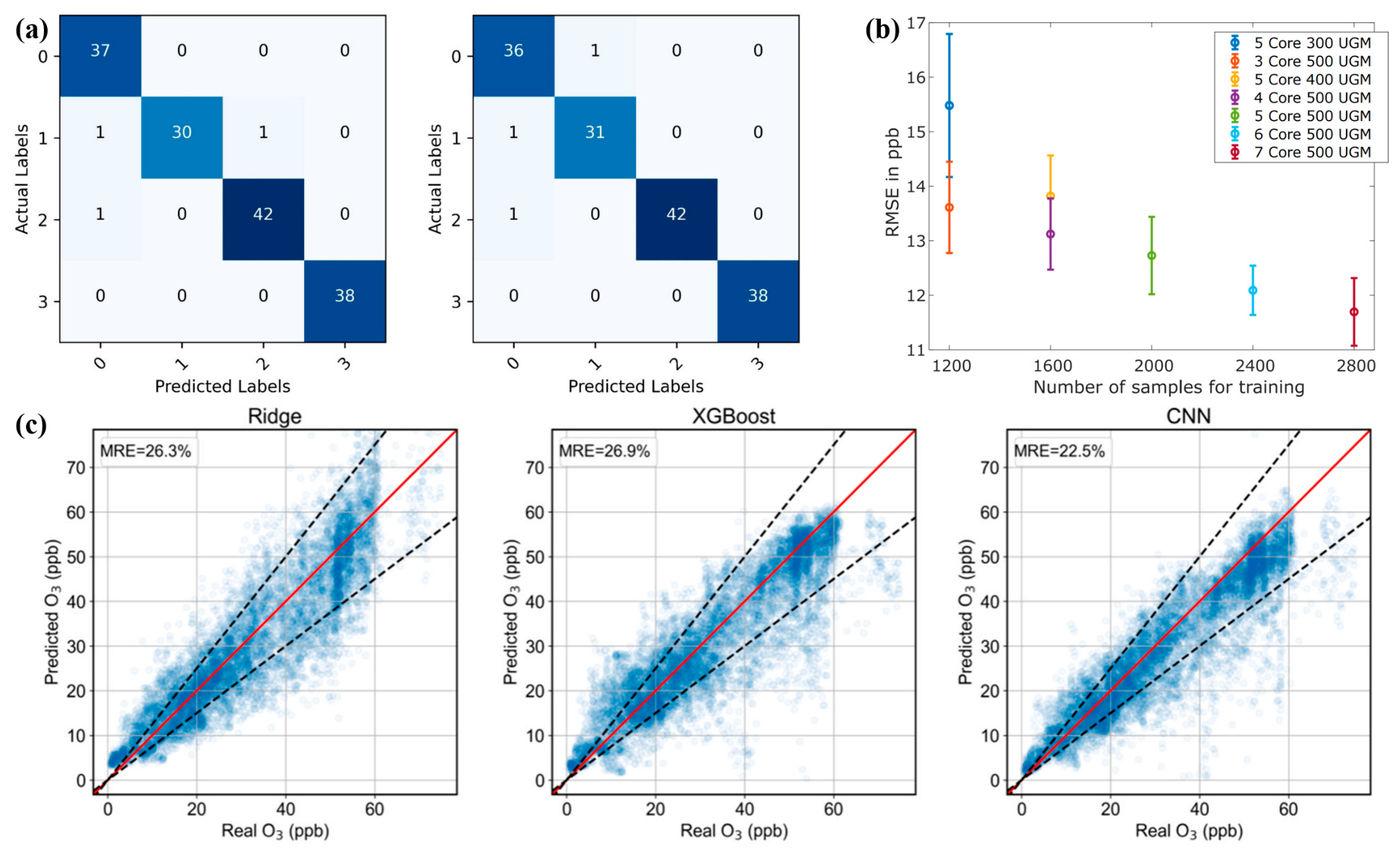
As environmental sensing moves toward quantitative indoor air monitoring, the difficulty shifts from recognizing separable odor sources to learning a reliable mapping within a high-dimensional mixture space. Robin et al. used an SGP30 MOS sensor with four gas-sensitive layers under temperature-cycled operation and developed a 10-layer CNN framework, referred to by the authors as TCOCNN, for quantifying multiple indoor-air-related gases, including acetone, ethanol, formaldehyde, toluene, VOCsum, hydrogen, and carbon monoxide [188]. The key point of this study is that CNN-based quantification depends not only on model architecture, but also on whether the calibration dataset sufficiently covers the chemical mixture space. As shown in Figure 9b, in the formaldehyde model, increasing the number of unique gas mixtures was more effective than simply increasing repeated core samples, with the best RMSE reaching 11.7 ppb. In the broader multi-target evaluation, TCOCNN also achieved lower RMSE than the feature-extraction/PLSR-based benchmark for all trained targets. This study therefore shows that deep learning can improve MOS-based VOC quantification, but only when dynamic operation and calibration design provide sufficiently rich and representative response patterns.
A further increase in AI involvement appears when the MOS sensor is actively driven to generate dynamic response patterns rather than being treated as a static transducer. Kobald et al. used a temperature-modulated commercial SGP30 SMOX sensor with four sensing pixels and compared ridge regression, XGBoost, and CNN models for pollutant-gas regression [189]. In laboratory-generated mixtures containing CO, NO2, O3, SO2, relative humidity, and interfering background gases, each temperature cycle generated a 180 × 4 resistance-response matrix. The CNN achieved the lowest average mean relative error of 9.1%, outperforming ridge regression and XGBoost. In a real outdoor-air test, where ozone concentrations were referenced to the nearest public monitoring station, the CNN also gave the best performance among the tested models, with MAE = 5.2 ppb, RMSE = 7.8 ppb, and MRE = 22.5%. As shown in Figure 9c, the predicted-versus-measured ozone results demonstrate the feasibility of applying temperature-modulated SMOX sensing to outdoor air-quality estimation. More importantly, SHAP analysis was used to examine which phases of the temperature cycle contributed to the prediction, indicating that CNN models can extract useful dynamic features from the modulation profile. This study therefore supports the idea that environmental MOS sensing can be improved through the coupling of operating protocol, dynamic sensor response, and nonlinear learning.
For deployment in open environments, the main challenge is not only calibration accuracy, but whether the learned model can remain valid when gas-plume characteristics change with sensor location. Huang et al. proposed DATAL, an unsupervised domain-adversarial adaptation framework for compensating spatial drift in electronic-nose gas detection [190]. Using a public open-sampling dataset based on modules containing eight Figaro MOS sensors, the study treated data collected at different source–sensor locations as different domains. DATAL combined temporal convolutional networks, multi-head self-attention LSTM, a gradient-reversal-based domain discriminator, and explicit distribution alignment to learn gas-discriminative yet domain-invariant temporal features. Across 20 source–target location combinations, the model achieved an average accuracy of 80.99%, outperforming conventional deep-learning and domain-adaptation baselines. Even when the labeled source-domain data were reduced to 30%, the average accuracy remained 73.54%. This case represents a higher level of AI involvement, where the model is designed not merely to fit a fixed calibration dataset, but to transfer gas-recognition ability across spatially shifted open-environment conditions.
Overall, environmental monitoring shows how the role of AI expands as deployment conditions become more realistic. Machine-learning models first convert complex odor fingerprints into source and concentration-related information; CNN-based methods then improve quantitative interpretation of mixed-gas response spaces; temperature modulation further provides dynamic features for deep regression models; and domain-adaptation frameworks address spatial drift and cross-location transfer in open environments. This progression makes environmental monitoring one of the clearest examples of why gas sensors increasingly need to be understood as part of a coupled hardware–operation–algorithm system.
5.5. Public Safety
Public-safety gas monitoring requires sensing systems to respond before hazardous events develop into accidents. Typical scenarios include combustible or toxic gas leakage, early fire emissions, battery thermal-runaway precursors, and abnormal emissions in domestic or industrial environments. Compared with ordinary gas detection, these tasks require not only gas identification, but also quantitative estimation under interference, rejection of nuisance conditions, dynamic early-warning capability, and deployable alarm infrastructure. Therefore, the role of AI in this field is to convert unstable and cross-sensitive sensor responses into actionable warning information.
In gas-leakage scenarios, the main difficulty is that target gases are often accompanied by uncertain interfering components. Ma et al. addressed this problem using an artificial olfactory system based on MOS sensor arrays for hazardous-gas quantitative identification under disturbed environments [191]. Instead of relying on single-sensor linear calibration, they constructed response-map-based shallow and deep learning models, including transfer learning with ResNet18 and a multi-fusion model. The average R2 increased from 0.6653 with univariate linear regression to 0.8368 with TL-ResNet18, and further to 0.9417 with the multi-fusion model [191]. This work shows that, in safety-related leakage monitoring, AI is increasingly used to extract quantitative target-gas information from interfered MOS array responses rather than simply classify isolated gases.
Fire detection further changes the task from gas recognition to early-warning discrimination under false-alarm constraints. Solórzano et al. evaluated a gas-sensor-array-based fire detector in a validated 240 m3 standard fire room [192]. The system integrated eight MOX sensors with CO, CO2, PID, temperature, and humidity sensing, and PLS-DA/SVM models were used to detect smoldering and plastic fires while rejecting nuisance scenarios. Four months after calibration, the PLS-DA model still achieved 100% specificity and 85% sensitivity, although plastic fires remained difficult because their signatures were close to nuisance conditions [192]. The PLS-DA results showed separation between fire and nuisance scenarios. This case emphasizes that public-safety sensing must balance early detection with false-alarm immunity.
Battery safety represents a more demanding stage because off-gases may appear before obvious voltage or temperature abnormalities during thermal runaway. Cheng et al. proposed a temperature-modulated MOS sensor-array strategy combined with MMT-Net for lithium-ion battery off-gas detection [193]. The method transformed temperature-modulated sensor responses into Gramian angular difference field features and used a multi-task network with modulation-parameter embedding and multi-head attention to perform gas classification and concentration prediction. Across nine modulation modes, MMT-Net achieved 100% classification accuracy and R2 = 0.976 with MAPE = 9.48%; under the 3.5–5 V, 30 s modulation mode, performance further improved to R2 = 0.9933 and MAPE = 5.24% [193]. The results indicate that strong quantitative performance can be maintained across different voltage ranges and modulation periods, although the optimal mode depends on the target gas. This study is particularly important because it couples sensing protocol, temporal feature encoding, and deep multi-task learning for early-warning applications.
At the deployment level, public-safety gas sensing also needs to be connected to automatic reporting and remote decision-making systems. Kumar et al. developed an IoT-HGDS for smart-kitchen monitoring using six tin-oxide-based MOS sensors, a DHT22 temperature/humidity sensor, an ESP32 microcontroller, and AWS-based data transmission [194]. The system collected 1350 samples from nine kitchen-related materials and applied standardized independent component analysis (SICA) preprocessing with logistic regression (LR), adaptive boosting (AdaBoost), and regularized discriminant analysis (RDA) classifiers. The best SICA–RDA model achieved 97.78% accuracy [194]. This work demonstrates a practical route from local MOS sensing and wireless transmission to cloud-assisted preprocessing, classification, and alert-oriented decision-making, even though the algorithmic complexity is lower than in deep-learning-based studies.
Overall, public-safety applications show a progression from interference-resistant hazardous-gas quantification, to early fire discrimination under nuisance constraints, to temperature-modulated battery off-gas analysis, and finally to connected monitoring systems. In this field, AI is valuable because safety-relevant information is distributed across mixed-gas composition, transient response patterns, operating protocols, and deployment context. MOS sensor arrays provide low-cost and sensitive detection channels, while machine-learning and deep-learning models transform cross-sensitive signals into quantitative estimates, early-warning decisions, and actionable alarms.
5.6. MEMS Utilization in Practical Applications
MEMS platforms are increasingly used in AI-assisted gas-sensing applications where miniaturization, low power consumption, fast thermal operation, and circuit-level integration are required. In food-quality assessment, Ren et al. integrated a MEMS MOX sensor array with a 180-nm CMOS interface and a CNN classifier, using both steady-state and transient response features to classify freshness states across multiple food categories [173]. In medical diagnostics, Durán et al. reported a 14-sensor MEMS metal-oxide eNose for colorectal-cancer breath profiling, combining controlled breath sampling, preprocessing, PCA-assisted feature reduction, and supervised learning for noninvasive cancer screening [195]. In environmental and public-safety monitoring, temperature-cycled or temperature-modulated SMOX/MOS platforms further show the value of programmable thermal operation, because rapid heating can transform simple resistance changes into dynamic response patterns suitable for CNNs, Transformers, and multi-task learning models.
The current role of MEMS in these applications is therefore not limited to device miniaturization. MEMS micro-hotplates provide a hardware basis for low-power operation, rapid temperature modulation, stable thermal control, and circuit-level integration, all of which are important for generating information-rich datasets. However, practical AI-assisted sensing also depends on the reproducibility of the sensing layer itself. Variations introduced during material deposition, patterning, or post-integration processing may still affect device-to-device consistency and model transferability. Therefore, although MEMS platforms provide a promising route toward integrated intelligent gas sensing, the high-consistency integration of sensing materials on MEMS devices remains a key challenge for future application-oriented research.
Overall, these application studies show that AI-assisted MOS gas sensing is moving from simple response classification toward task-oriented intelligent sensing. As practical scenarios become more complex, the key challenge is no longer only to improve sensor response, but to coordinate sensing materials, device platforms, operating protocols, and algorithms so that cross-sensitive signals can be transformed into reliable classification, regression, early-warning, and decision-making outputs.
6. Challenges and Future Perspectives
AI-assisted MOS gas sensing has progressed rapidly from simple pattern recognition toward classification, quantitative prediction, dynamic sensing, and application-oriented intelligent monitoring. However, the transition from laboratory demonstrations to reliable practical systems still faces several common challenges. Current datasets are often generated under different gas species, concentration ranges, humidity levels, temperature conditions, sampling protocols, and device configurations, which limits direct comparison among different studies. In many cases, datasets contain sensor responses and gas labels but lack sufficient metadata, such as device identity, fabrication batch, operating protocol, calibration date, flow rate, or environmental conditions. As a result, models trained on a specific dataset may show high internal accuracy but limited transferability to other devices, laboratories, or application environments [9,196,197,198].
Long-term stability and deployment reliability also remain difficult problems. MOS sensors are easily affected by humidity, background gases, residual adsorption, poisoning, and material aging, all of which can produce baseline shifts, response attenuation, or changes in response/recovery kinetics. These variations introduce a mismatch between the data used for training and the signals encountered during practical operation. Baseline correction, periodic calibration, adaptive modeling, and transfer-learning methods can partially alleviate this problem, but they also increase system complexity and may require additional labeled data [156,199,200,201,202]. For portable or IoT-oriented sensing systems, practical constraints such as model size, response latency, power consumption, data transmission, and system interoperability must also be considered [203,204,205,206]. These issues indicate that future AI-assisted gas sensors need not only higher model accuracy, but also more standardized testing, more representative datasets, and more stable hardware–software operation.
Beyond these general challenges, the coupling between material integration and model transferability deserves particular attention in MOS–MEMS gas sensors. MEMS micro-hotplates can provide miniaturized platforms, rapid thermal response, low power consumption, and relatively uniform device structures. Nevertheless, the final sensing response is strongly determined by how the MOS sensing layer is deposited, patterned, and coupled to the heated electrode region. Variations in material loading, film thickness, morphology, electrode coverage, contact condition, and thermal coupling can cause device-to-device or batch-to-batch differences in baseline resistance, response amplitude, kinetics, noise, and drift. For AI-assisted sensing, such differences are not only fabrication variations; they also become data-distribution variations that directly influence model training, validation, and transfer.
Therefore, improving material–device integration is an important route toward more reproducible AI-assisted MOS/MEMS sensing. Compared with manual drop coating, dispensing, or slurry-based deposition, wafer-level and lithographically defined integration methods can better control the location, geometry, loading, and coverage of sensing materials on MEMS platforms [42,44,55,65,66]. Such processes may help reduce uncontrolled response variation and provide more comparable datasets across sensing units and fabrication batches. At the same time, process information should be recorded together with sensing data, including material composition, deposition parameters, annealing conditions, pattern geometry, device identity, and testing environment. This would make it easier to distinguish whether model errors arise from gas interference, environmental variation, sensor drift, or fabrication inconsistency.
Overall, the future development of AI-assisted MOS/MEMS gas sensing will depend on the coordinated improvement of materials, devices, fabrication processes, operating protocols, datasets, and algorithms. MOS materials provide chemical responsiveness, MEMS platforms enable low-power thermal control and integration, dynamic operation enriches signal information, and AI models transform cross-sensitive responses into classification, regression, early-warning, and decision-making outputs. The remaining challenge is to make this chain reproducible and transferable across devices, batches, and realistic application environments. From this perspective, high-consistency material integration on MEMS platforms is an important step toward reliable datasets, transferable models, and practical intelligent gas-sensing systems.
7. Conclusions
Metal oxide semiconductor (MOS) gas sensors are being reshaped by the combined development of gas-sensitive materials, MEMS device platforms, dynamic operation strategies, and AI-assisted data processing. MOS materials provide the chemical basis for gas adsorption, surface reactions, and resistance modulation, while MEMS micro-hotplates enable miniaturized devices, low-power heating, rapid thermal control, temperature-modulated sensing, and compatibility with integrated readout and interface circuits. AI methods further extend the capability of MOS sensors by extracting information from cross-sensitive, transient, and multidimensional response patterns, thereby supporting gas identification, concentration prediction, drift correction, source attribution, and early-warning analysis.
This review summarizes recent progress from MOS sensing mechanisms and enhancement strategies to MEMS device principles, material–device integration, AI-assisted data-processing methods, and representative applications. In single sensors, arrays, temperature-modulated systems, drift-compensation strategies, and material-design workflows, AI has changed the role of MOS sensors from passive transducers to information-generating sensing elements. Application studies in food quality assessment, agriculture, medical diagnostics, environmental monitoring, and public safety further show that the required AI involvement increases as sensing tasks move from structured odor-fingerprint discrimination to nonlinear feature mapping, dynamic response interpretation, cross-domain adaptation, and connected monitoring.
Despite these advances, practical AI-assisted MOS/MEMS gas sensing still faces important challenges. Dataset heterogeneity, incomplete metadata, environmental interference, long-term drift, limited cross-device validation, and edge-deployment constraints continue to limit model comparability and transferability. More importantly, for MEMS-based gas sensors, structural uniformity of the micro-hotplate alone is not sufficient. The reproducibility of the MOS sensing layer—including material loading, film morphology, electrode coverage, and thermal coupling—directly affects response distributions and therefore influences model generalization. High-consistency integration of sensing materials on MEMS platforms is thus an important route toward reliable datasets and transferable AI models.
Overall, the future development of intelligent MOS gas sensing will depend on closer coordination among materials, device structures, fabrication processes, operating protocols, datasets, and algorithms. Rather than relying on algorithms to compensate for unstable hardware, the field needs sensing systems that generate reproducible, information-rich, and application-relevant data from the beginning. Through such material–device–algorithm co-design, MOS/MEMS gas sensors may evolve into more reliable intelligent sensing platforms for environmental monitoring, food safety, medical screening, industrial protection, and public-safety applications.
Author Contributions
Conceptualization, J.L. and F.W.; investigation, J.L., T.C., H.L., J.W., Y.W., Y.H. and Z.L.; writing—original draft preparation, J.L., T.C., H.L., J.W.; writing—review and editing, J.L., T.C., B.T. and F.W.; supervision, F.W.; project administration, F.W.; funding acquisition, F.W. All authors have read and agreed to the published version of the manuscript.
Funding
This work was supported in part by the National Natural Science Foundation of China under Grant 62174077 and in part by the Shenzhen Science and Technology Innovation Committee under Grant JCYJ20220818100415033, and in part by High-level Special Funds in SUSTech under grant G03034K009.
Institutional Review Board Statement
Not applicable.
Informed Consent Statement
Not applicable.
Data Availability Statement
No new data were created or analyzed in this study. Data sharing is not applicable to this article.
Acknowledgments
The authors acknowledge the funding support of this research. During the preparation of this manuscript, AI was only used to polish the English language and improve readability.
Conflicts of Interest
The authors declare no conflicts of interest.
Abbreviations
The following abbreviations are used in this manuscript:
| AI | Artificial intelligence |
| ALD | Atomic layer deposition |
| ANN | Artificial neural network |
| ANOVA | Analysis of variance |
| ART | Adaptive resonance theory |
| ARTMAP | Adaptive resonance theory mapping |
| AUC | Area under the curve |
| AWS | Amazon Web Services |
| Bi-LSTM | Bidirectional long short-term memory |
| BP | Back propagation |
| BPNN | Back-propagation neural network |
| CMOS | Complementary metal-oxide-semiconductor |
| CNN | Convolutional neural network |
| CVD | Chemical vapor deposition |
| DATAL | Domain adaptation framework combining temporal convolutional networks and multi-head self-attention LSTM |
| DC | Direct current |
| DT | Decision tree |
| EDC | Euclidean distance to centroids |
| ELM | Extreme learning machine |
| e-nose | Electronic nose |
| FCM | Fuzzy C-means |
| FFN | Feed-forward network |
| GAN | Generative adversarial network |
| GRNN | General regression neural network |
| GRU | Gated recurrent unit |
| GTW-GRNN | Geographically and temporally weighted general regression neural network |
| HDMMMOC | Hyperdisked model maximum margin optimum classifier |
| HGDS | Hazardous gas detection system |
| IoT | Internet of Things |
| KNN | K-nearest neighbors |
| LDA | Linear discriminant analysis |
| LR | Logistic regression |
| LSTM | Long short-term memory |
| LVQ | Learning vector quantization |
| MAE | Mean absolute error |
| MAPE | Mean absolute percentage error |
| MEMS | Microelectromechanical systems |
| ML | Machine learning |
| MLP | Multilayer perceptron |
| MLPNN | Multilayer perceptron neural network |
| MOS | Metal oxide semiconductor |
| MOX | Metal oxide |
| MRE | Mean relative error |
| NRMSE | Normalized root mean square error |
| PCA | Principal component analysis |
| PID | Photoionization detector |
| PLS | Partial least squares |
| PLS-DA | Partial least squares discriminant analysis |
| PLSR | Partial least squares regression |
| PNN | Probabilistic neural network |
| PSO-BP | Particle swarm optimization–back propagation |
| RBF | Radial basis function |
| RDA | Regularized discriminant analysis |
| RF | Random forest |
| RLS | Recursive least squares |
| RMSE | Root mean square error |
| RNN | Recurrent neural network |
| SHAP | Shapley additive explanations |
| SICA | Standardized independent component analysis |
| SMOX | Semiconducting metal oxide |
| STFT | Short-time Fourier transform |
| SVM | Support vector machine |
| SVR | Support vector regression |
| TL | Transfer learning |
| VOC | Volatile organic compound |
| VGG | Visual geometry group |
References
- Bandewad, G.; Datta, K.P.; Gawali, B.W.; Pawar, S.N. Review on discrimination of hazardous gases by smart sensing technology. Artif. Intell. Appl. 2023, 1, 70–81. [Google Scholar] [CrossRef]
- Yunusa, Z.; Hamidon, M.N.; Kaiser, A.; Awang, Z. Gas sensors: A review. Sens. Transducers 2014, 168, 61–75. [Google Scholar]
- Li, W.; Shahbazi, M.; Xing, K.; Tesfamichael, T.; Motta, N.; Qi, D.-C. Highly sensitive NO2 gas sensors based on MoS2@MoO3 magnetic heterostructure. Nanomaterials 2022, 12, 1303. [Google Scholar] [CrossRef] [Scilit] [PubMed]
- Chen, Z.; Zhou, B.; Xiao, M.; Bhowmick, T.; Kannan, P.K.; Occhipinti, L.G.; Gardner, J.W.; Hasan, T. Real-time, noise and drift resilient formaldehyde sensing at room temperature with aerogel filaments. Sci. Adv. 2024, 10, eadk6856. [Google Scholar] [CrossRef] [Scilit] [PubMed]
- He, L.X.; Wang, F.; Niu, G.Q.; Gong, H.M.; Yang, Z.T.; He, W.; Cao, J.M. Design of MEMS-based gas sensor micro heat plate. In Proceedings of the International Workshop on Materials, Chemistry and Engineering (IWMCE 2018), Xiamen, China, 16–17 June 2018; SciTePress: Setubal, Portugal, 2018; pp. 610–615. [Google Scholar] [CrossRef] [Scilit]
- Bhattacharyya, P. Technological journey towards reliable microheater development for MEMS gas sensors: A review. IEEE Trans. Device Mater. Reliab. 2014, 14, 589–599. [Google Scholar] [CrossRef] [Scilit]
- Nikolic, M.V.; Milovanovic, V.; Vasiljevic, Z.Z.; Stamenkovic, Z. Semiconductor gas sensors: Materials, technology, design, and application. Sensors 2020, 20, 6694. [Google Scholar] [CrossRef] [Scilit] [PubMed]
- Guo, M.; Brewster, J.T., II; Zhang, H.; Zhao, Y.; Zhao, Y. Challenges and opportunities of chemiresistors based on microelectromechanical systems for chemical olfaction. ACS Nano 2022, 16, 17778–17801. [Google Scholar] [CrossRef] [Scilit] [PubMed]
- Yan, J.; Kang, Y.; Wang, T.; Tian, Y.; Wang, C.; Ma, Z.; Song, Z. AI empowers intelligent chemical sensing systems. Innov. Inform. 2025, 1, 100014. [Google Scholar] [CrossRef] [Scilit]
- Xu, P.; Song, K.; Xia, X.; Chen, Y.; Wang, Q.; Wei, G. Temperature and humidity compensation for MOS gas sensor based on random forests. In Proceedings of the International Conference on Intelligent Computing for Sustainable Energy and Environment, Singapore, 22–24 September 2017; Springer: Singapore; pp. 135–145. [CrossRef] [Scilit]
- Hooshmand, S.; Kassanos, P.; Keshavarz, M.; Duru, P.; Kayalan, C.I.; Kale, I.; Bayazit, M.K. Wearable nano-based gas sensors for environmental monitoring and encountered challenges in optimization. Sensors 2023, 23, 8648. [Google Scholar] [CrossRef] [Scilit] [PubMed]
- Dong, X.; Han, S. Real-time correction and long-term drift compensation in MOS gas sensor arrays using iterative random forests and incremental domain-adversarial networks. Micromachines 2025, 16, 991. [Google Scholar] [CrossRef] [Scilit] [PubMed]
- Xiao, C.; Han, B.; Zhou, N.; Shi, M.; Mao, H. AI-enabled MOS gas sensors for applications in complex environments. Mater. Today Electron. 2026, 16, 100220. [Google Scholar] [CrossRef] [Scilit]
- Chung, J.H.; Shim, Y.-S. Micro-electro-mechanical systems gas sensors for next-generation smart sensing: From wafer-level fabrication to system-level artificial intelligence integration. Appl. Sci. Converg. Technol. 2026, 35, 59–71. [Google Scholar] [CrossRef] [Scilit]
- Zong, B.; Wu, S.; Yang, Y.; Li, Q.; Tao, T.; Mao, S. Smart gas sensors: Recent developments and future prospective. Nano-Micro Lett. 2025, 17, 54. [Google Scholar] [CrossRef] [Scilit] [PubMed]
- Xu, J.; Setiono, A.; Peiner, E. Piezoresistive microcantilever with SAM-modified ZnO-nanorods@silicon-nanopillars for room-temperature parts-per-billion NO2 detection. ACS Appl. Nano Mater. 2020, 3, 6609–6620. [Google Scholar] [CrossRef] [Scilit]
- Thomas, G.; Keller, V.; Spitzer, D. Highly vertical 3D bio-inspired hierarchical and multiscale superstructures on microcantilever for gas sensing of organophosphorous agents. Appl. Mater. Today 2022, 29, 101667. [Google Scholar] [CrossRef] [Scilit]
- Yaqoob, U.; Lenz, W.B.; Alcheikh, N.; Jaber, N.; Younis, M.I. Highly selective multiple gases detection using a thermal-conductivity-based MEMS resonator and machine learning. IEEE Sens. J. 2022, 22, 19858–19866. [Google Scholar] [CrossRef] [Scilit]
- Wang, J.; Xu, B.; Shi, L.; Zhu, L.; Wei, X. Prospects and challenges of AI and neural network algorithms in MEMS microcantilever biosensors. Processes 2022, 10, 1658. [Google Scholar] [CrossRef] [Scilit]
- Owais, T.; Khater, M.; Al-Qahtani, H. Graphene-based MEMS devices for gas sensing applications: A review. Micro Nanostruct. 2024, 195, 207954. [Google Scholar] [CrossRef] [Scilit]
- Ji, H.; Zeng, W.; Li, Y. Gas sensing mechanisms of metal oxide semiconductors: A focus review. Nanoscale 2019, 11, 22664–22684. [Google Scholar] [CrossRef] [Scilit] [PubMed]
- Barsan, N.; Weimar, U.D.O. Conduction model of metal oxide gas sensors. J. Electroceram. 2001, 7, 143–167. [Google Scholar] [CrossRef] [Scilit]
- Panigrahi, P.K.; Basavaiah, C.; Puvvada, N. Recent advances in nanostructured materials for application as gas sensors. ACS Omega 2024, 9, 3092–3122. [Google Scholar] [CrossRef] [Scilit] [PubMed]
- Filipovic, L.; Selberherr, S. Performance and stress analysis of metal oxide films for CMOS-integrated gas sensors. Sensors 2015, 15, 7206–7227. [Google Scholar] [CrossRef] [Scilit] [PubMed]
- Mariammal, R.N.; Ramachandran, K. Study on gas sensing mechanism in p-CuO/n-ZnO heterojunction sensor. Mater. Res. Bull. 2018, 100, 420–428. [Google Scholar] [CrossRef] [Scilit]
- Nasiri, N.; Clarke, C. Nanostructured chemiresistive gas sensors for medical applications. Sensors 2019, 19, 462. [Google Scholar] [CrossRef] [Scilit] [PubMed]
- Yamazoe, N. New approaches for improving semiconductor gas sensors. Sens. Actuators B Chem. 1991, 5, 7–19. [Google Scholar] [CrossRef] [Scilit]
- Mirzaei, A.; Ansari, H.R.; Shahbaz, M.; Kim, J.-Y.; Kim, H.W.; Kim, S.S. Metal oxide semiconductor nanostructure gas sensors with different morphologies. Chemosensors 2022, 10, 289. [Google Scholar] [CrossRef] [Scilit]
- Yang, S.; Lei, G.; Xu, H.; Lan, Z.; Wang, Z.; Gu, H. Metal oxide based heterojunctions for gas sensors: A review. Nanomaterials 2021, 11, 1026. [Google Scholar] [CrossRef] [Scilit] [PubMed]
- Wang, J.; Zhou, Q.; Peng, S.; Xu, L.; Zeng, W. Volatile organic compounds gas sensors based on molybdenum oxides: A mini review. Front. Chem. 2020, 8, 339. [Google Scholar] [CrossRef] [Scilit] [PubMed]
- Dey, A. Semiconductor metal oxide gas sensors: A review. Mater. Sci. Eng. B 2018, 229, 206–217. [Google Scholar] [CrossRef] [Scilit]
- Xu, C.; Tamaki, J.; Miura, N.; Yamazoe, N. Relationship between gas sensitivity and microstructure of porous SnO2. Denki Kagaku Oyobi Kogyo Butsuri Kagaku 1990, 58, 1143–1148. [Google Scholar] [CrossRef] [Scilit]
- Sun, Y.-F.; Liu, S.-B.; Meng, F.-L.; Liu, J.-Y.; Jin, Z.; Kong, L.-T.; Liu, J.-H. Metal oxide nanostructures and their gas sensing properties: A review. Sensors 2012, 12, 2610–2631. [Google Scholar] [CrossRef] [Scilit] [PubMed]
- Masuda, Y. Recent advances in SnO2 nanostructure based gas sensors. Sens. Actuators B Chem. 2022, 364, 131876. [Google Scholar] [CrossRef] [Scilit]
- Wang, X.; Wang, Y.; Tian, F.; Liang, H.; Wang, K.; Zhao, X.; Lu, Z.; Jiang, K.; Yang, L.; Lou, X. From the surface reaction control to gas-diffusion control: The synthesis of hierarchical porous SnO2 microspheres and their gas-sensing mechanism. J. Phys. Chem. C 2015, 119, 15963–15976. [Google Scholar] [CrossRef] [Scilit]
- Gong, H.; Zhao, C.; Niu, G.; Zhang, W.; Wang, F. Construction of 1D/2D α-Fe2O3/SnO2 hybrid nanoarrays for sub-ppm acetone detection. Research 2020, 2020, 2196063. [Google Scholar] [CrossRef] [Scilit] [PubMed]
- Vuong, N.M.; Chinh, N.D.; Huy, B.T.; Lee, Y.-I. CuO-decorated ZnO hierarchical nanostructures as efficient and established sensing materials for H2S gas sensors. Sci. Rep. 2016, 6, 26736. [Google Scholar] [CrossRef] [Scilit] [PubMed]
- Wang, P.; Yang, X. Engineering hierarchical CuO/WO3 hollow spheres with flower-like morphology for ultra-sensitive H2S detection at ppb level. Chemosensors 2025, 13, 250. [Google Scholar] [CrossRef] [Scilit]
- Tian, K.; Fu, Y.; Haq, I.; Kuang, S.; Xiong, G.; Zhao, Z.; Zhou, T.; Weng, J.; Peng, X.; Xiong, L. Fabrication of MOF-derived porous Au@Co-ZnO nanostructures with excellent C2H5OH sensing performance. Microstructures 2025, 5, 2025041. [Google Scholar] [CrossRef] [Scilit]
- Zhang, C.; Huan, Y.; Li, Y.; Luo, Y.; Debliquy, M. Low concentration isopropanol gas sensing properties of Ag nanoparticles decorated In2O3 hollow spheres. J. Adv. Ceram. 2022, 11, 379–391. [Google Scholar] [CrossRef] [Scilit]
- Deng, Y.; Chen, K.; Xie, W.; Huang, X.-Y.; Jiang, F.; Xue, L.; Zhang, Z.; Yue, Q.; Wu, L.; Luo, W.; et al. On-chip construction of hierarchically macro-/mesoporous cerium oxide/Pt gas-sensitive film for ultrasensitive detection of trace oxygen. Interdiscip. Mater. 2025, 4, 585–598. [Google Scholar] [CrossRef] [Scilit]
- Simon, I.; Bârsan, N.; Bauer, M.; Weimar, U. Micromachined metal oxide gas sensors: Opportunities to improve sensor performance. Sens. Actuators B Chem. 2001, 73, 1–26. [Google Scholar] [CrossRef] [Scilit]
- Yuan, Z.; Yang, F.; Meng, F.; Zuo, K.; Li, J. Research of low-power MEMS-based micro hotplates gas sensor: A review. IEEE Sens. J. 2021, 21, 18368–18380. [Google Scholar] [CrossRef] [Scilit]
- Niu, G.; Wang, F. A review of MEMS-based metal oxide semiconductors gas sensor in Mainland China. J. Micromech. Microeng. 2022, 32, 054003. [Google Scholar] [CrossRef] [Scilit]
- Briand, D.; Krauss, A.; Van der Schoot, B.; Weimar, U.; Barsan, N.; Göpel, W.; De Rooij, N.F. Design and fabrication of high-temperature micro-hotplates for drop-coated gas sensors. Sens. Actuators B Chem. 2000, 68, 223–233. [Google Scholar] [CrossRef] [Scilit]
- Ni, H.; Lee, H.-J.; Ramirez, A.G. A robust two-step etching process for large-scale microfabricated SiO2 and Si3N4 MEMS membranes. Sens. Actuators A Phys. 2005, 119, 553–558. [Google Scholar] [CrossRef] [Scilit]
- Niu, G.; Gong, H.; Zhao, C.; Wang, F. H2S sensor based on MEMS hotplate and on-chip growth of CuO-SnO2 nanosheets for high response, fast recovery and low power consumption. In Proceedings of the 2020 IEEE 33rd International Conference on Micro Electro Mechanical Systems (MEMS), Vancouver, BC, Canada, 18–22 January 2020; pp. 799–802. [Google Scholar] [CrossRef] [Scilit]
- Guan, D.; Yang, F.; Liu, Q.; Yu, K.; Sun, J. A novel prototype of low power consumption MEMS sensors for hydrogen detection. In Proceedings of the 2016 IEEE SENSORS, Orlando, FL, USA, 30 October–2 November 2016; IEEE: Piscataway, NJ, USA, 2016; pp. 1–3. [Google Scholar] [CrossRef] [Scilit]
- Wang, C.; Jin, J.; Li, Y.; Ding, W.; Dai, M. Design and fabrication of a MEMS-based gas sensor containing WO3 sensitive layer for detection of NO2. J. Micro/Nanolithogr. MEMS MOEMS 2017, 16, 015002. [Google Scholar] [CrossRef] [Scilit]
- Liu, Q.; Ding, G.; Wang, Y.; Yao, J. Thermal performance of micro-hotplates with novel shapes based on single-layer SiO2 suspended film. Micromachines 2018, 9, 514. [Google Scholar] [CrossRef] [Scilit] [PubMed]
- Tian, X.; Tao, J.; Xu, M.; Lin, Y.; Zhao, J. Design and simulation of an ultra-low-power hydrogen sulfide gas sensor with a cantilever structure. Micromachines 2024, 15, 295. [Google Scholar] [CrossRef] [Scilit] [PubMed]
- Vasiliev, A.A.; Nisan, A.V.; Potapov, G.N.; Samotaev, N.N.; Oblov, K.Y.; Ivanova, A.V. MEMS sensors based on very thin LTCC. Proceedings 2017, 1, 324. [Google Scholar] [CrossRef] [Scilit]
- Hille, P.; Strack, H. A heated membrane for a capacitive gas sensor. Sens. Actuators A Phys. 1992, 32, 321–325. [Google Scholar] [CrossRef] [Scilit]
- Belmonte, J.C.; Puigcorbé, J.; Arbiol, J.; Vilà, A.; Morante, J.R.; Sabaté, N.; Gràcia, I.; Cané, C. High-temperature low-power performing micromachined suspended micro-hotplate for gas sensing applications. Sens. Actuators B Chem. 2006, 114, 826–835. [Google Scholar] [CrossRef] [Scilit]
- Liu, L.; Wang, Y.; Sun, F.; Dai, Y.; Wang, S.; Bai, Y.; Li, L.; Li, T.; Zhang, T.; Qin, S. ‘Top-down’ and ‘bottom-up’ strategies for wafer-scaled miniaturized gas sensors design and fabrication. Microsyst. Nanoeng. 2020, 6, 31. [Google Scholar] [CrossRef] [Scilit] [PubMed]
- Hwang, W.-J.; Shin, K.-S.; Roh, J.-H.; Lee, D.-S.; Choa, S.-H. Development of micro-heaters with optimized temperature compensation design for gas sensors. Sensors 2011, 11, 2580–2591. [Google Scholar] [CrossRef] [Scilit] [PubMed]
- Baroncini, M.; Placidi, P.; Cardinali, G.C.; Scorzoni, A. Thermal characterization of a microheater for micromachined gas sensors. Sens. Actuators A Phys. 2004, 115, 8–14. [Google Scholar] [CrossRef] [Scilit]
- Guidi, V.; Cardinali, G.C.; Dori, L.; Faglia, G.; Ferroni, M.; Martinelli, G.; Nelli, P.; Sberveglieri, G. Thin-film gas sensor implemented on a low-power-consumption micromachined silicon structure. Sens. Actuators B Chem. 1998, 49, 88–92. [Google Scholar] [CrossRef] [Scilit]
- DeVoe, D.L. Thermal issues in MEMS and microscale systems. IEEE Trans. Compon. Packag. Technol. 2002, 25, 576–583. [Google Scholar] [CrossRef]
- Wang, Y.; Tong, W.G.; Han, N. Co-sputtered Pd/SnO2:NiO heterostructured sensing layers for MEMS-based ethanol sensors. Mater. Lett. 2020, 273, 127924. [Google Scholar] [CrossRef] [Scilit]
- Semancik, S.; Cavicchi, R. Kinetically controlled chemical sensing using micromachined structures. Acc. Chem. Res. 1997, 31, 279–287. [Google Scholar] [CrossRef] [Scilit]
- Weber, M.; Graniel, O.; Balme, S.; Miele, P.; Bechelany, M. On the use of MOFs and ALD layers as nanomembranes for the enhancement of gas sensors selectivity. Nanomaterials 2019, 9, 1552. [Google Scholar] [CrossRef] [Scilit] [PubMed]
- Tischner, A.; Maier, T.; Stepper, C.; Kock, A. Ultrathin SnO2 gas sensors fabricated by spray pyrolysis for the detection of humidity and carbon monoxide. Sens. Actuators B Chem. 2008, 134, 796–802. [Google Scholar] [CrossRef] [Scilit]
- Filipovic, L.; Lahlalia, A. Review—System-on-chip SMO gas sensor integration in advanced CMOS technology. J. Electrochem. Soc. 2018, 165, B862–B879. [Google Scholar] [CrossRef] [Scilit]
- Chen, Y.; Xu, P.; Li, X.; Ren, Y.; Deng, Y. High-performance H2 sensors with selectively hydrophobic micro-plate for self-aligned upload of Pd nanodots modified mesoporous In2O3 sensing-material. Sens. Actuators B Chem. 2018, 267, 83–92. [Google Scholar] [CrossRef] [Scilit]
- Li, M.; Luo, W.; Liu, X.; Niu, G.; Wang, F. Wafer-level patterning of SnO2 nanosheets for MEMS gas sensors. IEEE Electron. Device Lett. 2022, 43, 1981–1984. [Google Scholar] [CrossRef] [Scilit]
- Faleh, R.; Gomri, S.; Aguir, K.; Kachouri, A. A new combined transient extraction method coupled with WO3 gas sensors for polluting gases classification. Sens. Rev. 2021, 41, 437–448. [Google Scholar] [CrossRef] [Scilit]
- Kunt, T.A.; McAvoy, T.J.; Cavicchi, R.E.; Semancik, S. Optimization of temperature programmed sensing for gas identification using micro-hotplate sensors. Sens. Actuators B Chem. 1998, 53, 24–43. [Google Scholar] [CrossRef] [Scilit]
- Heilig, A.; Barsan, N.; Weimar, U.; Schweizer-Berberich, M.; Gardner, J.W.; Gopel, W. Gas identification by modulating temperatures of SnO2-based thick film sensors. Sens. Actuators B Chem. 1997, 43, 45–51. [Google Scholar] [CrossRef] [Scilit]
- Jolliffe, I.T.; Cadima, J. Principal component analysis: A review and recent developments. Phil. Trans. R. Soc. A 2016, 374, 20150202. [Google Scholar] [CrossRef] [Scilit] [PubMed]
- Zeng, X.; Shahzeb, M.; Cheng, X.; Shen, Q.; Xiao, H.; Xia, C.; Xia, Y.; Huang, Y.; Xu, J.; Wang, Z. An enhanced gas sensor data classification method using principal component analysis and synthetic minority over-sampling technique algorithms. Micromachines 2024, 15, 1501. [Google Scholar] [CrossRef] [Scilit] [PubMed]
- Schultealbert, C.; Baur, T.; Schütze, A.; Sauerwald, T. Facile quantification and identification techniques for reducing gases over a wide concentration range using a MOS sensor in temperature-cycled operation. Sensors 2018, 18, 744. [Google Scholar] [CrossRef] [Scilit] [PubMed]
- Wan, Z.; Dong, Y.; Yu, Z.; Lv, H.; Lv, Z. Semi-supervised support vector machine for digital twins based brain image fusion. Front. Neurosci. 2021, 15, 705323. [Google Scholar] [CrossRef] [Scilit] [PubMed]
- Men, H.; Fu, S.; Yang, J.; Cheng, M.; Shi, Y.; Liu, J. Comparison of SVM, RF and ELM on an electronic nose for the intelligent evaluation of paraffin samples. Sensors 2018, 18, 285. [Google Scholar] [CrossRef] [Scilit] [PubMed]
- Kim, B.; Kim, E.; Jung, S.; Kim, M.; Kim, J.; Kim, S. PM2.5 concentration forecasting using weighted Bi-LSTM and random forest feature importance-based feature selection. Atmosphere 2023, 14, 968. [Google Scholar] [CrossRef] [Scilit]
- Li, T.; Wang, Y.; Yuan, Q. Remote sensing estimation of regional NO2 via space-time neural networks. Remote Sens. 2020, 12, 2514. [Google Scholar] [CrossRef] [Scilit]
- Chu, J.; Li, W.; Yang, X.; Wu, Y.; Wang, D.; Yang, A.; Yuan, H.; Wang, X.; Li, Y.; Rong, M. Identification of gas mixtures via sensor array combining with neural networks. Sens. Actuators B 2021, 329, 129090. [Google Scholar] [CrossRef] [Scilit]
- Fisher, R.A. The use of multiple measurements in taxonomic problems. Ann. Eugen. 1936, 7, 179–188. [Google Scholar] [CrossRef] [Scilit]
- Itoh, T.; Koyama, Y.; Sakumura, Y.; Akamatsu, T.; Tsuruta, A.; Masuda, Y.; Shin, W. Discrimination of volatile organic compounds using a sensor array via a rapid method based on linear discriminant analysis. Sens. Actuators B 2023, 387, 133803. [Google Scholar] [CrossRef] [Scilit]
- Liu, C.; Sun, Y.; Guo, J.-Y.; Li, X.-L.; Tao, L.; Hu, J.-Y.; Cao, J.-X.; Tang, P.-H.; Zhang, Y. Gas sensor array based on carbon-based thin-film transistor for selective detection of indoor harmful gases. Rare Met. 2024, 43, 4401–4411. [Google Scholar] [CrossRef] [Scilit]
- Wold, S.; Sjöström, M.; Eriksson, L. PLS-regression: A basic tool of chemometrics. Chemom. Intell. Lab. Syst. 2001, 58, 109–130. [Google Scholar] [CrossRef] [Scilit]
- Lakhmi, R.; Fischer, M.; Darves-Blanc, Q.; Alrammouz, R.; Rieu, M.; Viricelle, J.-P. Linear and non-linear modelling methods for a gas sensor array developed for process control applications. Sensors 2024, 24, 3499. [Google Scholar] [CrossRef] [Scilit] [PubMed]
- Rai, P.; Saeed, S.H. Detection of harmful gases present in the environment. Indones. J. Electr. Eng. Comput. Sci. 2023, 30, 70–80. [Google Scholar] [CrossRef] [Scilit]
- Bezdek, J.C. Pattern Recognition with Fuzzy Objective Function Algorithms; Advanced Applications in Pattern Recognition; Springer: Boston, MA, USA, 1981. [Google Scholar] [CrossRef] [Scilit]
- Verma, P.; Sinha, M.; Panda, S. Fuzzy c-means clustering-based novel threshold criteria for outlier detection in electronic nose. IEEE Sens. J. 2021, 21, 1975–1981. [Google Scholar] [CrossRef] [Scilit]
- Rehman, A.U.; Bermak, A. Discriminant analysis of industrial gases for electronic nose applications. In Proceedings of the IEEE International Conference on Computational Intelligence and Virtual Environments for Measurement Systems and Applications (CIVEMSA), Ottawa, ON, Canada, 12–14 June 2018; pp. 1–5. [Google Scholar] [CrossRef] [Scilit]
- Dixon, S.J.; Brereton, R.G. Comparison of performance of five common classifiers represented as boundary methods: Euclidean distance to centroids, linear discriminant analysis, quadratic discriminant analysis, learning vector quantization and support vector machines, as dependent on data structure. Chemom. Intell. Lab. Syst. 2009, 95, 1–17. [Google Scholar] [CrossRef] [Scilit]
- Cover, T.M.; Hart, P.E. Nearest neighbor pattern classification. IEEE Trans. Inf. Theory 1967, 13, 21–27. [Google Scholar] [CrossRef] [Scilit]
- Smola, A.J.; Schölkopf, B. A tutorial on support vector regression. Stat. Comput. 2004, 14, 199–222. [Google Scholar] [CrossRef] [Scilit]
- Trincavelli, M.; Coradeschi, S.; Loutfi, A.; Soderquist, B.; Thunberg, P. Direct identification of bacteria in blood culture samples using an electronic nose. IEEE Trans. Biomed. Eng. 2010, 57, 2884–2890. [Google Scholar] [CrossRef] [Scilit] [PubMed]
- Pardo, M.; Sberveglieri, G. Classification of electronic nose data with support vector machines. Sens. Actuators B 2005, 107, 730–737. [Google Scholar] [CrossRef] [Scilit]
- Laref, R.; Losson, E.; Sava, A.; Adjallah, K.; Siadat, M. A comparison between SVM and PLS for E-nose based gas concentration monitoring. In Proceedings of the 2018 IEEE International Conference on Industrial Technology (ICIT), Lyon, France, 20–22 February 2018; pp. 1335–1339. [Google Scholar] [CrossRef] [Scilit]
- Breiman, L.; Friedman, J.H.; Olshen, R.A.; Stone, C.J. Classification and Regression Trees; Wadsworth International Group: Belmont, CA, USA, 1984. [Google Scholar]
- Breiman, L. Random forests. Mach. Learn. 2001, 45, 5–32. [Google Scholar] [CrossRef] [Scilit]
- Ma, N.; Halley, S.; Ramaiyan, K.; Garzon, F.; Tsui, L. Comparison of machine learning algorithms for natural gas identification with mixed potential electrochemical sensor arrays. ECS Sens. Plus 2023, 2, 011402. [Google Scholar] [CrossRef] [Scilit]
- Haykin, S. Neural Networks and Learning Machines, 3rd ed.; Prentice Hall/Pearson: Upper Saddle River, NJ, USA, 2009. [Google Scholar]
- Sundgren, H.; Winquist, F.; Lukkari, I.; Lundström, I. Artificial neural networks and gas sensor arrays: Quantification of individual components in a gas mixture. Meas. Sci. Technol. 1991, 2, 464–469. [Google Scholar] [CrossRef] [Scilit]
- Zhang, D.; Liu, J.; Jiang, C.; Liu, A.; Xia, B. Quantitative detection of formaldehyde and ammonia gas via metal oxide-modified graphene-based sensor array combining with neural network model. Sens. Actuators B 2017, 240, 55–65. [Google Scholar] [CrossRef] [Scilit]
- Zhang, L.; Tian, F.; Nie, H.; Dang, L.; Li, G.; Ye, Q.; Kadri, C. Classification of multiple indoor air contaminants by an electronic nose and a hybrid support vector machine. Sens. Actuators B 2012, 174, 114–125. [Google Scholar] [CrossRef] [Scilit]
- Han, J.; Li, H.; Cheng, J.; Ma, X.; Fu, Y. Advances in metal oxide semiconductor gas sensor arrays based on machine learning algorithms. J. Mater. Chem. C 2025, 13, 4285. [Google Scholar] [CrossRef] [Scilit]
- LeCun, Y.; Bottou, L.; Bengio, Y.; Haffner, P. Gradient-based learning applied to document recognition. Proc. IEEE 1998, 86, 2278–2324. [Google Scholar] [CrossRef] [Scilit]
- Du, M.; Abdulraheem, M.I.; Xu, L.; Zang, Y.; Song, Y.; Tarighat, M.A.; Raghavan, V.; Hu, J. Enhanced selectivity electronic nose systems for agricultural ammonia gas detection via a co-designed WO3–ZnO sensor array and convolutional neural networks. Sci. Rep. 2025, 15, 39100. [Google Scholar] [CrossRef] [Scilit] [PubMed]
- Zhang, X.; Wang, T.; Ni, W.; Zhang, Y.; Lv, W.; Zeng, M.; Yang, J.; Hu, N.; Zhan, R.; Li, G.; et al. Sensor array optimization for the electronic nose via different deep learning methods. Sens. Actuators B 2024, 410, 135579. [Google Scholar] [CrossRef] [Scilit]
- Kim, C.-H.; Choi, S.-H.; Choi, S.; Lee, S. A reproducible benchmark for gas sensor array classification: From FE-ELM to ROCKET and TS2I-CNNs. Sensors 2025, 25, 6270. [Google Scholar] [CrossRef] [Scilit] [PubMed]
- Elman, J.L. Finding structure in time. Cogn. Sci. 1990, 14, 179–211. [Google Scholar] [CrossRef] [PubMed]
- Hochreiter, S.; Schmidhuber, J. Long short-term memory. Neural Comput. 1997, 9, 1735–1780. [Google Scholar] [CrossRef] [Scilit] [PubMed]
- Cho, K.; van Merriënboer, B.; Gülçehre, Ç.; Bahdanau, D.; Bougares, F.; Schwenk, H.; Bengio, Y. Learning phrase representations using RNN encoder–decoder for statistical machine translation. In Proceedings of the 2014 Conference on Empirical Methods in Natural Language Processing (EMNLP), Doha, Qatar, 25–29 October 2014; pp. 1724–1734. [Google Scholar] [CrossRef] [Scilit]
- Vaswani, A.; Shazeer, N.; Parmar, N.; Uszkoreit, J.; Jones, L.; Gomez, A.N.; Kaiser, L.; Polosukhin, I. Attention is all you need. In Advances in Neural Information Processing Systems; Curran Associates, Inc.: Red Hook, NY, USA, 2017; Volume 30, pp. 5998–6008. [Google Scholar]
- Sun, J.; Dong, M.; Lu, F.; Wang, Z.; Zhu, J.; Wang, Y.; Zheng, L.; Zhao, F. Transformer-driven multi-scale contextual alignment for robust e-nose drift compensation. Knowl.-Based Syst. 2025, 327, 114136. [Google Scholar] [CrossRef] [Scilit]
- Specht, D.F. A general regression neural network. IEEE Trans. Neural Netw. 1991, 2, 568–576. [Google Scholar] [CrossRef] [Scilit] [PubMed]
- Amalia, A.; Rivai, M.; Purwanto, D. Indoor beef quality identification using gas sensor array and probabilistic neural network method. In Proceedings of the 2024 International Conference on Artificial Intelligence and Mechatronics System (AIMS), Virtual, Online, Indonesia, 22–23 February 2024. [Google Scholar] [CrossRef] [Scilit]
- Huang, G.-B.; Zhu, Q.-Y.; Siew, C.-K. Extreme learning machine: Theory and applications. Neurocomputing 2006, 70, 489–501. [Google Scholar] [CrossRef] [Scilit]
- Carpenter, G.A.; Grossberg, S.; Markuzon, N.; Reynolds, J.H.; Rosen, D.B. Fuzzy ARTMAP: A neural network architecture for incremental supervised learning of analog multidimensional maps. IEEE Trans. Neural Netw. 1992, 3, 698–713. [Google Scholar] [CrossRef] [Scilit] [PubMed]
- Savio, K.T.; Mishra, A.; Pandey, A.K.; Singh, S.K.; Sajana, S.; Adak, C.; Shukla, R.P.; Kamble, V.B. Data-driven approach toward the quantification of gases in a complex mixture using a non-selective single metal oxide gas sensor. ACS Sens. 2026, 11, 5417–5431. [Google Scholar] [CrossRef] [Scilit] [PubMed]
- Luo, W.; Zheng, Y.; Liu, Y.; Li, M. Identification of H2 and NH3 gases using calorimetric signals and transient response through machine learning. J. Semicond. 2026, 47, 022303. [Google Scholar] [CrossRef] [Scilit]
- Zhang, H.; Zhao, Z.; Chen, C.; Wu, L. PtRu nanoalloys decorated In2O3 nanoparticles: Gas sensing performance, mechanism study and machine learning-assisted discrimination of multiple volatile organic compounds. Sens. Actuators B Chem. 2025, 425, 136973. [Google Scholar] [CrossRef] [Scilit]
- Cho, H.; Lee, G.; Kim, D.; Kim, D.; Kim, B.; Choi, Y.; Lee, J.-O.; Kim, G.-T. New dynamic fingerprint in derivative-based phase space: Rapid gas sensing in seconds. ACS Sens. 2025, 10, 2840–2849. [Google Scholar] [CrossRef] [Scilit] [PubMed]
- Kim, T.; Kim, Y.; Cho, W.; Kwak, J.-H.; Cho, J.; Pyeon, Y.; Kim, J.J.; Shin, H. Ultralow-power single-sensor-based e-nose system powered by duty cycling and deep learning for real-time gas identification. ACS Sens. 2024, 9, 3557–3572. [Google Scholar] [CrossRef] [Scilit] [PubMed]
- Viet, N.N.; Phuoc, P.H.; Thong, L.V.; Chien, N.V.; Hieu, N.V. A comparative study of machine learning models for identifying noxious gases through thermal fingerprint measurements and MOS sensors. Sens. Actuators A Phys. 2024, 375, 115510. [Google Scholar] [CrossRef] [Scilit]
- Nguyen, N.V.; Nguyen, V.C.; Le, H.M.; Nguyen, V.H. Machine learning-enhanced multi-gas discrimination with a miniaturized MOS sensor array. J. Comput. Electron. 2025, 24, 117. [Google Scholar] [CrossRef] [Scilit]
- Senge, J.M.; Kaltenecker, F.; Krupitzer, C. Integrating sensor data, laboratory analysis, and computer vision in machine learning-driven e-nose systems for predicting tomato shelf life. Chemosensors 2025, 13, 255. [Google Scholar] [CrossRef] [Scilit]
- Rescalli, A.; Vegetali, G.; Gelosa, S.; Cellesi, F.; Cerveri, P. AI-based quantification of volatile organic compounds in gas mixtures exploiting temperature modulation of MOS sensor array. IEEE Sens. J. 2025, 25, 26324–26337. [Google Scholar] [CrossRef] [Scilit]
- Malec, A.; Suchorab, Z.; Guz, Ł.; Caserta, C. AI-aided e-nose calibration. IOP Conf. Ser. Mater. Sci. Eng. 2019, 710, 012024. [Google Scholar] [CrossRef] [Scilit]
- Darvishi, P.; Mirzaee-Ghaleh, E.; Ramedani, Z.; Karami, H.; Wilson, A.D. Detecting whey adulteration of powdered milk by analysis of volatile emissions using a MOS electronic nose. Int. Dairy. J. 2024, 157, 106012. [Google Scholar] [CrossRef] [Scilit]
- Liu, H.; Li, Q.; Yan, B.; Zhang, L.; Gu, Y. Bionic electronic nose based on MOS sensors array and machine learning algorithms used for wine properties detection. Sensors 2018, 19, 45. [Google Scholar] [CrossRef] [Scilit] [PubMed]
- Tayebi, N.; Su, X. Sensitive and selective gas/VOC detection using MOS sensor array for wearable and mobile applications. In Proceedings of the 2017 ISOCS/IEEE International Symposium on Olfaction and Electronic Nose (ISOEN), Montréal, QC, Canada, 28–31 May 2017; IEEE: Piscataway, NJ, USA, 2017; pp. 1–3. [Google Scholar] [CrossRef] [Scilit]
- Xu, M.; Zhong, Y.; Hu, X.; Tao, Y.; Shen, Q.; Zhang, S.; Zhang, P.; Zhang, H.; Cheng, Z.; Sun, X. Detection of CWA simulants by electronic nose based on low-powered MEMS gas sensor array. IEEE Sens. J. 2025, 25, 30361–30369. [Google Scholar] [CrossRef] [Scilit]
- Wawrzyniak, J. Quantification of volatile compounds in mixtures using a single thermally modulated MOS gas sensor with PCA–ANN data processing. Sensors 2025, 25, 6913. [Google Scholar] [CrossRef] [Scilit] [PubMed]
- Radhy, A.; Cahyafazri, M.R.; Dwitasari, I.; Aisyah, P.Y.; Indriawati, K.; Leu, J.-S. Development of an edge-AI-based electronic nose for quality assessment of Arabica coffee. TechRxiv 2026, preprint. [Google Scholar] [CrossRef] [Scilit] [PubMed]
- Alsharaiah, M.A.; Sanjalawe, Y.K.; Makhadmeh, S.N.; Al-Sayyed, R.M.; Al-Shboul, B.A. Gated recurrent unit model for assessment of food quality based on e-nose sensors supported with one-way analysis of variance. Bull. Electr. Eng. Inform. 2026, 15, 770–786. [Google Scholar] [CrossRef] [Scilit]
- Zhang, Z.; Zhang, Y.; Li, T.; Zhang, C.; Luo, Z.; Luo, B.; Tian, B.; Zhao, Y.; Wang, H. A resilient MEMS sensor array–AI system for DGA-based transformer fault monitoring in high-H2 environments. ACS Sens. 2025, 10, 8007–8015. [Google Scholar] [CrossRef] [Scilit] [PubMed]
- Hou, Y.; Wang, Z.; He, J.; He, X.; Yao, Y. A low-cost quantitative hydrogen concentration detection system. Eng. Res. Express 2025, 7, 025342. [Google Scholar] [CrossRef] [Scilit]
- Aulia, D.; Rivai, M.; Purnomo, M.H.; Yuniarno, E.M.; Anggraeni, W.; Aulia, S. Optimizing gas sensor array in an electronic nose using firefly algorithm with VGG-1D for cookie cooking level classification. Int. J. Intell. Eng. Syst. 2026, 19, 2. [Google Scholar] [CrossRef] [Scilit]
- Lin, J.; Zhan, X. Sensor-drift compensation in electronic-nose-based gas recognition using knowledge distillation. Informatics 2026, 13, 15. [Google Scholar] [CrossRef] [Scilit]
- Sears, W.M.; Colbow, K.; Consadori, F. General characteristics of thermally cycled tin oxide gas sensors. Semicond. Sci. Technol. 1989, 4, 351–359. [Google Scholar] [CrossRef] [Scilit]
- Cavicchi, R.E.; Suehle, J.S.; Kreider, K.G.; Gaitan, M.; Chaparala, P. Fast temperature programmed sensing for micro-hotplate gas sensors. IEEE Electron. Device Lett. 1995, 16, 286–288. [Google Scholar] [CrossRef] [Scilit]
- Lee, A.P.; Reedy, B.J. Temperature modulation in semiconductor gas sensing. Sens. Actuators B Chem. 1999, 60, 35–42. [Google Scholar] [CrossRef] [Scilit]
- Vergara, A.; Llobet, E.; Martinelli, E.; Di Natale, C.; D’Amico, A.; Correig, X. Feature extraction of metal oxide gas sensors using dynamic moments. Sens. Actuators B Chem. 2007, 122, 219–226. [Google Scholar] [CrossRef] [Scilit]
- Dutta, N.; Bhuyan, M. Optimal temperature modulation of MOS gas sensors by system identification. Int. J. Signal Process. Image Process. Pattern Recognit. 2012, 5, 17–28. [Google Scholar]
- Bora, A.; Sarma, K.C. Temperature modulation of MOS gas sensor for enhanced gas detection. Int. J. Sci. Prog. Res. 2015, 9, 3. [Google Scholar]
- Tian, Y.; Niu, G.; Hu, Y.; Wang, F. A novel pulse heating approach for gas sensors with concentration estimation through back propagation neural network. In Proceedings of the 2020 IEEE 15th International Conference on Nano/Micro Engineered and Molecular System (NEMS), Shenzhen, China, 27–31 April 2020; IEEE: New York, NY, USA; pp. 549–553. [CrossRef] [Scilit]
- Zhuang, Y.; Liu, X.; Wang, X.; Niu, G.; Cheng, R.; Wang, F. Pulse heating combined with machine learning for enhanced gas identification and concentration detection with MOS gas sensors. IEEE Sens. Lett. 2023, 7, 6006304. [Google Scholar] [CrossRef] [Scilit]
- Zhuang, Y.; Du, Y.; Lang, W.; Niu, G.; Wang, F. A deep learning approach for gas sensor data regression: Incorporating surface state model and GRU-based model. APL Mach. Learn. 2024, 2, 016104. [Google Scholar] [CrossRef] [Scilit]
- Luo, W.; Dai, F.; Liu, Y.; Wang, X.; Li, M. Pulse-driven MEMS gas sensor combined with machine learning for selective gas identification. Microsyst. Nanoeng. 2025, 11, 72. [Google Scholar] [CrossRef] [Scilit] [PubMed]
- Romain, A.-C.; Nicolas, J. Long term stability of metal oxide-based gas sensors for e-nose environmental applications: An overview. Sens. Actuators B Chem. 2010, 146, 502–506. [Google Scholar] [CrossRef] [Scilit]
- Korotcenkov, G.; Cho, B.K. Instability of metal oxide-based conductometric gas sensors and approaches to stability improvement (short survey). Sens. Actuators B Chem. 2011, 156, 527–538. [Google Scholar] [CrossRef] [Scilit]
- Fonollosa, J.; Fernandez, L.; Gutiérrez-Gálvez, A.; Huerta, R.; Marco, S. Calibration transfer and drift counteraction in chemical sensor arrays using direct standardization. Sens. Actuators B Chem. 2016, 236, 1044–1053. [Google Scholar] [CrossRef] [Scilit]
- Rudnitskaya, A. Calibration update and drift correction for electronic noses and tongues. Front. Chem. 2018, 6, 433. [Google Scholar] [CrossRef] [Scilit] [PubMed]
- Artursson, T.; Eklöv, T.; Lundström, I.; Mårtensson, P.; Sjöström, M.; Holmberg, M. Drift correction for gas sensors using multivariate methods. J. Chemom. 2000, 14, 711–723. [Google Scholar] [CrossRef]
- Ziyatdinov, A.; Marco, S.; Chaudry, A.; Persaud, K.; Caminal, P.; Perera, A. Drift compensation of gas sensor array data by common principal component analysis. Sens. Actuators B Chem. 2010, 146, 460–465. [Google Scholar] [CrossRef] [Scilit]
- Zhang, L.; Zhang, D. Domain adaptation extreme learning machines for drift compensation in e-nose systems. IEEE Trans. Instrum. Meas. 2014, 64, 1790–1801. [Google Scholar] [CrossRef] [Scilit]
- Yi, Z.; Shang, W.; Xu, T.; Guo, S.; Wu, X. Local discriminant subspace learning for gas sensor drift problem. IEEE Trans. Syst. Man. Cybern. Syst. 2020, 52, 247–259. [Google Scholar] [CrossRef] [Scilit]
- Chen, H.; Wang, Q.; Huang, P.; Lu, G. Joint distributed manifold preserving domain adaptation for drift compensation in e-nose. IEEE Sens. J. 2024, 24, 28287–28299. [Google Scholar] [CrossRef] [Scilit]
- Ganin, Y.; Ustinova, E.; Ajakan, H.; Germain, P.; Larochelle, H.; Laviolette, F.; March, M.; Lempitsky, V. Domain-adversarial training of neural networks. J. Mach. Learn. Res. 2016, 17, 1–35. [Google Scholar]
- Jiang, Q.; Zhang, Y.; Zhang, Y.; Liu, J.; Xu, M.; Ma, C.; Jia, P. An adversarial network used for drift correction in electronic nose. Sens. Actuators A Phys. 2024, 377, 115720. [Google Scholar] [CrossRef] [Scilit]
- Heng, Y.; Zhou, Y.; Nguyen, D.H.; Nguyen, V.D.; Jiao, M. An electronic nose drift compensation algorithm based on semi-supervised adversarial domain adaptive convolutional neural network. Sens. Actuators B Chem. 2025, 422, 136642. [Google Scholar] [CrossRef] [Scilit]
- Qayyum, F.; Kim, D.-H.; Bong, S.-J.; Chi, S.-Y.; Choi, Y.-H. A survey of datasets, preprocessing, modeling mechanisms, and simulation tools based on AI for material analysis and discovery. Materials 2022, 15, 1428. [Google Scholar] [CrossRef] [Scilit] [PubMed]
- Gao, S.; Cheng, Y.; Chen, L.; Huang, S. Rapid discovery of gas response in materials via density functional theory and machine learning. Energy Environ. Mater. 2025, 8, e12816. [Google Scholar] [CrossRef] [Scilit]
- Yang, Z.; Sun, Y.; Gao, S.; Yu, Q.; Zhao, Y.; Huo, Y.; Wan, Z.; Huang, S.; Wang, Y.; Gu, X. General model for predicting response of gas-sensitive materials to target gas based on machine learning. ACS Sens. 2024, 9, 2509–2519. [Google Scholar] [CrossRef] [Scilit] [PubMed]
- Zhang, R.; Chen, G.; Gao, S.; Chen, L.; Cheng, Y.; Gu, X.; Wang, Y. Combining first principles and machine learning for rapid assessment response of WO3 based gas sensors. Int. J. Min. Sci. Technol. 2024, 34, 1765–1772. [Google Scholar] [CrossRef] [Scilit]
- Guo, Y.; Yang, M.; Huang, G.; Zheng, Y. Machine-learning-enabled exploitation of gas-sensing descriptors: A case study of five pristine metal oxides. Chem. Eng. J. 2024, 492, 152280. [Google Scholar] [CrossRef] [Scilit]
- Su, M.; Guo, Y.; Hong, X.; Zheng, Y. Machine-learning for discovery of descriptors for gas-sensing: A case study of doped metal oxides. Talanta 2025, 287, 127594. [Google Scholar] [CrossRef] [Scilit] [PubMed]
- Zhao, Z.; Jiang, Y.; Lin, W.; Nan, W.; Yao, L.; Xiao, W.; Hu, J.; Hu, Y.; Liu, W.; Zheng, C.; et al. From discovery to optimization: Data-driven development of NH3 sensing materials validated by experiments and DFT. J. Hazard. Mater. 2025, 495, 139169. [Google Scholar] [CrossRef] [Scilit] [PubMed]
- Balivo, A.; Cipolletta, S.; Tudisco, R.; Iommelli, P.; Sacchi, R.; Genovese, A. Electronic nose analysis to detect milk obtained from pasture-raised goats. Appl. Sci. 2023, 13, 861. [Google Scholar] [CrossRef] [Scilit]
- Poeta, E.; De Chiara, M.L.V.; Cefola, M.; Caruso, I.; Genzardi, D.; Núñez-Carmona, E.; Pace, B.; Palumbo, M.; Sberveglieri, V. Quality monitoring of table grapes stored in controlled atmosphere using an S3 + MOS nanosensor device. Postharvest Biol. Technol. 2025, 227, 113587. [Google Scholar] [CrossRef] [Scilit]
- Chen, Q.; Song, J.; Bi, J.; Meng, X.; Wu, X. Characterization of volatile profile from ten different varieties of Chinese jujubes by HS-SPME/GC–MS coupled with e-nose. Food Res. Int. 2018, 105, 605–615. [Google Scholar] [CrossRef] [Scilit] [PubMed]
- Jolayemi, O.S.; Tokatli, F.; Buratti, S.; Alamprese, C. Discriminative capacities of infrared spectroscopy and e-nose on Turkish olive oils. Eur. Food Res. Technol. 2017, 243, 2035–2042. [Google Scholar] [CrossRef] [Scilit]
- Pacioni, G.; Cerretani, L.; Procida, G.; Cichelli, A. Composition of commercial truffle flavored oils with GC–MS analysis and discrimination with an electronic nose. Food Chem. 2014, 146, 30–35. [Google Scholar] [CrossRef] [Scilit] [PubMed]
- Längkvist, M.; Coradeschi, S.; Loutfi, A.; Rayappan, J. Fast classification of meat spoilage markers using nanostructured ZnO thin films and unsupervised feature learning. Sensors 2013, 13, 1578–1592. [Google Scholar] [CrossRef] [Scilit] [PubMed]
- Ghosh, A.; Ghosh, T.K.; Das, S.; Ray, H.; Mohapatra, D.; Modhera, B.; Ghosh, D.; Parua, S.; Pal, S.; Tiwari, S.; et al. Development of electronic nose for early spoilage detection of potato and onion during post-harvest storage. Mater. NanoSci. 2022, 9, 101–114. [Google Scholar]
- Vajdi, M.; Varidi, M.J.; Varidi, M.; Mohebbi, M. Using electronic nose to recognize fish spoilage with an optimum classifier. Food Meas. 2019, 13, 1205–1217. [Google Scholar] [CrossRef] [Scilit]
- Rahimzadeh, H.; Sadeghi, M.; Ghasemi-Varnamkhasti, M.; Mireei, S.A.; Tohidi, M. On the feasibility of metal oxide gas sensor based electronic nose software modification to characterize rice ageing during storage. J. Food Eng. 2019, 245, 1–10. [Google Scholar] [CrossRef] [Scilit]
- Ren, X.; Wang, Y.; Huang, Y.; Mustafa, M.; Sun, D.; Xue, F.; Chen, D.; Xu, L.; Wu, F. A CNN-based e-nose using time series features for food freshness classification. IEEE Sens. J. 2023, 23, 6027–6038. [Google Scholar] [CrossRef] [Scilit]
- Deebani, W.; Aziz, L.; Alawad, W.M.; Alahmari, L.A.; Al-Ahmary, K.M.; Alqurashi, Y.; Alwabel, A.S.A. Advancing electronic noses with transformers: Real-time classification of hazardous odors and food freshness. J. Food Sci. 2025, 90, e70609. [Google Scholar] [CrossRef] [Scilit] [PubMed]
- Giovanelli, G.; Limbo, S.; Buratti, S. Effects of new packaging solutions on physico-chemical, nutritional and aromatic characteristics of red raspberries (Rubus idaeus L.) in postharvest storage. Postharvest Biol. Technol. 2014, 98, 72–81. [Google Scholar] [CrossRef] [Scilit]
- Xiong, Y.; Xiao, X.; Yang, X.; Yan, D.; Zhang, C.; Zou, H.; Lin, H.; Peng, L.; Xiao, X.; Yan, Y. Quality control of Lonicera japonica stored for different months by electronic nose. J. Pharm. Biomed. Anal. 2014, 91, 68–72. [Google Scholar] [CrossRef] [Scilit] [PubMed]
- Bianchi, G.; Rizzolo, A.; Grassi, M.; Provenzi, L.; Lo Scalzo, R. External maturity indicators, carotenoid and sugar compositions and volatile patterns in ‘Cuoredolce®’ and ‘Rugby’ mini-watermelon (Citrullus lanatus (Thunb) Matsumura & Nakai) varieties in relation of ripening degree at harvest. Postharvest Biol. Technol. 2018, 136, 1–11. [Google Scholar] [CrossRef] [Scilit]
- Cozzolino, R.; Cefola, M.; Laurino, C.; Pellicano, M.P.; Palumbo, M.; Stocchero, M.; Pace, B. Electronic-nose as non-destructive tool to discriminate ‘Ferrovia’ sweet cherries cold stored in air or packed in high CO2 modified atmospheres. Front. Nutr. 2021, 8, 720092. [Google Scholar] [CrossRef] [Scilit] [PubMed]
- Qiao, J.; Su, G.; Liu, C.; Zou, Y.; Chang, Z.; Yu, H.; Wang, L.; Guo, R. Study on the application of electronic nose technology in the detection for the artificial ripening of crab apples. Horticulturae 2022, 8, 386. [Google Scholar] [CrossRef] [Scilit]
- Bieganowski, A.; Józefaciuk, G.; Bandura, L.; Guz, Ł.; Łagód, G.; Franus, W. Evaluation of hydrocarbon soil pollution using e-nose. Sensors 2018, 18, 2463. [Google Scholar] [CrossRef] [Scilit] [PubMed]
- Sudarmaji, A.; Kitagawa, A. Application of temperature modulation-SDP on MOS gas sensors: Capturing soil gaseous profile for discrimination of soil under different nutrient addition. J. Sens. 2016, 2016, 1035902. [Google Scholar] [CrossRef] [Scilit]
- Gorji-Chakespari, A.; Nikbakht, A.; Sefidkon, F.; Ghasemi-Varnamkhasti, M.; Brezmes, J.; Llobet, E. Performance comparison of fuzzy ARTMAP and LDA in qualitative classification of Iranian Rosa damascena essential oils by an electronic nose. Sensors 2016, 16, 636. [Google Scholar] [CrossRef] [Scilit] [PubMed]
- Xu, S.; Zhou, Z.; Lu, H.; Luo, X.; Lan, Y.; Zhang, Y.; Li, Y. Estimation of the age and amount of brown rice plant hoppers based on bionic electronic nose use. Sensors 2014, 14, 18114–18130. [Google Scholar] [CrossRef] [Scilit] [PubMed]
- Kim, S.-J.; Choi, S.-J.; Jang, J.-S.; Cho, H.-J.; Kim, I.-D. Innovative nanosensor for disease diagnosis. Acc. Chem. Res. 2017, 50, 1587–1596. [Google Scholar] [CrossRef] [Scilit] [PubMed]
- Thriumani, R.; Zakaria, A.; Hashim, Y.Z.H.-Y.; Jeffree, A.I.; Helmy, K.M.; Kamarudin, L.M.; Omar, M.I.; Shakaff, A.Y.M.; Adom, A.H.; Persaud, K.C. A study on volatile organic compounds emitted by in-vitro lung cancer cultured cells using gas sensor array and SPME-GCMS. BMC Cancer 2018, 18, 362. [Google Scholar] [CrossRef] [Scilit] [PubMed]
- Lee, B.; Lee, J.; Lee, J.-O.; Hwang, Y.; Bahn, H.-K.; Park, I.; Jheon, S.; Lee, D.-S. Breath analysis system with convolutional neural network (CNN) for early detection of lung cancer. Sens. Actuators B Chem. 2024, 409, 135578. [Google Scholar] [CrossRef] [Scilit]
- Cangialosi, F.; Bruno, E.; De Santis, G. Application of machine learning for fenceline monitoring of odor classes and concentrations at a wastewater treatment plant. Sensors 2021, 21, 4716. [Google Scholar] [CrossRef] [Scilit] [PubMed]
- Robin, Y.; Amann, J.; Baur, T.; Goodarzi, P.; Schultealbert, C.; Schneider, T.; Schütze, A. High-performance VOC quantification for IAQ monitoring using advanced sensor systems and deep learning. Atmosphere 2021, 12, 1487. [Google Scholar] [CrossRef] [Scilit]
- Kobald, A.; Weimar, U.; Barsan, N. Towards understanding temperature modulated SMOX gas sensor arrays for outdoor air quality applications. Sens. Actuators B Chem. 2025, 440, 137879. [Google Scholar] [CrossRef] [Scilit]
- Huang, X.; Sun, B.; Gan, W.; Zhang, X.; Feng, P.; Peng, X.; Chu, J. Drift compensation for gas detection in open environments using electronic nose via deep unsupervised adversarial domain adaptation. Sens. Actuators B Chem. 2026, 454, 139594. [Google Scholar] [CrossRef] [Scilit]
- Ma, D.; Ma, C.; Luo, C.; Mao, W.; Huang, C.; Wu, H.; Cen, K.; Zhang, Y.; Wang, Y. Accurate hazardous gas detection under uncertain disturbing environment with multi-fusion model combined with artificial olfactory system. J. Saf. Sci. Resil. 2026, 7, 100296. [Google Scholar] [CrossRef] [Scilit]
- Solórzano, A.; Eichmann, J.; Fernández, L.; Ziems, B.; Jiménez-Soto, J.M.; Marco, S.; Fonollosa, J. Early fire detection based on gas sensor arrays: Multivariate calibration and validation. Sens. Actuators B Chem. 2022, 352, 130961. [Google Scholar] [CrossRef] [Scilit]
- Cheng, H.; Zhao, W.; Duan, X.; Yan, R.; Yu, T.; Xiao, Y.; Hu, Z.; Ge, Z.; Chen, Y.; Xu, D.; et al. Application of multi-task learning with Gramian angular difference field features from temperature modulation sensor arrays for off-gas detection in lithium-ion batteries. Sens. Actuators B Chem. 2026, 449, 139142. [Google Scholar] [CrossRef] [Scilit]
- Kumar, K.; Verma, A.; Verma, P. IoT-HGDS: Internet of Things integrated machine learning based hazardous gases detection system for smart kitchen. Internet Things 2024, 28, 101396. [Google Scholar] [CrossRef] [Scilit]
- Durán, C.; Carrillo, J.; Pérez, O.; Quintero, M.; Bautista, G. Electronic nose based on MEMS sensors for non-invasive detection of colorectal cancer via breath profiling. IEEE Sens. Lett. 2025, 9, 5503204. [Google Scholar] [CrossRef] [Scilit]
- Dennler, N.; Rastogi, S.; Fonollosa, J.; Van Schaik, A.; Schmuker, M. Drift in a popular metal oxide sensor dataset reveals limitations for gas classification benchmarks. Sens. Actuators B Chem. 2022, 361, 131668. [Google Scholar] [CrossRef] [Scilit]
- Robbiani, S.; Lotesoriere, B.J.; Dellacà, R.L.; Capelli, L. Physical confounding factors affecting gas sensors response: A review on effects and compensation strategies for electronic nose applications. Chemosensors 2023, 11, 514. [Google Scholar] [CrossRef] [Scilit]
- Mahapatra, C. Recent advances in medical gas sensing with artificial intelligence-enabled technology. Med. Gas. Res. 2025, 15, 318–326. [Google Scholar] [CrossRef] [Scilit] [PubMed]
- Jiang, K.; Zeng, M.; Wang, T.; Wu, Y.; Ni, W.; Chen, L.; Yang, J.; Hu, N.; Zhang, B.; Xuan, F.; et al. Gas sensor drift compensation using semi-supervised ensemble classifiers with multi-level features and center loss. ACS Sens. 2025, 10, 2906–2918. [Google Scholar] [CrossRef] [Scilit] [PubMed]
- Sun, Y.; Zheng, Y. A method of gas sensor drift compensation based on intrinsic characteristics of response curve. Sci. Rep. 2023, 13, 11971. [Google Scholar] [CrossRef] [Scilit] [PubMed]
- Krayden, A.; Avraham, M.; Ashkar, H.; Blank, T.; Stolyarova, S.; Nemirovsky, Y. TinyML-based real-time drift compensation for gas sensors using spectral–temporal neural networks. Chemosensors 2025, 13, 223. [Google Scholar] [CrossRef] [Scilit]
- Sun, J.; Sun, Z.; Chen, Z.; Xie, Y.; Zhang, Y.; Wang, Z.; Zheng, L.; Zheng, H.; Zhao, X. A dynamic continuous-time attention framework for robust gas sensor drift compensation. Adv. Eng. Inf. 2026, 69, 104043. [Google Scholar] [CrossRef] [Scilit]
- Ramadan, M.N.A.; Ali, M.A.H.; Khoo, S.Y.; Alkhedher, M. Federated learning and TinyML on IoT edge devices: Challenges, advances, and future directions. ICT Express 2025, 11, 754–768. [Google Scholar] [CrossRef] [Scilit]
- El Barkani, M.; Benamar, N.; Talei, H.; Bagaa, M. Gas leakage detection using tiny machine learning. Electronics 2024, 13, 4768. [Google Scholar] [CrossRef] [Scilit]
- Shamim, M.Z.M. TinyML model for classifying hazardous volatile organic compounds using low-power embedded edge sensors: Perfecting factory 5.0 using edge AI. IEEE Sens. Lett. 2022, 6, 6003204. [Google Scholar] [CrossRef] [Scilit]
- Sharma, A.; Khullar, V.; Kansal, I.; Chhabra, G.; Arora, P.; Popli, R.; Kumar, R. Gas detection and classification using multimodal data based on federated learning. Sensors 2024, 24, 5904. [Google Scholar] [CrossRef] [Scilit] [PubMed]
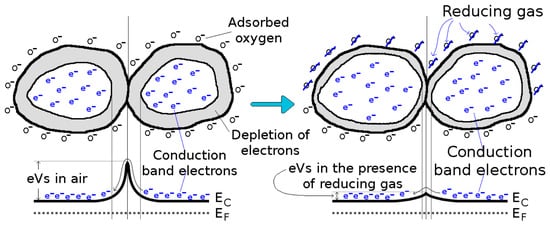
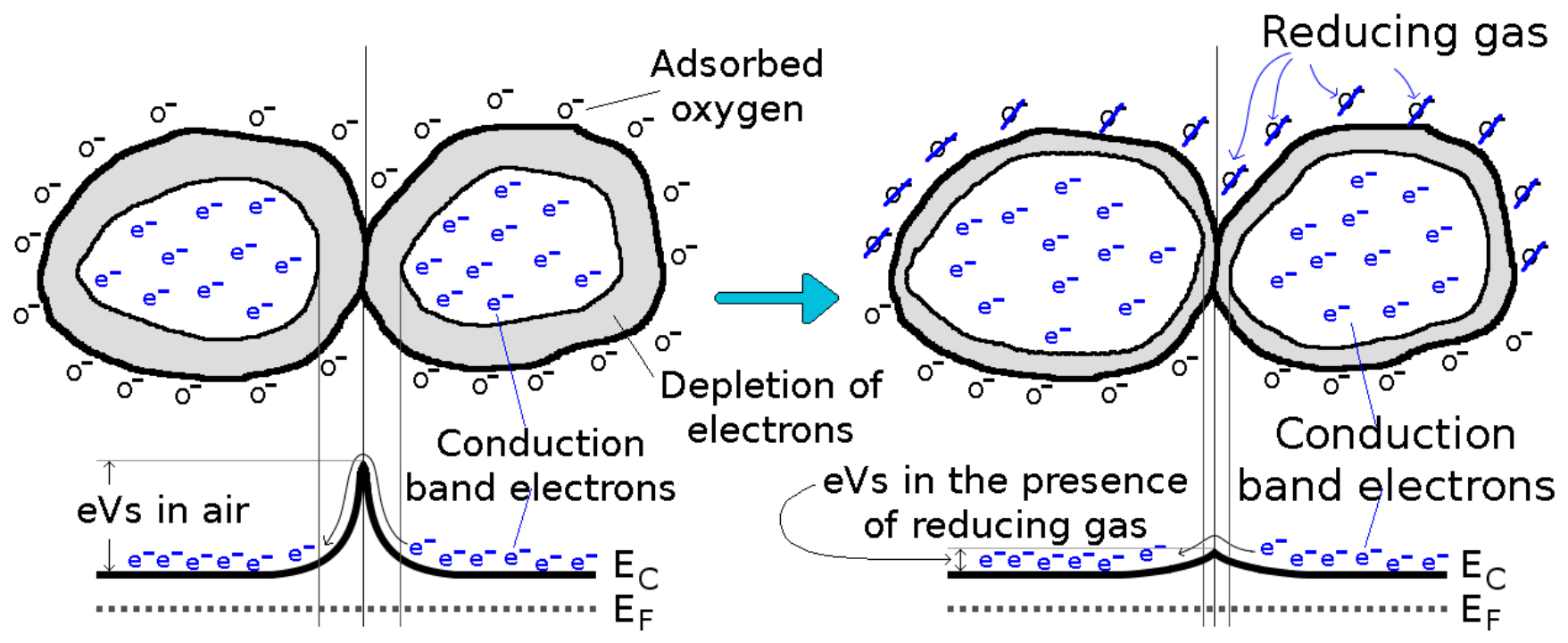
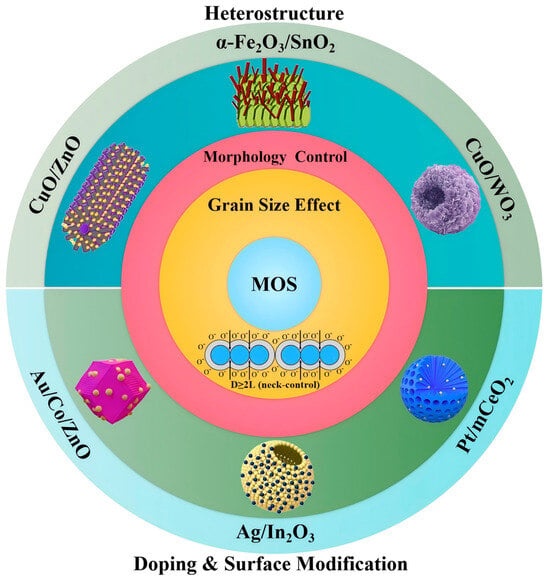
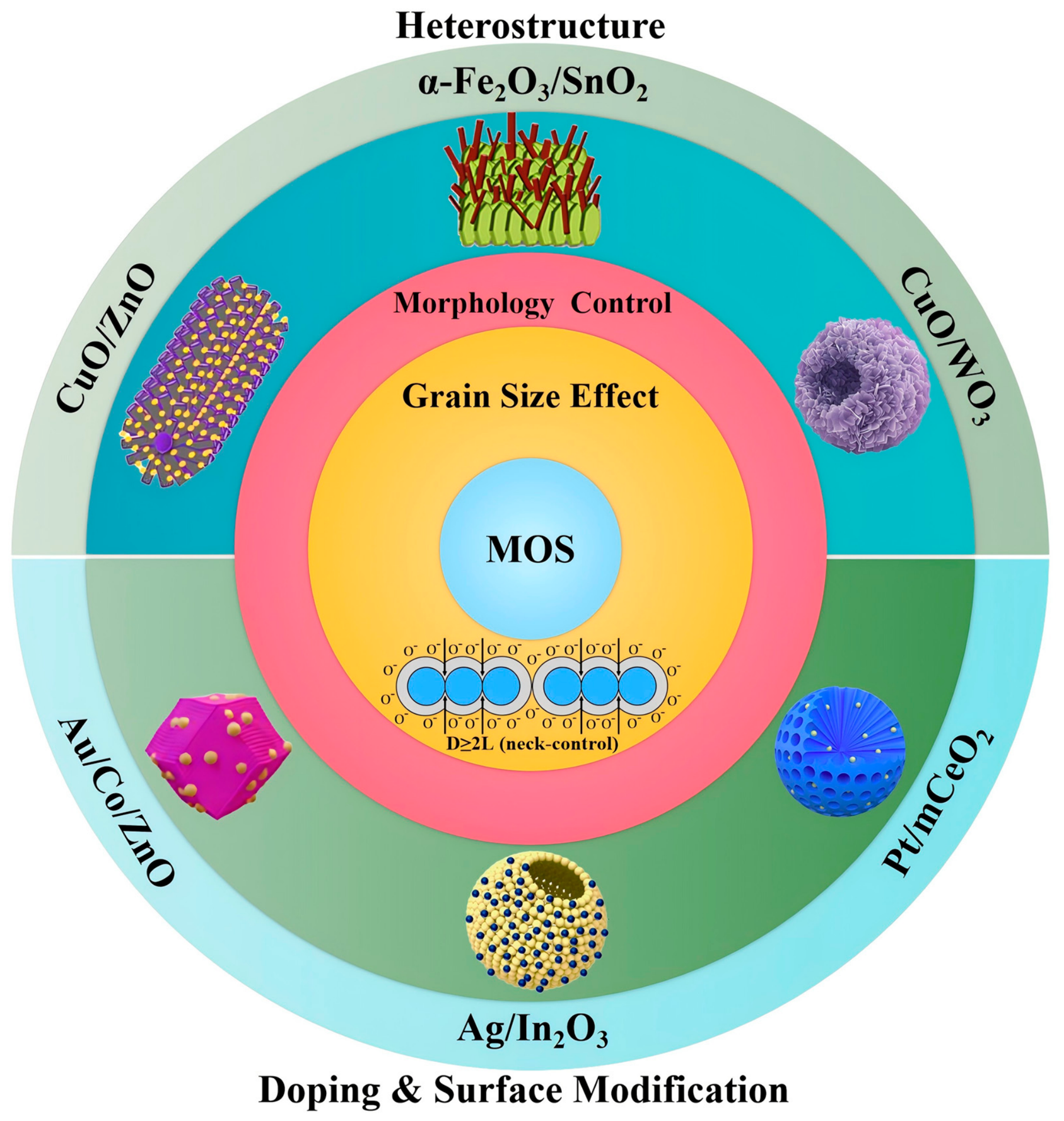
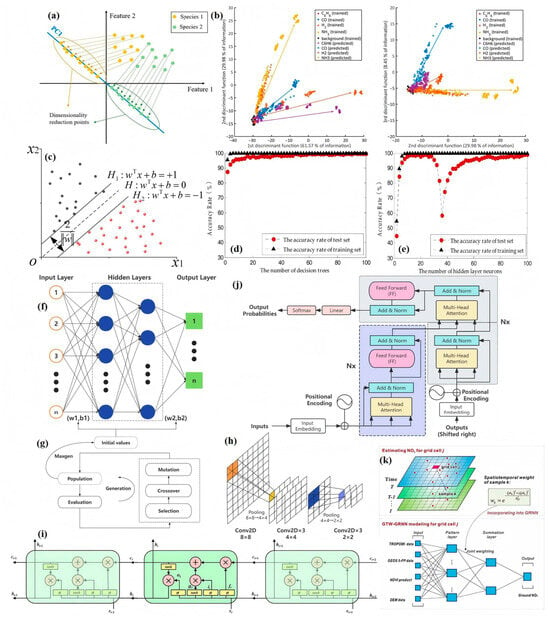
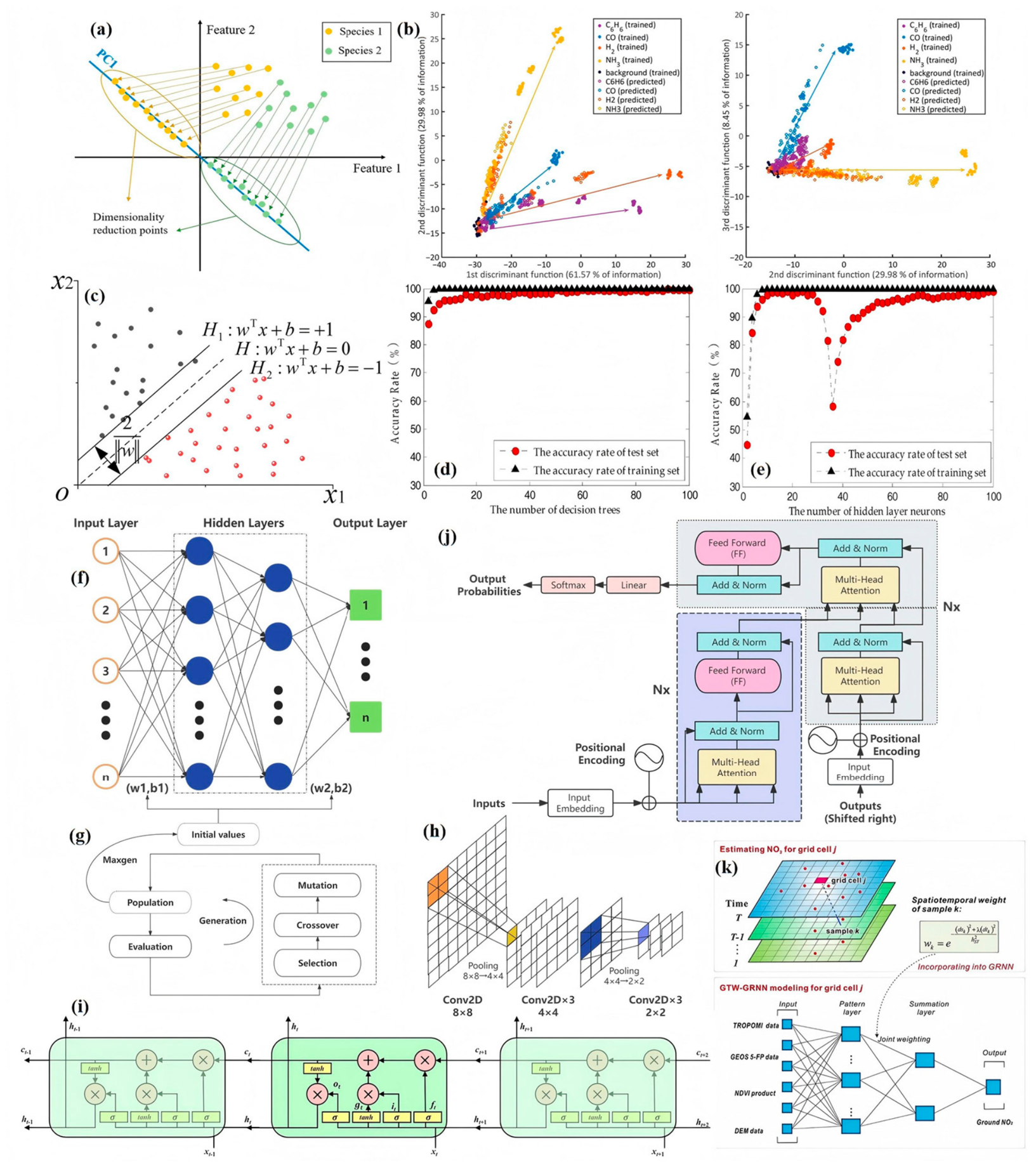
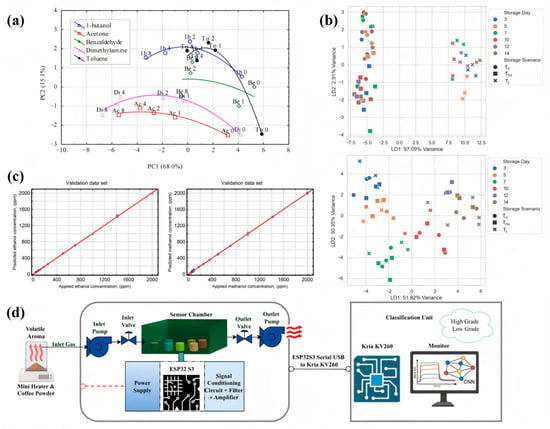
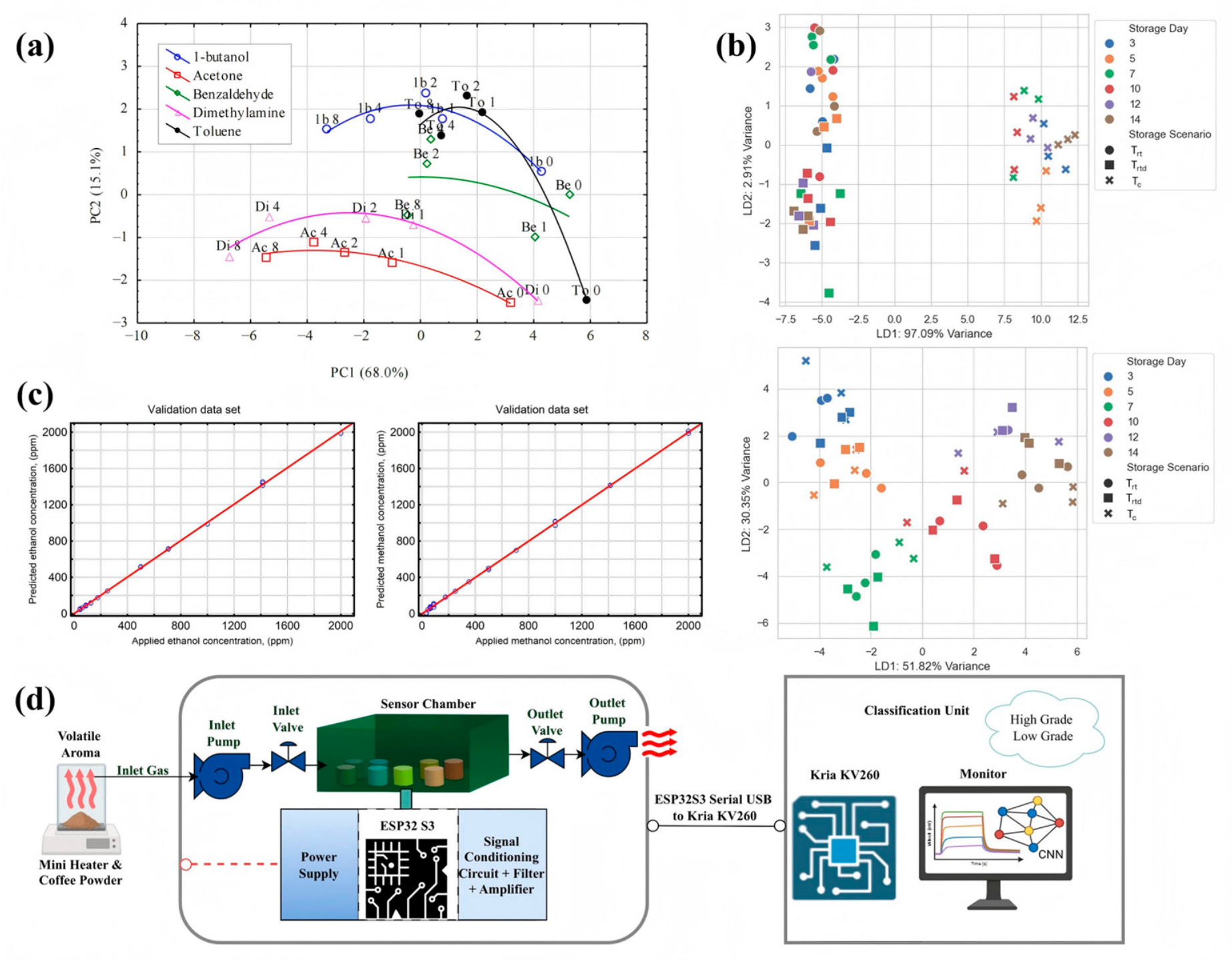
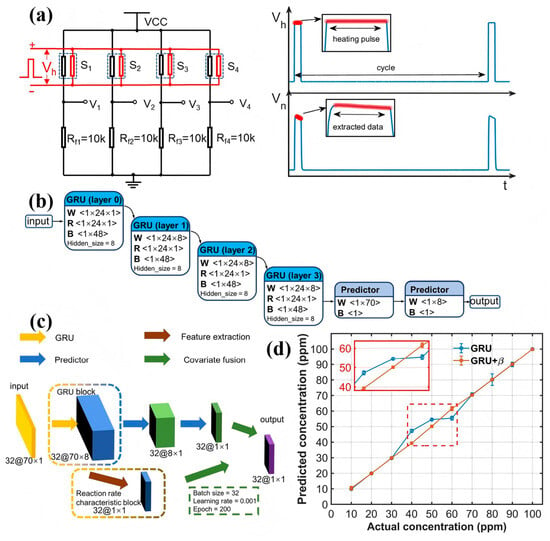
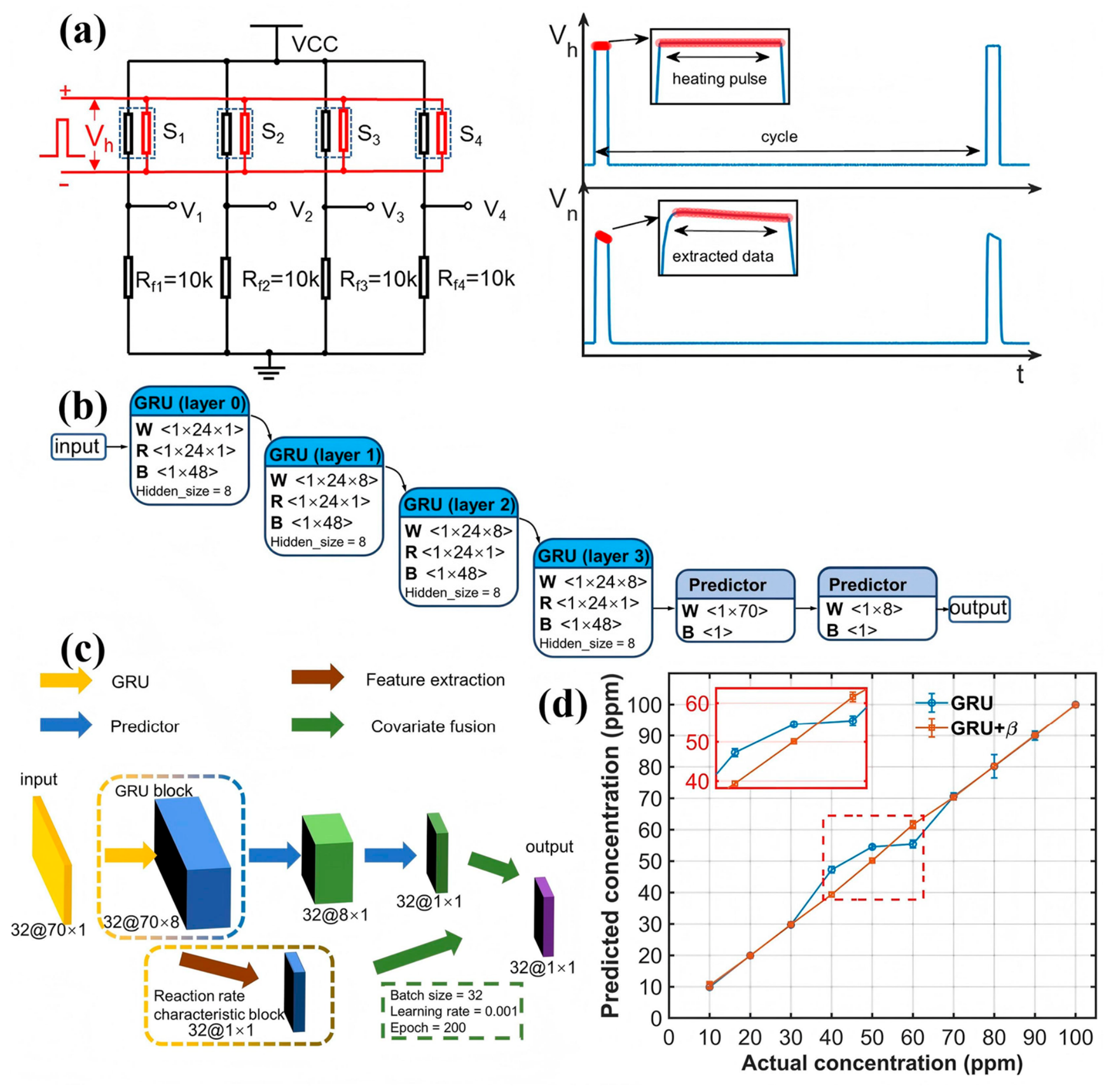
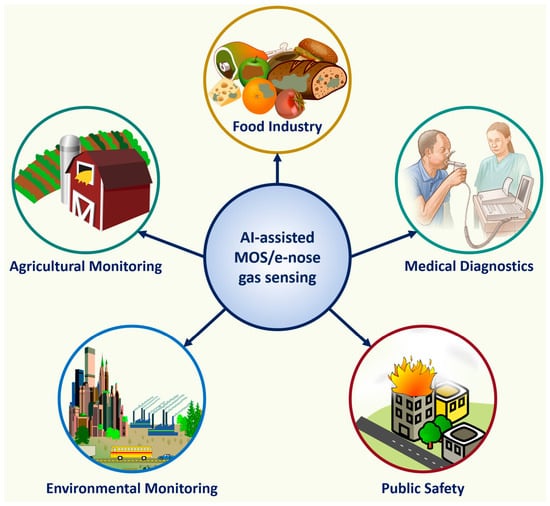
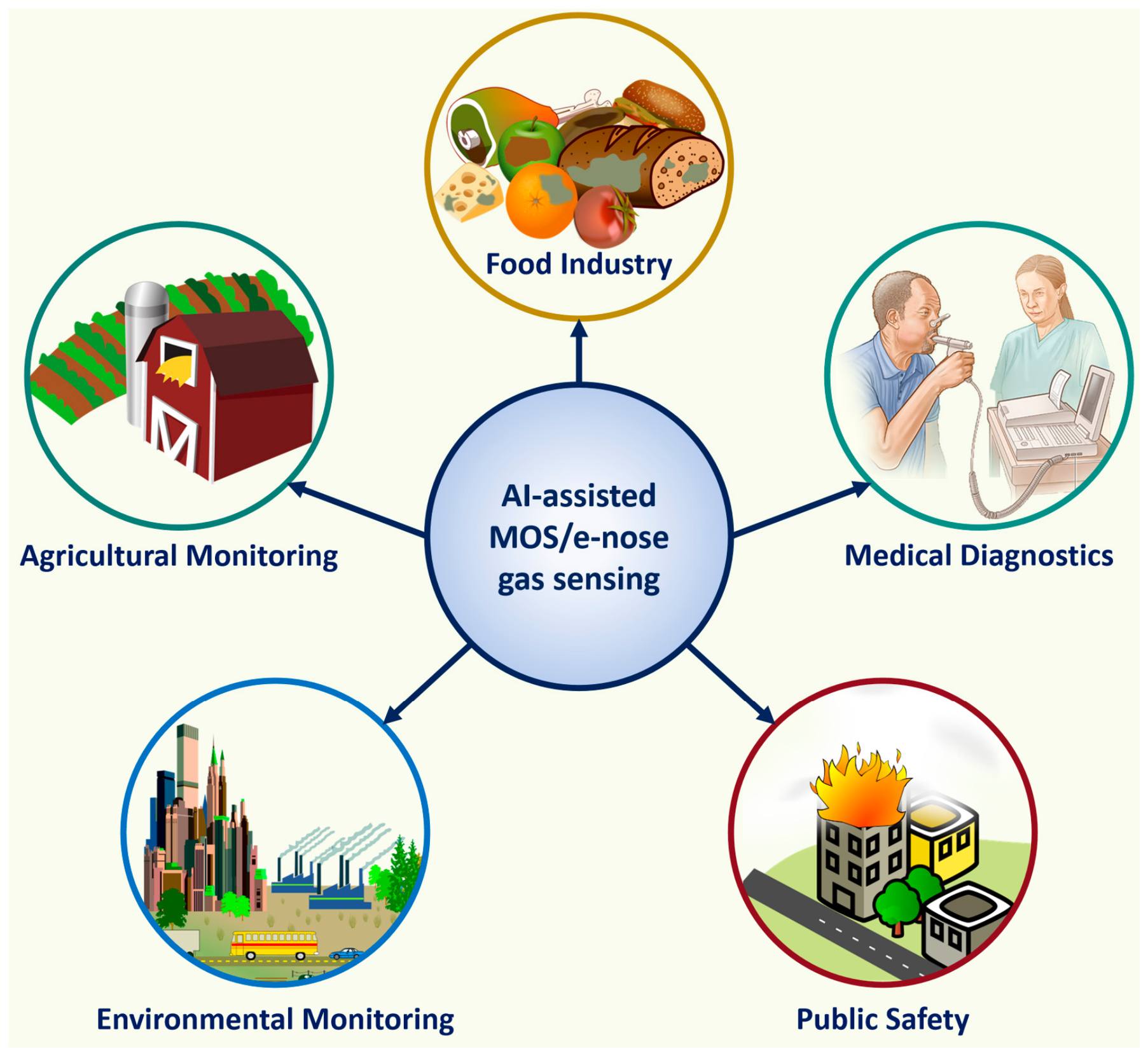
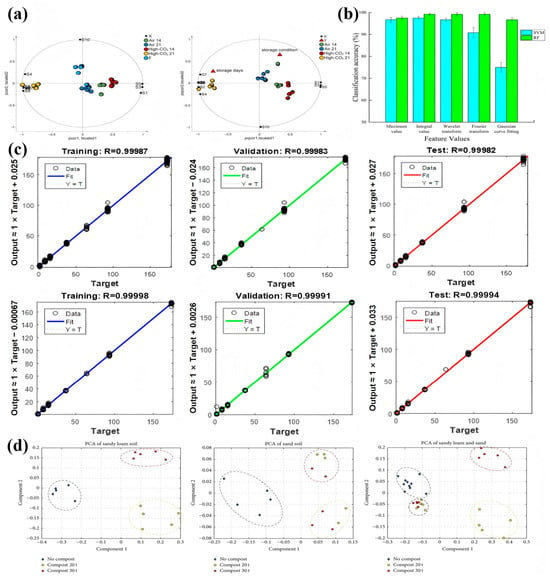
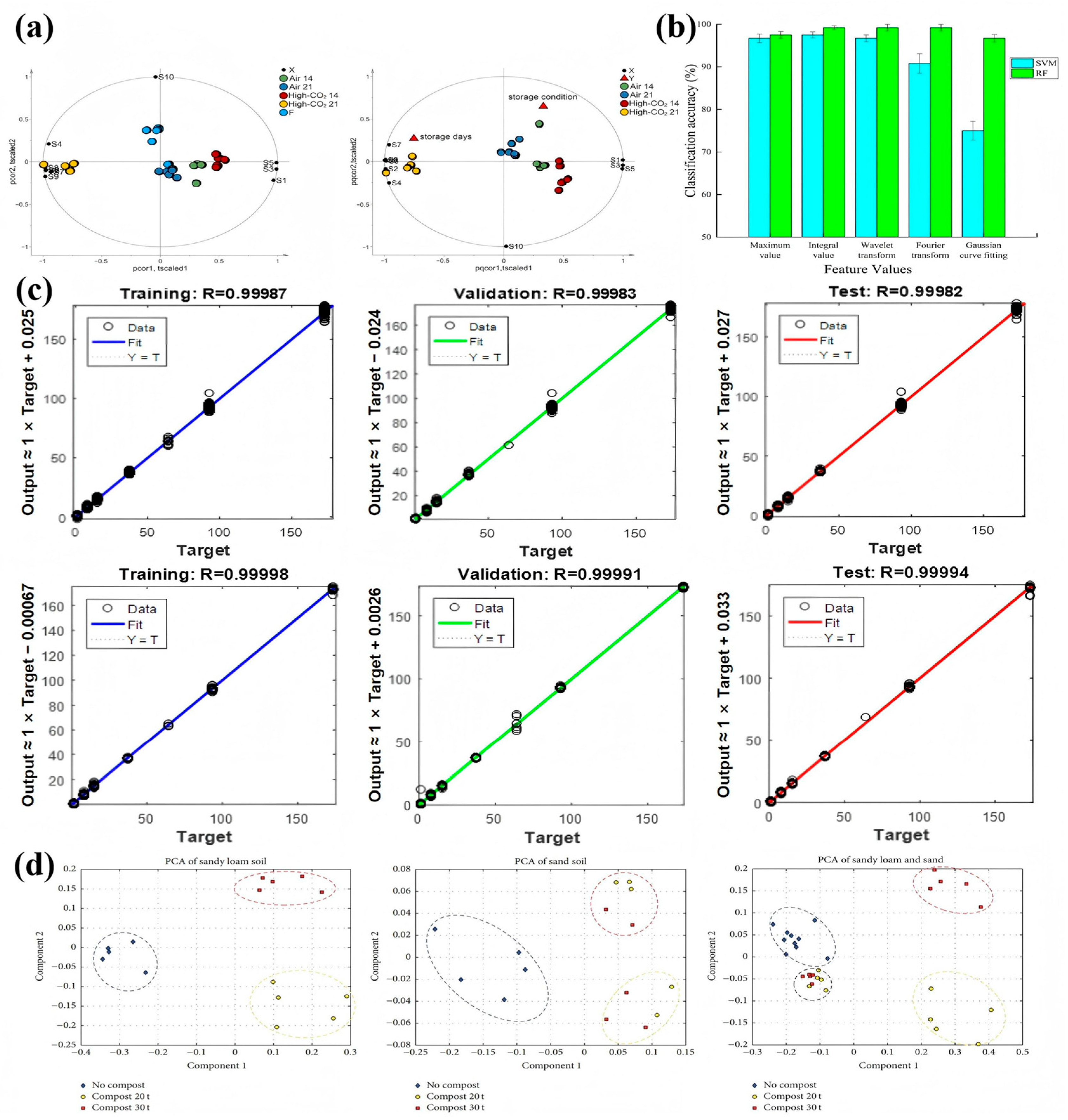
Disclaimer/Publisher’s Note: The statements, opinions and data contained in all publications are solely those of the individual author(s) and contributor(s) and not of MDPI and/or the editor(s). MDPI and/or the editor(s) disclaim responsibility for any injury to people or property resulting from any ideas, methods, instructions or products referred to in the content. |
© 2026 by the authors. Licensee MDPI, Basel, Switzerland. This article is an open access article distributed under the terms and conditions of the Creative Commons Attribution (CC BY) license.