


Abstract
Permeable pavements offer a dual-function solution, converting hardstanding into active stormwater control, yet field performance data under real rainfall remain limited. Unlike laboratory-based studies, this research captures in situ hydrological behaviour under natural rainfall variability. This study monitors the hydrological performance of a full-scale permeable pavement system at Heriot-Watt University, Edinburgh, over seven months, using paired rainfall and underdrain outflow measurements. Monthly water balance metrics, including retained depth and retention ratio, were derived from April to October. Results show the strongest volume retention during moderate-rainfall months, peaking at 18.7% in July, with an overall monitoring-period retention of 4.9%. Negative retention ratios in May and August reveal inter-event sub-base drainage dynamics that monthly metrics alone cannot fully resolve. Weekly hydrograph analysis identified two distinct hydraulic regimes: sub-base attenuation under low-to-moderate rainfall and near-direct underdrain transmission when antecedent wetness exhausted storage capacity. These findings demonstrate that the antecedent moisture condition is the primary control on the hydraulic regime, with implications for SuDS design and performance monitoring in temperate climates.
1. Introduction
The hydrological cycle has undergone a fundamental change as a result of urbanisation and the growth of impervious surfaces, which have decreased infiltration, accelerated stormwater runoff, and increased the risk of urban flooding. There is increasing pressure on cities to manage stormwater at the source more sustainably as precipitation extremes are exacerbated by climate change [1]. The use of Sustainable Drainage Systems (SuDS) serves as a key solution to these problems because they provide infrastructure that replicates natural hydrological processes instead of just moving runoff as fast as possible. Permeable pavements are one of the most attractive SuDS technologies since they make efficient use of land, roads, parking lots, and pedestrian zones by substituting a functional drainage surface for traditional hardstanding [2]. Despite their growing adoption in stormwater management policy and practice, the field performance of permeable pavements under real rainfall conditions remains insufficiently documented [3]. Much of the existing evidence is based on laboratory experiments or modelled outputs which are very informative but cannot fully capture the complexity induced by variable rainfall patterns, seasonal soil moisture fluctuations, and long-term subgrade behaviour [4]. This evidence gap creates uncertainty for engineers, planners, and regulators seeking to verify system performance, justify maintenance procedures, or calibrate design parameters with confidence.
This study addresses that gap through continuous field monitoring of a permeable pavement installation at Heriot-Watt University in Edinburgh, Scotland. By combining paired rainfall and underdrain outflow measurements across a range of events and seasons, this work develops a suite of volumetric and timing-based performance indicators, including retention volume, peak attenuation, and inflow-outflow lag. The study also attempts to characterise how the system responds across varying rainfall intensities and antecedent conditions. The innovation of this study lies in its field-based hydrological monitoring of a full-scale permeable pavement under natural rainfall, which helps fill the current gap in real-world performance data. Through the combined use of monthly retention metrics and weekly hydrograph analysis, the research generates defensible, field-grounded evidence to better understand storage, attenuation, and drainage behaviour, with direct relevance for SuDS design, post-installation verification, and maintenance decision-making in moderate climates.
2. Materials and Methods
2.1. Experimental Design
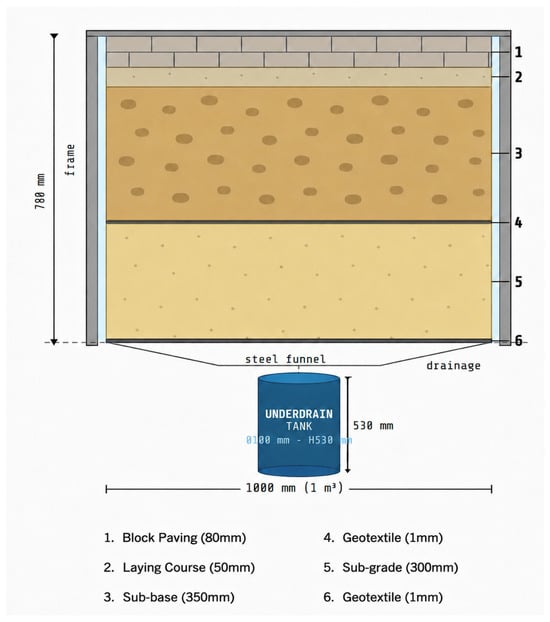
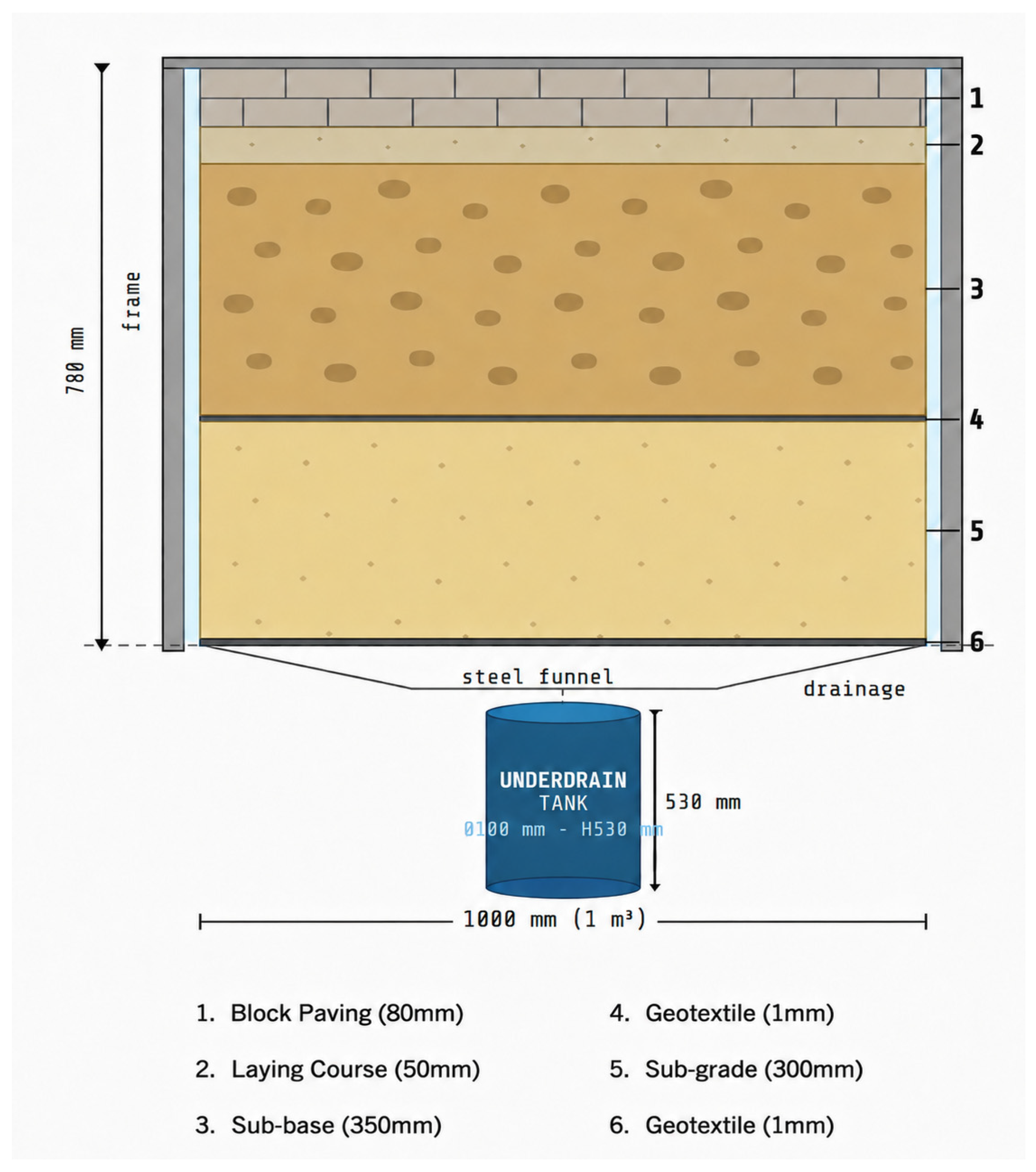
A full-scale (1:1) permeable pavement test rig was constructed at Heriot-Watt University, Edinburgh, Scotland, UK and installed outdoors to enable monitoring under natural environmental conditions. The pavement was constructed to represent a SuDS-compliant permeable pavement system and consisted of surface block paving over underlying structural and drainage layers. The pavement rig was contained within watertight polypropylene walls restrained by a welded steel frame to minimise lateral deformation and maintain geometric stability during testing. The pavement surface was left fully exposed throughout the monitoring period, allowing direct interaction with ambient rainfall and temperature variation. Within the enclosure, a layered permeable pavement build-up representative of UK modular permeable paving practice (e.g., parking bay applications) was constructed using thicknesses informed by Interpave [5] and permeable pavement design principles in BS 7533-13:2009 [6]. The nominal structure comprised an 80 mm permeable concrete block surface course over a 50 mm bedding course of fine aggregate (6 mm). Beneath this, a 350 mm open-graded coarse aggregate sub-base (20 mm) provided the primary structural load distribution layer and subsurface storage volume, as shown in Figure 1. A 300 mm clean sand subgrade (0.2 mm) was used as a repeatable foundation layer while still permitting infiltration processes to occur within the test specimen. Geotextile separation layers were incorporated at key interfaces to limit material migration while maintaining hydraulic functionality. A separator was installed to prevent the loss of subgrade material into underlying support zones, and an additional geotextile was placed between the sand subgrade and the open-graded sub-base to reduce intermixing and preserve both the sub-base void structure and the integrity of the subgrade.
Figure 1.
Permeable Pavement Cross-section and Underdrain Tank.
2.2. Data Collection
Rainfall and underdrain outflow were recorded as separate time series at different temporal resolutions. Rainfall was measured at 1 min intervals using a rain gauge, while underdrain outflow was recorded every 10 s. For analysis, the outflow data were aggregated to 1 min intervals. Both datasets were then imported into R, where timestamps were standardised and aligned for direct comparison of rainfall input and outflow response. Basic quality control was applied to remove records with missing timestamps and to ensure consistent units and sign conventions. The underdrain tank had a storage capacity of approximately 13.49 L, at which point it emptied via the outlet. Monthly inflow depth was derived directly from the rain gauge record, with the total inflow volume calculated, while the monthly outflow volume was obtained by integrating the underdrain hydrograph over the calendar month.
2.3. Hydrological Performance Metrics
Hydrological performance was assessed using a monthly water balance approach [5,7]. For each monitoring month, two primary metrics were calculated. Retained depth (mm) was defined as the difference between monthly inflow and outflow depths, representing the net volume stored within or lost through the pavement structure [8]. Retention ratio (%) was defined as the fraction of monthly inflow volume retained by the system, following the volume reduction ratio adopted in field monitoring studies of permeable interlocking concrete pavements and porous asphalt systems [7].
3. Results and Discussion
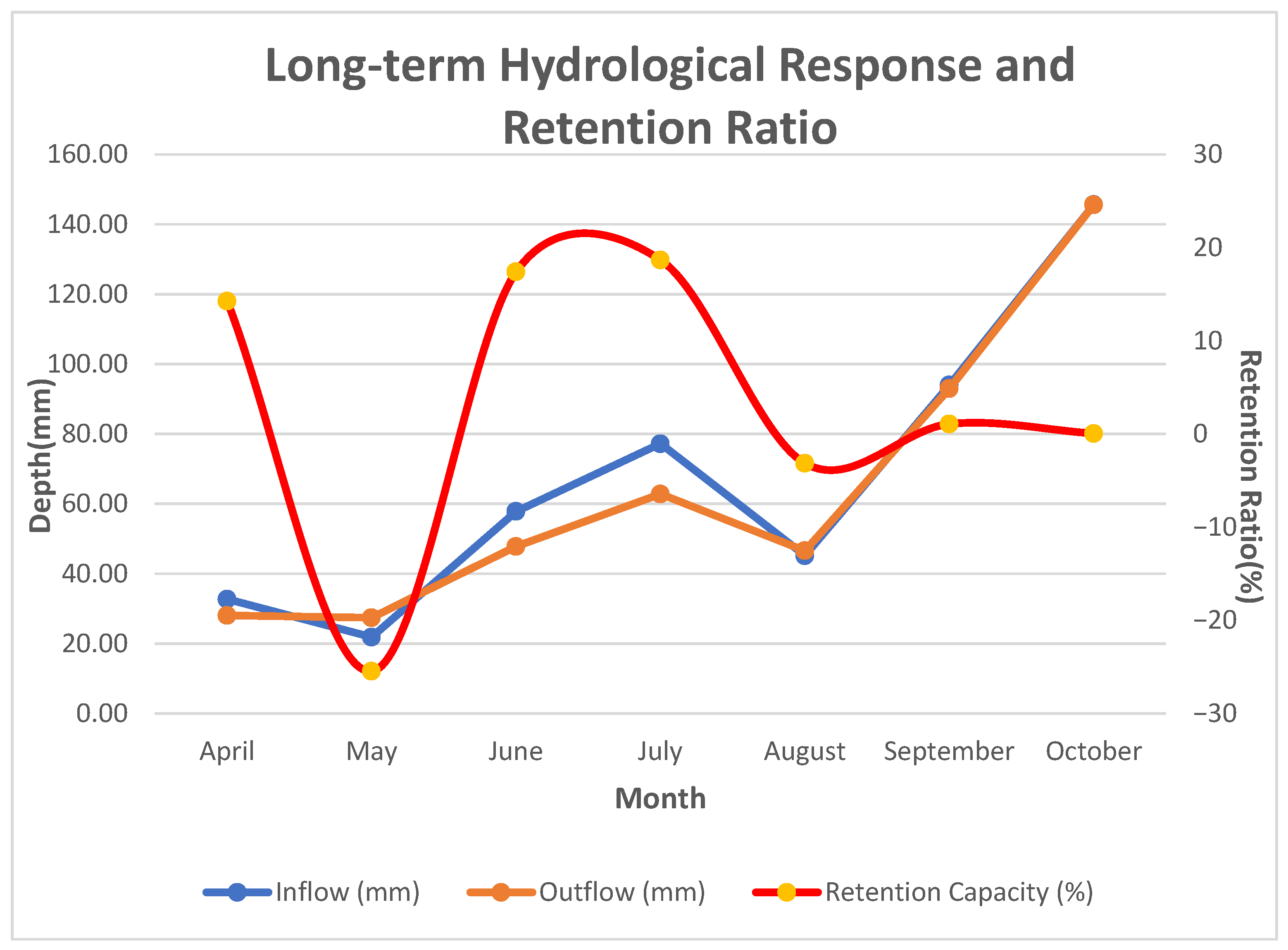
Monthly inflow, outflow, retained depth, and retention ratio for the April–October monitoring period are presented in Table 1. Monthly inflow depths ranged from 21.86 mm in May to 145.65 mm in October, reflecting considerable seasonal variability in rainfall magnitude across the monitoring period. Outflow depths tracked inflow closely in most months, with the system demonstrating its highest absolute retention during July (R = 18.7%) and June (R = 17.4%), corresponding to months of moderate rainfall intensity. The lowest positive retention was recorded in October (0.08 mm; R = 0.1%), where, despite receiving the highest monthly rainfall of the monitoring period (145.65 mm), near-complete underdrain discharge occurred. This indicated that sub-base storage capacity was consistently at or near saturation throughout this month—a condition consistent with the high antecedent wetness following a wet September.
Table 1.
Monthly Hydrological Performance.
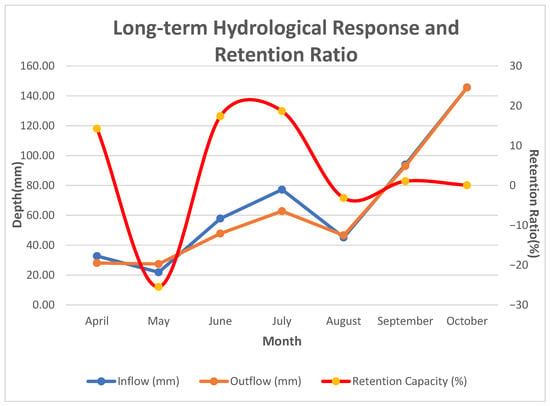
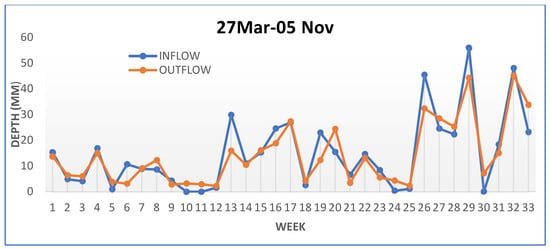
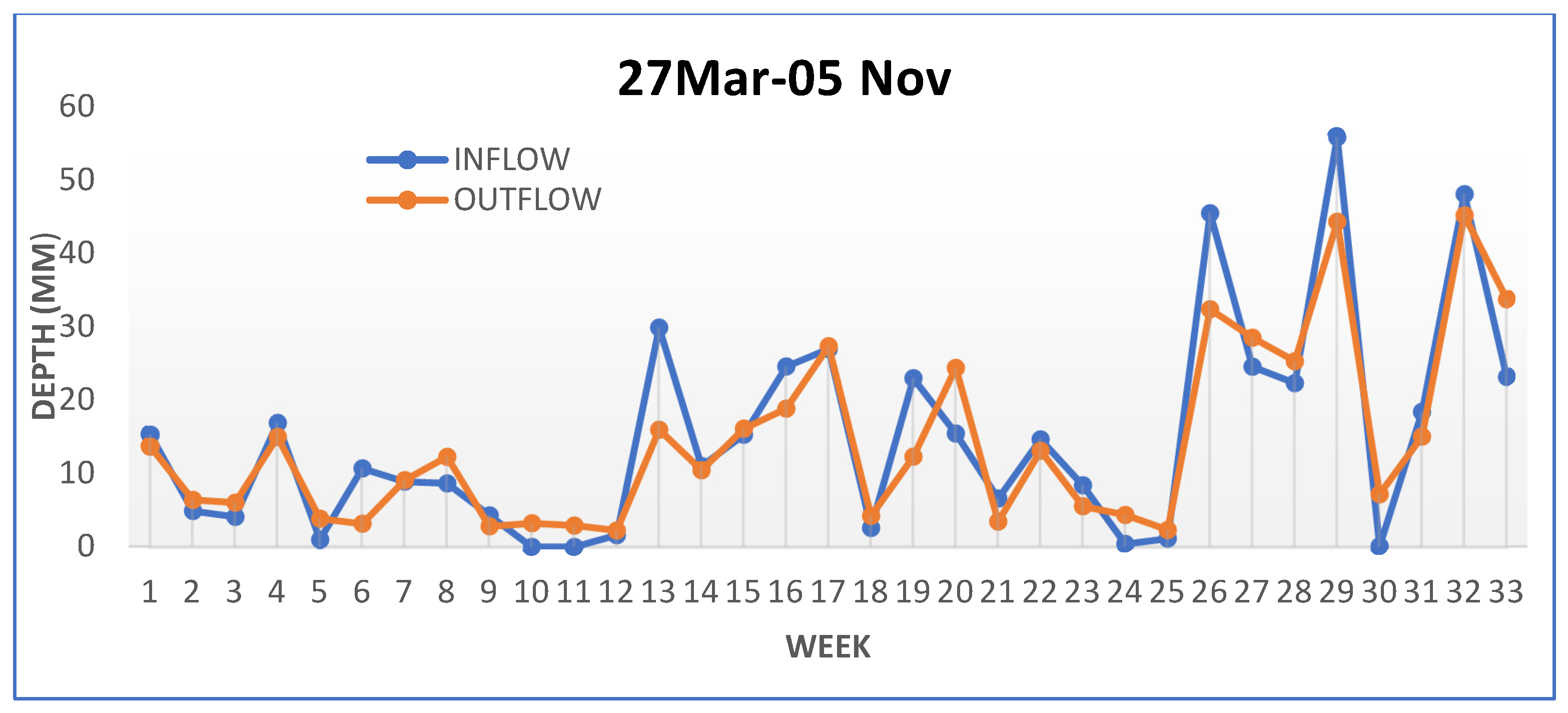
Negative retention ratios were recorded in May (R = −25.5%) and August (R = −3.1%), where measured outflow exceeded recorded inflow by 5.57 mm and 1.42 mm respectively. This behaviour is physically attributable to the delayed drainage of water stored within the sub-base aggregate from preceding rainfall periods, whereby residual pore water accumulated during antecedent wet conditions continues to discharge through the underdrain during subsequent months of lower rainfall. This inter-event storage and delayed release mechanism is well documented in permeable pavement field studies, where drainage of antecedent stored water routinely produces apparent outflow volumes that exceed concurrent inflow measurements under low-rainfall conditions [8]. While monthly aggregation (Figure 2) provides a tractable framework for seasonal performance assessment and enables direct comparison with published field studies, it inevitably masks event-scale hydraulic behaviour; the weekly hydrograph analysis presented in Figure 3 was therefore included to provide additional temporal resolution and capture inflow–outflow dynamics that monthly metrics alone cannot resolve.
Figure 2.
Monthly Retention Performance.
Figure 3.
Weekly Inflow and Outflow.
Across the seven complete months, cumulative inflow and outflow totalled 474.35 mm and 451.10 mm respectively. The overall monitoring-period retention ratio R (%), computed from the full record from 27 March to 5 November was 4.9%. These results indicate that while the system demonstrated meaningful retention during moderate-rainfall months, its capacity to attenuate outflow was substantially diminished under sustained high-rainfall and high-antecedent-moisture conditions.
The weekly graphs in Figure 3 reveal two distinct hydraulic regimes. During weeks 1–12, a consistent inflow–outflow lag confirmed sub-base storage was buffering incoming rainfall, which was most evident in week 13 where outflow responded with a visible delay. From week 25 onwards, both signals progressively converged to near-synchrony by weeks 30–33, as the monitoring-period peak of ~55 mm in week 29 in September–October exhausted sub-base storage under sustained antecedent wetness, reducing the system to near-direct transmission to the underdrain (October R = 0.1%). This transition is consistent with field evidence that under sustained high-intensity rainfall, permeable pavement storage capacity is exceeded, substantially reducing hydrological performance [9].
4. Conclusions
This study monitors the hydrological performance of a permeable pavement system over seven months, demonstrating volume retention during moderate-rainfall periods (peak R = 18.7% in July) but substantially diminished performance under sustained high-rainfall conditions, with an overall monitoring-period retention of 4.9%. The weekly hydrograph analysis confirmed two distinct hydraulic regimes: sub-base attenuation during low-to-moderate rainfall weeks and near-direct underdrain transmission during peak-rainfall weeks when antecedent wetness exhausted available storage capacity. Negative retention ratios in May (−25.5%) and August (−3.1%) highlight the importance of inter-event sub-base drainage dynamics, which monthly water balance metrics alone cannot fully resolve. These findings confirm that permeable pavement performance is highly dependent on antecedent moisture and sub-base storage conditions, underscoring the need for appropriate sub-base sizing relative to local rainfall regimes. As design approaches based on design storm events may underestimate the required storage depth and lead to flooding under real precipitation conditions [10], the study highlights the importance of real-condition field monitoring for reliable evaluation, design verification, and maintenance planning, particularly where laboratory and modelling approaches cannot fully capture the complexity of seasonal hydrological behaviour.
Author Contributions
Conceptualisation, C.P.; methodology, C.P. and Y.L.A.; software, C.P.; validation, C.P.; formal analysis, C.P.; investigation, C.P.; resources, C.P.; data curation, C.P.; writing—original draft preparation, C.P. and Y.L.A.; writing—review and editing, C.P., Y.L.A., I.E., and C.M.; visualisation, C.P.; project administration, C.P. and Y.L.A. All authors have read and agreed to the published version of the manuscript.
Funding
This research received no external funding.
Institutional Review Board Statement
Not applicable.
Informed Consent Statement
Not applicable.
Data Availability Statement
The datasets generated and analysed during the current study are not publicly available as they form part of an ongoing research project at Heriot-Watt University but may be available from the corresponding author upon reasonable request after completion of the thesis.
Conflicts of Interest
The authors declare no conflicts of interest. Caley Water Ltd. and Water Witness International have no commercial conflict of interest with this work.
References
- Oudin, L.; Salavati, B.; Furusho-Percot, C.; Ribstein, P.; Saadi, M. Hydrological impacts of urbanization at the catchment scale. J. Hydrol. 2018, 559, 774–786. [Google Scholar] [CrossRef] [Scilit]
- Monachese, A.P.; Gómez-Villarino, M.T.; López-Santiago, J.; Sanz, E.; Almeida-Ñauñay, A.F.; Zubelzu, S. Challenges and innovations in urban drainage systems: Sustainable drainage systems focus. Water 2025, 17, 76. [Google Scholar]
- Huang, P.; Zhang, K.; Chui, T.F.M. Hydrologic performance of permeable pavements under extreme and regular rainfall conditions. J. Hydrol. 2025, 652, 132653. [Google Scholar] [CrossRef] [Scilit]
- Sambito, M.; Severino, A.; Freni, G.; Neduzha, L. A Systematic Review of the Hydrological, Environmental and Durability Performance of Permeable Pavement Systems. Sustainability 2021, 13, 4509. [Google Scholar] [CrossRef] [Scilit]
- Interpave. Design & Construction of Concrete Block Permeable Pavements. Available online: https://www.paving.org.uk/essential-permeable-paving-for-suds-guide/ (accessed on 20 March 2026).
- BS 7533-13:2009; Pavements Constructed with Clay, Natural Stone or Concrete Pavers. Guide for the Design of Permeable Pavements Constructed with Concrete Paving Blocks and Flags, Natural Stone Slabs and Setts and Clay Pavers. British Standards Institution (BSI): London, UK, 2009.
- Ryan, J.W.; Arend, K.; Jay, D.D.; Jeffrey, P.J.; William, F.H. Hydrologic Performance of a Permeable Pavement and Stormwater Harvesting Treatment Train Stormwater Control Measure. J. Sustain. Water Built Environ. 2020, 6, 04019011. [Google Scholar] [CrossRef] [Scilit]
- Lee, Y.-T.; Ho, M.-C.; Chiou, Y.-S.; Huang, L.-L. Assessing the performance of permeable pavement in mitigating flooding in urban areas. Water 2023, 15, 3551. [Google Scholar] [CrossRef] [Scilit]
- Erickson, A.J.; Gulliver, J.S.; Weiss, P.T. Stormwater Treatment: Assessment and Maintenance; University of Minnesota, St. Anthony Falls Laboratory: Minneapolis, MN, USA, 2010. [Google Scholar]
- Abdalla, E.M.H.; Muthanna, T.M.; Alfredsen, K.; Sivertsen, E. Towards improving the hydrologic design of permeable pavements: A case study from Norway. Blue-Green Syst. 2022, 4, 197–213. [Google Scholar]

Disclaimer/Publisher’s Note: The statements, opinions and data contained in all publications are solely those of the individual author(s) and contributor(s) and not of MDPI and/or the editor(s). MDPI and/or the editor(s) disclaim responsibility for any injury to people or property resulting from any ideas, methods, instructions or products referred to in the content. |
© 2026 by the authors. Licensee MDPI, Basel, Switzerland. This article is an open access article distributed under the terms and conditions of the Creative Commons Attribution (CC BY) license.