


Abstract
Ships are highly advanced marine structures that incorporate state-of-the-art technologies. Nevertheless, they still depend on outdated systems in certain critical areas, such as escape lighting. Escape lighting systems are vital components of shipboard safety infrastructure. However, conventional systems rely heavily on decentralized battery-powered luminaires and manual testing, leading to high maintenance costs and environmental burdens. This study addresses these challenges through an engineering-driven redesign of escape lighting systems. A novel system architecture was developed, integrating photovoltaic energy sources with centralized battery storage and Automatic Testing Systems (ATSs) compliant with the IEC 62034 standard. The system interfaces with both main and emergency power networks, reducing reliance on fossil fuels and minimizing battery usage. Engineering simulations and operational data indicate a 20% reduction in fuel oil consumption per escape light and a threefold decrease in maintenance costs over a vessel’s lifecycle. For a standard vessel equipped with 350 luminaires, the system demonstrates significant operational efficiency and environmental benefits, including reduced emissions and hazardous waste. This work exemplifies how ocean engineering innovations can enhance vessel safety while promoting sustainability. The integration of renewable energy and automated diagnostics into critical shipboard systems represents a forward-looking approach to marine engineering, aligning with global goals for greener maritime operations. Moreover, the proposed system supports compliance with evolving maritime regulations and offers a scalable solution adaptable to various vessel types and operational profiles.
1. Introduction
The maritime industry is at a pivotal juncture, facing mounting environmental challenges and stringent international regulations aimed at reducing greenhouse gas (GHG) emissions [1]. The International Maritime Organization (IMO) has set ambitious targets, including a 40% reduction in GHG emissions by 2030 and the pursuit of net-zero emissions by 2050 [2,3,4]. These objectives demand innovative solutions that enhance sustainability while maintaining operational safety and reliability [5].
Renewable energy technologies have emerged as a cornerstone of this transition, offering pathways to reduce dependence on fossil fuels and mitigate environmental impacts. Among these, photovoltaic (PV) systems represent a practical and scalable option for auxiliary power generation on marine vessels [6,7]. By harnessing solar energy, PV integration can significantly lower fuel consumption, reduce emissions, and contribute to compliance with evolving regulatory frameworks [8,9]. However, despite growing interest in PV applications for maritime operations, existing research primarily focuses on propulsion systems and large-scale energy management [10,11], leaving auxiliary safety systems—such as emergency lighting—largely unexplored. Furthermore, there is a lack of comprehensive studies addressing the techno-economic feasibility and operational reliability of renewable-powered safety systems in marine environments.
Emergency escape lighting systems, mandated on passenger vessels and ferries and strongly recommended for all ships, are critical for ensuring passenger safety during emergencies [12,13]. Yet, these systems are traditionally based on battery-powered luminaires and manual testing protocols. Such legacy configurations pose several challenges: frequent battery replacements generate substantial environmental waste, while outdated testing procedures increase maintenance costs and risk operational failures during emergencies [14,15]. Although it is well known that improvements in regulations and compliance measures surrounding emergency escape lighting can significantly improve safety outcomes on passenger ships [16], the current literature offers limited solutions for reducing the environmental footprint of these systems or improving their reliability through automation and renewable integration.
This study addresses these gaps by proposing an innovative approach that combines PV energy generation with Automatic Test Systems (ATS) for battery-backed emergency escape lighting. The main aim of this work is to exemplify how the implementation of ATS for battery-backed emergency escape lighting and technological innovation can support both operational efficacy and compliance with stringent safety regulations. The scientific contribution of this work lies in introducing a novel architecture for escape lighting systems powered by renewable energy sources, reducing reliance on fossil fuels and minimizing battery waste. In addition, is proposed to integrate ATS technology to automate compliance testing and enhance operational reliability, thereby reducing maintenance costs and human error. In addition to these aspects, a techno-economic analysis of the proposed system is provided, offering insights into lifecycle costs, energy performance, and environmental benefits.
2. Methods
The present work proposes the implementation of eco-friendly systems to replace obsolete traditional solutions with innovative control systems based on automatic testing procedures, designed to minimize battery waste.
Escape or transitional lighting systems on passenger ships are based on self-contained luminaires equipped with batteries, typically of the nickel–cadmium type. These batteries have a nominal service life less of up to five years. Nevertheless, replacement shall be carried out at an earlier stage whenever the battery capacity is insufficient to ensure compliance with the required autonomy. Where the rated duration test fails to achieve the minimum operating time specified by the applicable regulations and standards, the battery shall be replaced. Accordingly, it is envisaged to modify the aforementioned lighting system with the objective of extending the service life of the batteries by implementing new-technology batteries with higher capacity, while simultaneously achieving a reduction in fuel consumption using renewable energy power supply.
Regarding the batteries, the system replaces the individual nickel–cadmium batteries—each with a typical service life of 4 to 5 years—installed in every luminaire with a centralized set of lithium-ion batteries per cabinet. These lithium-ion batteries typically have a service life of 8 to 10 years, depending on operating temperature and charge–discharge cycles. Consequently, the use of a central battery system instead of individual batteries significantly reduces maintenance requirements and replacement frequency. In addition, an ATS was implemented to reduce maintenance requirements and extend the service life of both the batteries and the overall system.
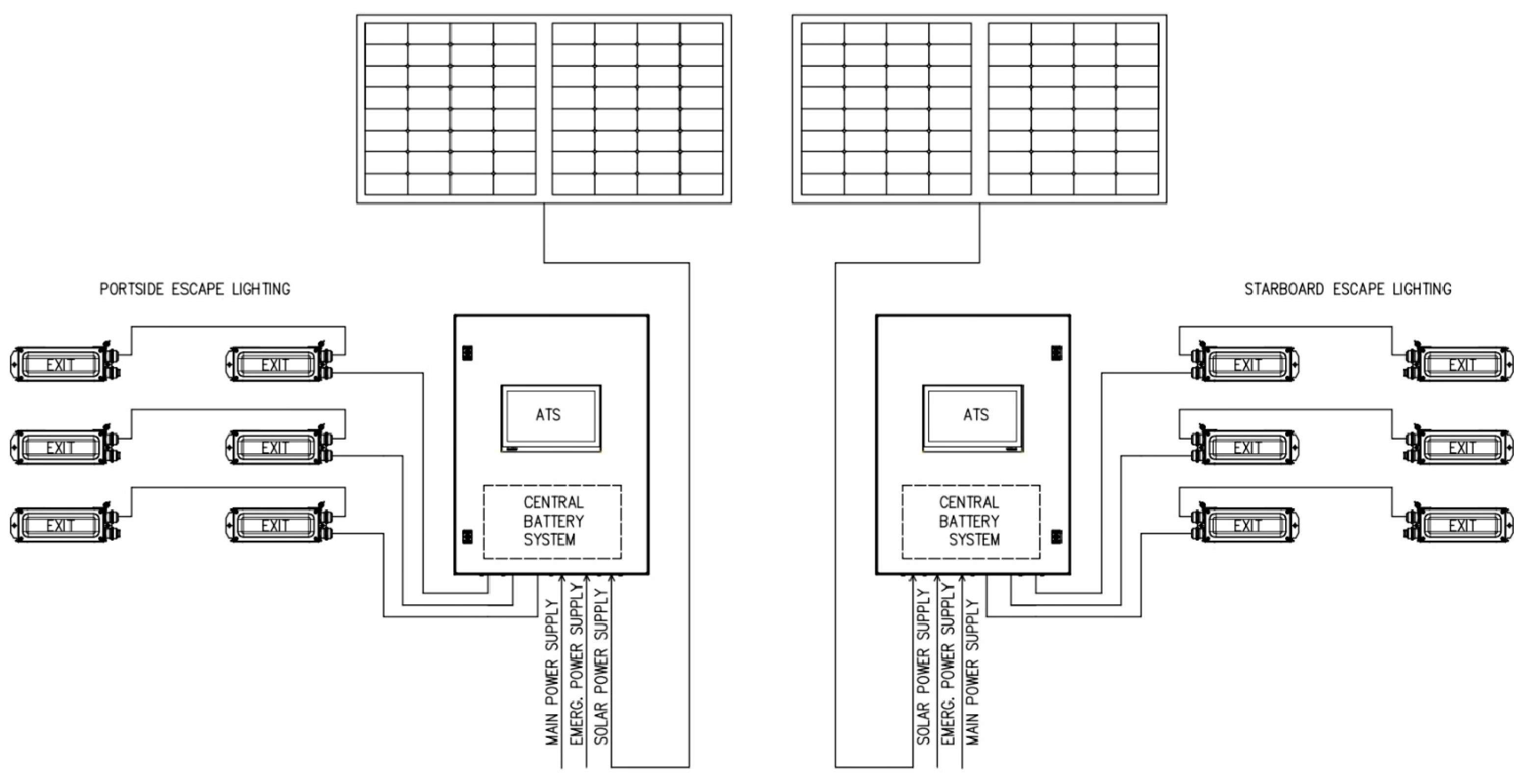
The primary power supply is based on PV, sized with sufficient capacity to maintain the batteries fully charged while simultaneously supplying the escape luminaires operating in maintained mode. This configuration allows for a significant reduction in energy consumption from conventional sources during normal operation, while ensuring uninterrupted service of the escape lighting system.
In addition, a secondary power supply is provided from the main switchboard. This supply automatically comes into operation in the event of insufficient solar generation or when the battery state of charge falls below predefined thresholds. Its function is to prevent excessive battery discharge and to ensure the continuity of power supply under prolonged periods of low solar availability.
Finally, and as a mandatory safety measure, a third power supply is taken from the emergency switchboard. This supply is dedicated exclusively to emergency conditions and is automatically activated in the event of a blackout or failure of both the primary and secondary power sources. In such circumstances, the emergency source guarantees the uninterrupted operation of the escape and transitional lighting, thereby ensuring the safety of personnel and compliance with applicable maritime safety regulations.
This multi-source power architecture provides enhanced system resilience, minimizes maintenance and operational risks, and ensures that the emergency lighting system remains fully functional at all times, regardless of the operating scenario.
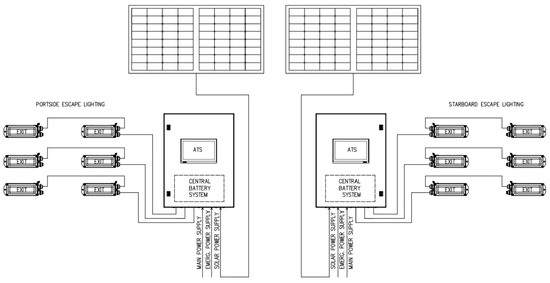
The main features of the system analyzed are shown in Figure 1.
Figure 1.
Main features of the system.
One of the main challenges on ships is the installation of PV panels, due to limited available space and the demanding marine environment. To address this, the photovoltaic system has been specifically designed to operate reliably under conditions classified as CX corrosion category and VH environmental severity level, including exposure to salt fog, high humidity, temperature fluctuations, and continuous mechanical vibration. The PV modules are mounted on corrosion-resistant supporting structures made of anodized aluminum or marine-grade stainless steel, with surface treatments tailored for CX environments. Electrical enclosures, connectors, and junction boxes are rated up to IP66 to prevent ingress of moisture and salt, while all cabling features UV-, salt-, and humidity-resistant insulation. The mechanical fixation system incorporates anti-vibration components and reinforced anchoring points to withstand dynamic loads from ship motion, ensuring long-term structural stability, electrical safety, and reliable energy generation without performance degradation. Therefore, the designed system aims to minimize the number of solar panels required. For this purpose, only a 550 Wp solar panel per cabinet is considered, similar to those commonly used in onshore installations.
With two cabinets, the total generated power is estimated at 2 × 550 Wp = 1100 W, which is sufficient to supply a maximum of 350 escape luminaires, assuming a typical consumption of 3 W per luminaire, corresponding to a total installed power of 1050 W. This approach optimizes the use of available space on board, reduces the exposure of panels to the marine environment, and ensures reliable supply to the emergency lighting system.
The system topology analyzed consists of 350 escape luminaires, each rated at 3 W, yielding a total installed power of 1050 W. This power is distributed across two switchboards, each supplied by the main electrical network and backed by a 550 Wp photovoltaic panel. The configuration ensures redundancy and compliance with maritime emergency lighting standards, while optimizing energy efficiency and system reliability.
The Automatic Test System (ATS) is designed in full compliance with IEC 62034 and in accordance with the applicable ship classification rules. Since no fully certified ATS equipment currently exists for marine applications, the system is estimated to utilize the following components: 1 × basic CP module of PLC, 1 × 16-channel digital input card, 1 × 16-channel digital output board, 6 × master DALI cards (64 drivers each), 1 × end card, 3 × 24 VDC relays (1 NO), and 3 × 24 VDC power contactors (63 A). The human–machine interface (HMI) is provided via the ship’s automation system.
The ATS ensures continuous reliability of the escape lighting system by performing automated functional tests at predefined intervals (monthly). These tests verify circuit integrity, the correct operation of luminaires, changeover devices, and the battery emergency power supply. Duration testing is triggered according to configurable schedules or system conditions (yearly), simulating mains failure to confirm that the battery emergency power source can supply the system for the required duration. Test data are transmitted through the aforementioned secured communication paths (modbus TCP or similar) to the automation system, enabling real-time status reporting and maintenance logging.
In the event of an ATS malfunction or communication failure, automated testing is deferred until the fault is resolved, with completion required within a maximum of 24 h. Any system fault is promptly indicated in the ship’s automation system, as the status of the escape luminaires and all ATS components is continuously monitored. A backup manual test procedure is also provided, allowing operators to verify system functionality.
3. Results and Discussion
3.1. CAPEX and OPEX
This section presents an analysis of the initial investment for both the traditional system, based on individual escape luminaires, and the PV system, supplied by a centralized battery and incorporating an ATS. This analysis allows for an objective comparison of implementation costs and the assessment of the benefits associated with each alternative in terms of maintenance, equipment service life, and overall reliability of the emergency lighting system.
Regarding the CAPEX, Table 1 and Table 2 show the details corresponding to the traditional and PV systems, respectively.
Table 1.
Main components, costs and CAPEX corresponding to the traditional system.
Table 2.
Main components, costs and CAPEX corresponding to the PV system.
Regarding the OPEX of the traditional system, it was assumed that battery replacement will occur every 5 years, at an average market price of €10 per battery, with a replacement time of 35 minutes per battery. This results in an estimated cost of €2135 per 5 years. Additionally, an average annual testing time of 1.2 hours per luminaire was considered for both the functional test (performed monthly) and the duration test (performed annually), resulting in an additional estimated annual operating cost of €3015.
Considering a system with ATS and centralized batteries, it was assumed that the batteries will be replaced every 10 years at a cost of €200 per battery, based on prices from various manufacturers, with a replacement time of 30 minutes per battery, resulting in an estimated cost of €437 per 5 years. Regarding system maintenance, since it is automated, only 5 hours per year are required, which corresponds to an estimated annual maintenance cost of €187.50.
3.2. Fuel Oil Consumption
From a fuel consumption perspective, it is estimated that if 350 escape or transitional emergency luminaires were kept continuously lighting up, the daily electrical energy required would be 25.2 kWh, corresponding to 9198 kWh/year. Considering an average consumption of marine diesel oil (MDO) of 180 g/kWh, the annual fuel consumption would be approximately 1.65 t/year.
Furthermore, for safety considerations, it was assumed that for roughly 20% of the time, the lighting could be powered by the ship’s onboard electrical net, to account for potential periods of prolonged low solar radiation. Under this scenario, the annual fuel consumption would be approximately 1.3 t/year, ensuring continuous operation of the emergency lighting system without relying exclusively on solar energy.
This estimation highlights the potential fuel savings achievable by implementing a PV-based lighting system with centralized batteries and an ATS, contributing to energy efficiency and a reduction in onboard greenhouse gas emissions.
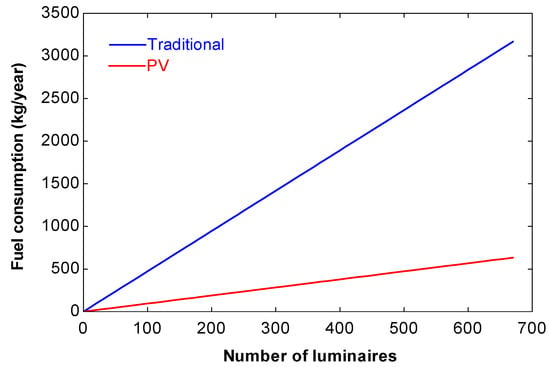
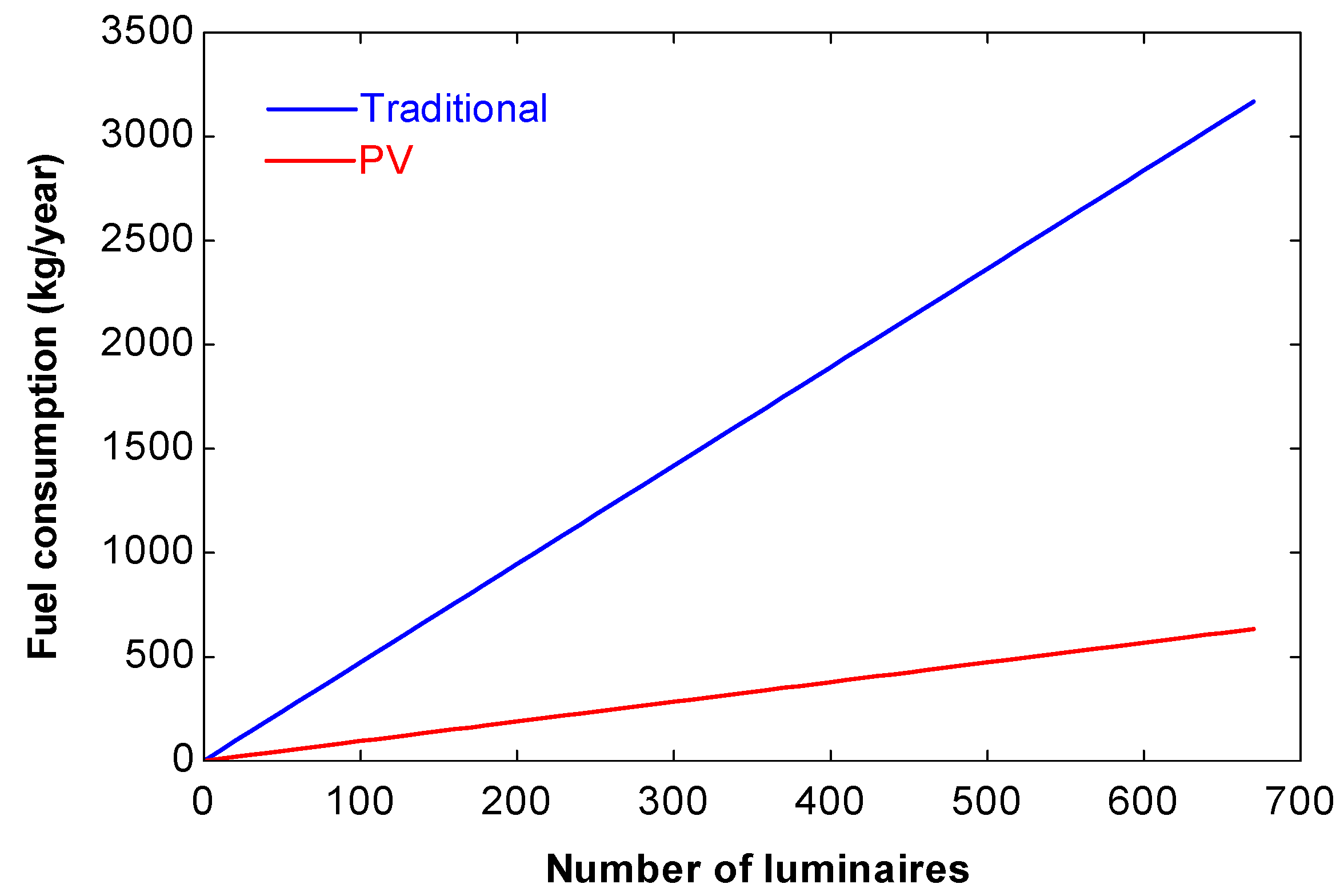
Based on the calculations presented above, the results are extrapolated according to the number of escape or transitional luminaires installed on board, resulting in the graph shown in Figure 2.
Figure 2.
Fuel consumption (kg/year) for installed permanent escape lighting.
The fuel consumption data, extrapolated according to the number of escape or transitional luminaires installed, reveal a significant reduction with the ATS:
- The traditional system shows a linear increase in fuel usage with the number of luminaires. For example, 350 luminaires consume 1655 kg/year of MDO.
- In contrast, the ATS with centralized batteries reduces consumption to 331 kg/year, rep-resenting approximately 80% fuel savings.
- The graph in Figure 2 demonstrates this linear relationship, with the widening gap between the two systems highlighting the cumulative fuel savings achievable at larger scales.
- These results indicate that the solar-powered ATS drastically reduces fuel dependency, contributing to lower operational costs and environmental impact.
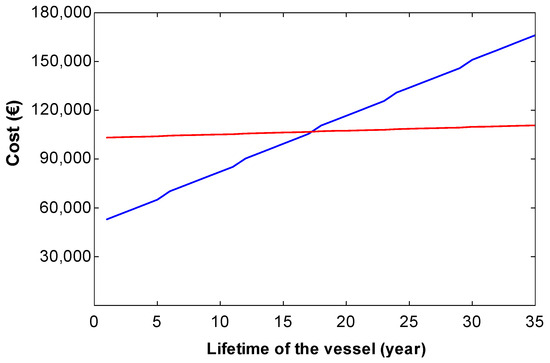
Another advantage was achieved in terms of maintenance costs. The maintenance costs were reduced by around 3:1. Figure 3 shows the cost of the system over the lifetime of the vessel. This figure considers 350 escape luminaires.
Figure 3.
Cost of the system.
Despite the higher initial CAPEX for the ATS, the long-term OPEX stability makes it economically favorable when considering the full lifecycle of the system. By year 15–20, the traditional system’s annual costs surpass those of the ATS, demonstrating the financial advantage of centralized, automated solutions. According to this, the benefits are:
- Economic efficiency: The ATS stabilizes operational costs over decades, avoiding the compounding expenses seen in the traditional system.
- Energy efficiency: Fuel consumption reductions of ~80% translate into lower MDO usage and greenhouse gas emissions.
- Scalability: Both fuel and OPEX trends are linear and predictable, supporting accurate planning for larger installations.
- Reliability and safety: ATS ensures minimal maintenance while maintaining full operational readiness of emergency lighting.
- Environmental compliance: The system aligns with regulatory goals for fuel efficiency and emission reduction, supporting sustainable maritime operations.
The results obtained in this study are not only applicable to ships equipped with 350 escape luminaires with integrated batteries, but can also be generalized to a wide range of vessels, including passenger ships, ferries, cruisers, and other types of ships where emergency lighting relies on battery systems. This includes tugs, fishing vessels, and smaller craft, as well as any vessel where transitional lighting is required due to the emergency power group taking longer than 45 seconds to connect to the emergency bus-bars. Consequently, the findings provide valuable guidance for the design, testing, and reliability assessment of escape lighting systems across diverse maritime platforms, contributing to enhanced safety, operational continuity, and environmental sustainability. By optimizing battery use and enabling efficient automated testing, these systems reduce energy consumption and minimize the environmental impact associated with battery replacement and electricity generation, promoting greener and more sustainable ship operations across a variety of vessel configurations and operational scenarios.
4. Conclusions
The increasing adoption of solar technologies in the maritime sector reflects a concerted effort to harness renewable energy solutions that support sustainable development goals, promote environmental stewardship, and foster innovation within the shipping industry. This work demonstrates that the integration of PV systems represents a viable and effective alternative for auxiliary power generation on vessels. In terms of technology, the implementation of an ATS compliant with IEC 62034 was proposed to ensure system reliability and operational safety. Although these solutions involve higher initial investment costs, they provide substantial long-term economic benefits through reduced maintenance and energy expenditures. Furthermore, the combination of PV technology and optimized battery use significantly decreases hazardous waste, lowers energy demand, and reduces fuel oil consumption and emissions, offering a sustainable and cost-effective alternative to conventional emergency lighting systems. Nevertheless, this study has certain limitations: system performance was evaluated under specific operational and climatic conditions, and further research is required to optimize photovoltaic efficiency in low-light areas, as well as to explore powering the entire vessel lighting networks using higher-power PV panels. Overall, the findings highlight the potential of renewable energy integration to enhance environmental performance, operational efficiency, and the reliability of maritime emergency power systems, while also identifying clear directions for future research.
Author Contributions
Conceptualization, L.G.R. and M.I.L.G.; methodology, L.G.R. and L.C.S.; software, L.G.R., formal analysis, L.G.R., M.I.L.G. and L.C.S.; investigation, L.G.R., M.I.L.G., and L.C.S.; resources, L.C.S.; writing—original draft preparation, L.G.R., and M.I.L.G.; writing—review and editing, M.I.L.G. and L.C.S.; supervision, L.C.S. and M.I.L.G. All authors have read and agreed to the published version of the manuscript.
Funding
This research received no external funding.
Institutional Review Board Statement
Not applicable.
Informed Consent Statement
Not applicable.
Data Availability Statement
The original contributions presented in this study are included in the article. Further inquiries can be directed to the corresponding author.
Conflicts of Interest
The authors declare no conflicts of interest.
References
- Mallouppas, G.; Yfantis, E.A. Decarbonization in Shipping Industry: A Review of Research, Technology Development, and Innovation Proposals. J. Mar. Sci. Eng. 2021, 9, 415. [Google Scholar] [CrossRef] [Scilit]
- Sardar, A.; Anantharaman, M.; Islam, T.M.R.; Garaniya, V. Data collection framework for enhanced carbon intensity indicator (CII) in the oil tankers. Can. J. Chem. Eng. 2024, 103, 170–187. [Google Scholar] [CrossRef] [Scilit]
- Budiyanto, M.A.; Putra, G.L.; Riadi, A.; Andika, R.; Zidane, S.A.; Muhammad, A.H.; Theotokatos, G. Techno-Economic Analysis of Combined Gas and Steam Propulsion System of Liquefied Natural Gas Carrier. Energies 2024, 17, 1415. [Google Scholar] [CrossRef] [Scilit]
- Serris, M.; Petrou, P.; Iakovidis, I.; Dimitrellou, S. Techno-Economic and Environmental Evaluation of a Solar Energy System on a Ro-Ro Vessel for Sustainability. Energies 2023, 16, 6523. [Google Scholar] [CrossRef] [Scilit]
- Elkafas, A.G. Advanced operational measure for reducing fuel consumption onboard ships. Environ. Sci. Pollut. Res. 2022, 29, 90509–90519. [Google Scholar] [CrossRef] [Scilit] [PubMed]
- Tay, Z.Y.; Konovessis, D. Sustainable energy propulsion system for sea transport to achieve United Nations sustainable development goals: A review. Discov. Sustain. 2023, 4, 1–34. [Google Scholar] [CrossRef] [Scilit]
- Rodríguez, L.G.; Castro-Santos, L.; Galdo, M.I.L. Feasibility and Limitations of Solar Energy Integration in Merchant Ships: A Case Study on Fire Detection Systems. J. Mar. Sci. Eng. 2025, 13, 991. [Google Scholar] [CrossRef] [Scilit]
- Hudișteanu, V.-S.; Nica, I.; Verdeș, M.; Hudișteanu, I.; Cherecheș, N.-C.; Țurcanu, F.-E.; Gherasim, I.; Galatanu, C.-D. Technical and Economic Analysis of Sustainable Photovoltaic Systems for Street Lighting. Sustainability 2025, 17, 7179. [Google Scholar] [CrossRef] [Scilit]
- Bai, H.; Lu, T.; Liu, W.; Li, X.; Lv, W.; Lv, S. Maximizing underwater energy harvesting efficiency using flexible solar cells: A pathway to sustainable ocean power. Proc. Natl. Acad. Sci. USA 2025, 122, e2423651122. [Google Scholar] [CrossRef] [Scilit] [PubMed]
- Kobougias, I.; Tatakis, E.; Prousalidis, J. PV Systems Installed in Marine Vessels: Technologies and Specifications. Adv. Power Electron. 2013, 2013, 1–8. [Google Scholar] [CrossRef] [Scilit]
- Salem, A.A.; Seddiek, I.S. Techno-Economic Approach to Solar Energy Systems Onboard Marine Vehicles. Pol. Marit. Res. 2016, 23, 64–71. [Google Scholar] [CrossRef] [Scilit]
- Kang, H.J.; Lee, D.; Shin, J.G.; Lee, G.J.; Choi, J. Interactive Escape Route Control for Passenger Ships Using Emergency Lighting. Mar. Technol. Soc. J. 2010, 44, 43–49. [Google Scholar] [CrossRef] [Scilit]
- Ma, Y.; Gelenbe, E.; Liu, K. Impact of IoT System Imperfections and Passenger Errors on Cruise Ship Evacuation Delay. Sensors 2024, 24, 1850. [Google Scholar] [CrossRef] [Scilit] [PubMed]
- Rodríguez, L.G.; Castro-Santos, L.; Galdo, M.I.L. Techno-Economic Analysis of the Implementation of the IEC 62034:2012 Standard—Automatic Test Systems for Battery-Powered Emergency Escape Lighting—In a 52.8-Meter Multipurpose Vessel. Eng 2025, 6, 110. [Google Scholar] [CrossRef] [Scilit]
- Rodríguez, L.G.; Castro-Santos, L.; Barros, J.J.C.; Galdo, M.I.L. Multi-Criteria Evaluation of Smart Escape and Emergency Lighting Alternatives for Offshore Platforms: Case Study of BorWin5. J. Mar. Sci. Eng. 2025, 13, 1614. [Google Scholar] [CrossRef] [Scilit]
- Stefanou, E.; Louvros, P.; Stefanidis, F.; Boulougouris, E. Alternative Evacuation Procedures and Smart Devices’ Impact Assessment for Large Passenger Vessels under Severe Weather Conditions. Sci 2024, 6, 12. [Google Scholar] [CrossRef] [Scilit]

Disclaimer/Publisher’s Note: The statements, opinions and data contained in all publications are solely those of the individual author(s) and contributor(s) and not of MDPI and/or the editor(s). MDPI and/or the editor(s) disclaim responsibility for any injury to people or property resulting from any ideas, methods, instructions or products referred to in the content. |
© 2026 by the authors. Licensee MDPI, Basel, Switzerland. This article is an open access article distributed under the terms and conditions of the Creative Commons Attribution (CC BY) license.