1. Introduction
Groundwater constitutes the main freshwater source in Mediterranean and semi-arid regions. Limited surface water availability has resulted in intense pressure on groundwater storage. Groundwater recharge has been affected by intensive agricultural activities, land-use changes, and climate change, through alterations in precipitation patterns and hydrogeological processes. Groundwater quality has been degraded by nitrate contamination driven by excessive fertilizer application and insufficient management practices in agricultural areas. This situation is expected to worsen under climate change due to changes in recharge dynamics, rendering agricultural aquifers vulnerable to nitrate contamination. Τhe incorporation of climate-sensitive methodologies into groundwater vulnerability assessment frameworks is essential for accurately identifying present and future contamination risk areas and for supporting effective groundwater protection and pollution management strategies.
DRASTIC is a widely adopted method for estimating intrinsic groundwater vulnerability. It combines seven factors of groundwater hydrology that control contaminant transport to groundwater, such as depth to groundwater, groundwater recharge, porous media, soil characteristics, topographical slope, unsaturated layer properties, and hydraulic conductivity. Because of its theoretical simplicity and practicality of application, DRASTIC has been extensively employed across diverse hydrogeological settings, including GIS-based vulnerability mapping in the Erbil Dumpsite area of Iraq [
1], the Yeşilköy aquifer in Cyprus [
2], groundwater quality vulnerability around Surat, India [
3], comparative methodology studies in Chalkidiki, Greece [
4], and contamination potential analysis in Pemalang District, Indonesia [
5].
To address these limitations, hybrid approaches that combine index-based vulnerability assessments with physically based hydrological and hydrogeological models have become increasingly important. Such methods help us better represent the process by directly simulating the key parameters controlling contaminant transport. Several recent studies have extended the traditional DRASTIC framework by incorporating climatic variables and future climate projections, such as optimized DRASTIC applications under the climate scenarios of RCP4.5, and RCP8.5 for urban groundwater [
6], climate-forced hydrological projections influencing groundwater status [
7], and advanced frameworks integrating climate impacts via machine learning [
8,
9] coupled a modified DRASTIC model (DRASTIC-L) with a SWAT–MODFLOW framework, enabling direct simulation of groundwater recharge, depth to groundwater, and hydraulic conductivity rather than relying solely on observational datasets. Similarly, [
10] demonstrated that incorporating land-use and climate variability into a modified DRASTIC framework significantly improved groundwater contamination risk prediction in a semi-arid basin compared to the traditional index.
The present work incorporates the DRASTIC index into a physically based distributed hydrological–hydrogeological modeling framework that is driven by local climate projections and is founded on prior integrated approaches [
11,
12]. Groundwater recharge, groundwater level variation, and nitrate transport are effectively simulated for current and future time steps using bias-corrected Med-CORDEX climatic estimators for the high-emission RCP8. 5, which provides a climate-driven temporal DRASTIC index. The main novelty of this study lies in the integration of bias-corrected Med-CORDEX regional climate projections into an Integrated Modelling System (IMS), enabling time-varying simulation of net recharge and depth to groundwater, which are subsequently used to update the DRASTIC index. In addition, the study provides a quantitative validation of DRASTIC vulnerability patterns against both observed and simulated nitrate concentrations, offering an empirical evaluation of index performance. The computational approach is subsequently applied to the Almyros groundwater body in Thessaly, Greece, to assess nitrate vulnerability to pressure caused by climate change and to offer directives for adaptive groundwater management in Mediterranean groundwater systems.
2. Materials and Methods
This research examines the Almyros Basin, situated along the southern edge of the Thessalian Plain and integrated within the larger Almyros–Pilion hydrological framework. The basin hosts an aquifer system extending over roughly 293 km
2, with a mean elevation near 108 m and an average slope of 5.56%. The study area has a Mediterranean climate, with a yearly rainfall of around 500 mm and an annual temperature of 16.6 °C [
11]. The aquifer consists of Neogene formations (clay, clay–gravel–sand, and clay–sand), Quaternary sands, and natural limestone [
12]. Highly permeable sandy materials are found along the coastline, while clay lenses occur mostly in the aquifer’s western sections. Hydrogeologically, the groundwater body of Almyros consists of semi-porous Neogene layers and porous Quaternary deposits [
12]. Hydraulic conductivity daily ranges lie between 0.1 and 18.7 m, which spatially average to 2.3 m.
The main methods used in this study are the DRASTIC method, under bias-corrected Med-CORDEX climatic data for RCP 8.5 using the GUF-CCLM4-8-18.v1 climate model data.
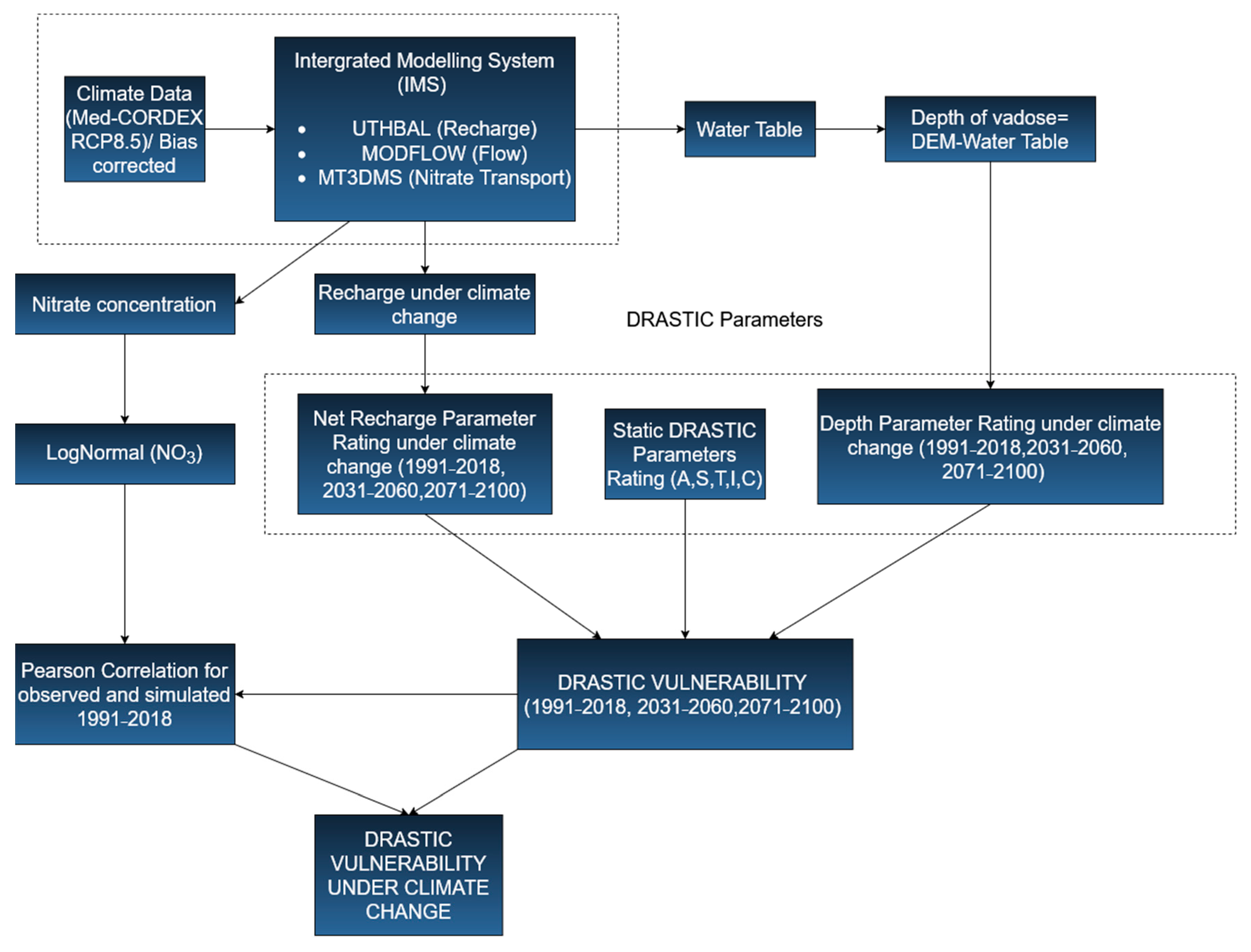
Figure 1 presents the methodological framework applied to evaluate groundwater vulnerability under both current and projected climate conditions. The workflow combines bias-corrected Med-CORDEX climatic data with an Integrated Modelling System (IMS) to simulate groundwater recharge, flow patterns, and nitrate transport. The model outputs are then used to calculate key DRASTIC parameters, particularly the net recharge and the depth to groundwater that practically change, for both historical and future timescales. The framework also includes statistical validation of the simulated nitrate concentrations and allows for the assessment of groundwater vulnerability under different climate change scenarios. This flowchart provides a structured outline of the sequential modeling, parameterization, and assessment steps that are described in detail in the following sections.
2.1. DRASTIC Index-Based Method
The DRASTIC LU index is obtained through a weighted linear combination of the contributing factors:
where the acronym parameters “
D”, “
R”, “
A”, “
S”, “
T”, “
I”, and “
C” denote depth to groundwater, net recharge, aquifer composition, topsoil characteristics, ground topography, influence of unsaturated layer, and hydraulic conductivity, respectively, with
r indicating parameter ratings and w their associated weights.
Within the DRASTIC scheme, parameters were differentially weighted established on their power on groundwater vulnerability, with the unsaturated depth being assigned the largest importance (5). The parameter was rated for the baseline 1991–2018 and simulated 1991–2018, and the future periods 2031–2060, 2071–2100. Net recharge, a major contributing factor (weight = 4), was calculated by aggregating monthly recharge values generated with the UTHBAL model for the same intervals. Aquifer media had a moderate influence (weight = 3). Soil characteristics, which primarily control near-surface infiltration and contaminant attenuation, were assigned a lower weight (2) and derived from the USDA soil texture classification based on sand, silt, and clay in the upper 30 cm. Topography had minimal impact (weight = 1) and was quantified through slope analysis. Hydraulic conductivity (weight = 3) was estimated using data from the European Soil Data Centre and supplemented with field measurements in the Almyros region.
2.2. Integrating Modeling System
An Integrated Modelling System (IMS) was applied by coupling the UTHBAL hydrological model, the REPIC nitrate leaching model, MODFLOW groundwater flow model, and MT3DMS solute transport model. The IMS simulates groundwater recharge, groundwater levels, and nitrate transport under climate and land-use forcing. Model setup, parameterization, boundary conditions, calibration procedures, and performance metrics have been fully described and validated in previous peer-reviewed studies using the same modeling framework. All IMS components were calibrated and validated and showed strong model performance [
11,
12]. The MT3DMS model was used to simulate nitrate transport, calibration statistics across different periods which show Nash–Sutcliffe efficiency values ranging from approximately 0.80 to 0.82, coefficients of determination (R
2) between 0.87 and 0.96, and index of agreement values close to 0.95. In the present study, the IMS is employed as an established tool to generate climate-driven inputs for DRASTIC vulnerability assessment.
2.3. Pearson’s Correlation
The robustness of the results was evaluated using correlation analysis. In particular, Pearson’s correlation coefficient [
13] was implemented to determine the form of relationship between the DRASTIC groundwater vulnerability index scores to the simulated nitrate concentrations for both the historical and simulated periods spanning 1991–2018. Pearson’s correlation is calculated by the following relation:
where
denotes the DRASTIC index, while
corresponds to the normalized nitrate concentration at the same location;
and
represent their respective mean values. Values of
extend from −1, which shows an ideal inverse relationship, to +1, which shows an ideal positive relationship.
The Pearson correlation between the DRASTIC index values and the nitrate concentrations simulated with the MT3DMS model both for historic and simulated period 1991–2018 is 0.70, suggesting a good agreement with the observed spatial nitrate pattern [
11]. The study focuses on verifying DRASTIC vulnerability under projected climate conditions to assess future changes in groundwater vulnerability.
3. Results and Discussion
3.1. Parameters of DRASTIC
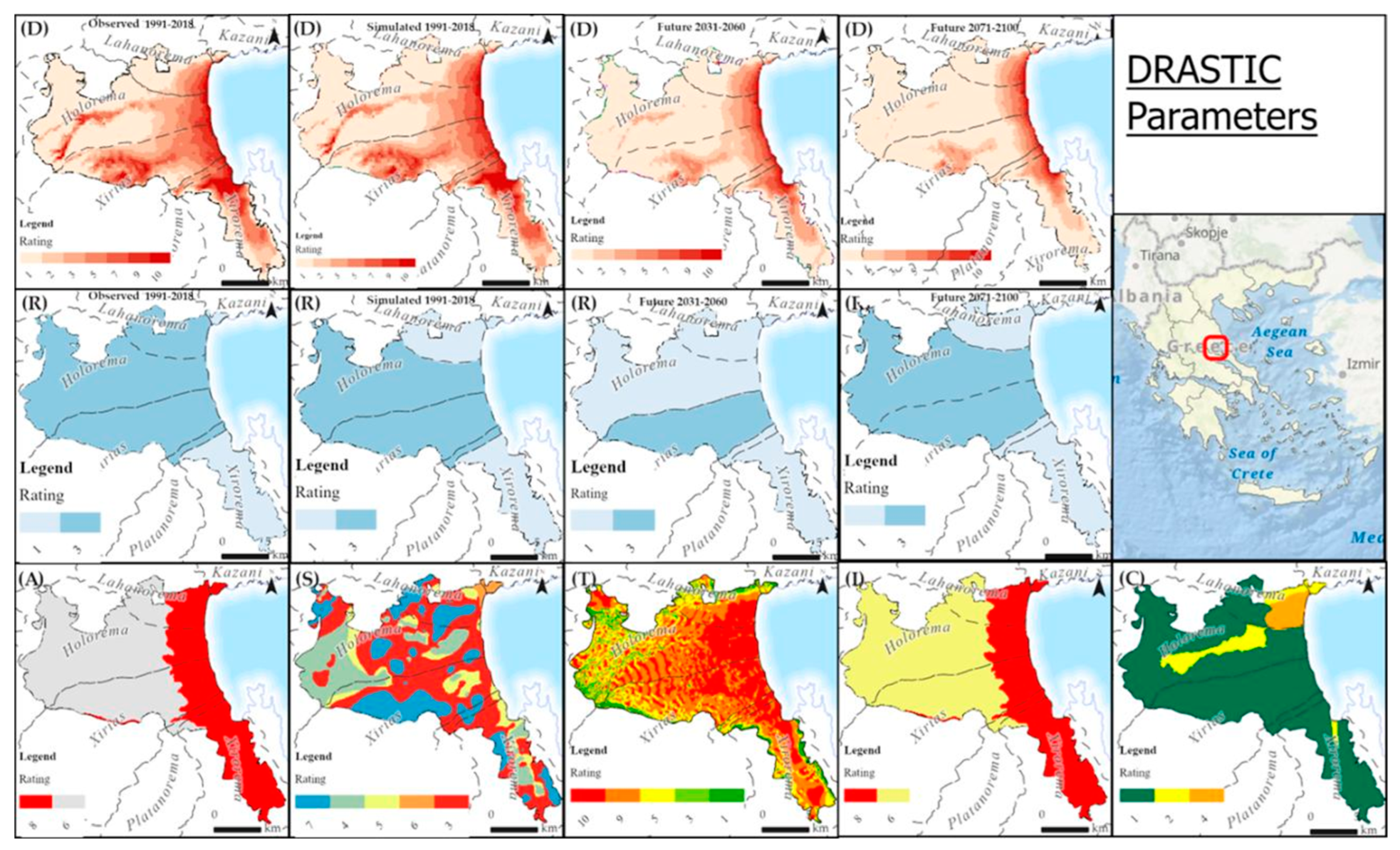
The DRASTIC parameter values were assigned their respective ratings through the Reclassify function within ArcGIS Pro 3.5, and their respective spatial distribution is illustrated for the past and future climate conditions in
Figure 2.
The Depth-to-Water (D) parameter shows consistently high values in the coastal and eastern lowland areas, indicating shallow groundwater and increased vulnerability to nitrates. Net recharge (R) displays relatively moderate-to-low values across the aquifer between observed, simulated, and future periods. This indicates that future climate change mainly affects the amount of recharge. The Aquifer media (A) parameter indicates higher ratings along the coastline due to permeable formations found in that area. More consolidated inland formations exhibit lower ratings. The Soil Media (S) parameter shows pronounced spatial heterogeneity, with high ratings in areas dominated by coarse-textured soils that promote rapid infiltration and lower ratings where finer soils prevail.
The topography (T) parameter shows higher vulnerability in low-slope coastal and plain areas, where reduced runoff enhances infiltration, while steeper inland terrain exhibits lower vulnerability. The Impact of the Unsaturated Layer (I) parameter indicates that permeable unsaturated materials mainly occur along the coast, whereas inland regions have thicker or less permeable zones. Minor future changes suggest increased vadose zone sensitivity to climate. Hydraulic conductivity (C) highlights areas of high aquifer transmissivity, especially in coastal and alluvial deposits, facilitating water and contaminant movement.
3.2. Calculation of Groundwater Vulnerability with DRASTIC and IMS
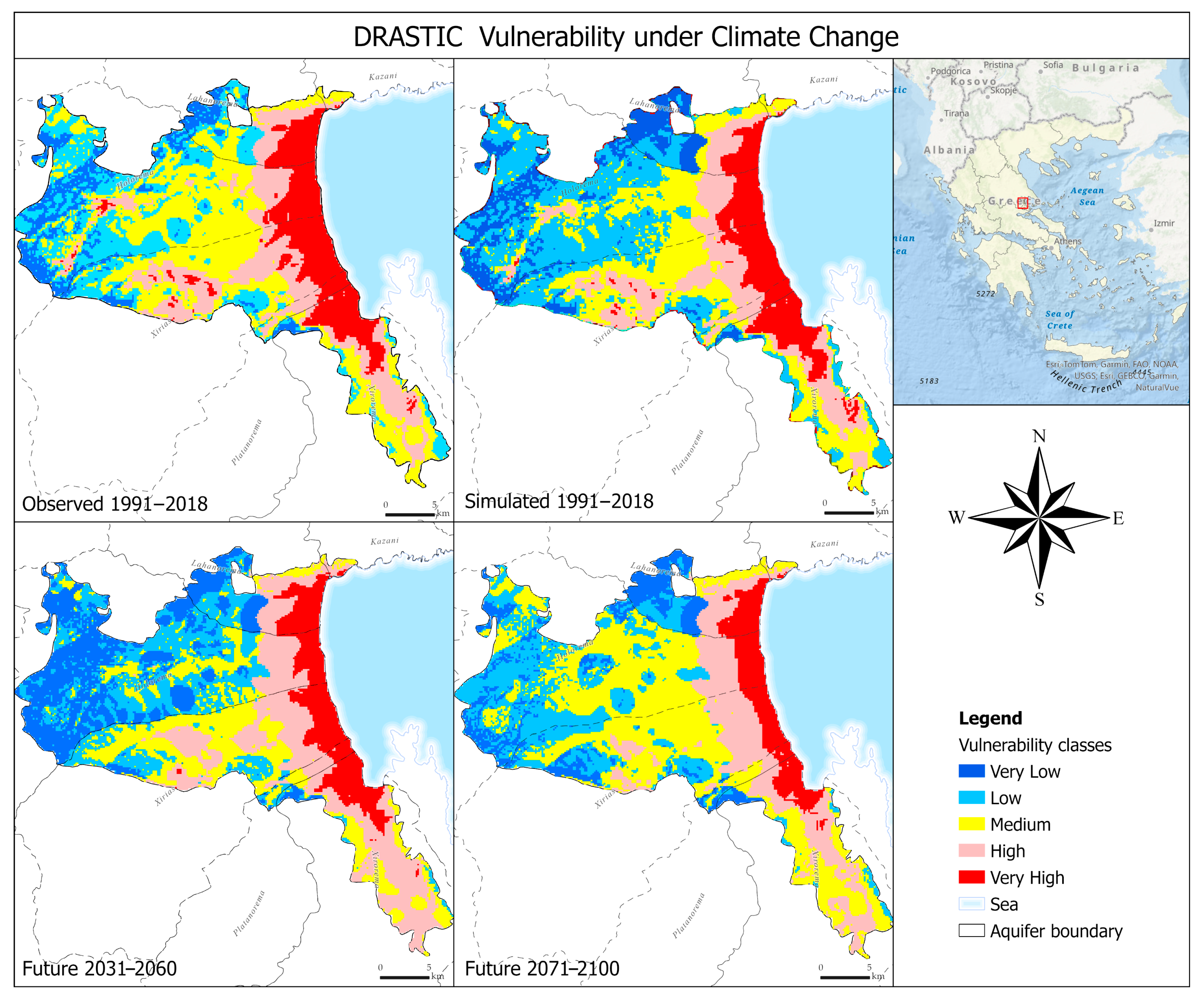
The products of the calculation of groundwater vulnerability are shown in
Figure 3. The geographical spread of aquifer vulnerability is estimated under observed (1991–2018) and projected future climate scenarios. During the observed period, low to medium vulnerability dominates central and western inland zones, while high to very high vulnerability is present along coastal and eastern areas, likely due to intensive groundwater abstraction. The vulnerability maps for the observed and simulated period 1991–2018 display minor differences between medium and high vulnerability classes. In the future period 2031–2060, the medium and high vulnerability values occupy larger areas than the high to very high vulnerability ranking. Over the long-term period (2071–2100), vulnerability patterns change significantly, reflecting an overall increase in groundwater vulnerability under climate change. The very high vulnerability zones become more spatially continuous along the coastline zone, while low to medium values are reduced. The dominance of medium to high vulnerability classes across the aquifer indicates that climate change exacerbates the existing pressures rather than creating new vulnerability zones. Broadly, the high and very high values remain in the coast zone throughout all the periods, while inland areas—previously considered relatively secure—are projected to experience significant deterioration in groundwater vulnerability. The temporal evolution from present to future periods underscores the nonlinear nature of vulnerability escalation.
The quantitative distribution of vulnerability classes indicates shifts in groundwater vulnerability under future climate scenarios (
Table 1).
During the historic period (1991–2018), the aquifer is characterized by a relatively low to very low vulnerability covering 42.0% of the aquifer area, high to very high vulnerability at 32.1%, and medium vulnerability accounting for 25.8%. Under mid-century conditions (2031–2060), the percentage of low to very low vulnerability remains nearly constant (42.4%). However, the high to very high vulnerability class increases to 35.6%, while medium vulnerability decreases to 22.0%. This shift implies a contrast in vulnerability levels, where moderately vulnerable areas shift toward higher vulnerability levels rather than remaining stable.
By the late-century period (2071–2100), the proportion of low to very low vulnerability decreases to 34.1%, while medium vulnerability amplifies significantly to 37.5%. However, the high to very high vulnerability category decreases to 28.4%. This trend shows that areas of the aquifer remain moderately vulnerable without any spatial expansions of high vulnerability zones. Overall, groundwater vulnerability and climate change exhibit a nonlinear temporal trend. The mid-century period displays an increase in high vulnerability values, whereas the late-century scenario shows a wider spatial spread of vulnerability throughout the aquifer. The results suggest that climate change can also affect the low vulnerability areas by increasing the intermediate vulnerability values. Pearson correlation between DRASTIC index and nitrate concentrations for 1991–2018 (observed and simulated) is 0.70/0.67, showing robustness.
4. Conclusions
In this study, the DRASTIC method and an Integrated Modeling System (IMS) were applied to estimate the groundwater vulnerability for the baseline 1991–2018 and simulated period 1991–2018 and future periods 2031–2060, 2071–2100. The GUF-CCLM4-8-18.v1 Med-CORDEX-IMS model was selected as the climate input based on its good performance in the study area, providing the climate-driven parameters which were used for the DRASTIC index. The results show that high and very high vulnerability values appeared along the coastline zone due to shallow depth of vadose zones, permeable materials, and high hydraulic conductivity, while in the northwest and western area of the aquifer, low and very low values of vulnerability dominated. These changes in the spatial distribution of vulnerability were observed due to non-static variable factors of the groundwater table and groundwater recharge that change over time. A shift was also observed in the vulnerability classes between the future projections. Mid-century maps display an increase in high vulnerability values, while in the late century, medium vulnerability values show an increase in the western area of the aquifer. These variations in vulnerability values suggest that climate change is likely to modify the spatial distribution of vulnerability rather than amplifying the existing high vulnerability values. Consequently, there is a need for adaptive groundwater strategies, particularly in the vulnerable coastal zones to ensure long-term sustainability under climate change. However, reliance on a single model and scenario limits robustness, highlighting the need for multi-model and multi-scenario ensembles to better quantify uncertainty in future groundwater vulnerability assessments.