


Abstract
The rapid expansion of bibliometric research has generated a large volume of descriptive “snapshot” studies that map publication trends but offer limited strategic or policy-relevant insight. Although improved database access and visualization tools have broadened participation in bibliometric analysis, methodological variability, limited reproducibility, and insufficient evaluative framing constrain its utility for research governance. We argue that bibliometric studies should not be conducted as ends in themselves, but as methods for addressing clearly defined, decision-relevant questions. We define evaluative bibliometrics as decision-oriented analysis grounded in explicit research questions, theoretically aligned indicator selection, temporal sensitivity, robustness assessment, and contextual interpretation. Key methodological considerations are examined, including database selection, search strategy design, attribution bias, normalization approaches, and science mapping parameters. We further synthesize emerging reporting frameworks and propose an evaluative extension framework that integrates decision-context specification with structured transparency requirements. By reframing bibliometrics as a decision-support discipline rather than a descriptive genre, this paper provides a methodological roadmap for researchers, editors, and institutions seeking to enhance the rigor, interpretability, and strategic relevance of bibliometric evidence.
1. Background
1.1. From Library Science to Research Governance
Bibliometrics has evolved in parallel with the transformation of the scientific enterprise. Originally defined by Alan Pritchard in 1969 as the application of mathematical and statistical methods to books and other media, it emerged within library science to support collection development and identification of core journals [1]. Early applications were pragmatic, aimed at improving cataloguing efficiency and resource allocation in academic libraries.
Over subsequent decades, bibliometric indicators became central to research evaluation, institutional benchmarking, and national science policy [2]. Citation counts, journal impact metrics, and productivity measures now inform decisions ranging from promotion and grant allocation to global university rankings [3]. Bibliometrics has thus transitioned from a technical library tool to a strategic instrument embedded in research governance.
1.2. Proliferation and the “Bibliometric Bandwagon”
This expansion has coincided with what has been termed the “bibliometric bandwagon” [4]. Researchers across medicine, engineering, nursing, and the social sciences increasingly employ bibliometric techniques to navigate rapidly expanding literature. The annual volume of scientific publications has increased substantially, creating challenges for traditional narrative review methods and increasing interest in quantitative synthesis approaches.
Improved database accessibility and user-friendly analytical software have accelerated this trend [5]. Subscription-based platforms such as Web of Science and Scopus, alongside open resources including PubMed and Google Scholar, have lowered technical barriers to data access. Visualization tools enable rapid mapping of publication trends, citation patterns, collaboration networks, and thematic structures. As a result, bibliometric analysis has become a recognizable publication genre across disciplines.
1.3. Variability in Methodological Rigor
Despite its growing popularity, the rapid proliferation of bibliometric studies has not been matched by consistent methodological rigor. The ease of exporting and visualizing datasets has contributed to marked variability in analytical quality [6]. Many studies remain largely descriptive, presenting ranked lists of productive authors, institutions, or countries without explicit evaluative framing or theoretical grounding.
Indicators are often reported without sufficient attention to disciplinary norms, database coverage limitations, citation time lags, or field size. Network metrics may be presented without justification of threshold parameters or robustness assessment. Incomplete reporting of search strategies, data cleaning procedures, and software settings further constrains reproducibility and comparability.
Descriptive cross-sectional analyses can be produced efficiently using widely available tools, yet their strategic value is often limited. Static snapshots rapidly lose relevance as publication outputs expand and citation patterns evolve. Repeated confirmation of established structural patterns rarely advances conceptual understanding or informs policy intervention. To generate meaningful insight, bibliometric investigations must be guided by clearly articulated research questions that address substantive knowledge gaps or inform decision-making.
1.4. The Need for an Evaluative Paradigm
To sustain its relevance within contemporary research governance, bibliometrics must move beyond descriptive mapping toward analytically grounded evaluation [7]. Although structural mapping remains valuable for exploratory purposes, its strategic utility is limited when not anchored in explicit research questions and decision contexts. Reframed in evaluative terms, bibliometrics becomes a method for generating actionable insight rather than merely enumerating outputs.
This approach is defined by clearly articulated decision-relevant questions, theoretically justified indicator selection, temporal sensitivity, and critical reflection on methodological assumptions. Instead of reporting productivity or citation rankings in isolation, it seeks to explain patterns, assess influence mechanisms, and inform institutional or policy choices through alignment between analytical design and intended use.
Recent studies in adjacent decision-oriented domains illustrate both the growing reach and the current limits of this approach. For example, bibliometric analyses have been used to examine the development, collaboration structure, citation patterns, and thematic evolution of probabilistic preference decision-making and intelligent decision research [8], whereas more recent review work has combined bibliometric analysis with systematic review to identify major methodological trends, underexplored areas, and future directions in data-driven decision-making [9]. Together, these studies demonstrate the expanding use of bibliometric methods in strategically relevant fields, but they also suggest that many applications remain focused on structural and thematic description rather than explicit evaluative alignment with a defined decision context.
Advancing this shift requires both conceptual clarification and strengthened methodological rigor, supported by transparent reporting practices that enable reproducibility, comparability, and critical appraisal. The following sections elaborate this framework and propose structured standards to enhance the scientific and strategic value of bibliometric research. Fundamentally, a bibliometric study should not be conducted for its own sake, but to answer a decision-relevant question.
2. Methodological Foundations for Evaluative Bibliometrics
Evaluative bibliometrics requires methodological choices that are explicitly aligned with clearly defined research questions and intended analytical use. Unlike routine descriptive mapping, which often follows standardized templates, evaluative approaches demand justification of data sources, indicator selection, parameter settings, and interpretative frameworks. Methodological rigor is therefore both technical and conceptual, as these choices shape the validity, comparability, and policy relevance of findings.
2.1. Data Sources, Retrieval Strategies, and Bias
Selection of bibliographic databases is a foundational decision that determines corpus composition, citation counts, collaboration networks, and thematic mapping outcomes. Major citation indexes differ in journal inclusion criteria, disciplinary representation, language coverage, and historical depth. Identical search queries executed across databases may therefore yield divergent datasets and citation metrics.
The Web of Science Core Collection has traditionally been regarded as a benchmark source for evaluative bibliometrics due to curated journal selection and structured citation metadata. Scopus offers broader coverage and comparable analytical tools [10]. Open-access platforms such as PubMed and Google Scholar extend accessibility but present limitations. PubMed lacks comprehensive citation linking for relational analysis, while Google Scholar’s expansive coverage includes non-peer-reviewed materials and limited quality control. Database selection should therefore be justified in relation to the study objective.
Transparent documentation of database choice, complete search strings, inclusion and exclusion criteria, document type filters, and extraction dates is essential for replication and interpretation. Search strategies must balance sensitivity and specificity. Overly restrictive queries risk omitting relevant literature, whereas overly broad searches introduce noise and distort network structures. Iterative refinement, pilot testing, and expert consultation improve dataset validity [11].
Data preprocessing requires systematic cleaning and standardization. Duplicate removal, harmonization of author names, and consolidation of institutional affiliations are necessary to avoid distortion of productivity and collaboration metrics. Author name disambiguation remains a persistent challenge, particularly in contexts involving common surnames, transliteration from non-Latin scripts, and inconsistent naming conventions. Inadequate disambiguation can materially affect citation attribution and network structure, thereby compromising evaluative inference [12].
Reliance on algorithmically generated metadata may introduce additional bias. For example, Web of Science “Keywords Plus” terms are derived from cited references rather than author-supplied descriptors. Although such terms may enhance retrieval sensitivity, their opaque derivation can reduce thematic precision in co-occurrence or clustering analyses. When algorithmically generated fields are included, validation through manual screening or sensitivity comparison is advisable [13,14].
2.2. Indicator Selection and Interpretative Validity
Bibliometric indicators are not neutral descriptors; rather, they reflect underlying assumptions about scientific contribution and influence. Publication counts capture output, but not necessarily quality or impact. Citation-based indicators may approximate scholarly recognition, yet they are also shaped by disciplinary citation norms, self-citation practices, database coverage, and the cumulative effects of time. Composite metrics may improve sensitivity, but they can also reduce interpretive transparency [15].
In this paper, descriptive bibliometrics refers to analyses that map and summarize publication-related patterns, such as output, citations, collaboration, or thematic structure, without being explicitly intended to inform a specific evaluative decision. By contrast, evaluative bibliometrics refers to decision-oriented analysis in which the research question, indicator selection, temporal design, and interpretation are explicitly aligned with a defined institutional, editorial, funding, or policy purpose. Table 1 summarizes the main distinctions between these two approaches.
Table 1.
Conceptual distinctions between descriptive and evaluative bibliometrics.
Within an evaluative framework, indicator selection should be guided by conceptual relevance rather than convention alone. For example, normalized citation metrics are often appropriate when assessing research visibility, whereas network centrality measures may be more informative for examining collaboration dynamics, provided they are interpreted in relation to network size and density. Cross-disciplinary comparisons generally require field-normalized indicators to account for differences in citation behavior across fields.
Temporal design is also central to interpretive validity. Cumulative citation counts tend to favor older publications and may obscure more recent or emerging influence. Standardized citation windows, time-sliced analyses, and growth-rate assessments can therefore provide a clearer view of developmental trajectories and contemporary impact.
Interpretation must extend beyond numerical reporting. Bibliometric indicators should be considered in relation to disciplinary citation norms, collaboration patterns, funding intensity, and publication practices, including language distribution and journal stratification. In practice, this may involve field normalization, benchmark comparisons within subject categories, incorporation of funding acknowledgment data, and explicit discussion of domain-specific citation behavior. Without such contextualization, quantitative measures risk being treated as objective proxies of performance rather than as approximations shaped by methodological assumptions (Table 1).
2.3. Science Mapping and Analytical Design
Science mapping techniques, including co-authorship networks, co-citation analysis, bibliographic coupling, and keyword co-occurrence mapping, enable structural examination of research fields [16]. In evaluative bibliometrics, these methods should serve clearly defined analytical objectives rather than function as routine visual components.
Design choices in network construction materially influence interpretation. Threshold selection, clustering algorithms, layout parameters, edge-weight definitions, and term preprocessing strategies can alter apparent structures and centrality patterns. Minimum citation counts, keyword frequency cut-offs, inclusion criteria, and rules governing synonym consolidation and stopword removal should therefore be explicitly defined and justified in relation to the research question. Where feasible, alternative parameter settings and preprocessing decisions should be explored to assess structural stability and analytical robustness.
Analytical depth is enhanced when quantitative mapping is integrated with domain expertise. Cluster labeling, thematic interpretation, and identification of research fronts benefit from informed judgment and, when appropriate, triangulation with narrative synthesis or expert consultation. Mapping outputs should not be presented as objective depictions of inherent structure, but as analytical representations shaped by database selection, preprocessing decisions, and parameter choices.
Emerging approaches incorporating natural language processing and machine learning offer opportunities for large-scale thematic extraction and relational analysis [17,18]. Their outputs, however, are sensitive to preprocessing choices, model architecture, training corpora, and validation strategies. Careful documentation of these analytical configurations is necessary to preserve interpretability and methodological accountability.
2.4. Reproducibility and Analytical Transparency
Reproducibility is integral to methodological credibility in evaluative bibliometrics. Because database contents evolve and citation counts accumulate over time, variations in extraction dates, filtering criteria, or parameter settings may yield materially different outcomes. Analytical decisions must therefore be explicitly documented to permit independent verification and longitudinal comparison.
In evaluative contexts, reproducibility extends beyond technical record-keeping. It requires coherent alignment between research questions, data construction, indicator selection, and parameter choices. When bibliometric findings inform institutional or policy decisions, undocumented analytical flexibility may compromise interpretative integrity. Structured reporting mechanisms, discussed in the following section, provide practical means of embedding reproducibility within routine practice.
3. Reporting Standards and Reproducibility in Bibliometric Research
The interpretability of bibliometric findings depends on both analytical rigor and transparent documentation of data construction, parameter choices, and methodological assumptions. Without systematic reporting, bibliometric outputs risk being treated as technical artefacts rather than reproducible analyses.
3.1. The Reproducibility Imperative
Reproducibility in bibliometrics is particularly sensitive to temporal and procedural variation. Database content evolves continuously as new records are indexed and citation counts accumulate. Minor differences in extraction dates, search syntax, document filters, or threshold settings may yield materially different datasets.
Incomplete reporting of search strategies, eligibility criteria, data cleaning procedures, and analytical parameters constrains independent verification and longitudinal updating. This limitation is especially consequential when bibliometric results inform evaluative judgments regarding researchers, institutions, or research domains. Transparent specification of methodological workflows is therefore both a scientific and ethical requirement in evaluative contexts.
3.2. Structured Reporting Frameworks
To address variability in methodological reporting, several initiatives have proposed structured guidance for bibliometric analyses. Frameworks such as BIBLIO (Guideline for Reporting Bibliometric Reviews of the Biomedical Literature) [7], PRIBA (Preferred Reporting Items for Bibliometric Analysis) [6], and GLOBAL (Guidance List for repOrting Bibliometric AnaLyses) [19] aim to standardize documentation of data sources, retrieval strategies, analytical procedures, and interpretative boundaries.
Structured reporting serves three principal functions. First, it enhances comparability by clarifying differences in database coverage, normalization strategies, and indicator definitions. Second, it supports cumulative knowledge building by enabling replication and methodological refinement. Third, it reduces selective reporting by requiring disclosure of analytical decisions that materially influence results.
By mandating explicit documentation of dataset construction, disambiguation procedures, counting methods, normalization approaches, and network parameters, these frameworks strengthen transparency and interpretability. Such guidance does not prescribe uniform methodology; rather, it ensures that methodological choices are visible and open to critical appraisal [20].
3.3. Comparative Synthesis of Reporting Guidance
Table 2 synthesizes the principal reporting domains articulated in BIBLIO, PRIBA, and GLOBAL and contrasts them with the evaluative extensions proposed in the present study. Substantial convergence is evident across the three frameworks, particularly regarding database transparency, search documentation, indicator specification, and reproducibility safeguards. However, while these frameworks provide an essential foundation for transparency, reproducibility, and methodological consistency, they do not by themselves ensure that bibliometric design choices are aligned with a specific evaluative purpose or decision context. Accordingly, high-quality reporting should be regarded as a necessary foundation for evaluative bibliometrics, but not a sufficient condition for decision-relevant inference. Variability in citation windows, normalization strategies, counting approaches, and parameter thresholds continues to limit cross-study comparability. For bibliometrics to function reliably in evaluative settings, reporting standards must therefore be complemented by clearer conceptual alignment and partial standardization where defensible.
Table 2.
Comparative Synthesis of Bibliometric Reporting Guidelines and Proposed Evaluative Extensions.
3.4. Toward a Minimum Reporting Set for Evaluative Bibliometrics
Building on the comparative synthesis in Table 2 and Table 3 presents an evaluative extension framework tailored to decision-oriented bibliometric studies. Instead of repeating the procedural requirements set out in existing guidance, the framework identifies additional elements needed for responsible evaluative inference. To improve its practical utility, Table 3 also specifies the stakeholder groups and the policy or management decisions that bibliometric analysis may be intended to inform.
Table 3.
Evaluative Extension Framework for Decision-Oriented Bibliometric Studies.
These extensions emphasize explicit specification of decision context, formulation of hypothesis-driven research questions, theoretical alignment between indicators and conceptual constructs, temporal design justification, transparent attribution rules, and structured sensitivity assessment. By integrating these components, bibliometric analysis is repositioned from structural description toward structured decision support.
Among methodological choices with direct evaluative consequences, attribution of credit in multi-authored publications warrants particular attention. In large collaborative projects, whole-counting approaches may inflate productivity indicators and affect comparative rankings. Fractional allocation provides a proportionate alternative [21]. Because counting rules can materially alter performance metrics, explicit justification and reporting of attribution methods are essential for interpretability and comparability.
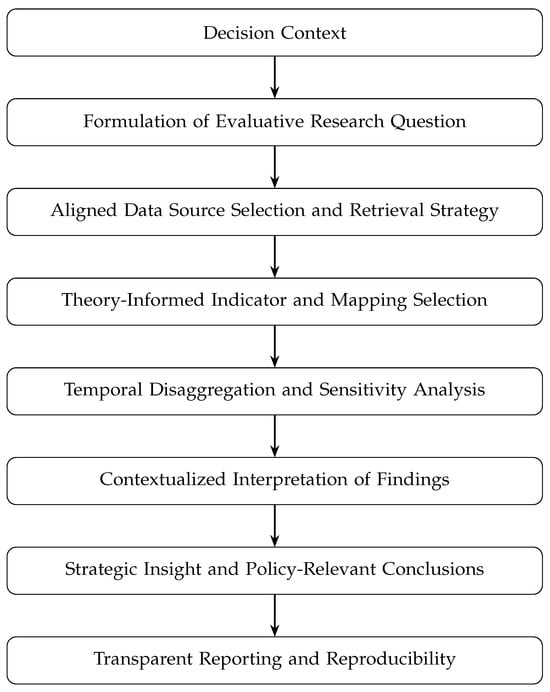
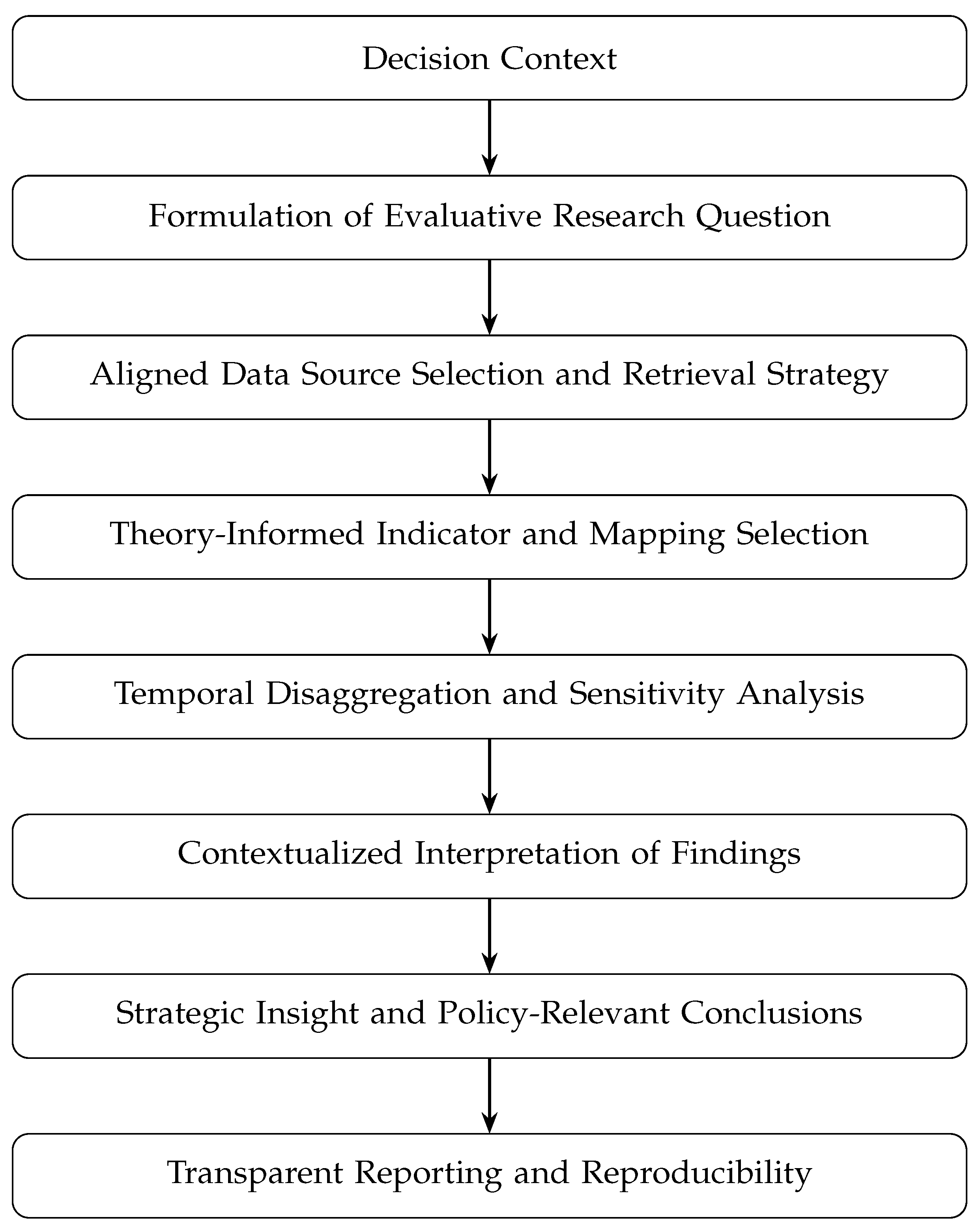
Embedding these evaluative extensions within routine reporting practice enhances interpretative validity, strengthens cross-study comparability, and reinforces the credibility of bibliometric evidence in strategic contexts. These dimensions are further operationalized in Figure 1, which presents a stepwise workflow linking decision context and evaluative research questions to strategic insight and transparent reporting.
Figure 1.
Conceptual workflow for operationalizing the evaluative extension framework from decision context to strategic insight and transparent reporting. The workflow begins with definition of the decision context and formulation of evaluative research questions. Data sources, retrieval strategies, and indicator selection are aligned with the analytical objective. Temporal analysis and robustness assessment strengthen interpretative validity. Findings are contextualized to generate strategic insight, while transparent reporting ensures reproducibility and responsible application in research governance.
4. From Maps to Decisions: Operationalizing Evaluative Bibliometrics
Operationalizing evaluative bibliometrics requires translating structural patterns into analytically grounded insight. The challenge is not merely generating indicators or visualizations, but aligning analytical design with clearly defined decision contexts. Effective operationalization integrates research questions, data construction, indicator selection, and interpretation into a coherent workflow oriented toward strategic inference.
4.1. Defining Decision Contexts
Evaluative analysis begins with explicit articulation of the decision context. Different stakeholders require distinct forms of evidence. Institutional leaders may seek insight into thematic positioning and collaboration strategy; funding agencies may prioritize emerging research fronts or long-term impact trajectories; journal editors may examine citation momentum and international reach. Without clarity regarding intended use, bibliometric outputs remain descriptive rather than actionable.
Research questions should therefore be framed in explanatory or strategic terms. Instead of identifying the most productive authors or countries, analyses may investigate how collaboration structures influence citation impact, whether thematic diversification enhances institutional resilience, or how funding patterns shape research concentration. Such framing shifts emphasis from enumeration to explanation and from static mapping to evaluative inference.
4.2. Linking Indicators to Mechanisms and Strategic Insight
Operationalization requires examining underlying mechanisms rather than surface metrics. High citation impact may reflect interdisciplinary positioning, network centrality, methodological innovation, or policy relevance. Combining network analysis with temporal citation trajectories can distinguish sustained influence from transient visibility. Topic modeling and co-word analysis can reveal whether research clusters are consolidating, fragmenting, or evolving.
These approaches enable identification of emerging domains, structural imbalances, and underexplored research areas. Conceptual mapping can differentiate established core themes from peripheral or declining topics, thereby informing strategic prioritization. At institutional and policy levels, integrating productivity metrics with collaboration and thematic analysis supports assessment of specialization profiles, partnership dynamics, and knowledge flow patterns.
4.3. Integrating Uncertainty and Sensitivity
Decision-oriented analysis must explicitly acknowledge uncertainty. Parameter choices in network construction, normalization strategies, counting methods, and citation windows can materially influence outcomes. Sensitivity analyses examining alternative thresholds, counting approaches, or normalization schemes enhance robustness and interpretative credibility.
Uncertainty may also arise from database coverage bias, language restrictions, indexing delays, and metadata inconsistencies. To enhance transparency, authors should report the database source, relevant sub-collections (e.g., Science Citation Index Expanded, Social Sciences Citation Index, and Emerging Sources Citation Index within the Web of Science Core Collection), and the date of data extraction. Parameter selections should be explicitly justified and, where feasible, results compared across alternative specifications. In evaluative bibliometrics, these methodological choices should be justified not only for transparency, but also for their relevance to the specific decision context and evaluative question guiding the analysis.
4.4. Toward an Evaluative Workflow
Evaluative bibliometrics can be understood as a structured workflow. Figure 1 provides the operational roadmap for the evaluative extension framework presented in Table 3. The process begins with defining the decision context and formulating a focused evaluative research question, because the intended use of the analysis determines the type of evidence required. Data source selection and retrieval strategy should then be aligned with this objective, with explicit justification of database choice, transparent reporting of search strings and filters, and retrieval procedures that balance sensitivity and specificity through iterative refinement, pilot testing, and, where appropriate, expert validation. Indicator selection should likewise be theoretically aligned with the evaluative purpose of the study, so that measures of influence, collaboration, thematic development, or research visibility are chosen for their relevance to the decision context rather than on the basis of routine availability alone. Analyses should also incorporate appropriate temporal design and robustness assessment, including consideration of different time windows, thresholds, normalization approaches, or counting methods where relevant. Interpretation should be contextualized within disciplinary, institutional, and policy realities to ensure that findings support meaningful evaluative inference rather than simple structural description. The process culminates in strategic insight and transparent reporting, thereby ensuring reproducibility, clarifying methodological boundaries, facilitating critical appraisal, and moving bibliometric analysis from descriptive mapping toward decision-relevant inference.
4.5. Implications for Researchers, Editors, and Institutions
For researchers, evaluative bibliometrics encourages hypothesis-driven inquiry and deliberate alignment between research questions, indicator selection, and interpretative frameworks. Integrating quantitative mapping with domain expertise enhances explanatory depth and reduces reliance on purely descriptive outputs.
For journal editors, clearer decision-oriented framing and structured reporting standards may improve methodological rigor, increase reproducibility, and reduce submissions that offer limited analytical contribution. Editorial policies that require explicit justification of data sources, parameter settings, and sensitivity analyses could further strengthen the field’s standards.
For institutions and policymakers, evaluative approaches provide structured evidence to inform strategic planning, collaboration development, resource allocation, and research prioritization. Explicit acknowledgment of uncertainty and methodological constraints supports responsible use of bibliometric indicators in governance contexts.
Embedding decision context, methodological transparency, temporal design, and sensitivity assessment into routine practice enhances scientific legitimacy and reinforces the contribution of bibliometrics to research management.
4.6. Limitations and Future Studies
This study has several limitations that should be acknowledged. First, the paper is primarily conceptual and methodological in nature. Although the proposed framework is intended to support bibliometric practice, it has not yet been empirically tested across a broad range of disciplinary, institutional, or policy settings. Second, while this work reviews key reporting frameworks and methodological considerations relevant to evaluative bibliometrics, it does not provide an exhaustive assessment of all available indicators, databases, or analytical tools. Accordingly, the framework should be interpreted as a structured foundation for improving evaluative bibliometric practice rather than as a fixed or universally applicable framework.
Future studies should examine the empirical application and validation of this framework across different research domains and decision-making contexts. In particular, further work is needed to assess how indicator selection, temporal design, and robustness procedures perform when aligned with specific evaluative aims, such as funding decisions, institutional benchmarking, and strategic research planning. Comparative studies across disciplines and databases would also help assess the generalizability of the framework. In addition, new computational tools, including machine learning and large language models, are expanding the scope of bibliometric analysis. They can help researchers examine large volumes of literature, identify broad themes, and detect patterns that may be difficult to observe through manual analysis alone. At the same time, these methods can be difficult to interpret, reproduce, and evaluate, particularly when their underlying processes are not clearly reported. They may also introduce bias through data selection, model design, or analytic settings [22]. Recent review work in adjacent decision-oriented fields further suggests that bibliometric analysis is increasingly being combined with systematic review to identify methodological trends, emerging topics, and future research opportunities, supporting more integrative and forward-looking approaches [23].
5. Conclusions
Bibliometrics has evolved from a library-based quantitative technique into a central tool for research evaluation, strategic planning, and research governance. As its use expands across funding allocation, promotion systems, institutional benchmarking, and policy development, the methodological expectations placed on bibliometric studies must also become more rigorous. Although descriptive publication mapping has demonstrated strong technical capability, it does not always generate the strategic insight required for evaluative use. Bibliometric analysis must therefore move beyond routine description towards approaches designed to inform judgment and support clearly defined decisions.
This paper advances a conceptual and methodological framework for evaluative bibliometrics by arguing that studies should be grounded in a specific decision context and guided by explicit evaluative research questions. From this perspective, methodological choices, including indicator selection, temporal design, robustness assessment, and interpretation, should be treated as justified analytic decisions aligned with the purpose of the study. Transparent reporting remains essential for reproducibility and accountability, but transparency alone is not sufficient. The value of bibliometric evidence also depends on whether the design of the study is theoretically coherent and appropriate to the evaluative question being addressed.
By integrating conceptual clarification, methodological foundations, a comparative appraisal of existing reporting guidance, and the proposed evaluative extension framework, this study repositions bibliometrics as a decision-support discipline rather than a purely descriptive exercise. It also clarifies the distinction between descriptive mapping and evaluative analysis, providing a more structured basis for improving interpretative validity, methodological consistency, and cross-study comparability.
Bibliometric studies should not be conducted for their own sake, but to answer clearly defined and decision-relevant questions. Only through such alignment can bibliometrics fulfill its potential as a rigorous and meaningful tool for research evaluation and governance.
Funding
This research received no external funding.
Institutional Review Board Statement
Not applicable.
Informed Consent Statement
Not applicable.
Data Availability Statement
No new data were created or analyzed in this study. Therefore, data sharing is not applicable to this article.
Acknowledgments
During the preparation of this manuscript, the authors used OpenAI ChatGPT 5.2 for the purposes of language editing and improving clarity of expression. The author has reviewed and edited the output and take full responsibility for the content of this publication.
Conflicts of Interest
The author declares no conflicts of interest.
Abbreviations
The following abbreviations are used in this manuscript:
| BIBLIO | Guideline for Reporting Bibliometric Reviews of the Biomedical Literature |
| GLOBAL | Guidance List for repOrting Bibliometric AnaLyses |
| PRIBA | Preferred Reporting Items for Bibliometric Analysis |
References
- Pritchard, A. Statistical bibliography or bibliometrics. J. Doc. 1969, 25, 348–349. [Google Scholar]
- Cheng, K.; Li, Z.; Sun, Z.; Guo, Q.; Li, W.; Lu, Y.; Qi, S.; Shen, Z.; Xie, R.; Wang, Y.; et al. The rapid growth of bibliometric studies: A call for international guidelines. Int. J. Surg. 2024, 110, 2446–2448. [Google Scholar] [CrossRef] [Scilit] [PubMed]
- Moher, D.; Naudet, F.; Cristea, I.A.; Miedema, F.; Ioannidis, J.P.A.; Goodman, S.N. Assessing scientists for hiring, promotion, and tenure. PLoS Biol. 2018, 16, e2004089. [Google Scholar] [CrossRef] [Scilit] [PubMed]
- Jonkers, K.; Derrick, G.E. The bibliometric bandwagon: Characteristics of bibliometric articles outside the field literature. J. Am. Soc. Inf. Sci. Technol. 2012, 63, 829–836. [Google Scholar] [CrossRef] [Scilit] [PubMed]
- Hassan, W.; Duarte, A.E. Bibliometric analysis: A few suggestions. Curr. Probl. Cardiol. 2024, 49, 102640. [Google Scholar] [CrossRef] [Scilit]
- Koo, M.; Lin, S.C. An analysis of reporting practices in the top 100 cited health and medicine-related bibliometric studies from 2019 to 2021 based on a proposed guidelines. Heliyon 2023, 9, e16780. [Google Scholar] [CrossRef] [Scilit]
- Montazeri, A.; Mohammadi, S.; Hesari, P.M.; Ghaemi, M.; Riazi, H.; Sheikhi-Mobarakeh, Z. Preliminary guideline for reporting bibliometric reviews of the biomedical literature (BIBLIO): A minimum requirements. Syst. Rev. 2023, 12, 239. [Google Scholar] [CrossRef] [Scilit]
- Xu, Z.; Lei, T.; Qin, Y. An overview of probabilistic preference decision-making based on bibliometric analysis. Appl. Intell. 2022, 52, 15368–15386. [Google Scholar] [CrossRef] [Scilit]
- Li, B.; Xu, Z.; Hong, N.; Hussain, A. A bibliometric study and science mapping research of intelligent decision. Cogn. Comput. 2022, 14, 989–1008. [Google Scholar] [CrossRef] [Scilit]
- AlRyalat, S.A.S.; Malkawi, L.W.; Momani, S.M. Comparing bibliometric analysis using PubMed, Scopus, and Web of Science databases. J. Vis. Exp. 2019, 152, 58494. [Google Scholar] [CrossRef] [Scilit]
- Zhang, N.; Wu, H.; Li, C. Improving the foundations of bibliometric analysis: A call for search strategy standardization. Int. J. Surg. 2025, 111, 8720–8721. [Google Scholar] [CrossRef] [Scilit] [PubMed]
- Nowakowska, M. A comprehensive approach to preprocessing data for bibliometric analysis. Scientometrics 2025, 130, 5191–5225. [Google Scholar] [CrossRef] [Scilit]
- Gupta, S.; Singh, V.K. Exploring distributional characteristics and similarities of scholarly keywords: A comparative study of Web of Science Keywords Plus and Dimensions Concepts. Perform. Meas. Metrics 2025, 26, 126–139. [Google Scholar] [CrossRef] [Scilit]
- Wang, L.; Yu, F.; Chen, X.; Tian, J. Enhancing bibliometric analysis accuracy in robotic surgery: A proposal for search strategy refinement. J. Robot. Surg. 2025, 19, 121. [Google Scholar] [CrossRef] [Scilit]
- Hoang, A.D. Evaluating bibliometrics reviews: A practical guide for peer review and critical reading. Eval. Rev. 2025, 49, 1074–1102. [Google Scholar] [CrossRef] [Scilit]
- Passas, I. Bibliometric Analysis: The Main Steps. Encyclopedia 2024, 4, 1014–1025. [Google Scholar] [CrossRef] [Scilit]
- Li, P.; Pei, Y.; Ye, J.; Li, Y. The construction and refined extraction techniques of knowledge graph based on large language models. Sci. Rep. 2026, 16, 8104. [Google Scholar] [CrossRef] [Scilit] [PubMed]
- Kataoka, Y.; Takayama, T.; Yoshimura, K.; So, R.; Tsujimoto, Y.; Yamagishi, Y.; Takagi, S.; Furukawa, Y.; Sakata, M.; Bašić, Đ.; et al. Automating the data extraction process for systematic reviews using GPT-4o and o3. Res. Synth. Methods 2026, 17, 42–62. [Google Scholar] [CrossRef] [Scilit]
- Ng, J.Y.; Haustein, S.; Sabe, M.; Solmi, M.; Waltman, L.; Moher, D. Guidance List for reporting bibliometric analyses (GLOBAL): A research protocol. Open Sci. Framew. 2023. [Google Scholar] [CrossRef]
- Stephen, D.; Schniedermann, A.; Lovakov, A.; Schmidt, M.; Ottaviani, M.; Sorgatz, N.; Cruz Romero, R.; Möller, T.; Aman, V.; Stahlschmidt, S. Implicit reporting standards in bibliometric research: What can reviewers’ comments tell us about reporting completeness? arXiv 2025. [Google Scholar] [CrossRef] [Scilit]
- Põder, E. What is wrong with the current evaluative bibliometrics? Front. Res. Metrics Anal. 2022, 6, 824518. [Google Scholar] [CrossRef] [Scilit]
- Thelwall, M. Responsible uses of large language models for research evaluation. In Proceedings of the 20th International Conference on Scientometrics & Informetrics, Yerevan, Armenia, 23–27 June 2025. [Google Scholar]
- Lagzi, M.D.; Farkhondeh, F.; Amoozad Mahdiraji, H.; Sakka, G. Exploring data-driven decision-making practices: A comprehensive review with bibliometric insights and future directions. EuroMed J. Bus. 2025. advance online publication. [Google Scholar] [CrossRef] [Scilit]

Disclaimer/Publisher’s Note: The statements, opinions and data contained in all publications are solely those of the individual author(s) and contributor(s) and not of MDPI and/or the editor(s). MDPI and/or the editor(s) disclaim responsibility for any injury to people or property resulting from any ideas, methods, instructions or products referred to in the content. |
© 2026 by the author. Licensee MDPI, Basel, Switzerland. This article is an open access article distributed under the terms and conditions of the Creative Commons Attribution (CC BY) license.