


Abstract
A translative covering the rectangle with homothetic copies of a right isosceles triangle T (of the legs parallel to the sides of ) is considered. It is shown that any collection of equal triangles homothetic to T with the total area at least 2 permits a translative covering of ; this bound is tight. It is also demonstrated that any collection of positive homothetic copies of T with the total area at least 3 permits a translative covering of . Moreover, it is proven that if , then any collection of triangles homothetic to T with the total area at least permits a translative covering of ; this bound is tight.
MSC:
52C15
1. Introduction
A collection (a sequence) of planar convex bodies permits a covering of a planar convex body D, if the sets can cover D, i.e., if it is possible to apply translations and rotations to the sets (), then the resulting translated and rotated bodies cover D, i.e., . If we use only translations, then we get a translative covering.
It is known that any collection of squares whose total area is not smaller than 3 permits a translative covering of a unit square (see [1,2,3]). If rotations are allowed, then the lower bound 3 can be reduced to 2 (see [4]). It is also known [5] that any collection of homothetic copies of a triangle whose total area is not smaller than two times the area of permits a translative covering of . All these bounds are tight.
Let T be a right isosceles triangle and let I be the unit square with the sides parallel to the legs of T. Song and Su [6] proved that any collection of positive homothetic copies of T with the total area not smaller than 2 permits a covering of I. The generalization of this result for the covering rectangles is given in [7]. The lower bound 2 presented in [6] is tight. However, both translations and 180° rotations are used for the covering. In this note, we do not use rotations. We are not able to generalize this result for the covering I with unequal triangles, but we are able to obtain the tight lower bound for the covering I with equal triangles, as well as for the covering of some rectangles with unequal triangles.
In Section 2 we will show that any collection of congruent triangles homothetic to T with the total area not smaller than 2 permits a translative covering of I; this lower bound is tight.
In Section 3, we will prove that any collection of positive homothetic copies T with the total area not smaller than 3 can translatively cover I; it is very likely that this lower bound is not tight.
Let be a rectangle of sidelengths a and b, with the sides parallel to the legs of T. In Section 4 we will show that if , then any collection of positive homothetic copies of T with the total area not smaller than permits a translative covering of R; this lower bound is tight.
2. Translative Covering a Square with Equal Triangles
Lemma 1.
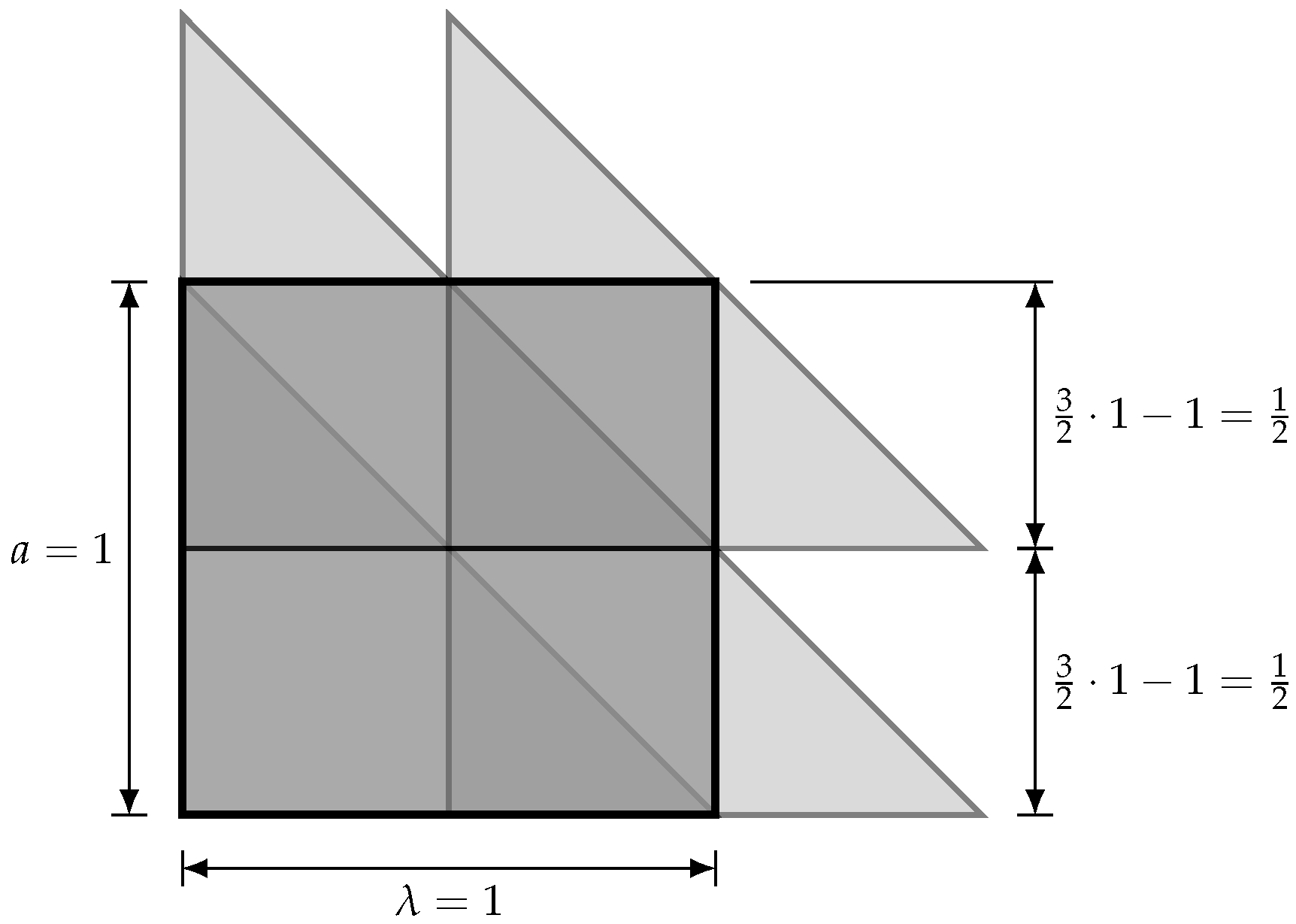
Two congruent right isosceles triangles with legs of length can cover the rectangle for .
Proof.
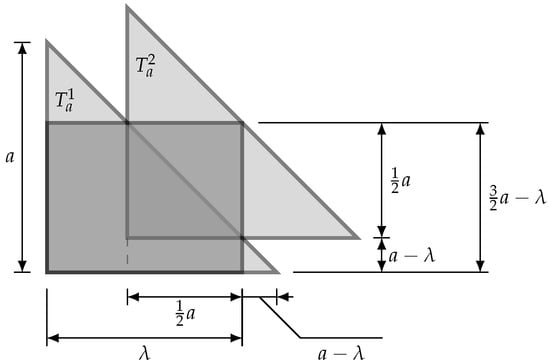
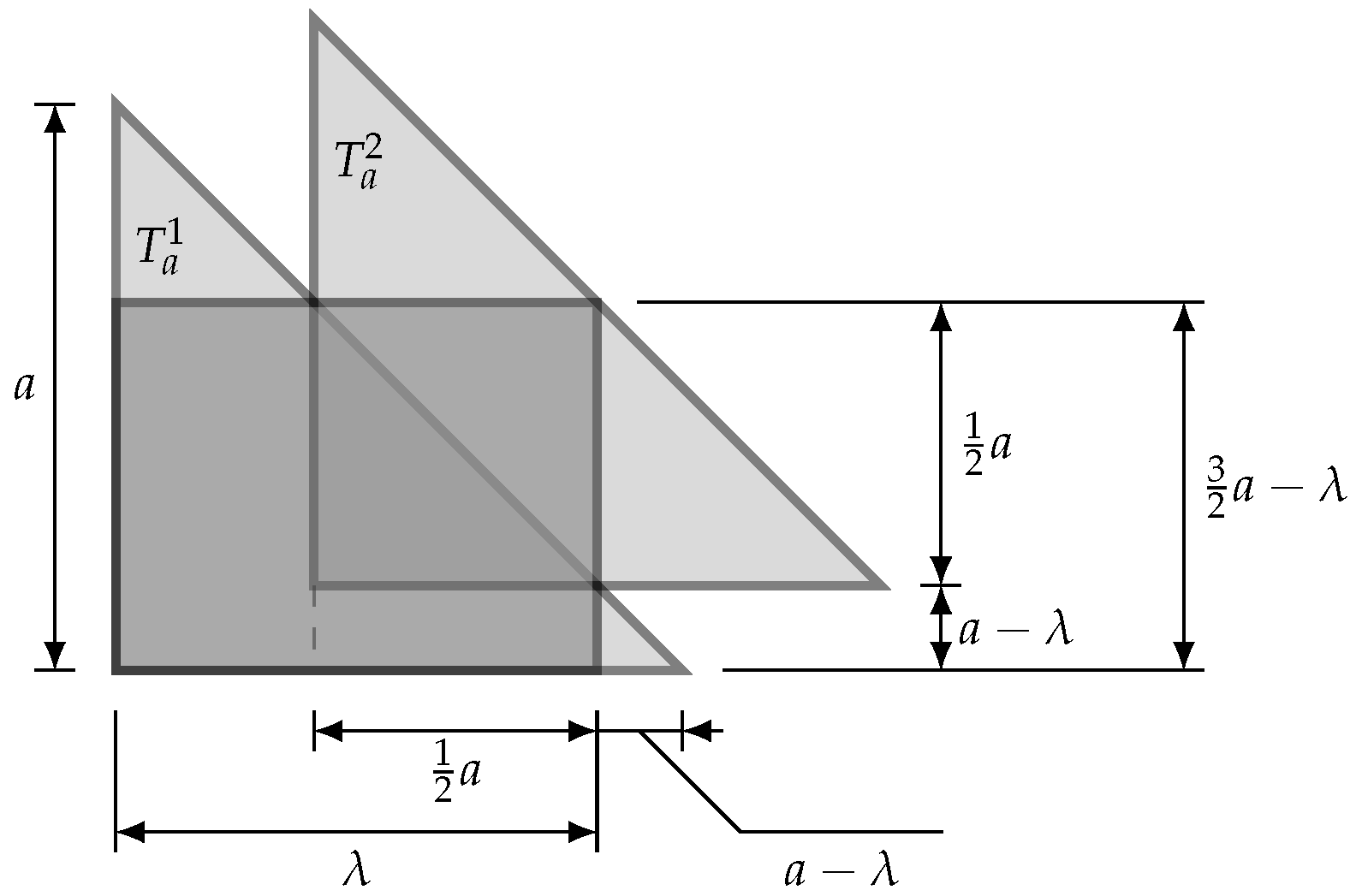
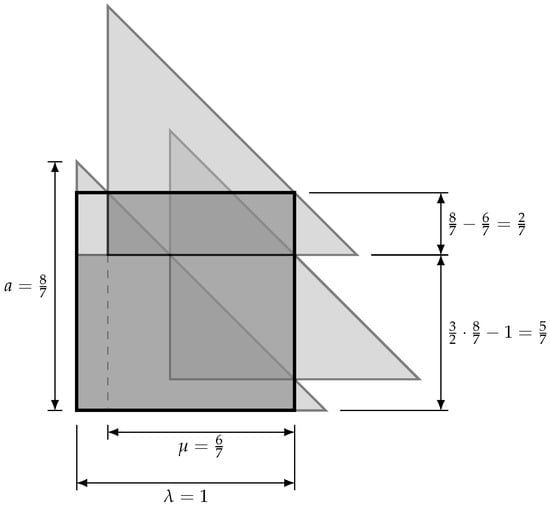
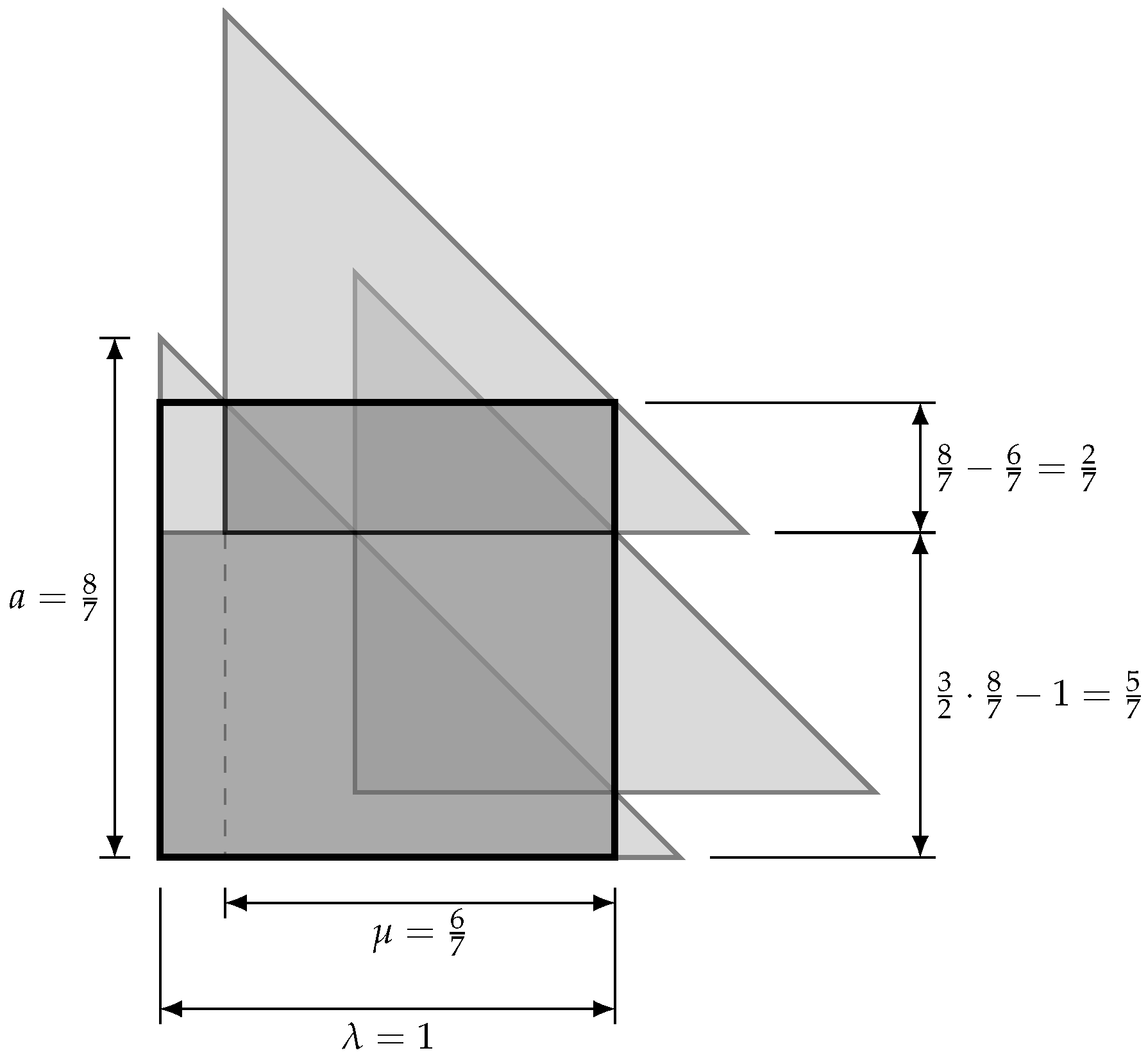
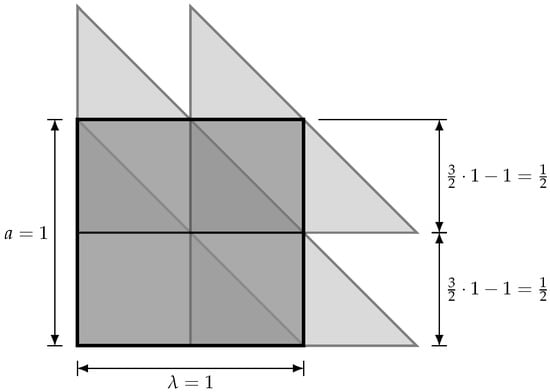
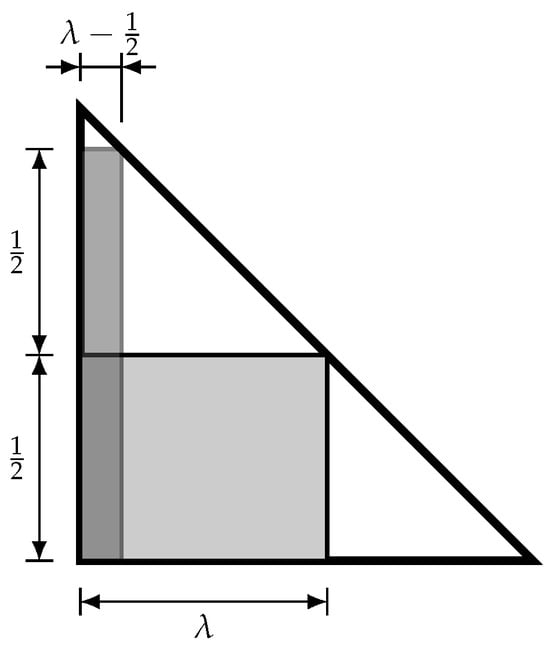
Let and let be right isosceles triangles with legs of length a. Moreover, let be the image of under the translation by the vector . Then the triangles and cover the rectangle (see Figure 1). □
Figure 1.
The rectangle covered with two equal right isosceles triangles.
Lemma 2.
The right isosceles triangle with legs of length can cover the rectangle for .
Proof.
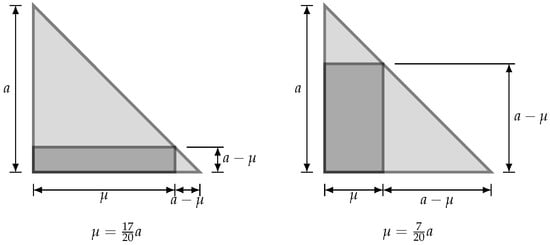
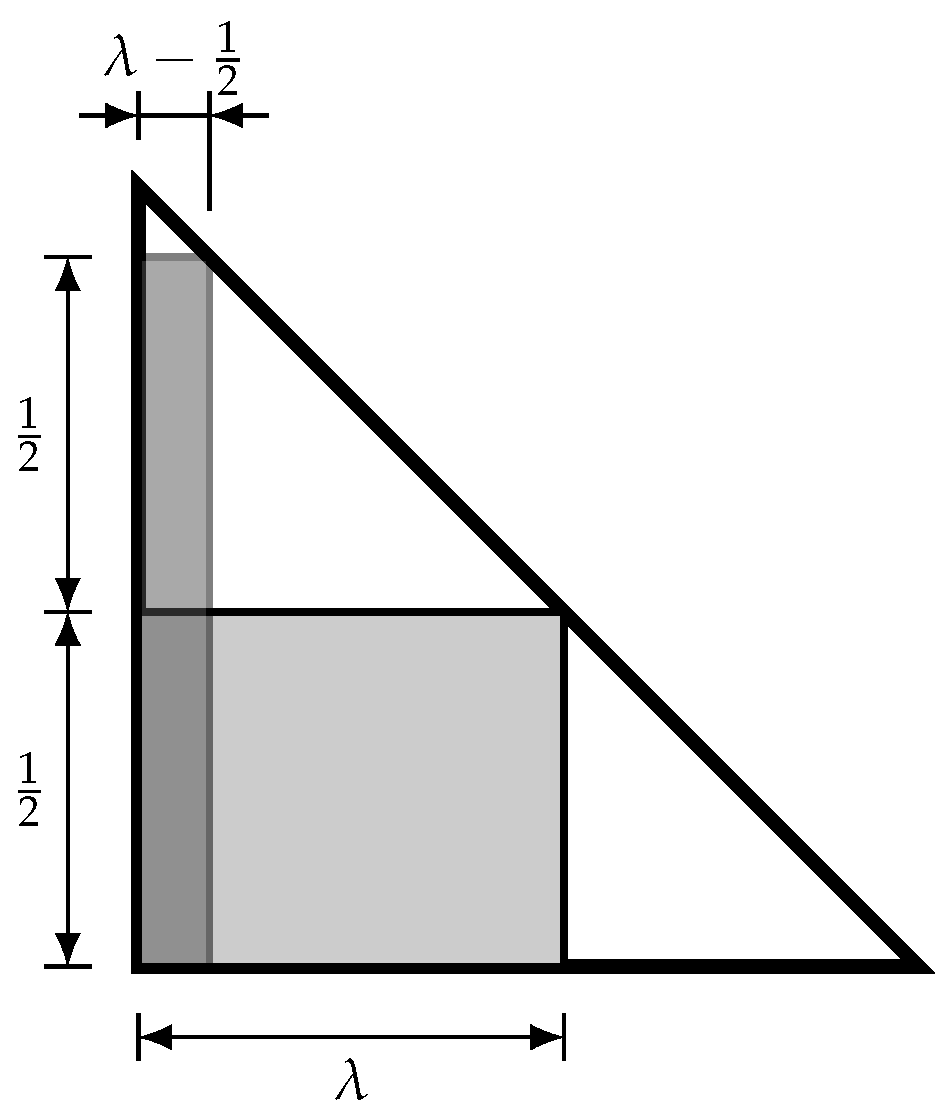
Let T be a right isosceles triangle with legs of length a. Consider a rectangle R with side lengths and , where . Place T in such a way that its right-angle vertex coincides with a vertex of R, and the legs of T contain the two sides of R incident with that vertex (see Figure 2).
Figure 2.
The rectangle covered with the right isosceles triangle.
Two vertices of the rectangle lie on the legs of T at distances and from the right-angle vertex; since , these points are not the endpoints of the legs. The fourth vertex of R lies on the hypotenuse of T, since the sum of the lengths of the sides of R adjacent to this vertex is which equals the length of the legs of T.
Hence, the entire rectangle R is contained in T. Therefore the triangle T covers the rectangle . □
For covering with one triangle, we take and in Lemma 2.
Remark 1.
A single triangle of area 2 (i.e., with ) can cover I.
It is clear that the number 2 cannot be replaced here by any smaller one. Therefore, the lower bound 2 presented in Theorem 1 is tight.
For covering with two equal triangles, we take and in Lemma 1.
Corollary 1.
Two congruent right isosceles triangles with legs of length can cover the square with the sidelength .
Corollary 2.
Two congruent right isosceles triangles with legs of length (with the total area ) can cover the unit square I.
Figure 3.
The unit square covered with three right isosceles triangles with legs of length .
Figure 4.
The unit square covered with four right isosceles triangles with legs of length 1.
Remark 2.
Three congruent right isosceles triangles with legs of length (with the total area ) can cover the unit square I.
Remark 3.
Four congruent right isosceles triangles with legs of length 1 (with the total area ) can cover the unit square I.
Theorem 1.
Any collection of n congruent triangles () homothetic to T with the total area not smaller than 2 permits a translative covering of I.
Proof.
Consider a collection of n congruent triangles , each homothetic to T, with the total area not smaller than 2 and let a denote the length of the legs of . Since the area of one triangle is equal to , the condition implies that
If , a collection of n triangles with the total area 2 can cover I (see Remark 1, Corollary 2 and Remarks 2 and 3).
Assume that .
In the covering process, we will first cover the square with an appropriate family of rectangles. Then, the triangles from the collection will be placed in such a way that they cover these rectangles.
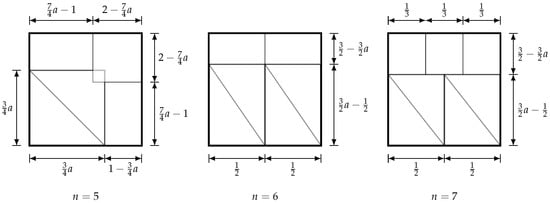
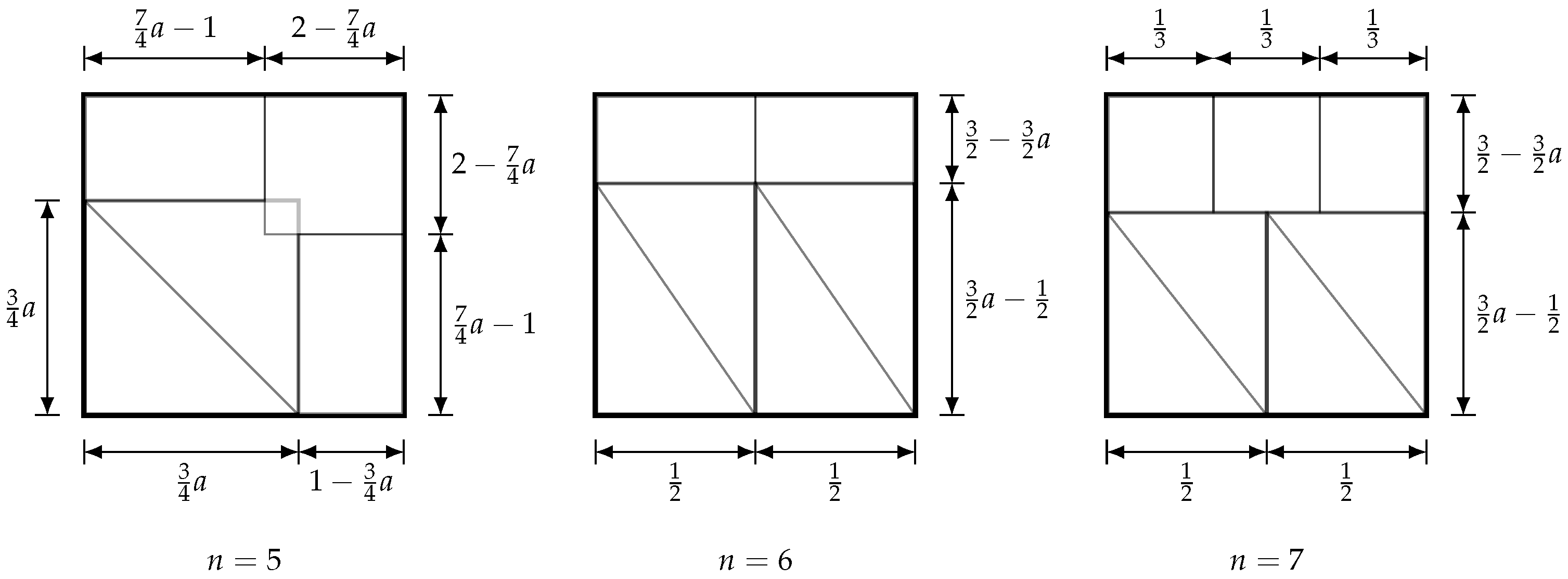
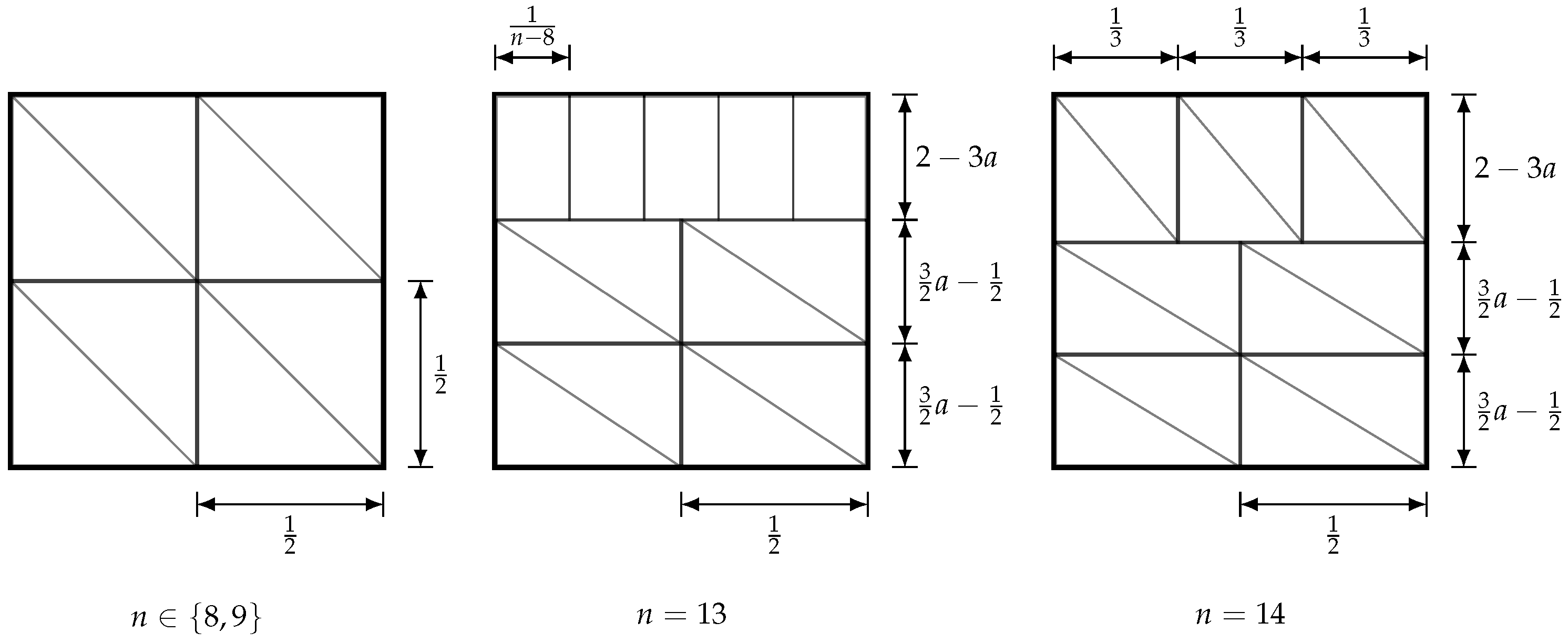
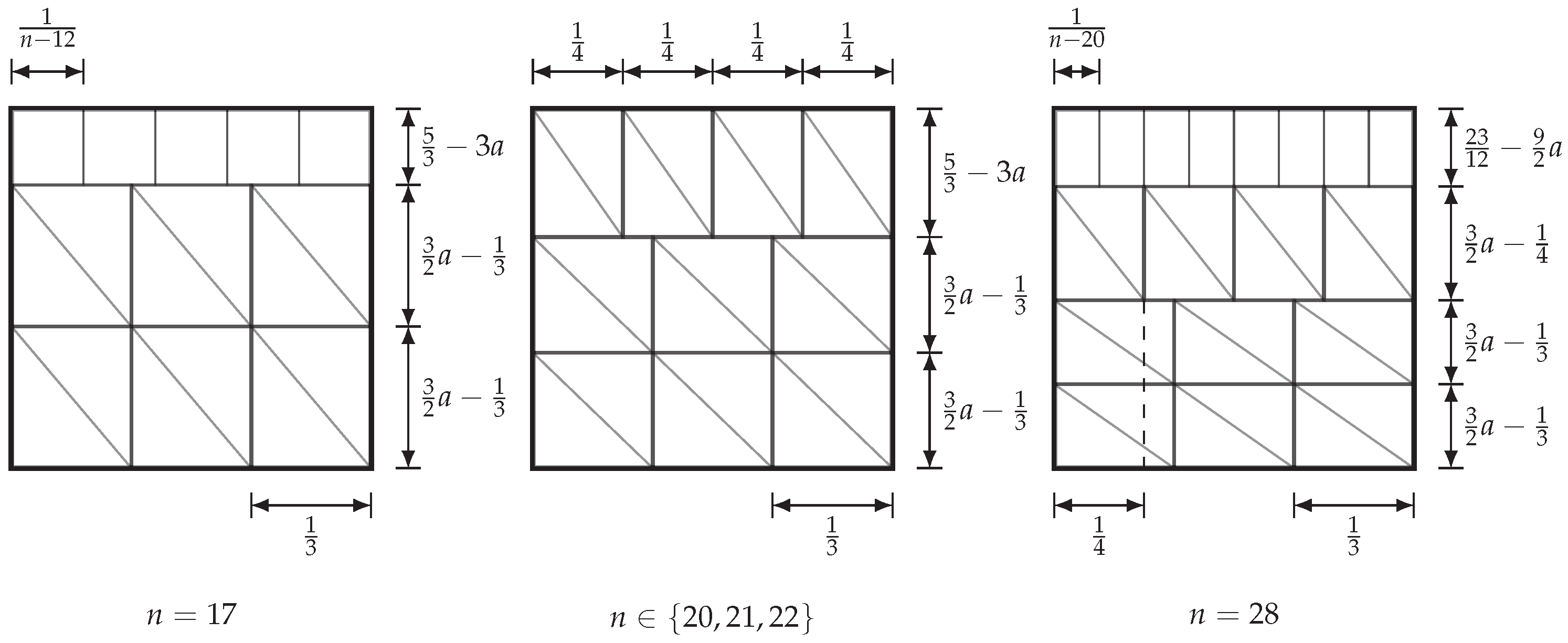
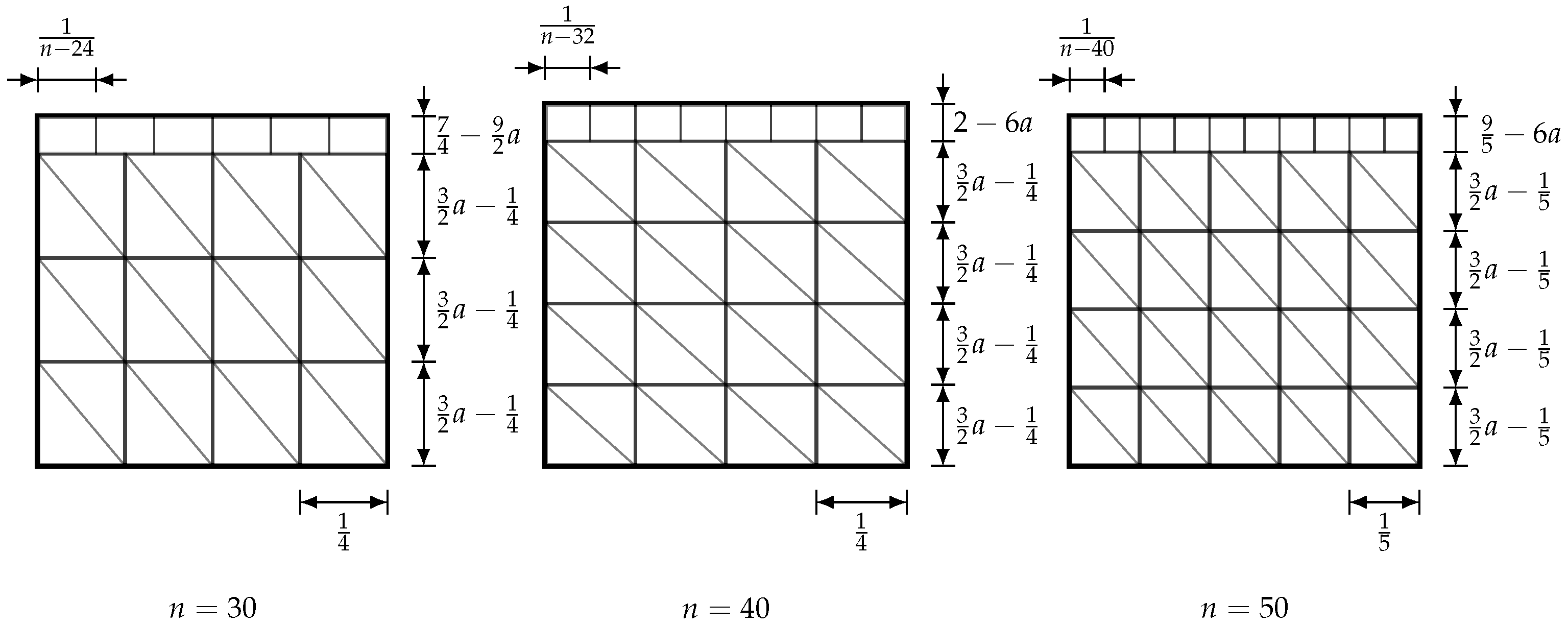
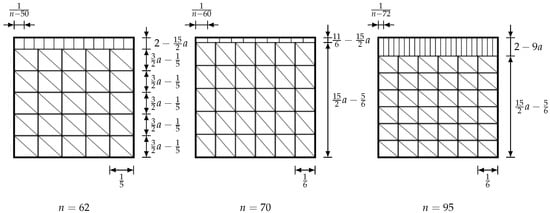
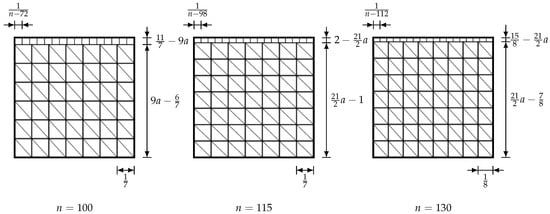
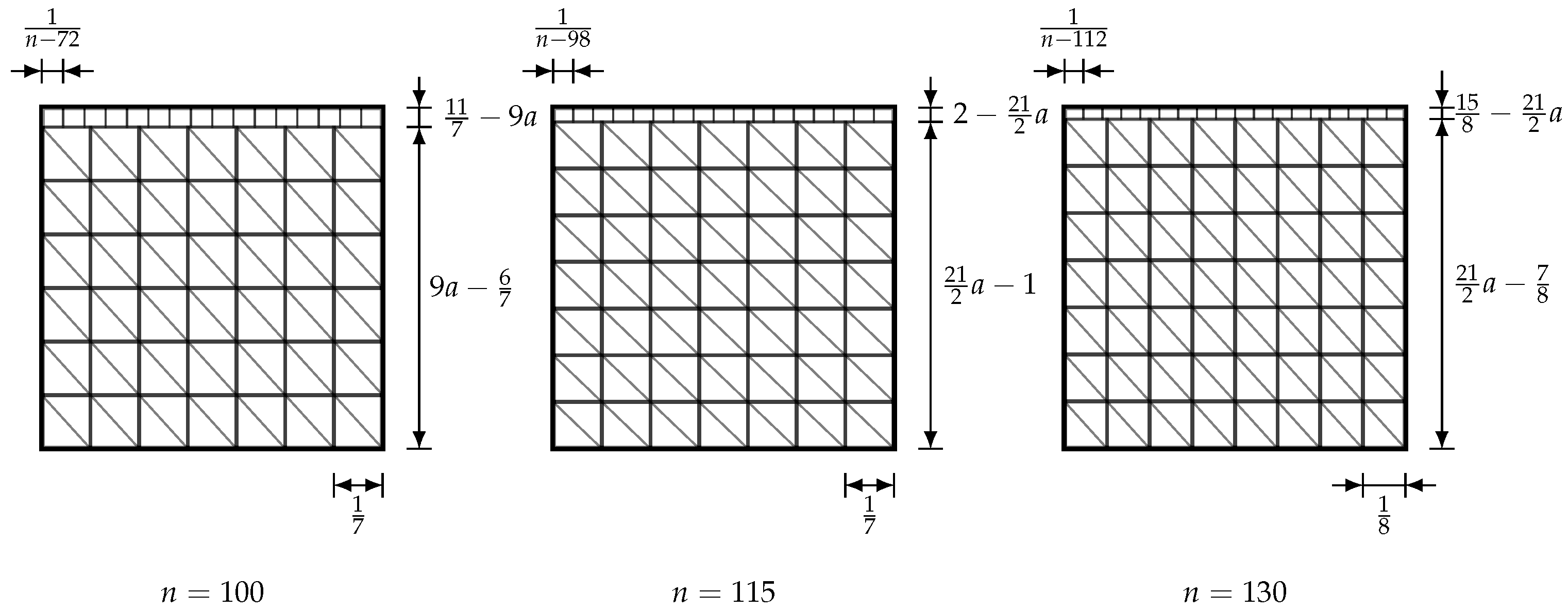
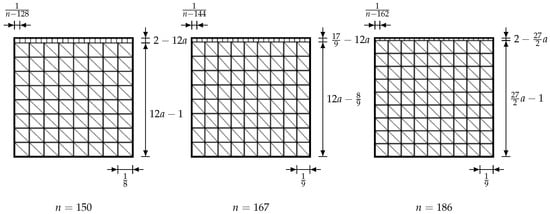
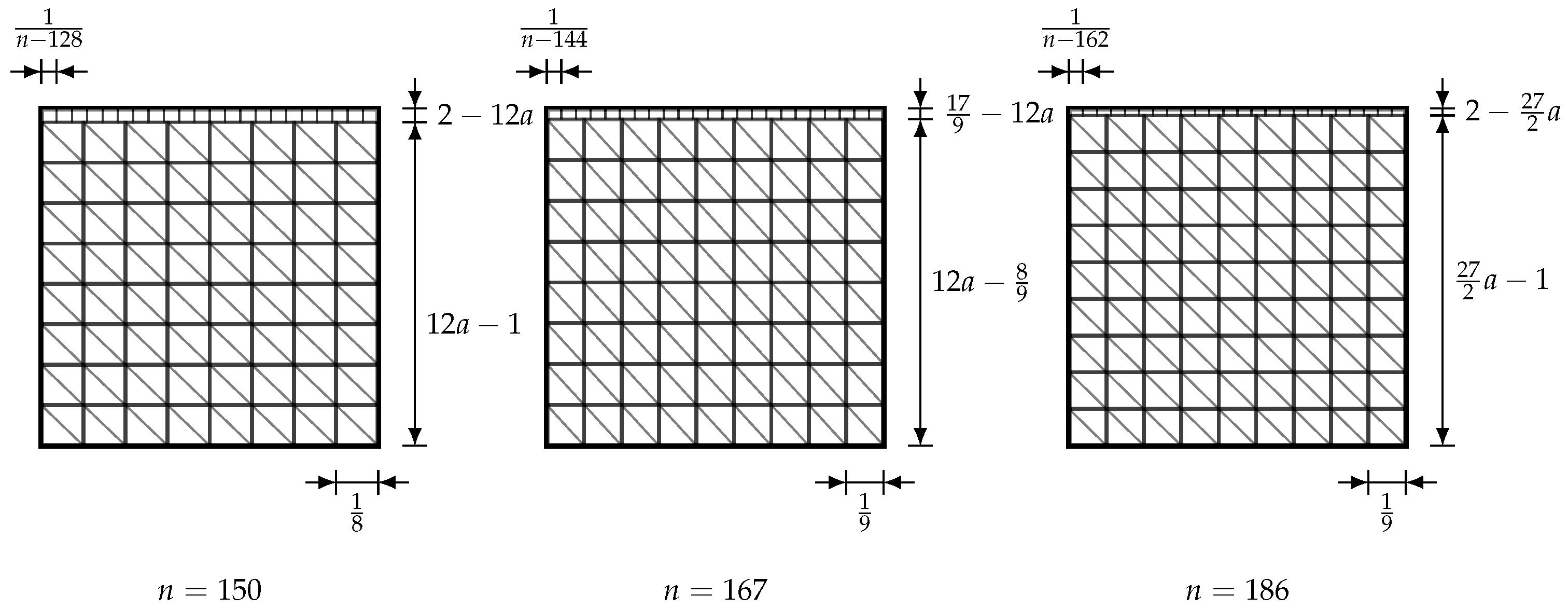
In Figure 5, Figure 6, Figure 7, Figure 8, Figure 9, Figure 10, Figure 11 and Figure 12, any rectangle with a marked diagonal will be covered with two triangles (as in Lemma 1), and any rectangle without a marked diagonal will be covered with a single triangle (as in Lemma 2). For example, in Figure 5, left, the square of sidelength will be covered with two triangles, while the square of sidelength will be covered with one triangle.
Figure 5.
.
Figure 6.
.
Figure 7.
.
Figure 8.
.
Figure 9.
.
Figure 10.
.
Figure 11.
.
Figure 12.
.
In many cases, we will use one of the following two methods.
In the method (for example, see Figure 6, middle, where ) the unit square is covered with rectangles of sidelengths and and with rectangles of sidelengths and . By Lemma 1 (we take ), each rectangle can be covered with two triangles . Moreover, by Lemma 2 (we take ), the rectangle can be covered with , if
Obviously, . Consequently, to check that the triangles can cover I it suffices to show that
where
We will verify this inequality in Cases 4 and 9.
In the method (for example, see Figure 5, middle and right, where ) the unit square is covered with rectangles of sidelengths and and with rectangles of sidelengths and . By Lemma 1, each rectangle can be covered with two triangles (we take ). Moreover, by Lemma 2 (we take ), the rectangle can be covered with , provided that
Consequently, to check that the triangles can cover I, it suffices to show that
where
We will verify this inequality in Cases 2, 6, and 9.
Consider ten cases depending on the number of triangles in the collection.
- Case 1: . We cover I with four rectangles as shown in Figure 5, left. Now, we check that five triangles , for , can cover these rectangles. According to Corollary 1, two triangles can cover a square of sidelength . Since by Lemma 2, a rectangle of size can be covered with a single triangle . Thus, we cover two such rectangles with two triangles . Moreover, by taking in Lemma 2, we conclude that can cover a square of sidelength . It is easy to verify that Therefore, a square of sidelength can be covered with .
- Case 3: . We cover the square with four equal squares, as shown in Figure 6, left. Clearly,By Corollary 1 these rectangles can be covered with eight triangles .
- Case 5: (see Figure 6, right). Since for , the rectangle of size can be covered with two triangles .
- Case 7: . See Figure 7, middle. Bysix rectangles and four rectangles can be covered with 20 triangles .
- Case 9: .If (see Figure 8, left), then we use method :If (see Figure 8, middle), then we use :If (see Figure 8, right), then we use :If (see Figure 9, left), we use :If (see Figure 9, middle), we use :If (see Figure 9, right), we use :If (see Figure 10, left), we use :If (see Figure 10, middle), we use the method :If (see Figure 10, right), we use :If (see Figure 11, left), we use :If (see Figure 11, middle), we use :Finally, if (see Figure 11, right), we use :
- Case 10: . Clearly, for any there is an integer m such thatNote that
Subcase 10.1: . It is easy to check that
This implies that I can be covered with rectangles of size (as shown in Figure 12, left, where and ). Each such rectangle can be covered with two triangles (we take in Lemma 1). Consequently, I can be covered with triangles and to prove that I can be covered with n triangles it suffices to check that . Observe that
Since (the total area of the triangles is not smaller than 2), it follows that .
Subcase 10.2: . We cover I with squares of sidelength (as illustrated in Figure 12, right, where ). By Corollary 1, each such square can be covered with two triangles (in our subcase ). Consequently, I can be covered with triangles . Observe that
Since , it follows that . Consequently, I can be covered with n triangles . □
3. Translative Covering a Square with Unequal Triangles
By an s-rectangle we mean a rectangle , where .
Lemma 3.
Any right isosceles triangle of legs of length not greater than 2 contains an s-rectangle of the area equal to times the area of .
Proof.
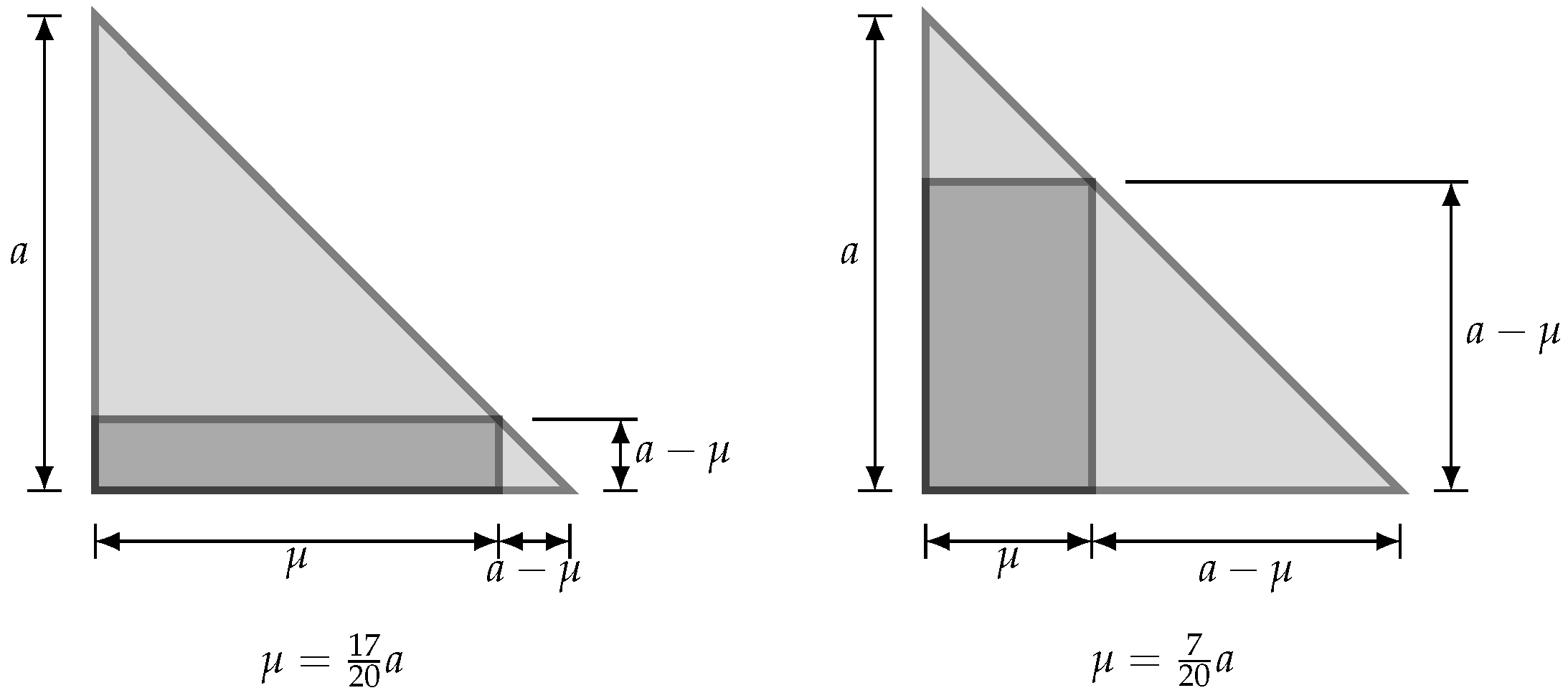
Let k be a non-negative integer such that , where t denotes the length of the leg of .
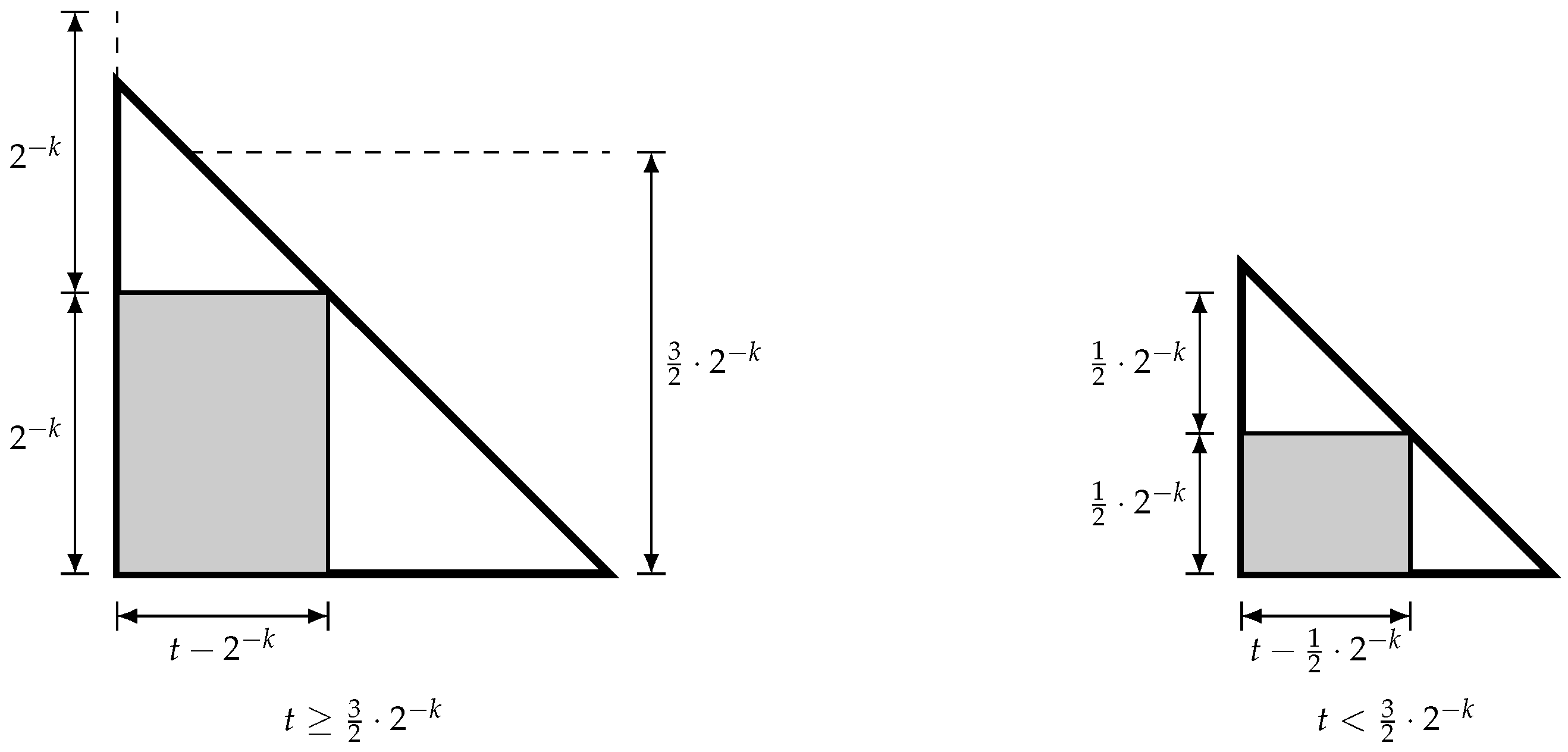
- Case 1: . It is easy to check that . ThusThis means that contains the s-rectangle of the area not smaller than times the area of (see Figure 13, left). Clearly, .
- Case 2: . It is easy to verify that . ThusThis means that contains the s-rectangle of the area greater than times the area of (see Figure 13, right). Clearly, . □
Figure 13.
s-rectangle contained in .
Lemma 4.
If a right isosceles triangle contains a rectangle for and , then also contains a rectangle .
Proof.
See Figure 14, where . □
Figure 14.
Ilustration of Lemma 4.
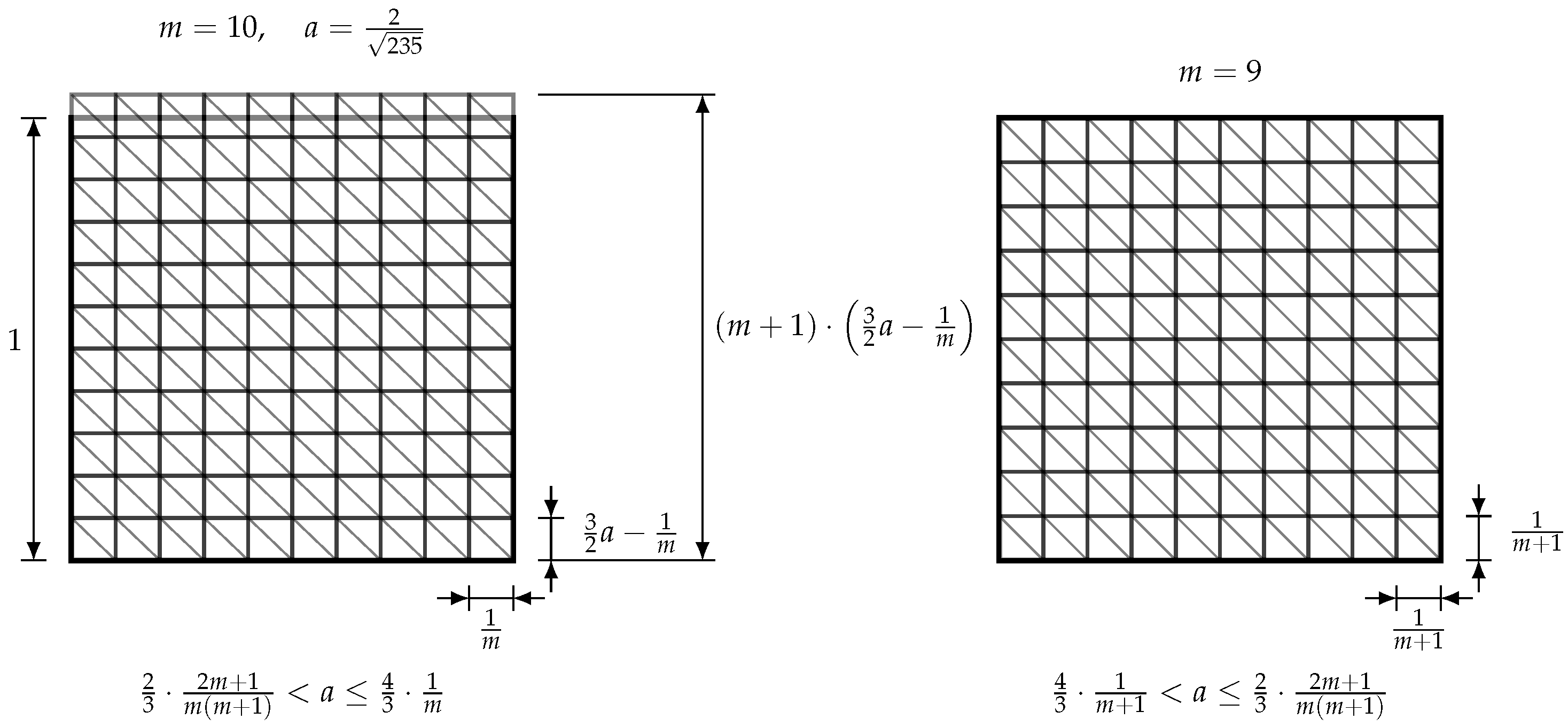
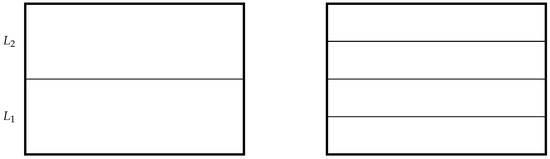
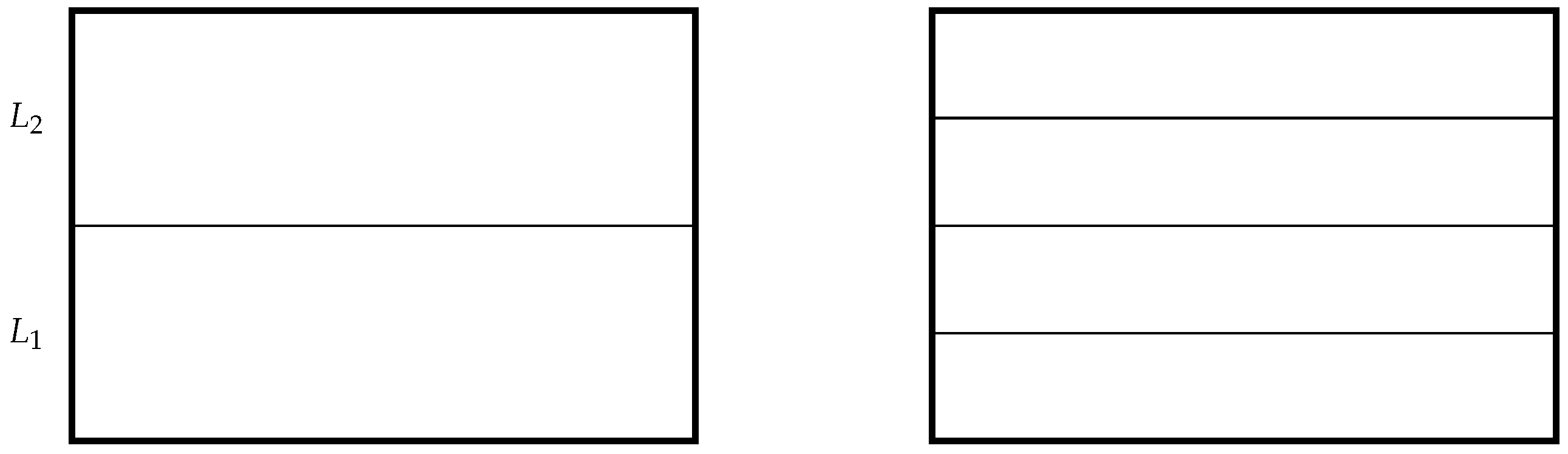
Now we describe the main covering method. Let (for ) and let be a collection of triangles homothetic to T such that , where is the length of the leg of , . The rectangle is divided into horizontal layers of height , for each positive integer k (see Figure 15, left, where and Figure 15, right, where ).
Figure 15.
Division of the rectangle into horizontal layers.
By Lemma 3 we know that any triangle contains an s-rectangle such that and that . We will use these rectangles for the covering. The rectangles, except perhaps the last one, will be placed in layers of the proper height.
- The covering algorithm.
- [1]
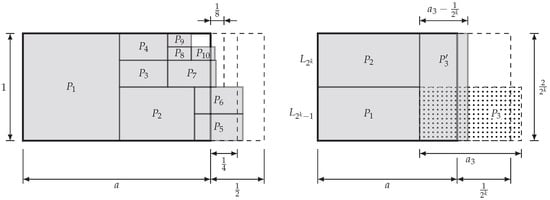
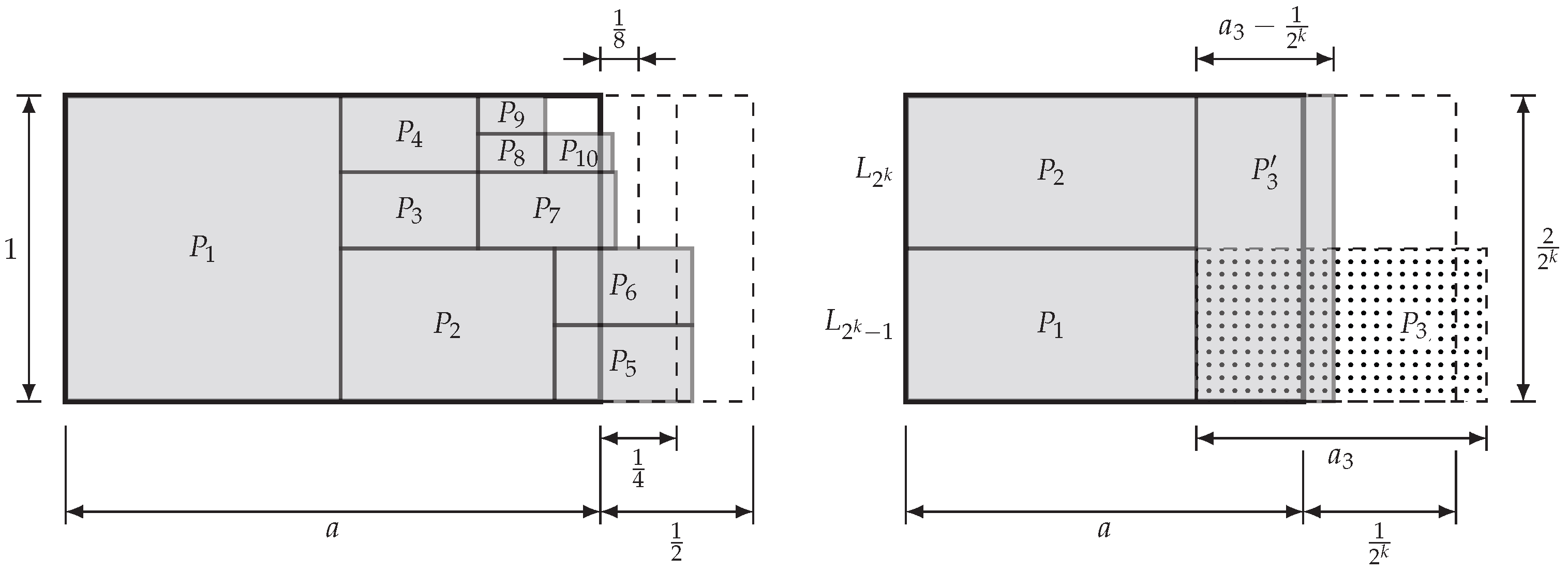
- The first triangle is placed so that the corresponding rectangle is placed into the lowest layer of height at the left-bottom corner of the layer, i.e., is packed at the left-bottom corner of (see Figure 16 left and right).Figure 16. Illustration of the covering algorithm.
- Assume that and that have been placed. Let be an integer such that . Denote by all the layers in of height . If each point of a layer is covered by a placed triangle, then is full.
- [2]
- If there is enough empty space in to pack , then we pack into the lowest possible layer of height as far to the left as possible (see in Figure 16 left and right).
- [3]
- Otherwise, we find the smallest integer j such that the layer is not full.
- [3a]
- If either or , then we place along the bottom of so that the left side of is the right side of the last rectangle packed into this layer.
- [3b]
- If and if is full, then we place along the bottom of so that the left side of is the right side of the last rectangle packed into this layer.
- [3c]
- If and if is not full, then we check which layer from among and is the least filled. Initially, we place along the bottom of this last filled layer so that the left side of is the right side of the last rectangle packed into this layer.
- [3c1]
- If, after placing , the distance between the right side of and the right side of is not greater than , then we do not change anything; in that case the area of the part of lying outside is not greater than .
- [3c2]
- If after placing (together with ) the distance between the right side of and the right side of is greater than (as on Figure 16 right), then we will use another part of for the covering; by Lemma 4 we can cover with the uncovered part of (the uncovered part of ), which is contained in a rectangle of sides of length (as on Figure 16, right); as a consequence, is covered by triangles .
Example 1.
On Figure 16, left the rectangle is packed by Rule 1, the rectangles and by Rule 2, the rectangles and are placed by Rule 3a, the rectangle , of height 1/8, by Rule 3c1.
Example 2.
On Figure 16, to the right of the rectangle is packed by Rule 1 and the rectangle by Rule 2. Since there is not enough space to put in or in , we use Rule 3c2. The whole is covered.
Lemma 5.
Any collection of positive homothetic copies T of homothety ratio not greater than 2, with the total area not smaller than permits a translative covering of the rectangle , where .
Proof.
Let be a collection of triangles homothetic to T and let denote the length of the leg of , . Without loss of generality, we can assume that .
We cover by the method presented above. Assume that is not covered by . We will show that this leads to a contradiction.
Since is not covered, no rectangle has been placed by Rule 3c2. Observe that all placed rectangles have disjoint interiors. Some rectangles (placed by Rule 1 or 2) are contained in . If a rectangle has been placed by Rule 3b, then the area of the part of lying outside is not greater than . If a rectangle has been placed by Rule 3c1, then the area of the part of lying outside is not greater than .
The sum of the areas of parts of rectangles lying outside is smaller than . This means that the total area of the rectangles , is smaller than . Consequently, by Lemma 3, the sum of the areas of triangles is smaller than , which is a contradiction. □
Taking in Lemma 5, we get the following result.
Theorem 2.
Any collection of positive homothetic copies T with the total area not smaller than 3 permits a translative covering of I.
Conjecture 1.
Any collection of positive homothetic copies T with the total area not smaller than 2 permits a translative covering of I.
4. Translative Covering a Rectangle with Triangles
Lemma 6.
Any collection of positive homothetic copies T of homothety ratio not greater than 2, with the total area not smaller than permits a translative covering of the rectangle .
Proof.
Assume that is a sequence of positive homothetic copies T of homothety ratio not greater than 2, with the total area not smaller than . Let be a homothety with the ratio . By Lemma 5 we know that the triangles can translatively cover . This means that can translatively cover R. □
Theorem 3.
Any collection of positive homothetic copies T with the total area not smaller than permits a translative covering of the rectangle , provided that .
Proof.
Let , where Assume that is a sequence of positive homothetic copies T, with the total area not smaller than . We lose no generality in assuming that , where denotes the length of the leg of .
- Case 1: . Since for , by Lemma 6 we deduce that the triangles can cover R.
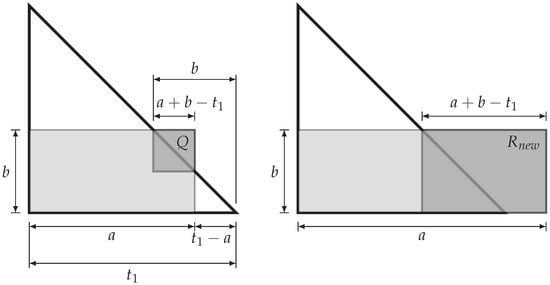
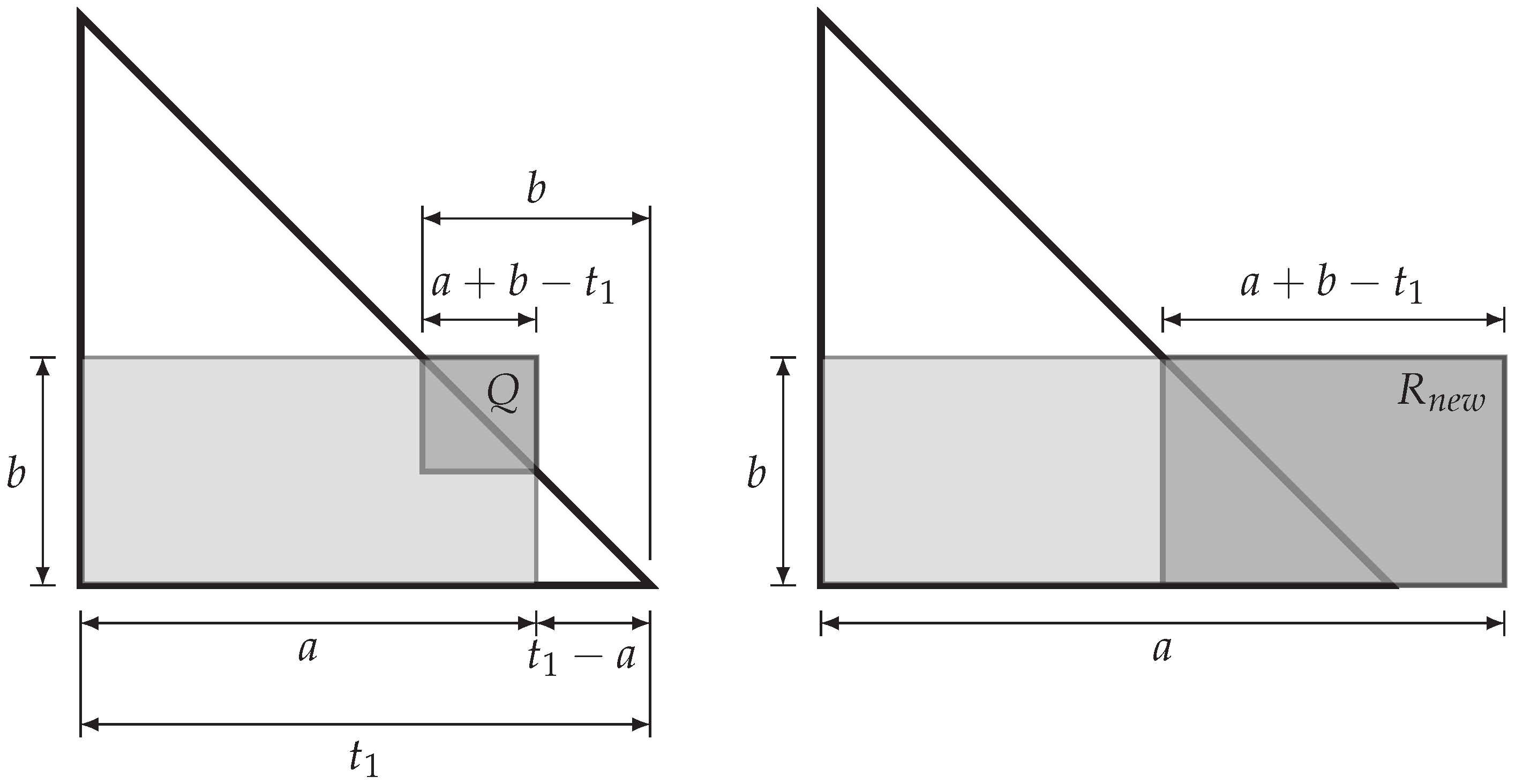
- Case 2: and . The first triangle is placed so that the part of R not covered by this triangle is contained in a square Q of sidelength (see Figure 17, left). It is easy to verify thatBy Theorem 2, we deduce that the remaining triangles , of the total area greater than , can cover Q (the total area of the triangles is greater than three times the area of Q).Figure 17. Illustration of Cases 2 and 3 of the proof of Theorem 3.
- Case 3: and . The first triangle is placed so that the part of R not covered by this triangle is contained in a rectangle (see Figure 17, right). It is easy to verify thatThis implies, by Lemma 6, that the remaining triangles , of the total area greater than , can cover .
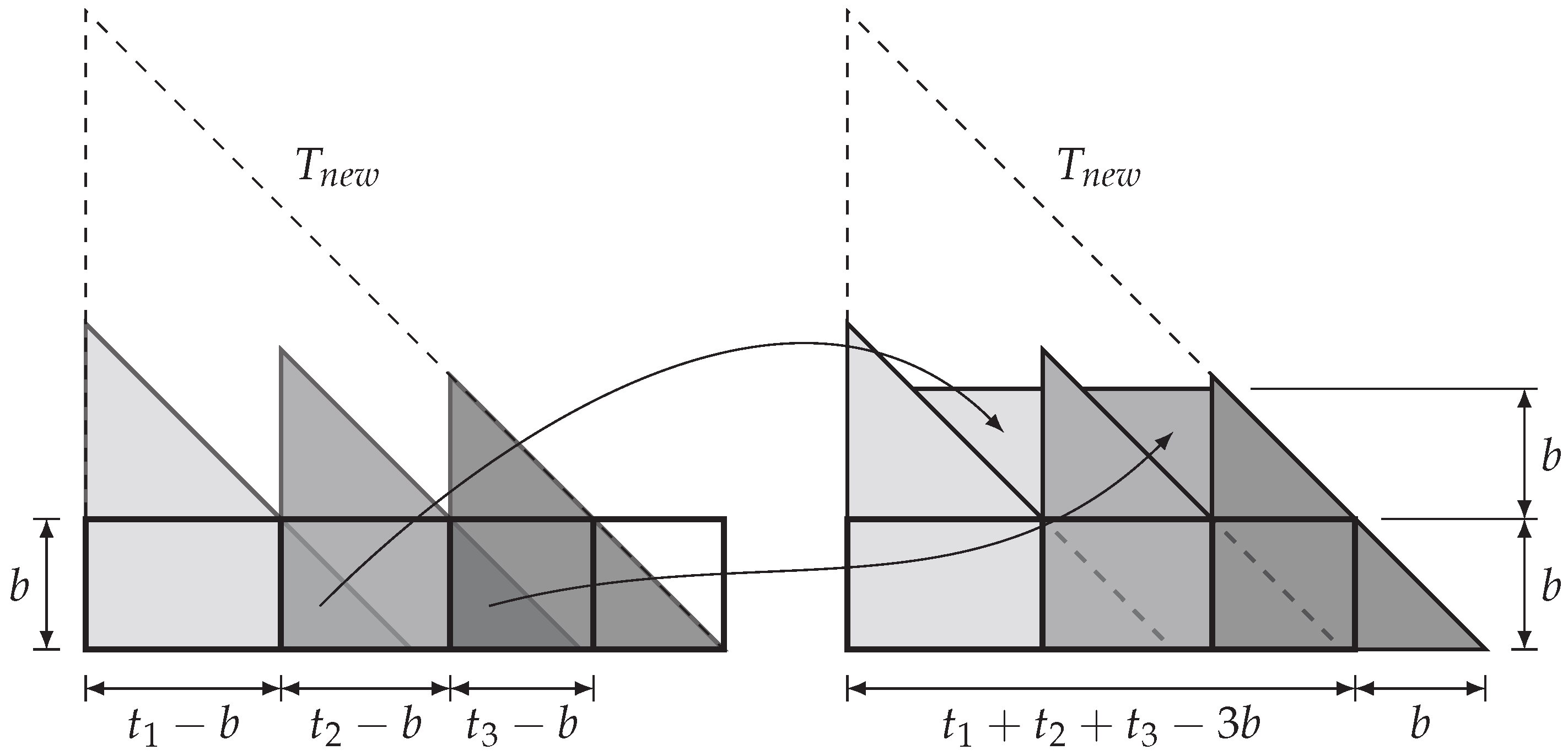
- Case 4: there is an integer such that and . Any can cover the rectangle . Consequently, can cover . It is easy to see (Figure 18) that the sum of the areas of is smaller than the area of a triangle of legs of length . Consider the following sequence of triangles: . By Case 2 or Case 3, we know that this sequence permits a translative covering of R. Consequently, can cover R.Figure 18. Ilustration of Case 4 of the proof of Theorem 3.
- Case 5: for each i. We place the triangles as in Case 4. If R is not covered, then the sum of the areas of the triangles is not greater than the area of the triangle of legs of length smaller than (see Figure 18), which is a contradiction. □
Clearly, any copy of T with the homothety ratio smaller than can not translatively cover the rectangle . This means that the lower bound given in Theorem 3 is tight.
Author Contributions
Conceptualization, J.J. and Ł.Z.; Methodology, J.J. and Ł.Z.; Formal analysis, J.J. and Ł.Z.; Visualization, J.J. and Ł.Z.; Writing—original draft preparation, J.J. and Ł.Z.; Writing—review and editing, J.J. and Ł.Z. All authors have read and agreed to the published version of the manuscript.
Funding
This research received no external funding.
Data Availability Statement
No new data were created or analyzed in this study. Data sharing is not applicable to this article.
Conflicts of Interest
The authors declare no conflicts of interest.
References
- Januszewski, J. Translative covering of a square by a sequence of arbitrary-oriented squares. Demonstr. Math. 2007, 40, 681–700. [Google Scholar] [CrossRef] [Scilit]
- Januszewski, J. Translative covering of a square by a sequence of arbitrary-oriented squares: Part II. Demonstr. Math. 2008, 41, 441–454. [Google Scholar] [CrossRef] [Scilit]
- Moon, J.W.; Moser, L. Some packing and covering theorems. Colloq. Math. 1967, 17, 103–110. [Google Scholar] [CrossRef] [Scilit]
- Januszewski, J. Covering the unit square by squares. Beitr. Algebra Geom. 2002, 43, 411–422. [Google Scholar]
- Füredi, Z. Covering a triangle with homothetic copies. In Discrete Geometry; Bezdek, A., Ed.; CRC Press: Boca Raton, FL, USA, 2003; pp. 435–445. [Google Scholar]
- Song, F.; Su, Z. Parallel covering a square with isosceles right triangles. Results Math. 2025, 80, 124. [Google Scholar] [CrossRef] [Scilit]
- Januszewski, J.; Zielonka, Ł. Covering a rectangle with isosceles right triangles. J. Geom. 2025, 116, 42. [Google Scholar] [CrossRef] [Scilit]
Disclaimer/Publisher’s Note: The statements, opinions and data contained in all publications are solely those of the individual author(s) and contributor(s) and not of MDPI and/or the editor(s). MDPI and/or the editor(s) disclaim responsibility for any injury to people or property resulting from any ideas, methods, instructions or products referred to in the content. |
© 2026 by the authors. Licensee MDPI, Basel, Switzerland. This article is an open access article distributed under the terms and conditions of the Creative Commons Attribution (CC BY) license.