Article

Translative Covering a Square with Isosceles Right Triangles

by
Janusz Januszewski
and
Łukasz Zielonka
*
Department of Mathematics, Bydgoszcz University of Science and Technology, Al. Prof. S. Kaliskiego 7, 85-789 Bydgoszcz, Poland
*
Author to whom correspondence should be addressed.
Geometry 2026, 3(2), 8; https://doi.org/10.3390/geometry3020008
Submission received: 4 November 2025 / Revised: 17 March 2026 / Accepted: 7 April 2026 / Published: 13 April 2026

Abstract

A translative covering the rectangle a × b with homothetic copies of a right isosceles triangle T (of the legs parallel to the sides of a × b ) is considered. It is shown that any collection of equal triangles homothetic to T with the total area at least 2 permits a translative covering of 1 × 1 ; this bound is tight. It is also demonstrated that any collection of positive homothetic copies of T with the total area at least 3 permits a translative covering of 1 × 1 . Moreover, it is proven that if a 5 + 33 4 b , then any collection of triangles homothetic to T with the total area at least 1 2 ( a + b ) 2 permits a translative covering of a × b ; this bound is tight.

1. Introduction

A collection (a sequence) C 1 , C 2 , of planar convex bodies permits a covering of a planar convex body D, if the sets C 1 , C 2 , can cover D, i.e., if it is possible to apply translations and rotations to the sets C n ( n = 1 , 2 , ), then the resulting translated and rotated bodies C n cover D, i.e., D C n . If we use only translations, then we get a translative covering.
It is known that any collection of squares whose total area is not smaller than 3 permits a translative covering of a unit square (see [1,2,3]). If rotations are allowed, then the lower bound 3 can be reduced to 2 (see [4]). It is also known [5] that any collection of homothetic copies of a triangle T whose total area is not smaller than two times the area of T permits a translative covering of T . All these bounds are tight.
Let T be a right isosceles triangle and let I be the unit square with the sides parallel to the legs of T. Song and Su [6] proved that any collection of positive homothetic copies of T with the total area not smaller than 2 permits a covering of I. The generalization of this result for the covering rectangles is given in [7]. The lower bound 2 presented in [6] is tight. However, both translations and 180° rotations are used for the covering. In this note, we do not use rotations. We are not able to generalize this result for the covering I with unequal triangles, but we are able to obtain the tight lower bound for the covering I with equal triangles, as well as for the covering of some rectangles with unequal triangles.
In Section 2 we will show that any collection of congruent triangles homothetic to T with the total area not smaller than 2 permits a translative covering of I; this lower bound is tight.
In Section 3, we will prove that any collection of positive homothetic copies T with the total area not smaller than 3 can translatively cover I; it is very likely that this lower bound is not tight.
Let R = a × b be a rectangle of sidelengths a and b, with the sides parallel to the legs of T. In Section 4 we will show that if a 5 + 33 4 b , then any collection of positive homothetic copies of T with the total area not smaller than 1 2 ( a + b ) 2 permits a translative covering of R; this lower bound is tight.

2. Translative Covering a Square with Equal Triangles

Lemma 1.
Two congruent right isosceles triangles with legs of length a > 0 can cover the rectangle λ × 3 2 a λ for 1 2 a λ a .
Proof. 
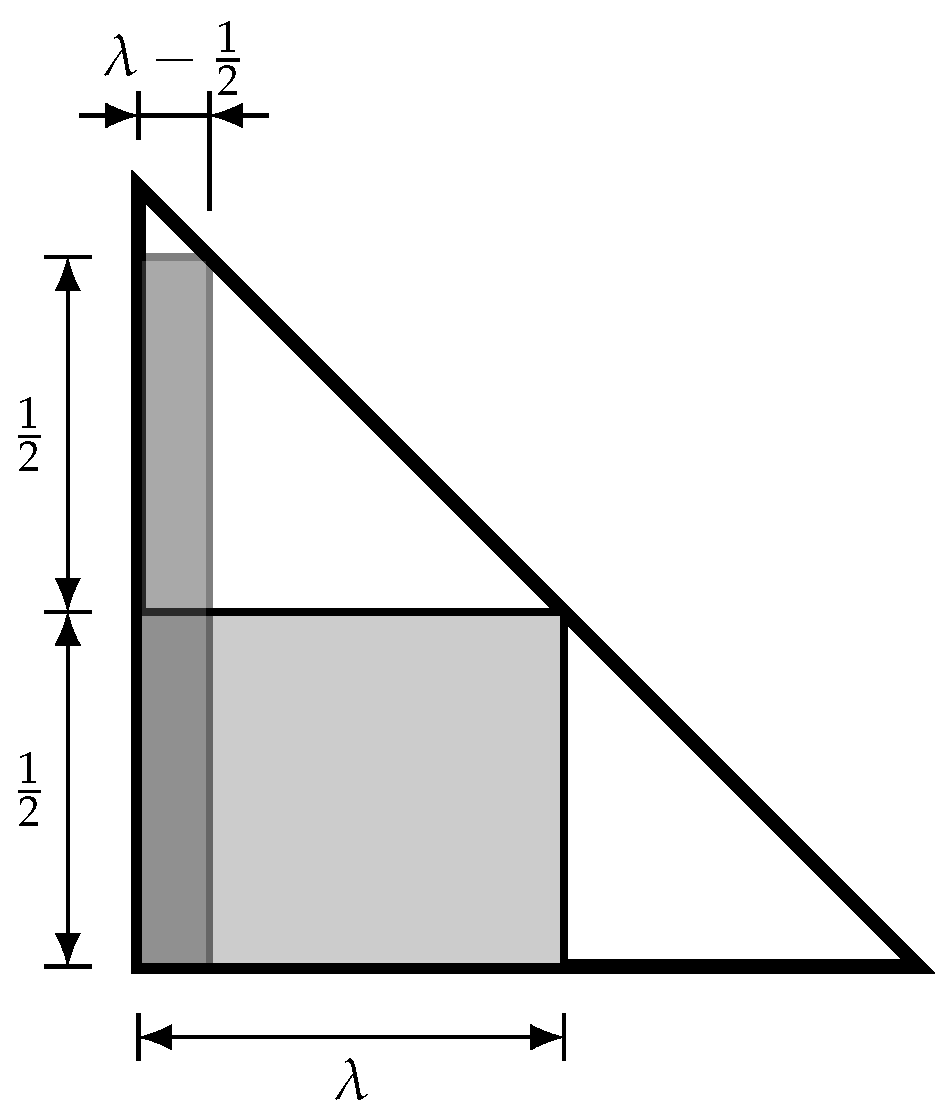
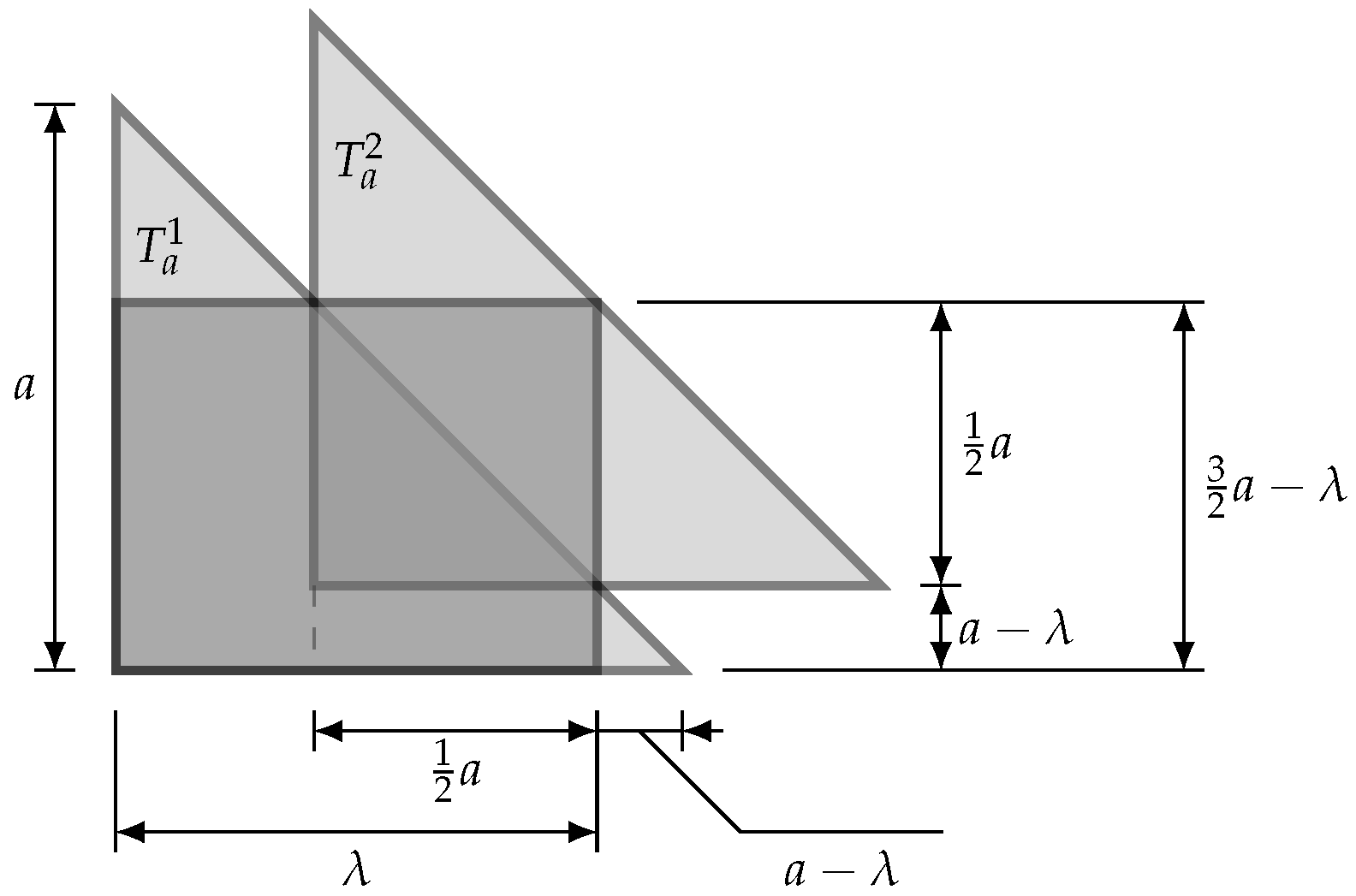
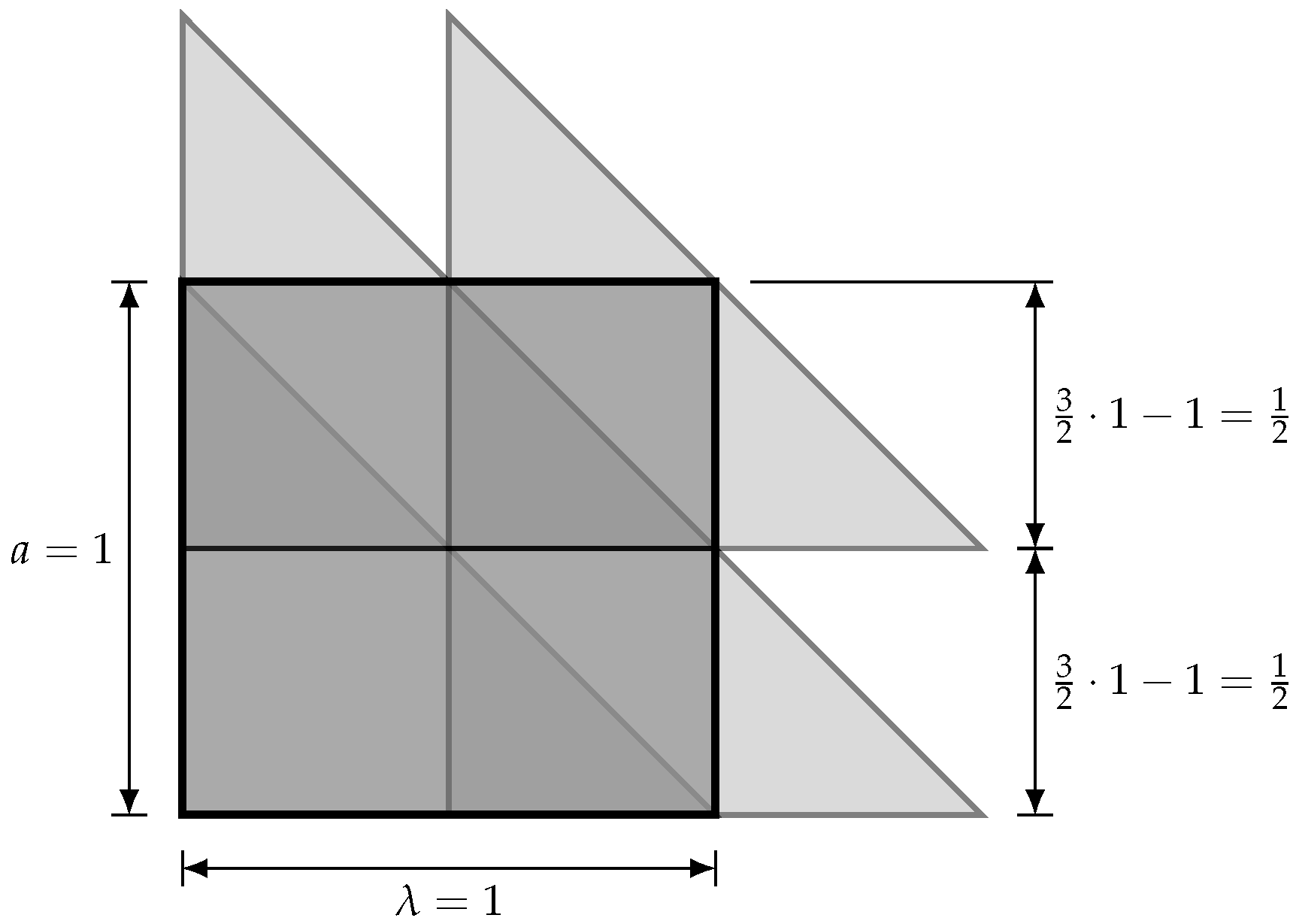
Let λ 1 2 a , a and let T a 1 , T a 2 be right isosceles triangles with legs of length a. Moreover, let T a 2 be the image of T a 1 under the translation by the vector λ 1 2 a , a λ . Then the triangles T a 1 and T a 2 cover the rectangle λ × 3 2 a λ (see Figure 1).    □
Lemma 2.
The right isosceles triangle with legs of length a > 0 can cover the rectangle μ × a μ for 0 < μ < a .
Proof. 
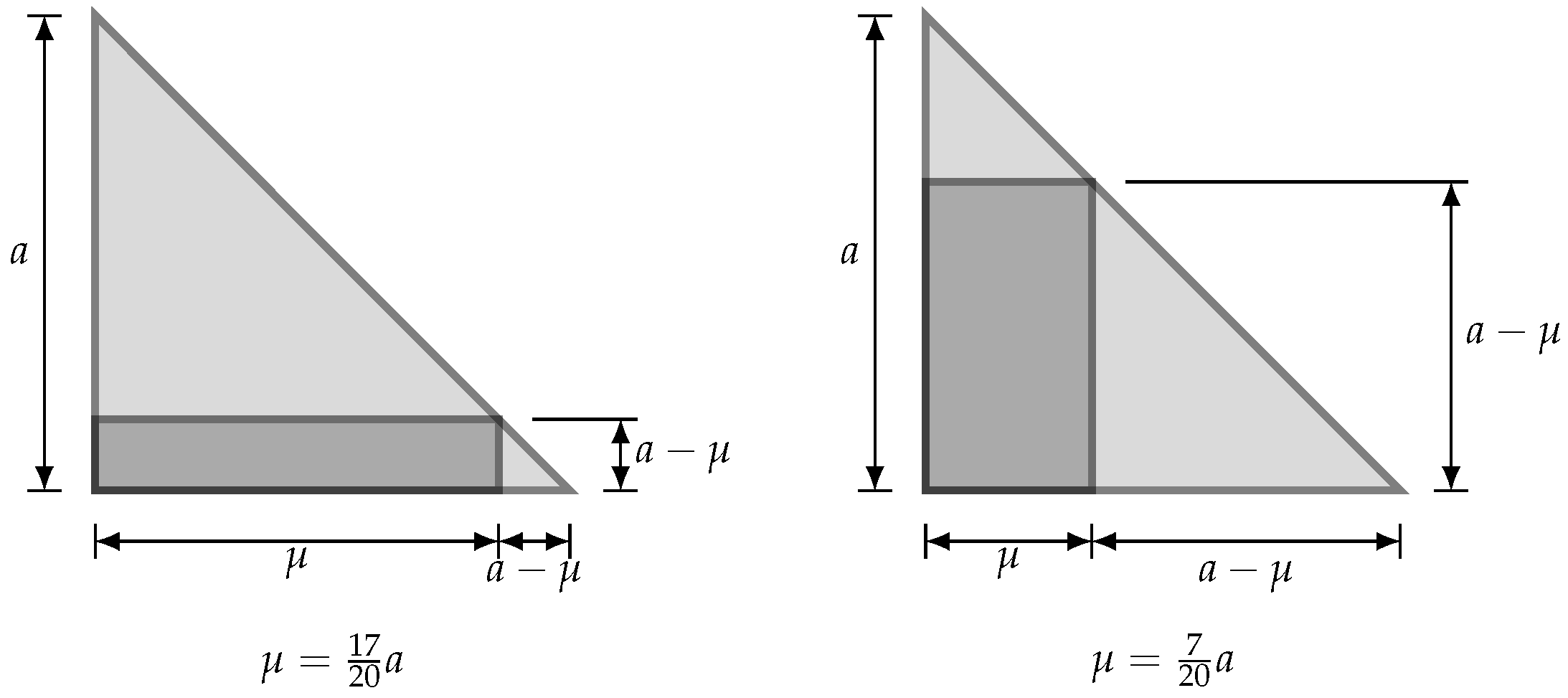
Let T be a right isosceles triangle with legs of length a. Consider a rectangle R with side lengths μ and a μ , where 0 < μ < a . Place T in such a way that its right-angle vertex coincides with a vertex of R, and the legs of T contain the two sides of R incident with that vertex (see Figure 2).
Two vertices of the rectangle lie on the legs of T at distances μ and a μ from the right-angle vertex; since 0 < μ < a , these points are not the endpoints of the legs. The fourth vertex of R lies on the hypotenuse of T, since the sum of the lengths of the sides of R adjacent to this vertex is μ + ( a μ ) = a , which equals the length of the legs of T.
Hence, the entire rectangle R is contained in T. Therefore the triangle T covers the rectangle μ × ( a μ ) .    □
For covering with one triangle, we take μ = 1 and a = 2 in Lemma 2.
Remark 1.
A single triangle of area 2 (i.e., with a = 2 ) can cover I.
It is clear that the number 2 cannot be replaced here by any smaller one. Therefore, the lower bound 2 presented in Theorem 1 is tight.
For covering with two equal triangles, we take λ = 3 4 a and a = 4 3 in Lemma 1.
Corollary 1.
Two congruent right isosceles triangles with legs of length a > 0 can cover the square with the sidelength 3 4 a .
Corollary 2.
Two congruent right isosceles triangles with legs of length 4 3 (with the total area 2 · 1 2 · 4 3 2 = 16 9 ) can cover the unit square I.
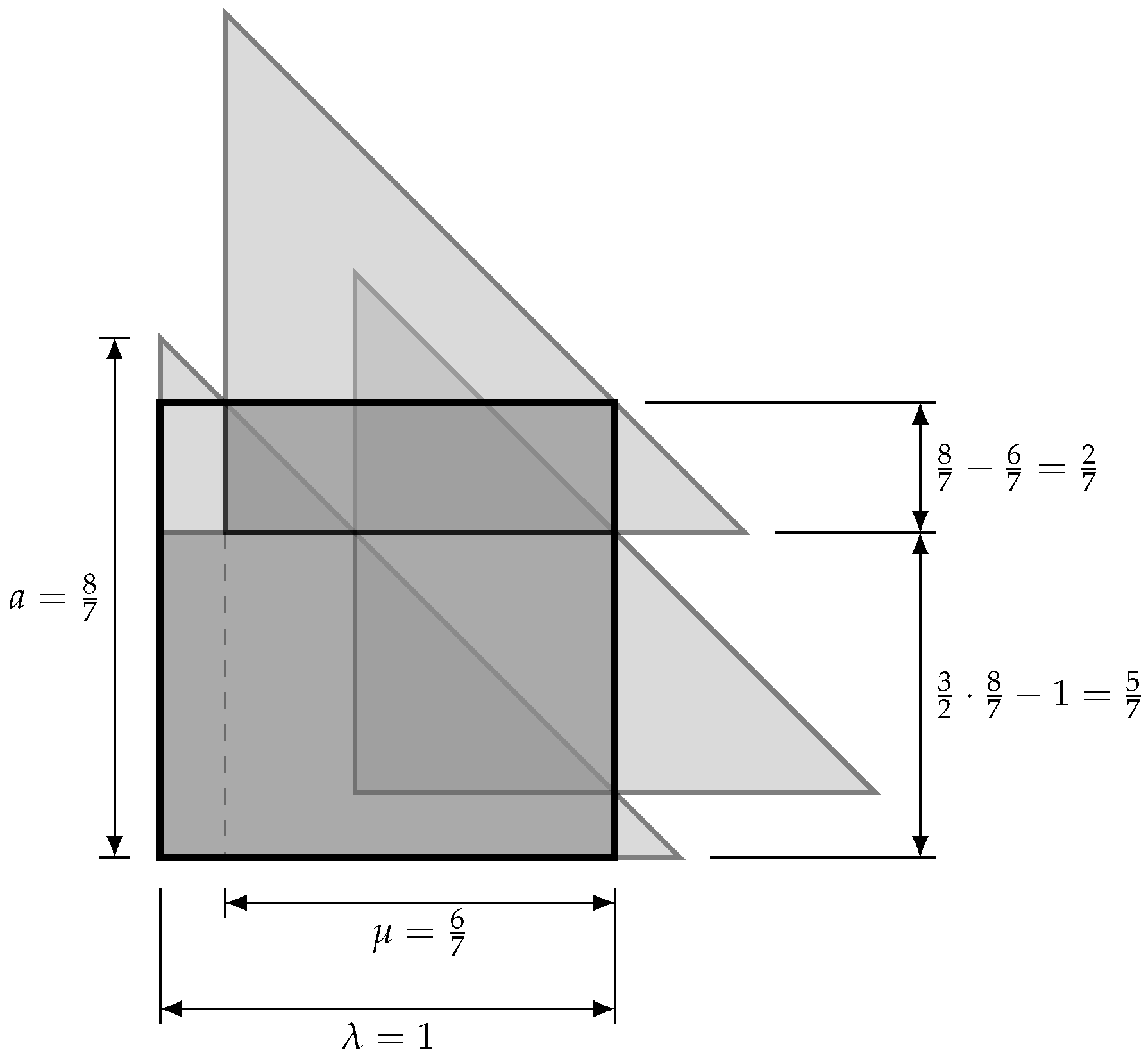
The covering with three and four equal triangles is presented in Figure 3 and Figure 4.
Remark 2.
Three congruent right isosceles triangles with legs of length 8 7 (with the total area 3 · 1 2 · 8 7 2 = 96 49 ) can cover the unit square I.
Remark 3.
Four congruent right isosceles triangles with legs of length 1 (with the total area 4 · 1 2 · 1 2 = 2 ) can cover the unit square I.
Theorem 1.
Any collection of n congruent triangles ( n = 1 , 2 , ) homothetic to T with the total area not smaller than 2 permits a translative covering of I.
Proof. 
Consider a collection of n congruent triangles T a , each homothetic to T, with the total area not smaller than 2 and let a denote the length of the legs of T a . Since the area of one triangle is equal to 1 2 a 2 , the condition n · 1 2 a 2 2 implies that
a 2 n .
If n { 1 , 2 , 3 , 4 } , a collection of n triangles with the total area 2 can cover I (see Remark 1, Corollary 2 and Remarks 2 and 3).
Assume that n > 4 .
In the covering process, we will first cover the square with an appropriate family of rectangles. Then, the triangles from the collection will be placed in such a way that they cover these rectangles.
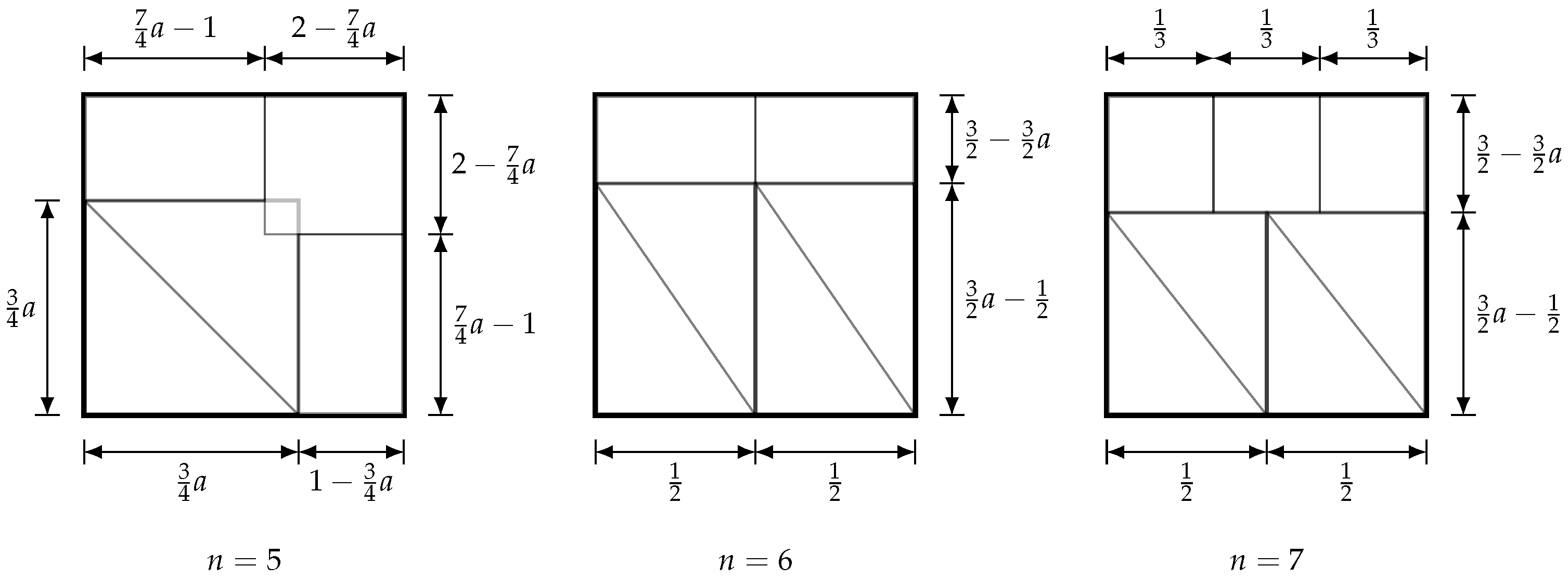
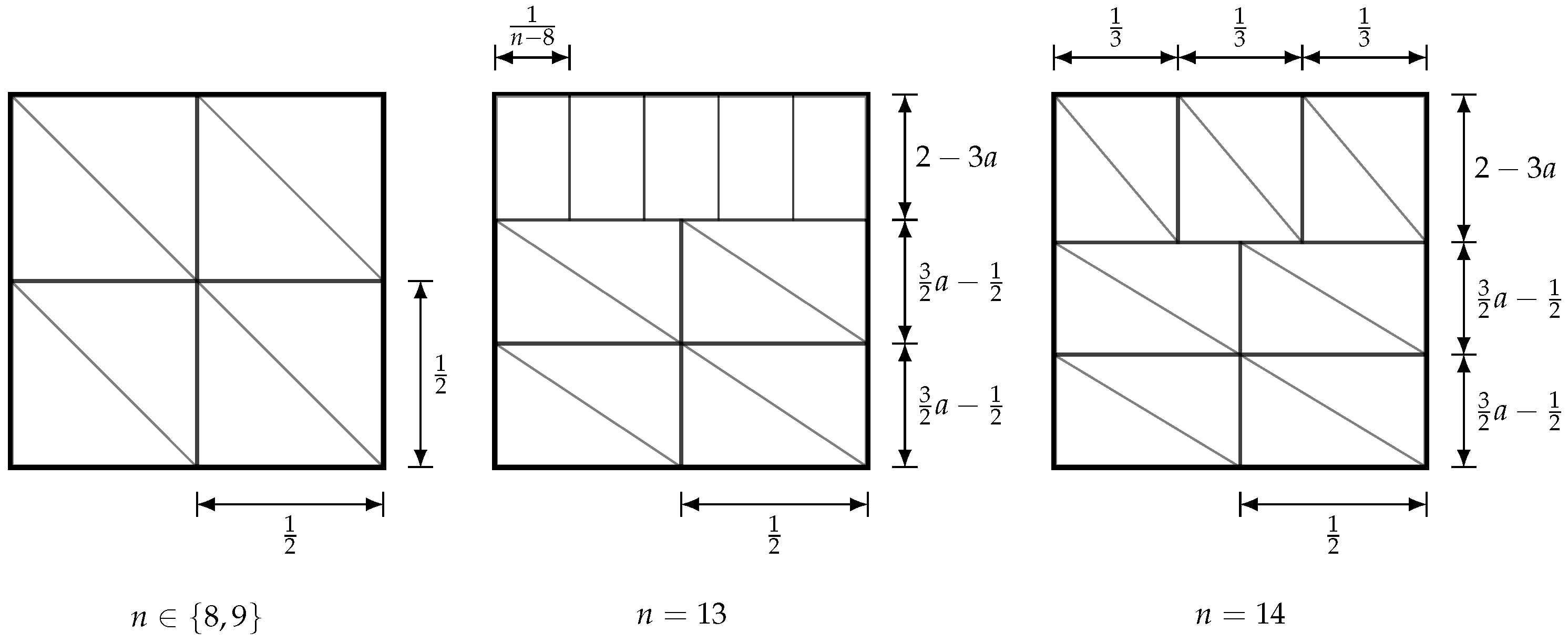
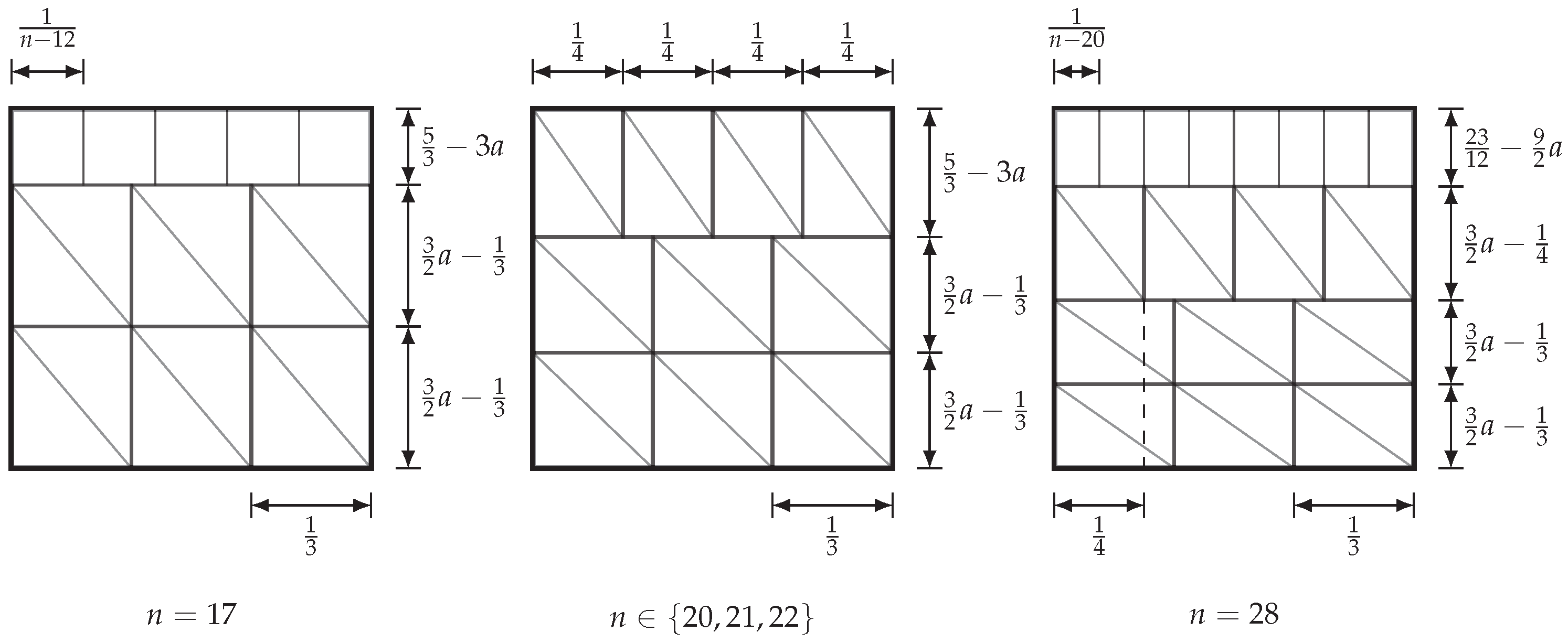
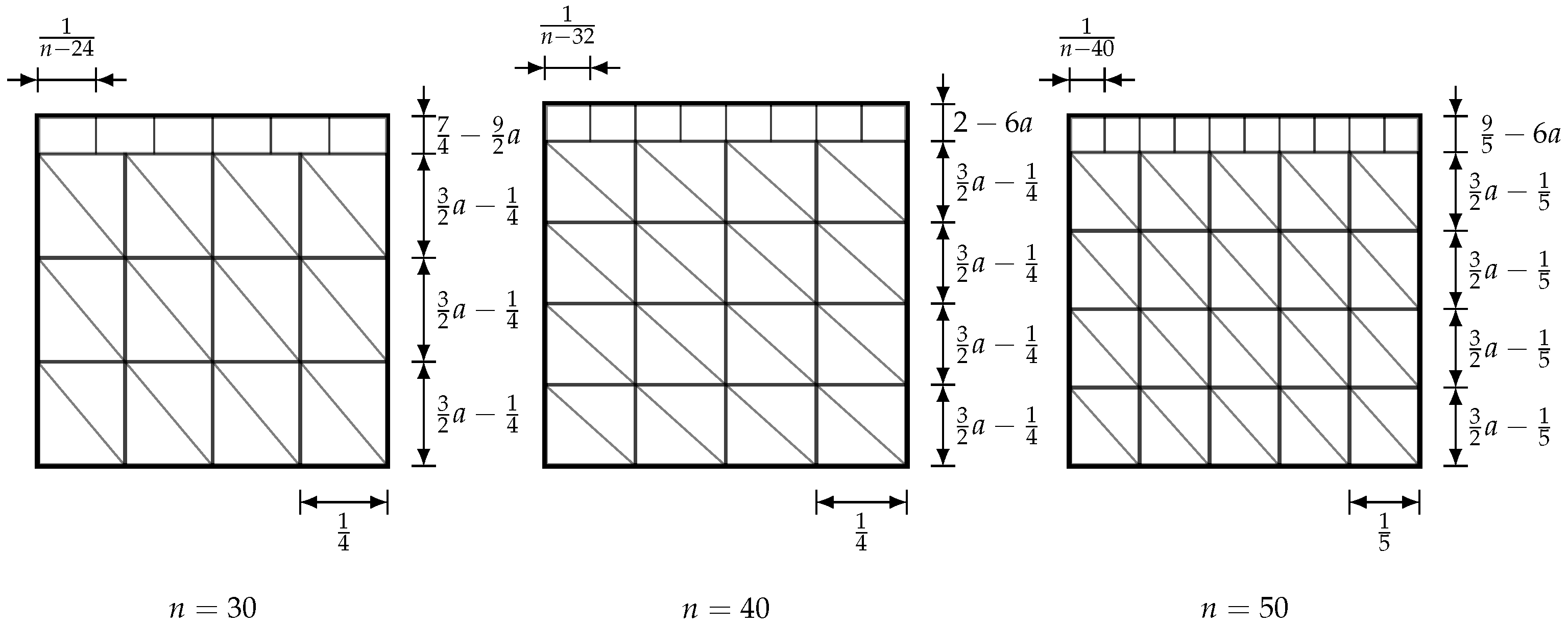
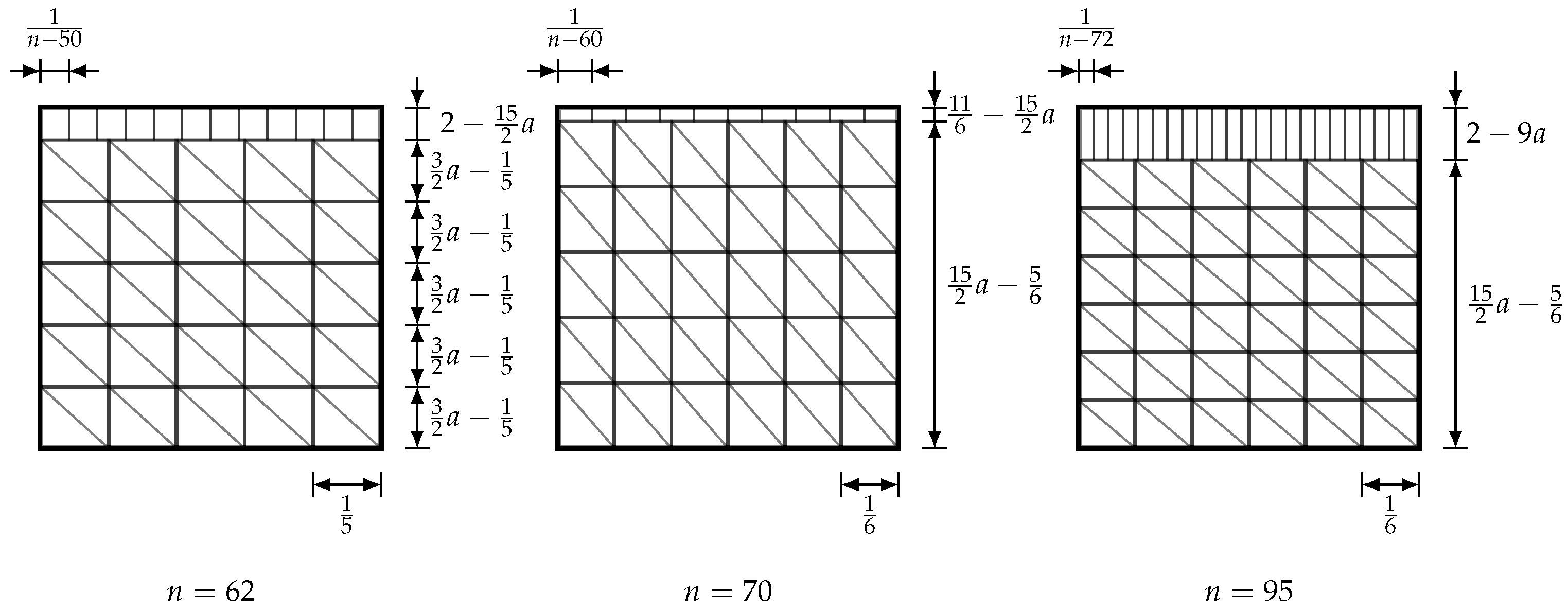
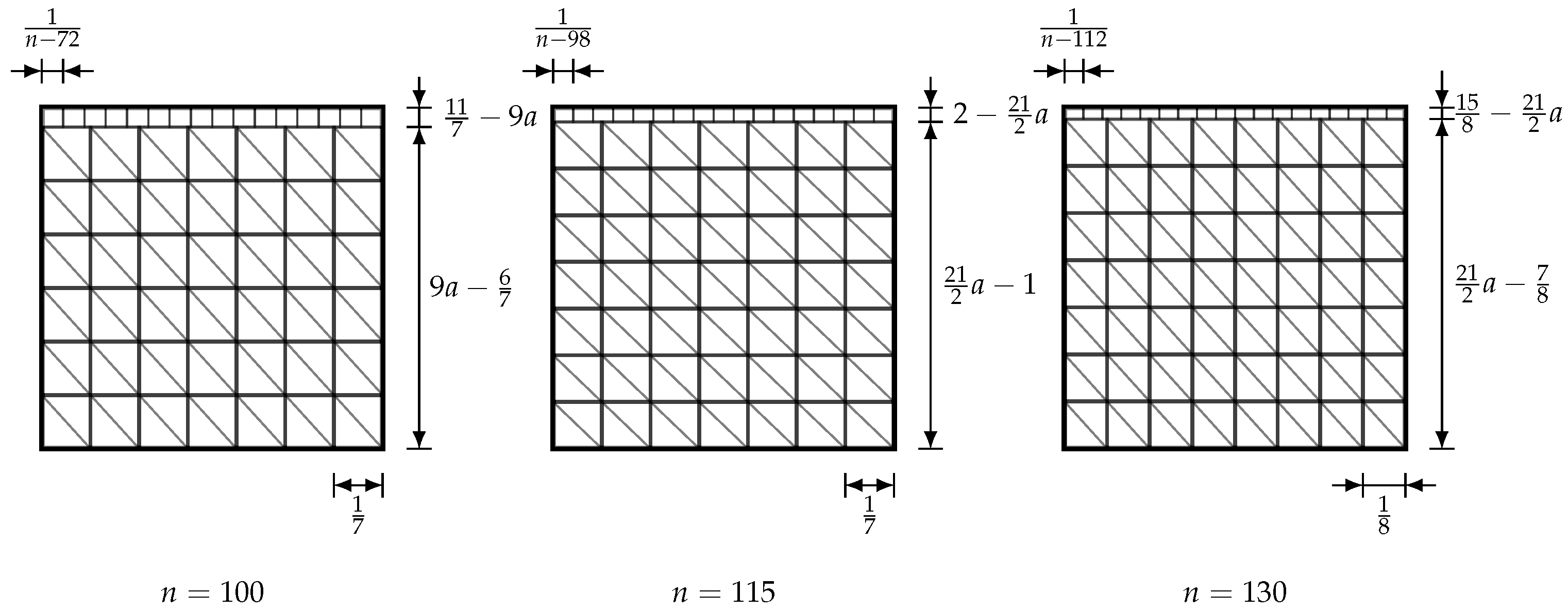
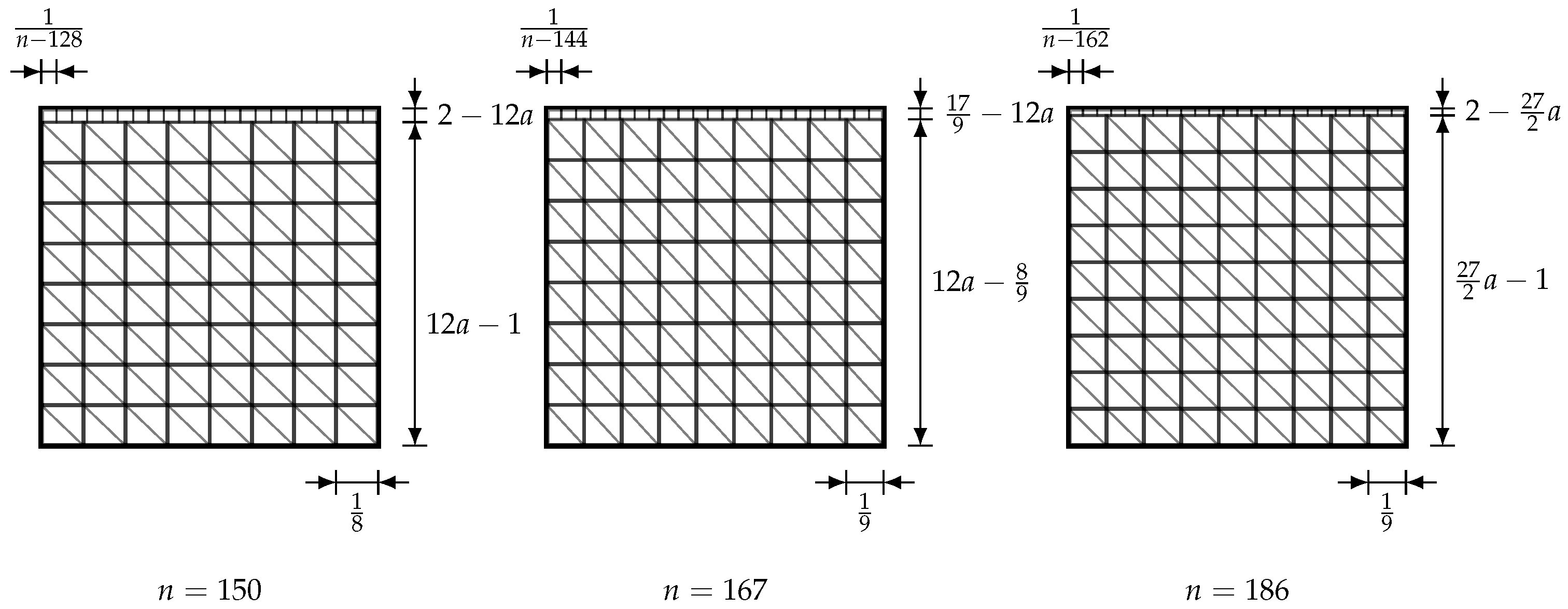
In Figure 5, Figure 6, Figure 7, Figure 8, Figure 9, Figure 10, Figure 11 and Figure 12, any rectangle with a marked diagonal will be covered with two triangles (as in Lemma 1), and any rectangle without a marked diagonal will be covered with a single triangle (as in Lemma 2). For example, in Figure 5, left, the square of sidelength 3 4 a will be covered with two triangles, while the square of sidelength 2 7 4 a will be covered with one triangle.
In many cases, we will use one of the following two methods.
In the method M 1 ( k ) (for example, see Figure 6, middle, where k = 2 ) the unit square is covered with k 2 rectangles of sidelengths 1 k and 3 2 a 1 k and with n 2 k 2 rectangles of sidelengths 1 k ( 3 2 a 1 k ) = 2 3 2 k a and 1 n 2 k 2 . By Lemma 1 (we take λ = 1 k ), each rectangle 1 k × 3 2 a 1 k can be covered with two triangles T a . Moreover, by Lemma 2 (we take μ = 2 3 2 k a ), the rectangle ( 2 3 2 k a ) × ( 1 n 2 k 2 ) can be covered with T a , if
a ( 2 3 2 k a ) 1 n 2 k 2 .
Obviously, a 2 n . Consequently, to check that the triangles can cover I it suffices to show that
λ 1 ( n , k ) 0 ,
where
λ 1 ( n , k ) = 2 n ( 1 + 3 2 k ) 2 1 n 2 k 2 .
We will verify this inequality in Cases 4 and 9.
In the method M 2 ( k ) (for example, see Figure 5, middle and right, where k = 2 ) the unit square is covered with k · ( k 1 ) rectangles of sidelengths 1 k and 3 2 a 1 k and with n 2 k ( k 1 ) rectangles of sidelengths 1 ( k 1 ) ( 3 2 a 1 k ) and 1 n 2 k ( k 1 ) . By Lemma 1, each rectangle 1 k × 3 2 a 1 k can be covered with two triangles T a (we take λ = 1 k ). Moreover, by Lemma 2 (we take μ = 1 ( k 1 ) ( 3 2 a 1 k ) ), the rectangle 1 ( k 1 ) ( 3 2 a 1 k ) × 1 n 2 k ( k 1 ) can be covered with T a , provided that
a ( 1 ( k 1 ) ( 3 2 a 1 k ) ) 1 n 2 k ( k 1 ) .
Consequently, to check that the triangles can cover I, it suffices to show that
λ 2 ( n , k ) 0 ,
where
λ 2 ( n , k ) = 2 n ( 3 2 k 1 2 ) + 1 k 2 1 n 2 k ( k 1 ) .
We will verify this inequality in Cases 2, 6, and 9.
Consider ten cases depending on the number of triangles in the collection.
  • Case 1: n = 5 . We cover I with four rectangles as shown in Figure 5, left. Now, we check that five triangles T a , for a 2 5 , can cover these rectangles. According to Corollary 1, two triangles T a can cover a square of sidelength 3 4 a . Since 7 4 a 1 = a 1 3 4 a , by Lemma 2, a rectangle of size 1 3 4 a × 7 4 a 1 can be covered with a single triangle T a . Thus, we cover two such rectangles with two triangles T a . Moreover, by taking μ = 1 2 a in Lemma 2, we conclude that T a can cover a square of sidelength 1 2 a . It is easy to verify that 2 7 2 a 1 2 a for a 2 5 . Therefore, a square of sidelength 2 7 2 a can be covered with T a .
  • Case 2: n { 6 , 7 } . We use the method M 2 ( 2 ) (see Figure 5, middle and right). It is easy to verify that
    λ 2 ( n , 2 ) = 2 n ( 3 1 2 ) + 1 2 2 1 n 4 > 0 .
  • Case 3: n { 8 , 9 } . We cover the square with four equal squares, as shown in Figure 6, left. Clearly,
    8 · 1 2 3 4 a 2 4 · 9 16 · 2 n 2 = 9 n 1 , for n { 8 , 9 } .
    By Corollary 1 these rectangles can be covered with eight triangles T a .
  • Case 4: 10 n 13 . We use the method M 1 ( 2 ) (see Figure 6, middle, where n = 13 ). It is easy to verify that
    λ 1 ( n , 2 ) = 2 n ( 1 + 3 ) 2 1 n 8 > 0 .
  • Case 5: n = 14 (see Figure 6, right). Since ( 2 3 a ) < a 1 3 for a 2 14 , the rectangle of size 1 3 × ( 2 3 a ) can be covered with two triangles T a .
  • Case 6: 15 n 19 . We use the method M 2 ( 3 ) (see Figure 7, left). It is easy to verify that
    λ 2 ( n , 3 ) = 2 n 9 2 1 2 + 1 3 2 1 n 12 > 0 .
  • Case 7: 20 n 22 . See Figure 7, middle. By
    3 2 a 1 4 5 3 3 a , for a 2 n 2 22 ,
    six rectangles 1 2 × 3 2 a 1 2 and four rectangles 1 4 × ( 5 3 3 a ) can be covered with 20 triangles  T a .
  • Case 8: 23 n 29 , see Figure 7, right. By
    a 23 12 9 2 a = 11 2 a 23 12 11 n 23 12 1 n 20 , for 23 n 29 ,
    I can be covered with n triangles T a .
  • Case 9: 30 n 205 .
    If 30 n 35 (see Figure 8, left), then we use method M 2 ( 4 ) :
    λ 2 ( n , 4 ) = 2 n ( 6 1 2 ) + 1 4 2 1 n 24 0 .
    If 36 n 45 (see Figure 8, middle), then we use M 1 ( 4 ) :
    λ 1 ( n , 4 ) = 2 n ( 1 + 6 ) 2 1 n 32 > 0 .
    If 46 n 56 (see Figure 8, right), then we use M 2 ( 5 ) :
    λ 2 ( n , 5 ) = 2 n ( 15 2 1 2 ) + 1 5 2 1 n 40 > 0 .
    If 57 n 68 (see Figure 9, left), we use M 1 ( 5 ) :
    λ 1 ( n , 5 ) = 2 n ( 1 + 15 2 ) 2 1 n 50 > 0 .
    If 69 n 81 (see Figure 9, middle), we use M 2 ( 6 ) :
    λ 2 ( n , 6 ) = 2 n ( 9 1 2 ) + 1 6 2 1 n 60 > 0 .
    If 82 n 95 (see Figure 9, right), we use M 1 ( 6 ) :
    λ 1 ( n , 6 ) = 2 n ( 1 + 9 ) 2 1 n 72 > 0 .
    If 96 n 111 (see Figure 10, left), we use M 2 ( 7 ) :
    λ 2 ( n , 7 ) = 2 n ( 21 2 1 2 ) + 1 7 2 1 n 84 > 0 .
    If 112 n 127 (see Figure 10, middle), we use the method M 1 ( 7 ) :
    λ 1 ( n , 7 ) = 2 n ( 1 + 21 2 ) 2 1 n 98 > 0 .
    If 128 n 145 (see Figure 10, right), we use M 2 ( 8 ) :
    λ 2 ( n , 8 ) = 2 n ( 12 1 2 ) + 1 8 2 1 n 112 > 0 .
    If 146 n 164 (see Figure 11, left), we use M 1 ( 8 ) :
    λ 1 ( n , 8 ) = 2 n ( 1 + 12 ) 2 1 n 128 > 0 .
    If 165 n 184 (see Figure 11, middle), we use M 2 ( 9 ) :
    λ 2 ( n , 9 ) = 2 n ( 27 2 1 2 ) + 1 9 2 1 n 144 > 0 .
    Finally, if 185 n 205 (see Figure 11, right), we use M 1 ( 9 ) :
    λ 1 ( n , 9 ) = 2 n ( 1 + 27 2 ) 2 1 n 162 > 0 .
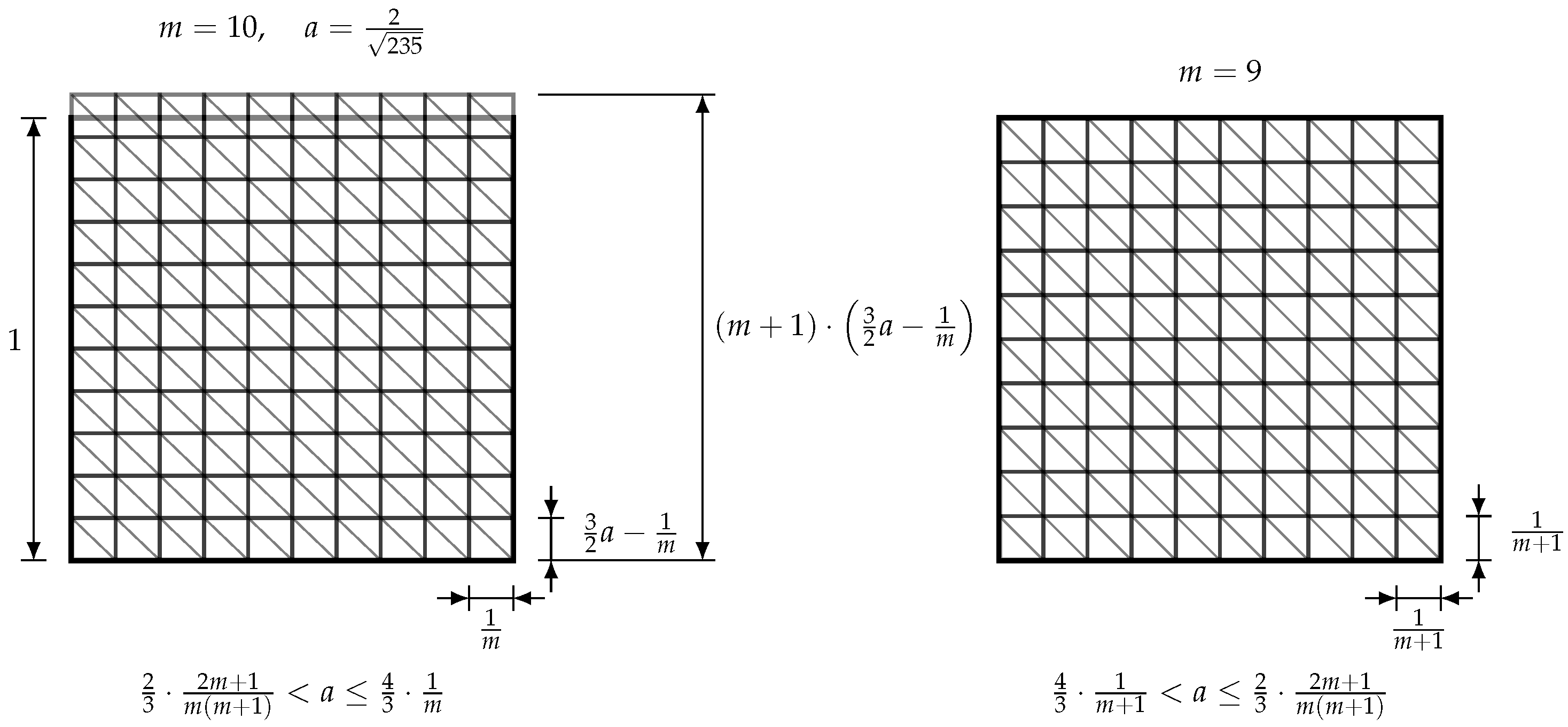
  • Case 10: n 206 . Clearly, for any a > 0 there is an integer m such that
    1 m + 1 < 3 4 a 1 m , i . e . , 4 3 · 1 m + 1 < a 4 3 · 1 m .
    Note that
    4 3 · 1 m + 1 < 2 3 · 2 m + 1 m ( m + 1 ) 4 3 · 1 m .
Subcase 10.1: 2 3 · 2 m + 1 m ( m + 1 ) < a 4 3 · 1 m . It is easy to check that
1 m · 3 2 a 1 m > 1 , for a > 2 3 · 2 m + 1 m ( m + 1 ) .
This implies that I can be covered with m · ( m + 1 ) rectangles of size 1 m × 3 2 a 1 m (as shown in Figure 12, left, where m = 10 and a = 2 235 ). Each such rectangle can be covered with two triangles T a (we take λ = 1 m in Lemma 1). Consequently, I can be covered with 2 m ( m + 1 ) triangles T a and to prove that I can be covered with n triangles T a it suffices to check that n 2 m ( m + 1 ) . Observe that
m ( m + 1 ) a 2 < m ( m + 1 ) · 4 3 · 1 m 2 = 16 9 · m + 1 m 2 for m 8 .
Since n · 1 2 a 2 2 (the total area of the triangles is not smaller than 2), it follows that n > 2 m ( m + 1 ) .
Subcase 10.2: 4 3 · 1 m + 1 < a 2 3 · 2 m + 1 m ( m + 1 ) . We cover I with ( m + 1 ) · ( m + 1 ) squares of sidelength 1 m + 1 (as illustrated in Figure 12, right, where m = 9 ). By Corollary 1, each such square can be covered with two triangles T a (in our subcase 3 4 a > 1 m + 1 ). Consequently, I can be covered with 2 ( m + 1 ) 2 triangles T a . Observe that
( m + 1 ) 2 a 2 ( m + 1 ) 2 · 4 9 · ( 2 m + 1 ) 2 m 2 ( m + 1 ) 2 = 4 9 · 2 m + 1 m 2 2 for m 9 .
Since n · 1 2 a 2 2 , it follows that n 2 ( m + 1 ) 2 . Consequently, I can be covered with n triangles T a .   □

3. Translative Covering a Square with Unequal Triangles

By an s-rectangle we mean a rectangle c × d , where d { 1 , 1 / 2 , 1 / 4 , 1 / 8 , 1 / 16 , , } .
Lemma 3.
Any right isosceles triangle T r of legs of length not greater than 2 contains an s-rectangle of the area equal to 4 / 9 times the area of T r .
Proof. 
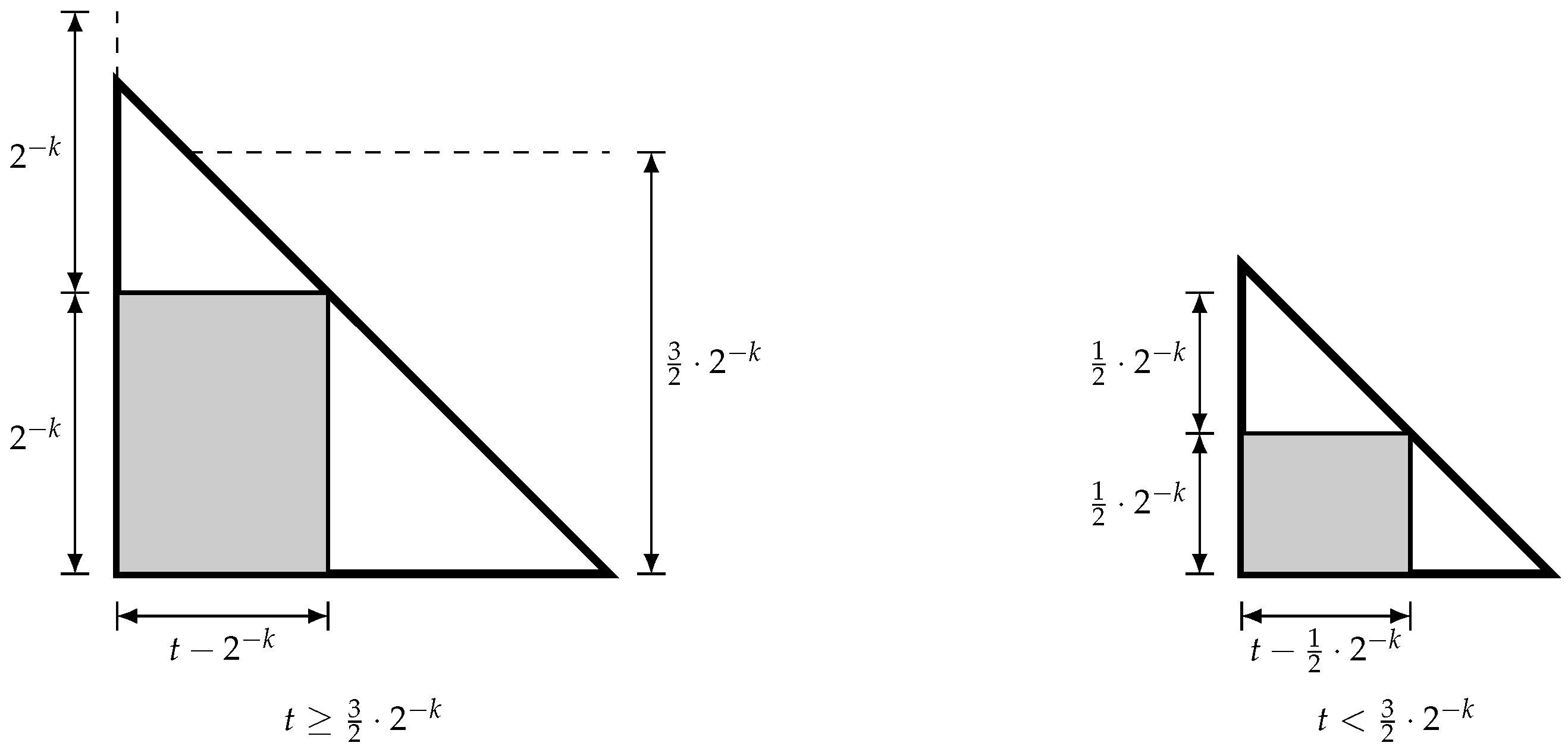
Let k be a non-negative integer such that 2 k t < 2 · 2 k , where t denotes the length of the leg of T r .
  • Case 1: t 3 2 · 2 k . It is easy to check that 2 9 t 2 2 k t + 4 k 0 . Thus
    4 9 · 1 2 t 2 ( t 2 k ) 2 k .
    This means that T r contains the s-rectangle ( t 2 k ) × 2 k of the area not smaller than 4 / 9 times the area of T r (see Figure 13, left). Clearly, t 2 k < 2 · 2 k 2 k = 2 k .
  • Case 2: t < 3 2 · 2 k . It is easy to verify that 2 9 t 2 1 2 · 2 k t + 1 4 · 4 k < 0 . Thus
    4 9 · 1 2 t 2 < ( t 1 2 · 2 k ) · 1 2 · 2 k .
    This means that T r contains the s-rectangle ( t 2 k 1 ) × 2 k 1 of the area greater than 4 / 9 times the area of T r (see Figure 13, right). Clearly, t 2 k 1 < 3 2 · 2 k 2 k 1 = 2 · 2 k 1 .    □
Figure 13. s-rectangle contained in T r .
Geometry 03 00008 g013
Lemma 4.
If a right isosceles triangle T r contains a rectangle λ × 1 2 j for j 1 and λ > 1 / 2 j , then T r also contains a rectangle ( λ 1 2 j ) × 2 2 j .
Proof. 
See Figure 14, where j = 1 .    □
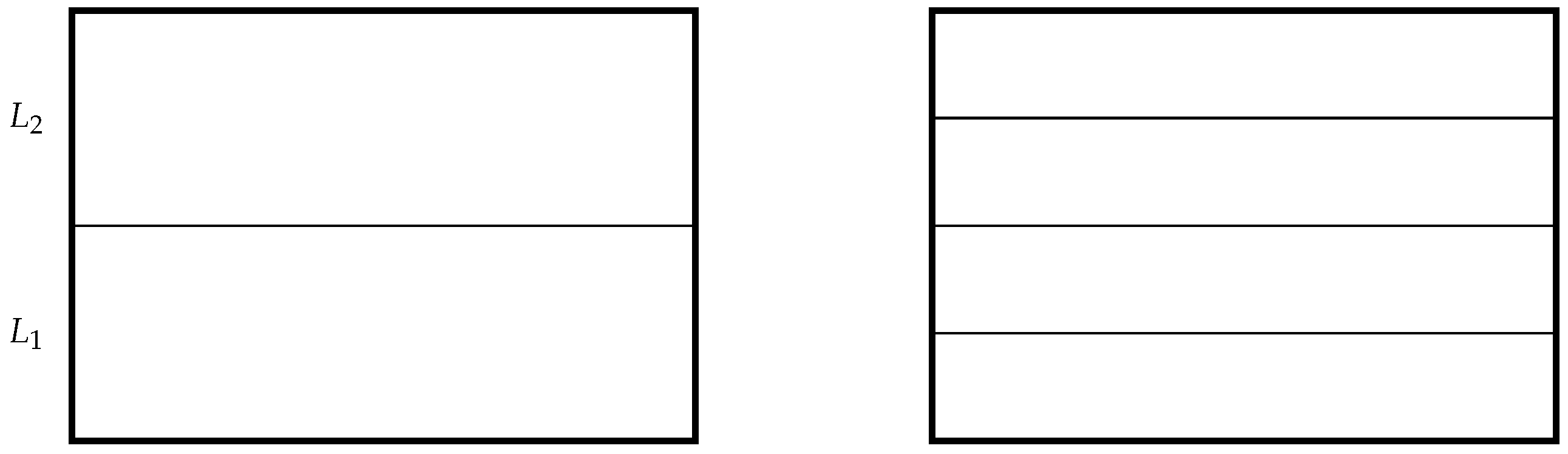
Now we describe the main covering method. Let R 1 = a × 1 (for a > 0 ) and let T 1 , T 2 , be a collection of triangles homothetic to T such that t 1 t 2 , where t i is the length of the leg of T i , i = 1 , 2 , 3 , . The rectangle R 1 is divided into 2 k horizontal layers of height 2 k , for each positive integer k (see Figure 15, left, where k = 1 and Figure 15, right, where k = 2 ).
By Lemma 3 we know that any triangle T i contains an s-rectangle P i = a i × b i such that a i · b i 2 9 t i 2 and that a i 2 b i . We will use these rectangles P i T i for the covering. The rectangles, except perhaps the last one, will be placed in layers of the proper height.
  • The covering algorithm.
[1]
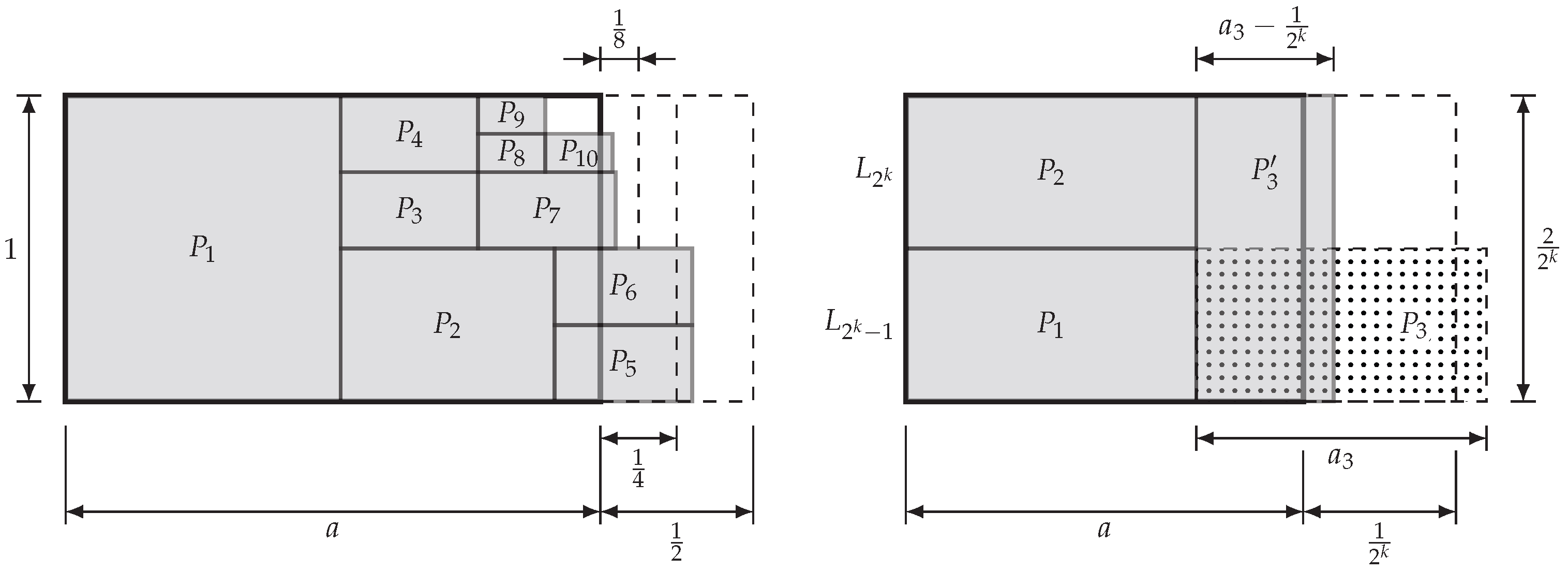
The first triangle T 1 is placed so that the corresponding rectangle P 1 is placed into the lowest layer of height b 1 at the left-bottom corner of the layer, i.e., P 1 is packed at the left-bottom corner of R 1 (see Figure 16 left and right).
  • Assume that n > 1 and that T 1 , , T n 1 have been placed. Let k = k ( n ) be an integer such that b n = 1 / 2 k . Denote by L 1 , , L 2 k all the layers in R 1 of height b n . If each point of a layer L i is covered by a placed triangle, then L i is full.
[2]
If there is enough empty space in R 1 to pack P n , then we pack P n into the lowest possible layer of height b n as far to the left as possible (see P 2 in Figure 16 left and right).
[3]
Otherwise, we find the smallest integer j such that the layer L j is not full.
[3a]
If either j 2 k 2 or j = 2 k , then we place P n along the bottom of L j so that the left side of P n is the right side of the last rectangle packed into this layer.
[3b]
If j = 2 k 1 and if L 2 k is full, then we place P n along the bottom of L j so that the left side of P n is the right side of the last rectangle packed into this layer.
[3c]
If j = 2 k 1 and if L 2 k is not full, then we check which layer from among L 2 k 1 and L 2 k is the least filled. Initially, we place P n along the bottom of this last filled layer so that the left side of P n is the right side of the last rectangle packed into this layer.
[3c1]
If, after placing P n , the distance between the right side of P n and the right side of R 1 is not greater than b n , then we do not change anything; in that case the area of the part of P n lying outside R 1 is not greater than  b n 2 .
[3c2]
If after placing P n (together with T n P n ) the distance between the right side of P n and the right side of R 1 is greater than b n (as P 3 on Figure 16 right), then we will use another part of T n for the covering; by Lemma 4 we can cover with T n the uncovered part of L 2 k 1 L 2 k (the uncovered part of R 1 ), which is contained in a rectangle P n of sides of length ( a n b n ) × 2 b n (as P 3 on Figure 16, right); as a consequence, R 1 is covered by triangles T 1 , , T n .
Example 1.
On Figure 16, left the rectangle P 1 is packed by Rule 1, the rectangles P 2 ,   P 3 ,   P 4 ,   P 8 , and P 9 by Rule 2, the rectangles P 5 , P 6 and P 7 are placed by Rule 3a, the rectangle P 10 , of height 1/8, by Rule 3c1.
Example 2.
On Figure 16, to the right of the rectangle P 1 is packed by Rule 1 and the rectangle P 2 by Rule 2. Since there is not enough space to put P 3 in L 2 k 1 or in L 2 k , we use Rule 3c2. The whole R 1 is covered.
Lemma 5.
Any collection of positive homothetic copies T of homothety ratio not greater than 2, with the total area not smaller than 9 4 ( a + 1 3 ) permits a translative covering of the rectangle R 1 = a × 1 , where a > 0 .
Proof. 
Let T 1 , T 2 , be a collection of triangles homothetic to T and let t i denote the length of the leg of T i , i = 1 , 2 , 3 , . Without loss of generality, we can assume that t 1 t 2 .
We cover R 1 by the method presented above. Assume that R 1 is not covered by T 1 , T 2 , . We will show that this leads to a contradiction.
Since R 1 is not covered, no rectangle has been placed by Rule 3c2. Observe that all placed rectangles P i have disjoint interiors. Some rectangles (placed by Rule 1 or 2) are contained in R 1 . If a rectangle P m has been placed by Rule 3b, then the area of the part of P m lying outside R 1 is not greater than b m · 2 b m . If a rectangle P m has been placed by Rule 3c1, then the area of the part of P m lying outside R 1 is not greater than b m 2 .
The sum of the areas of parts of rectangles lying outside R 1 is smaller than 1 2 2 + 1 4 2 + = 1 3 . This means that the total area of the rectangles P 1 , P 2 , is smaller than a · 1 + 1 3 . Consequently, by Lemma 3, the sum of the areas of triangles T 1 , T 2 , is smaller than 9 4 ( a + 1 3 ) , which is a contradiction.    □
Taking a = 1 in Lemma 5, we get the following result.
Theorem 2.
Any collection of positive homothetic copies T with the total area not smaller than 3 permits a translative covering of I.
Conjecture 1.
Any collection of positive homothetic copies T with the total area not smaller than 2 permits a translative covering of I.

4. Translative Covering a Rectangle with Triangles

Lemma 6.
Any collection T 1 , T 2 , of positive homothetic copies T of homothety ratio not greater than 2, with the total area not smaller than 9 4 ( a b + 1 3 b 2 ) permits a translative covering of the rectangle R = a × b .
Proof. 
Assume that T 1 , T 2 , is a sequence of positive homothetic copies T of homothety ratio not greater than 2, with the total area not smaller than 9 4 ( a b + 1 3 b 2 ) . Let H be a homothety with the ratio h = 1 / b . By Lemma 5 we know that the triangles H ( T 1 ) , H ( T 2 ) , can translatively cover H ( R ) = a b × 1 . This means that T 1 , T 2 , can translatively cover R.    □
Theorem 3.
Any collection of positive homothetic copies T with the total area not smaller than 1 2 ( a + b ) 2 permits a translative covering of the rectangle a × b , provided that a 5 + 33 4 b .
Proof. 
Let R = a × b , where a 5 + 33 4 b 2.686 b . Assume that T 1 , T 2 , is a sequence of positive homothetic copies T, with the total area not smaller than 1 2 ( a + b ) 2 . We lose no generality in assuming that t 1 t 2 , where t i denotes the length of the leg of T i .
  • Case 1: t 1 2 b . Since 1 2 ( a + b ) 2 9 4 ( a b + 1 3 b 2 ) for a 5 + 33 4 b , by Lemma 6 we deduce that the triangles can cover R.
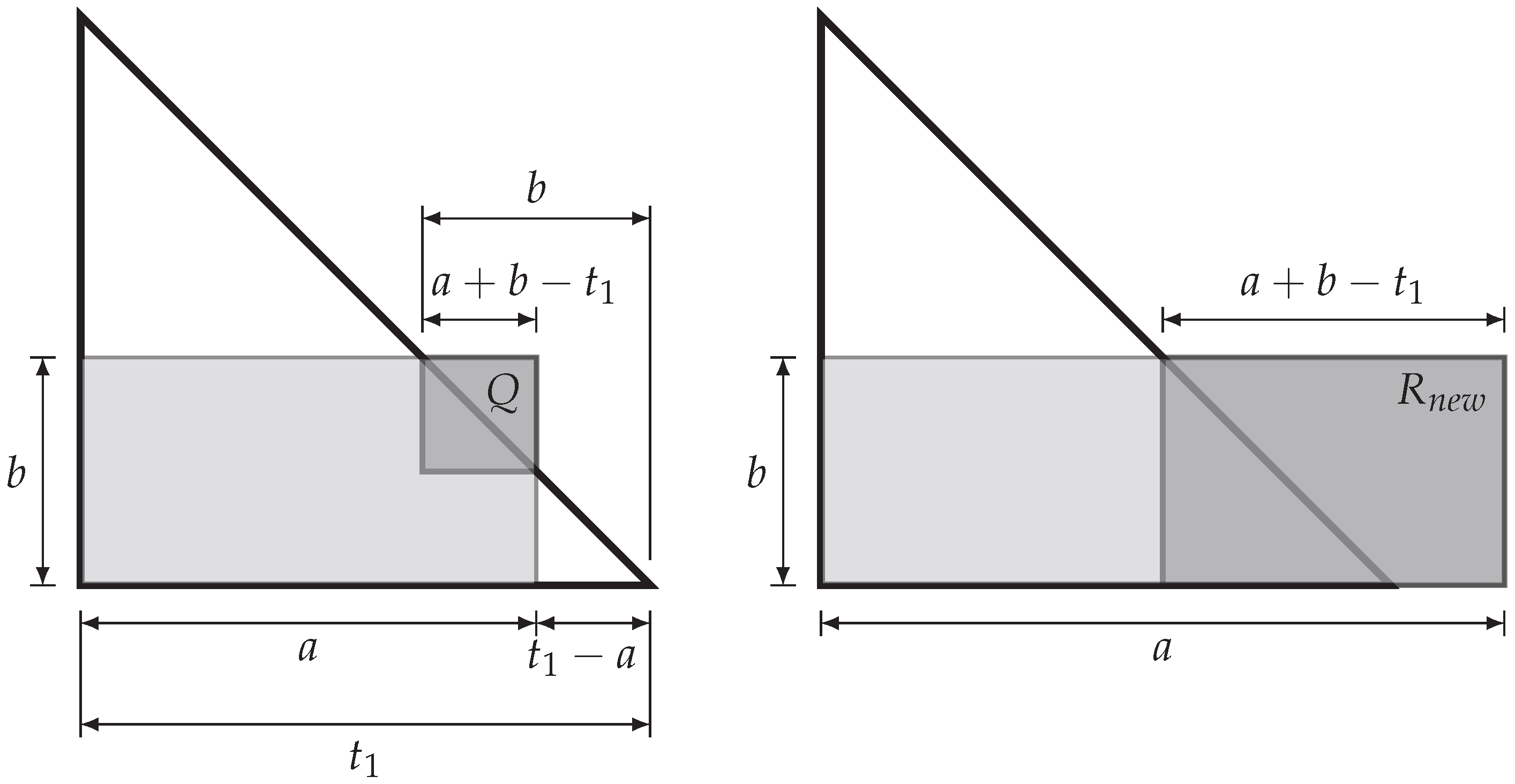
  • Case 2: t 1 a and t 2 2 b . The first triangle is placed so that the part of R not covered by this triangle is contained in a square Q of sidelength a + b t 1 (see Figure 17, left). It is easy to verify that
    1 2 ( a + b ) 2 1 2 t 1 2 3 ( a + b t 1 ) 2 .
    By Theorem 2, we deduce that the remaining triangles T 2 , T 3 , , of the total area greater than 1 2 ( a + b ) 2 1 2 t 1 2 , can cover Q (the total area of the triangles is greater than three times the area of Q).
  • Case 3: 2 b < t 1 < a and t 2 2 b . The first triangle is placed so that the part of R not covered by this triangle is contained in a rectangle R n e w = ( a + b t 1 ) × b (see Figure 17, right). It is easy to verify that
    1 2 ( a + b ) 2 1 2 t 1 2 9 4 [ ( a + b t 1 ) b + 1 3 b 2 ] .
    This implies, by Lemma 6, that the remaining triangles T 2 , T 3 , , of the total area greater than 1 2 ( a + b ) 2 1 2 t 1 2 , can cover R n e w .
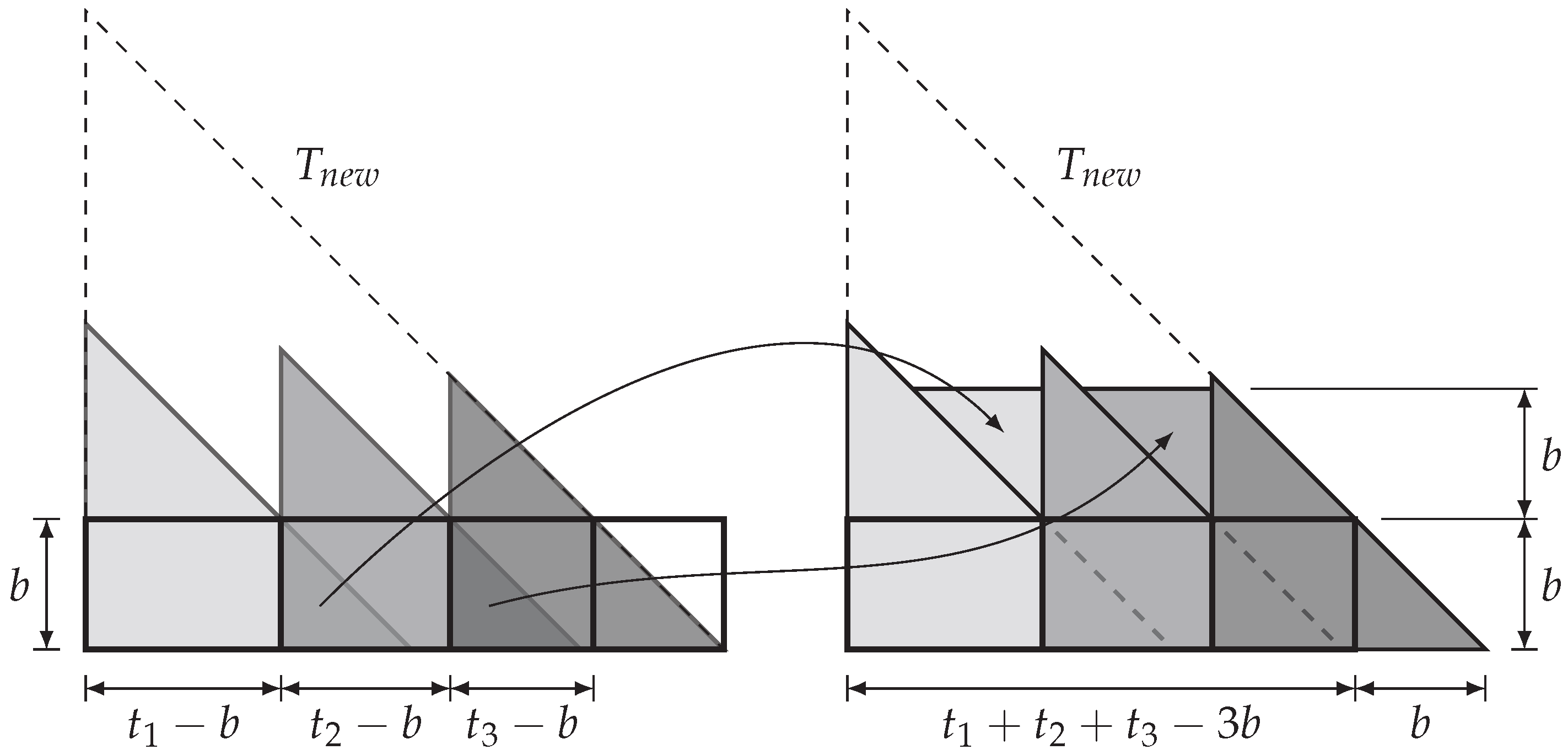
  • Case 4: there is an integer m 2 such that t m > 2 b and t m + 1 2 b . Any T i can cover the rectangle ( a i b ) × b . Consequently, T 1 , , T m can cover ( t 1 + + t m m b ) × b . It is easy to see (Figure 18) that the sum of the areas of T 1 , , T m is smaller than the area of a triangle T n e w of legs of length t 1 + + t m ( m 1 ) b . Consider the following sequence of triangles: T n e w , T m + 1 , T m + 2 , . By Case 2 or Case 3, we know that this sequence permits a translative covering of R. Consequently, T 1 , T 2 , can cover R.
  • Case 5: t i > 2 b for each i. We place the triangles as in Case 4. If R is not covered, then the sum of the areas of the triangles is not greater than the area of the triangle T n e w of legs of length smaller than a + b (see Figure 18), which is a contradiction.    □
Clearly, any copy of T with the homothety ratio smaller than 1 2 ( a + b ) 2 can not translatively cover the rectangle a × b . This means that the lower bound 1 2 ( a + b ) 2 given in Theorem 3 is tight.

Author Contributions

Conceptualization, J.J. and Ł.Z.; Methodology, J.J. and Ł.Z.; Formal analysis, J.J. and Ł.Z.; Visualization, J.J. and Ł.Z.; Writing—original draft preparation, J.J. and Ł.Z.; Writing—review and editing, J.J. and Ł.Z. All authors have read and agreed to the published version of the manuscript.

Funding

This research received no external funding.

Data Availability Statement

No new data were created or analyzed in this study. Data sharing is not applicable to this article.

Conflicts of Interest

The authors declare no conflicts of interest.

References

  1. Januszewski, J. Translative covering of a square by a sequence of arbitrary-oriented squares. Demonstr. Math. 2007, 40, 681–700. [Google Scholar] [CrossRef][Green Version]
  2. Januszewski, J. Translative covering of a square by a sequence of arbitrary-oriented squares: Part II. Demonstr. Math. 2008, 41, 441–454. [Google Scholar] [CrossRef]
  3. Moon, J.W.; Moser, L. Some packing and covering theorems. Colloq. Math. 1967, 17, 103–110. [Google Scholar] [CrossRef]
  4. Januszewski, J. Covering the unit square by squares. Beitr. Algebra Geom. 2002, 43, 411–422. [Google Scholar]
  5. Füredi, Z. Covering a triangle with homothetic copies. In Discrete Geometry; Bezdek, A., Ed.; CRC Press: Boca Raton, FL, USA, 2003; pp. 435–445. [Google Scholar]
  6. Song, F.; Su, Z. Parallel covering a square with isosceles right triangles. Results Math. 2025, 80, 124. [Google Scholar] [CrossRef]
  7. Januszewski, J.; Zielonka, Ł. Covering a rectangle with isosceles right triangles. J. Geom. 2025, 116, 42. [Google Scholar] [CrossRef]
Figure 1. The rectangle covered with two equal right isosceles triangles.
Geometry 03 00008 g001
Figure 2. The rectangle covered with the right isosceles triangle.
Geometry 03 00008 g002
Figure 3. The unit square covered with three right isosceles triangles with legs of length 8 7 .
Geometry 03 00008 g003
Figure 4. The unit square covered with four right isosceles triangles with legs of length 1.
Geometry 03 00008 g004
Figure 5. n { 5 , 6 , 7 } .
Geometry 03 00008 g005
Figure 6. 8 n 14 .
Figure 6. 8 n 14 .
Geometry 03 00008 g006
Figure 7. 15 n 29 .
Figure 7. 15 n 29 .
Geometry 03 00008 g007
Figure 8. 30 n 56 .
Figure 8. 30 n 56 .
Geometry 03 00008 g008
Figure 9. 57 n 95 .
Figure 9. 57 n 95 .
Geometry 03 00008 g009
Figure 10. 96 n 145 .
Geometry 03 00008 g010
Figure 11. 146 n 205 .
Geometry 03 00008 g011
Figure 12. n 206 .
Figure 12. n 206 .
Geometry 03 00008 g012
Figure 14. Ilustration of Lemma 4.
Geometry 03 00008 g014
Figure 15. Division of the rectangle R 1 = a × 1 into horizontal layers.
Geometry 03 00008 g015
Figure 16. Illustration of the covering algorithm.
Geometry 03 00008 g016
Figure 17. Illustration of Cases 2 and 3 of the proof of Theorem 3.
Geometry 03 00008 g017
Figure 18. Ilustration of Case 4 of the proof of Theorem 3.
Geometry 03 00008 g018
Disclaimer/Publisher’s Note: The statements, opinions and data contained in all publications are solely those of the individual author(s) and contributor(s) and not of MDPI and/or the editor(s). MDPI and/or the editor(s) disclaim responsibility for any injury to people or property resulting from any ideas, methods, instructions or products referred to in the content.