Article

Wessel’s Algebra and Morley’s Theorem

by
Sebastian Xambó-Descamps
1,2
1
Faculty of Mathematics and Statistics, Universitat Politècnica de Catalunya, 08028 Barcelona, Spain
2
Mathematical Institute (IMTech), Universitat Politècnica de Catalunya, 08028 Barcelona, Spain
Geometry 2026, 3(2), 9; https://doi.org/10.3390/geometry3020009
Submission received: 4 January 2026 / Revised: 31 March 2026 / Accepted: 27 April 2026 / Published: 8 May 2026
(This article belongs to the Special Issue Feature Papers in Geometry)

Abstract

This paper is devoted to provide a proof of F. Morley’s theorem concerning triangles in the Euclidean plane E (see Theorem 1 in the Introduction section) phrased in terms of the geometric algebra G of E (called Wessel’s algebra). This algebra is studied in detail in Section 2, its uses in describing isometries of E in Section 3, its bearing on the geometry of Morley’s construction in Section 4, and the claimed proof in Section 5. Morley’s theorem can be extended by using all the trisectors (interior and exterior) of a triangle, and suitable intersections of them. These intersections form what we call Morley’s constellation and out of it 36 generalized Morley triangles can be formed. Among these triangles, 27 are equilateral and with sides parallel to the original Morley triangle (Appendix B). The 36 triangles are depicted in Appendix C. All graphics in this work have been created by the author.

1. Introduction

Geometric algebra is a mathematical structure naturally associated with any quadratic linear space, and its main virtue is that it can be used to encode and intrinsically (i.e., in a coordinate-free way) develop the geometry of such spaces. Beyond its use in a rich variety of purely mathematical developments, a surprising range of applications have been brought to light in the last hundred years, particularly in the wake of the early breakthroughs of W. Pauli (1900–1958) and P.A.M. Dirac (1902–1984) to model the electron’s spin. Relevant developments in the literature have been gathered in ⋄15 in Appendix A.
Despite the formidable panorama outlined above, a geometric algebra proof of the following ever surprising theorem seems to be missing:
Theorem 1 
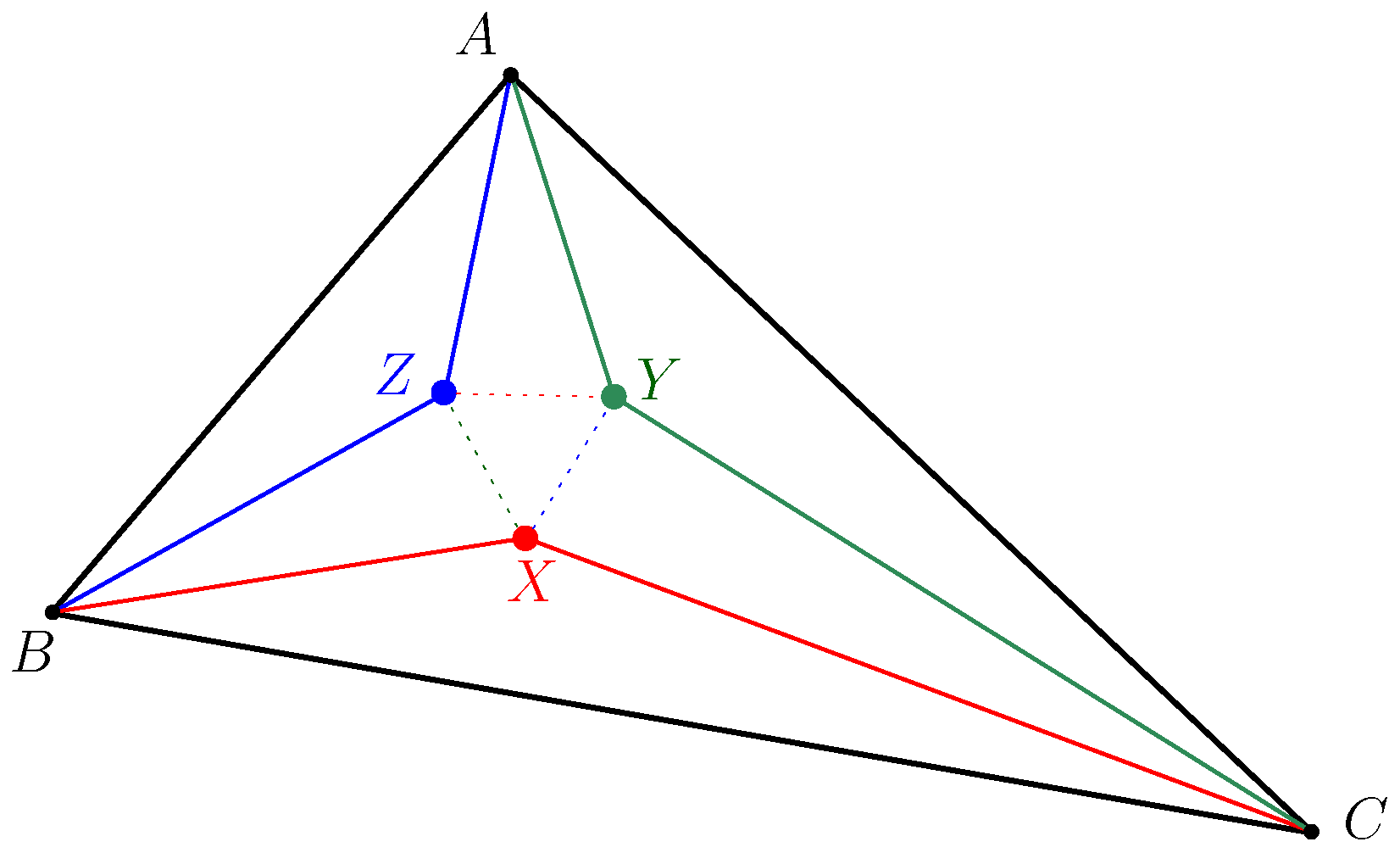
(Frank Morley, 1899). For any triangle A B C in the Euclidean plane, its Morley triangle X Y Z (see Figure 1) is equilateral.
The situation is all the more surprising when a search of the literature reveals a sustained fascination of researchers with this theorem and also with some of its natural generalizations. We refer to ⋄16 in Appendix A for a brief guide to the references on these topics. Since the methods used in those works are specific to Euclid-style plane geometry, it is reasonable to expect potential advantages in exploring arguments expressed in a formalism, such as geometric algebra, that by its nature transcends those limitations, at least in the sense that whatever is learned from the geometric algebra of the Euclidean plane (which we call Wessel’s algebra) will greatly facilitate the study of geometric topics in any dimension, including spaces that are not necessarily Euclidean.
Yet, the question of who may be most interested in finding a proof of Theorem 1 using the geometric algebra formalism presents an auspicious opportunity to address readers eager to find a forthright introduction to Wessel algebra as a gateway to geometric algebra in general, and, as an extra reward, its use in producing a novel proof of Theorem 1 as well as connections to its natural generalizations.
With these premises in mind, the paper is structured as follows: Wessel’s algebra is presented in Section 2, with emphasis on how isometries (translations, rotations and reflections) are handled; Section 3 is devoted to providing explicit expressions for the various compositions of symmetries and Section 4 to establishing a number of symmetry properties of the Morley configuration depicted in Figure 1, while the promised proof of Theorem 1 is laid out in Section 5.
The paper has three appendices: Appendix A, to accommodate annotations to a few statements in the preceding sections; Appendix B, in which the definitions of the angle trisectors of a triangle are defined, the constellation of points obtained as intersections of pairs of trisectors of the same ‘color’ is depicted, and its surprising properties are described; and Appendix C, devoted to drawing the 27 equilateral triangles that can be formed with vertices in Morley’s constellation as well as the nine Morley triangles that are not equilateral.

2. The Wessel Algebra

In the approach to plane Euclidean geometry with geometric algebra the platform is the oriented Euclidean plane E (for a recap of this notion, see ⋄17 in Appendix A), and the finesse is provided by its associated geometric algebra. Despite appearances, this arrangement differs fundamentally from the traditional modeling of both the algebra and the Euclidean plane in the formalism of the usual (algebraic) complex numbers C (the resulting system is usually known as Argand’s plane). To appraise the sharp contrast between the two approaches in more detail, see ⋄18 in Appendix A. Here, it is just remarked that if we identify E with C , then i commutes with vectors, which is a major difference from the fact that the geometric entity corresponding to i (which is to be denoted by i ) anticommutes with vectors. Of course, this calls for some care, but this fact, rather than a hurdle, is actually one of the assets which confer C = { a + b i | a , b R } its resilience in the face of geometric problems in the Euclidean plane.
  • 1 (Plane Euclidean geometry and geometric algebra). An expedient way to describe this algebra is to start with Grassmann’s exterior algebra of E , ( G , ) , and enrich it with its geometric product. Let us spell this out in detail.
We have G = G 0 G 1 G 2 , where G k is the space of k-vectors: G 0 = R (0-vectors or scalars, denoted by Greek symbols), G 1 = E (1-vectors or simply vectors, denoted by Latin symbols like u , v , ) and G 2 (2-vectors or bivectors, typically v v , v , v E ). The bivector v v is an algebraic representation of the area element corresponding to the oriented parallelogram [ v , v ] = { λ v + λ v | λ , λ [ 0 , 1 ] } . The wedge product ∧ is bilinear and v v = 0 , indicating that the area element of [ v , v ] is 0. From ( v + v ) ( v + v ) = 0 , we conclude that v v = v v , so that the area element of [ v , v ] is opposite of the area element of [ v , v ] .
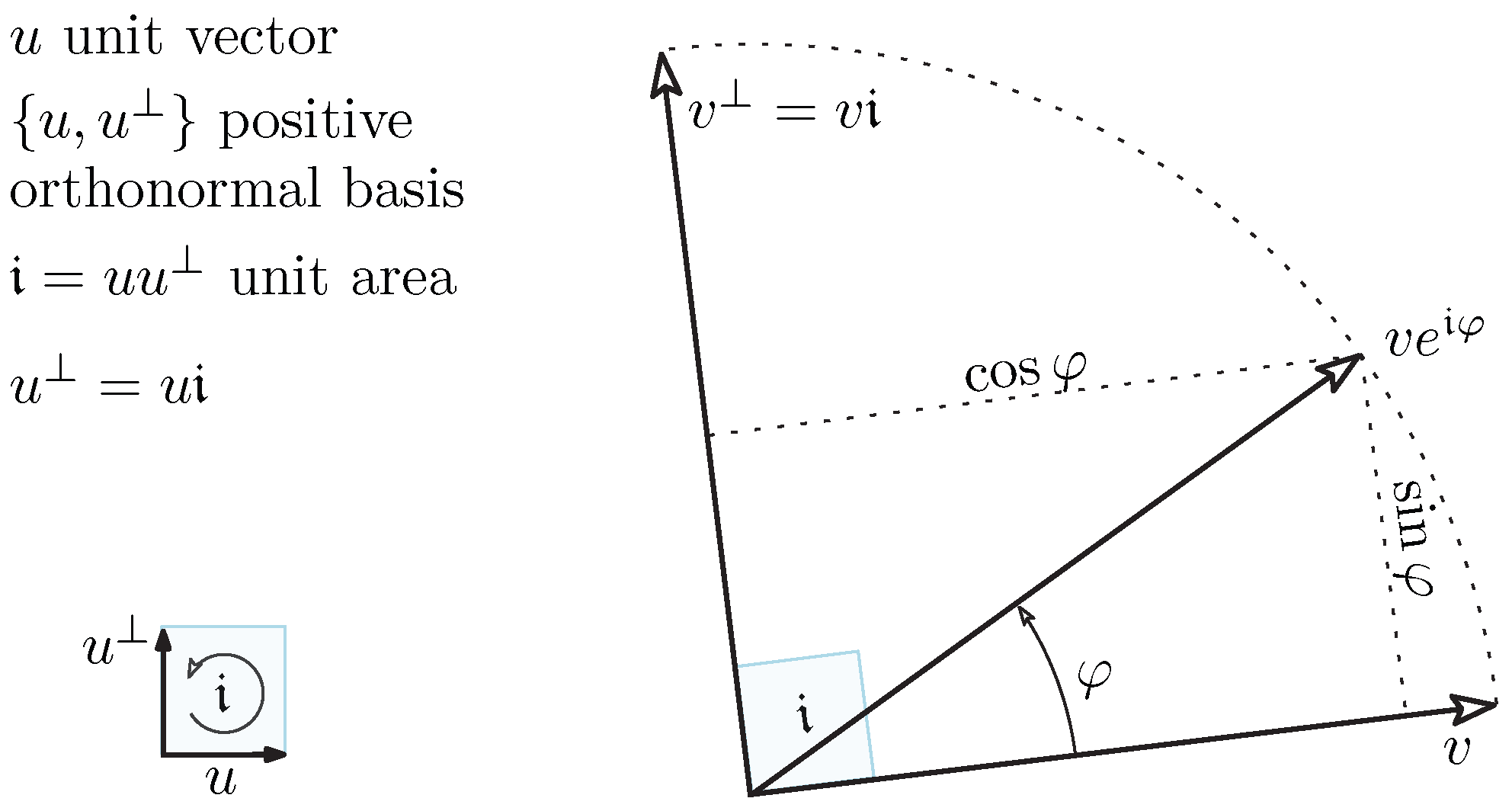
If we choose any basis of E , say e = e 1 , e 2 , and use the decompositions v = α e 1 + β e 2 and v = α e 1 + β e 2 , we immediately get v v = ( α β α β ) e 1 e 2 = det e ( v , v ) e 1 e 2 . This shows that { 1 , e 1 , e 2 , e 1 e 2 } is a basis of G . Note that v v = e 1 e 2 if and only if det e ( v , v ) = 1 , a condition that happens when { v , v } is a positively oriented orthonormal basis of E (as in this case v = e 1 cos φ + e 2 sin φ , v = e 1 sin φ + e 2 cos φ for some φ ). In particular the bivector i = e 1 e 2 is the same for all positively oriented orthonormal bases and it is usually called the pseudoscalar of E (it is the unit area element). Thus we have G 2 = R i and elements x G (which are called multivectors) have the form
x = α + v + β i ( α , β R , v E ) .
  • 2 (The geometric product). There is a unique bilinear associative unital product  x x G ( x , x G ), such that
    v v = v · v + v v
    for all v , v E . This product is called geometric product. Observe that (1) implies that v 2 = v · v , and v v = v v if (and only if) v · v = 0 (denoted by v v , or, in words, if and only if v and v are orthogonal). We see, in particular, that any non-zero vector v is invertible: v 1 = v v · v = v | v | 2 . This feature is paramount in geometric algebra, as computations in it have the flavor of computations in R , except that the geometric product is not commutative.
Uniqueness of the geometric product follows from checking that the conditions in the statement determine the multiplication table of the basis { 1 , e 1 , e 2 , i } of G corresponding to an orthonormal basis e = e 1 , e 2 of E , as shown in Table 1 (Left). For example e 1 e 2 = e 1 e 2 = i , because e 1 · e 2 = 0 ; e 1 i = e 1 e 1 e 2 = e 2 , as e 1 2 = e 1 · e 1 = 1 ; i 2 = e 1 e 2 e 1 e 2 = e 1 2 e 2 2 = 1 , as e 2 e 1 = e 1 e 2 ; and so on.
Existence of the geometric product follows by defining a bilinear product by means of Table 1 (Left) and checking that it satisfies (1) and is associative. The relation (1) is straightforward: if v = α e 1 + β e 2 and v = α e 1 + β e 2 , then using bilinearity and the values provided by Table 1 (Left) we have:
v v = ( α e 1 + β e 2 ) ( α e 1 + β e 2 ) = α α + β β + ( α β β α ) i = v · v + v v .
Notice the relation v v = A ( v , v ) i between the area element v v and the oriented area A ( v , v ) = α β β α of the parallelogram [ v , v ] .
It remains to prove that the geometric product is associative. This could be achieved by inspecting all possible cases that can be formed with Table 1, Left, as for example ( e 2 i ) e 1 = e 2 ( i e 1 ) , where the value of both sides is 1 . But it is more enlightening to provide a conceptual argument, which here will be no more than accommodating to this case, the general proof presented in ([1], Sect. 1) by profiting from the particular features of E . By writing e 00 = 1 , e 10 = e 1 , e 01 = e 2 , e 11 = i , the product table becomes Table 1, Middle, which can be summarized, regarding the subindices as ordered pairs of bits, by the formula
e j e k = ( 1 ) t ( j , k ) e j + k ,
where j + k denotes the bit-wise sum of j and k (example: 01 + 11 = 10 ), while t ( j , k ) = 1 if j 2 = k 1 = 1 and 0 otherwise (see Table 1, Right).
To check associativity, it suffices to see that
( e j e k ) e l = e j ( e k e l ) for all j , k , l B = { 10 , 01 , 11 } .
Using (2), we have:
( e j e k ) e l = ( 1 ) t ( j , k ) e j + k e l = ( 1 ) t ( j , k ) + t ( j + k , l ) e ( j + k ) + l e j ( e k e l ) = ( 1 ) t ( k , l ) e j e k + l = ( 1 ) t ( k , l ) + t ( j , k + l ) e j + ( k + l ) .
Since ( j + k ) + l = j + ( k + l ) , to conclude it is enough to see that
t ( j , k ) + t ( j + k , l ) and t ( k , l ) + t ( j , k + l )
have the same parity for all j , k , l B . Actually we claim that both sums have the same parity as t ( j , k ) + t ( j , l ) + t ( k , l ) , and this is clearly enough to complete the proof.
The claim itself follows from the fact that t ( j + k , l ) and t ( j , k + l ) have the same parity as t ( j , l ) + t ( k , l ) and t ( j , k ) + t ( j , l ) , respectively. Since the analysis of both expressions is similar, let us focus on the details of t ( j + k , l ) . If j and k are disjoint (that is, they do not share a 1 in any position, which is equivalent to saying that the bit-wise product j k is 00), then we actually have the equality t ( j + k , l ) = t ( j , l ) + t ( k , l ) , as follows from the definition of the transposition counter. In general, observing that j + j k , k + j k and j k are pair-wise disjoint (for example, ( j + j k ) ( j k ) = j k + j k = 00 , as the bit-wise product is distributive and associative and j j = j , j + j = 00 for any j), we have
t ( j , l ) = t ( j + j k , l ) + t ( j k , l ) , t ( k , l ) = t ( k + j k , l ) + t ( j k , l ) , t ( j , l ) + t ( k , l ) = t ( j + j k , l ) + t ( k + j k , l ) + 2 t ( j k , l ) = t ( j + j k + k + j k ) + 2 t ( j k , l ) = t ( j + k ) + 2 t ( j k , l ) .
  • 3 (Geometric algebra). The geometric algebra of E is G enriched with the geometric product, and we will use the same symbol G to denote it. For historical reasons (see [2]), we say that G is the W e s s e l   a l g e b r a of E . The even subalgebra of G is
    G + = G 0 G 2 = R R i = C .
    Since i 2 = 1 , C is isomorphic to the complex numbers C , α + β i α + β i , but the geometric nature of i (the unit area element) justifies saying that C is the algebra (actually a field) of geometric complex numbers, and so we may conveniently refer to C as the field of algebraic complex numbers. Let us just remark that fields of geometric complex numbers are abundant in higher dimensions because there are plenty of bivectors j such that j 2 = 1 (for example j = u u , where u and u are orthogonal vectors such that u 2 = u 2 = 1 ).
Table 1, Left, shows that i anticommutes with vectors, and that v i E for all v E . Actually, the map E E , v v i , is a rotation of amplitude π / 2 . Indeed, for any unit vector u, let u be the result of rotating u through π / 2 , so that { u , u } is a positive orthonormal basis, and hence i = u u , which yields, on multiplying by u on the left, u i = u . In general, v e i φ is the rotation of vector v through φ (see Figure 2):
v e i φ = v cos φ + v i sin φ = v cos φ + v sin φ .
Since v e i φ = e i φ v for any vector v, we also have the relation
v e i φ = e i φ / 2 v e i φ / 2 .
This identity will be handy for finding expressions of the composition of symmetries and rotations.
  • 4 (Notational conventions). We need to distinguish two pragmatic uses of vectors: one is to indicate a position, in which case they will be called points and will be denoted by capital Latin letters like A, B, C, P, Q, X, …; the other use is as translators of points, in which case they will be denoted by lowercase letters such as u , u , v , v , and used in expressions like Q = P + v = v + P , or, equivalently, v = Q P . Even though expressions such as P + Q make sense in the abstract, for after all they can be seen as a sum of two vectors, we will avoid such usage as a way to enforce and highlight those two roles. In graphic illustrations, points are represented by bullet dots and vectors by arrows. The helpfulness of these distinctions will be apparent in the description of rotations and symmetries below.
An isometry of E is a map f : E E such that | f ( X ) f ( Y ) | = | X Y | for all X , Y E . Since the length of a nonzero vector is positive, an isometry is a 1-to-1 map. For example, the map T v : X X + v , which is called the translation of E by v, is an isometry, as T v ( X ) T v ( Y ) = ( X + v ) ( Y + v ) = X Y .
  • 5 (Rotations and symmetries). Now we are ready to articulate rotations and symmetries of the Euclidean plane E by means of the Wessel algebra, and to recognize its benefits.
    Rotations of E . The rotation of points about a point P through an angle φ will be denoted by R P , φ and it is defined by the formula R P , φ ( X ) = P + ( X P ) e i φ . Plainly, we are rotating the vector X P through φ (see Figure 2) and adding the result to P, so that, in particular, P is a fixed point. If φ = 0 , R P , φ = Id (for which all points are fixed); otherwise P is the only fixed point, for X = P + ( X P ) e i φ says that ( X P ) = ( X P ) e i φ = 0 and this implies X P = 0 if φ 0 . In fact R P , φ is an isometry, for R P , φ ( X ) R P , φ ( X ) = ( X X ) e i φ , which has the same length as X X .
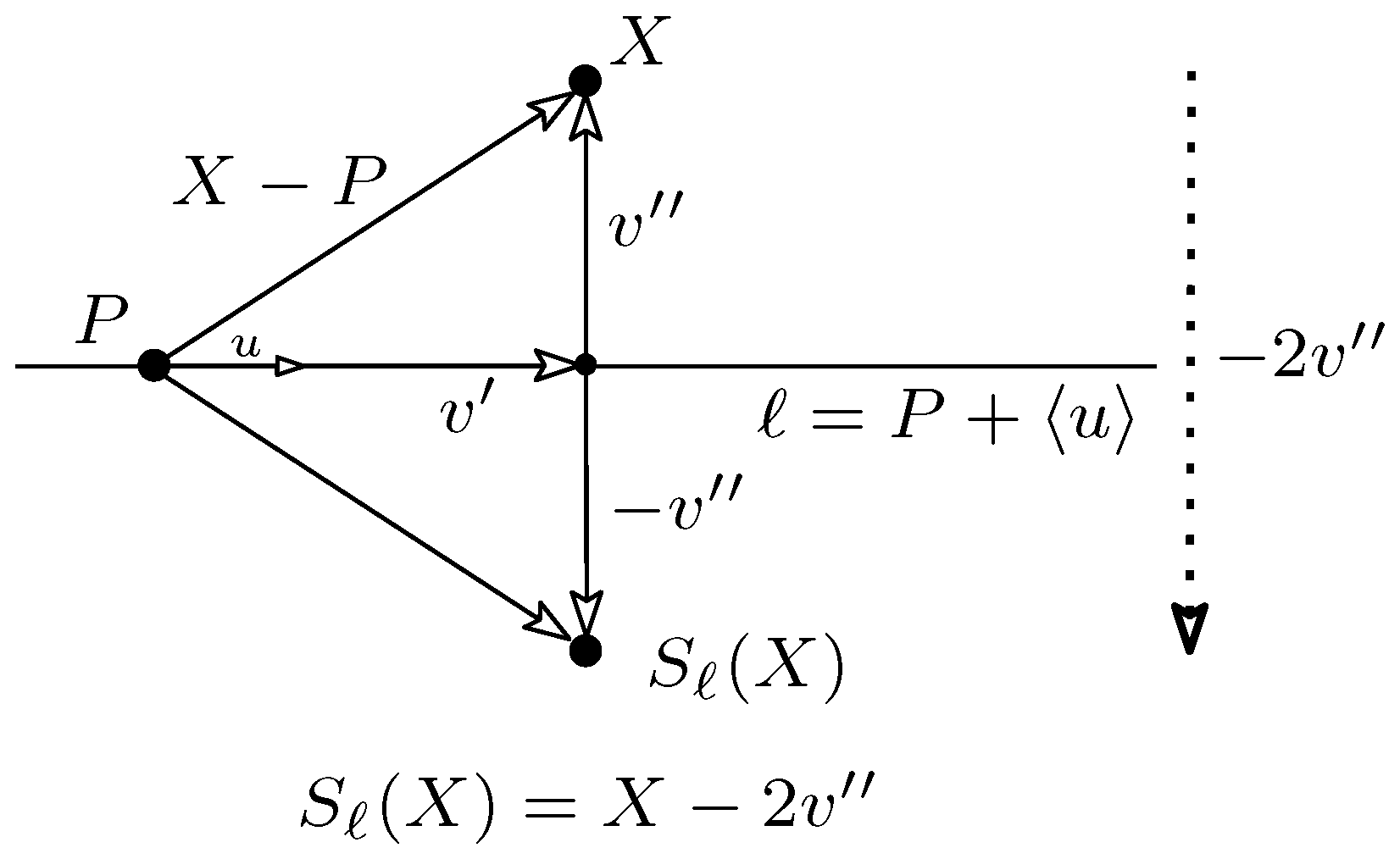
    Symmetries of E . Take an arbitrary line , say the line though a point P with direction vector u: = P , u = P + u = { P + λ u | λ R } . With the notations of Figure 3, S ( X ) = X 2 v , which is the geometric definition of S .
Now we claim that in the Wessel algebra S has the following expression:
S ( X ) = P + u ( X P ) u 1 .
Indeed, write X P = v + v , where v u and v u , as depicted in Figure 3. Since v and v commute and anticommute with u, respectively, u ( X P ) u 1 = v v . Therefore,
P + u ( X P ) u 1 = P + v v = X 2 v = S ( X ) .
In the description of S we have used an arbitrary point P and an arbitrary direction vector u of , but it is worth remarking that the expression of S only depends on , not on those arbitrary choices, for moving P along or rescaling u does not change v . Note that the expression (5) readily shows that S is an isometry, for S ( X ) S ( X ) = u ( X X ) u 1 , and hence, its square length is u ( X X ) u 1 u ( X X ) u 1 = u ( X X ) 2 u 1 = ( X X ) 2 (u commutes with the scalar ( X X ) 2 ).
It is also worth noting that a point X is fixed by S if and only if X , for such points are precisely those that satisfy v = 0 (in the above notations) and this condition is equivalent to saying that X .
Given a vector w , the composition T w S will be denoted by S , w (or S P , u , w if is specified as = P + u ). It is an isometry of E and it has no fixed points if w 0 , for the relation X = w + X 2 v implies w = 2 v and this can only happen, as w and v are perpendicular, when w = v = 0 . The isometries of the form S , w ( w     ) are called gliding symmetries.

3. Composition of Translations, Rotations and Symmetries

Having expressions in the Wessel algebra for rotations and symmetries, we are ready to explore the compositions specified in Table 2. To ease notations, we are going to write u φ = e i φ , and use the ensuing relations u φ 1 = e i φ = u φ and u φ u φ = u φ + φ .
  • 6 ( f = T v R P , φ , φ 0 , and f = R P , φ T v , φ 0 ). If we let P = P + v ( 1 u φ ) 1 , then
    T v R P , φ = R P , φ .
    First let us solve for X the equation X = f ( X ) = v + P + ( X P ) u φ : ( X P ) ( 1 u φ ) = v , or X = P + v ( 1 u φ ) 1 . This shows that P in the statement is the only fixed point of f. Now it suffices to check that R P , φ ( X ) = f ( X ) for any point X E :
    R P , φ ( X ) = P + ( X P ) u φ = P + v ( 1 u φ ) 1 + ( X P v ( 1 u φ ) 1 ) u φ = P + ( X P ) u φ + v ( 1 u φ ) 1 v ( 1 u φ ) 1 u φ = P + ( X P ) u φ + v ( 1 u φ ) ( 1 u φ ) 1 = P + ( X P ) u φ + v = f ( X ) .
Remark 1. 
The expression ( 1 u φ ) 1 appearing in the definition of P is equal to u π 2 φ 2 / 2 sin φ 2 , so that it scales by 1 2 sin φ / 2 the result of rotating v through π 2 φ 2 . Indeed,
1 u φ = 1 cos φ i sin φ = 2 sin 2 φ 2 2 i sin φ 2 cos φ 2 = 2 sin φ 2 ( sin φ 2 i cos φ 2 ) = 2 sin φ 2 cos ( π 2 φ 2 ) i sin ( π 2 φ 2 ) = 2 sin φ 2 u φ 2 π 2 ,
which proves the claimed expression.
In the case f = R P , φ T v , φ 0 , if we let P = P + v u φ ( 1 u φ ) 1 , then
R P , φ T v = R P , φ .
As in the previous case, P turns out to be the only fixed point of f and the relation R P , φ ( X ) = f ( X ) is obtained by a similar computation.
Remark 2. 
Using the previous Remark, we get
u φ ( 1 u φ ) 1 = u φ u π 2 φ 2 / 2 sin ( φ 2 ) = u π 2 + φ 2 / 2 sin ( φ 2 ) .
  • 7 ( f = R P , φ R P , φ ). We have
    f ( X ) = R P , φ ( P + ( X P ) u φ ) = P + P P + ( X P ) u φ u φ = P ( P P ) u φ + ( X P ) u φ u φ = P + ( P P ) ( 1 u φ ) + ( X P ) u φ u φ .
    If u φ u φ = 1 , this equation says that f ( X ) = X + ( P P ) ( 1 u φ ) = X + v , where v = ( P P ) ( 1 u φ ) , and this means that f = T v .
If u φ u φ 1 , then f has a unique fixed point P = P + ( P P ) 1 u φ 1 u φ u φ , for the equation X = f ( X ) is equivalent to ( X P ) ( 1 u φ u φ ) = ( P P ) ( 1 u φ ) and X = P is its unique solution. Moreover, a short computation shows that in this case f = R P , φ + φ :
R P , φ + φ ( X ) = P + ( X P ) u φ u φ = P + ( P P ) 1 u φ 1 u φ u φ + X P ( P P ) 1 u φ 1 u φ u φ u φ u φ = P + ( P P ) ( 1 u φ ) + ( X P ) u φ u φ
which agrees with f ( X ) .
  • 8 ( f = T v S and f = S T v ). The composition f is a gliding symmetry: if v = v + v , where v , v , and = + 1 2 v , then
    T v S = S , v .
    This is a symmetry if and only if v = 0 , that is, if and only if v .
Indeed, in any case T v S = T v T v S , so it suffices to see that T v S = S . Using a representation = P , u , we have = P + 1 2 v , u . Hence,
S ( X ) = P + 1 2 v + u ( X P 1 2 v ) u 1 = v + P + u ( X P ) u 1 = v + S ( X ) = T v ( S ( X ) ) .
where in the second step we use that u and v anticommute.
The composition f is also a gliding symmetry: if v = v + v , where v , v , and = 1 2 v , then
S T v = T v S = S , v .
This is a symmetry if and only if v = 0 , that is, if and only if v .
Indeed, if = P , u and P = P 1 2 v , then = P , u and
S ( T v ( X ) ) = S ( X + v + v ) = P + u ( X P + v + v ) u 1 = v + P + u ( X P + v ) u 1 = v + P 1 2 v + u ( X P + 1 2 v ) u 1 = v + P + u ( X P ) u 1 = v + S ( X ) = S , v ( X ) .
In the third step, use that u v u 1 = v (for v commutes with u ) and in the fourth that u v u 1 = v (for v anticommutes with u ).
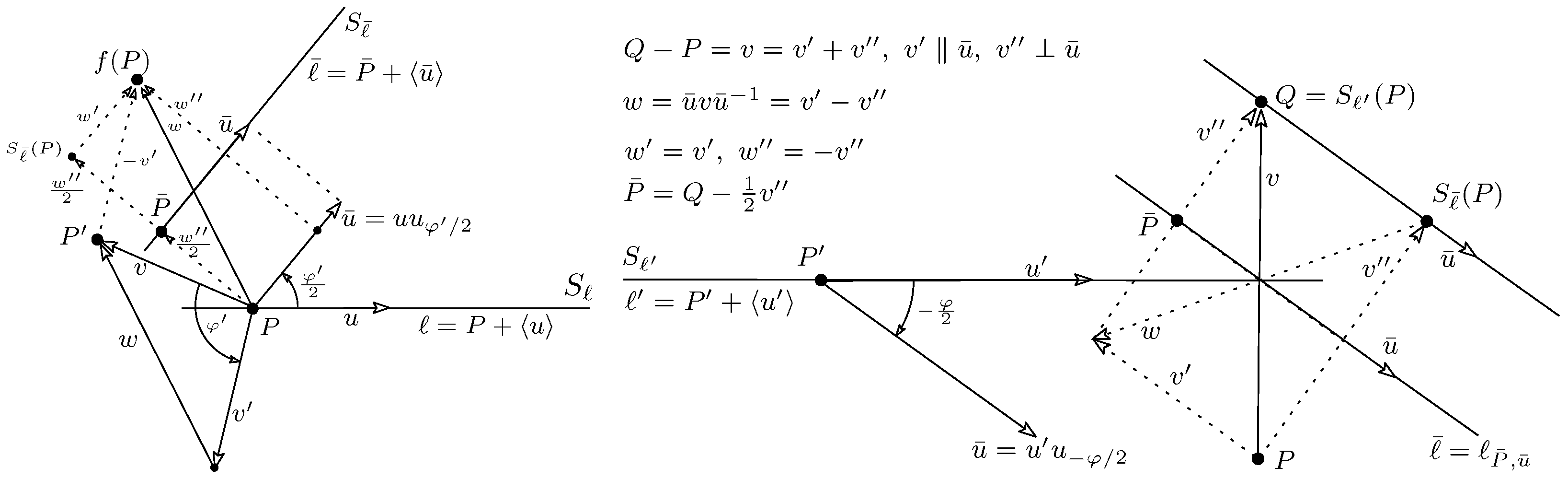
  • 9 ( f = R P , φ S and f = S R P , φ ). These compositions produce gliding symmetries. To deal with f (see Figure 4, Left), choose any representation P , u of and set v = P P , v = v u φ and w = v v . Then
    R P , φ S ( X ) = R P , φ ( P + u ( X P ) u 1 ) = P + ( P P + u ( X P ) u 1 ) u φ = P + ( P P ) ( 1 u φ ) + u ( X P ) u 1 u φ = P + ( P P ) ( 1 u φ ) + u u φ / 2 ( X P ) u φ / 2 1 u 1 = w + S ¯ ( X ) w = ( P P ) ( 1 u φ ) , ¯ = P , u ¯ , u ¯ = u u φ / 2 = w + S ¯ + w / 2 ( X ) , w = w + w , w ¯ , w ¯ .
    In the third step use P = P + ( P P ) and in the fourth use Equation (4) to get
    u ( X P ) u 1 u φ = u ( X P ) u φ u 1 = u u φ / 2 ( X P ) u φ / 2 1 u 1 .
    The last step relies on ⋄8.
Now consider f = S R P , φ (see Figure 4, Right). Choose any representation = P , u . Let Q = S ( P ) , u ¯ = u u φ / 2 , v = Q P = v + v , with v u ¯ and v u ¯ , and P ¯ = Q 1 2 v . Then f = S P ¯ , u ¯ , v = S ¯ , v . Indeed:
f ( X ) = S ( P + ( X P ) u φ ) = P + u ( P P + ( X P ) u φ ) u 1 = P + u ( P P ) u 1 + u ( X P ) u φ u 1 = S ( P ) + u u φ / 2 ( X P ) u φ / 2 u 1 = Q + u ¯ ( X P ) u ¯ 1 = P ¯ + 1 2 v + u ¯ ( X P ¯ 1 2 v ) u ¯ 1 + u ¯ ( Q P ) u ¯ 1 = P ¯ + u ¯ ( X P ¯ ) u ¯ 1 + v u ¯ ( Q P ) u ¯ 1 = u ¯ v u ¯ 1 = v v = v + S P ¯ , u ¯ ( X ) = S P ¯ , u ¯ , v ( X ) .
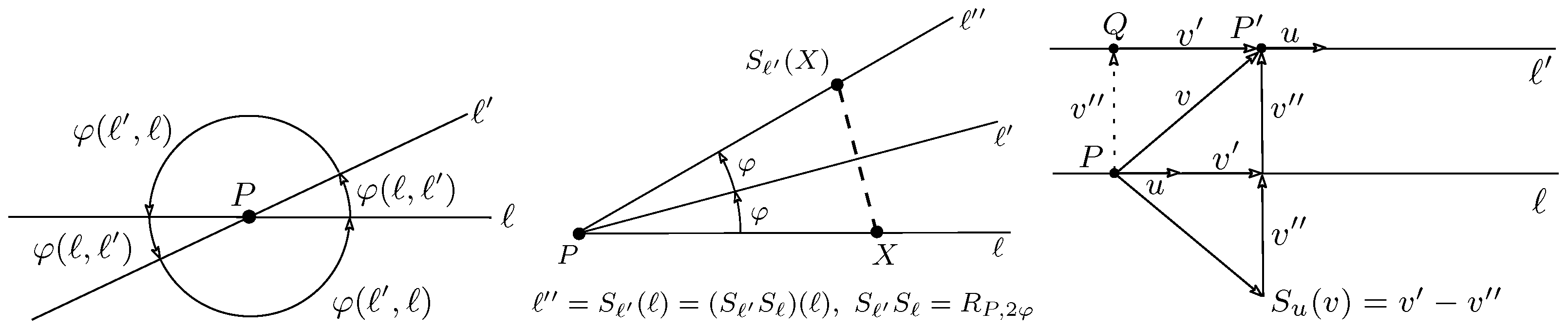
  • 10 ( S S ). If , this composition is the rotation R P , 2 φ (Figure 5, Middle), where P = and φ = φ ( , ) is the oriented angle from to (Figure 5, Left). Otherwise, it is the translation T 2 v , where v is the vector orthogonal to (hence also to ) such that T v ( ) = (Figure 5, Right).
Indeed, choosing unit direction vectors u and u for and such that u · u = cos φ , we have:
( S S ) ( X ) = S P + u ( X P ) u = P + u u ( X P ) u u ,
and u u = u · u + u u = cos φ u u = cos φ i sin φ = e i φ , and u u = e i φ . Therefore, using that i anticommutes with vectors, we have
( S S ) ( X ) = P + e i φ ( X P ) e i φ = P + ( X P ) e 2 i φ = R P , 2 φ ( X ) .
In particular we note that S 2 = Id .
If the lines and are parallel, say = P + u and = P + u ( u 2 = 1 ), let v = P P and v = v + v , with v u and v u . Then we have (see Figure 5, Right):
( S S ) ( X ) = S ( P + u ( X P ) u ) = P + u P P + u ( X P ) u u = P + u ( P P ) u + X P = X + v u v u = X + v + v ( v v ) = X + 2 v .
This means that the composition is the translation T 2 v : X X + 2 v .
  • 11 (Groups of isometries—for future reference). We let U = { u φ = e i φ φ [ 0 , 2 π ) } , the group of unit (geometric) complex numbers, and T = { T v v E } the group of translations (actually, the map E T , v T v is an isomorphism, as T v + v = T v T v and T v = Id if and only if v = 0 ).
Fix a point O (call it origin) and consider the set G O = { R O , φ | φ [ 0 , 2 π ) } of rotations about O. This set is actually a group under the composition operation, as Id = R O , 0 G O and
R O , φ R O , φ = R O , φ + φ , R 1 ( O , φ ) = R O , φ .
Moreover, the map U G O , u φ R O , φ , is a group isomorphism.
Define G = { T v R O , φ | v E , φ [ 0 , 2 π ) } . It is clear that this set contains T . It also contains all rotations R P , φ , for any P and any φ , because R P , φ = T v R O , φ , where v = ( P O ) ( 1 u φ ) (use ⋄6 or check it directly). Now ⋄6 implies that G is a group under the composition operation. Moreover, the map f O : E × U G , ( v , u φ ) T v R O , φ is bijective, but it is not a group isomorphism because
( T v R O , φ ) ( T v R O , φ ) = T v ( R O , φ T v ) R O , φ = T v R P , φ R O , φ [ P = O + v u φ ( 1 u φ ) 1 ] = T v T w R O , φ R O , φ [ w = ( P O ) ( 1 u φ ) = + v u φ ] = T v + v u φ R O , φ + φ .
This suggests defining in E × U the operation ( v , u φ ) ( v , u φ ) = ( v + v u φ , u φ u φ ) . With this operation, E × U is a group, which here we denote by P = E U (usually called the semi-direct product of E by U). With this definition, the computation above shows that the map f O : P G is a group isomorphism.
The group P can also be described by using the set of matrices
M = 1 0 v u φ   |   v E , u φ U ,
endowed with the product
1 0 v u φ 1 0 v u φ = 1 0 v + v u φ u φ u φ ,
as the map P M , ( v , u φ ) 1 0 v u φ , is manifestly an isomorphism. We note that the product (12) is a slight variation of the matrix product, as instead of u φ v we use v u φ . Nevertheless, the product is associative, for this property is easily seen to be equivalent to the commutativity of U. It is also clear that I 2 M is the neutral element and that
1 0 v u φ 1 = 1 0 v u φ u φ .
A final remark is that under the isomorphisms M P G the subgroups of P and M corresponding to T are { ( v , 1 ) | v E } and 1 0 v 1 | v E , respectively, but we will use the same symbol T to denote them.
The map δ : M U , 1 0 v u φ det 1 0 v u φ = u φ is a surjective homomorphism and its kernel is T . Therefore, T is a normal subgroup. The corresponding surjective homomorphisms P U and G U will also be denoted by δ .
Let us describe the action of G on E in terms of M. The action of f = T v R O , φ on E is given by the relation f ( X ) = v + ( X O ) u φ , which is the second component of the product
1 0 v u φ 1 X O .
This suggests representing points X as vectors 1 x , where x = X O , and in this way the action is given by matrix multiplication.
Remark 3. 
Although we are going to need only the group G, it is interesting to point out the following facts. Let S be the set of all gliding symmetries of E and G ¯ = G S . Using the results of ⋄6–⋄10 it turns out that G ¯ is closed under the operation of composition and consequently it is a group. Moreover, it can be seen that G ¯ is the group of all isometries of E , and that G is the group of all proper isometries, that is, isometries that preserve orientation. The isometries in S reverse the orientation and are called improper isometries.

4. Symmetry Insights About Morley’s Construction

With the notations used in Morley’s construction (Figure 1), we set:
R A = R A , 2 α , R B = R B , 2 β , R C = R C , 2 γ .
Theorem 2. 
R A , R B , R C have the following properties:
(1) 
R A = S A Z S A B = S A C S A Y
R B = S B X S B C = S B A S B Z
R C = S C Y S C A = S C B S C X
(2) 
R B R C = R X , 2 ( π α ) = R X , 2 ( π 3 α )
R C R A = R Y , 2 ( π β ) = R X , 2 ( π 3 β )
R A R B = R Z , 2 ( π γ ) = R Z , 2 ( π 3 γ )
(3) 
R A 3 = S A C S A B , R B 3 = S B A S B C , R C 3 = S C B S C A .
(4) 
R A 3 R B 3 R C 3 = Id .
Proof. 
Because of the cyclic symmetry, it is enough to prove one relation in each case.
(1)
Follows directly from Equation (11): S A Z S A B = R A , 2 φ ( A B , A Z ) = R A , 2 α = R A and likewise S A C S A Y = R A , 2 φ ( A Y , A C ) = R A , 2 α = R A .
(2)
By (1), we can write R B R C = S B X S B C S C B S C X = S X B S X C , which by Equation (11) is equal to R X , 2 φ ( X C , X B ) = R X , 2 ( 2 π α ) = R X , 2 ( π α ) = R X , 2 ( π 3 α ) (in the second step the summand 2 π can be omitted as its contribution to the rotation is null).
(3)
We have R A 3 = R A , 6 α , and this is equal to S A C S A B by Equation (11).
(4)
By (3), R A 3 R B 3 R C 3 = S A C S A B S B A S B C S C B S C A , which is the identity because S A B S B A , S B C S C B , S A C S C A are the identity.
In what follows, the unit complex number e i φ will be denoted by u φ . In particular, we have R P , φ ( X ) = P + ( X P ) u φ . Moreover, R P , u φ will be used as an alias for R P , φ .
Theorem 3 
(Fixed point of the composition of two rotations). If u φ u ψ 1 , the composition R = R Q , ψ R P , φ has a unique fixed point F, which is given by the expression
F = P + ( Q P ) 1 u ψ 1 u φ u ψ ,
and in this case R = R F , φ + ψ . Otherwise, R Q , ψ R P , φ = T v , where v = ( Q P ) ( 1 u ψ ) .
Proof. 
For any point X, its transform X is
X = R Q , ψ ( R P , φ ( X ) ) = R Q , ψ ( P + ( X P ) u φ ) = Q + P Q + ( X P ) u φ u ψ = Q ( Q P ) u ψ + ( X P ) u φ u ψ .
If u φ u ψ = 1 , this equation says that X = X + ( Q P ) ( 1 u ψ ) = X + v , or X = T v ( X ) . So we may assume that u φ u ψ 1 . If F is fixed by R = R Q , ψ R P , φ , then F = P + ( F P ) is equal to F = Q ( Q P ) u ψ + ( F P ) u φ u ψ ; hence,
Q ( Q P ) u ψ + ( F P ) u φ u ψ = P + ( F P ) ( Q P ) ( 1 u ψ ) = ( F P ) ( 1 u φ u ψ ) .
and solving for F P we get a unique F given by the claimed formula.
R = R F , φ + ψ is established by calculating R F , φ + ψ ( X ) = F + ( X F ) u φ u ψ using the expression for F given by Equation (14):
F + ( X F ) u φ u ψ = P + ( Q P ) 1 u ψ 1 u φ u ψ + ( X P ( Q P ) 1 u ψ 1 u φ u ψ ) u φ u ψ = P + ( Q P ) ( 1 u ψ ) + ( X P ) u φ u ψ = Q + ( P Q ) ( P Q ) ( 1 u ψ ) + ( X P ) u φ u ψ = Q + ( Q P ) u ψ + ( X P ) u φ u ψ ,
which agrees with R ( X ) . □
Corollary 1 
(Determination of X , Y , Z ). Let u A = e 2 i α , u B = e 2 i β , u C = e 2 i γ . Then we have:
X = C + ( B C ) 1 u B 1 u B u C = C + ( B C ) sin β sin ( β + γ ) e i γ = B + ( C B ) sin γ sin ( β + γ ) e i β , Y = A + ( C A ) 1 u C 1 u C u A = A + ( C A ) sin γ sin ( γ + α ) e i α = C + ( A C ) sin α sin ( γ + α ) e i γ Z = B + ( A B ) 1 u A 1 u A u B = B + ( A B ) sin α sin ( α + β ) e i β = A + ( B A ) sin β sin ( α + β ) e i α .
We only need to work out the expressions for X, as those for Y and Z follow from the cyclic arrangement. The first expression is obtained by applying the formula of Theorem 3 to the composition R B R C , as X is its fixed point. For the second expression of X note that
1 u B = 1 e 2 i β = 1 cos 2 β i sin 2 β = 2 sin 2 β 2 i sin β cos β = 2 i sin β ( cos β + i sin β ) = 2 i sin β e i β ,
and hence 1 u B 1 u B u C = sin β e i β sin ( β + γ ) e i ( β + γ ) = sin β sin ( β + γ ) e i γ . Finally, the third expression for X is derived from the second as follows:
C + ( B C ) sin β sin ( β + γ ) e i γ = B + ( C B ) ( C B ) sin β sin ( β + γ ) e i γ = B + ( C B ) ( 1 sin β sin ( β + γ ) e i γ ) and sin ( β + γ ) sin β e i γ = sin β cos γ + cos β sin γ sin β cos γ + i sin β sin γ = sin γ ( cos β + i sin β ) = sin γ e i β .
The formulas in Corollary 1 can be used to draw Morley’s triangle and then the trisectors of the three angles, as shown in Figure 6.
Remark 4. 
The second and third expressions for X can be inferred from the law of sines, which has not been used to obtain them. Indeed, with the notations of Figure 1, X C = X C B C ( B C ) e i γ , where X C B C = sin β sin α by the sine theorem, and sin α = sin ( β + γ ) . Similarly, X B = B X B C ( C B ) e i β = sin γ sin α ( C B ) e i β = ( B A ) sin γ sin ( β + γ ) e i β . Anyway, the law of sines can be obtained easily using the Wessel algebra (see ⋄19).
  • 12 (Criteria for a triangle to be equilateral). Let A B C be a triangle in E 2 and O a given point (origin). Let ω 0 , ω 1 , ω 2 C . Then the expression
    ( A O ) ω 0 + ( B O ) ω 1 + ( C O ) ω 2
    is independent of O if and only if ω 0 + ω 1 + ω 2 = 0 . This follows immediately from the following computation, where O is any other point:
    ( A O ) ω 0 + ( B O ) ω 1 + ( C O ) ω 2 = ( A O ) ω 0 + ( O O ) ω 0 + ( B O ) ω 1 + ( O O ) ω 1 + ( C O ) ω 2 + ( O O ) ω 2 = ( A O ) ω 0 + ( B O ) ω 1 + ( C O ) ω 2 + ( O O ) ( ω 0 + ω 1 + ω 2 ) .
If we now apply this result using ω 0 = 1 , ω 1 = ω , ω 2 = ω 2 , where ω = e 2 π 3 i (note that ω 3 = 1 and hence 1 + ω + ω 2 = ( ω 3 1 ) / ( ω 1 ) = 0 ), then in particular we have
( A O ) + ( B O ) ω + ( C O ) ω 2 = ( A G ) + ( B G ) ω + ( C G ) ω 2
where G is the barycenter of A B C . With this we can prove that A B C is equilateral if and only if ( A O ) + ( B O ) ω + ( C O ) ω 2 = 0 , that is, if and only if x + y ω + z ω 2 = 0 , where x = A G , y = B G , z = C G . If the triangle is equilateral, then y = x ω and z = y ω = x ω 2 , and hence x + y ω + z ω 2 = x + x ω 2 + x ω 4 = x ( 1 + ω 2 + ω ) = 0 . Conversely, assume that x + y ω + z ω 2 = 0 . This, together with x + y + z = 0 , implies that y ( ω 1 ) + z ( ω 2 1 ) = 0 , or y + z ( ω + 1 ) = 0 , or y = z ω 2 (because ω + 1 = ω 2 ), or z = y ω . Hence, we also have x = ( y + z ) = y ( 1 + ω ) = y ω 2 , or y = x ω , and these facts imply that A B C is equilateral.
The special case O = A tells us that A B C is equilateral if and only if
( B A ) ω + ( C A ) ω 2 = 0 , or B A = ( A C ) ω .

5. Proof of Theorem 1 with Wessel’s Algebra

  • 13 (Notations and conventions). Let us set (cf. Figure 1):
    a = C B , b = A C , c = B A ,
    so that a = a a , b = b b , c = c c ( a , b , c unit vectors). Then we have the following relations:
    b = a e i 3 γ , c = b e i 3 α , a = c e i 3 β .
    Notice, for example, that b = a e i ( π 3 γ ) = a e i 3 γ .
  • 14 (Proof). It is based on the expressions for X , Y , Z obtained in Corollary 1. With the notations and conventions declared in Table 3, the third expression of Z and the second of Y in Corollary 1 take the form
    Z = A + c c sin β sin γ e i α , Y = A b b sin γ sin β e i α .
    Since c = b e i 3 α , by (17), we readily get
    Z Y = b b sin γ sin β c sin β sin γ e i α e i α .
    Now use Equation (A2) to replace b and c, and then the identity (A4) to obtain
    Z Y = 4 δ sin β sin γ b ( sin β sin γ e i α ) e i α .
    It can be immediately seen that β = γ + α , and hence sin β = sin γ cos α + cos γ sin α . On the other hand, sin γ e i α = sin γ cos α i sin γ sin α . Therefore,
    sin β sin γ e i α = cos γ sin α + i sin γ sin α = sin α e i γ .
    Since e i γ e i α = e i ( γ α ) = e i ( β + 2 γ ) , we get
    Z Y = 4 δ sin α sin β sin γ b e i ( β + 2 γ ) .
    The expressions for X Z and Y X are obtained from (18) by cyclic permutations:
    X Z = 4 δ sin α sin β sin γ c e i ( γ + 2 α ) ,
    Y X = 4 δ sin α sin β sin γ a e i ( α + 2 β ) .
    In particular X Y Z is equilateral: X Y = Y Z = Z X = 4 δ sin α sin β sin γ .
Remark 5. 
The expressions (18) tell us not only the length of the sides of Morley’s triangle X Y Z , but also the orientation of its sides with respect to the triangle A B C .

Funding

This research received no external funding.

Data Availability Statement

The original contributions presented in this study are included in the article. Further inquiries can be directed to the corresponding author.

Acknowledgments

The idea of trying to derive the original F. Morley’s theorem by means of geometric algebra originated several years ago (around 2015, on the occasion of the conference AGACSE 2015 held in Barcelona) on reading Connes’ paper [3], while the motivation to think about its generalization was triggered by conversations with Jaume Pagès Fita, who early in 2022 called my attention to Le Masne’s book [4] and more specifically to the comments on pages 21–22 on the 27 Morley equilateral triangles associated to any triangle. I am grateful for his suggestions, especially for the good moments I have experienced while exploring these matters. Thanks also to the excellent services of the Facultat de Matemàtiques i Estadística library, of the Universitat Politècnica de Catalunya, and especially to the efficiency of the librarians in finding copies of historical documents. I am also thankful for the freely available tools that facilitate undertakings such as the production of this paper, as for example ipe, a wonderful program for geometric drawing, or high-performing latex environments such as Miktex and TeXstudio, or the useful answers to questions about bibliography provided by large language models such as ChatGPT or Gemini, among others. During the preparation of this manuscript, the author used ChatGPT or Gemini for the purposes of checking bibliographic information and portrait enhancement based on a historical photograph. The author has reviewed and edited the output and take full responsibility for the content of this publication.

Conflicts of Interest

The author declares no conflicts of interest.

Appendix A. Notes

  • 15 (References for geometric algebra and its applications). Geometric algebra was conceived by G. Leibniz (1646–1716) and developed by C. Wessel (1745–1818), W.R. Hamilton (1805–1865) and H. Grassmann (1809–1877), W.K. Clifford (1845–1879) and R. Lipschitz (1832–1903), É. Cartan (1869–1951) and H. Weyl (1885–1955), and many others afterwards. In ([1], §1) you can find a general direct construction of geometric algebra based on Grassmann exterior algebra. For the pioneering work of C. Wessel, see [2]. For tracing back to Leibniz the idea of geometric algebra, see ([5], §§1–4). For a panoramic overview of the development of geometric algebra, particularly in relation to physics, consult [6,7] and the forthcoming [8], which includes an extensive list of references. See also [9] and the references cited there.
  • 16 (References on Morley’s theorem and its natural generalizations). Oakley & Baker [10], provide a critical well-documented account of the history of Morley’s theorem (150 references) up until 1978. The story is also told in ([11], §10) (83 references). Now it may be useful, particularly in view of generalizations, to also consider the following selection of works that have appeared since 2007: [12,13,14,15].
In this context, it is worth pointing out that (other) biographical sketches of F. Morley life and works can be found in https://www.ams.org/journals/bull/1938-44-03/S0002-9904-1938-06692-X/S0002-9904-1938-06692-X.pdf (obituary by Arthur B. Coble) (accessed on 1 January 2026), in https://mathshistory.st-andrews.ac.uk/Biographies/Morley/ (accessed on 1 January 2026), and in https://en.wikipedia.org/wiki/Frank_Morley (accessed on 1 January 2026). “Professor Morley had a strong conviction that geometry was the ideal medium for the presentation of abstract mathematical ideas to the general intellectual public and he welcomed the opportunities which came to him to spread this gospel in other universities” (quoted from Coble’s obituary).
Euclid-style proofs of Theorem 1 usually conclude that the sides of the Morley triangle are equal to 4 δ sin α sin β sin γ , where δ is the diameter of the circumcircle of A B C . The proof based on the Wessel algebra (⋄14) delivers a stronger conclusion, as it also provides explicit expressions (Equation (18)) for the inclinations of its sides with respect to A B C .
  • 17 ( E , the algebraic model of the Euclidean plane).  E is a real vector space of dimension 2 (its elements are called vectors and are denoted by Latin letters such as v , v , w , ) endowed with a scalar product v · v R which is bilinear, symmetric and positive definite, which means that v · v > 0 for any vector v 0 . The length of a vector v is defined as + v · v and will be denoted | v | , so that | v | 0 for any v, with equality if and only if v = 0 .
It turns out that | v | | v | v · v | v | | v | for any v , v (Cauchy–Schwarz inequality), which implies that 1 v · v | v | | v | 1 if v , v 0 . Consequently, there exists a unique α = α ( v , v ) [ 0 , π ] (called the angle defined by v and v ) such that cos α = v · v | v | | v | .
  • 18 (On the Argand plane). In the habitual view of the complex numbers
    C = { z = a + b i | a , b R }
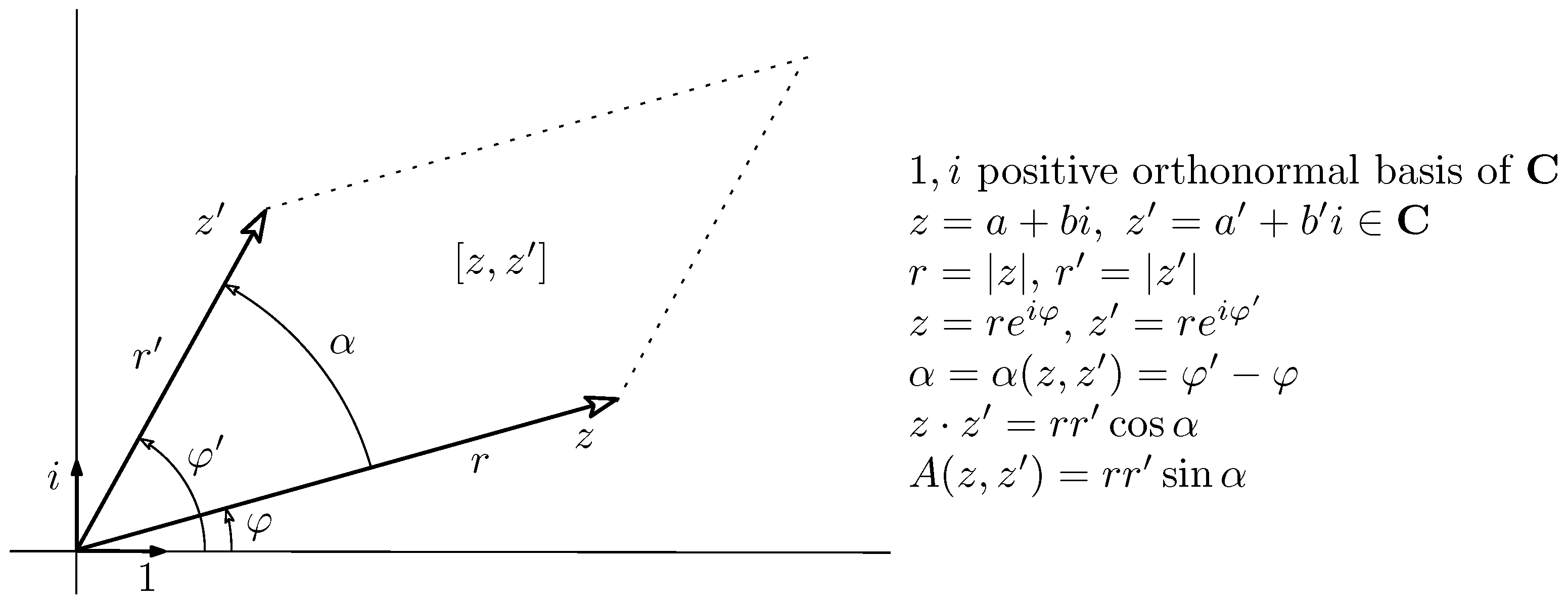
    in relation to plane Euclidean geometry, they play two quite different roles. Primarily, they were (and are) construed as an algebra (actually a field) in which the main rule is that i 2 = 1 . This conception emerged in the quest to solve polynomial equations begun in the sixteenth century by G. Cardano (Ars Magna, 1545) and continued by many others ever since. But later C was also seen as a model of the oriented Euclidean plane (cf. [2]), in the sense that C is an oriented real vector space of dimension 2 (with { 1 , i } a positively oriented basis) in which (see Figure A1):
Figure A1. The Euclidean interpretation of C : Oriented angle between z , z C and oriented area A ( z , z ) of the parallelogram [ z , z ] = { λ z + λ z | λ , λ [ 0 , 1 ] } .
Geometry 03 00009 g0a1
z, regarded as a vector, has length r = | z | = a 2 + b 2 = z z ¯ ;
the scalar product associated to the quadratic form z z ¯ = a 2 + b 2 is
z · z = a a + b b = re ( z ¯ z ) ;
the oriented area A ( z , z ) of the parallelogram [ z , z ] defined by z and z is given by A ( z , z ) = a b b a = im ( z ¯ z ) ;
the oriented angle α = α ( z , z ) is determined by the relations α = ± arccos ( z · z | z | | z | ) , with ± equal to the sign of A ( z , z ) .
Using the polar forms z = r e i φ , z = r e i φ , we have:
α = φ φ z ¯ z = r r e i α = r r cos α + i r r sin α z · z = re ( z ¯ z ) = r r cos α A ( z , z ) = im ( z ¯ z ) = r r sin α .
  • 19 (The law of sines). Using the notations indicated in ⋄13, and letting S stand for the oriented area of A B C , we have a b = b ( a ) = a b sin ( 3 γ ) i = 2 S i . Since we get the same value for b c and c a , we have
    a b sin ( 3 γ ) = b c sin ( 3 α ) = c a sin ( 3 β ) = 2 S .
On dividing by a b c , we get
a / sin ( 3 α ) = b / sin ( 3 β ) = c / sin ( 3 γ ) = δ ,
where δ = a b c / 2 S . Consequently,
a = δ sin ( 3 α ) , b = δ sin ( 3 β ) , c = δ sin ( 3 γ ) .
Remark A1. 
It turns out that δ is the diameter of the circumcircle of A B C , but this fact is not used in our arguments.
  • 20 (A trigonometric identity). For any real number θ 0 , π ,
    sin ( 3 θ ) / sin ( θ ) = 4 sin ( π 3 θ ) sin ( 2 π 3 θ ) .
    Indeed, using basic trigonometric algebra we find that both sides are equal to
    4 cos 2 θ 1 = ( 2 cos ( θ ) 1 ) ( 2 cos ( θ ) + 1 ) .
    Note that using the notations set in Table 3, the identity can be written in the form
    sin ( 3 θ ) = 4 sin θ sin θ sin θ ,
    and that in this form it is also valid for θ = 0 , π .
[On the 2650 birthday of Thales] Thales seems also to have been the first to go about proving mathematical statements [that already had a long history] by a regular series of arguments, marshaling what was already known and proceeding step by step to the desired proof as an inevitable consequence. In other words, he invented deductive mathematics, which was to be systematized and brought to a high polish two and a half centuries later by Euclid [this year it is his 2350 birthday].
From Isaac Asimov’s, Biographical Encyclopedia of Science and Technology, The Lives and Achievements of 1510 Great Scientists from Ancient Times to the Present Chronologically Arranged.
(Hoping that this prodigious stream of shining lights over millennia will continue to irradiate over humanity forever).

Appendix B. Angle Trisectors and Morley’s Constellation

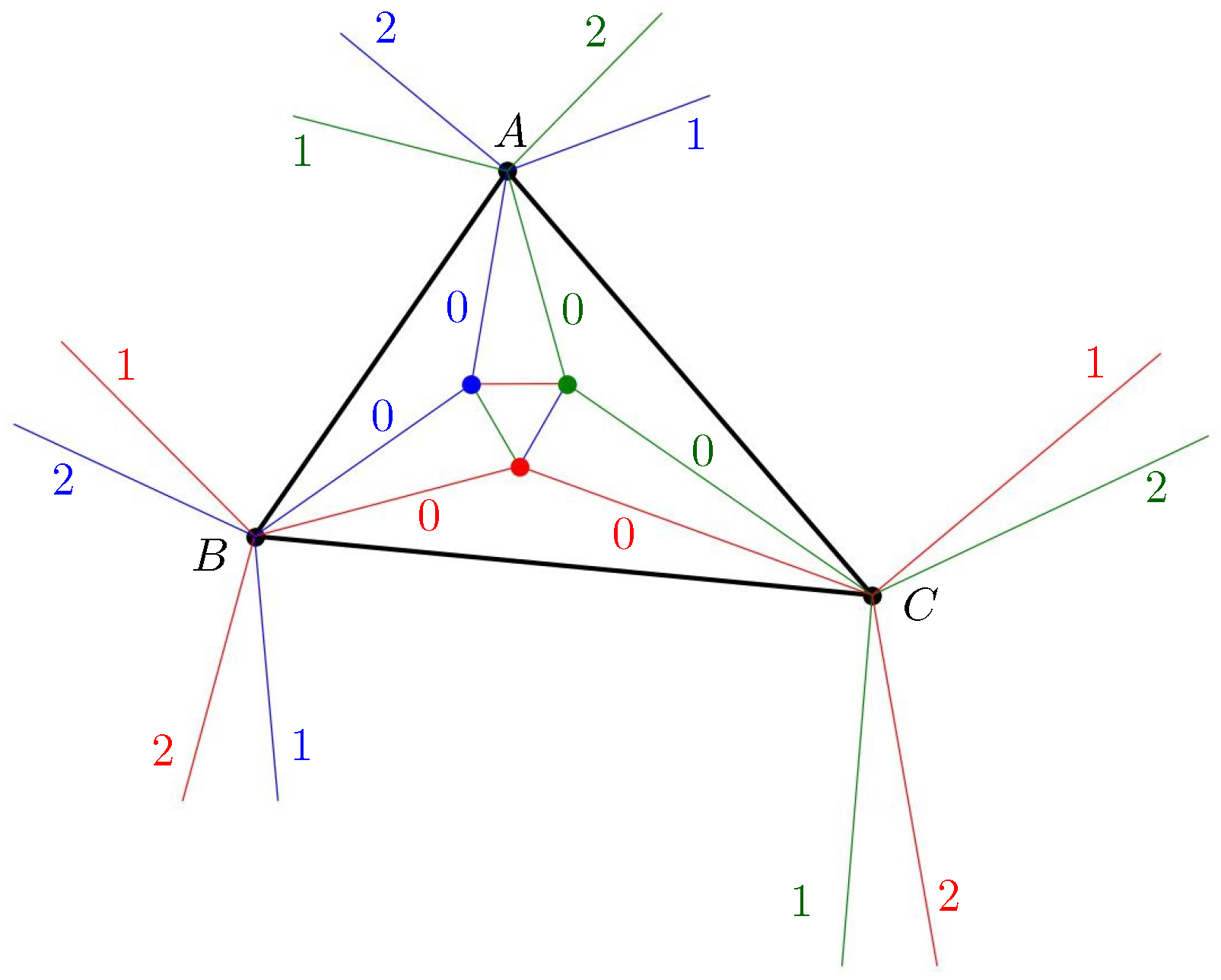
The Morley triangle X Y Z of a triangle A B C involves its interior angle trisectors, as shown in Figure 6, where the pairs of trisectors contiguous to B C , C A and A B are depicted in red, green and blue, respectively. Thus, the trisectors of B ^ , C ^ and A ^ are colored, according to the positive sense of the orientation, red and blue, green and red, and blue and green, respectively.
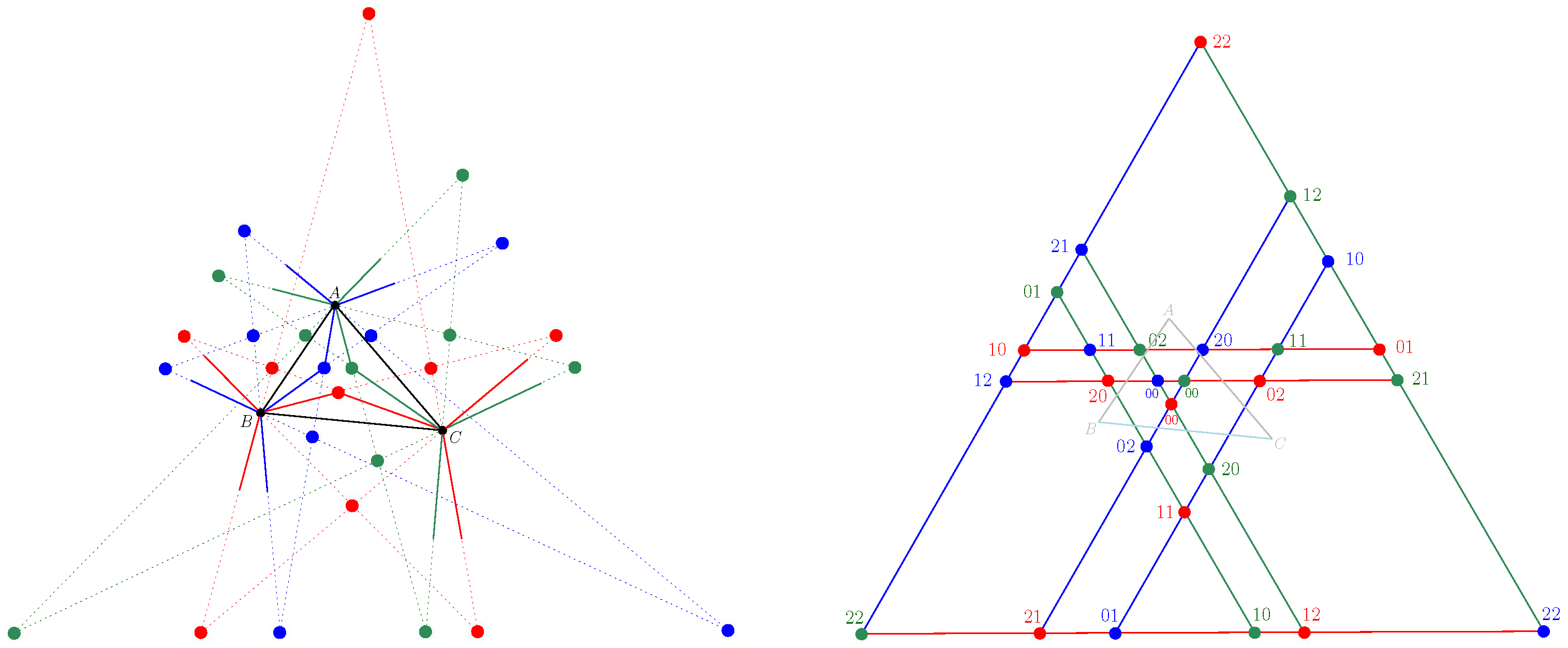
The constructions we are about to inspect concern the interior and exterior trisectors, which are described in Figure A2. Drawing the 27 points obtained by intersecting any pair of trisectors of the same color, the striking result, here called Morley’s constellation (MC for short), is shown in Figure A3. It obviously reveals that the constellation has a simple geometric structure closely related to the triangle X Y Z , and suggests that it may be feasible to explain this structure in rather elementary terms, i.e., with no need to find analytic expressions for them in the guise of those obtained for X , Y , Z (at least for the time being). In other words, it may not be necessary to repeat, for the other points of the constellation, the relatively hard work done to find expressions for the vertices X, Y and Z, and for the inclinations of the sides of X Y Z .
The MC in Figure A3 reproduces, with different notations and conventions, ([11], Figures 7 and 8), or, nearly one century earlier, ([16], Figure 3). Our labels i j , i j and i j correspond to the labels i j , i j and i j in [11] and to the labels D i j , E i j , F i j in [16]. Let us also mention two papers published in between that also consider the 27 Morley triangles and the MC with varying conventions: ([17], Figure 8) (Table A1 below displays the correspondence between his florid notations and ours), and ([18], Figure 3) (his M i j , N i j , P i j corresponding to our i j , i j , i j ).
Figure A2. The labels of interior trisectors are all 0, but they are distinguished with the color assigned to the trisector. The exterior trisectors are produced by rotating the interior trisectors by 2 π / 3 and 4 π / 3 about the corresponding vertex in the contiguous orientation sense, and they are labeled 1 and 2 with the same color as the corresponding 0 trisector. For example, the red exterior trisectors concurring at B are obtained by rotating the interior red trisector at B by 2 π / 3 and 4 π / 3 2 π / 3 ; similarly, the blue (gren) exterior trisectors concurring at B (C) are obtained by rotating the interior blue (green) trisector at B (C) by 2 π / 3 and 4 π / 3 2 π / 3 . Notations: the trisector at vertex V corresponding to a colored  t { 0 , 1 , 2 } will be denoted by V t . For example, A 1 is the trisector of A ^ with label 1. To achieve that in the graphic the side X Y has an inclination of π / 3 with respect to the graphical horizontal u , the side B C has to be rotated (say about B) through γ β . Indeed, from Equation (18b) we know that a e i ( α + 2 β ) is the inclination of Y X over the graphical horizontal. If we require that this inclination be π / 3 , then we have a e i ( α + 2 β ) = u e π 3 i , and this implies that a = u e i ( γ β ) .
Geometry 03 00009 g0a2
Table A1. In [17], and also in ([19], Fig. 8), the points in the MC are denoted by the symbols in the first, third and fifth rows of the table below, while the second, fourth and sixth rows show the colored codes from Figure A3 corresponding to those symbols. Accordingly, the Morley triangles in the MC are denoted by the following triplets: x y z , x y z , ξ η ζ , ξ η ζ , X Y Z , X Y Z , x y z , x η Z , ξ η ζ , ξ Y z , X y ζ , X Y Z , x y z , x Y ζ , ξ η ζ , ξ y Z , X η z , X Y Z , x η ζ , ξ Y Z , X y z , x y Z , ξ η z , X Y ζ , x Y z , ξ y ζ , X η Z , x X X , ξ x x , X ξ ξ , y Y Y , η y y , Y η η , z Z Z , ζ z z , Z ζ ζ The fourth row lists the 9 monochrome Morley equilateral triangles; the remaining are trichrome, with the equilateral on the first two rows and the non-equilateral in the third row.
x ξ X x ξ X x ξ X”
001122200112021021
y η Y y η Y y η Y”
001122200112021021
z ζ Z z ζ Z z ζ Z”
001122200112021021
Let us return to the structure of the MC, which [11] discusses in connection to his Lighthouse Theorem and using only Euclid-style reasoning (the lighthouse metaphor arises from picturing the red trisectors, say, as beams of lighthouses at B and C turning in opposite directions, counterclockwise at B and clockwise at C: cf. Figure A3). In addition to the observations collected in Figure A3, the striking fact that the 27 equilateral Morley triangles have parallel sides is established. Nevertheless, in view of further reflections, it may not be idle to add here a few more comments.
Courtesy of [3], Remark 1, the red point i j = B i C j of the MC ( i , j { 0 , 1 , 2 } ) is the fixed point of the composition R B , u B ω i R C , u C ω j , where ω = e 2 π i / 3 (this is a generalization of Corollary 1, as there the case 00 has been established). Analogous formulas are valid for the green and blue points of the MC. But in the said Remark 1 it is stated that “one obtains in this way the 18 nondegenerate (sic) equilateral triangles of variants of Morley’s theorem”, with no insight into the fact that the sides of all 18 triangles are parallel to the sides of the Morley triangle X Y Z , and no explanation of what ‘nondegenerate’ might mean (as we saw above, they are in fact non-equilateral tricolor Morley triangles), and no reference to the remaining nine equilateral triangles (in our terms, the monochrome Morley triangles). Note also that [3], condition (a), corresponds to our relation Theorem 2 (4), and it may be worth further inquiring how it relates to the MC in terms of the WA.
The paper in [20] uses the complex model of plane Euclidean geometry to provide an interesting proof of Theorem 1 and a complete description of the MC explained in Figure A3 and of all the Morley triangles (including the monochrome and the non-equilateral). A translation of this approach to WA should be worthwhile, even if it were only to obtain more transparent and less cumbersome expressions for the MC points. In that quest, notice that Cundy’s turns become the elements of the group U = { u φ = e i φ | φ [ 0 , 2 π ) } and that this group acts on any circumference in E with center at an arbitrary point O by
X R O , φ ( X ) = O + ( X O ) u φ .
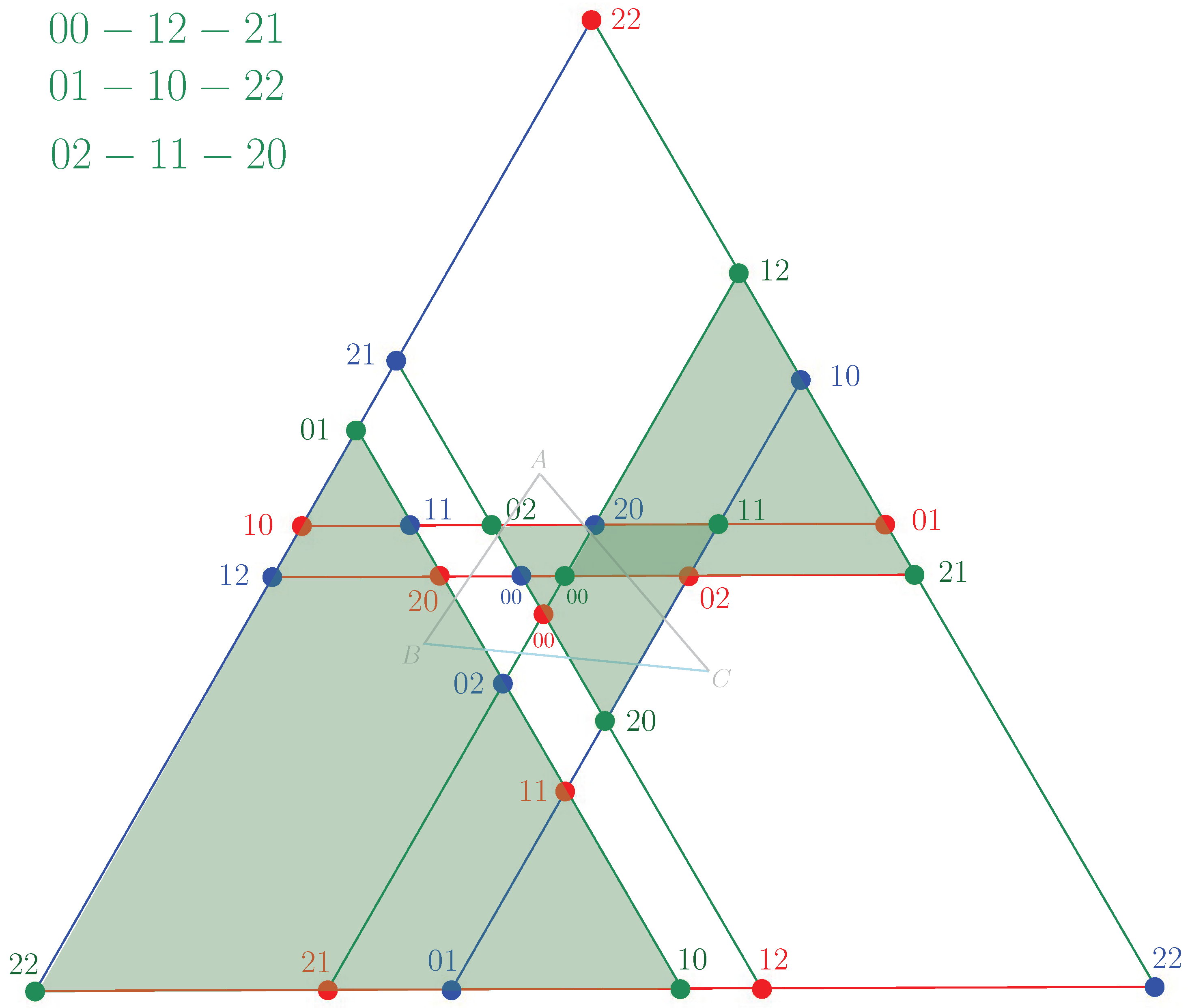
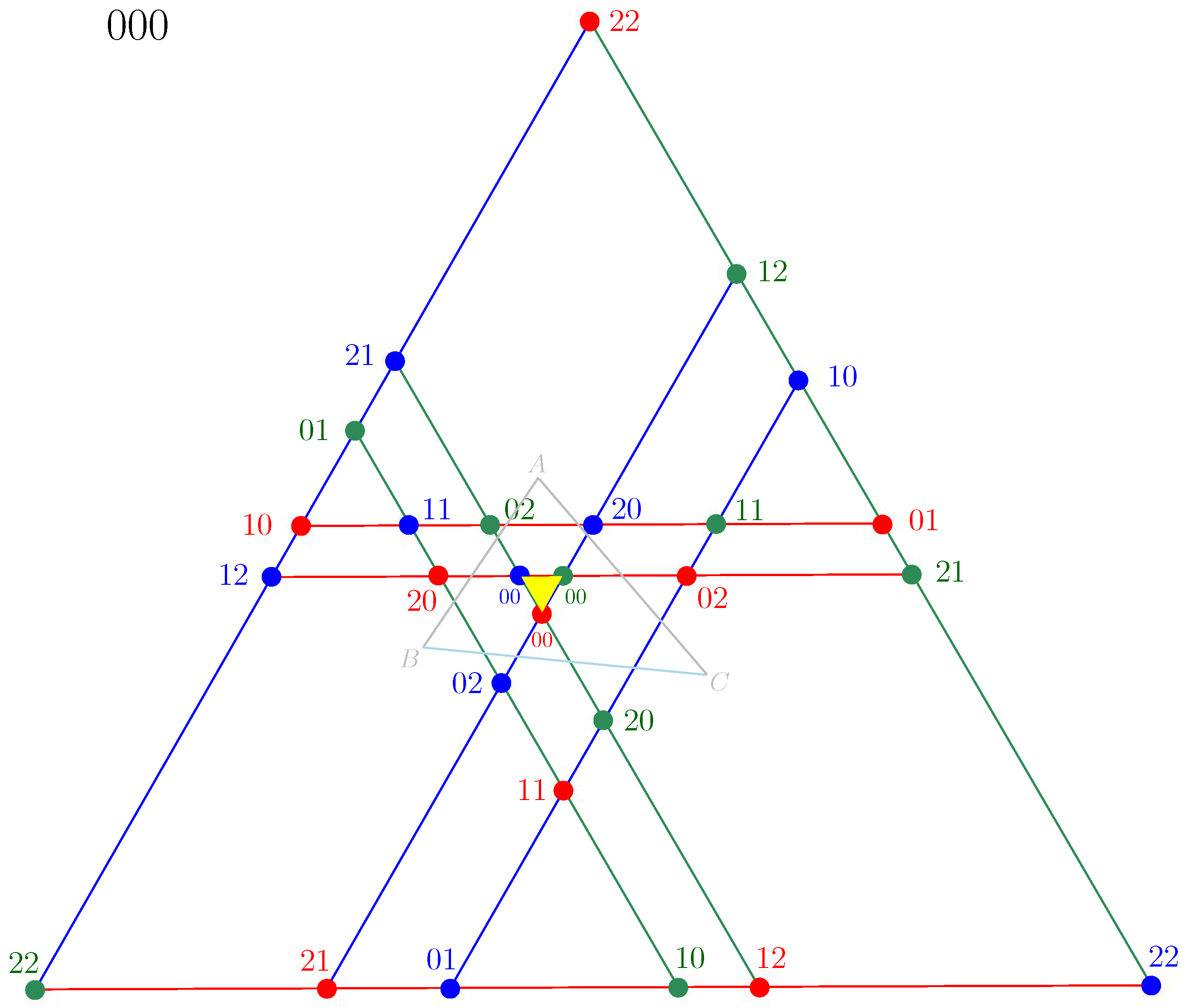
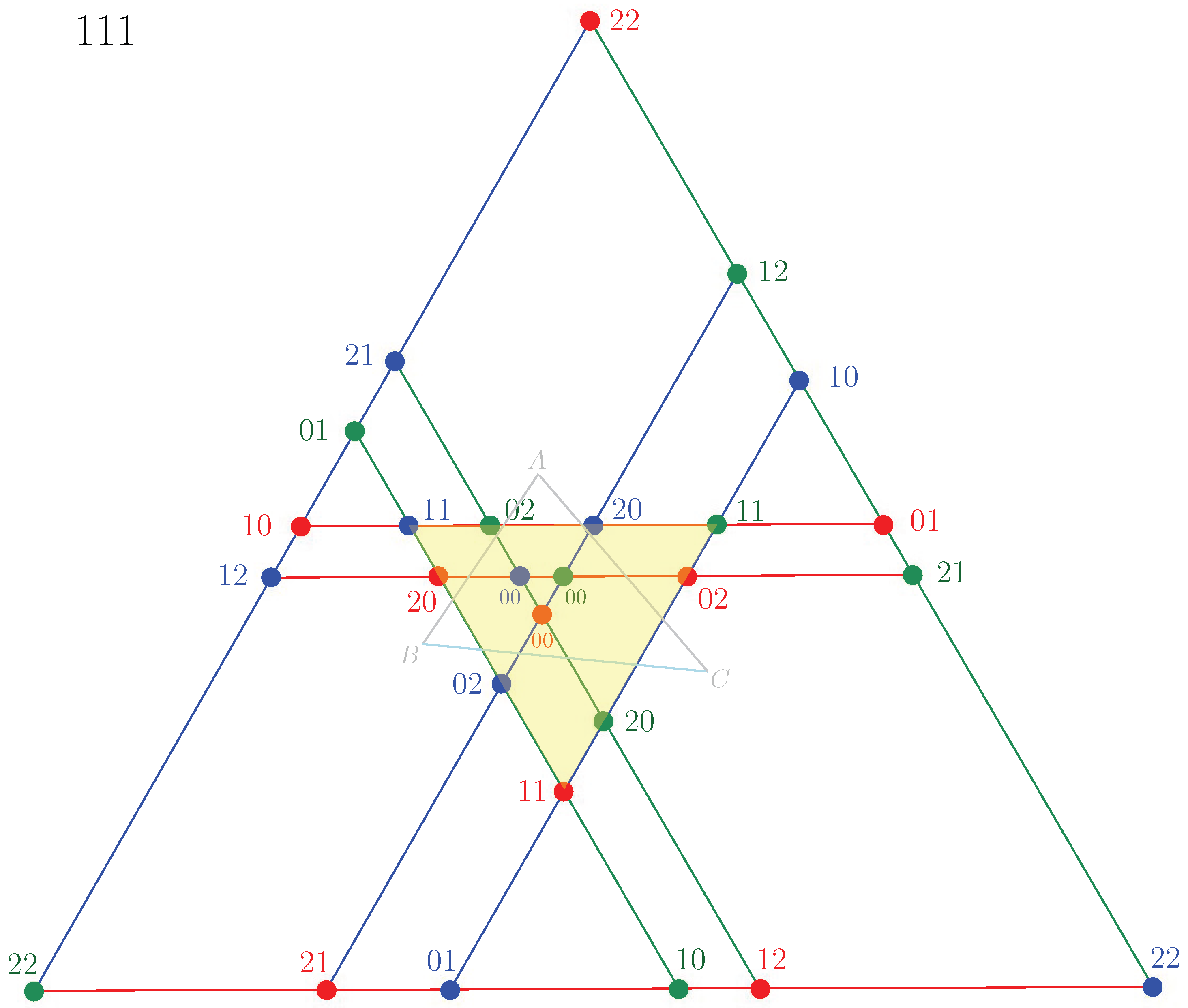
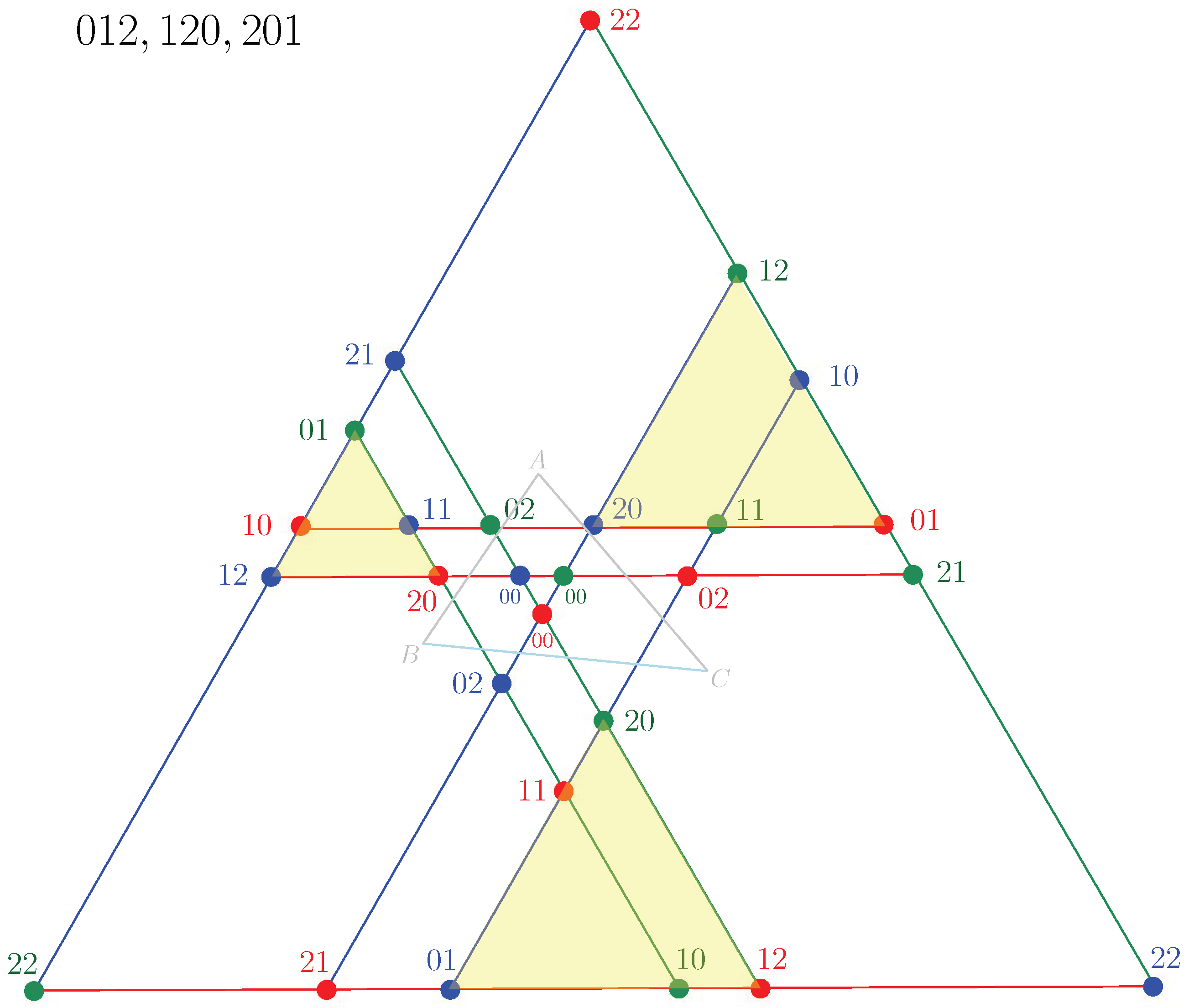
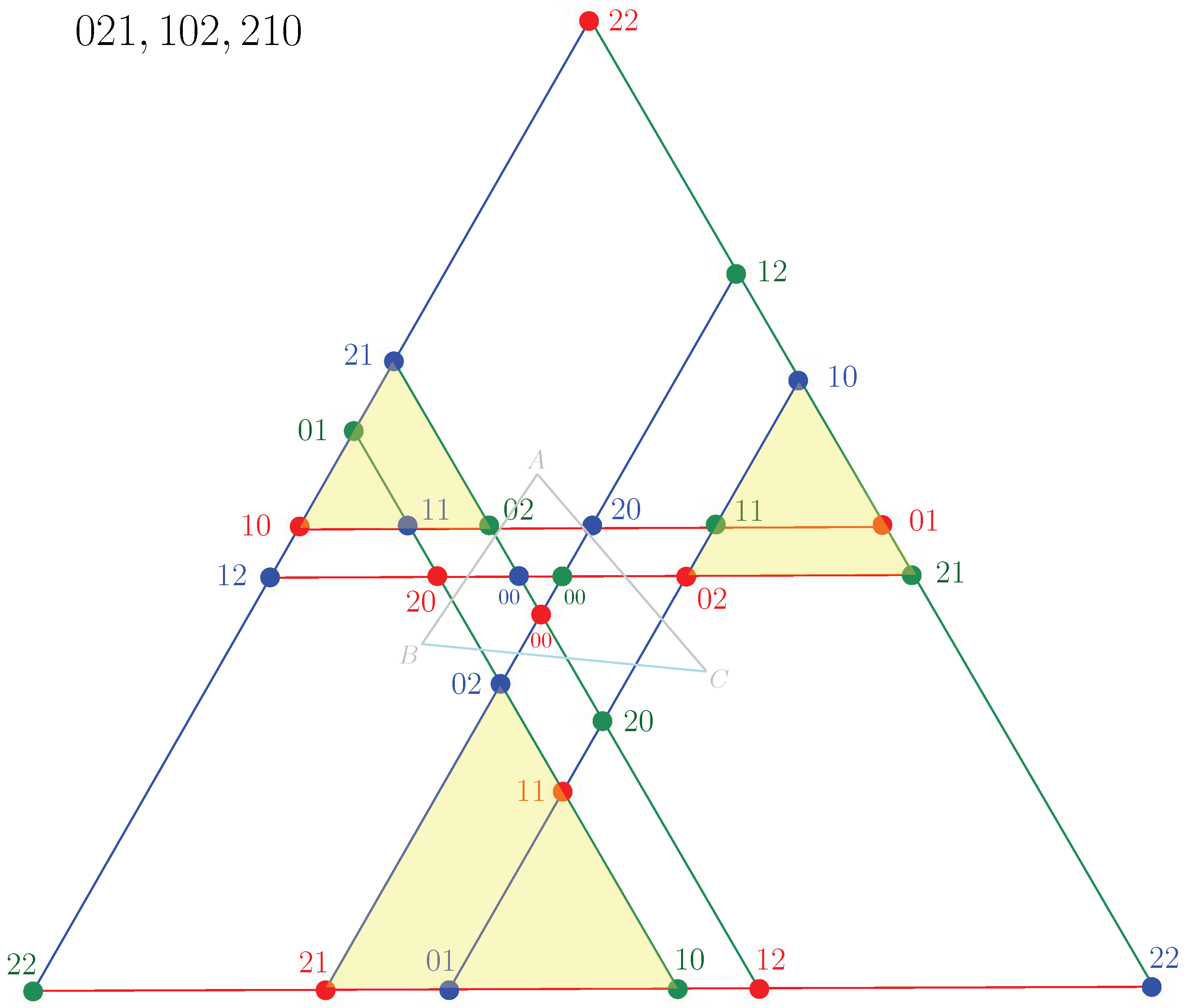
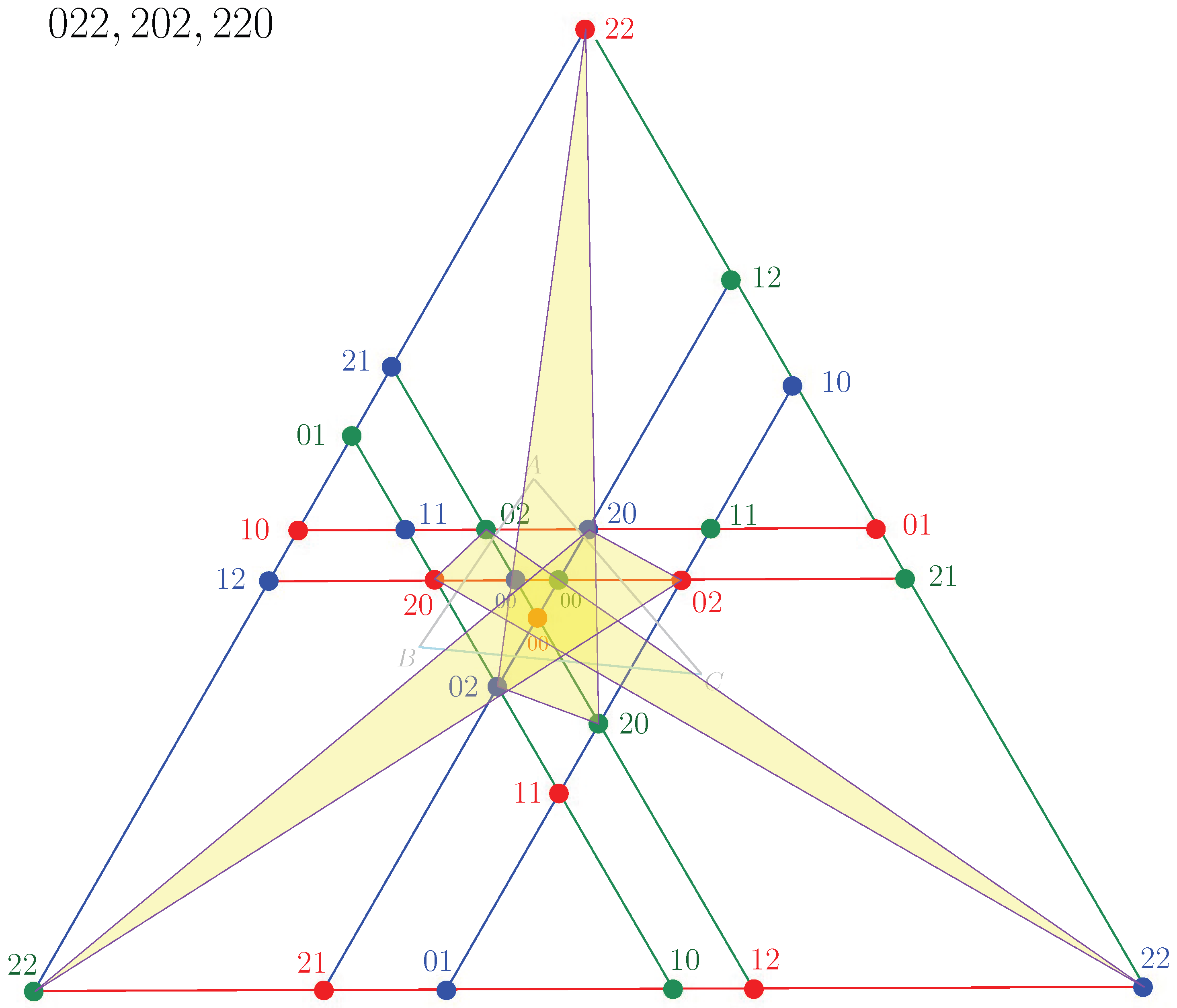
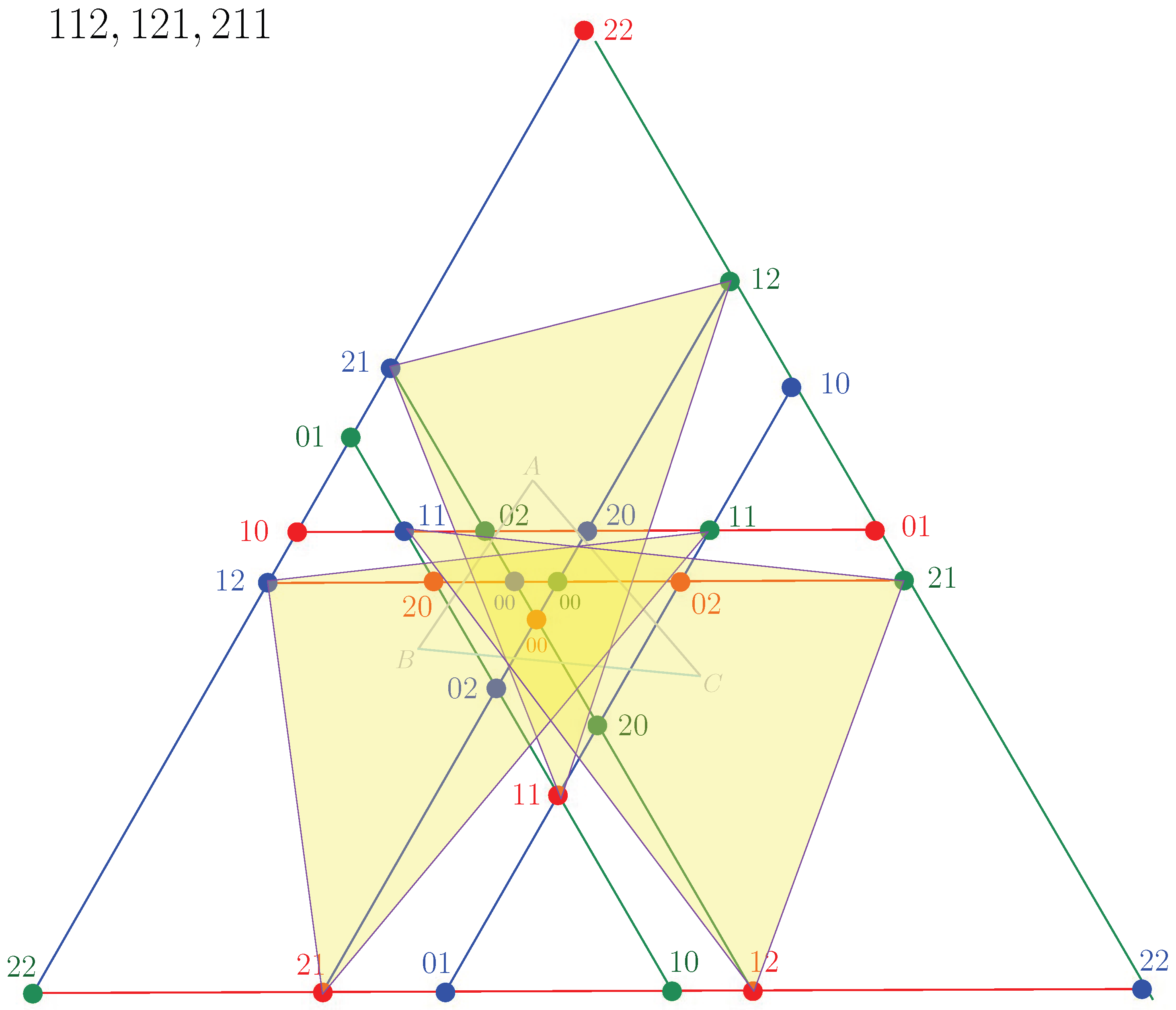
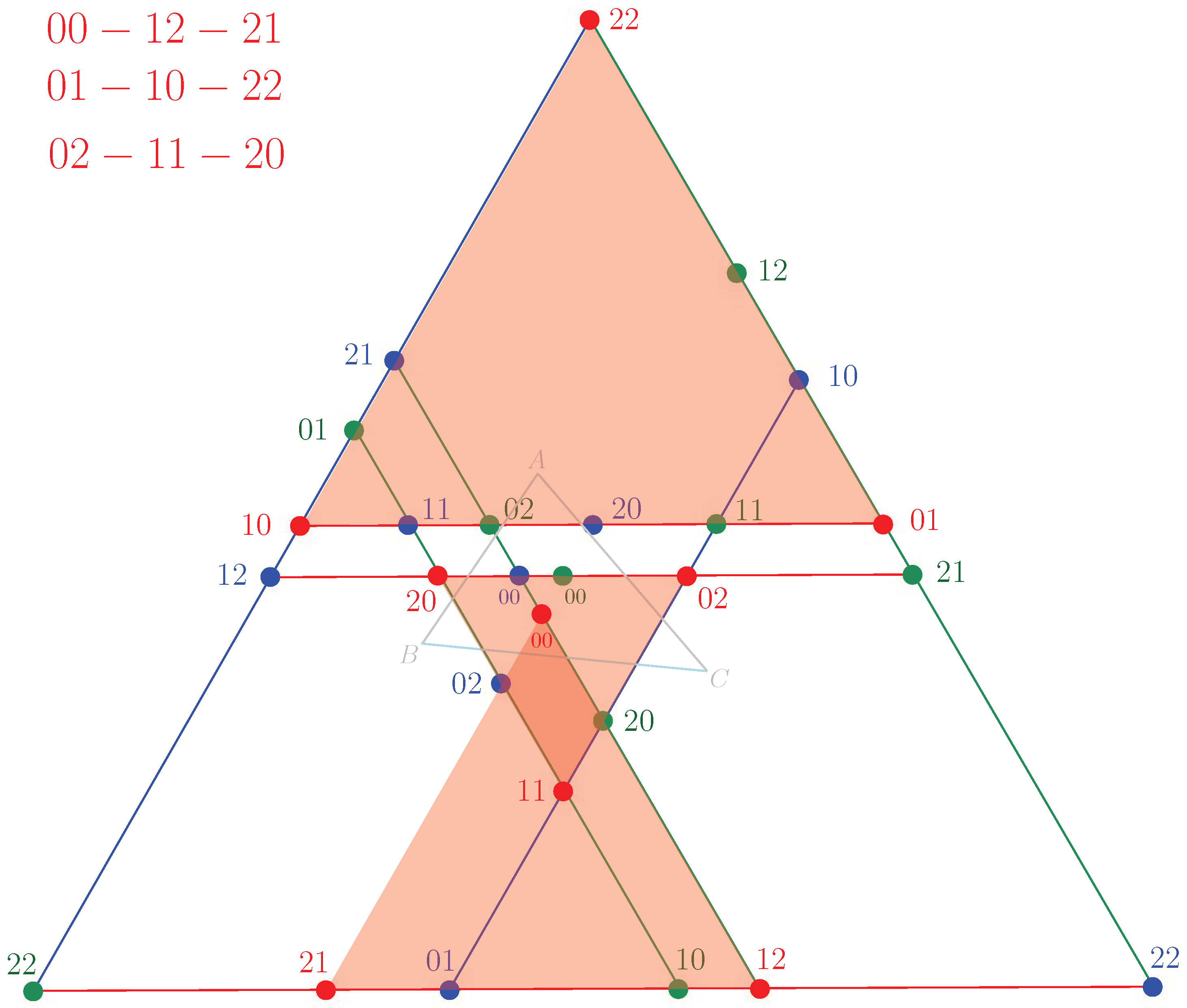
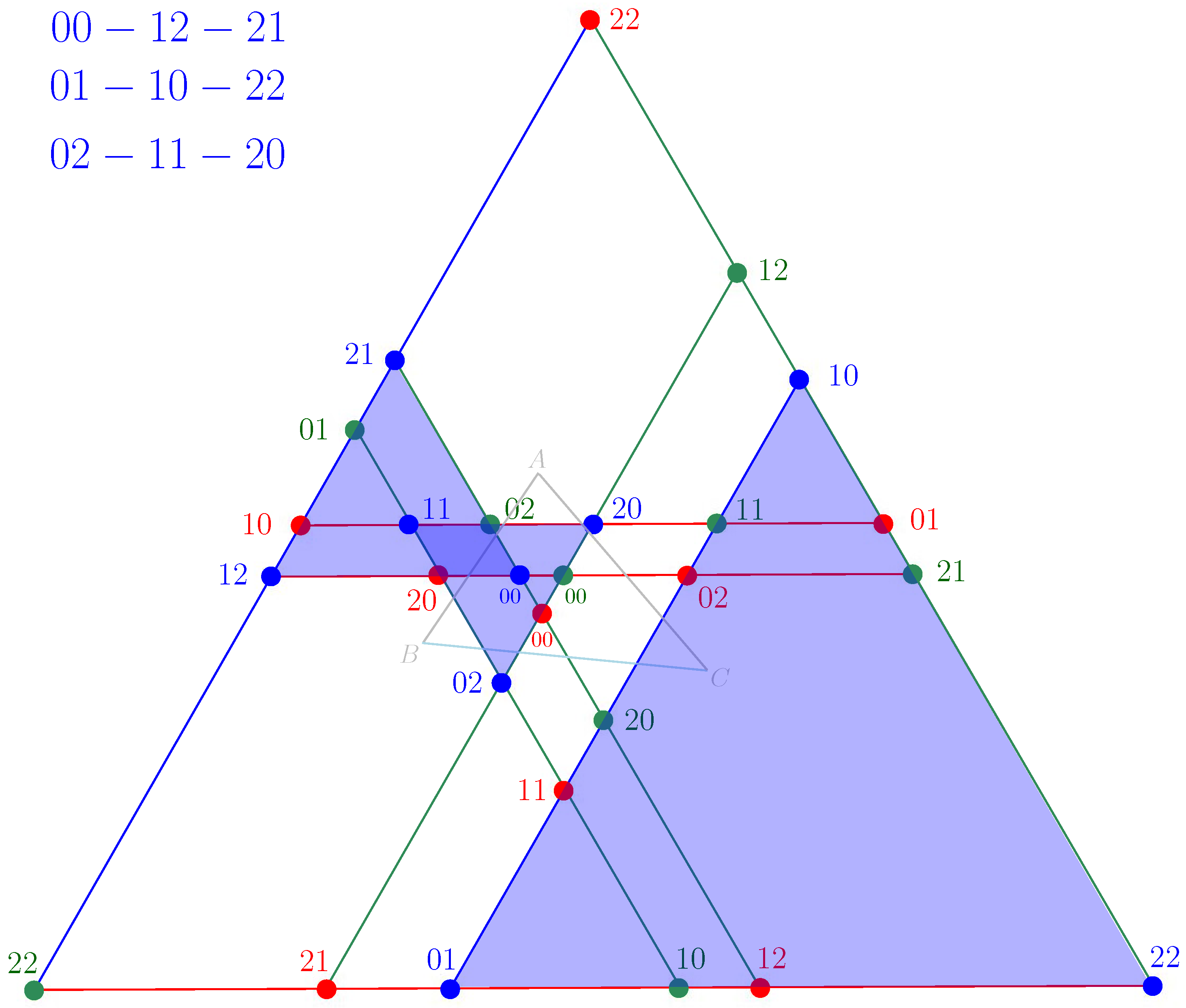
Figure A3. Left. Intersecting any pair of angle trisectors of the same color of A B C , for the three colors, we get 27 points (let us call this collection the Morley constellation of A B C ). By definition, each trisector has three points of the same color. Right. For each color, there are three lines which are parallel to the side of the Morley triangle of that color and each such line is incident with six points, two of each color. Each point belongs to exactly two of the nine lines, which is reflected numerically by 9 × 6 / 2 = 27 . A colored label i j near a point denotes that it is the intersection of the trisectors i and j of that color (they are written on the right image to avoid cluttering the left image). Out of these 27 points we can pick 27 equilateral triangles, of which 9 are monochrome, i.e., its vertices have the same color (3 red, 3 green and 3 blue) and 18 are trichrome triangles. The red triangles are 00 12 21 , 01 10 22 and 02 11 20 (cf. Figure A15), and similarly for the three green and three blue triangles (cf. Figure A16 and Figure A17). To spot the tricolor triangles, let i j k denote, for each triple i , j , k { 0 , 1 , 2 } , the triangle whose vertices are i j , j k , k i . For example, 000 is the triangle 00 00 00 , which is the original Morley triangle X Y Z . Out of the remaining 26 tricolor triangles, the following 17 are equilateral: [002], [011], [012], [122], 111, 222, where [ i j k ] denotes the list of triangles obtained by all permutations of i , j , k . For details, see the graphics in Appendix C. On the other hand, the nine triangles [001], [112] and [022] are not equilateral (they are the triangles i j k such that i + j + k 1 mod 3 ). Note that we may consider i j k as a ternary number, which corresponds to the decimal 9 i + 3 j + k , ranging from 0 to 26.
Geometry 03 00009 g0a3

Appendix C. A Gallery of Morley Triangles

In terms of the MC Figure A3, there are 27 Morley triangles, labeled i j k , with i , j , k { 0 , 1 , 2 } . All are trichrome, in the sense that each of them has a red vertex, a green vertex and a blue vertex. Among these 27 triangles, 18 are equilateral, with sides parallel to the first Morley triangle (000), and 9 are non-equilateral, precisely those for which i + j + k 1 mod 3 . Finally, we can also form 9 equilateral monochrome triangles (3 with red vertices, 3 with green vertices, and 3 with blue vertices), thus giving a total of 27 equilateral triangles associated to any triangle.
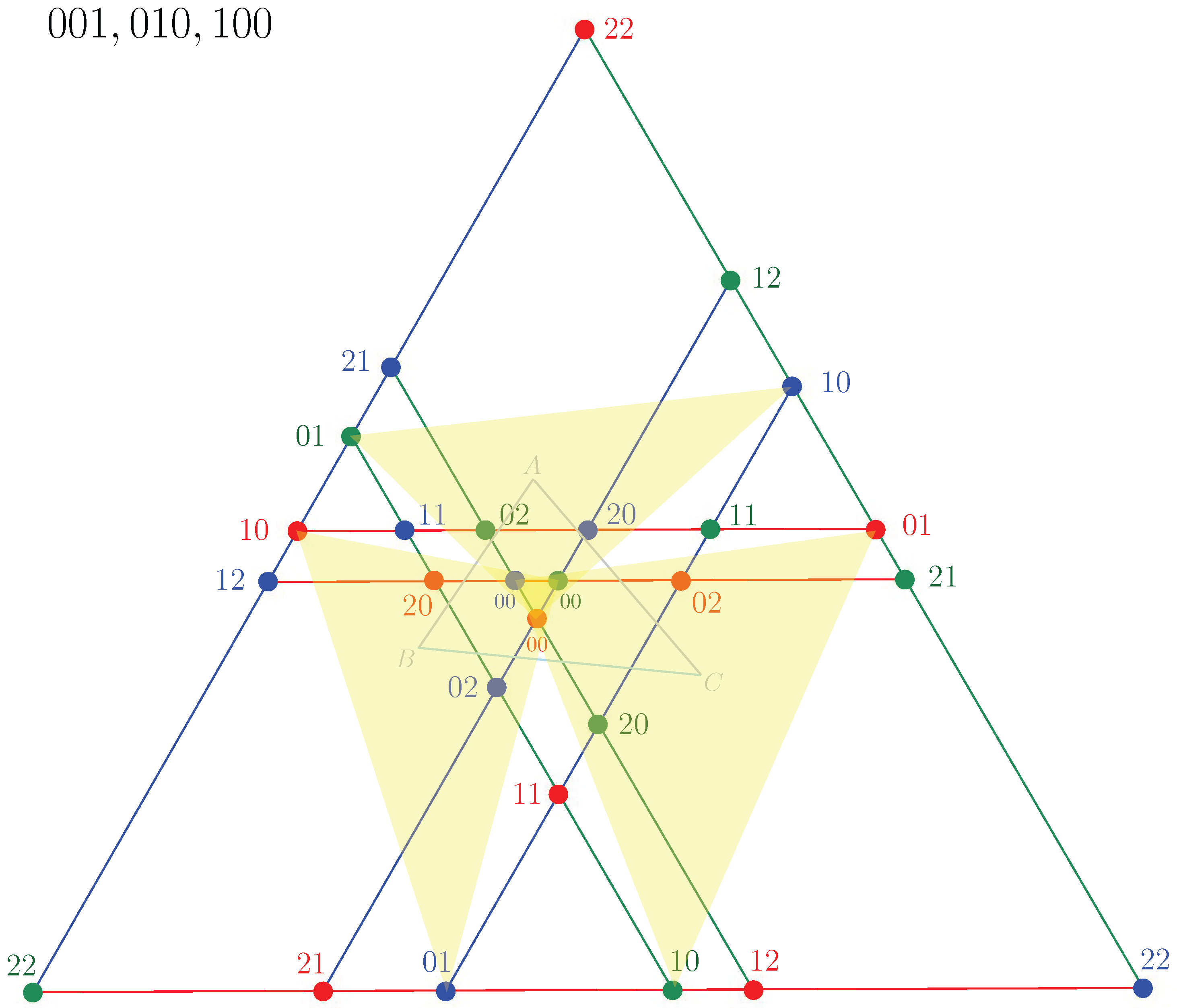
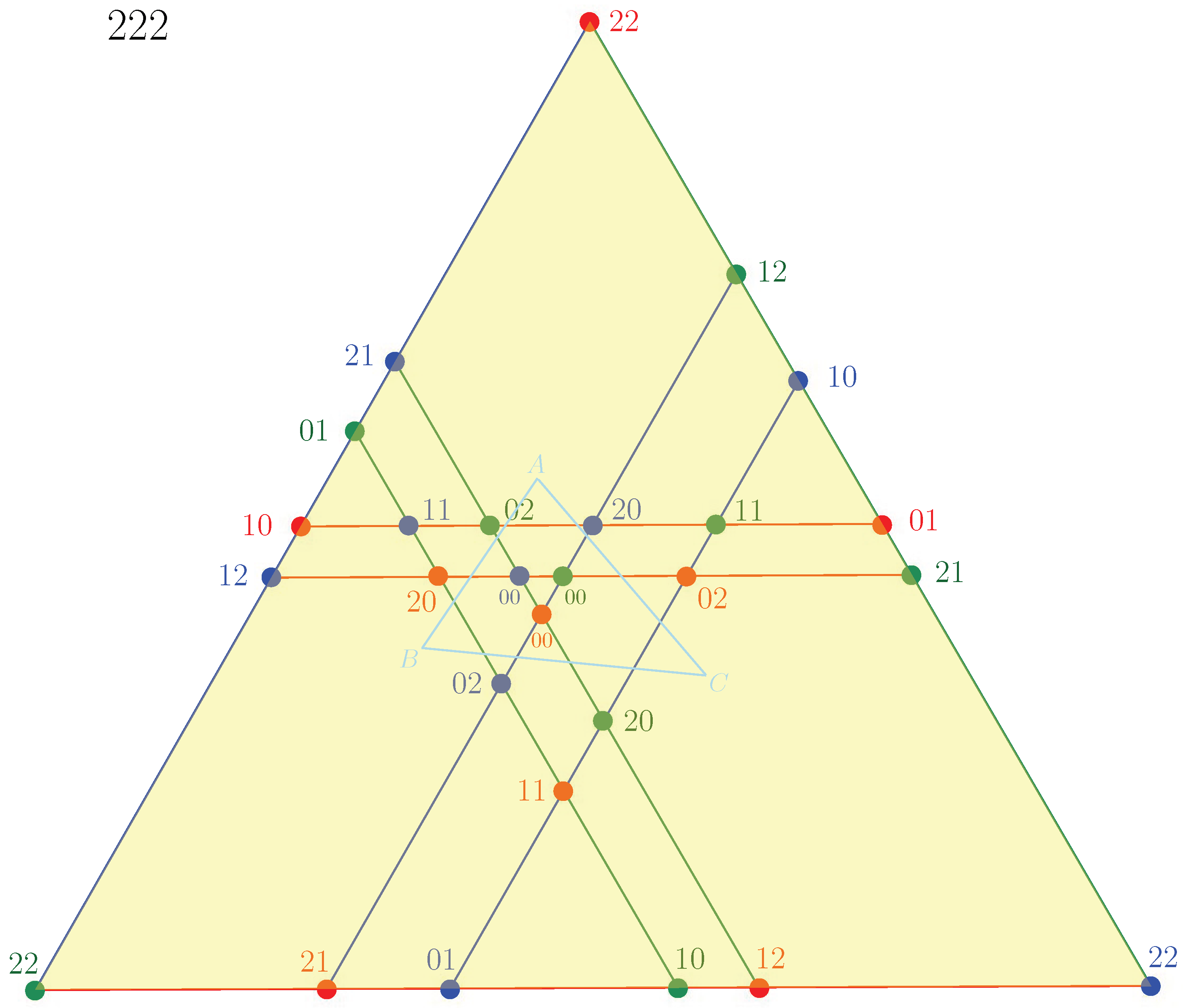
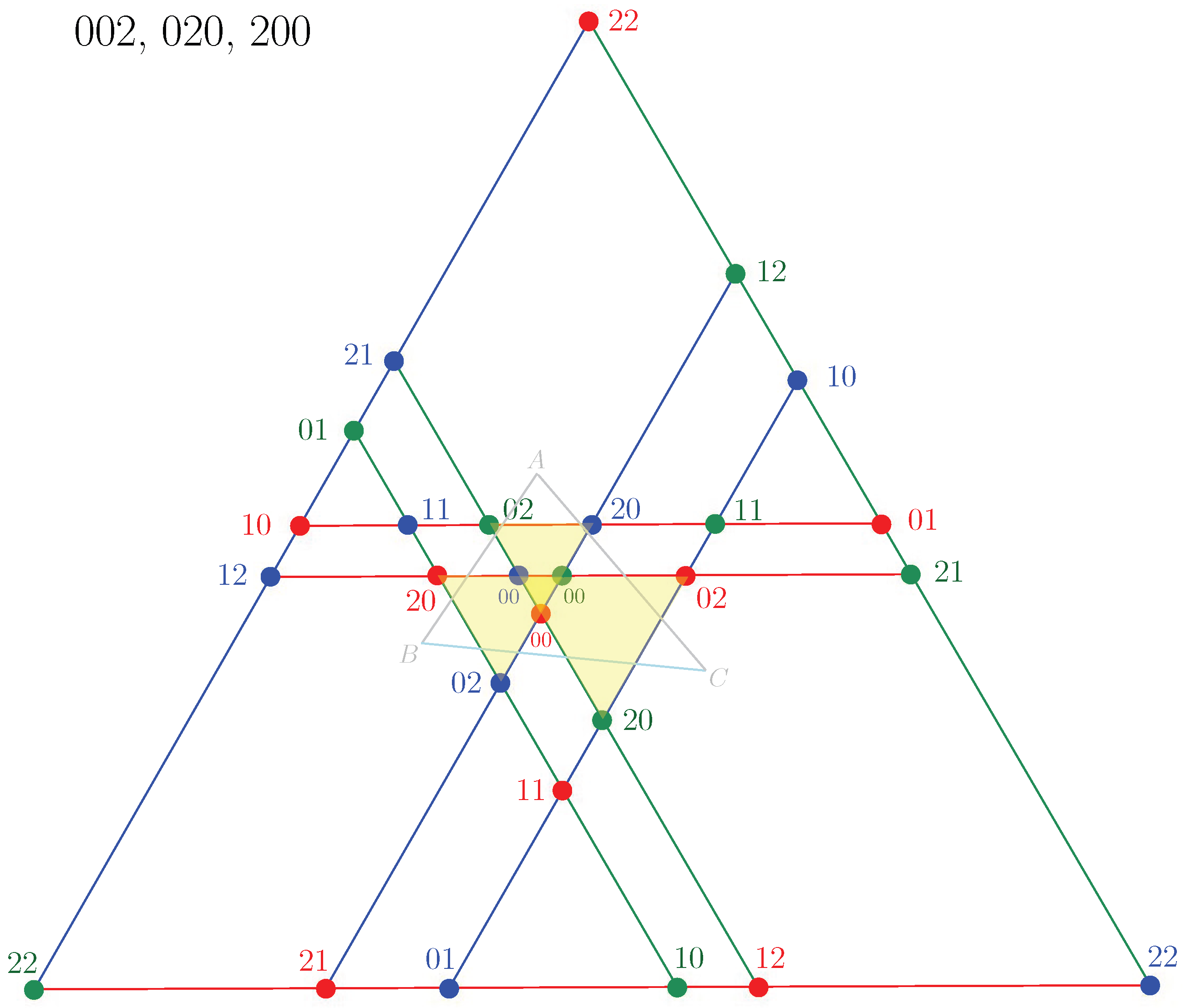
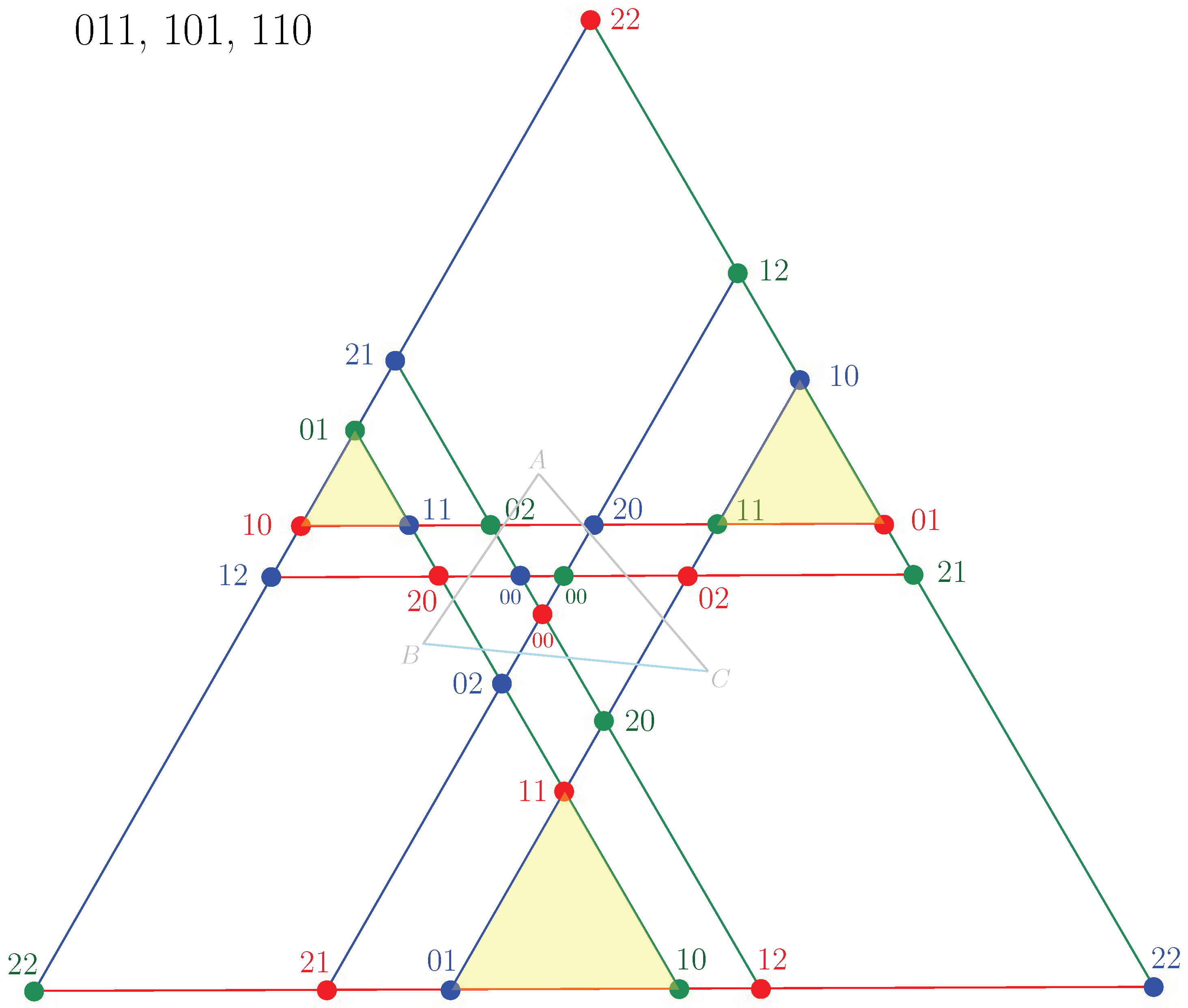
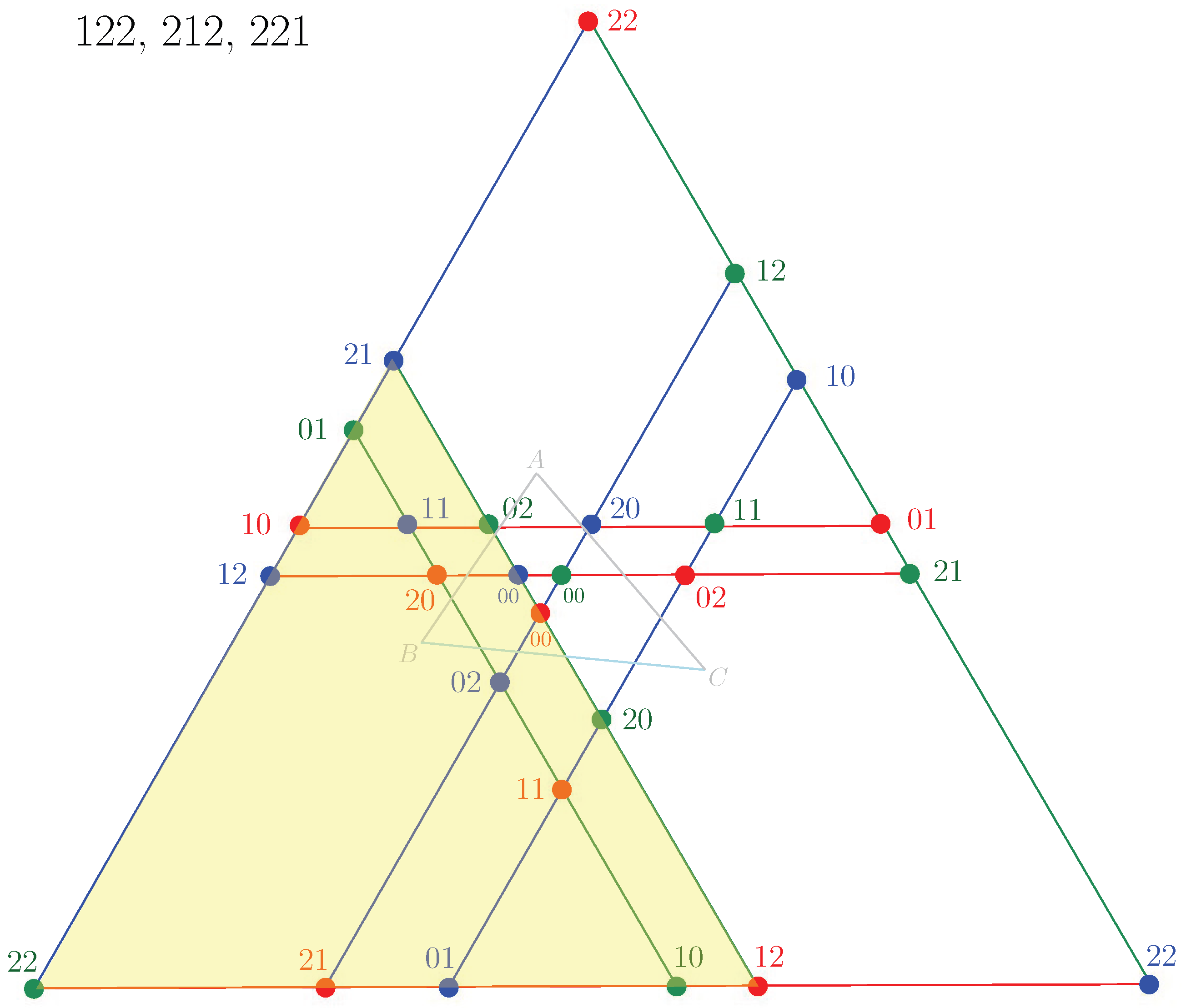
All 36 triangles are drawn by taking Figure A3, Right, as a canvas. The 27 Morley triangles have been filled with a translucent yellow (30% opacity). There is one figure for each of the triangles 000, 111, 222, but the triangles [ 002 ] = { 002 , 020 , 200 } are depicted in the same image, as in this manner we get a clear view of the effects of permuting 002 cyclically. A similar arrangement is obeyed for the images [ 011 ] = { 011 , 101 , 110 } and [ 122 ] = { 122 , 212 , 221 } . In the case [ 012 ] , we group the triangles corresponding to the even permutations of 012, namely { 012 , 120 , 201 } , in one image, and in another the triangles corresponding to odd permutations of 012, i.e., { 021 , 102 , 210 } . The non-equilateral Morley triangles are displayed in the three images corresponding to the triangles [ 001 ] = { 001 , 010 , 100 } , [ 112 ] = { 112 , 121 , 211 } and [ 122 ] = { 122 , 212 , 221 } . In the case of the monochorome equilateral triangles, we have one figure for the three red triangles, one for the three green, and one for the three blue. The symbols ⥀ and ⥁ indicate positive and negative orientation, respectively.
Figure A4. The Morley triangle 000 is the original Morley triangle X Y Z : ⥀.
Geometry 03 00009 g0a4
Figure A5. The Morley triangle 111: ⥀.
Geometry 03 00009 g0a5
Figure A6. The Morley triangle 222: ⥀.
Geometry 03 00009 g0a6
Figure A7. The Morley triangles 002, 020, 200: ⥁.
Geometry 03 00009 g0a7
Figure A8. The Morley triangles 011, 101, 110: ⥁.
Geometry 03 00009 g0a8
Figure A9. The Morley triangle 122. The triangles 212, 221 are not depicted, to avoid too much overlap among them, but they are easily visualized at the bottom right corner and the top corner, respectively: ⥁.
Geometry 03 00009 g0a9
Figure A10. The Morley triangles 012, 120, 201 (even permutations of 012): ⥀.
Geometry 03 00009 g0a10
Figure A11. The Morley triangles 021, 102, 210 (odd permutations of 012): ⥀.
Geometry 03 00009 g0a11
Figure A12. The Morley triangles 001, 010, 100 (not equilateral): ⥁.
Geometry 03 00009 g0a12
Figure A13. The Morley triangles 022, 202, 220 (not equilateral): ⥁.
Geometry 03 00009 g0a13
Figure A14. The Morley triangles 112, 121, 211 (not equilateral): ⥀.
Geometry 03 00009 g0a14
Figure A15. The red Morley triangles.
Geometry 03 00009 g0a15
Figure A16. The green Morley triangles.
Geometry 03 00009 g0a16
Figure A17. The blue Morley triangles.
Geometry 03 00009 g0a17
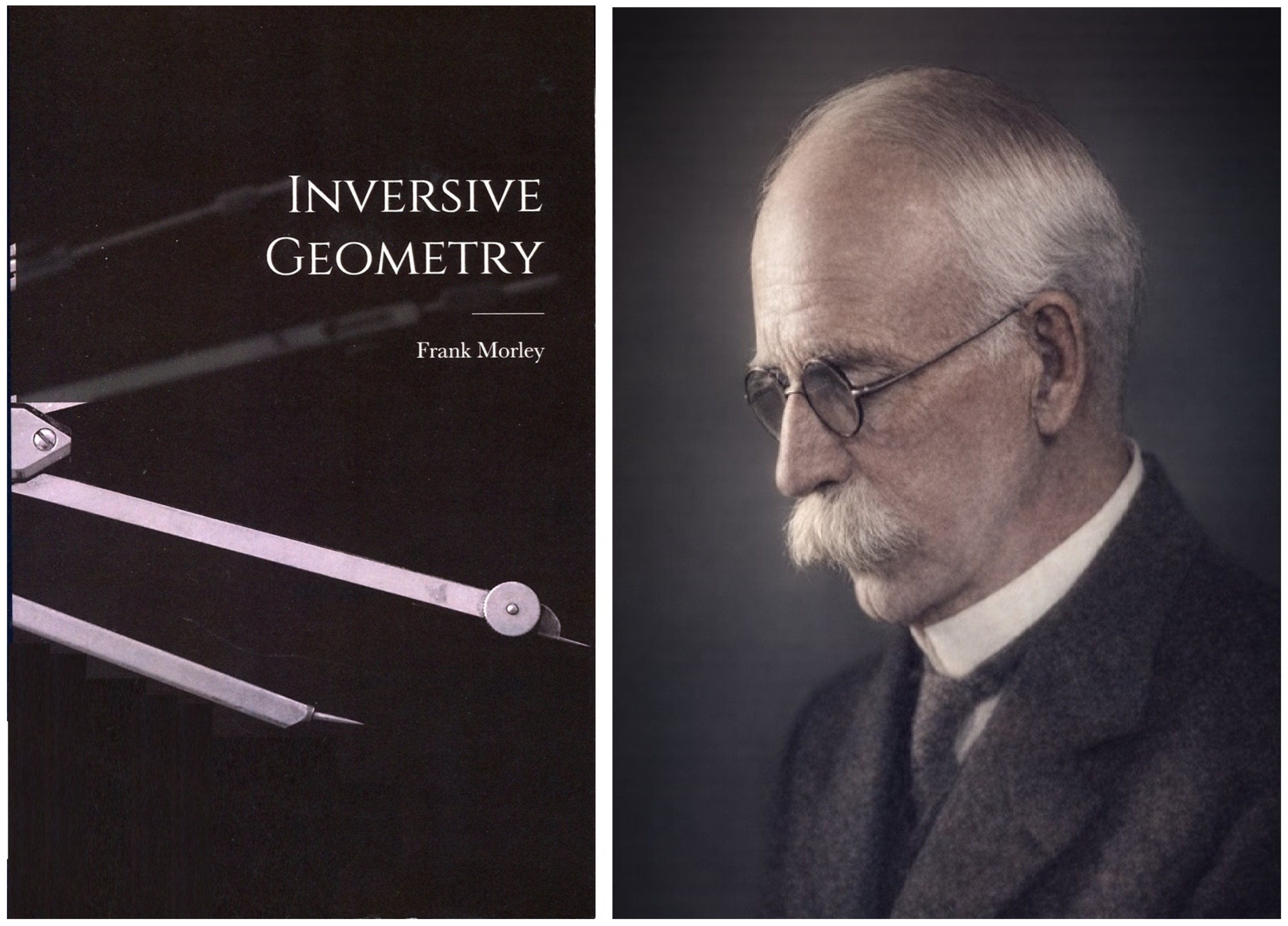
Figure A18. Left: Cover of Inversive Geometry, [21]. Right: Frank Morley (1860–1937), portrait enhancement produced with the assistance of ChatGPT (OpenAI), based on a historical photograph.
Geometry 03 00009 g0a18

References

  1. Xambó-Descamps, S. Geometry and Physics with Geometric Algebra. Geom. Mech. 2025, 2, 337–383. [Google Scholar] [CrossRef]
  2. Crowe, M.J. A History of Vector Analysis. The Evolution of the Idea of Vectorial System; Dover Publications: Garden City, NY, USA, 1994; Slightly Corrected Reproduction of the Volume with the Same Title Published by Dover in 1985, Itself an Unabridged Reproduction of the volume Published by University of Notre Dame in 1967. [Google Scholar]
  3. Connes, A. A new proof of Morley’s theorem. Publ. Math. L’ihés 1998, S88, 43–46. [Google Scholar] [CrossRef]
  4. Le Masne, R. Les Polyèdres, ou la Beauté des Mathématiques, 2nd ed.; Belin éditeur: Paris, France, 2009; Review; Available online: https://www.lajauneetlarouge.com/les-polyedres-ou-la-beaute-des-mathematiques/ (accessed on 1 January 2026).
  5. Xambó-Descamps, S. From Leibniz’ characteristica geometrica to contemporary Geometric Algebra. Quad. d’Història l’Enginyeria 2018, 16, 109–141. Available online: https://web.mat.upc.edu/sebastia.xambo/HistoricalEssays/2018-Xambo--From-Leibniz-CG-to-GA.pdf (accessed on 1 January 2026).
  6. Hestenes, D. Space-Time Algebra, 2nd ed.; Birkhäuser: Basel, Switzerland, 2015; With a Foreword by Anthony Lasenby and a Preface After Fifty Years by the Author. [Google Scholar]
  7. Hestenes, D. The genesis of geometric algebra: A personal retrospective. Adv. Appl. Clifford Algebr. 2017, 27, 351–379. [Google Scholar] [CrossRef][Green Version]
  8. Xambó-Descamps, S. Spinning Spinors: A Centenary Perspective on Quantum Spin and the Sustained Math-Physics Dialog It Spawned; Cambridge Scholars: Tyne, UK, 2026; Based on the Invited Lecture Presented at ICACGA-2022 with the Same Title. [Google Scholar]
  9. Hitzer, E.; Legatiuk, D.; Xambó-Descamps, S.; Kraußhar, S. Overview of Hypercomplex Algebra and Analysis. In Generalizations of Complex Analysis and Applications: New Developments in Quaternions, Octonions, Clifford’s Geometric Algebras, and Clifford Annalysis; Trends in Mathematics; Birkhäuser: Basel, Switzerland, 2026; pp. 1–57. [Google Scholar]
  10. Oakley, C.O.; Baker, J.C. The Morley trisector theorem. Am. Math. Mon. 1978, 85, 737–745. [Google Scholar] [CrossRef]
  11. Guy, R.K. The lighthouse theorem, Morley & Malfatti—A budget of paradoxes. Am. Math. Mon. 2007, 114, 97–141. [Google Scholar]
  12. Kuruklis, S.A. Trisectors like Bisectors with equilaterals instead of Points. Cubo 2014, 16, 71–110. [Google Scholar] [CrossRef]
  13. Gasteratos, I.; Kuruklis, S.; Kuruklis, T. A Trigonometrical Approach to Morley’s Observation. Cubo 2017, 19, 73–85. [Google Scholar] [CrossRef]
  14. Dergiades, N.; Hung, T.Q. On some extensions of Morley’s trisector theorem. arXiv 2020. [Google Scholar] [CrossRef]
  15. Kolar-Šuper, R.; Volenec, V. Morley’s triangles of a triangle in the isotropic plane. J. Geom. 2024, 115, 21. [Google Scholar] [CrossRef]
  16. Taylor, F.G.; Marr, W. The six trisectors of each of the angles of a triangle. Proc. Edinb. Math. Soc. 1913, 32, 119–131. [Google Scholar] [CrossRef]
  17. Dobbs, W. Morley’s triangle. Math. Gaz. 1938, 22, 50–57. [Google Scholar] [CrossRef]
  18. Gambier, M.B. Trisectrices des angles d’un triangle. Ann. Sci. L’école Norm. Supérieure 1954, 71, 191–212. [Google Scholar] [CrossRef][Green Version]
  19. Gibbins, N. The Non-Equilateral Morley Triangles. Math. Gaz. 1942, 26, 81–86. [Google Scholar] [CrossRef]
  20. Cundy, H.M. A direct proof of Morley’s theorem. Math. Gaz. 1984, 68, 112–119. [Google Scholar] [CrossRef]
  21. Morley, F.; Morley, F.V. Inversive Geometry; Chelsea Publishing Company: New York, NY, USA, 1954. [Google Scholar]
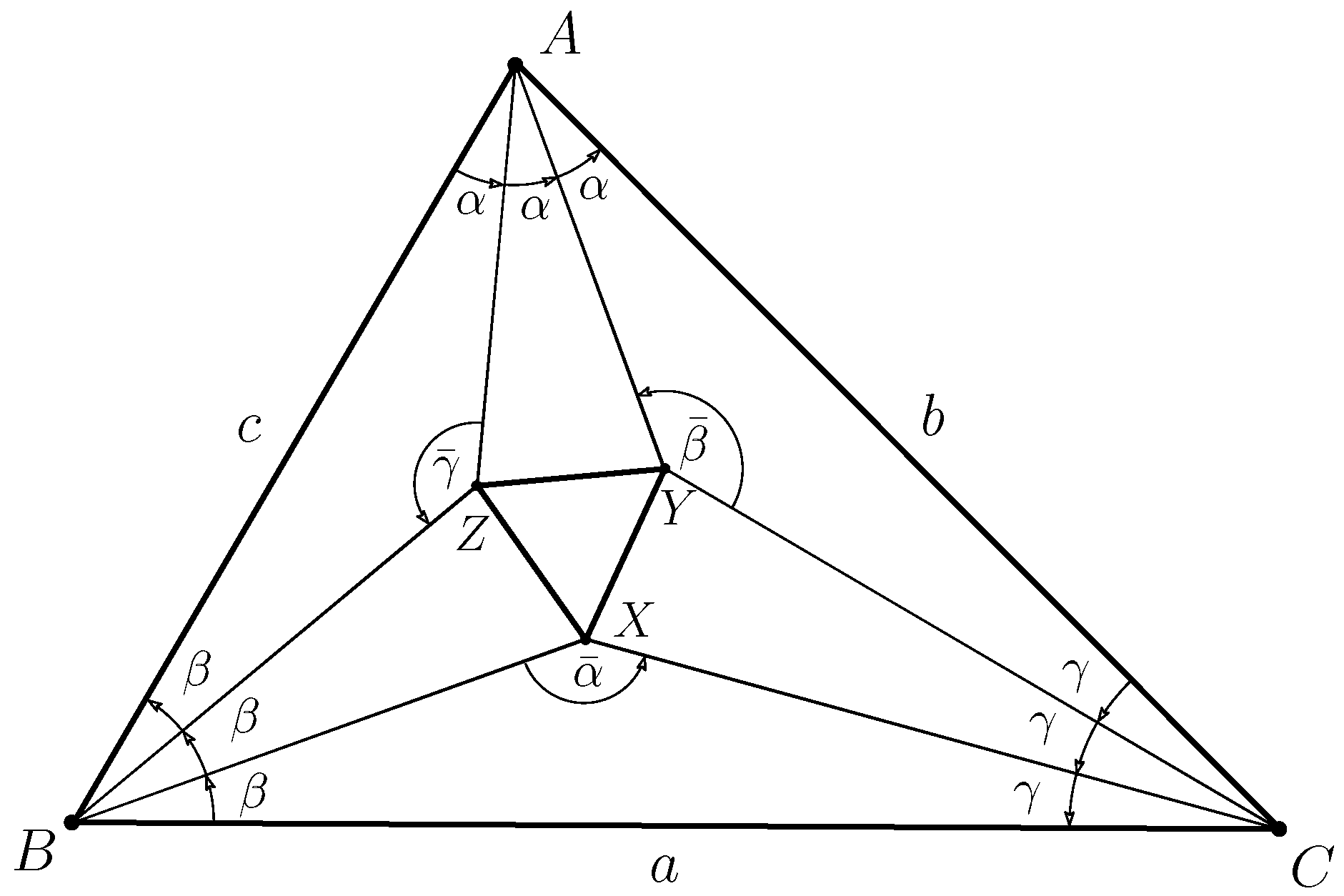
Figure 1. Morley’s construction: Let A B C be a triangle in the Euclidean plane. Define the angles α , β , γ by trisecting the triangle angles A ^ , B ^ , C ^ , and produce the triangle X Y Z as shown. This triangle is aptly known as Morley’s triangle of A B C . For later reference, note that α ¯ = 2 π 3 + α , β ¯ = 2 π 3 + β , γ ¯ = 2 π 3 + γ , as, for example, α ¯ = π ( β + γ ) = π ( π 3 α ) = 2 π 3 + α .
Geometry 03 00009 g001
Figure 2. Definition of the unit area i (Left) and rotation of vector v through φ (Right).
Geometry 03 00009 g002
Figure 3. Symmetry in the Euclidean plane about a line .
Geometry 03 00009 g003
Figure 4. Left. Illustration of the composition f = R P , φ S . Take any representation P , u of and define v = P P , v = v u φ , w = v v and u ¯ = u u φ / 2 . Let w = w + w , where w u ¯ and w u ¯ . Let P ¯ = P + w 2 and ¯ = P ¯ , u ¯ . By the computation above, f is the gliding symmetry T w S ¯ = S ¯ , w , which is a symmetry if and only if w u ¯ . Since P is fixed by S , f ( P ) = R P , φ ( P ) = P + ( P P ) u φ = P v u φ = P v = P + v v = P + w , which verifies that f ( P ) = S ¯ , w ( P ) . To avoid the cluttering of four arrow heads at f ( P ) , they have been offset a bit. Right. Illustration of the composition f = S R P , φ . It is the gliding symmetry T v S P ¯ , u ¯ = S P ¯ , u ¯ , v . Since P is fixed by R P , φ , f ( P ) = S ( P ) = Q , whereas S ¯ , v ( P ) = v + S ¯ ( P ) = Q , which is a direct verification of the equality f ( X ) = S R P , φ ( X ) for X = P .
Geometry 03 00009 g004
Figure 5. Left: Oriented angles φ ( , ) and φ ( , ) between two lines meeting at P. From the definition it follows that φ ( , ) + φ ( , ) = π . Middle and Right: The composition of symmetries S S is, respectively, the rotation R P , 2 φ ( P = ) when and are not parallel and otherwise it is the translation T 2 v , where v is the perpendicular vector to the lines such that T v ( ) = (if v = P P , let v = v + v with v u and v u , and note that Q = T v ( P ) = P + v = P + v v = P v , from which we get = T v ( ) ).
Geometry 03 00009 g005
Figure 6. Given the triangle A B C , the points X Y Z are computed by means of the formulas in Corollary 1 and then the angles’ trisectors are obtained by joining each of these points to vertices of the corresponding side. Here and in the following we use the colors red, green, blue for the trisectors adjacent to B C , C A , and A B , respectively.
Geometry 03 00009 g006
Table 1. Geometric products of the basis elements of G . In the form 1 , e 1 , e 2 , i (Left) and in the form e 00 , e 10 , e 01 , e 11 (Middle). Right: The transposition counter t: its value is 1 if j 2 = k 1 = 1 (indicating that in the product e 2 appears before e 1 ) and 0 otherwise.
1 e 1 e 2 i e 00 e 10 e 01 e 11 t100111
e 1 1 i e 2 e 10 e 00 e 11 e 01 10 + 1 + 1 + 1
e 2 i 1 e 1 e 01 e 11 e 00 e 10 01 1 + 1 1
i e 2 e 1 1 e 11 e 01 e 10 e 00 11 1 + 1 1
Table 2. In each cell we have the composition of the isometry on top of its column followed by the isometry at the head of its row, but we omit the composition symbol . The case T v T v = T v + v is obvious. All other cases require closer attention.
T v R P , φ S
T v T v T v T v R P , φ T v S
R P , φ R P , φ T v R P , φ R P , φ R P , φ S
S S T v S R P , φ S S
Table 3. For a given angle θ , the variables θ , θ , θ , θ are defined in terms of θ . Since clearly θ + θ = θ + θ = π , then sin θ = sin θ , cos θ = cos θ , sin θ = sin θ , cos θ = cos θ . Note that according to the convention declared in Figure 1 the value θ agrees with θ ¯ . We also have that sin ( β + γ ) = sin ( π 3 α ) = sin α and similarly sin ( γ + α ) = sin β , sin ( α + β ) = sin γ .
θ θ θ θ
π 3 + θ 2 π 3 + θ π 3 θ 2 π 3 θ
Disclaimer/Publisher’s Note: The statements, opinions and data contained in all publications are solely those of the individual author(s) and contributor(s) and not of MDPI and/or the editor(s). MDPI and/or the editor(s) disclaim responsibility for any injury to people or property resulting from any ideas, methods, instructions or products referred to in the content.