


Abstract
University students often experience heightened stress due to academic pressure, financial concerns, and life transitions, with potential consequences for psychological and physical wellbeing, behaviour, and learning. Exposure to natural environments has consistently been shown to reduce stress; however, barriers to accessing these environments may limit their benefits for university students. Virtual Reality (VR) offers a potentially accessible alternative by providing immersive simulations of natural environments. This preliminary study examined whether a 20-min VR nature experience could reduce stress among university students compared with a VR museum experience and a quiet-activity control condition. Thirty university students were allocated to one of the three conditions and completed measures of perceived stress and state anxiety before and after the intervention, alongside measures of nature relatedness, presence, user experience, and engagement. The VR nature condition showed a greater reduction in state stress than the VR museum condition but did not differ significantly from the quiet-activity control condition. State anxiety significantly decreased from pre- to post-intervention across conditions, although this reduction did not significantly differ between conditions. Both VR conditions reported significantly higher user experience than the control, whilst engagement was significantly higher in the VR nature condition than the control. However, no significant between-condition differences were detected for presence. These preliminary findings suggest that brief VR nature exposure may support student wellbeing and provide a basis for further adequately powered investigation.
Keywords:
virtual reality; student; higher education; nature; stress; anxiety; wellbeing; pilot study 1. Introduction
University students frequently experience mental health difficulties, with 91.8% reporting stress or anxiety during their studies (Brett et al., 2023), and 13.5% experiencing severe stress (Alkhawaldeh et al., 2023). These difficulties have previously been associated with academic pressures (Wang & Tong, 2025), financial uncertainty (Slimmen et al., 2022), and social and educational transitions (Mulaudzi, 2023), with stressors often persisting throughout a student’s university career (Pitt et al., 2018). Prolonged or elevated stress has been associated with a range of negative consequences on individuals’ physical, emotional and cognitive wellbeing (Girotti et al., 2024; Toussaint et al., 2016). This includes reduced sleep quality and fatigue (Nordberg et al., 2022), reduced immune function (Ishikawa & Furuyashiki, 2022), headaches (Berry & Drummond, 2018), depression (Tafet & Nemeroff, 2016), and impairments in concentration and memory (Ma et al., 2025; Schwabe et al., 2022). Furthermore, stress is also positively associated with anxiety, with higher levels of perceived stress being associated with greater anxiety symptoms (Levenstein et al., 1993). Collectively, these consequences may contribute to poorer attendance and increased illness (Acabchuk et al., 2017; Peeters et al., 2025). Given the high prevalence of these stressors, it is important to understand the potential consequences they may have on students.
Nature relatedness, defined as an individual’s connection with nature, has previously been associated with improved psychological wellbeing (Capaldi et al., 2017; Grabowska-Chenczke et al., 2022), reduced stress (Shuda et al., 2020), greater psychological resilience, and increased ability to cope with stress (Ingulli & Lindbloom, 2013). Greater nature relatedness has also been associated with emotional regulation, with individuals who feel more connected to nature potentially using natural environments as a means of escape and reflection, facilitating restorative experiences (Bakir-Demir et al., 2021; Home et al., 2012). Importantly, the benefits of nature appear to extend beyond simply spending time outdoors. Exposure to natural environments has been associated with a greater reduction in stress than exposure to urban outdoor environments (Ewert & Chang, 2018).
Stress Reduction Theory offers one explanation for these benefits, proposing that exposure to natural environments can elicit evolutionary responses linked to positive emotions (Yao et al., 2021). This is further supported by Sudimac et al. (2022), who found that a 60-min walk in a natural environment reduced stress-related amygdala activity. Attention Restoration Theory provides a complementary explanation, proposing that natural environments facilitate involuntary attention and recovery from directed-attention fatigue (Kaplan, 1995; Ohly et al., 2016). Overall, these findings suggest that exposure to natural environments may provide a valuable means of reducing stress.
Despite these well-established benefits, access to natural environments may be limited for some students due to geographical, time, and mobility barriers. Students often have limited time for nature-related activities due to academic commitments (Puhakka, 2021), and the availability of green spaces (Thompson et al., 2023) potentially influences the types of nature-based activities available to students (Woolf, 2026). Urban green spaces that are available are often inadequately designed to accommodate those with disabilities (Selanon & Chuangchai, 2023), creating additional barriers to accessing natural environments. These barriers suggest a need for new methods of nature immersion that are both accessible and practical for university students.
Virtual Reality (VR) offers a potential alternative to physical nature exposure by enabling individuals to interact with immersive virtual environments that can approximate aspects of real-world experiences (Batterley & Limniou, 2026; Felton & Jackson, 2021). VR can elicit a strong sense of presence, often described as the subjective feeling of ‘being there’ (Servotte et al., 2020), whilst also providing spatial context that provides users with accurate representations of size and distance (Desselle et al., 2020). These characteristics have led to VR being used across a range of disciplines, including education (Batterley et al., 2026; Batterley & Meyer, 2025), medicine (Collingwoode-Williams et al., 2024), and social skills training (Mosher & Carreon, 2021). In research contexts, the enhanced sense of presence also further enhances ecological validity by allowing participants to engage with experimentally controlled environments that closely resemble real-world experiences (Karakashevska et al., 2025). Given VR’s ability to replicate real-world environments, it is important to examine whether virtual nature exposure can provide similar psychological benefits that are found in natural environments.
Previous research has highlighted the potential benefits of virtual nature exposure for emotional wellbeing. This includes improvements in emotional state (Finkler et al., 2025), feelings of calmness (Noronha & Campos, 2021), and stress (Bianco et al., 2023; Ma et al., 2025; Owens & Bunce, 2023) after VR nature exposure. This is also the case following relatively brief periods of exposure (Anderson et al., 2017; Annerstedt et al., 2013; Browning et al., 2020; Mostajeran et al., 2023; Reese et al., 2022). These brief interventions may be particularly well suited for university students, given that academic demands and time constraints may limit opportunities to engage with stress management activities. Furthermore, short, single-session mental health interventions have previously been shown to be effective for students (Bu & Duan, 2019; Lee et al., 2023). However, research examining the effects of VR nature exposure on stress and anxiety amongst university students remains limited. More broadly, a recent review and meta-analysis found evidence that virtual nature exposure may benefit the mental health and wellbeing of higher education students (Bashir & Kumar, 2024). However, further research is needed to determine whether the stress-reducing benefits of VR are specifically due to exposure to natural content rather than to immersion in VR more generally or taking a break from activities.
The present study examines whether a 20-min VR nature experience could reduce stress in university students compared with a 20-min VR museum visit and a 20-min quiet-activity control condition. Nature relatedness was measured before exposure to examine whether baseline nature relatedness was associated with changes in perceived stress. Post-exposure measures of presence, user experience, and engagement were included to characterise participants’ experiences of the three conditions. It was hypothesised that: (H1) participants in the VR nature condition would show a greater reduction in perceived stress and anxiety than those in the VR museum and quiet-activity control conditions; (H2) baseline nature relatedness would be significantly associated with changes in perceived stress and anxiety; and (H3) presence, user experience, and engagement would differ significantly between conditions.
2. Materials and Methods
2.1. Participants
Participants consisted of a volunteer sample of 30 university students from the University of Liverpool. A power analysis was conducted in G*Power (Version 3.1.9.7) for a 3 × 2 mixed ANOVA with a medium effect size (f = 0.25), an alpha of 0.05, 3 groups and 2 measurements. The results indicated that 42 participants needed to be recruited for the study. As this study was designed as a preliminary exploratory investigation of the effects of brief nature exposure on state stress and state anxiety, a smaller sample of 30 participants was recruited due to time constraints. Participants were systematically allocated to either the VR nature (n = 10), VR museum (n = 10) or control condition (n = 10). Specifically, the first participant was allocated to the VR nature condition, the second to the VR museum condition, and the third to the control condition. This allocation sequence was repeated for subsequent participants until 10 participants were assigned to each condition.
To be eligible to take part in the study, participants were required to be at least 18 years old and have normal or corrected-to-normal vision and hearing (e.g., glasses and hearing aids). Participants who had previous experience with severe motion sickness, had a recent concussion, or had any other medical conditions that could cause problems when using the VR equipment were not eligible to take part in the study. Participants were recruited via posters placed around the university campus and through the University of Liverpool’s Experimental Participation Requirement Scheme. This scheme provides first-year psychology students with course credit in exchange for participation in research. Ethical approval was obtained from the University of Liverpool’s Research Ethics Committee (reference number 16931).
2.2. Design
This study employed a 3 × 2 mixed experimental design. Environment was the between-subjects factor, with participants systematically allocated to one of three conditions: VR nature, VR museum, and quiet-activity control. Time was the within-subjects factor, with VAS-stress and State Trait Anxiety Inventory scores being measured immediately before and after the 20-min intervention. Nature relatedness was measured prior to the intervention, whilst presence, engagement, and user experience were measured following the intervention.
2.3. Materials
2.3.1. VR Nature Environment
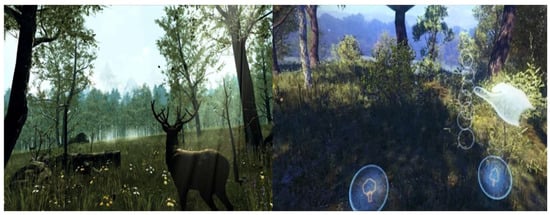
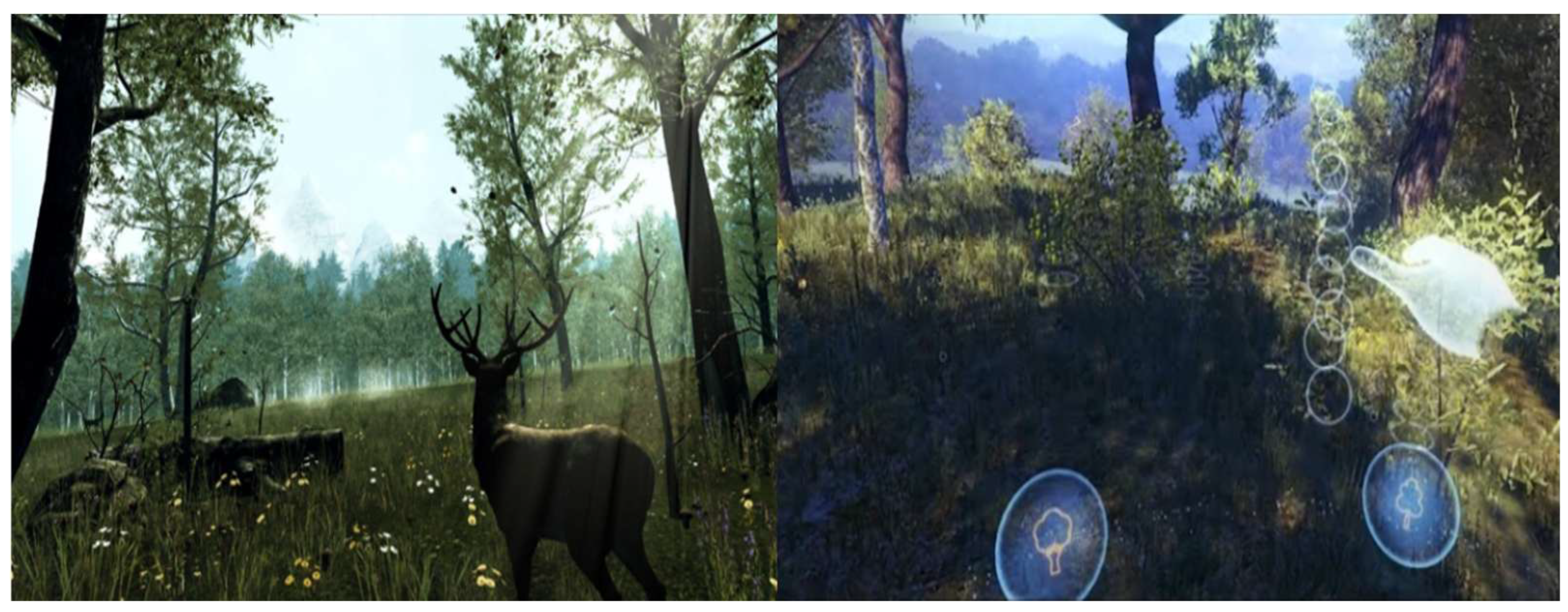
The Nature Treks simulation was created by Greener Games (2017) and involved participants taking part in the “green meadows” world using a Meta Quest 2 VR headset. The simulation tasked participants with exploring a green meadow surrounded by mountains and a river with birds, butterflies, and other animals. Participants were able to interact with the simulation using the VR controllers, allowing them to move around and pick up objects. An example of the nature environment is illustrated in Figure 1.
Figure 1.
Nature Treks VR Simulation.
2.3.2. VR Museum Environment
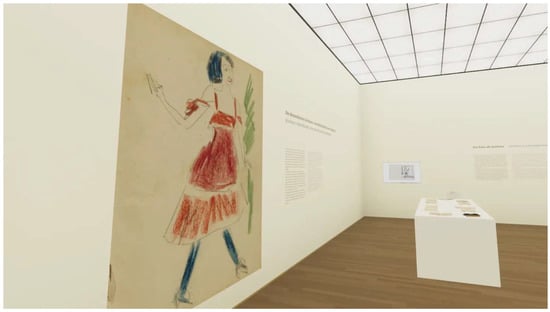
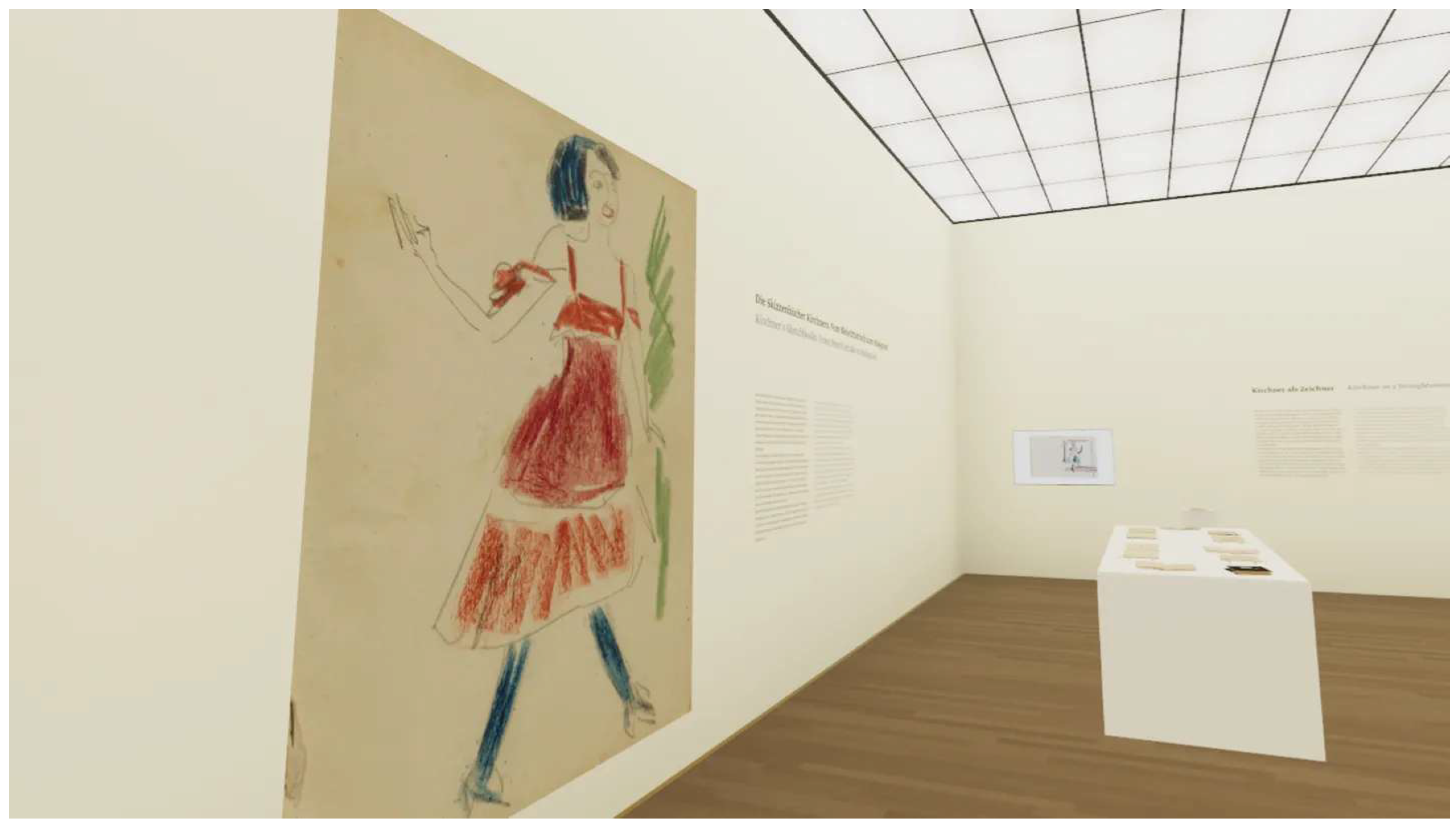
The Kirchner Museum Davos was created by HEGIAS Vision AG (2022) and tasked participants with exploring the museum, looking at exhibits, and reading the information boards. Participants interacted with the simulation using the VR controllers. This simulation was chosen as it allowed the user to explore the virtual world in a way that is similar to the VR nature environment. An example of the museum environment is illustrated in Figure 2.
Figure 2.
VR Museum Simulation.
2.3.3. Control Environment
During this condition, participants remained in the testing environment and were instructed to engage in a quiet activity such as reading, studying, or browsing on their phone. Although participants were free to select their activity, all participants chose to browse their phones during this condition.
2.3.4. State Stress
Based on the recommendation from Lesage et al. (2012), a single item (VAS-stress) was used to measure participants’ stress at that current moment. This was measured on a scale of 0 to 100, with 0 being not at all stressed and 100 being extremely stressed, with higher scores indicating higher state stress. A copy of the state stress item can be found in Appendix C.
2.3.5. State Anxiety
The State-Trait Anxiety Inventory (STAI) was developed by Spielberger et al. (1971) to measure participants’ state anxiety. This 20-item questionnaire required participants to answer statements based on how they are currently feeling. This includes items such as “I feel calm” and “I feel upset”. Participants responded using a 4-point Likert scale ranging from 1 (Not at all) to 4 (Very much so). An additional attention check was included in this section of the questionnaire to improve the reliability of the data. Higher scores on this questionnaire indicated higher state anxiety. A copy of the state anxiety questionnaire can be found in Appendix B.
2.3.6. Nature Relatedness
The NR-6 Measure of Nature Relatedness was developed by Nisbet and Zelenski (2013) to measure the participants’ relationship with nature and the natural world. Participants rated their agreement with six items on a 5-point Likert scale from 1 (Disagree Strongly) to 5 (Agree Strongly). Four items aimed to capture nature connectedness (for example, “I always think about how my actions affect the environment”), whilst the remaining two items aimed to find individual differences in need, awareness, and comfort gained from nature and wildlife (for example, “I take notice of wildlife wherever I am”). Higher scores indicated that participants had greater nature connectedness. A copy of the nature relatedness questionnaire can be found in Appendix A.
2.3.7. User Experience
The User Experience Questionnaire Short (UEQ-S) is an 8-item questionnaire developed by Schrepp et al. (2017) to measure users’ experience of a simulation. This was assessed using a 7-point Likert scale, whereby participants responded between two different descriptors, e.g., “Clear” and “Confusing”. The UEQ-S has two components: pragmatic and hedonic. The four hedonic items measure aspects of the simulation related to pleasure or fun. Each of the four pragmatic items, on the other hand, measure the interaction qualities that relate to the task or goals that the user is aiming to achieve whilst using the simulation. Higher scores on the UEQ-S indicate a more positive user experience. A copy of the user experience questionnaire can be found in Appendix E.
2.3.8. Presence
An adapted version of the Witmer and Singer (1998) presence questionnaire was used to measure the extent to which users experienced the simulated environment as opposed to the physical world. This version has 7 items and included questions such as “How natural did your interactions with the simulation seem?” followed by a 7-point rating scale. Higher scores on this questionnaire indicated a greater sense of presence. As the questionnaire was designed to assess experiences within virtual environments, presence scores were only analysed for participants in the VR nature and VR museum conditions. This is due to several items of this questionnaire not being applicable outside of a virtual environment. A copy of the presence questionnaire can be found in Appendix D.
2.3.9. Engagement
The engagement item was developed by the researchers to measure how engaged the users felt during each condition. The item asked users to “Please rate how engaged you felt with the activity/environment” on a scale from 0 (Not at all engaged) to 10 (Very engaged). Higher scores on this questionnaire indicated a greater sense of engagement. A copy of the engagement item can be found in Appendix F.
2.4. Procedure
After obtaining informed consent, participants completed a demographics questionnaire, followed by the STAI and the VAS-stress item. They then answered the Nature Relatedness questionnaire. Once the questionnaires were completed, participants were placed in one of the three environmental conditions (VR nature, VR museum, or control). After 20 min had elapsed, participants then completed the STAI and VAS-stress item again, followed by the presence, UEQ-S, and engagement questionnaires. The presence questionnaire was only presented to participants assigned to the VR conditions. Once participants reported their feedback on the study, they were then debriefed. The study took approximately 40 min to complete.
2.5. Statistical Analysis
A series of 3 × 2 mixed ANOVAs were conducted to investigate the effects of environment (VR nature, VR museum, and quiet-activity control) and time (pre-intervention and post-intervention) on state stress and state anxiety. Environment was the between-subjects factor whilst time was the within-subjects factor. Where significant interactions were identified, Bonferroni-adjusted pairwise comparisons were conducted.
Pearson’s correlations were conducted to examine the association between baseline nature relatedness and changes in state stress and state anxiety. Additionally, separate one-way between-subjects ANOVAs were conducted to investigate differences in user experience and engagement between the three environments. Where significant main effects were identified, Bonferroni-adjusted post hoc comparisons were conducted.
As the presence questionnaire was designed to assess experiences within virtual environments, an independent-samples t-test was conducted to compare presence scores between the VR nature and VR museum conditions. The quiet-activity control condition was excluded from this analysis due to several questionnaire items not being applicable to activities undertaken outside of a virtual environment.
Statistical significance was determined using an alpha level of 0.05. Effect sizes were reported using partial eta squared (ηp2) for the mixed ANOVAs and omega squared (ω2) for the one-way ANOVAs.
3. Results
3.1. Baseline Characteristics
The educational characteristics of the participants across the three conditions are presented in Table 1, whilst baseline stress and anxiety scores can be found in Table 2.
Table 1.
Education of participants across conditions.
Table 2.
Baseline Stress and Anxiety across conditions.
3.2. State Stress
A 3 × 2 mixed ANOVA was conducted to examine the effect of environment (VR nature, VR museum, and quiet-activity control) and time (pre- and post-intervention) on state stress. There was a significant main effect of time, F(1, 27) = 34.65, p < 0.001, ηp2 = 0.56, indicating a reduction in state stress from pre-intervention (M = 28.83, SD = 19.58) to post-intervention (M = 18.20, SD = 15.19) across the three conditions. Whilst there was no significant main effect of environment, F(2, 27) = 0.73, p = 0.490, ηp2 = 0.05, there was, however, a significant interaction between time and environment, F(2, 27) = 3.49, p = 0.045, ηp2 = 0.21, suggesting that changes in state stress differ between conditions.
Bonferroni-adjusted pairwise comparisons of time within each condition indicated that state stress significantly decreased in the VR nature condition from pre-intervention (M = 31.00, SD = 18.73) to post-intervention (M = 14.00, SD = 13.90, p < 0.001). State stress also significantly decreased in the quiet-activity control condition from pre-intervention (M = 33.20, SD = 23.41) to post-intervention (M = 23.80, SD = 18.78, p = 0.006). However, the VR museum condition did not produce any significant differences between pre-intervention (M = 22.30, SD = 16.20) and post-intervention (M = 16.80, SD = 11.86, p = 0.090).
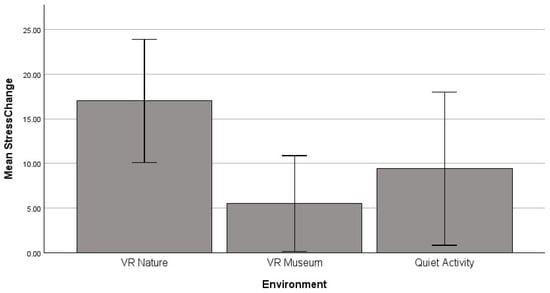
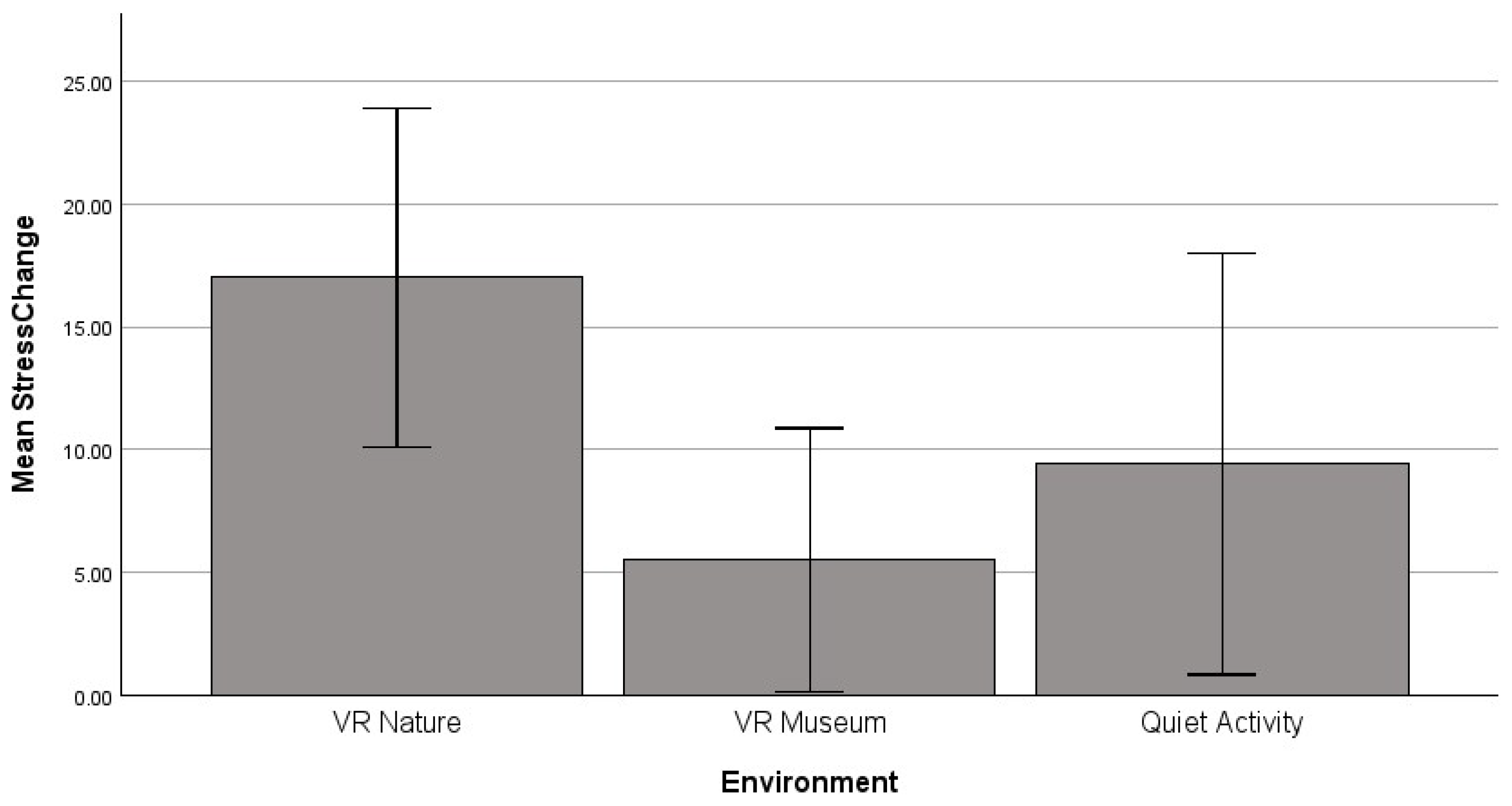
To further examine the significant Time × Environment interaction, Bonferroni-adjusted pairwise comparisons of stress change between conditions were conducted. Stress reduction was significantly greater in the VR nature condition (M = 17.00, SD = 9.66) than in the VR museum condition (M = 5.50, SD = 7.50, p = 0.045). However, stress change did not significantly differ between the VR nature and quiet-activity control condition (M = 9.40, SD = 12.00, p = 0.292) or between the VR museum and quiet-activity control conditions (p = 1.000). A bar chart of the state stress scores across the environments can be found in Figure 3.
Figure 3.
Bar chart showing mean stress scale change for each environment, with error bars demonstrating a 95% confidence interval.
To examine whether the differences between the experimental conditions remained after controlling for baseline stress, an additional ANCOVA was conducted. Post-intervention stress was selected as the dependent variable, condition as the fixed factor, and baseline stress as the covariate. The ANCOVA revealed a significant effect of condition on post-intervention stress after controlling for baseline stress, F(2, 26) = 4.12, p = 0.028, ηp2 = 0.24. However, Bonferroni-adjusted pairwise comparisons indicated no significant differences between the VR nature and VR museum conditions (mean difference = −8.62, 95% CI [−17.47, 0.23], p = 0.058), VR nature and quiet-activity conditions (mean difference = −8.33, 95% CI [−17.03, 0.37], p = 0.064) or the VR museum and quiet-activity conditions (mean difference = 0.30, 95% CI [−8.64, 9.23], p = 1.000).
A Pearson’s correlation was conducted to examine the association between baseline nature relatedness and change in state stress. There was no significant correlation between nature relatedness and state stress change, r(28) = 0.05, p = 0.813.
3.3. State Anxiety
A 3 × 2 mixed ANOVA was conducted to examine the effect of environment (VR nature, VR museum, and quiet activity control) and time (pre- and post-intervention) on state anxiety. There was a significant main effect of time, F(1, 27) = 5.98, p = 0.021, ηp2 = 0.18, with anxiety scores decreasing from pre-intervention (M = 33.30, SD = 8.52) to post-intervention (M = 30.67, SD = 7.15) across conditions. However, there was no significant main effect of environment, F(2, 27) = 0.19, p = 0.825, ηp2 = 0.01. The Time × Environment interaction was also not significant, F(2, 27) = 1.63, p = 0.215, ηp2 = 0.11, indicating that the reduction in state anxiety did not significantly differ between conditions.
A Pearson’s correlation was conducted to examine the association between baseline nature relatedness and change in state anxiety. There was no significant correlation between nature relatedness and state anxiety change, r(28) = 0.32, p = 0.088.
3.4. User Experience
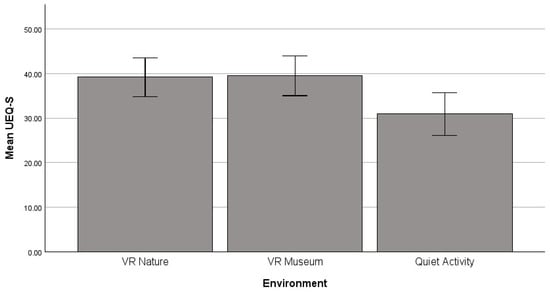
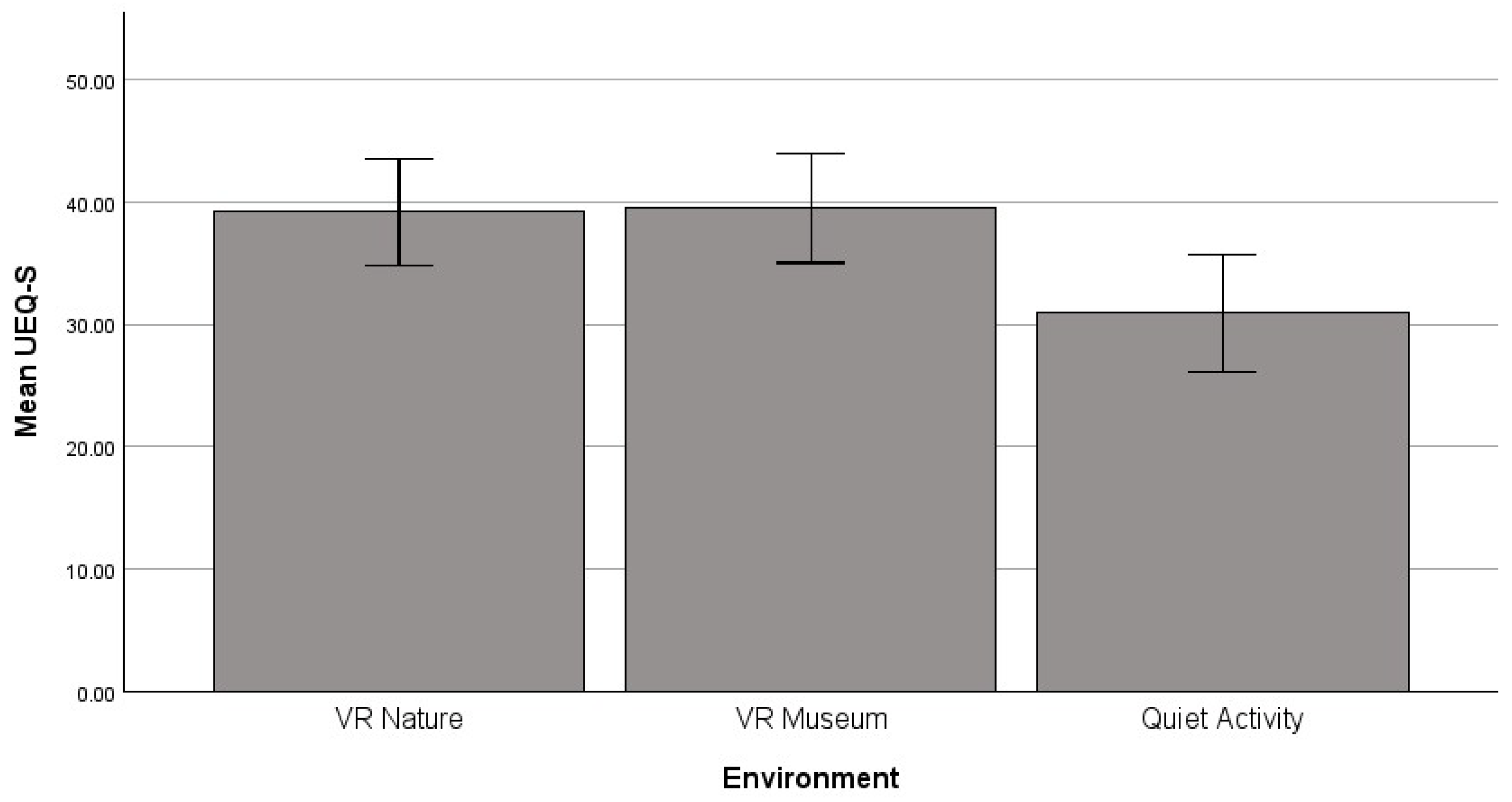
A one-way between-subjects ANOVA was conducted to compare the effect of Environment on User Experience, showing a significant main effect of Environment on User Experience (F(2, 27) = 5.91, p = 0.007, ω2 = 0.25). Bonferroni-adjusted post hoc tests demonstrated a significant difference between the VR nature environment (M = 39.20, SD = 6.09) and quiet-activity control (M = 30.90, SD = 6.72, p = 0.021), and between the VR museum environment (M = 39.50, SD = 6.22) and quiet-activity control (p = 0.016). However, no significant difference was found between the VR nature environment and VR museum environment (p = 1.000). A bar chart of the UEQ-S scores across the environments can be found in Figure 4.
Figure 4.
Bar chart showing mean UEQ-S for each environment, with error bars demonstrating a 95% confidence interval.
3.5. Presence
An independent-samples t-test was conducted to compare presence scores between the VR nature and VR museum conditions. The analysis revealed no significant differences in presence scores between the VR nature condition (M = 40.40, SD = 12.41) and VR museum condition (M = 37.10, SD = 12.97), t(18) = 0.58, p = 0.568, d = 0.26, 95% CI [−8.63, 15.23].
3.6. Engagement
As one participant in the quiet-activity condition did not complete the engagement item, the following engagement analyses were conducted using the 29 available responses.
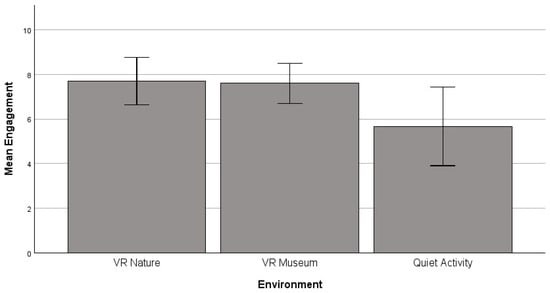
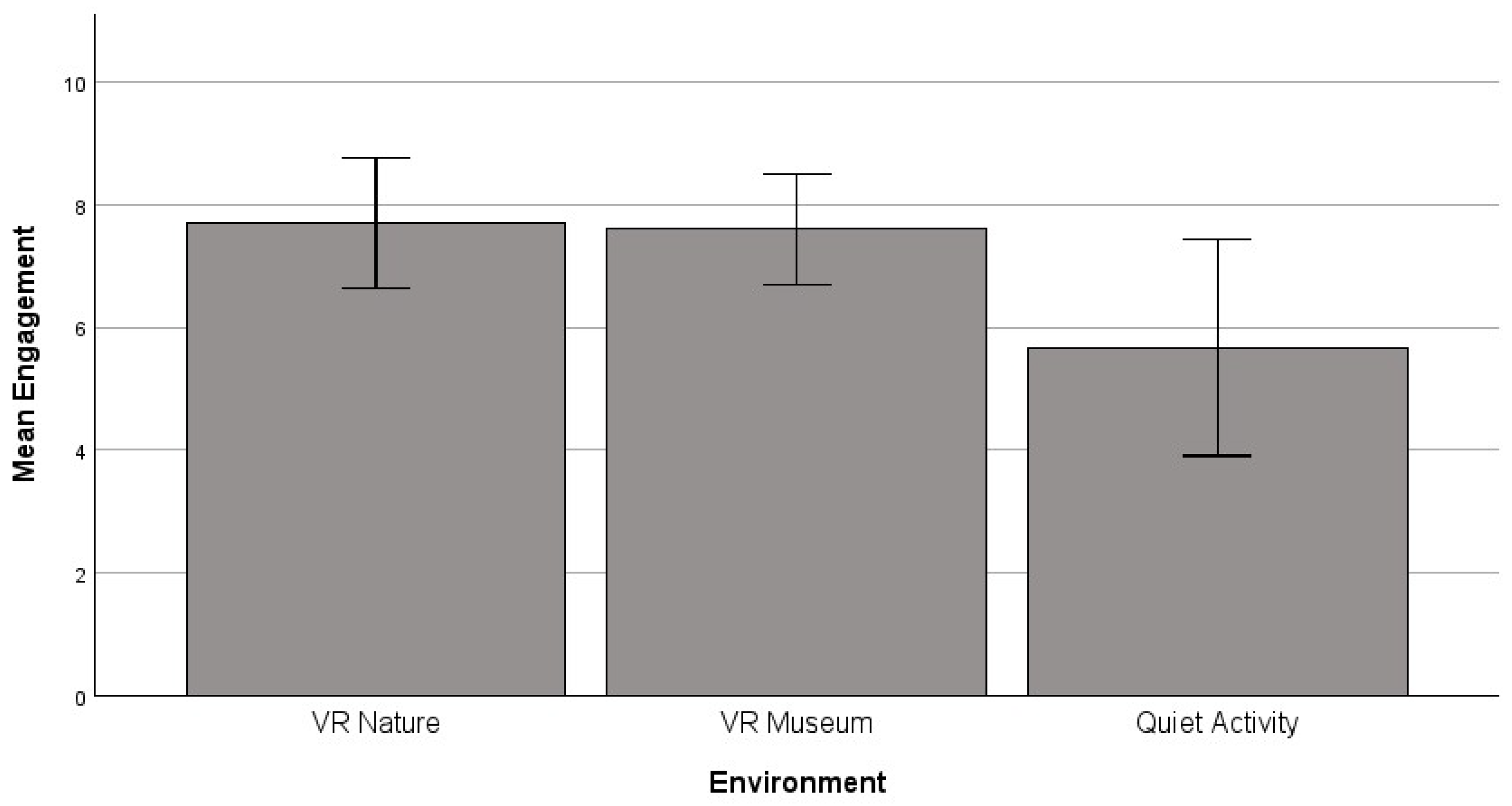
A one-way between-subjects ANOVA found a significant main effect of Environment on Engagement (F(2, 26) = 4.16, p = 0.027, ω2 = 0.18). Bonferroni-adjusted post hoc tests demonstrated a significant difference (p = 0.048) between VR nature Environment (M = 7.70, SD = 1.49) and quiet-activity control (M = 5.67, SD = 2.29). No significant difference (p = 1.000) was found between VR nature Environment and VR museum Environment (M = 7.60, SD = 1.27), or between VR museum Environment and quiet-activity control (p = 0.064). A bar chart of the engagement scores across the environments can be found in Figure 5.
Figure 5.
Bar chart showing mean engagement for each environment, with error bars demonstrating a 95% confidence interval.
3.7. Results Summary
A summary of the ANOVA findings across four of the outcome measures is presented in Table 3, including the F-statistics, degrees of freedom, p-values, and effect sizes.
Table 3.
Summary of the ANOVA results across outcome measures.
4. Discussion
This study investigated whether a 20-min VR nature experience could reduce stress in university students compared with a VR museum and quiet-activity control condition. Nature relatedness was measured to examine its potential association with changes in perceived stress and anxiety, whilst measures of presence, engagement, and user experience were included to capture participants’ experiences across the conditions. The first hypothesis was partially supported. Participants in the VR nature condition showed a significantly greater reduction in perceived stress than those in the VR museum condition. However, the VR nature condition did not differ significantly from the quiet-activity control. State anxiety was significantly reduced across the sample over time, although the magnitude of this reduction did not change significantly between conditions. The second hypothesis was not supported, as baseline nature relatedness was not significantly associated with changes in either perceived stress or anxiety. Finally, the third hypothesis was partially supported, with significant differences being observed in user experience and engagement, but not presence.
The greater reduction in perceived stress observed in the present study is consistent with previous research supporting the restorative potential of virtual nature environments. Reductions in perceived stress following VR nature exposure have been reported across a range of populations, including university students (Ahn et al., 2025), healthcare workers (Beverly et al., 2022), and intensive care nurses (Nijland et al., 2021). Similarly, Mendes and Cameirão (2023) found that exposure to a realistic virtual nature environment was associated with lower levels of stress. The present findings extend this literature by directly comparing two immersive VR experiences, with a greater reduction in stress being observed in the nature environment than in the museum environment. As both conditions involved immersive VR, this difference suggests that the environmental content may have contributed to the observed differences in scores.
However, the absence of a significant difference between VR nature and the quiet-activity control is important when interpreting these findings. Participants in the control condition were tasked with engaging in a quiet activity, with all participants using their phones during the 20-min period. Although the VR nature condition produced a greater reduction in perceived stress than the VR museum condition, this reduction was not significantly greater than that observed following a quiet activity. Therefore, the present findings do not demonstrate that a VR nature environment is more effective at reducing stress than taking a short break from an activity. This distinction is important when considering the potential applications of VR nature as a wellbeing intervention.
The significant difference in perceived stress scores between the two VR environments could be understood through theories of nature restoration. Stress Reduction Theory proposes that natural features, such as greenery, water, and open landscapes, can elicit positive emotions (Yao et al., 2021). Consistent with this, exposure to natural environments has also been associated with greater stress reduction than exposure to urban environments (Ewert & Chang, 2018). This is alongside increased parasympathetic nervous system activation and relaxation, as well as reduced physiological arousal (Shaffee & Abd Shukor, 2018; Van den Berg et al., 2015). The VR nature environment used in the present study incorporated several of these features, including a green meadow, mountains, a river, and wildlife. It is therefore possible that recreating these natural features within an immersive VR environment contributed to the greater reduction in perceived stress relative to the museum environment.
Whilst state anxiety significantly reduced from pre- to post-intervention across conditions, there was no significant Time × Environment interaction. This suggests that this reduction did not significantly differ between the VR nature, VR museum, and quiet-activity control conditions. These findings are consistent with previous literature which has reported reductions in state anxiety following VR interventions (Camara & Hicks, 2020; Concannon et al., 2020; García-González et al., 2024; O’Meara et al., 2020). However, the present findings suggest that VR nature did not provide any additional anxiety reduction benefits relative to the other conditions. The differing findings between perceived stress and anxiety may reflect differences in the constructs assessed by the two measures. A brief intervention may be sufficient to influence participants’ immediate perceptions of stress, but not enough to produce equivalent changes across the broader symptoms of anxiety captured by the STAI.
Nature relatedness was included to examine whether individuals with a stronger pre-existing connection to nature experienced greater changes in perceived stress and anxiety. Previous research has demonstrated an association between nature connectedness, emotional regulation, and stress (Bakir-Demir et al., 2021; Kim et al., 2025; Lau et al., 2023), while VR nature itself has been associated with increases in nature relatedness (Ma et al., 2025). However, the findings of the study indicated that baseline nature relatedness was not significantly associated with changes in either stress or anxiety. Given the preliminary nature of the study, further research with a larger sample is needed to determine whether pre-existing nature relatedness may influence psychological responses to VR nature exposure.
The findings also revealed no significant between-condition differences in presence scores. This finding is important given that presence has previously been identified as a factor through which immersive virtual environments can facilitate restorative experiences (Frost et al., 2022; Liszio et al., 2018). However, the absence of a significant between-condition difference does not necessarily indicate that presence was unimportant for stress and anxiety reduction. The current analysis only shows that average presence scores did not significantly differ between the two conditions.
With regard to user experience, both VR conditions received significantly higher user experience scores than the quiet-activity control, whilst no significant differences were observed between the VR nature and museum environments. These findings suggest that higher user experience scores were not specific to natural content but may instead reflect the immersive characteristics of the VR more generally. Previous research has similarly associated VR with greater enjoyment and interactivity compared with less immersive formats, such as computer monitors and other screen-based tasks (Reer et al., 2022; Yang & Zhang, 2022). These benefits may be influenced by characteristics of VR such as novelty, sensory immersion, and virtual realism (Leveau & Camus, 2023; Newman et al., 2022; Talukdar & Yu, 2024).
The relatively unstructured nature of the VR experiences may also have contributed to participants’ user experience scores. During both VR experiences, participants were able to freely explore the virtual environments, rather than completing a prescribed task. Qualitative feedback supports this freedom benefit as participants indicated that they enjoyed the freedom provided by the simulation. For example, “I began exploring the wildlife and felt more happy” and “I enjoyed wandering around the field with the animals and wildlife”. This freedom may have allowed participants to engage with the environment at their own pace, without the performance demands associated with goal directed tasks.
Engagement showed a different pattern, with participants in the VR nature condition reporting significantly greater engagement than those in the quiet-activity control, while the VR museum did not significantly differ from either group. These findings suggest that VR nature environments may not necessarily be more engaging than other VR content. Attention Restoration Theory may provide a possible explanation, as natural environments are thought to capture the user’s attention in a relatively effortless way, allowing attention to be sustained without the demands associated with directed attention (Kaplan, 1995; Ohly et al., 2016). Participant feedback further supports this theory, with one participant in the VR nature condition commenting that “it felt like it went faster than how much time had actually transpired”. Perceptions of time passing quickly are commonly associated with increased engagement and attentional absorption (Im & Varma, 2018), suggesting that some participants became highly involved in the VR nature environment. In contrast, feedback from the VR museum condition included comments such as “I quite quickly ran out of things to do”, suggesting that aspects of the VR museum environment may have been less effective at sustaining engagement over the 20-min period. However, as engagement did not significantly differ between these two VR conditions, these qualitative observations should be interpreted cautiously. Future research could examine whether specific characteristics of virtual environments, such as opportunities for exploration and interaction, could contribute to sustained engagement.
Limitations and Future Implications
Several limitations are important to consider when interpreting the present study’s findings. Firstly, the final study sample consisted of 30 participants, with only 10 participants in each condition, which fell below the planned sample of 42 suggested by the power analysis. As a result, the study was underpowered relative to its original design, increasing uncertainty around the findings. Replication with a larger sample is therefore suggested before drawing more concrete conclusions regarding the effectiveness of VR nature for reducing student stress.
The sample also consisted entirely of undergraduate students from a single university, despite eligibility being open to both undergraduate and postgraduate students. Undergraduate and postgraduate students may experience different sources and levels of stress due to differences in academic workload, assessment demands, financial circumstances, and wider responsibilities. Similarly, institutional factors, such as availability of wellbeing support, campus environment, and access to green spaces, may also influence both students’ baseline stress scores and the potential benefit of a VR nature intervention. As a result, the findings are limited in the extent to which they can be generalised to the wider higher education population. Future research should include a more diverse sample across institutions and levels of study.
The novelty of VR may have influenced user experience and engagement ratings. With only 8% of students being found to have access to a VR headset (Student Device Usage Report, 2022), participants unfamiliar with immersive technologies may respond positively to the experience due to its novelty rather than its therapeutic properties. Future studies could therefore measure previous VR experience and examine whether these factors predict participant responses.
An additional limitation of the study was its focus on using self-report measures of stress and anxiety. Although subjective measures provide valuable insight into participants’ perceived psychological states, they may be influenced by factors such as individual differences in self-reporting and response biases. Future research could incorporate physiological measures, such as heart rate variability, to provide a more comprehensive assessment of stress and anxiety.
Although information regarding participants’ year of study was collected, the absence of age and gender data prevented further assessment of demographic differences between the conditions. Future research should collect more comprehensive demographic information to better characterise the sample and assess possible gender and age differences between the groups.
Despite the VR museum environment allowing participants to navigate and explore the virtual space in a similar way to the VR nature environment, some differences between the environments remained. For example, the VR nature environment provided opportunities for the user to interact with animals and objects, whereas the VR museum involved viewing exhibits and information boards. Previous research has highlighted the importance of considering the functional characteristics of VR simulations when evaluating their effectiveness (Batterley, 2026). As a result, the observed differences cannot be exclusively due to the presence of nature content. Future research should consider using more closely matched VR environments that control for differences in interactivity and cognitive demands.
Despite these limitations, the study provides a preliminary examination of brief VR nature exposure within a university population. The greater reduction in self-reported stress relative to the VR museum suggests that environmental content may influence perceived stress following immersive experiences. However, as physiological and neural indicators of stress were not assessed, the findings cannot establish whether these subjective improvements are linked to changes in physiological stress responses.
VR nature may be particularly valuable where access to physical natural environments is limited due to time, location, or mobility. Future adequately powered studies should therefore compare VR nature with real-world nature exposure, while examining repeated use and long-term outcomes. This research would help determine whether brief VR nature exposure can offer benefits beyond those of taking a short break. Additionally, due to the continuously developing area that is VR technology, research into use for wellbeing should aim to grow alongside technological advancements, to improve effectiveness and level of immersion.
5. Conclusions
The findings suggest that brief VR nature exposure may have potential for reducing perceived stress amongst university students, with a significantly greater reduction observed compared to the VR museum condition but not compared with the quiet-activity control. Whilst state anxiety was decreased across all three conditions, no significant differences were observed between the conditions. Both VR environments received higher user-experience ratings than the control. Whilst engagement was higher in the VR nature condition than in the control, the scores did not differ significantly between the two VR conditions. These preliminary findings suggest that VR nature needs further investigation as a brief, accessible, and potentially engaging approach to supporting student wellbeing. With further development and adequately powered evaluations across a larger and more diverse student sample, future research should examine whether VR nature exposure offers benefits beyond those associated with taking a short break through a quiet activity. This study therefore provides preliminary evidence for examining the effectiveness of VR nature interventions within a higher education setting.
Author Contributions
Conceptualization, L.-w.B.D., C.H. and M.B.; methodology, L.-w.B.D., C.H. and M.B.; validation, L.-w.B.D., C.H. and M.B.; formal analysis, L.-w.B.D., C.H. and M.B.; investigation, L.-w.B.D.; resources, M.B.; data curation, L.-w.B.D.; writing—original draft preparation, L.-w.B.D., C.H. and M.B.; writing—review and editing, L.-w.B.D., C.H. and M.B.; visualization, L.-w.B.D., C.H. and M.B.; supervision, C.H. and M.B.; project administration, L.-w.B.D., C.H. and M.B. All authors have read and agreed to the published version of the manuscript.
Funding
This research received no external funding.
Institutional Review Board Statement
The study was conducted in accordance with the Declaration of Helsinki and approved by the University of Liverpool Research Ethics Committee (ethics approval number 16931 dated 24 November 2025).
Informed Consent Statement
Informed consent was obtained from all subjects involved in the study.
Data Availability Statement
The dataset generated and analysed during the current study is available on the Open Science Framework (OSF) repository at https://osf.io/rxgdb/overview?view_only=5000adfd024c4bbea87fbe1308046aa5 (accessed on 27 October 2026).
Conflicts of Interest
The authors declare no conflicts of interest.
Abbreviations
The following abbreviations are used in this manuscript:
| VR | Virtual Reality |
| STAI | State Trait Anxiety Inventory |
| UEQ-S | User Experience Questionnaire Short |
Appendix A
For each of the following, please rate the extent to which you agree with each statement, using the scale from 1 to 5 as shown below. Please respond as you really feel, rather than how you think “most people” feel.
Table A1.
The NR-6: A new brief measure of nature relatedness.
Appendix B
Read each statement and select the appropriate response to indicate how you feel right now, that is, at this very moment. There are no right or wrong answers. Do not spend too much time on any one statement but give the answer which seems to describe your present feelings best.
Table A2.
State-Trait Anxiety Inventory (STAI).
Appendix C
Please rate how stressed you feel at this current moment. 0 being not at all stressed and 100 being extremely stressed.
Table A3.
VAS-Stress.
Appendix D
Table A4.
Presence Questionnaire.
Appendix E
Read each statement and select the appropriate response to indicate how you feel about the experience.
Table A5.
User Experience Questionnaire Short (UEQ-S).
Appendix F
Please rate how engaged you felt with the activity/environment. 0 being not at all engaged and 10 being very engaged.
Table A6.
Engagement Scale.
References
- Acabchuk, R. L., Kamath, J., Salamone, J. D., & Johnson, B. T. (2017). Stress and chronic illness: The inflammatory pathway. Social Science & Medicine, 185, 166–170. [Google Scholar] [CrossRef] [Scilit]
- Ahn, J., Kim, J., Park, Y., Kim, R., & Choi, H. (2025). Nature-based virtual reality relaxation to improve mental health and sleep in undergraduate students: A randomized controlled trial. Digital Health, 11, 20552076251365140. [Google Scholar] [CrossRef] [Scilit]
- Alkhawaldeh, A., Al Omari, O., Al Aldawi, S., Al Hashmi, I., Ann Ballad, C., Ibrahim, A., & ALBashtawy, M. (2023). Stress factors, stress levels, and coping mechanisms among university students. The Scientific World Journal, 2023(1), 2026971. [Google Scholar] [CrossRef] [Scilit]
- Anderson, A. P., Mayer, M. D., Fellows, A. M., Cowan, D. R., Hegel, M. T., & Buckey, J. C. (2017). Relaxation with immersive natural scenes presented using virtual reality. Aerospace Medicine and Human Performance, 88(6), 520–526. [Google Scholar] [CrossRef] [Scilit]
- Annerstedt, M., Jönsson, P., Wallergård, M., Johansson, G., Karlson, B., Grahn, P., & Währborg, P. (2013). Inducing physiological stress recovery with sounds of nature in a virtual reality forest—Results from a pilot study. Physiology & Behavior, 118, 240–250. [Google Scholar] [CrossRef] [Scilit]
- Bakir-Demir, T., Berument, S. K., & Akkaya, S. (2021). Nature connectedness boosts the bright side of emotion regulation, which in turn reduces stress. Journal of Environmental Psychology, 76, 101642. [Google Scholar] [CrossRef] [Scilit]
- Bashir, S., & Kumar, S. (2024). Innovative approaches to stress reduction: A review of virtual reality therapy in university-going students: Stress reduction approaches. Pakistan Journal of Health Sciences, 5(8), 259–267. [Google Scholar] [CrossRef] [Scilit]
- Batterley, M. (2026). The impact of simulation design on improving learning outcomes in virtual reality [Doctoral dissertation, University of Liverpool]. University of Liverpool Research Repository. [Google Scholar]
- Batterley, M., & Limniou, M. (2026). Learning in virtual reality. In The palgrave encyclopedia of cyberpsychology (pp. 1–8). Springer Nature. [Google Scholar]
- Batterley, M., Limniou, M., Mason, G., & Bode, C. (2026). How learning environments affect university students’ employability skills development: Students and staff views. Education Sciences, 16(1), 41. [Google Scholar] [CrossRef] [Scilit]
- Batterley, M., & Meyer, G. (2025). Beyond reality—The influence audio-visual-haptic training has on sequence learning in a VR and real-world environment. PsyArXiv. [Google Scholar] [CrossRef] [Scilit]
- Berry, J. K. M., & Drummond, P. D. (2018). Psychological generators of stress-headaches. Journal of Behavioral Medicine, 41(1), 109–121. [Google Scholar] [CrossRef] [Scilit]
- Beverly, E., Hommema, L., Coates, K., Duncan, G., Gable, B., Gutman, T., Love, M., Love, C., Pershing, M., & Stevens, N. (2022). A tranquil virtual reality experience to reduce subjective stress among COVID-19 frontline healthcare workers. PLoS ONE, 17(2), e0262703. [Google Scholar] [CrossRef] [Scilit]
- Bianco, A., Gentile, A., Thomas, E., Ficarra, S., & Nordstrom, A. (2023). Nature through virtual reality as a stress-reduction tool: A systematic review. International Journal of Stress Management, 30(4), 341–353. [Google Scholar] [CrossRef] [Scilit]
- Brett, C. E., Mathieson, M. L., & Rowley, A. M. (2023). Determinants of wellbeing in university students: The role of residential status, stress, loneliness, resilience, and sense of coherence. Current Psychology, 42(23), 19699–19708. [Google Scholar] [CrossRef] [Scilit]
- Browning, M. H., Mimnaugh, K. J., Van Riper, C. J., Laurent, H. K., & LaValle, S. M. (2020). Can simulated nature support mental health? Comparing short, single-doses of 360-degree nature videos in virtual reality with the outdoors. Frontiers in Psychology, 10, 2667. [Google Scholar] [CrossRef] [Scilit]
- Bu, H., & Duan, W. (2019). A single-session positive cognitive intervention on first-year students’ mental health: Short-term effectiveness and the mediating role of strengths knowledge. Journal of American College Health, 67(6), 515–522. [Google Scholar] [CrossRef] [Scilit]
- Camara, D. R., & Hicks, R. E. (2020). Using virtual reality to reduce state anxiety and stress in university students: An experiment. GSTF Journal of Psychology (JPsych), 4(2). [Google Scholar]
- Capaldi, C. A., Passmore, H. A., Ishii, R., Chistopolskaya, K. A., Vowinckel, J., Nikolaev, E. L., & Semikin, G. I. (2017). Engaging with natural beauty may be related to well-being because it connects people to nature: Evidence from three cultures. Ecopsychology, 9(4), 199–211. [Google Scholar] [CrossRef] [Scilit]
- Collingwoode-Williams, T., Gillies, M., Nambyiah, P., Fertleman, C., & Pan, X. (2024). Delivering bad news: VR embodiment of self evaluation in medical communication training. IEEE. [Google Scholar] [CrossRef] [Scilit]
- Concannon, B. J., Esmail, S., & Roberts, M. R. (2020). Immersive virtual reality for the reduction of state anxiety in clinical interview exams: Prospective cohort study. JMIR Serious Games, 8(3), e18313. [Google Scholar] [CrossRef] [Scilit]
- Desselle, M. R., Brown, R. A., James, A. R., Midwinter, M. J., Powell, S. K., & Woodruff, M. A. (2020). Augmented and virtual reality in surgery. Computing in Science & Engineering, 22(3), 18–26. [Google Scholar] [CrossRef] [Scilit]
- Ewert, A., & Chang, Y. (2018). Levels of nature and stress response. Behavioral Sciences, 8(5), 49. [Google Scholar] [CrossRef] [Scilit]
- Felton, W. M., & Jackson, R. E. (2021). Presence: A review. International Journal of Human–Computer Interaction, 38(1), 1–18. [Google Scholar] [CrossRef] [Scilit]
- Finkler, W., Vlietstra, L., Waters, D. L., Zhu, L., Gallagher, S., Walker, R., & van Heezik, Y. (2025). Virtual nature and well-being: Exploring the potential of 360° VR. Applied Psychology: Health and Well-Being, 17(1), e70008. [Google Scholar] [CrossRef] [Scilit]
- Frost, S., Kannis-Dymand, L., Schaffer, V., Millear, P., Stallman, H., Mason, D. C. P. J., Wood, P. A., & Atkinson-Nolte, J. (2022). Virtual immersion in nature and psychological well-being: A systematic literature review. Journal of Environmental Psychology, 80, 101765. [Google Scholar] [CrossRef] [Scilit]
- García-González, J., Martínez-Navarro, A., Romero-del Rey, R., Requena-Mullor, M., Zheng, R., Lopez-Villen, A., & Alarcon-Rodriguez, R. (2024). State-trait anxiety levels and vital signs of pregnant women following intervention with virtual reality during the nonstress test: A randomized controlled trial. Journal of Affective Disorders, 355, 308–314. [Google Scholar] [CrossRef] [Scilit]
- Girotti, M., Bulin, S. E., & Carreno, F. R. (2024). Effects of chronic stress on cognitive function–from neurobiology to intervention. Neurobiology of Stress, 33, 100670. [Google Scholar] [CrossRef] [Scilit]
- Grabowska-Chenczke, O., Wajchman-Świtalska, S., & Woźniak, M. (2022). Psychological well-being and nature relatedness. Forests, 13(7), 1048. [Google Scholar] [CrossRef] [Scilit]
- Greener Games. (2017). Nature treks VR (Version 1.29) [Virtual Reality Software]. Meta Horizon Store. Available online: https://www.meta.com/en-gb/experiences/nature-treks-vr/2616537008386430/?srsltid=AfmBOopmWBCtKOiCKeYDv7du91W-L2p2t0dZvgrFZJRuCzNXh-Zfq9cY (accessed on 25 November 2025).
- HEGIAS Vision AG. (2022). Kirchner museum davos [Virtual Reality Software]. Meta Horizon Store. Available online: https://www.meta.com/en-gb/experiences/kirchner-museum-davos/3309777629127084/ (accessed on 25 November 2025).
- Home, R., Hunziker, M., & Bauer, N. (2012). Psychosocial outcomes as motivations for visiting nearby urban green spaces. Leisure Sciences, 34(4), 350–365. [Google Scholar] [CrossRef] [Scilit]
- Im, S. H., & Varma, S. (2018). Distorted time perception during flow as revealed by an attention-demanding cognitive task. Creativity Research Journal, 30(3), 295–304. [Google Scholar] [CrossRef] [Scilit]
- Ingulli, K., & Lindbloom, G. (2013). Connection to nature and psychological resilience. Ecopsychology, 5(1), 52–55. [Google Scholar] [CrossRef] [Scilit]
- Ishikawa, Y., & Furuyashiki, T. (2022). The impact of stress on immune systems and its relevance to mental illness. Neuroscience Research, 175, 16–24. [Google Scholar] [CrossRef] [Scilit]
- Kaplan, S. (1995). The restorative benefits of nature: Toward an integrative framework. Journal of Environmental Psychology, 15(3), 169–182. [Google Scholar] [CrossRef] [Scilit]
- Karakashevska, E., Batterley, M., Yao, Y., & Makin, A. D. (2025). They look virtually the same: Extraretinal representation of symmetry in virtual reality. Cortex, 189, 59–75. [Google Scholar] [CrossRef] [Scilit]
- Kim, J., Patel, S., Nam, H., Cho, J., & Kim, K. (2025). Experiencing immersive virtual nature for well-being, restoration, performance, and nature connectedness: A scoping review. IEEE Transactions on Visualization and Computer Graphics, 31(11), 9761–9771. [Google Scholar] [CrossRef] [Scilit]
- Lau, S. S., Leung, S. S., Wong, J. W., Lee, T. C., Cartwright, S. R., Wong, J. T., Man, J., Cheung, E., & Choi, R. P. (2023). Brief repeated virtual nature contact for three weeks boosts university students’ nature connectedness and psychological and physiological health during the COVID-19 pandemic: A pilot study. Frontiers in Public Health, 10, 1057020. [Google Scholar] [CrossRef] [Scilit]
- Lee, C. S., Bowman, M., & Wu, J. L. (2023). Preliminary outcomes from a single-session, asynchronous, online stress and anxiety management workshop for college students. Trends in Psychiatry and Psychotherapy, 45, e20210448. [Google Scholar] [CrossRef] [Scilit]
- Lesage, F. X., Berjot, S., & Deschamps, F. (2012). Clinical stress assessment using a visual analogue scale. Occupational Medicine, 62(8), 600–605. [Google Scholar] [CrossRef] [Scilit]
- Leveau, P. H., & Camus, E. S. (2023). Embodiment, immersion, and enjoyment in virtual reality marketing experiences. Psychology & Marketing, 40(7), 1329–1343. [Google Scholar] [CrossRef] [Scilit]
- Levenstein, S., Prantera, C., Varvo, V., Scribano, M. L., Berto, E., Luzi, C., & Andreoli, A. (1993). Development of the perceived stress questionnaire: A new tool for psychosomatic research. Journal of Psychosomatic Research, 37(1), 19–32. [Google Scholar] [CrossRef] [Scilit]
- Liszio, S., Graf, L., & Masuch, M. (2018). The relaxing effect of virtual nature: Immersive technology provides relief in acute stress situations. Annual Review of Cybertherapy and Telemedicine, 16, 87–93. [Google Scholar]
- Ma, J., Li, H., Zhao, M., & Williams, J. (2025). Mind nature: A virtual reality nature therapy for reducing anxiety and negative mood in university students. International Journal of Clinical and Health Psychology, 25(4), 100636. [Google Scholar] [CrossRef] [Scilit]
- Mendes, D. C., & Cameirão, M. S. (2023). Comparing perceived restorativeness and stress reduction in virtual reality environments using abstract fractal geometries versus realistic natural landscapes. In IFIP conference on human-computer interaction (pp. 3–22). Springer Nature. [Google Scholar] [CrossRef] [Scilit]
- Mosher, M. A., & Carreon, A. C. (2021). Teaching social skills to students with autism spectrum disorder through augmented, virtual and mixed reality. Research in Learning Technology, 29. [Google Scholar] [CrossRef] [Scilit]
- Mostajeran, F., Fischer, M., Steinicke, F., & Kühn, S. (2023). Effects of exposure to immersive computer-generated virtual nature and control environments on affect and cognition. Scientific Reports, 13(1), 220. [Google Scholar] [CrossRef] [Scilit]
- Mulaudzi, I. C. (2023). Challenges faced by first-year university students: Navigating the transition to higher education. Journal of Education and Human Development, 12(2), 79–87. [Google Scholar] [CrossRef] [Scilit]
- Newman, M. A. R. K., Gatersleben, B., Wyles, K. J., & Ratcliffe, E. (2022). The use of virtual reality in environment experiences and the importance of realism. Journal of Environmental Psychology, 79, 101733. [Google Scholar] [CrossRef] [Scilit]
- Nijland, J. M., Veling, W., Lestestuiver, B. P., & Van Driel, C. M. (2021). Virtual reality relaxation for reducing perceived stress of intensive care nurses during the COVID-19 pandemic. Frontiers in Psychology, 12, 706527. [Google Scholar] [CrossRef] [Scilit]
- Nisbet, E. K., & Zelenski, J. M. (2013). The NR-6: A new brief measure of nature relatedness. Frontiers in Psychology, 4, 813. [Google Scholar] [CrossRef] [Scilit]
- Nordberg, H., Kroll, J. L., Rosenfield, D., Chmielewski, M., & Ritz, T. (2022). Chronic stress experience, sleep, and physical activity: Relations with change in negative affect and acute stress response to a naturalistic stressor. British Journal of Health Psychology, 27(2), 449–467. [Google Scholar] [CrossRef] [Scilit]
- Noronha, H., & Campos, P. (2021). Harnessing virtual reality nature to promote well-being. Interacting with Computers, 33(4), 353–366. [Google Scholar] [CrossRef] [Scilit]
- Ohly, H., White, M. P., Wheeler, B. W., Bethel, A., Ukoumunne, O. C., Nikolaou, V., & Garside, R. (2016). Attention restoration theory: A systematic review of the attention restoration potential of exposure to natural environments. Journal of Toxicology and Environmental Health, Part B, 19(7), 305–343. [Google Scholar] [CrossRef] [Scilit]
- O’Meara, A., Cassarino, M., Bolger, A., & Setti, A. (2020). Virtual reality nature exposure and test anxiety. Multimodal Technologies and Interaction, 4(4), 75. [Google Scholar] [CrossRef] [Scilit]
- Owens, M., & Bunce, H. (2023). The effect of brief exposure to virtual nature on mental wellbeing in adolescents. Scientific Reports, 13(1), 17769. [Google Scholar] [CrossRef] [Scilit]
- Peeters, M., Braakhekke, E., Kesselring, M., Wijsbroek, S., Schramel, I., Putter, I., Klaassen, E., Groenendijk, J., Sieffers, N., de Wildt, S., & Kleinjan, M. (2025). Understanding and tackling academic stress and school attendance problems within the school system; a co-creation approach. Mental Health & Prevention, 37, 200388. [Google Scholar] [CrossRef] [Scilit]
- Pitt, A., Oprescu, F., Tapia, G., & Gray, M. (2018). An exploratory study of students’ weekly stress levels and sources of stress during the semester. Active Learning in Higher Education, 19(1), 61–75. [Google Scholar] [CrossRef] [Scilit]
- Puhakka, R. (2021). University students’ participation in outdoor recreation and the perceived well-being effects of nature. Journal of Outdoor Recreation and Tourism, 36, 100425. [Google Scholar] [CrossRef] [Scilit]
- Reer, F., Wehden, L. O., Janzik, R., Tang, W. Y., & Quandt, T. (2022). Virtual reality technology and game enjoyment: The contributions of natural mapping and need satisfaction. Computers in Human Behavior, 132, 107242. [Google Scholar] [CrossRef] [Scilit]
- Reese, G., Stahlberg, J., & Menzel, C. (2022). Digital shinrin-yoku: Do nature experiences in virtual reality reduce stress and increase well-being as strongly as similar experiences in a physical forest? Virtual Reality, 26(3), 1245–1255. [Google Scholar] [CrossRef] [Scilit]
- Schrepp, M., Hinderks, A., & Thomaschewski, J. (2017). Design and evaluation of a short version of the user experience questionnaire (UEQ-S). International Journal of Interactive Multimedia and Artificial Intelligence, 4(6), 103–108. [Google Scholar] [CrossRef] [Scilit]
- Schwabe, L., Hermans, E. J., Joëls, M., & Roozendaal, B. (2022). Mechanisms of memory under stress. Neuron, 110(9), 1450–1467. [Google Scholar] [CrossRef] [Scilit]
- Selanon, P., & Chuangchai, W. (2023). The importance of urban green spaces in enhancing holistic health and sustainable well-being for people with disabilities: A narrative review. Buildings, 13(8), 2100. [Google Scholar] [CrossRef] [Scilit]
- Servotte, J.-C., Goosse, M., Campbell, S. H., Dardenne, N., Pilote, B., Simoneau, I. L., Guillaume, M., Bragard, I., & Ghuysen, A. (2020). Virtual reality experience: Immersion, sense of presence, and cybersickness. Clinical Simulation in Nursing, 38, 35–43. [Google Scholar] [CrossRef] [Scilit]
- Shaffee, N., & Abd Shukor, S. F. (2018). The effect of natural settings on stress reduction. Alam Cipta, 11(2), 25–33. [Google Scholar]
- Shuda, Q., Bougoulias, M. E., & Kass, R. (2020). Effect of nature exposure on perceived and physiologic stress: A systematic review. Complementary Therapies in Medicine, 53, 102514. [Google Scholar] [CrossRef] [Scilit]
- Slimmen, S., Timmermans, O., Mikolajczak-Degrauwe, K., & Oenema, A. (2022). How stress-related factors affect mental wellbeing of university students a cross-sectional study to explore the associations between stressors, perceived stress, and mental wellbeing. PLoS ONE, 17(11), e0275925. [Google Scholar] [CrossRef] [Scilit]
- Spielberger, C. D., Gonzalez-Reigosa, F., Martinez-Urrutia, A., Natalicio, L. F., & Natalicio, D. S. (1971). The state-trait anxiety inventory. Revista Interamericana de Psicologia/Interamerican Journal of Psychology, 5(3 & 4), 145–158. [Google Scholar] [CrossRef] [Scilit]
- Student Device Usage Report. (2022). Learning innovation. Available online: https://uploads-ssl.webflow.com/5c77b4f8eced0c7b2aacbca8/625fe8c783d347008b6a9df7_LI_Student-Device-Usage-Report-April2022.pdf (accessed on 10 July 2025).
- Sudimac, S., Sale, V., & Kühn, S. (2022). How nature nurtures: Amygdala activity decreases as the result of a one-hour walk in nature. Molecular Psychiatry, 27(11), 4446–4452. [Google Scholar] [CrossRef] [Scilit]
- Tafet, G. E., & Nemeroff, C. B. (2016). The links between stress and depression: Psychoneuroendocrinological, genetic, and environmental interactions. The Journal of Neuropsychiatry and Clinical Neurosciences, 28(2), 77–88. [Google Scholar] [CrossRef] [Scilit]
- Talukdar, N., & Yu, S. (2024). Breaking the psychological distance: The effect of immersive virtual reality on perceived novelty and user satisfaction. Journal of Strategic Marketing, 32(8), 1147–1171. [Google Scholar] [CrossRef] [Scilit]
- Thompson, C. A., Pownall, M., Harris, R., & Blundell-Birtill, P. (2023). Is the grass always greener? Access to campus green spaces can boost students’ sense of belonging. International Journal of Sustainability in Higher Education, 24(8), 1841–1857. [Google Scholar] [CrossRef] [Scilit]
- Toussaint, L., Shields, G. S., Dorn, G., & Slavich, G. M. (2016). Effects of lifetime stress exposure on mental and physical health in young adulthood: How stress degrades and forgiveness protects health. Journal of Health Psychology, 21(6), 1004–1014. [Google Scholar] [CrossRef] [Scilit]
- Van den Berg, M. M., Maas, J., Muller, R., Braun, A., Kaandorp, W., Van Lien, R., Van Poppel, M. N., Van Mechelen, W., & Van den Berg, A. E. (2015). Autonomic nervous system responses to viewing green and built settings: Differentiating between sympathetic and parasympathetic activity. International Journal of Environmental Research and Public Health, 12(12), 15860–15874. [Google Scholar] [CrossRef] [Scilit]
- Wang, Y., & Tong, Y. (2025). Academic pressure and perceived stress: The mediating role of life satisfaction. Social Behavior and Personality: An International Journal, 53(1), 1–8. [Google Scholar] [CrossRef] [Scilit]
- Witmer, B. G., & Singer, M. J. (1998). Measuring presence in virtual environments: A presence questionnaire. Presence, 7(3), 225–240. [Google Scholar] [CrossRef] [Scilit]
- Woolf, Y. (2026). Students’ agency in campus greenspace: How guerrilla use informs the design of university greenspace. Urban Forestry & Urban Greening, 119, 129384. [Google Scholar] [CrossRef] [Scilit]
- Yang, S., & Zhang, W. (2022). Presence and flow in the context of virtual reality storytelling: What influences enjoyment in virtual environments? Cyberpsychology, Behavior, and Social Networking, 25(2), 101–109. [Google Scholar] [CrossRef] [Scilit]
- Yao, W., Zhang, X., & Gong, Q. (2021). The effect of exposure to the natural environment on stress reduction: A meta-analysis. Urban Forestry & Urban Greening, 57, 126932. [Google Scholar] [CrossRef] [Scilit]

Disclaimer/Publisher’s Note: The statements, opinions and data contained in all publications are solely those of the individual author(s) and contributor(s) and not of MDPI and/or the editor(s). MDPI and/or the editor(s) disclaim responsibility for any injury to people or property resulting from any ideas, methods, instructions or products referred to in the content. |
© 2026 by the authors. Licensee MDPI, Basel, Switzerland. This article is an open access article distributed under the terms and conditions of the Creative Commons Attribution (CC BY) license.