


Abstract
Academic stress has been associated with psychological distress, unhealthy behaviors, and poorer academic functioning among university students, particularly in health sciences programs. This study examined the association between academic stress and perceived academic impairment, considering five eating behavior phenotypes as parallel indirect pathways. A quantitative cross-sectional study was conducted with 225 undergraduate health sciences students from a public university in southeastern Mexico. Academic stress was assessed using the SISCO Academic Stress Inventory, eating behavior phenotypes using the Eating Behavior Phenotypes Scale, and perceived academic impairment using the recoded University Academic Performance Scale. Parallel multiple-mediator path analysis with bootstrap confidence intervals was performed, adjusting for relevant sociodemographic and academic covariates. Academic stress was positively associated with all five eating behavior phenotypes, which were, in turn, positively associated with perceived academic impairment. The total indirect effect was significant, and all specific indirect pathways were supported by bootstrap confidence intervals excluding zero. The direct association between academic stress and perceived academic impairment also remained significant. These findings suggest that multidimensional eating behavior may represent an important mechanism linking academic stress with perceived academic impairment. Given the cross-sectional design, the findings should be interpreted as indirect associations rather than evidence of causal or temporal mediation.
1. Introduction
Academic stress is recognized as a multidimensional psychophysiological phenomenon that arises when students perceive that the demands of their educational environment exceed their adaptive resources (Barraza-Macías, 2007; Guízar Sánchez et al., 2023). This construct encompasses cognitive, emotional, behavioral, and physiological responses associated with academic stressors, including examination periods, academic overload, professor evaluations, time constraints, and the pressure to maintain competitive grade point averages. Within higher education, health sciences students represent a particularly vulnerable population due to the confluence of demanding theoretical curricula, early clinical exposure, patient care responsibilities, and the emotional burden associated with confronting human suffering and mortality (Weurlander et al., 2019; Guízar Sánchez et al., 2023).
Sustained exposure to these multifaceted academic demands has been associated with adverse outcomes such as psychological distress, burnout, and maladaptive coping behaviors (Ishak et al., 2013; Dyrbye et al., 2014).
The vulnerability of health sciences students to academic stress may be further amplified by the structural characteristics of their training programs. Medical, nursing, and pharmacy curricula are often characterized by an intensive pace of knowledge acquisition, frequent high-stakes assessments, sleep disruption during clinical rotations, and the expectation of progressive professional competence during formative stages (Vázquez-Vázquez et al., 2022; Monserrat-Hernández et al., 2023). Research conducted in Mexican medical education contexts has documented that a substantial proportion of students report moderate to severe levels of perceived academic stress, with examination-related stressors and academic overload among the most frequently endorsed stressors (Guízar Sánchez et al., 2023; Navarro-Sandoval et al., 2024). These findings are consistent with international evidence indicating that health sciences students often report elevated stress levels compared with students from non-health disciplines (Chai et al., 2024; Al-Dalaeen et al., 2024).
Several theoretical models have proposed that stress-related eating may involve neuroendocrine and reward-related mechanisms, including activation of the hypothalamic–pituitary–adrenal axis, cortisol regulation, and reward sensitivity (Lupien et al., 2007; Schwabe & Wolf, 2013). Under conditions of chronic or repeated stress exposure, alterations in HPA-axis activity have been linked in the previous literature to changes in appetite regulation, preference for energy-dense foods, and disinhibited eating patterns (Adam & Epel, 2007; Dallman, 2010; Sinha & Jastreboff, 2013). However, because the present study did not assess physiological markers such as cortisol or neuroendocrine activity, these mechanisms are considered here only as theoretical background rather than pathways directly tested by the data.
The relationship between stress and eating behavior has also been discussed in relation to glucocorticoid signaling and reward-related processes. Previous studies suggest that stress may be associated with greater salience and reinforcing value of highly palatable foods through reward-related mechanisms (Epel et al., 2001; Groesz et al., 2012). In university populations, maladaptive eating behaviors have been documented as prevalent and relevant to student well-being. The Eating Behavior Phenotypes Scale (EFCA) identifies five subphenotypes of dysregulated eating: dietary disorganization, compulsive eating, hedonic eating, hyperphagia, and emotional eating (Anger et al., 2022). Emotional eating, in particular, has received attention because of its associations with perceived stress (Dalton, 2024; Shatwan & Alzharani, 2024). Hedonic eating has been discussed in relation to reward-based responses to stress (Macht, 2008; Sinha & Jastreboff, 2013). Dietary disorganization, including irregular meal patterns and meal skipping, is especially common among university students navigating demanding academic schedules (Chávez-Hernández, 2023; Navarro-Sandoval et al., 2024).
Maladaptive eating behaviors may also be relevant to academic functioning through their association with cognitive and behavioral processes involved in learning. Executive functions, including working memory, inhibitory control, and cognitive flexibility, are supported by adequate nutritional intake and stable glucoregulatory control (Chávez-Hernández, 2023; Harris et al., 2024). Meal skipping, as one manifestation of dietary disorganization among stressed students, has been associated with reduced attentional capacity, lower verbal fluency, and poorer academic outcomes in previous research (Chávez-Hernández, 2023; Phelan et al., 2025). Nevertheless, these associations should be interpreted cautiously because academic functioning may also influence stress and eating behaviors, suggesting possible bidirectional or reciprocal pathways.
Empirical evidence from Mexican university populations provides important contextual grounding. A cross-sectional study among university students in Mexico City reported significant correlations among executive functions, emotional eating, eating habits, and academic achievement, with emotional eating emerging as a behavioral correlate of poorer academic performance (Chávez-Hernández, 2023). Research among medical students at UNAM documented a high prevalence of perceived academic stress and significant sex differences, with female students reporting greater emotional distress (Guízar Sánchez et al., 2023). Studies in northwestern Mexico have found that elevated academic stress is associated with poorer dietary quality and higher consumption of ultra-processed foods (Navarro-Sandoval et al., 2024). Furthermore, Vázquez-Vázquez et al. (2022) reported that emotional eating was prevalent among Mexican university students and was associated with academic stress levels.
Despite the growing body of literature, few studies have examined academic stress, eating behaviors, and academic functioning simultaneously within an indirect-association framework. Most research has been conducted in North American, European, or Asian contexts, with limited attention to Mexican health sciences populations. Moreover, existing studies often employ global or unidimensional measures of eating behavior that may not fully capture the diversity of maladaptive eating patterns. The use of a multidimensional eating behavior instrument is relevant because maladaptive eating may involve dietary disorganization, compulsive eating, hedonic eating, hyperphagia, and emotional eating.
The general objective of this study was to examine the association between academic stress and perceived academic impairment, considering five eating behavior phenotypes as parallel indirect pathways, in a sample of health sciences students from a public university in southeastern Mexico. Perceived academic impairment refers to poorer perceived academic performance based on the recoded University Academic Performance Scale, in which higher scores indicate greater impairment. Based on previous evidence, it was hypothesized that: (a) academic stress would be positively associated with dietary disorganization, hedonic eating, compulsive eating, hyperphagia, and emotional eating; (b) these eating behavior phenotypes would be positively associated with perceived academic impairment; and (c) the five eating behavior phenotypes would show significant positive indirect pathways in the association between academic stress and perceived academic impairment.
2. Materials and Methods
2.1. Study Design
The present study employed a quantitative, non-experimental, observational, cross-sectional design. This design was selected to examine associations among academic stress, eating behavior phenotypes, and perceived academic impairment at a single point in time. Given the cross-sectional nature of the data, the mediation model was interpreted as an indirect association model rather than evidence of temporal or causal mediation.
2.2. Participants and Sample
The source population consisted of 542 undergraduate students enrolled in health sciences degree programs at the Universidad Autónoma del Estado de Quintana Roo (UQROO), a public university located in southeastern Mexico, during the study period. Because the institution did not provide enrollment data disaggregated by academic semester, the sample size was estimated using the total available enrollment as the finite population reference (N = 542). Assuming a 95% confidence level, a 5% margin of error, and maximum variability (p = 0.50), the estimated recruitment target was approximately 225 participants.
Eligibility criteria were subsequently applied during recruitment, restricting participation to students enrolled from the first to the fourth academic semester in Medicine, Nursing, or Pharmacy. A non-probabilistic convenience sampling strategy was used; therefore, the sample size calculation was used to establish the minimum recruitment target rather than to support probabilistic representativeness.
The final sample comprised 225 undergraduate students from Medicine (n = 114, 50.7%), Nursing (n = 66, 29.3%), and Pharmacy (n = 45, 20.0%). The sample included 153 women (68.0%) and 72 men (32.0%). Participants ranged in age from 18 to 42 years (M = 19.29, SD = 2.54; median = 19). Students were enrolled from the first to the fourth academic semester: first semester (n = 44, 19.6%), second semester (n = 54, 24.0%), third semester (n = 76, 33.8%), and fourth semester (n = 51, 22.7%).
Because the survey invitation was distributed through institutional and classroom-based channels, the exact number of eligible students who actually received the Microsoft Forms link could not be determined. Therefore, an exact response rate could not be calculated.
2.3. Instruments
Academic Stress Inventory (SISCO). Academic stress was assessed using the full 31-item version of the SISCO Academic Stress Inventory (Barraza-Macías, 2007; Guzmán-Castillo et al., 2022). The instrument is organized into five sections: a dichotomous filter item (item 1), a single global stress-intensity item (item 2), eight academic-stressor items (items 3.1–3.8), fifteen symptom/reaction items (items 4.1–4.15), and six coping-strategy items (items 5.1–5.6). The stressor and symptom/reaction items are rated on a five-point Likert scale ranging from 1 = never to 5 = always. In the present study, the full instrument was administered, but academic stress was operationalized as the combination of perceived academic demands and the reactions associated with stress. Accordingly, the analytical academic stress score was computed as the mean of the 23 items comprising the academic-stressor dimension (items 3.1–3.8; 8 items) and the symptom/reaction dimension (items 4.1–4.15; 15 items). The filter item was excluded because it only identifies whether a student has experienced stress and does not form part of a continuous frequency score; the global-intensity item was excluded because it is a separate single-item global indicator rather than a frequency-based item comparable to the remaining items; and the six coping-strategy items (items 5.1–5.6) were excluded because they assess self-regulatory responses to stress rather than exposure to stressors or associated symptomatology. This decision is consistent with the systemic-cognitivist model underlying the SISCO (Barraza-Macías, 2007), in which academic stress is conceptualized as a process comprising stressors (input demands) and symptoms or reactions (the response to those demands), whereas coping constitutes a self-regulatory strategy that is conceptually distinct from the level of experienced stress and was therefore not merged into the stress-load score. Higher scores indicated greater perceived academic stress. The resulting academic stress score showed good internal consistency in the present sample (Cronbach’s α = 0.89). Several indicators supported combining the two dimensions into a single academic-stress score. Both subscales showed good internal consistency (academic stressors, α = 0.84; symptoms or reactions, α = 0.86), as did the 23-item combined score (α = 0.89), and the two dimensions were substantially and positively correlated (r = 0.555, p < 0.001), indicating that they share a common underlying construct while retaining distinct content. Because a confirmatory factor analysis of this modified composite was not conducted, the scoring decision is presented as a theoretically grounded operationalization rather than a formal validation of a unidimensional structure (see Section 4.4).
Eating Behavior Phenotypes Scale (EFCA). Eating behavior phenotypes were assessed using the Eating Behavior Phenotypes Scale (EFCA; Anger et al., 2022), a 16-item self-report instrument designed to assess five maladaptive eating behavior phenotypes: dietary disorganization, hedonic eating, compulsive eating, hyperphagia, and emotional eating. Items are rated on a five-point Likert scale ranging from 1 = never to 5 = always. Item 9 was reverse-coded according to the original scoring instructions before computing the scale scores. For each EFCA subphenotype, item-level mean scores were computed, with higher scores indicating greater frequency of the corresponding maladaptive eating behavior phenotype. In the present sample, the total EFCA score showed acceptable internal consistency (Cronbach’s α = 0.82). Internal consistency was also acceptable for the five subscales: dietary disorganization (α = 0.71), hedonic eating (α = 0.73), compulsive eating (α = 0.74), emotional eating (α = 0.84), and hyperphagia (α = 0.74).
University Academic Performance Scale (RAU). Perceived academic impairment was assessed using the 20-item self-report version of the University Academic Performance Scale (RAU), developed and validated in Mexican university students by Preciado-Serrano et al. (2021). The RAU assesses students’ self-perceived academic functioning through three factors: contribution to academic activities, dedication to study, and lack of organization of didactic resources. Items are rated on a seven-point Likert-type scale ranging from 0 = never to 6 = always. In the original scoring structure, the first two factors are positively oriented, with higher scores indicating better perceived academic functioning, whereas the third factor is negatively oriented, with higher scores indicating poorer perceived academic functioning. To align all dimensions in the same interpretive direction, items from the first two factors were reverse coded before computing the global score. The final RAU score was calculated as the mean of the 20 items. After recoding, higher scores indicated poorer perceived academic performance; therefore, the outcome variable was labelled perceived academic impairment. In the present sample, the recoded RAU score showed excellent internal consistency (Cronbach’s α = 0.90). A confirmatory factor analysis conducted in the present sample supported the three-factor structure of the recoded RAU, using robust maximum likelihood estimation (N = 225). The model showed excellent fit: Satorra–Bentler χ2(167) = 223.92, p = 0.002; χ2/df = 1.34; CFI = 0.959; TLI = 0.954; RMSEA = 0.039, 90% CI [0.024, 0.052]; SRMR = 0.047. All 20 items loaded significantly on their intended factors (standardized loadings = 0.49–0.75, all p < 0.001; Supplementary Table S2), and the three latent factors were strongly and positively intercorrelated (impaired contribution–reduced dedication, r = 0.68; reduced dedication–lack of organization, r = 0.63; impaired contribution–lack of organization, r = 0.58; all p < 0.001). Subscale reliabilities ranged from acceptable to good (impaired contribution to academic activities, α = 0.85; reduced dedication to study, α = 0.80; lack of organization of didactic resources, α = 0.79), and the global recoded score showed excellent internal consistency (α = 0.90). The strong intercorrelations among the three dimensions provide supportive, but not conclusive, evidence for the use of the averaged global score as a parsimonious summary index; strong correlations among first-order factors do not, by themselves, establish a higher-order general factor, and the global score should therefore be interpreted with this caveat, recognizing that it summarizes three conceptually distinct dimensions.
2.4. Procedure
Data were collected through a digital survey administered using Microsoft Forms from September to October 2024, during regular academic activities and outside vacation periods. Participants were invited through institutional channels and direct invitations during academic sessions. The survey included an introductory section describing the study objectives, eligibility criteria, voluntary nature of participation, confidentiality procedures, absence of incentives, and electronic informed consent.
Only students who provided electronic informed consent were allowed to continue to the questionnaire. Completion of the survey required approximately 15–20 min. Participation was voluntary and confidential, and no incentives were offered.
The study protocol was reviewed and approved by the Comité de Ética en Investigación de la División de Ciencias de la Salud of Universidad Autónoma del Estado de Quintana Roo (approval number: CONBIOETICA-23-CEI-001-20231115; protocol code: CEI/PI-21/24; date of approval: 10 June 2024).
2.5. Data Analysis
Statistical analyses were performed using IBM SPSS Statistics version 26 and the PROCESS Macro version 4.2 (Hayes, 2022). Descriptive statistics were computed for sociodemographic and study variables. Internal consistency was assessed using Cronbach’s alpha coefficients.
Because all survey items were configured as mandatory in Microsoft Forms, no missing data were observed for the study variables. Therefore, all 225 participants were included in the final analyses.
Sex differences in EFCA subphenotypes were examined using independent-samples t-tests based on the mean scores of each subphenotype. Levene’s test was used to assess equality of variances, and Welch-corrected results were interpreted when the homogeneity of variance assumption was violated. Because five EFCA subphenotypes were compared by sex, Bonferroni correction was applied, setting the adjusted significance threshold at p < 0.01.
A zero-order correlation matrix was computed among academic stress, the five EFCA subphenotypes, and perceived academic impairment. Common method variance was assessed using Harman’s single-factor test, following recommendations for evaluating common method bias in self-report research (Podsakoff et al., 2003). An unrotated single-factor solution was examined using item-level data from the study instruments, and a first-factor variance below 50% was interpreted as indicating that a single unrotated factor did not dominate the covariance structure, while recognizing that this test cannot rule out shared-method effects.
The main analysis consisted of a parallel multiple-mediator model using ordinary least squares path analysis with PROCESS Model 4. Academic stress was entered as the independent variable, perceived academic impairment as the dependent variable, and the five EFCA subphenotypes—dietary disorganization, hedonic eating, compulsive eating, hyperphagia, and emotional eating—as simultaneous parallel mediators. The model was adjusted for sex, age, family income, academic semester, and academic program. Academic program was dummy-coded, with Medicine as the reference category and Nursing and Pharmacy entered as dummy variables.
Indirect effects were estimated using 10,000 bootstrap resamples and 95% percentile bootstrap confidence intervals. Indirect effects were considered statistically significant when the confidence interval did not include zero. Given the cross-sectional design, these estimates were interpreted as indirect pathways or indirect associations rather than evidence of causal mediation. Because no a priori power analysis was conducted, a post hoc sensitivity and power analysis was performed for the primary parallel mediation model, following the Monte Carlo approach of Schoemann et al. (2017). Simulations were implemented in Python version 3.11 (NumPy version 1.26). Population values were set to the observed completely standardized path coefficients and to the observed correlations among academic stress and the five mediators, and 2000 datasets of N = 225 were generated from a multivariate normal distribution. For each dataset, indirect effects were evaluated with Monte Carlo confidence intervals (10,000 draws; 95% confidence interval; α = 0.05), and power was defined as the proportion of datasets in which the interval excluded zero. Because these estimates are based on the observed effect sizes, the pathway-specific power values are reported as exploratory and are not interpreted as independent evidence of the reliability of the observed associations; primary emphasis is placed on the sensitivity analysis, which estimated the smallest completely standardized indirect effect detectable at 80% power with N = 225 in a single-mediator model with equal standardized paths.
Regression assumptions were evaluated for all ordinary least squares equations included in the parallel mediation model. Linearity and homoscedasticity were assessed through visual inspection of standardized residual-versus-predicted value plots. Residual normality was examined using the Shapiro–Wilk test. Multicollinearity was assessed using tolerance and variance inflation factor values, and influential observations were examined using Cook’s distance. No substantial violations of ordinary least squares regression assumptions were detected.
3. Results
3.1. Sociodemographic and Academic Characteristics
The final analytic sample included 225 undergraduate health sciences students. Participants had a mean age of 19.29 years (SD = 2.54; median = 19; range = 18–42). Most participants were younger than 20 years, female, and single. The sample included students from Medicine, Nursing, and Pharmacy, enrolled from the first to the fourth academic semester.
Monthly family income categories showed socioeconomic variability within the sample. The sociodemographic and academic characteristics of the participants are summarized in Table 1.
Table 1.
Sociodemographic and Academic Characteristics of the Participants (N = 225).
3.2. Descriptive Statistics, Reliability, and Common Method Variance
Table 2 presents descriptive statistics for the main study variables. Academic stress showed a moderate mean level (M = 3.30, SD = 1.04). Among the eating behavior phenotypes, hedonic eating showed the highest mean score (M = 3.19, SD = 1.46), followed by dietary disorganization (M = 2.98, SD = 1.42), compulsive eating (M = 2.83, SD = 1.33), emotional eating (M = 2.82, SD = 1.41), and hyperphagia (M = 2.63, SD = 1.19). The mean score for perceived academic impairment was 3.66 (SD = 0.51).
Table 2.
Descriptive statistics and reliability estimates for the main study variables.
Internal consistency was satisfactory for academic stress (Cronbach’s α = 0.89), the total EFCA score (α = 0.82), and perceived academic impairment (α = 0.90). Internal consistency estimates for the EFCA subphenotypes were also acceptable: dietary disorganization (α = 0.71), hedonic eating (α = 0.73), compulsive eating (α = 0.74), emotional eating (α = 0.84), and hyperphagia (α = 0.74).
Harman’s single-factor test indicated that the first unrotated factor accounted for 28.42% of the total variance, below the commonly used 50% threshold. This indicates that a single unrotated factor did not dominate the covariance structure; however, shared-method effects could not be excluded, because all variables were measured through the same self-report survey at the same time.
3.3. Zero-Order Correlations
Zero-order Pearson correlations are presented in Table 3. Academic stress was positively associated with all five eating behavior phenotypes and with perceived academic impairment. The strongest correlation between academic stress and eating behavior phenotypes was observed for emotional eating (r = 0.420, p < 0.001), followed by dietary disorganization (r = 0.366, p < 0.001), compulsive eating (r = 0.349, p < 0.001), hedonic eating (r = 0.309, p < 0.001), and hyperphagia (r = 0.197, p = 0.003). Perceived academic impairment was strongly associated with academic stress (r = 0.508, p < 0.001) and showed moderate, statistically significant correlations with all five eating behavior phenotypes (r = 0.347–0.451, all p < 0.001).
Table 3.
Zero-order Pearson correlations among academic stress, eating behavior phenotypes, and perceived academic impairment.
3.4. Sex Differences in Eating Behavior Phenotypes
Sex differences in eating behavior phenotypes were examined using independent-samples t-tests. Levene’s test was used to determine whether equal variances could be assumed, and Welch-corrected results were interpreted when the homogeneity of variance assumption was violated. Because five comparisons were conducted, Bonferroni correction was applied, setting the adjusted significance threshold at p < 0.01.
Women reported significantly higher dietary disorganization than men (t(223) = 2.676, p = 0.008), and significantly higher emotional eating (t(223) = 3.209, p = 0.002). Although men showed higher compulsive eating (t(109.605) = −2.259, p = 0.026) and hyperphagia (t(223) = −2.026, p = 0.044), these differences did not remain significant after Bonferroni correction. No significant sex difference was observed for hedonic eating (t(223) = 1.511, p = 0.132). Table 4 summarizes these results.
Table 4.
Sex differences in eating behavior phenotypes.
3.5. Parallel Mediation Analysis
Regression assumptions were evaluated for all ordinary least squares equations included in the parallel mediation model. Linearity and homoscedasticity were supported by visual inspection of standardized residual-versus-predicted value plots. Residuals showed no significant deviations from normality across the six regression equations, with Shapiro–Wilk values ranging from W = 0.984 to W = 0.991 and all p > 0.05. Multicollinearity was not a concern, as the maximum variance inflation factor was 1.78 and the minimum tolerance value was 0.562. Influential observations were examined using Cook’s distance, with maximum values ranging from 0.019 to 0.052, all well below the conventional threshold of 1.00.
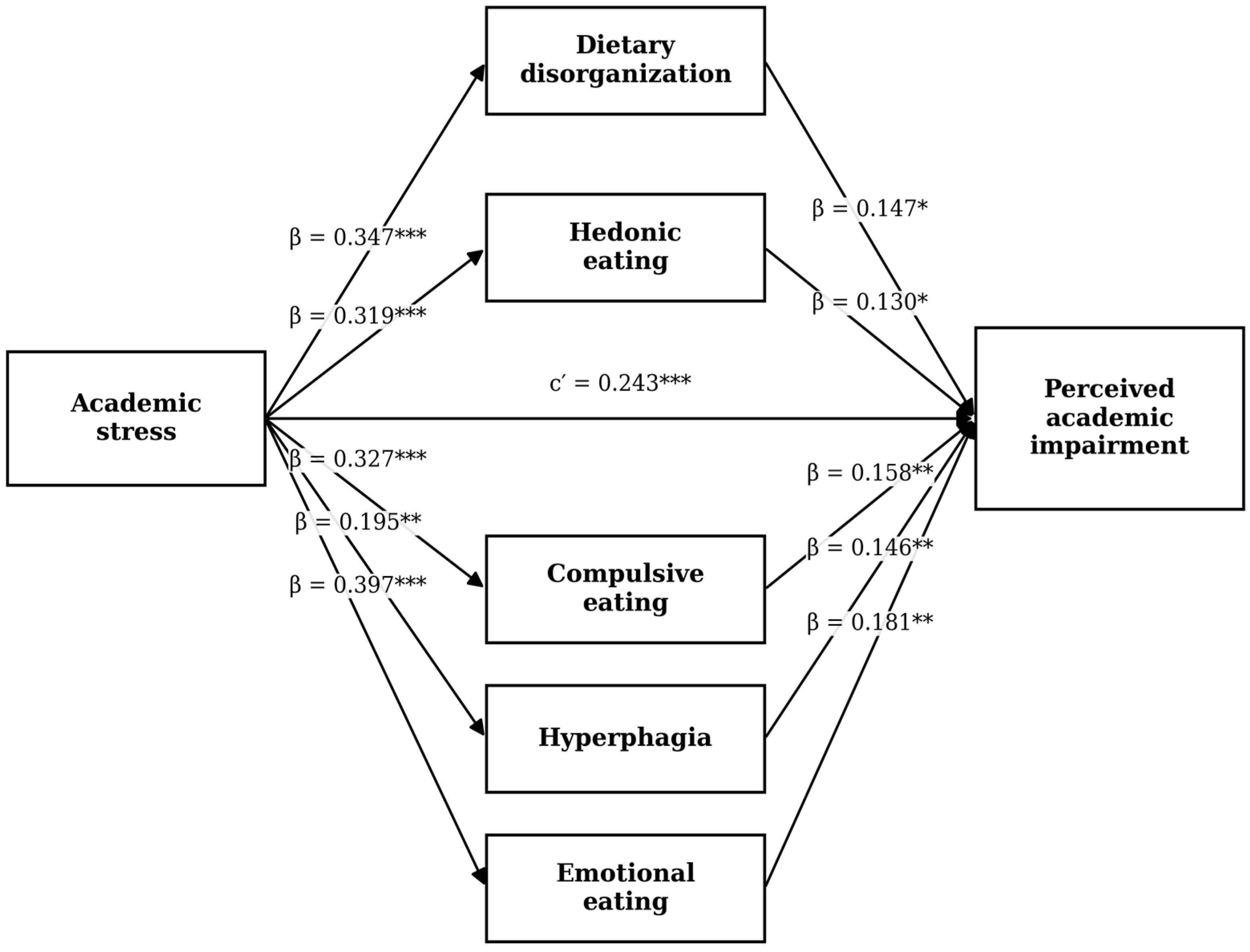
A parallel multiple-mediator model was estimated to examine indirect pathways linking academic stress to perceived academic impairment through the five eating behavior phenotypes (Figure 1). The model was adjusted for sex, age, family income, academic semester, and academic program. Academic program was dummy-coded, with Medicine as the reference category.
Academic stress was positively associated with all five mediators: dietary disorganization, hedonic eating, compulsive eating, hyperphagia, and emotional eating (Table 5). Each eating behavior phenotype was also positively associated with perceived academic impairment. The direct association between academic stress and perceived academic impairment remained significant after including the five mediators, reflecting a pattern of statistically significant direct and indirect associations. The final outcome model explained 46.3% of the variance in perceived academic impairment (R2 = 0.463, F(12, 212) = 15.22, p < 0.001).
Table 5.
Adjusted parallel mediation model for perceived academic impairment.
The total effect of academic stress on perceived academic impairment was significant (B = 0.237, SE = 0.028, t = 8.52, p < 0.001, 95% CI [0.182, 0.292], β = 0.488). After the mediators were included, the direct effect remained significant (B = 0.118, SE = 0.029, t = 4.03, p < 0.001, 95% CI [0.060, 0.176], β = 0.243).
The total indirect effect through the five eating behavior phenotypes was statistically significant (B = 0.119, BootSE = 0.021, 95% bootstrap CI [0.081, 0.161] (completely standardized effect = 0.244, 95% CI [0.170, 0.323])). All five specific indirect pathways were also statistically significant, as none of the bootstrap confidence intervals included zero (Table 6). Pairwise contrasts among the specific indirect effects were not significant, indicating that no single indirect pathway was statistically stronger than the others. A post hoc sensitivity analysis indicated that, with N = 225, the study could detect completely standardized indirect effects of approximately 0.045 or larger with about 80% power. Exploratory, effect-size-based power estimates for the specific pathways—which should not be interpreted as independent evidence of the reliability of the observed associations—were high for the total indirect effect (>0.99) and adequate for the emotional-eating pathway (0.84) but fell below 0.80 for the remaining pathways (dietary disorganization = 0.76, compulsive eating = 0.74, hyperphagia = 0.61, hedonic eating = 0.58).
Table 6.
Total and specific indirect effects of academic stress on perceived academic impairment through eating behavior phenotypes.
Figure 1.
Parallel multiple-mediator model of the association between academic stress and perceived academic impairment through five eating behavior phenotypes. (Note. Values on the paths are completely standardized regression coefficients (β). Paths a link academic stress to each mediator; paths b link each mediator to perceived academic impairment; c′ is the direct effect of academic stress on perceived academic impairment. The model was adjusted for sex, age, family income, academic semester, and academic program (dummy-coded, with Medicine as the reference category); covariate paths are omitted for clarity and are reported in Supplementary Table S1. The total effect of academic stress on perceived academic impairment was β = 0.488, p < 0.001, and the direct effect was c′ = 0.243, p < 0.001. The completely standardized total indirect effect was 0.244, with a 95% bootstrap confidence interval of [0.170, 0.323] obtained from 10,000 percentile bootstrap resamples; the corresponding unstandardized indirect effects and their bootstrap confidence intervals are reported in Table 6. R2 for perceived academic impairment = 0.463. N = 225. Because the design was cross-sectional, the coefficients represent indirect associations and should not be interpreted as evidence of causal mediation. * p < 0.05, ** p < 0.01, *** p < 0.001.)
4. Discussion
4.1. Academic Stress, Eating Behavior Phenotypes, and Perceived Academic Impairment
The present study examined the association between academic stress and perceived academic impairment among health sciences students, considering five eating behavior phenotypes as parallel indirect pathways. The main finding was that academic stress was positively associated with dietary disorganization, hedonic eating, compulsive eating, hyperphagia, and emotional eating. Each of these eating behavior phenotypes was also positively associated with perceived academic impairment. The total indirect effect through the five eating behavior phenotypes was statistically significant, and all five specific indirect pathways were significant. The direct association between academic stress and perceived academic impairment remained significant after including the mediators, reflecting a pattern of statistically significant direct and indirect associations. Given the cross-sectional design, these findings should be interpreted as indirect associations rather than evidence of temporal or causal mediation.
The positive associations between academic stress and the five eating behavior phenotypes are consistent with previous evidence suggesting that university students under high academic demands may be more likely to report dysregulated eating patterns, including emotional eating, irregular meal patterns, and reward-related food intake (Choi, 2020; Dalton, 2024; Chai et al., 2024; Shatwan & Alzharani, 2024). Health sciences students may be particularly vulnerable because their academic routines often involve demanding curricula, time pressure, frequent evaluations, clinical responsibilities, and limited opportunities for regular meals or rest. In this context, eating behaviors may become closely linked to stress regulation, daily organization, and coping responses.
Several theoretical models have proposed that stress-related eating may be influenced by neuroendocrine and reward-related processes, including activation of the hypothalamic–pituitary–adrenal axis, cortisol regulation, and increased sensitivity to highly palatable foods (Dallman, 2010; Tomiyama et al., 2011; Sinha & Jastreboff, 2013). However, the present study did not measure cortisol, metabolic biomarkers, or neuroendocrine activity. Therefore, these mechanisms should be understood as theoretical background rather than pathways directly tested in this sample. From a behavioral perspective, eating may also function as an emotion-regulation strategy, particularly when students experience academic overload, uncertainty, or negative affective states (Macht, 2008; Dalton, 2024).
The finding that all five eating behavior phenotypes were positively associated with perceived academic impairment suggests that academic functioning may be linked not only to emotional eating but also to broader patterns of dysregulated eating. Dietary disorganization may reflect irregular meal schedules, meal skipping, or poor planning around academic routines, which could interfere with concentration, energy regulation, and perceived study effectiveness. Hedonic eating may reflect reward-driven intake in response to stress or environmental cues. Compulsive eating and hyperphagia may indicate more disinhibited patterns of intake, whereas emotional eating may reflect the use of food as a coping response to distress. Together, these findings support the relevance of examining eating behavior as a multidimensional construct rather than as a single global indicator.
The positive association between eating behavior phenotypes and perceived academic impairment is consistent with evidence linking dietary quality, eating patterns, and cognitive or academic functioning (Chávez-Hernández, 2023; Harris et al., 2024; Phelan et al., 2025). Irregular eating, poor dietary quality, and stress-related eating may be associated with lower perceived academic functioning through mechanisms involving attention, self-regulation, fatigue, or psychological distress. Nevertheless, the outcome in the present study was not objective academic achievement, such as grade point average, but a recoded self-report measure of perceived academic functioning. Therefore, the findings should be interpreted specifically in relation to perceived academic impairment rather than objective academic performance.
The persistence of a significant direct association between academic stress and perceived academic impairment indicates that eating behavior phenotypes explained only part of this association. Other factors not assessed in the present study may also contribute to poorer perceived academic functioning among stressed students. These may include sleep disturbance, burnout, anxiety, depressive symptoms, reduced physical activity, chronotype, cognitive interference, socioeconomic stress, social support, and personality-related factors. Consistently with this possibility, dispositional traits such as negative affectivity and social inhibition—the two components of Type D personality—have been shown to relate independently to maladaptive eating behaviors and adiposity (Atan et al., 2025) and may therefore represent plausible unmeasured variables that partly account for the observed stress–eating associations. Future research should examine these variables within more comprehensive longitudinal models to clarify the relative contribution of behavioral, psychological, and contextual mechanisms.
4.2. Sex Differences in Emotional Eating and Dietary Disorganization
The sex-difference analyses showed that women reported significantly higher dietary disorganization and emotional eating than men after Bonferroni correction. These findings are consistent with previous studies suggesting that female university students may be more likely to report emotional eating or stress-related eating patterns (Epel et al., 2001; Tomiyama et al., 2011; Dalton, 2024). However, sex-related interpretations should be made cautiously because eating behavior is influenced by a combination of biological, psychological, social, and cultural factors. In the present study, men showed higher compulsive eating and hyperphagia at the unadjusted level, but these differences did not remain significant after Bonferroni correction. Therefore, these patterns should be interpreted as exploratory rather than definitive. No significant sex difference was observed for hedonic eating.
4.3. Practical Implications, Strengths, and Future Directions
From an institutional perspective, the findings suggest that student well-being initiatives in health sciences programs may benefit from considering the interconnections among academic stress, eating behavior, and perceived academic functioning. However, because this was a cross-sectional study, the results should not be interpreted as evidence that changing eating behaviors would necessarily improve academic outcomes. Rather, they support the need for future longitudinal and intervention studies to test whether integrated programs addressing stress management, emotional regulation, sleep, nutrition, and academic support can improve student well-being and academic functioning over time.
This study has several strengths. First, it focused on health sciences students in a Mexican public university context, a population that remains underrepresented in the international literature on academic stress and eating behavior. Second, it used a multidimensional measure of eating behavior and examined five specific phenotypes as parallel mediators. Third, the mediation model was adjusted for sex, age, family income, academic semester, and academic program. Fourth, the assumptions underlying the regression models were evaluated, and common method variance was assessed using Harman’s single-factor test.
4.4. Limitations
Several limitations should be acknowledged. First, the cross-sectional design precludes conclusions about temporal ordering or causality. Although the statistical model identified significant indirect pathways, these findings should not be interpreted as evidence that academic stress causes changes in eating behavior or that eating behavior causes perceived academic impairment. Longitudinal and experimental designs are needed to examine temporal and causal relationships.
Second, all variables were measured using self-report instruments, which may introduce recall bias, social desirability bias, and shared method variance. Although Harman’s single-factor test indicated that the first unrotated factor accounted for 28.42% of the total variance, this diagnostic indicates only that a single unrotated factor did not dominate the covariance structure and does not rule out common method bias, because all variables were measured through the same self-report survey at the same time.
Third, the academic outcome was based on a recoded self-report measure of perceived academic functioning rather than objective academic indicators such as grade point average, course grades, examination scores, or academic records. Therefore, the findings should be interpreted specifically in terms of perceived academic impairment and not as evidence of objective academic performance. Relatedly, the analytical academic-stress score combined the stressor and symptom/reaction dimensions of the SISCO into a single index. Although both dimensions were internally consistent (α = 0.84 and α = 0.86) and substantially correlated (r = 0.555), the dimensionality of this modified composite was not formally examined through confirmatory factor analysis; the combined score should therefore be interpreted as a theoretically grounded operationalization of academic stress rather than as a psychometrically validated unidimensional scale.
Fourth, because no clinical cut-off points, diagnostic criteria, or external benchmarks were used, the magnitude of the observed associations should not be interpreted as clinically meaningful. The results indicate statistically significant associations and indirect pathways, but they do not establish clinical severity or clinical relevance.
Fifth, the study used a non-probabilistic convenience sample from a single public university in southeastern Mexico. Although the sample size was estimated using the available source population, the sampling strategy limits the generalizability of the findings to other institutions, regions, academic programs, or student populations. In addition, because the survey invitation was distributed through institutional and classroom-based channels, the exact number of eligible students who actually received the Microsoft Forms link could not be determined; therefore, an exact response rate could not be calculated. In addition, no a priori power analysis was conducted; a post hoc sensitivity analysis indicated that the study was adequately powered to detect the total indirect effect, whereas the smaller specific indirect pathways were likely underpowered, and these exploratory pathway-specific estimates should therefore be interpreted with caution.
Sixth, several potentially relevant covariates were not assessed, including sleep quality, chronotype, physical activity, mental health symptoms, burnout, social support, body mass index, dietary intake, and substance use. These factors may contribute to both eating behavior phenotypes and perceived academic impairment. Finally, the study did not include physiological markers of stress, such as cortisol or other neuroendocrine indicators; therefore, any discussion of stress-related biological mechanisms should be interpreted as theoretical background rather than mechanisms directly tested in this study.
5. Conclusions
This study found that academic stress was positively associated with perceived academic impairment among health sciences students, and that five eating behavior phenotypes showed significant indirect pathways in this association. Higher academic stress was associated with greater dietary disorganization, hedonic eating, compulsive eating, hyperphagia, and emotional eating, which were also associated with greater perceived academic impairment according to the recoded RAU total score. The total indirect effect was statistically significant, and the direct association between academic stress and perceived academic impairment remained significant, reflecting a pattern of statistically significant direct and indirect associations.
These findings highlight the relevance of considering eating behavior as a multidimensional component of student well-being in health sciences education. However, given the cross-sectional design, the results should be interpreted as indirect associations rather than evidence of causal or temporal mediation. Future longitudinal and intervention studies are needed to determine whether integrated strategies addressing academic stress, emotional regulation, nutrition, sleep, and psychological support can contribute to improved student well-being and academic functioning over time.
Universities training future healthcare professionals should recognize that academic functioning is closely connected to psychological and behavioral health. Accordingly, student support programs may benefit from interdisciplinary approaches that address both academic demands and modifiable well-being-related behaviors.
Supplementary Materials
The following supporting information can be downloaded at: https://www.mdpi.com/article/10.3390/psycholint8030047/s1, Supplementary Table S1: Full regression coefficients, including covariates and R2 for the six equations; Supplementary Table S2: Confirmatory factor analysis of the recoded RAU.
Author Contributions
Conceptualization, B.P.-Z. and N.Y.T.-S.; methodology, B.P.-Z.; software, Y.A.A.-N.; validation, N.Y.T.-S. and B.M.-R.; formal analysis, B.P.-Z. and Y.A.A.-N.; investigation, Y.A.A.-N. and N.Y.T.-S.; resources, A.L.C.-B.; data curation, Y.A.A.-N. and B.P.-Z.; writing—original draft preparation, B.P.-Z., Y.A.A.-N. and N.Y.T.-S.; writing—review and editing, B.M.-R. and A.L.C.-B.; visualization, B.P.-Z.; supervision, B.M.-R.; project administration, B.M.-R.; funding acquisition, A.L.C.-B. All authors have read and agreed to the published version of the manuscript.
Funding
This research received no external funding.
Institutional Review Board Statement
The study was conducted in accordance with the Declaration of Helsinki and approved by the Comité de Ética en Investigación de la División de Ciencias de la Salud of Universidad Autónoma del Estado de Quintana Roo (committee registration number: CONBIOETICA-23-CEI-001-20231115; protocol code: CEI/PI-21/24; date of approval: 10 June 2024).
Informed Consent Statement
Informed consent was obtained electronically from all participants before completing the questionnaire.
Data Availability Statement
The data supporting the findings of this study are available from the corresponding author upon reasonable request, subject to ethical and privacy restrictions.
Acknowledgments
The authors thank the students who participated in this study and the Division of Health Sciences at Universidad Autónoma del Estado de Quintana Roo for their support during data collection.
Conflicts of Interest
The authors declare no conflicts of interest.
Abbreviations
The following abbreviations are used in this manuscript:
| EFCA | Eating Behavior Phenotypes Scale |
| HPA | Hypothalamic–pituitary–adrenal |
| MXN | Mexican peso |
| SISCO | Academic Stress Inventory |
| UQROO | Universidad Autónoma del Estado de Quintana Roo |
References
- Adam, T. C., & Epel, E. S. (2007). Stress, eating and the reward system. Physiology & Behavior, 91(4), 449–458. [Google Scholar] [CrossRef] [Scilit] [PubMed]
- Al-Dalaeen, A., Batarseh, N., Al-Bashabsheh, Z., Aljeradat, B., Batarseh, D., & Karablieh, A. (2024). Stress levels and eating behavior among university students in Jordan: A cross-sectional study. Journal of Education and Health Promotion, 13, 285. [Google Scholar] [CrossRef] [Scilit] [PubMed]
- Anger, V. E., Formoso, J., & Katz, M. T. (2022). Scale of Eating Behavior Phenotypes (EFCA), confirmatory factor analysis and psychometric properties. Nutrición Hospitalaria, 39(2), 405–413. [Google Scholar] [CrossRef] [Scilit] [PubMed]
- Atan, R. M., Sahin Demirci, K., Tari Selcuk, K., & Arslan, S. (2025). Negative affectivity and social inhibition as independent predictors of eating behaviors and adiposity: A study on type D personality traits. Personality and Individual Differences, 247, 113423. [Google Scholar] [CrossRef] [Scilit]
- Barraza-Macías, A. (2007). Propiedades psicométricas del Inventario SISCO del estrés académico. Revista PsicologiaCientifica.com, 9(13). Available online: https://psicologiacientifica.com/inventario-sisco-estres-academico (accessed on 22 July 2026).
- Chai, Y., Fu, G., Liu, Y., Song, Q., Xue, C., & Luo, S. (2024). The relationship between stress, anxiety and eating behavior among Chinese students: A cross-sectional study. Frontiers in Public Health, 12, 1466700. [Google Scholar] [CrossRef] [Scilit] [PubMed]
- Chávez-Hernández, M. E. (2023). Correlation of executive functions, academic achievement, eating behavior and eating habits in university students of Mexico City. Frontiers in Education, 8, 1268302. [Google Scholar] [CrossRef] [Scilit]
- Choi, J. (2020). Impact of stress levels on eating behaviors among college students. Nutrients, 12(5), 1241. [Google Scholar] [CrossRef] [Scilit] [PubMed]
- Dallman, M. F. (2010). Stress-induced obesity and the emotional nervous system. Trends in Endocrinology & Metabolism, 21(3), 159–165. [Google Scholar] [CrossRef] [Scilit] [PubMed]
- Dalton, E. D. (2024). Emotional eating in college students: Associations with coping and healthy eating motivators and barriers. International Journal of Behavioral Medicine, 31(4), 563–572. [Google Scholar] [CrossRef] [Scilit] [PubMed]
- Dyrbye, L. N., West, C. P., Satele, D., Boone, S., Tan, L., Sloan, J., & Shanafelt, T. D. (2014). Burnout among U.S. medical students, residents, and early career physicians relative to the general U.S. population. Academic Medicine, 89(3), 443–451. [Google Scholar] [CrossRef] [Scilit] [PubMed]
- Epel, E., Lapidus, R., McEwen, B., & Brownell, K. (2001). Stress may add bite to appetite in women: A laboratory study of stress-induced cortisol and eating behavior. Psychoneuroendocrinology, 26(1), 37–49. [Google Scholar] [CrossRef] [Scilit] [PubMed]
- Groesz, L. M., McCoy, S., Carl, J., Saslow, L., Stewart, J., Adler, N., Laraia, B., & Epel, E. (2012). What is eating you? Stress and the drive to eat. Appetite, 58(2), 717–721. [Google Scholar] [CrossRef] [Scilit] [PubMed]
- Guízar Sánchez, D. P., Sampieri Cabrera, R., Inclán Rubio, V., & Muñoz Comonfort, A. (2023). Perceived academic stress in Mexican medical students: The role of sex, emotional distress, burnout, academic-social support, current abuse experiences, and coping strategies. Salud Mental, 46(3), 155–163. [Google Scholar] [CrossRef] [Scilit]
- Guzmán-Castillo, A., Bustos, C., Zavala, W., & Castillo-Navarrete, J. L. (2022). Inventario SISCO del estrés académico: Revisión de sus propiedades psicométricas en estudiantes universitarios. Terapia Psicológica, 40(2), 197–211. [Google Scholar] [CrossRef] [Scilit]
- Harris, C. L., Chapman, H., & Groves, N. (2024). Eating competence is related to executive function skills in college students. Eating Behaviors, 55, 101922. [Google Scholar] [CrossRef] [Scilit] [PubMed]
- Hayes, A. F. (2022). Introduction to mediation, moderation, and conditional process analysis: A regression-based approach (3rd ed.). The Guilford Press. [Google Scholar]
- Ishak, W., Nikravesh, R., Lederer, S., Perry, R., Ogunyemi, D., & Bernstein, C. (2013). Burnout in medical students: A systematic review. The Clinical Teacher, 10(4), 242–245. [Google Scholar] [CrossRef] [Scilit] [PubMed]
- Lupien, S. J., Maheu, F., Tu, M., Fiocco, A., & Schramek, T. E. (2007). The effects of stress and stress hormones on human cognition: Implications for the field of brain and cognition. Brain and Cognition, 65(3), 209–237. [Google Scholar] [CrossRef] [Scilit] [PubMed]
- Macht, M. (2008). How emotions affect eating: A five-way model. Appetite, 50(1), 1–11. [Google Scholar] [CrossRef] [Scilit] [PubMed]
- Monserrat-Hernández, M., Checa-Olmos, J. C., Arjona-Garrido, Á., López-Liria, R., & Rocamora-Pérez, P. (2023). Academic stress in university students: The role of physical exercise and nutrition. Healthcare, 11(17), 2401. [Google Scholar] [CrossRef] [Scilit] [PubMed]
- Navarro-Sandoval, K. G., Pacheco-Pérez, L. A., Ruiz-González, K. J., Manríquez-Betanzos, J. C., García-Puga, J. A., & Quintero-Vargas, J. T. J. (2024). Prevalencia de ansiedad, estrés y hábitos alimenticios en estudiantes universitarios de Ciencias de la Salud en el Noroeste de México. In Sociedad, salud y educación en grupos vulnerables (pp. 275–304). Astra Ediciones. [Google Scholar] [CrossRef] [Scilit]
- Phelan, J. M., Rosenkranz, R. R., Logan, C., Haub, M. D., Mailey, E. L., Ezzati, A., & Rosenkranz, S. K. (2025). The association of overall dietary quality on stress, anxiety, depression, and academic performance in college students: A systematic review. Journal of American College Health, 73(3), 977–988. [Google Scholar] [CrossRef] [Scilit] [PubMed]
- Podsakoff, P. M., MacKenzie, S. B., Lee, J.-Y., & Podsakoff, N. P. (2003). Common method biases in behavioral research: A critical review of the literature and recommended remedies. Journal of Applied Psychology, 88(5), 879–903. [Google Scholar] [CrossRef] [Scilit] [PubMed]
- Preciado-Serrano, M. de L., Ángel-González, M., Colunga-Rodríguez, C., Vázquez-Colunga, J. C., Esparza-Zamora, M. A., Vázquez-Juárez, C. L., & Obando-Changuán, M. P. (2021). Construcción y validación de la Escala RAU de Rendimiento Académico Universitario. Revista Iberoamericana de Diagnóstico y Evaluación–e Avaliação Psicológica, 60(3), 5–14. [Google Scholar] [CrossRef] [Scilit]
- Schoemann, A. M., Boulton, A. J., & Short, S. D. (2017). Determining power and sample size for simple and complex mediation models. Social Psychological and Personality Science, 8(4), 379–386. [Google Scholar] [CrossRef] [Scilit]
- Schwabe, L., & Wolf, O. T. (2013). Stress and multiple memory systems: From “thinking” to “doing”. Trends in Cognitive Sciences, 17(2), 60–68. [Google Scholar] [CrossRef] [Scilit] [PubMed]
- Shatwan, I. M., & Alzharani, M. A. (2024). Association between perceived stress, emotional eating, and adherence to healthy eating patterns among Saudi college students: A cross-sectional study. Journal of Health, Population and Nutrition, 43, 144. [Google Scholar] [CrossRef] [Scilit] [PubMed]
- Sinha, R., & Jastreboff, A. M. (2013). Stress as a common risk factor for obesity and addiction. Biological Psychiatry, 73(9), 827–835. [Google Scholar] [CrossRef] [Scilit] [PubMed]
- Tomiyama, A. J., Dallman, M. F., & Epel, E. S. (2011). Comfort food is comforting to those most stressed: Evidence of the chronic stress response network in high-stress women. Psychoneuroendocrinology, 36(10), 1513–1519. [Google Scholar] [CrossRef] [Scilit] [PubMed]
- Vázquez-Vázquez, V. M., Bosques-Brugada, L. E., Guzmán-Saldaña, R. M. E., Lerma-Talamantes, A., & Franco-Paredes, K. (2022). Modelo empírico de la alimentación emocional en estudiantes universitarios mexicanos. Psicumex, 12, 1–23. [Google Scholar] [CrossRef] [Scilit]
- Weurlander, M., Lönn, A., Seeberger, A., Hult, H., Thornberg, R., & Wernerson, A. (2019). Emotional challenges of medical students generate feelings of uncertainty. Medical Education, 53(10), 1037–1048. [Google Scholar] [CrossRef] [Scilit] [PubMed]

Disclaimer/Publisher’s Note: The statements, opinions and data contained in all publications are solely those of the individual author(s) and contributor(s) and not of MDPI and/or the editor(s). MDPI and/or the editor(s) disclaim responsibility for any injury to people or property resulting from any ideas, methods, instructions or products referred to in the content. |
© 2026 by the authors. Licensee MDPI, Basel, Switzerland. This article is an open access article distributed under the terms and conditions of the Creative Commons Attribution (CC BY) license.