


Abstract
Background and Objectives: The nomenclature of calcium pyrophosphate deposition (CPPD) disease remains confusing, with different labels used interchangeably to describe the disease. Although ‘CPPD disease’ is the term that has been recommended by EULAR since 2011, ‘pseudogout’ remains the most frequently used label in the medical literature. This study aimed to investigate how the labels ‘CPPD disease’ versus ‘pseudogout’ affect the public’s perceptions of the illness. Methods: In this randomized controlled single-blind study, 200 members of the public watched a 2 min video describing a form of arthritis labeled as either ‘CPPD disease’ or ‘pseudogout’. Participants then completed a questionnaire assessing their perceptions of the illness using the Brief Illness Perception Questionnaire (BIPQ), with additional questions about their perceived seriousness of the illness and embarrassment associated with it, and beliefs about causes and management strategies. The primary outcome was the level of embarrassment associated with the illness. Results: Overall, embarrassment scores were low with no significant difference between the ‘CPPD disease’ and ‘pseudogout’ groups. Participants in both groups viewed the illness as being serious. There were no differences between the groups in their responses to the BIPQ, nor in their beliefs on the likely causes and management strategies. Even after a video intervention, participants’ understanding of the illness remained low. Conclusions: The labels ‘CPPD disease’ and ‘pseudogout’ do not differentially influence perceptions about the illness among members of the public. This could be due to the lack of knowledge about CPPD disease, highlighting the need to increase public awareness of this important condition.
1. Introduction
Calcium pyrophosphate deposition (CPPD) disease is a painful inflammatory arthritis caused by the deposition of calcium pyrophosphate crystals in joints and periarticular tissues. CPPD disease is one of the most common inflammatory arthropathies, with prevalence estimates of 4% to 7% in Europe and the United States [1,2]. CPPD disease is more common in the elderly and as the population ages, it is likely to become a condition of increasing public health importance [3].
Historically, little research has been conducted into CPPD disease due to a lack of disease definitions and research tools. In the past five years, however, significant progress has been made, most notably with the publication of the ACR/EULAR classification criteria for CPPD disease and imaging definitions for CPPD [4,5]. This improvement in research infrastructure has led to an increasing number of drug trials in CPPD disease, expanding the therapeutic landscape for this condition [6]. Despite these advances, the nomenclature of CPPD remains confusing, with different labels used interchangeably to describe the disease [7]. Although ‘CPPD disease’ is the term that has been recommended by the European Alliance of Associations for Rheumatology (EULAR) since 2011, the term ‘pseudogout’ (coined by McCarty et al. in 1962 to describe acute episodes of arthritis resembling gout but associated with crystals other than monosodium urate) has remained popular amongst clinicians [8,9,10]. A recent systematic literature review analyzing 886 articles published between 2000 and 2022 found that the most frequent label used to designate the condition remains ‘pseudogout’, appearing in nearly half of the articles [11].
Both EULAR and experts in crystal arthritis have expressed concern regarding the ongoing use of the term ‘pseudogout’ because it does not specify the causative crystals in CPPD and suggests that calcium pyrophosphate crystals are less important than monosodium urate crystals [8,12,13]. Moreover, the term ‘pseudogout’ may cause confusion among patients and could potentially be misinterpreted as gout, an illness that is associated with inaccurate lay views—often considered an embarrassing, self-inflicted illness caused by over-indulgence in food and alcohol [14,15]. A qualitative study on the lived experience of CPPD conducted by the OMERACT CPPD working group in 2021 found that several patients expressed dislike at the connection of the term pseudogout with gout and were embarrassed by the negative connotations attached to the term gout [16].
Previous research in gout has shown that disease labels can have a significant impact on perceptions about the illness. Petrie et al. demonstrated that by renaming gout ‘urate-crystal arthritis’, the illness was viewed by the public as a more chronic and serious illness which required long-term medication, while the gout-labeled illness was seen as more socially embarrassing and attributed to poor diet and over-consumption of alcohol [17]. Nomenclature changes have also been proposed in other medical conditions to reduce stigma associated with existing disease labels. In 2015, ‘primary biliary cirrhosis’ was renamed ‘primary biliary cholangitis’, largely driven by patients’ concern regarding the association of the term ‘cirrhosis’ with alcoholism and poor prognosis [18]. Similarly, a nomenclature change has also been advocated in schizophrenia due to the stigmatizing effect of the label within society and concerns around how this hinders treatment and recovery [19].
This study aimed to investigate how the different labels, ‘CPPD disease’ versus ‘pseudogout’, affect the public’s perceptions of the illness. We hypothesized that the pseudogout-labeled illness would be considered a more socially embarrassing illness and attributed to poor diet due to the similarities of this label with gout.
2. Materials and Methods
2.1. Study Design and Participants
200 participants were recruited into this single-blind randomized controlled trial from May 2025 to August 2025 by advertising for a study about “perceptions of arthritis” on a job search website and posters placed on public noticeboards (e.g., university campus, supermarkets) in Aotearoa/New Zealand. Participants were not aware that the study was examining disease labels in CPPD disease. To meet inclusion criteria, participants had to be at least 18 years old and able to read and understand English. Health professionals or students enrolled in a health-related course or degree were excluded. Participants had the option of completing the study in-person or online via Zoom call (Zoom Workplace version 7.0.6). The trial was approved by the Auckland Health Research Ethics Committee (approval no. AH29102) and registered with the Australian New Zealand Clinical Trials Registry (ACTRN12625000135415p). Written informed consent was obtained from all participants.
2.2. Randomization and Masking
The randomization schedule was created by a statistician (GDG) using a pseudorandom number generator within Microsoft Excel (version 16.112.3). Six blocks of variable size with 10–30 participants each were created. Within each block, participants registered into the study were sorted into 2 groups: the random numbers in the lower half of the block were allocated to watch the video describing a form of arthritis labeled as ‘CPPD disease’, and the random numbers in the upper half of the block were allocated to watch the video describing a form of arthritis labeled as ‘pseudogout’. Randomization was performed on registered individuals to enable the video intervention to be automatically delivered to eligible participants and therefore the two intervention groups differed in sample size. The randomization schedule was not available to the researcher who carried out the participant surveys (VT).
2.3. Procedures
Participants were randomly assigned to watch a 2 min video describing a form of arthritis labeled as either ‘CPPD disease’ or ‘pseudogout’. The videos were prepared by the study researchers (VT, ND) and provided an overview of the symptoms, epidemiology, diagnosis and treatment for CPPD disease in lay language. The content of the videos was informed by existing patient information sheets on CPPD disease, including the one available on the American College of Rheumatology website. The videos are available to view using the following links: https://vimeo.com/1067884941/5945546f36?fl=ip&fe=ec (Pseudogout version, accessed on 15 August 2026); https://vimeo.com/1067884104/0d2eb8842e?fl=ip&fe=ec (CPPD disease version, accessed on 15 August 2026)). After watching the video, participants completed a questionnaire assessing their perceptions of the illness. Previous research by our group has demonstrated that a 2 min video intervention can substantially influence beliefs about the causes of an illness and its management [20]. The content of the videos and questionnaires was identical except for the disease label. Participants watched the video and completed the questionnaire in the presence of a study researcher (VT) who ensured that the video had been watched in full and that all questionnaire items were completed.
2.3.1. Demographic Data
Participant demographic data were collected, including age, gender, ethnicity, and occupation. Prioritized ethnicity was self-reported using the standard ethnicity question from the New Zealand census [21].
2.3.2. Illness Perceptions
Illness perceptions were assessed using the Brief Illness Perception Questionnaire (BIPQ) [22], which assesses key illness perception domains. The specific items in the BIPQ included consequences (how much the illness would affect a person’s life), timeline (how long it would continue), personal control (how much control a person would have over the illness), treatment control (how much medication would help), identity (how severe symptoms would be), concern (how concerned a person would be about the illness), emotions (how much the illness would affect a person emotionally), and understanding (how well a person understands the illness). Questions were asked in a hypothetical manner: “Please imagine you have been diagnosed with CPPD disease/pseudogout. Please answer the following questions on how you think the illness would influence your life”. Each BIPQ item was measured on an 11-point Likert scale (from 0 to 10), with higher scores indicating stronger endorsement of that item. Additional questions on the perceived seriousness of the illness (“How serious do you think CPPD disease/pseudogout is as an illness?”) and embarrassment associated with a diagnosis (“How embarrassed would you feel if you were diagnosed with CPPD disease/pseudogout?”) were included and assessed on an 11-point Likert scale (from 0 = “Not serious at all”/“Not at all embarrassed” to 10 = “Extremely serious”/“Extremely embarrassed”). Participants were also asked to rate the health of someone diagnosed with the illness (compared to a person in excellent health) on a 7-point scale from “terrible” to “excellent”.
2.3.3. Causal Beliefs
Participants were asked to list the three most important causes of the illness, and their answers were grouped into aging, genetics, overuse or injury to the joints, diet, lifestyle, metabolic imbalance and other. The responses were grouped by one researcher (VT) with any unclear responses discussed with a second researcher (ND). These determinations were made with the researchers blinded to study group allocation. Where participants indicated “calcium deposition” as the most important causal factor for CPPD disease/pseudogout, this was replaced with the second most important causal factor listed. Participants were also asked to rate how much they agree that the following factors were important in causing the illness (“If you or someone you know was diagnosed with CPPD disease/pseudogout, what do you think are the likely causes of this condition? Please rate the following causes below on how much you believe each factor is likely to be important.”): stress or worry; hereditary; diet; aging; alcohol use; environmental pollution; chance or bad luck; a germ or virus; the person’s own behavior, modified from the Illness Perception Questionnaire—Revised and rated on a 5-point scale from “strongly disagree” to “strongly agree” [23].
2.3.4. Medication Beliefs
Participants were asked to rate their perceived need to take long-term medications, their motivation to take long-term medications and their concern regarding long-term medication use if they were diagnosed with CPPD disease/pseudogout. These were rated on an 11-point scale (from 0 = “Wouldn’t need it at all”/“Not at all motivated”/“Not at all concerned” to 10 = “It would be absolutely essential”/“Extremely motivated”/“Extremely concerned”).
2.3.5. Strategies for Managing the Illness
Participants were asked their perceptions of the likely efficacy of the following strategies for managing the disease (“We are interested in your thoughts about how likely different types of behavior would help your condition if you were diagnosed with CPPD disease/pseudogout”): managing stress; regular exercise; stopping or reducing alcohol intake; taking long-term medication; changing to a healthier diet; using alternative medicine; losing weight. All items were rated on an 11-point scale from 0 = “wouldn’t help at all” to 10 = “very likely to help”.
The questions exploring medication beliefs and management strategies were devised by the health psychology experts in our research team and have been used in our prior studies exploring illness perceptions in gout [17,20,24].
2.4. Statistical Analysis
The sample size of 200 participants was based on a previous study of diseases labeled ‘urate crystal arthritis’ or ‘gout’ [17]. This sample size allowed the detection of at least a 2-point difference for each BIPQ item with >90% power at the 5% significance level for a two-tailed test. The primary outcome of the study was the response to the question assessing embarrassment (“How embarrassed would you feel if you were diagnosed with CPPD disease/pseudogout?”). In Petrie et al.’s study comparing the disease labels “urate crystal arthritis” or “gout” this question yielded a mean difference of 1.54 [95% CI 0.69–2.39] between the urate-crystal arthritis-labeled and gout-labeled groups [17]. Secondary outcomes included the responses to the remaining questionnaire items. Differences between the two groups were evaluated with t-tests for independent samples for the primary outcome (p < 0.05 was considered significant) and are presented as measures of effect and precision (95% CI) for the secondary outcomes. With large sample sizes, the use of parametric analysis methods has been validated for any distribution [25]. The homogeneity of variance assumption was examined for each test. To remove multiplicity concerns a p value is only presented for the primary outcome. Post hoc analysis examining the influence of age on embarrassment score (primary outcome) was conducted using 2-way analysis of variance (ANOVA) with the disease labels (‘CPPD disease’ vs. ‘pseudogout’) and age (<30 years vs. ≥30 years, based on the median age of the study participants) as the two main effects and their interaction. General linear regression modeling for the primary outcome (embarrassment score) on disease label (‘CPPD disease’ vs. ‘pseudogout’) and age as a continuous variable was also performed. Analyses were completed using SAS (v9.4, SAS Institute Inc., Cary, NC, USA).
3. Results
3.1. Participants
Between 19 May and 12 August 2025, 203 participants were screened for eligibility and inclusion in the study. Two participants were excluded as they were enrolled in a health-related degree and one participant was excluded as they were unable to complete the study via Zoom call or in person. A total of 200 participants met the inclusion criteria, consented to the study, and were randomized to watch a video on a form of arthritis labeled as ‘CPPD disease’ (n = 102) or ‘pseudogout’ (n = 98). All 200 participants watched the video and completed the questionnaire with a researcher (VT). The mean age of participants was 35 years (median 30; range 18–84) and 123 (61.5%) were female. A range of ethnicities were represented including European, Asian, Māori (Indigenous New Zealanders) and Pacific peoples. Participant demographic characteristics are summarized in Table 1.
Table 1.
Demographic characteristics in participants assigned to watch the video on ‘CPPD disease’ or the video on ‘pseudogout’ *.
3.2. Illness Perceptions
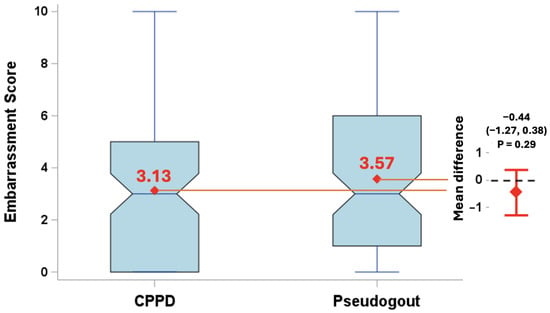
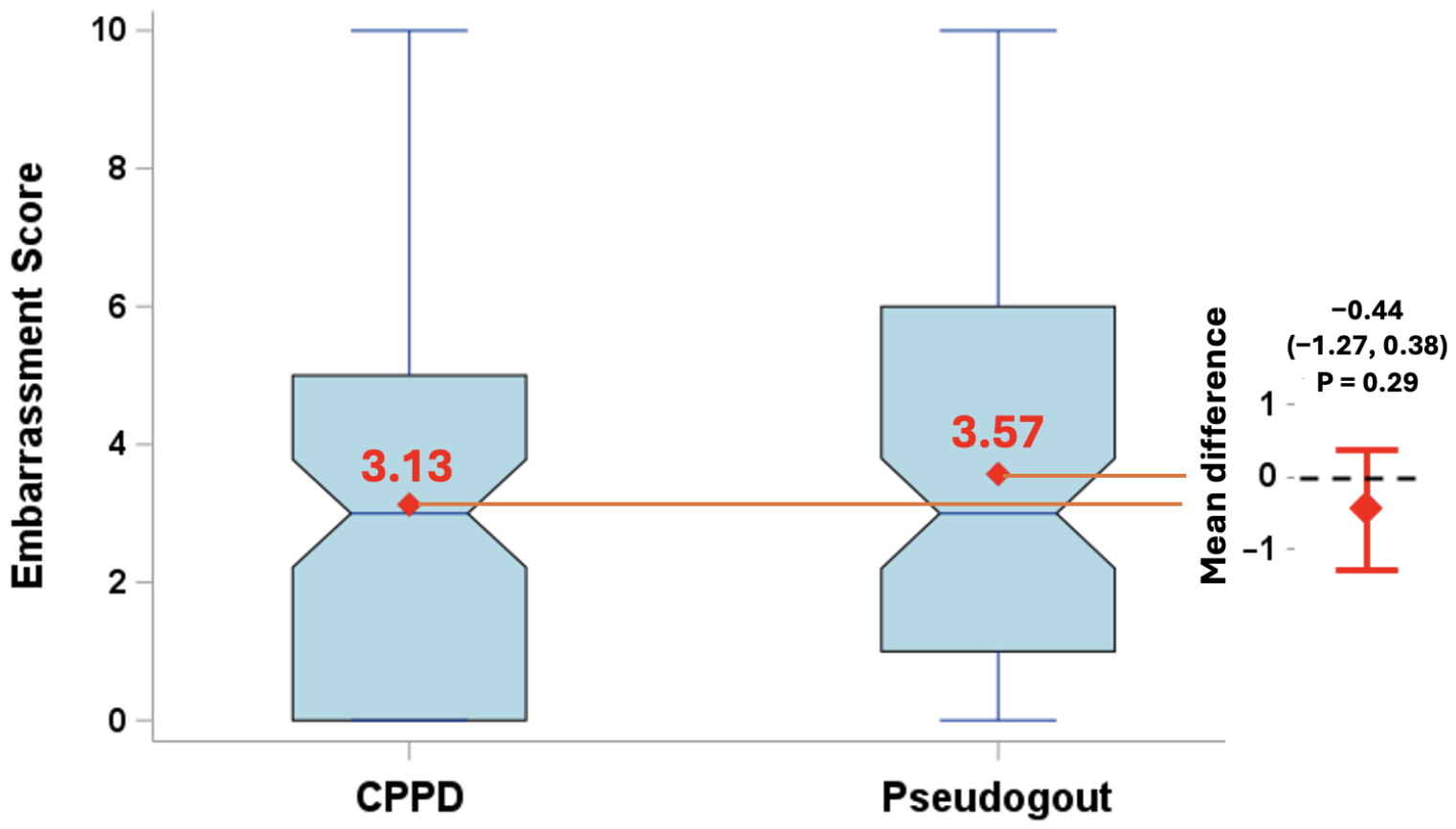
Overall, embarrassment scores were low with no significant difference between the ‘CPPD disease’ and ‘pseudogout’ groups (mean ± SD score 3.13 ± 2.83 versus 3.57 ± 3.10; mean difference [95% CI] −0.44 [−1.27, 0.38]; p = 0.29), as demonstrated in Figure 1. Participants also viewed the illness as being serious, with no significant difference between the ‘CPPD disease’ or ‘pseudogout’ groups (mean ± SD score 7.14 ± 1.31 versus 6.89 ± 1.27; mean difference [95% CI] 0.25 [−0.11, 0.61]). Similarly, there were no differences between the ‘CPPD disease’ or ‘pseudogout’ groups in their responses to the items on the BIPQ (Table 2). Despite the video intervention, participants’ understanding of the illness remained low (mean ± SD score 5.75 ± 1.92 vs. 5.87 ± 2.13 in the ‘CPPD disease’ and ‘pseudogout’ groups respectively). Participants in both the ‘CPPD disease’ and ‘pseudogout’ groups rated patients with the illness as having poor health, with no difference observed between the two groups (mean ± SD score 2.98 ± 0.83 versus 3.04 ± 0.85; mean difference [95% CI] −0.06 [−0.29, 0.17]).
Figure 1.
Perceived level of embarrassment associated with a diagnosis of the condition according to whether a participant watched the video on ‘CPPD disease’ or the video on ‘pseudogout’. Scale 0–10, with 0 indicating “not at all embarrassed” and 10 indicating “extremely embarrassed”.
Table 2.
Perceptions of illness using the BIPQ according to whether a participant watched the video on ‘CPPD disease’ or the video on ‘pseudogout’.
3.3. Causal Beliefs
When asked about the most important causes of the illness, participants commonly identified aging, genetics or diet as the most important causes. We observed a trend towards pseudogout causal beliefs for diet, and CPPD disease causal beliefs for overuse/injury to joints; however, the differences between the two groups were not statistically significant (Table 3). Participants were also asked to rate different causes of the illness. Those who watched the video on ‘CPPD disease’ believed that the behavior of an individual was a less important cause than those who watched the ‘pseudogout’ video (mean ± SD score 3.56 ± 1.11 versus 3.87 ± 0.87, mean difference [95% CI] −0.31 [−0.59, −0.03]); however, there were no differences between the two groups when rating stress, hereditary factors, diet, aging, alcohol use, pollution, chance, or a germ/virus as possible causes of the illness (Table 4).
Table 3.
Perception of the most likely cause of illness on the BIPQ according to whether a participant watched the video on ‘CPPD disease’ or the video on ‘pseudogout’. Values are the number (%) of participants who listed a cause as the most important cause of the illness.
Table 4.
Perception of causes of illness according to whether a participant watched the video on ‘CPPD disease’ or the video on ‘pseudogout’. Scale 1–5, with 1 indicating “strongly disagree” and 5 indicating “strongly agree”.
3.4. Disease Management Beliefs
No differences were observed between the ‘CPPD disease’ and ‘pseudogout’ groups in their beliefs about the need to take long-term medications (mean ± SD score 7.56 ± 1.99 versus 7.54 ± 2.07; mean difference [95% CI] 0.02 [−0.55, 0.58]), motivation to take long-term medications (mean ± SD score 7.35 ± 2.34 versus 7.23 ± 2.67; mean difference [95% CI] 0.12 [−0.58, 0.82]) or concern regarding long-term medication use (mean ± SD score 6.51 ± 2.61 versus 6.68 ± 2.46; mean difference [95% CI] −0.17 [−0.88, 0.53]) for the illness. There were no differences between the two groups in their perceptions on the likely efficacy of different management strategies for the illness (Table 5).
Table 5.
Management strategies according to whether a participant watched the video on ‘CPPD disease’ or the video on ‘pseudogout’. Scale 0–10, with 0 indicating “wouldn’t help at all” and 10 indicating “very likely to help”.
3.5. Post Hoc Analysis Examining the Influence of Participant Age on the Primary Outcome
In the 2-way ANOVA examining the influence of age on the primary outcome, we found that there remained no significant overall difference in the embarrassment scores between the ‘CPPD disease’ and ‘pseudogout’ groups (p = 0.24), nor was there a significant interaction between age group and disease label (p = 0.89). We did, however, observe a significant difference in mean embarrassment scores across the entire study population by age. Among those aged <30 years, mean embarrassment scores for either disease label were higher compared to those ≥30 years (p = 0.04, mean difference 0.87, 95% CI 0.04–1.70). Specifically, among those aged <30 years, mean embarrassment score for the ‘CPPD disease’ group was 3.54 (SD = 2.87) and mean embarrassment score for the pseudogout group was 4.09 (SD = 3.21). Among those aged ≥30 years, mean embarrassment score for the CPPD disease group was 2.73 (SD = 2.76) and mean embarrassment score for the pseudogout group was 3.16 (SD = 2.97). Results of the post hoc analysis are presented in Supplementary Table S1. Similarly, general linear regression modeling for the main effects of group allocation (‘CPPD disease’ vs. ‘pseudogout’) and age as a continuous variable, and their interaction on the primary outcome (embarrassment score) found embarrassment scores were significantly associated with increasing age (p < 0.001); however, there were no differences in embarrassment scores according to group allocation (p = 0.272), nor was there a significant interaction between age and group allocation on the embarrassment score (p = 0.733) (Supplementary Figure S1).
4. Discussion
Findings from this randomized controlled single-blind study showed that the disease labels ‘CPPD disease’ and ‘pseudogout’ did not differentially influence perceptions about the illness in members of the public. A hypothetical diagnosis of either ‘CPPD disease’ or ‘pseudogout’ was associated with low levels of embarrassment. Irrespective of the disease label, participants viewed the condition as serious, with a chronic timeline and significant consequences for a person’s life, necessitating the use of long-term medications. Overall, no differences were observed between the ‘CPPD disease’ and ‘pseudogout’ groups in their beliefs on causes and management strategies for the illness. Aging, genetics, and diet were viewed as important causal factors for the condition, and long-term medication use and lifestyle changes (regular exercise, changing to a healthier diet) were viewed as important management strategies by both groups.
Our findings contrast with those from Petrie et al.’s study on disease labels in gout [17]. Despite the similarity of the term ‘pseudogout’ with ‘gout’, the ‘pseudogout’ label was not associated with higher embarrassment scores, nor was it more likely to be attributed to diet or alcohol intake. This suggests that commonly held lay perceptions of gout were not transferred to the disease label of ‘pseudogout’.
In this study, the lack of difference in illness perceptions between the ‘CPPD disease’ and ‘pseudogout’ groups could be due to the lack of awareness about CPPD disease among the public. Even after the 2 min video intervention, participants’ understanding of the illness remained low. Therefore, it is likely that participants did not have significant pre-existing views or beliefs regarding the illness, and consequently, their perceptions of the illness may have been informed by the content of the video rather than the disease label itself.
Strengths of this study include its randomized controlled trial design and large sample size, which allowed adequate power to detect small changes in the BIPQ. Additionally, participants watched the video and completed the questionnaire in the presence of a study researcher which provided quality control and ensured completeness of responses (no missing data). Exclusion of healthcare professionals and students enrolled in a health-related course/degree also helped ensure that we did not recruit participants with pre-existing knowledge of CPPD disease which may influence their perceptions of the illness.
Limitations of the study include the relatively young age of the participants, which may affect the generalizability of the findings to the wider population, particularly since CPPD disease is more common in the elderly. Our post hoc analysis demonstrated lower mean embarrassment scores with age; however, there was no significant difference in embarrassment scores according to group allocation (disease label) and no interaction was observed between age and disease label. This suggests that views about an illness can differ by age, but in this setting, it was not attributable to the disease label used. Additional limitations include the short duration of the video (2 min) which may not offer enough time for participants to process the information and form their own views/beliefs about the condition, particularly when it is not well known. Finally, we did not collect information on participants’ health status/comorbidities, regular medication use, family history, nor whether they had prior knowledge of CPPD disease/pseudogout, which are factors that may influence an individual’s perceptions of an illness.
We acknowledge that it would be interesting to explore the impact of disease labels among patients who have CPPD disease; however, this may prove difficult, as most patients are already aware of the commonly used labels for the condition through their prior interactions with medical professionals. Our research group is currently establishing a registry of patients with CPPD disease and as part of this, we are collecting information on patients’ illness perceptions and beliefs about causal factors associated with CPPD disease. We plan to share the insights gained from this registry in future publications.
In summary, this study highlighted the lack of awareness and understanding of CPPD disease among members of the public. In the absence of a high level of pre-existing knowledge of the condition, the disease labels ‘CPPD disease’ or ‘pseudogout’ did not influence perceptions about the illness. Contrary to our hypothesis, the term ‘pseudogout’ did not appear to be confused with ‘gout’ as commonly held perceptions of gout were not transferred to the ‘pseudogout’ label. The study findings highlight the need to increase public awareness of CPPD disease, particularly as the prevalence of this condition is expected to increase with the aging population. The Gout, Hyperuricemia and Crystal-Associated Disease Network (G-CAN) has recently completed a project to refine and standardize the technical nomenclature for CPPD and has further plans to develop common language definitions for CPPD for use in communications with patients, members of the public and other stakeholders [7,26]. This will be a crucial step forward in improving public understanding and awareness of this important condition.
Supplementary Materials
The following supporting information can be downloaded at https://www.mdpi.com/article/10.3390/gucdd4030018/s1. Table S1: Post hoc analysis examining the interaction between participant age group and disease label on embarrassment score (primary outcome). Figure S1: Post hoc analysis examining the interaction of participant age and disease label on embarrassment score (primary outcome) using general linear modeling.
Author Contributions
Conceptualization, V.T. and N.D.; methodology, V.T., R.M., K.J.P. and N.D.; formal analysis, V.T., G.D.G. and N.D.; writing—original draft preparation, V.T.; writing—review and editing, V.T., R.M., K.J.P., A.M.H., B.M., G.D.G. and N.D.; supervision, G.D.G. and N.D.; project administration, V.T., A.M.H. and B.M.; funding acquisition, V.T. and N.D. All authors have read and agreed to the published version of the manuscript.
Funding
V.T. is funded by the Health Research Council of New Zealand (grant number 25/047) for her research on CPPD disease.
Institutional Review Board Statement
The study was conducted in accordance with the Declaration of Helsinki and was approved by the Auckland Health Research Ethics Committee (approval no. AH29102) on 8 May 2025.
Informed Consent Statement
Informed consent was obtained from all subjects involved in the study.
Data Availability Statement
The raw data supporting the conclusions of this article will be made available by the authors upon request.
Conflicts of Interest
N.D. has received consulting fees, speaker fees, or grants from Novartis, Horizon, Selecta, Arthrosi, LG Chem, JPI, PTC Therapeutics, Protalix, Unlocked Labs, Hikma, Dexcel Pharma, Shanton Pharma, Sobi, Avalo, Biomarin, Crystalys, SK Chemicals, Medcryst, Convergence Bio, Implicit, and Gondola Bio outside the submitted work. The other authors have no conflicts of interest to declare. The funder had no role in the design of the study; in the collection, analyses, or interpretation of data; in the writing of the manuscript; or in the decision to publish the results.
References
- Rosenthal, A.K.; Ryan, L.M. Calcium pyrophosphate deposition disease. N. Engl. J. Med. 2016, 374, 2575–2584. [Google Scholar] [CrossRef] [Scilit]
- Pascart, T.; Filippou, G.; Lioté, F.; Sirotti, S.; Jauffret, C.; Abhishek, A. Calcium pyrophosphate deposition disease. Lancet Rheumatol. 2024, 6, e791–e804. [Google Scholar] [CrossRef] [Scilit]
- Abhishek, A.; Neogi, T.; Choi, H.; Doherty, M.; Rosenthal, A.K.; Terkeltaub, R. Review: Unmet needs and the path forward in joint disease associated with calcium pyrophosphate crystal deposition. Arthritis Rheumatol. 2018, 70, 1182–1191. [Google Scholar] [CrossRef] [Scilit]
- Abhishek, A.; Tedeschi, S.K.; Pascart, T.; Latourte, A.; Dalbeth, N.; Neogi, T.; Fuller, A.; Rosenthal, A.; Becce, F.; Bardin, T.; et al. The 2023 ACR/EULAR classification criteria for calcium pyrophosphate deposition disease. Arthritis Rheumatol. 2023, 75, 1703–1713. [Google Scholar] [CrossRef] [Scilit]
- Tedeschi, S.K. A new era for calcium pyrophosphate deposition disease research: The first-ever calcium pyrophosphate deposition disease classification criteria and considerations for measuring outcomes in calcium pyrophosphate deposition disease. Gout Urate Cryst. Depos. Dis. 2024, 2, 52–59. [Google Scholar] [CrossRef] [Scilit]
- Tai, V.; Jauffret, C.; Dalbeth, N.; Pascart, T. The fast-evolving landscape of treatments for calcium pyrophosphate deposition disease. Gout Urate Cryst. Depos. Dis. 2025, 3, 22. [Google Scholar] [CrossRef] [Scilit]
- Sirotti, S.; Jauffret, C.; Adinolfi, A.; Cipolletta, E.; Cirillo, D.; Ingrao, L.; Lucia, A.; Filippucci, E.; Pascart, T.; Tedeschi, S.K.; et al. Pseudogout, chondrocalcinosis, CPPD et al: Crystal clear… or clear as mud?-The time has come to reconsider the nomenclature of calcium pyrophosphate deposition. Ann. Rheum. Dis. 2025, 84, 1287–1292. [Google Scholar] [CrossRef] [Scilit]
- Zhang, W.; Doherty, M.; Bardin, T.; Barskova, V.; Guerne, P.-A.; Jansen, T.L.; Leeb, B.F.; Perez-Ruiz, F.; Pimentao, J.; Punzi, L.; et al. European league against rheumatism recommendations for calcium pyrophosphate deposition. Part I: Terminology and diagnosis. Ann. Rheum. Dis. 2011, 70, 563–570. [Google Scholar] [CrossRef] [Scilit]
- McCarty, D.J.; Kohn, N.N.; Faires, J.S. The significance of calcium phosphate crystals in the synovial fluid of arthritic patients: The “pseudogout syndrome”. Ann. Intern. Med. 1962, 56, 711–737. [Google Scholar] [CrossRef] [Scilit]
- Kohn, N.N.; Hughes, R.E.; McCarty, D.J.; Faires, J.S. The significance of calcium phosphate crystals in the synovial fluid of arthritic patients: The “pseudogout syndrome”. II. Identification of crystals. Ann. Intern. Med. 1962, 56, 738–745. [Google Scholar] [CrossRef] [Scilit]
- Jauffret, C.; Adinolfi, A.; Sirotti, S.; Cirillo, D.; Ingrao, L.; Lucia, A.; Cipolletta, E.; Filippucci, E.; Tedeschi, S.; Terkeltaub, R.; et al. Systematic literature review on calcium pyrophosphate deposition (CPPD) nomenclature: Condition elements and clinical states- A Gout, Hyperuricaemia and Crystal-Associated Disease Network (G-CAN) consensus project. RMD Open 2025, 11, e004847. [Google Scholar] [CrossRef] [Scilit]
- Tedeschi, S.K. Issues in CPPD nomenclature and classification. Curr. Rheumatol. Rep. 2019, 21, 49. [Google Scholar] [CrossRef] [Scilit]
- Sirotti, S.; Terkeltaub, R.; Filippou, G. Describing calcium pyrophosphate deposition: Undoing the tower of Babel! Curr. Opin. Rheumatol. 2024, 36, 241–250. [Google Scholar] [CrossRef] [Scilit]
- Lindsay, K.M.; Gow, P.M.; Vanderpyl, J.; Logo, P.M.; Dalbeth, N.M. The experience and impact of living with gout: A study of men with chronic gout using a qualitative grounded theory approach. J. Clin. Rheumatol. 2011, 17, 1–6. [Google Scholar] [CrossRef] [Scilit]
- Spencer, K.; Carr, A.; Doherty, M. Patient and provider barriers to effective management of gout in general practice: A qualitative study. Ann. Rheum. Dis. 2012, 71, 1490–1495. [Google Scholar] [CrossRef] [Scilit]
- Fuller, A.; Cai, K.; Filippou, G.; Pascart, T.; Diaz-Torne, C.; Hensey, O.; Grossberg, D.; Christensen, R.; Shea, B.; Singh, J.A.; et al. Experience and impact of crystal pyrophosphate deposition (CPPD) from a patient and caregiver perspective: A qualitative exploration from the OMERACT CPPD working group. Semin. Arthritis Rheum. 2021, 51, 655–660. [Google Scholar] [CrossRef] [Scilit]
- Petrie, K.J.; MacKrill, K.; Derksen, C.; Dalbeth, N. An illness by any other name: The effect of renaming gout on illness and treatment perceptions. Health Psychol. 2018, 37, 37–41. [Google Scholar] [CrossRef] [Scilit]
- Beuers, U.; Gershwin, M.E.; Gish, R.G.; Invernizzi, P.; Jones, D.E.; Lindor, K.; Ma, X.; Mackay, I.R.; Parés, A.; Tanaka, A.; et al. Changing nomenclature for PBC: From ‘cirrhosis’ to ‘cholangitis’. J. Hepatol. 2015, 63, 1285–1287. [Google Scholar] [CrossRef] [Scilit]
- Lasalvia, A.; Penta, E.; Sartorius, N.; Henderson, S. Should the label “schizophrenia” be abandoned? Schizophr. Res. 2015, 162, 276–284. [Google Scholar] [CrossRef] [Scilit]
- Murdoch, R.; Mihov, B.; Horne, A.; Petrie, K.J.; Gamble, G.D.; Fleck, L.; Dalbeth, N. Effects of Causal Beliefs About Gout on Public Views About Gout Management: A Randomized Experimental Study. Arthritis Care Res. 2026. Online ahead of print. [Google Scholar] [CrossRef] [Scilit]
- Ministry of Health. Ethnicity Data Protocols. 2017. Available online: https://www.tewhatuora.govt.nz/assets/Our-health-system/Digital-health/Health-information-standards/HISO-10001-2017-Ethnicity-Data-Protocols.pdf (accessed on 10 September 2025).
- Broadbent, E.; Petrie, K.J.; Main, J.; Weinman, J. The brief illness perception questionnaire. J. Psychosom. Res. 2006, 60, 631–637. [Google Scholar] [CrossRef] [Scilit]
- Moss-Morris, R.; Weinman, J.; Petrie, K.; Horne, R.; Cameron, L.; Buick, D. The revised illness perception questionnaire (IPQ-R). Psychol. Health 2002, 17, 1–16. [Google Scholar] [CrossRef] [Scilit]
- Murdoch, R.; Mihov, B.; Horne, A.M.; Petrie, K.J.; Gamble, G.D.; Dalbeth, N. Impact of Television Depictions of Gout on Perceptions of Illness: A Randomized Controlled Trial. Arthritis Care Res. 2023, 75, 2151–2157. [Google Scholar] [CrossRef] [Scilit]
- Lumley, T.; Diehr, P.; Emerson, S.; Chen, L. The importance of the normality assumption in large public health data sets. Annu. Rev. Public Health 2002, 23, 151–169. [Google Scholar] [CrossRef] [Scilit]
- Filippou, G.; Pezzoni, L.; Filippucci, E.; Tedeschi, S.K.; Pascart, T.; Adinolfi, A.; Cipolletta, E.; Jauffret, C.; Sirotti, S.; Abhishek, A.; et al. Gout, Hyperuricemia and Crystal-Associated Disease Network (G-CAN) consensus statement regarding labels and definitions for disease elements in calcium pyrophosphate crystal deposition (CPPD). Ann. Rheum. Dis. 2026. Epub ahead of print. [Google Scholar] [CrossRef] [Scilit]

Disclaimer/Publisher’s Note: The statements, opinions and data contained in all publications are solely those of the individual author(s) and contributor(s) and not of MDPI and/or the editor(s). MDPI and/or the editor(s) disclaim responsibility for any injury to people or property resulting from any ideas, methods, instructions or products referred to in the content. |
© 2026 by the authors. Published by MDPI on behalf of the Gout, Hyperuricemia and Crystal Associated Disease Network. Licensee MDPI, Basel, Switzerland. This article is an open access article distributed under the terms and conditions of the Creative Commons Attribution (CC BY) license.