


Abstract
Introduction/problem: HE soft-power scholarship privileges national policy and elite/research intensive universities; we know less about how everyday institutional brand experience in post-1992 universities generate potential soft-power resources. Methods: three English post-1992 case studies; 24 semi-structured interviews; students, academic and brand managers; purposive sampling; recursive abstraction. Result: five mechanisms—values, culture, inclusivity, nurturing, innovation—corresponding to credibility/legitimacy, belonging/relational influence, accessibility/opportunity, human development/attachment and progress/future orientation. Discussion/contribution: soft power need not orientate only in elite prestige; post-1992 universities can potentially generate soft-power resources through credible institutional experiences, with implications for institutional branding, internationalization and educational practice.
1. Introduction
In an increasingly interconnected and competitive global landscape, higher education institutions (HEIs) have emerged not only as centers of teaching and research, but also as strategic actors within systems of international influence, cultural diplomacy, and societal projection. As nations seek to strengthen their global standing through attraction, rather than coercion, the concept of soft power, defined by Nye as being the ability to shape preferences through attraction rather than force [1,2], has become increasingly significant within the political, cultural, and educational discourses. Within this context, higher education (HE) operates as a critical mechanism through which national values, identities, and societal ideals are communicated internationally. Universities are therefore increasingly understood not simply as educational providers, but as influential cultural institutions capable of shaping international perceptions, building long-term relationships, and contributing to geopolitical influence through education, research, and societal engagement.
HE has consequently become recognized as being a key contributor to national soft power, particularly through its capacity to attract international students, nurture cross-border collaborations, and project cultural and societal values [3,4]. The movement of students, ideas, and knowledge across borders creates opportunities for countries to cultivate long-term relational influence, reinforce national reputation, and communicate values associated with openness, innovation, and social progress. Recent scholarship increasingly positions international education as being a strategic component of global influence, with universities functioning as sites through which trust, legitimacy, and international attractiveness are constructed [5,6,7].
1.1. The UK Higher Education Sector
The United Kingdom (UK) provides a particularly salient example. The UK’s HE sector is globally recognized for its diversity, accessibility, and academic reputation, consistently attracting substantial numbers of international students, while simultaneously maintaining extensive international partnerships and research collaborations [8,9]. Although the global success of UK HE is frequently framed in economic terms, particularly through discussions surrounding export income, international recruitment, and global league tables, it also reflects the UK’s ability to project an attractive national image grounded in values such as academic freedom, inclusivity, diversity, and social mobility. Universities therefore function not only as educational institutions, but also as cultural ambassadors, shaping how the UK is perceived, and experienced, by global audiences [10,11].
Despite this growing recognition, the role of HEIs in generating soft power remains comparatively under-theorized, particularly at the level of institutional practice. Existing research has predominantly focused on macro-level policy frameworks, elite universities, or national competitiveness indicators [12,13], leaving a significant gap in understanding how everyday institutional activities, such as branding, marketing, widening participation initiatives, and student engagement practices, actually contribute to the broader systems of attraction and influence. This gap is particularly pronounced in relation to post-1992 universities. Although these institutions have played a transformative role in widening access to higher education, and advancing social mobility within the UK, they remain largely absent from discussions relating to soft power, which continue to privilege the elite, and research-intensive, institutions that dominate global rankings.
This paper therefore reframes UK HEIs, particularly post-1992 universities, not as peripheral contributors to national influence, but as active and strategically significant agents of UK soft power. In doing so, it challenges dominant assumptions that global influence within higher education is generated primarily through institutional prestige and elite status. Instead, the paper argues that soft power may also emerge through communication, and enactment, of societal values such as inclusion, accessibility, community engagement, and opportunity-driven education.
1.2. The HE Sector as a Soft Power Asset
This paper builds upon prior empirical research examining the antecedents, nature, and consequences of brand success within post-1992 English universities [14]. This earlier research identified five defining characteristics of successful HE brands, these being (1) core values, (2) distinct culture, (3) inclusivity, (4) a nurturing environment, and (5) innovation. Importantly, these characteristics were found not only to shape institutional identity, and stakeholder perceptions, but also to function as mechanisms of societal value communication [15]. As is also known to be the case in other sectors [16,17,18], the findings suggest that HE branding operates, not merely as a market-facing activity designed to enhance competitiveness, but also as a process through which universities communicate broader cultural, ethical, and social values to both domestic and international audiences.
In particular, the findings highlight the centrality of inclusion, access, and value-driven education within the HE brand. Universities were consistently described by stakeholders as being ‘inclusive and welcoming to all’ and as providing ‘non-judgmental safe spaces’ [14], reflecting institutional commitments to equity, participation, and social mobility. While these values are often framed internally as being educational priorities, they simultaneously operate externally as symbolic value signals, shaping international perceptions of the UK as being an open, progressive, and opportunity-driven society. In this sense, inclusion and widening participation can be understood not only as educational objectives, but also as mechanisms of soft power that contribute to international attractiveness and reputational influence within the global HE landscape.
The importance of such value signaling is well established within the soft power literature, which emphasizes the role of culture, political values, and societal credibility in generating influence [1,19]. More recent scholarship has extended these discussions to include education as a key domain of soft power, highlighting the ability of universities to cultivate trust, legitimacy, and long-term relational capital across borders [5,6,20]. Within this framework, universities operate as sites of value transmission through which individuals engage with, experience, and internalize cultural and societal norms that may continue to shape attitudes and behaviors long after their period of study.
This long-term dimension of influence is particularly evident in the role of students, and alumni, as being carriers of soft power. The research underpinning this paper demonstrates that the university experience becomes embedded within an individual’s social and cultural capital, shaping identity formation, values, networks, and future trajectories. International graduates may therefore function as informal ambassadors, extending the reach and influence of UK HE through their professional, political, and social networks [13]. This highlights the enduring nature of HE as a soft power asset, with influence extending well beyond immediate institutional, or transactional, outcomes.
At the same time, the study reveals that values such as inclusion, diversity, and equity are not only enacted institutionally, but actively communicated and performed through branding and marketing practices. Universities were found to prioritize the consistent articulation of their values across multiple stakeholder touchpoints, ensuring that messages surrounding diversity, opportunity, innovation, and belonging remain both visible and credible. This aligns closely with broader theories of societal marketing and value signaling, whereby organizations communicate socially desirable values in order to establish legitimacy, trust, and stakeholder alignment [21,22,23]. From a soft power perspective, such communication is particularly significant, as influence is dependent on the perceived authenticity, consistency, and resonance of projected values.
1.3. Linking Soft Power to HE Branding
Drawing on these insights discussed, the paper considers the linkages between institutional branding, societal marketing, and international engagement with soft power outcomes. This positions HEIs as operating across three interrelated domains, these being (1) value signaling, (2) cultural projection, and (3) strategic engagement. Collectively, these domains contribute to outcomes including international attractiveness, institutional legitimacy, reputation, trust formation, and long-term influence. In doing so, the paper offers a novel contribution by demonstrating how soft power is generated, not solely through state policy or elite institutional prestige, but through the everyday practices, identities, and value-driven activities of universities across the sector.
Accordingly, this study revisits empirical research into brand success within three English post-1992 universities to examine how the characteristics and stakeholder experiences associated with successful HE brands may generate potential soft-power resources. In doing so, it explores the institutional-level processes through which university brand experience may contribute to wider systems of attraction, legitimacy and relational influence. The contribution of this study is threefold. Firstly, the paper extends existing conceptualizations of soft power by demonstrating how influence is enacted through institutional-level practices within higher education, rather than solely through national policy or diplomatic structures. Secondly, it advances higher education branding scholarship by illustrating how brand success is connected not only to market-oriented outcomes, but also to broader systems of cultural, societal, and geopolitical influence. Thirdly, it foregrounds the role of post-1992 universities, challenging dominant narratives that currently equate global influence exclusively with elite institutions and global rankings performance. In doing so, the paper responds directly to contemporary debates surrounding the role of higher education within an increasingly globalized, competitive, and politically complex environment. As universities face mounting pressure to demonstrate both economic value and societal impact, understanding their role in shaping international perceptions, relationships, and systems of influence becomes increasingly important.
2. Soft Power
Soft power has evolved considerably since its original conceptualization by [24], reflecting its increasing application across political, cultural, organizational, and educational contexts. While early discussions of soft power focused predominantly on nation states and foreign policy, contemporary scholarship increasingly recognizes the role of non-state actors, such as universities, cultural institutions, and global organizations, and the role they play in shaping systems of international influence and attraction [5,20]. Within HE, soft power has become particularly significant due to the sector’s capacity to project societal values, facilitate intercultural exchange, and cultivate long-term relational influence through education, research, and international mobility.
2.1. Conceptualizing Soft Power
At its core, Nye [2] conceptualizes soft power through three interrelated pillars, these being (1) culture, understood as practices and outputs that are attractive to others; (2) political values, perceived as legitimate and morally grounded; and (3) foreign policy, which carries credibility through ethical and humanitarian positioning. More recent scholarship has extended these dimensions to include domains such as education, digital presence, innovation, and public engagement, recognizing the expanding channels through which influence is exercised within contemporary global systems [5]. As noted by De Martino [25], the concept has consequently been interpreted and operationalized in multiple ways, reflecting both its flexibility and its increasingly interdisciplinary nature.
Across these perspectives, soft power is commonly understood to be the ability to build, and sustain, relational capital grounded in trust, credibility, legitimacy and shared values. Rather than relying upon coercion or economic force, soft power operates through attraction, persuasion, and the cultivation of supportive, trust-based environments that enhance the legitimacy of an organization or state. In this sense, soft power is fundamentally relational, dependent not upon the intentions of the actor itself, but upon the perceptions, experiences, and responses of others.
This relational dimension is further emphasized by Henne [26] who positioned soft power as being a persuasive mechanism through which actors achieve influence without recourse to force. From this perspective, soft power offers a means of addressing complex leadership and governance challenges, including conflict resolution, stakeholder alignment, and international relationship-building. However, its effectiveness is neither universal nor automatic. Rather, it is shaped by cultural, social, and institutional contexts, with evidence suggesting that soft power is more readily accepted within environments characterized by democratic norms, openness, and lower power distance [27]. Consequently, culture becomes central not only to the application of soft power, but also to its interpretation and impact [28].
Despite its widespread adoption, the concept of soft power remains contested. Scholars have raised concerns regarding conceptual ambiguity, definitional inconsistency, and the challenges associated with measurement and operationalization [26]. While soft power is frequently positioned in contrast to hard power, with emphasis placed upon cooperation rather than coercion [29], this binary distinction has increasingly been questioned. Nye [30] acknowledged that soft power rarely operates in isolation and instead interacts with both tangible and intangible resources to generate influence. In some instances, the very values underpinning soft power may also become constraints, particularly where they are perceived as inconsistent, performative, or inauthentic [31]. This highlights the importance of authenticity and credibility within systems of attraction-based influence.
Importantly, the presence of resources alone is insufficient to generate soft power. As Oshewolo et al. [32] argued, influence is contingent upon the effective deployment of resources through appropriate strategies, communication processes, and relational mechanisms. Within higher education, this suggests that institutional prestige, or international reputation, is insufficient to generate meaningful influence. Rather, influence emerges through the credible communication and enactment of institutional values, including inclusion, accessibility, diversity, innovation, and social responsibility. Universities therefore generate soft power not solely through status or rankings performance, but through the ways in which their values are experienced, communicated, and interpreted by stakeholders.
Central to this process is the role of communication and engagement. Joustra [33] highlighted the significance of two-way communication in facilitating reciprocity, network-building, and the co-creation of meaning between actors. Soft power, therefore, is not simply projected outward, but negotiated and reinforced through ongoing interaction and relational exchange. This is particularly relevant within higher education contexts, where student experience, alumni relationships, international partnerships, and stakeholder engagement all contribute to the development of long-term relational capital. Taken together, these perspectives suggest that soft power is best understood not as an institutional resource that can simply be possessed or projected, but as a relational process through which resources acquire influence when they are perceived as credible, legitimate, and authentic by others. This distinction is particularly important within higher education. Institutional reputation, values, and identity may provide resources for attraction, but their capacity to generate influence depends upon how they are enacted, communicated, and experienced by stakeholders. Soft power therefore emerges at the intersection of institutional intention and stakeholder interpretation, providing an important conceptual basis for examining the relationship between HE branding and wider systems of influence.
2.2. Soft Power Identities and Belonging
Recent scholarship has sought to move beyond static interpretations of soft power by examining the broader social and structural dynamics that shape its effectiveness. Contemporary scholarship increasingly recognizes that soft power is not universally experienced, or passively received, but is shaped through social structures, individual interpretation, and broader inequalities that influence how messages are understood and enacted [2]. Similarly, environments characterized by positive emotions, shared symbols, belonging, and social cohesion may be more conducive to successful soft power strategies [34]. Such findings are particularly relevant to HEIs, where identity, belonging, and community formation often play central roles within institutional culture and student experience.
Language, branding, and institutional communication also play particularly significant roles in shaping soft power outcomes. The ways in which messages are framed, articulated, and disseminated shape perceptions of legitimacy, trustworthiness, and authenticity, although these interpretations remain inherently variable depending upon context and audience [35]. Within HE, branding practices therefore extend beyond market differentiation, functioning instead as mechanisms through which universities communicate institutional identity, societal values, and cultural positioning. This aligns closely with broader theories of societal marketing and value signaling, where organizations seek to establish legitimacy, and stakeholder alignment, through the communication of socially desirable values [21]. Read together, this literature indicates that the effectiveness of soft power depends not simply upon the attractiveness of the message communicated, but upon whether that message resonates with stakeholders’ identities, experiences, and sense of belonging. Branding therefore provides more than a communication mechanism: it represents one of the processes through which institutional values are interpreted, negotiated, and potentially incorporated into stakeholder relationships. This connects the relational foundations of soft power with the experiential nature of HE branding and shifts attention from institutional projection towards stakeholder reception.
As a consequence, soft power may operate more consistently within culturally aligned, or locally resonant contexts, while becoming more diffuse and contested at the global level [36]. Nevertheless, in contemporary global systems, soft power has become an increasingly important mechanism through which states, and organizations, seek to enhance influence, legitimacy, and international attractiveness. This is evident across multiple domains, including cultural diplomacy, international education, digital communication, and mega-events, which operate as platforms for projecting values, identity, and reputation [37,38]. Such initiatives facilitate the development of networks and relationships, leveraging visibility, engagement, and shared experience to generate longer-term influence and reputational capital [39].
Overall, soft power represents a relational and people-centered form of influence grounded in attraction, legitimacy, credibility, and shared values. Its significance lies not only in shaping perceptions, but also in nurturing enduring relationships, facilitating cultural exchange, and generating long-term societal and reputational influence. Within HE, these dynamics position universities as increasingly as being significant actors within broader systems of international influence, societal projection, and cultural diplomacy. The effectiveness of such influence, however, remains contingent upon context, authenticity, and the alignment between communicated institutional values and lived stakeholder experience.
3. Embedding Soft Power Strategies
The literature reviewed above establishes three conditions through which soft power operates: the availability of potentially attractive resources, their credible enactment, and their interpretation through stakeholder relationships. Applied to higher education, these conditions provide a bridge between soft power and institutional branding. HEIs operate within increasingly internationalized environments in which institutional identity, values, and reputation are communicated to multiple internal and external audiences. However, the capacity of these characteristics to generate influence depends upon whether institutional claims are experienced as being authentic and meaningful by stakeholders.
Embedding soft power within HE therefore requires attention not only to what universities communicate, but to how institutional values are enacted through organizational and educational practice. As a result, many HEIs are implicitly, or explicitly, deploying soft power strategies as mechanisms for aligning internal institutional capabilities with external stakeholders’ expectations. Rather than relying on formal authority or purely transactional relationships, soft power enables universities to influence perceptions and behaviors through attraction, legitimacy, credibility, and trust, thereby supporting institutional objectives associated with recruitment, engagement, internationalization, and global positioning [40].
3.1. Enhancing Higher Education Performance
Within HE contexts, soft power contributes to institutional performance through the reinforcement of ethical legitimacy and value alignment. Universities that visibly, and consistently, adhere to principles such as inclusion, diversity, equity, academic freedom, social responsibility, and student empowerment, cultivate reputational capital that strengthens trust amongst students, staff, policymakers, and external stakeholders [34]. This values-led positioning enhances institutional attractiveness, particularly within international markets where students increasingly seek universities aligned with broader societal and personal values. Simultaneously, such positioning can nurture stronger internal commitment amongst staff and students who identify with institutional culture and mission.
Importantly, the effectiveness of soft power within HE is contingent not only upon the values communicated externally, but upon the extent to which those values are authentically embedded within institutional culture, governance, and lived experience. Contemporary students and stakeholders are increasingly capable of identifying inconsistencies between projected institutional narratives and operational realities. Consequently, soft power influence depends heavily upon perceived authenticity, and coherence, between strategic messaging and institutional practice. Universities that fail to align external communications with genuine organizational behaviors risk reputational damage and diminished trust, particularly where narratives surrounding inclusion, diversity, or social responsibility are perceived as performative rather than substantive.
From a student and staff engagement perspective, soft power strategies interact directly with motivational and relational drivers within the HE environment. Universities that prioritize belonging, recognition, participation, and personal development create conditions in which individuals are more likely to engage meaningfully with institutional life. Drawing upon motivational theory [41], such environments reinforce both achievement and affiliation through non-coercive mechanisms, thereby enhancing satisfaction, participation, innovation, and co-creation. Soft power mechanisms such as including participatory learning environments, student voice initiatives, values-led leadership, and inclusive institutional cultures, therefore contribute not only to improved educational experiences, but also to organizational resilience, innovation, and adaptability within increasingly complex higher education systems [41].
These dynamics are particularly significant within post-1992 universities, where institutional missions have historically centered upon widening participation, accessibility, employability, and community engagement. Such institutions often derive influence not through elite prestige or exclusivity, but through their ability to create supportive, inclusive, and opportunity-driven educational environments. In this context, soft power emerges through relational and societal value creation rather than traditional indicators of institutional status. This challenges dominant assumptions within the global HE discourse that equate influence solely with rankings performance, research intensity, or historical prestige. Collectively, the literature therefore points towards two contrasting bases of HE influence: one grounded primarily in prestige, reputation, and competitive status, and another grounded in accessibility, relational experience, values, and societal contribution. Yet the latter remains considerably less developed within existing accounts of higher education soft power. In particular, limited attention has been given to how these characteristics are experienced by stakeholders within post-1992 universities and how such experiences might translate institutional brand success into potential soft-power resources. It is this relationship that the present study examines.
3.2. Enhancing Higher Education Influence
Beyond the internal institutional environment, soft power enables HEIs to leverage reputational influence, and external networks, in support of strategic growth and international engagement. Universities that establish credibility, trustworthiness, and thought leadership within their fields, are better positioned to shape agendas, develop partnerships, attract collaborators, and influence policy conversations. In this sense, universities function as informal leaders within global education ecosystems, extending influence beyond formal institutional boundaries, through the development of relational capital and knowledge exchange networks [42].
International partnerships, transnational education initiatives, collaborative research projects, and alumni networks all operate as mechanisms through which universities amplify influence and reinforce their position within global knowledge systems [43]. Such activities contribute not only to institutional visibility, but also to the cultivation of long-term international relationships that may continue to generate influence long after formal educational interactions have concluded [44]. International alumni, in particular, represent important carriers of soft power, often acting as informal ambassadors who extend institutional, and national, influence through their professional, social, and political networks. Empirical evidence increasingly suggests that soft power plays a significant role in enhancing institutional competitiveness and global standing by facilitating collaboration, mobility, and access to international opportunities. Within HE, this is particularly evident in universities’ abilities to attract international students, secure international research partnerships, and develop sustained relationships with global stakeholders. These outcomes demonstrate how symbolic influence, such as grounded in values, identity, legitimacy, and reputation, can translate into tangible institutional benefits, reinforcing competitiveness within an increasingly globalized and marketized sector [45,46].
At the same time, the deployment of soft power strategies within HE raises important ethical and operational tensions. The use of values-based influence introduces questions surrounding authenticity, transparency, representation, and equity. If institutional narratives concerning inclusion, diversity, sustainability, or social responsibility are perceived as being superficial, or strategically performative, they risk undermining stakeholder trust and institutional credibility [47]. These tensions are especially significant within HE, where universities must continually navigate the relationship between market-driven objectives and broader public, civic, and societal missions.
Consequently, the effectiveness of soft power within HEIs is closely connected to leadership, governance, and institutional coherence. Institutional leaders play a critical role in translating abstract organizational values into meaningful and consistent practices, ensuring alignment between strategic messaging, institutional culture, and stakeholder experience. Where significant discrepancies emerge between what universities claim, and what stakeholders experience, credibility can be rapidly eroded [48]. Effective implementation of soft power strategies therefore requires not only strong leadership, but also robust governance structures, cultural alignment, stakeholder engagement, and ongoing critical evaluation.
Overall, soft power can be understood as being a dynamic and relational mechanism through which higher education institutions enhance both institutional performance and broader societal influence. By integrating culture, values, legitimacy, and relational capital, HEIs are able to strengthen internal engagement, while simultaneously projecting attractive and credible institutional identities to external audiences. When strategically aligned with institutional goals, and authentically embedded within organizational practice, soft power supports not only recruitment, reputation, and internationalization, but also broader contributions to society, cultural diplomacy, and global knowledge exchange. However, the effectiveness of such strategies remains fundamentally dependent upon authenticity, consistency, and the alignment between communicated institutional values and lived stakeholder experience.
4. Materials and Methods
A case study strategy was adopted to enable rich, contextually grounded insights into the phenomenon under investigation. More specifically, the study employed a multiple case study approach, focusing on three post-1992 English higher education institutions that were broadly comparable in structure, mission, and market positioning. This design enabled cross-case comparison while retaining sensitivity to institutional context, allowing the study to identify both shared patterns and institution-specific expressions of brand identity, value communication, and stakeholder experience.
Primary data were collected to capture the views, experiences, and interpretations of key institutional stakeholders. A purposive sampling strategy was employed, with participants selected on the basis of their knowledge of, and sustained engagement with, the research problem [49]. Data were collected through semi-structured, face-to-face interviews, enabling consistency across participants while also allowing flexibility to explore identified themes in depth.
A total of twenty-four interviews were undertaken across the three case study institutions. The aim was to capture a range of perspectives on the nature, meaning, and perceived success of the higher education brand. This approach aligns with the objective of understanding how branding efforts are interpreted and experienced in practice, thereby demonstrating how such efforts are “received and understood” by key stakeholders [50] (p. 152).
As defined in Table 1, the research population comprised three key stakeholder groups: final-year undergraduate students in business, management, and marketing; academics identified as embodying the institutional brand; and the institutional brand manager, or equivalent senior professional role. These groups were selected because of their direct and sustained engagement with the institution and their capacity to provide informed perspectives on institutional values, identity, culture, and lived brand experience. Their inclusion enabled the study to examine the HEI brand from both internal and experiential perspectives, supporting a more nuanced understanding of how brand values such as inclusion, accessibility, distinctiveness, and student empowerment are enacted and communicated.
Table 1.
Coding of respondents.
Data analysis followed a structured six-stage process using recursive abstraction as the primary analytical technique [51]. Recursive abstraction involves iterative cycles of paraphrasing, coding, grouping, and thematic distillation, allowing higher-order patterns to emerge progressively through repeated engagement with the data. This approach was appropriate for the exploratory nature of the study, as it enabled the analysis to move from detailed stakeholder accounts towards more abstract conceptual insights.
Ensuring analytical rigor is critical in qualitative research [52]. Recursive abstraction provided a transparent and systematic method for managing and interpreting the interview data, while retaining sensitivity to participant meaning and institutional context. The technique has been applied across a range of disciplines, including tourism, management, and marketing, demonstrating its suitability for research concerned with complex organizational and stakeholder phenomena [53,54].
Unlike more linear thematic approaches, recursive abstraction emphasizes iterative refinement. In this study, interview data were repeatedly reviewed, paraphrased, coded, and refined into broader thematic categories. This enabled the identification of key patterns relating to institutional values, brand identity, stakeholder alignment, and the perceived consequences of brand success.
5. Findings and Discussion
The findings of this research position the HE brand not simply as a corporate or institutional construct, but as a mechanism of soft power through which influence is exerted via attraction, legitimacy, relational engagement, and value alignment rather than control or coercion. Across all three case study institutions, participants consistently described successful HE brands as those capable of communicating clear institutional values, fostering belonging, and creating meaningful long-term relationships with stakeholders. In doing so, the data suggests that HE branding extends beyond market differentiation and recruitment activity, functioning instead as a broader process of societal value communication and influence.
5.1. Core Value and Value Alignment
Across the three cases, participants consistently identified core values as fundamental to the nature of a successful HE brand. However, the data suggest that values acquire significance not simply through their articulation at the institutional level, but through the extent to which they are recognized, shared and experienced by stakeholders. This distinction is important in the context of soft power, where attraction depends upon the perceived credibility and legitimacy of the values being communicated.
Participants described institutional values as providing a framework through which the purpose and identity of the university could be understood. Importantly, these values were not regarded simply as managerial statements or elements of formal brand positioning. Rather, participants emphasized their translation into institutional behaviors and everyday experiences. This was particularly evident in the student accounts, where alignment between personal and institutional values could develop through sustained experience of the university. One student reflected:
“I feel like my values and this uni’s [sic] values are the same. These have developed and been shaped during my time here.”(UoPS3)
This account suggests that value alignment may be more than a process of stakeholders selecting institutions whose values already correspond with their own. University experience can itself contribute to the development and reinforcement of those values. This extends the relevance of value alignment to soft power: universities potentially influence not only how stakeholders perceive the institution, but also how individuals understand their own values and their relationship with the wider society in which the institution is embedded.
The data also indicate that stakeholders distinguish between values that are merely communicated and those that are demonstrably enacted. Participants were particularly sensitive to superficial expressions of organizational ethics. Student participants demonstrated awareness of practices such as greenwashing and questioned values-based activity perceived as being undertaken “for show” or for political reasons. The original analysis consequently identified a strong expectation that institutional values should be demonstrated through behavior rather than simply asserted through communication. This distinction is significant for soft power because institutional attraction is unlikely to be sustained where stakeholders perceive a discrepancy between espoused values and organizational practice.
The stakeholder perspectives also reveal an important distinction between managerial articulation and stakeholder ownership of the brand. Staff were viewed as integral to enacting institutional values at multiple touchpoints, while the wider findings demonstrate that students actively interpret and evaluate whether those values correspond with their experience. Indeed, the thesis found that participants across stakeholder groups regarded the HE brand as fundamentally different from a conventional commercial brand, describing it instead through emotional connections, relationships, social purpose and societal impact. Thus, although brand managers may articulate institutional values strategically, their credibility ultimately depends upon academics and other staff embodying those values and students recognizing them in their lived experience.
This provides an important qualification for a straightforward branding interpretation of soft power. Institutional values cannot simply be communicated into legitimacy. Their influence depends upon perceived authenticity and congruence between institutional claims, organizational practices and stakeholder experience. In this sense, universities operate as sites in which values are communicated, enacted, negotiated and potentially internalized. Where alignment occurs, institutional credibility and stakeholder identification may be strengthened; where it does not, the capacity of the institution to generate attraction and legitimacy may be weakened.
For post-1992 universities, this mechanism is particularly significant. Their contribution to soft power may derive less from inherited prestige and exclusivity than from the credibility of values associated with accessibility, inclusion, opportunity and societal contribution. The findings therefore suggest that value alignment provides one mechanism through which institutional brand success can translate into soft-power resources, but only where those values are experienced as authentic rather than merely projected.
5.2. Distinct Culture and Social Identity
A second characteristic identified across the cases was the distinct culture of the university. Participants did not understand institutional culture simply as an internal organizational characteristic; rather, they described it as something produced through relationships between staff, students, the institution and wider society. This provides an important bridge between institutional branding and soft power because it positions the university as a social environment through which belonging, relationships and wider societal influence are generated.
Across stakeholder groups, participants associated a successful HE brand with a culture that created a sense of belonging. One academic described this as:
while another emphasized the importance of“providing belonging for staff and students alike”,(BUA2)
“nurturing multiple relationships based on co-creation and multiple-beneficial outputs”.(BUA1)
These accounts suggest that institutional culture is relational rather than simply projected through formal branding. The university becomes a setting in which relationships are developed and maintained, with staff and students participating in the production of the institutional experience. Students similarly understood university culture through relationships, but their accounts extended its significance beyond the individual student. One participant described the need for universities to “win the hearts” not only of prospective students but also of their families, explaining:
“The university is an important part of the student’s family, so it’s important to be likeable and important to have brand distinction.”(MMUS1)
This is particularly significant from a soft-power perspective. Attraction is not confined to formal institutional communications or to the individual enrolled student. University experiences circulate through wider networks of family and community, potentially extending institutional reputation and influence beyond those who interact directly with the institution. The relational character of the HE brand was also strongly articulated by academics. Rather than understanding the student–institution relationship as a transactional exchange, one participant characterized it in terms of
“partnerships and relationships. And learning together along the way.”(MMUA3)
Another academic suggested that the university becomes
“part of the individual’s social capital and they carry with it for them for life.”(MMUA1)
This introduces an important temporal dimension to the findings. The influence of the university does not necessarily end at graduation. If institutional affiliation becomes incorporated into an individual’s social capital and identity, relationships with the university may persist beyond the immediate educational encounter. In soft-power terms, this suggests a potential mechanism through which institutional influence can become relational, cumulative and enduring.
Participants also located university culture within a broader societal mission. The thesis findings show considerable convergence across stakeholder groups around the idea that HE institutions should not operate as conventional commercial organizations. Universities were understood as socially embedded institutions whose purpose included improving lives, contributing through research and professional practice, developing students and influencing society. Participants consequently described relevance and societal impact as fundamental characteristics of the HE brand. This societal orientation was particularly apparent in participants’ descriptions of universities as institutions that should “interact with all people and support and educate people” (MMUA1) and contribute to “inspiring the future generations of society” (BUHoB/MM1). These accounts move the meaning of institutional culture beyond campus experience towards a broader understanding of universities as civic and social actors.
However, the findings also complicate a purely managerial interpretation of institutional culture. Participants did not describe culture as something that could simply be created through brand strategy and transmitted to passive audiences. Instead, it emerged through co-creation, relationships, stakeholder experience and the interaction between the university and its communities. The distinction is important: institutional culture may be strategically articulated, but its credibility depends upon stakeholders experiencing and reproducing it. For post-1992 universities, this provides a potentially distinctive route to soft-power influence. Rather than relying predominantly upon historical prestige, selectivity or global ranking position, their influence may also be generated through cultures of belonging, accessibility, relationality and societal contribution. Such characteristics allow institutional reputation to travel through students, staff, families, alumni and communities, extending the university’s influence beyond its organizational boundaries. The findings therefore suggest that distinct institutional culture provides a second mechanism connecting brand success with soft power. Through relationships, belonging, social capital and societal engagement, the university can become embedded within the identities and networks of its stakeholders. Its soft-power potential consequently resides not simply in what the institution communicates about itself, but in the relationships and experiences through which its culture is lived, shared and carried into wider society.
5.3. Inclusivity, Belonging, and Legitimacy
Inclusivity emerged as one of the strongest and most consistent themes across the data. Participants described successful universities as “inclusive and welcoming to all” (C1HoB/MM2), but understood inclusivity as extending beyond access to encompass recognition of different student needs, backgrounds and expectations. As one student explained:
“the type of student who come here and the type of institution it is. And I think that’s where institutions can go wrong, thinking all students are the same and want the same experience.”(C2S1)
Stakeholder accounts revealed different emphases within this shared understanding. Students foregrounded individual recognition, belonging and opportunity, while academics also associated inclusivity with recognition of different forms of expertise and contribution. One academic argued that a strong HE brand should value those who excel in teaching and student relationships alongside excellent researchers. Inclusivity therefore operated at both individual and institutional levels, shaping who felt able to participate and whose contribution was valued. Importantly, students sometimes contrasted this accessible institutional identity with more traditional constructions of university prestige. One participant rejected the idea that universities should position students as “the best of the best”, instead valuing an institution that communicated that individual success was achievable without adopting an aggressively competitive identity. This provides an important counterpoint to prestige-led accounts of higher education attraction.
From a soft-power perspective, these findings suggest that accessibility and inclusion can themselves operate as resources of attraction and legitimacy. For post-1992 universities, whose institutional missions have historically emphasized widening participation and opportunity, influence may therefore derive not only from academic status but from credible experiences of openness, belonging and social mobility. However, this influence depends upon inclusivity being experienced rather than merely communicated. Where institutional claims align with stakeholder experience, they can strengthen credibility and identification; where they do not, legitimacy may be weakened.
5.4. Nurturing Environment and Relational Influence
Participants consistently characterized the HE brand as a nurturing and enabling environment extending beyond academic provision to support personal growth, confidence and belonging. Students particularly emphasized the importance of supportive relationships and holistic development. As one participant explained:
“The nature of a university brand isn’t about being the highest in the league tables. For me, it’s about helping me do really well personally.”(C3S3)
The role of staff was particularly significant in translating this nurturing proposition into lived experience. One student described the university’s nurturing character as being “represented throughout the interactions with academics”, while another reflected that lecturers had supported their transition into university and were “always there to help you for your best interest.” Academics approached nurturing from a complementary perspective, associating supportive institutional cultures with staff feeling valued and able to contribute; conversely, their absence could leave individuals feeling “disillusioned or undervalued.”
These perspectives position the university experience as relational and co-created rather than transactional. Students foregrounded personal development, transition and interpersonal support, while academics additionally emphasized recognition and contribution. Staff interactions therefore become important brand touchpoints through which institutional values are either reinforced or undermined. These findings align with stakeholder marketing and the experiential branding literature [55,56,57], while extending the soft-power interpretation by illustrating how influence can develop through supportive relationships and formative experiences. Rather than operating solely as reputational constructs, HE brands can generate attachment through experiences that shape confidence, identity and belonging. In soft-power terms, nurturing therefore provides a relational pathway through which institutional experience may generate longer-term identification and influence.
5.5. Innovation, Influence, and Social Contribution
Innovation emerged as another defining characteristic of the HE brand, with participants emphasizing the expectation that universities should be progressive, dynamic, and future-oriented. Innovation was understood broadly, encompassing teaching approaches, campus environments, institutional adaptability, and wider societal contribution. Participants expressed concern that excessive emphasis on rankings and measurable performance indicators could restrict creativity and innovation, suggesting that universities should prioritize meaningful and transformative experiences rather than focusing exclusively on competitive metrics. Students in particular viewed innovation as evidence of institutional investment in the future. As one participant explained, universities should be
“investing in the next generation by demonstrating innovation. Innovation in teaching. Innovation in facilities. Innovation in approach.”(C2S3)
Stakeholder perspectives revealed different emphases within this shared expectation. Students tended to experience innovation through teaching, facilities and the physical university environment, whereas staff connected innovation more explicitly with institutional progress and adaptability. One staff participant described the university environment as exciting because:
“It never stands still. We never sit on our laurels. We are always moving and progressing.”(C1HoB/MM1)
Importantly, innovation was also linked directly to societal impact and influence. Participants suggested that successful HE brands are those capable of contributing positively to wider society through knowledge creation, social progress, and community engagement. One academic described the role of the HE brand as to “inspire, inform and make an impact”, while a student similarly connected being “constantly moving and innovative” with the capacity to “impact society”. This extends innovation beyond technological or pedagogical advancement towards broader forms of cultural and societal contribution. Within a soft-power framework, these findings position innovation as a mechanism through which universities project relevance, progress, and credibility. However, the stakeholder accounts suggest that innovation must be experienced as well as communicated. Institutions that visibly demonstrate adaptability, creativity and societal contribution may therefore cultivate attraction and legitimacy through their association with progress and future orientation.
5.6. HE Branding as a Soft Power Mechanism
Taken together, the findings position HE branding as a relational and experiential process through which soft-power resources may be generated. Across the five themes—core values, distinct culture, inclusivity, nurturing environments, and innovation—participants described successful HE brands in terms of experiences that foster credibility, belonging, opportunity, personal development, and perceptions of progress. Brand success therefore extended beyond awareness, recruitment, or reputation to encompass longer-term relational and societal outcomes. The findings also demonstrate that these characteristics were experienced differently across stakeholder groups. Students tended to evaluate the brand through their lived experiences of support, belonging, opportunity, teaching, and the university environment; academics emphasized relationships, professional contribution, and the enactment of institutional values; while brand-management participants more frequently connected these characteristics with institutional identity and societal purpose. Despite these different emphases, there was considerable convergence around the importance of values, relationships, and societal contribution to a successful HE brand.
This provides an institutional-level mechanism through which HE branding may contribute to soft power. Core values support credibility and legitimacy; distinct culture fosters belonging and relational influence; inclusivity creates attraction through accessibility and opportunity; nurturing environments support personal development and attachment; and innovation communicates progress and future orientation. Soft power, therefore, does not arise simply from the communication of an attractive institutional identity, but from the extent to which that identity is credibly enacted and experienced by stakeholders. For post-1992 universities, this offers an important alternative to prestige-centered accounts of HE influence. Their potential contribution to UK soft power may derive from accessibility, inclusion, supportive relationships, innovation, and societal engagement rather than exclusivity or historic status alone. The findings therefore identify post-1992 universities as an under-examined source of soft-power resources while demonstrating how institutional brand experience can provide a bridge between university-level practices and wider systems of attraction and influence.
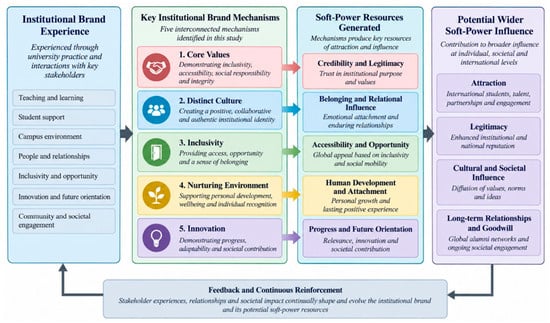
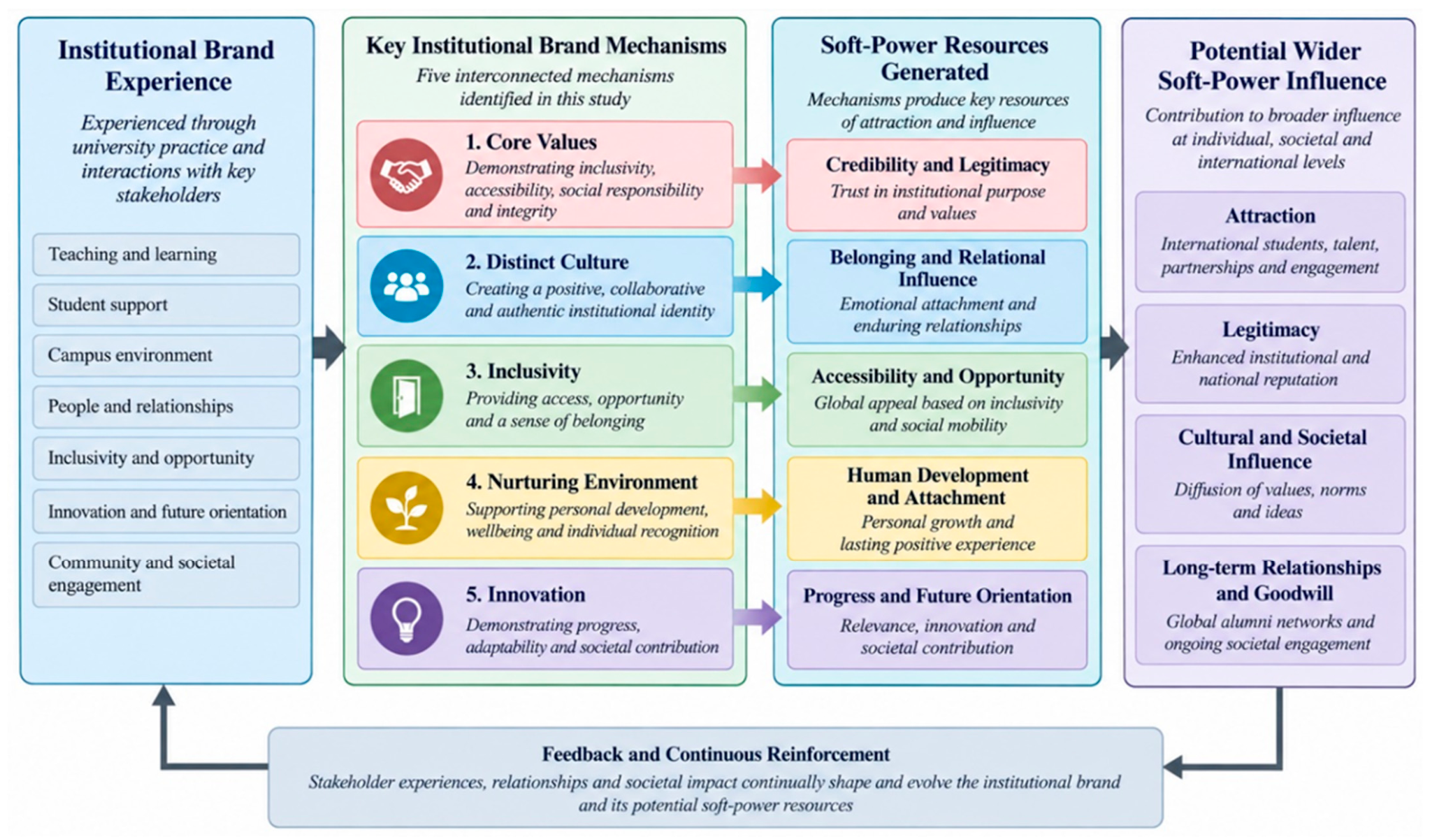
Drawing these findings together, Figure 1 presents the conceptual framework emerging from the study. It illustrates how institutional brand experience is enacted through five interconnected brand mechanisms—core values, distinct culture, inclusivity, nurturing environments, and innovation—which generate potential soft-power resources through credibility and legitimacy, relational influence, accessibility, human development, and future orientation. The framework conceptualizes these relationships as dynamic rather than linear, recognizing that stakeholder experience and wider societal engagement continually shape and reinforce the institutional brand.
Figure 1.
Conceptual Framework: From Institutional Brand Experience to Wider Soft Power Influence (source: authors’ own work).
6. Conclusions
6.1. Conclusions and Contribution
This study extends understanding of HE branding by examining how institutional brand characteristics may contribute to the generation of soft-power resources. Drawing on stakeholder perspectives from three English post-1992 universities, the findings identify five interconnected characteristics of successful HE brands: core values, distinct culture, inclusivity, a nurturing environment, and innovation. These characteristics provide institutional-level pathways through which universities may generate credibility and legitimacy, belonging and relational influence, accessibility and opportunity, personal development and attachment, and perceptions of progress and future orientation. The findings therefore move beyond predominantly market-oriented interpretations of HE branding centered on differentiation, recruitment, reputation, and competitive positioning.
Participants understood universities as socially embedded and values-led institutions whose brands are experienced through relationships, teaching, support, institutional culture, and engagement with wider society. Brand influence consequently depends not simply upon what universities communicate, but upon the extent to which institutional values are credibly enacted and experienced by stakeholders. This provides the principal theoretical contribution of the study. Rather than treating institutional reputation as synonymous with soft power, the findings identify a process through which institutional identity and values are enacted through university practice, interpreted through stakeholder experience, and potentially translated into attraction, legitimacy, belonging, and relational influence. HE branding can therefore provide an institutional-level bridge between university practices and wider systems of soft power.
The study also extends existing discussion by foregrounding post-1992 universities, which remain comparatively underrepresented within accounts of UK higher education and soft power. The findings suggest that potential soft-power resources need not derive solely from selectivity, rankings, or historic prestige. Accessibility, inclusion, nurturing relationships, innovation, and societal engagement may provide alternative sources of attraction and legitimacy. This broadens understanding of both the institutions capable of contributing to UK soft power and the mechanisms through which that contribution may emerge.
6.2. Implications for Higher Education
The findings have implications for university leadership, branding, internationalization, and educational practice. Most importantly, they suggest that soft power should not be regarded solely as an outcome of international marketing, institutional reputation, or student recruitment. The everyday educational experience itself contributes to the credibility and attractiveness of the institution.
Teaching, student support, inclusive practice, relationships with staff, opportunities for personal development, and the wider institutional environment are therefore important components of how university values are experienced. Where these experiences correspond with the identity and values communicated by the institution, they may strengthen trust, belonging, and longer-term stakeholder attachment. Conversely, where institutional rhetoric and lived experience diverge, legitimacy may be weakened.
This places particular importance on authenticity and coherence. Universities seeking to communicate values such as inclusion, opportunity, innovation, and social responsibility need to ensure that these are embedded across educational and organizational practice rather than treated principally as promotional claims. Branding, from this perspective, becomes a shared institutional responsibility extending beyond marketing functions to those responsible for teaching, student experience, leadership, community engagement, and internationalization. For post-1992 universities, the findings also suggest value in recognizing accessibility, widening participation, student development, and societal engagement as potential sources of institutional influence rather than positioning these characteristics as secondary to conventional indicators of prestige. Their contribution to the reputation and attractiveness of UK higher education may therefore be distinctive rather than simply a lesser version of that generated by elite institutions.
6.3. Limitations and Future Research
Several limitations should be considered when interpreting the findings. First, the study draws upon three English post-1992 universities and therefore does not seek statistical generalization across the UK higher education sector. The institutional setting was deliberately selected to investigate a comparatively under-examined part of the sector, but future research could examine whether the mechanisms identified here are reproduced across pre-1992, research-intensive, specialist, and international higher education institutions.
Second, the purposive sampling strategy reflects the objectives of the original study. Student participants were final-year undergraduates from Business, Management, and Marketing disciplines, while academic participants were selected partly because of their perceived alignment with the institutional brand. This enabled the original research to obtain informed perspectives on HE brand success, but these participants may have been comparatively familiar with institutional branding and receptive to institutional values. Perspectives from students and academics in STEM, the Humanities, professional disciplines, and other areas may reveal different interpretations or greater contestation of institutional brand narratives. Future research should therefore examine these relationships across broader disciplinary and stakeholder populations.
Third, the present study reinterprets qualitative data originally generated to investigate HE brand success through a soft-power lens. The findings consequently identify institutional characteristics and processes that may operate as soft-power resources rather than directly measuring national soft-power outcomes. Claims concerning longer-term international or national influence should therefore be interpreted accordingly. Longitudinal research following graduates, including international alumni, would be particularly valuable in examining whether institutional experiences and relationships persist beyond graduation and how perceptions of universities and the UK circulate through subsequent professional and social networks.
Future research could also test and refine the conceptual framework developed from these findings across different institutional and national contexts. Comparative research could examine whether the five pathways identified here operate differently according to institutional type, disciplinary setting, student background, or national higher education system. Further attention should also be given to misalignment and contestation, examining circumstances in which institutional values are rejected, perceived as performative, or contradicted by stakeholder experience. Such research would provide a fuller understanding of not only how universities may generate soft-power resources, but also the conditions under which those resources are weakened or lost.
Author Contributions
Conceptualization, H.O.; Methodology, H.O.; Writing—original draft preparation, H.O., T.A. and M.P.; Writing—review and editing, H.O., T.A., M.P. and E.G., Supervision, H.O., M.P. and E.G. All authors have read and agreed to the published version of the manuscript.
Funding
This research received no external funding.
Institutional Review Board Statement
The study was conducted in accordance with the Declaration of Helsinki and approved by the Ethics Committee of Bournemouth University (approval reference 14265 on 31 October 2017).
Informed Consent Statement
Informed consent was obtained from all subjects involved in the study.
Data Availability Statement
There is no primary data analysis in this paper, and the secondary data reviewed is based on publicly available sources.
Conflicts of Interest
The authors declare no conflicts of interest.
References
- Nye, J. Soft Power: The Means to Success in World Politics; Public Affairs: New York, NY, USA, 2004. [Google Scholar]
- Nye, J. The Future of Power; PublicAffairs: New York, NY, USA, 2011. [Google Scholar]
- Altbach, P.; Knight, J. The internationalization of higher education: Motivations and realities. J. Stud. Int. Ed. 2007, 11, 290–305. [Google Scholar] [CrossRef] [Scilit]
- Knight, J. International Education Hubs: Student, Talent, Knowledge-Innovation Models; Springer: Cham, Switzerland, 2014. [Google Scholar]
- McClory, J. The Soft Power 30: A Global Ranking of Soft Power; Portland Communications: London, UK, 2015. [Google Scholar]
- Streitwieser, B. Internationalisation of Higher Education and Global Mobility; Symposium Books: Oxford, UK, 2017. [Google Scholar]
- Brooks, R.; Waters, J. Student Migrants and Contemporary Educational Mobilities; Palgrave Macmillan: London, UK, 2021. [Google Scholar]
- Marginson, S. Dynamics of national and global competition in higher education. High. Ed. 2006, 52, 1–39. [Google Scholar] [CrossRef] [Scilit]
- Universities UK International. The Scale of UK Higher Education Transnational Education 2018–19; UUKi: London, UK, 2020. [Google Scholar]
- Taylor, J. Toward a strategy for internationalisation: Lessons and practice from four universities. J. Stud. Int. Ed. 2004, 8, 49–171. [Google Scholar] [CrossRef] [Scilit]
- Lomer, S. Recruiting International Students in Higher Education: Representations and Rationales in British Policy; Palgrave Macmillan: Cham, Switzerland, 2017. [Google Scholar]
- Verbik, L.; Lasanowski, V. International Student Mobility: Patterns and Trends; Observatory on Borderless Higher Education: London, UK, 2007. [Google Scholar]
- Mosneaga, A.; Winther, L. Emerging talents? International students before and after their career start in Denmark. Pop. Space Place 2013, 19, 181–195. [Google Scholar] [CrossRef] [Scilit]
- O’Sullivan, H. Branding in Higher Education: Antecedents, Consequences and Nature of Brand Success in UK Post-92 HEIs. Ph.D. Thesis, Bournemouth University, Poole, UK, 2022. [Google Scholar]
- Ali-Choudhury, R.; Bennett, R.; Savani, S. University marketing directors’ views on the components of a university brand. Int. Rev. Pub. Nonprofit Mark. 2009, 6, 11–33. [Google Scholar] [CrossRef] [Scilit]
- Balmer, J.; Gray, E. Corporate brands: What are they? What of them? Euro J. Mark. 2003, 37, 972–997. [Google Scholar] [CrossRef] [Scilit]
- Aaker, D. Managing Brand Equity; Free Press: New York, NY, USA, 1991. [Google Scholar]
- Keller, K.; Swaminathan, V. Strategic Brand Management: Building, Measuring and Managing Brand Equity; Pearson: Harlow, UK, 2019. [Google Scholar]
- Anholt, S. Competitive Identity: The New Brand Management for Nations, Cities and Regions; Palgrave Macmillan: Basingstoke, UK, 2007. [Google Scholar]
- de Wit, H.; Altbach, P. Internationalization in higher education: Global trends and recommendations for its future. Pol. Rev. High. Ed. 2021, 5, 28–46. [Google Scholar] [CrossRef] [Scilit]
- Hemsley-Brown, J.; Goonawardana, S. Brand harmonisation in the international higher education market. J. Bus. Res. 2007, 60, 942–948. [Google Scholar] [CrossRef] [Scilit]
- Chapleo, C.; O’Sullivan, H. Contemporary thought in higher education marketing. J. Mark. High. Ed. 2017, 27, 159–161. [Google Scholar] [CrossRef] [Scilit]
- O’Sullivan, H.; Polkinghorne, M.; Chapleo, C.; Babaee, F. Brand activism: Gen Z and socio-political branding. Encyclopedia 2026, 6, 27. [Google Scholar] [CrossRef] [Scilit]
- Nye, J. Bound to Lead: The Changing Nature of American Power; Basic Books: New York, NY, USA, 1990. [Google Scholar]
- de Martino, M. Soft Power: Theoretical framework and political foundations. Przegląd Eur. 2020, 4, 11–24. [Google Scholar] [CrossRef] [Scilit]
- Henne, P. What we talk about when we talk about soft power. Int. Stud. Pers. 2022, 23, 94–111. [Google Scholar] [CrossRef] [Scilit]
- Yecies, B.; Keane, M.; Yu, H.; Zhao, E.; Zhong, P.; Leong, S.; Wu, H. The cultural power metric: Toward a reputational analysis of China’s soft power in the Asia-Pacific. Glob. Med. China 2019, 4, 203–219. [Google Scholar] [CrossRef] [Scilit]
- Brannagan, P.; Giulianotti, R. Soft power and soft disempowerment: Qatar, global sport and football’s 2022 World Cup finals. Leis. Stud. 2018, 37, 703–719. [Google Scholar]
- Vuković, S. Soft power, bias and manipulation of international organizations in international mediation. Int. Neg. 2015, 20, 414–443. [Google Scholar] [CrossRef] [Scilit]
- Nye, J. Soft power: The origins and political progress of a concept. Palgrave Commun. 2017, 3, 17008. [Google Scholar] [CrossRef] [Scilit]
- Ageeva, V. The rise and fall of Russia’s soft power. Russ. Glob. Aff. 2021, 19, 118–145. [Google Scholar] [CrossRef] [Scilit]
- Oshewolo, S.; Nwozor, A.; Fayomi, F.; Oluwatuyi, M. “Instrumentalizing” the United Nations: Nigeria and its quest for regional leadership in Africa. World Aff. 2019, 184, 77–100. [Google Scholar]
- Joustra, R. The coordinates of covenantal pluralism: Mapping pluralist theory in the 21st Century. Rev. Faith Int. Aff. 2020, 18, 18–34. [Google Scholar] [CrossRef] [Scilit]
- Aromaa, E.; Eriksson, P.; Montonen, T.; Mills, A. Emotion as soft power in organisations. J. Organ. Eff. People Perform. 2020, 7, 341–357. [Google Scholar] [CrossRef] [Scilit]
- Mamo, Y.; Anagnostopoulos, C.; Chadwick, S.; Andrew, D. I Feel Qatari Today […] I Feel Disabled Today, […] I Feel Like a Migrant Worker Today…. Sport Leadersh. Moral Legitimacy Commun. Sport 2025, 13, 1010–1038. [Google Scholar] [CrossRef] [Scilit]
- Madise, D.; Isike, C. Ubuntu diplomacy: Broadening soft power in an African context. J. Pub. Aff. 2020, 20, e2097. [Google Scholar] [CrossRef] [Scilit]
- Schéré, E. Soft power—The underestimated strategy for global influence. Fletcher F. World Aff. 2021, 45, 41. [Google Scholar]
- Alshikhy, T.; O’Sullivan, H.; Polkinghorne, M.; Gennings, E. The role and impact of sporting mega-events in the context of soft power. Encyclopedia 2025, 5, 31. [Google Scholar] [CrossRef] [Scilit]
- Vibber, K.; Lovari, A. The overlooked public: Examining citizens’ perceptions of and perceived role in hosting mega-events. Place Brand. Pub. Dipl. 2021, 18, 156–168. [Google Scholar] [CrossRef] [Scilit]
- Peyton, T.; Zigarmi, D.; Fowler, S. Examining the relationship between leaders’ power use, followers’ motivational outlooks, and followers’ work intentions. Front. Psych. 2019, 9, 2620. [Google Scholar] [CrossRef] [Scilit]
- Acquah, E.; Topalli, P.; Wilson, M.; Junttila, N.; Niemi, P. Adolescent loneliness and social anxiety as predictors of bullying victimization. Int. J. Adol. Youth 2016, 21, 320–331. [Google Scholar] [CrossRef] [Scilit]
- Chadwick, S.; Widdop, P.; Burton, N. Soft power sports sponsorship—A social network analysis of a new sponsorship form. J. Pol. Mark. 2022, 21, 196–217. [Google Scholar] [CrossRef] [Scilit]
- Baker, C.; Atkinson, D.; Grabher, B.; Howcroft, M. Soft Power, Cultural Relations and Conflict Through Eurovision and Other Mega-Events: A Literature Review; British Council: London, UK, 2024. [Google Scholar]
- Baker, M.; Balmer, J. Visual identity: Trappings or substance? Euro. J. Mark. 1997, 31, 366–382. [Google Scholar] [CrossRef] [Scilit]
- Al-Tamimi, N.; Amin, A.; Zarrinabadi, N. Qatar’s Nation Branding and Soft Power: Exploring the Effects on National Identity and International Stance; Springer Nature: Cham, Switzerland, 2023. [Google Scholar]
- Krzymowski, A. Role and significance of the United Arab Emirates foreign aid for its soft power strategy and sustainable development goals. Soc. Sci. 2022, 11, 48. [Google Scholar] [CrossRef] [Scilit]
- Cialdini, R. Influence: The Psychology of Persuasion; Harper Business: New York, NY, USA, 2007. [Google Scholar]
- Kellerman, B. Bad Leadership: What It Is, How It Happens, Why It Matters; Harvard Business School Press: Boston, MA, USA, 2004. [Google Scholar]
- Creswell, J. Research Design: Qualitative, Quantitative and Mixed Methods Approaches; Sage: Thousand Oaks, CA, UK, 2009. [Google Scholar]
- Leijerholt, U.; Chapleo, C.; O’Sullivan, H. A brand within a brand: An integrated understanding of internal brand management and brand architecture in the higher education sector. J. Brand Man. 2019, 26, 144–159. [Google Scholar] [CrossRef] [Scilit]
- Polkinghorne, M.; Taylor, J. Recursive abstraction method for analysing qualitative data. In Encyclopaedia of Tourism Management and Marketing; Buhalis, D., Ed.; Edward Elgar Publishing: Cheltenham, UK, 2021; pp. 636–638. [Google Scholar]
- Gephart, R., Jr. Qualitative research and the Academy of Management Journal. Acad. Man. J. 2004, 47, 454–462. [Google Scholar] [CrossRef] [Scilit]
- Polkinghorne, M.; Taylor, J. Switching on the BBC: Using Recursive Abstraction to Undertake a Narrative Inquiry Based Investigation into the BBC’s Early Strategic Business and Management Issues. In SAGE Case Studies in Business and Management Research Methods, Part 2; SAGE: London, UK, 2019. [Google Scholar]
- Polkinghorne, M.; Bobeva, M.; Shahid, S. Managing Sustainable Projects: Analyzing Qualitative Interview Data using the Recursive Abstraction Method. In SAGE Case Studies in Business and Management Research Methods; SAGE: London, UK, 2023. [Google Scholar]
- Hult, G.; Mena, J.; Ferrell, O.; Ferrell, L. Stakeholder marketing: A definition and conceptual framework. AMS Rev. 2011, 1, 44–65. [Google Scholar] [CrossRef] [Scilit]
- Schmitt, B. The Consumer Psychology of Brands; Oxford University Press: Oxford, UK, 2012. [Google Scholar]
- Veloutsou, C.; Guzmán, F. The evolution of brand management thinking over the last 25 years as recorded in the Journal of Product & Brand Management. J. Prod. Brand Man. 2017, 26, 2–12. [Google Scholar] [CrossRef] [Scilit]

Disclaimer/Publisher’s Note: The statements, opinions and data contained in all publications are solely those of the individual author(s) and contributor(s) and not of MDPI and/or the editor(s). MDPI and/or the editor(s) disclaim responsibility for any injury to people or property resulting from any ideas, methods, instructions or products referred to in the content. |
© 2026 by the authors. Licensee MDPI, Basel, Switzerland. This article is an open access article distributed under the terms and conditions of the Creative Commons Attribution (CC BY) license.