


Abstract
Teaching excellence has become an increasingly important but contested concept in higher education, shaped by institutional priorities, policy instruments, and changing understandings of pedagogical quality. Teaching awards are widely used to recognize outstanding teaching, although institutional schemes may also encompass broader forms of pedagogical and curricular innovation. This study examines the longitudinal evolution of teaching recognition schemes and pedagogical innovation initiatives at the University of Porto, a large Portuguese public university, from 2004 onwards. A qualitative documentary analysis was conducted of regulations, calls for applications, application forms, evaluation criteria, evidence requirements, jury arrangements, and dissemination mechanisms associated with successive institutional initiatives. The findings show a gradual expansion from an initial focus on excellence in e-learning to broader forms of pedagogical excellence, project-based innovation, curricular experimentation, and educational innovation. Over time, recognition shifted from individual teachers to pedagogical teams, funded projects, curricular units, and institutional innovation mechanisms. Evidence requirements also became more formalized, incorporating reflective accounts, evaluation grids, impact documentation, and dissemination expectations. The study concludes that pedagogical awards can operate not only as symbolic recognition mechanisms but also as institutional policy instruments that shape what counts as excellent teaching and how pedagogical knowledge circulates within the university.
1. Introduction
Higher education institutions have long been defined by the coexistence of teaching and research activities. Although the Humboldtian ideal assumes that these activities are mutually reinforcing, the research–teaching nexus is not automatic and is shaped by institutional structures, disciplinary cultures, workload models, performance regimes, and national policy contexts [1,2]. In practice, teaching and research often compete for academic time, recognition, and career incentives. This tension is particularly visible in research-intensive universities, where academic prestige, rankings, promotion systems, and resource allocation are frequently driven by research productivity, while teaching remains important but less directly rewarded [3,4,5]. Simultaneously, universities are under growing pressure to demonstrate the quality and impact of teaching, as expectations regarding teaching quality and the preparation of students for uncertain and complex futures continue to evolve [2,6].
However, defining and measuring teaching quality remains conceptually and methodologically difficult. Teaching quality may be associated with student satisfaction, engagement, learning outcomes, pedagogical innovation, peer review, professional standards, or reflective practice, but no single indicator is sufficient [6]. Against this background, teaching excellence has become a highly visible but ambiguous concept. It is used to signal quality, accountability, innovation, and student-centred learning, but is often insufficiently defined and may become an organizational or symbolic category rather than a concept grounded in pedagogical practice [6,7,8]. This ambiguity matters because institutional definitions of excellence shape what is recognized, rewarded, documented, and disseminated [9,10].
Teaching awards are among the most visible mechanisms through which higher education institutions seek to recognize and signal teaching excellence. Such schemes are often presented as ways to raise the profile of teaching, acknowledge outstanding educators, encourage pedagogical innovation, and motivate academic staff to enhance student learning [9,11,12]. They respond to the persistent asymmetry in academic reward systems by making excellent teaching more visible, legitimate, and valued within academic culture [8,10,13]. However, teaching awards are conceptually and operationally ambiguous. They may foster reflection, strengthen pedagogical language, and support professional identity, but their impact on teaching practice may be limited when they retrospectively recognize already excellent teachers rather than supporting wider pedagogical change [9,14,15,16]. They may also be perceived as tokenistic, divisive, insufficiently transparent, overly dependent on student evaluations, or disconnected from promotion and career structures [12,17].
A central issue, therefore, is not simply whether awards reward excellence but how they define, evidence, and disseminate it. Award criteria, application forms, portfolios, nomination processes, assessment panels, and dissemination requirements are not neutral administrative devices. They define the standards against which teaching is judged, determine the forms of evidence considered legitimate, and shape the relationship between individual recognition and institutional learning [10,13,15,18,19]. Excellent teaching may therefore be recognized not only because it is practiced, but also because it can be narrated, evidenced, and aligned with the evaluative language of awards, promotion criteria, or institutional policy [13,14,20]. Recognition becomes more consequential when it is connected to dissemination, academic development, and the public circulation of pedagogical knowledge through workshops, publications, mentoring, communities of practice, teaching commons, or curriculum development initiatives [20,21,22,23].
Despite this growing body of work, limited knowledge remains about how pedagogical award schemes evolve over time within a single institution and how successive regulations, calls, application forms, criteria, evidence requirements, jury arrangements, and dissemination mechanisms reshape institutional understandings of teaching excellence itself. Existing studies have analyzed award criteria across institutions, explored recipients’ conceptions of excellent teaching, examined teaching portfolios, and discussed the role of the scholarship of teaching and learning and academic development [10,18,20,22,24]. However, few studies have adopted a longitudinal documentary approach to examine how these elements change across different generations of institutional initiatives.
This study is grounded in the assumption that teaching excellence is not a fixed or self-evident category, but an institutional construct shaped by the mechanisms through which it is recognized, evidenced, and disseminated. In this study, award documents are not treated as neutral descriptions of pre-existing teaching excellence but as institutional artefacts through which excellence is defined, made assessable, and rendered visible. Regulations, calls, application forms, criteria, evidence requirements, jury arrangements, and dissemination mechanisms are therefore analytically relevant because they reveal what forms of teaching an institution chooses to value, what evidence it considers legitimate, and how recognized practices are expected to circulate within the academic community.
The conceptual framework brings together three interrelated perspectives: teaching excellence as a contested construct, pedagogical awards as instruments of recognition and institutional policy, and the relationship between recognition, evidence, dissemination, and pedagogical change.
1.1. Teaching Excellence as a Contested Construct
Teaching excellence has become a prominent term in higher education policy, quality assurance, and institutional discourse. It is commonly associated with high-quality teaching, innovation, student-centred learning, student engagement, inclusive practice, curriculum design, assessment, reflective practice, educational leadership, and measurable impact on learning. However, despite its widespread use, the concept remains difficult to define with precision. Several authors have argued that teaching excellence is value-laden, context-dependent and interpreted differently by academics, students, institutions, policymakers and award bodies [8,10,19,24].
This conceptual ambiguity has practical consequences for evaluating and rewarding teaching. If teaching excellence can refer to classroom delivery, student support, innovation, curriculum leadership, scholarly teaching, inclusive pedagogy, impact on student learning or contribution to institutional culture, then any award scheme necessarily privileges some dimensions over others [10,18]. In this sense, institutional criteria do not simply identify excellence; they help define what excellence means in a particular organizational setting [10,13].
Recent analyses of teaching excellence schemes show that award documents tend to construct excellence across multiple dimensions. Teaching excellence may include impact, innovation, inclusivity, scholarship of teaching and learning, and student-centeredness, expressed through areas such as pedagogy, curriculum planning and design, assessment, student support, professional development, and community service [10]. Other studies similarly show that award criteria may include student-centeredness, campus leadership, scholarship of teaching and learning, curriculum development, and evidence of student learning [18]. Teaching excellence is therefore best understood not as a single universal standard, but as a negotiated institutional construct that may emphasize individual classroom performance, student satisfaction, pedagogical innovation, reflective practice, curriculum transformation, educational leadership, dissemination of practice or contribution to institutional change [10,18,20,22].
A critical perspective on teaching excellence also requires attention to the institutional and political work performed by the concept. Excellence is not only a descriptive category used to identify effective teaching; it can also operate as a normative category through which institutions establish what forms of teaching become visible, legitimate, and worthy of recognition [8,10]. Critical accounts have further questioned the apparently self-evident desirability of excellence, linking contemporary discourses of teaching excellence to wider processes of competition, comparison, performativity, managerial governance, and neoliberal restructuring of higher education [25,26]. From this perspective, award criteria are not neutral mechanisms for identifying pre-existing quality. By specifying valued practices and the forms through which they must be demonstrated, they establish boundaries around what can be presented, documented, compared, and rewarded as excellent teaching [10,13,14].
This perspective highlights an important ambivalence in teaching recognition systems. On the one hand, awards may help counter the historically weaker status of teaching relative to research, provide institutional visibility to pedagogical work, affirm professional identities, and encourage reflection on teaching practices [14,15]. Conversely, recognition schemes may also operate as institutional steering mechanisms by encouraging academics to align both their practices and the representation of those practices with formally recognized priorities and evaluative expectations [26,27,28]. What becomes recognizable as excellence may therefore reflect not only the quality of pedagogical practice but also its capacity to be narrated, evidenced, and rendered institutionally legible within particular evaluative frameworks [13,14]. Conversely, pedagogical work that is highly situated, relational, disciplinary, or difficult to document may be less visible within formal systems of recognition [8,25].
The competitive structure of awards introduces further tension. Because formal recognition differentiates between those whose practices are selected and those whose practices are not, single-winner models may intensify positional competition around a concept that is itself contextual, multidimensional, and contested [15,17,25]. Such individualized forms of recognition may sit uneasily alongside approaches to pedagogical development that depend on collaboration, collective reflection, and the circulation of knowledge about teaching [25,29]. Teaching excellence awards should therefore be examined neither simply as benign celebrations of good teaching nor assumed a priori to be instruments of managerial control. Rather, their significance lies in their potentially dual capacity to valorize pedagogical work while simultaneously participating in the institutional construction of what counts as excellent teaching.
Teaching excellence must also be understood in the context of discipline. Teaching and learning practices are shaped by epistemological structures, educational purposes, assessment traditions, and professional expectations of different fields, and approaches that are effective or valued in one disciplinary setting may not be directly transferable to another [30]. Professional fields may also develop characteristic “signature pedagogies” through which students learn to think, perform, and act in ways associated with particular professions [31]. Consequently, institution-wide teaching awards face a distinctive evaluative challenge: common criteria may provide transparency and comparability across an institution, but they may also privilege particular conceptions of teaching if disciplinary differences in knowledge, curriculum, assessment, and pedagogical practice are not sufficiently accommodated. Therefore, evaluating teaching excellence involves not only deciding what counts as excellence but also determining how common institutional expectations are interpreted across different disciplinary and professional contexts.
1.2. Terminological Scope: Teaching, Pedagogy, and Pedagogical Innovation
The terms teaching and pedagogy are closely related but are not treated as interchangeable in this study. Teaching refers primarily to the practices, strategies, interactions, and activities through which educators organize and support student learning. Pedagogy is used in a broader sense to encompass not only teaching practices but also the assumptions, values, purposes, conceptions of learning, and contextual relationships that inform those practices. Pedagogy is therefore more than teaching technique: it concerns the relationships among teachers, learners, knowledge, educational purposes, and the institutional and cultural contexts in which teaching and learning occur [32,33].
This distinction is analytically important for the study of excellence and recognition. A teaching award may emphasize enacted practices and their observable or documented effects, such as instructional design, assessment, student engagement, or learning outcomes. A broader concern with pedagogy may additionally address the rationale underlying those practices, the conceptions of learning and knowledge on which they are based, their relationship to curriculum and disciplinary contexts, and the educational values they embody. The distinction should not, however, be understood as a rigid separation. Teaching practices embody pedagogical assumptions, while pedagogical commitments become visible through teaching, curriculum design, assessment, and interactions with students. The relationship between the two is therefore one of analytical distinction rather than practical independence [32,33].
In this article, teaching excellence is used as the principal analytical term because the study examines institutional mechanisms for recognizing and evaluating teaching and because it is the focus reflected in the article title. The terms pedagogical, pedagogical excellence, and pedagogical innovation are retained where they form part of the official designation or language of University of Porto initiatives, including the Pedagogical Excellence Award and Pedagogical Innovation Projects. More generally, pedagogical innovation is used when the institutional initiatives extend beyond particular teaching practices to encompass their underlying rationale, curriculum design, assessment, interdisciplinary arrangements, or broader processes of educational change. Maintaining this distinction makes it possible to examine not only which teaching practices were recognized but also how institutional understandings of pedagogy and pedagogical change were progressively articulated through successive recognition schemes.
1.3. Teaching Awards as Instruments of Recognition and Institutional Policy
Teaching awards are often presented as mechanisms for recognizing outstanding educators and raising the status of teaching in higher education. They can provide symbolic visibility, reputational value, and, in some cases, material or career-related benefits for academics. They may also affirm teachers’ professional identities, strengthen confidence, encourage reflection, and signal that teaching matters within academic culture [9,14,15,34].
However, awards do more than celebrate individual achievements. From an institutional perspective, they can function as policy instruments. In this article, the term is used in a bounded institutional sense to refer to formal mechanisms through which institutional priorities are translated into eligibility rules, evaluative criteria, evidence requirements, forms of recognition, and dissemination expectations [27]. By defining these elements, awards communicate what an institution values and what forms of teaching it wishes to encourage [10,18,27]. In this sense, pedagogical awards participate in teaching governance.
This is particularly important in higher education systems where research remains more strongly embedded in promotion, reputation and resource allocation. Teaching awards may attempt to rebalance the symbolic economy of academic work by increasing the visibility of teaching excellence, but they may remain limited if they operate as isolated gestures rather than as part of broader systems of academic development, career progression and institutional strategy [16,17,28]. They may also reinforce the separation between teaching and research if teaching is recognized separately but not integrated into mainstream understandings of academic excellence [28].
Recognition appears to become more meaningful when embedded in institutional structures rather than treated as an isolated symbolic gesture. Its potential institutional value is stronger when teaching is connected to academic promotion, evaluated through multidimensional criteria, supported by leadership and teaching communities, and aligned with policies that sustain pedagogical innovation and career development [21,23,35]. Pedagogical awards can therefore be understood as operating along a continuum, from symbolic recognition of individual merit to broader policy mechanisms that shape academic expectations, support pedagogical development, influence career structures, and disseminate recognized practices.
1.4. From Recognition to Pedagogical Change: Evidence, Dissemination and Academic Development
A central issue in the study of pedagogical awards is the relationship between recognition and changes in teaching practices. Awards may affirm excellence, but affirmation alone does not necessarily transform teaching culture. Their broader institutional significance depends partly on whether they require evidence, promote reflection, support dissemination, and connect individual recognition with collective academic development.
Demonstrating teaching excellence is a key component of this process. Teaching portfolios, reflective statements, peer evaluations, student feedback, examples of learning materials, evidence of student learning, records of curriculum innovation, and accounts of professional development require academics to translate pedagogical practice into documented forms [18,23]. This documentary work can have developmental value because it encourages teachers to articulate their teaching philosophy, reflect on their pedagogical decisions, connect practice with evidence, and make claims about impact [14].
Simultaneously, documentation is not neutral. It requires academics to present their practice in a language that is institutionally recognizable and aligned with the award criteria. Award applications often involve a mediated voice in which situated pedagogical practice must be translated into a coherent, persuasive, and evidence-based account that fits the genre and expectations of the award [13,14]. Excellent teaching may therefore be rewarded not only because it is practiced, but also because it can be convincingly evidenced, narrated, and made institutionally legible.
However, the requirement to provide evidence of teaching quality should not be conflated with the stronger claim that teaching ought to operate as an evidence-based practice. Evidence can inform pedagogical judgement, support reflection, and provide grounds for examining claims about teaching and learning, but it cannot, by itself, determine what is educationally desirable or appropriate in a particular context. Biesta [36] argues that the question of “what works” is necessarily incomplete in education because judgements about effectiveness depend on prior judgements about educational purposes and values. Therefore, evidence cannot substitute for the professional and normative judgement through which educators interpret particular students, disciplines, curricula, and institutional settings.
Similar cautions are visible in the literature originating from medicine and medical education. The Best Evidence Medical Education framework, for example, does not present research evidence as mechanically transferable into educational practice; it emphasizes the quality, utility, strength, target, and setting of evidence and explicitly retains a role for teachers’ professional judgement when deciding whether evidence is relevant to a particular educational context [37]. More broadly, critiques of evidence-based medicine have warned against the rigid application of generalized evidence without adequate attention to context, professional expertise, and the particularities of practice [38]. In higher education, an evidentiary orientation should therefore be understood as supporting informed pedagogical judgement rather than replacing it. Excessively prescriptive interpretations of evidence may narrow pedagogical possibilities by privileging established, measurable, or readily documentable practices over emerging, context-sensitive, or exploratory forms [36,39].
Dissemination is another key dimension. Awards may have a limited institutional impact if they remain confined to individual recognition. However, they can contribute to collective learning when award-winning practices are made public through workshops, vignettes, teaching commons, mentoring, communities of practice, publications, institutional resources, and curriculum development initiatives. In this sense, dissemination connects recognition to academic development, the scholarship of teaching and learning, and the circulation of pedagogical knowledge within and beyond the institution [20,22].
The conceptual distinction between recognizing, evidencing, and disseminating teaching excellence allows us to analyze whether pedagogical awards function merely as retrospective distinctions or whether they become mechanisms for institutional learning. Recognition identifies valued practices, evidence legitimizes them, and dissemination enables them to circulate, be questioned, adapted, and potentially institutionalized. Therefore, this framework supports a longitudinal documentary analysis of how excellence is framed over time: as individual performance, reflective practice, technological innovation, curriculum development, pedagogical scholarship, collective innovation, or institutional transformation.
1.5. Aim and Research Questions
Against this background, this study examines the longitudinal evolution of teaching recognition schemes and pedagogical innovation initiatives at the University of Porto, Portugal. Drawing on documentary analysis of regulations, calls for applications, application forms, evaluation criteria, evidence requirements, jury arrangements, and dissemination mechanisms, it analyzes how institutional understandings of teaching excellence have changed over time. The study is guided by the following research question: How have teaching recognition schemes and pedagogical innovation initiatives evolved as institutional mechanisms for recognizing, evidencing, and disseminating teaching excellence at the University of Porto? More specifically, it asks: (1) What conceptions of teaching excellence have been embedded in award regulations and related documents over time? (2) How do eligibility rules, evaluation criteria, and required evidence shape the definition of pedagogical quality? (3) How have these initiatives evolved from individual recognition to broader institutional mechanisms for pedagogical innovation and dissemination? By addressing these questions, this article shows how pedagogical awards can function not only as symbolic mechanisms of recognition but also as institutional policy instruments that define what counts as excellent teaching, what evidence is required to legitimize it, and how pedagogical knowledge may circulate within the university.
2. Materials and Methods
2.1. Study Context and Institutional Case
This study is situated within the longer transformation of Portuguese higher education following the 1974 democratic transition. The first decades of this period were characterized primarily by democratization, widening participation, institutional expansion, and diversification, as Portugal moved from a relatively restricted higher education system to a substantially broader university and polytechnic sector [40]. These developments changed not only the scale and social composition of higher education but also the expectations placed on institutions and academic work in general. Therefore, it is important not to treat the post-1974 period as a single, homogeneous policy phase: democratization and expansion preceded later transformations associated with European integration, quality assurance, institutional autonomy, performance, and new forms of governance.
Since the 1990s, and particularly during the 2000s, Portuguese higher education has become increasingly embedded in European and transnational policy developments. The Bologna Process reinforced attention to student-centred learning, learning outcomes, competence development, curricular restructuring, and the comparability of qualifications, while quality assurance progressively required institutions to make teaching and learning processes more explicit, documentable, and open to external evaluation [40,41]. The establishment of the contemporary assessment and accreditation system in 2007 further consolidated expectations that institutions should document educational objectives, pedagogical processes, academic success, resources, and improvement mechanisms. These developments contributed to shifting teaching quality from being understood primarily as a matter located within individual academic practice to an issue that was increasingly visible at the program and institutional levels.
This transformation occurred alongside changes in the governance of Portuguese higher education. Research on the Portuguese system has identified the increasing influence of managerialism and New Public Management principles, particularly through stronger institutional autonomy combined with performance monitoring, evaluation, strategic management, and forms of ex post accountability [42,43]. The governance reforms associated with the 2007 legal framework strengthened institutional management while simultaneously providing mechanisms through which policy objectives could be pursued, and institutional performance could be monitored [42]. Subsequent research has documented a reconfiguration of the balance between collegial and managerial forms of decision-making within Portuguese higher education institutions [44].
This broader context is relevant to the emergence of institutional teaching-recognition mechanisms. Teaching awards can be interpreted as attempts to increase the visibility and status of teaching within academic systems in which research has historically carried stronger reputational and career rewards. Simultaneously, their emergence within an environment increasingly concerned with quality, accountability, institutional strategy, and demonstrable performance means that recognition cannot be separated entirely from broader developments in higher education governance. Awards, criteria, evidence requirements, and dissemination mechanisms create ways of making teaching institutionally visible and articulating expectations concerning valued educational practice. In this respect, the movement from teaching as predominantly individual professional practice to teaching as an institutional concern carries dual significance: it can provide greater recognition and support for pedagogical work while also making teaching more amenable to organizational evaluation, steering, and accountability.
This interpretation should not be understood as implying that managerial reform directly caused the development of teaching awards at the University of Porto or that academics necessarily experienced such initiatives as instruments of managerial control. The documentary evidence analyzed in this study does not support such causal or experiential claims. Rather, the national and European policy trajectories provide the historical and organizational contexts within which successive mechanisms for recognizing, evidencing, supporting, and disseminating teaching have developed. Therefore, the University of Porto initiatives can be examined at the intersection of several concurrent developments: the increasing institutional valorization of teaching, European pedagogical and curricular agendas, the expansion of quality assurance, and changing modes of institutional governance.
The empirical case analyzed in this study is the University of Porto, a large Portuguese public university with a broad disciplinary profile and a long-standing institutional trajectory in pedagogical recognition and innovation. The University of Porto was selected as a relevant institutional case because, since the early 2000s, it has developed successive initiatives related to e-learning, teaching excellence, pedagogical innovation, and educational innovation. These initiatives reflect wider national and European concerns with quality assurance, student-centred learning, digital education, professional development, and the institutional valorization of teaching.
The trajectory can be understood through successive and partially overlapping institutional stages. The first, beginning in 2004, was associated with the Excellence in e-Learning Award and focused on the pedagogically meaningful use of digital platforms. The second, established in 2012, broadened this focus through the Pedagogical Excellence Award, emphasizing innovative teaching strategies, student engagement, active learning, reflective practice, and student success. The 2016 Programme to Promote Pedagogical Excellence provided a transitional stage by bringing recognition together with support for pedagogical projects. From 2017 onwards, Pedagogical Innovation Projects and the course-unit pedagogical innovation initiative moved further toward project-based and curricular innovation, including course-unit redesign, interdisciplinarity, active methodologies, and assessment innovation. The most recent stage, associated with the Educational Innovation Programme, the Innovative Pedagogical Practice Award, and the Institutional Pedagogical Innovation Seal, brought recognition, support, dissemination, and valorization together through awards, seals, workshops, publications, and technical-pedagogical support.
This institutional case therefore provides an opportunity to analyze how teaching excellence and pedagogical innovation were progressively reframed over time at the University of Porto: from digital teaching practices to broader pedagogical excellence, from individual recognition to teams and projects, and from symbolic awards to more structured mechanisms of educational innovation.
The selection of a single institutional case was deliberate rather than a consequence of limited sampling size. Case study research is particularly valuable when the purpose is to examine a phenomenon in depth in relation to its organizational and historical context over time. The analytical value of a case does not depend on its statistical representativeness of a wider population. However, carefully selected cases can generate contextually grounded insights, challenge assumptions, and contribute to the development or refinement of conceptual explanations [45,46].
The University of Porto is particularly informative for the present purpose because it combines temporal depth, institutional continuity, disciplinary breadth, and successive generations of teaching recognition and pedagogical innovation. This longitudinal trajectory makes it possible to examine changes that would be difficult to identify through a cross-sectional comparison of institutions at a single point in time. Therefore, the purpose is not to claim that the University of Porto represents Portuguese or European higher education as a whole, but to use an information-rich institutional trajectory to examine how recognition mechanisms can progressively define, evidence, support, and disseminate particular understandings of teaching excellence. The relevance of the case lies in the analytical processes it makes visible and the extent to which these processes may inform the interpretation of comparable institutional contexts.
2.2. Research Design and Documentary Corpus
The empirical corpus comprised 65 documents related to teaching recognition and pedagogical innovation initiatives developed at the University of Porto from 2004 onwards. The corpus spans the successive initiatives and institutional phases examined in this study, including the Excellence in e-Learning Award, the Pedagogical Excellence Award and related developments, Pedagogical Innovation Projects, the course-unit pedagogical innovation initiative, and the Educational Innovation Programme and its associated recognition mechanisms. The complete document-level distribution across initiatives and periods is provided in Supplementary Table S1. The corpus included both normative documents—such as regulations, rectoral orders, calls for applications, and formal programme descriptions—and operational documents, including application forms, methodological guidelines, evaluation grids, jury-related records, dissemination templates, reports, and implementation materials.
Documents were identified through University of Porto institutional channels and records associated with the initiatives under study. The corpus represents the complete set of relevant documents located for the initiatives and period examined. Inclusion was limited to documents providing information relevant to the design, implementation, evaluation, recognition, or dissemination of the initiatives. All 65 documents in the corpus are public documents. Some remain directly accessible through University of Porto web channels; others are not maintained in a publicly searchable online repository but can be obtained upon request through the relevant University services. Source provenance and public status are reported document by document in Supplementary Table S1; general access conditions are summarized in the table note.
The documentary analysis was conducted using the original Portuguese-language documents. English translations of programme titles, documentary terminology, and extracts presented in the manuscript and Supplementary Material were prepared by the authors for reporting purposes; no official University English translations were available.
A complete documentary inventory, including document identifier, date, official Portuguese title, author-prepared English translation, initiative, document type, source/provenance, and public status, is provided in Supplementary Table S1. This inventory establishes a traceable link between the documentary corpus and the findings reported in the manuscript.
The main categories of documents included in the documentary corpus are summarized in Table 1.
Table 1.
Main institutional phases and documentary sources analyzed.
The inclusion of both normative and operational documents was important because the study did not examine only what the University of Porto formally declared as valuable. It also analyzed how teaching excellence and pedagogical innovation were made assessable, comparable, and institutionally visible through concrete administrative and evaluative procedures [47,48].
2.3. Analytical Dimensions and Procedure
The analysis was organized around a documentary inventory and a cross-dimensional analytical matrix. First, the documents were identified, classified, and organized by period, initiative, and document type. This made it possible to establish the chronological scope of the corpus and distinguish between regulatory, procedural, evaluative, and dissemination-related documents.
Second, each document was read in full and relevant information was extracted into an analytical matrix informed by the conceptual framework and the research questions. The matrix combined deductive categories derived from the literature on teaching excellence, pedagogical awards, academic development, and institutional recognition with inductive attention to the specific language, structure, and emphases of the University of Porto documents (Table 2).
Table 2.
Analytical dimensions used for the longitudinal documentary analysis.
Third, the extracted information was compared across initiatives to identify continuities, shifts, and ruptures in how pedagogical excellence and innovation were framed at the University of Porto. The comparison focused on whether the initiatives privileged individual or collective recognition, technological innovation or broader pedagogical quality, symbolic awards or funded projects, and isolated distinctions or institutional dissemination. Finally, a cross-dimensional interpretive synthesis examined each analytical category across the full timeline and identified the main patterns of change.
For descriptive reporting, an application refers to a formally submitted proposal or candidacy, whereas an awarded application refers to a proposal or practice that is formally selected for recognition or funding. The term individual participant refers to a person named within an individual or team application. Because some initiatives permitted team applications, the number of applications and the number of individual participants were not directly equivalent. Where the documentary records did not permit these units to be distinguished reliably, this is stated explicitly.
Quantitative information available in the documents, such as monetary values, numbers of applications and individual participants, and numbers of recognized or funded applications, was used descriptively to contextualize the evolution of the initiatives. These data were not used for statistical analysis but as supplementary information supporting documentary interpretation. A consolidated descriptive overview is provided in Supplementary Table S3.
The completed cross-dimensional analytical matrix is presented in Supplementary Table S2. It presents, for each initiative and period, the documentary evidence extracted for objectives, target participants, application procedures, evaluation criteria, required evidence, jury arrangements, forms of recognition or support, dissemination mechanisms, and institutional orientation.
2.4. Analytical Trustworthiness and Researcher Positioning
The first author conducted the initial full-text reading of the documentary corpus and extracted the relevant information into an analytical matrix. The second author subsequently reviewed the completed matrix and cross-checked the extracted information against the corresponding original documents, including the chronology and official designation of the initiatives, award values, number of prizes, jury composition, and dissemination mechanisms. No disagreements requiring formal adjudication were identified during the verification process. This procedure was intended to verify the accuracy and consistency of documentary extraction rather than to provide independent coding or inter-rater reliability.
A separate formal audit trail was not maintained during the initial analysis. To strengthen analytical transparency in the revised study, the complete documentary inventory and populated cross-dimensional analytical matrix are provided as Supplementary Tables S1 and S2, respectively, enabling readers to trace the relationship between the source documents, analytical categories, and longitudinal synthesis reported in the Section 3.
Both authors are employed at the University of Porto. The first author is a senior technical officer in the Rectorate, is professionally involved in the educational innovation programmes examined in this study, and has responsibilities in the area of pedagogical innovation. The second author is a professor at the University. This institutional positioning provided contextual knowledge of programme development, terminology, and organizational arrangements while also requiring a clear distinction between institutional familiarity and documentary evidence. Interpretive claims were therefore grounded in the identified documentary corpus and limited to what those sources could support. Access to the documentary corpus did not depend on confidential, privileged, or non-public records. All 65 documents analyzed are public institutional documents; some are directly accessible online, while others can be obtained upon request through the relevant University of Porto services.
3. Results
The analysis of the University of Porto documents identified a longitudinal trajectory in which pedagogical recognition evolved from a focus on e-learning practices to broader mechanisms of pedagogical excellence, curricular innovation, and educational innovation. Figure 1 summarizes the main phases of this evolution.
Figure 1.
Longitudinal evolution of pedagogical recognition and educational innovation at the University of Porto. Column headings represent analytical stages in the longitudinal trajectory and do not, in every case, reproduce the full official designation of an institutional programme. Created in BioRender. Silva, P. (2026) https://BioRender.com/1dprrrn.
The cross-dimensional evidence supporting this longitudinal synthesis is presented in Supplementary Table S2, while Supplementary Table S1 provides document-level traceability and Supplementary Table S3 consolidates the descriptive quantitative information.
The documentary matrix also made it possible to contextualize this trajectory using descriptive quantitative information. The University of Porto’s Excellence in e-Learning Award granted 11 awards between 2004/05 and 2010/11. The Pedagogical Excellence Award, formally established in 2012, granted eight awards corresponding to the 2012/13–2017/18 academic cycles; for chronological consistency, these are reported here by year of award as 2013–2018. Pedagogical Innovation Projects funded 69 projects from 130 submitted applications between 2017 and 2022. The course-unit pedagogical innovation initiative recognized 18 course units from 31 submitted applications between 2017 and 2020, with no awards recorded in 2021 and 2022. In the most recent phase, the Innovative Pedagogical Practice Award recognized 31 practices from 75 submitted applications between 2022/23 and 2025/26, while the Institutional Pedagogical Innovation Seal recognized ten applications from 13 submissions between 2023/24 and 2025/26. These figures are used descriptively as indicators of the diversification and institutional reach of the initiatives rather than as measures of impact (Supplementary Table S3).
3.1. From E-Learning Excellence to Broader Pedagogical Excellence
The institutional framing of pedagogical excellence at the University of Porto changed over time. In the earliest phase, associated with the Excellence in e-Learning Award, excellence was primarily linked to the structured and pedagogically meaningful use of digital platforms. The award valued the integration of online content, curricular planning, student engagement, and evidence of platform use. Applicants were expected to submit structured documentation, including a case study or pedagogical account of the course unit, a description of the online and face-to-face integration strategy, and evidence of platform use and access to teaching materials (D01–D07 and D17; Supplementary Table S1).
The Pedagogical Excellence Award was formally established in 2012, with awards reported from 2013 onwards. It replaced the narrower e-learning focus with a broader understanding of teaching excellence. The emphasis shifted toward innovative teaching strategies, active student participation, alignment between teaching, learning, and assessment, integration of the scientific dimension of teaching, and evidence of impact on student learning and academic success. The 2016 programme marked further development by combining prizes with support for pedagogical projects, thereby linking recognition to the stimulation of new pedagogical initiatives (D08–D20; Supplementary Table S1).
3.2. Expanding the Object of Recognition: From Individual Teachers to Teams, Projects, and Course Units
The documents show a gradual expansion of the object of recognition at the University of Porto. In the earliest phase, the award was directed mainly at individual teachers who had used e-learning in their course units. Although co-authorship could be involved, the award was formally centred on the applicant, and the prize was attributed to the first subscriber.
In the early Pedagogical Excellence Award phase (established in 2012, with awards from 2013), the initiative continued to recognize teachers with demonstrated pedagogical performance, but the documents increasingly allowed for the recognition of pedagogical teams. In 2016, the combination of awards and pedagogical projects reinforced this collective and developmental logic. Recognition was no longer limited to past practice; it also became connected to the promotion of future-oriented pedagogical change.
The course-unit pedagogical innovation initiative, introduced in 2017, further transformed the object of recognition by focusing on course-unit-level innovation, interdisciplinary work, curricular experimentation, and the reconfiguration of the educational offer (D21–D24, D28, D32, D34–D35; Supplementary Table S1). The quantitative records likewise indicate widening participation: Pedagogical Innovation Projects involved 309 individual participants/team members across 130 applications; the course-unit pedagogical innovation initiative involved 159 participants; the Innovative Pedagogical Practice Award involved 225 participants across 75 applications; and the Institutional Pedagogical Innovation Seal involved 93 participants across 13 applications (Supplementary Table S3).
3.3. Making Excellence Assessable: Criteria, Evidence, and Evaluation Procedures
Across the corpus, pedagogical excellence was progressively translated into criteria, evidence requirements, and evaluation procedures. In the Excellence in e-Learning Award, the criteria combined pedagogical, technical, social, and institutional dimensions. These included active learning, innovation, articulation between online and face-to-face teaching, quality and accessibility of digital materials, interaction, collaboration, documentation, and dissemination potential (D01–D07; Supplementary Tables S1 and S2).
In the Pedagogical Excellence Award, the criteria became broader and more demanding. The documents placed a stronger emphasis on the coherence of the teaching–learning–assessment process, the integration of teaching and research, the ECTS workload, and the use of quantitative and qualitative evidence to support claims about pedagogical quality. The required documentation was closer to a reflective pedagogical article or teaching portfolio, requiring applicants to explain what they did, why they did it, how it aligned with learning objectives, and what evidence supported its impact (D08–D20; Supplementary Tables S1 and S2).
Subsequent University of Porto initiatives further formalized these evidentiary requirements. Pedagogical Innovation Projects and the course-unit pedagogical innovation initiative required applicants to present proposals, justify their pedagogical relevance, define objectives, describe methods, identify expected impact, and, in some cases, specify dissemination mechanisms. Later records include dedicated evaluation grids and criteria documents (e.g., D31, D36, D43, D49, D52, and D63; Supplementary Table S1). Documentation of submitted applications, eligibility decisions, and successful applications also became more extensive in the later phases. This trajectory indicates a growing formalization of the evidence required to make pedagogical claims institutionally assessable.
3.4. From Symbolic Award to Institutional Policy Instrument
The documentary trajectory suggests that the University of Porto initiatives moved from symbolic recognition to a more structured institutional policy instrument. The early e-learning award recognized and incentivized good practices in the use of digital platforms, while also providing a monetary prize, institutional prestige, and opportunities for public dissemination.
Subsequent initiatives broadened this function. The Pedagogical Excellence Award promoted a more comprehensive institutional understanding of good teaching by requiring reflection, evidence, alignment between teaching and learning, and attention to student success. The 2016 programme strengthened this policy function by combining awards with funded projects. In later project-based and curricular initiatives, pedagogical innovation became associated with structured calls, evaluation criteria, funding, dissemination, and curricular redesign.
3.5. Changing Forms of Recognition and Support
The type and value of recognition at the University of Porto also evolved over time. In the earlier phases, recognition was strongly associated with a monetary prize and formal symbolic distinction. The Excellence in e-Learning Award and the early Pedagogical Excellence Award followed a single-prize model, with an award value of €5000 in the documented editions. The award regulations did not prescribe a specific use for these funds. The amount was transferred internally to a University cost centre (CCO) accessible to the awardee and was therefore subject to the general institutional rules governing expenditure from such cost centres, rather than to award-specific requirements concerning reinvestment in teaching or pedagogical innovation.
The 2016 programme introduced a more differentiated recognition structure. In the Pedagogical Excellence Award, more than one proposal could be recognized, including a first prize and honourable mentions. In parallel, Pedagogical Innovation Projects introduced a distinct form of financial support linked to proposed pedagogical innovation activities, with the number of supported projects depending on the annual budget of the programme.
The course-unit pedagogical innovation initiative further diversified this model by recognizing curricular innovation at the course-unit level, with financial support attached to awarded initiatives and the number of awards depending on the available budget. In the most recent phase, the Innovative Pedagogical Practice Award and Institutional Pedagogical Innovation Seal contributed to a more diversified portfolio of recognition and support mechanisms. The Innovative Pedagogical Practice Award could recognize up to six proposals, with an annual budget of €10,000: one first prize of €3000, two second prizes of €2000 each, and three third prizes of €1000 each. The institutional pedagogical innovation seal introduced institutional certification with a three-year validity period, with a value of €1000 for type 1 and €800 for type 2 renewals, while the number of awards depended on the annual budget.
3.6. Jury Composition and Authority to Define Excellence
The composition and appointment of juries reveal who was authorized to evaluate pedagogical excellence at the University of Porto. In the early e-learning and pedagogical excellence phases, the jury was centrally appointed by the Rector. In the 2004, 2009, and 2012 regulations, the jury was composed of seven members. In the 2013 and 2014 editions, the model became more flexible, with juries composed of five to nine members each.
The 2016 programme introduced further changes in the governance of evaluation. For Pedagogical Innovation Projects, the jury was composed of five to nine members appointed by the Rector and included one student representative. For the Pedagogical Excellence Award, the jury was chaired by the Pro-Rector for Innovation and Sport and included a majority of members external to the University of Porto.
In the most recent phase, the Educational Innovation Programme maintained a flexible jury model, with five to nine members appointed by the Rector. The same programme-level jury evaluated both the Innovative Pedagogical Practice Award and the institutional pedagogical innovation seal. In 2023 and 2024, the jury was chaired by the Pro-Rector for Educational Innovation and included a student representative. Throughout the trajectory, pedagogical excellence remained centrally governed within the University of Porto, while the evaluation process became broader and more complex.
The initiatives were institution-wide and therefore potentially involved candidates from markedly different disciplines and professional contexts. From 2012 to 2026, rectoral appointment orders provide documentary evidence of disciplinary breadth in jury composition. Across this period, 56 jury-member appointments were recorded: 40 appointments were drawn from 13 University of Porto schools or faculties, nine were student representatives, and seven were external members. Because some individuals served on more than one jury, these figures refer to appointments rather than 56 unique persons. This evidence indicates that disciplinary diversity was incorporated into jury composition. However, the documentary corpus does not describe a formal procedure for calibrating or comparing judgements across disciplinary fields. The evidence therefore supports disciplinary breadth in evaluative representation, but not the existence of a documented cross-disciplinary calibration protocol.
3.7. Dissemination and the Circulation of Pedagogical Knowledge
Dissemination was one of the most consistent dimensions across the University of Porto initiatives. From the early e-learning phase, recognized practices were expected to be shared through workshops or public presentations, and the university could disseminate materials associated with the award.
The dissemination infrastructure also evolved over time. The e-learning phase was associated with eight institutional e-learning workshops between 2004 and 2012. From 2013 onwards, this dissemination logic was broadened through the Annual Workshop on Pedagogical Innovation and Sharing, with 14 editions documented between 2013 and 2026. These records document activities that occurred; they do not by themselves establish subsequent adoption or pedagogical impact.
In the Pedagogical Excellence Award, dissemination became more explicit through public presentations and the publication of pedagogical reflections (e.g., D19). In the later phases, dissemination became increasingly integrated into the recognition process. Approved projects were connected to institutional dissemination activities, finalists presented their work in public sessions, and submitted works could be considered for publication. In the most recent phase, the Innovative Pedagogical Practice Award included presentation at the Pedagogical Innovation Workshop and publication in institutional pedagogical innovation channels, while the Institutional Pedagogical Innovation Seal was linked to institutional visibility and publication following implementation of recognized course units (e.g., D41–D42, D46, D57, and D60–D65; Supplementary Table S1). Taken together, the initiatives show that recognition, evidence, and dissemination became progressively more interconnected across the main institutional phases.
3.8. Overall Trajectory: Recognizing, Evidencing, and Disseminating Teaching Excellence
Taken together, the results show three main longitudinal shifts at the University of Porto. First, the object of recognition expanded from individual teachers using e-learning to teachers, teams, pedagogical projects, course units, and broader innovation initiatives. Second, evidence requirements became increasingly formalized, requiring applicants to document pedagogical rationale, alignment with learning outcomes, student engagement, impact, and dissemination potential. Third, dissemination became more central, moving from workshops and public presentations to publications, institutional sharing mechanisms, and pedagogical innovation spaces. The documentary trajectory therefore shows recognition, evidence, and dissemination becoming progressively more interconnected. It also shows an expansion in the institutional mechanisms through which teaching and pedagogical innovation were made visible, assessable, and eligible for support.
4. Discussion
This study examined the longitudinal evolution of pedagogical awards and innovation initiatives at the University of Porto, focusing on how teaching excellence was recognized, evidenced, and disseminated over time. The findings show that these initiatives did not remain stable as mechanisms for symbolic recognition. Rather, they evolved from an early focus on e-learning excellence to broader mechanisms of pedagogical excellence, project-based innovation, curricular experimentation, and educational innovation. This trajectory suggests that pedagogical awards can function both as devices for recognizing individual achievement and as institutional instruments through which universities define, assess, and circulate particular understandings of teaching quality.
4.1. E-Learning as a Gateway to Broader Pedagogical Excellence
The movement from e-learning excellence to broader pedagogical excellence at the University of Porto suggests that the early emphasis on digital platforms should not be read simply as a technological stage in the university’s history. Rather, e-learning operated as an initial mechanism through which pedagogical innovation became visible, assessable, and open to dissemination. The relevant issue was not the adoption of digital tools in itself, but the way these tools required teachers to articulate pedagogical design, student engagement, and evidence of use.
This interpretation is consistent with work showing that blended learning becomes pedagogically meaningful when face-to-face and online experiences are thoughtfully integrated and the learning experience is deliberately redesigned, rather than when technology is simply layered onto existing teaching practices [49]. The present study adds to this literature by showing that e-learning awards may also function as institutional entry points for a broader language of teaching quality evaluation. In the University of Porto case, the early recognition of technology-supported teaching opened the way to a wider understanding of pedagogical excellence.
4.2. Beyond Individual Recognition: Teaching Excellence as a Collective and Curricular Process
The University of Porto initiatives moved from recognizing individual teachers and their practices to recognizing pedagogical teams, funded projects, course units, and structured educational innovation initiatives. This shift challenges the traditional image of teaching excellence as an individual attribute and aligns with literature suggesting that excellent teaching extends beyond individual classroom performance. Teaching recognition schemes may have broader effects when they are connected to educational leadership, communities of practice, curriculum design, program development, students’ holistic development, and the relationship between teaching, research, and service [24,50]. Collaborative reflective practice has also been identified as important for creating conditions in which pedagogical change can move beyond isolated individual excellence [29].
The present study adds to this discussion by showing how such broadening can be embedded in the formal architecture of institutional recognition. The shift from individual teachers to teams, projects, and course units suggests that pedagogical excellence at the University of Porto was progressively reframed as a collective, curricular, and developmental process. At the same time, this expansion raises an important tension: if excellence is increasingly collective and context-dependent, recognition schemes must avoid reproducing overly individualized models of distinction. The move toward teams, projects, and course units observed in this study can therefore be interpreted as a possible institutional response to the risk that teaching awards may single out individuals without contributing to broader improvements in teaching [15].
4.3. Making Excellence Assessable: Opportunities, Limits, and Disciplinary Challenges
Across the University of Porto initiatives analyzed, excellence was operationalized through application forms, reflective accounts, evaluation grids, evidence of student engagement, teaching-learning-assessment alignment, platform-use data, pedagogical rationale, and dissemination requirements. This finding aligns with research showing that teaching excellence schemes commonly define excellence through multiple dimensions, including impact, innovation, inclusivity, scholarship of teaching and learning, and student-centeredness, and across areas such as pedagogy, curriculum design, assessment, student support, and professional development [10]. It also resonates with literature on institutional teaching awards and academic promotion, where multidimensional criteria, teaching portfolios, reflective accounts, evidence of student learning, and scholarly accounts of teaching practice are central to assessing pedagogical quality [23,51,52].
However, making excellence assessable is not a neutral process. Educational proficiency is constructed through evaluation reports and the ways reviewers read, summarize, comment on, omit, or emphasize information in application files. In the present study, the University of Porto documents did not simply record excellence; they progressively defined the forms of evidence through which excellence became visible. This created a language through which teaching could be recognized in an institutional culture that was historically more oriented towards research, but it also carried the risk that excellence might become aligned with what is easiest to narrate, document, and evaluate.
This distinction is important because requiring evidence to support claims about teaching is not equivalent to adopting an evidence-based model of pedagogical practice. Evidence may strengthen reflection, transparency, and justification of pedagogical decisions, but it cannot independently establish what constitutes educationally desirable practice. As Biesta [36] argues, evidence about effectiveness can inform educational action only in relation to judgements about purposes, values, and context. Similarly, approaches developed within medical education acknowledge that the transferability and utility of evidence depend on the setting and require professional judgement rather than mechanical application [37]. The significance of the University of Porto trajectory should therefore be understood primarily as an increasing formalization of the evidence required to make claims about pedagogical quality, rather than as a movement towards “evidence-based teaching”.
Consequently, the findings point to a productive but ambivalent relationship between evidence and recognition. Criteria, portfolios, reports, evaluation grids, and documentation of student learning can strengthen the legitimacy of teaching recognition by making claims that are open to scrutiny and reflection. Simultaneously, evidence requirements can privilege pedagogical work that produces outcomes that are readily observable, measurable, or narratable, while practices whose value is relational, emergent, highly contextual, or difficult to quantify may be less easily represented within formal evaluation processes [25,36,39]. Therefore, a strong evidentiary requirement may support pedagogical development when evidence is treated as a resource for professional judgement but becomes restrictive when evidence is treated as a prescription for practice.
A further challenge is disciplinary comparability. The University of Porto is a comprehensive institution, and the recognition schemes examined here apply common institutional frameworks to teaching conducted across diverse disciplinary and professional settings. However, teaching practices cannot be separated entirely from the forms of knowledge, inquiry, assessment, and professional formation characteristics of particular fields [30,31]. Active learning, student engagement, authentic assessment, curricular innovation, and teaching–research integration may consequently take substantially different forms across medicine, engineering, mathematics, the humanities, arts, and social sciences. Common criteria may be necessary for institution-wide recognition, but comparability should not be confused with uniformity.
This has implications for the authority exercised by the award juries. Evaluators are required to make judgements across practices whose pedagogical purposes and evidence of quality may not be directly commensurable. Therefore, institution-wide recognition mechanisms require criteria that are sufficiently explicit to support transparency while remaining sufficiently open to disciplinary interpretation. Where disciplinary diversity is not explicitly incorporated into jury composition, evaluative procedures, or evidence interpretation, there is a risk that institutionally dominant or more readily documentable teaching forms become implicit benchmarks for excellence. Therefore, the issue is not whether institutions should abandon common criteria but how those criteria can support equitable judgement without erasing the disciplinary contexts in which teaching acquires meaning.
This tension is especially relevant to pedagogical innovations. Innovative teaching frequently involves experimentation under conditions where robust prior evidence may be incomplete, context-dependent, or unavailable. Requiring applicants to articulate a rationale and examine the consequences of an innovation can promote scholarly and reflective practice; conversely, requiring innovation to conform in advance to narrowly defined forms of established evidence could discourage experimentation. Therefore, the challenge for recognition schemes is not to choose between evidence and innovation but to create evaluative arrangements in which multiple forms of evidence can inform, rather than pre-empt, pedagogical judgement and responsible experimentation [36,38].
4.4. The Ambivalent Policy Role of Pedagogical Awards
The findings suggest that teaching recognition schemes can acquire the characteristics of institutional policy instruments rather than functioning solely as symbolic celebrations of individual achievement. The earliest University of Porto initiative operated primarily as an exemplary mechanism, identifying and rewarding particular e-learning practices. Later initiatives, especially those associated with pedagogical projects, course units, and educational innovation, increasingly structured the forms of teaching and pedagogical change that received institutional recognition, resources and visibility. This trajectory is consistent with the view that teaching excellence policy instruments may move beyond the identification of exemplary cases towards mechanisms that seek to shape broader institutional understandings of valued teaching [27]. In this sense, awards and related initiatives can participate in the governance of teaching by translating institutional priorities into eligibility rules, evaluative criteria, evidence requirements and forms of recognition [10].
However, this policy function is inherently ambivalent. Institutional criteria can make teaching more visible and provide a formal language through which pedagogical work acquires recognition in academic environments where research has traditionally carried greater status and rewards. Simultaneously, the criteria do not simply reveal a pre-existing form of excellence. By specifying the practices, outcomes, and forms of evidence considered worthy of recognition, award schemes contribute to establishing the boundaries of what is institutionally legible as excellent teaching [10,13,14]. In the University of Porto documents, digital integration, student-centred learning, pedagogical reflection, teaching–research articulation, curricular redesign, innovation, dissemination, and institutional contribution progressively became prominent within the formal language of recognition. Such specifications may support pedagogical development, but they may also encourage academics to align both their practices and the representation of those practices with institutional priorities and evaluative expectations [26]. From this perspective, excellence is not only identified through recognition mechanisms; it is also partially constituted through them.
The competitive dimension of recognition introduces further tension. Single-winner models create a particularly narrow distinction between practices that are formally recognized and those that are not selected, despite the contextual and multidimensional character of teaching excellence. Therefore, teaching award schemes may generate positional differentiation alongside their intended functions of affirmation, visibility, and professional recognition [15,17]. Such individualized forms of distinction may sit uneasily alongside approaches to pedagogical development that emphasize collaboration, collective reflection, and shared knowledge of teaching [25,29]. Importantly, the documentary corpus examined in this study does not allow us to determine how unsuccessful applicants or other academics experience these distinctions. Whether awards are perceived as motivating, divisive, tokenistic, developmental, or managerial remains an empirical question that cannot be resolved from institutional documents alone.
The later diversification of recognition mechanisms at the University of Porto may be interpreted as a partial response to some limitations of individualized, single-winner recognition. Monetary prizes were progressively complemented by honourable mentions, funded projects, recognition of teams and course units, institutional seals, public presentations, publication opportunities and technical-pedagogical support. These developments created multiple institutional routes through which pedagogical work could become visible and supported, rather than concentrating recognition in a single distinction. Nevertheless, diversification does not remove the selective and normative character of recognition; decisions must still be made about what forms of teaching are valued, what constitutes legitimate evidence, and who is authorized to make such judgements.
The University of Porto case illustrates a broader tension in teaching excellence policy. Recognition mechanisms can contribute to raising the visibility and status of teaching, provide resources for pedagogical development, and facilitate the circulation of educational practices. Simultaneously, they participate in defining which forms of teaching are institutionally legitimate, assessable, and rewardable. Consequently, teaching awards should be understood as neither inherently developmental nor inherently managerial. Their significance depends on how recognition is designed, what forms of evidence are privileged, how contextual and disciplinary diversity is accommodated, who participates in defining excellence, and whether recognized practices remain individual distinctions or become resources for collective pedagogical learning [25,28].
4.5. Dissemination Beyond Recognition: Circulating Pedagogical Knowledge
The dissemination trajectory is one of the clearest indicators that the University of Porto initiatives moved beyond individual recognition. Recognized practices were progressively transformed into public pedagogical knowledge through workshops, public presentations, publications, and institutional dissemination spaces. This finding aligns with the literature arguing that the value of awards depends partly on whether recognized practices become visible and usable by others. Narrative vignettes, for example, can make award-winning practices available for academic development, while workshops, presentations, publications, and educational leadership can connect teaching awards to the teaching commons and the scholarship of teaching and learning [20,22].
The University of Porto case shows how dissemination can become part of the mechanism through which teaching excellence is constructed. When teachers are required or encouraged to write, present, and share their practice, excellence is transformed from private pedagogical work into public pedagogical knowledge. However, dissemination should not be equated with simple showcasing. Its developmental value depends on whether recognized teachers are given meaningful opportunities to share their teaching concepts and experiences and whether these practices can be discussed, adapted, and used beyond the award recipients [53]. The documentary evidence demonstrates the existence of dissemination mechanisms and activities; it does not demonstrate their subsequent uptake or impact.
4.6. Contributions and Implications
This study contributes to the literature by showing that teaching excellence is not a fixed or self-evident category, but a construct that can be progressively reframed through institutional mechanisms. The longitudinal analysis of the University of Porto demonstrates how excellence moved from e-learning to broader understandings of pedagogical excellence, project-based innovation, curricular experimentation, and institutional educational innovation. It also shows that award schemes can be analyzed as documentary and policy artefacts: regulations, calls, forms, criteria, juries, and dissemination requirements do not merely implement awards; they define what teaching excellence is expected to look like, what evidence is required to legitimize it, and how recognized practice should circulate.
The findings also have practical implications. Universities seeking to value teaching should design recognition mechanisms that are transparent, multidimensional, and sensitive to institutional, disciplinary, and pedagogical contexts. Criteria should be explicit but not overly restrictive; evidence requirements should permit multiple forms of substantiation and professional judgement; and dissemination should be planned as part of recognition rather than as an optional afterthought. Recognition mechanisms may move beyond symbolic distinction when they connect recognition, evidence, dissemination, academic development, and opportunities for collective pedagogical learning. Whether they actually produce such outcomes, however, requires empirical evidence beyond institutional documents.
4.7. Study Boundaries and Future Research
The boundaries of this study arise primarily from its documentary design rather than from the use of a single institution. The longitudinal focus on the University of Porto enabled an in-depth analysis of successive recognition mechanisms within their institutional and historical context; however, the documentary corpus does not provide access to how these initiatives were experienced by applicants, awardees, non-awardees, jury members, academic developers, students, or other institutional actors. Therefore, the analysis can identify how teaching excellence was formally framed, evidenced, evaluated, supported, and disseminated, but it cannot determine how these institutional expectations were interpreted, negotiated, resisted, or incorporated into academic practice.
The second boundary concerns the effects. Institutional documents provide evidence of the intended objectives, eligibility conditions, evaluation criteria, forms of recognition, and dissemination mechanisms. However, they did not establish whether the initiatives directly improved teaching practices, curriculum design, student learning, academic careers, or institutional teaching cultures. Accordingly, the analysis should not be interpreted as demonstrating the causal effects of awards or innovation schemes. Questions concerning motivation, competition, professional identity, managerial influence, sustained pedagogical change, and student outcomes require different forms of empirical evidence.
The third boundary concerns the uneven availability of documentary records across the longitudinal period. Records of submitted applications, non-eligible applications, and successful proposals were more readily available for recent initiatives than for earlier ones. Therefore, the study was able to reconstruct changes in formal criteria and institutional arrangements more systematically than the differences between recognized and non-recognized applications across the entire period.
These boundaries point to several complementary directions for future research. Interviews with applicants, non-awardees, award recipients, jury members, academic developers, and students could examine how recognition criteria and evidence requirements are interpreted and experienced. Longitudinal follow-up of funded projects and recognized practices could investigate whether recognition is associated with sustained curricular or pedagogical change and whether disseminated practices are adopted elsewhere in the institution. Comparative research across Portuguese and international universities could further examine whether the mechanisms identified in the University of Porto case—particularly the relationships among recognition, evidence, institutional steering, and dissemination—are reproduced, modified, or contested in different organizational and policy contexts. Such comparisons would extend rather than validate the single case, using analytical propositions as a basis for examining similarities and differences across contexts [45,54].
5. Conclusions
This longitudinal case study shows that teaching excellence awards do not simply recognize a preexisting quality. Through eligibility rules, evaluation criteria, evidence requirements, jury arrangements, forms of support, and dissemination expectations, recognition schemes participate in producing what becomes institutionally legible as excellent teaching in higher education. The University of Porto trajectory, from an early focus on individual e-learning practice to more diversified mechanisms involving teams, projects, course units, awards, and institutional recognition, reveals a shift not only in the forms of recognition but also in the institutional construction of teaching excellence itself.
This study advances the recognition–evidence–dissemination perspective to understand this process. Recognition identifies and valorizes particular forms of teaching; evidence makes claims about teaching that is assessable and institutionally visible; and dissemination can transform recognized practices from individual accomplishments into pedagogical knowledge available to wider academic communities. These processes are mutually reinforcing but also selective. Criteria and evidence can strengthen transparency and legitimacy while privileging practices that are readily articulated and documented. Awards can increase the visibility and status of teaching while differentiating between recognized and non-recognized practices. Institutional priorities can support pedagogical development while simultaneously shaping the boundaries of what is considered worthy of recognition in the field. Teaching excellence awards should therefore be understood as neither inherently developmental nor inherently managerial, but as ambivalent institutional instruments whose significance depends on their design, interpretation, and use in practice.
Although the University of Porto represents a particular institutional and national trajectory, the analytical questions raised by this case extend beyond Portugal. A longitudinal analysis reveals something that a cross-sectional inventory of award criteria cannot: institutional definitions of excellence change as recognition, evidentiary requirements, evaluative authority, support structures, and dissemination mechanisms are recombined over time. As universities internationally seek to raise the status of teaching, document educational quality, promote innovation, and circulate effective practices, the relevant question is not only who receives recognition, but also what forms of teaching recognition systems make visible, legitimate, and assessable. The contribution of teaching awards should consequently be judged not only by the distinctions they confer, but also by the institutional understandings of excellence they construct and by whether recognition can become a resource for broader pedagogical learning.
Supplementary Materials
The following supporting information can be downloaded at: https://www.mdpi.com/article/10.3390/higheredu5030095/s1. Table S1: Documentary corpus included in the analysis; Table S2: Cross-dimensional analytical matrix of University of Porto teaching recognition and pedagogical innovation initiatives; Table S3: Descriptive quantitative overview of University of Porto teaching recognition and pedagogical innovation initiatives.
Author Contributions
Conceptualization, M.P. and P.S.; methodology, M.P. and P.S.; validation, M.P. and P.S.; formal analysis, M.P. and P.S.; investigation, M.P.; resources, M.P.; data curation, M.P.; writing—original draft preparation, M.P.; writing—review and editing, M.P. and P.S.; visualization, M.P. and P.S.; supervision, P.S.; project administration, M.P. and P.S. All authors have read and agreed to the published version of the manuscript.
Funding
This research received no external funding.
Institutional Review Board Statement
Not applicable. This study was based on documentary analysis of institutional documents and did not involve humans or animals.
Informed Consent Statement
Not applicable. This study did not involve human participants.
Data Availability Statement
The data supporting the findings of this study are derived from public documents concerning University of Porto teaching-recognition and pedagogical-innovation initiatives. The complete documentary inventory, including source provenance and public status, is provided in Supplementary Table S1, with general access conditions summarized in the accompanying note. All 65 documents analyzed are public. Some remain directly accessible through University institutional web channels, whereas others are available upon request through the relevant University of Porto services because they are not maintained in a publicly searchable online repository.
Acknowledgments
The graphical abstract is created in BioRender. Silva, P. (2026). https://BioRender.com/2ch0zhe. No generative AI tools were used in its conception or production.
Conflicts of Interest
The authors declare no conflicts of interest.
References
- Matthews, A.; Kotzee, B. Bundled or unbundled? A multi-text corpus-assisted discourse analysis of the relationship between teaching and research in UK universities. Br. Educ. Res. J. 2022, 48, 578–597. [Google Scholar] [CrossRef] [Scilit]
- Matthews, A.M.; McLinden, M.; Greenway, C. Rising to the pedagogical challenges of the Fourth Industrial Age in the university of the future: An integrated model of scholarship. High. Educ. Pedagog. 2021, 6, 1–21. [Google Scholar] [CrossRef] [Scilit]
- Harland, T.; Wald, N. Vanilla teaching as a rational choice: The impact of research and compliance on teacher development. Teach. High. Educ. 2018, 23, 419–434. [Google Scholar] [CrossRef] [Scilit]
- Huang, Y.; Jiang, L.; Zhai, R. Reconciling teaching and research tensions: A sustainability framework for expert teacher development in research-intensive universities. Sustainability 2025, 17, 7113. [Google Scholar] [CrossRef] [Scilit]
- Mitten, C.; Ross, D. Sustaining a commitment to teaching in a research-intensive university: What we learn from award-winning faculty. Stud. High. Educ. 2018, 43, 1348–1361. [Google Scholar] [CrossRef] [Scilit]
- Jasman, A.; Blass, E.; Shelley, S. Becoming an academic for the twenty-first century: What will count as teaching quality in higher education. Policy Futures Educ. 2013, 11, 660–670. [Google Scholar] [CrossRef] [Scilit]
- Charles, M. Teaching, in spite of excellence: Recovering a practice of teaching-led research. Stud. Philos. Educ. 2018, 37, 15–29. [Google Scholar] [CrossRef] [Scilit]
- Goode, C. Who decides? A review of challenges of the discourse around teaching excellence. J. Univ. Teach. Learn. Pract. 2025, 22. [Google Scholar] [CrossRef] [Scilit]
- Burns, D.; Grundy, J.; White, H.; O’Connor, D.A.; Furber, C. Exploring the experience of participants in a pilot scheme to recognise teaching excellence in healthcare: A mixed methods approach. Int. J. Nurs. Stud. Adv. 2024, 7, 100255. [Google Scholar] [CrossRef] [Scilit] [PubMed]
- Chan, C.K.Y.; Chen, S.W. Conceptualisation of teaching excellence: An analysis of teaching excellence schemes. Assess. Eval. High. Educ. 2024, 49, 485–498. [Google Scholar] [CrossRef] [Scilit]
- Gulko, N.; Barber, K.; Bouten, L.; Churyk, N.T.; Everaert, P.; Gordon, E.A.; Kawor, S.; Lento, C.; McGuigan, N.; Middelberg, S.L.; et al. Let the students be heard: Student voices on teaching excellence awards. Stud. High. Educ. 2025, 50, 1701–1729. [Google Scholar] [CrossRef] [Scilit]
- Hammer, D.; Piascik, P.; Medina, M.; Pittenger, A.; Rose, R.; Creekmore, F.; Soltis, R.; Bouldin, A.; Schwarz, L.; Scott, S. Recognition of teaching excellence. Am. J. Pharm. Educ. 2010, 74, 164. [Google Scholar] [CrossRef] [Scilit] [PubMed]
- Kuiper, A.C.; Stein, S.J. Engaging, innovating and inspiring: The paradox of the mediated voice of award-winning teachers. High. Educ. Res. Dev. 2019, 38, 1197–1212. [Google Scholar] [CrossRef] [Scilit]
- McCormack, C.; Vanags, T.; Prior, R. “Things fall apart so they can fall together”: Uncovering the hidden side of writing a teaching award application. High. Educ. Res. Dev. 2014, 33, 935–948. [Google Scholar] [CrossRef] [Scilit]
- Seppala, N.; Smith, C. Teaching awards in higher education: A qualitative study of motivation and outcomes. Stud. High. Educ. 2020, 45, 1398–1412. [Google Scholar] [CrossRef] [Scilit]
- Warnes, M. Questioning the impact of teaching fellowships on excellent teachers. Postdigit. Sci. Educ. 2021, 3, 162–180. [Google Scholar] [CrossRef] [Scilit]
- Madriaga, M.; Morley, K. Awarding teaching excellence: “What is it supposed to achieve?” Teacher perceptions of student-led awards. Teach. High. Educ. 2016, 21, 166–174. [Google Scholar] [CrossRef] [Scilit]
- Miller-Young, J.; Sinclair, M.; Forgie, S. Teaching excellence and how it is awarded: A Canadian case study. Can. J. High. Educ. 2020, 50, 40–52. [Google Scholar] [CrossRef] [Scilit]
- Parker, P. Teaching excellence from whose perspective? Int. J. Assess. Eval. 2014, 20, 35–43. [Google Scholar] [CrossRef] [Scilit][Green Version]
- Seng, M.G.J.; Geertsema, J. Sharing practices, but what is the story? Exploring award-winning teachers’ conceptions of teaching. High. Educ. Res. Dev. 2018, 37, 254–269. [Google Scholar] [CrossRef] [Scilit]
- Crookes, P.A.; Outram, S.; Else, F.C. Developing a collaborative pilot programme to promote innovation in higher education focusing on the reward and recognition of teaching. J. Furth. High. Educ. 2018, 42, 1156–1166. [Google Scholar] [CrossRef] [Scilit]
- Huber, M.T. Citizens of the teaching commons: The rise of SoTL among US professors of the year, 1981–2015. Teach. Learn. Inq. 2019, 7, 154–167. [Google Scholar] [CrossRef] [Scilit]
- Subbaye, R.; Vithal, R. Teaching criteria that matter in university academic promotions. Assess. Eval. High. Educ. 2017, 42, 37–60. [Google Scholar] [CrossRef] [Scilit]
- Zou, T.X.P.; Harfitt, G.; Carless, D.; Chiu, C.S.T. Conceptions of excellent teaching: A phenomenographic study of winners of awards for teaching excellence. High. Educ. Res. Dev. 2022, 41, 577–592. [Google Scholar] [CrossRef] [Scilit]
- O’Leary, M.; Wood, P. Reimagining teaching excellence: Why collaboration, rather than competition, holds the key to improving teaching and learning in higher education. Educ. Rev. 2019, 71, 122–139. [Google Scholar] [CrossRef] [Scilit]
- Saunders, D.B.; Blanco Ramírez, G. Against ‘teaching excellence’: Ideology, commodification, and enabling the neoliberalization of postsecondary education. Teach. High. Educ. 2017, 22, 396–407. [Google Scholar] [CrossRef] [Scilit]
- Ashwin, P. Developing effective national policy instruments to promote teaching excellence: Evidence from the English case. Policy Rev. High. Educ. 2022, 6, 27–45. [Google Scholar] [CrossRef] [Scilit]
- Macfarlane, B. Prizes, pedagogic research and teaching professors: Lowering the status of teaching and learning through bifurcation. Teach. High. Educ. 2011, 16, 127–130. [Google Scholar] [CrossRef] [Scilit]
- Kennelly, R.; McCormack, C. Creating more “elbow room” for collaborative reflective practice in the competitive, performative culture of today’s university. High. Educ. Res. Dev. 2015, 34, 942–956. [Google Scholar] [CrossRef] [Scilit]
- Neumann, R.; Parry, S.; Becher, T. Teaching and learning in their disciplinary contexts: A conceptual analysis. Stud. High. Educ. 2002, 27, 405–417. [Google Scholar] [CrossRef] [Scilit]
- Shulman, L.S. Signature pedagogies in the professions. Daedalus 2005, 134, 52–59. [Google Scholar] [CrossRef] [Scilit]
- Alexander, R.J. Pedagogy, curriculum and culture. In Pedagogy and Practice: Culture and Identities; Hall, K., Murphy, P., Soler, J., Eds.; SAGE: London, UK, 2008; pp. 3–27. [Google Scholar]
- Watkins, C.; Mortimore, P. Pedagogy: What do we know? In Understanding Pedagogy and Its Impact on Learning; Mortimore, P., Ed.; Paul Chapman Publishing: London, UK, 1999; pp. 1–19. [Google Scholar]
- Shephard, K.; Harland, T.; Stein, S.; Tidswell, T. Preparing an application for a higher-education teaching-excellence award: Whose foot fits Cinderella’s shoe? J. High. Educ. Policy Manag. 2010, 33, 47–56. [Google Scholar] [CrossRef] [Scilit]
- Weist, E.M.; Armstrong-Mensah, E.; Cprek, S.E.; Evans, D.P.; Garcia, J.; Godley, S.; Kruger, J.S.; Neubauer, L.C.; Walker, E.R.; Leon, J.S. Strategies and distinguishing characteristics of faculty change agents teaching public health: A study on innovative teaching in higher education. Front. Public Health 2026, 14, 1694800. [Google Scholar] [CrossRef] [Scilit] [PubMed]
- Biesta, G.J.J. Why “What Works” Won’t Work: Evidence-based practice and the democratic deficit in educational research. Educ. Theory 2007, 57, 1–22. [Google Scholar] [CrossRef] [Scilit]
- Harden, R.M.; Grant, J.; Buckley, G.; Hart, I.R. BEME Guide No. 1: Best Evidence Medical Education. Med. Teach. 1999, 21, 553–562. [Google Scholar] [CrossRef] [Scilit] [PubMed]
- Greenhalgh, T.; Howick, J.; Maskrey, N. Evidence Based Medicine Renaissance Group. Evidence based medicine: A movement in crisis? BMJ 2014, 348, g3725. [Google Scholar] [CrossRef] [Scilit] [PubMed]
- Kvernbekk, T. Evidence-Based Educational Practice. In Oxford Research Encyclopedia of Education; Oxford University Press: Oxford, UK, 2017. [Google Scholar] [CrossRef] [Scilit][Green Version]
- Rosas, J.C.; Queirós, A.; Nunes, F.; Martins, S.C. (Eds.) 50 Anos de Mudança e Inovação: As Novas Universidades no Contexto da Democratização Portuguesa; UMinho Editora: Braga, Portugal, 2025. [Google Scholar] [CrossRef] [Scilit]
- Rosa, M.J.; Cardoso, S.; Videira, P. Is accreditation “on the right track”? The views of Portuguese academics. Tert. Educ. Manag. 2020, 26, 185–197. [Google Scholar] [CrossRef] [Scilit]
- Magalhães, A.; Veiga, A.; Amaral, A.; Sousa, S.; Ribeiro, F. Governance of governance in higher education: Practices and lessons drawn from the Portuguese case. High. Educ. Q. 2013, 67, 295–311. [Google Scholar] [CrossRef] [Scilit]
- Santiago, R.; Carvalho, T. Managerialism rhetorics in Portuguese higher education. Minerva 2012, 50, 511–532. [Google Scholar] [CrossRef] [Scilit]
- Magalhães, A.; Veiga, A.; Videira, P. Reconfiguring power in Portuguese higher education. Educ. Policy Anal. Arch. 2018, 26, 135. [Google Scholar] [CrossRef] [Scilit]
- Flyvbjerg, B. Five misunderstandings about case-study research. Qual. Inq. 2006, 12, 219–245. [Google Scholar] [CrossRef] [Scilit]
- Yin, R.K. Case Study Research and Applications: Design and Methods, 6th ed.; SAGE Publications: Los Angeles, CA, USA, 2018. [Google Scholar]
- Bowen, G.A. Document analysis as a qualitative research method. Qual. Res. J. 2009, 9, 27–40. [Google Scholar] [CrossRef] [Scilit]
- Prior, L. Using Documents in Social Research; SAGE Publications: London, UK, 2003. [Google Scholar]
- Garrison, D.R.; Kanuka, H. Blended learning: Uncovering its transformative potential in higher education. Internet High. Educ. 2004, 7, 95–105. [Google Scholar] [CrossRef] [Scilit]
- Acai, A.; Ahmad, A.; Fenton, N.; Graystone, L.; Phillips, K.; Smith, R.; Stockley, D. The 3M National Teaching Fellowship: A high-impact community of practice in higher education. Teach. Learn. Inq. 2018, 6, 50–66. [Google Scholar] [CrossRef] [Scilit]
- Huggett, K.N.; Greenberg, R.B.; Rao, D.; Richards, B.; Chauvin, S.W.; Fulton, T.B.; Kalishman, S.; Littlefield, J.; Perkowski, L.; Robins, L.; et al. The design and utility of institutional teaching awards: A literature review. Med. Teach. 2012, 34, 907–919. [Google Scholar] [CrossRef] [Scilit] [PubMed]
- Olsson, T.; Roxå, T. Assessing and rewarding excellent academic teachers for the benefit of an organization. Eur. J. High. Educ. 2013, 3, 40–61. [Google Scholar] [CrossRef] [Scilit]
- Scheidig, F.; Tremp, P. Teaching award winners: (In)visible best-practice examples? Findings from Austria and Switzerland. Int. J. Acad. Dev. 2025, 30, 378–390. [Google Scholar] [CrossRef] [Scilit]
- Yin, R.K. Validity and generalization in future case study evaluations. Evaluation 2013, 19, 321–332. [Google Scholar] [CrossRef] [Scilit]
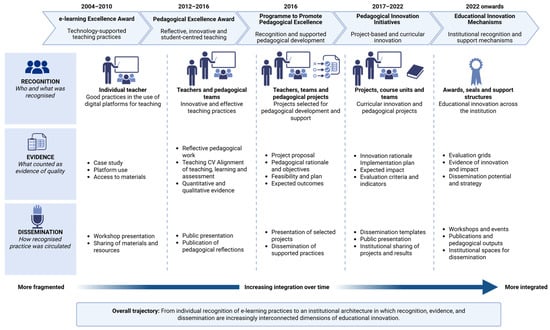
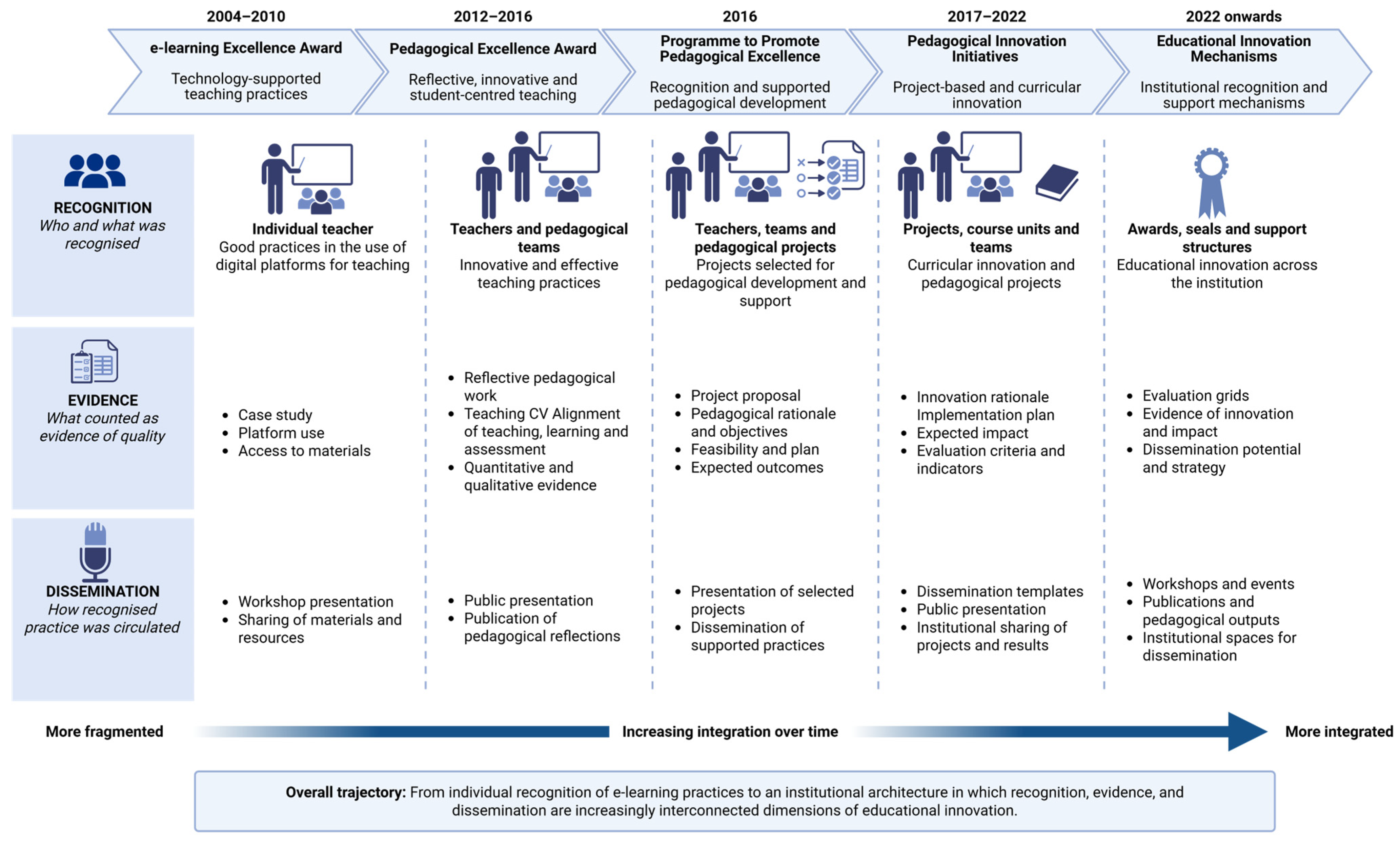

Disclaimer/Publisher’s Note: The statements, opinions and data contained in all publications are solely those of the individual author(s) and contributor(s) and not of MDPI and/or the editor(s). MDPI and/or the editor(s) disclaim responsibility for any injury to people or property resulting from any ideas, methods, instructions or products referred to in the content. |
© 2026 by the authors. Licensee MDPI, Basel, Switzerland. This article is an open access article distributed under the terms and conditions of the Creative Commons Attribution (CC BY) license.