


Abstract
Evidence regarding the relationships among metacognitive awareness, teacher digital competence, science teaching self-efficacy, attitudes toward science, and experimental science anxiety remains limited. The aim of this study was to examine, through a structural equation model, the relationships among metacognitive awareness, teacher digital competence, science teaching self-efficacy, attitudes toward science, and experimental science anxiety, with particular attention to the association between metacognitive awareness and experimental science anxiety in pre-service teachers. The sample comprised 325 undergraduate pre-service teachers enrolled in bachelor’s degree programmes in Early Childhood Education and Primary Education at the University of Jaén. Data were analyzed using structural equation modeling with robust maximum likelihood estimation and bootstrap procedures. The results indicated that metacognitive awareness and teacher digital competence were positively associated with science teaching self-efficacy, which was the strongest predictor of attitudes toward science, explaining 30.1% of their variance. Metacognitive awareness was negatively associated with experimental science anxiety (β = −0.217, p < 0.001). Mediation analyses indicated significant indirect associations through science teaching self-efficacy. In conclusion, the present study may inform the design of initial teacher education programs through the integration of metacognitive awareness, teacher digital competence, and active learning methodologies to strengthen scientific literacy and quality education in experimental science teaching.
1. Introduction
Pre-service teacher education constitutes a fundamental stage in developing the professional competencies required to deliver high-quality teaching and address the educational demands of the twenty-first century [1,2]. Within the field of Experimental Science Education, this stage is particularly important because future teachers must develop not only scientific knowledge but also pedagogical, digital, and personal competencies that enable them to design learning experiences grounded in inquiry, problem solving, critical thinking, and scientific literacy [3,4,5]. Accordingly, examining these factors during initial teacher education is particularly relevant because pre-service teachers are still developing the professional knowledge and competencies required for their future teaching practice. From this perspective, evidence has shown that the quality of science teaching depends on the interaction among disciplinary knowledge, professional competencies, and cognitive and emotional factors that influence both teaching practice and students’ learning [6,7]. Among these factors, emotional variables have received increasing attention because of their associations with motivation, academic achievement, persistence, and future professional practice among teachers [8,9]. According to the Control-Value Theory of Achievement Emotions, the emotions experienced during learning depend on students’ perceived control over academic tasks and the value they assign to them, thereby significantly influencing their engagement, self-regulation, and academic performance [10]. Within the field of Experimental Science Education, science anxiety has received increasing attention as a domain-specific academic emotion because of its documented associations with scientific learning and future science teaching [11].
Experimental science anxiety is defined as the set of emotional, cognitive, and physiological responses that arise when students are required to learn, assess, or teach scientific content [12]. Empirical evidence has shown that higher levels of anxiety are associated with lower confidence, less favorable attitudes toward science, poorer academic performance, and a reduced willingness to implement experimental teaching methods in future professional practice [13,14,15]. These findings highlight the need to identify the cognitive and professional factors that may contribute to reducing anxiety and strengthening the preparation of future science teachers [11]. In the present study, attitudes toward science and experimental science anxiety are therefore considered distinct affective outcomes: attitudes reflect a more general evaluative orientation toward science and its teaching, whereas anxiety represents a domain-specific emotional response to learning, assessment, and teaching-related scientific demands. Examining them separately allows the model to distinguish between positive attitudinal dispositions and negative emotional responses within pre-service teacher education.
One of these factors is metacognitive awareness, defined as individuals’ knowledge of their own cognitive processes and their ability to plan, monitor, and regulate the strategies they use during learning [16]. In Experimental Science Education, metacognition promotes the understanding of scientific concepts, problem-solving, evidence-based argumentation, and critical reflection on teaching practice, all of which are essential competencies for effective science teaching [17]. Moreover, previous research has shown that higher levels of metacognitive awareness are associated with greater self-regulated learning, better academic performance, and stronger self-efficacy, while also being associated with lower levels of negative emotions by enhancing students’ perceived control over academic tasks [10,18]. In this regard, recent systematic reviews emphasize that the development of metacognitive competencies is one of the fundamental pillars for promoting self-regulated learning and evidence-informed pedagogical decision-making during pre-service teacher education [19,20,21].
At the same time, teacher digital competence has become one of the essential professional competencies required to respond to the digital transformation of education [22]. This competence encompasses the critical, ethical, and pedagogical use of digital technologies to enhance teaching and learning processes [23]. Within Experimental Science Education, the integration of simulations, virtual laboratories, artificial intelligence, digital modeling, and other technological resources expands opportunities to foster experimentation, visualize scientific phenomena, and promote inquiry-based learning [24,25]. Consequently, numerous studies have shown that higher levels of teacher digital competence are associated with greater science teaching self-efficacy, more positive attitudes toward pedagogical innovation, and greater confidence in integrating educational technologies during pre-service teacher education [5,26].
Science teaching self-efficacy is another key factor in understanding the preparation of future teachers. According to Social Cognitive Theory, self-efficacy refers to individuals’ beliefs about their capability to organize and execute the actions required to achieve specific goals [6]. In educational settings, these beliefs influence the selection of instructional strategies, effort, persistence, pedagogical innovation, and commitment to teaching [27]. In particular, the available evidence indicates that higher levels of science teaching self-efficacy are associated with greater use of active teaching methodologies, more positive attitudes toward science, and lower levels of anxiety about teaching science [28,29,30,31]. Furthermore, longitudinal studies and meta-analyses have shown that self-efficacy can be strengthened through training experiences based on active learning methodologies, STEAM programs, and successful mastery experiences during pre-service teacher education, establishing it as one of the strongest predictors of teachers’ professional development [32]. In addition, some studies suggest that self-efficacy may play a mediating role between different teaching competencies and attitudes toward science, although this relationship remains underexplored in pre-service teacher education [4].
Previous research has examined several of these relationships separately, including associations between metacognitive awareness and self-efficacy, teacher digital competence and science teaching self-efficacy, and science teaching self-efficacy and attitudes toward science. Thus, much of the available evidence has focused on individual or pairwise associations rather than examining these constructs simultaneously within a single structural model, particularly among students enrolled in Early Childhood Education and Primary Education teacher education programs. Likewise, the potential mediating role of science teaching self-efficacy in the relationships between metacognitive awareness, teacher digital competence, and attitudes toward science remains insufficiently explored. This gap limits a comprehensive understanding of the statistical pathways linking cognitive and digital competencies with positive attitudes toward science, as well as the association between metacognitive awareness and experimental science anxiety during pre-service teacher education [4,7].
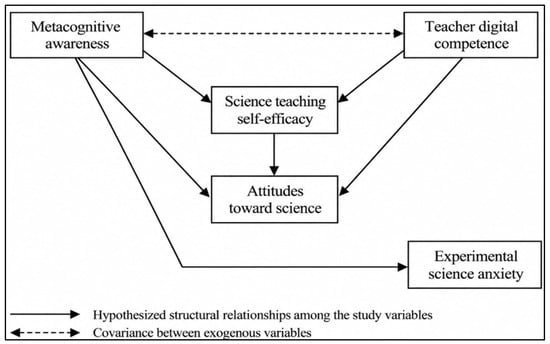
The proposed relationships are also theoretically directional. Accordingly, the proposed structural model specified metacognitive awareness and teacher digital competence as exogenous predictors of science teaching self-efficacy and attitudes toward science, with science teaching self-efficacy also specified as a predictor and mediator of attitudes toward science. Metacognitive awareness was additionally specified as a predictor of experimental science anxiety. Metacognitive awareness and teacher digital competence are considered resources that may be associated with stronger science teaching self-efficacy, whereas stronger science teaching self-efficacy may be associated with more favorable attitudes toward science. Accordingly, the model examines both the direct associations of metacognitive awareness and teacher digital competence with attitudes toward science and their indirect associations through science teaching self-efficacy. This specification is consistent with Social Cognitive Theory, in which self-efficacy beliefs are understood as important determinants of individuals’ engagement, effort, persistence, and behavioral choices [6,27]. Given the cross-sectional design of the study, however, these theoretically specified directions are interpreted as hypothesized associations rather than causal relationships.
In contrast, experimental science anxiety is examined specifically in relation to metacognitive awareness. Although teacher digital competence and science teaching self-efficacy could plausibly be associated with anxiety, these direct paths are not specified in the present model because the study focuses on metacognitive awareness as a cognitive self-regulatory resource that may help pre-service teachers manage the cognitive and emotional demands associated with experimental science. Thus, the absence of direct paths from teacher digital competence and science teaching self-efficacy to experimental science anxiety reflects the theoretically delimited scope of the proposed model rather than an assumption that such associations are impossible. The proposed model therefore contributes by integrating cognitive, digital, motivational, and emotional domains within a theoretically delimited structural framework, allowing the mediating role of science teaching self-efficacy to be examined specifically in relation to attitudes toward science while considering experimental science anxiety as a distinct affective outcome.
To extend the existing evidence and advance the understanding of the factors that promote effective science teaching during pre-service teacher education, the aim of the present study is to examine, through a structural equation model, the relationships among metacognitive awareness, teacher digital competence, science teaching self-efficacy, attitudes toward science, and experimental science anxiety, with particular attention to the association between metacognitive awareness and experimental science anxiety in pre-service teachers. In addition, the mediating role of science teaching self-efficacy in the relationships between metacognitive awareness and attitudes toward science, as well as between teacher digital competence and attitudes toward science, was investigated.
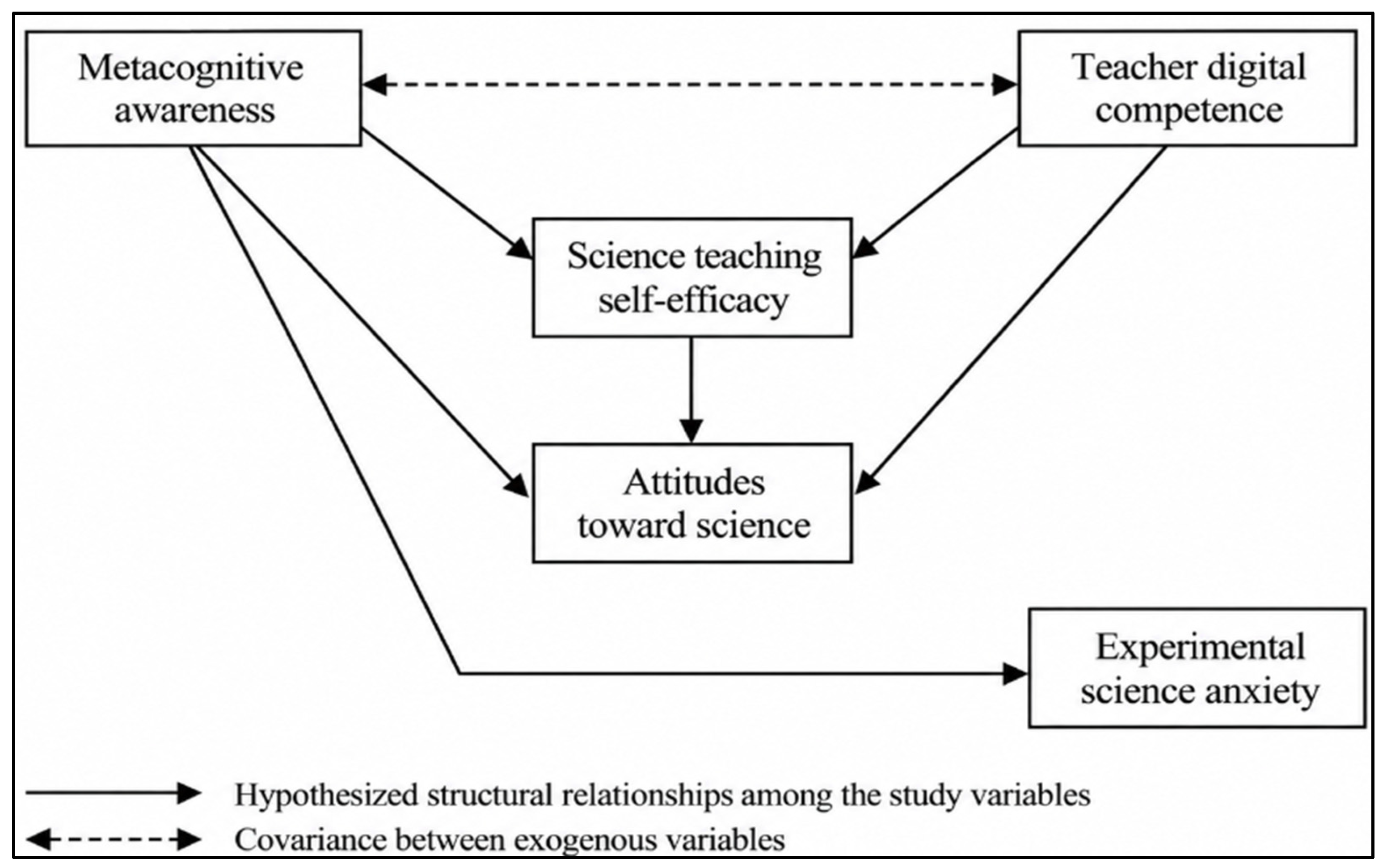
Based on the existing literature, the following research hypotheses (Figure 1) were proposed:
Figure 1.
Proposed conceptual model.
H1.
Metacognitive awareness and teacher digital competence are positively associated with science teaching self-efficacy.
H2.
Science teaching self-efficacy, metacognitive awareness, and teacher digital competence are positively associated with attitudes toward science, whereas metacognitive awareness is negatively associated with experimental science anxiety.
H3.
Science teaching self-efficacy mediates the associations between metacognitive awareness and attitudes toward science and between teacher digital competence and attitudes toward science.
2. Materials and Methods
2.1. Study Design
This study employed a quantitative cross-sectional observational design, which does not permit causal inference, following the recommendations of the Strengthening the Reporting of Observational Studies in Epidemiology (STROBE) guidelines for observational studies [33]. Participants were recruited using a convenience sampling strategy based on their availability and willingness to participate in the study. Eligibility was based on enrolment in the Bachelor’s degree programme in Early Childhood Education or Primary Education and voluntary participation in the study. No additional formal inclusion or exclusion criteria were established.
2.2. Participants
The sample consisted of 325 undergraduate pre-service teachers enrolled in Bachelor’s degree programmes in Early Childhood Education and Primary Education at a university in Jaén, Spain. The participants had a mean age of 21.05 years (SD = 2.79), ranging from 18 to 40 years. Regarding their degree program, 87 students (26.8%) were enrolled in the Early Childhood Education program, whereas 238 (73.2%) were enrolled in the Primary Education program. The sample comprised 69.5% women (n = 226) and 30.5% men (n = 99). The distribution of participants according to degree program and academic year is presented in Table 1. The higher representation of pre-service teachers enrolled in the Primary Education program reflected their greater availability during the data-collection period.
Table 1.
Distribution of participants by teacher education program and academic year.
A convenience sampling approach was used. The sample comprised pre-service teachers who were available during the data-collection period and voluntarily agreed to participate. Eligibility required enrolment in the Bachelor’s degree programme in Early Childhood Education or Primary Education. No additional formal inclusion or exclusion criteria were established. The response rate was 100%.
Regarding academic year, the sample included 76 first-year pre-service teachers, 79 second-year pre-service teachers, 140 third-year pre-service teachers, and 30 fourth-year pre-service teachers. The participant cohort used in the present study was also included in a previous publication by the authors [34]. That study addressed the development and psychometric validation of the Brief Science Teaching Self-Efficacy Scale for Pre-Service Teachers (BSTSES-PST), whereas the present study addresses a different research question by examining the structural relationships among metacognitive awareness, teacher digital competence, science teaching self-efficacy, attitudes toward science, and experimental science anxiety.
2.3. Measures
First, sociodemographic information was collected using a brief ad hoc questionnaire. The variables included gender, age, degree program (Early Childhood Education or Primary Education), and academic year.
To assess science teaching self-efficacy, the BSTSES-PST was used. This scale was previously developed and psychometrically validated specifically for pre-service teachers [34] and was used in the present study as an established measure rather than being subjected to further psychometric validation. Its content was therefore designed to assess science teaching self-efficacy within the context of initial teacher education, making it appropriate for participants who may have limited independent teaching experience. The instrument consists of eight items rated on a five-point Likert scale, where 1 = strongly disagree, 2 = disagree, 3 = neither agree nor disagree, 4 = agree, and 5 = strongly agree. Sample items include “When students achieve better results in science, it is usually because the teacher has found more effective ways to teach” and “Effective science teaching can improve students’ academic achievement”.
Metacognitive awareness was assessed using the Spanish short version of the Metacognitive Awareness Inventory (MAI-SP) [35]. The instrument consists of 19 items distributed across two dimensions: knowledge of cognition and regulation of cognition. Participants responded using a five-point Likert scale ranging from 1 (not at all typical of me) to 5 (very typical of me). Sample items include “I know how to determine which information is most important to learn” and “I stop and go back over information that I have not understood clearly”.
Teacher digital competence was assessed using the Teacher Digital Competence Scale [26]. The scale comprises 50 items distributed across five dimensions: (1) information and data literacy, (2) communication and collaboration, (3) digital content creation, (4) safety, and (5) problem solving. Participants rated their level of knowledge on a seven-point Likert scale ranging from 1 (minimum level of knowledge) to 7 (maximum level of knowledge). The scale assesses pre-service teachers’ perceived competence across a range of digital resources and skills. Sample items include “Strategies for searching, locating, and selecting information in different formats (e.g., text, video)” and “Tools for designing assessment tests”.
Attitudes toward science were assessed using the Attitudes Toward Science in Pre-Service Teachers Questionnaire [36]. The instrument comprises 24 items organized into four dimensions: image of science, attitudes toward the environment, school science, and science teaching. These dimensions assess participants’ perceptions of the contribution of science and technology to social well-being, the role of science in addressing environmental problems, previous experiences with science learning during compulsory education, and attitudes toward science teaching in Early Childhood and Primary Education. The first three dimensions were derived from the ROSE (Relevance of Science Education) questionnaire developed by Schreiner and Sjøberg [37] and were subsequently adapted and validated for the Spanish context by Vázquez et al. [38]. Responses were recorded on a four-point Likert scale ranging from 1 (strongly disagree) to 4 (strongly agree), with higher scores indicating more positive attitudes toward science and science teaching. Sample items include “Science and technology are important for society” and “Science and technology will provide better opportunities for future generations”.
Experimental science anxiety was assessed using the Brief Experimental Sciences Anxiety Scale for Pre-Service Teachers (BESAS-PST [15]), an adaptation and validation of the Brief Scientific Anxiety Scale (BSAS) [12] for the context of pre-service teacher education. The scale consists of nine items organized into two dimensions: science learning anxiety and science evaluation anxiety. Participants responded by imagining the situations described in each item and indicating the level of anxiety they would experience on a five-point scale: 1 = no anxiety, 2 = mild anxiety, 3 = moderate anxiety, 4 = considerable anxiety, and 5 = high anxiety. Sample items include “I feel anxious when preparing or completing Experimental Science assignments during my teacher education program” and “I become nervous when learning new Experimental Science content for Early Childhood or Primary Education”.
All instruments used in the present study were selected on the basis of previous evidence of validity and their suitability for pre-service teacher education, with all of them having been previously validated or adapted to the Spanish context of pre-service teacher education.
2.4. Procedure
Data were collected during participants’ regular class sessions after they had been informed about the objectives of the study, the voluntary nature of their participation, and the confidentiality of the information provided. Before completing the questionnaire, all participants provided informed consent. Participation was voluntary, and the response rate was 100%.
The questionnaire was accessed via a QR code that directed participants to a survey hosted on the Google Forms platform. To ensure participants’ anonymity, no personally identifiable information was collected. The questionnaire required approximately 15–20 min to complete. The study focused on pre-service teachers because the research questions concerned the development and interrelationships of cognitive, digital, motivational, attitudinal, and emotional factors during initial teacher education. As participants were still completing their initial professional preparation, their responses were interpreted within the context of pre-service teacher education rather than independent teaching practice.
2.5. Data Analysis
For the structural analyses, a composite score was calculated for each construct by averaging the corresponding item responses. Higher scores therefore represented higher levels of metacognitive awareness, teacher digital competence, science teaching self-efficacy, positive attitudes toward science, and experimental science anxiety. Composite scores were used in accordance with the scoring structure and recommendations of the respective validated instruments. Although several instruments comprise multiple dimensions, the present study used their total scores because the research hypotheses concerned the relationships among the overarching constructs rather than associations involving individual dimensions. This approach also allowed the structural model to remain focused on the theoretical relationships specified among the five study constructs while avoiding an unnecessary increase in the number of parameters and paths.
Before testing the study hypotheses, the quality of the dataset was assessed by identifying missing values and computing descriptive statistics (means, standard deviations, minimum and maximum values, skewness, and kurtosis) for all study variables. In addition, bivariate correlations were calculated using Pearson’s correlation coefficient, and the internal consistency of each scale was assessed using Cronbach’s alpha [39] and McDonald’s omega, with values of 0.70 or higher considered indicative of acceptable reliability [40]. The proposed theoretical model was then tested using structural equation modeling (SEM) based on observed composite scores and implemented in the lavaan package [41].
The structural model specified direct paths from metacognitive awareness and teacher digital competence to science teaching self-efficacy; from science teaching self-efficacy, metacognitive awareness, and teacher digital competence to attitudes toward science; and from metacognitive awareness to experimental science anxiety. Metacognitive awareness and teacher digital competence were allowed to covary as exogenous variables. No direct paths from teacher digital competence or science teaching self-efficacy to experimental science anxiety were specified. Model parameters were estimated using the Robust Maximum Likelihood (MLR) estimator, which provides robust standard errors (SEs) and a chi-square (χ2) statistic corrected for potential departures from multivariate normality [42]. No missing data were identified in the dataset; therefore, all participants were included in the analyses.
Overall model fit was evaluated using multiple complementary fit indices: the chi-square statistic (χ2), the Comparative Fit Index (CFI), the Tucker–Lewis Index (TLI), the Root Mean Square Error of Approximation (RMSEA) with its 90% confidence interval, and the Standardized Root Mean Square Residual (SRMR). Following the recommendations of Hu and Bentler [43] and Kline [42], model fit was considered acceptable when CFI and TLI values were ≥0.95, RMSEA was ≤0.06, and SRMR was ≤0.08. Standardized path coefficients (β), their standard errors (SEs), z values, 95% confidence intervals, and corresponding p values were estimated for all structural relationships specified in the model. In addition, coefficients of determination (R2) were calculated for the endogenous variables to assess the proportion of variance explained by the model.
Finally, the mediating role of science teaching self-efficacy was examined by estimating direct, indirect, and total effects using a nonparametric bootstrap procedure with 5000 bootstrap resamples. Bias-corrected and accelerated (BCa) 95% bootstrap confidence intervals were computed, and indirect effects were considered statistically significant when the corresponding confidence interval did not include zero. Statistical significance was set at p < 0.05 for all analyses.
All statistical analyses were performed using R version 4.6.1 [44].
2.6. Ethical Considerations
The study was approved by the Ethics Committee of the University of Jaén (Reference No. CH-251030/FEB.PRY) and was conducted in accordance with the ethical principles of the Declaration of Helsinki [45]. Throughout the study, voluntary participation, participant confidentiality, and the appropriate handling of all information provided by participants were ensured.
3. Results
3.1. Descriptive Statistics, Reliability, and Correlations
Table 2 presents the descriptive statistics and distributional characteristics of the study variables. Metacognitive awareness had a mean of 68.79 (SD = 10.928), with observed values ranging from 39 to 95, a skewness of 0.026, and a kurtosis of −0.246. Teacher digital competence had a mean of 227.58 (SD = 40.349), with observed values ranging from 73 to 343, a skewness of.045, and a kurtosis of 0.551. Science teaching self-efficacy had a mean of 30.03 (SD = 4.379), with observed values ranging from 19 to 40, a skewness of 0.140, and a kurtosis of −0.415.
Table 2.
Descriptive statistics, and distributional characteristics of the study variables.
Attitudes toward science had a mean of 76.54 (SD = 9.843), with observed values ranging from 48 to 96, a skewness of 0.172, and a kurtosis of −0.247. Finally, experimental science anxiety had a mean of 24.37 (SD = 7.707), with observed values ranging from 9 to 45, a skewness of −0.049, and a kurtosis of −0.222. On the other hand, the internal consistency analyses indicated that all instruments used in the present study showed satisfactory internal consistency. Cronbach’s alpha coefficients ranged from 0.84 to 0.93, and McDonald’s omega coefficients ranged from 0.84 to 0.93 across all study variables. For science teaching self-efficacy specifically, both Cronbach’s alpha and McDonald’s omega were 0.84, supporting the internal consistency of the BSTSES-PST in the present sample. All reliability coefficients exceeded the recommended threshold of.70, indicating adequate internal consistency for all measures (Table 3).
Table 3.
Internal consistency of the instruments used in the present study.
The correlation analyses revealed positive and statistically significant associations between metacognitive awareness and attitudes toward science (r = 0.41, p < 0.01), science teaching self-efficacy (r = 0.38, p < 0.01), and teacher digital competence (r = 0.42, p < 0.01), whereas metacognitive awareness was negatively associated with experimental science anxiety (r = −0.21, p < 0.01) (Table 4).
Table 4.
Bivariate correlations among metacognitive awareness, attitudes toward science, science teaching self-efficacy, teacher digital competence, and experimental science anxiety.
3.2. Structural Equation Model
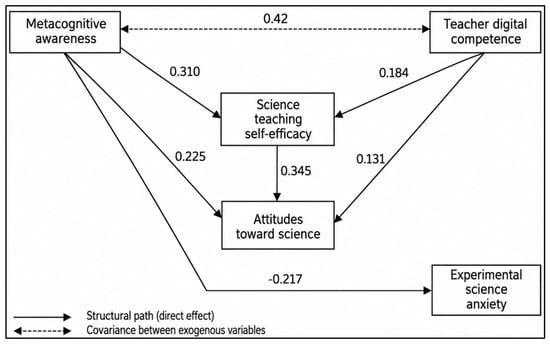
To test the proposed theoretical model, a structural equation model (SEM) was estimated using robust maximum likelihood (MLR) estimation. The model showed very good overall fit to the observed covariance structure, χ2(3) = 1.74, p = 0.420, CFI = 0.99, TLI = 0.99, RMSEA = 0.02, 90% CI [0.000, 0.105], and SRMR = 0.017. Although the point estimate of RMSEA indicated close fit, its confidence interval was relatively wide, likely reflecting the model’s low degrees of freedom. Metacognitive awareness and teacher digital competence showed a positive association (r = 0.42, p < 0.01), represented as the covariance between the two exogenous variables in Figure 2.
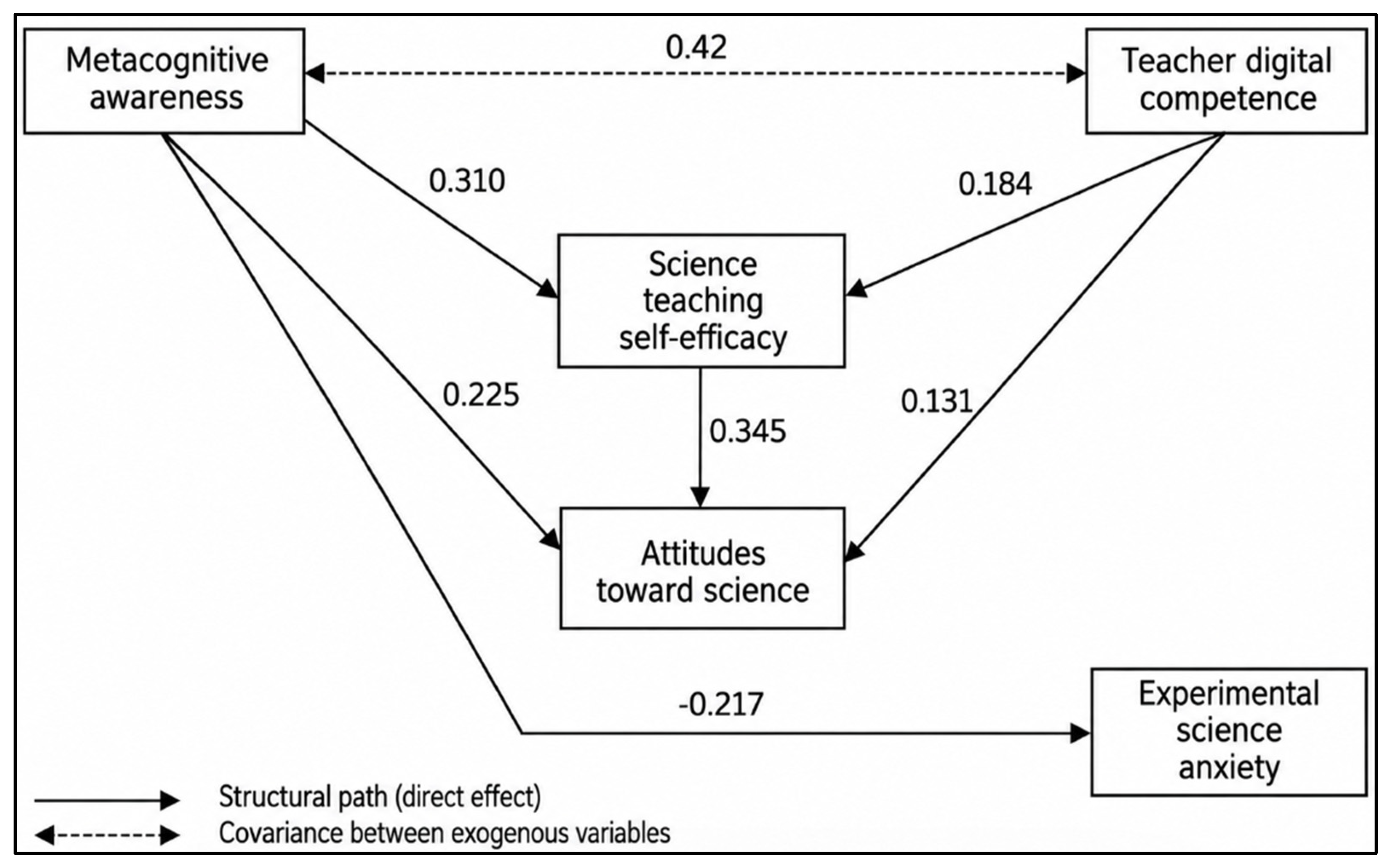
Figure 2.
Final structural equation model with standardized path coefficients. Values represent standardized path coefficients (β). The dashed line represents the covariance between the exogenous variables. All structural regression paths shown in the figure were statistically significant (p < 0.05).
Metacognitive awareness showed the strongest standardized association with science teaching self-efficacy (β = 0.310, p < 0.001), whereas teacher digital competence was also positively and significantly associated with this variable (β = 0.184, p = 0.002), although with a smaller standardized coefficient. Together, these variables explained 17.8% of the variance in science teaching self-efficacy (R2 = 0.178; 17.8%).
Regarding attitudes toward science, science teaching self-efficacy showed the strongest standardized association with attitudes toward science (β = 0.345, 95% CI [0.251, 0.440], p < 0.001). In addition, metacognitive awareness showed a significant positive association with attitudes toward science (β = 0.225, 95% CI [0.122, 0.328], p < 0.001), whereas teacher digital competence exhibited a weaker but still statistically significant positive association (β = 0.131, 95% CI [0.024, 0.238], p = 0.016). Collectively, these variables explained 30.1% of the variance in attitudes toward science (R2 = 0.301; 30.1%). The standardized path coefficients, standard errors, and test statistics for the direct effects are presented in Table 5.
Table 5.
Standardized path coefficients of the structural model.
Furthermore, metacognitive awareness was significantly and negatively associated with experimental science anxiety (β = −0.217, p < 0.001), indicating that higher levels of metacognitive awareness were associated with lower levels of anxiety. The model explained 4.7% of the variance in experimental science anxiety (R2 = 0.047; 4.7%).
3.3. Indirect Effects
To examine the mediating role of science teaching self-efficacy, indirect effects were estimated using a bootstrap procedure with 5000 resamples. The mediation analyses indicated that science teaching self-efficacy was involved in significant statistical mediating pathways between metacognitive awareness and attitudes toward science, as well as between teacher digital competence and attitudes toward science (Table 6).
Table 6.
Indirect and total effects.
Specifically, the indirect effect of metacognitive awareness on attitudes toward science through science teaching self-efficacy was positive and statistically significant (β = 0.135, p < 0.001, 95% CI [0.085, 0.193]). Similarly, teacher digital competence showed a positive and statistically significant indirect association with attitudes toward science through science teaching self-efficacy (β = 0.068, p = 0.004, 95% CI [0.025, 0.117]). Regarding the total effects, metacognitive awareness showed a significant positive total effect on attitudes toward science (β = 0.332, p < 0.001, 95% CI [0.220, 0.442]). Teacher digital competence also demonstrated a significant positive total effect, although of smaller magnitude (β = 0.195, p = 0.002, 95% CI [0.073, 0.316]).
4. Discussion
The results obtained in the present study provided statistical support for the three proposed hypotheses and evidenced an integrative model in which cognitive, digital, motivational, and emotional factors were statistically interrelated within pre-service teacher education. The main contribution of the present study lies in examining these constructs simultaneously within a theoretically grounded structural model. In particular, the findings identified two statistical mediation pathways involving science teaching self-efficacy in the associations of metacognitive awareness and teacher digital competence with attitudes toward science, while also identifying a negative association between metacognitive awareness and experimental science anxiety. These findings extend the existing evidence, which has largely been limited to bivariate or partial associations among these variables, and provide a more comprehensive understanding of the relationships among cognitive, digital, motivational, and emotional factors associated with science teaching during initial teacher education [4,7].
The results obtained support H1, showing that both metacognitive awareness and teacher digital competence were positively associated with science teaching self-efficacy. These findings are consistent with Bandura’s Social Cognitive Theory [6], which proposes that self-efficacy beliefs develop through the interaction of personal capabilities, learning experiences, and perceived competence in managing complex tasks. The use of the BSTSES-PST is particularly relevant in this context because the instrument was specifically developed and psychometrically validated for pre-service teachers [34], rather than being transferred from a population of practicing teachers. In the present sample, its internal consistency was also satisfactory, providing additional evidence that the measure functioned reliably among students undergoing initial teacher education.
From this perspective, greater metacognitive awareness may be related to greater perceived control over academic tasks and stronger confidence in teaching science, as pre-service teachers with greater metacognitive awareness may report greater perceived control over their learning processes and stronger confidence in teaching science. This interpretation is consistent with the findings of Aguada et al. [17], who emphasized that formulating investigable questions and engaging in systematic reflection on inquiry processes are fundamental strategies for developing scientific thinking. It is also supported by recent reviews by Karlen and Dignath [20] and Trautwein et al. [21], which identify self-regulation and metacognition as key predictors of professional learning and development in teacher education. Similarly, the positive association between teacher digital competence and science teaching self-efficacy suggests that proficiency in educational technologies represents a professional competence that extends beyond mere technical expertise. The pedagogical use of simulations, virtual laboratories, artificial intelligence, and other digital resources may facilitate the design of more active, reflective, and inquiry-based learning experiences, while potentially contributing to pedagogical knowledge and pre-service teachers’ professional confidence [25,26]. These findings are consistent with recent reviews indicating that the pedagogically meaningful integration of digital technologies is associated with self-regulated learning, metacognitive reflection, and the development of professional teaching competence when grounded in clearly defined educational objectives [19,24].
With respect to H2, the findings indicate that science teaching self-efficacy is the strongest statistical predictor of attitudes toward science, whereas metacognitive awareness and teacher digital competence showed additional positive associations with attitudes toward science. Metacognitive awareness was also negatively associated with experimental science anxiety. These findings reinforce the growing body of evidence identifying self-efficacy as one of the principal factors associated with motivation, persistence, and willingness to implement innovative teaching methodologies in science education [4,6,28]. They are also consistent with recent studies showing that higher levels of self-efficacy are associated with more positive attitudes toward science teaching and greater confidence in dealing with complex classroom situations during teacher preparation and teaching practice [30,31,32]. Importantly, the negative association between science teaching self-efficacy and experimental science anxiety has also been reported previously in this participant cohort [34]. However, this previously reported association was not specified as a structural path in the present model. The present study therefore extends this evidence by examining experimental science anxiety alongside metacognitive awareness within a broader multivariable structural model.
The negative association observed between metacognitive awareness and experimental science anxiety is particularly noteworthy. This finding can be interpreted in light of Pekrun’s Control-Value Theory [10], which posits that academic emotions largely depend on students’ perceived control over learning tasks. From this perspective, pre-service teachers with higher levels of metacognitive awareness may perceive greater control over their learning, which could be associated with lower levels of academic anxiety. This interpretation is consistent with previous research suggesting that reducing science anxiety requires simultaneously strengthening cognitive and motivational resources [11] and that self-efficacy is one of the main protective factors against anxiety associated with science teaching [13]. Similarly, Megreya and Al-Emadi [12] have reported that science anxiety influences both academic and professional decision-making, highlighting the importance of addressing these factors during initial teacher education.
The key novel contribution of the present study is the identification of statistical mediation pathways involving science teaching self-efficacy in the associations of metacognitive awareness and teacher digital competence with attitudes toward science. This represents an important contribution, as it indicates that both variables are related to attitudes toward science through direct and indirect statistical pathways involving science teaching self-efficacy. These findings are broadly consistent with Bandura’s [6] theoretical framework regarding the role of self-efficacy in linking personal capabilities with professional behavior, while extending this perspective by simultaneously integrating cognitive, digital, and emotional variables into a single explanatory model. In contrast to previous studies primarily focused on correlational analyses [4,7], the present study provides evidence regarding the statistical pathways linking cognitive, digital, and motivational factors with attitudes toward science teaching.
From an educational perspective, these findings have important implications for initial teacher education. The results suggest that the preparation of pre-service teachers should not focus exclusively on the acquisition of scientific knowledge but should also consider learning experiences that incorporate the development of metacognitive awareness, teacher digital competence, and science teaching self-efficacy. In this regard, Experimental Science Education courses within initial teacher education could incorporate learning experiences based on scientific inquiry, authentic problem-solving, the design of instructional sequences, the pedagogical use of digital technologies, and systematic reflection on teaching practice. Recent evidence indicates that these types of experiences are associated with self-efficacy, professional competence, and positive attitudes toward science teaching [19,24,28,31].
Despite these contributions, the present study has several limitations. First, the cross-sectional design precludes causal inferences regarding the relationships among the variables examined. Future research should therefore employ longitudinal and experimental designs to investigate the development of these processes throughout university teacher education and during the early years of professional practice. Second, the study was conducted at a single Spanish university, limiting the generalizability of the findings to other educational contexts. Furthermore, all variables were assessed using self-report instruments, which may increase the risk of biases associated with subjective perceptions and common method variance. In addition, the convenience sampling strategy and the unequal representation of students across degree programs may limit the generalizability of the findings. Although the sample included participants from different degree programs and academic years, the present study was not designed to compare these subgroups; therefore, the analyses were conducted on the full sample. Nevertheless, the psychometric properties of the instruments were adequate in the overall sample, supporting their use in the present study.
Finally, future research should extend the proposed model by incorporating variables that are particularly relevant to Experimental Science Education, such as pedagogical content knowledge (PCK), teacher professional identity, inquiry-based science teaching, self-regulated learning, and the educational integration of artificial intelligence. It would also be valuable to examine the stability of the model through longitudinal designs and cross-cultural comparisons involving different universities and educational contexts, thereby providing a deeper understanding of the processes underlying the development of professional competence among future science teachers.
5. Conclusions
The present study provides empirical evidence of an integrative pattern of statistical associations among metacognitive awareness, teacher digital competence, science teaching self-efficacy, attitudes toward science, and experimental science anxiety among pre-service teachers enrolled in Early Childhood Education and Primary Education teacher education programs. The findings reveal a pattern of statistical associations in which science teaching self-efficacy is involved in the relationships between metacognitive awareness, teacher digital competence, and attitudes toward science. The findings contribute to a more comprehensive understanding of the relationships among cognitive, digital, motivational, and emotional factors in pre-service teacher education by integrating these variables within a structural model.
The findings indicate significant indirect effects of metacognitive awareness and teacher digital competence on attitudes toward science, with science teaching self-efficacy as the mediating variable in both pathways. Furthermore, the negative relationship between metacognitive awareness and experimental science anxiety indicates that higher levels of metacognitive awareness are associated with lower levels of experimental science anxiety.
In sum, initial teacher education should move beyond approaches focused exclusively on the acquisition of scientific knowledge or technological competencies. In this regard, these findings may inform teacher education approaches that incorporate opportunities to develop metacognitive awareness, teacher digital competence, and science teaching self-efficacy through active learning methodologies, including scientific inquiry, systematic reflection on teaching practice, and authentic teaching experiences. Such approaches may be relevant to the preparation of pre-service teachers as they develop confidence in their teaching abilities and commitment to high-quality science education and meaningful learning in experimental sciences.
Author Contributions
Conceptualization, J.G.S.-S., and D.A.-R.; methodology, J.G.S.-S., R.Q.L., and D.A.-R.; software, J.G.S.-S.; validation, J.G.S.-S. and D.A.-R.; formal analysis, J.G.S.-S.; investigation, J.G.S.-S., R.Q.L., and D.A.-R.; resources, J.G.S.-S. and D.A.-R.; data curation, J.G.S.-S., and D.A.-R.; writing—original draft preparation, J.G.S.-S.; writing—review and editing, J.G.S.-S. and D.A.-R.; visualization, J.G.S.-S., and D.A.-R.; supervision, D.A.-R.; project administration, J.G.S.-S., and D.A.-R. All authors have read and agreed to the published version of the manuscript.
Funding
This research received no external funding.
Institutional Review Board Statement
The study was conducted in accordance with the Declaration of Helsinki, and approved by the Ethics Committee of the University of Jaén (Reference CH-251030/FEB.PRY), approved on 9 March 2026.
Informed Consent Statement
Informed consent was obtained from all subjects involved in the study.
Data Availability Statement
The data presented in this study are available upon reasonable request from the corresponding author. They are not publicly available due to ethical and privacy restrictions.
Acknowledgments
This study was supported by the MCIN/AEI/10.13039/501100011033 and ERDF/EU under Grant PID2024-156176OB-I00.
Conflicts of Interest
The authors declare no conflicts of interest.
References
- Darling-Hammond, L. Powerful Teacher Education: Lessons from Exemplary Programs; Jossey-Bass: San Francisco, CA, USA, 2006. [Google Scholar]
- European Commission. Supporting Teacher and School Leader Careers: A Policy Guide; Publications Office of the European Union: Luxembourg, 2020; Available online: https://op.europa.eu/en/publication-detail/-/publication/2d8bc92f-6d13-11eb-aeb5-01aa75ed71a1 (accessed on 15 June 2026).
- Bybee, R.W. The Case for STEM Education: Challenges and Opportunities; NSTA Press: Arlington, VA, USA, 2013. [Google Scholar]
- Gordon, D.; Blundell, C.; Mills, R.; Bourke, T. Teacher self-efficacy and reform: A systematic literature review. Aust. Educ. Res. 2023, 50, 801–821. [Google Scholar] [CrossRef] [Scilit]
- Wiegand, S.; Borromeo, R. Promoting pre-service teachers’ professionalism in STEAM education and education for sustainable development through mathematical modelling activities. ZDM Math. Educ. 2023, 55, 1269–1282. [Google Scholar] [CrossRef] [Scilit]
- Bandura, A. Self-Efficacy: The Exercise of Control; W. H. Freeman: New York, NY, USA, 1997. [Google Scholar]
- Jiang, H.; Chugh, R.; Zhai, X.; Wang, K.; Wang, X. Longitudinal analysis of teacher self-efficacy evolution during a STEAM professional development program: A qualitative case study. Humanit. Soc. Sci. Commun. 2024, 11, 1162. [Google Scholar] [CrossRef] [Scilit]
- Camacho-Morles, J.; Slemp, G.R.; Pekrun, R.; Loderer, K.; Hou, H.; Oades, L.G. Activity achievement emotions and academic performance: A meta-analysis. Educ. Psychol. Rev. 2021, 33, 1051–1095. [Google Scholar] [CrossRef] [Scilit]
- Pekrun, R. The control-value theory of achievement emotions: Assumptions, corollaries, and implications for educational research and practice. Educ. Psychol. Rev. 2006, 18, 315–341. [Google Scholar] [CrossRef] [Scilit]
- Pekrun, R. Emotions and Learning; International Academy of Education: Brussels, Belgium, 2014. [Google Scholar]
- Burns, E.C.; Grabau, L. Editorial: Exploring sources and mitigation strategies for science anxiety in educational contexts. Front. Psychol. 2025, 16, 1674790. [Google Scholar] [CrossRef] [Scilit]
- Megreya, A.M.; Al-Emadi, A.A. The impacts of math anxiety, science anxiety, and gender on arts versus sciences choices in Qatari secondary schools. PeerJ 2023, 11, e14510. [Google Scholar] [CrossRef] [Scilit]
- Galimova, E.G.; Prokopyev, A.I.; Aytuganova, J.I.; Zakharova, V.L.; Shindryaeva, N.N.; Kolomoets, E.N. Examining the relationships among anxiety associated with teaching science, interest in science, and self-efficacy. Eurasia J. Math. Sci. Technol. Educ. 2024, 20, em2447. [Google Scholar] [CrossRef] [Scilit]
- Jiang, Z.; Tang, X.; Tan, L.; Su, R.; Wei, B. STEM identity and STEM career intention: A meta-analysis. Int. J. STEM Educ. 2025, 12, 57. [Google Scholar] [CrossRef] [Scilit]
- Soriano-Sánchez, J.G.; López, R.Q.; Airado-Rodríguez, D. Adaptation and Validation of a Scale of Anxiety Toward Experimental Sciences in Pre-Service Teachers: Implications for the Teaching of Experimental Sciences. Educ. Sci. 2026, 16, 741. [Google Scholar] [CrossRef] [Scilit]
- Schraw, G.; Dennison, R.S. Assessing metacognitive awareness. Contemp. Educ. Psychol. 1994, 19, 460–475. [Google Scholar] [CrossRef] [Scilit]
- Aguada, M.R.; Pipitone, C.; Marbà, A. Aprender a formular preguntas investigables en la formación inicial del profesorado de educación primaria. Rev. Eureka Enseñ. Divulg. Cienc. 2023, 20, 2601. [Google Scholar] [CrossRef] [Scilit]
- Michalsky, T. Metacognitive scaffolding for preservice teachers’ self-regulated design of higher order thinking tasks. Heliyon 2024, 10, e24280. [Google Scholar] [CrossRef] [Scilit]
- Fahrni, D.D.D.; Iten, G.; Prasse, D.; Hascher, T. Teachers’ practices in the use of digital technology to promote students’ self-regulated learning and metacognition: A systematic review. Teach. Teach. Educ. 2025, 165, 105150. [Google Scholar] [CrossRef] [Scilit]
- Karlen, Y.; Dignath, C. A systematic review of teachers’ knowledge of self-regulated learning and its assessment. Educ. Psychol. Rev. 2026, 38, 101. [Google Scholar] [CrossRef] [Scilit]
- Trautwein, U.; Eberhart, J.; Dignath, C.; Bonner, C.V.; Roberts, B.W. Self-regulation competence as a superpower: An integrated framework for K–12. Educ. Psychol. Rev. 2026, 38, 95. [Google Scholar] [CrossRef] [Scilit]
- UNESCO. Global Education Monitoring Report 2023: Technology in Education—A Tool on Whose Terms? UNESCO: Paris, France, 2023; Available online: https://unesdoc.unesco.org/ (accessed on 17 June 2026).
- Redecker, C. European Framework for the Digital Competence of Educators: DigCompEdu; Publications Office of the European Union: Luxembourg, 2017. [Google Scholar] [CrossRef]
- Kuhn, C.; Depré, K.; Zlatkin-Troitschanskaia, O.; Reichert-Schlax, J. Using digital tools in teacher education for fostering instructional competence among (pre-service) teachers. Z. Erzieh. 2025, 28, 1389–1411. [Google Scholar] [CrossRef] [Scilit]
- Pocalana, G.; Robutti, O.; Ciartano, E. Resources and praxeologies involved in teachers’ design of an interdisciplinary STEAM activity. Educ. Sci. 2024, 14, 333. [Google Scholar] [CrossRef] [Scilit]
- Hernández-Ramos, J.P.; Sánchez-Prieto, J.C. La formación inicial y su impacto en la competencia digital de los futuros docentes. Educ. Knowl. Soc. 2025, 26, e31933. [Google Scholar] [CrossRef] [Scilit]
- Tschannen-Moran, M.; Hoy, A.W. Teacher efficacy: Capturing an elusive construct. Teach. Teach. Educ. 2001, 17, 783–805. [Google Scholar] [CrossRef] [Scilit]
- Ibourk, A.; Mathis, C. Developing preservice elementary teachers’ self-efficacy toward teaching science. Int. J. Sci. Educ. 2024, 47, 656–679. [Google Scholar] [CrossRef] [Scilit]
- Mohammed, S.M.; Luguterah, A.W. Exploration of science teaching self-efficacy outside professional development context for inquiry-based teaching. Cogent Educ. 2024, 11, 2377840. [Google Scholar] [CrossRef] [Scilit]
- Stepanović Ilić, I.; Peixoto, F.; Dabić, M.; Videnović, M.; Castro, J.; Ferreira, N.; Monteiro, V. Construction of a scale measuring primary teachers’ self-efficacy to teach STEAM: The STEAM-TSES. Front. Educ. 2025, 9, 1519327. [Google Scholar] [CrossRef] [Scilit]
- Toma, R.B.; Yánez-Pérez, I.; Meneses-Villagrá, J.Á. Measuring self-efficacy beliefs in teaching inquiry-based science and the nature of scientific inquiry. Sci. Educ. 2025, 34, 3347–3363. [Google Scholar] [CrossRef] [Scilit]
- Zhou, X.; Shu, L.; Xu, Z.; Padrón, Y. The effect of professional development on in-service STEM teachers’ self-efficacy: A meta-analysis of experimental studies. Int. J. STEM Educ. 2023, 10, 37. [Google Scholar] [CrossRef] [Scilit]
- Vandenbroucke, J.P.; von Elm, E.; Altman, D.G.; Gøtzsche, P.C.; Mulrow, C.D.; Pocock, S.J.; STROBE Initiative. Strengthening the Reporting of Observational Studies in Epidemiology (STROBE): Explanation and Elaboration. Epidemiology 2007, 18, 805–835. [Google Scholar] [CrossRef] [Scilit]
- Soriano-Sánchez, J.G.; Quijano, R.; Sastre, S.; Airado-Rodríguez, D. Brief Science Teaching Self-Efficacy Scale for Pre-Service Teachers: Educational Implications of Science Teaching Self-Efficacy in Relation to Anxiety Toward Experimental Sciences, STEAM Familiarity, and Academic Achievement. Educ. Sci. 2026, 16, 1132. [Google Scholar] [CrossRef] [Scilit]
- González-Cabañes, E.; García, T.; Álvarez-García, D.; Fernández, E.; Rodríguez, C. Validation of the shortened version of the Metacognitive Awareness Inventory in Spanish university students. Psicothema 2022, 34, 454–462. [Google Scholar] [CrossRef] [Scilit]
- Mazas, B.; Bravo, B. Actitudes hacia la ciencia del profesorado en formación de Educación Infantil y Educación Primaria. Profesorado 2018, 22, 329–348. [Google Scholar] [CrossRef] [Scilit]
- Schreiner, C.; Sjøberg, S. Sowing the Seeds of ROSE: Background, Rationale, Questionnaire Development and Data Collection for ROSE (The Relevance of Science Education): A Comparative Study of Students’ Views of Science and Science Education; University of Oslo, Department of Teacher Education and School Development: Oslo, Norway, 2004. [Google Scholar]
- Vázquez, Á.; Acevedo, J.A.; Manassero, M.A.; Acevedo, P. Actitudes del alumnado sobre ciencia, tecnología y sociedad, evaluadas con un modelo de respuesta múltiple. Rev. Electrón. Investig. Educ. 2006, 8, 1–37. Available online: http://redie.uabc.mx/vol8no2/contenido-vazquez2.html (accessed on 15 June 2026).
- Cronbach, L.J. Coefficient alpha and the internal structure of tests. Psychometrika 1951, 16, 297–334. [Google Scholar] [CrossRef] [Scilit]
- Hair, J.F.; Hult, G.T.M.; Ringle, C.M.; Sarstedt, M. A Primer on Partial Least Squares Structural Equation Modeling (PLS-SEM), 3rd ed.; Sage: Thousand Oaks, CA, USA, 2022. [Google Scholar]
- Rosseel, Y. lavaan: An R package for structural equation modeling. J. Stat. Softw. 2012, 48, 1–36. [Google Scholar] [CrossRef] [Scilit]
- Kline, R.B. Principles and Practice of Structural Equation Modeling, 5th ed.; Guilford Press: New York, NY, USA, 2023. [Google Scholar]
- Hu, L.; Bentler, P.M. Cutoff criteria for fit indexes in covariance structure analysis: Conventional criteria versus new alternatives. Struct. Equ. Model. 1999, 6, 1–55. [Google Scholar] [CrossRef] [Scilit]
- R Core Team. R: A Language and Environment for Statistical Computing; Version 4.6.1; R Foundation for Statistical Computing: Vienna, Austria, 2026; Available online: https://www.R-project.org/ (accessed on 25 June 2026).
- World Medical Association. World Medical Association Declaration of Helsinki: Ethical Principles for Medical Research Involving Human Subjects. JAMA 2013, 310, 2191–2194. [Google Scholar] [CrossRef] [Scilit]

Disclaimer/Publisher’s Note: The statements, opinions and data contained in all publications are solely those of the individual author(s) and contributor(s) and not of MDPI and/or the editor(s). MDPI and/or the editor(s) disclaim responsibility for any injury to people or property resulting from any ideas, methods, instructions or products referred to in the content. |
© 2026 by the authors. Licensee MDPI, Basel, Switzerland. This article is an open access article distributed under the terms and conditions of the Creative Commons Attribution (CC BY) license.