


Abstract
Reflection can contribute to learning, helping students actively and constructively recall material and connect it with other aspects of their lives, as described by the interactive–constructive–active–passive (ICAP) framework. For engineering students in particular, reflection may support the lifelong learning required throughout one’s professional career. This study focused on weekly reflection journals implemented in two junior-level and senior-level civil and environmental engineering courses, investigating (i) how engagement with this activity impacted student learning and (ii) students’ views on reflection. Students offered perspectives using optional pre- and post-surveys, while course grades and direct assessment of journal engagement provided insight into impacts on learning. In both courses, students who engaged more consistently with the journal activity saw a small but positive impact on their learning independent of previous academic performance, while those in the senior-level course whose entries exhibited more constructive levels of engagement also saw a positive impact. In post-surveys, students stated journals helped them to review, identify areas of confusion, and ask questions. Most survey respondents highly rated the journal’s impact on learning, although some found greater value in other, more structured activities. Accordingly, the reflection journal may function effectively as one of multiple options for conceptual engagement.
1. Introduction
Reflection is a critical element in learning and contextualizing new knowledge, as evidenced, for example, by its prominent place in frameworks such as Kolb’s Experiential Learning Cycle [1] and by several studies that have considered reflection within the Interactive–Constructive–Active–Passive (ICAP) framework [2,3,4,5,6]. From a synthesis of various definitions offered in the scientific literature surrounding STEM education, reflection is an active, systematic, and persistent cognitive process that helps students to critically examine their existing knowledge, beliefs, and assumptions in the context of new experiences and ideas [5,7]. This description aligns with the constructivist pedagogical tradition, in which students actively construct new knowledge by relating it to existing knowledge and navigating the resulting cognitive dissonance, enabling them to effectively retain and apply what they are learning [8,9]. The negotiation between existing and new information that can occur during reflection stimulates meta-cognition, creating opportunities for students to monitor what and how they are learning, as well as identify areas of confusion and gaps in proficiency [4,10]. Furthermore, the connections students draw can reveal how the material they are learning relates to their own lives and interests, helping to increase the perceived value of this new knowledge [11].
These qualities make reflection an important element in self-regulated and lifelong learning, which literature has identified as a critical professional skill for engineers [7,10,12]. In recent years in particular, there is increased emphasis on the roles engineers can play in addressing large-scale grand challenges, related to issues such as sustainability and climate change, in collaboration with diverse stakeholders [7,13]. The complexities associated with such an endeavor necessitate a reflective process capable of integrating new information and interrogating pre-existing assumptions [7]. However, the literature suggests that many engineering curricula have not explicitly taught or implemented reflection practices [10].
Much of the existing research on reflection at the collegiate level has focused mainly on non-engineering students or engineering students early in their college career (e.g., first-year students), sometimes employing laboratory settings rather than actual classroom conditions [4,6,14]. However, studies on reflection in engineering courses do exist. The relatively few studies implemented in technically rigorous, upper-level undergraduate engineering courses have generally explored various types of reflection activities that build on the Kolb experiential learning cycle (e.g., reflection-in-action, reflection-on-action, and reflection-for-action), often linked to specific experiential learning scenarios (e.g., laboratory exercises) [12,15,16,17]. For example, Rover et al. [12] implemented reflection at the assignment level (e.g., pre-lab assignments and post-lab feedback forms) and at the course level (e.g., students identified challenges encountered across a series of exercises) in electrical and computer engineering courses. Separately, Barroso & Morgan [15] considered the use of reflective essays, with prompts incorporating different levels of detail, to elicit student perspectives on active and cooperative learning activities in structural engineering courses. In both cases, the studies examined the content of reflections and discussed how instructors perceived the resulting effects on student experience, but, in my understanding, they did not directly assess impacts on student learning and performance in the courses.
Another strand of research on reflection in engineering education has focused on the ICAP framework [2,3,4,5,6], which identifies different levels of student engagement (interactive, constructive, active, and passive) that can contribute to learning. These studies mainly occurred in introductory engineering courses and focused on regular, individual reflections after each class session, where students commented on what they felt was and was not going well, areas of confusion, and topics of special interest [4,5,6]. Individual reflection activities typically fall within the “active” or “constructive” categories of the ICAP framework. As defined in the framework, students engaged in “active” learning are doing something themselves, beyond passively receiving information from an instructor, to assimilate, activate, or search knowledge within the bounds of class content. Activities in this category might include copying problem solutions (rather than simply watching the instructor work the solution), highlighting information while reading, or performing a matching task [2,5,6]. Students engaged in “constructive” activities go beyond the boundaries of the class to develop, infer, integrate, or organize additional information and knowledge in new ways [2,3]. This category might include taking notes that interpret and build connections between concepts (rather than simply listening to a lecture passively), drawing concept maps, independently solving a problem that integrates multiple topics, asking questions, generating hypotheses, or comparing and contrasting different cases [2,5,6]. The highest level of the ICAP framework is “interactive,” where multiple students engage in constructive activities collaboratively. The ICAP framework’s hypothesis is that higher levels of engagement lead to more effective learning [2,3,5], which, for the case of individual reflection, would suggest that constructive reflection activities may be more valuable than active ones [5]. While ICAP studies, including those focused specifically on reflection activities, have tested this hypothesis by directly assessing impacts on student learning, they have observed mixed results [4,5,6].
This research builds on the previous work done on reflection in engineering courses within the context of the ICAP framework, maintaining the focus on regular, individual reflection activities that may represent “active” or “constructive” levels of engagement. However, whereas previous studies predominantly explored guided reflections after each class session in introductory courses, this research implemented weekly reflection journals in two technically rigorous upper-level civil and environmental engineering courses. The journal offered each student the freedom to engage in a regular and relatively open-ended reflective practice that could fall within the active and/or constructive levels of the ICAP framework, depending on the student’s approach throughout the semester. Accordingly, this research investigated the following research questions:
- (i)
- Do students’ participation and level of engagement with the reflection journal activity impact their learning, as represented by academic performance in the course?
- (ii)
- How does the reflection journal activity affect students’ perspectives on the value and role of reflection in learning?
I hypothesized that the act of making regular, thoughtful entries in reflection journals would improve student learning (as measured by overall course grades and exam scores), especially if a student’s entries embodied constructive rather than active engagement (consistent with the ICAP hypothesis). I also hypothesized that students would see benefits to their learning from regular reflection, leading them to see greater value in reflective practice and consider employing similar strategies in the future.
2. Materials and Methods
This study incorporated multiple quantitative and qualitative methodologies, which will be described in detail below, after a summary of the course context and the attributes of the reflection journal activity. Briefly, associations between journal engagement and academic performance (overall course grades and exam scores) enabled me to explore the potential impact of reflection on student learning, while I assessed student perspectives through pre- and post-surveys conducted at the beginning and end of the semester. Especially given the relatively limited sample size offered by the two study courses, this combination of techniques allowed for triangulation, reducing possible biases associated with single methods and enabling deeper exploration of findings [9].
2.1. Course Context
This study focused on the implementation of reflection journals in two primarily undergraduate civil and environmental engineering courses at a large private university in the northeastern United States. The two courses included: (i) an introductory course on fluid mechanics required for both civil engineering and environmental engineering majors, typically taken during the junior year (referred to hereafter as the “junior-level course”); and (ii) a course on air quality and pollution, required for environmental engineering majors and typically taken in the senior year (“senior-level course”).
I was the instructor for both courses during the fall semester of the 2025–2026 academic year, when the study occurred. During this semester, 55 students were enrolled in the junior-level course, most of whom were junior civil engineering majors, and 30 students were enrolled in the senior-level course, most of whom were senior environmental engineering majors (Table 1). The senior-level course is open to graduate students and undergraduate civil engineering majors as an elective, and it is also cross-listed as an elective in chemical engineering. Graduate students typically only take the junior-level course if they enter the graduate program without a bachelor’s degree in engineering. While I filled the roles of both instructor and researcher, I endeavored to minimize research bias by keeping these two roles as separate as possible through informed consent, data collection, and data analysis procedures, as described below.
Table 1.
Summary of student makeup within the two engineering courses in this study. In the senior-level course, one student was a dual civil and environmental engineering major. The table counts this student in both major categories. All surveys were anonymous, and students who completed the post-surveys did not necessarily also complete pre-surveys.
2.2. Ethical Review and Informed Consent
The Institutional Review Board at the university where the study was conducted reviewed and authorized it as exempt research (IRB #25-121). All students in the two courses were offered an opportunity to read a summary of the study and provide written informed consent to participate during the first week of the semester, and they were free to withdraw their consent at any point. Consent forms were sealed until the completion of the entire 2025–2026 academic year, to ensure students did not feel pressure to participate. Because I did not know which students provided affirmative consent during the semester, I tracked journal engagement for every student in both courses. However, only the data from the students who provided consent were included when performing data analysis, which occurred after the end of the academic year.
2.3. Summary of the Reflection Journal
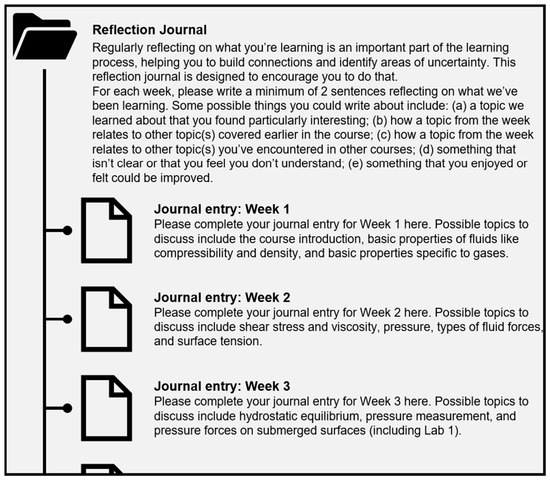
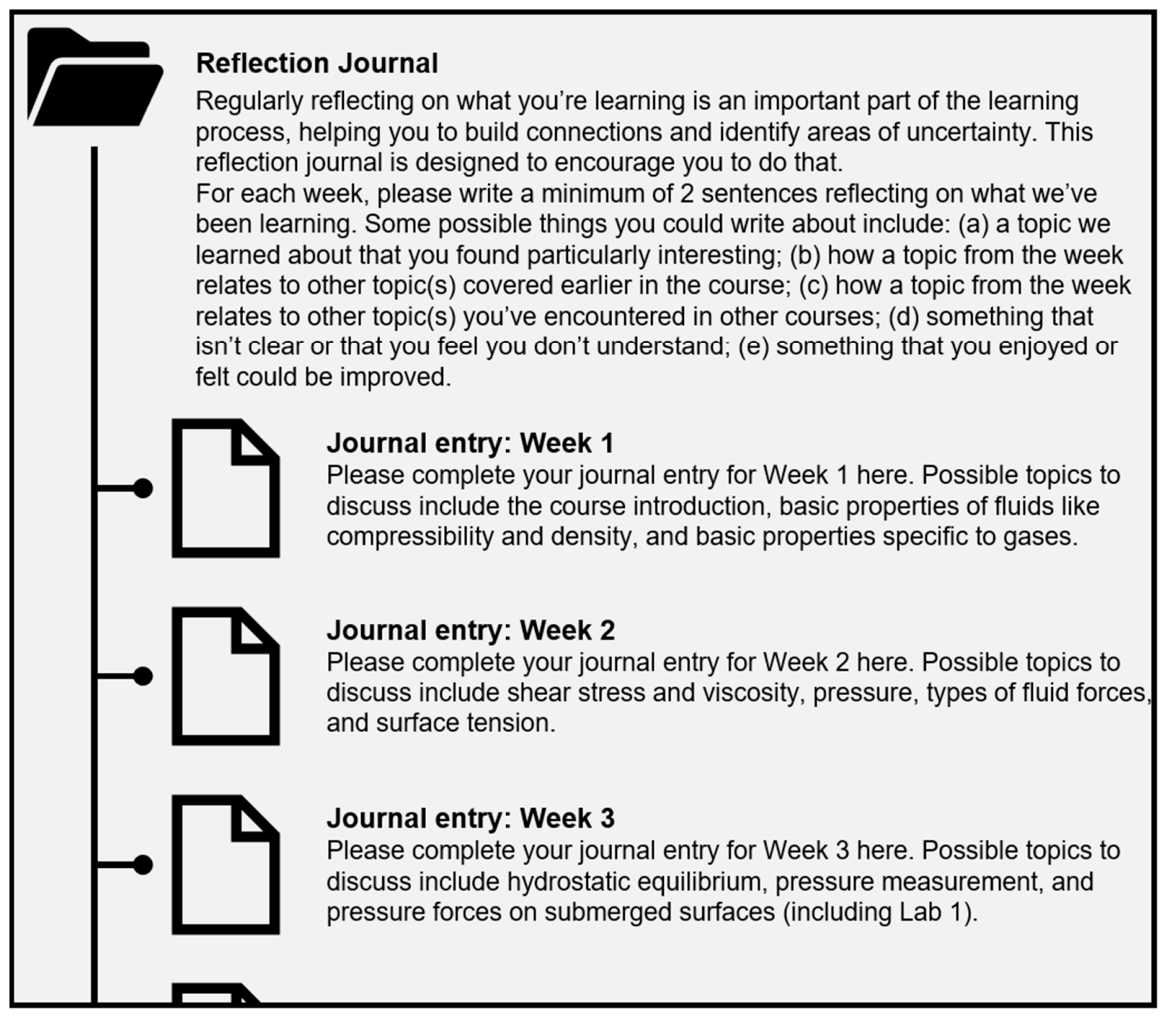
In both courses, students completed weekly reflection journal entries throughout the semester. Each weekly entry was completed online as a separate assignment, appearing within a “reflection journal” folder in the course’s learning management system (LMS). The folder description provided a general prompt summarizing the purpose of the reflection journal and broad guidance for completing entries. Within the folder, each weekly journal assignment included a specific prompt that listed topics covered during that week of the course, providing students with a starting point for their entries (Figure 1). In total, the junior-level course included 13 weekly journal entry assignments, while the senior-level course included 12 assignments. Entries were not assigned in weeks that did not cover new material (for example, one week of the senior-level course included only a mid-term exam review and the mid-semester break). Journal entries accounted for a small portion of the overall course grade (5% in each course), with entries being graded solely for completion. A student’s entries were not accessible to other students in the class.
Figure 1.
The structure of the reflection journal in each course’s online learning management system. A folder contained separate journal entry assignments for each week in the course, with each assignment becoming visible to the student at the beginning of the relevant week. The folder itself included general guidance, while each specific assignment listed topics from that week of the course. The example assignments shown in the figure reflect the first three weeks of the junior-level course.
The structure of the reflection journal activity described above included a few adjustments made after piloting the journal during the previous academic year. During the pilot, the journals were a single item in the online LMS, and students were responsible for adding new entries to this journal each week. Based on student feedback, I restructured the journal to be a sequence of separate weekly assignments within a folder in the online LMS (as shown in Figure 1). This change made it easier for students to keep track of deadlines, removing that cognitive load so they could focus more on journal entry content. It also allowed me to include class topics from the week in each assignment prompt, with the hope that this would encourage students to think more deeply about those topics, rather than simply listing what we covered.
As the instructor, I read all students’ entries during the following week, sometimes adding responses visible to the student, especially if they asked a question or provided feedback on the class. For research purposes, I also used a rubric to rate the engagement level of each entry on a scale of 1 to 4 (Table 2). This scale represented a spectrum of active and constructive engagement as defined by the ICAP framework, following an approach similar to Menekse et al. [2,6]. Those studies judged reflections to be deeper and of higher quality when they included specific details and made connections across multiple concepts, often making them more unique than statements simply reiterating single concepts from class [5,6]. In the scale I used, a score of 1 corresponded to active engagement (e.g., reiteration of concepts or discussion of applications covered in class), a 4 represented constructive engagement (e.g., synthesis across topics or relevant applications beyond those covered in class), while scores of 2 or 3 represented mixtures of active and constructive elements. Entries with more constructive elements were rated more highly on the scale, since the ICAP framework hypothesizes that constructive activity may support learning more effectively than active engagement [2,3]. In addition to this engagement rating, I also recorded whether entries contained each of the following:
Table 2.
Rubric for assessing the engagement level of journal entries. Guided by the definitions of “active” and “constructive” within the ICAP framework, I developed the levels, descriptions, and illustrative examples prior to the start of the courses to aid the assessment of journal engagement. All illustrative examples focus on one concept from the junior-level course (Bernoulli’s principle) to show a range of possible journal entries for a single topic. Engagement levels were not shared with students and did not impact their grades in any way.
- Expressions of confusion or uncertainty;
- Questions asking for conceptual clarification;
- Questions asking about real-world application of concepts;
- Positive or negative feedback on the course;
- Mentions of any external factors (beyond the course) affecting the student’s learning.
2.4. Additional Data Collection to Directly Assess Learning Impacts of the Reflection Journal
Beyond the assessment of student journal entries during each week of the semester, I also collected data on academic performance in each course as a representation of student learning. Such data enabled direct analysis of relationships between students’ engagement with the reflection journal activity and their learning. Collected data on academic performance in each course included the following:
- Overall final grades for the semester, excluding the journal component (i.e., the 5% portion of the grade coming from journal entry completion was removed from the calculation, resulting in a new score scaled to 100%);
- Grades on each exam (the junior-level course included three exams, while the senior-level course included two).
Prior to the start of the semester, I also recorded each student’s overall grade point average (GPA, on a 4.0 scale), obtained from the university’s database of student records. A student’s pre-semester GPA provided an overall metric of prior academic performance, which was included as a control in regression models during data analysis [5].
Additionally, students participating in the study had the opportunity to complete optional, anonymous pre-surveys and post-surveys. All surveys were administered online as Google Forms, and participants were not asked to provide any identifying information. The pre-survey was available during the first two weeks of the semester, and it employed open-ended (qualitative) questions and close-ended (e.g., Likert scale [18]) questions to collect student perspectives on the following:
- The types of learning strategies students have typically used to build understanding and retain material;
- Whether they had engaged in reflective activities in previous courses, either as a course requirement or as a self-initiated strategy;
- Their opinions regarding the efficacy of those strategies;
- Their existing familiarity with the topics that will be covered in the present course.
The post-survey was available during the final two weeks of the semester, and it used a similar format to collect the following information:
- Students’ self-reported level of confidence regarding course topics;
- Their general opinions on the reflection journal activity and how it relates to other strategies they have used in the past;
- Factors that hindered or enabled meaningful reflection within the journal activity;
- If and how they plan to modify the learning strategies they employ in future classes based on this experience;
- The perceived importance and role of reflective activities in their professional and personal lives.
Full versions of the surveys are provided in Supplementary Information Text S1 (pre-survey) and Supplementary Information Text S2 (post-survey). Results from both surveys were viewed and downloaded only after the conclusion of the 2025–2026 academic year, to avoid any possible influence on the journal activity during the semester.
2.5. Data Analysis
Primary analyses focused on exploring possible relationships between students’ reflection journal engagement and learning, using the data collected during the semester. The principal metric used to represent learning was a student’s overall grade in the course, with the reflection journal component excluded from the grade calculation. For each course, the overall grade (with reflection journal component excluded) acted as the dependent variable in regression analyses. Beta regression with a logit link, implemented using the betareg package in R (version 4.3.1), was used as the regression model because the dependent variable was constrained from 0 to 100% [19,20]. Initially, unadjusted (bivariate) regression models were used to begin exploring relationships between grades and measured characteristics of reflection journal engagement, including:
- Number of entries completed by the student;
- Average engagement level of the student’s entries (scale of 1–4);
- Proportion of the student’s entries that expressed confusion or uncertainty;
- Proportion of the student’s entries containing a question asking for clarification on a concept from class;
- Proportion of the student’s entries containing a question asking about possible applications of a concept;
- Proportion of the student’s entries containing feedback on the course;
- Proportion of the student’s entries mentioning issues outside of the class that affected learning.
Following these initial models, a multivariate model was constructed that included all journal characteristics listed above (as explanatory variables), as well as students’ pre-semester GPAs to control for overall academic performance.
Beginning with this large multivariate model, I iterated through successively smaller models by sequentially removing the variable with the largest p-value, as long as its p-value was >0.10 in both models [21]. This process kept models for both courses consistent, while also simplifying models to focus only on those parameters with the strongest relationships to student learning. In the final models, all remaining variables had p < 0.10 in at least one course, and all variables had variance inflation factors (VIFs) < 3, signifying low collinearity between variables [22,23]. When interpreting results, following guidance from the American Statistical Association [24], I avoided using a threshold p-value such as 0.05 to make definitive statements of statistical significance, although p-values were still used to aid in interpretation.
After completing these beta regression analyses focused on overall grades, I also developed separate regression models focused on students’ scores on individual exams in each course, to provide possible insight into whether reflection journals had a greater impact on specific topics or portions of the course. To keep models consistent, each regression included the same explanatory variables as the final multivariate models focused on overall grades. However, explanatory variables focused on reflection journal engagement were modified to only include the weeks of the course covered by each exam. For example, the model focused on the first exam in the junior-level course, which occurred at the beginning of week 5, only included information about journal entries from the first four weeks of the course. It is worth noting that this separation reduced the degree to which certain parameters varied in these models, since some exams were linked with only 4–5 weekly journal entries. This circumstance potentially limited the ability of these models to detect statistical trends, especially given the relatively small sample size of participating students in each course.
Pre- and post-surveys were anonymous, so it was not possible to link a student’s responses across both surveys, or with the direct assessment of reflection journal engagement and academic performance. Accordingly, I focused on analyzing data from each survey to complement and provide context for the direct findings associated with journal engagement and learning. Close-ended survey responses (e.g., yes/no and Likert scale questions) were analyzed by computing descriptive statistics (e.g., proportions of responses falling into each category). I assessed differences between groups (e.g., students in the junior-level course vs. the senior-level course) using (i) two-proportion Z-tests [25] to compare categorical and percentage data, and (ii) Mann Whitney U-tests [26] to compare continuous or integer data. The non-parametric Mann Whitney U-test was used due to small sample sizes and non-normality among some distributions of data (such as previous GPA). Due to the particularly small sample sizes in the post-survey data, I also used Fisher’s exact tests [27] to confirm results when comparing categorical data across groups. As this low sample size limited the viability of hypothesis testing to rigorously evaluate trends within the post-survey data, I also used exploratory visualizations to identify possible relationships across responses. Open-ended (qualitative) survey responses were analyzed inductively to identify emergent themes that were commonly expressed by participating students [28], providing a complement to quantitative results.
To help establish adequate separation between my dual roles as course instructor and researcher, all data analysis activities occurred after the conclusion of the entire 2025–2026 academic year. This timetable ensured several months between the end of the two study courses (offered in the 2025 fall semester) and data analysis. Still, it is important to acknowledge that my positioning as an instructor, who hopes the learning activities I design and implement are effective, could contribute to a positive bias toward the impact of the reflection journals. To the extent possible given the limited sample size, I have endeavored to minimize any such bias through the use of clear and reproducible procedures.
3. Results
In both courses, a very similar percentage of students gave informed consent to participate in this study (77–78%; Table 1). All results discussed below include only those students who gave positive informed consent.
3.1. Previous Exposure to Reflection Activities Among Students
The optional pre-surveys, reflecting students’ views at the beginning of the study semester, provided insight into if and how students had previously engaged in reflection activities within an academic context. In total, approximately half of all students in the two courses completed the pre-survey, including 27 students in the junior-level course (49% of all students in the course and 63% of those providing informed consent to participate in the study) and 16 students in the senior-level course (53% of students in the course and 70% of those participating in the study). Especially among the junior class, students reported that previous courses (whether engineering-focused or not) did not typically require or explicitly encourage the use of regular reflection journals (78% of juniors compared to 44% of seniors; two-proportion Z = 3.73, p = 0.053; Table 3). However, larger proportions of juniors (63% compared to 44% of seniors) reported engaging in at least one other type of reflection activity, such as group discussions or written assignments focused on specific class topics (although sample sizes were not sufficient to provide statistical support for this difference: Z = 0.83, p = 0.364). Seniors more frequently reported that previous courses had required reflection journals (44% compared with 7% of juniors, Z = 5.97, p = 0.015), although this result is likely because many of these students had taken my fluid mechanics course in the previous year, when I piloted the reflection journals.
Table 3.
Summarized results from optional, anonymous pre-surveys in both classes. The n-values provided at the top indicate the number of students completing the pre-survey in each class. Most results are shown as the number of students reporting a certain response, followed by the percentage in parentheses. Other results present an average rating on a scale of 1 (not at all) to 5 (extremely), with the calculated average shown first followed by the standard deviation in parentheses. Differences between the courses are assessed using Mann Whitney U-tests (to compare average ratings) and two-proportion Z-tests (for percentage parameters). For each test performed, the test statistic (U or Z) and the p-value are provided.
Despite this exposure among at least some students, no participants reported using reflection journals as their primary study strategy (Table 3). Instead, most students (70%) focused on reviewing in-class examples and homework problems, which is reasonable for engineering students whose exams often focus on calculations and problem solving. Likewise, students who had previous exposure to reflection journals rated them somewhat lower than their primary study strategies with regard to how well they aided learning (Mann Whitney U = 500, p = 0.021). On average, reflection journals received average ratings of approximately 3 on a scale of 1 (not helpful at all) to 5 (extremely helpful), while students gave their primary study strategies an average rating of nearly 4 (Table 3).
Those students who had used reflection journals previously reported a range of experiences, with some highlighting the value of thinking back on the material and identifying areas of uncertainty before moving on to a new topic. According to one senior: “With this approach, I like thinking just (at least) one more time about the previous concepts, and verbalizing my thoughts on strengths and weaknesses on certain topics as we go through them. This way when I go study for an exam or assignment, I know where I should head first in the studying process.” In contrast, different students saw journal assignments as busy work, noting that the activity did not seem to aid their learning, but they also acknowledged that reflection journals may be more valuable to others in the class. For example: “They may be helpful to some. It is not my personal ideal method of relooking at content. It does not impact me the way is does other students in terms of understanding content.”
Finally, it is also worth noting that most students participating in the pre-surveys reported low levels of familiarity with course topics at the beginning of the semester. Students reported average ratings across multiple specific topics of approximately 2.1 on a scale of 1 (not familiar at all) to 5 (extremely familiar), with a negligible difference across courses (U = 219.5, p = 0.939). Accordingly, students in both courses had considerable room to learn and grow throughout the semester.
3.2. Engagement with Reflection Journals
Across both courses, students completed similar fractions (75–80%) of assigned journal entries (Table 4, Z = 1.55, p = 0.212). Typically, entries tended to fall on the lower portion of the engagement scale (ratings 1 or 2), representing active learning practices such as reiteration of conceptual material, potentially with some limited discussion of applications and topic synthesis. Part of one entry, focused on a fundamental fluid mechanics concept from the junior-level course, demonstrates this type of conceptual reiteration: “We learned that pressure increases as the depth below the water surface increases.”
Table 4.
Summary statistics on students in the junior-level and senior-level engineering courses and their engagement with reflection journals. Differences between the courses are assessed using Mann Whitney U-tests (to compare pre-semester GPAs) and two-proportion Z-tests (for percentage parameters). For each test performed, the test statistic (U or Z) and the p-value are provided.
In the senior-level course, journal entries reached higher engagement levels more often. About 10% of entries in the senior-level course, compared to only 2% in the junior-level course, were classified as a 4 on the engagement scale (Table 4; Z = 19.2, p < 0.001), representing high-level synthesis across multiple topics and/or detailed discussion of applications beyond in-class examples. A strong example of this type of entry occurred as a follow-up to an in-class discussion of air pollutants from incomplete combustion. During class, a student asked about the factors that influence the degree to which combustion reactions proceed to completion. After providing a partial answer, I stated that I could not recall all the factors and would get back to the student. The student used that week’s journal entry to do their own research into the question:
“I looked into the factors that influence combustion a bit. It turns out that the air-to-fuel ratio, the degree of mixing in the combustion zone, temperature during combustion, and residence time in the combustion zone are some of the most important factors. Different types of combustion (lean, rich, pre-mixed, etc.) also serve different purposes across industries, such as low burning temperature or increased flame stability. Consequently, these different types of combustion emit pollutants in different ways as well.”
This highly engaged journal entry provided an opportunity for me to respond to the student individually, praising their initiative and offering some additional points that would be useful later in the course, and to review this topic with all students during our next class. Along similar lines, students in the senior-level course asked questions more often, especially concerning how class concepts applied in different contexts (Table 4; Z = 15.7, p < 0.001).
Beyond engaging with the material itself, students also used journals to provide direct feedback on the course, with approximately 10% of entries from both courses including positive or negative feedback. This type of engagement could provide a collective learning benefit for the entire class, by providing the instructor with regular insight into how students are feeling and how the class could be improved before the end of the semester.
3.3. Associations Between Journal Engagement and Learning (Research Question i)
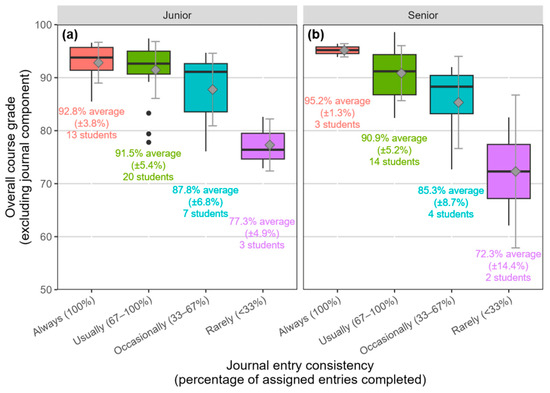
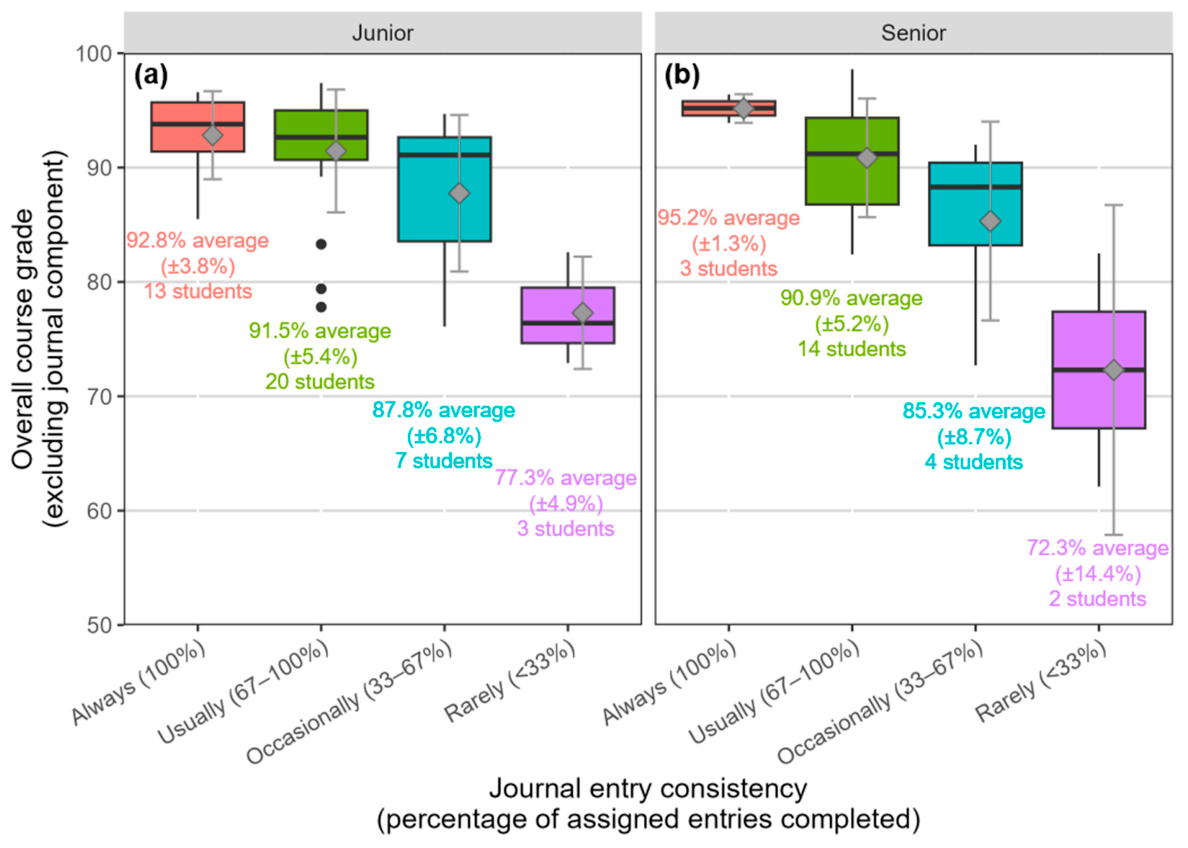
Although on average, students completed 75–80% of assigned journal entries, some fell well outside of this range. Some students completed all entries, while a few rarely participated in the activity. In general, those students who completed more journal entries tended to earn higher course grades, even when excluding the journal component from the grade calculation (Figure 2; unadjusted beta regression coefficient [standard error]: 0.12 [0.02], p < 0.001 for junior-level course; coefficient [standard error]: 0.20 [0.03], p < 0.001 for senior-level course).
Figure 2.
Course grades among students exhibiting varying levels of consistency in completing weekly reflection journal entries in (a) junior-level and (b) senior-level engineering courses. For this analysis, overall course grades were calculated excluding the component associated with journal entry completion. Boxplots show grade distributions for each consistency category, while the slightly offset gray diamonds and error bars represent the average and standard deviation. The text below each boxplot provides the average grade, standard deviation (in parentheses), and number of students in each category.
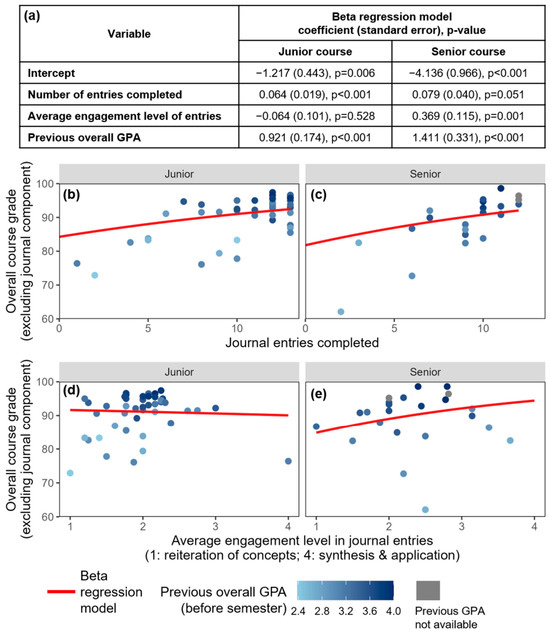
Multivariate beta regression models further explored these relationships between journal engagement and learning, while also controlling for previous academic performance. As described in Section 2, initial models included all measured journal characteristics, as well as students’ overall pre-semester GPA to represent prior academic performance. After sequentially removing explanatory variables with limited associations with the dependent variable (overall course grades, excluding the journal component) from each model iteration (p > 0.10 for both courses), the explanatory variables remaining in the final regression models included the number of journal entries completed, the average engagement level of those entries, and the student’s overall pre-semester GPA (Figure 3).
Figure 3.
Beta regression model results showing relationships between reflection journal engagement and overall grades in junior-level and senior-level engineering courses. Separate regression models were developed for each course, with each model including three explanatory variables: number of weekly journal entries completed by the student throughout the semester, average engagement level of entries (assessed on a scale of 1–4), and previous overall GPA before the course. The course grades used in the models excluded the component associated with journal entry completion. The table summarizes all regression model coefficients (a), while the graphs show how course grades varied with respect to the number of entries completed (b,c) and average engagement level (d,e) in each course. Red curves show beta regression models, computed for visualization purposes using average values of explanatory variables not on the x-axis (engagement level and GPA for (b,c), entries completed and GPA for (d,e)).
Even when controlling for prior academic performance (GPA), completing more assigned journal entries was positively associated with a higher course grade in the junior-level course (Figure 3; regression coefficient [standard error]: 0.064 [0.019], p < 0.001). Students with higher GPAs did still tend to earn higher grades, but the regression model suggested that completing journal entries also played a role. This relationship is less statistically robust in the senior-level course (coefficient [standard error]: 0.079 [0.040], p = 0.051), but it is notable that previous GPAs were unavailable for two students who completed a high number of journal entries and also earned high grades (two gray points in the upper right of Figure 3c). Due to the missing GPA data, these students were not included in the regression analysis. If, instead, these two students were assigned the class’s average GPA so they could be included, the positive relationship between the number of entries and course grades would become much more robust (coefficient [standard error]: 0.105 [0.038], p = 0.006).
Students’ average engagement level also correlated positively with overall grades in the senior-level course (coefficient [standard error]: 0.369 [0.115], p = 0.001; Figure 3), although this relationship was not present in the junior-level course (coefficient [standard error]: -0.064 [0.101], p = 0.528). As mentioned previously, journal entries in the junior-level course tended to fall lower on the engagement scale, likely limiting the potential for any association. On the other hand, entries in the senior-level course showed greater variation in engagement levels. These trends fit with the characteristics of each course, since the junior-level course (fluid mechanics) included quite a bit of new and often conceptually dense material. In this case, relatively straightforward repetition of concepts may have been a valuable approach to solidifying these ideas through journal entries. On the other hand, while the senior-level course included new material as well, it also focused on applying fundamental principles learned earlier in the curriculum to issues in a different setting (e.g., dispersion of pollutants in the atmosphere). Accordingly, using journal entries to engage with the material in more constructive (rather than active) ways may have been especially valuable in this course.
Finally, I also developed beta regression models, using the same set of explanatory variables (number of entries, average engagement level, previous GPA), to consider associations with each individual exam in these courses. Journal entry completion and engagement levels were modified so that these variables only reflected entries from the weeks covered by each exam. From these models, the only clear relationship (beyond associations with previous GPA) occurred between the number of entries completed and the first exam in the junior-level course (coefficient [standard error]: 0.236 [0.077], p = 0.002; Table S1). This first exam covered several foundational concepts (e.g., fluid density, viscosity, and pressure) that were important building blocks for the rest of the course, so establishing a solid understanding of these early concepts was likely valuable throughout the semester. At least in this junior-level course, the reflection journals may have helped to develop that fundamental conceptual knowledge.
3.4. Students’ Views on Reflection After Engaging in This Journal Activity (Research Question ii)
At the conclusion of the semester, relatively few students (30% of study participants in the junior-level course and 48% in the senior-level course) completed optional, anonymous post-surveys. It would not be appropriate to assume that those who completed the post-surveys are representative of all study participants, since, for example, those completing the surveys may have the strongest opinions (positive or negative) on the journal activity. However, their responses still provided valuable complementary information adding context to the results reported previously.
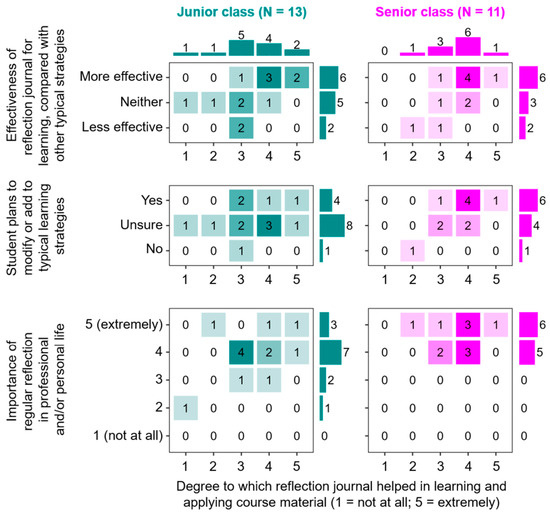
Those completing post-surveys rated the reflection journal activity relatively highly in terms of how much it aided learning (Figure 4). On a scale of 1 (not helpful at all) to 5 (extremely helpful), 46% of participating juniors and 63% of participating seniors rating the journals as a 4 or 5 (any difference in responses between juniors and seniors is not statistically supported, based on results from Fisher’s exact test: p = 0.444). Similar proportions also reported feeling that the journals were more effective than other typical study strategies they have used. Several participants elaborated on how they felt the journals were helpful. Junior-level students tended to focus on the value of repetition and the freedom to speak openly about areas of uncertainty. For example, one junior stated the journal “made it so that I wasn’t constantly losing track of what we were doing. The information was constantly being accessed in my mind. Not only this, but it actually allowed me to communicate weaknesses that I was feeling, instead of suppressing them.” Similarly, another junior noted the journal “opened my eyes up to the fact that I do not know as much as I think I do after I leave from class…I was going back and simply reviewing parts…where I was having trouble, and making sure to note them in the reflection.” Seniors expressed similar benefits, noting the value of repetition outside of class and of identifying ways in which class concepts related to other courses or aspects of their lives. One student stated that it provided an “easily accessible” avenue for asking questions, while also making the semester feel less rushed: “Having dedicated time to look back on a week of material feels very grounding in a positive way, especially since it is something that is not extremely time consuming and rather takes some thought and intention.”
Figure 4.
Summarized and cross-tabulated results of selected questions from optional, anonymous post-surveys in both classes. N-values provided at the top indicate the number of students completing the post-survey in each class. Darker cyan and magenta shading in each matrix indicates more students with the given combination of responses in the junior-level and senior-level course, respectively. Bar graphs along the edges of the matrices summarize responses to the individual survey questions represented by each axis.
Some participants did also note negative aspects of the journal activity. For example, two seniors stated that the journals sometimes felt like busy work, repeating what they already know rather than further building on their knowledge. Four juniors made similar comments, while also mentioning that they found concept checks to be more valuable. Concept checks were a separate activity implemented in both courses, consisting of short, open-note, multiple-choice quizzes implemented in the online LMS. They played a similar role to reflection journals, providing opportunities for students to review and solidify their understanding of key concepts, but with more structure. These statements are especially noteworthy because concept checks were not mentioned in the post-survey questions; the students brought them up themselves, noting they preferred the greater level of structure. On a related note, two seniors mentioned appreciating that the journal prompts provided some structure (by listing topics from the week) and suggested that more detailed prompts might be useful. Generally, these responses suggest students have different preferences regarding the most effective level of structure when reviewing and engaging with conceptual material. Accordingly, the reflection journal’s value likely varied from student to student, depending on the degree to which they were interested and saw value in engaging with a relatively open-ended activity. As one junior concisely stated: “It all really depends on how much effort someone puts into it.”
Participants also reported high levels of confidence in course concepts, with average ratings of 4.04 (standard deviation: 0.84) in the junior-level course and 4.18 (standard deviation: 0.58) in the senior-level course across various specific topics, using a scale of 1 (not confident at all) to 5 (extremely confident). Because these responses were so unbalanced, I could not directly correlate students’ self-reported confidence levels with their opinions on the journals’ value for learning. Similarly, due to the low number of students completing post-surveys overall, statistical tests provided limited information on trends across responses. However, visualization of cross-tabulated data suggested that those who rated the journal activity more highly may have also seen it as being more effective than other strategies and were considering modifying their typical learning strategies (Figure 4). In particular, a majority of senior-level participants reported that they planned to adjust their learning strategies, based on their experience with the journal activity. Again, however, it is important to acknowledge that the small sample size limits the interpretability and generalizability of these possible relationships.
More broadly, large majorities of post survey participants from both classes (77% of juniors and 100% of seniors completing the post-survey) felt reflection to be important in one’s personal and/or professional life, rating it at a 4 or 5 on a scale of 1 (not important at all) to 5 (extremely important). However, it is unclear how much these general opinions related specifically to the reflection journal activity in class. Based on qualitative responses, my sense is that the reflection journals may have opened a few students’ eyes to how regular reflection can promote learning and balance in one’s life. On the other hand, many students already saw reflective practice as being particularly valuable for personal growth and finding meaning in a hectic world [10].
4. Discussion
4.1. The Value of Reflection Journals for Students and Instructors
Based on the analysis of journal engagement and course grades, as well as students’ thoughts in post-surveys at the end of the semester, the weekly reflection journal activity seemed to contribute positively to learning in this study. These results suggest an affirmative answer to research question i, which asked whether engaging with the reflection journal aided student learning. In both courses included in the research, simply making weekly journal entries more consistently was associated with higher overall grades. In other words, the journals had value regardless of whether students’ entries exemplified active or constructive engagement, as defined by the ICAP framework. Particularly in the junior-level course, this engagement appeared to be most helpful with fundamental concepts covered early in the semester, as evidenced by the positive relationship between the number of journal entries completed before the first exam and grades on that exam. Additionally, students noted in surveys that by actively revisiting topics through their entries, they could begin to identify areas where they are confused. Anwar & Menekse similarly noted that student reflection on learning experiences can help identify areas of uncertainty [5].
Students’ opinions, as expressed in post-surveys, broadly aligned with the positive associations identified through statistical analyses. Many survey participants rated the reflection journals highly regarding their contribution to learning, often noting the journals were more effective than other typical learning strategies. Notably, these trends differed from those observed in pre-surveys, where students saw reflection journals as less valuable than other strategies such as reviewing notes, in-class examples, and homework problems. It is possible that engaging in the journal activity during the semester changed students’ perspectives, raising their opinions on the value and role of reflection in learning (research question ii). Alternatively, perhaps students felt the journal was useful specifically in these two courses, harmonizing well with my teaching style, which generally aimed for a balance between conceptual understanding and practical application. However, given the relatively low response rates in the post-survey, it is also possible that students who saw value in the journal activity were overrepresented among survey respondents.
Particularly for those students in the senior-level course who were acquainted with the previous year’s pilot, the current version’s use of more specific weekly prompts listing relevant topics may have helped to improve the value of the journal activity. Previous work has found that students receiving reflection prompts that included specific mention of learning objectives, rather than more general language, performed better on assessments [4]. The researchers hypothesized that specific prompts elicited more constructive reflections that went beyond basic conceptual recall [4], which had been my hope when making modifications after the pilot. However, constructive journal entries were relatively uncommon in both courses (15% of entries in the junior-level course and 33% in the senior-level course rated at an engagement level of 3 or 4; Table 4), and most students’ typical entries fell below constructive engagement (the median student’s average engagement level was 2.0 in the junior-level course and 2.3 in the senior-level course). Accordingly, it is not clear from the current study whether more specific weekly prompts led to more constructive reflections. Rather, listing specific topics in the prompts may have simply encouraged most students to review and engage with those concepts at an active level.
Beyond direct impacts on individual student learning, reflection journals also offered additional benefits from an instructor standpoint. The journals provided frequent informal student feedback in the form of questions, notes of confusion, and opinions about in-class activities. This information allowed me to identify and review difficult concepts and make other adjustments throughout the semester, reflecting an ongoing collaborative feedback model supported by previous research [11,29]. Such a model could have a class-wide impact on learning, including for anyone less engaged in the journal activity, while also providing the opportunity to give individual students iterative constructive feedback in a low-stakes setting [11].
However, some students reported that journals did not feel valuable for their own learning, viewing the required weekly journal entries as extra busy work and preferring other activities with more structure. For engineering students moving through a dense and demanding curriculum, even the addition of relatively small tasks may feel like a considerable burden, especially if the student does not feel the activity aligns with the learning strategies they have previously found effective [10]. Nevertheless, engaging in the journal activity did seem to encourage at least a few students to reexamine their pre-existing beliefs about what learning strategies work well for them. Based on qualitative responses in post-surveys, the reflection journals may have nudged some students to begin trying to engage in regular reflective practice or to incorporate it into more aspects of their lives.
4.2. Mixed Support for the ICAP Hypothesis
Beyond the learning effects of baseline participation with the reflection journal, as measured by the number of entries made throughout the semester, this study’s first research question also concerned students’ level of engagement with the journal activity. Consistent with the general hypothesis of the ICAP framework [2,5], I hypothesized that students engaging at a deeper level (“constructive” rather than “active”) would see greater learning benefits. The results provided partial support for this hypothesis, consistent with previous studies that have shown mixed results [5,6,30]. In the senior-level course, the ICAP hypothesis appeared to hold true: students with higher average journal engagement levels, corresponding to more constructive engagement where students applied and synthesized class concepts, tended to earn higher course grades. This finding agreed with results from Menekse et al., who found a positive correlation between the quality of students’ daily reflections and improvements in knowledge (measured through pre- and post-tests) [6].
However, this relationship between more constructive engagement and higher grades was not present in the junior-level course. The small number of constructive journal entries in this course may have made it especially difficult to find statistical evidence for such a trend. Therefore, rather than providing direct evidence against the ICAP hypothesis, this finding may be more reflective of the fact that the journal activity did not seem to encourage much constructive engagement in the junior-level course. As discussed previously, though, journal engagement below the constructive level did still provide a benefit. At an active level, existing research suggests the repetition and information recall associated with simply thinking again about concepts covered in class can enhance learning and help students to form effective mental models around those concepts [11].
Given these findings, it is possible that individual, open-ended constructive reflection may be more feasible and effective at higher academic levels, as students have additional experience and course knowledge to apply. Prompting students to reflect specifically on how their developing course knowledge can apply outside the classroom may be especially valuable in these settings. However, it is possible that extended prompts designed to guide students toward more constructive engagement, rather than the relatively open-ended instructions provided in the current journal activity, could encourage deeper reflection and greater benefit at earlier academic levels. Group interaction may aid these efforts, as Anwar & Menekse found that team reflections (representing the top of the ICAP framework) were even more effective than individualized constructive engagement among first-year engineering students [5].
4.3. Possible Future Modifications to Reflection Journals
Given the student feedback offered in the post-survey, there may be opportunities to better position the reflection journal activity to promote learning for students in technically focused upper-level courses. In addition to crafting prompts that provide additional guidance toward constructive reflection, as discussed above, a reflection journal may function most effectively as one option within a collection of concept-focused activities, where students have choices in which activities they complete to help them find strategies that work well for their own learning [11]. This approach would align with Universal Design for Learning (UDL) principles, which focus on offering students multiple options for accessing and organizing information, learning, and demonstrating knowledge [31,32]. Along with the reflection journal, the existing concept checks mentioned in some students’ qualitative responses could be another element in this collection, providing an option with greater structure. Potentially, new activities such as photo-journals could also be included for students who might prefer to focus on finding creative ways to identify and show conceptual applications in their daily lives. Students could choose which and how many of each type of activity to complete, with each submission contributing to an overall pool of “concept-focused activity collection” points. The points could be flexibly structured so that students would not need to complete everything for full credit, providing the freedom to try different options and focus on what they feel is most valuable [33].
4.4. Study Limitations
This research has several limitations, which should be considered when interpreting results. First, the study employed a relatively small sample size, focusing on students in two engineering courses during a single semester. The study also lacked a control group for comparison. These factors limited the ability of statistical analyses to identify and explain trends, although the use of multiple quantitative and qualitative methods providing different types of information helped to reduce potential bias and triangulate findings [9]. The fact that data collection occurred across an entire academic semester also likely provided greater insight than data collected at a single point in time [5].
Additionally, this study did not collect students’ demographic data, which could have been used to consider whether the reflection journal affected students with various backgrounds and experiences in different ways. However, the study’s relatively small sample size would have limited any detailed analysis of demographics. This could be a valuable topic to explore in future, larger-scale studies.
Finally, many students in the senior-level course had seen a similar reflection journal in a previous course with me, when I piloted the activity. This fact undoubtedly affected their previous exposure to reflection in academic settings and may have impacted their perspectives on the journal during the study. For example, their opinions may have been shaped more by how the current version compared with the pilot, rather than a pure assessment of the journal’s effect on their learning. A separate, less familiar group of students, or the use of different types of reflection activities such as those linked with Kolb’s Experiential Learning Cycle [12,15,16,17], may have generated distinct results.
5. Conclusions
This study built on previous efforts connecting reflection activities in engineering education to the ICAP framework. While previous work focused mainly on introductory engineering courses, the current research explored the implementation of a weekly reflection journal in two upper-level civil and environmental engineering courses, with a focus on how the activity impacted student learning. Based on a direct analysis of journal entries and course grades, as well as optional pre- and post-surveys conducted at the beginning and end of the semester, students in both courses benefitted from engaging in the activity more consistently and saw it as an effective strategy to aid their learning. Completing journal entries helped students to review concepts, identify areas of uncertainty, ask questions, and offer feedback to the instructor. Overall, the study findings provided mixed support for the ICAP hypothesis that higher engagement levels lead to more effective learning. In the senior-level course, those students whose journal entries exemplified engagement at a higher level of the ICAP framework (constructive rather than active) tended to earn higher grades, supporting the hypothesis. In contrast, engagement level did not appear to play a role in the junior-level course, although this finding may relate to the fact that the reflection journals did not seem to elicit much constructive engagement in the junior-level course. Given feedback from some students expressing a preference for activities with more structure, the reflection journal may function most effectively as one option among a collection of concept-focused activities, providing students with opportunities to choose strategies that align with their preferences for engagement and learning. To provide further support and build on the findings presented here, future studies could test similar reflection journal activities in comparison to alternative reflection techniques (with inclusion of a control group), utilizing a larger sample size across multiple courses and instructors that may enable analysis of impacts across distinct demographic groups.
Supplementary Materials
The following supporting information can be downloaded at https://www.mdpi.com/article/10.3390/higheredu5030071/s1, Text S1: Pre-survey; Text S2: Post-survey; Table S1: Beta regression model results showing relationships between reflection journal engagement and individual exam grades.; Dataset S1: Raw data spreadsheet files of student journal engagement and academic performance, presurvey responses, and postsurvey responses from both courses.
Funding
This research received no external funding.
Institutional Review Board Statement
The study was conducted in accordance with the Declaration of Helsinki. It was reviewed and approved for an exemption by the Syracuse University Institutional Review Board (IRB #25-121, 18 April 2025).
Informed Consent Statement
Informed consent was obtained from all subjects involved in the study.
Data Availability Statement
All de-identified data used in this study are available upon request.
Acknowledgments
I would like to thank all the students in the two courses considered in this study, with appreciation for their willingness to try new things in class, contribute to research into those activities, and offer their candid perspectives. I am also grateful to Neuhaus and Ash Heim for their support and thoughts on study design and analysis.
Conflicts of Interest
The author declares no conflicts of interest.
Abbreviations
The following abbreviations are used in this manuscript:
| GPA | Grade Point Average |
| ICAP | Interactive-Constructive-Active-Passive |
| IRB | Institutional Review Board |
| LMS | Learning Management System |
| STEM | Science, Technology, Engineering, and Math |
| UDL | Universal Design for Learning |
| VIF | Variance Inflation Factor |
References
- Kolb, A.; Kolb, D. Eight Important Things to Know about the Experiential Learning Cycle. Aust. Educ. Lead. 2020, 40, 8–14. [Google Scholar]
- Chi, M.T.H. Active-Constructive-Interactive: A Conceptual Framework for Differentiating Learning Activities. Top. Cogn. Sci. 2009, 1, 73–105. [Google Scholar] [CrossRef] [Scilit]
- Chi, M.T.H.; Wylie, R. The ICAP Framework: Linking Cognitive Engagement to Active Learning Outcomes. Educ. Psychol. 2014, 49, 219–243. [Google Scholar] [CrossRef] [Scilit]
- Menekse, M.; Anwar, S.; Akdemir, Z.G. How Do Different Reflection Prompts Affect Engineering Students’ Academic Performance and Engagement? J. Exp. Educ. 2022, 90, 261–279. [Google Scholar] [CrossRef] [Scilit]
- Anwar, S.; Menekse, M. Unique Contributions of Individual Reflections and Teamwork on Engineering Students’ Academic Performance and Achievement Goals. Int. J. Eng. Educ. 2020, 36, 1018–1033. [Google Scholar]
- Menekse, M.; Stump, G.; Krause, S.J.; Chi, M.T.H. The Effectiveness of Students’ Daily Reflections on Learning in an Engineering Context. In Proceedings of the 2011 ASEE Annual Conference & Exposition, Vancouver, BC, Canada, 26 June 2011; pp. 22.1451.1–22.1451.10. [Google Scholar]
- Turns, J.A.; Sattler, B.; Yasuhara, K.; Borgford-Parnell, J.L.; Atman, C.J. Integrating Reflection into Engineering Education. In Proceedings of the 2014 ASEE Annual Conference & Exposition, Indianapolis, IN, USA, 15 June 2014; pp. 24.776.1–24.776.16. [Google Scholar]
- Kalamas Hedden, M.; Worthy, R.; Akins, E.; Slinger-Friedman, V.; Paul, R.C. Teaching Sustainability Using an Active Learning Constructivist Approach: Discipline-Specific Case Studies in Higher Education. Sustainability 2017, 9, 1320. [Google Scholar] [CrossRef] [Scilit]
- Hartikainen, S.; Rintala, H.; Pylväs, L.; Nokelainen, P. The Concept of Active Learning and the Measurement of Learning Outcomes: A Review of Research in Engineering Higher Education. Educ. Sci. 2019, 9, 276. [Google Scholar] [CrossRef] [Scilit]
- Kövesi, K.; Thomson, G.A.; Barna, O.; Csete, M.S.; Nagy, B.V. A Review of Student Thoughts on Reflective Practice. In Proceedings of the 52nd Annual Conference of the European Society for Engineering Education (SEFI) 2024, Lausanne, Switzerland, 2–5 September 2024. [Google Scholar]
- Barbeau, L.; Happel, C.C. Critical Teaching Behaviors: Defining, Documenting, and Discussing Good Teaching; Routledge: New York, NY, USA, 2023. [Google Scholar]
- Rover, D.T.; Duwe, H.J.; Mina, M.; Fila, N.D.; Jones, P.H.; Sleeth, L.S. Learning and Professional Development Through Integrated Reflective Activities in Electrical and Computer Engineering Courses. In Proceedings of the 2021 IEEE Frontiers in Education Conference (FIE), Lincoln, NE, USA, 13–16 October 2021; pp. 1–9. [Google Scholar]
- National Academies of Sciences, Engineering, and Medicine. Environmental Engineering for the 21st Century: Addressing Grand Challenges; The National Academies Press: Washington, DC, USA, 2019. [Google Scholar]
- Campbell, A.L.; Direito, I.; Mokhithi, M. Developing Growth Mindsets in Engineering Students: A Systematic Literature Review of Interventions. Eur. J. Eng. Educ. 2021, 46, 503–527. [Google Scholar] [CrossRef] [Scilit]
- Barroso, L.R.; Morgan, J. Implementing Reflection in Technical Courses. In Proceedings of the 2014 IEEE Frontiers in Education Conference (FIE) Proceedings, Madrid, Spain, 22–25 October 2014; pp. 1–6. [Google Scholar]
- Mina, M.; Cowan, J.; Fila, N.D.; Theh, W.S. Promoting Graduate and Professional Attributes by Coordinating Kolbian Reflections for Industrial Design and Engineering Students. Proc. Des. Soc. Des. Conf. 2020, 1, 1775–1784. [Google Scholar] [CrossRef] [Scilit]
- Cowan, J. Students’ Evidenced Claims for Development of Abilities Arising from Linked Reflection-on-Action and Reflection-for-Action. Reflective Pract. 2020, 21, 159–170. [Google Scholar] [CrossRef] [Scilit]
- Jebb, A.T.; Ng, V.; Tay, L. A Review of Key Likert Scale Development Advances: 1995–2019. Front. Psychol. 2021, 12, 637547. [Google Scholar] [CrossRef] [Scilit] [PubMed]
- Cribari-Neto, F.; Zeileis, A. Beta Regression in R. J. Stat. Softw. 2010, 34, 1–24. [Google Scholar] [CrossRef] [Scilit]
- Ferrari, S.; Cribari-Neto, F. Beta Regression for Modelling Rates and Proportions. J. Appl. Stat. 2004, 31, 799–815. [Google Scholar] [CrossRef] [Scilit]
- Trimmer, J.; Kisiangani, J.; Odame-Boafo, B.E.; Appavou, L.; Poulin, C.; Osei, D.; Delaire, C.; Bauza, V. Satisfaction and Willingness-to-Pay for Water Services in Rural Northern Ghana: Do We Need Intermediary Steps toward Safely Managed Services? PLoS Water 2026, 5, e0000547. [Google Scholar] [CrossRef] [Scilit]
- Poulin, C.; Trimmer, J.; Press-Williams, J.; Yachori, B.; Khush, R.; Peletz, R.; Delaire, C. Performance of a Novel Machine Learning-Based Proxy Means Test in Comparison to Other Methods for Targeting pro-Poor Water Subsidies in Ghana. Dev. Eng. 2022, 7, 100098. [Google Scholar] [CrossRef] [Scilit]
- O’brien, R.M. A Caution Regarding Rules of Thumb for Variance Inflation Factors. Qual. Quant. 2007, 41, 673–690. [Google Scholar] [CrossRef] [Scilit]
- Wasserstein, R.L.; Schirm, A.L.; Lazar, N.A. Moving to a World Beyond “p < 0.05”. Am. Stat. 2019, 73, 1–19. [Google Scholar] [CrossRef] [Scilit]
- Wooditch, A.; Johnson, N.J.; Solymosi, R.; Medina Ariza, J.; Langton, S. Comparing Two-Sample Means or Proportions. In A Beginner’s Guide to Statistics for Criminology and Criminal Justice Using R; Wooditch, A., Johnson, N.J., Solymosi, R., Medina Ariza, J., Langton, S., Eds.; Springer International Publishing: Cham, Switzerland, 2021; pp. 169–182. [Google Scholar]
- Fay, M.P.; Proschan, M.A. Wilcoxon-Mann-Whitney or t-Test? On Assumptions for Hypothesis Tests and Multiple Interpretations of Decision Rules. Stat. Surv. 2010, 4, 1–39. [Google Scholar] [CrossRef] [Scilit] [PubMed]
- Warner, P. Testing Association with Fisher’s Exact Test. J. Fam. Plan. Reprod. Health Care 2013, 39, 281–284. [Google Scholar] [CrossRef] [Scilit] [PubMed]
- Azungah, T. Qualitative Research: Deductive and Inductive Approaches to Data Analysis. Qual. Res. J. 2018, 18, 383–400. [Google Scholar] [CrossRef] [Scilit]
- Mandouit, L. Using Student Feedback to Improve Teaching. Educ. Action Res. 2018, 26, 755–769. [Google Scholar] [CrossRef] [Scilit]
- Menekse, M.; Stump, G.S.; Krause, S.; Chi, M.T.H. Differentiated Overt Learning Activities for Effective Instruction in Engineering Classrooms. J. Eng. Educ. 2013, 102, 346–374. [Google Scholar] [CrossRef] [Scilit]
- Almeqdad, Q.I.; Alodat, A.M.; Alquraan, M.F.; Mohaidat, M.A.; Al-Makhzoomy, A.K. The Effectiveness of Universal Design for Learning: A Systematic Review of the Literature and Meta-Analysis. Cogent Educ. 2023, 10, 2218191. [Google Scholar] [CrossRef] [Scilit]
- Denial, C.J. A Pedagogy of Kindness; University of Oklahoma Press: Norman, OK, USA, 2024. [Google Scholar]
- Hogan, K.A.; Sathy, V. Inclusive Teaching: Strategies for Promoting Equity in College Classrooms; West Virginia University Press: Morgantown, WV, USA, 2022. [Google Scholar]

Disclaimer/Publisher’s Note: The statements, opinions and data contained in all publications are solely those of the individual author(s) and contributor(s) and not of MDPI and/or the editor(s). MDPI and/or the editor(s) disclaim responsibility for any injury to people or property resulting from any ideas, methods, instructions or products referred to in the content. |
© 2026 by the author. Licensee MDPI, Basel, Switzerland. This article is an open access article distributed under the terms and conditions of the Creative Commons Attribution (CC BY) license.