1. Introduction
Generative artificial intelligence (AI) has moved rapidly from a novel digital resource to a routine part of university study. Tools such as ChatGPT, Gemini, Copilot, and DeepSeek are now used for brainstorming, explanation, translation, summarization, coding support, feedback, and the early organization of written work [
1]. This pace of adoption has created a practical challenge for higher education: students often incorporate new tools into their academic routines before institutional rules, assessment designs, and classroom expectations have fully stabilized [
2,
3].
The central concern is not simply whether students use AI, but how they decide when AI-supported work remains legitimate academic assistance and when it becomes misconduct. A student may use AI to clarify a concept, compare possible structures for an argument, or revise grammar; the same system may also generate complete responses, replace disciplinary reasoning, or obscure authorship [
4]. Recent scholarship therefore frames academic integrity in AI-rich environments around disclosure, responsibility, authorship, and the degree of cognitive outsourcing rather than around a binary distinction between use and non-use [
5,
6].
This issue is also cultural and institutional. Universities regulate conduct through policies, but students also learn norms through assignment instructions, feedback, peer practice, disciplinary expectations, and local understandings of originality and effort. Generative AI has unsettled these norms because the boundary between acceptable support and unauthorized substitution is not always visible in the final product. As a result, student judgments may be shaped as much by perceived learning value and classroom signals as by formal definitions of academic misconduct [
7,
8].
Although the literature has grown quickly, two gaps remain important. First, much existing work explains adoption, usefulness, or intention to use AI; comparatively less attention has been paid to how students morally interpret AI use in academic tasks. Second, evidence from Latin America and from Colombian public universities remains limited relative to the volume of research from more heavily studied English-speaking or Global North systems [
9,
10]. This matters because public universities in Colombia serve heterogeneous student populations and operate within institutional conditions in which academic support, technological access, disciplinary cultures, and AI policies may not mirror the assumptions of studies conducted elsewhere.
The present study addresses these gaps using survey data from 357 undergraduate students enrolled in 14 academic programs at a Colombian public university. This setting offers a useful case for examining student judgment during a period of active norm formation: students were incorporating AI into everyday academic work during the first academic term of 2025, while the available survey data do not indicate exposure to a standardized campus-wide AI disclosure template or assignment-level AI policy. The study, therefore, examines how students negotiate the meaning of AI use for academic integrity at a moment when its practical value for learning and its ethical boundaries remain unsettled.
Against this background, the article is guided by two overarching research questions. First, how frequently do undergraduate students use generative AI in their study practices, and how do they judge whether AI use in academic tasks constitutes academic fraud? Second, how are perceived learning support, perceived dependence on AI, perceived creativity reduction, and study habits associated with students’ ethical judgments and self-reported academic consequences of AI use?
The article makes three contributions. First, it connects academic integrity judgments with students’ study routines rather than treating them as isolated opinions. Second, it develops the concept of pragmatic ambiguity: a condition in which students recognize the practical value of AI for learning while remaining uncertain about its ethical limits. Third, it adds evidence from an underrepresented Latin American public-university context to global discussions about AI literacy, assessment design, and academic integrity in higher education. Throughout the article, the analyses are interpreted as associations in a cross-sectional, self-reported survey; no causal claims are made.
2. Generative AI, Academic Integrity, and Study Practices in Higher Education
This section develops the conceptual framework for the study. It first examines generative AI as a study resource, then situates current debates within a longer history of academic integrity and educational technology. Building on this discussion, it explains why students’ ethical judgments about AI may be better understood through pragmatic ambiguity than through fixed categories of acceptance or rejection.
2.1. Generative AI as Learning Support, Writing Assistance, and Possible Outsourcing
Research on generative AI in higher education initially focused on adoption: how often students use these tools, why they accept them, and for what purposes. Shuhaiber et al. [
11] show, from a student perspective, that ChatGPT is increasingly embedded in higher-education routines, while Uppal and Hajian [
12] connect students’ perceptions of ChatGPT with academic enhancement, procrastination, and ethical concerns. Across contexts, students report using AI to clarify concepts, summarize readings, draft or improve text, translate content, generate examples, and support programming tasks [
13,
14,
15]. Reviews and early empirical studies suggest that these tools have already become part of ordinary academic practice rather than remaining marginal innovations [
2,
16,
17]. This provides the basis for the first overarching research question, which examines the prevalence of AI use in the present sample and how students judge whether such use constitutes academic fraud.
At the same time, AI use is not a single behavior. It is useful to distinguish at least four forms of engagement. First, AI may function as learning support when students use it to ask questions, compare explanations, check understanding, or study difficult material. Second, it may serve as writing assistance when students use it for planning, revision, grammar, translation, or style. Third, it may become outsourcing when the system performs the intellectual work that an assignment is intended to assess. Fourth, it may be judged as academic misconduct when AI use violates task instructions, institutional rules, or disclosure expectations. These categories often overlap in practice, which helps explain why students’ ethical judgments may vary across tasks, disciplines, and forms of institutional guidance [
4,
5,
18].
The global literature reinforces this differentiated view. Large-scale and multicultural studies show that students and educators often acknowledge AI’s potential for learning support while also expressing concern about overreliance, authorship, and assessment fairness [
19,
20]. Kalniņa et al. [
21] similarly show that AI creates both benefits and challenges in teacher-education contexts, while Tlili et al. [
22] describe ChatGPT as an educationally ambivalent tool that can support learning but also complicate responsibility and trust.
Policy analyses of universities outside Latin America likewise show that institutions are moving unevenly from prohibition and detection toward more granular expectations involving disclosure, responsible use, and assessment redesign [
23,
24]. The Colombian case examined here is therefore locally grounded but internationally relevant: it speaks to a broader transition in which AI use is becoming normalized before ethical expectations have become fully standardized.
2.2. Academic Integrity, Technology, and Pragmatic Ambiguity
Concerns about academic integrity did not begin with generative AI. Earlier waves of educational technology raised questions about plagiarism, text matching, online assessment, and the reliability of originality-checking systems. The COVID-19 period intensified these debates because remote assessment expanded opportunities for unauthorized collaboration, copying, and unmonitored use of digital tools. Eshet [
25] shows that plagiarism and originality-checking practices changed across the pre-pandemic, pandemic, and post-pandemic periods, which underscores how integrity concerns are shaped by assessment conditions, detection infrastructures, and institutional responses. Generative AI extends this history by making academic assistance more interactive, adaptive, and difficult to classify.
This historical trajectory can be understood as a movement from a detection-centered integrity culture to an authorship-centered integrity culture. Earlier digital-integrity debates often asked whether student text matched existing sources and whether plagiarism-detection systems could identify improper borrowing. AI-assisted academic work raises a different set of questions: who contributed to the reasoning, whether the assistance was disclosed, whether the work still represents the student’s own competence, and when support becomes cognitive outsourcing. Recent work on authentic assessment and institutional AI-policy responses illustrates this shift from text similarity toward transparency, responsibility, and the protection of meaningful student authorship [
18,
24].
The concept of pragmatic ambiguity helps explain this transition. In this article, pragmatic ambiguity refers to a situation in which students make practical use of AI because it appears educationally valuable, efficient, or accessible, while the normative status of that use remains unsettled. The ambiguity is pragmatic because students are not simply uncertain in the abstract; they are making everyday decisions about assignments, deadlines, study routines, and perceived risks. It is also normative because the legitimacy of AI use depends on expectations about authorship, disclosure, task purpose, originality, and acceptable assistance.
Analytically, pragmatic ambiguity is used here as an interpretive construct with empirical indicators, rather than as a standalone scale. It differs from a simple policy gap because it focuses not only on the absence or unevenness of formal guidance, but also on how students assign meaning to AI use while acting under incomplete or task-specific expectations [
23,
24]. It also differs from intentional misconduct because it does not presume deception, concealment, or deliberate rule breaking. Instead, the concept captures a transitional condition in which students may view AI as useful for learning while remaining uncertain about when that support weakens authorship, effort, or responsibility. Farrelly and Baker [
4] emphasize that AI-related integrity judgments depend on disclosure, authorship, task expectations, and the degree of student contribution, which supports the distinction made here. In the analysis, pragmatic ambiguity is empirically approached through the associations among AI-use frequency, perceived learning support, perceived dependence, perceived creativity reduction, study routines, judgments about the fraud item, and self-reported academic consequences.
This framing sharpens the logic behind the first overarching research question. The issue is not only whether students use AI, but how they classify that use when asked whether it constitutes academic fraud. It also informs the second overarching research question, which examines how perceived learning support, perceived dependence on AI, perceived creativity reduction, and study habits are associated with ethical judgments and self-reported academic consequences. The term fraud should therefore be interpreted carefully. Fraud is a strong and culturally loaded word. Some students may reject that label even if they still believe that certain uses of AI are unacceptable, especially when the survey item does not specify the task type, the amount of AI contribution, or whether the use was disclosed.
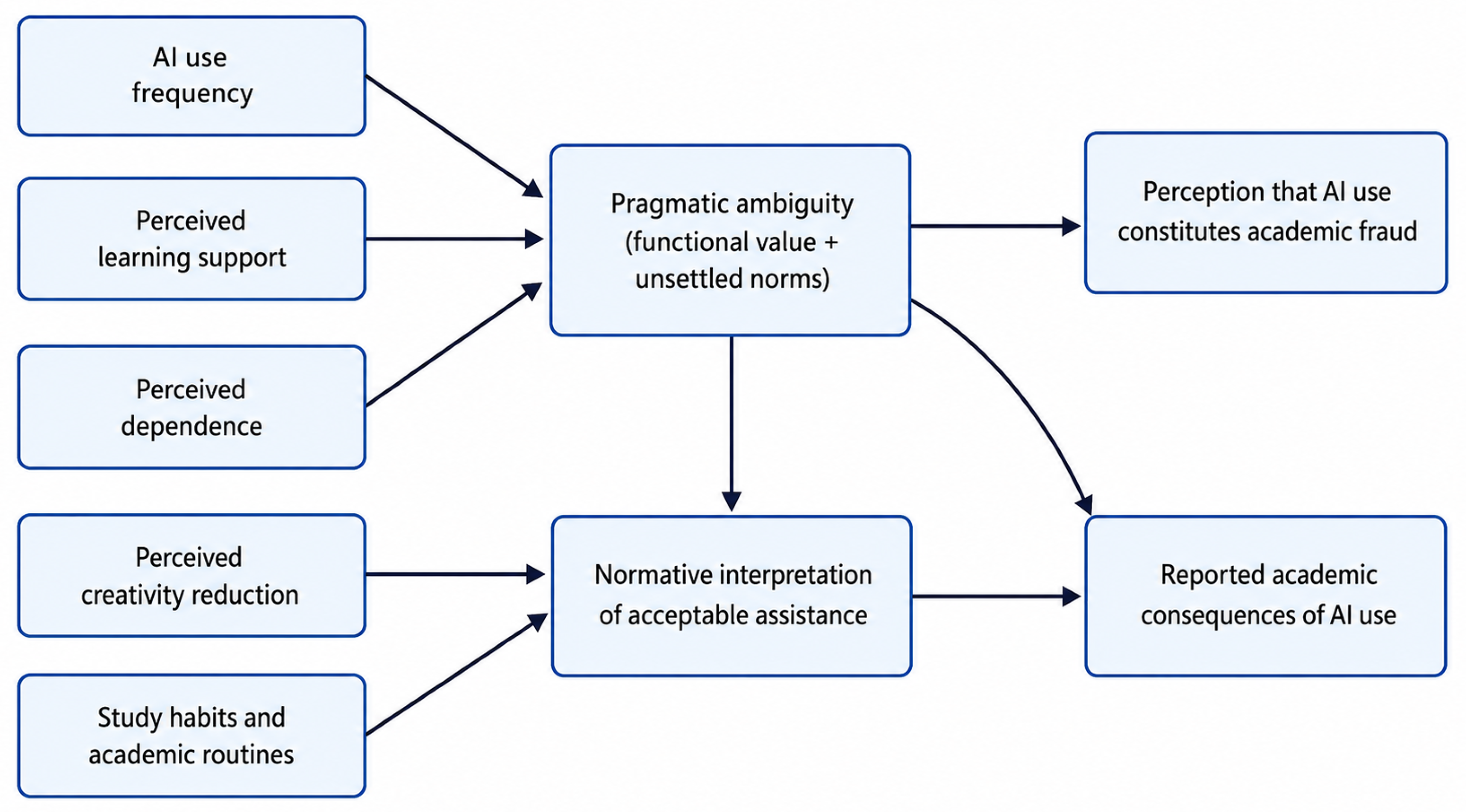
Figure 1 summarizes the conceptual logic of the article. The left side of the model identifies the main conditions examined in the study: AI-use frequency, perceived learning support, perceived dependence, perceived creativity reduction, and study habits. These factors are expected to shape students’ interpretation of AI through two connected processes: pragmatic ambiguity, understood as the coexistence of functional value and unsettled norms, and the normative interpretation of what counts as acceptable assistance. The right side of the model represents the two main outcomes of interest: students’ judgment of whether AI use constitutes academic fraud and their self-reported academic consequences of AI use. The figure is intended as an organizing framework for expected associations, not as a causal model.
2.3. Study Habits, AI Literacy, and Ethical Judgment
A socio-educational account of AI use must consider study habits alongside technology use. Generative AI becomes part of a broader study ecology that includes time allocation, note review, help-seeking, supplementary resources, and self-monitoring. Lobos et al. [
26] highlight the importance of self-regulated learning in digitally mediated educational contexts, and related research links study routines with engagement, persistence, and academic adaptation. Students who invest more time in independent work may therefore evaluate AI differently from students who mainly use it as a shortcut under pressure [
27,
28].
AI literacy and prompt literacy are also increasingly important. Students need to know how to formulate requests, evaluate outputs, recognize hallucinations or shallow explanations, and decide when AI-generated suggestions are appropriate for a given task. Prompt engineering and critical use are now entering discussions of curriculum and classroom practice [
29,
30,
31]. At the same time, technical skill does not settle the ethical question. A student who knows how to prompt effectively may use that skill to deepen learning, accelerate routine work, or delegate academic labor. This tension also appears in discussions of information literacy and educational inquiry in AI-mediated environments [
32,
33]. It is therefore central to the second overarching research question, which examines whether dependence, creativity concerns, and study habits are associated with students’ ethical judgments and self-reported academic consequences of AI use.
The relationship between creativity and academic integrity is especially relevant. Eshet and Margaliot [
34] suggest that creative thinking may contribute to academic integrity by supporting students’ capacity to produce original work and regulate academic misconduct. In AI-mediated environments, perceived creativity reduction may therefore signal more than dissatisfaction with a tool. It may reflect concern that AI is displacing the student’s own intellectual contribution. This expectation guides the interpretation of perceived creativity reduction in the models below.
3. Materials and Methods
This section describes the dataset, survey context, variable coding, and statistical procedures used in the study. The goal is to make the analysis reproducible and to clarify the scope of the survey measures used to examine students’ judgments about AI and academic integrity.
3.1. Study Context, Dataset, and Survey Procedure
The analysis uses the public dataset reported by Correa [
35], which contains survey responses from 357 undergraduate students at the Manizales campus of a Colombian public university. The dataset is also connected to a broader line of institutional research on student trajectories in Colombian public higher education, including a related public-university dataset on student retention and a study of perceived factors associated with dropout intention [
36,
37]. According to the dataset documentation, data were collected during the first academic term of 2025 using proportional allocation across 14 academic programs. Within each program, responses were gathered through a quota-based procedure until the target number for that program was reached. The dataset is cross-sectional and self-reported, and it is intended for secondary educational research rather than causal inference.
The timing of data collection is especially important for this topic. The first academic term of 2025 was a period in which generative AI tools, classroom expectations, and institutional policy responses were still evolving rapidly. The findings should therefore be read as a time-specific snapshot of student perceptions during an active phase of norm formation, rather than as a stable estimate of long-term academic-integrity norms.
The institutional setting is important for interpreting the findings. The study took place in a public university context where students came from several academic programs and where AI-related expectations were still being interpreted in relation to coursework, general academic-integrity norms, and everyday study routines. The cleaned analytical dataset does not record whether each respondent had been exposed to a specific AI policy, assignment-level disclosure rule, or scenario-based AI-use instruction. For this reason, the study treats the survey as evidence of students’ perceptions and study practices during a period of active norm formation rather than as evidence of responses to a standardized institutional AI policy.
The repository associated with the dataset reports that it includes the original anonymized Spanish responses, a cleaned English analytical file, a codebook, a bilingual questionnaire, and supporting files for reuse. The present article used the cleaned English analytical file supplied with the manuscript materials. The response-date field in that file had identifying timestamp detail removed; therefore, the manuscript reports the documented collection period rather than individual response dates. Data management was described as complying with Colombia’s Personal Data Protection Act. No personally identifying information was analyzed in the present study.
3.2. Variables and Coding
The main integrity outcome was the ordered response to the item represented in the analytical dataset as AI use in academic tasks is fraud. The response categories were coded from 1 to 5: strongly disagree, disagree, undecided, agree, and strongly agree. Higher values therefore indicate stronger agreement with the fraud framing. A second outcome captured whether students reported having failed or not passed an assessed activity because of AI use; this variable was coded as binary.
The main explanatory variables were selected to represent students’ AI-use frequency, perceived educational value, perceived side effects, AI-related skill, study habits, and institutional context. Ordinal variables were coded in their natural order so that higher values represented more frequent use, stronger perceived learning support, stronger perceived dependence, stronger perceived creativity reduction, greater prompt-engineering knowledge, or more intensive study habits. Contextual covariates included program cluster, non-local student status, and receipt of university support. Program clusters were used because some individual programs had small cell counts.
Table 1 summarizes the key survey measures used in the analysis, the operational wording available in the cleaned English analytical file, and the numerical coding applied before the descriptive, correlational, and regression analyses. This table is included to make the measurement decisions transparent, especially because the interpretation of the findings depends on how broad items such as the fraud question, perceived AI dependence, and perceived creativity reduction were operationalized.
As shown in
Table 1, the coding was directional: higher values consistently represent more frequent use, stronger agreement, greater perceived intensity, or more favorable study-related evaluations. This coding makes the regression results easier to interpret because positive associations indicate movement toward stricter fraud judgments or higher reported intensity, whereas negative associations indicate movement toward more permissive judgments or lower reported intensity, depending on the outcome being modeled.
The analytical dataset did not include scenario-based items specifying particular AI practices, such as grammar checking, idea generation, full-text generation, code generation, prompt documentation, or disclosure to an instructor. It also did not include a measure asking whether students had used a formal AI disclosure template. This limitation is important for interpretation because the fraud item captures a broad perception rather than a fully contextualized academic-integrity judgment.
3.3. Analytical Strategy
The analysis proceeded in five stages. First, descriptive statistics were used to summarize the sample, AI-use patterns, study habits, and integrity-related perceptions. Second, cross-tabulations and chi-square tests examined associations between fraud perception and selected predictors, including AI-use frequency, perceived learning support, perceived dependence, perceived creativity reduction, and program cluster. Effect sizes were reported using Cramer’s V. Third, Spearman correlations were used for selected ordinal and continuous variables because several measures were ranked rather than interval-level.
Fourth, an ordered logistic regression model was estimated for the fraud-perception outcome. Ordered logit was selected because the outcome categories have a meaningful order and because the analytical interest is whether predictors are associated with more permissive or stricter integrity judgments. Fifth, a binary logistic regression model was estimated for reported failure due to AI use. Coefficients were converted to odds ratios to support interpretation by an interdisciplinary readership.
All modeled variables were complete in the cleaned analytical dataset, so the 357 cases were retained in the reported models. Variance inflation factors were used to assess multicollinearity. The proportional odds assumption for the ordered model was evaluated using a Brant-style Wald comparison across the estimable cumulative logits. The first three cumulative splits were stable; the final split was unstable because only 12 students selected strongly agree, producing a sparse top category in the unconstrained diagnostic. The omnibus diagnostic across the estimable splits did not reject the equal-slopes assumption (, , ). This result supports the ordered specification but is interpreted with caution because of the sparsity of the highest response category.
A robustness model also collapsed the fraud item into agreement versus all other responses and re-estimated the relationship using binary logit. This binary model was not treated as a substitute for the parallel-lines diagnostic; instead, it was used to assess whether the direction and relative importance of the main predictors changed under a simpler outcome definition. The binary model for reported failure due to AI use was interpreted cautiously because only 36 students reported that outcome. All statistical analyses were conducted in R version 4.5.2 [
38], using a reproducible analytical script and the cleaned English analytical file from the public dataset reported by Correa [
35].
4. Results
The results are presented in five steps. The section first describes the sample and the main AI-related variables. It then examines how integrity judgments are distributed across AI-use patterns, characterizes the undecided group, reports the multivariable models, and closes with robustness and diagnostic checks.
4.1. Descriptive Results
The sample included undergraduate students from several academic programs and with varied institutional profiles.
Table 2 summarizes the main demographic, institutional, and program-cluster characteristics of the respondents.
The descriptive indicators in
Table 3 show that AI use was embedded in a broader pattern of active study practices rather than appearing only among academically disengaged students. The table reports the main AI-use, study-habit, and integrity-related variables used in the analysis.
Overall, the sample combined extensive exposure to AI with relatively strong study routines. More than half of the students reported studying independently for more than five hours per week, 70.3% said they organized notes almost always or always before tests, and 75.1% reported similarly frequent use of supplementary resources. Participation in study groups or tutoring was lower but still common. These patterns suggest that AI use in this dataset coexisted with sustained study effort rather than replacing conventional study practices.
AI use was also concentrated around a small number of platforms. ChatGPT was reported by 95.8% of respondents, Gemini by 65.5%, DeepSeek by 42.9%, and Copilot by 36.4%. Frequency data point in the same direction: 61.1% of students reported using AI almost always or always for study, and only two respondents reported never using it. The central empirical question is therefore not whether students use AI, but how they place AI within their academic routines and ethical judgments.
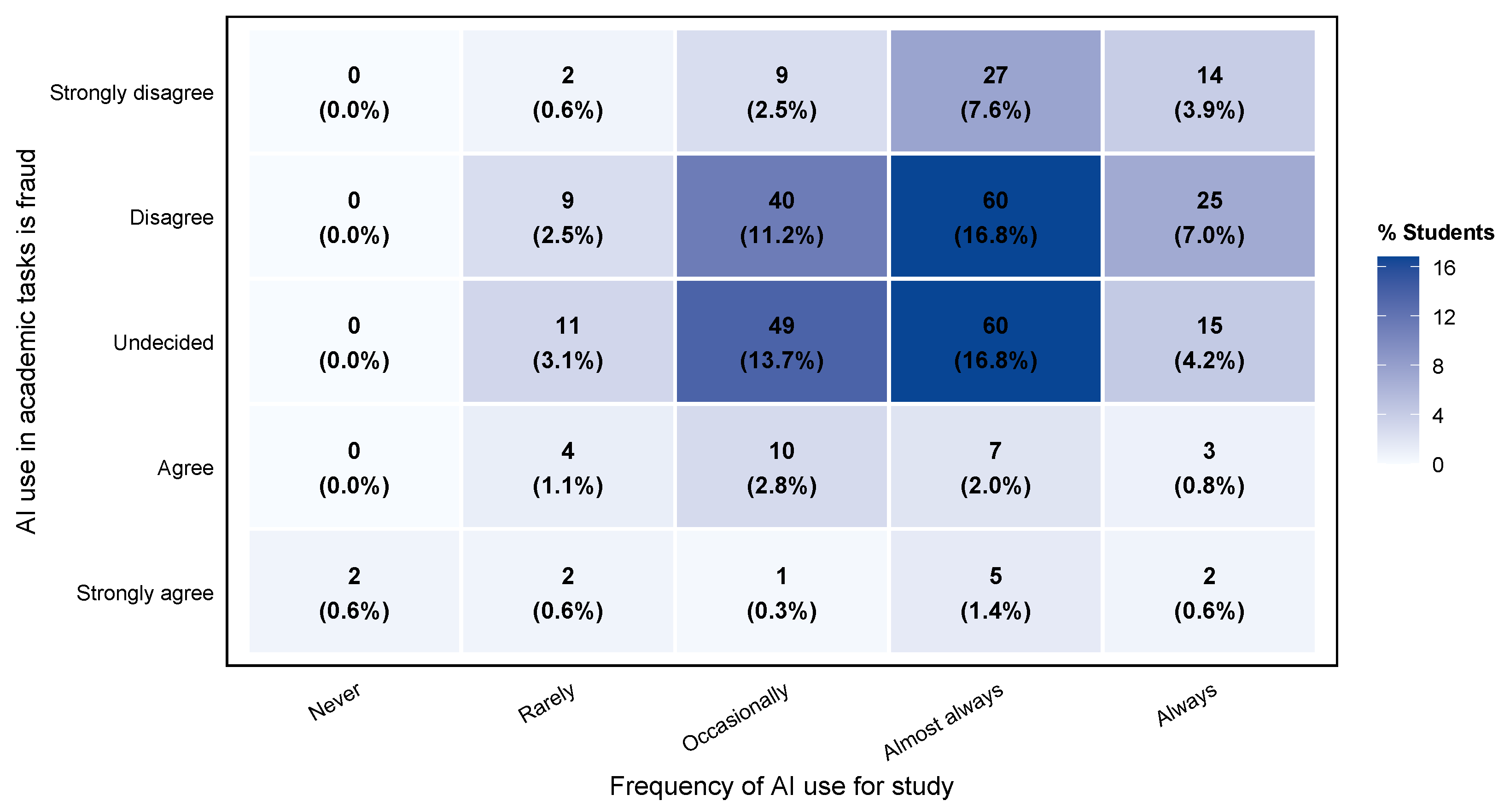
Responses to the integrity item show a more unsettled picture. A slight majority of students disagreed or strongly disagreed with the statement that using AI in academic tasks is fraud, but more than one-third were undecided and only a small minority agreed. To show how this distribution intersects with frequency of use,
Figure 2 presents a heatmap of AI-use frequency by responses to the fraud item. Each cell reports the number of students and the percentage of the full sample.
Figure 2 suggests that frequent AI use was not accompanied by a simple or uniform rejection of integrity concerns. Among students who almost always used AI, the largest cells were disagree and undecided; each represented 60 students, or 16.8% of the full sample. Among those who always used AI, disagreement also remained more common than agreement. This pattern is consistent with the idea of pragmatic ambiguity: students may normalize AI as a study resource while still negotiating whether, when, and why its use should be treated as academic misconduct.
4.2. Integrity Perceptions, AI Use, and the Undecided Group
The bivariate association tests provide a more formal view of these patterns.
Table 4 summarizes the chi-square tests and Cramer’s
V effect sizes for the main relationships between integrity-related perceptions, AI-use variables, program cluster, and reported academic consequences.
As shown in
Table 4, fraud perception varied strongly by frequency of AI use (
,
, Cramer’s
). Students who used AI more often were less likely to classify its use as fraud. A similar pattern appeared for perceived learning support: the association between the fraud item and the belief that AI helps students understand academic topics was also strong (
,
, Cramer’s
). Students who experienced AI as pedagogically useful were more likely to reject a blanket fraud framing.
Two perceived side effects of AI use were also related to integrity judgments. Fraud perception was associated with perceived AI dependence (, , Cramer’s ) and perceived creativity reduction (, , Cramer’s ). The creativity pattern is especially important because it suggests that students evaluate AI not only in relation to formal rules but also in relation to what the tool may be doing to authorship, originality, and their own intellectual contribution.
The Spearman correlations used as ordinal checks pointed in the same general direction. Fraud perception was negatively associated with AI-use frequency (, ) and perceived learning support (, ), while it was positively associated with perceived creativity reduction (, ). For the reported-failure outcome, perceived learning support showed a negative association (, ), whereas perceived creativity reduction showed a positive association (, ). These correlations are modest, but they support the same substantive pattern observed in the cross-tabulations and regression models.
Reported failure due to AI use followed a different pattern. This outcome was not significantly associated with frequency of AI use (, ), which indicates that frequent users were not automatically the students most likely to report negative academic consequences. Reported failure was strongly associated with perceived dependence (, , Cramer’s ). This suggests that negative consequences are associated less with how often students use AI in general than with whether they feel their use has become difficult to regulate.
The undecided group deserves particular attention because it represents more than one-third of the sample.
Table 5 compares three broad response groups: students who rejected the fraud framing, students who were undecided, and students who endorsed the fraud framing. The indicators include AI-use frequency, perceived learning support, perceived dependence, perceived creativity reduction, independent study time, and reported failure due to AI use.
Table 5 shows that undecided students were not disengaged from AI. A majority used AI almost always or always for study, and nearly all reported that AI probably or definitely helped them understand academic topics. At the same time, their level of perceived creativity reduction was higher than that of students who rejected the fraud framing but lower than that of students who endorsed it. This intermediate profile supports the interpretation that indecision reflects ethical uncertainty rather than simple lack of experience with AI.
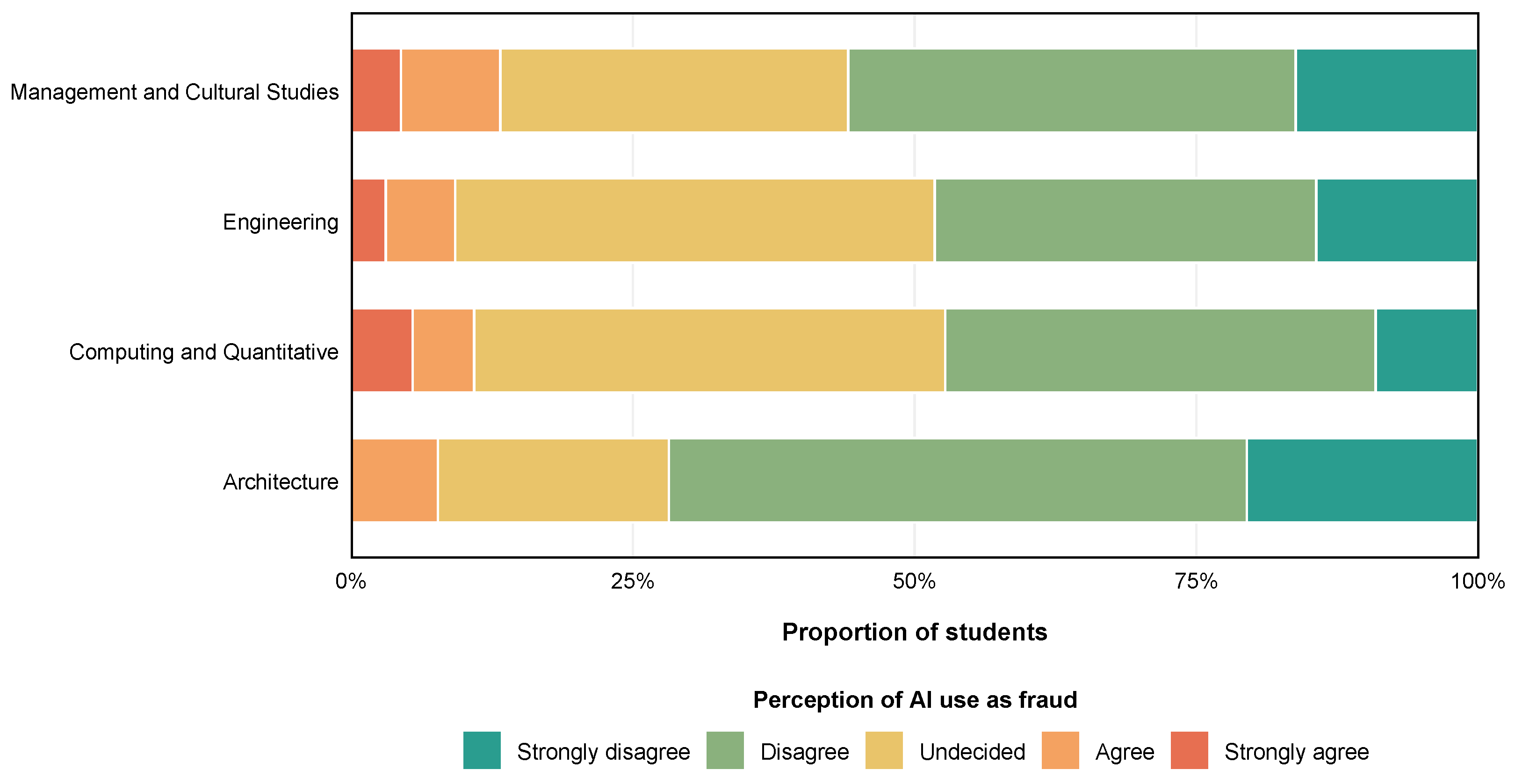
Disciplinary differences were visible but not statistically decisive. Fraud perception did not vary significantly across the four program clusters (
,
, Cramer’s
).
Figure 3 displays the distribution of fraud-perception responses within each program cluster to show these descriptive differences more clearly.
Figure 3 shows some variation in disagreement, agreement, and indecision across program clusters, but the broader pattern cuts across disciplinary boundaries. Students from different programs appear to be negotiating the status of AI under conditions of incomplete normative clarity rather than following a single discipline-specific interpretation of academic fraud.
4.3. Regression Results
The ordered logistic regression model tested whether AI-use frequency, perceived learning support, perceived dependence, perceived creativity reduction, prompt-engineering knowledge, study habits, and contextual covariates were associated with stricter or more permissive judgments about whether AI use in academic tasks constitutes fraud.
Table 6 presents the odds ratios, confidence intervals, and significance levels for this model.
The ordered logit results show that the strongest predictors of fraud perception were evaluative rather than merely exposure-based. More frequent AI use was associated with lower odds of moving toward stricter fraud judgments (OR = 0.669, ). Perceiving AI as helpful for understanding academic topics showed an even stronger negative association with strict fraud judgments (OR = 0.581, ). In other words, students who experienced AI as educationally useful were less likely to define its use in academic tasks as fraudulent.
Perceived creativity reduction moved in the opposite direction. Students who believed AI reduced their creativity had significantly higher odds of endorsing stricter fraud judgments (OR = 1.498, ). Independent study time also showed a positive association with stricter judgments (OR = 1.174, ). This result may indicate that students who invest more time in independent preparation place greater value on process, effort, and personal accountability. Perceived AI dependence, prompt-engineering knowledge, non-local status, and study-method effectiveness were not statistically significant once the other predictors were considered together.
The binary logistic regression model examined whether the same predictors were associated with self-reported failure or non-passing of an assessed activity because of AI use.
Table 7 reports the odds ratios, confidence intervals, and significance levels for this model.
The binary logistic model produced a more selective pattern. The most consistent predictor was perceived learning support from AI. Students who believed AI helped them understand academic topics were less likely to report having failed an assessed activity because of AI use (OR = 0.396, ). This should not be interpreted causally; rather, it suggests that students who frame AI as a learning support are less likely to associate it with negative academic consequences. Perceived creativity reduction was positive and close to conventional significance (OR = 1.403, ), but the evidence is less conclusive.
Predicted probabilities from the ordered model also support the normalization interpretation. Holding other variables at their observed means or reference categories, the predicted probability of disagreeing that AI use is fraud increased as AI-use frequency rose, while the predicted probabilities of being undecided or endorsing the fraud framing decreased. This pattern should be read as an association between regular AI use and more permissive judgments, not as evidence that AI use causes students to become more permissive.
4.4. Robustness and Diagnostic Checks
The robustness analysis supports the main interpretation. When the fraud-perception outcome was collapsed into agreement versus all other responses and re-estimated as a binary logit, the direction of the key relationships remained unchanged. Perceived learning support from AI still reduced the odds of classifying AI use as fraud (OR = 0.475, ), whereas perceived creativity reduction increased those odds (OR = 1.917, ). Independent study time also remained positively associated with stricter judgment (OR = 1.433, ).
Diagnostic checks support the stability of the main models while also pointing to appropriate caution. All variance inflation factors remained below 3.1, indicating low multicollinearity among the retained predictors. The binary model converged without evidence of complete separation, and fitted probabilities remained moderate rather than clustering at boundary values. The proportional-odds diagnostic did not reject the equal-slopes assumption across the estimable cumulative splits (, , ), although the sparse highest category means that this diagnostic should be interpreted as supportive rather than definitive. These checks reinforce the internal consistency of the findings while underscoring that the models identify associations, not causal effects.
5. Discussion
This study shows that students do not interpret generative AI through a single, settled ethical rule. Their judgments are associated with how useful they find AI for learning, how often they use it, how it fits into their study routines, and whether they believe it is beginning to displace their own creativity. This pattern is consistent with recent work showing that generative AI has moved rapidly into everyday academic practice while still raising unresolved questions about authorship, assessment fairness, and acceptable assistance [
2,
16,
17]. The findings therefore support the idea of pragmatic ambiguity: students are making practical use of AI while negotiating ethical boundaries that remain only partly stabilized.
5.1. Academic Integrity as a Contextual and Negotiated Judgment
The first research question asked how frequently students use generative AI and how they judge whether AI use in academic tasks constitutes academic fraud. The results show that AI use was common, but ethical interpretation was not uniform. Students who used AI more frequently and students who viewed AI as helpful for understanding course content were less likely to classify AI use as fraud. This does not mean that frequent users disregard academic integrity. A more plausible interpretation is that many students judge AI in relation to what the tool does in a particular learning situation. Farrelly and Baker [
4] argue that AI-related integrity debates depend heavily on disclosure, authorship, and task expectations, and the present findings point in the same direction: students appear to distinguish between AI as academic support and AI as a substitute for their own work [
5,
6].
This interpretation also aligns with international evidence showing that students and educators often recognize the learning value of AI while remaining concerned about overreliance and assessment fairness [
19,
20]. In the present sample, perceived learning support was associated with more permissive judgments about the fraud item. This finding is important because it suggests that students may not be rejecting integrity norms; instead, they may be resisting a blanket label that treats all AI-supported academic work as equivalent. Kasneci et al. [
16] similarly note that generative AI can support explanation, feedback, and learning processes, but those benefits become ethically complicated when the boundaries of acceptable use are unclear.
The large undecided group gives this argument additional weight. Undecided students were not marginal AI users: most used AI frequently and nearly all reported that AI helped them understand academic topics. At the same time, their concern about creativity reduction was higher than among students who rejected the fraud framing and lower than among students who endorsed it. This intermediate profile suggests that indecision reflects ethical uncertainty rather than lack of experience. It is consistent with policy research showing that universities are moving unevenly from broad prohibition and detection toward more nuanced expectations involving disclosure, responsible use, and assessment redesign [
23,
24].
The measurement issue is central here. The survey item asks whether AI use in academic tasks is fraud. That wording captures a consequential moral judgment, but it does not specify whether AI was used for grammar checking, brainstorming, explanation, coding, translation, text generation, or completing an assignment. It also does not indicate whether the use was disclosed or permitted by the instructor. The low level of agreement with the fraud item may therefore reflect rejection of a broad and culturally loaded label rather than acceptance of all AI uses. Some students may regard undisclosed outsourcing as unacceptable while still refusing to call every AI-supported task fraudulent [
4,
5,
18].
A clearer distinction is therefore needed between acceptable AI-supported learning and misconduct. Farrelly and Baker [
4] emphasize that AI-related integrity judgments depend on disclosure, authorship, task expectations, and the degree of student contribution. In this article, acceptable AI-supported learning refers to uses that help students understand, revise, question, translate, or organize their own work while preserving their responsibility for the intellectual product. Cognitive outsourcing refers to cases in which AI performs the reasoning, writing, coding, or problem-solving that the assignment is designed to assess, especially when that use is undisclosed or prohibited. This distinction is important because the same tool can support learning in one assignment and undermine authorship in another, depending on the task purpose, disclosure requirements, and instructor expectations [
5,
18].
5.2. Creativity, Study Effort, and the Meaning of Academic Work
The second research question examined how perceived learning support, perceived dependence, perceived creativity reduction, and study habits were associated with ethical judgments and reported academic consequences. Among these factors, perceived creativity reduction was one of the clearest correlates of stricter fraud judgments. This finding suggests that students’ ethical concerns are tied not only to rule compliance, but also to authorship, originality, and intellectual ownership. Eshet and Margaliot [
34] show that creative thinking is connected to academic integrity and may help shape ethical academic behavior. In the present study, perceived creativity reduction appears to mark the point at which AI begins to feel less like support and more like substitution.
Independent study time pointed in a similar direction. Students who devoted more time to independent study were more likely to endorse stricter fraud judgments. This should not be read as evidence that students who study longer are morally superior. A more cautious interpretation is that students who invest more time in preparation may place greater value on process, effort, and personal accountability. This interpretation fits with research on self-regulated learning, which emphasizes the role of study routines, monitoring, and sustained engagement in academic performance [
27,
28,
39].
The finding on reported failure due to AI use should be interpreted carefully. Students who believed AI helped them understand course content were less likely to report having failed an assessed activity because of AI use. Because the data are cross-sectional and self-reported, this does not show that AI improves learning or prevents failure. It suggests only that students who frame AI as a learning support are less likely to associate it with negative academic consequences. This cautious reading is important because the binary model included only 36 positive cases, making the result exploratory rather than definitive [
17,
20].
The practical significance of these effects lies less in prediction and more in identifying where educational guidance is most needed. Moorhouse et al. [
23] argue that institutional responses to generative AI should move beyond detection and toward clearer pedagogical expectations, a point that is consistent with the present findings. The associations suggest that students’ judgments are shaped by two pedagogically actionable dimensions: whether AI is experienced as learning support and whether it is perceived to weaken creativity or personal contribution. These dimensions can guide instructors toward clearer task instructions, examples of acceptable assistance, and assessment designs that help students see the difference between support for learning and substitution of learning.
5.3. Institutional and Pedagogical Implications
The findings point to a practical policy problem: general warnings about AI and integrity are unlikely to be enough when many students already use AI and many remain uncertain about its ethical status. Moorhouse et al. [
23] emphasize that institutional responses to generative AI need to move beyond detection and toward clearer pedagogical expectations. The present study supports that view. Universities should translate broad integrity principles into assignment-level guidance that distinguishes between permitted uses, permitted uses with disclosure, and prohibited uses that amount to unauthorized outsourcing of assessed work [
5,
24]. This institutional challenge is consistent with broader work showing that generative AI is reshaping not only student practices, but also academic research, teaching responsibilities, and faculty perceptions of the changing higher-education landscape [
40,
41].
A more useful approach would make the learning process visible. Instructors can provide short disclosure templates asking students whether AI was used, for what purpose, and at what stage of the task. For some assignments, students can add a reflective note explaining how AI shaped brainstorming, revision, coding, translation, or feedback. Prompt documentation may be appropriate when the process is central to the learning outcome, but it should not become a mechanical requirement for every task. Oral defenses, annotated drafts, revision histories, process-based assessment, and source-tracing activities can also help clarify authorship and make students’ own contribution more visible [
4,
5,
23].
AI literacy should, therefore, include ethical judgment as well as technical skill. Students need support in evaluating outputs, recognizing hallucinations or shallow explanations, understanding data and citation limitations, and deciding when AI use is aligned with the purpose of a task. They also need concrete examples of unacceptable outsourcing. A policy that only tells students to use AI responsibly places too much interpretive burden on them. A stronger educational response would teach students how to move from access to accountable use [
29,
30,
31].
These implications are especially relevant in public-university settings where students may use AI to manage academic demands, language barriers, uneven access to support, or time pressure. AI may reduce some barriers by offering rapid explanations and examples, but it may also create new risks of dependence, shallow learning, or hidden authorship. For that reason, institutional responses should avoid treating AI only as a disciplinary threat. They should combine clear boundaries with pedagogy that strengthens authorship, creativity, and critical academic practice [
19,
20].
The Colombian public-university context also matters for interpretation. Compared with many studies conducted in Global North or highly resourced institutional settings, this case reflects a public university environment in which students’ AI judgments may be shaped by heterogeneous academic preparation, uneven access to support, strong expectations of effort and merit, disciplinary cultures, and evolving local guidance. This contextual reading is consistent with prior work noting the need for more evidence from Latin American higher education and less frequently studied institutional settings [
9,
10]. It also resonates with related Colombian public-university research on student trajectories and dropout-related academic conditions [
36,
37]. The findings should therefore be read as context-sensitive evidence of how students interpret AI under particular institutional and cultural conditions, not as a universal model of student ethics.
5.4. Limitations and Future Directions
Several limitations define the scope of the study. The dataset comes from a single campus and reflects one public-university setting. The measures are self-reported and may be shaped by memory, self-presentation, and local interpretation. The study is cross-sectional, so it cannot determine whether AI use changes students’ ethical judgments or whether students with more permissive judgments are simply more likely to use AI. All results should therefore be read as associations, not causal effects [
25].
The reliance on self-reporting also means that the study captures students’ declared perceptions and experiences rather than directly observed AI behavior. Social desirability bias may lead some respondents to underreport practices they consider questionable or to present their AI use as more responsible than it was in practice. Conversely, some students may overstate negative experiences if they associate AI with institutional risk or personal concern. Future research should therefore combine surveys with behavioral, qualitative, or assignment-level evidence to examine how stated perceptions correspond to actual AI-use practices.
The integrity measurement is also limited. The study did not employ a widely validated academic-integrity questionnaire. Instead, it used a small number of direct perception items, especially the single item asking whether AI use in academic tasks is fraud. That item is useful because it captures a clear and socially meaningful judgment, but it cannot represent all dimensions of academic integrity, including authorship, disclosure, task type, originality, acceptable assistance, collaboration, and assignment-specific rules. The analytical dataset also did not include scenario-based AI cases or disclosure-practice items.
Future research should examine these issues through mixed-method and longitudinal designs. Interviews could clarify what students mean when they describe AI as helpful, risky, creativity-reducing, or fraudulent. Assignment-level studies could test whether disclosure templates, oral defenses, process-based assessment, or AI-literacy instruction reduce ethical uncertainty among undecided students. Comparative research across institutions and countries would also help determine whether the pattern observed here—high perceived usefulness, frequent AI use, and unresolved ethical judgment—is specific to this Colombian public-university setting or part of a broader transition in higher education. Eshet [
25] shows that integrity debates are shaped by assessment conditions and institutional responses, and generative AI makes those conditions even more important for future research.
6. Conclusions
This study examined how undergraduate students interpret generative AI in academic work and how those interpretations are associated with study habits, perceived learning support, perceived side effects, and reported academic consequences. The findings show that AI had already become part of everyday study practice in the sample, but shared ethical boundaries remained unsettled. Most respondents did not classify AI use in academic tasks as fraud, while a substantial group remained undecided. This pattern suggests that the central issue is not simply whether students use AI, but how they understand the difference between legitimate assistance and academic misconduct.
The study contributes the concept of pragmatic ambiguity to explain this tension in a context-sensitive way. Students may value AI because it supports learning and efficiency while still questioning whether some uses weaken authorship, creativity, effort, or responsibility. This framing cautions against treating AI use as either inherently legitimate or inherently fraudulent across all tasks and institutional contexts.
For higher education institutions, especially those working in comparable public-university settings, the practical lesson is to make acceptable assistance visible and teachable. Assignment-level expectations, disclosure practices, examples of prohibited outsourcing, and assessments that make students’ own reasoning and process observable can help reduce ambiguity without treating all AI use as misconduct.
Author Contributions
Conceptualization, E.M.L.-L., O.E.B.-C. and C.D.C.-Á.; methodology, E.M.L.-L.; formal analysis, O.E.B.-C.; data curation, O.E.B.-C.; writing—original draft, O.E.B.-C. and E.M.L.-L.; writing—review and editing, C.D.C.-Á.; visualization, E.M.L.-L. and C.D.C.-Á.; supervision, O.E.B.-C. and C.D.C.-Á. All authors have read and agreed to the published version of the manuscript.
Funding
This research received no external funding.
Institutional Review Board Statement
Not applicable.
Informed Consent Statement
Not applicable.
Data Availability Statement
The dataset supporting this study is publicly available in Mendeley Data: Correa, C. (2026) [
35].
Study habits and artificial intelligence use among university students: A proportionally stratified survey dataset. Mendeley Data, V1.
https://doi.org/10.17632/mcwb2ppdsw.1, accessed on 18 March 2026. Data management complied with Colombia’s Personal Data Protection Act [
42].
Acknowledgments
During the preparation of this manuscript, the authors used ChatGPT (GPT-5.5 Pro, OpenAI) for the limited purpose of initial visual support in drafting the conceptual figure. The prompts asked the tool to create a clean, publication-quality conceptual diagram based on author-specified constructs and relationships, including AI-use frequency, perceived learning support, perceived dependence, creativity concerns, study habits, pragmatic ambiguity, ethical judgment, and reported academic consequences. No generative AI tools were used for study design, data collection, statistical analysis, or interpretation of results. The authors reviewed and edited the output and take full responsibility for the content of this publication.
Conflicts of Interest
The authors declare no conflicts of interest.
References
- Chan, C.K.Y.; Hu, W. Students’ voices on generative AI: Perceptions, benefits, and challenges in higher education. Int. J. Educ. Technol. High. Educ. 2023, 20, 43. [Google Scholar] [CrossRef] [Scilit]
- Crompton, H.; Burke, D. Artificial intelligence in higher education: The state of the field. Int. J. Educ. Technol. High. Educ. 2023, 20, 22. [Google Scholar] [CrossRef] [Scilit]
- Lee, D.; Arnold, M.; Srivastava, A.; Plastow, K.; Strelan, P.; Ploeckl, F.; Lekkas, D.; Palmer, E. The impact of generative AI on higher education learning and teaching: A study of educators’ perspectives. Comput. Educ. Artif. Intell. 2024, 6, 100221. [Google Scholar] [CrossRef] [Scilit]
- Farrelly, T.; Baker, N. Generative artificial intelligence: Implications and considerations for higher education practice. Educ. Sci. 2023, 13, 1109. [Google Scholar] [CrossRef] [Scilit]
- Perkins, M.; Roe, J. Decoding academic integrity policies: A corpus linguistics investigation of AI and other technological threats. High. Educ. Policy 2024, 37, 633–653. [Google Scholar] [CrossRef] [Scilit]
- Gonsalves, C. Addressing student non-compliance in AI use declarations: Implications for academic integrity and assessment in higher education. Assess. Eval. High. Educ. 2025, 50, 592–606. [Google Scholar] [CrossRef] [Scilit]
- Bittle, K.; El-Gayar, O. Generative AI and academic integrity in higher education: A systematic review and research agenda. Information 2025, 16, 296. [Google Scholar] [CrossRef] [Scilit]
- Gulumbe, B.H.; Audu, S.M.; Hashim, A.M. Balancing AI and academic integrity: What are the positions of academic publishers and universities? AI Soc. 2025, 40, 1775–1784. [Google Scholar] [CrossRef] [Scilit]
- Salas-Pilco, S.Z.; Yang, Y. Artificial intelligence application in Latin America higher education: A systematic review. Int. J. Educ. Technol. High. Educ. 2022, 19, 21. [Google Scholar] [CrossRef] [Scilit]
- Michel-Villarreal, R.; Vilalta-Perdomo, E.; Salinas-Navarro, D.E.; Thierry-Aguilera, R.; Gerardou, F.S. Challenges and opportunities of generative AI for higher education as explained by ChatGPT. Educ. Sci. 2023, 13, 856. [Google Scholar] [CrossRef] [Scilit]
- Shuhaiber, A.; Kuhail, M.A.; Salman, S. ChatGPT in higher education—A student’s perspective. Comput. Hum. Behav. Rep. 2025, 17, 100565. [Google Scholar] [CrossRef] [Scilit]
- Uppal, K.; Hajian, S. Students’ perceptions of ChatGPT in higher education: A study of academic enhancement, procrastination, and ethical concerns. Eur. J. Educ. Res. 2025, 14, 199–211. [Google Scholar] [CrossRef] [Scilit]
- Duong, C.D.; Vu, T.N.; Ngo, T.V.N. Applying a modified technology acceptance model to explain higher education students’ usage of ChatGPT: A serial multiple mediation model with knowledge sharing as a moderator. Int. J. Manag. Educ. 2023, 21, 100883. [Google Scholar] [CrossRef] [Scilit]
- Farhi, F.; Jeljeli, R.; Aburezeq, I.; Dweikat, F.F.; Al-Shami, S.A.; Slamene, R. Analyzing students’ views, concerns, and perceived ethics about ChatGPT usage. Comput. Educ. Artif. Intell. 2023, 5, 100180. [Google Scholar] [CrossRef] [Scilit]
- Ivanov, S.; Soliman, M.; Tuomi, A.; Alkathiri, N.A.; Al-Alawi, A.N. Drivers of generative AI adoption in higher education through the lens of the theory of planned behaviour. Technol. Soc. 2024, 77, 102521. [Google Scholar] [CrossRef] [Scilit]
- Kasneci, E.; Sessler, K.; Küchemann, S.; Bannert, M.; Dementieva, D.; Fischer, F.; Gasser, U.; Groh, G.; Günnemann, S.; Hüllermeier, E.; et al. ChatGPT for good? On opportunities and challenges of large language models for education. Learn. Individ. Differ. 2023, 103, 102274. [Google Scholar] [CrossRef] [Scilit]
- Lo, C.K. What is the impact of ChatGPT on education? A rapid review of the literature. Educ. Sci. 2023, 13, 410. [Google Scholar] [CrossRef] [Scilit]
- Kofinas, A.K.; Tsay, C.-H.; Pike, D. The impact of generative AI on academic integrity of authentic assessments within a higher education context. Br. J. Educ. Technol. 2025, 56, 2522–2549. [Google Scholar] [CrossRef] [Scilit]
- Yusuf, A.; Pervin, N.; Román-González, M. Generative AI and the future of higher education: A threat to academic integrity or reformation? Evidence from multicultural perspectives. Int. J. Educ. Technol. High. Educ. 2024, 21, 21. [Google Scholar] [CrossRef] [Scilit]
- Ravšelj, D.; Keržič, D.; Tomaževič, N.; Umek, L.; Brezovar, N.; Iahad, N.A.; Abdulla, A.A.; Akopyan, A.; Segura, M.W.A.; AlHumaid, J.; et al. Higher education students’ perceptions of ChatGPT: A global study of early reactions. PLoS ONE 2025, 20, e0315011. [Google Scholar] [CrossRef] [Scilit] [PubMed]
- Kalniņa, D.; Nīmante, D.; Baranova, S. Artificial intelligence for higher education: Benefits and challenges for pre-service teachers. Front. Educ. 2024, 9, 1501819. [Google Scholar] [CrossRef] [Scilit]
- Tlili, A.; Shehata, B.; Adarkwah, M.A.; Bozkurt, A.; Hickey, D.T.; Huang, R.; Agyemang, B. What if the devil is my guardian angel: ChatGPT as a case study of using chatbots in education. Smart Learn. Environ. 2023, 10, 15. [Google Scholar] [CrossRef] [Scilit]
- Moorhouse, B.L.; Yeo, M.A.; Wan, Y. Generative AI tools and assessment: Guidelines of the world’s top-ranking universities. Comput. Educ. Open 2023, 5, 100151. [Google Scholar] [CrossRef] [Scilit]
- Dabis, A.; Csáki, C. AI and ethics: Investigating the first policy responses of higher education institutions to the challenge of generative AI. Humanit. Soc. Sci. Commun. 2024, 11, 1006. [Google Scholar] [CrossRef] [Scilit]
- Eshet, Y. Examining the dynamics of plagiarism: A comparative analysis before, during, and after the COVID-19 pandemic. Int. J. Educ. Integr. 2025, 21, 3. [Google Scholar] [CrossRef] [Scilit]
- Lobos, K.; Cobo-Rendón, R.; Bruna Jofré, D.; Santana, J. New challenges for higher education: Self-regulated learning in blended learning contexts. Front. Educ. 2024, 9, 1457367. [Google Scholar] [CrossRef] [Scilit]
- Clarke, C.; Mullin, M.; McGrath, D.; Farrelly, N. University students and study habits. Ir. J. Psychol. Med. 2024, 41, 179–188. [Google Scholar] [CrossRef] [Scilit]
- David, L.; Biwer, F.; Crutzen, R.; de Bruin, A.B.H. The challenge of change: Understanding the role of habits in university students’ self-regulated learning. High. Educ. 2024, 88, 2037–2055. [Google Scholar] [CrossRef] [Scilit]
- Walter, Y. Embracing the future of artificial intelligence in the classroom: The relevance of AI literacy, prompt engineering, and critical thinking in modern education. Int. J. Educ. Technol. High. Educ. 2024, 21, 15. [Google Scholar] [CrossRef] [Scilit]
- Qian, Y. Prompt engineering in education: A systematic review of approaches and educational applications. J. Educ. Comput. Res. 2025, 63, 1782–1818. [Google Scholar] [CrossRef] [Scilit]
- Lee, D.; Palmer, E. Prompt engineering in higher education: A systematic review to help inform curricula. Int. J. Educ. Technol. High. Educ. 2025, 22, 7. [Google Scholar] [CrossRef] [Scilit]
- Lo, L.S. The CLEAR path: A framework for enhancing information literacy through prompt engineering. J. Acad. Librariansh. 2023, 49, 102720. [Google Scholar] [CrossRef] [Scilit]
- Correia, A.-P.; Hickey, S.; Xu, F. Realizing the possibilities of large language models: Strategies for prompt engineering in educational inquiries. Theory Into Pract. 2025, 64, 434–447. [Google Scholar] [CrossRef] [Scilit]
- Eshet, Y.; Margaliot, A. Does creative thinking contribute to the academic integrity of education students? Front. Psychol. 2022, 13, 925195. [Google Scholar] [CrossRef] [Scilit]
- Correa, C. Study habits and artificial intelligence use among university students: A proportionally stratified survey dataset. Mendeley Data 2026, V1. [Google Scholar] [CrossRef]
- López-López, E.M.; Bru-Cordero, O.E.; Correa Álvarez, C.D. A Survey Dataset on Student Retention in Higher Education: A Colombian Public University Case. Data 2026, 11, 75. [Google Scholar] [CrossRef] [Scilit]
- López-López, E.M.; Bru-Cordero, O.E.; Correa Álvarez, C.D. Perceived Factors Associated with Dropout Intention: Compositional Evidence for Sustainable Higher Education from a Colombian Public University. Sustainability 2026, 18, 4151. [Google Scholar] [CrossRef] [Scilit]
- R Core Team. R: A Language and Environment for Statistical Computing; R Foundation for Statistical Computing: Vienna, Austria, 2025. [Google Scholar]
- Gamero-Burón, C. Study habits and university academic performance: The predictive power of online exams. Rev. Digit. Investig. Docencia Univ. 2024, 18, e1826. [Google Scholar] [CrossRef] [Scilit]
- Al-Zahrani, A.M. The impact of generative AI tools on researchers and research: Implications for academia in higher education. Innov. Educ. Teach. Int. 2024, 61, 1029–1043. [Google Scholar] [CrossRef] [Scilit]
- Kallunki, V.; Kinnunen, P.; Pyörälä, E.; Haarala-Muhonen, A.; Katajavuori, N.; Myyry, L. Navigating the evolving landscape of teaching and learning: University faculty and staff perceptions of the artificial intelligence-altered terrain. Educ. Sci. 2024, 14, 727. [Google Scholar] [CrossRef] [Scilit]
- Ley 1581 de 2012. Por la Cual se Dictan Disposiciones Generales Para la Protección de Datos Personales. Congreso de Colombia, 2012. Diario Oficial No. 48.587, 17 de Octubre de 2012. Available online: https://www.alcaldiabogota.gov.co/sisjur/normas/Norma1.jsp?i=49981 (accessed on 18 December 2025).
| Disclaimer/Publisher’s Note: The statements, opinions and data contained in all publications are solely those of the individual author(s) and contributor(s) and not of MDPI and/or the editor(s). MDPI and/or the editor(s) disclaim responsibility for any injury to people or property resulting from any ideas, methods, instructions or products referred to in the content. |