Article

A Q-Methodological Approach to Capturing ESD-Related Beliefs in Primary Teacher Education: Instrument Development and Pilot Study


Department of Geography and Natural and Social Sciences, University of Wuppertal, 42119 Wuppertal, Germany
*
Author to whom correspondence should be addressed.
Trends High. Educ. 2026, 5(2), 50; https://doi.org/10.3390/higheredu5020050
Submission received: 1 March 2026 / Revised: 3 June 2026 / Accepted: 9 June 2026 / Published: 11 June 2026

Abstract

This article presents a Q-methodological approach to capturing the relational structure of teacher beliefs regarding education for sustainable development (ESD). It reports on the development and pilot testing of a Q-sample designed to assess the suitability of Q-methodology with a pilot sample of pre-service primary teachers. Research on ESD emphasizes the field’s normative complexity and conceptual ambiguity, which pose challenges for empirically investigating professional beliefs. Current approaches often conceptualize beliefs as isolated dimensions or thematically reconstructed individual constructions, which provides limited insight into their relational organization as structured configurations of meaning. The Q-sample was constructed through a structured selection from a hybrid concourse, drawing on international empirical studies, student reflections, and theory-derived statements. The Q-sample was administered via an online Q-sorting procedure using a forced quasi-normal distribution and analyzed using by-person factor analysis to examine structural differentiation and interpretability. The pilot study produced an interpretable two-factor solution, demonstrating the instrument’s ability to generate distinguishable belief configurations. Overall, the findings suggest that Q-methodology is a conceptually coherent and methodologically robust approach for capturing the relational structure of ESD-related belief configurations in teacher education research.

1. Introduction

Education for Sustainable Development (ESD) poses particular professional challenges for teachers. In the literature, ESD is discussed as a normative educational endeavor that links ecological, socio-cultural, and economic issues with ethical value references and societal goal orientations while simultaneously claiming to be didactically open [1,2,3]. Current educational debates emphasize that, despite its normative framing, ESD does not constitute a conceptually unified or normatively consensual educational paradigm but is instead characterized by ongoing controversies and competing theoretical approaches [4,5].
Particularly in the context of (early) childhood education, ESD is described as being shaped by fundamental, irreconcilable tensions that are constitutive of the educational endeavor itself. These tensions are reflected, for example, in the relationship between pedagogical openness and normative orientation, between educational mandates and societal purpose- or policy-orientation, and between age-appropriate accessibility and the complexity of societal challenges. Educators and teachers must situationally negotiate such tensions within teaching and learning processes [6,7]. These tension-laden conditions become operative in teachers’ professional practice.
In the field of professionalization research, professional action is commonly conceptualized as competence-based, situation-sensitive decision-making under conditions of uncertainty [8,9]. Accordingly, different competence models conceptualize professional teaching as an interplay of cognitive, affective–motivational, and normative–value-related dispositions [10]. Within this framework, subjective beliefs assume a central orienting function. As relatively stable dispositional structures formed early in life, they substantially influence how teachers perceive and interpret instructional situations, as well as the sources of action they deem legitimate or meaningful [11]. Building on these conceptualizations, the present study understands teacher beliefs as relatively stable, experience-based systems of meaning that guide perception, interpretation, and professional action [11,12]. Rather than constituting isolated, addable dimensions, beliefs are understood as configurations of interrelated convictions that only reveal their full meaning in relation to one another—forming quasi-logical, theory-like semantic networks [11,13]. This understanding has direct methodological implications: instruments that assess beliefs as independent items risk fragmenting what is, in essence, a relational structure [13]. In the context of ESD, this relational character is accentuated further. Professional action in ESD is shaped particularly by normative judgements, value conflicts, and ambivalent demands that cannot be reduced to discrete positions but must be understood as part of a broader interpretive framework. ESD-related beliefs therefore constitute a central—and structurally complex—component of professional teaching competence [14,15]. Teacher education plays a critical role in this regard, as foundational beliefs are formed during initial training and prove difficult to restructure thereafter [16,17].
Especially in the context of ESD, the structure of such beliefs is highly complex. Sustainability-related topics are normatively charged, emotionally laden, and characterized by goal conflicts and ambivalences [18,19]. Empirical studies addressing ESD-related competences as well as related constructs such as understandings or conceptions of pre-service and in-service teachers present an overall heterogeneous yet, in their central findings, largely consistent picture. Across professionalization stages, studies frequently report vague or truncated understandings of ESD, in which different theoretical approaches and educational aims are only weakly differentiated [20,21,22,23,24]; see also [25,26]. Although both pre-service and in-service teachers generally express positive attitudes toward sustainability and ESD, these attitudes often prove to be only weakly reflected in subject-specific didactical reasoning or limited in their capacity to guide instructional action [27,28,29]. Several studies also suggest that beliefs are fragmented and partly contradictory. These beliefs are also normatively and emotionally overlaid, and central interpretive and action-guiding patterns remain implicit or become situationally inconsistent [30,31,32].
A closer examination of how ESD-related teacher beliefs are conceptualized and studied in the empirical literature reveals a recurring methodological pattern. Across a range of subject-didactic contexts—including science education, primary education, physical education, language education, and general teacher education—beliefs are most often operationalized as distinct dimensions and examined in relation to variables such as knowledge, motivation, self-efficacy, or implementation intentions [25,27,33,34]. This variable-oriented logic also characterizes more recent quantitative studies employing pre–post designs, scale validation procedures, or regression-based modeling approaches [35,36,37], and persists even in structurally more complex analyses such as structural equation modeling [38]. In these studies, beliefs function primarily as predictors whose statistical effects are estimated rather than as internally structured systems that are themselves the focus of analysis.
Qualitative research has approached the issue from a different angle. Studies reconstruct interpretive patterns, orientational frameworks, professional visions, and normative tensions underlying teachers’ engagement with sustainability-related topics [26,30,31,39]. Recent work from similarly diverse disciplinary perspectives follows this line of inquiry [26,32,40,41,42,43]. While these approaches provide detailed insights into the content and meaning of teachers’ beliefs, they typically result in thematic categories, typologies, or accounts of tensions without explicitly modeling the relational organization of beliefs within individuals. Although configurational approaches have recently been applied to ESD-related instructional practices [28], the belief construct itself continues to be examined dimensionally or thematically rather than as a structured configuration.
Consequently, studies that conceptualize and empirically investigate belief configurations as an independent theoretical and methodological object remain absent from the international ESD literature, particularly in the context of teacher education. Moreover, the term beliefs is frequently used interchangeably with related constructs such as attitudes, values, conceptions, or orientations [13,43,44], further complicating systematic inquiry into the structural organization of belief systems. Taken together, these limitations point to the need for an approach that renders the internal structure of ESD-related belief systems empirically visible—one that attends not only to what teachers believe and how strongly they believe it, but also to how those beliefs are organized in relation to one another.
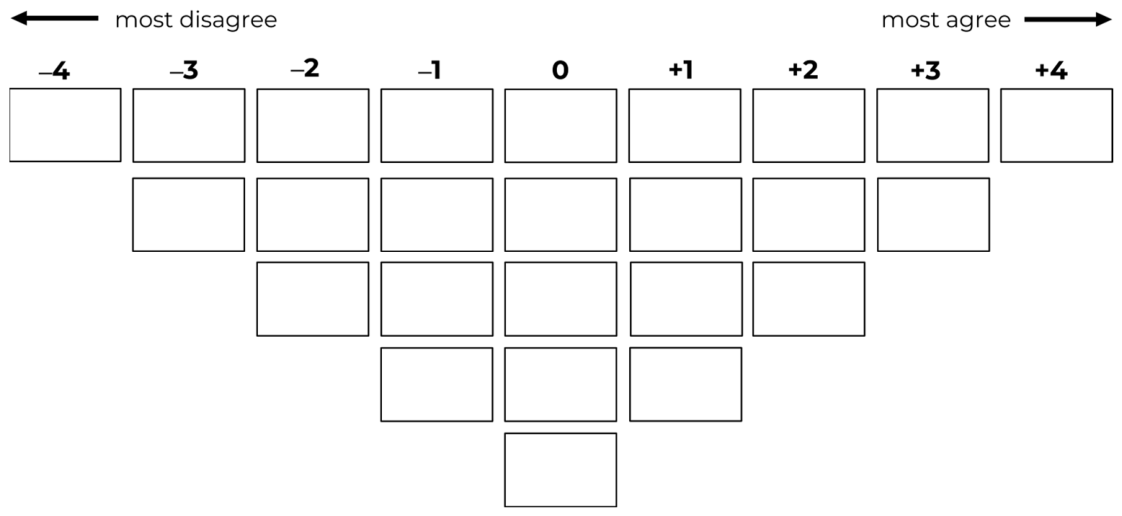
Against this background, Q-methodology offers a promising approach for reconstructing subjective belief configurations. William Stephenson developed Q-methodology in the field of psychology in the 1930s as a method for the systematic study of human subjectivity. It is a by-person factor-analytic approach that combines qualitative and quantitative elements within a “qualiquantological” logic [45] to reconstruct shared viewpoints as structured wholes [46,47,48]. In a typical Q-study, participants rank a set of statements according to specified instructions (e.g., from “most disagree” to “most agree”) within a predefined grid. This process produces an individualized sorting pattern that reflects the participant’s subjective perspective. Subsequently, the Q-sorts are intercorrelated and subjected to by-person factor analysis to identify shared sorting patterns. The resulting factors represent shared patterns of meaning across similar Q-sorts and can be interpreted as distinct, internally coherent viewpoints. Unlike variable-centered approaches that aim for statistical generalization to a population, Q provides substantive generalizability: the resulting factors are generalizable with respect to the types of viewpoints that exist within a population rather than the number of people holding them [49,50]. Figure 1 illustrates an example of a Q-sort distribution grid, as commonly employed in Q-methodological research [48].
Within the field of educational research, Q-methodology is reflected in recent contributions to the education sciences as a valuable approach for investigating the complex, subjective dimensions of teaching, learning, and professional practice [51]. Although international reviews document its growing use in educational settings [52], and recent scholarship has demonstrated its applicability across a range of educational domains, including teacher beliefs and professional perspectives, its systematic application to ESD-related professional beliefs in primary teacher education remains largely absent from the literature, particularly in the German-language context despite early methodological introductions [51]. Given its capacity to reveal both shared and differentiated viewpoints, Q-methodology is a promising yet under-explored approach for investigating such complex and normatively contested educational domains [53]. While it has been sporadically applied in sustainability-related contexts in teacher education—for example, in analyzing SDG prioritizations among teachers and pre-service teachers [54], or in exploring sustainability-related perspectives and professional agency of teachers [55,56]—and while recent work has demonstrated its applicability for investigating pre-service teachers’ beliefs and attitudes in German-language teacher education contexts [57,58], no instrument has been systematically developed and pilot-tested that uses this approach to reconstruct the belief configurations of pre-service or in-service primary teachers regarding ESD.
As Ramlo (2024) [59] has empirically demonstrated, divergent perspectives exist within the Q-research community: while some researchers emphasize close adherence to Stephenson’s original theoretical framework and internal community exchange, others advocate for methodological openness, integration across disciplinary boundaries, and a willingness to move beyond Stephenson’s original vision. The present study tends toward the latter orientation, focusing on the instrumental application of Q-methodology as a tool for belief configuration research in a disciplinary context where the methodology is not yet widely established.
Against this background, this article presents a Q-methodological approach to capturing ESD-related belief configurations in primary teacher education contexts, encompassing the development and pilot-testing of a Q-sample as an instrument for reconstructing such configurations, and examining its methodological suitability for empirical application. The focus is therefore on establishing the instrumental preconditions for such reconstruction rather than on substantively interpreting belief configurations themselves.
Consequently, the following research questions are addressed:
RQ 1. 
To what extent is Q-methodology suitable for capturing the relational structure of ESD-related beliefs in teacher education contexts?
RQ 2. 
Does the pilot study provide sufficient evidence of differentiated belief configurations related to ESD to justify further empirical research?

2. Materials and Methods

This study followed a structured, five-step process to develop, pilot, and refine a Q-sample designed to enable the reconstruction of ESD-related belief configurations in teacher education contexts, using a pilot sample of pre-service primary teachers and following the iterative framework proposed by Paige and Morin (2016) [60,61]. The five-step structure serves as an organizational framework for describing the instrument development process transparently and systematically. The instrument was developed for the German educational context, and the final Q-sample was formulated in German. During the development process, statements adapted from the existing literature were translated into German. For international dissemination, this article presents all statements in English. The final Q-sample is provided in Appendix A (Table A1), including the original German version and an English translation.
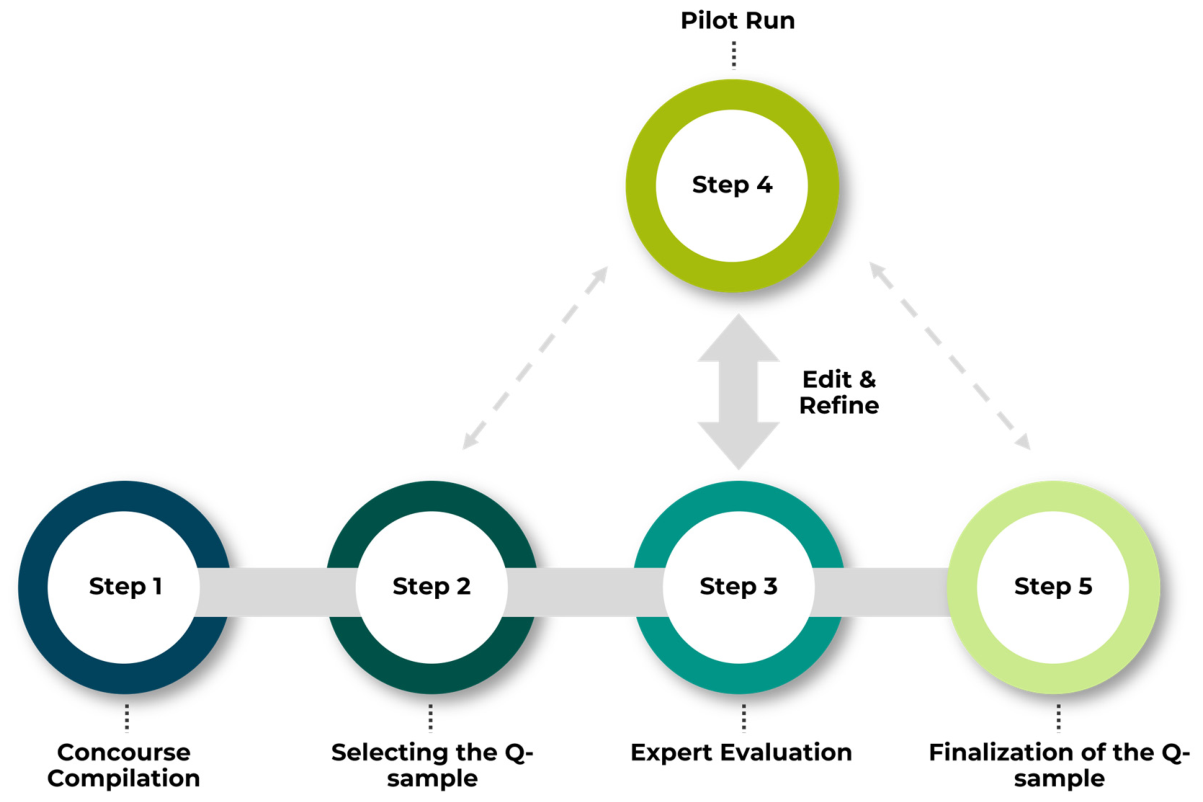
The process included concourse compilation, selecting the Q-sample, expert evaluation, a pilot run and iterative editing and refinement, which led to the finalized instrument. Figure 2 provides an overview of the sequential steps. This section reports the methodological stages (steps 1–4), and the Results section presents the finalized instrument (step 5).

2.1. Step 1: Concourse Compilation

In Q-methodology, the concourse refers to the range of communications through which subjective meanings related to a topic are articulated within a given field of discourse [62]. It provides the discursive foundation for selecting a Q-sample and should reflect the diversity and tensions within that discourse [47].
While the concourse is theoretically infinite [46], the present study approximates it through a systematic compilation from complementary sources, aiming to reflect the breadth and depth of the relevant discourse [48]. For this study, the concourse was determined through a hybrid sampling strategy [63,64], combining a ready-made approach with a small naturalistic component. The ready-made component drew primarily on empirically operationalized and previously validated belief and competence measures from international ESD research, as these instruments explicitly address belief-related dimensions of ESD. At the same time, many of these measures are themselves informed by international policy frameworks (e.g., [65]), thereby ensuring indirect coverage of policy-oriented perspectives within the ESD discourse without relying on policy documents directly. The naturalistic component complemented this by incorporating statements generated from reflective essays by pre-service teachers.
The systematic compilation resulted in a pool of 188 statements (see Table 1), from which the Q-sample was subsequently selected. The following section provides a detailed description of each source.
First, statements were extracted from international empirical studies that operationalized pre-service or in-service teachers’ beliefs, conceptions, or competences related to ESD. Although beliefs are conceptualized inconsistently across the literature, items addressing normative orientations, teaching–learning processes, and understandings of ESD were deliberately included to capture a broad range of belief-related positions [11,12]. All items were translated from their original languages and refined to preserve their core conceptual meaning while reformulating them into statements that are both Q-appropriate and linguistically accessible. For example, the Turkish statement from the Beliefs about Education for Sustainable Development (BESD) Scale, “SKE, öğrencilerin ileriye yönelik karar verme yeteneğini geliştirir.” [65], was translated into German as: “Lernen im Sinne von BNE sollte Schüler:innen dabei unterstützen, selbstständig Entscheidungen für eine nachhaltige Zukunft zu treffen.”
Second, to complement the ready-made component, a small naturalistic component was included. Following established Q-methodological practice of drawing on written primary sources from participants’ communicative contexts [63,64], statements were generated from reflective responses provided by two pre-service primary school teachers specializing in science and social studies education at the bachelor’s degree level. The students were presented with case vignettes depicting typical situations from university coursework and school practice related to ESD. They were asked to articulate their perspectives on these situations. Their open-ended reflections were analyzed and reformulated into statements for the concourse, as has been done in other Q-studies that use reflective essays as a source of concourse material [57,58].
Finally, additional theory-derived statements were formulated to ensure adequate coverage of the domain where relevant conceptual perspectives were underrepresented in the collected material.

2.2. Step 2: Selecting the Q-Sample

From this initial pool of 188 statements, 54 were selected to form the Q-sample through a two-step structured sampling process [48,64]. In a first step, statements were reviewed according to the professional belief dimensions proposed by Fives and Buehl (2012) [13], distinguishing beliefs about context, content, learners, learning, teaching, and the purpose of education. This served as an analytical tool for the initial review and was subsequently consolidated into the three broader orientations proposed by Reusser and Pauli (2014) [11]—distinguishing epistemological, learner-related, and context-related belief dimensions—as this provided a more parsimonious structure for the selection process. General epistemological beliefs not explicitly related to ESD, as well as self-efficacy beliefs, were deliberately excluded.
As the study focuses on pedagogical beliefs related to the enactment of ESD in classroom practice rather than on general sustainability attitudes, a second step drew on pedagogical orientations toward ESD. In particular, the two-dimensional framework proposed by Papenfuss et al. (2019) [70]—spanning a Structure–Agency dimension and a Knowing–Being dimension, yielding four pedagogical orientations—served as a heuristic framework to ensure that instrumental, emancipatory, transmissive and transformative perspectives were all represented within the Q-sample. This strategy prevented any single educational paradigm from being overrepresented and supported the inclusion of potentially conflicting or competing orientations. To strengthen this procedure, experts in the field of ESD were invited to categorize the statements according to the four pedagogical orientations. Their classifications offered an additional interpretive check and helped ensure a comprehensive representation of ESD perspectives within the Q-sample.
During the refinement process, statements with limited substantive content, semantic redundancy, or insufficient relevance to classroom practice were removed or merged. Contrasting and critical positions towards ESD were intentionally retained to enable participants to express divergent or ambivalent viewpoints. Several negatively framed statements were included to capture skeptical or distancing attitudes towards ESD.
All selected statements were linguistically revised following standard Q-methodological recommendations to ensure clarity, interpretability, and focus on a single subjective position [48]. Complex or multi-layered formulations were simplified, technical terminology was reduced, and most statements were phrased in evaluative terms (e.g., using “should”) to facilitate personal positioning without imposing normative prescriptions.
The resulting Q-sample consists of 35 carefully selected statements. This size is within the range commonly recommended for Q-methodological research [48]. It allows for a diversity of perspectives while remaining manageable for participants.
Unlike variable-centered approaches, Q-methodology does not rely on psychometric validation procedures such as reliability coefficients or latent variable modeling. Rather, methodological rigor stems from the systematic construction of the concourse, the conceptual clarity and balance of the Q-sample, and the interpretive coherence of the resulting factor structure [48,52].

2.3. Step 3: Expert Evaluation

Following the iterative process recommended by Paige and Morin (2016) [60], in which Q-sample construction, expert evaluation, and piloting involve recursive feedback loops, Step 3 comprised two distinct phases: an iterative expert evaluation aimed at validating the concourse compilation and identifying content-related gaps, followed by a pre-test focused on linguistic comprehensibility and procedural feasibility.
Building on the initial expert categorization conducted in Step 2, continued consultation with ESD experts served to externally validate the concourse compilation and identify potential gaps in subject-specific coverage [60].
This iterative consultation revealed that subject-specific perspectives on ESD in primary social and science education were underrepresented in the initial Q-sample. Targeted revisions were therefore informed by the scoping review by Limpert and Gryl (2025) [71], which systematically maps central pedagogical approaches to ESD in primary education.
Following the expert evaluation phase, the revised Q-sample was subjected to a digital pre-test using an online Q-sort environment. The pretest focused on the comprehensibility of the statements, the usability of the sorting interface, and the feasibility of the sorting procedure. Particular attention was paid to identifying statements that were unclear, overly complex, or semantically overlapping.
After the evaluation and pre-test, several statements were refined, merged, or reformulated. Complex or multidimensional items were simplified to reflect a single, identifiable viewpoint. Technical terminology was reduced to ensure that the Q-sample was accessible to participants with varying levels of prior knowledge. Contrasting and potentially polarizing statements were deliberately retained to preserve the Q-sample’s capacity to capture divergent and ambivalent belief configurations, in line with established Q-methodology principles [48].
Following the iterative refinement process, one additional statement was removed. The final Q-sample therefore comprised 34 statements. Before its implementation in the pilot study, the revised Q-sample was reviewed once more by the ESD experts involved in the initial categorization process (see Section 2.2). The final selection of statements was made in consultation with these experts to ensure conceptual clarity, balanced representation of pedagogical orientations, and comprehensive coverage of the relevant ESD discourse.

2.4. Step 4: Pilot

A pilot study was conducted to examine the feasibility of the Q-sort procedure, the clarity and functionality of the statements, and the instrument’s suitability for subsequent empirical use. In line with established Q-methodology recommendations, the pilot study served only instrumental purposes and was not intended to generate substantive interpretations of belief configurations [48,64].
The pilot was carried out with a P-set (i.e., the set of participants in Q-methodology) of ten master’s students enrolled in primary teacher education programs at a German university. Five participants studied primary education with a focus on social and science education, and five studied special needs education with a primary-level orientation. All participants had completed the same university seminar related to ESD in the preceding semester. Participants were purposively selected from the intended main study’s target population and recruited through direct contact. Participation was voluntary and uncompensated. In line with Q-methodological principles, in which the focus lies on the nature of subjective viewpoints rather than on their demographic distribution [72], the homogeneity of this P-set is understood in terms of a shared educational context, providing a common basis for interpreting the Q-sample items. In line with the instrumental purpose of the pilot study, this P-set, with a shared experiential background, was considered appropriate at this stage of instrument development [48,60].
The Q-sort was administered entirely online using the EQ Web Sort (Version 7.0.0) platform [73]. After an introductory phase, participants first conducted a pre-sort by assigning the 34 statements to three categories: “tend to disagree”, “no tendency” and “tend to agree”. The statements were then ranked within a forced quasi-normal distribution ranging from –4 (most disagree) to +4 (most agree). This ranking followed a predefined distribution structure that specified the number of statements per ranking position (see Table 2). This procedure was chosen to encourage deliberate prioritization of the statements and to ensure sufficient variance across the Q-sorts, in line with standard Q-methodological practice.
In addition to the Q-sort, participants provided sociodemographic information and details about their previous experiences with ESD. They also offered qualitative feedback on the comprehensibility of the statements, the clarity of the instructions, and the user-friendliness of the online format. These comments were used to identify potential issues with wording, redundancy, or procedural clarity.
For the purpose of instrument testing, the Q-sorts were analyzed using principal component analysis with varimax rotation in the software KenQ Analysis Desktop Edition (KADE, Version 1.3.1) [74]. The analysis aimed to assess whether the Q-sorts produced a coherent correlation structure and an interpretable factor solution suitable for further application. No substantive interpretation of the factors was undertaken at this stage.

2.5. Post-Pilot Evaluation and Refinement

Following the pilot study, a post-pilot evaluation and refinement phase was conducted as part of the iterative Q-sample development process recommended by Paige and Morin (2016) [60]. The pilot results informed a renewed round of expert consultation, during which the Q-sample was reviewed once more for conceptual clarity, content coverage, and potential redundancies. This iterative review, conducted at a temporal distance from the initial instrument development, allowed for a fresh perspective on the statements and revealed several issues that warranted further revision. The following adjustments were made on the basis of this expert consultation.
Statement 1 (“Existing materials are sufficient to implement teaching in line with ESD.”) was removed. Unlike the remaining statements, which address pedagogical orientations and convictions about ESD at a conceptual level, this statement focuses on the availability of teaching materials, a practical and operational concern that falls outside the belief-related scope of the instrument.
Statement 5 (“Responsibility for ESD should primarily lie with teachers who have received specific further training.”) was retained, as the statement was considered relevant for the main study, which will include practicing teachers with more diverse attributions of professional responsibility. The wording was revised by replacing “further trained” with “formally trained” to avoid restricting the statement to additional in-service training.
Statement 30 (“There is hardly any time for ESD in everyday school practices.”) was removed. Like Statement 1, it addresses a practical, resource-related concern rather than a pedagogical belief or conviction about ESD, and therefore falls outside the belief-related scope of the instrument.
Statements 31 (“Reflecting on global interconnections overwhelms many pupils.”) and 34 (“Open and participatory learning formats cannot be implemented equally easily with all learner groups in ESD-oriented teaching.”) were merged into a single reformulated statement: “Some learners are overwhelmed by the complex content and open learning formats of ESD.” Both statements address similar convictions about the limitations of learners in ESD contexts and were therefore consolidated to reduce redundancy.

3. Results

The following section presents the results of the pilot study, focusing on the functional suitability of the Q-sample. Given that this study reports on instrument development rather than a substantive Q-study, the factor selection and analysis are presented as empirical findings that directly address the research questions rather than as methodological decisions preceding the analysis.
All ten participants were master’s students on primary teacher education programs focusing on social and science education. They were predominantly female (n = 9), were in their fifth or sixth semester (n = 6), and aged between 23 and 27 years (M = 24.3). Regarding prior ESD experience, all participants reported having completed at least one ESD-related university seminar. In terms of self-reported familiarity with ESD, five participants indicated moderate familiarity, four indicated good familiarity, and one indicated very good familiarity with the concept.

3.1. Selection of Factors

The pilot data were analyzed to evaluate the instrument’s functional suitability, including assessing the coherence of the correlation structure, the feasibility of factor extraction and the potential of the statement set to distinguish between different subjective viewpoints. The analysis was conducted solely for methodological purposes and did not aim at identifying or interpreting stable belief configurations.
In Q-methodology, individual Q-sorts are correlated with one another to identify shared patterns in how statements are ranked. The resulting correlation matrix is the basis for subsequent by-person factor analysis. Each correlation coefficient indicates the degree of similarity between two participants’ complete sorting patterns across all statements [48]. In the present pilot study, the intercorrelations among the ten Q-sorts (see Table 3) indicated an overall coherent pattern, with most Q-sorts showing moderate similarity and one more weakly correlated sort (Participant (P) 9). Since the pilot P-set was designed to evaluate the instrument’s functionality rather than maximize perspectival diversity, a certain degree of similarity among Q-sorts was expected. Nevertheless, the variability observed in the correlation matrix was sufficient to support exploratory factor analysis.
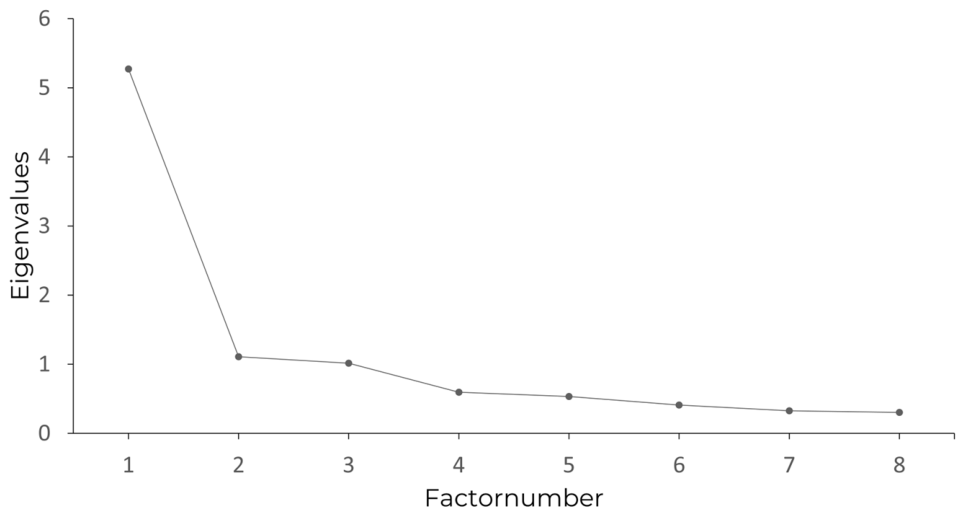
To determine the number of factors to retain, the unrotated principal component solution was evaluated using heuristic and Q-methodological criteria [48]. According to the Kaiser–Guttman criterion, three factors met the threshold for extraction because each accounted for more variance than a single Q-sort. Together, these three factors explained 74% of the total variance. Examination of the scree plot (Figure 3), which displays eigenvalues in descending order, revealed clear inflection points after the second and third factors. Accordingly, two- and three-factor solutions were both justifiable.
To further clarify the factor structure, a Varimax rotation was performed for a three-factor solution to maximize interpretive simplicity. Following Brown (1980) [75], the threshold for significant factor loadings was calculated, resulting in a critical value of 0.44 (p < 0.01) for the present Q-sample (N = 34). In the rotated solution, the first two factors were defined by multiple Q-sorts with significant loadings, whereas the third factor was supported by only one significant Q-sort (see Table A3 in Appendix B). In line with Q-methodological standards, which recommend retaining only factors defined by at least two clearly defining Q-sorts, the third factor was considered unstable. Accordingly, the two-factor solution was chosen for further analysis. This solution accounted for approximately 64% of the explained variance and provided an analytically coherent and interpretable structure for subsequent factor interpretation. In the Varimax-rotated two-factor solution, all Q-sorts loaded significantly on at least one factor. Each factor was defined by at least two Q-sorts with significant loadings, meeting Q-methodological criteria for factor interpretability (see Table 4). Five Q-sorts loaded significantly (p < 0.01) on both factors and were therefore considered cross-loading [48]. In several cases, the differences in loadings were minimal (e.g., P4 had a factor loading of 0.5819 on factor 1 and 0.5875 on factor 2), indicating ambivalent factor affiliation. These cross-loading Q-sorts are marked in Table 4 to indicate their dual-factor association.
Consistent with standard Q-analytical conventions, statements were classified as distinguishing for one of the retained factors or as consensus statements based on their significance in differentiating between factor arrays, using a conservative threshold of p < 0.01 and a less strict criterion of p < 0.05 [75].
In total, 16 statements were identified as distinguishing for Factor 1 and 16 statements as distinguishing for Factor 2 (factor-specific), while 19 statements were classified as consensus statements.
The presence of multiple distinguishing statements for each factor indicates that the Q-sample generated sorting patterns with sufficient differentiation capacity within the pilot P-set [48]. The comparatively high number of consensus statements may reflect shared baseline orientations rooted in the participants’ common educational background, as well as the small sample size, rather than limitations of the instrument itself [48,75].
Taken together, these findings indicate that the Q-sample generated structured and differentiable sorting patterns that meet established Q-methodological criteria. Each factor was defined by multiple significantly loading Q-sorts, and a substantial number of statements were identified as distinguishing at conventional significance levels. This confirms that the instrument is capable of capturing differentiated belief configurations and is ready for substantive empirical application in the main study.

3.2. Participant Feedback

Participant feedback from the pilot study informed two types of revisions: linguistic clarifications to individual statements based on reported ambiguities and procedural adjustments for the main study based on reported usability concerns.

3.2.1. Linguistic Revisions

The open-ended comments in which participants described statements as linguistically unclear or ambiguous were examined. On this basis, two statements were revised to improve semantic clarity and specificity:
Regarding Statement 19 (“In the context of ESD, teachers set clear standards by providing values-based orientation”), participants reported uncertainty about the terms “clear standards,” “orientation,” and “values-based.” To reduce ambiguity, the statement was reformulated as follows: “Teachers base their teaching on their own values and beliefs”.
Statement 2 (“In the context of ESD, learning processes should be designed cooperatively.”) was perceived as overly generic and insufficiently specific to the ESD context. To align the statement more closely with ESD-related didactical principles emphasizing learner agency, it was therefore reformulated as: “In the context of ESD, learning processes should be designed in a self-directed manner”.
These revisions addressed linguistically ambiguous formulations, resulting in more specific and semantically focused statements.

3.2.2. Usability and Task Experience

The online Q-sort procedure functioned reliably, and the instructions and interface were reported as clear and easy to understand. Participants did not report any major technical difficulties. Participant feedback indicated that the online Q-sort tool was generally perceived as understandable and user-friendly, suggesting that the technical implementation did not pose a systematic burden on the sorting process. Reported usability issues were limited and primarily related to device-specific constraints (e.g., use on smartphones) rather than to the tool itself.
The Q-sort task was described as cognitively demanding, with several participants reporting that it required careful reflection on the statements. At the same time, multiple participants expressed discomfort with the forced distribution (“The final arrangement did not fully reflect my actual understanding of and perspective on ESD”, P4, translated from German), noting that the final arrangement did not always fully reflect their subjective evaluations. This feedback was interpreted as an acceptance-related issue rather than a technical limitation. For the main study, this finding informed a targeted revision of the study instructions, with a stronger emphasis on explaining the relative nature of the sorting logic and the purpose of a forced distribution.
Overall, the feedback suggests that the Q-sorting procedure was perceived as usable and engaging while highlighting the need for clearer procedural guidance to enhance participant understanding and acceptance in the main study.

3.3. Step 5: Finalization of the Q-Sample

The final version of the instrument, derived from the iterative evaluation and refinement procedures described above, consists of a Q-sample comprising 31 statements. Due to the reduced number of statements, the forced distribution grid was proportionally adjusted. Although the total number of slots decreased to accommodate the 31 statements, the symmetric quasi-normal distribution logic remained intact, with a slightly more compact central structure. The final Q-sample (Table A1) and the revised distribution grid (Table A2) are provided in Appendix A.

4. Discussion

4.1. Using Q-Methodology to Capture the Complexity of ESD-Related Beliefs

As outlined above, ESD is often described as an open-ended field. Thus, the present study examined whether Q-methodology is a suitable approach for reconstructing the relational structure of ESD-related beliefs in teacher education contexts (RQ 1).
The development and testing of the Q-sample revealed that the conceptual openness of ESD is accompanied by a pronounced interpretative ambiguity. Even during the validation process by experts, individual statements were interpreted differently. This observation is consistent with empirical findings suggesting that even scholars working on ESD do not share a uniform understanding of the core concepts of sustainability but rather articulate diverse and sometimes fragmented interpretations [76]. In this respect, Q-methodology proved particularly suitable. Rather than attempting to reduce ambiguities or frame them normatively, this approach allows divergent interpretations and value orientations to become systematically visible and comparable in their structural relations. Through the forced distribution format, participants are required to position statements relative to one another, thereby making implicit prioritizations, tensions, and trade-offs explicit. Unlike scale-based instruments, which typically measure levels of agreement with isolated statements, Q-methodology foregrounds the structure of belief configurations. It thus captures how participants weigh competing considerations rather than merely whether they endorse them. At the same time, compared to purely qualitative approaches, Q provides a systematic and replicable means of reconstructing shared patterns of meaning while retaining sensitivity to subjective nuance.
Participant feedback from the pilot study further supports this interpretation. Several respondents emphasized that the sorting task required more intensive engagement with the statements than conventional multiple-choice or Likert-scale formats. One participant noted that the procedure prompted a closer reading and deeper reflection on each statement (P1), while another highlighted the necessity of carefully weighing and prioritizing positions instead of simply assigning numerical ratings (P6). Additionally, participants described the task as interesting, suggesting that the format may encourage active involvement in the reflection process. These observations are consistent with previous reports of high participant motivation in Q-sorting procedures [77]. Taken together, these findings imply that the Q-sorting procedure captures existing belief configurations and actively prompts participants to articulate and structure their perspectives in relational terms. This distinguishes it from conventional rating formats.
Against the background of existing scale-based and qualitative approaches to investigating ESD-related beliefs, the present Q-based data collection and analysis strategy can therefore be situated as a complementary and innovative pathway.
The methodological strengths observed in this pilot are not limited to ESD as a research domain. Q-methodology appears particularly suitable for investigating educational fields characterized by normative plurality, conceptual ambiguity, and competing interpretive frames. In such contexts, belief configurations are unlikely to be adequately captured through additive measurement approaches alone but instead require methods capable of reconstructing relational configurations of meaning. Its broader applicability across diverse and complex educational settings has also been documented in recent review research [52].
It should be noted, however, that the present pilot study establishes the preconditions for reconstructing belief configurations rather than the configurations themselves. Q-methodology enables relational reconstruction insofar as participants rank statements relative to one another within a forced distribution, producing a holistic sorting pattern that reflects an integrated subjective perspective. The by-person factor analysis then groups these patterns into shared viewpoints. However, the actual reconstruction of belief configurations as structured wholes requires substantive factor interpretation—a step that was deliberately withheld in this pilot, whose purpose was exclusively instrumental. The pilot thus demonstrates that the developed instrument can generate the data structures from which belief configurations can be reconstructed, not that such configurations have already been identified. This distinction is theoretically important: it locates the present study as a necessary first step in a research program oriented toward the empirical investigation of relational belief structures in ESD.

4.2. Differentiation Potential of the Instrument and Methodological Implications for Further Research

In addressing RQ 2, the pilot study was examined to determine if it provided sufficient evidence of differentiated belief configurations to justify the further empirical application of the instrument. In Q-methodology, differentiation is not determined solely by the number of extracted factors but by the presence of statistically significant factor loadings, clearly defining Q-sorts, and distinguishing statements that separate factor arrays from one another [47,48].
The pilot analysis resulted in a two-factor solution that met established criteria for interpretability. Each factor was defined by multiple significantly loading Q-sorts, and a substantial number of statements were identified as distinguishing at conventional significance levels. These findings indicate that the Q-sample was capable of generating structured sorting patterns that are analytically differentiable within the examined P-set.
At the same time, several Q-sorts exhibited cross-loadings, and a relatively high proportion of statements were classified as consensus items. In small samples with a shared educational background, such patterns are not unusual and may reflect the limited size of the P-set rather than deficiencies of the instrument itself [47,48]. The presence of consensus statements is analytically meaningful insofar as it reveals shared baseline orientations within the group against which factor-specific distinctions become visible.
Beyond demonstrating differentiation capacity, the pilot also fulfilled a central diagnostic function in refining the Q-sample. Participant feedback on statement clarity and task experience informed targeted revisions of the statement set. These adjustments sharpened the conceptual coverage of the instrument and reduced thematic overlap, thereby strengthening its discriminative potential for subsequent data collection [64,78].
Overall, the pilot findings do not yet establish stable belief configurations, nor do they exhaust the range of possible configurations. This is consistent with the study’s purpose: the pilot was designed to evaluate the instrument’s capacity to generate the structural preconditions for belief configuration reconstruction—not to accomplish that reconstruction itself. The evidence gathered supports this more limited but foundational claim: the Q-sample produces analytically differentiable sorting patterns that meet established criteria for factor interpretability. This confirms that the instrument is ready for substantive empirical application, in which the relational structure of ESD-related belief configurations can be reconstructed and interpreted as structured wholes.

4.3. Limitations and Outlook

This pilot study was conducted with a small P-set sharing a common educational background. While appropriate for an initial instrument trial, the limited size and shared educational context of the P-set may have constrained the range of viewpoints that became visible in the factor structure. It remains possible that viewpoints on ESD held within the target population were not captured in this pilot.
In Q-methodology, the aim is not statistical generalization [49,50] but the systematic reconstruction of shared perspectives within a defined P-set [48,75]. Instead, Q provides substantive generalizability: findings are generalizable with respect to the types of viewpoints that exist within a population rather than the number of people holding them [49,50]. The identified factors represent reliable schematics that can be expected to recur across different P-sets and Q-samples, provided that both the Q-sample adequately covers the relevant discursive space and the P-set represents the relevant range of perspectives [49,50]. The systematic construction of the Q-sample in this study—designed to represent competing pedagogical orientations toward ESD (see Section 2.2)—establishes the discursive foundation for substantive generalizability in subsequent studies. The pilot study itself does not yet provide substantively generalizable findings, as factor interpretation was deliberately withheld; rather, it demonstrates that the instrument is capable of generating the structural preconditions for such generalization in a main study. The present pilot therefore provides preliminary evidence of the functional adequacy and differentiation capacity of the Q-sample within a restricted participant group rather than definitive evidence of stable belief configurations.
Future research should apply the refined instrument to larger and more heterogeneous samples in order to examine the robustness and variation in reconstructed belief configurations across professional stages and institutional contexts. Complementary post-sort interviews may further strengthen interpretive rigor by clarifying how participants understand key statements and how these interpretations are embedded within their overall sorting patterns [57].
A further limitation concerns the conceptual complexity and normative density of ESD itself. As emphasized in international debates, ESD is characterized by competing theoretical orientations and evolving conceptual distinctions [79,80]. During statement development and expert review, it became evident that key terms allow for multiple plausible interpretations. While such interpretive openness reflects the contested nature of the field, it also underscores the importance of continued refinement and contextual sensitivity when operationalizing ESD-related beliefs.
Despite its limitations, the study demonstrates the feasibility and analytical relevance of the developed Q-sample for investigating belief configurations related to ESD. The resulting Q-sample not only operationalizes pre-defined dimensions but also enables the empirical reconstruction of relational belief configurations within a normatively contested professional field. By translating theoretical and discursive complexities into a structured sorting procedure, the instrument establishes a foundation for systematically examining how future and practicing teachers position themselves within competing pedagogical orientations toward ESD. The developed instrument provides a scalable, adaptable framework for subsequent empirical studies analyzing professional belief configurations in sustainability-oriented education and beyond.

4.4. Theoretical and Profession-Related Implications for ESD Research and Teacher Education

Beyond its methodological contribution, the developed Q-sample offers potential value for teacher professionalization in the context of ESD. Previous research has shown that Q methodology can be used productively in teacher education settings to stimulate reflection and professional dialog [57]. In this respect, the instrument developed in this study may serve not only as a research tool but also as a structured framework for examining and discussing belief configurations within teacher education programs.
In the field of ESD, teachers are required to navigate normative plurality, ethical tensions, and competing pedagogical orientations [79,80]. Professional decision-making in sustainability-related education therefore involves continuous interpretation and prioritization rather than the application of fixed instructional models. Making belief configurations visible can support awareness of these underlying orientations and thereby contribute to reflective professional development.
From a theoretical perspective, this approach aligns with research conceptualizing teacher beliefs as structured and experience-based systems that guide interpretation and action [12,13]. Rather than classifying teachers into static categories, the Q-sample allows for the empirical reconstruction of how such belief configurations are internally organized. This reconstruction may serve as a starting point for professional dialog, critical examination, and further development.
At the same time, the instrument contributes to ongoing debates in ESD by offering an empirical approach to examining how diverse pedagogical and normative orientations are configured within professional practice. In this way, the Q-sample provides a link between education-theoretical discussions and research on teacher belief configurations without reducing the complexity of either domain.

5. Conclusions

This study developed and pilot-tested a Q-sample designed to enable the empirical reconstruction of ESD-related belief configurations in teacher education contexts. The pilot study assessed the instrument’s structural coherence, differentiation capacity, and methodological suitability rather than establishing substantive belief configurations. Findings indicate that the Q-sample generates structured and differentiable sorting patterns that meet established Q-methodological criteria for factor interpretability and that the instrument is well-suited for substantive empirical application. By introducing Q-methodology into ESD teacher belief research—a domain in which the approach remains underrepresented—this study opens an empirical pathway for examining how competing pedagogical orientations and normative tensions are configured within teachers’ professional meaning-making, rather than merely measured as isolated dimensions. The developed instrument provides a conceptually grounded basis for its more systematic use in ESD research and teacher education—establishing the methodological preconditions for reconstructing relational belief configurations as structured wholes, a reconstruction that subsequent studies with larger and more heterogeneous samples are positioned to carry out.

Supplementary Materials

The following supporting information can be downloaded at https://www.mdpi.com/article/10.3390/higheredu5020050/s1, Document S1: Q-Sort instructions and online procedure documentation; Document S2: Anonymized open-ended responses from the pilot study concerning statement clarity and task experience; Document S3: KADE analysis output from the pilot study.

Author Contributions

Conceptualization, S.V. and M.K.; methodology, S.V.; validation, S.V. and M.K.; formal analysis, S.V.; investigation, S.V.; data curation, S.V.; writing—original draft preparation, S.V.; writing—review and editing, S.V. and M.K.; visualization, S.V.; supervision, M.K.; All authors have read and agreed to the published version of the manuscript.

Funding

This research received no external funding.

Institutional Review Board Statement

Ethical review and approval were waived for this study because, according to German legislation on research involving human subjects, such approval is only required when sensitive data are collected, physical interventions are performed, or subjects could be harmed. Before the study began, all participants were informed of its aims, that participation was voluntary, that transmitting the data constituted voluntary consent to participate, that participation could be discontinued at any time, and that full anonymity was guaranteed. Since no personal data were collected from the students, their anonymity was also guaranteed.

Informed Consent Statement

Informed consent was obtained from all subjects involved in the study.

Data Availability Statement

The anonymized Q-sort data generated and analyzed during the pilot study are available in the Supplementary Materials. During the preparation of this manuscript, the authors used Claude (Anthropic) for reviewing and refining manuscript sections for linguistic clarity and coherence, and DeepL for translation support. The authors have reviewed and edited the output and take full responsibility for the content of this publication.

Acknowledgments

We would like to thank Hannah Wellmanns for her valuable support in conducting the pilot study and for her engagement in the context of her master’s thesis.

Conflicts of Interest

The authors declare no conflicts of interest.

Abbreviations

The following abbreviations are used in this manuscript:
ESDEducation for Sustainable Development
BESDBeliefs about Education for Sustainable Development
KADEKenQ Analysis Desktop Edition
PCAPrincipal Component Analysis

Appendix A

Table A1. Final Q-Sample in German and English.
NumberOriginal Statements in German LanguageStatements in English Language
1Im Sinne von BNE sollten Lernprozesse selbstgesteuert gestaltet werden.In the context of ESD, learning processes should be designed in a self-directed manner.
2BNE-orientierter Unterricht sollte lebensnahe Themen behandeln und globale Herausforderungen mit dem Alltag der Schüler:innen verknüpfen.ESD-oriented teaching should address real-life topics and link global challenges to students’ everyday experiences.
3BNE sollte Lernräume schaffen, in denen ein sensibler Umgang mit Emotionen möglich ist.ESD should create learning environments that allow for sensitive engagement with emotions.
4Für BNE sollten sich vor allem speziell ausgebildete Lehrkräfte verantwortlich fühlen.Responsibility for ESD should primarily lie with specific formally trained teachers.
5Die Perspektiven der Schüler:innen sollten in der Umsetzung von BNE handlungsleitend berücksichtigt werden.Students’ perspectives should guide the implementation of ESD.
6BNE sollte im Unterricht fachübergreifend umgesetzt werden.ESD should be implemented across subject areas in teaching.
7Im Rahmen von BNE sollten Schüler:innen angeregt werden, gesellschaftliche Machtverhältnisse zu hinterfragen.In the context of ESD, students should be encouraged to question societal power relations.
8BNE-orientierter Unterricht sollte sich an klaren Lernzielen und festen Inhalten (z.B. Klimawandel, Ressourcen oder Konsum) orientieren.ESD-oriented teaching should be guided by clear learning objectives and defined content (e.g., climate change, resources, or consumption).
9BNE sollte Werte wie Freiheit und Gerechtigkeit kritisch hinterfragen lassen.ESD should encourage critical reflection on values such as freedom and justice.
10Bereits in der Grundschule sollten Kinder angeregt werden, über Umwelt, Nachhaltigkeit und ihr eigenes Verhalten nachzudenken.Already in primary school, children should be encouraged to reflect on the environment, sustainability, and their own behavior.
11Lernen im Sinne von BNE zielt darauf, gängige Vorstellungen (z.B. zu Konsum, Fortschritt oder Wachstum) kritisch zu hinterfragen.Learning in the context of ESD aims to critically question common assumptions (e.g., about consumption, progress, or growth).
12BNE sollte mit klar strukturierten und von der Lehrkraft geführten Lernprozessen umgesetzt werden.ESD should be implemented through clearly structured and teacher-guided learning processes.
13Kinder können schon heute wichtige Beiträge zur gesellschaftlichen Gestaltung leisten, nicht erst als Erwachsene.Children can already make important contributions to shaping society, not only as adults.
14BNE sollte politisches Engagement als Ziel fördern.ESD should promote political engagement as an educational goal.
15BNE bedeutet, dass Schüler:innen partizipativ an schulischen Gestaltungsprozessen mitwirken.ESD means that students participate in shaping processes within the school.
16Im Rahmen von BNE erhalten Kinder vor allem konkrete Handlungsempfehlungen für ihr Verhalten im Alltag.In the context of ESD, children primarily receive concrete recommendations for their everyday behavior.
17Im Rahmen von BNE sollten die unterschiedlichen Lebensrealitäten aller Menschen berücksichtigt werden.In the context of ESD, the diverse life realities of all people should be taken into account.
18Lehrkräfte gestalten Unterricht auf der Grundlage ihrer eigenen Werte und Überzeugungen.Teachers base their teaching on their own values and beliefs.
19Lernen im Sinne von BNE sollte Schüler:innen darin unterstützen, selbstständig Entscheidungen für eine nachhaltige Zukunft zu treffen.Learning in the context of ESD should support students in making independent decisions for a sustainable future.
20Unterricht im Sinne einer BNE sollte die drei Nachhaltigkeitsdimensionen (ökologisch, ökonomisch, sozial-kulturell) aufeinander bezogen vermitteln.Teaching in the context of ESD should convey the three dimensions of sustainability (ecological, economic, and socio-cultural) in relation to one another.
21Im Rahmen von BNE sollten auch grundlegende gesellschaftliche Veränderungen thematisiert werden.In the context of ESD, fundamental societal changes should also be addressed.
22Für wirksame BNE muss die ganze Schule—nicht nur der Unterricht—einbezogen werden.For effective ESD, the whole school—not only classroom teaching—must be involved.
23Schüler:innen sollten lernen, kontroverse Aussagen zu hinterfragen, auch jene die diskriminierend oder wissenschaftlich nicht haltbar sind.Students should learn to question controversial statements, including those that are discriminatory or scientifically unsound.
24Für BNE sind die 17 Nachhaltigkeitsziele (SDGs) der UN eine verlässliche Grundlage, an der man sich orientieren sollte.For ESD, the 17 Sustainable Development Goals (SDGs) provide a reliable framework for orientation.
25Im Rahmen von BNE sollten Lehr- und Lernprozesse zu aktuellen gesellschaftlichen Fragen eine klare Haltung vermitteln.In the context of ESD, teaching and learning processes concerning current societal issues should convey a clear stance.
26Im Rahmen von BNE sollten Lernende eigene Vorstellungen einer wünschenswerten Zukunft entwickeln.In the context of ESD, learners should develop their own visions of a desirable future.
27Im Sinne von BNE ist es zentral, dass Kinder ihr eigenes Verständnis und ihre eigene Meinung bilden können.In the context of ESD, it is essential that children can form their own understanding and their own opinions.
28Die Umsetzung von BNE im Schulalltag ist nur mit erheblichem Zusatzaufwand möglich.It would require considerable additional effort to implement ESD in everyday school practices.
29BNE ist inhaltlich vor allem Aufgabe von Fächern wie Sachunterricht oder Geographie.In terms of content, ESD is primarily the responsibility of subjects such as science and social studies or geography.
30BNE ist in vielen Aspekten zu idealistisch für den Schulalltag.In many respects, ESD is too idealistic for everyday school practices.
31Manche Lernende sind mit den komplexen Inhalten und offenen Lernformen der BNE überfordert.Some learners are overwhelmed by the complex content and open learning formats of ESD.
Table A2. Revised Q-sort distribution grid for 31 statements.
Level of Agreement−4−3−2−10+1+2+3+4
(most disagree)(no tendency)(most agree)
Statements per column234454432

Appendix B

Table A3. Factor loadings for the three-factor solution.
ParticipantFactor 1Factor 2Factor 3
30.84450.12570.0627
40.82120.4279−0.0749
80.80590.13890.2199
70.58400.52720.3114
50.03450.8226−0.1633
60.26330.79810.1331
100.35520.69570.3818
20.50620.62340.2617
10.44200.51550.3169
90.09680.0660* 0.9457
* Only Q-sort with a significant loading on Factor 3 (p < 0.01).

References

  1. UNESCO. Education for Sustainable Development Goals: Learning Objectives; UNESCO: Paris, France, 2017. [Google Scholar]
  2. Wals, A.E.J. Learning Our Way to Sustainability. J. Educ. Sustain. Dev. 2011, 5, 177–186. [Google Scholar] [CrossRef]
  3. Bonnett, M. Environmental Education and the Issue of Nature. J. Curric. Stud. 2007, 39, 707–721. [Google Scholar] [CrossRef]
  4. Costa, J.; Kminek, H.; Ruckelshauß, T.; Singer-Brodowski, M.; Weselek, J. Einleitung: Kontroversen und Debatten im Kontext von Bildung für nachhaltige Entwicklung. In Bildung für Nachhaltige Entwicklung: Kontroversen und Debatten: Schriftenreihe “Ökologie und Erziehungswissenschaft” der Kommission Bildung für Nachhaltige Entwicklung der Deutschen Gesellschaft für Erziehungswissenschaft (DGfE); Costa, J., Kminek, H., Ruckelshauß, T., Singer-Brodowski, M., Weselek, J., Eds.; Verlag Barbara Budrich: Leverkusen, Germany, 2025; pp. 7–14. [Google Scholar]
  5. Kopnina, H. Education for the Future? Critical Evaluation of Education for Sustainable Development Goals. J. Environ. Educ. 2020, 51, 280–291. [Google Scholar] [CrossRef]
  6. Lange, S.D.; Kater-Wettstädt, L.; Lischka-Schmidt, R. Grundlegend nachhaltig–Grundschultheoretische Spannungsmomente einer Bildung für Nachhaltige Entwicklung. Z. Für Grund. J. Prim. Educ. Res. 2026, 19, 47–64. [Google Scholar] [CrossRef]
  7. Davis, J.M.; Elliott, S.; Ärlemalm-Hagsér, E. Early Childhood Education for Sustainability: A Short History; Springer: Singapore, 2024. [Google Scholar]
  8. Baumert, J.; Kunter, M.; Blum, W.; Klusmann, U.; Krauss, S.; Neubrand, M. The COACTIV Model of Teachers’ Professional Competence. In Cognitive Activation in the Mathematics Classroom and Professional Competence of Teachers: Results from the COACTIV Project; Springer US: Boston, MA, USA, 2013; Volume 8. [Google Scholar] [CrossRef]
  9. Shulman, L.S. Knowledge and Teaching: Foundations of the New Reform. Harv. Educ. Rev. 1987, 57, 1–22. [Google Scholar] [CrossRef]
  10. Blömeke, S.; Gustafsson, J.-E.; Shavelson, R.J. Beyond dichotomies: Competence viewed as a continuum. Z. Für Psychol. 2015, 223, 3–13. [Google Scholar] [CrossRef]
  11. Reusser, K.; Pauli, C. Berufsbezogene Überzeugungen von Lehrerinnen und Lehrern. In Handbuch der Forschung zum Lehrerberuf; Terhart, E., Bennewitz, H., Rothland, M., Eds.; GESIS-Leibniz-Institut für Sozialwissenschaften: Mannheim, Germany, 2014; pp. 642–661. [Google Scholar]
  12. Pajares, M.F. Teachers’ Beliefs and Educational Research: Cleaning up a Messy Construct. Rev. Educ. Res. 1992, 62, 307–332. [Google Scholar] [CrossRef]
  13. Fives, H.; Buehl, M.M. Spring cleaning for the “messy” construct of teachers’ beliefs: What are they? Which have been examined? What can they tell us? In APA Educational Psychology Handbook: Vol 2. Individual Differences and Cultural and Contextual Factors; Harris, K.R., Graham, S., Urdan, T., Graham, S., Royer, J.M., Zeidner, M., Eds.; American Psychological Association: Washington, DC, USA, 2012; pp. 471–499. [Google Scholar]
  14. Vukelić, N. Teacher Action Competence in Education for Sustainable Development. J. Contemp. Educ. Stud./Sodob. Pedagog. 2022, 73, 180–194. [Google Scholar]
  15. Bertschy, F.; Künzli, C.; Lehmann, M. Teachers’ Competencies for the Implementation of Educational Offers in the Field of Education for Sustainable Development. Sustainability 2013, 5, 5067–5080. [Google Scholar] [CrossRef]
  16. Läge, D.; McCombie, G. Berufsbezogene Lehrerüberzeugungen als pädagogisches Bezugssystem erfassen. Ein Vergleich von angehenden und berufstätigen Lehrpersonen der verschiedenen Schulstufen in der Schweiz. Z. Für Pädagogik 2015, 61, 118–143. [Google Scholar]
  17. Heinze, F. Bildung für Nachhaltige Entwicklung als Schulische Querschnittsaufgabe: Anforderungen an Lehrpersonen; Budrich Academic Press: Opladen, Germany; Berlin, Germany; Toronto, ON, Canada, 2022. [Google Scholar]
  18. Sterling, S. Sustainable Education: Re-Visioning Learning and Change; Green Books: Totnes, UK; Devon, UK, 2001. [Google Scholar]
  19. Wals, A.E.; Jickling, B. “Sustainability” in higher education. From doublethink and newspeak to critical thinking and meaningful learning. Int. J. Sustain. High. Educ. 2002, 3, 221–232. [Google Scholar] [CrossRef]
  20. Ates, H.; Gül, S.K. Investigating of Pre-Service Science Teachers’ Beliefs on Education for Sustainable Development and Sustainable Behaviors. Int. Electron. J. Environ. Educ. 2018, 8, 105–122. [Google Scholar]
  21. Tomas, L.; Girgenti, S.; Jackson, C. Pre-Service Teachers’ Attitudes toward Education for Sustainability and Its Relevance to Their Learning: Implications for Pedagogical Practice. Environ. Educ. Res. 2017, 23, 324–347. [Google Scholar] [CrossRef]
  22. Dittmann-Zöllner, S.; Berninger, I.; Springob, J. Bildung für nachhaltige Entwicklung: Ein Querschnittsthema in der Lehrer*innenbildung?! ZfL Discuss. Pap. 2023, 12, 1–20. [Google Scholar] [CrossRef]
  23. Gaubitz, S. Bildung für nachhaltige Entwicklung im Verständnis von Sachunterrichtsstudierenden. In Herausforderungen und Zukunftsperspektiven für den Sachunterricht: Probleme und Perspektiven des Sachunterrichts; Schmeinck, D., Michalik, K., Goll, T., Eds.; Verlag Julius Klinkhardt: Bad Heilbrunn, Germany, 2023; pp. 101–107. [Google Scholar]
  24. Zhou, R. Education for sustainable development in China: Experiences from school teachers’ perspectives and enactments. Discov. Sustain. 2024, 5, 388. [Google Scholar] [CrossRef]
  25. Akça, F. Sustainable development in teacher education in terms of being solution oriented and self-efficacy. Sustainability 2019, 11, 6878. [Google Scholar] [CrossRef]
  26. Hinzke, J.-H.; Herzig, T.; Weber, L. Bildung für nachhaltige Entwicklung als Herausforderung für die Lehrer*innenbildung. Orientierungen von Lehramtsstudierenden zu Nachhaltigkeit und nachhaltigkeitsbezogener Bildung. Z. Für Bild. 2024, 14, 357–373. [Google Scholar] [CrossRef]
  27. Bröll, L.; Haustein, A. Bildung für nachhaltige Entwicklung in den Überzeugungen von Sachunterrichtslehrkräften. In Konzepte der Professionalisierungsforschung im Dialog: Theoretische und Empirische Perspektiven für die Lehrkräftebildung; Zachow, I., Heins, J., Böse, S., Hauenschild, K., Schütte, U., Eds.; Verlag Julius Klinkhardt: Bad Heilbrunn, Germany, 2025; pp. 188–197. [Google Scholar]
  28. Sinakou, E.; Donche, V.; Van Petegem, P. Teachers’ Profiles in Education for Sustainable Development: Interests, Instructional Beliefs, and Instructional Practices. Environ. Educ. Res. 2024, 30, 397–418. [Google Scholar] [CrossRef]
  29. UNESCO; International Education. Teachers Have Their Say: Motivation, Skills and Opportunities to Teach Education for Sustainable Development and Global Citizenship; UNESCO: Paris, France, 2021. [Google Scholar]
  30. Winter, C.; Firth, R. Knowledge about Education for Sustainable Development: Four Case Studies of Student Teachers in English Secondary Schools. J. Educ. Teach. Int. Res. Pedagog. 2007, 33, 341–358. [Google Scholar] [CrossRef]
  31. Andersson, K. Starting the Pluralistic Tradition of Teaching? Effects of Education for Sustainable Development (ESD) on Pre-Service Teachers’ Views on Teaching about Sustainable Development. Environ. Educ. Res. 2017, 23, 436–449. [Google Scholar] [CrossRef]
  32. Duifhuis, P.; Savelsbergh, E.; van Dijk, G. Pre-service science teachers’ visions on education for sustainable development–tensions, underlying beliefs, and experiences. Int. J. Sci. Educ. 2025, 1–22. [Google Scholar] [CrossRef]
  33. Sinakou, E.; Donche, V.; Boeve-de Pauw, J.; van Petegem, P. Development and Validation of a Questionnaire on Teachers’ Instructional Beliefs and Practices in Education for Sustainable Development. Environ. Educ. Res. 2021, 27, 1305–1328. [Google Scholar] [CrossRef]
  34. Sagdic, A.; Sahin, E. An Assessment of Turkish Elementary Teachers in the Context of Education for Sustainable Development. Int. Electron. J. Environ. Educ. 2016, 6, 141–155. [Google Scholar] [CrossRef]
  35. Baumann, R.; Meyer, S.; Bärtlein, L.; Martschinke, S. Intrinsische Motivation, Wissen und Selbstwirksamkeit zu BNE im Grundschullehramtsstudium. Z. Für Hochschulentwicklung 2023, 18, 229–249. [Google Scholar] [CrossRef]
  36. Lohmann, J.; Nigg, C.; Hertle, I.; Kugelmann, C. Preservice physical education teachers’ beliefs about sustainable development in physical education-scale development and validation. Ger. J. Exerc. Sport Res. 2023, 54, 43–54. [Google Scholar] [CrossRef]
  37. Bulut, B.; Elci Oksuzoglu, I. Teachers’ Beliefs About Education for Sustainable Development: Challenges and Opportunities. Sustainability 2025, 17, 7552. [Google Scholar] [CrossRef]
  38. Vukelic, N.; Loncaric, D.; Roncevic, N. Predicting Student Teachers’ ESD Implementation Intention: The Role of Values, Beliefs, Attitudes, and Self-Efficacy. J. Teach. Educ. Sustain. 2025, 27, 33–56. [Google Scholar] [CrossRef]
  39. Zhukova, O.; Fjodorova, I.; Iliško, D. Novice Teachers’ Beliefs and Knowledge about Education for Sustainable Development. Acta Paedagog. Vilnensia 2020, 44, 34–44. [Google Scholar] [CrossRef]
  40. Wagner, S.; Keller, M.V.; Flierl, K.S.; Daumiller, M. ‘Was denn noch?’ Wie Lehrkräfte den Auftrag zur Umsetzung von Bildung für nachhaltige Entwicklung wahrnehmen. GAIA-Ecol. Perspect. Sci. Soc. 2025, 34, 151–160. [Google Scholar] [CrossRef]
  41. Heinze, F. «Weil Haltungen nicht vom Himmel fallen»–Individuelle Werthaltungen und Überzeugungen zu BNE: Ein Professionalisierungsproblem? Beiträge Zur Lehrerinnen-Und Lehrerbildung 2026, 44, 45–59. [Google Scholar] [CrossRef]
  42. Bedir, H. English Language Teachers‘ Beliefs and Perceptions on Sustainability. Int. J. Curric. Instr. 2021, 13, 1880–1895. [Google Scholar]
  43. Böse, S.; Gräbe, V. Implizites Wissen, Orientierungen und Habitus angehender Lehrkräfte in der Nachhaltigkeitsbildung. In Bildung für Nachhaltige Entwicklung: Kontroversen und Debatten: Schriftenreihe “Ökologie und Erziehungswissenschaft” der Kommission Bildung für Nachhaltige Entwicklung der Deutschen Gesellschaft für Erziehungswissenschaft (DGfE); Costa, J., Kminek, H., Ruckelshauß, T., Singer-Brodowski, M., Weselek, J., Eds.; Verlag Barbara Budrich: Leverkusen, Germany, 2025; pp. 15–36. [Google Scholar]
  44. Vidal, S.; Kuckuck, M. Pre-Service Teacher Action Competence in Education for Sustainable Development: A Scoping Review. Sustainability 2025, 17, 3856. [Google Scholar] [CrossRef]
  45. Stenner, P.; Rogers, R.S. Q methodology and qualiquantology: The example of discriminating between emotions. In Mixing Methods in Psychology: The Integration of Qualitative and Quantitative Methods in Theory and Practice; Todd, Z., Nerlich, B., McKeown, S., Clarke, D.D., Eds.; Psychology Press: London, UK, 2004; pp. 99–118. [Google Scholar]
  46. Stephenson, W. The Study of Behavior; Q-Technique and Its Methodology; The University of Chicago Press: Chicago, IL, USA, 1953. [Google Scholar]
  47. Brown, S.R. A Primer on Q Methodology. Operant Subj. 1993, 16, 91–138. [Google Scholar] [CrossRef]
  48. Watts, S.; Stenner, P. Doing Q Methodological Research: Theory, Method and Interpretation; Sage Publications: Thousand Oaks, CA, USA, 2012. [Google Scholar]
  49. Ramlo, S. Non-Statistical, Substantive Generalization: Lessons from Q Methodology. Int. J. Res. Method Educ. 2024, 47, 65–78. [Google Scholar] [CrossRef]
  50. Thomas, D.B.; Baas, L.R. The Issue of Generalization in Q Methodology: “Reliable Schematics” Revisited. Operant Subj. 1992, 16, 18–36. [Google Scholar] [CrossRef]
  51. Brown, S.R.; Montgomery, D. (Eds.) Q Methodology and Education; Springer Nature Switzerland: Cham, Switzerland, 2025. [Google Scholar]
  52. Lundberg, A.; de Leeuw, R.; Aliani, R. Using Q methodology: Sorting out subjectivity in educational research. Educ. Res. Rev. 2020, 31, 100361. [Google Scholar] [CrossRef]
  53. Müller, F.H.; Kals, E. Die Q-Methode. Ein innovatives Verfahren zur Erhebung subjektiver Einstellungen und Meinungen. Forum Qual. Sozialforschung/Forum Qual. Soc. Res. 2004, 5, 34. [Google Scholar] [CrossRef]
  54. Kotuláková, K.; Kohutiarová, V.; Orolínová, M.; Trcková, K. A Q-Methodology Study to Identify Slovak and Czech Secondary School Teachers’ Prioritised Features of the Sustainable Development Goals. Environ. Educ. Res. 2025, 31, 390–412. [Google Scholar] [CrossRef]
  55. Guerra, A.; Chen, J.; Du, X.; Nielsen, H.; Kørnøv, L. Teacher’s Agency in Education for Sustainable Development: An East-West Collaborative Erasmus Programme Using Q Methodology. Int. J. Sustain. High. Educ. 2024, 25, 155–176. [Google Scholar] [CrossRef]
  56. Cokcaliskan, H.; Okulu, H.Z.; Yorulmaz, A. Perceptions of the Sustainable Development Goals: A Q-Methodology Study with Turkish Preservice Teachers. Environ. Educ. Res. 2024, 30, 1729–1747. [Google Scholar] [CrossRef]
  57. Kling, I.; Buhl, M. Applying Q methodology in higher teacher education for pre-service teachers’ (self-)reflection, learning and professional development. Front. Educ. 2025, 10, 1–18. [Google Scholar] [CrossRef]
  58. Kling, I.; Lintner, A. Praxisbezogene Einstellungen von Lehramtsstudierenden-Eine Q-Studie. Empirische Pädagogik 2022, 36, 80–98. [Google Scholar]
  59. Ramlo, S. Q methodologist views on the future of Q: A study of a research community. Qual. Quant. Int. J. Methodol. 2024, 58, 4897–4914. [Google Scholar] [CrossRef]
  60. Paige, J.B.; Morin, K.H. Q-Sample Construction: A Critical Step for a Q-Methodological Study. West. J. Nurs. Res. 2016, 38, 96–110. [Google Scholar] [CrossRef]
  61. Thume, S. Das Fachverständnis zum Schulfach Geographie-Eine Analyse am Beispiel der Individuellen Relevanz von Unterrichtsprinzipien Mittels Q-Methode; BoD-Books on Demand: Norderstedt, Germany, 2023. [Google Scholar]
  62. Stephenson, W. Consciring: A General Theory for Subjective Communicability. Ann. Int. Commun. Assoc. 1980, 4, 7–36. [Google Scholar] [CrossRef]
  63. Sæbjørnsen, S.E.N.; Ellingsen, I.T.; Good, J.M.; Ødegård, A. Combining a naturalistic and theoretical Q sample approach: An empirical research illustration. Operant. Subj. 2016, 38, 15–32. [Google Scholar] [CrossRef]
  64. McKeown, B.; Thomas, D.B. Q methodology; Sage: Los Angeles, CA, USA, 2013. [Google Scholar]
  65. Sağdıç, A.; Sahin, E. Sürdürülebilir kalkınma eğitimine yönelik inançlar: Ölçek geliştirme çalışması [Beliefs on education for sustainable developmnet: Scale development study]. Kırşehir Eğitim Fakültesi Derg. [J. Kirsehir Educ. Fac.] 2015, 16, 161–180. [Google Scholar]
  66. Boon, H.J. Beliefs and Education for Sustainability in Rural and Regional Australia. Educ. Rural Aust. 2011, 21, 37–54. [Google Scholar]
  67. Bourn, D.; Kalsoom, Q.; Soysal, N.; Ince, B. Student Teachers’ Understanding and Engagement with Education for Sustainable Development (ESD) in England, Türkiye (Turkey) and Pakistan; Research Paper no. 23; UCL: London, UK, 2023. [Google Scholar]
  68. Soysal, N. Pre-Service Classroom Teachers’ Perceived Competencies on Education for Sustainable Development. Ph.D. Thesis, Middle East Technical University, Ankara, Türkiye, 2016. [Google Scholar]
  69. Chaaban, Y.; Du, X.; Lundberg, A.; Abu-Tineh, A. Education Stakeholders’ Viewpoints about an ESD Competency Framework: Q Methodology Research. Sustainability 2023, 15, 1787. [Google Scholar] [CrossRef]
  70. Papenfuss, J.; Merritt, E.; Manuel-Navarrete, D.; Cloutier, S.; Eckard, B. Interacting Pedagogies: A Review and Framework for Sustainability Education. J. Sustain. Educ. 2019. [Google Scholar]
  71. Limpert, M.-M.; Gryl, I. (Un)sortierte Vielfalt: Ein Review zu Bildung für nachhaltige Entwicklung im Sachunterricht. GW Unterr. 2025, 178, 61–83. [Google Scholar] [CrossRef]
  72. Ramlo, S. Examining Subjectivity with Q Methodology; Routledge, Taylor & Francis Group: London, UK; New York, NY, USA, 2025. [Google Scholar]
  73. Banasick, S. EQ Web Sort (Version 7.0.0) [Computer Software]; 2024. Available online: https://zenodo.org/records/15765780 (accessed on 8 June 2026).
  74. Banasick, S. KADE: A desktop application for Q methodology. J. Open Source Softw. 2019, 4, 1360. [Google Scholar] [CrossRef]
  75. Brown, S.R. Political Subjectivity Applications of Q Methodology in Political Science; Yale University Press: New Haven, CT, USA; London, UK, 1980. [Google Scholar]
  76. Sinakou, E.; Boeve-de Pauw, J.; Goossens, M.; van Petegem, P. Academics in the field of Education for Sustainable Development: Their conceptions of sustainable development. J. Clean. Prod. 2018, 184, 321–332. [Google Scholar] [CrossRef]
  77. Jaschke, T. Mathematikunterrichtsbezogene Überzeugungen mithilfe der Q-Methode typisieren. Bildungsforschung 2018, 1860–8213, 1–15. [Google Scholar] [CrossRef]
  78. Van Exel, N.; Job, A.; de Graaf, G. Q Methodology: A Sneak Preview, 2005. Available online: https://qmethodblog.wordpress.com/wp-content/uploads/2016/01/qmethodologyasneakpreviewreferenceupdate.pdf (accessed on 8 June 2026).
  79. Hesselink, F.; van Kempen, P.; Wals, A. ESDebate: International Debate on Education for Sustainable Development; IUCN: Fontainebleau, France, 2000. [Google Scholar]
  80. Pettig, F.; Singer-Brodowski, M. Learning in Relation with a Changing World: Thinking Beyond ESD 1 and ESD 2 Towards ESD 3. J. Educ. Sustain. Dev. 2024, 18, 176–201. [Google Scholar] [CrossRef]
Figure 1. Example of a quasi-normal distribution grid.
Higheredu 05 00050 g001
Figure 2. Overview of the Q-sample development process (following Paige & Morin (2016) [60]).
Higheredu 05 00050 g002
Figure 3. Scree Plot.
Higheredu 05 00050 g003
Table 1. Origin and type of sources contributing to the Q-sample.
Types of InformationSourcesNumber of
Statements
Empirical StudiesQuestionnaires on pre-service teachers’ beliefs of ESDBoon (2011) [66]
Sağdıç & Sahin (2015) [65]
3
30
Questionnaires on pre-service teachers’ conceptions of ESDBourn et al. (2023) [67]22
Questionnaires on competences in ESDSoysal (2016) [68]15
Q-Sort on competences in ESDChaaban et al. (2023) [69]39
Reflective Essays to Case Vignettes2 pre-service primary teachers66
Theory-derivedConceptual and pedagogical ESD discourse [70]13
Total188
Table 2. Forced quasi-normal distribution grid used for the 34 statements in the pilot study.
Level of Agreement−4−3−2−10+1+2+3+4
(most disagree)(no tendency)(most agree)
Statements per column234565432
Table 3. Intercorrelation matrix of the ten pilot Q-sorts.
Participant12345678910
11.00
20.641.00
30.480.471.00
40.530.660.691.00
50.330.410.210.381.00
60.510.640.320.550.481.00
70.520.650.490.680.390.581.00
80.400.520.560.650.180.370.621.00
90.310.310.210.080.030.180.360.291.00
100.570.630.440.540.460.680.680.460.381.00
Table 4. Factor loadings for the varimax-rotated two-factor solution with cross-loadings marked in gray.
ParticipantFactor 1Factor 2
5* 0.8289−0.1270
6* 0.80650.2333
100.68920.4607
20.66450.5171
10.53980.5055
80.2564* 0.7690
30.2732* 0.7088
9−0.0514* 0.6285
70.57880.6160
40.58190.5875
* The Q-sorts marked with an asterisk have clearly significant loadings for their respective factors.
Disclaimer/Publisher’s Note: The statements, opinions and data contained in all publications are solely those of the individual author(s) and contributor(s) and not of MDPI and/or the editor(s). MDPI and/or the editor(s) disclaim responsibility for any injury to people or property resulting from any ideas, methods, instructions or products referred to in the content.