


Abstract
Confidence in mathematics is a key factor for academic success, being influenced by emotional, behavioral, and technological aspects. The integration of digital tools, such as GeoGebra, has shown potential to promote engagement and develop mathematical skills. This study investigates how affective and behavioral engagement, confidence in the use of technology, and the perception of GeoGebra use relate to and contribute to explaining the confidence in mathematics of future teachers. The sample comprised 54 undergraduate students in Basic Education from a higher polytechnic institution. Participants engaged in learning activities involving real functions of a real variable using both traditional methods and GeoGebra. Data were analyzed using partial least squares structural equation modeling. The results indicate that behavioral engagement positively influences affective engagement, which, in turn, enhances confidence in mathematics. Confidence in the use of technology also has a positive effect on confidence in mathematics. The perception of GeoGebra use significantly influences behavioral engagement and confidence in the use of technology, but not affective engagement. These findings highlight the importance of the critical integration of digital technologies in mathematics education and emphasize the need to design pedagogical strategies that promote active participation and strengthen future teachers’ confidence in using technological tools.
1. Introduction
Information and Communication Technologies (ICT) have become indispensable resources in modern schools, being used with the aim of enhancing the effectiveness of the teaching and learning process [1]. Their incorporation into teaching aims to create educational environments in which students can construct their own knowledge through visualization and experimentation [2].
In the context of the COVID-19 pandemic, education faced unprecedented challenges that accelerated the integration of technology into teaching. Liguori and Winkler [3] highlight that this period fostered a more entrepreneurial pedagogical approach, requiring a paradigm shift in online education. Tools such as Moodle proved effective in supporting distance learning, demonstrating satisfactory levels of usability [4]. This scenario reinforces the importance of critically and purposefully integrating digital technologies into different educational contexts, not only in online environments but also in the classroom.
In this context, GeoGebra, as dynamic mathematics software, has stood out as a powerful tool associated with the promotion of active and meaningful learning in mathematics [5,6]. Despite its recognized potential, Yohannes and Chen [7] found that there is a limited number of studies on the integration of GeoGebra in mathematics education, which justifies the relevance of research analyzing the impact of its use on students’ learning and attitudes.
The way mathematics is taught directly influences students’ learning experiences and their beliefs about the subject. In this regard, Duque [8] proposes a reconceptualized approach that harmonizes absolutist and constructivist perspectives, combining the conceptual and historical rigor of mathematics with opportunities for active and contextualized exploration. By providing learning experiences that balance conceptual precision with freedom of exploration, this type of approach can simultaneously enhance affective and behavioral engagement, strengthen confidence in mathematics, and foster more positive attitudes towards the use of digital technologies.
In this study, affective engagement is understood as the emotions, interest, and enjoyment associated with learning mathematics, while behavioral engagement refers to students’ active participation in learning tasks, such as persisting in problem-solving, interacting with peers, and engaging in the proposed activities.
Students’ confidence in mathematics, as well as their affective and behavioral engagement, has been associated with better academic outcomes [9,10]. Moreover, confidence in using technology is also a key factor for the successful integration of technology in teaching [11]. Creating tools and digital environments that foster students’ self-regulation and interest is, therefore, a priority for educational innovation [12].
Recent technological innovations have brought about significant changes in education, offering creative tools that contribute to improving the quality of learning. According to Ubaidillah et al. [13], students recognize satisfactory levels of proficiency in the use of these technologies and especially value ease of use and perceived usefulness, which are determining factors for their acceptance and use in educational contexts. The authors argue that educational policies should promote strategies that ensure technological innovations meet these criteria, thereby effectively supporting students’ academic progress in the competitive higher education environment.
Beyond their pedagogical role, technology also provides tools for data analysis that can support more informed and efficient decision-making in educational contexts [14]. Therefore, its critical and well-founded integration is an essential step towards fostering more meaningful, motivating, and contemporary-aligned mathematics education.
Previous studies highlight that the use of GeoGebra contributes to improving conceptual understanding and mathematical problem-solving [6,15]. This tool enables a more exploratory and interactive form of learning, promoting significantly higher performance compared to traditional approaches [16].
Students’ attitudes towards mathematics are recognized as a key factor for academic success, especially when complemented by the use of digital technologies [17]. Thus, understanding future teachers’ perceptions of GeoGebra is crucial to supporting teacher training and the development of innovative pedagogical practices in mathematics education.
Although several of the relationships examined have been previously reported in the Mathematics Education literature, the contribution of this study lies in the integrated analysis of these constructs within the specific context of initial teacher education and in their articulation with perceptions of GeoGebra use. By examining engagement, confidence, and perceptions of technology use simultaneously within a single structural model, the study seeks to provide a more comprehensive understanding of how these factors relate to one another in a university context. Thus, the study seeks to answer the following research question: how do affective and behavioral engagement, confidence in the use of technology, and perceptions of GeoGebra use relate to one another and associate with pre-service teachers’ confidence in mathematics within the context of initial teacher education? In this sense, the present study aims to empirically test a structural model that integrates the relationships between affective and behavioral engagement, confidence in the use of technology, and perceptions of GeoGebra use, and their association with pre-service teachers’ confidence in mathematics.
After this introduction, the theoretical framework is presented, followed by the methodology adopted, the results, and their respective discussion. The article concludes with the conclusions, highlighting practical implications and suggesting future lines of research.
2. Literature Review
2.1. Engagement in Mathematics
Academic engagement is widely recognized as an essential factor for student success [18]. Creating learning environments that promote active participation, motivation, interest, and student engagement significantly contributes to better academic outcomes [19]. In the specific case of mathematics, engagement is assumed not only as an instructional outcome but also plays a mediating role between individual student factors, such as motivational beliefs, and their academic performance [20]. According to Abate et al. [17], engagement in mathematics refers to students’ participation in mathematical activities carried out in the classroom and their commitment to learning the content taught.
Fredricks et al. [21] propose a three-dimensional approach to engagement, considering the affective, behavioral, and cognitive dimensions. These authors argue that understanding the student experience requires analyzing how they behave, feel, and think, which is fundamental to developing effective pedagogical interventions. Li and Lerner [22] also identify a bidirectional relationship between affective and behavioral engagement, indicating that positive emotions favor active participation, and sustained engagement behaviors reinforce emotions related to learning.
In the present study, affective engagement is understood as the degree of interest, pleasure, and positive emotions that future teachers experience when learning mathematics, while behavioral engagement refers to the frequency and quality of active participation in tasks, such as solving problems, interacting with peers, and using GeoGebra. These definitions are based on Fredricks et al. [21] but are applied here specifically to the context of teaching real functions of a real variable with GeoGebra. Although conceptually distinct, these dimensions are often considered interdependent in the literature, reflecting different facets of the same process of academic engagement.
Among the strategies to promote engagement, Everingham et al. [23] highlight: (i) the creation of an environment that fosters interaction between students and teachers, (ii) the integration of assessment into the teaching and learning process, aligning it with classroom activities, (iii) the relevance of content to the course objectives and to students’ future professional practice, and (iv) the effective use of technologies. In this last aspect, the educational software GeoGebra constitutes a relevant example, as it provides opportunities for the joint exploration and visualization of mathematical concepts, promoting interaction, collaborative work, and active learning [5,24,25].
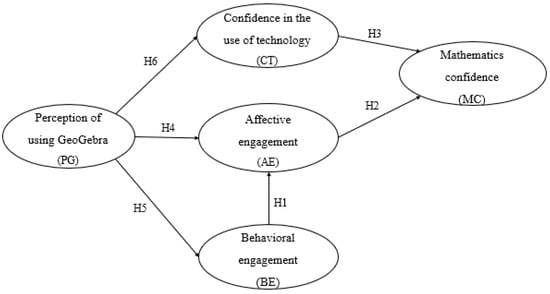
When intentionally integrated, technology creates opportunities for active engagement and learning-centered pedagogical practices [26], contributing to the development of creative and digital skills with a positive impact on student engagement [18]. The literature presented indicates a close relationship between participation behaviors and emotions associated with learning, which supports the formulation of the following research hypothesis:
Hypothesis 1.
Behavioral engagement positively influences the affective engagement of future teachers.
2.2. Confidence in Mathematics
Confidence in mathematics is often understood as a specific aspect of mathematical ability, being related to an individual’s perception of their own capacity to handle challenges in this domain [27]. According to Pierce et al. [28], this concept refers to students’ belief in their aptitude to achieve good results and overcome mathematical difficulties. This understanding is close to the concept of academic self-efficacy and is often used in the literature in a related or complementary way to describe students’ perceived competence in relation to mathematical tasks.
Several factors influence this perception, including students’ attitudes and their affective and behavioral engagement [29]. In this sense, greater involvement in learning mathematics can contribute to increased confidence and reduced mathematics anxiety [23], reinforcing the importance of promoting motivating and engaging learning experiences. In this study, confidence in mathematics is defined as the student’s belief that they have the ability to understand mathematical concepts, apply procedures, and overcome difficulties, regardless of prior experiences or the use of technology. This definition is close to the notion of self-efficacy in mathematics; however, the term “confidence” is adopted here to maintain consistency with the original scale used and with the reference literature [27,28]. Thus, based on empirical evidence that involvement favors confidence in mathematics, the following research hypothesis is formulated:
Hypothesis 2.
Affective engagement positively influences the confidence in mathematics of future teachers.
2.3. Confidence in the Use of Technology
The integration of technology in education should be approached critically and strategically. Cloete [30] argues that technology should not be seen merely as a tool, but as a means capable of shaping culture, thereby requiring careful and contextualized incorporation into the educational process. In line with this perspective, Duhaney and Zemel [26] emphasize that digital technologies, in addition to innovating classroom activities, foster greater interaction between teachers and students, enriching the educational environment and learning experience.
In this study, confidence in the use of technology is understood as the perception of self-efficacy in using digital tools, particularly GeoGebra, in exploring and solving mathematical problems, including the ability to learn new resources autonomously. Thus, the construct is conceptually close to technological self-efficacy and is operationalized through the perceived competence in using digital resources in an educational context.
In the context of mathematics, the presence of technology has become inevitable, assuming a central role in problem-solving and visualizing complex concepts [29]. However, students’ acceptance of technology depends heavily on their perception of its usefulness and convenience. As noted by Staddon [31], students tend to critically evaluate the purpose of a technology before adopting it, and it is crucial that teachers consider aspects such as competence, design, and pedagogical appropriation when planning its use in face-to-face or online environments.
The relationship between confidence in mathematics and confidence in technology has particular characteristics. Uniyal et al. [29] identified a link between these two types of confidence, although students, in general, feel more confident in the isolated use of technology than in its joint application with mathematics. These results suggest that developing confidence in the use of technology can be a facilitating factor in strengthening confidence in mathematics, especially if this use is intentionally geared towards mathematical reasoning. Thus, understanding how confidence in the use of technology can foster confidence in mathematics is fundamental to the development of effective pedagogical strategies that integrate digital technologies into teaching. Based on this evidence, the following hypothesis is formulated:
Hypothesis 3.
Confidence in the use of technology positively influences the confidence in mathematics of future teachers.
2.4. Perception of Technology Use
When used effectively, technology should not be treated as a mere accessory but as a pedagogical tool with the potential to transform teaching and learning. Its integration should aim to create collaborative and communicative environments, fostering interaction among students, as well as supporting the resolution of mathematical problems and conceptual development [32]. To this end, it is essential that such integration is guided by clear objectives and directly aligned with the curriculum, thereby enriching the educational experience [26].
In mathematics education, the intentional integration of technology has the capacity to transform traditional teaching models, bringing them closer to constructivist and student-centered approaches [33]. This integration has a positive effect on students’ mathematical performance [32] and contributes to increased confidence in mathematics and student engagement, decisive factors for better learning outcomes [28,34].
Students’ engagement with software and technological devices involves two distinct dimensions: a technical one, related to familiarity with and mastery of functions and commands, and an emotional and motivational one, encompassing confidence and interest in both mathematics and technology [35]. This distinction helps to understand students’ attitudes toward technology-mediated learning, as also suggested by García-Santillán et al. [11], when identifying variables such as mathematical confidence, technological confidence, motivation, and engagement as determinants of attitudes.
Despite the potential of technology, its full integration into the curriculum faces challenges, whether due to the perceptions of teachers and students [35], or due to contextual factors, such as family involvement, which can influence differences in student performance and well-being [36]. In contrast, technological environments have shown a positive impact on students’ attitudes, promoting greater interest and enjoyment of mathematics [37].
An example of widely recognized technology in mathematics education is GeoGebra, a software that integrates geometry, algebra, spreadsheets, graphs, statistics, and calculus into a single dynamic environment [38]. This resource facilitates the visualization and independent exploration of complex mathematical concepts, promoting active learning [39].
The literature highlights several positive impacts of using GeoGebra in mathematics education, including significant improvements in students’ performance and motivation [16,40], greater conceptual learning, and reduced reliance on memorization [41]. The meta-analysis conducted by Juandi et al. [42] confirmed that the use of GeoGebra has a greater impact on the development of students’ mathematical skills compared to learning based on traditional methods. Furthermore, students’ perception of this tool is generally positive, being associated with feelings of confidence, creativity, and enjoyment, which in turn reinforces both their engagement and their confidence not only in mathematics but also in technology [43,44].
Mathematics future teachers also recognize the educational value of GeoGebra, appreciating its potential to create dynamic, visually rich, and exploratory learning environments that foster conceptual understanding [45].
In the present study, the perception of technology use is defined as the prospective teachers’ subjective evaluation of the relevance, ease of use, and potential of GeoGebra to support the understanding of mathematical concepts, promote collaboration, and enhance engagement during Algebra and Functions classes. This perception is understood as a broad construct that integrates cognitive components (usefulness and support for learning), functional components (ease of use), and affective components (interest and enjoyment), reflecting students’ overall experience with the use of the software in an educational context. This definition, aligned with Ran et al. [32] and Tatar and Zengin [45], was operationalized through adapted items that capture the appreciation of GeoGebra as an educational resource.
Considering the evidence that the perception of technology use directly influences student engagement and confidence, the following research hypotheses are formulated, specifically focused on future teachers:
Hypothesis 4.
The perception of GeoGebra use positively influences the affective engagement of future teachers.
Hypothesis 5.
The perception of GeoGebra use positively influences the behavioral engagement of future teachers.
Hypothesis 6.
The perception of GeoGebra use positively influences future teachers’ confidence in using technology.
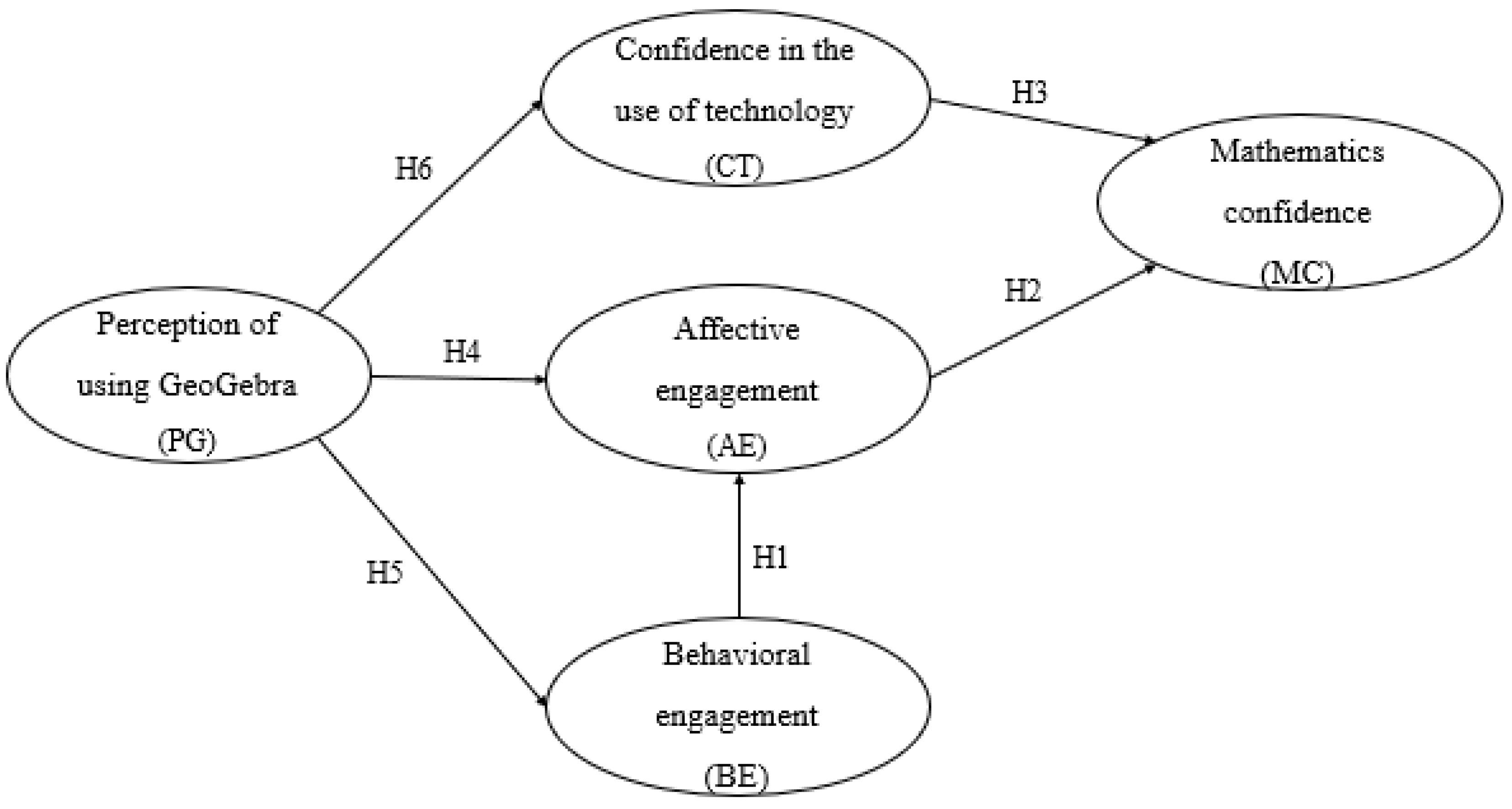
Based on the formulated hypotheses, the conceptual model presented in Figure 1 was developed.
Figure 1.
Conceptual model.
3. Materials and Methods
3.1. Population and Sample
The target population of this study consisted of 80 students from two classes of the Basic Education degree at the Polytechnic Institute of Leiria, who were enrolled in the curricular unit of Topics in Algebra and Functions. These students were in the first year of the program and, at this stage of their initial teacher education, had not yet chosen a subject specialization, as this decision is made only at the master’s level.
The sample included 54 students, future teachers, who completed the proposed tasks throughout the semester of the 2022/2023 academic year and who answered the applied questionnaire. It is important to note that the 80 students correspond to those enrolled in the course unit, and some level of dropout during the semester is common. Additionally, the questionnaire was administered at the end of the semester, when the topic of functions is taught, which coincided with the final class of the course unit. As participation was voluntary and not all students attended this final session, not all enrolled students took part in the study.
3.2. Data Collection Instruments
The present study is based on a questionnaire survey that examines mathematical confidence, confidence in the use of technology, affective engagement, behavioral engagement, perception of using GeoGebra [46] to learn functions, and several individual variables (age, number of hours per week dedicated to studying for the course unit, whether a graphic calculator was used in secondary school, and whether any software was used in mathematics lessons during secondary school).
The constructs of mathematical confidence (comprising 4 items), affective engagement (comprising 4 items), and behavioral engagement (comprising 4 items) were drawn from the Attitudes towards Mathematics and Technology scale developed by Pierce et al. [28]. The Confidence in the Use of Technology scale consists of 5 items adapted from the studies by Chalaune and Subedi [40], Pierce et al. [28], and Shadaan and Leong [24]. The Perception of Using GeoGebra to Learn Functions scale comprises 13 items, also adapted from the studies by Chalaune and Subedi [40], Pierce et al. [28], and Shadaan and Leong [24]. In total, the questionnaire covers 30 items measured on a five-point Likert agreement scale (1—“strongly disagree” to 5—“strongly agree”). A full description of all questionnaire items for each construct is provided in the Appendix A.
3.3. Procedures
This study is quantitative in nature and was conducted in three phases. In the first phase, specifically to study the topic of real functions of a real variable, the classes began with concepts about the generalities of functions, and for this, the traditional method was used: theoretical exposition of the subject matter, followed by solving tasks with feedback on the Moodle platform (version 3.11) using paper and pencil. Subsequently, in the second phase, the GeoGebra software was used to study linear and quadratic functions, and the students’ completed tasks with feedback provided via the Moodle platform, this time using the GeoGebra software. The use of GeoGebra Classic (web-based version) took place over three 90 min sessions, integrated into the development of the topic of real functions of a real variable. The proposed tasks were structured in nature and included graphical representation activities using sliders to explore the behavior of linear and quadratic functions, as well as tasks applied to real-life contexts. These activities were guided by worksheets that allowed students to follow defined steps while also encouraging autonomous exploration of the software’s functionalities. Some tasks were completed and submitted on the Moodle platform, with automatic and immediate feedback.
In both phases, 80 students from two classes took part, that is, 40 pairs of students. It should be noted that the composition of the groups remained the same from the beginning to the end of the study. The organization of work in pairs aimed to promote peer interaction, the discussion of strategies, and the joint exploration of the proposed tasks. During the activities, the teacher assumed a facilitator role, moving around the classroom and supporting the groups in solving the tasks and using GeoGebra whenever difficulties arose.
In the third phase, at the end of the semester in July 2023, the students were invited to complete a questionnaire created using Google Forms, with the link shared via the Moodle platform. Prior to completing the questionnaire, participants were informed of the study’s objectives, the anonymity and confidentiality of the information provided, and were assured that the information would be used solely for statistical purposes in the present study. Participation was voluntary and not associated with any assessment component, and the responses were provided individually. To reduce potential biases associated with self-reported data collection, anonymity was ensured and it was emphasized that participation would have no impact on students’ evaluation.
The database from Google Forms was downloaded to Microsoft Excel. Subsequently, descriptive, exploratory, and structural equation modelling analyses were performed using IBM SPSS Statistics 28 [47] and SMARTPLS 4 [48]. To characterize the students, descriptive statistics techniques were applied, namely frequency counts and selected descriptive measures. In addition, to assess the participants’ levels of agreement with the items in each construct, descriptive analysis was conducted using the mean and standard deviation.
The formulated hypotheses, which relate perceptions of GeoGebra use, engagement, confidence in technology use, and confidence in mathematics, have never been tested collectively and, therefore, fall within an exploratory context. For this reason, partial least squares structural equation modelling (PLS-SEM) was chosen, a variance-based method suitable for assessing the validity and behavior of latent constructs in new or complex models. PLS-SEM is also recommended when the sample size is relatively small and when the researcher seeks to maximize the explained variance in the endogenous variables [49].
In evaluating structural equation models using the PLS-SEM approach, it is essential to verify the quality of the measures before interpreting the structural model, ensuring that the constructs are reliable, valid, and distinct from one another [49,50]. Following the recommendations in the literature, the analysis included the assessment of indicator and construct reliability, convergent and discriminant validity, as well as the evaluation of collinearity among variables. These steps ensure that the results obtained from the structural analysis reflect robust and unbiased relationships between the constructs under study. According to Hair et al. [50], indicator reliability was assessed through factor loadings, which should ideally be above 0.708, indicating that the construct explains more than 50% of the indicator’s variance. As stated by the same authors, construct reliability was evaluated using Cronbach’s alpha and composite reliability (CR), with values above 0.7 considered acceptable. Regarding convergent validity, this was examined using the Average Variance Extracted (AVE), which should exceed 0.50, indicating that the construct explains more than 50% of the variance in its indicators.
The analysis of discriminant validity aims to verify whether each construct is empirically distinct from the others, and it is carried out based on the Fornell–Larcker criterion and the Heterotrait–Monotrait ratio (HTMT). The Fornell–Larcker criterion establishes that the square root of the AVE for each construct should be greater than its correlations with the other constructs, while HTMT values should be below 0.90 for conceptually similar constructs and below 0.85 for conceptually distinct constructs [49].
To evaluate the structural model, the coefficient of determination (R2) of the independent variables was calculated, and the bootstrapping technique with 5000 samples was applied to determine the t-statistics and the significance of the paths [49]. According to Cohen [51]), in the field of social and behavioral sciences, the coefficient of determination is classified as follows: 2% small effect, 13% medium effect, and 26% large effect. To avoid collinearity issues, VIF (Variance Inflation Factor) values should preferably be below 3 [50].
Additionally, the effect size (f2) of each exogenous construct on the endogenous constructs was analyzed, allowing for the assessment of the individual contribution of each relationship within the structural model. According to Cohen [51], f2 values of 0.02, 0.15, and 0.35 indicate weak, moderate, and strong effects, respectively.
4. Results and Discussion
4.1. Characterization of the Participants
The sample consisted of 54 students aged between 18 and 29 years, with a mean age of approximately 21 years (SD = 2.08). On average, participants reported studying around 3 h per week for the course unit (SD = 2.19). Regarding prior experience with technology, most students (n = 38, 70.4%) stated that they had used a graphing calculator in secondary school, while only 14.8% (n = 8) reported having used software in mathematics classes at that level. Although the questionnaire included these sociodemographic and academic variables, they were not incorporated into the structural model as control variables. In preliminary exploratory analyses, no statistically significant differences were observed in the main study variables as a function of these factors. Therefore, the analysis focused on the relationships between the proposed theoretical constructs, prioritizing model parsimony, given the exploratory nature of the study and the relatively small sample size.
4.2. Measurement Model Evaluation
In Table 1, it can be observed that the individual reliability of the indicators is considered adequate, as the factor loadings of the retained items are statistically significant (p < 0.001) and exceed 0.708 [50], with the lowest value being 0.793 (item CT5). Regarding construct reliability, both Cronbach’s alpha and Composite Reliability (CR) values are above 0.7, which, according to Hair et al. [50], is considered satisfactory. Concerning convergent validity, the Average Variance Extracted (AVE) values are above 0.5, as recommended by Hair et al. [49]. These results indicate that a substantial portion of the variance of the indicators is explained by the latent constructs.
Table 1.
Estimation of the Measurement Model Parameters.
According to the Fornell-Larcker criterion, all values of the square root of the AVE (values in bold in Table 2) are greater than the correlations between the constructs [49], indicating that the evaluated constructs are distinct concepts and are adequately represented in the measurement model. The HTMT matrix revealed high values between affective engagement and behavioral engagement (0.952), exceeding the recommended threshold of 0.90 [49,52], which constitutes an indicator of a strong association between these dimensions. This result suggests a marked conceptual proximity between affective and behavioral engagement, which is consistent with the literature that conceptualizes engagement as a multidimensional construct whose dimensions are strongly interrelated. This overlap can be explained by the conceptual proximity between the affective and behavioral dimensions of engagement, which are often treated as interdependent facets of the same construct in educational studies [21], reflected in the high correlation between the indicators of both. Even so, the two dimensions were retained as distinct constructs in the model, as they represent theoretically differentiated components of engagement and have often been analyzed separately in the literature. Moreover, the dimensions showed different patterns of relationships with the remaining constructs in the structural model, supporting their analytical usefulness as conceptually related, but not redundant, variables.
Table 2.
Discriminant validity.
4.3. Structural Model Assessment
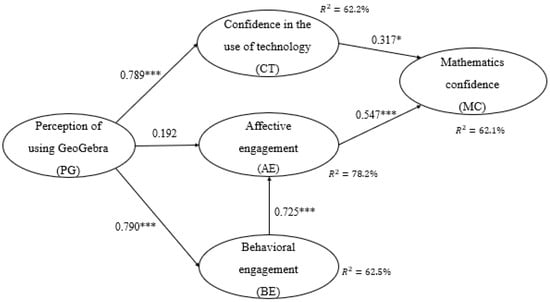
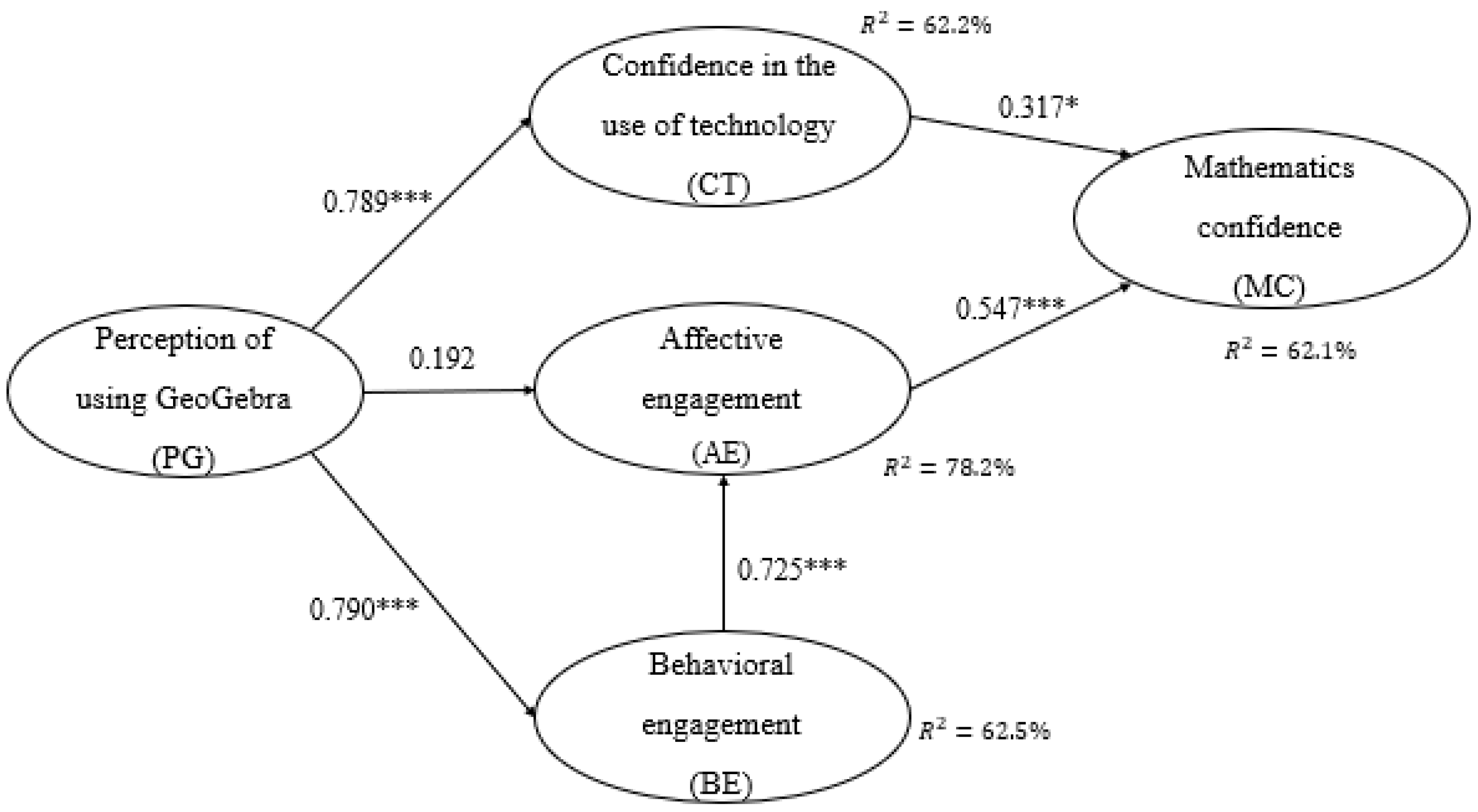
The structural model represented in Figure 2 showed coefficient of determination values of 0.621 for the construct of confidence in mathematics, 0.622 for confidence in the use of technology, 0.625 for behavioral involvement, and 0.782 for affective involvement, indicating a substantial level of explanation according to Cohen [51]. Thus, the model presents explanatory values that can be considered high for the endogenous constructs analyzed.
Figure 2.
Estimation of the structural model parameters. Note: *** p < 0.001, * p < 0.05.
The magnitude of the individual effects was also assessed through the f2 effect size. The results indicate very large effects in the relationships PG → BE (f2 = 1.664) and PG → CT (f2 = 1.646), as well as a large effect in the relationship BE → AE (f2 = 0.903). A moderate effect was observed in the relationship AE → MC (f2 = 0.464), a smaller effect in CT → MC (f2 = 0.156), and a weak effect in PG → AE (f2 = 0.063), according to Cohen’s [51] criteria.
The 95% bootstrap confidence intervals were also analysed to assess the precision of the path coefficient estimates. It was found that, for the statistically significant relationships, the intervals do not include zero, reinforcing the robustness of the results. In contrast, for the PG → EA relationship, the interval includes zero, confirming the lack of sufficient statistical evidence to support this hypothesis.
In Table 3, the analysis of VIF values showed that they are below 3, as recommended by Hair et al. [50], indicating no collinearity issues. Regarding the hypotheses, behavioral engagement is positively associated with the affective engagement of future teachers (β = 0.725, 95% CI [0.481, 0.904], t = 6.727, p < 0.001), providing empirical support for Hypothesis 1. This finding is consistent with previous studies highlighting the interrelationship between the affective and behavioral dimensions of engagement, suggesting that positive emotions foster greater participation and that sustained participation reinforces emotions associated with learning [22].
Table 3.
Structural model analysis results.
The results provide sufficient statistical evidence to support Hypothesis 2, that is, affective engagement is positively associated with future teachers’ confidence in mathematics (β = 0.547, 95% CI [0.289, 0.804], t = 4.168, p < 0.001). This result is consistent with previous studies that highlight the importance of positive emotions and emotional engagement in mathematics confidence [29]. Indeed, higher affective engagement has been associated with increased confidence and reduced mathematics anxiety [23], suggesting the relevance of learning environments that promote motivating and emotionally positive experiences to the development of students’ confidence in mathematics.
Confidence in the use of technology is positively associated with confidence in mathematics (β = 0.317, 95% CI [0.064, 0.553], t = 2.517, p < 0.05), providing support for Hypothesis 3. This finding corroborates evidence reported by authors who identified a relationship between these two types of confidence [29].
The results do not provide sufficient statistical evidence to support Hypothesis 4; that is, no statistically significant association was observed between the perceived use of GeoGebra and the affective engagement of future teachers (β = 0.192, 95% CI [−0.007, 0.440], t = 1.685, p > 0.05). This result contrasts with previous studies highlighting the positive impact of technological environments on students’ attitudes and emotions, fostering greater interest and enjoyment in mathematics [37]. A possible explanation may lie in the fact that affective engagement could be more dependent on prolonged and diverse experiences with technology, which may not manifest immediately in an experimental usage context.
Perceived use of GeoGebra software is positively associated with behavioral engagement (β = 0.789, 95% CI [0.648, 0.898], t = 12.186, p < 0.001), providing support for Hypothesis 5. This finding is consistent with the literature indicating that the effective integration of technology in mathematics teaching can transform the traditional classroom model, making it more interactive and student-centered [33], as well as promoting active learning and autonomy in the exploration of concepts [39].
Finally, the results provide sufficient statistical evidence to support Hypothesis 6, that is, there is sufficient statistical evidence to state that perceived use of the GeoGebra software is positively associated with future teachers’ confidence in the use of technology (β = 0.789, 95% CI [0.652, 0.894], t = 12.540, p < 0.001). This finding is consistent with previous studies linking the use of digital tools in mathematics teaching to increased technological confidence [43,44].
5. Conclusions
The present study seeks to highlight the importance of integrating technological tools into the teaching and learning process in a critical and well-founded manner. The results suggest that the integration of technological tools may be associated with higher levels of students’ emotional and behavioral engagement, as well as higher levels of confidence in mathematics and in the use of digital technologies.
The empirical results provide support for the hypothesis that behavioral engagement is positively associated with affective engagement, reinforcing the idea that active and continuous participation in learning activities may be related to the development of positive attitudes toward mathematics. It was also found that confidence in mathematics is positively associated with confidence in the use of technology, indicating that learning environments that integrate digital tools may contribute to the development of students’ self-confidence in both domains.
Despite some findings, such as the absence of a statistically significant relationship between perceived use of GeoGebra and affective engagement, the study highlights the importance of reflecting on the design and implementation of pedagogical strategies that can promote positive and diversified experiences with digital technologies. The results of the structural model suggest that factors such as affective engagement, behavioral engagement, and confidence are associated, and may play a relevant role in the preparation of future teachers who are more confident and better equipped to use technological resources.
In summary, the study contributes to understanding how perceptions and the use of technologies, particularly GeoGebra, may be associated with the engagement and confidence of future mathematics teachers. These conclusions suggest the importance of integrating pedagogical experiences with digital technologies in initial teacher education, creating opportunities for future teachers to simultaneously develop engagement, confidence, and familiarity with tools such as GeoGebra, thereby contributing to more motivating and meaningful mathematics teaching practices in training contexts.
One limitation of the study is the relatively small sample size, composed of 54 students from a bachelor’s degree in Basic Education at a polytechnic institution, which limits the generalizability of the results to other courses or educational contexts. Additionally, the use of self-report data and cross-sectional design recommends caution in interpreting the results, particularly regarding possible causal relationships. The focus on learning real functions of a real variable and the combination of traditional methods with the use of GeoGebra may also have influenced the observed effects.
Future research may explore different contexts, educational content, and intervention durations to deepen the understanding of the influence of GeoGebra on the engagement and confidence of future teachers. Studies with larger and more diverse samples may also include sociodemographic and academic variables as control variables, allowing for a more detailed analysis of the possible impact of these factors on the relationships between the constructs studied. In this sense, the results presented offer relevant insights into the design of training experiences in initial teacher education programs, particularly regarding the pedagogical integration of digital technologies in mathematics teaching.
Author Contributions
Conceptualization, E.M.S. and M.F.O.; methodology, E.M.S. and M.F.O.; software, E.M.S.; validation, E.M.S. and M.F.O.; formal analysis, E.M.S. and M.F.O.; investigation, E.M.S. and M.F.O.; resources, E.M.S. and M.F.O.; data curation, E.M.S. and M.F.O.; writing—original draft preparation, E.M.S. and M.F.O.; writing—review and editing, E.M.S. and M.F.O.; visualization, E.M.S. and M.F.O.; supervision, E.M.S. and M.F.O. All authors have read and agreed to the published version of the manuscript.
Funding
This research received no external funding.
Institutional Review Board Statement
Ethical review and approval were waived for this study involving higher education students, in accordance with local legislation and institutional requirements, as the study was conducted within a curricular unit of the Bachelor’s degree in Basic Education at the Polytechnic Institute of Leiria and consisted of a pedagogical activity integrated into the regular teaching and learning process. The study did not involve the collection of sensitive data. All participants were informed about the objectives of the study, the voluntary nature of their participation, as well as the anonymity and confidentiality of the data collected, which were used exclusively for statistical and scientific purposes. The study was conducted in accordance with the Declaration of Helsinki.
Informed Consent Statement
Informed consent was obtained from all subjects involved in the study.
Data Availability Statement
Data available on request.
Conflicts of Interest
The authors declare no conflicts of interest.
Appendix A
Table A1.
Questionnaire dimensions and items.
References
- Rybak, A. Effectiveness of teaching and learning in technology-supported mathematics education. J. Phys. Conf. Ser. 2021, 1946, 012004. [Google Scholar] [CrossRef] [Scilit]
- Nobre, C.N.; Meireles, M.R.G.; Vieira, N., Jr.; de Resende, M.N.; da Costa, L.E.; da Rocha, R.C. The use of GeoGebra software as a calculus teaching and learning tool. Inform. Educ. 2016, 15, 253–267. [Google Scholar] [CrossRef] [Scilit]
- Liguori, E.; Winkler, C. From offline to online: Challenges and opportunities for entrepreneurship education following the COVID-19 pandemic. Entrep. Educ. Pedagog. 2020, 3, 346–351. [Google Scholar] [CrossRef] [Scilit]
- Serrano, P.H.S.M.; Beltrão, A.E.; Dantas, A.R.S. Usabilidade e Design Instrucional no Ensino Remoto Emergencial com o Moodle. Cad. Educ. Tecnol. Soc. 2022, 15, 28–33. [Google Scholar] [CrossRef] [Scilit]
- Zulnaidi, H.; Oktavika, E.; Hidayat, R. Effect of use of GeoGebra on achievement of high school mathematics students. Educ. Inf. Technol. 2020, 25, 51–72. [Google Scholar] [CrossRef] [Scilit]
- Kamal, N.M.; Maat, S.M. Keberkesanan Penggunaan Perisian GeoGebra dalam Pembelajaran Fungsi dan Graf Terhadap Pencapaian Pelajar Matrikulasi Jurusan Perakaunan. Malays. J. Soc. Sci. Humanit. 2021, 6, 294–309. [Google Scholar] [CrossRef] [Scilit]
- Yohannes, A.; Chen, H.L. GeoGebra in mathematics education: A systematic review of journal articles published from 2010 to 2020. Interact. Learn. Environ. 2021, 31, 5682–5697. [Google Scholar] [CrossRef] [Scilit]
- Duque, R.L. Reconceptualized perspective of mathematics: Effects on students’ mathematics achievement and learning experiences. Int. J. Sci. Math. Technol. Learn. 2025, 32, 213. [Google Scholar] [CrossRef] [Scilit]
- Mweni, N.T.; O’Connor, M.M.; Kerich, W. Effects of Student Confidence on Achievement in Mathematics among Secondary School Students in Ganze District Kilifi County Kenya. Int. J. Res. Innov. Soc. Sci. 2023, 7, 1009–1016. [Google Scholar] [CrossRef] [Scilit]
- Barkatsas, A.T.; Kasimatis, K.; Gialamas, V. Learning secondary mathematics with technology: Exploring the complex interrelationship between students’ attitudes, engagement, gender and achievement. Comput. Educ. 2009, 52, 562–570. [Google Scholar] [CrossRef] [Scilit]
- García-Santillán, A.; Escalera-Chávez, M.; Cordova Rangel, A.; Lopez-Morales, J. Attitude and behavioral among students, computers and mathematics:(A case study in public university). Br. J. Educ. 2013, 1, 14–32. [Google Scholar]
- Sui, C.-J.; Yen, M.-H.; Chang, C.-Y. Investigating effects of perceived technology-enhanced environment on self-regulated learning: Beyond p-values. Educ. Inf. Technol. 2024, 29, 161–183. [Google Scholar] [CrossRef] [Scilit]
- Ubaidillah, N.Z.; Baharuddin, N.N.; Kasil, N.; Ismail, F. Students’ perception of the use of technology in education. Environ.-Behav. Proc. J. 2020, 5, 117–122. [Google Scholar] [CrossRef] [Scilit]
- Santos, E.; Oliveira, M.F. Data analysis on decision-making. In Reference Module in Social Sciences; Elsevier: Amsterdam, The Netherlands, 2024. [Google Scholar] [CrossRef] [Scilit]
- Övez, F.T.D. The impact of instructing quadratic functions with the use of GeoGebra software on students’ achievement and level of reaching acquisitions. Int. Educ. Stud. 2018, 11, 1–11. [Google Scholar] [CrossRef] [Scilit]
- Mushipe, M.; Ogbonnaya, U.I. GeoGebra and Grade 9 learners’ achievement in linear functions. Int. J. Interact. Mob. Technol. 2019, 14, 206–219. [Google Scholar] [CrossRef] [Scilit]
- Abate, A.; Atnafu, M.; Michael, K. Visualization and problem-based learning approaches and students’ attitude toward learning mathematics. Pedagog. Res. 2022, 7, em0119. [Google Scholar] [CrossRef] [Scilit]
- Bergdahl, N.; Nouri, J.; Fors, U. Disengagement, engagement and digital skills in technology-enhanced learning. Educ. Inf. Technol. 2020, 25, 957–983. [Google Scholar] [CrossRef] [Scilit]
- Al-Hendawi, M. Academic engagement of students with emotional and behavioral disorders: Existing research, issues, and future directions. Emot. Behav. Difficulties 2012, 17, 125–141. [Google Scholar] [CrossRef] [Scilit]
- Papageorgiou, E.; Wong, J.; Liu, Q.; Khalil, M.; Cabo, A.J. A systematic review on student engagement in undergraduate mathematics: Conceptualization, measurement, and learning outcomes. Educ. Psychol. Rev. 2025, 37, 66. [Google Scholar] [CrossRef] [Scilit]
- Fredricks, J.A.; Blumenfeld, P.C.; Paris, A.H. School engagement: Potential of the concept, state of the evidence. Rev. Educ. Res. 2004, 74, 59–109. [Google Scholar] [CrossRef] [Scilit]
- Li, Y.; Lerner, R.M. Interrelations of behavioral, emotional, and cognitive school engagement in high school students. J. Youth Adolesc. 2013, 42, 20–32. [Google Scholar] [CrossRef] [Scilit]
- Everingham, Y.L.; Gyuris, E.; Connolly, S.R. Enhancing student engagement to positively impact mathematics anxiety, confidence and achievement for interdisciplinary science subjects. Int. J. Math. Educ. Sci. Technol. 2017, 48, 1153–1165. [Google Scholar] [CrossRef] [Scilit]
- Shadaan, P.; Leong, K.E. Effectiveness of Using GeoGebra on Students’ Understanding in Learning Circles. Malays. Online J. Educ. Technol. 2013, 1, 4. [Google Scholar]
- Pritchard, A. Ways of Learning: Learning Theories for the Classroom; Routledge: Abingdon, UK, 2017. [Google Scholar] [CrossRef] [Scilit]
- Duhaney, D.C.; Zemel, P.C. Technology and the educational process: Transforming classroom activities. Int. J. Instr. Media 2000, 27, 67–72. [Google Scholar]
- Marley-Payne, J.; Dituri, P.; Davidson, A. Financial education, mathematical confidence, and financial behavior. J. Financ. Couns. Plan. 2022, 33, 194–204. [Google Scholar] [CrossRef] [Scilit]
- Pierce, R.; Stacey, K.; Barkatsas, A. A scale for monitoring students’ attitudes to learning mathematics with technology. Comput. Educ. 2007, 48, 285–300. [Google Scholar] [CrossRef] [Scilit]
- Uniyal, A.; Bahuguna, B.; Gupta, O. Behaviour of university students towards the integration of mathematics with technology: An empirical analysis. AIP Conf. Proc. 2022, 2481, 050013. [Google Scholar] [CrossRef] [Scilit]
- Cloete, A.L. Technology and education: Challenges and opportunities. HTS Theol. Stud. 2017, 73, 7. [Google Scholar] [CrossRef] [Scilit]
- Staddon, R.V. Exploring higher education students’ perspectives on factors affecting use, attitudes and confidence with learning technologies. Int. J. Instr. 2023, 16, 31–52. [Google Scholar] [CrossRef] [Scilit]
- Ran, H.; Kim, N.; Secada, W. A meta-analysis on the effects of technology’s functions and roles on students’ mathematics achievement in K-12 classrooms. J. Comput. Assist. Learn. 2021, 38, 258–284. [Google Scholar] [CrossRef] [Scilit]
- Ben-Av, M.; Gurevich, I. Students’ perception of the mathematical classroom when integrating digital technologies. In EDU-LEARN18 Proceedings; IATED: Valencia, Spain, 2018; p. 0894. [Google Scholar] [CrossRef] [Scilit]
- García-Santillán, A.; Escalera-Chávez, M.E.; Rojas-Kramer, C.A.; Moreno-García, E.; Pozos-Texon, F. Technology-Assisted Undergraduate Mathematics Learning; Universidad Cristóbal Colón: Veracruz, México, 2015. [Google Scholar]
- Galbraith, P. Students, mathematics, and technology: Assessing the present–challenging the future. Int. J. Math. Educ. Sci. Technol. 2006, 37, 277–290. [Google Scholar] [CrossRef] [Scilit]
- Martinez-Yarza, N.; Solabarrieta-Eizaguirre, J.; Santibáñez-Gruber, R. The impact of family involvement on students’ social-emotional development: The mediational role of school engagement. Eur. J. Psychol. Educ. 2024, 39, 4297–4327. [Google Scholar] [CrossRef] [Scilit]
- Romero-Albaladejo, I.M.; García-López, M.D.M. Mathematical attitudes transformation when introducing GeoGebra in the secondary classroom. Educ. Inf. Technol. 2024, 29, 10277–10302. [Google Scholar] [CrossRef] [Scilit]
- GeoGebra. What is GeoGebra? 2024. Available online: https://www.geogebra.org/about (accessed on 2 September 2024).
- Charles-Ogan, G.; Ibibo, G. GeoGebra: A Technological Soft Ware for Teaching and Learning of Calculus in Nigerian Schools. Am. J. Appl. Math. Stat. 2018, 6, 115–120. [Google Scholar] [CrossRef]
- Chalaune, B.B.; Subedi, A. Effectiveness of GeoGebra in teaching school mathematics. Contemp. Res. Interdiscip. Acad. J. 2020, 4, 46–58. [Google Scholar] [CrossRef] [Scilit]
- Zulnaidi, H.; Zakaria, E. The effect of using GeoGebra on conceptual and procedural knowledge of high school mathematics students. Asian Soc. Sci. 2012, 8, 102–106. [Google Scholar] [CrossRef] [Scilit]
- Juandi, D.; Kusumah, Y.S.; Tamur, M.; Perbowo, K.S.; Wijaya, T.T. A meta-analysis of GeoGebra software decade of assisted mathematics learning: What to learn and where to go? Heliyon 2021, 7, e06953. [Google Scholar] [CrossRef] [Scilit] [PubMed]
- Joshi, D.R.; Singh, K.B. Effect of using GeoGebra on eight grade students’ understanding in learning linear equations. Math. Teach. Res. J. 2020, 12, 76–83. [Google Scholar] [CrossRef] [Scilit]
- Dahal, N.; Shrestha, D.; Pant, B.P. Integration of GeoGebra in teaching and learning geometric transformation. J. Math. Stat. Sci. 2019, 5, 323–332. [Google Scholar] [CrossRef] [Scilit]
- Tatar, E.; Zengin, Y. Conceptual understanding of definite integral with GeoGebra. Comput. Sch. 2016, 33, 120–132. [Google Scholar] [CrossRef] [Scilit]
- GeoGebra Classic (online). Available online: https://www.geogebra.org/classic (accessed on 20 March 2023).
- IBM Corp. IBM SPSS Statistics for Windows, Version 29.0; IBM Corp.: Armonk, NY, USA, 2023. Available online: https://www.ibm.com/spss (accessed on 2 September 2024).
- SmartPLS GmbH. SmartPLS, Version 4.0; SmartPLS GmbH: Monheim am Rhein, Germany, 2023. Available online: https://www.smartpls.com (accessed on 2 September 2024).
- Hair, J.F.; Hult, G.T.M.; Ringle, C.M.; Sarstedt, M. A Primer on Partial Least Squares Structural Equation Modeling (PLS-SEM), 3rd ed.; SAGE Publications: Thousand Oaks, CA, USA, 2022. [Google Scholar]
- Hair, J.F.; Risher, J.J.; Sarstedt, M.; Ringle, C.M. When to use and how to report the results of PLS-SEM. Eur. Bus. Rev. 2019, 31, 2–24. [Google Scholar] [CrossRef] [Scilit]
- Cohen, J. Statistical Power Analysis for the Behavioral Sciences, 2nd ed.; Lawrence Erlbaum Associates: Hillsdale, NJ, USA, 1988. [Google Scholar]
- Henseler, J.; Ringle, C.M.; Sarstedt, M. A new criterion for assessing discriminant validity in variance-based structural equation modeling. J. Acad. Mark. Sci. 2015, 43, 115–135. [Google Scholar] [CrossRef] [Scilit]

Disclaimer/Publisher’s Note: The statements, opinions and data contained in all publications are solely those of the individual author(s) and contributor(s) and not of MDPI and/or the editor(s). MDPI and/or the editor(s) disclaim responsibility for any injury to people or property resulting from any ideas, methods, instructions or products referred to in the content. |
© 2026 by the authors. Licensee MDPI, Basel, Switzerland. This article is an open access article distributed under the terms and conditions of the Creative Commons Attribution (CC BY) license.